Western Kentucky’s LGBTQ+ Crisis: The Most Harm, the Least Protection Queer Kentucky's survey data reveals a region where nearly every measure of harm is at its worst, and state law still leaves trans Kentuckians out entirely.


LGBTQ+ people living in western Kentucky are experiencing a substantially more dangerous environment than anywhere else in the state, reporting being physically attacked at nearly twice the statewide rate. For trans folks, it goes even further: Kentucky’s hate crime statute has no name for what happens to them when they are attacked. A trans Kentuckian can be assaulted for being trans, and the state may prosecute the harm, but not the reason it was done.
Across the Queer Kentucky survey, western Kentucky ranks first or near first on nearly every measure of harm: LGBTQ+ residents with no health care provider, never tested for HIV, refused care by a provider, physical assault, suicidal ideation, drug use, smoking, feeling unsafe at home and deciding to move away. This is a region where nearly every measure of harm, access and community is at risk. And state policy and protections have failed them time and time again.
29.2% of queer residents in western Kentucky reported at least one instance of physical assault, which they attributed to the overarching anti-LGBTQ+ climate in the state. Overall, the statewide rate of physical assault stands at 15.2%.
54.5% of queer individuals report feeling physically unsafe at home, and 52.2% report feeling unsafe in public. Both are the highest of any region.
But it doesn’t stop at physical assault. In most of western Kentucky, a person who discriminates against and refuses an LGBTQ+ person a job, an apartment or service at a counter faces no legal consequences in doing so.
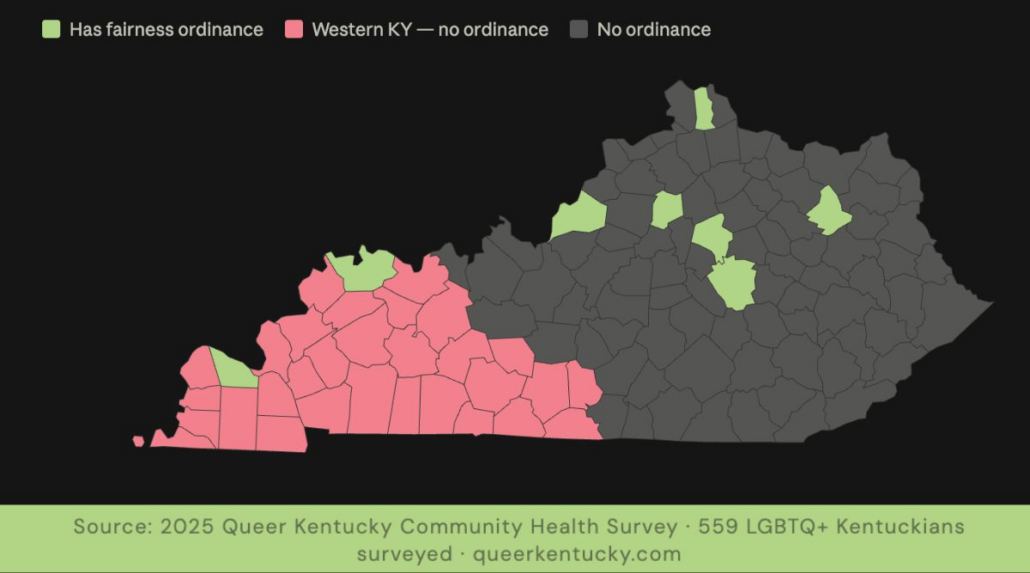
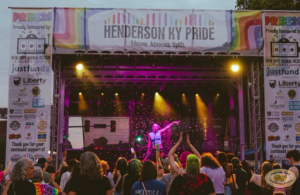
Across all of Kentucky, 24 communities have local Fairness Ordinances — including western Kentucky’s Paducah in 2018 and Henderson in 2019 — but that’s two of the 24, and they sit 130 miles apart. In between and beyond them, Owensboro, Bowling Green, Hopkinsville, Madisonville, Murray and Mayfield have no local fairness ordinances. On a map of who Kentucky has agreed to protect, most of western Kentucky isn’t on it.
What about larger state protections in Kentucky? It turns out that the state of Kentucky does have a hate crime law that protects sexual orientation. But it’s still reliant on individual judgment, and it still doesn’t protect trans people.
KRS 532.031, passed in 1998, applies when someone commits offenses because of a person’s race, color, religion, sexual orientation or national origin. In 2017, the legislature amended the statute to add a category, extending it to victims targeted for their actual or perceived employment as a peace officer, firefighter or emergency medical services worker.
Gender identity is not on the list.
Nine years ago, when the state legislature reopened the statute to add police and first responders, it still left trans Kentuckians out. For example, if a gay man is assaulted in Paducah, it can legally qualify as a hate crime. But if a trans woman is assaulted on the same block, both the state and law enforcement officers can choose to do nothing. The statute, by not including gender identity, allows law enforcement to turn a blind eye and delegitimize incidents against trans people.
This story exists because of readers like you. Give $5 a month to keep Queer Kentucky free.
Even within the bounds of discrimination against sexual orientation, this hate crime law does “protect,” the statute has no teeth and the law still does far less than what it implies. It might look and sound substantial, but functions as a performative exercise in the court system. As a result, there are many opportunities to create distance between the assault and any consequence for it. For instance, a judge decides at sentencing whether bias was a primary factor. A finding of bias permits denying probation instead of requiring it. The parole board may delay or deny parole.
It’s subject to discretion and personal biases that could creep in all the way down.
The laws already on the books are only part of it. Kentucky’s 2026 General Assembly may not have passed any anti-LGBTQ+ bills, but the climate in western Kentucky still hasn’t improved.
A bill doesn’t have to pass to embolden violence in its communities. Another factor behind why the climate in Western Kentucky still hasn’t improved. A bill only has to be filed, assigned, debated and covered on the local news, which are all separate moments of exposing a Kentuckian to hear whether or not their queer neighbor has the same rights as they do.
For example, Senate Bill 72 would have let health care providers refuse any treatment that violated their conscience. House Bill 468, pitched as a routine civil rights update, would have stripped the enforcement power from the Kentucky Commission on Human Rights and the 22 local commissions that actually enforce fairness ordinances. Both cleared their chamber of origin before stalling.
If House Bill 468 had passed, it would have taken away the only fairness ordinance protections two cities in Western Kentucky have.
And people are responding the only way the law leaves open to them: they blend in, censor their identity and opinions, or leave the state altogether.
According to the same survey, 18.5% of LGBTQ+ individuals living in Western Kentucky have decided to move out of state due to anti-LGBTQ+ policies; statewide, only 8.1% decide to leave. The compounding burden of assault, health care gaps, housing stress, and drug use appears to translate into a concrete intention to leave. One respondent wrote:
“Currently planning to move out of [the] states to a blue state. I have a lot of trans friends that I am scared for. I want them to go somewhere more blue, more safe, more open minded.”
In the face of so much hardship, western Kentucky remains home to LGBTQ+ advocates who keep showing up anyway. In May 2019, 55 residents in Bowling Green spoke in favor of a Fairness Ordinance, while 31 spoke against it. The commission voted it down 3-2. Advocates put it back on the agenda and have continued pushing for it. When a Fairness Ordinance was voted on in January 2018 in Paducah, residents flooded the city commission meeting, forcing the fire marshal to move the overflow into the adjacent hall to listen through open doors. That ordinance passed 4-1.
The people of western Kentucky continue to fight for the safety of their LGBTQ+ neighbors. But with so few fairness ordinances and statewide protections that stop short of covering them, many LGBTQ+ western Kentuckians remain at risk.
If you or someone you know is struggling, call or text the 988 Suicide & Crisis Lifeline at 988. LGBTQ+ young people can press 3 to reach counselors trained in LGBTQ+ care, an option that returned on Sept. 30, 2026 after it was cut in July 2025. The Trevor Project also offers 24/7 support at 1-866-488-7386 or by texting START to 678-678.
Keep reading
 S.G. Goodman Brings Her Kentucky Tour Home This Week
 Lexington Herald-Leader Layoffs Put Kentucky Local News at Risk
 From Appalachia to Western Kentucky, Drag Artists Are Building Queer Community Across the Commonwealth
 No Doctor, No Test, Refused at the Door: What the Data Shows About LGBTQ+ Health Care in Western Kentucky
 Henderson KY Pride Fires Back at Calls to End Pride