KEEP. Region. One or more per story. Paducah, Henderson, Owensboro, Hopkinsville, Murray, the Purchase and Pennyrile.

Tag Archive for: Region: Western Kentucky

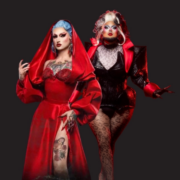
Henderson KY Pride's Haunted Haus of Drag guests Aurora Gozmic, left, and Sinema LaRue in red and black looks.

‘They Can’t Legislate Community’: Henderson KY Pride’s Haunted Haus of Drag Returns Oct. 23

Henderson KY Pride is hosting its annual Halloween drag fundraiser, Haunted Haus of Drag, at the Preston Arts Center on Friday, October 23, under the theme, “Haunted Runway.”

This year’s theme combines “drag performance with horror couture” and will feature special guest Aurora Gozmic, a Chicago-based drag artist and competitor on Season 6 of The Boulet Brothers’ Dragula.

Other guests include Sinema Larue, the “Desert Diva Bearded Queen 26” from Houston, Texas, and the event will be emceed by Louisville entertainer Leah Halston, known as “The Chocolate Thunder” and host of the Play Mates and Play Louisville.

Henderson KY Pride has hosted a Halloween-themed fundraiser since its launch in 2024, which at its core is focused on creating a community for LGBTQ+ people.

“Sometimes that could be the only thing we have to fall back on,” Cooper Beck, founder and executive director of Henderson KY Pride, tells Queer Kentucky. “The government can legislate us all they want, but they can’t legislate community and how we stick together and the joy that comes from community.”

Beck adds, “That’s something that is almost impossible to take away.”

The small nonprofit’s first-ever event in the summer of 2024 drew a larger-than-expected crowd, according to Beck.

The 21-year-old came up with the idea for Henderson KY Pride for a class project during his freshman year at Bellarmine University. He decided that he wanted to host a small LGBTQ+ visibility event in Henderson, which he advertised on Facebook and organized with the help of some volunteers.

“It went kind of hometown viral,” Beck says.

There was so much interest in the Facebook event that Beck decided to change it to a “mini pride” that would be held in a parking lot next to the town’s Chloe Randall Organization. To Beck’s surprise, 400 people showed up to the event.

“There was a clear hunger and need for visibility and community,” he says.

The inaugural event’s high turnout inspired Beck and the volunteers to host another event in order to meet that need for visibility, community, and connection.

Beck and his co-organizers decided to host a Halloween-themed event that October to do “something new to the community” and, again, were surprised by its popularity.

“We didn’t really know what to expect with it. It was kind of like taking a shot in the dark,” Beck says. “But we sold out.”

More than 200 people showed up to the organization’s inaugural Halloween fundraiser, and it “instantly” became one of its most sought-after events of the year, he adds. Turnout at this year’s event is expected to be high.

Haunted Haus of Drag attendees are encouraged to dress up in costume, and there will be a Haunted Runway costume contest with prizes. The event, formerly called ‘Dragula,’ is only for adults 18 years of age and older since the production will include adult themes and content, strong language, loud music, flashing lights, and theatrical effects.

General Admission tickets are $25. Henderson KY Pride Circle members receive $10 off General Admission, bringing the member price to $15. A limited number of VIP tables have also been available, featuring reserved seating for eight guests, early admission, drink tickets, and a private VIP performance by Aurora Gozmic.

A cash bar will be available throughout the evening in partnership with Beverage Barn. Alcohol service is restricted to guests 21 and older with a valid physical ID.

All proceeds from Haunted Haus of Drag benefit Henderson KY Pride and support the nonprofit’s year-round LGBTQ+ programming, advocacy, community events, and resources.

Find out more information here.
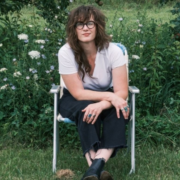
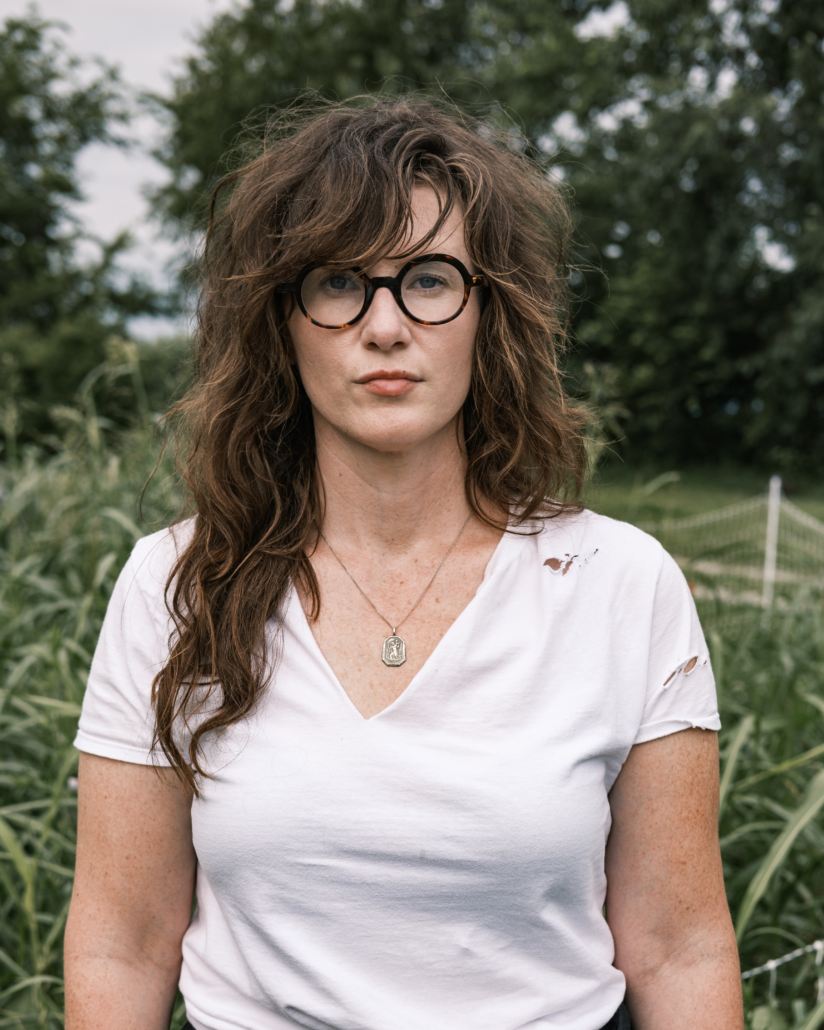
S.G. Goodman sits in a folding lawn chair in a field of wildflowers, wearing a white T-shirt, black wide-leg jeans and black boots.

S.G. Goodman Brings Her Kentucky Tour Home This Week

Singer-songwriter S.G. Goodman is coming to town. The Hickman, Kentucky, native is making two stops in the Commonwealth this week. She’s appearing at the Bourbon & Beyond festival this Thursday, Sept. 24, at the Highland Festival Grounds at the Kentucky Exposition Center before making her way north to Newport to play the Southgate House Revival on Friday, Sept. 25.

Goodman’s current tour spans the South, a sure nod to her commitment to place-making, honoring of home, and love of the spaces that made her. Her third solo album, Planting by the Signs, was released in 2025 and pays homage both to the sound of folk tradition and to Appalachia’s movements through life as guided by the moon and stars.

The Southgate House Revival (SGHR) show takes place in the stunning Sanctuary room, which houses the original organ from when it was a church and is flanked by magnificent stained-glass windows. While the SGHR was formerly a Methodist Episcopal church, its repurposed space also holds true to the spiritual influence that erected its walls.

Goodman’s Southern Baptist upbringing is apparent in her music, and in many ways, reclaimed in her unique sound. The artist, an up-and-coming queer icon in her own right, was named the 2023 Emerging Act of the Year by the Americana Music Association. But more than that, she gives voice and name to many Southern queers who found a love for music in the church and have grown up to find their identity at odds with the values they were raised with.

By marrying the spirit of her faith tradition with a raw and fresh sound in the folk genre, she honors her home while making listeners across the region feel that their space, too, can be held. Goodman seamlessly balances the complexity of rural, Southern, queer identity in a fashion that is so familiar to many, and offers a representation outside the region that makes us proud.

She’s surely one to continue watching, and this series of shows is an opportunity for folks to have their “I was there when…” moment with an artist who graced the cover of Queer Kentucky’s very last print issue in 2025.

Bourbon & Beyond is the annual music festival celebrating Kentucky’s famous spirit with dozens of musical acts on each of its four days. Both weekend and day passes are still available for purchase.

Goodman is joined in Newport by opener Abby Hamilton, whose debut album, #1 Zookeeper (of the San Diego Zoo), is a musical match made in heaven. Hamilton is a Kentuckian too, hailing from Nicholasville.

The Southgate House Revival hosts live music seven nights a week across three spaces within the venue. S.G. Goodman goes on at 8 p.m.; doors open at 7 p.m.

The Lexington Herald-Leader logo over a black-and-white photograph of stacked newspapers.

Lexington Herald-Leader Layoffs Put Kentucky Local News at Risk McClatchy Media, the parent company of the Lexington Herald-Leader, laid off a total of 13 staff

McClatchy Media Company’s recent round of layoffs will likely speed up the already rapid decline of Kentucky’s media landscape, journalists and journalism experts said.

The journalists who remain at The Herald-Leader are now expected to produce the same quality journalism with roughly half the newsroom staff, according to former staffers. And laid-off journalists are worried about how the loss of reporters will impact communities, particularly more rural parts of the state without many alternative news sources.

“We know that the math says that if you lose this many people who produce stories over a year’s time, that’s not replaceable,” said Benjy Hamm, director of the University of Kentucky’s Institute for Rural Journalism and Community Issues. “Hundreds and hundreds of stories [will] go untold now because of this loss.”

McClatchy laid off a total of 13 Herald-Leader staff–12 reporters and one editor–cutting the newsroom by 52 percent and eliminating entire beats, former Herald-Leader staffers said. Now, seven weeks before the November mid-term elections, the paper has two reporters in charge of covering Lexington city and state politics. And the paper lost its only Eastern Kentucky and environmental reporter.

“The fact that our company has been losing money is no secret, but I think layoffs of this scale were surprising to most people involved,” said Alex Acquisto, an award-winning statewide enterprise reporter covering politics and public health for the Herald-Leader and union guild representative who was laid off last week. She spearheaded the newspaper’s coverage of the COVID-19 pandemic before turning to the effects of climate disasters as well as the impacts of Kentucky’s near-total abortion ban and transgender care bans.

And it’s not just the Lexington Herald-Leader – the media company laid off more than 90 employees across 13 newspapers in eight states last week, including The Miami Herald, The Sacramento Bee, The Kansas City Star, and The Lexington Herald-Leader, Kentucky’s second-largest newspaper.

The newspaper giant has gotten rid of staff and entire newspapers in recent years and has been plagued by debt and declining print revenue, even filing for bankruptcy in 2020. That same year, the formerly family-owned business was sold to the hedge fund Chatham Asset Management. In 2025, the company closed its Washington, D.C. bureau and sold two of its Georgia papers, The Macon Telegraph and The Columbus Ledger-Enquirer, to the state subsidiary of the National Trust for Local News this past July.

Kentucky’s rural press is shrinking with several areas considered news deserts. There are six counties in the Bluegrass state without a single news source and 88 with only one, according to a 2025 report from The State of Local News Project from Northwestern University’s Medill Local News Initiative.

Many small towns in Kentucky, including in Eastern Kentucky, have their own daily newspapers that publish an issue at least once a week, like Whitesburg’s The Mountain Eagle and Louisa’s The Levisa Laser.

But as community newspapers struggled to stay afloat, many of Kentucky’s small communities looked to The Herald-Leader for statewide news and their deep politics coverage to stay informed, journalism experts said.

The daily newspaper’s only reporter based in Eastern Kentucky, Austin R. Ramsey, was one of the staffers impacted by the layoffs.

Acquisto argued that while the layoffs will ultimately hurt the news landscape of Fayette County, the cuts will be more severely felt in rural communities. “That isn’t to say that those communities still won’t look to the Herald-Leader for information, but the type of content that we give them is greatly impacted.”

Jennifer Brown, publisher, editor, and co-founder of the Hopkinsville digital news outlet The Hoptown Chronicle, said that she has relied on The Herald-Leader as a primary source for state political news for years. Most of the region’s available television news comes from stations based in Nashville, she said.

“Many people here are more informed about what’s going on in the Tennessee state government than they are [about] Kentucky,” she said, adding that she is a long-time subscriber to The Lexington Herald-Leader.

Brown worries that the layoffs will impact the newsroom’s institutional knowledge of communities and issues that its reporters have covered for years on their respective beats.

Hamm, the director of the University of Kentucky’s Institute for Rural Journalism and Community Issues said though, that the full picture of how the newspaper’s layoffs will impact its coverage is still unclear. But he argued that the cuts would mean fewer watchdog reporters and less reliable information about how elected officials across the state are doing their jobs.

“There is no gain from cutting half your staff that’s beneficial for readership or the community,” Hamm said.

A spokesperson for McClatchy has yet to respond to a request for comment from Queer Kentucky.

Kentucky drag artists Mars, Venus Knight, and Braya Grey in a composite portrait photograph against a pink background.

From Appalachia to Western Kentucky, Drag Artists Are Building Queer Community Across the Commonwealth Drag artists from Ashland to Bowling Green share their stories of performance, community, and resilience across Kentucky.

From the hills of Appalachia to the bustling bars of Louisville and Lexington, out to western Kentucky’s rural areas, drag artists in Kentucky have unique experiences and stories to tell.

These artists are living embodiments of how different drag can be in the commonwealth, but also how this art is found across it. Recently, these drag performers shared their tales, ideas, dreams, and connection to the drag community statewide with Queer Kentucky.

Eastern Kentucky

“Everyone has a real care and concern for each other. Someone could hate someone’s guts, but they’ll still make sure you’re fed and housed,” Mars, a drag performer from Ashland in Eastern Kentucky, says.

Mars and Dorian Slay, another local performer, say they have collectively faced some issues with bringing drag to Ashland.

Mars said someone connected to the city once complained about a drag show at a local restaurant, and it got a “zoning violation” for being an “adult event.”

The far-right social media account Libs of TikTok then went after the event. Mars said some performers were sent hateful messages, and sometimes death threats.

Although drag performers do receive some negative pushback from the Kentucky public, Dorian says the good outweighs the bad.

“Honestly, the amount of appreciation and love that I’ve experienced here in eastern Kentucky is way greater than the amount of hate,” Dorian says.

Drag artists are performers, but that’s not all there is to drag. Many of these artists participate in local and national activism in a variety of ways.

Both Mars and Dorian have worked with Advocates for Appalachia, an organization that raises money for charities, hosts food drives, and advocates for people in need by taking part in strategy meetings to address local issues. The organization promotes community with a variety of events, such as a book club or their bi-monthly “Yap Sesh” which gives community members a space to vent and feel less alone.

Mars and Dorian said it’s part of how they give back to a community that shows up for their performances and the queer community in general. Despite government pushback, people always turn out in big crowds for their shows in Ashland, Dorian said.

Mars says he has seen his drag have an impact on drag culture in eastern Kentucky, even though he is a trans man who performs in feminine drag.

“The most important thing to me,” he told Queer Kentucky, “is I have a lot of trans men or transmasculine come up to me and say that watching a trans man do feminine drag so confidently has helped them work through… this expectation that we are supposed to be masculine all the time.”

Central Kentucky

In central Kentucky, artists like Benita Bloom, Braya Grey, Koko Taylor, Jen Erocity, Gemini Jewels, and Corabelle Bundy Jolie come from various backgrounds, but they’ve found a home performing in the central Kentucky drag scene.

The artists in this area say there is a freedom to express themselves more openly and with less fear, especially in cities like Lexington and Louisville.

“I think what makes drag special in central Kentucky is the connection that you feel when you enter a drag show,” Gemini Jewels said.

Jen, a Louisville artist, says Louisville is special because there is diversity throughout the city’s drag scene. She says she likes to perform in some of the lesser-known queer spaces in the city, such as Camp Spaceman, Portal and Kaiju.

“I just feel happier with my performance when it’s a more intimate venue,” Jen says.

Corabelle Bundy Jolie, who resides in Lexington, says she enjoys performing at the more obscure locales as well. She says she particularly loves small-town pride festivals and performing at brunches in Frankfort.

“Why can’t the queer community have their own space in some of these little cities?” she asks, acknowledging that it can be difficult for queer people in rural areas to have access to LGBT+ experiences.

In September, Corabelle is performing at Pikeville Pride this year as Ms. Pikeville Pride. She says she’s excited to share her drag with people in a more rural area.

Benita Bloom-Cox, a nonbinary drag artist, says that while central Kentucky is special and diverse, there are aspects of the drag scene that have potential for growth.

They perform as a “bearded queen”, which has occasionally resulted in not getting booked for certain events, they say.

But that hasn’t stopped Benita from expressing their true colors. Instead, those experiences have driven them to show up for those who are not always given the spotlight, they explain.

“It has been great to be able to stand on those stages and represent people you normally don’t see on stage,” they say. “You don’t see nonbinary people out here.”

Artist Braya Grey says her favorite place to perform in Lexington is the Bar Complex, where she is part of the Johnny’s Angels cast.

“I feel very lucky to have grown up in Lexington,” Braya says. “Old-fashioned drag queens here… have taken me under their wing and have helped me grow.”

Braya says she loves Lexington’s queer community because of its diversity.

“It’s few and far between that you are able to perform with so many different layers of people,” she says.

It’s that acceptance of difference that inspired Koko Taylor, a cisgender, straight queen.

“It’s really lovely to be around people that you can be involved with, share life stories with, and laugh at each other,” she says.

Western Kentucky

For those in Western Kentucky, they wear their Kentucky roots with drag pride. For example, queens Gorgina George and Venus Knight share a love for the Bowling Green community.

“Everyone always says, ‘you’re bigger than Bowling Green,’” Venus Knight tells Queer Kentucky. “Bowling Green has always been my home, and I love Bowling Green. Why not live in a place that you love, and then travel to all the places that you enjoy?”

Venus says the community in Bowling Green is special in the way they show up for each other.

“Bowling Green is my kingdom, and I feel that my supporters, my knights as I call them, have been the best that I’ve ever experienced, and they motivate me in a way that uplifts my heart,” Venus says.

She says she also tries to show up for them, including several years ago when she helped raise money for tornado victims affected by the 2021 storms.

Gorgina, who often uses it/its pronouns as part of its drag persona’s backstory about coming to Earth from another planet, says it also feels welcomed in and connected to the Bowling Green community.

“The Bowling Green scene is very interesting in the sense that they want vulnerability from you,” Gorgina says.

Onwards

Across Kentucky, drag artists are blossoming and are also looking to help the next generation. For those thinking about drag?

“Just do it!” Corabelle says.

These artists emphasized the importance of being open to advice from fellow performers, but they also said it’s equally important to remain authentic.

Drag is forever evolving, and each of these performers says they hope the scene begins to embrace diversity more, and that artists show up for each other despite the sometimes competitive nature of drag.

“It’s on us to protect each other,” Braya says,”…[to] build a community that works for each other, for us.”

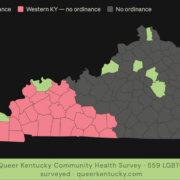
A county map of Kentucky showing which communities have local LGBTQ+ fairness ordinances, with western Kentucky counties highlighted in pink to show the region's lack of protections.

Western Kentucky’s LGBTQ+ Crisis: The Most Harm, the Least Protection Queer Kentucky's survey data reveals a region where nearly every measure of harm is at its worst, and state law still leaves trans Kentuckians out entirely.

LGBTQ+ people living in western Kentucky are experiencing a substantially more dangerous environment than anywhere else in the state, reporting being physically attacked at nearly twice the statewide rate. For trans folks, it goes even further: Kentucky’s hate crime statute has no name for what happens to them when they are attacked. A trans Kentuckian can be assaulted for being trans, and the state may prosecute the harm, but not the reason it was done.

Across the Queer Kentucky survey, western Kentucky ranks first or near first on nearly every measure of harm: LGBTQ+ residents with no health care provider, never tested for HIV, refused care by a provider, physical assault, suicidal ideation, drug use, smoking, feeling unsafe at home and deciding to move away. This is a region where nearly every measure of harm, access and community is at risk. And state policy and protections have failed them time and time again.
29.2% of queer residents in western Kentucky reported at least one instance of physical assault, which they attributed to the overarching anti-LGBTQ+ climate in the state. Overall, the statewide rate of physical assault stands at 15.2%.

54.5% of queer individuals report feeling physically unsafe at home, and 52.2% report feeling unsafe in public. Both are the highest of any region.

But it doesn’t stop at physical assault. In most of western Kentucky, a person who discriminates against and refuses an LGBTQ+ person a job, an apartment or service at a counter faces no legal consequences in doing so.

Across all of Kentucky, 24 communities have local Fairness Ordinances — including western Kentucky’s Paducah in 2018 and Henderson in 2019 — but that’s two of the 24, and they sit 130 miles apart. In between and beyond them, Owensboro, Bowling Green, Hopkinsville, Madisonville, Murray and Mayfield have no local fairness ordinances. On a map of who Kentucky has agreed to protect, most of western Kentucky isn’t on it.

What about larger state protections in Kentucky? It turns out that the state of Kentucky does have a hate crime law that protects sexual orientation. But it’s still reliant on individual judgment, and it still doesn’t protect trans people.

KRS 532.031, passed in 1998, applies when someone commits offenses because of a person’s race, color, religion, sexual orientation or national origin. In 2017, the legislature amended the statute to add a category, extending it to victims targeted for their actual or perceived employment as a peace officer, firefighter or emergency medical services worker.

Gender identity is not on the list.

Nine years ago, when the state legislature reopened the statute to add police and first responders, it still left trans Kentuckians out. For example, if a gay man is assaulted in Paducah, it can legally qualify as a hate crime. But if a trans woman is assaulted on the same block, both the state and law enforcement officers can choose to do nothing. The statute, by not including gender identity, allows law enforcement to turn a blind eye and delegitimize incidents against trans people.

Even within the bounds of discrimination against sexual orientation, this hate crime law does “protect,” the statute has no teeth and the law still does far less than what it implies. It might look and sound substantial, but functions as a performative exercise in the court system. As a result, there are many opportunities to create distance between the assault and any consequence for it. For instance, a judge decides at sentencing whether bias was a primary factor. A finding of bias permits denying probation instead of requiring it. The parole board may delay or deny parole.

It’s subject to discretion and personal biases that could creep in all the way down.

The laws already on the books are only part of it. Kentucky’s 2026 General Assembly may not have passed any anti-LGBTQ+ bills, but the climate in western Kentucky still hasn’t improved.

A bill doesn’t have to pass to embolden violence in its communities. Another factor behind why the climate in Western Kentucky still hasn’t improved. A bill only has to be filed, assigned, debated and covered on the local news, which are all separate moments of exposing a Kentuckian to hear whether or not their queer neighbor has the same rights as they do.

For example, Senate Bill 72 would have let health care providers refuse any treatment that violated their conscience. House Bill 468, pitched as a routine civil rights update, would have stripped the enforcement power from the Kentucky Commission on Human Rights and the 22 local commissions that actually enforce fairness ordinances. Both cleared their chamber of origin before stalling.

If House Bill 468 had passed, it would have taken away the only fairness ordinance protections two cities in Western Kentucky have.

And people are responding the only way the law leaves open to them: they blend in, censor their identity and opinions, or leave the state altogether.

According to the same survey, 18.5% of LGBTQ+ individuals living in Western Kentucky have decided to move out of state due to anti-LGBTQ+ policies; statewide, only 8.1% decide to leave. The compounding burden of assault, health care gaps, housing stress, and drug use appears to translate into a concrete intention to leave. One respondent wrote:

“Currently planning to move out of [the] states to a blue state. I have a lot of trans friends that I am scared for. I want them to go somewhere more blue, more safe, more open minded.”

In the face of so much hardship, western Kentucky remains home to LGBTQ+ advocates who keep showing up anyway. In May 2019, 55 residents in Bowling Green spoke in favor of a Fairness Ordinance, while 31 spoke against it. The commission voted it down 3-2. Advocates put it back on the agenda and have continued pushing for it. When a Fairness Ordinance was voted on in January 2018 in Paducah, residents flooded the city commission meeting, forcing the fire marshal to move the overflow into the adjacent hall to listen through open doors. That ordinance passed 4-1.

The people of western Kentucky continue to fight for the safety of their LGBTQ+ neighbors. But with so few fairness ordinances and statewide protections that stop short of covering them, many LGBTQ+ western Kentuckians remain at risk.

If you or someone you know is struggling, call or text the 988 Suicide & Crisis Lifeline at 988. LGBTQ+ young people can press 3 to reach counselors trained in LGBTQ+ care, an option that returned on Sept. 30, 2026 after it was cut in July 2025. The Trevor Project also offers 24/7 support at 1-866-488-7386 or by texting START to 678-678.

The exterior entrance of AVOL Kentucky, Suite 100, photographed at dusk. A black A-frame chalkboard sign in front of the brick and gray-sided building reads "Free AVOL HIV STI Testing" in colorful lettering. String lights hang above the entrance, and bare winter shrubs line the base of the building.

No Doctor, No Test, Refused at the Door: What the Data Shows About LGBTQ+ Health Care in Western Kentucky Survey data points to a crisis in access, education, and trust — and the organizations working to close the gap.

From Mayfield to Paducah to Murray, Western Kentucky is full of life, history, and unique challenges, but when it comes to accessing reliable, informed, and specific health care, LGBTQ+ people in the region face obstacles that other Kentuckians might never feel.

Recently published data from the 2025 Queer Kentucky Community Health Survey reveals that LGBTQ+ people in Western Kentucky are significantly less likely to be receiving routine health care. The survey, which collected data from 559 LGBTQ+ Kentuckians, indicated that 58.2% of respondents in Western Kentucky have no regular healthcare provider.

That number grows even more concerning when you dig into disparities in reference to sexual health. The rate statewide for those who have never tested for HIV is 48.2%. In Western Kentucky, it’s 67.2%.

According to community organizers, these numbers illustrate how education can affect public health. It’s also tied to legislation. In 2023, Kentucky’s Republican State Senate majority passed Senate Bill 150, which implemented anti-trans policies including forcing trans students to use bathrooms and locker rooms that conflict with their gender identity, but it also made teaching about sex education or puberty virtually impossible for certain age groups.

“A lot of the schools still really push an abstinence-only sexual health education… and that has a real limiting and long-lasting impact on people’s view of sex in general,” said Christine Lindner, President of West KY NOW, a local chapter of the National Organization for Women, a feminist membership organization that advances economic justice, reproductive justice, and civil rights.

Without education or access to care, communities are left without the necessary resources to thrive, according to health care providers in the region.

“If people don’t know about things they don’t know to be tested, they don’t know what to look for,” said AJ Garnett, Outreach Director at LivWell, a nonprofit organization providing healthcare, support services, prevention education, and HIV testing to communities in the region. “Being able to educate people when they’re younger, whether it be middle school or high school, would make a world of difference.”

Another contributing factor behind these numbers is the limited resources available in the Western section of the state. The more densely populated areas of Louisville, Lexington, and Bowling Green are all in Central or South Central Kentucky. These areas experience higher concentrations of hospitals, clinics, and places of care. About one in five people in the US live in rural areas, but only 9% of physicians practice in rural communities.

While there are resources in Western Kentucky, including LivWell, they are limited and some LGBTQ+ people in these communities are not comfortable seeking care. Data from the 2025 Queer Kentucky Community Health Survey also indicates deeper issues than just seeing a doctor regularly; the survey also pointed to high levels of discrimination in the region. Almost 13% of respondents statewide reported a provider refusing care due to their LGBTQ+ identity, but in Western Kentucky this number jumps to 30%, the highest in the state.

“No amount of shaking hands and assuring people is going to alleviate years of distrust that they’ve built up for good reason,” said Garnett. “…Sometimes in those very rural areas, people just don’t even know we exist.”

The isolation of LGBTQ+ in rural Kentucky presents real challenges to reaching these communities, but queer people are still finding ways to thrive and build stronger futures.

“I think people don’t realize how large the community is out here in Western Kentucky, but we are really under-resourced and underfunded,” said Lindner. “I think there’s a desire for healthier queer existence, but there’s just a lot of pressure out here.”

West KY NOW regularly creates inclusive events and programming with the intention of building stronger communities in the region, including a feminist bowling night.

This data presents an opportunity for deeper investments by community groups, care providers, and educators. According to Garnett, closing these gaps looks like building deeper inroads with communities to establish trust between provider and patient.

Other Kentucky-based organizations working to close that trust gap with rural LGBTQ+ communities include AVOL, an organization committed to ending HIV through testing, medical intervention, and community support, and Matthew25, which works with those living with, at risk of, or affected by HIV and other sexually transmitted infections. With four clinics across Southern Indiana and Western Kentucky, Matthew25 serves 25 counties in Kentucky and 12 in Indiana.

“I know a lot of people are scared because of the way they’ve been treated in the past… I’m not going to sit here and pretend like there aren’t doctors and nurses out there that give people hell every time they come in to talk about HIV or other STIs,” said Garnett. “But I can tell you with us, with organizations like AVOL, with Matthew25, everyone I speak to in these organizations is so eager and anxious to help, and excited to be part of people’s lives and make them better.”

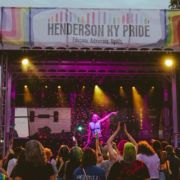
Crowd cheers as a performer takes the stage at Henderson KY Pride

Henderson KY Pride Fires Back at Calls to End Pride "It will take far more than one uninformed letter to the editor to undo a record-breaking year, erase thousands of people or weaken the force this organization has become in Henderson," the board said.

Henderson KY Pride issued a public response after a letter to the editor called for pride events in the community to end. In their rebuttal, the organization’s board pushed back point by point. Here is what they had to say:

Dear Editor:

A recent letter to the editor, written by Eliza Bruce, called upon Henderson to “put an end” to Pride events in our community. Because that piece contains several inaccurate and misleading claims about our organization, our performers, and the people who attend our events, we believe it deserves a response.

It is clear from the piece that the writer did not attend Pride ’26 or our Pride Kickoff Drag Brunch. In fact, we make the reasonable assumption this author has never attended a Henderson KY Pride event. Their account was assembled from selected photos and videos viewed online and then presented as a complete picture of our work.

Pride ’26 set a record for us when it welcomed more than 2,000 people to downtown Henderson. More than 85 vendors signed up, including local businesses, nonprofit organizations, healthcare providers, churches, artists, musicians, food vendors and community groups. Attendees connected with resources, supported local businesses, enjoyed local, regional, and national talent, and spent the day celebrating alongside friends and neighbors. It is convenient that almost none of that appeared in the opinion piece.

Instead, the writer focused almost entirely on drag and repeatedly described performances as sexual, dangerous or degrading. Drag is a form of live entertainment built around costume, character, music, comedy, dance and theatrical exaggeration. A performer accepting a tip from an audience member is a common part of that tradition. Describing the interaction as sexual does not make it so.

While Pride ’26 was family-friendly, we completely understand that not every event we host will feel suitable for every person or every family. That is true of movies, concerts, comedy shows, festivals and theatrical productions. Adults decide what they wish to attend, and parents decide what is appropriate for their children.

If you do not like an event, do not attend it. Yes, it truly is that simple.

What is not reasonable is demanding that everyone else lose the opportunity to attend because one person disapproves.

The opinion piece also framed Pride as something being imposed on Henderson by outsiders. That could not be further from the truth. Henderson KY Pride is made up of people who live here, work here, own businesses here, worship here, raise families here and contribute to this community every day. The people who attend our events are predominantly a part of Henderson, although our success has attracted visitors from neighboring cities, counties and states.

We would gladly welcome the writer—or anyone else with sincere questions—to contact our organization, attend an event, meet our board of directors and learn more about what we do.

This year, Henderson KY Pride broke records in attendance, sponsorships, donations, partnerships and outreach. Our support grew because people across this community understand the importance of ensuring LGBTQ+ people can live openly and safely in the place they call home.

To every LGBTQ+ person in Henderson, and to those who have traveled to attend our celebrations and events, please hear us clearly: You continue to have a place here.

Henderson KY Pride will remain dedicated to protecting your right to live authentically, openly and without shame. We will continue creating spaces where you can gather, celebrate and be seen.

One author may call for an “end” to Pride. But it will take far more than one uninformed letter to the editor to undo a record-breaking year, erase thousands of people or weaken the force this organization has become in Henderson.

To those hoping we will disappear, fall silent or stop fighting for a Henderson where LGBTQ+ people can thrive: you are going to be sorely disappointed.

Henderson KY Pride Board of Directors

P.S. Eliza, our invitation is sincere: attend one of our events in person, meet the people you wrote about, and see the work for yourself. Your ticket is on us.”

Nathan Wilson smiling in sunglasses and a neon cap in front of a Matthew25 mobile health clinic truck

How Rural Kentucky HIV Care Saved Nathan Wilson

He was an HIV patient in Rural Kentucky. Now he helps run the nonprofit that saved his life. Nathan Wilson is on a mission to fight against the stigma of living with HIV in Kentucky and beyond. 

Before Nathan Wilson worked at HIV health nonprofit Matthew25, he was a patient. He was a convicted felon and was in active addiction for more than a decade. Now, Wilson oversees patient experiences as the facilities and project manager for the organization. He serves the same rural Kentucky communities where he once struggled to find care himself.

Matthew25, which celebrates its 30th anniversary this year, works with those living with, at risk of, or affected by HIV and other sexually transmitted infections. With four clinics across Southern Indiana and Western Kentucky, the organization serves 25 counties in Kentucky and 12 in Indiana.

Wilson became a patient with Matthew25 in 2019. He found out he was living with HIV while at a Suboxone clinic. He recalls being told: “Hey, your blood test shows this. You should probably reach out to these people.”

He admits that he wasn’t the best patient at Matthew25 in the first year, but the workers at the organization were patient with him. He made up for it, and four years later, he began working at the nonprofit, first as a driver, transporting patients to appointments and then working the group’s food pantry. He now oversees facilities operations for all four of Matthew25’s clinics. 

“Matthew 25 has changed my life since day one — not only changed it, but saved it,” Wilson says. He said the organization fought for him to get his HIV medications when he was incarcerated. While the group didn’t succeed, the fact that they worked hard to help him had an effect on Wilson.

When he first started working at Matthew25, he wasn’t sure he was “a healthcare facility would hire somebody” like him. 

But now he sees his various roles with the group as a full-circle moment. 

“I spent every day on the road with patients — young, old, different ethnicities, different backgrounds — and it changed my view of how broadly HIV affects people,” Wilson says. “It also broke down a lot of barriers between me and patients, because I am one of them.” 

He says many people he’s met also living with HIV don’t have such robust support systems. 

“A lot of times, you’re just there to listen. People don’t necessarily want advice; they just need somebody to hear them,” Wilson says. “Matthew25 has recognized that from the beginning: that we support system. Sometimes they just need to get something off their chest.”

 Wilson believes his work is a part of a greater impact on their patients.

“I work to make sure we have the best possible experience for both clients and employees. That’s the van someone rides in, the exam room they sit in, the quality of our medical equipment. I want people to feel welcomed and cared for in every detail of their environment.”

He says it’s that care that he was shown at Matthew25 that still stays with him.

“Everywhere else I went, I was treated like an addict or a criminal. I never felt that way here. They strive so hard to meet people where they’re at — without judgment, just focused on providing the medical care you need and whatever support you want,” Wilson says.

Matthew25 is one of a few providers supporting Western Kentucky, offering services in locations outside large urban centers. Geography, Wilson says, plays a large role in obstacles to care for HIV-positive Kentuckians. The organization itself travels about a 200-mile radius to pick a patient up to get them to their HIV care, but also any other medical care they need. 

Another obstacle, Wilson says, is fear. He remembers thinking it was a death sentence when he was told he had HIV. 

“I think a lot of people avoid getting tested because they’re scared of what they’ll find, and worried about cost. What they don’t always know is how many resources exist specifically to help with treatment and suppressing viral load,” he explains. “If we can suppress viral loads in people already living with HIV to the point where there’s no transmission risk, then eventually this ends.” 

Wilson says there’s still stigma surrounding living in the area and a misconception that HIV is only a virus gay men get. He said that while he is a gay man, he also was an IV drug user. Male-on-male sexual intercourse is not the only way a person can contract HIV. 

“I think transmission is still deeply misunderstood, and that misunderstanding costs lives.”

The stigma from the gay community also comes to Wilson’s mind. 

“There’s still so much shame and secrecy around it. I’ve been undetectable for years, but people still treat HIV-positive individuals as if we’re diseased,” Wilson says. “You would think that people who have experienced so much oppression themselves would be more willing to accept others.”

He adds that it’s that specific stigma that makes him want to be open about his status and history: “to show that life doesn’t end with an HIV diagnosis.”

Wilson believes the only way to overcome this stigma and to work to stop the transmission of HIV is to recognize each other’s humanity. 

“People with diabetes aren’t stigmatized for their condition. People with cancer are treated with compassion. People living with HIV deserve the same. And the most important thing to hold onto is this: We could actually see the end of this disease, in my lifetime, or the next,” he says, explaining the need to support HIV medications and PrEP. “Transmission can be stopped. Why would we not want to do everything in our power to make that happen?”

Rainbow pride flags at Henderson KY Pride 2026 festival in Henderson, Kentucky

Small Town, Big Pride: Henderson KY Pride Celebrates Record Growth Ahead of Saturday’s Festival

Editor’s note: This story was published in June 2026. Some details may have changed since then.

FOR IMMEDIATE RELEASE

HENDERSON, KY — Henderson KY Pride is preparing for its largest and most ambitious celebration yet as the organization welcomes the community to Pride ’26 on Saturday, June 27, in downtown Henderson.

Now gearing up for its third annual celebration, Henderson KY Pride has experienced remarkable growth since its inaugural event in 2024. What began as a first-of-its-kind community celebration, that started from a class project, has grown into one of the largest pride celebrations in Western KY, bringing together local businesses, nonprofit organizations, entertainers, community leaders, and families from across the region.

This year’s celebration will feature more than 85 vendors, over 30 performers, an expanded event footprint, a larger beer garden, food trucks, live music, family-friendly activities, community resources, and an official after-party following the festival.

Headlining the evening festivities is Jaida Essence Hall, winner of RuPaul’s Drag Race Season 12 and one of the most recognized drag performers in the country.

The growth comes at a time when many LGBTQIA+ organizations across the nation are facing reduced sponsorships, funding challenges, and declining community support. In contrast, Henderson KY Pride has experienced record community investment, with more sponsors, vendors, volunteers, and community partners supporting this year’s celebration than ever before.

“The support we’ve received this year has been absolutely incredible,” said Cooper Beck, Founder and Executive Director of Henderson KY Pride. “Every sponsor, volunteer, vendor, and attendee helps make this event possible. Together we have been able to achieve things that many of us never thought we’d see in our town. This kind of support sends a powerful message that Henderson is a community where people from all walks of life can come together and be celebrated for who they are.”

In addition to entertainment and vendors, organizers have made attendee comfort and safety a priority. The festival will feature 15 free hydration stations, more than 3,000 complimentary bottled waters, shaded gathering spaces, a dedicated Hospitality Center, accessible amenities, and support from local public safety agencies throughout the event.

Since its founding, Henderson KY Pride has expanded beyond its annual festival to offer year-round visibility for LGBTQIA+ individuals, families, and allies throughout Henderson and surrounding counties.

Pride ’26 will take place from 2:00 p.m. to 10:00 p.m. in Central Park and Main Street. Admission is free and open to the public.

For event information, festival maps, entertainment schedules, and additional details, visit: https://linktr.ee/hendersonkypride


Media Contact
Cooper Beck
Executive Director
Henderson KY Pride, Inc.
[email protected]

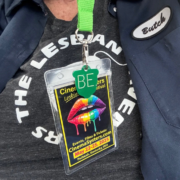
A close-up of a Cinema Systers Film Festival badge on a green lanyard featuring the rainbow lips logo and dates May 22–25, 2025, worn over a "Save the Lesbians" t-shirt with a "Butch" name patch. Description: A Cinema Systers 2025 festival badge hangs from the signature green lanyard, displaying the rainbow lips logo and website CinemaSysters.com. The attendee's "Butch" name patch and "Save the Lesbians" shirt perfectly capture the joyful, unapologetic spirit of the Cinema Systers community in Paducah, Kentucky.

Paducah’s Cinema Systers Is America’s Only Lesbian Film Festival — And It’s Turning 10

It all started with an acorn. Now, it’s the United States’ only lesbian film festival.

Laura Petrie founded Cinema Systers – a four-day film festival in Paducah, Kentucky connecting lesbian creatives through workshops, open mics, film screenings, dinners, dances, and more – in 2016, following an inspirational visit to Michigan to participate in the Michigan Womyn’s Music Festival. 

At the event, Petrie was given an acorn and instructed to plant it in her hometown in the name of forging new spaces for women and their passions. For Petrie, that acorn is the Cinema Systers Film Festival. 

“We’re celebrating a decade here of something unusual,” Petrie said. “We’re starved to see our stories on screen. We’re not victims or villains or stereotypes. We can have joyous stories, come together, and celebrate each other.”

A Festival Built on Sapphic Storytelling

For the past ten years, Petrie has platformed hundreds of artists and their work through Cinema Systers. Now, named on the 2026 Curve Power List as an empowering figure in the arts, Petrie hopes to continue summoning like-minded lesbians and sapphic filmmakers from across the globe to Paducah to celebrate Cinema Systers’ ten year anniversary.  

Each year, guests enjoy four days surrounded by Paducah’s lovely nature, participating in workshops and open mics hosted by prolific lesbians, and escaping the pressures of performing for male and straight audiences. 

“I wanted to dedicate a weekend to lesbian films,” Petrie said. “It doesn’t have to be lesbian content, but the perspective of a lesbian filmmaker. We want to uplift the visions and voices of the sapphic filmmakers.”


Four women wearing Cinema Systers festival lanyards sit together on a dimly lit panel stage, with one woman gesturing as she speaks to the group.

Laura Petrie discusses sapphic filmmaking during a Cinema Systers Film Festival event in Paducah, Kentucky. Photo credit: Cinema Systers.


Since the festival’s invention a decade ago, Cinema Systers has featured films spanning genres, countries, and perspectives. Previously, films from France, Germany, and the UK have graced Maiden Alley Cinema’s vintage screens. Whether these works of lesbian art are animations, documentaries, or horror shorts, Petrie believes they create safe spaces for women and “normalize our lifestyle and existence” as queer people. 

Although this year’s festival is jam-packed with additional anniversary celebrations, Petrie’s favorite part of the event remains the same: hearing the emotion, joy, and relief of women in the theaters.

“I love to hear the women’s laughter, the collective sighs. The recognition of things that the mainstream might not get in the dialogue, on the screen; things we can laugh at collectively and know that we’re safe.” 

Petrie, raised on a horse farm twenty minutes outside the city, believes Paducah is “the perfect spot for that.” Paducah is not only the home for Cinema Systers, but one of only nine UNESCO Creative Cities: places where creativity, culture, and cooperation thrive. At the confluence of the Ohio and Tennessee rivers, Paducah represents the bridge between southern comfort and artistic innovation. Fans traveling in to view films can also visit Paducah’s National Quilt Museum, its historic lowertown, and the many thriving restaurants, breweries, and boutiques located downtown – some of which provide discounts to Cinema Systers patrons. 

“Women return year after year, and bring friends,” Petrie said. “It’s a homecoming. A community, a family.”

Workshops That Turn Audiences Into Filmmakers

Dr. Marie Cartier, a professor of Women and Gender Studies at California State University Northridge, travels to Kentucky each spring to attend the festival, teach filmmaking workshops, and indulge in Paducah’s charming southern setting. 

“Go get your discount and go through the quilt museum, eat the ice cream, see the sunset, walk by the water. I really look forward every year to doing those things in Paducah,” Cartier said. “But more importantly, being with my friends that I’ve now met, that I see every year.” 

An aerial view of a dimly lit bar and event venue filled with Cinema Systers festival attendees mingling at tables and a bar, with purple-clothed display tables in the foreground.

Cinema Systers festival attendees gather for a social event at a Paducah, Kentucky venue during the annual film festival. Photo credit: Cinema Systers.

Cinema Systers’ 2026 lineup features a musical performance from The Grace Theisen Trio, a poetry reading from E. Nina Jay, and over twenty unique films made by and for the sapphic perspective. 

Cartier will be teaching a filmmaking workshop on transitioning between scenes, but she’s previously taught participants how to direct actors, make short films, and write scripts. Her goal is always the same: to transform moviegoers into filmmakers.

“Many times now, people go, ‘oh, I could do a film. I could do it.’ And then the next year, they have something on screen,” Cartier said. “It’s a really big accomplishment of Paducah. It’s a great place to go as an accomplished filmmaker; it’s a great place to go as a beginning filmmaker.”

Petrie’s passion extends further than just film – she’s a committed advocate for building belonging, growing communities, and celebrating queer identities. 

“I think Laura had a vision ten years ago,” Cartier said. “A lot of people can have a vision and not be able to carry it through. And she had a vision and she has really done the footwork to make it happen.” 

Beyond the Festival: A Nonprofit, a Farm, and a Community

Cinema Systers isn’t the only space she’s carved out for queer Kentuckians. 

Petrie founded the nonprofit My Syster’s Art, Inc. to help produce Cinema Systers and other filmmaking events, such as filmmaking workshops tailored to uplift the often underrepresented voices of queer women, women of color, and other marginalized women. In 2016, she renovated her 34-acre property into The Art Farm: a women’s retreat designed for creatives to disappear and produce work while surrounded by the gorgeous Paducah scenery. 

Whether on her farm, through her nonprofit, or during Cinema Systers, Petrie is committed to creating safe, celebratory spaces for marginalized women – allowing them to tell their own stories, embrace their identity, and unite with a community of queer moviegoers, artists, and Kentuckians. 

“Be ready to feel loved and joyous from the first event,” Petrie said. “Because you’re going to find your sisterhood: artists who have similar points of view to our own, which is a perspective you don’t see on mainstream tv and movies.”

Lesbians and queer women eager to experience Petrie’s vision of community, celebration, and creativity can now purchase tickets to the Cinema Systers Film Festival, which runs from May 21st to May 24th. 

Period Y’all founder Skylar Davis stands in front of a truck filled with donated menstrual products while supporting efforts to combat period poverty in Kentucky.

Period Y’all founder Skylar Davis leads Kentucky fight against period poverty

What started as an extension of the Garrard County Food Bank has grown into Kentucky’s leading defense against period poverty: the lack of access to products, resources, and educational materials which ensure a safe and comfortable menstrual cycle. 

Skylar Davis is the founder of Period Y’all, a nonprofit initiative advocating for reproductive justice and accessible period products for all Kentuckians. Founded in 2022, Period Y’all has established period pantries – boxes stocked with period products free for the public – in three counties, donated products to over a hundred schools in the Appalachian region, and educated countless members of the community about the importance of reproductive autonomy. 

Previously, Davis poured her passion for advocacy and reproductive justice into policy work, hoping to combat bills threatening reproductive rights. She found herself disheartened by the constant negativity and decided to search for a way to “bring some joy.”

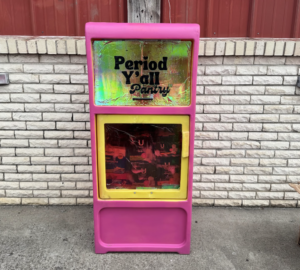
A bright pink Period Y’all pantry stocked with free menstrual products stands outside a building in Kentucky to provide public access to period supplies.

A Period Y’all pantry stocked with free menstrual products provides public access to pads and tampons for community members in Kentucky. Photo provided by Skylar Davis.

“I really wanted to do something that was meaningful,” Davis said. “To be able to fight for something more positive. Even if it takes years to pass.”

Inspired by Change Today, Change Tomorrow’s “Friday Period” project, which encouraged members of the community to claim free period supplies every Friday, Davis returned to her hometown in Garrard County to establish Period Y’all.

“The first time, I came with one folding table and probably 40 boxes of pads and tampons that people had donated,” Davis said. “And then it grew once I realized how great the need was. It wasn’t just period products, but hygiene products and incontinence products for the elderly.”

Now, with period pantries in Paducah, Berea, and Garrard, dozens of communities can access products, information, and assistance to help manage their menstrual cycles.

“It’s cool to see the variety of people that are thankful for the products,” Davis said. “It’s not just women in the community. It’s grandmothers who are caring for their grandchildren; maybe they’re on a fixed income, so they don’t have the extra money for the products. It’s mothers. It’s teens that come through and ask us for stuff. Men will ask for their partners and know what their partners use.”

McKenna Newman, a Period Y’all volunteer and fellow Garrard County native, teamed up with Davis to “help bring menstrual equality to anyone in need.”

“Growing up in Garrard County, many girls, including myself, had to get creative managing our periods,” Newman said. “Whether it be financially or the mental and physical burden we all had dealing with it. It is a shame rooted in women and no one should be embarrassed of this natural process.”

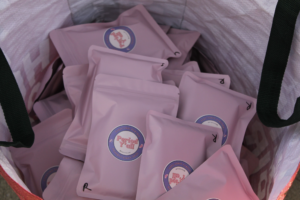
Reusable pink pouches filled with menstrual products labeled Period Y’all sit inside a tote bag as part of efforts to distribute free period supplies in Kentucky.

Reusable pouches filled with menstrual products prepared by Period Y’all for distribution to communities across Kentucky. Photo provided by Skylar Davis.

Following its success in Garrard County, over 30 requests for pantries arose across the Commonwealth. Davis plans to open 13 additional period pantries in locations such as Richmond, Somerset, Morehead, Hazard, Louisville, and more.

“When Period Y’all first started, we were doing monthly pop-ups… The products we had, we were able to source through donations, cold calling, and advertising on social media,” Newman said. “All it took was one Facebook post, and now, here we are, four years later, providing hygiene products to schools across Kentucky.”

Recalling her experience with policy work, Davis hopes to empower students to make informed choices about their bodies, health, and their administration.

“Within the next few years, I’m really hoping to get more students involved in shaping the education side of the work,” Davis said. “They’re the ones that are experiencing this in school. They don’t have access to products because it’s not in their school’s budget.”

Since the implementation of Senate Bill 150, schools have restricted students from discussions surrounding gender and sexuality – something that affects all students, regardless of identity. Students experiencing their period in school are only allowed to receive certain pre-approved products, while their teachers have been warned to avoid explaining what periods are.

“People don’t realize the correlation between attacks on trans people and LGBTQ people and those who have periods,” Davis said. “These attacks hurt all of us, not just a marginalized group of people. We can fight back against all of this harmful legislation.”

To join Period Y’all’s crusade against period poverty, Davis and Newman encourage volunteers to participate in “packing parties” – where packages of free pads and tampons are assembled – or to host a product drive. 

“If you ever wanted to get involved with reproductive advocacy… Create a conversation. Make a post. Start a group. Connect with other people,” Newman said. “Your voice is your best tool. Be loud, be proud, and don’t be ashamed! Societal shame around periods is one of the many reasons we have a crisis surrounding women’s health.”

Interested in establishing a Period Pantry in your city, hosting a product drive, or donating menstrual products to support underserved Kentuckians? Contact Skylar Davis to support Period Y’all!


Behind the Scenes: Laura Petrie Reflects on Pride and the Impact of Lesbian Film

By: Laura Petrie, Executive Director of the Cinema Systers Film Festival in Paducah, KY.

When it comes to movies, no two scenes are the same. 

It’s the unexpected twists, emotional moments, and bittersweet endings that make a movie worth watching over and over again. In a similar way, no two women are the same. Our unique identities and experiences allow us to shape our vibrant communities and write the script of what the future will hold.

As the Executive Director of Cinema Systers Film Festival, the only all-lesbian film festival in the United States, my mission in the months following Pride Month is simple, yet powerful: to create a space where both women and films are celebrated in their full authenticity. 

Our Paducah-based festival each Memorial Day Weekend has transformed into more than just a showcase of talent. Since 2016, it has grown into a community that takes center stage in the lives of countless women who are a part of the LGBTQ+ community. Our films are created and directed by women, for women.

It’s no secret that films are best enjoyed with each other. Today, it has become imperative for the LGBTQIA+ community to remain connected, especially when it comes to the art we share. As beautiful as a film can be, oftentimes it’s the beauty of sharing it with one another that is the real reward. With our film festival being one of the only events in the country with our kind of presence, we must lift it up to share with others.

While the four-day film festival was in-person, I realized the importance of going online to connect with people throughout the rest of the year. So, in 2016, I bought a computer and created my first Facebook profile. Despite my limited knowledge of digital tools, I was determined to find new ways to reach audiences and fill the theater seats during our festival. Once I began to promote our film festival online, in-person attendance increased. Now, almost 10 years later, social media continues to help us share the works of Sapphic filmmakers with our growing network of supporters. 

Through our social media platforms, we have created a stage to share our filmmakers’ art with audiences who might not otherwise see these stories reflected on screen. Year after year, lesbian filmmakers and attendees from across the country not only found our festival, but they showed up in our sweet river town in Western Kentucky. Thanks to creating our Facebook page ten years ago, our festival and community have grown in ways we never imagined. 

Our content is centered around our upcoming film line-ups, which we showcase through Reels, paired with Pride graphics and events that we boost, allowing us to engage with our ever-growing community. While our reach is now across the globe, we have not lost sight of our local community by resharing posts from like-minded organizations next door, like Paducah Pride United Together. 

I’ve found that success stems from having the courage to promote your business and a willingness to learn. In my case, I manage the social media tools available to me, and I encourage anyone looking to build community to explore what social media has to offer. 

The heart of Pride is visibility, and Cinema Systers Film Festival maintains a commitment to this visibility by not only hearing lesbian voices but celebrating them not only during Pride month, but in the other months of the year. Together, this mission and our commitment to leveraging the tools at our disposal allow us to continue to write the next scene–bold, proud, and unmistakably ours. 

Dreamin’ in a Small Kentucky Town: Who is DaAnte Bowman?

From dancing and screenwriting in his childhood bedroom to on stage with artists like Lizzo and Kendrick Lamar, and now frequenting rooms with filmmakers, dancers, singers with big aspirations like himself, DaAnte Bowman offers some prime insights for young Black Queer artists in Kentucky.

Bowman says, “Trust your gut… Be willing to forget what you think you know and become a sponge. Be open. Be brave.”

Growing up in Kentucky, as the oldest of five, in a single-mother household, Bowman learned early what creativity and resiliency looked like. His mother was a teen mom at 16, juggling multiple jobs while still managing to flood the home with music – constant bumps of Mariah Carey, Aaliyah, and Whitney Houston were the soundtrack of his childhood. That environment planted roots for a lifelong love of performance and storytelling.

Bowman says, “My favorite movies were people who leave everything behind and chase their dreams.”

Photo by Nova Film

In his childhood home, there was little access to media; flipping through three cable channels to set the vibe. Bowman’s imagination became his main outlet. He began writing shows and creating characters, world-building, and scripting the kind of art he wished existed. Movies like Coyote Ugly, Crossroads, and Save the Last Dance culminated in glimpses of escape and transformation for him.

Bowman says, “That essence of not having a lot, and turning nothing into something, was just threaded from watching my Mom work so many jobs and also find time to nurture us in a way. I guess there is a resiliency in that creativity because she made things that, like for example, what’s the Tupac song, make miracles every Thanksgiving – that’s the essence.”

Navigating life as a Black gay man in a small, white-dominated town of Madisonville shaped his identity in complex, often painful ways. Bowman describes those years as intensely introspective, which were filled with the silences resulting in self-censorship. Racism and homophobia forced him to retreat to an inward cocoon. 

He says, “I would grow up and hear certain things, like for example, in the church, there was a prominent moment where there was an older gay man who was walking around with high heels, very out, doing his thing. I remember getting out of church, and the energy shifted when everyone was congregating outside and saying their goodbyes… and he walked by, and everyone got quiet. And me, a little gay boy, put two and two together. They didn’t like him. Everyone got quiet…” 

For a long time, his creativity was hidden out of fear that expressing too much would expose who he really was. 


Back to the Drawing Board…


Bowman says that “Growing up with that fear and hiding your identity to come out is a very detrimental thing when you are trying to find yourself.”

Eventually, his vision led him to take a leap of faith. He began school at Northern Kentucky University, and was there briefly before mapping out a plan in the student union during lunch rush, to move to LA with just two suitcases and enough money for just one week at a hotel.

Bowman shares, “The two years I was at NKU, I was tired of living in fear. I was tired of being scared and not the full potential as who I was. That’s why, even then, I started to wear leggings, I started to wear crop tops, because at home, I would never do stuff like that. I started building myself, and being okay with getting the looks, getting the stares, or getting out of my head that if I express myself and show up like that man on the street, that I’m not going to get reprimanded or hated on, or jumped. I can just exist and be.”

When he boarded a flight to LA, he had no contacts, no job setup, and no clear plan – just a list of things that he was determined to do when he got there.

LA was far from glam. He spent nights in 24-hour diners, utilizing public spaces to shower, and stayed very briefly with distant family members, only to be kicked out after coming out. He went three months solid, without an audition, battling isolation and financial instability. He returned to Kentucky for safety during the COVID-19 pandemic, in hopes of later returning to LA.

In 2021, he found a home in an artist living community in LA and began rebuilding his relationship with creativity – this time, on his own terms. He was not in contact with the family members who deemed him estranged, and started at the drawing board again. 


Where’s Bowman Now?


Bowman says, “I think that your life’s purpose and your life’s work really come out of your heart through your purpose and creativity.”

Today, he’s working across music, dance, and film; not as separate disciplines, but as extensions of one another. For him, these mediums are different languages for the same message and speak for the person he once was hiding.

His identity is at the core of his artwork. While he was attending the LA Film School, a lot of his projects correlated themes of resilience, becoming, and reclaiming identity. Creating has become a sacred act to him, a way of saying, “I was here.”

One of Bowman’s biggest turning points came when he stopped seeking validation from people who could not fully understand his journey. He began valuing his art by the internal mapping of his truth. That’s when the real deal breakthroughs happened, when he rooted his process in faith, self-belief, and divine purpose. He now encourages others to find their own gifts and lean into them, unapologetically.


Photo provided by DaAnte Bowman


Recently, Bowman hosted a dance choreography class at the Millennium Dance Complex in LA that was centered with many femmes, queer folk, and allies. He is also developing a project called The Island of the Misfitz, which is a TV show with a bold and genre-blending narrative that centers on the artist’s journey. He’s seeking collaborations with producers and femme artists to bring it to life. It’s a beautiful project in the works that he’s committed to grounding both storytelling and soul. 

If he had to sum up his artistic mission in just a few words, he says, “Face yourself. Find your why. Let the rest unfold.”

His creativity is a spiritual practice, rooted in community, love, and connection to something greater than himself. His path as a Black Gay Artist is one that is more than just making art for the sake of making it, but venerating through healing. It’s about discovering what it means to love himself, to build more community from the ground up, and to trust the divine guidance of his journey. 

From Kentucky to LA, every step has been an act of courage and, most importantly, a declaration that he always meant to be here.

Want to know more about DaAnte Bowman? Visit https://linktr.ee/stepintotheinferno or find him on YouTube: https://www.youtube.com/@daantesinferno

Let Your Rainbow Flag Fly: 2025 Rural Pride Events You Won’t Want to Miss

Pride is an important part of celebrating our identities and collective history as LGBTQ+ individuals. In rural areas, these celebrations can be especially important, as queer individuals in rural areas often report experiencing more feelings of isolation than their urban counterparts. Because of this truth, and with Pride Month being right around the corner, it’s important to highlight rural pride festivals located within Kentucky, as well as their dates, times, and locations for your convenience. Come out and show your support and queer joy at one or more of these festivals this summer! 

Richmond Pride Festival:

Richmond, Kentucky is in the southeastern part of the state. Richmond is still a fairly small town despite its status as a University town, and the 2025 Pride festival will be only its fifth pride celebration ever! This event will take place on Saturday, June 7th from Noon to 8pm EST on East Water Street in Richmond, KY. Richmond Pride organizers are still searching for volunteers for the event. You can find more information about volunteering, attending, or view vendor spotlights on their Instagram or Facebook pages. 
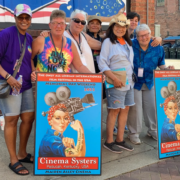
photo provided by Richmond Pride.


Mt. Sterling Pride:

Mt. Sterling, a small town in Eastern Kentucky, is celebrating its fourth annual Pride festival this year. This Pride festival will be complete with activities, vendors, and live entertainment shows in the afternoon. Mt. Sterling Pride will take place from 10am-4pm EST on Saturday, June 7th, located at the Dubois Community Center. You can find more information on their social media pages!

photo provided by Mt. Sterling Pride.


Glasgow Pride:

Glasgow, in the southwestern part of the state, is hosting its second annual pride event on Sunday, June 8th from noon-4 pm CST at 115 Beaver Trail. Glasgow Pride’s goals include promoting the diversity that exists within the LGBTQ+ community, and work toward equity for all individuals. You can find more information on their website:https://www.glasgowkypride.org/

Photo provided by Glasgow Pride


Paducah Pride United Together:

This will be Paducah’s third annual pride festival, as in 2024 they had to cancel due to a lack of funding. Paducah is in the far west and south of our state. Paducah Pride aims to use funding for the defending of LGBTQ+ rights. Go support Paducah Pride on June 14th, from 11am-8pm CST at the Paducah-McCracken Co. Convention & Expo Center. Find more information, and volunteer and media creation opportunities on their social media pages.


Augusta Pride in the Park:

Augusta is an incredibly small town in Kentucky, making it even more important that there is an LGBT+ pride celebration in such a slightly populated area. This organization aims to bring together diverse communities. This will be their third annual celebration, taking place at Noon EST on June 14th, at Augusta River Park. More information is available on their social media pages. 

photo provided by Augusta Pride.


Owensboro Blue Bridge Pride:

Owensboro is in the western part of the state. The organization, Blue Bridge Pride, works with Unity Fellowship to celebrate pride in the Owensboro area. This event will take place on Sunday, June 22 starting at Noon CST. It will be located at the Owensboro Unity Fellowship. More information is available on their Facebook page. 


Corbin Pride:

The organizers of Corbin Pride are always working to bring more LGBTQ+ events to the Corbin area. Corbin is a small town in the southeastern part of Kentucky, having a population of around 8000 people. Corbin Pride is still looking for vendors and volunteers, so check out their Facebook page for details! This event will be held from 11am-4pm EST on June 28, located at Nibroc Park in Corbin. 


Henderson Pride:

Henderson, Kentucky is a fairly small town in the western part of Kentucky. The first ever Henderson Pride festival was held in 2024, and it will now be returning for its second year ever on Saturday, June 28th from 2pm-9pm CST at Central Park in Henderson, Kentucky. This organization strives to advocate for inclusivity through community-based action and conversations. To learn more about the organization or the festival, visit https://www.hendersonkypride.org/. 


Murray Pride:

Murray is located in the far southwest of the state. The organizers of Murray Pride are active within the community there, and recently held an open board meeting to discuss the details for the upcoming Pride festival. Murray Pride, which is in need of volunteers and vendors, will take place on August 30th, and more information will be available soon via their facebook page. 


Kentucky Black Pride:

Kentucky Black Pride is an organization that was founded in 2016 to promote pride and awareness for queer and transgender people of color. This Pride festival takes place a bit later in the year, from September 11-14th at Noon-7pm each day. Kentucky Black Pride Festival is located in Woodland Park, Lexington Kentucky. To be a sponsor, vendor, or just to gain more information, go to their website at https://www.kentuckyblackpride.com/. 

photo provided by Kentucky Black Pride.


The Pride of London Picnic:

London is a small town with a population of about 8,000 people. It is in the southeastern area of the state, very near the Daniel Boone National Forest and Corbin. This organization strives to promote awareness of LGBTQ+ issues, as well as providing education and a safe environment for all diverse people and minority groups. The Pride of London Picnic will take place on Saturday, September 20th, and more information will become available on their Facebook page as we draw closer to the date. 

Photo provided by London Pride.


Pikeville Pride:

Pikeville Pride has been celebrating pride events since 2018, founded partially in response to a 2017 neo-Nazi march. Now, Pikeville pride brings hope and joy to rural Kentuckians, in a small town of only around 7500 people in southeastern Kentucky. Pikeville Pride will take place in Appalachian Wireless Arena Park, Pikeville, Kentucky on September 27th. Check out their social media accounts for more information!

photo provided by Pikeville Pride


Capital Pride Festival:

Our state capital, Frankfort, will be having a pride festival later this year. While it is our capital, Frankfort is a fairly rural area. It is very centrally located within the state. The Capital Pride Festival will take place on Saturday, October 11th. You can find more information on their website at https://www.capitalprideky.org/

Attendees at Capital Pride. Photo provided by Capital Pride.


Danville Pride Festival:

Danville, which is southwest of Lexington, has started celebrating pride in their area within the past couple of years. Danville Pride is currently searching for vendors of many types. More information on that is available via their Facebook page! The 2025 Danville Pride festival will take place on October 18th. It begins at Noon EST at the Danville Pioneer Playhouse. 

Attendees at Danville Pride. Photo provided by Danville Pride.


Bowling Green Pride: 

Bowling Green, in the southwestern part of Kentucky, started loudly celebrating Pride in 2017. It is organized by Bowling Green Fairness. Just before the end of LGBTQ+ history month, this event will take place on October 25th from Noon to 5pm EST at Circus Square Park.

Bowling Green Pride attendees at the end of the parade route at Bowling Green City Hall. Photo provided by Bowling Green Pride


Chill Out & Proud Somerset:

Somerset is a small city in the south of Kentucky. This organization aims to promote support from allies for marginalized groups in their community. They strive to host events for LGBTQ+ folks in the Appalachian area. This event takes place October 25th on Festival Field, located at Somerset Community College. There will be drag shows, activities, and a sensory creation space. Donate, volunteer, be a vendor, or find out more at their website: https://chilloutandproud.org/

Attendees at Chill Out & Proud Somerset. Photo provided by Chill Out & Proud Somerset.


Building Bridges for Rural Queer Artists

I used to be hesitant to call myself an artist. I didn’t make a living from my art, and I had no formal training. Still, my days revolved around writing whenever they could. When it felt like I had no audience, I kept writing and leaning into my art anyway. What audience did I need other than myself?

Not knowing how to navigate the traditional publishing world, I decided to self-publish my first poetry chapbook, Push and Pull (2022). Two more chapbooks followed: The Observer Effect (2023) and The Holy in the Humdrum (2024). Along the way, I learned that authenticity and genuine love for craft could attract an audience, even without the backing of traditional publishing.

In between these milestones, I started writing for Queer Kentucky. Through this, I discovered a vibrant and inspiring community of Queer artists across the state. The once-blurry concept of being an artist began to take shape, and the geometry wasn’t as complicated as I had thought. While artistry is deeply personal, I learned that the journey doesn’t have to be a solitary one.

Through Queer Kentucky and programs like New Leaders Council Kentucky and the Kentucky Rural-Urban Exchange, I uncovered the existing networks that support artists in Kentucky. After some of my videos about anti-LGBTQIA+ bills in Kentucky and poems about rural culture went viral, I found myself connected to a national community of rural and Southern people.

Leaning into this newfound community, people began reaching out for advice about opportunities for rural Queer writers. While I shared what I knew, I realized a significant gap remained, particularly for rural folks who were not straight and white. Drawing on the connections I had built across Kentucky, I decided to do something about it.

During a conversation with a peer, I mentioned my dream of creating an anthology that showcased diverse rural artists. He told me about a grant with a same-day deadline. I applied, and to my surprise, I got it. A month later, I applied for another grant and was awarded that one too.

Having never received a grant before, I felt out of my depth. The realization that being a working artist involves much more than creating—grant writing, marketing, networking—was both daunting and exhilarating. It lit a fire in me to keep pushing forward. The grants focused on amplifying BIPOC and Queer voices in Appalachia and bridging Kentucky’s rural-urban divide. With that funding, I launched Backwoods Literary Press, an initiative to reclaim and document narratives from rural communities, small towns, and reservations. In November 2024, we published Discarded: A Rural Anthology, featuring 63 artists from 27 states. The book captures a tapestry of experiences, from poetry rich in imagery to challenges against distorted urban stereotypes of rural America. Themes include discussions around Queerness, Christianity, colonialism, racism, and rural identity.

In just six months, I managed to establish a fiscally sponsored nonprofit, compile the works of 63 artists, and publish an anthology. The response has been overwhelmingly positive. We’ve sold enough to sustain the press and are preparing to publish another collection this year, with submissions opening in late spring. For updates, visit www.backwoodsliterarypress.com or follow us on Instagram at @backwoodsliterarypress.

This journey has taught me that being an artist isn’t about financial success or formal accolades. It’s about dedication to your craft and the courage to share your voice, even when it feels like no one is listening. The support I’ve received from organizations that uplift rural and Queer voices has been transformative, and I want to pay it forward by sharing these resources with others.

Affrilachian Arts Institute, Berea

Founded by Malcolm Davis, this institute uplifts Black artists in Appalachia by combining history and creative practice. Upcoming projects include performances at the Smithsonian Folklife Festival and a growing roster of Black Appalachian artists.


Appalshop, Whitesburg

Appalshop is a cultural cornerstone in Kentucky, using education, media, theater, and music to document and revitalize Appalachian traditions. It challenges stereotypes, supports justice, and participates in global dialogue. Notable works include the documentaries I Know My Body and As Long As You Can, which explore Queer experiences in Appalachia.


ArtMarkit, Covington

ArtMarkit, a Queer-owned creative hub in Northern Kentucky, offers access to gently used art supplies, mentorship, and workshops. It aims to make creative expression accessible and provides space for community engagement and artistic growth.


Prism Area Arts Alliance, Owensboro

Based in Western Kentucky, the Prism Arts Alliance promotes Queer expression in Daviess County. It provides a safe space for Queer people to express themselves artistically, with weekly meetups for actors, writers, artists, and poets.


Carnegie Center for Literacy and Learning, Lexington

The Carnegie Center offers classes in writing, publishing, and languages, as well as outreach programs and literary events. Many programs are free or have scholarships available. It celebrates LGBTQIA+ diversity through events like Queer author panels and the Queer Literary Hoedown, with a zero-tolerance policy for discrimination.


Gateway Regional Arts Center (GRAC), Mt. Sterling

GRAC believes in “all the arts for all the people,” connecting the landscapes and cultures of Central and Eastern Kentucky through various art forms. They host the Small Town America Institute for Rural Arts & Culture, which supports rural arts councils with resources and research to enhance community vibrancy.


Kentucky Arts Council, Statewide

The Kentucky Arts Council supports artists across the state with grants and programs like the Al Smith Fellowship, Emerging Artist Program, and others. It also offers the Kentucky Peer Advisory Network, where professionals provide free consultations on areas like grant writing, marketing, and strategic planning. The Kentucky Arts Partnership Grant Program supports arts organizations with operating funding.


In conclusion, my journey as an artist has been centered around discovery, resilience, and the power of community. I have learned that being an artist is not defined by financial success or formal accolades, but by the commitment to craft and the willingness to share your voice, regardless of if you have an audience or not. Through collaboration and support from organizations that uplift rural and Queer voices, I have not only found my own path, but a collective strength in working together to create more inclusive spaces for diverse creators. Together, we can bridge divides, amplify voices pushed to the margin, and continue to develop Kentucky’s artistic landscape. To fellow artists: pursue your craft, connect with your community, and remember that your voice is needed–now more than ever.

In Western Kentucky, the Only All-Lesbian Film Festival in the U.S. Is Thriving

Editor’s note: This story covers Cinema Systers’ 2025 festival. Read our 2026 story on the festival’s 10th anniversary.

Every Memorial Day weekend, something extraordinary happens in Paducah: queer women from across the country and around the world gather for Cinema Systers Film Festival, the only all-lesbian film festival in the United States. In a town known for quilting and riverboats, this four day celebration of lesbian filmmakers has quietly and powerfully carved out space for queer women in the arts—on their own terms.

Cinema Systers is more than a film festival. It’s a cultural gathering, a reunion, and a declaration: that lesbian voices belong, and that they deserve to be heard loudly—in rural places too. Since 2016, the festival has brought feature films, documentaries, comedies, horror, and more to Maiden Alley Cinema in downtown Paducah, with all works told through the lens of queer women. Founded by Laura Petrie after the closing of the Michigan Womyn’s Music Festival, Cinema Systers was born from a desire to plant something new—an “acorn,” as Petrie calls it—in her own hometown.

“I initially thought about showing films in a barn on my farm,” Petrie said. “When we saw how many women wanted to come, we knew we needed to move it downtown.” Maiden Alley Cinema welcomed them, and so did the city.

It’s no small thing that this happens in Western Kentucky—a region that can be left out of statewide conversations about queerness. Paducah stands out: in 2018, the city passed a Fairness Ordinance protecting LGBTQ+ people from discrimination in employment, housing, and public accommodations. More than 250 people showed up at city hall for the vote. It passed 4-1, making Paducah the only city in the region with such protections.

The creative culture of Paducah played a role too. A UNESCO Creative City and home to the National Quilt Museum, the town has long drawn artists from all over the globe. That spirit of openness helped make Cinema Systers possible—and now, nearly a decade in, it’s helped it thrive. What began as a three-day screening event has evolved into a full-blown arts festival: music, comedy, spoken word, workshops, 2D feminist art shows, networking events, and the popular Artist Meets Audience filmmaker Q&A.

“The mission of the festival is to amplify lesbian voices,” said Petrie. “And provide a stage for artists whose work is rarely seen in mainstream spaces.” Over time, that stage has grown.

While every year brings standout films, Petrie recalls one called Dance Me To The End Of Time, about a remarkable woman from Kentucky who grew up on a tobacco farm and later lived in South Africa. She eventually succumbed to an illness linked to chemicals used in tobacco farming during her childhood. “There have been hundreds of films screened at Cinema Systers since 2016, and many stick with me,” Petrie said. Though not all are explicitly queer in content, she emphasized that all the films are made through a lesbian lens.

“There are thousands of film festivals in the U.S., and even quite a few LGBTQ+ ones,” Petrie said. “But we’re the only one that showcases exclusively lesbian-produced films. That matters. We celebrate the feminine point of view here.”

What does it feel like to walk into this festival? For many, it’s a kind of homecoming. The atmosphere is welcoming, relaxed, electric with connection. You’ll find people deep in conversation between films, swapping stories over drinks at the Saturday Night Party, or sharing silence together in the dark of the theater as the screen glows with the work of queer women who dared to make something true.

Looking ahead, Petrie hopes to grow Cinema Systers to match the audience capacity of the Columbia Art House—a nearly century-old art deco theater in Paducah currently undergoing renovations. And with My Systers Art, Inc., a nonprofit formed to support the festival and other year-round events, she’s continuing to build infrastructure for queer women’s art in the region—including turning her own 34 acre farm into The Art Farm Women’s Retreat, which hosts events like the upcoming Lesbian Labor Day weekend.

“Growing up riding horses, driving tractors, and playing sports shaped me into a confident person with a can-do attitude,” Petrie said. “I have always lived outside of normative hetero-patriarchy and often had to fight to live life on my own terms. So when the opportunity to create a women’s event presented itself, I just went for it.”

And year after year, more women come. They come for the films, for the freedom, for the chance to sit in a room full of people who understand. They come because this isn’t just about watching a movie—it’s about being seen.

Don’t miss out! Buy your ticket here to join the celebration at Cinema Systers this Memorial Day weekend.


From no stoplights to her name in lights: The Rise of S.G. Goodman

Born in western Tennessee and raised across state lines in Hickman, Kentucky, S.G. Goodman’s journey as an artist is deeply rooted in the landscape and culture of her upbringing. Hickman, a small town nestled in Fulton County along the Mississippi River, shaped much of her perspective. “I come from a long line of farmers. Hickman is a very small town. We didn’t have fast food. We didn’t have a stoplight. I’m ever finding out how much of an impact being raised in a rural, small community has had on me,” she reflects.

Raised in the Southern Baptist church, Goodman credits her religious upbringing for some of her foundational skills as a musician. “I would consider myself a recovering Southern Baptist at this point in my life,” she says with a hint of humor, but her reverence for the musical traditions of her childhood is clear. “Being that I’ve never had any formal training in music, I consider my time going to church three times a week as my formal training. If you dig, you find you’re in a deep, rich history of singing style and a culture that is very specific to your area.”

photo by Carey Neal Gough

Goodman’s connection to Kentucky runs deeper than music. Her father’s work as a farmer instilled in her a sense of place, a tie to the landscape and its lushness. “After traveling the United States so many times in a year, the thickness around here is what I miss the most—the lushness of the vegetation and animals,” she explains. Her home, part of the Lower Mississippi Delta region, offers a unique blend of landscapes, from cypress trees to slough waters. These visuals are central to her identity, both as an artist and as a Queer person.

“When thinking about how the landscape and where I was raised affected my Queerness, I would say it’s always been really important to me,” Goodman says, while acknowledging this understanding has been an evolving process. “I wasn’t 12 and walking around saying I’m a Kentucky Queer.”

For Goodman, Queer identity and rural identity can be complicated to hold together, but she is committed to representation. “Now that I am this version of myself, and secure in my identity as a Queer person, I understand how important it is for rural representation in Queer spaces.”

photo by Carey Neal Gough

Her early experience at Murray State University underscores her sense of being an outsider. Coming from Hickman, her first encounters with the busier streets of Murray felt overwhelming. “I remember driving around the town, and you know, there’s stoplights and bigger intersections and things way different than my little tiny hometown of Hickman. I felt so alone and like I didn’t know if I was meant to be there or not.”

She humorously recounts struggling with traffic laws, having learned to drive on a farm by the age of seven. “I knew how to drive, but I didn’t know the laws.” These feelings of uncertainty extended into the early years of her music career. “I oftentimes say, ‘I’m thinking of my grandparents, sharecroppers who only finished 6th grade, and I say that I’m carving out all the places in the world that were meant for them.’ Sometimes I have to remind myself that this is really who I am and my truth.”

Goodman’s music often mirrors this personal and cultural complexity. Her first album, Old Time Feeling, carries a love for her homeland, while her second, Teeth Marks, offers an exploration of trauma and empathy. “As far as the music I’ve put out currently, if we focus on the theme of love throughout it, I would say that my record Old Time Feeling… really spoke of a love for a place. Teeth Marks was more of a look inward.”

photo by Carey Neal Gough

Her unique voice and evocative storytelling earned Goodman significant recognition, including the Emerging Artist of the Year award at the Americana Music Association Awards. Kentucky’s first openly gay poet laureate and music journalist Silas House says, “S.G. is particularly important as a representative because she is completely herself in every way and she refuses to ever put aside her ruralness. It is a huge part of who she is, and especially the way that has shaped her in relation to her Queerness. Her music and her existence itself complexifies the notion of what it means to be a rural Queer person. I have tremendous respect for her music but also for who she is as an activist and as a representative for so many of us who don’t see ourselves portrayed accurately in popular media enough.”

Even as she finds success, Goodman wrestles with the complexity of her rural and Queer identities. “The only way to change a place is to stay put. And to do the work. And to live your life,” she says, though she recognizes the nuance of that truth. She wants to believe it, but she understands that some people must leave for their safety or mental health. For Goodman, the tension between identity and geography is a story still unfolding, but it is one she tells with unflinching honesty and profound artistry.

Kentucky braces for storms, possible tornadoes. Risk highest in the west.

by Sarah Ladd, Kentucky Lantern
April 2, 2025

Gov. Andy Beshear has declared a state of emergency for Kentucky ahead of expected storms and possible tornadoes over the next four days.

Beshear warned of “severe storms that are intense and long-lived” and a risk of tornadoes, hail, flooding and high winds across Kentucky.

Under his emergency order, Kentucky Emergency Operations Center, transportation officials and the Kentucky National Guard will be ready to respond if they’re needed.

“Tornadoes are expected, and I know that’s tough to hear. And we are most concerned about the area of Western Kentucky that has gotten hit far too much, as well as a wider area of Western Kentucky,” Beshear said in a statement. “Remember, these can be strong tornadoes, EF-2 and greater. We’re really concerned about people’s safety, especially in the overnight, because when storms or tornadoes hit while people are asleep, that’s sadly when we’ve lost the most people. So, everybody out there, be really careful.”

What’s expected?

West Kentucky and Western Kentucky are at the highest risk for tornadoes and other storms, according to the National Weather Service. Central Kentucky is under an “enhanced risk” and Eastern Kentucky is under “marginal” risk, according to NWS.

Starting Wednesday night, Western and West Kentucky can expect “a major outbreak of severe storms with strong, long track tornadoes, very large hail and damaging winds,” according to the National Weather Service. Winds could reach 70 miles per hour.

On Thursday and Friday, West Kentuckians in Fulton, Hickman, Carlisle, Ballard, McCracken, Graves and the surrounding areas may experience flash flooding, “rapid rises on area rivers,” heavy rain and severe storms, according to NWS. Paducah is under a flash flood warning through Sunday and may see record-breaking rainfall.

NWS predicts up to 15 inches of rain in West Kentucky, with Western and Central Kentucky expecting a maximum of 10 inches.

Louisville is under a flood watch through Thursday.

Tips for safety

The National Weather Service recommends these safety tips during the type of storms Kentucky is bracing for:

Find shelter during the storm. Have a plan to go somewhere safe if you need to. Do not drive through standing water. Keep a flashlight, shoes and cell phone near your bed while you sleep. Make sure your phone is charged and weather alerts are turned on. During a tornado, get as low as possible — the lowest room in the home, under a table. Get under something heavy and sturdy to protect yourself from debris. During a tornado, stay away from windows and doors.


GET THE MORNING HEADLINES.

SUBSCRIBE


Kentucky Lantern is part of States Newsroom, a nonprofit news network supported by grants and a coalition of donors as a 501c(3) public charity. Kentucky Lantern maintains editorial independence. Contact Editor Jamie Lucke for questions: [email protected].

25 Faces of Fairness: Laura Petrie

Laura Petrie (AKA RESIN REBEL) she/her, Paducah

Use one Queer slang word to describe Kentucky!

Paducaaah is Leztopiaaah! Who knew?

How did you activate and organize your community for equality?

I have spent my life as an activist…a feminist…and an organizer. In 1993, I was selected to serve on the inaugural statewide steering committee for the Kentucky Fairness Alliance. In the mid-1990’s I published a local LGBTQ+ newsletter called “A Common Thread” which announced networking opportunities, community organizing events and LGBTQ+ social events in and around Paducah. In the 1990’s I was a recipient of a Kentucky Foundation for Women grant for “Grassroots Women Present,” and served as site producer for a traveling play about Belinda Ann Mason, a Kentucky writer who contracted the AIDS virus through a transfusion.

I served on the Paducah Pride committee, and was instrumental in helping initiate and organize the very first Paducah Pride events in the 1990’s. Because of my community organizing skills and my passion for LGBTQ+ work (although I do not identify as Christian) I was recruited to serve as a founding board member of the LGBTQ+ friendly Metropolitan Community Church of Paducah.

Serving as a worker at lesbian and women’s festivals for over two decades has given me the confidence and vision to plant my “acorns” locally. When the Michigan Womyn’s Music Festival ended in 2015, after 40 years of providing a safe space for women, we were tasked to “sprout our acorns” in our home towns to create women’s community and events.

In 2016, I sprouted my “acorn,” Cinema Systers Film Festival, a four day women’s cultural festival in Paducah. In addition to screening lesbian produced films, we have filmmaking workshops, Q&As, LGBTQ+ musicians, comedians, spoken word artists, open mic, karaoke, DJs, dancing, catered parties, networking opportunities, art displays, silent auction and more.

Building People Power: Stories From the Fight For Fairness

By Chad Kamen and Cassidy Meurer

Special thanks to Pam McMichael for her help on this.

All photos from the Fairness Campaign records, Archives & Special Collections, University of Louisville. 

SPARKING A MOVEMENT

“I’ve helped create Fairness” tapestry on display, circa 1999-2000.

In the mid-1980s, the shape of queer activism in the state was rapidly changing. The onset of the AIDS epidemic, as well as changing ideas around visibility, mobilized organizers to focus on solidifying people power among queer Kentuckians. An emergent activist group called the Greater Louisville Human Rights Coalition (GLHRC) followed this call to action in Louisville by pursuing anti-discrimination protections for queer people. Their aim was the endorsement of the Louisville-Jefferson County Human Relations Commission, which they won in 1986 through documenting discrimination in the city and building coalitional support from civil rights leaders, such as Dr. Lyman T. Johnson.

Though the GLHRC was successful in getting an endorsement, there was a continued need for pressure to dismantle prejudice against queer people, as well as to win the support for legislation from Louisville’s Board of Aldermen. These continued fights led a group of organizers to create the March for Justice. As the first Pride march in Louisville, the March set the tone for activism in the area by highlighting the need for visibility, intersectional approaches to hate, and greater civil liberties. A key example of such was the March’s connection to the passage of Louisville’s Hate Crimes Ordinance. This intersectional piece of legislation, passed in 1991, was built in response to white supremacist violence against a Black family living in the Preston Park neighborhood. Through the coalition-building of activists across the city, the legislation became the first in Louisville to explicitly include sexual orientation as a protected class. However, the fight for clear and explicit protections against discrimination for queer Kentuckians was just beginning. 

Carla Wallace speaks on the steps of City Hall during the Fairness Campaign’s first press conference, October 9, 1991, Louisville, Kentucky.


CONSTRUCTING FAIRNESS

The March for Justice’s 1991 platform included a demand that would become central to organizing across the state: the call for protections from discrimination in employment, housing, and public accommodations. To achieve this vision, organizers from the March for Justice and other related activist groups across Louisville established the Fairness Campaign, which would be formally announced during a press conference that fall.

From its founding onward, the Fairness Campaign served a variety of functions. It was an organizing collective, a community of friends, a support system, and an outlet for queer expression. Built into the fabric of Fairness was also a call to anti-racist work, as the organizing team recognized that there could be no queer liberation without that for people of color, specifically Black Americans. While this article focuses primarily on the Fairness Campaign’s work toward anti-discrimination legislation, the organization’s investment in anti-racism has been and continues to be substantial – ranging from trainings to internal assessments of organizational culture to coalition-building actions. 

Building on the broad-based success of the Hate Crimes Ordinance, the Fairness Campaign was able to gain support for the first Fairness Ordinance in November of 1991. However, the measure never made it to a vote after support from the Board began to unravel due to election turnover and homophobic external pressure. Following this attempt, organizers further committed themselves to getting the opinions of the Board on record for future campaigning purposes. In the summer of 1992, the Fairness Campaign successfully mobilized support from the Board for a vote, leading to an 8-4 decision against the ordinance on August 25, 1992.

(From left to right) Sara Reed, Betty Payne, and Mattie Jones at a candlelight vigil for the Fairness Ordinance after it failed to make it out of committee at the Louisville Board of Aldermen in December 1991, Louisville, Kentucky.


1992 also saw a transformation of the fight for queer rights in Kentucky through the case of Commonwealth v. Wasson. Overturning the state’s criminalization of consensual sodomy, the Kentucky Supreme Court’s decision made the state the fifth in the country to strike down its sodomy laws. In turn, queer organizers across Kentucky met this victory and the resulting attempts by state politicians to re-criminalize sodomy with fervor. The fall of 1992 would see organizers form the roots of what would the following year formally become Lexington Fairness and the more statewide-focused Kentucky Fairness Alliance (KFA).

With the goals of educating the public about LGBTQ+ issues and defeating anti-gay bills introduced in the Kentucky General Assembly, KFA pulled together a broad coalition of leaders from across the state, ranging from Henderson to Northern Kentucky. This building of unity would quickly be brought outward in 1993 through collaborations between KFA and the Fairness Campaign on an awareness-building booth at the Kentucky State Fair and extensive, successful lobbying in Frankfort. In 1994 alone, the political action committees associated with both KFA and the Fairness Campaign would defeat a slate of 15 anti-gay bills. By 1995, KFA built chapters in Paducah, Henderson, and Madison County, as well as developed a system called the Action Alert Phone Tree to mobilize supporters against anti-queer legislation.

SECURING A FAIRER KENTUCKY

The mid-1990s saw new challenges in Louisville for the Fairness Campaign, as organizers encountered a generally unsupportive Board of Aldermen. In both 1995 and 1997, the Fairness Campaign was unsuccessful in getting an ordinance to pass, with both attempts involving restructuring of the ordinance’s language in hopes of passage. While the effort in 1995 attempted to focus on employment non-discrimination, the 1997 push for fairness included the first fight to incorporate the language of gender identity. The latter push for the inclusion of gender was not taken up by Fairness’s allies on the Board for fears it would not pass, a move which would propel Fairness to deepen its commitment to trans solidarity in future efforts. In response to the unsuccessful attempts in 1995 and 1997, Fairness supporters engaged in civil disobedience by respectively refusing to leave City Hall and blocking Sixth Street.

(Left) Fairness supporters and organizers including Lisa Gunterman (pictured on the left) leave City Hall under arrest, March 28, 1995, Louisville, Kentucky. (Right) Fairness supporters block Sixth Street outside City Hall, September 9, 1997,  Louisville, Kentucky.

The year 1998 on both a local and state level served as a turning point for the fight for Fairness. Starting this year, the Kentucky General Assembly would begin crafting and refining the Kentucky Hate Crimes Act. This act would become the first statewide hate crimes protection, as well as the first piece of statewide legislation to include sexual orientation as a protected class.

Alicia Pedreira and Faye Goodman address a rally outside of the Jefferson County Courthouse, November 24, 1998, Louisville, Kentucky.

In Louisville, the discriminatory firing of Alicia Pedreira by Kentucky Baptist Home for Children would lead to a surge in momentum around getting an ordinance passed. Although Pedreira had disclosed her sexuality upon her hiring, her employer reacted negatively when an image of her wearing a shirt with the slogan “Isle of Lesbos” was displayed (without Pedreira’s knowledge or consent) at the Kentucky State Fair. Pedreira’s story broke through to the Board of Aldermen as a growing wave of news reports and Fairness-led events raised awareness about homophobic and transphobic discrimination in Louisville. The throughline of employment discrimination would prove successful, with the Board passing workplace protections for both sexual orientation and gender identity on January 26, 1999 in a 7-5 vote.

The win in Louisville would usher in a wave of victories for additional communities in Kentucky. On July 8, 1999, organizers won the state’s first comprehensive discrimination protections for sexual orientation and gender identity in a 12-3 vote from the Lexington-Fayette Urban County Council. The end of 1999 would also see similarly expansive victories reach Henderson in October and Jefferson County.


OVERCOMING OBSTACLES TOGETHER

For the Fairness Campaign and the Kentucky Fairness Alliance alike, the new millennium brought with it the hope of a more just Kentucky. Following the victories of 1998 and 1999, both organizations quickly found themselves navigating new terrain. The growing momentum for extending anti-discrimination protections to queer people opened the possibility for a statewide Fairness bill, with the first attempt at such being filed in the 2000 General Assembly. The four successes in getting ordinances also led to momentum for another win a few years later in Covington in 2003. The effort to get this ordinance on the books marked the first coordinated campaign between chapters of KFA to get comprehensive legislation passed on a local level.


Kentucky Fairness Alliance at the 15th Annual March for Justice, June 24, 2000, Louisville, Kentucky.


However, the growth of the movement faced challenges. In Louisville, Fairness Campaign organizers spent the first years of the 2000s focused on organizing against and then preparing for the merging of the city and Jefferson County. Merger, as it was known, created a different political terrain for activism, displacing power from the historically-Black neighborhoods of West Louisville to the often whiter neighborhoods of East Louisville. Changes in the government of Henderson also impacted organizers for Fairness in the city. After a successful effort throughout the 1990s to build community around anti-discrimination legislation, a new wave of city commissioners repealed Henderson’s ordinance in 2001.


Kickoff event for the statewide Equality Begins at Home campaign, March 21, 1999, Henderson, Kentucky.


Coordinated backlash to greater protections for queer Kentuckians would only grow in the coming years, as 2004 saw the escalation of efforts by state lawmakers to ban marriage equality. That year, lawmakers pushed for a full constitutional ban by putting the question of marriage equality on the ballot. The Kentucky Fairness Alliance and the Fairness Campaign joined together to defeat the measure. Through this effort, KFA and Fairness mobilized a network of over 2,500 volunteers across the state to get out people to vote “NO on the Amendment.” Despite these efforts, Kentuckians would still vote the ban on marriage equality into the state’s Constitution.

The bringing together of organizers through the NO on the Amendment campaign led to deepened efforts at gaining protections on a statewide level, such as hospital visitation rights and partnership benefits for university employees. Collaborating on such a level also meant that organizers in the Fairness Campaign and the Kentucky Fairness Alliance needed greater structure for coordinating efforts, embodied in the creation of the Fairness Coalition.

A NEW ERA OF FAIRNESS

The 2010 session of the Kentucky General Assembly serves as a turning point in the history of the fight for fairness. It was the first in years to not feature any legislative attempts to discriminate against queer Kentuckians. With the room to be on the offense, organizers could focus on shifting organizational strategies and structural capacities. After seven years without a new local anti-discrimination ordinance getting on the books, the Fairness Coalition decided to set their aims on the passing of new city ordinances.

Fairness supporters marching for statewide anti-discrimination legislation in the Kentuckiana Pride Parade, 2010, Louisville, Kentucky.


To support these efforts across the state, KFA and the Fairness Campaign would slowly continue further aligning their work, ultimately merging into one organization – the Fairness Campaign as we know it today – in 2013. Their increased focus on statewide solidarity brought new faces and cities into the fold, including the Eastern Kentucky city of Vicco, which would become the smallest city in America to provide anti-discrimination protections for queer people.

In its first decade as a statewide organization, the Fairness Campaign has focused on securing marriage equality, championing gender diversity across Kentucky, and fighting a renewed wave of anti-queer (specifically transphobic) repression. As of July 2024, Fairness ordinances have now reached over 24 communities across Kentucky, ranging from Paducah to Morehead. Through the actions and organizing of Fairness Campaign team members and volunteers, the struggle for statewide non-discrimination continues on.

The Fairness Campaign team poses at a workshop hosted by Southerners on New Ground (SONG), circa late 1990’s-early 2000’s.

Ten Queer-owned businesses to support during the post-holiday sales slump

Hey, you, quit hibernating! Your wrists will get all hairy. Seriously, the urge to couch rot after the holidays and severe weather is legitimate. Across the South, so many of our yards turned into a blown-up snow globe. But businesses owned by and in solidarity with the LGBTQ+ community only get so many snow days before they really feel the need for support. Here’s a quick rundown of 10 queer-friendly gems in Kentucky that could use some warming up.

Bowling Green

Paw-a-Day Inn

A luxury pet resort that emphasizes no cages. When was the last time your furry companions got treated to a nice Spaw Day?


Covington

Creative House of Art and Design

Possibly the coolest CHAD in Kentucky, this shop features art classes for all ages. (Someday it will be warm enough to enjoy the outdoor space, too!)


Lexington

Chaotic Good

A critical hit, this venue is a dynamic coffee spot and tabletop gaming hub. Roll up, have a cinnamon roll, and roll some dice. 


Imperial Flowers

Too impatient to manifest spring? Check out this established florist’s offering of fresh and blooming plants galore.


Third Street Stuff

A funky trifecta of art, activism, and coffee, Third Street is the ideal place to park, break bread, and pick out a niche gift or two.


Louisville

Barret Babes

Cozy, eclectic, and positively witchy, this vintage shop is home to a local art gallery, an apothecary, and more (including weekly tarot readings).


Old Louisville Coffee Co-op

Book swaps, support groups, open-mic poetry nights. Name it and this big-hearted co-op offers it with plenty of caffeine on top.


Set & Setting

This Portland-based bookstore features LGBTQ+ novels and countless titles available for preorder. Set and Setting? I’m sat.


Owensboro

Sugarbutt Sweets 

Rolls and balls and cakes, oh my! Ashley Stewart’s small business packs a sweet punch for any craving.


Simpsonville

Little Mount Lavender

We could all use a 16-inch fiber body brush after the past few months, but this local farm’s specialty in lavender-based goods must be seen (and smelled) to be believed. #Medicinal.


Pink Shirt, Pink Hat, and the Western Kentucky BBQ Belt

I grew up in the outskirts of Henderson County in Western Kentucky. For as long as I can remember, every Christmas, birthday, or day worth celebrating had a central staple: Thomason’s BBQ Baked Beans. When I tell y’all it’s a special local business, I mean it. But, don’t just take my word for it.

A small, unpretentious joint, Thomason’s BBQ sells 37,000 pounds of BBQ Baked Beans a year. Their beans and BBQ sauce have been served on the PGA tour, the Kentucky Derby, and the Kentucky Bourbon Festival. Thomason’s BBQ was even named #2 best BBQ in the state of Kentucky by Southern Living Magazine.

Kevin Gibson took over Thomason’s three years ago for his father, who took over the local business when Gibson was in the eighth grade. Gibson had been traveling the world with a homebase in Louisville, where he had an immensely successful 22 year career at Humana. Eager to bring his skills and expanded worldview back home, Gibson was quickly reminded that “change is really hard here.”

While Gibson was referencing introducing new sauces and other small changes, he was also referencing that he is a gay business owner in a town that “doesn’t really have a gay scene.” When Gibson took over the restaurant, he knew the food was known as a traditional BBQ restaurant, and that “traditional” had certain implications locally. 

Kevin Gibson was the first donor to Henderson Pride, which had their first Pride celebration in June of 2024. His $5,000 donation and presence on the board were in his personal capacity, not representing his business. Gibson voices struggle here, because he wants to proudly demonstrate that Thomason’s BBQ is gay-owned. 

“Just because I put a pride flag up doesn’t mean I’m pushing an agenda down your throat. It’s celebrating who I am and that I own a great business,” Gibson says.

Still, the “traditional” history of the business and city have presented challenges. Gibson says he is deeply aware of how he is perceived, and it’s simply not fair. But, in the three years he has run the business, Gibson has got more comfortable in embracing all aspects of himself. 

Gibson has used his successful corporate background to “try some new things” at the already-successful business his father poured so much into. Gibson developed “KG’s sweet sauce” with his friend Terra Nelson, who has been on Food Network and is currently the General Manager and Pastry Chef at Butcher and Bee in Nashville. Gibson also developed Damon’s heat rub, named after his brother, and Amanda’s tangy marinade, named after his sister. 

To let customers try these new offerings, Gibson developed a gift box with the new items and a dish towel designed by his brother, who does all of their apparel. This was well received by the community, and they have kept some of the family-centered items available for purchase.

Additionally, Gibson rebranded, created a website and Instagram, and did more marketing and partnerships – including Bourbon BBQ sauce served in shot glasses with the Thomason’s logo at the Kentucky BBQ and Bourbon Festival.

While Gibson brought his evolved self home and is attempting to subtly bring that spirit to the BBQ joint, Gibson is also committed to keeping some things the same. 

Thomason’s BBQ is in one of the poorest parts of Henderson. To keep food accessible, they do not take credit cards, and they try to keep costs low for the neighborhood. Gibson wants to serve everyone.

“We get rich people. We get poor people. We get Black people. We get white people. We get trans people. We get gay people. We get straight people. We get all walks of life here, and I’m a firm believer that BBQ transcends who you are. Because BBQ is just good food,” Gibson says.

He continues to say that many of their customers are very religious, Trump supporters, and Republicans. Gibson says his identity has not been an issue for the most part. 

For Gibson, BBQ has a way of bringing people together. People from all different backgrounds will buy from the same batch of mutton, BBQ beans, etc. In this spirit, Gibson says, “Even if people don’t know they’re sitting at the table together – they are.”

Bringing people together through BBQ doesn’t stop at his storefront, though. Gibson has observed how Kentucky Tourism is centered around bourbon. When people visit, they often come to Louisville and then to Lexington or the Bourbon Trail. This left Gibson wondering, “How do we get people to this side of the state?”

In a study Gibson conducted over four months, he asked customers where they were coming from and if they were coming just for BBQ. In that time, Thomason’s brought visitors from 25 different states through the doors. With that proof that there is a tourism opportunity there, Gibson seized it with the support of Kentucky Tourism.

With Western Kentucky boasting over 40+ mom and pop BBQ joints, Gibson pushed the culinary passage of the “West Kentucky BBQ Belt.” While there is all kinds of BBQ, from Texas to North Carolina to Memphis style, Gibson says West Kentucky has its own style. 

“I want Thomason’s to be on the map, but in many ways, we already are,” Gibson says. He continues that he is pursuing this to further promote Thomason’s, but also all of West Kentucky BBQ. 

Gibson has faced some challenges in his unapologetic nature of moving through local business politics. Other local gay business owners have urged Gibson to “not ruffle any feathers.” 

The local culture is filled with “the same people doing the same things,” he says. But, in his pink shoes and pink hat, Gibson is changing that. 

The “traditional” West Kentucky BBQ joint specializes in a vinegar-based BBQ dip, mutton, and those sinfully delicious BBQ. Do your stomach and the often-overlooked western part of the state a favor by stopping by.

JD Vance, Donald Trump answer to the rural-urban divide while organizers in Kentucky work to build bridges beyond elections

The “rural-urban divide” has been named a major fault line in American politics. This conversation leaves people quaking every presidential election, when rural swing states are often named as the deciding factor of the national vote.

JD Vance, venture capitalist and senator from Ohio, has been named Donald Trump’s running mate for November’s presidential election. Vance wrote “Hillbilly Elegy,” a best-selling memoir that received reviews naming the self-proclaimed “Appalachian” tale as exploitative, stereotypical, and unrepresentative of the region holding 13 states and 25 million people. Silas House, LGBTQ+ Kentuckian and chair of Appalachian Studies at Berea College, says the book “played to bogus notions on the left and right about the impoverished region.” 

National coverage of Vance’s appointment as Trump’s running mate has theorized he was appointed to appeal to the “working class, rural white voters” that helped Trump win his first election. So, it can be said that the rural-urban divide will have more national political attention than ever as we enter into the 2024 election. As outside cameras, dollars, and opinions enter working class, rural communities across the United States, there are people already organizing here who are rooted in a love of a place and its people – without November as a primary focus.

Spotlight or not, there is year-round work going into bridging rural and urban communities: sewing solidarity and connection amongst neighbors who share a common love for a common place. In the case of the Rural-Urban Exchange Program (RUX), that love is for Kentucky. 

RUX works to bridge divides and build connections among Kentuckians by meeting people, exploring place, and cultivating partnerships through annual weekend intensives and other programs. Although Kentucky’s population is only allegedly 3.4% LGBTQ+, the program boasts that 40% of applicants this year are LGBTQ+, according to Savannah Barrett, co-founder of RUX. 

Barrett said to Queer Kentucky  that “everything is infinitely richer because queer people are a part of this. RUX is like an ecosystem: diversity makes us stronger.”

With Black, Brown, Indigenous, LGBTQ+, and other historically marginalized people often targeted and or suppressed in states like Kentucky, RUX aims to use representation, care, and shared values to foster a welcoming space for all Kentuckians. RUX bridges relationships across differences, but most importantly, it uplifts a Kentucky story that is as “exciting, diverse, and complex as the communities RUX serves.”

While Barrett is not queer, the Steering Committee leading the program has diverse representation, including LGBTQ+ folks. Barrett shares that having diverse people at the front of the room and in places of leadership, not just included as an afterthought, is a key to making a place actually inclusive. 

For many marginalized folks in rural areas, there is a feeling of loving a place, but not feeling like it loves you back. Barrett discusses this in the context of reflecting on her western Kentucky home with her eastern Kentucky friends.  

“We realized there are a lot of us who feel tied to place, but also don’t feel like we could be our full selves in the communities we came from,” she says 

From her personal friends to people involved with RUX, Barrett explains that it’s not a common experience that people are invited to talk about who they are as queer people and who they are as Kentuckians in the same breath. 

For these reasons and more, RUX has been designed to invite people to show up as their full selves. 

Levi House grew up in southeastern Kentucky, moved to Louisville at 18, and has lived in more urban places since. As a trans man, he has often felt that push and pull with his rural community. 

Because of the space created and the discussions he had in RUX, House was brought hope about his complex relationship with home. This was mostly through being exposed to LGBTQ+ organizers living in rural areas across the state– living in places he did not think had many queer folks or safe spaces for them.

“As a queer person who left the rural place where I was raised, I have always felt a responsibility and desire to go back to where I am from– to the land and to the people,” House says.

He not only recognizes the responsibility to his home that RUX helped him reckon. House continues, “RUX feels really powerful. There are so many powerful people involved. It empowers me to step into my responsibility, to be aware of everything happening in Kentucky, and to work with all kinds of people to make it better.”

Bayley Amburgey is an organizer living in Louisville, originally from eastern Kentucky. She works in non-profits, and organizes outside of work through mutual aid and art. RUX has greatly expanded her network in many ways she did not expect. 

She says, “Being Black and queer, you can usually assume how people feel about you. You have to be able to gauge that as a safety measure. I didn’t expect to make besties with someone like Papa Tom, a white man in his 80s.” But, she did. 

RUX has helped Amburgey to knock down walls, and also to realize some walls were never really there in the first place. This has supported Amburgey in expanding her network across Kentucky, especially as someone who recognizes that opportunities and resources are often gate kept from marginalized groups, as well as younger organizers like herself. This program bridges multiple gaps for her. 

Amburgey repeated throughout our conversation that we cannot discount people. She says that people are experts on their lives, even if you disagree with their interpretation. For her, division is sewn by reducing each other to stereotypes. The antidote to this is listening to each other, humanizing each other, and seeing each other’s hearts. 

She says, “You can show me data points all day about the community I grew up in and the community I live in now. But, if everyone who lives there says that is not their experience, what is the data really offering other than stereotypes to throw money at?”

Partisan politics asks us to tune in when the voting booths are out, to make issues black or white, to pick a side, and to fight with our people in the process. Building community infrastructure asks us to hold complexities, to pitch in where we can, to love our communities, and to fight for our people, year-round. 

As narratives about rural and urban communities are elevated by this presidential election, Kentucky’s Rural-Urban Exchange Program is actively challenging and expanding the boiled-down narratives about the communities they serve.

From the Archives: A Brief Butch History

The term “butch,” commonly associated with LGBTQ+ women, originated from a robust Lesbian subculture in the mid-1900s. While its cultural meaning has shifted and is more widely used amongst many different genders and sexualities, it is still predominantly used to describe more masculine-presenting women. In our collections at Faulkner Morgan Archive, we have a wide range of items showcasing a deep history of butch women, long before the term even came to be used as a queer marker. 

Clothing has often served as a central aspect of one’s gender expression, particularly within the LGBTQ+ community. Take one of our favorite photos in the archive, for instance. While we do not know the exact date, location or subjects of the image, we are still able to explore a queer reading of what we see. The women in this photo are wearing loose-fitting, masculine clothing. We can even see the cuffs are rolled up (pretty substantially we might add) as this style of clothing was not made to fit women at that time. There also seems to be an immense joy radiating from their faces.

Two Unidentified Women, Early 1900s, Collection of Faulkner Morgan Archive

How do we know that images we have collected are queer though? We have no idea who these items originally belonged to or who is depicted, but we do know how they were acquired in Kentucky. A gay man from rural Winchester, KY, spent decades at flea markets, yard sales, and antique stores purchasing photographs of what he described as “sissy men” and “manly women.” The photographs had to show, in the collector’s estimation, “that look, somewhere in the eyes.” Many of the photographs display elements of cross dressing or close, intimate contact. All the photographs are anonymous, but for their collector they testified to an early LGBTQ presence in his home state.

Stereoscopic Cards of an All-Female Marriage and Family, Found in Georgetown, KY, early 1900s, Collection of Faulkner Morgan Archive

Found at a flea market in Georgetown, these stereoscopic cards play quite openly with same-sex desire, showing two women getting married. Even in this same-sex marriage, though, one of the women is clearly dressed more masculine or butch. The two women then go on to even have a baby. The one in masculine dress asks “I wonder where the baby got her blue eyes?”  For some, this could just be a humorous, slightly-edgy parlor joke. But if you’re a woman who loves women, living in Kentucky around 1900, these cards could be a revelation—that other forms of love and family can exist.  

Unidentified Woman Smoking, Early 1900s, Collection of Faulkner Morgan Archive

Oftentimes, masculine clothing and other non-femme appearances acted as visual cues to subtly, or not so subtly, signify queerness to others. These simple differences of dress were also seen as deviant and abnormal. They could also potentially signify more than simple masculine dress, but also of a masculine identity. One article that we’ve found unveils how a community reacted to someone wearing clothing that didn’t match their assigned sex at birth.

Aaron Bark, of Muhlenberg County, was outed after their death in 1903 as a “woman… dressed in men’s clothes.” When this was discovered by the community, they exclaimed that “‘Mr. Bark’ Was A Woman.” Bark apparently shared with a neighbor that living as a man was simply easier for them to survive as it was more difficult for women to make a living for themselves at that time. While this story raises complex questions about our understanding of gender identity in the early 20th century, it is clear that dressing masculine was Bark’s way of survival. 

“Aaron Bark,”  Hopkinsville Newspaper, April 28, 1903, Collection of Faulkner Morgan Archive

As time has progressed, we begin to see a less binary understanding of gender and sexuality. Faulkner Morgan Archive, in our mission to save and share Kentucky’s LGBTQ history, also records queer Kentucky now, as it happens. Ian Smoking by Louisville-based artist Casie Lewis is a perfect example. Through their bold images, Lewis captures the complexity and frivolity of their circle of trans and genderqueer friends in Kentucky.  This photo, in particular, plays with butchness and the gender ambiguity that surrounds butchness. Masculinity is emphasized in this genderqueer imagery. 

Ian Smoking, 2014, Photograph by Casie Lewis, Collection of Faulkner Morgan Archive

The Faulkner Morgan Archive works to shed light on the deep historical roots of the LGBTQ+ community here in Kentucky. Through archived photos such as these, the significance of representing varied gender expression becomes evident. By exploring this brief, yet rich, butch history, we share stories that not only acknowledge struggles and triumphs but also to foster a profound sense of belonging.

The Faulkner Morgan Archive is a grassroots community archive with a mission to share Kentucky’s LGBTQ history. Our collections span 200 years of history, representing individuals, events, and institutions across Kentucky’s diverse LGBTQ spectrum, creating a rich resource for activists, scholars, artists, museums, and the curious. We believe sharing our history can change our future. You can find us online at FaulknerMorgan.org or on Facebook and Instagram @FaulknerMorganArchive.

Western Kentucky town of Henderson celebrates first-ever Pride 25 years after Fairness Ordinance overturned

photo by Lauren Smith-Reed (they/she) Young people sit in front of a crowd looking towards the stage at Henderson, Kentucky’s first-ever Pride on June 30, 2024.

In 1999, the western Kentucky town of Henderson passed the fairness ordinance to prohibit discrimination based on sexual orientation. Henderson was originally the third city in Kentucky to have LGBTQIA+ protections, alongside Louisville and Lexington.

Eighteen months later, the ordinance was repealed after the then Commissioner Robby Mills asked the city attorney to draft a measure that would repeal the ordinance and lead to a vote under a different slate of commissioners.

Then, 20 years later, the fairness ordinance was reintroduced when the former mayor, Joan Hoffman, brought the issue back up to the city commission.

Mayor Pro Tem Brad Staton, Commissioner X.R. Royster, and Commissioner Austin P. Vowels all voted in favor of the ordinance. With over a hundred Hendersonians there in support of the ordinance, the fairness ordinance passed again in 2019.

Now, five years later, Henderson held its first Pride event on June 30, 2024 at The Chloe Randolph Foundation. The event was led and organized by a born and bred Hendersonian, 19-year-old rising sophomore at Bellarmine, Cooper Beck.

Growing up LGBTQIA+ in Henderson, Beck spoke at the event of being the only queer person he knew for a long time. In an interview with Queer Kentucky, he shares that he has “always wanted to see a pride event in Henderson.”

With his hard work and the support of other organizers, that he did.

To make it even more special, Mayor Pro Tem Brad Staton and Commissioner Austin P. Vowels came out to support. In their speech, the pair declared June 2024 as “National Pride Month” for Henderson, Kentucky. In their speeches, they align this proclamation with inviting “all citizens to actively promote the principles of equality and liberty for all, irrespective of sexual orientation or gender identity.”

Chris Hartman, executive director of the Fairness Campaign which supported Henderson in passing the Fairness Ordinance, gave his statement on Henderson Pride:

It’s so exciting to see Henderson host its first Pride Festival this year. Henderson was a pioneer for LGBTQIA+ rights in Kentucky when they became the third community in our commonwealth to protect LGBTQIA people from discrimination. Despite the Henderson Fairness Ordinance repeal in 2001, the resilience of LGBTQIA+ people in Henderson persisted. That resilience led to the second passage of Fairness in 2019 and now the first Pride celebration. With so few Western Kentucky communities stepping up to celebrate and protect LGBTQIA+ people, Henderson’s leadership and visibility could not be more important today.


That resilience, leadership, and visibility of Henderson’s LGBTQIA+ community was at the forefront of Henderson’s first-ever Pride. While there was so much joy in the celebration, there were whispers around the crowd that they never thought they’d live to see the day that Henderson would hold a Pride event.

Among those folks was Phyllis Ward, a retired guidance counselor whose husband was on the commission that originally passed the fairness ordinance in 1999. Ward shares that her husband, Sonny Ward, pushed the efforts alongside Joan Hoffman and Michelle Deep.

In an interview with Queer Kentucky, she recalled the multiple hearings that drew over 800 people and lasted as late as 2 a.m. some nights. She saw how difficult it was to get the initial passage, and she supported Hoffman in pushing for the Fairness Ordinance again in 2019. 

When Ward walked up to Henderson’s first-ever Pride, she thought the group of about 10 people in front of the lot was the event. Turns out, it was the 300 people under rainbow tents behind them.

She says, “This event makes me want to cry. It does. We all fought for this for decades, and here it is. It makes me have cold chills: to know that Sonny died this past year and that he would be so proud too.”

Swan De’Leone is the PrEp Navigator at Matthew 25, which strives to reduce new HIV infections and improve quality of life through holistic care, support, services, and education.

In an interview with Queer Kentucky, De’Leone shared that he was sometimes uncomfortable growing up queer in Henderson. While he went through bullying and discrimination, he has been lucky to have family and friends behind him.

On how he feels to see Henderson having its first Pride, he shares that it “literally brings him tears of joy.” He also noted the hope in seeing Cooper Beck, who is such a young and talented organizer, pull this off. 

For De’Leone, Henderson Pride was a reminder that, “We have to fight for what’s right, even if it’s uncomfortable. It’s all for the next generation.” 

Among the many vendors were Matthew 25, Fairness Campaign, Henderson Tourist Commission, Henderson County Public Library, local businesses, and churches.

Reverend Lauren McDuffie (she/her) is a pastor at Community Baptist Church, who had a table at the event. As many folks in the LGBTQIA+ community have experienced harm from the church, Reverend McDuffie wants to “particularly” welcome those who have been harmed. She shares that she and the church “want to be part of this event and support this message that everyone is welcomed and loved.”

Although she only moved to Henderson about a year ago, Reverend McDuffie was not shocked to see Henderson’s Pride event put on. She says, “Among the people I’ve gotten to know in Henderson, this is not surprising. In fact, this is exactly the community I have gotten to know. But, it is exciting.”

Sharing her excitement for Henderson’s first-ever Pride were the owners of Corkscrew Curiosities, Jasmine Elzy and Kyla Ford. The locally owned Antique and Oddities shop was designed as a downtown space where folks can shop, hangout, and be welcomed as themselves.

Elzy shares that she grew up in a religious household where she was not exposed to the LGBTQIA+ community. Now, she and Ford have created a local business that is an inclusive and embracing space for everyone, with special care for the LGBTQIA+ community.

“It’s not enough to be tolerated and accepted. The LGBTQIA+ community deserves to be celebrated,” Elzy says.

The event had a drag showcase featuring: Summer Malone, Paris Starz, Lady Jasmine Michaels, Vivika Darko, Kitt St. Clair, Griffin, and Sofia Starz. Following them was a live performance from Manii the Gem ft. Slippery When Wet and Rush Slocum.

And for 4 hours, in the blistering heat, the performers, organizers, speakers, vendors, and community members ensured that the LGBTQIA+ community of Henderson was celebrated.

This story is part of a series from Queer Kentucky focused on following the 2024 Kentucky General Assembly, its impacts, and civic organizing from a queer lens. Follow Queer Kentucky on your favorite social media platform to stay up-to-date with our newest Gov and Politics coverage.

Time for Clack Fans and Flags: Kentucky’s 2024 Pride Festival Schedule

Queer Kentucky’s Covington Kentucky Pride Party

Friday, May 31, 8 p.m. – 11 p.m.

Paducah Pride: United Together
Saturday, June 1, 11 a.m. – 4:00 p.m. CT, 1857 Event Center

Richmond Pride
Saturday, June 1, Noon – 8:00 p.m. ET, Irvine McDowell Park

Shelby County Pride Dragapalooza
Saturday, June 1, 5:00 p.m. ET, The Barrel Room

NKY Pride
Sunday, June 2, Noon – 5:00 p.m. ET, Goebel Park, Covington

Queer Kentucky Pride
Saturday
, June 8, 4:00 p.m. – 12:00 a.m. ET, MileWide Brewery, Louisville

Mt. Sterling Pride
Saturday, June 8, 9:00 a.m. – 4:00 p.m. ET, Dubois Comm. Center

Danville Area Pride Picnic Potluck
Sunday, June 9, 6:00 – 8:00 p.m. ET

Augusta Pride in the Park
Saturday, June 15, Noon ET, River Park (Augusta Boat Dock)

Kentuckiana Pride Parade & Festival
Saturday, June 15, Noon – 10:00 p.m. ET, Big Four Lawn

Lexington Pride Festival
Saturday, June 29, 11:00 a.m. – 9:00 p.m. ET, Central Bank Center

Ashland Pride Picnic
Saturday, July 13, 1:00 p.m. – 5:00 p.m. ET, Ashland Riverfront Park

KY Black Pride Festival (Lexington)
Saturday, September 14, Noon – 7:00 p.m. ET, Woodland Park

Louisville Pride Festival
Saturday, September 14, 11:00 a.m. – 11:00 p.m. ET, Bardstown Road

Capital Pride Festival
Saturday, October 12, 11:00 a.m. – 5:00 p.m. ET, Downtown Frankfort

Pikeville Pride
Saturday, October 12, Noon ET, Appalachian Wireless Arena

Bowling Green Pride Festival
Saturday, October 26, Noon – 5:00 p.m. CT, Circus Square Park

Chill Out & Proud Somerset
Saturday, October 26, Somerset College Festival Field

DETAILS TBA
Berea Pride
Boone County Pride
Harlan County Pride March
Heartland Pride (Elizabethtown)
Latinx Pride (Louisville)
Murray Pride Parade & Picnic
Owensboro Pride

7 Kentucky student newsrooms collaborate on pro-DEI statement, anti-DEI bills likely dead

photo by Jon Cherry for Queer Kentucky

Of the slate of anti-LGBTQ+ legislation this session, it looks like the healthcare discrimination, religious freedom expansion, anti-drag, and anti-DEI bills are all dead. There is always the chance that bills that did not pass will be infused into bills that have passed, like HB 470 was infused into SB 150 last year. We’ll report on the development of all anti-LGBTQ+ bills to ensure that any quiet infusions are covered.

Of the bills named anti-LGBTQ+ this legislative session, the anti-DEI (diversity, equity, and inclusion) bills were the source of some of the widest statewide controversy. However, it looks like both bills dubbed as anti-DEI, House Bill 9 and Senate Bill 6, are dead.

March 28th was the last day for lawmakers to pass veto-proof bills. Even if the bill is revived after lawmakers return from the veto period, lawmakers would not have time to override Governor Andy Beshear’s likely veto. 

There was a House overhaul of SB 6, where elements of the House’s anti-DEI bill, HB 9, were infused into SB 6. This House’s changes to the bill included more extreme anti-DEI measures, like eliminating DEI programs and offices at public universities and colleges. 

Both the House and the Senate are controlled by the Republican Party, and it is common for a political party with control of the chambers to infuse bills into one another in order to pass as much policy as possible.

However, as originally quoted by the Kentucky Lantern, Senate Republican Floor Leader Damon Thayer said the caucus decided to “not concur with the House changes.” 

Republican Senate President Robert Stivers also provided commentary on the bill not moving out of the Republican-controlled Senate. Also quoted by the Kentucky Lantern, “It has been contentious within our caucus, and that’s about all I can say,” Stivers said.

Further, Republican House Speaker David Osborne provided insight into what happened in the House. Also quoted by Kentucky Lantern, Osborne said in regards to SB 6, “There was just a disagreement in the languages. Neither side (was) willing to give substantively on it.” 

This demonstrates controversy within the Republican Party on measures limiting DEI. 

The controversy around these anti-DEI bills is not limited to just the Republican-controlled House and Senate, however. 

Seven independent, student-run newsrooms at seven of Kentucky’s public universities collaborated on an editorial stand in support of DEI initiatives on campus. 

The editorial was drafted and approved by the student editorial boards at The College Heights Herald at Western Kentucky University, The Eastern Progress at Eastern Kentucky University, The Murray State News at Murray State University, The Louisville Cardinal at the University of Louisville, The Northerner at Northern Kentucky University, Thorobred News at Kentucky State University and The Kentucky Kernel at the University of Kentucky.

To the best of our knowledge, this is unprecedented to have student media coordinating at this level. These student newsrooms are providing commentary that encapsulates perspectives from rural, urban, eastern, and western Kentucky.

Price Wilborn (he/him), Commentary Editor for the College Heights Herald, is a junior from Shelbyville, Kentucky, triple majoring in Political Science, History, and Legal Studies. 

In early 2024, the Kentucky Press Association held its annual meeting in Bowling Green, where the Herald’s Editor-In-Chief, Alexandria Anderson, was introduced to several members of leadership and several different independent, student-run news organizations from across the commonwealth.

There was discussion of a joint DEI editorial, and Wilborn’s role as Commentary Editor at the Herald positioned him to use his specialty to take the idea “and run with it.” He reached out to other news organizations involved and drafted the first draft of the editorial. Wilborn stayed in contact with each news organization, providing progress updates and encouraging edits to ensure comfortability with the final editorial.

Wilborn is from rural Kentucky, and he found WKU’s DEI efforts to be “refreshing” when he first arrived on the Hill. With his appreciation only growing for these efforts over his time at WKU, he says, 

“I have been exposed to new ideas, people and experiences that I never would have been introduced to. Protecting these initiatives, scholarships, programs and more is a no-brainer to me. 

I had the opportunity to make a statement, and I knew I had to take it.”

The editorial reads, “We call on the Kentucky General Assembly to do better. We call on the General Assembly to realize that DEI initiatives and the discussion and acceptance of diversity are in the best interest of every single student, faculty and staff member at each public university campus in the commonwealth.”

Another excerpt from the editorial reads, “Despite what certain lawmakers in Kentucky and around the nation might think, diversity is not going away. The world is moving forward, and Kentucky cannot be left behind.”

The editorial discusses how students would likely be discouraged from attending school in Kentucky, especially if they are of a marginalized identity – namely students of color. It is also discussed how this would limit people from diverse backgrounds from feeling welcome in Kentucky’s public colleges, or even in the state at all. As well, there is commentary made on the intent of schooling, “Classrooms are meant to be safe spaces for discussion and debates with the purpose of education, not political theater.”

In regards to how anti-DEI legislation would impact student newsrooms, Wilborn shares that, “Efforts to ban DEI would impact the college experience for student journalists just like it would every other aspect of our campuses. Our programs thrive on diversity of thoughts and views, and this requires students to desire to attend our universities.”

He continues, “Protecting diversity allows us to continue reporting on the diversity that exists on our campus, working to broaden the views and minds of each person who reads our publication.”

Across the country, state lawmakers have been pushing legislation that would restrict or fully ban diversity, equity, and inclusion efforts. In early March, there were over 30 bills across the country “targeting DEI funding, practices, and promotion at schools,” according to BestColleges. Kentucky’s HB 9 and SB 6 were among those bills.

There was a coordinated effort to fight the named anti-DEI bills, HB 9 and SB 6. The Fairness Campaign, Kentucky’s LGBTQ+ advocacy organization, led the advocacy work fighting these bills and other anti-LGBTQ+ bills. Chris Hartman (he/him), Executive Director of the Fairness Campaign, shared the following statement on HB 9, SB 6, and other anti-LGBTQ+ bills likely being dead,

“While it was another very tough legislative session, we made it out relatively unscathed. After two years of crushing anti-LGBTQ defeats, we were able to ward off the worst attacks during this Kentucky General Assembly. Bills that are effectively dead for the year include anti-Fairness House Bill 47, anti-drag Senate Bill 147, and healthcare discrimination Senate Bill 239. 

These victories have been made possible by the thousands of Kentuckians who joined us to raise their voices in opposition.”

This story is part of a series from Queer Kentucky focused on following the 2024 Kentucky General Assembly from a queer lens. Follow Queer Kentucky on your favorite social media platform to stay up-to-date with our GA24 coverage.

Op-Ed: On Supporting a Free Palestine as a Queer, Rural Kentuckian

The views and opinions expressed in submissions to Queer Kentucky are those of the authors and do not necessarily reflect the official policy or position of Queer Kentucky. Any content provided by our submissions or regular columnists are of their opinion. As a reader, you are always welcome to submit your op-eds through our submission form: https://queerkentucky.com/submit-an-article/

I am from the hills of western Kentucky, and I grew up going to Southern Baptist church every Sunday. I have had to actively unlearn much of what I was raised on, but I have held on to a few things.

I have held that there is nothing more important than taking care of the people around us. I have held that morality is subjective, and that with the right framing, most of us can believe anything if we are taught that it is “good.” I have held that community will triumph over empire.

For me, these holdings directly translate to fighting for liberation, in Palestine and everywhere. The dominant conversation about the history of occupation in Palestine has been that the “conflict” is “complicated,” and while there are complicated feelings around personal identities that fit into what is happening, referring to what is happening as either a conflict or as complicated is a gross function of imperialist propaganda. This is to say that there is a David and a Goliath, and as Americans living in the imperial core, we sure as hell ain’t David. 

Growing up in rural Kentucky culture, it is customary to fight for yours before you fight for others. There is a culture of scarcity, of being willing to let “the other” suffer in the name of prolonging your lineage. This culture is rooted in racial contempt, an intentionally fabricated social culture created by the ruling elite, where poor whites are targeted with a divide-and-conquer class strategy in the name of preventing solidarity between poor white people and Black people. This further oppresses Black communities and keeps white communities disconnected from community organizing that actually benefits and sustains those who will come after us. While this may seem out of context in talking about Palestine, I bring this up to illustrate that our culture, our everyday, our everything: it is constructed by those in power, for those in power, at all of our expenses. 

Growing up in a predominantly white and rural area of Kentucky, I grew up in a culture of scarcity, but it is important to note why. There is enough for all of us, and there always was. The scarcity was and is fabricated as a function of racial capitalism. The resources that could go to better housing, healthcare, and education have been funneled into international military occupation and therefore imperialism. According to U.S. News, “The United States has sent more than $260 billion in combined military and economic aid since World War II, plus about $10 billion more in contributions for missile defense systems like the Iron Dome.” People I grew up around would give a stranger the shirt off their back, but they’d also be susceptible to the narratives that justify our military spending and imperial conquests. I hardly consider this a failing on them, but rather an invitation for all of us to bring our neighbors into unlearning the constructed narratives that hold all of us back. 

Israel is a country that has existed for less than a century, with the United States and the Soviet Union first recognizing it as an established country in 1948. The United States as a colonial and imperial power has not only helped Israel as a colonial power, but foundationally invested in its sustainment as an entity whose existence has always depended on violent erasure of Palestinians. The United States functions as a parent corporation, with Israel functioning as a “watchdog state for imperialism in the Middle East.” 

Past this, as illustrated by the U.S. Campaign for Palestinian Rights, Kentucky gives $25,508,008 to Israel per year. Alone, Louisville gives $9,430,420. Reckoning that these resources have been drained from our community and put toward violence of another community is two-fold. Part of this reckoning is tied to seeing and knowing what all of that money could have gone toward in keeping us as healthy and comfortable as we deserve to be as Kentuckians. The other part of this reckoning is tied to how our money is what is funding the continued genocide of Palestinians. This is to say that we have a direct responsibility as Americans, and more specifically as Kentuckians, to denounce and fight what is happening. 

We should care about protecting land and community regardless of what it costs us, and regardless of what our personal identities are. What we allow to happen to any of us is what we allow to happen to all of us. But, I know that our liberation is tied: as workin’ folk, as country folk, as Queer folk, as living and breathing beings who are in relation with every breath in and out. 

I made a video that went viral, and in it I read a poem I wrote on supporting Palestine as a Queer Kentuckian. This was to a video of me decorating a cake decorated as a watermelon – as an ode to the censored version of the Palestinian flag. This video was met with an outpouring of love from folks, namely from rural areas and Appalachia, who have shared that the message deeply resonated. Among this support has been a few comments about how Palestinians would have me dead because I am Queer – a common narrative rooted in settler colonialism that is used to justify violence toward Palestinians. This is called “pinkwashing,” a term coined by Palestinian activists to describe, “an Israeli government propaganda strategy that cynically exploits LGBTQIA+ rights to project a progressive image while concealing Israel’s occupation and apartheid policies oppressing Palestinians.” This divide-and-conquer narrative harms Palestinians and serves the overall empire in improving marketing for the settler colonial state of Israel. But, as insight to the often erased Queer Palestinian culture, @BabaSubeaux shared on Twitter.com, 

“What do any of you know of my Palestine? Of the late night Queer parties in Ramallah? 

Of raves held in biblically aged buildings? Of lesbians in hijabs, of gay men in hoop earrings, of trans Palestinians dancing with joyful abandon? (1 / 3)

We fear Israel first, before our families, always. We’re 100 times more likely to die at the hands of an Israeli gun or bomb than by western propagandized ideas of honor killings. I’ve seen white Christian Americans wish their child be dead rather than gay. (2 / 3)

Israel is the one that weaponizes the homophobia that Queer people all over the world of all religions experience to justify murdering Palestinians of all kinds, young and old, Christian and Muslim, Queer and Straight. (3 / 3)”

As discussed earlier through the lens of racial contempt, social attitudes and general culture are influenced by the political and legal policies instituted by those in power. Anti-LGBTQ+ sentiments are sewn in American culture as a divide-and-conquer tactic, and not without harm.  A review study published in 2018 by JAMA Pediatrics looked at how many LGBTQ+ people die by suicide each year versus what percentage of transgender people die by suicide. It was found that LGBTQ+ youth were, “3.5 times as likely to attempt suicide as their heterosexual peers.” As well, “rates of attempting suicide among transgender teens were 5.87 times higher than the average among all teens.” According to the Trevor Project, “LGBTQ+ youth are not inherently prone to suicide risk because of their sexual orientation or gender identity but rather placed at higher risk because of how they are mistreated and stigmatized in society.”

There were 508 bills introduced last year that violently targeted LGBTQ+ Americans, 11 of which were in Kentucky, aiming to further divide and conquer us through harmfully framed narratives around queer people. These bills served to stigmatize, vilify, and bring harm to LGBTQ+ communities – namely LGBTQ+ youth. This is to say that we should not fight for others only in our name, but in the name of fighting for all of us – because our “liberation is bound” together. 

The imperial core might be built on centuries of power, but there is a power they will never be able to touch – the power of the people. It runs through all of us, and we have the opportunity to build more power every single day. Our power, our community, will inevitably last beyond empire– built on a shaky foundation of extraction, exploitation, violence, and divide-and-conquer tactics. Queer people who dare to exist beyond the social constructs that exist to divide us need to understand this more than ever. 

We can do a lot with a sling and a rock: with sustainment, with love, with intention, with organizing, and most of all, with each other. We have so much more power than they want us to believe. We have a new world to create with every breath in and out – one beyond empire, beyond manmade division, beyond all of this. 

Below are a few resources to organize and keep up with what is happening: 

Instagrams: @psl.louisville, @lex4palestine, @lou4palestine, @louisvillesjpOrganizations: PSL National/ Louisville, Louisville Students for Justice in Palestine, Queer Artist For Palestine

If you or someone you know is struggling, call or text the 988 Suicide & Crisis Lifeline at 988. LGBTQ+ young people can press 3 to reach counselors trained in LGBTQ+ care, an option that returned on Sept. 30, 2026 after it was cut in July 2025. The Trevor Project also offers 24/7 support at 1-866-488-7386 or by texting START to 678-678.

Owensboro activist says much work to be done, but holds onto ‘Fairness’ hopes

By Chelsey Gillum
[email protected]

“Did I know I was different? Absolutely. Did other kids know it? Absolutely. And while I spent some of my childhood wondering why I was different, I don’t ever recall wishing that I wasn’t,” says Owensboro celebrity, Chad Benefield.

I am not an Owensboro native. I have been living in OBKY for roughly two years, and have gotten a good sense of how the LGBTQIA+ community is treated here. For instance, Owensboro is one of the only bigger cities that still does not have a Fairness Ordinance. To a newcomer, Owensboro seems to be behind the times in our push for equality. While working in community awareness for a non-profit, I attended the Chamber of Commerce’s famous “Rooster Booster Breakfast”, where many business owners, community leaders, and elected officials were in attendance. I was a nervous newbie, but my ears perked up at the hilarious emcee, Chad. 

Chad was flamboyant, energetic, and utterly entertaining. In fact, he was the only thing keeping me awake at 7:30 AM. I later learned that Chad is also a morning show DJ on a country station. I thought to myself, how does an openly gay man land such a visible role in a community that seems so lacking in diversity and inclusion? After hearing his story, I was blown away by his courage and pride.

Chad is the ultimate rolling stone. He has lived in many different cities and traveled to twice as many countries – but at the heart of it, he’s an Owensboro native. Growing up, he was a jack of all trades. Chad said, “I had a teacher in high school that suggested once (in a college reference letter I wasn’t supposed to open and read, but did anyway) that she was concerned that I wanted to do too much and needed to learn to focus on one thing. What question was then and always will be – why would I want to do that?” As a child, you could find Chad changing the clothes on his sisters’ Barbies, because the outfits his sister chose were, in his own words: “tragic”. The next minute, he would be lacing up his cleats for little league. 

Chad says he knew he was gay from an early age. He said, “This is slightly embarrassing and highly stereotypical, but my own revelation came while watching…wait for it…the prison movie ‘Midnight Express’. Feel free to insert a laugh track here. I know this is about as cliche as it gets.” After a heated, almost-kiss scene, Chad says, “I vividly remember my sister saying, ‘gross!’. I also vividly remember that I didn’t find it ‘gross’ at all. I knew in that moment how different I was. I suppose I should have also known in that moment the reaction some people were going to have to my attractions.” His own father would call him slurs, and try to shame him for being who he is, but Chad kept pressing forward. 

In 1998, he met his now-husband, Kevin – who is a very popular hair stylist in town. Chad planned on moving to Manhattan to attend NYU, until he was offered a position with Tristate Broadcasting. Shortly after, he and Kevin started dating. The decision to grow roots in his hometown instead of going to NYU loomed over their heads, so Chad decided to do something about it. “During the early years of our relationship, people routinely (and rudely) asked me in front of Kevin, ‘Do you regret not going to New York?’ So, when I decided that I was going to propose to him, I decided that I was going to do it in New York City. For years, New York was this cloud hovering over our relationship as the one thing that could have pulled us apart,” Chad said. “So, I decided to make it a part of our story that truly bonded us together. In March of 2016, I proposed to Kevin in New York City. A year later, on March 13th, 2017, we were married on Bow Bridge in Central Park. Now, every March, we celebrate our anniversary there and we consider it our home away from home. New York is now a defining part of our story, instead of something that could have ended it.”

Another way Chad used negativity to fuel something good was during Pride 2019. A Fairness Ordinance was being discussed among elected officials, and Chad and Kevin decided to share their own stories of discrimination to push the legislation forward. Ultimately, the ordinance died with a 2-2 split – a devastating loss for the LGBTQIA+ community in Owensboro. When asked about Owensboro’s inclusivity, Chad brought up issues regarding more than the LGBTQIA+ community. At Daviess County High School, he mentioned an annual “Slave Day”, in which seniors could own underclassmen as “slaves”. He said, “But, when you review recent history in places like Owensboro- where Slave Day was a thing and a Non-Discrimination Ordinance failed and many public events start with a Christian prayer- it’s clear we have work to do.  And, look!  I love Owensboro and I get to serve the city and its people on a daily basis and I consider that one of the most rewarding parts of my personal and professional life. This is a great place to live. But, I’d be burying my own head in the sand if I suggested that living here is the same for everyone. It’s not. The playing field is not remotely close to level.”

But, there is hope due to ‘red-state treasures’ like Chad in Owensboro. Chad mentioned Bob Coons, the pastor of Unity Fellowship, who has worked tirelessly to create a safe haven for members of the LGBTQIA+ community. He also mentioned Melissa Smith, an LGBTQIA+ business owner – who was turned down by a well-known real estate broker because of her identity. The direct quote was, “We don’t rent to people like you.” Melissa took those hurtful words and turned them into a victory. She is now extending her business beyond Owensboro to a neighboring city, Henderson, KY.

Chad and his husband Kevin travel the world and make it their personal goal to experience and learn about as many cultures as possible. They are open and proud wherever they go, even in countries that are very anti-LGBTQIA+ – because, as Chad says, “I believe visibility is important – EVERYWHERE.” When asked what he would say to someone who is in the LGBTQIA+ community and wants to become a public figure in a place like Owensboro, he said, “This is simple. There may be people in your life who don’t want you to be you. There will be people in your life who try to silence you. But your own internalized fear is far more powerful and crippling than those people. They only have power over you if you surrender to them. They can only silence you if you let them.  I know the journey is different for every single person and I get that self-acceptance and self-love are on a continuum. But you be you. If someone doesn’t like it, that’s their issue and not yours.”

As a newcomer to Owensboro, with no current plans of relocating anytime soon, people like Chad give me hope. I am so happy to see him every time I go to ‘Rooster Booster Breakfast’ or hear him on the morning show at WBKR. Chad is a true Owensboro Treasure, and I am eternally grateful for his openness and love. Chad left me with a quote from Tony Kushner’s Angels in America: “You are fabulous creatures, each and every one. And I bless you. More life. The Great Work Begins.”

Dear Rand and Kelley Paul: My Trans Vote Matters

by Ysa Leon
they/them
[email protected]

Editor’s Note: This piece is an editorial submission. As a 501(c)3, Queer Kentucky, INC cannot endorse political candidates and we must stand by that obligation. If they Paul Campaign were to reach out and want to publish something, we would legally honor that obligation as well.

I was in Western Kentucky this past weekend at the Fancy Farm Picnic. For those who are unfamiliar with Fancy Farm, it’s a long-standing Kentucky political tradition that consists of BBQ, Bingo, and politicians roasting each other. For one weekend a year, people from all over Kentucky come to this small community to participate in this tradition, which helps raise money for their local parish, St. Jerome Catholic Church. 

During the roast, I stood in the back left of the crowd. Those attending their first Fancy Farm are often told what to expect from the raucous crowds. It’s no secret Democrats were outnumbered both on stage and in the crowd by Republicans. This was expected. I stood proudly, but aware of my surroundings, in a sea of Democrats. Since we were outnumbered, there was an overlap of Rand Paul supporters in our section. 

As a young, nonbinary progressive living in Kentucky, I always have my guard up. 

But what I saw – and heard – during Rand Paul’s wife, Kelley’s, speech was something I couldn’t have prepared myself for. 

On a daily basis, I see transphobia among Republicans across the country. Just in Kentucky, I see legislation to criminalize social and medical transitions for youth. I see legislation to ban trans women from athletics. I see legislation to demonize safe hormone replacement therapy. I see legislation to obstruct meaningful education of queer issues and identities. I knew this level of hate was out there, because I have experienced it firsthand, but I have never experienced it so loud and so proud, by people who are supposed to represent me. 

Paul claimed, while referencing the participation of transgender women in sports, that Democrats “can’t even define what a woman is.”. She claimed that Democrats say “men can have babies” (which, by the way, is true). This kind of transphobic rhetoric is why over 80 percent of transgender youth consider suicide. It’s why 40 percent of trans youth attempt suicide. It’s why one of her husband’s supporters felt confident enough to tell me I was “going to hell.”

These statistics should alarm you, but I want to remind you that the numbers are people. I am one of the 80 percent. I am one of the 40 percent. I am a living, working, voting Kentuckian that is constantly told I am not welcome here. 

During the roast, candidates representing the Kentucky Republican Party (KYGOP)  talked about bringing Kentuckians together for truth and liberty. I embraced my truth just over a year ago, however, I still have yet to feel any liberty. Rand Paul and his wife, along with their friends on that stage, are doing everything they can to make sure I never will. 

In their remarks, truth and integrity were rare. The most laughable part to me was their claim that Democrats seek to have “a drag queen in every classroom.” Ironically, because of Rand Paul’s dangerous rhetoric attacking teachers and unions, and his desire to defund the Department of Education, Kentucky is struggling to even have a teacher in every classroom. If he truly cared about public education, he would focus on investing in teachers and students, instead of falsely claiming drag queens are going to be in classrooms.

Speeches were limited to six minutes, but it felt like a lifetime. I fought through tears during each six-minute GOP speaker’s transphobic tirade. I know I wasn’t the only queer, or trans, Kentuckian in the crowd. We all felt the same fear and anger. This was not our Kentucky. 

These same speakers who spewed this venomous transphobic hate, repeatedly told the crowd of their ability to unify Kentucky. How they wanted to stop the divisiveness. How they wanted to end polarization. How they plan to make Kentucky a better place to live. My question to them is: As a queer and trans person, am I a Kentuckian to you? Because the grins and jeers I faced following each transphobic “joke” told me what your supporters view of me, but what do YOU, my supposed representative, see me as?

Kelley Paul did not make me feel welcomed. Instead, I felt attacked and endangered. I can tell you one thing, I sure as hell didn’t feel represented. It was clear that when she and her friends on that stage spoke of a united Kentucky, they longed for a Kentucky that did not include me.

The way I felt during Fancy Farm is why I’m voting like my life depends on it, because it does. That’s why on November 8, I’ll be casting my vote for Charles Booker, because he is someone who believes my life matters, and is someone I know will never make me feel unsafe. 

Ysa Leon is studying Communications and Social Advocacy at Transylvania University. They founded Transys Queer Athlete Organization called TU One Team, and was recently nominated for the NCAA Division III LGBTQ Student-Athlete of the Year award. 

Instagram

Twitter

If you or someone you know is struggling, call or text the 988 Suicide & Crisis Lifeline at 988. LGBTQ+ young people can press 3 to reach counselors trained in LGBTQ+ care, an option that returned on Sept. 30, 2026 after it was cut in July 2025. The Trevor Project also offers 24/7 support at 1-866-488-7386 or by texting START to 678-678.