KEEP. Beat. Additive. Government, elections, courts, policy, civic life.

Tag Archive for: Beat: Civic

A speaker holds a microphone and addresses a crowd at an outdoor rally as people gather behind her.

Talesha Wilson Is Changing the World. Louisville’s West End is Her Headquarters.

Editor’s note: This story was originally published by The National LGBTQ Task Force on October 15, 2026, and is republished here with permission. It profiles Talesha Wilson, a local ambassador for Creating Change 2027.

As a hometown hero, beloved community organizer, and content creator, Talesha Wilson’s light is a beacon for Louisville residents who would like to know themselves, and their city, as deeply as Wilson does. The Task Force is thrilled to have her join us as an Ambassador for Creating Change 2027.

Wilson’s role in the community isn’t easy, requiring a balancing act between acting as a courageous problem-solver who engages the everyday community member and a curious leader who questions the integrity of systems that claim to advance Black equity.

“We live in a world that is headstrong on making our lives difficult – when we try to live easy, soft, gentle lives with each other,” Wilson said.

It is the central reason Wilson is a local ambassador for Creating Change 2027, which will take place less than 10 minutes from her local high school.

“I don’t want to be this unique leader. I don’t want to be this thing that feels unachievable, like you can’t touch it,” Wilson said. “You can touch everything that I’m doing because we are right here with each other. I’m in the hood with my cousins. I’m also in the boardrooms with the people. You can be anyone and do this work, and that’s the type of movement leader that I am wanting to be and exude.”

Always BlackAF
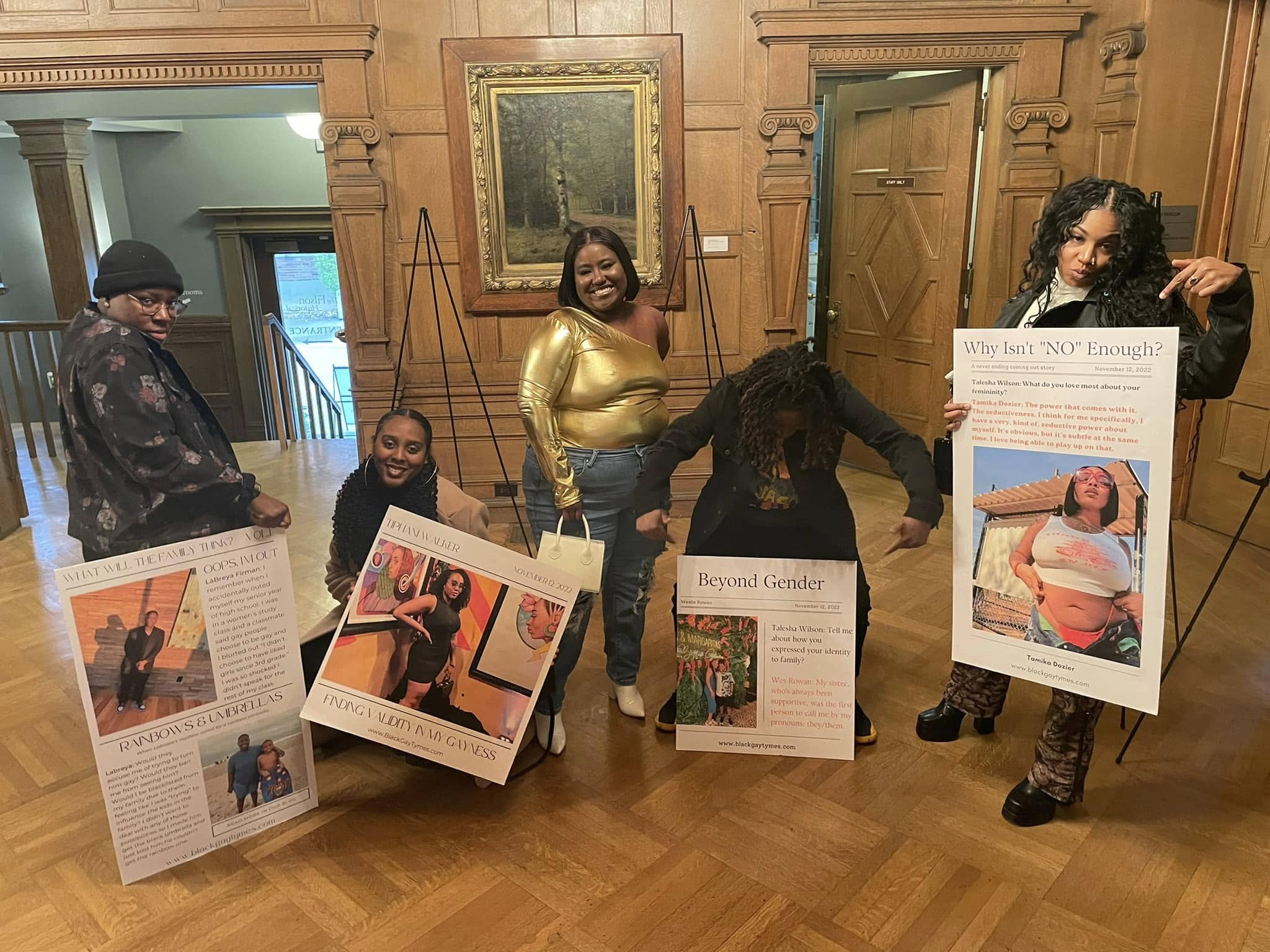
Five people pose in a wood-paneled room with poster boards from an exhibit, including boards titled "Beyond Gender" and "Why Isn't NO Enough?"
(Source: Talesha Wilson via The National LGBTQ Task Force)

As the co-executive director of Black Leadership Action Coalition of Kentucky Action Fund (BlackAF), Wilson’s pride begins in Louisville’s West End. She grew up with a hustler as a father and fearless go-getter for a mother, as both instilled an unapologetic demeanor built by confidence, community, and self-knowing.

“My daddy – he cooked, he did carpentry, renovated homes and was a barber. He was a hustler and he cared about the specifics,” Wilson said. “My mother always allowed me the freedom to speak up, say what’s on my mind. She was very big on ‘Say whatever you need to say to me, because if you can speak up to me, you can speak up to other people.’”

But, for Wilson, growing up in Louisville’s Blackest area also meant recognizing they were the least prioritized. “But, in my lived experience, it’s fun, it’s joy. We are loud. We eat. We talk. We make sure our neighbors are good,” Wilson explained. “That is the story that I want other people in the city to know. West End Louisville is Black culture.”

Her first act of resistance took place at Central High School, when a beloved Pan-Africana teacher Mr. X, was reprimanded during Black History Month for his support of reparations. Wilson worked with her classmates to stage a protest in support of X.

“We [walked] out of the class, right at 1 p.m. since school was over at 2:20,” Wilson said. “I was willing to take that risk. I had an advantage here because with my grandma and mama I wouldn’t be in any trouble. I’m willing to be a voice for my folks…and, over time, I’ve learned how to build their skills and confidence to speak up for themselves.”
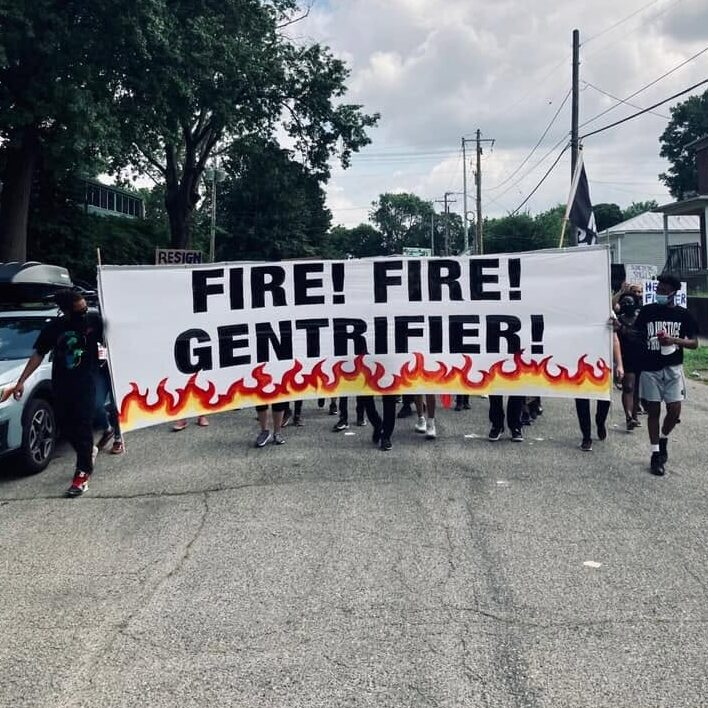
Marchers carry a large banner reading "Fire! Fire! Gentrifier!" down a street in summer 2020.
During Summer 2020, Wilson and Louisville activists called out then-Mayor Fischer for allowing businesses to gentrify Louisville’s East Market District. (Source: Talesha Wilson via The National LGBTQ Task Force)

Wilson Paves The Way

Wilson continued her advocacy work throughout college, serving as an ambassador for the University of Louisville’s LGBTQ+ center. She also interned under Marian Vassar, the executive director of the university’s diversity and equity efforts.

“People weren’t talking about racism, sexism, homophobia, transphobia. People were uncomfortable with being called in to check their implicit biases, and I was helping people navigate those conversations,” Wilson explained. “I started my own community organization called Diversity at The Table where we talked about how gender, race, class and sexuality all intersect with each other on a regular basis.”

Then, tragedy struck on the backdrop of COVID-19. Breonna Taylor was murdered by the Louisville Police Department under the guise of arresting her partner Kenneth Walker, sparking outrage in Wilson’s hometown and across the world. “A friend of mine that I went to high school with kept talking about it, kept talking about Kenneth,” Wilson said. “I didn’t know Kenneth intensely, but me and him rode the same bus [in high school.]”
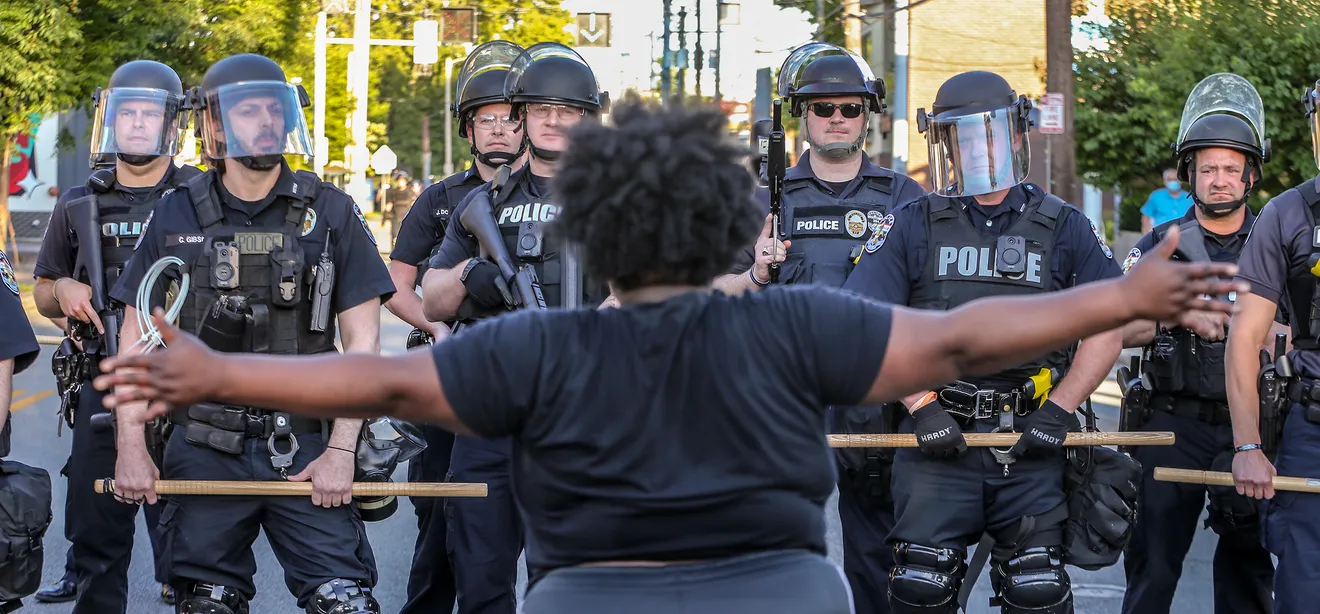
A protester stands with arms outstretched facing a line of police officers in riot gear holding batons.
Talesha Wilson protests in the name of police brutality in light of Breonna Taylor’s death in Louisville. The images inspired the world to fight for justice against anti-Black racism. (Source: Courier Journal via The National LGBTQ Task Force)

Wilson sprung into action, protesting downtown while the Louisville Courier Journal shared jarring images of tanks, military involvement, and officers in protest gear. “It was a war zone, so chaotic, so scary. We were not prepared,” Wilson recalled. Tensions from the protest led to a mass community call-in where Wilson and other politically engaged activists gathered to discuss safety precautions. “I was trying to find venues but I said, ‘I’m just going to open up my backyard, we’re going to have direct action training.’”

“There were so many white people asking, ‘What do you need?’ I was there to tell them what we needed; water, juice, stuff to help with tear gas. We need snacks. We needed everything. I grabbed my poster pads to roll out what they thought needed to be discussed. We talked about, if you’re going to be down there protesting, how to be safe and effective.”

The protests of Summer 2020 actualized Wilson’s mission to normalize advocacy both for the community and individuals. Her work ballooned into other local entities becoming involved such as local churches and community spaces who opened their doors to host those trainings.

“There was no political home at that time, but we were trying to build it,” Wilson said.

Wilson then focused her advocacy through facilitation, as she collected resources after calls for long-term infrastructure investment to engage folks consistently.
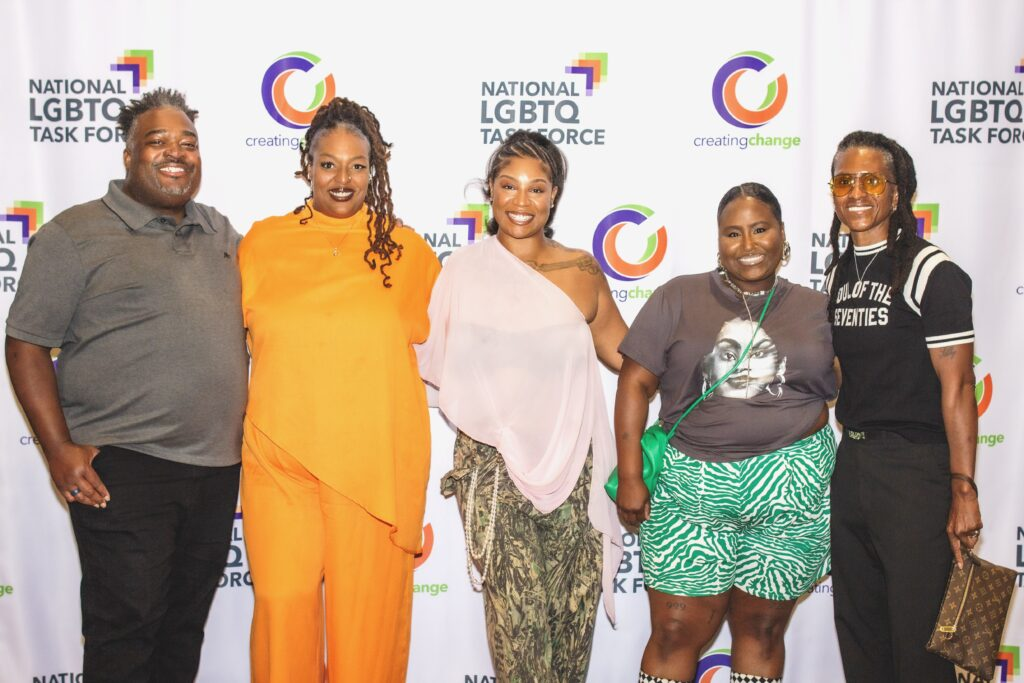
Five people pose in front of a National LGBTQ Task Force and Creating Change backdrop at the Creating Change Kickoff Mixer.
Talesha Wilson and fellow Black, queer movement leaders attend the Creating Change Kickoff Mixer in August 2026 at the convening’s host hotel. (Source: Matthew Pruitt via The National LGBTQ Task Force)

Her current work as co-executive director for BLACKAF reflects this mission, as the organization offers civic engagement, leadership development, and community dialogues on local issues such as community violence/safety, mental health, community care, and a “We Keep Us Safe” series that details how we get to liberation for the Black community.

Now, as one of Creating Change’s local ambassadors, Wilson hopes to build concerted efforts to merge conversations and identities, “where solutions must be intersectional.”

“I really want to get more urban Black gay people to experience Creating Change. I want them to bring that razzle dazzle and that’s what’s missing in Kentucky’s queer spaces,” Wilson said. “If we really want to win, some things are going to need to be shaken up. Get uncomfortable. Be willing and able to respond to questions that haven’t been asked before. I want Black urban gay folks there because we bring all of that. We deserve seats at those tables too.”

About Amber D. Dodd

Amber D. Dodd (she/her) serves as the producer for the National LGBTQ Task Force. She is an award-winning editor, curator, and journalist whose specialty lies in contextualizing Black America. Her work captures similar frameworks, including the Missing & Murdered Indigenous Persons Movement. She owns her own creative brand, blaQplight., a media company that captures authentic Black, queer experiences through education, entertainment, and empowerment.

Amber’s former roles include serving as Howard Magazine Editor, The Spokesman-Review’s Racial-Equity Reporter, and a Culture Freelance Reporter for the Afro-American Newspapers. She is a nonfiction writer, independent communications consultant, and a DJ. Her works can be read in Bi+ Women’s Quarterly Magazine, SWERV Magazine, and the Federal D. Glover Community Wellness Network in Oakland.

This story first appeared on The National LGBTQ Task Force. Republished with permission.

The Our People Our Vote logo on a bright yellow background with orange and teal stripes, above the words Free, nonpartisan election help for Kentucky voters

Early Voting Starts Oct. 29. Our People Our Vote Wants Kentucky Voters to Have Help at the Polls.

With early voting set for Oct. 29-31, Our People Our Vote is working to make sure Kentucky voters have the help they need at the polls. Organizers call it the largest community-led nonpartisan Election Protection program in the state.

Our People Our Vote, founded in 2022 by Common Ground Kentucky, is a statewide civic engagement program with over 20 partners across the Commonwealth.

Partners of the program are trying to get people to the polls and provide nonpartisan voter education, according to Alicia Hurle, 46, co-executive director of Common Ground.

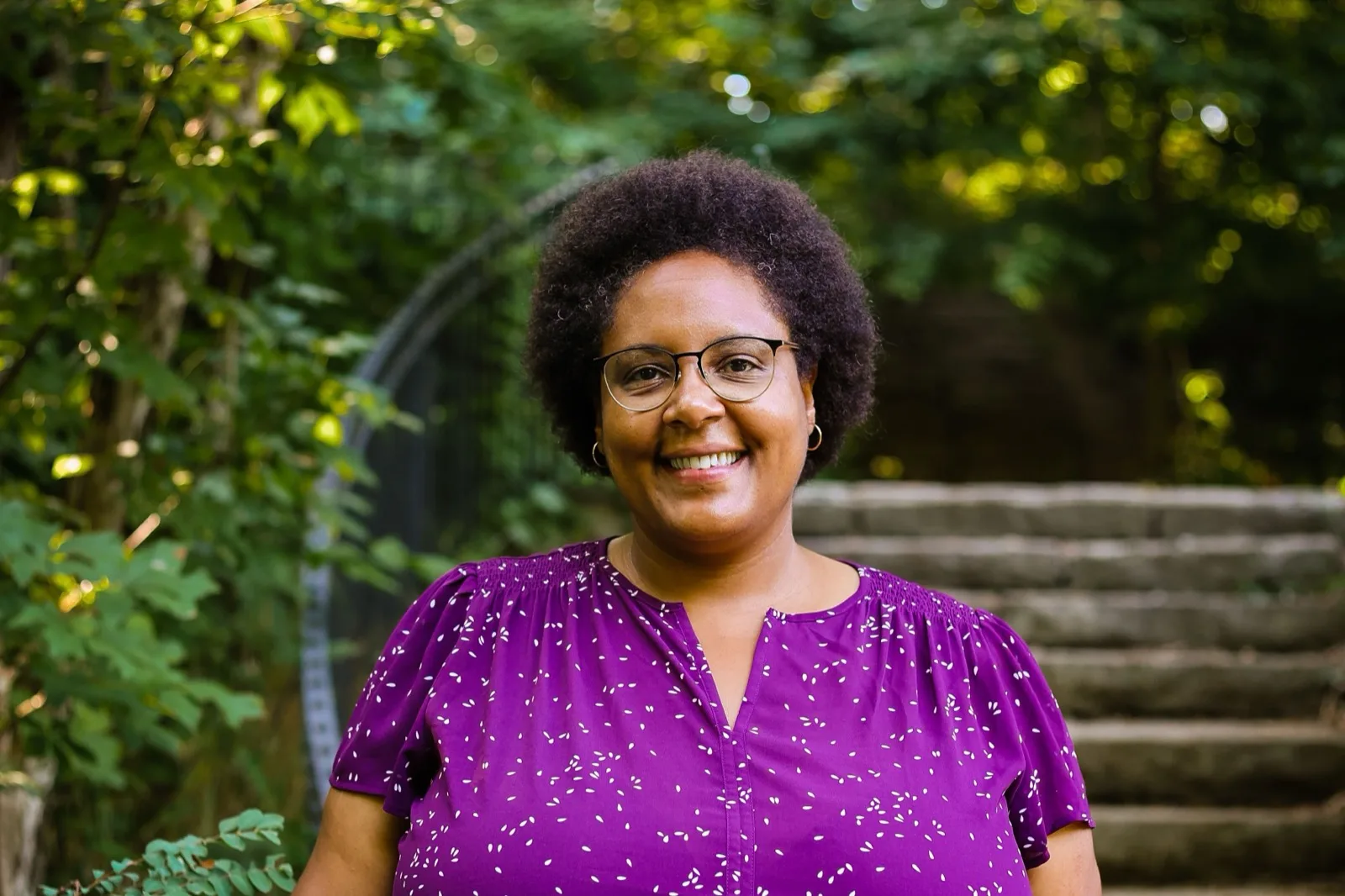
Alicia Hurle, co-executive director of Common Ground Kentucky, smiling outdoors in a purple top in front of stone steps and trees

Alicia Hurle, co-executive director of Common Ground Kentucky. Photo courtesy of Alicia Hurle

“We really want voters to know that they can be here in Kentucky and they can be supported,” Hurle said. “It really is non-partisan information focused on supporting people to make the choices that they want in the ballot box.”

Education will be provided through door-to-door canvassing, phone calls, texts and postcards.

More nonpartisan education is available on the program’s website, where people can find information and answers about the voting process. A nonpartisan guide is available with candidate information, allowing voters to make informed decisions at the polls.

Hurle said it’s important for voters to check their voter registration and polling location, which can be found on the website.

Volunteers with the program aim to reach out to marginalized communities across the state, according to Hurle. Those include people of color, LGBTQ+ folks, new Americans who are eligible to vote, working-class Kentuckians and people with felony convictions who have had voting rights restored through Gov. Andy Beshear’s 2019 executive order. “Our goal is to focus on those folks that have been locked out of the process and who are not turning out at high rates,” Hurle said. “We really want to support them … we call it voter care.”

Our People Our Vote aims beyond voter registration. It also works to help people get to the polls so that they have a higher chance of voting. “We’re trying to change the electorate in Kentucky through this program,” Hurle said.

Local volunteers will be on the ground in certain polling places for people facing issues such as intimidation or suppression at the polls, and help will be available from the program’s office as well, Hurle said. She added that she loves seeing volunteers working with possible voters, and knowing that support can make a difference for people wanting to get involved. “One person, one vote at a time,” she said.

Volunteers are recruited by partner organizations in Common Ground’s coalition, Hurle said. These groups include the League of Women Voters of Kentucky, the Louisville Urban League, the New Americans Initiative and the Americana Community Center.

Common Ground provides these groups with a list of voters to talk to, as well as digital tools. It also handles mailers so that organizations don’t have to use their own budget, according to Hurle.

“Once folks are plugged in, they’ll be invited to participate in community initiatives either connected to the legislative sessions or local campaigns,” Hurle said.

Hurle reminded voters that early voting is available to all Kentuckians, with polls open Thursday, Friday and Saturday, Oct. 29-31, before Election Day on Nov. 3. During early voting, hours and locations vary by county, and in counties that use vote centers, people can vote at any center instead of an assigned polling place.

“I’ve seen the power of folks getting involved in this way. Voting is the first step in a longer journey to get civically engaged,” Hurle said. “My entry point into this work was knowing that it was my duty to vote, but when I got deeper into the democratic process, I found there’s so many other ways to get involved.”

In recent years, Hurle said she has seen a change where more young and working-class voters have been going to the polls, and she finds joy and motivation in knowing that Our People Our Vote is changing Kentucky to be more representative of its population.

Hurle said there’s a lot of fear and confusion surrounding this election following changes from the federal government, which she thinks can be discouraging for potential voters.

“We’re really encouraging people to defend their vote this year, to show up and to make sure their vote is counted,” Hurle said. “This isn’t a time to shrink away from the process. It’s really a time to lean in.”

Disclosure: Queer Kentucky Executive Director Missy Spears serves as board co-president of Common Ground Kentucky, which founded and runs Our People Our Vote.

Rural Appalachian LGBTQ+ students shouldn’t have to choose between opportunity and belonging

The views and opinions expressed in submissions to Queer Kentucky are those of the authors and do not necessarily reflect the official policy or position of Queer Kentucky. Any content provided by our submissions or regular columnists are of their opinion. As a reader, you are always welcome to submit your op-eds through our submission form.

For students leaving rural Appalachian Kentucky communities, college is often framed as a pathway out of small towns and toward opportunity. But for many LGBTQ+ students from these communities, that pathway isn’t just about academics; it’s about survival, negotiation and the search for belonging in spaces that were never fully designed with them in mind.

For many, choosing college isn’t just about rankings, majors or cost. It’s about asking harder questions: Will I be safe? Will I be accepted? Will I have a community where I can authentically exist? Imagine being accepted to multiple top universities, each offering opportunities for a bright future, yet none can guarantee safety, belonging or a supportive environment. Rural communities across Appalachia are often deeply rooted and connected to their place. While that can foster strong support systems, it can also limit access to resources and acceptance for marginalized identities. Students carry those experiences with them as they consider where to go next.

Recent political shifts only intensify this process. Conversations around diversity, equity and inclusion (DEI) have become polarized and, in some cases, restricted across institutions. For LGBTQ+ students, especially those from rural backgrounds, these changes shape daily life, influencing whether they stay safe, supported or seen on campus.

What emerges is a pattern of conditional belonging. Many students arrive with cautious optimism, only to encounter environments where support exists but is inconsistent. Resources may be limited or restricted. Faculty and staff may be well-intentioned but not always equipped. Policies may exist on paper but feel distant in practice. The result is constant navigation, or code-switching, to determine when to be visible and where it is safe to fully exist as an authentic member of the LGBTQ+ community.

And yet, students are not passive. They create spaces of belonging through friendships, student organizations and online communities, often filling gaps institutions leave behind. This gap between institutional promises and lived experiences matters. Students should not have to choose between opportunity and belonging.

So tell us your story. How were you able to be your authentic self as a queer person while choosing a college? How did you find your community and build welcoming spaces on campus? What has your academic journey looked like, and how have you built your true lived experience?

This study is looking for those stories. If you’re an LGBTQ+ undergraduate student, 18 or older, from a rural Appalachian Kentucky community, you’re invited to take part in a research study on how identity, place and the current political climate shaped your choice of a public four-year college or university. Participation involves a 45- to 90-minute virtual interview, with questions provided in advance. If this resonates with your experience, your participation matters to this work. Real change doesn’t happen in silence. It happens when those most impacted are heard.

Participation is confidential. Names, phone numbers, emails and identifying information will not be shared outside of the research findings.

To learn more or to participate, contact Channing Lawson at [email protected].

About the researcher: Channing Lawson (He, Him, His) I am a bisexual man from a small rural Appalachian community of Eastern Kentucky. Currently pursuing my doctoral degree in higher education at Morehead State University, where I’m researching what factors LGBTQ+ students from rural Appalachian communities of Eastern Kentucky consider when choosing a public four-year post-secondary institution especially in the current political climate.
A field of corn glowing in the sun.

At Black Soil KY’s Farmacy Markets, Narcan Sits Beside the Produce

From the war on drugs to the legacy of the crack era, Black people in the U.S. have been systemically and perpetually harmed by both drug use and public health disparities. That sobering reality is also true in Kentucky, where a Lexington nonprofit is working to build safer futures by changing how support is delivered, integrating harm reduction into already effective agricultural programming.

“We are trying to think outside of the box around crafting unique, one-of-a-kind programming while providing a critical community need,” said Ashley C. Smith, Executive Director and Co-founder of Black Soil KY.

Established in 2017 by Smith and her husband, Trevor Claiborn Sr., the organization’s mission is to “reconnect Black Kentuckians to their heritage and legacy in agriculture” through programming, events, and community building.

From food access to harm reduction

Since its founding, Black Soil KY has worked with farmers and community partners to host events that make agricultural education and fresh food more accessible to Black communities across the state. While the organization was effective at increasing access and education around food, Smith saw an opportunity to develop programming rooted in the idea that drug abuse, food insecurity, and public health are intersectional problems that demand intersectional solutions.

In 2023, the number of drug overdose deaths in Kentucky declined for the first time since 2018, according to the Kentucky Injury Prevention and Research Center, but not every community felt that progress. That same year, Black Kentuckians experienced an 8% rise in overdose deaths. More broadly, Black people in America are 46% more likely to die from a drug overdose compared to other groups, the U.S. Department of Health and Human Services reports.

The opioid crisis is not the only harm felt more intensely by Black communities in the state. Kentucky currently ranks as the state with the second-highest rate of food insecurity in the country, the Kentucky Center for Economic Policy reports. Data indicates that Black communities across the state are nearly twice as likely to be food insecure, compared to White Kentuckians, according to Feeding America.

These are the disparities that Black Soil KY intended to close with a new approach to community care.

In 2024, in partnership with The Foundation for a Healthy Kentucky, a nonprofit that works to reduce health disparities while promoting health equity across the state, Black Soil KY acquired funding from Vital Strategies, a global public health organization, to begin integrating harm reduction into its already effective portfolio of programming.

Harm reduction is a spectrum of strategies that are intended to minimize the harmful nature of drug use. Such strategies include providing clean syringes, sexual health testing, contraceptives, fentanyl testing strips, counseling, mental health support programs, and more. Harm reduction aims to minimize the harmful effects of drug use rather than ignore them.

First, the organization went to the farmers. In 2024, the nonprofit trained 30 small and mid-size farms on harm reduction, including signs of overdose, Narcan usage, and how to respond to the substance abuse they might come across in their work. The organization saw farmers as a priority because of how inseparable their work is from the communities they serve, and how intrinsically connected they are to an individual’s well-being, according to Smith.

“We trained Kentucky small- to mid-sized farms: farmers, farm operators, and their families around how to be harm reduction first responders,” Smith said. “They oftentimes live in rural communities, but travel to urban communities to make deliveries… And we were hearing stories from farmers who make deliveries in communities afflicted by substance use and abuse disorders.”

After they built the training model for farmers, Black Soil KY expanded their harm reduction programs into their other community-centered events. In 2024, the group first began including harm reduction supplies as part of their free food distribution in Central Kentucky. After seeing the success of these resources, Black Soil KY opened two neighborhood “farmacy market” locations in Lexington in 2025.

The “farmacy markets” were a first-of-its-kind concept, providing harm reduction supplies and educational materials right alongside fresh food directly within communities. Alongside fresh produce, these markets provide communities with tampons, condoms, and harm reduction necessities, including Narcan and fentanyl testing strips.

“All of these steps, these multidisciplinary, interdisciplinary approaches are really seeing people for who they are and meeting them where they’re at, while also increasing their recovery capital around their nutrition and their health and their wellness,” Smith said.

This year, the organization launched its “Shop N’ Learn Community Series,” a partnership with Vital Strategies and the Kentucky Department of Public Health, part of a broader effort to combat rising overdose rates among BIPOC and underserved populations. The monthly event is “focused on expanding awareness and implementation of harm reduction strategies to often overlooked, hard-to-reach, underrepresented communities in relation to harm reduction and recovery care.” Individuals who attend a “Shop N’ Learn” event also receive a $40 gift card.

The series has been hosted in part by guest speakers, who share their own testimonies and expertise around recovery and healing.

“I am from the community, and I had an opportunity to go share my lived experience with the same community that I was brought up in — as terrifying as that is for me being only three years sober,” said Tywanna White, a recovery coach with Voices of Hope, a recovery community center in Lexington. “I said yes to an opportunity to be able to carry the message. The people in the audience had so many questions, and I was able to educate them on some things that I was taught from this same community.”

White was one of the featured speakers at a “Shop N’ Learn” event in June. According to White, this programming is exactly what it takes to dismantle health disparities facing Black Kentuckians.

“Seeing those faces looking right back at me wanting to be open, it shifted something. It told me that there’s a need for this…” said White. “I didn’t have any voices trying to help educate me on my substance use. It was so normalized. So no one even knew that I was struggling because it’s so normalized in the Black community.”

According to Smith, around 10,000 community members showed up at their events in 2024 and 2025. The impact, beyond attendance, speaks for itself. Smith said attendees of their programs report progress.

“We’ve really been able to see a lot of positive outcomes like reducing interpersonal and inter-communal violence,” Smith said.

Civic engagement as harm reduction

This programming is just the beginning of how Black Soil KY plans to build deeper inroads across communities that need care. Civic engagement is among the many solutions Black Soil KY is exploring to heighten awareness of health disparities.

In 2024, just 48% of Black Kentuckians voted in the general election. That is compared to over 70% of White Kentuckians. There is a growing body of research pointing to a strong correlation between civic engagement and public health: The more engaged a community is, the healthier they are. Black Soil KY identified these disparities and created new programming to empower Black communities in Kentucky to have a stronger say in what policies and people are given a platform.

In September, Black Soil KY, in partnership with the Lexington Urban League Young Professionals, a network of young professionals advancing public service and professional development, is exploring how civic engagement will take center stage as a new harm reduction topic in their “Shop N’ Learn” series.

For the first time, the workshop will focus on how to participate in elections and the importance of voting. The workshop will bring folks together who have overcome or are currently working through substance abuse, and support them in getting registered to vote while providing educational materials on the choices they have in November.

“We can really facilitate getting everyone active and engaged. And we truly believe that’s also a part of harm reduction: being active in your community,” said Smith.

Black Soil KY’s programming has become a staple in communities, with leaders celebrating how the organization addresses both a person’s material needs while safeguarding their emotional and physical well-being.

“A person wants to be heard, they want to be seen, they want to feel like they’re human. And so it starts with getting to know the people off paper, knowing what it is they need at that moment, and then focusing on removing the substance later…” said White. “I think it’s a beautiful thing to incorporate harm reduction in these same communities where harm happens and also center it around food. That is the medicine.”
This work was supported by the 2026 CNP Media Fund. #CNPMediaFund

Missy Spears speaks into a microphone at an outdoor event, with drag performers standing behind her.

How Missy Spears’ Humor and Advocacy Evolved Into Powerful Local Leadership

Editor’s note: This story was originally published by The National LGBTQ Task Force on October 1, 2026, and is republished here with permission. It profiles Missy Spears, Queer Kentucky’s executive director.

“I’m a queer kid with a traumatic childhood, we end up really funny.”

For activist Missy Spears, comedy is ever-present. A viral moment of social media posts poking fun at a public mishap. The way a politician vehemently denies silly allegations purported by The Onion.

“I apologize for him,” Spears says, as her cat waltzes into her camera. “He’s very emotional.” Political satire surpasses species, as she helped the animal department fix 40 cats under her first self-led, community project – a TNR campaign “Cut Your Balls Off Covington.”
There’s always room to work, too. “I wrote a grant for $500 to get those cats fixed,” Spears said. “My background is from running my own projects in the community for eight years. Then I worked at one nonprofit for a year and consulted for another.”

Humor, she says, opens more doors than tough talks or too-long-didn’t-read social media posts. What was once cheeky political satire has turned into a life dedicated to elevating LGBTQ+ communities. “At first, it was just saying things on the Internet that other people were too scared to say to see if I could forward along or force conversations, then it turned into finding ways to raise money for causes,” Spears said. “Humor can be a good BS barometer.”

Missy Spears, executive director of Queer Kentucky, in a portrait headshot.
Missy Spears serves as the executive director of Queer Kentucky, the state’s only LGBTQ+ newsroom. Her impact has led her to becoming a trusted leader within the Creating Change 2027 Local Ambassador Program. (Photo by Ryan Grant)

It adds an edge to Missy’s decade of advocacy through an indomitable work ethic, people-first attitude, and multi-faceted leadership as executive director of Queer Kentucky, the state’s only LGBTQ+ newsroom.

LOL, JK

Spears was always politically engaged, including establishing a pantry with local queers in Covington and raising funds for queer-related causes.

A jokester at heart, she created a local “Cards Against Covington” parody of Cards Against Humanity in 2015. “This was just one example of using satire to call attention,” Spears said.

The party-favorite tests gamers on how quirky and crass they can be, compiling answers that turn historic misfortune into comedic oddity. Using real-life events of Covington, Kentucky’s history, the game poked fun at local entities such as University of Cincinnati naming its practice field after well-known racist Marge Schott and the city’s brash history of redlining.

“We sold a couple thousand of them throughout the city in a relatively short time, and it was…. an effective way to at least start a conversation.”

Spears witnessed an accidental synergy that created and rallied folks to sharpen their political education.

“Progressives were on an upswing of power, the Obergefell v. Hodges opinion, and the Me Too Movement was just about to take off,” she said, calling the 2010s a “perfect storm” of pop culture for political jabs and collective accountability.

The game’s reception influenced city officials to speak with Spears to clear up any misconceptions about their work and their current goals for the city. In turn, Spears became a trusted community source that Covington and neighboring cities could engage with. “I realized very quickly when I started to say things on Facebook, enough people would comment that a city official would respond to my page,” Spears said. “It was the power of people talking about these folks and poking fun at things would make them pay attention and sometimes change. That’s where and how I built my network; I just made fun of so many politicians that they would have meetings with me and form relationships.”

What Can Grow Bigger From This?

In March 2018, Spencer Jenkins created Queer Kentucky as a means of blog-era storytelling through vibrant magazine writing. But, as attacks on trans communities accelerated, Queer Kentucky’s mission matured.

“I also never thought my little queer blog would develop into a sustainable nonprofit recognized across the globe,” Jenkins said in a 2023 statement released by the Northern Kentucky Tribune.

Recognizing Spears’ outreach, advocacy and effectiveness, Jenkins announced her as executive director. Under Spears’ leadership, fun, buzzing moments evolved into hard news that queer Kentuckians could be educated and informed by.

“Our focus on queer health, particularly queer physical and mental health, cultural health, and civic health, is coming at a crucial time for an at-risk population that has been under attack for quite some time,” Spears said in the announcement.

Missy Spears at the NLGJA annual conference in 2026.
Missy Spears at the NLGJA Conference in 2026. (Source: NLGJA)

The stories Queer Kentucky tells, she says, not only dispel harmful misconceptions, it unites queer pockets of the state by prioritizing the needs and future of their communities. Three years later, recent stories include stories surrounding a police officer’s multiple federal lawsuits and a how-to guide on where to find HIV-competent doctors throughout the state.

“As long as you know your community, you can figure out what stories people need,” said Spears. “It’s why we launched a research project in 2024 with The Moore Lab researchers who helped us track the lived experiences of Kentuckians including discrimination, health access, and questions about HIV and PREP+, substance use and harm reduction.” Their coverage has earned recognition from GLAAD, including two nominations for Outstanding Independent Journalism and Best Print Article.

Given the newsroom’s success, Queer Kentucky shares the gospel to whoever’s willing to listen. Spears, along with fellow newsroom leaders, appear in journalistic spaces to discuss their success in niche storytelling.

Missy Spears, far left, on the NLGJA panel “If We Built Journalism Today, Would We Call it a Newsroom?” in San Francisco.
Missy Spears (far left) participates in the NLGJA “If We Built Journalism Today, Would We Call it a Newsroom?” panel at the annual conference in San Francisco. (Source: NLGJA)

“It’s been incredible to see us get writers from The Advocate, The Hill, and Washington Post writing for Queer Kentucky, but we still have folks born and bred in Kentucky that have no journalism experience like myself,” Spears said. “I love it because it’s like no one can tell the story better than someone that’s living there for a lot of these things.”

While 2027 looms, Spears has started counting down the days until Creating Change. She’s using her role as an ambassador to spread the news of The National LGBTQ Task Force coming to town, while encouraging Kentucky’s regional organizations to work together during the largest LGBTQ+ movement skill-building event.

“They get to learn from organizations that have more resources and ask; what have they found that worked? What skill sets or software could they tell us about? Is there anything that we can take from what they’re doing and scale it down? I would really love for folks outside of Kentucky to attend Creating Change to question their own stereotypes about red, Southern states,” Spears said. “I also really hope they learn how to pronounce Louisville.”

Missy Spears hugs National LGBTQ Task Force staff at the Creating Change kickoff mixer in August 2026.
Missy Spears hugs The Task Force staff at the Creating Change Kickoff Mixer in August 2026. (Source: The National LGBTQ Task Force)

This story first appeared on The National LGBTQ Task Force. Republished with permission.
Officer Zachary Stayton approaches Brandon Hill during the Roebling Bridge protest on July 17, 2025, captured on Covington Police Department body camera footage

Roebling Bridge protester arrested in court on felony riot charge

Update: the Oct. 5 arraignment

By Molly Stevens, Queer Kentucky.

During a routine pretrial hearing on the morning of October 5, Taylor Marshall was taken into custody on a felony indictment. Bond was set at $2,500. The charges currently filed against Marshall are first-degree rioting, obstructing governmental operations, second-degree disorderly conduct, and resisting arrest. The most severe of these charges is first-degree rioting, a Class D felony.

Per Kentucky Revised Statutes 525.020, rioting in the first degree constitutes knowingly participating in a riot, and that riot resulting in a person other than a participant of the riot suffering physical injury, or substantial property damage occurring. A “riot” per Kentucky Revised Statutes 525.010 is a public disturbance involving an assemblage of five (5) or more persons which by tumultuous and violent conduct creates grave danger of damage or injury to property or persons or substantially obstructs law enforcement or other government function.

At an arraignment in Kenton County Circuit Court that afternoon, Marshall’s attorney, Ben Potash, entered a not guilty plea and told the court that Marshall’s bond had been posted. He then moved for the bond to be rescinded and for Marshall to be released on their own recognizance, arguing that Marshall has no prior criminal record. Judge Kate Molloy granted the motion.

Dozens of community members packed the courtroom, occupying every available seat. After the arraignment, Potash said, “My client is devastated; my client has a life. They were already pulled out of their life for a year over this.”

He called the felony charge disproportionate. “Whatever you may think about it, having this poor person run through the ringer for over a year for this, and now facing a felony charge is just completely out of proportion to whatever you think might have happened that day,” Potash said.

When asked whether Marshall knew they would be detained that day, Potash said, “We didn’t know about the felony indictment until I checked the records this weekend. This was not a transparent process. From where I sit and where my client sits, it sure looks retaliatory.”

Marshall is one of four Roebling Bridge protesters who sued Covington and its police department in July 2026 over the police response to the march. Marshall’s suit, filed in Kenton County Circuit Court, names Officer Ross Woodward, an unidentified female officer and the city. It alleges Woodward caused a concussion that left Marshall with serious memory loss and aphasia, and it states that Marshall never resisted arrest, one of the charges Marshall now faces. Suzanne Bratt, Logan Imber and Brandon Hill filed similar suits in federal court. The civil cases are ongoing.

The next status hearing for this case will take place November 30, at 1:30 p.m. at the Kenton County Justice Center, 230 Madison Avenue in Covington.


Originally published Oct. 5, 2026

Community News, Queer Kentucky.

Taylor Marshall, the final protester still facing charges from the July 17, 2025 Roebling Bridge protest, was indicted Monday on one count of felony riot and taken into custody at a routine pretrial hearing, according to a press release issued the same morning. Bond was set at $2,500.

The protest began on the Cincinnati side of the bridge, where about two hundred people turned out against the detention of Imam Ayman Soliman, a former chaplain at Cincinnati Children’s Hospital whose visa and asylum were revoked before Immigration and Customs Enforcement arrested him. Dozens of demonstrators then marched across the Roebling Bridge into Covington, where 15 people were arrested. Two journalists were among those charged.

The march fell on July 17, the fifth anniversary of the death of civil rights leader and U.S. Rep. John Lewis, and coincided with nationwide “Good Trouble Lives On” demonstrations held that day. Lewis was 25 when Alabama state troopers fractured his skull on the Edmund Pettus Bridge in Selma in 1965, during the voting rights march that became known as Bloody Sunday.

Covington police officer Zachary Stayton was placed on unpaid administrative leave in November 2025 after a department investigation found he did not follow proper procedure at the protest. Video released by the Covington Police Department and reviewed by Queer Kentucky showed Stayton punching protester Brandon Hill in the head while Hill lay on the ground. Covington police said at the time they believed Hill had a gun. Stayton completed remedial training before returning to duty.

Hill sued the department and two officers in federal court in July 2026, alleging excessive force and civil rights violations. In a statement to Queer Kentucky at the time, the city of Covington declined to comment on pending litigation and noted that a Kenton County judge had reviewed the evidence and found probable cause for the felony charges against Hill.

Queer Kentucky has followed the case since 2025, including the community response to Stayton’s suspension and a broader look at policing, civil rights and community safety in Northern Kentucky.


Full text of the Oct. 5 press release

Reproduced in full and unedited, as issued on October 5, 2026.

Covington, Kentucky: Urgent – new felony indictment in Roebling Bridge case.

This morning, Taylor Marshall, the final defendant in the Roebling Bridge arrests last July, was indicted on one charge of felony riot. The vigil and march were in support of Imam Ayman Soliman, who was being detained by ICE. Despite being offered the same plea deal that most of the other defendants have been offered over the past year, Marshall was denied that plea at a September 16th hearing. Marshall was taken into custody this morning during their routine pretrial hearing and bond has been set at $2500.

Marshall’s attorney, Ben Potash, said of the case, “I have never seen a protester arrested in court for something that may have happened a year prior. I have never seen a judge reject a plea because a defendant failed to admit to an unindicted conspiracy. Taylor’s incarceration is unjust and unfair and it does not fit in with the rule of law. We are going to defend Taylor and avail ourselves of every legal remedy that we have.”

Their next court date is today October 5, 2026 at 1:30PM at the Kenton County Justice Center at 230 Madison Avenue, Covington, KY 41011 Room 7A in front of Judge Kate Molloy.


HIV self testing kits sitting on a ledge.

Federal Cuts “Handcuffed” BIPOC Harm Reduction in Kentucky. Communities Are Stepping Up.

In April, the Substance Abuse and Mental Health Services Administration (SAMHSA) released a letter notifying funding recipients that the agency is taking a “clear shift away from harm reduction,” including eliminating funding for fentanyl testing strips, clean syringes and needles, and “overdose hotlines.”

Harm reduction at its core is “a set of practical strategies and ideas aimed at reducing negative consequences associated with drug use,” according to the National Harm Reduction Coalition. The organization further details that some of those strategies could include the safer use, managed use, abstinence, meeting people who use drugs “where they’re at,” and addressing conditions of use along with the use itself.

SAMHSA’s decision has had immediate and life-threatening consequences for Kentucky organizations doing the work to close critical gaps in care for those in need, including for marginalized people.
“When they put this letter out there, they literally just handcuffed a lot of people,” said Shreeta Waldon, executive director of the Kentucky Harm Reduction Coalition (KyHRC), a Louisville-based nonprofit that works to reduce substance use disorder overdoses and deaths.

The letter cited a White House executive order from July 2025 to justify the policy changes. The order, “Ending Crime And Disorder On America’s Streets,” details those changes among a list of other line items including homelessness and crime. “Do not fund programs that fail to achieve adequate outcomes, including so-called ‘harm reduction’ or ‘safe consumption’ efforts,” the order reads.

It describes such strategies like harm reduction as ineffective; however, harm reduction is actually an evidence-backed practice that has been backed by scientific research.

What Kentucky Lost When SAMHSA Cut Harm Reduction Funding

These changes and attacks on harm reduction initiatives have hit the already limited ecosystem of harm reduction services built by and for Black and brown communities.

“SAMHSA award terms are now prohibiting federal grant funds from supporting several traditional harm reduction supplies, including syringes for illicit injection, safer smoking supplies, and fentanyl and other substance test strips,” Waldon explains. “That means that organizations are now navigating a much narrower definition of what federally funded harm reduction can include and not include.”

Recent research revealed that Trump’s elimination of federal funding for programs that provide syringe exchange and other harm reduction interventions will directly contribute to an increase in overdose deaths and non-fatal overdoses. Outcomes that Black and brown communities already feel more intensely.

KyHRC is one of the few groups in the state still delivering harm reduction care and resources for BIPOC communities, despite these concerning changes. In addition to new limitations, Waldon’s group immediately lost a $400,000 grant after the SAMHSA decision. However, instead of deferring programs or shortening their impact, the organization found new ways to deliver care to communities.

KyHRC began working with partners across the country to source harm reduction resources that they no longer could get from federal funding. Waldon mentioned that, among other groups, the Connecticut-based organization Reduce Harm Inc. has supported KyHRC with clean syringes, testing strips, and other supplies that are no longer accessible.

The redefinition of what the government will fund comes after a well-documented body of evidence pointing to harm reduction as a key strategy to prevent drug-related deaths. Studies show that fentanyl testing strips prevent overdoses, and research shows that providing clean syringes prevents the transfer of blood-borne diseases. A 2025 study including 67 communities, some of which were in Kentucky, found that when offered harm reduction strategies, those communities experienced a 15% reduction in non-fatal opioid overdoses and an estimated savings of $190,100 in healthcare spending per community.

Why Black Kentuckians Feel the Cuts Hardest

For Black communities in Kentucky, these new limitations are felt even more deeply than their neighbors. In 2023, the overall number of drug overdose deaths in Kentucky declined for the first time in years, while Black Kentuckians experienced an 8% rise in overdose deaths. Black Kentuckians continue to face worse health outcomes, less access to regular health care, and higher mortality rates compared to other groups. It is these realities that make harm reduction and community resources for Black and brown people all the more critical, according to the organizers delivering care despite greater obstacles.

“If you are trying to give me aid and help me based on the statistics that you have for white people, it’s not going to help me because it’s not made for me,” said Adria (AD) Shouse, a master barber at Well Groomed Barbershop Parlor.

Shouse is a barber with the African American Barbershop and Beauty Salon Initiative (BBSI), a public health program part of Project Ricochet, a nonprofit organization working to improve outcomes for minority youth in Lexington and beyond. BBSI transforms “relationship-rich environments” like barbershops and beauty salons into spaces where communities can get care and education related to diabetes, sexual health, mental health, drug use, and harm reduction.

“I’ve seen changed behavior in people that I’ve been cutting for years that have utilized resources through BBSI,” said Shouse.

BBSI provides community events based out of these safe spaces that bring care, including harm reduction resources, right to the communities who need it. This direct level of intervention is what Shouse says is missing in much of the conversation around BIPOC public health funding.

“The funding is different when it comes to people of color or minorities,” said Shouse. “They’re trying to keep certain communities and certain people in certain places because it works to their advantage.”

Shouse’s clients are predominantly Black men and young people, and in her work she fulfills a material need while offering support for other challenges.

Doulas Trained in Harm Reduction

It is that same model that other community leaders are implementing to provide support for Black pregnant people as well.

Granny’s Birth Initiative (GBI) is a nonprofit based in Louisville that supports Black parental health, partnering the care a pregnant person needs with the harm reduction resources they are unable to find elsewhere. That starts with training their doulas on harm reduction strategies, including trauma-informed care and Narcan usage.

“We make sure that our doulas are trained in that because doulas do provide resource navigation and it should always be non-judgmental support,” said doula Alexa Scisney, founder and executive director of GBI. “We want them to be well trained on not just keeping a straight face, but genuinely and truly understanding the type of resources that are needed.”

Black pregnant people are at least three times more likely to die due to a pregnancy-related condition, compared to their White counterparts. In Kentucky specifically, 82% of pregnancy-related deaths are deemed preventable. About 1 in 20 pregnant people use illicit drugs during pregnancy. This puts the work that GBI does as ground zero for public health progress and reducing harm.

“I know that doulas are an industry that is new to Kentucky, but a doula is somebody that’s supposed to be providing physical, mental, and emotional, non-judgmental support,” said Scisney. “And here at GBI, that non-judgment is something that we really highlight because it is not our job to do harm to people already seeking harm reduction resources. Our doors are always open.”

In addition to the SAMHSA decision, resources for harm reduction in Kentucky have been rocked by funding cuts and lack of consideration for how harm reduction impacts public health. In May, the University of Kentucky announced that it would formally end its HIV/AIDS prevention and treatment organization. The Target4 Project was part of this elimination, which provided HIV/AIDS intervention and services in addition to harm reduction supplies and targeted outreach.

Kentucky public health leaders say they will continue to step up in their communities, despite the new obstacles in front of them.

“Let us be the voice because we are the people who have experienced it. We’re the closest to it. We’re the closest because we live it every day,” said Waldon.

While the Trump administration and SAMHSA cut opportunities and funding, harm reductionists and community leaders continue to show up in new ways for their neighbors. While groups still hope for more permanent and sustainable funding, it is the promise of safer, stronger communities that pushes them forward, they said.

“For me, harm reduction has always been the radical decision to believe that every human being is worth keeping alive before they change, before they recover, before they become who somebody else thinks they should be,” said Waldon.
This work was supported by the 2026 CNP Media Fund. #CNPMediaFund

Lexington councilmember Liz Sheehan, who introduced the city's data center moratorium, speaking on stage.

It’s a Pause, Not a Ban: Liz Sheehan on Lexington’s Data Center Moratorium

During a meeting of the Lexington Fayette Urban County Government Council on June 9, Lexington became the first major Kentucky city to enact a moratorium on data centers.

Councilmember Liz Sheehan, who represents Lexington’s 5th district, introduced the resolution, which passed unanimously and without debate.

Sheehan, who is also Kentucky’s first openly bisexual elected official, spoke with Queer Kentucky to help make sense of the moratorium and shed light on all things data center in the Commonwealth.

The following interview has been edited for length and clarity.

What Lexington’s Data Center Moratorium Actually Does

Tell us a little bit about what a moratorium is, and why it might be a useful legislative tool.

The basic definition of a moratorium is that it’s a pause; in this case, it’s a pause on development approvals around data centers. It allows us to pause any approvals, update our policies and definitions, and then resume development after that.

Some people hear the word moratorium and it sounds scarier than it really is.

I think in our community people are also confusing the term moratorium with a ban. A ban is a [permanent] policy, but a moratorium is temporary.

Why does it seem like these data centers always end up impacting marginalized communities?

It comes down to property values. A development company is going to be thinking about their cost and looking for land that is available at a lower cost to them. Due to historically discriminatory practices like redlining, we’re seeing overlap here on where data centers are going.

We see headlines full of protests against data centers. Do you have any constituents contacting you in support of data centers?

I do have constituents on both sides of this issue. Some people see great benefits in increased technology in our world, including AI. Some folks are concerned about limiting data center development because our modern society is supported by online mechanisms.

If you think about newspapers going out of print and moving online, or online banking, or healthcare records, or social media, our world is increasingly online. So we do need infrastructure to support that, but I think there are disagreements about what that infrastructure looks like and where it can go.

What Lexingtonians Can Do

Is there anything that we can do to reduce the demand for data centers?

Our world is increasingly online, but I do think we can hold companies to higher standards when it comes to negative environmental impact. For instance, there are differences in cooling systems for data centers; a closed-loop system uses less water. Or you can use alternative energy to support the data centers to reduce energy demands of fossil fuels.

Technology changes so fast. I am worried that we are over-developing. For me, it’s also about whether we take a beat and see if we actually need all of this. Because if technology around computing power changes in the next 2-5 years, and now we have all of these humongous data centers built that could occupy half of the space and need half of the energy, do we need to do this now?

Besides public comment, is there anything Lexingtonians can do to express their opinions?

We have a fact form called Engage Lexington where people can go and give comments and learn more. Not everyone can come to the government center (council meetings), and this provides us an opportunity to not only hear from the public but also educate them about what we’re working on so we can get to those nuanced conversations.

We need people to come to the table to talk with us about the specifics of what they want to see and what they don’t want to see. In Lexington, there isn’t an appetite at all for hyperscale data centers; our communities seem to be against them, our developers aren’t looking to develop hyperscale here. But then we do have to figure out what is the (size) threshold for a data center, versus one that we think is too much.

If you want to see energy caps, tell us what you think that energy cap should be; if you want to see square footage changes, tell us what you think that should be. That’s where our conversation is headed, is trying to find that breaking point of what is acceptable and what is not.

We’re really working to find a solution that supports our community, supports our existing businesses, but that isn’t negatively harming our environment.

The Lexington Herald-Leader logo over a black-and-white photograph of stacked newspapers.

Lexington Herald-Leader Layoffs Put Kentucky Local News at Risk McClatchy Media, the parent company of the Lexington Herald-Leader, laid off a total of 13 staff

McClatchy Media Company’s recent round of layoffs will likely speed up the already rapid decline of Kentucky’s media landscape, journalists and journalism experts said.

The journalists who remain at The Herald-Leader are now expected to produce the same quality journalism with roughly half the newsroom staff, according to former staffers. And laid-off journalists are worried about how the loss of reporters will impact communities, particularly more rural parts of the state without many alternative news sources.

“We know that the math says that if you lose this many people who produce stories over a year’s time, that’s not replaceable,” said Benjy Hamm, director of the University of Kentucky’s Institute for Rural Journalism and Community Issues. “Hundreds and hundreds of stories [will] go untold now because of this loss.”

McClatchy laid off a total of 13 Herald-Leader staff–12 reporters and one editor–cutting the newsroom by 52 percent and eliminating entire beats, former Herald-Leader staffers said. Now, seven weeks before the November mid-term elections, the paper has two reporters in charge of covering Lexington city and state politics. And the paper lost its only Eastern Kentucky and environmental reporter.

“The fact that our company has been losing money is no secret, but I think layoffs of this scale were surprising to most people involved,” said Alex Acquisto, an award-winning statewide enterprise reporter covering politics and public health for the Herald-Leader and union guild representative who was laid off last week. She spearheaded the newspaper’s coverage of the COVID-19 pandemic before turning to the effects of climate disasters as well as the impacts of Kentucky’s near-total abortion ban and transgender care bans.

And it’s not just the Lexington Herald-Leader – the media company laid off more than 90 employees across 13 newspapers in eight states last week, including The Miami Herald, The Sacramento Bee, The Kansas City Star, and The Lexington Herald-Leader, Kentucky’s second-largest newspaper.

The newspaper giant has gotten rid of staff and entire newspapers in recent years and has been plagued by debt and declining print revenue, even filing for bankruptcy in 2020. That same year, the formerly family-owned business was sold to the hedge fund Chatham Asset Management. In 2025, the company closed its Washington, D.C. bureau and sold two of its Georgia papers, The Macon Telegraph and The Columbus Ledger-Enquirer, to the state subsidiary of the National Trust for Local News this past July.

Kentucky’s rural press is shrinking with several areas considered news deserts. There are six counties in the Bluegrass state without a single news source and 88 with only one, according to a 2025 report from The State of Local News Project from Northwestern University’s Medill Local News Initiative.

Many small towns in Kentucky, including in Eastern Kentucky, have their own daily newspapers that publish an issue at least once a week, like Whitesburg’s The Mountain Eagle and Louisa’s The Levisa Laser.

But as community newspapers struggled to stay afloat, many of Kentucky’s small communities looked to The Herald-Leader for statewide news and their deep politics coverage to stay informed, journalism experts said.

The daily newspaper’s only reporter based in Eastern Kentucky, Austin R. Ramsey, was one of the staffers impacted by the layoffs.

Acquisto argued that while the layoffs will ultimately hurt the news landscape of Fayette County, the cuts will be more severely felt in rural communities. “That isn’t to say that those communities still won’t look to the Herald-Leader for information, but the type of content that we give them is greatly impacted.”

Jennifer Brown, publisher, editor, and co-founder of the Hopkinsville digital news outlet The Hoptown Chronicle, said that she has relied on The Herald-Leader as a primary source for state political news for years. Most of the region’s available television news comes from stations based in Nashville, she said.

“Many people here are more informed about what’s going on in the Tennessee state government than they are [about] Kentucky,” she said, adding that she is a long-time subscriber to The Lexington Herald-Leader.

Brown worries that the layoffs will impact the newsroom’s institutional knowledge of communities and issues that its reporters have covered for years on their respective beats.

Hamm, the director of the University of Kentucky’s Institute for Rural Journalism and Community Issues said though, that the full picture of how the newspaper’s layoffs will impact its coverage is still unclear. But he argued that the cuts would mean fewer watchdog reporters and less reliable information about how elected officials across the state are doing their jobs.

“There is no gain from cutting half your staff that’s beneficial for readership or the community,” Hamm said.

A spokesperson for McClatchy has yet to respond to a request for comment from Queer Kentucky.

A county map of Kentucky showing which communities have local LGBTQ+ fairness ordinances, with western Kentucky counties highlighted in pink to show the region's lack of protections.

Western Kentucky’s LGBTQ+ Crisis: The Most Harm, the Least Protection Queer Kentucky's survey data reveals a region where nearly every measure of harm is at its worst, and state law still leaves trans Kentuckians out entirely.

LGBTQ+ people living in western Kentucky are experiencing a substantially more dangerous environment than anywhere else in the state, reporting being physically attacked at nearly twice the statewide rate. For trans folks, it goes even further: Kentucky’s hate crime statute has no name for what happens to them when they are attacked. A trans Kentuckian can be assaulted for being trans, and the state may prosecute the harm, but not the reason it was done.

Across the Queer Kentucky survey, western Kentucky ranks first or near first on nearly every measure of harm: LGBTQ+ residents with no health care provider, never tested for HIV, refused care by a provider, physical assault, suicidal ideation, drug use, smoking, feeling unsafe at home and deciding to move away. This is a region where nearly every measure of harm, access and community is at risk. And state policy and protections have failed them time and time again.
29.2% of queer residents in western Kentucky reported at least one instance of physical assault, which they attributed to the overarching anti-LGBTQ+ climate in the state. Overall, the statewide rate of physical assault stands at 15.2%.

54.5% of queer individuals report feeling physically unsafe at home, and 52.2% report feeling unsafe in public. Both are the highest of any region.

But it doesn’t stop at physical assault. In most of western Kentucky, a person who discriminates against and refuses an LGBTQ+ person a job, an apartment or service at a counter faces no legal consequences in doing so.

Across all of Kentucky, 24 communities have local Fairness Ordinances — including western Kentucky’s Paducah in 2018 and Henderson in 2019 — but that’s two of the 24, and they sit 130 miles apart. In between and beyond them, Owensboro, Bowling Green, Hopkinsville, Madisonville, Murray and Mayfield have no local fairness ordinances. On a map of who Kentucky has agreed to protect, most of western Kentucky isn’t on it.

What about larger state protections in Kentucky? It turns out that the state of Kentucky does have a hate crime law that protects sexual orientation. But it’s still reliant on individual judgment, and it still doesn’t protect trans people.

KRS 532.031, passed in 1998, applies when someone commits offenses because of a person’s race, color, religion, sexual orientation or national origin. In 2017, the legislature amended the statute to add a category, extending it to victims targeted for their actual or perceived employment as a peace officer, firefighter or emergency medical services worker.

Gender identity is not on the list.

Nine years ago, when the state legislature reopened the statute to add police and first responders, it still left trans Kentuckians out. For example, if a gay man is assaulted in Paducah, it can legally qualify as a hate crime. But if a trans woman is assaulted on the same block, both the state and law enforcement officers can choose to do nothing. The statute, by not including gender identity, allows law enforcement to turn a blind eye and delegitimize incidents against trans people.

Even within the bounds of discrimination against sexual orientation, this hate crime law does “protect,” the statute has no teeth and the law still does far less than what it implies. It might look and sound substantial, but functions as a performative exercise in the court system. As a result, there are many opportunities to create distance between the assault and any consequence for it. For instance, a judge decides at sentencing whether bias was a primary factor. A finding of bias permits denying probation instead of requiring it. The parole board may delay or deny parole.

It’s subject to discretion and personal biases that could creep in all the way down.

The laws already on the books are only part of it. Kentucky’s 2026 General Assembly may not have passed any anti-LGBTQ+ bills, but the climate in western Kentucky still hasn’t improved.

A bill doesn’t have to pass to embolden violence in its communities. Another factor behind why the climate in Western Kentucky still hasn’t improved. A bill only has to be filed, assigned, debated and covered on the local news, which are all separate moments of exposing a Kentuckian to hear whether or not their queer neighbor has the same rights as they do.

For example, Senate Bill 72 would have let health care providers refuse any treatment that violated their conscience. House Bill 468, pitched as a routine civil rights update, would have stripped the enforcement power from the Kentucky Commission on Human Rights and the 22 local commissions that actually enforce fairness ordinances. Both cleared their chamber of origin before stalling.

If House Bill 468 had passed, it would have taken away the only fairness ordinance protections two cities in Western Kentucky have.

And people are responding the only way the law leaves open to them: they blend in, censor their identity and opinions, or leave the state altogether.

According to the same survey, 18.5% of LGBTQ+ individuals living in Western Kentucky have decided to move out of state due to anti-LGBTQ+ policies; statewide, only 8.1% decide to leave. The compounding burden of assault, health care gaps, housing stress, and drug use appears to translate into a concrete intention to leave. One respondent wrote:

“Currently planning to move out of [the] states to a blue state. I have a lot of trans friends that I am scared for. I want them to go somewhere more blue, more safe, more open minded.”

In the face of so much hardship, western Kentucky remains home to LGBTQ+ advocates who keep showing up anyway. In May 2019, 55 residents in Bowling Green spoke in favor of a Fairness Ordinance, while 31 spoke against it. The commission voted it down 3-2. Advocates put it back on the agenda and have continued pushing for it. When a Fairness Ordinance was voted on in January 2018 in Paducah, residents flooded the city commission meeting, forcing the fire marshal to move the overflow into the adjacent hall to listen through open doors. That ordinance passed 4-1.

The people of western Kentucky continue to fight for the safety of their LGBTQ+ neighbors. But with so few fairness ordinances and statewide protections that stop short of covering them, many LGBTQ+ western Kentuckians remain at risk.

If you or someone you know is struggling, call or text the 988 Suicide & Crisis Lifeline at 988. LGBTQ+ young people can press 3 to reach counselors trained in LGBTQ+ care, an option that returned on Sept. 30, 2026 after it was cut in July 2025. The Trevor Project also offers 24/7 support at 1-866-488-7386 or by texting START to 678-678.

Creating Change 2027 Is Coming to Louisville. Here’s What to Know. Louisville Is Hosting One of the Biggest LGBTQ+ Conferences in the Country.

Editor’s note: This story was published in September 2026. Some details may have changed since then.

A ballroom in the downtown Louisville Marriott was decked out in many colors last week, when organizers at The National LGBTQ Task Force, an advocacy nonprofit, met with local LGBT organization leaders to kick off the road to a national event.

The initial reception brought together local, state and national leaders to begin conversations and strengthen Kentucky connections ahead of the 2027 Creating Change event, which will be held in Louisville on January 27-31, 2027. 

Local musicians and drag performances book-ended a mix-and-mingle event where the Task Force staff revealed the theme for Creating Change in 2027. The event theme is “Radical Imagination: Building Our Destiny.” 

Alicia Hurle, co-executive director of Common Ground Kentucky, made sure to instruct visitors how to pronounce “Louisville.” 

“Loouvull, like you got marbles in your mouth,” she said, to scattered laughter. 

Louisville has a long history of activism, something that Chris Hartman, executive director of Kentucky’s Fairness Campaign, immediately recognized when he stepped up to speak. In 1999, Louisville was the first city in the Commonwealth to pass a fairness ordinance to protect LGBTQ+ people from discrimination. In 2026, organizers defeated every one of the anti-LGBT bills proposed in the Kentucky legislative session. 

Fernando Lopez, Director of Creating Change, praised Kentucky for “having organizing in your blood,” and said they wanted the rest of the country to learn from Kentucky’s successes. 

“I know coalitions are messy, but we work together when it matters,” they said. “If you have an idea, a connection, if you want to bring that into this work, if you have something to teach, we have a lot to learn. Submit your proposals. We want to connect to your volunteers. Our job is to leave every city better than where we found it,” Lopez said.

What is Creating Change? 

The Creating Change annual event will bring the nation’s foremost political and leadership experts to Louisville for skill-building day-long institutes, keynote presentations, awards and workshops. The event aims to allow leaders to share strategies, sharpen skills and build the relationships that power the Creating Change movement. 

The event started in 1988, one year after the 1987 National March on Washington for Lesbian and Gay Rights. Today, Creating Change draws about 3,500 attendees from all over the country. Previous speakers have included civil rights activist Julian Bond, National Farm Workers Association co-founder Dolores Huerta, political activist Ben Jealous, Maryland Gov. Martin O’Malley, former Labor Secretary Shaun Donovan, Bishop Yvette Flunder, journalist and immigration rights activist Jose Antonio Vargas, and transgender actress and LGBTQ+ advocate Laverne Cox.

Proposals for events at Creating Change are open now until Sept. 15, 2026, and registration is available at a variety of levels, including assistance for those with financial difficulties.

“We have a crisis of hope” 

When Task Force President Kierra Johnson finally got up to speak at this event, the room got much quieter.

“We are living in a moment unlike any we’ve seen before, and we have a crisis of hope on our hands,” she said.

“People are confused, they are scared, there is a gaping hole of mistrust and plenty to go around: mistrust of government, mistrust of schools, mistrust of corporations, mistrust of nonprofits,” Johnson said. “And this is the work that we signed up to do. The work is to fill those gaps.”

Over the last five years, Johnson said the state organizations the Task Force has worked with have asked the coalition to come back, which is “not always how things have been.” 

Johnson said the task force has learned to be different: to understand “the difference between being transactional and extractive versus being relational and additive.” 

She stressed the importance of doing things differently now, especially within the faith space, because LGBTQ folks “overwhelmingly identify as spiritual and religious.” Right-wing opposition, she said, is already organizing on a faith path, and “they know how to strategically use faith, and what people think faith is, as a weapon of mass destruction.” 

“The national LGBTQ Task Force is committed to being real with you, to being authentic, to being provocative, which is really hard,” Johnson said. “But we believe you can’t shy away from hard conversations, so we just set the table and say let’s have ‘em.” 

Johnson looked around the room with pride on their face.

“It is resistance to dream right now to claim our destiny, and our agency to build it ourselves,” they said. “This is our home and it is up to us to do it. And we refuse to let anybody else take that away from us. I can’t wait to get into some good trouble with you,” she said.

Beshear’s National Rise Could Mean A Less Hands-On Approach at Home As Kentucky Gov. Andy Beshear goes national, experts say his governing style may shift

Governor Andy Beshear will likely take a less hands-on approach to governing Kentucky as he tries to court a national constituency for a possible presidential run, political experts said.

Beshear has been recognized for his boots-on-the-ground style of governance, like his hands-on approach to managing the December 2021 Western Kentucky tornado outbreak and the 2022 Eastern Kentucky floods.

This approach helped him win reelection in 2023. But Kentuckians will likely not see the same level of day-to-day management from the governor as he spends more time out of state and wades into more national political battles to prove that he is president material.

“Beshear is playing to a much larger constituency and walking around sodden fields in Western Kentucky isn’t going to do him a whole lot of political good at this point,” Stephen Voss, associate professor of political science at the University of Kentucky, told Queer Kentucky.

Beshear’s audience changed after he won his second term as a lame duck governor, said Kyle Kondick, managing editor of Sabato’s Crystal Ball, a nonpartisan weekly newsletter on politics. And he appears to have some interest in running for president.

While Beshear has not officially announced a 2028 presidential campaign, it is widely believed that he is positioning himself for a potential run. In 2023, he said that his gubernatorial re-election campaign may not be his last; he launched a federal super PAC called In This Together PAC in January 2024; he is embarking on a promotional tour for his book Go and Do Likewise, and he has taken part in some high-profile political fights.

“The biggest challenge Beshear faces as a non-grandstanding candidate is he still needs to convince Democratic primary voters that he’s got fight in him, that he’ll take the fight to Trump’s Republican Party,” said Voss.

“We’ll likely continue to see Beshear take positions on issues that might get national attention.”

Beshear recently jumped into the national conversation around the role of the United States Immigration and Customs Enforcement agency. During a Team Kentucky update last week, Beshear called ICE the “worst-trained, most aggressive law enforcement unit” he has ever seen when asked about a $20 million deal with the agency made to purchase shock gloves produced in Lexington.

He then called for every ICE agent to be “withdrawn, retrained, and actually taught what the law does and does not allow.”

These comments come shortly after Beshear has placed public pressure on Republican U.S. Senator Mitch McConnell during his prolonged absence from public life. He also recently entered an online spat with U.S. Senator Rand Paul after he criticized Beshear for not attending the Fancy Farm Picnic, a community festival and church fundraiser that serves as the unofficial start of Kentucky’s campaign season.

Kentuckians should also expect Beshear to make more decisions at home framed for a national Democratic audience, especially on Civil Rights, LGBTQ+ rights, and other values that conflict with the current GOP legislature, experts said.

Voss noted that Beshear will likely not change his position on those issues now that he has broader ambitions.

“Beshear has managed to serve as a voice in favor of LGBTQ+ rights, including trans rights, while doing it in a language that was not particularly provocative and that didn’t evoke a lot of opposition from his more moderate supporters,” he said.

Executive Director of The Fairness Campaign Chris Hartman noted that Beshear has supported LGBTQ+ rights “long before it was popular” and that he believes the governor will continue to do so.

“It’s still not popular, and the governor leaned into the protection of trans youth and their rights while he was running for reelection…and that is really rare.”

Democratic State Senator Keturah Herron added that she does not think Beshear’s stance on policy and governing style will change much throughout the remainder of his term.

“I think the governor will continue to govern Kentucky these last 16 months or so as he did on day one and throughout his term, with love, compassion, focusing on economic growth, public education, and keeping the main thing the main thing,” Herron wrote in an email to Queer Kentucky.

Beshear’s spokesperson Scottie Ellis said that the governor’s main priority will always be serving the people of Kentucky.

“The Governor has proven his commitment to our Commonwealth and his ability to balance the demands of the job and his personal responsibilities by delivering record-breaking investments and new jobs, maintaining safe roadways and bridges, helping the state overcome 16 federally declared weather disasters and more,” Ellis wrote in an email.

“The book tour presents another opportunity for Gov. Beshear to further showcase Kentucky on a national stage, as our commonwealth plays an important part in “Go and Do Likewise.”

The ‘Family Safety’ Pretense: Flock Cameras and Northern Kentucky Parks Northern Kentucky residents pushed back hard against AI-powered surveillance cameras. And in some cities, they won.

When Kenton County’s police chief asked his fiscal court this summer for money to install six automated license plate reader (ALPR) cameras at the entrances to the county’s parks, his primary reasoning was to make those parks safer.

“We see this as a way to keep potential predators from coming into our parks and preying on children,” Chief Spike Jones said at the July 14 meeting.

Commissioner Jon Draud of Edgewood seemed to agree that it was a problem.

“There’s a lot of weird people that hang out at parks,” he said in response to Jones’ report, which stated the cameras would only point into the parks – not the general right-of-way – and only record vehicle data entering and exiting.

The report cited more than 1,000 calls for “suspicious person/vehicle” in the county’s parks since 2021, by far the most common type of call in those areas. Figures showing how many of those calls resulted in arrest or charges were not immediately available.

Vague commentary aside (Draud did not elaborate on who he meant by “weird people”), the story sounds reasonable enough on its surface. It aligns with police departments across the country making the case that the emerging technology is a game-changer for both investigating and deterring crime. Flock Safety’s website is populated by dozens of accounts of these types of cameras’ role in facilitating or expediting case closures.

The game-changing element is the AI-powered data collection and analysis that act as what police officials call a “force multiplier,” allowing departments to do more with stretched resources and pooled intelligence.

“It has changed how we do police work,” Lexington Police Commander Matt Greathouse told Kentucky Law Enforcement magazine. “Not only in Lexington and Fayette County, but all these counties now have some sort of Flock camera. What’s great about that is we can share that information across those jurisdictional boundaries, which we have discussed in many cases.”

Even Kentucky police agencies that have decided to discontinue their use of the cameras stressed the technology’s value. When announcing its decision in July to cancel its contract with Flock, the Newport Police Department said, “The city’s decision should not be interpreted as opposition to emerging public safety technologies or as a reflection that [ALPRs] lack public safety value.”

A ‘permanent dragnet’ for the ‘safest’ cities?

Residents and business owners across Northern Kentucky have been asking leaders why the cameras are needed — and whether the potential threats to their privacy are worth the returns in fighting crime — when they already feel safe.

At an August 17 public hearing, Independence Police Chief Brian Ferayorni spoke to his department’s initial deployment of 10 cameras in 2024, after a pilot the year prior. He purchased five more in 2025 and another five again this past June. He said 17 of those cameras were active at the time of the hearing.

“We are utilizing these ALPR cameras to identify and arrest criminals that come to the city to victimize our citizens and deter others who plan on doing the same,” he told more than 100 people in attendance and more watching the meeting from home.

The city council has approved Ferayorni’s contracts with Flock each of the last three budget cycles, with little fanfare. According to city contracts obtained by Link NKY, each camera costs roughly $3,000 per year, plus initial installation fees ranging from $650 to $1,250 each, depending on location. The first 10 cameras and their installation cost $68,900 over a 24-month period. The second and third contracts waived the installation fees, totalling $30,000 a batch, each for 24-month terms. In total so far, the city has spent nearly $130,000 on the cameras for four years of service from 2024 into 2028, when the most recently signed contract would expire.

Ferayorni defended the cost with a list of more than 30 recent cases he said the cameras assisted in solving since their deployment. Most common among those were stolen vehicles (10); missing persons, drugs and assaults and threats made up the next third (three each), with a variety of other one- or two-off cases comprising the remaining dozen.

Independence resident Zach Ford looked at FBI crime statistics prior to the meeting. While praising the chief for keeping the city “probably the best…in the commonwealth,” he said he couldn’t square a request for more cameras with the safety he feels police officers and more traditional tools already provide.

“We are among 80 percent for the safest cities in Kentucky, and that’s without Flock cameras,” he said during the three-hour public hearing, where, like in other recent meetings across Northern Kentucky, dozens stood up to speak against the city’s use of the cameras, with no one speaking in their favor.

Home security tech site SafeWise aggregates FBI crime data to rank cities by per-capita crime rates. It ranked Independence as the commonwealth’s fifth overall safest city in 2026, aligning with the figures Ford shared and making Independence the top-ranked among its Northern Kentucky peers. Neighboring Taylor Mill is the only other NKY city in the site’s top 10 for the year. A similar federal crime data aggregate site, Crime by City, ranks Independence as Kentucky’s safest, followed by Fort Thomas and Erlanger also in the top five. Newport and Florence had two of the commonwealth’s highest crime rates per capita among reporting cities, alongside Bowling Green, Owensboro and the Louisville metro.

“We have cities that are close to us with higher crime rates that are saying our Fourth Amendment’s more important,” Ford said, referring to Newport officials citing a recent U.S. Supreme Court case (Chatrie vs. United States) which they said could have future implications on how AI-powered ALPR networks could constitute unconstitutional searches.

While the Chatrie case did not consider ALPR cameras specifically, it challenged police’s authority to mass-obtain mobile device location data through so-called “geofence” warrants, as part of a criminal investigation (in this case, of a bank robbery in Virginia). The justices reaffirmed court precedent by holding that the suspect’s geolocation data tied to his cell phone constituted private, Fourth Amendment-protected information. Flock Safety maintains their cameras’ constitutionality, citing dozens of recent lower-court rulings throughout the U.S. affirming their position that the still, discrete images captured by the cameras in public areas do not fall under Fourth Amendment protection.

Court opinions aside, public opinion largely holds these cameras violate their rights.

Around the same time Ford was addressing Independence leaders, about 10 miles north in Fort Mitchell, resident Ashley Chaiken was expressing her concerns to her city council.

“Law enforcement has solved crime without the violation of our Fourth Amendment right,” Chaiken said. “Extreme cases do not justify a permanent dragnet of surveillance on the entire population.”

Less than 24 hours after Chaiken and others’ comments in Fort Mitchell, Mayor Greg Pohlgeers announced in a Facebook post that he was ending their contract with Flock, “effective immediately.” Less than a week following the meeting in Independence, their mayor issued a similar statement, announcing the city would be removing its cameras, but that he “continue[s] to believe [their] original decision to utilize this technology was a sound one.”

Fort Thomas, also frequently listed among Kentucky’s safest cities, has scheduled a public hearing on September 2 to discuss their use of the cameras, with scrutiny and pushback already coalescing online.

‘How much crime has been stopped?’

Serious crime in Kentucky has been shrinking for several years, since even before the commonwealth’s first Flock cameras went into service in 2022, according to both federal crime data and Kentucky State Police’s annual reporting, although there’s some variation.

Overall crime has shrunk steadily since 2019, achieving roughly a 23-percent reduction in the seven-year period, with nearly 10-percent reductions in “serious crime” in both 2024 and 2025. Both state and federal data sets show a steeper drop in property crime than in violent crime, but they differ on how violence has progressed: While federal data show cases like homicide and assault returning to 2019 levels after a spike during the height of the COVID-19 pandemic, state police data show violent crime is up by 10 percent statewide compared to pre-pandemic, after topping out in 2023.

Year Overall (FBI) Overall (KSP) Violent (FBI) Violent (KSP) Property (FBI) Property (KSP)
2019 100 100 100 100 100 100
2020 99 96 128 110 96 96
2021 90 92 129 106 86 85
2022 80 84 98 101 78 78
2023 87 91 102 113 85 84
2024 77 84 97 109 75 75
2025 78 110 67

Crime statistics indexed against 2019 levels. Sources: FBI Uniform Crime Reporting; Kentucky State Police annual reports.

Federal and state police data vary somewhat in their categorizations of crimes and reporting methods, which, along with differently sized data sets, could partially account for the discrepancy in violent crime rates.

Compared to the rest of the country, U.S. News and World Report currently ranks Kentucky’s violent crime rate as seventh lowest, according to FBI city-crime data, with below-average property crime rates, as well. For crime overall, Kentucky ranks 28th, on the lower end of the crime-heavier half.

Kentucky’s overall per-capita crime rate is lower than four of its neighboring seven states, with only Ohio, Illinois and Virginia ranking safer. Those rankings hold when zoomed in on property crime, and only Illinois and Virginia rank safer for violent crime.

For Chaiken, it’s not adding up.

“The pros for these cameras are supposedly that they stop crimes and help solve crimes,” she said. “How much crime has been stopped in Fort Mitchell? How many crimes have been solved solely based on data from the ALPR cameras in Fort Mitchell?”

Voters wait in line to cast their votes.

Kentucky’s 6th Congressional District Is Finally Competitive. What LGBTQ+ Voters Need to Know. The race to replace Andy Barr is closer than anyone expected.

Republican U.S. Rep. Andy Barr has been unbeatable in Kentucky’s 6th Congressional District for seven election cycles, defeating Democratic opponents and defending the GOP’s hold on the district. With Barr easily winning the Republican nomination for U.S. Senate to replace Sen. Mitch McConnell, Barr’s congressional seat, which includes Lexington, Frankfort, and Richmond, is now up for grabs. And for the first time in over a decade, it isn’t guaranteed to stay red.

In November, Kentucky’s 6th will have a choice between Navy veteran, former legislative director to Gov. Andy Beshear, and most recently, Assistant United States Attorney, Democrat Zach Dembo, and former state senator and, most recently, Commissioner of the Tennessee Department of Health, Republican Ralph Alvarado.

While Barr’s winning streak in the 6th was unmatched, this new matchup has drawn the attention of high-profile political players on both sides.

Dembo has been endorsed by Beshear, U.S. Sen. Mark Kelly of Arizona, U.S. Rep. Lauren Underwood of Illinois, the National Education Association, End Citizens United, and several other statewide politicians, national figures, and groups.

On the other side, Alvarado has the backing of President Donald Trump among other Republican leaders. Recent polling puts the two in a tight race. A June 24-28 survey conducted by GQR and commissioned by the Dembo campaign tracks Alvarado leading by just 3%. Andy Barr won the district by 26 points in 2024.

For progressive Kentuckians, this congressional race comes with surprising optimism.

“It’s a rare opportunity that a congressional seat outside of the third is competitive,” said Chris Hartman, executive director of the Fairness Campaign, an LGBTQ+ advocacy organization based in the state. “So every voice is going to matter, and every vote is going to matter in that race.”

The Fairness Campaign has not made an endorsement in the race, and its political action committee, C-FAIR, focuses on local races.

Democratic strategists attribute the race’s competitive nature in part to the candidate that Dembo is, and who he is not.

“He doesn’t have a record that anybody can shoot at as far as votes are taken,” said Jared Smith, a Kentucky-based democratic consultant and partner at Piper and Smith. “I think that for people who normally wouldn’t look at a Democratic candidate, especially some of the quality ones that have run in the past, this is a different story.”

Smith also noted that Dembo is a “prolific fundraiser.” After just 6 months on the campaign trail, Dembo’s campaign recorded over $550,000 in contributions. For comparison, Barr’s most recent general election opponent, Randy Cravens, raised just $2,500 in 2024 ahead of the Democratic primary.

While Dembo has not held elected office himself, his Republican opponent has a track record that voters can point to both in and out of state. Alvarado served as a member of the Kentucky State Senate from 2015 until 2023, when he resigned to take a new role as the commissioner for the Tennessee Department of Health.

In this position, Alvarado, who is a physician, quickly created a reputation for denying funding for HIV-related services. Within days of his time in Tennessee, Alvarado led the state to officially reject a CDC grant that provided millions of dollars to HIV prevention and care programs. A move that worries LGBTQ+ Kentuckians.

“I’m incredibly concerned about Ralph Alvarado’s record around HIV services, around healthcare access and around LGBTQ+ issues and laws and policies that impact the queer community,” said Hartman. “Certainly former Sen. Alvarado was never a vote in favor of LGBTQ issues in the Kentucky General Assembly.”

Democratic strategists imagine that Kentucky’s 6th could be a race that represents a reflection of the president’s low approval rating, which currently sits at around 38%.

“The referendum on the president is all midterms are,” said Smith. “This is a president that ran a campaign on three things. No new wars, prosecute the Epstein files, and bring down the cost of living. And he has done the opposite of all three of those things.”

As voters approach the general election in November, Dembo continues to gain momentum with high-profile supporters who have themselves performed well in the 6th. Democrat Beshear, who endorsed Dembo in May, won the district by about 20 points in 2023.

“I got to work closely with Zach Dembo when he was in my administration, and I assure you he’s the kind of person that will lead with conviction, character, and competence,” Beshear said in his endorsement statement.

Kentucky’s 6th joins a growing list of races that could flip for the first time in years. The Democratic Congressional Campaign Committee is tracking 46 “districts in play” this cycle, including Kentucky’s 6th. Democratic strategists remain hopeful that blue candidates will have a special edge this cycle.

“It’s a unique moment. If anybody tells you that there’s not going to be a blue wave in the fall, they’re not being truthful with you,” said Smith.

A flock license plate reader camera mounted on a pole.

Northern Kentucky Communities Push Back Against Flock Safety Surveillance Cameras. Residents, elected officials, and tech experts are uniting against Flock Safety cameras across Kentucky.

More and more Northern Kentucky police departments are looking to install AI-powered surveillance cameras along public roads and in public spaces, but they’re meeting strong resistance from a diverse range of residents, business owners, tech experts, local activists, political hopefuls and elected officials on both sides of the aisle.

Most recently, at Kenton County Fiscal Court’s July 14 meeting, the message was unified and clear.

“I don’t feel safer in a community with more surveillance,” one county resident told commissioners during public comment. “I don’t feel my family is safer, my neighbors are safer because police have access to more cameras in the community.”

More than a dozen people spoke against Kenton County Police Chief Spike Jones’ request for six Flock Safety-brand automated license plate reader cameras (ALPRs) to monitor vehicles visiting county parks and the jail. No speaker supported installing the cameras, which go beyond reading license plates. Using artificial intelligence, they also record additional identifying characteristics like vehicle make, model, color, and other markings like dents, decals or customizations, and store that information in searchable databases. These cameras document every vehicle that passes, not just vehicles already connected to suspected criminal activity.

The recent pushback in Kenton County is part of a growing chorus of voices across the region (and country) uniting against the new technology.

What exactly are police asking for?

Before public comment, Jones laid out his request, promising the cameras would only monitor entrances to county properties and would not track nearby vehicles on the road. They would not have biometric-screening capability like facial recognition, and local data storage would expire after 30 days unless tagged as part of an investigation by an ALPR-certified officer. They would not be used for traffic enforcement.

“We see this as a way to keep potential predators from coming into our parks and preying on children,” Jones said. “This will add a layer of security for folks coming to enjoy these beautiful spaces that the Court works so hard to maintain.”

Jones presented data showing more than 1,000 reports of “suspicious activity or person” across the county’s seven parks over the last five years. Jones said the cameras would help his stretched roster of officers cover the parks more effectively and shared anecdotes from his peers affirming the cameras’ value.

“It’s not to create an Orwellian society, as some have thought,” Jones said. “But we want to take care of our parks, and other county property, and give our officers, who are spread about the county, the ability to do that.”

Other cities throughout Northern Kentucky, unlike Jones’ request, have Flock cameras positioned on or looking toward public rights-of-way like Dixie Highway and Alexandria Pike. Some of these were placed by the municipalities themselves, while others were placed by county or state agencies, like the Kentucky Transportation Cabinet (KYTC), in spaces or on roads they manage.

‘Not a simple plate check’

The crowd at Kenton County Fiscal Court wasn’t convinced.

“I can think of no better way to deter families from using our great parks than for them to know every time they bring their children to the park, they’re being tracked,” said Michael Staverman, an advocate who has spoken at numerous recent hearings regarding Flock technology and other policing issues throughout Northern Kentucky.

Jordan Baldridge, who’s running for a seat on the county commission, spoke of being a new father and how cameras would keep his child from enjoying their nearby park.

“I have a 10-month-old,” he told the commissioners. “I will not be going to the parks if there’s a Flock surveillance camera.”

Baldridge’s experience working in information technology gave him pause, too.

“Once the AI reads it, it’s there forever. It’s not secure; it’s not safe,” he said. “This is not a simple plate check. This is a government-accessible record of people’s movements.”

Commissioners shared some of their constituents’ concerns about privacy, security and the potential for expansion or legal challenges.

“I struggle with it,” said Commissioner Joe Nienaber of Fort Wright. “It’s an easier pill to swallow when we’re aiming our efforts inside our parks. The thing that scares me is that I know what the intention is today, but what do tomorrow’s people bring?”

“We’re seeing more and more municipalities being sued over these issues,” added Commissioner Beth Sewell of Covington, where multiple Flock cameras went into service in 2025, most deployed by KYTC. “It might be best for us to take this slowly.”

ALPR watchdog DeFlock has mapped hundreds of thousands of the cameras across the U.S., including more than 100 active across Northern Kentucky, on both public and private property. Additionally, Kenton County police and other regional agencies have or are still using cruiser-mounted license plate readers, but those became too expensive for Jones’ department to maintain.

Screenshot from DeFlock map depicting ALPRs across Northern Kentucky (captured Aug. 10, 2026)

Questions have swirled around Flock Safety’s data security in recent months, as cities across the country pause, drop or walk back agreements. Locally, Newport just cancelled its Flock contract after a town hall in July revealed deep and pervasive anxiety over their deployment. Fort Thomas is seeing similar pushback as it considers deploying them.

Driving these concerns are privacy questions of vulnerability, hacking and abuse. In late 2025, reporting by technology news outlet 404 revealed, “Flock left livestreams and administrator control panels…exposed to the open internet, where anyone could watch them, download 30 days’ worth of video archive,” and take other actions. Flock acknowledged the vulnerability but downplayed its seriousness at the time, and said clients’ data has never been shared with state or federal law enforcement, including with the Immigration and Customs Enforcement (ICE).

“If it’s in any way hackable, we don’t want anything to do with that,” Jones said.

As for misconduct, Kentucky law requires agencies to establish written guidelines for using ALPRs that also establish clear penalties for abusing the technology.

“If they’ve abused that privilege, they’d be terminated,” he said. “There are people who have lost their positions and lost their certifications.”

The Institute for Justice, which tracks police misconduct and civil rights violations, has counted more than two dozen cases where officers were accused of using Flock camera data to stalk or harass civilians. The American Civil Liberties Union has accused the company of lying to governments and the public about ways it stores its cameras’ data.

Commissioners also asked about the risk of false identification and wrongful arrest.

At least one such incident has occurred elsewhere in the commonwealth: Leitchfield (Grayson County) police issued an apology in May 2025 after officers stopped and handcuffed a woman whose vehicle was falsely flagged by an ALPR system as stolen. Research reported by Business Insider suggests that one in 10 license plate scans by Flock cameras misidentify the state.

Jones didn’t have specific examples of that on hand, but Kenton County Attorney Stacy Tapke said, “They want to have good probable cause because, if that’s a bad arrest, that ends up in a bad prosecution.”

The fiscal court took no action at the meeting, but said they’d review Jones’ report and return to the topic at a future date. The city of Independence will hold a public information session about its use of Flock cameras on August 17 at 7:00 p.m. at its administration building (5409 Madison Pike).

U.S. Sen. Mitch McConnell (R-KY) speaks at a Senate hearing in Washington, D.C in May 2026.

50 Days, 50 Missed Votes: How McConnell’s Absence Is Stalling Kentucky’s Priorities From the farm bill to defense spending, Sen. Mitch McConnell's prolonged absence has left Kentucky without a decisive vote at a critical moment in Washington.

It has been over 50 days since U.S. Sen. Mitch McConnell was hospitalized after falling in his Washington, D.C., home. During his prolonged absence from public life, the Republican lawmaker has missed 60 roll call votes and the unofficial start of the campaign season, Kentucky’s Fancy Farm Picnic.

In late July, Gov. Andy Beshear, a Democrat, demanded that McConnell make a direct, public verbal address or video appearance to prove he is cognitively and physically able to serve or to resign. McConnell and his office have only released written updates with few details about the senator’s health. On Friday, McConnell released another statement saying that he had been discharged from the rehab center and will be doing physical therapy at home.

In his most recent statement, McConnell did not indicate when he would make a public appearance or return to work.

Beshear noted in his letter to McConnell that the country is facing numerous challenges in his absence that he is required to address as an elected official and former Senate Republican leader.

“President Trump is stuck in a war of his own making and has greatly strengthened the very country he claims is a threat. Prices continue to rise, crushing Americans who are working hard but not getting ahead,” Beshear wrote. “Americans’ voting rights are being eliminated by the Supreme Court and threatened by congressional action.”

Here’s a brief breakdown of how McConnell’s absence is impacting Kentuckians:

Kentuckians will not likely feel an impact on their day-to-day lives yet

Legal and politics experts noted that Kentuckians will likely not notice a difference in their lives just yet since McConnell’s staff is likely taking care of the daily operations required to keep existing federal programs running.

“I doubt there’s much harm being done,” said Al Cross, retired professor emeritus of journalism at the University of Kentucky School of Journalism. “McConnell has a very good staff; they can take care of all the business that Kentucky has.”

Farm Bill, Defense Authorization Act stalled

The long-time Republican senator holds influential positions in several key committees, including the Rules and Administration; Appropriations; and Agriculture, Nutrition, and Forestry committees. His long absence means he is no longer the deciding vote on committee panels where Republicans have a small majority over Democrats, like on the Appropriations Committee.

This means multiple pieces of legislation lawmakers are trying to push out of committee have stalled since McConnell is not present to cast a tie-breaking vote. Committee leaders have also had to repeatedly delay or cancel scheduled markups and hearings for fiscal year funding bills due to the senator’s ill health.

McConnell’s absence has directly impacted the advancement of the federal farm bill, a major package of laws that impacts food and farming across the country, that is renewed roughly once every five years. Arkansas Sen. John Boozman (R ), chair of the Committee on Agriculture, Nutrition, and Forestry, cast a yes vote last week for the bill on McConnell’s behalf. While Senate rules do allow lawmakers the chance to vote by proxy in some cases, Boozman’s by-proxy vote for McConnell did not count due to specific committee rules.

The package sets national policy on agriculture, nutrition, conservation, and rural development, with nutrition being the largest part of it, which includes multiple food assistance programs, like the Supplemental Nutrition Assistance Program (SNAP), formerly known as food stamps.

Nearly 560,000 Kentuckians received SNAP funds in July of this year alone, according to data from the Cabinet for Health and Family Services.

The House-passed version of the package does not expand the program and maintains cuts that were enacted last year. It also supports requiring states with SNAP error rates above 6 percent to cover a percentage of the program’s benefit cost based on a sliding scale. Before, the program was completely federally funded.

McConnell’s weeks-long absence prevented Republicans from having enough votes to move the bill out of committee along party lines ahead of its August recess.

The 84-year-old senator serves as the chairman of the Senate Appropriations Subcommittee on Defense, and his lengthy absence has stalled national defense spending. His absence leaves the committee panel at a 14-14 partisan tie, preventing Republicans from passing defense appropriations or military funding packages against a unified Democratic opposition.

The National Defense Authorization Act for fiscal year 2027 passed the House but has faced delays in the Senate, in part, due to McConnell’s absence. Democrats are opposing the bill in protest of the Trump administration’s ongoing war with Iran and over the bill’s proposed $1.15 trillion budget for national security, which they argue is an excessive increase coupled with cuts to domestic and non-defense programs.

Democrats have also raised concerns over the inclusion of extreme-right provisions targeting the LGBTQ+ community in the annual spending bill and provisions that appear designed to more closely tie together U.S. and Israeli militaries.

A House-passed version of the bill included an anti-transgender amendment that prohibits gender-related medical care under TRICARE, the healthcare program for members of the armed forces and their families. The provision also bars the program from covering the cost of gender-related medical procedures and treatments. Congress also passed an amendment to the bill that bans transgender girls from taking part in female sports at Department of Defense Activity schools.

Republicans hold a small majority in the Senate, at 53-47, and McConnell’s continuing absence has tightened that margin.

Potentially delayed some harmful Trump administration priorities

McConnell’s absence, in general, means that Republican lawmakers hold a little bit less power at the federal level, which some left-leaning elected officials have argued might be useful for the state and the country as a whole.

Gov. Beshear told Bloomberg’s Joe Mathieu that McConnell’s ongoing absence means Republicans potentially can not count on his vote for the SAVE Act if the measure comes to the floor. Under the broader reiteration of the bill dubbed the SAVE America Act, voters would be required to show documents to prove their citizenship in person at the polling sites. Americans who have legally changed their names because of marriage or to better align with their gender identity might find this new requirement particularly challenging to meet.

“Not having Mitch McConnell show up isn’t necessarily a bad thing because he certainly doesn’t show up to help the American people.”

Mitch McConnell behind a podium and pointing.

Mitch McConnell Discharged from Rehab Center, Returns Home for Physical Therapy

Kentucky Republican Sen. Mitch McConnell announced on Tuesday that he had been released from the rehab facility he was staying at following a fall several weeks ago.

“On the advice of my doctors, I’ll maintain an intensive regimen of physical therapy from home during the state work period, and I’ll continue to engage with my staff and colleagues on important Senate business,” he said in a statement.

McConnell, 84, has not made a public appearance since being hospitalized on June 14 following what he described in a statement as a fall that left him “briefly unconscious.”

“My doctors have confirmed that I didn’t break any bones or suffer a concussion. I didn’t have a heart attack or a stroke. I don’t have any tumors or hemorrhages,” he said in a statement in June.

His office published additional statements in late July saying he is still having “intense physical therapy.”

Questions have been raised about his ability to serve the remainder of his term, which ends in January 2027. Conspiracy theories emerged after McConnell’s office released two images of the senator with his wife, Elaine Chao.

Kentucky Gov. Andy Beshear, a likely 2028 presidential contender, has called for McConnell to resign if he cannot serve in office anymore.

“I am calling on you to directly and verbally address the people of Kentucky and provide proof of your capacity to serve, or resign,” Beshear wrote to McConnell late last month, according to the Associated Press.

McConnell’s absence has put a spotlight on a 2024 state law that changed how an empty U.S. Senate seat could be filled. Instead of the governor being allowed to select a temporary senator, it instead requires a special election to serve out the remaining term of the seat. McConnell’s term expires in January 2027.

Beshear vetoed the law, but the GOP-controlled legislature overrode the veto. There are competing claims to what could happen if a vacancy should emerge.

An empty wooden chair under a single spotlight on a dark stage.

Kentucky’s Competing Laws Make a Senate Vacancy Anything But Simple

Editor’s note: This story was published in August 2026. Sen. Mitch McConnell returned to the Senate on Sept. 14, 2026, casting his first vote since his June hospitalization.

Republican Sen. Mitch McConnell’s extended hospital stay has sparked more than conspiracy theories and proof-of-life memes. It’s raised a question Kentucky politicians and officials are grappling with: If a vacancy were to occur, who decides who will represent Kentucky in the U.S. Senate? 

McConnell, 84, has not made a public appearance since being hospitalized on June 14 following what he described in a statement as a fall that left him “briefly unconscious.” “My doctors have confirmed that I didn’t break any bones or suffer a concussion. I didn’t have a heart attack or a stroke. I don’t have any tumors or hemorrhages,” he said. His office published additional statements in late July saying he is still having “intense physical therapy.”

While his office has issued assurances that McConnell is stable and pushing through a rigorous regimen of physical therapy, two recently released bedside photos with his wife Elaine Chao have been mocked for their “staged” vibes, fueling speculation ranging from claims that the senator is on life support to suggestions that he is purposely convalescing to avoid dealing with the SAVE Act. For some, his absence at Fancy Farm was the last straw, and Kentucky Gov. Andy Beshear has been leading the charge among Democrats to call for the senator’s resignation. Were he to do so, what follows isn’t straightforward.

“It’s actually pretty complicated,” Joshua A. Douglas, a professor and associate dean for research at the University of Kentucky Rosenberg College of Law, told Queer Kentucky. “And I think there’s a decent chance the issue could end up in the courts.”

To be clear, McConnell may be absent from the Senate floor, but he still has the seat — though senators are not permitted to vote when absent. McConnell has missed 46 votes since being hospitalized, and the empty chair has generated interest in an unresolved constitutional question involving Kentucky law and competing U.S. constitutional provisions.

Wielding a vote, a senator can affect federal legislation like the Equality Act, approve funding for programs including HIV prevention and treatment, and influence judicial confirmations that could be highly consequential for LGBTQ+ rights, such as marriage equality and trans protections.

In Kentucky, competing state laws are creating uncertainty about how a vacancy would be filled, should one arise — typically, this would happen as a result of death, resignation or expulsion from the Senate.

“Before 2024, Kentucky law allowed the governor to appoint a successor if there is a vacancy from a list of three people provided by the outgoing senator’s party,” explained Douglas. “But the legislature passed a new law in 2024, House Bill 622, that takes away the governor’s authority to fill a vacancy.”

That bill had been introduced in the wake of McConnell’s February 28, 2024, announcement that he would step down as Senate Republican leader, while serving the remainder of his term. While the bill was winding its way through Kentucky’s General Assembly, Beshear, a Democrat, vetoed it, but Kentucky’s GOP-controlled House and Senate overrode the veto.

“So, if there is a vacancy, the governor would call a special election,” said Douglas.

But it’s tricky.

“The Kentucky Constitution Section 152 seems to contradict this,” Douglas told Queer Kentucky, quoting the provision’s language: “Vacancies in all offices for the state at large, or for districts larger than a county, shall be filled by appointment of the governor.”

And it gets more complicated when the 17th Amendment to the U.S. Constitution is taken into account. It establishes a federal framework, but how that framework interacts with Kentucky’s constitution and current statute is where things get murky.

The amendment permits a governor to make a temporary appointment until the vacancy is filled by election, if state law allows such appointments. Most states permit a governor to make a temporary appointment as per the 17th Amendment, and Kentucky law allowed this for about 80 years, until 2021, when McConnell and fellow Republicans backed a bill that was passed by the Republican-controlled legislature, which restricted how Beshear might fill a vacancy.

Per Kentucky’s current statute (HB 622), that would involve a special election. The person would only serve for the remainder of the current term, said Douglas. There would still be a regular election for the term that starts January 3, 2027, when the next U.S. Congress begins.

“Hence the contradiction,” he said, “The 17th Amendment says the legislature may authorize the governor to appoint a temporary replacement, the Kentucky Constitution says the governor appoints one, and the Kentucky legislature now says there must be a special election after the new law.”

Timing adds another layer of uncertainty.

While the current law says that there is a 63-day deadline for notice and a 56-day deadline for filing, Douglas said he doesn’t see a deadline requirement for the governor to call the special election.

“I don’t see anything in the law providing a deadline for when the Governor must call the special election. But the 63-day notice and 56-day deadline for filing certainly impacts this all.”

Considering that November 3 is the scheduled general election day to determine who will replace McConnell at the end of his term, Beshear would have to issue a “proclamation” that sheriffs receive by September 1. County sheriffs are responsible for giving public notice of elections. So Candidates would need to file by September 8 if the special election were to be held by November 3.

If those deadlines are not met, it’s unclear when the special election would be held to fill the remainder of McConnell’s term, should the seat become vacant. That raises the question as to whether the special election could be held on or after the scheduled general election on November 3 to determine who serves the new six-year Senate term starting January 2027.

All things considered, given the latest change in current law enacted by Republican legislators in 2024 (HB 622), the most likely outcome would be a special election with a good chance the matter gets taken up by the Kentucky court system – potentially working its way from Circuit Court to Kentucky Court of Appeals to the Supreme Court of Kentucky – to address the question as to whether the governor has the constitutional authority or obligation to make a temporary appointment.

As for working its way up to SCOTUS? It probably won’t reach the U.S. Supreme Court, because it’s really a matter of Kentucky constitutional law, and also, the 17th Amendment permits a state legislature (governor) to make a temporary appointment – but doesn’t require it.

With Republicans holding a narrow majority of 53-47, even a temporary vacancy – or a Democrat appointee – could affect legislation and political dynamics for the whole country. While Republican U.S. Rep. Andy Barr and Democrat Charles Booker are on course to challenge each other in the general election for McConnell’s seat, it’s not a given that they would be selected to face off against each other in a special election. That uncertainty of timing, authority, and eventually who is on the ballot is probably going to remain unresolved until McConnell’s seat becomes vacant or his term simply ends. 

Sen. Mitch McConnell, R-Ky., attends the annual Fancy Farm picnic Saturday, Aug. 2, 2025, in Fancy Farm, Ky. (AP Photo/Mark Humphrey)

What Can a Governor Do If a Sitting Senator Disappears?

It’s been more than six weeks since U.S. Senator Mitch McConnell was hospitalized after a fall in his home in June, raising questions about his ability to serve the remainder of his term, which ends in January 2027. 

Because of McConnell’s absence and the lack of information about his health condition, Kentucky Democratic Gov. Andy Beshear and others have called on McConnell to step aside if he cannot continue in the role. However, Beshear can’t do much to replace the former Republican leader amid his continued absence from public life, legal experts told Queer Kentucky.  

This is not the first time that an elected official has seemingly vanished recently. New Jersey Republican U.S. Rep. Tom Kean Jr. missed more than 140 votes earlier this year during a 142-day absence from public life. He eventually revealed that he had been hospitalized with severe depression. Florida Democratic U.S. Rep. Frederica Wilson was mysteriously absent from public life this year, missing more than 40 House votes due to eye surgery. 

McConnell’s team has released photos and statements to address rumors around the senator’s health, but his team has provided little detail on the status of his recovery. 

Queer Kentucky reached out to Beshear and McConnell’s offices with questions on what the elected officials plan to do next. Neither responded.

Here’s a brief breakdown of what Beshear can do to replace McConnell. 

Apply pressure on McConnell to resign

Beshear does not have any legislatively granted power to remove a U.S. Senator from his post, multiple legal experts said. But what he can do is apply pressure on McConnell and his team to have the senator step down if he is incapacitated and unable to do his job. 

“He has sort of the power of the podium to be able to advocate but no formal power,” said Quinn Yeargain, an associate professor of constitutional and criminal law at Michigan State University. 

This is what Beshear attempted to do earlier this week. On Monday, Beshear sent McConnell a letter giving the Republican senator an ultimatum to prove he can still serve or resign. 

“As Governor of the state you serve, I am calling on you to directly and verbally address the people of Kentucky and provide proof of your capacity to serve, or resign,” Beshear wrote. 

Beshear added in the letter that a Senate vacancy happens when “a senator dies, resigns, or is expelled by a vote of the Senate itself,” and warned that if McConnell did not show proof that he was still fit to serve, he would urge Senate GOP Leader John Thune to begin the process of his expulsion.

Hold a special election if McConnell is forced to leave office

The U.S. Senate can not vote to remove a senator because they are ill, incapacitated, or absent because there is not a recognized constitutional ground that triggers that formal process, legal experts said. 

“It really doesn’t matter if he [McConnell] slips into a vegetative state because he is still alive, and there’s nothing that could be done about that,” said Sanford Levinson, a constitutional law professor at the University of Texas. “That’s a terrible feature of the Constitution.” 

The Senate does have the power to hold a vote to expel a senator for misconduct. But even if that vote were to happen, the Senate would need a two-thirds vote in favor of removing McConnell to expel him from his seat. 

If McConnell leaves office, it’s a bit unclear what Beshear can do to replace him. 

A Kentucky governor used to be able to appoint a temporary U.S. senator from an approved list provided by the departing senator’s political party until a special election was held. 

But Kentucky lawmakers repealed that statute in state law during 2024. Now, the law requires the governor to hold a special election to fill vacancies in Senate or House seats.

Some legal experts argue that under Section 152 of the Kentucky Constitution, a special election must be called to fill a vacant seat if there are more than three months between a vacancy and an election. Monday, August 3 marks that three-month deadline for Beshear. Beshear, however, stated that date “has no legal impact on my options should a vacancy occur this year.” 

The governor is also required by law to issue an official writ or proclamation announcing the special election at least 63 days before the election date, legal experts told Queer Kentucky. And political parties, groups, or independent candidates must file certificates or notifications of nomination at least 56 days before the election. 

But, Yeargain added, there is a legal argument based on a provision in the Kentucky Constitution that states if there is no other way established by law to fill a vacancy, the governor has the power to fill the vacancy. But this argument has not been tested in Kentucky after lawmakers recently changed how such vacancies can be filled, according to Yeargain.  

Beshear could try to rely on this clause to argue that he does have the power to appoint a replacement for McConnell if his seat becomes suddenly vacant. But, Yeargain said, that decision would likely spark a state legal battle in Kentucky state courts and potentially in federal court.  

“It queues up a real conflict,” Yeargain said.

Do nothing

Beshear could also simply not take any steps to replace McConnell. Kentucky has not had a Democratic senator since 1992, which suggests that a Democrat might not be able to win an election to replace McConnell in a special election

Beshear has publicly said McConnell missing votes could actually be a good thing for Democrats since the lawmaker can not do any harm in his absence. 

“McConnell hasn’t been there to vote on the SAVE Act, which would tear voting rights away. He hasn’t been there to vote to support this war in Iran that this president started and shouldn’t be continuing,” Beshear told Bloomberg’s Joe Mathieu.

“Not having Mitch McConnell show up isn’t necessarily a bad thing because he certainly doesn’t show up to help the American people.” 

Queer Kentucky Annual Report 2025 in front of a dancing crowd at night.

ANNUAL REPORT: Queer Kentucky Reported 30% More Stories on 42% Less Funding

8 million readers: even with a funding shortfall due to the political climate, the only LGBTQ+ newsroom in Kentucky saw growth and national attention.

Queer Kentucky, the Commonwealth’s only LGBTQ+-dedicated newsroom, which reached 8 million readers, recently released its annual report for 2025, highlighting the news outlet’s work despite a sharp decline in funding.

“It tells the real story about what’s been going on with Queer Kentucky this past year, good and bad, including the fact that we’ve got challenges and that we need support. But in the midst of all that, we’re doing great work,” John Reisert, president of the board of directors of Queer Kentucky said.

The organization published 262 stories — about a 30% increase from the previous year — and reached 8 million readers — a more than 400% increase from 2024, according to the report.

“Eight million people heard the stories of LGBTQ+ Kentuckians last year, and I think that matters more than people realize. We’re not just filling a coverage gap. We’re actively rewriting the national narrative on what Kentucky looks like,” Missy Spears, Queer Kentucky’s executive director, said.

Queer Kentucky and its team received several national recognitions. Founder and former executive director Spencer Jenkins and Queer Kentucky were nominated for Best Print Magazine Article at the GLAAD Media Awards for the 2024 article “Noah J. Ricketts Brings the Bluegrass to Hollywood and Broadway” in the Reimagining Masculinity Queer Kentucky print publication. Queer Kentucky was also nominated by GLAAD in 2026 for Outstanding Independent Journalism.

Missy Spears was named one of GO! Magazine’s 2025 Top 100 Queer Women and served as a Grand Marshal of the Cincinnati Pride parade. She also received the Jeanne Córdova Award from NLGJA: The Association of LGBTQ+ Journalists, one of the highest honors in queer media.

The report also noted that Queer Kentucky’s coverage has grown beyond Kentucky’s urban centers, now including Northern Kentucky, Eastern Kentucky, and Appalachian communities.

In 2025, the newsroom shifted its focus to civic literacy, providing more news out of Frankfort. Queer Kentucky also hosted in-person events that brought journalists and the community together.

The team delivered research-driven stories, highlighting the challenges faced by LGBTQ+ Kentuckians as health policies shift with the current administration. The organization also emphasized harm reduction and public health, publishing more stories about resources across the state. The work goes beyond the words. The Queer Kentucky team also distributed more than 300 HIV self-test kits across Kentucky alongside continued coverage to raise awareness.

The report showed the continued partnership with researchers from Kentucky’s Moore Lab to create a public resource survey on LGBTQ+ health data in Kentucky, which began in 2024. That survey reached thousands of Kentuckians in 2025.

“A GLAAD nomination and the Jeanne Cordova Award in the same year is national recognition for queer Kentucky voices, and it means something. But we also had 4,100 LGBTQ+ Kentuckians answer our call to collect data that nobody else was collecting,” Spears said. “That’s the work. The awards and nominations are really fun, but the data is how we prove our community’s needs are real and form the blueprint for our journalism coverage.”

The report also details how funding has decreased across the board for nonprofits in the US, including Queer Kentucky. The report shows the organization lost almost 42% of its total funding.

Even with the financial situation, Reisert said the news outlet still fulfilled its mission.

“We took a huge cut to our budget, and that should have impacted what we’re able to do. Yet, we seemingly did even more than the previous year in terms of coverage. We’re still making an impact,” he said.

The current administration’s federal grant-funding changes last year impacted the organization, Reisert said.

“Money that was earmarked or available to organizations like ours in the past isn’t now. It was also an eye-opener for us… that we should look at how we fund our work and find different ways to do it,” Reisert said.

Now, the organization is looking ahead and expanding its storytelling footprint in areas like Western Kentucky, starting in Paducah.

“Paducah is gay. I will scream that from the hilltops,” Spears said. “Paducah boasts one of the most LGBTQ+ friendly downtowns, a fairness ordinance going back a decade, and hosts the only lesbian film festival in the country.”

The expansion isn’t a new idea, she noted. It’s the result of groundwork laid well before this year’s report, Spears said. “We’ve been forming relationships in the community since 2023 and are excited to strengthen and expand our network over the next few years. Louisville and Lexington aren’t going anywhere, [and] our job has always been to highlight the Kentuckians that get left out of the conversation.”

For Reisert, that mission carries a particular urgency.

“We live in a red state, and Kentucky is doing as much or more than any other red state in the country when it comes to initiatives targeting queer and trans folks,” he said. “If you don’t report on it, it’s just going to happen with no light shining upon it, and there will be no way to resist it.”

Senator Mitch McConnell, seated, smiles alongside his wife, former U.S. Secretary of Transportation Elaine Chao, who stands beside him with her hand on his shoulder in an office setting

Mitch McConnell’s Health: Why Congress Owes You Nothing

Editor’s note: This column was published in July 2026. Sen. Mitch McConnell returned to the Senate on Sept. 14, 2026, casting his first vote since his June hospitalization.

The views and opinions expressed in submissions to Queer Kentucky are those of the authors and do not necessarily reflect the official policy or position of Queer Kentucky. Any content provided by our submissions or regular columnists are of their opinion. As a reader, you are always welcome to submit your op-eds through our submission form.

Where is Mitch? Who is my senator right now? Is he even alive?

Following a rather prolonged absence from his job, questions arose as to the whereabouts (and breathing status) of the senior senator from Kentucky, Mitch McConnell.

The questions themselves were not unfounded. Given his age, 84, and his numerous lost battles with gravity, coupled with his on-air moments of freezes that earned the moniker “Glitch McConnell”, voters in the Commonwealth of Kentucky were curious what is up, and what information is owed to us in situations like this?

As people around the country joined in, the short and probably infuriating answer to what information was owed is: Nothing at all.

Unlike the presidency, which operates under strict succession protocols and medical reporting, Congress functions under a veil of legally protected secrecy. Getting a straight answer when a member goes missing in action isn’t just difficult—the system was explicitly engineered that way.

In comparison, if the President undergoes a routine procedure under anesthesia, the 25th Amendment triggers a formal, temporary transfer of executive power to the vice president. The White House physician releases a detailed medical memo, and the public is kept informed.

For a sitting United States Senator or Representative, no such accountability exists.

Members of Congress are independent constitutional officers under Article I of the U.S. Constitution. In other words, members of Congress are independent contractors of our votes. They are Uber drivers for a republic democracy.

Since they are not executive employees, no similar medical mandates exist for health disclosures. There is no statute, House rule, or Senate regulation forcing a legislator to disclose hospital stays, medical diagnoses, or cognitive declines.

And, since the people who elect them are their technical bosses, remember Uber, neither the Speaker of the House nor the Senate Majority Leader has the constitutional authority to declare a colleague “incapacitated.” A member is either sworn in or the seat is vacant—there is no formal “sick leave.” If called to work, taking a vote on the Capitol floor or in committee, an absence just amounts to a missed vote. Similar to someone who missed a flight, got stuck in traffic, or had a stomach ache, it is just business as usual.

Unless a member voluntarily resigns, dies, or faces an extraordinary two-thirds expulsion vote by their peers (see George Santos…diva), the seat remains theirs—even if it sits empty for months while constituents go completely unrepresented.

When a seat finally becomes vacant, federalism, our lovely split function of government, places the rules into two wildly different systems.

The House of Representatives is fairly straightforward. Article I, Section 2 mandates that House vacancies must be filled through special elections called by the state’s governor. Governors cannot hand-pick a temporary replacement. If a representative steps down or passes away, that congressional district simply goes without a voice until voters go to the polls.

The Senate, where the Mitch of it all arises, is a little, or, lot more confusing. Under the 17th Amendment, state legislatures decide how Senate vacancies are handled. Most delegate temporary appointment power to their governor, but state laws vary wildly:

Governors in states like California or New York have unrestricted appointments and can immediately appoint anyone of their choosing to fill the seat until the next general election. Strangely enough, Kentucky’s process has seen a pretty recent development. In 2024, Kentucky lawmakers passed House Bill 622 that took away the Governor’s power to appoint a temporary replacement. Under the revised law, the Governor issues a proclamation calling an election, with the winner serving the remainder of the unexpired term.

Further complicating matters, Section 152 of the Kentucky Constitution authorizes the Governor to appoint a replacement. The 17th Amendment already says that state legislatures can determine how this issue is handled, which conflicts with the state Constitution. Adherence to the 2024 law may seem to follow the 17th Amendment, but how does that fit within the framework of the state Constitution?

Is there a reason for the differing succession laws and little to no requirement for transparency? Due to the openness of the federal law (17th Amendment), state legislatures routinely manipulate succession laws right before an aging or ill senator steps down to favor their own party, see the 2024 bill. State control creates deep inequality: A constituent in one state might get an appointed senator within days, while a constituent in a neighboring state endured a half-year vacancy awaiting a special election.

The absence of clarity in some states and the lack of time to prepare for death or incapacitation has actually moved the needle of progress. Before modern primary elections, state party bosses solved sudden Senate vacancies using a cynical political convention known as the “Widow’s Succession.” Governors who wanted to avoid bloody primary fights over a vacant seat would appoint the deceased senator’s widow. The widow was expected to act as a quiet “placeholder”—keeping the chair warm, voting the party line, and stepping aside when the next official election arrived. This patronizing political trick unintentionally cracked open the door for women in the federal government.

In 1922, the United States had our first female senator. As a publicity stunt to appeal to the newly allowed-to-vote women, Rebecca Latimer Felton was appointed after the death of Sen. Thomas E. Watson. She was sworn in and served for a whopping 24 hours before her elected male successor took over—becoming the first woman in the U.S. Senate.

But getting back to the current Mitch predicament, none of these succession issues matter if the “proof of life” photo shared along with a statement purporting to assuage concerns and rumors, are to be believed.

Therein lies the issue: Many question why nothing has come out besides that photo and limited information. The act itself has done little to tamp down speculation, and the public is clamoring for something more. The public struggle to get clear information about absent leaders boils down to a structural conflict: individual constitutional privacy vs. democratic accountability.

Because the U.S. Constitution provides no mandate for medical transparency in Congress, disclosures remain entirely voluntary. Combined with 50 distinct state succession laws, the system inherently shields politicians—leaving constituents guessing until an official resignation occurs or an empty seat forces the government’s hand.

At the core of the issue is a fundamental clash of rights. While voters naturally expect transparency from those elected to represent them, members of Congress are individually protected by federal privacy laws like HIPAA. Because there is no statutory mandate or constitutional requirement forcing federal legislators to publish personal medical logs or report extended hospitalizations, any updates released to the public are purely voluntary.

Politically, the incentives are overwhelmingly aligned toward silence. A lawmaker’s power in Washington relies heavily on perceived strength, committee seniority, and vote counts. Admitting to a severe illness or long-term cognitive decline can instantly trigger primary challenges, provoke calls for resignation, or jeopardize their party’s tight legislative margins. As a result, congressional communications staff routinely resort to vague press statements or prolonged silence, framing absences as routine rest rather than significant incapacity.

Kentuckians demand answers. Americans demand answers. Unfortunately, within our political system, no answers are owed to either.

Rocky Adkins speaks on the floor of the Kentucky House of Representatives

Rocky Adkins, EKY Democrat and Beshear Advisor, Announces Run for Kentucky Governor

Former Kentucky House leader and senior advisor to Gov. Andy Beshear, Rocky Adkins announced Tuesday that he is running for governor in 2027.

Adkins, 66, is a Sandy Hook native who represented Eastern Kentucky in the state House for more than three decades, serving as House Majority Leader from 2004 to 2017 before becoming Minority Leader through 2019. That year, he ran for governor himself, finishing second to Beshear in the Democratic primary. Following his loss, Adkins joined the Beshear administration as a senior advisor — a role he held until stepping down on July 10.

“Life is too hard for too many Kentuckians, and it does not have to be that way,” Adkins said in a campaign ad also released Tuesday. “People are working hard and doing their part. They deserve a government that does its part, too. For the past six years, we have worked to build a government that serves the people. I am running to make sure that work continues.”

A Morehead State University graduate and former college basketball player, Adkins has spent much of his public life focused on Eastern Kentucky — pushing for education funding, Medicaid expansion, and pension reform.

Adkins is also a cancer survivor who has raised more than $2.3 million for cancer research through his annual charity golf tournament.

He enters a Democratic primary field that already includes Lt. Gov. Jacqueline Coleman. No Republicans have announced their run for governor yet.

Queer Kentucky will continue to monitor the race as the 2027 field takes shape.

Rep. Thomas Massie speaks at a podium during a congressional event

Sorry, Thomas Massie Is Not Running for McConnell’s Senate Seat

Massie, who recently lost his Republican primary, said he wasn’t interested in “the same circus with different monkeys.”

Rep. Thomas Massie has shut down speculation that he’d seek a Senate seat if Sen. Mitch McConnell were to leave office early, telling an interviewer he’d rather stay exactly where he is.

In a recent interview, Kentucky Republican U.S. Rep. Thomas Massie shut down any notion that he’d seek U.S. Sen. Mitch McConnell’s seat if he were to leave office early.

“Not interested,” Massie told a TMZ reporter in Washington, D.C., on Capitol Hill. 

He explained that if a special election is called for McConnell’s U.S. Senate seat, he would not run. 

He told the reporter, explaining Kentucky’s Senate replacement law, “What people need to know is there’s only a special election for his unfulfilled term, which would go till January.”

That means the winner of the special election required to be held if McConnell leaves office before August 3 would just serve out the last few months of his term. 

“Even though my sentence got commuted, I still have to spend six more months in this chair,” Massie said.

The reporter then said the Senate might just be “a different prison cell” to which Massie did not disagree.

Massie lost the Republican House primary for Kentucky’s fourth congressional district in May to Ed Gallrein, a retired Navy SEAL who was recruited to run by President Donald Trump. Massie got caught in Trump’s crosshairs after breaking with the president several times, including helping force out the Epstein files as well as being outspoken against the war on Iran. 

He told the reporter that the clearest reason for wanting to stay in the House was the procedural tool he used to force the Epstein files out. 

“The problem with being in the Senate is they don’t have a discharge petition, and that’s how I got the Epstein Files Transparency Act passed,” he explained. 

In the House, the discharge petition allows members to force a floor vote over leadership’s objections since the leadership is who normally sets the agenda.

Giving that up, Massie said, would mean he would be trading what he says is real influence for a seat among colleagues he wasn’t necessarily eager to join.

“I’d have to really consider giving up the power that we have here in the People’s House to go over there and serve with a bunch of geriatric, you know, folks that should be in nursing homes,” he said, referencing the age of many senators. In the Senate, the average age is 65. Newsweek notes that over a third of senators are 70 or older. 

Asked again about the Senate, Massie gave a direct response: “Not interested,” he said. 

Pressed again by the reporter, he added, “Not really. It’s the same circus with different monkeys.”


Officer Zachary Stayton approaches Brandon Hill during the Roebling Bridge protest on July 17, 2025, captured on Covington Police Department body camera footage

Roebling Protester Sues Covington Police for Excessive Force

COVINGTON – A man who suffered injuries during the Roebling Bridge protest last year sued the Covington Police Department and two officers this week. 

Brandon Hill sued officer Zachary Stayton, an unidentified officer and the department, according to a complaint filed in the U.S. District Court for the Eastern District of Kentucky. Hill alleges a Monell violation, accusing the defendants of excessive force and violating his civil rights.  

Hill was among 15 people arrested at the protest on July 17, 2025, which began at The Banks in Cincinnati and crossed the Roebling Bridge into Covington. Two journalists were among those charged. More than 100 people were protesting the detainment of Imam Ayman Soliman, a former chaplain at Cincinnati Children’s Hospital, who had his visa and asylum revoked before being arrested by Immigration and Customs Enforcement. 

On November 4, 2025, Stayton was put on unpaid administrative leave after the department investigated the protest and found he did not follow proper procedure. Videos showed Stayton punching Hill in the head while Hill lay on the ground. Covington police said at the time they believed Hill had a gun. Stayton was required to complete remedial training before returning to duty. Queer Kentucky covered the community response to the suspension at the time.

“Hill’s injuries include, but are not limited to, numerous contusions, swelling, and an injury to his arm that significantly limited his mobility in the weeks following the assault,” the complaint says. “These injuries resulted in Hill both missing work (approximately six weeks) and being assigned to “light duty” by his employer upon his return.”

In a statement to Queer Kentucky, the city of Covington said Hill was still facing charges.

“The City of Covington is aware of the federal lawsuit recently filed by one of the individuals facing criminal charges related to the July 2025 incident on the Roebling Suspension Bridge,” the statement said. “As a matter of policy, the city does not typically comment on active litigation. However, it is important to note that the individual who filed the lawsuit is currently being prosecuted by the Commonwealth’s Attorney’s office after a Kenton County Judge reviewed the evidence presented in the case and determined there was probable cause for the felony charges, allowing the matter to move forward through the criminal justice system. 

“The events that occurred on the Roebling Bridge in July 2025 posed serious public safety concerns. The city remains committed to ensuring Covington is a safe place for all residents and visitors. 

“Because both the criminal case and the civil litigation remain pending, the city has no further comment at this time.”

University of Kentucky Queer Students Face Policy Backlash

Queer students at the University of Kentucky are concerned because of policies created by the Trump administration that the university is adopting. While federal policy changes may sometimes seem theoretical, recent research suggests that a lack of perceived university support is linked to worsening mental health among queer students nationwide.

UK has already seen queer student organizations and events targeted by policies handed down by Trump officials. 

University of Kentucky Rolls Back LGBTQ+ Protections

The first sign of a shift in university policy came in April 2025, when Jay Blanton, University of Kentucky’s vice president for university relations and chief communications officer, told the Herald Leader that UK halted LGBTQ+ graduation celebrations “in accordance with state and federal law.” Additionally, the change came in cooperation with state law House Bill 4, which prohibits differential student housing based on factors like gender, the University removed gender-inclusive housing.

Funding Pulled From LGBTQ+ Student Organizations

Then, in October 2025, Kentucky Kernel reported that LGBTQ+ student organizations STEMgiQueers and OUTLaw had UK support and funding to participate in a professional development conference revoked. This was attributed to the University’s attempt to comply with a new directive by the U.S. Department of Education’s Office for Civil Rights regarding the university-endorsed minority organizations and events. During the spring 2026 semester, Carson English, then UK’s Gender Sexuality Alliance (GSA) president, a queer rights activist, and public policy student told Queer Kentucky how these changes were affecting LGBTQ+ UK students urging the university to support LGBTQ+ students. He said he’s seen a change in queer students since the policies. 

“I have noticed a decrease in, you know, student usage of safe spaces on campus. Less students are coming in,” he said. He also feels the concern personally. 

When asked if he believes UK’s campus is more or less safe compared to previous years, English said, “I say a little bit less safe.” 

English self-categorized as someone who can “sort of [straight] pass.” 

He added: “I’m not usually the target of any sort of hate crimes, hate speech, anything like that.”

“I don’t understand why queer groups are being targeted so much,” English said. “I’m not doing anything to harm them. I’m not doing anything to harm anybody… it feels like such a small percentage of the population is being targeted at such a large scale.” 

Anti-LGBTQ+ Groups Gain Ground on Campus

Beyond administrative changes, student organizations described as being anti-LGBTQ+ have seemed to increase their presence perhaps emboldened by UK’s enforcement of arguably inequitable policy. Student representatives for Turning Point USA (TPUSA) have become hard to miss. Even though an investigation has been initiated by UK regarding leaked TPUSA group chat messages claimed to allegedly normalize violence and participate in discriminatory harassment, the group still has increasingly promoted anti-LGBTQ+ messaging, including by highlighting voices like prominent anti-trans activist Riley Gaines.

English said that while he thinks there are more private anti-LGBTQ+ events, most students remained supportive. 

“I think from what I’ve seen, what’s happening is the vast majority of students are not in support of the changes, or are allies, or part of the queer community, and sort of in private spaces, hate speech has increased such as the group chats that were leaked from TPUSA,” he explained.

When asked if he felt supported by the university, English responded, “No.” 

He said he felt that university officials kept deferring blame to the state or federal government, as opposed to being non-complicit, taking accountability, or at least communicating changes better to students. 

“I think the way… that management or the higher-ups of the university are conducting this and managing themselves in this situation is cowardly,” English said.

English graduated this year. As he thinks of the job market that awaits him now, he said that losing the university support leading up to this huge change felt “uneasy.”

University officials did not respond to Queer Kentucky’s request for comment.

He explained that while it’s been difficult for his organization, the GSA’s members have come together. 

“It’s just made us stronger in our convictions,” English said. 

Senate Minority Leader Mitch McConnell, R-Ky., left, speaks with Kentucky Gov. Andy Beshear during a ceremony in the Rotunda at the Kentucky State Capitol in Frankfort, Ky., Jan. 2, 2024.

Gov. Andy Beshear demands answers about McConnell and his health amid hospitalization

Kentucky Democratic Gov. Andy Beshear sent a letter to Republican U.S. Sen. Mitch McConnell’s office in Washington, D.C., demanding more information about the senator and his health. 

“Over the last several weeks, Kentuckians have grown increasingly concerned about the current state of your health and wellbeing, and ability to hold office in the United States Senate,” the letter, addressed to McConnell, 84, said. 

Beshear, who is considered a possible 2028 presidential contender, said, “As Governor, I request that you fully update Kentuckians regarding the current status of your health. As public officeholders, we have made a commitment to our constituents to do our best to represent them and to always be transparent. I believe this requires clear communication about one’s ability to serve.”

The letter comes after growing concerns over McConnell’s health after he was admitted to a hospital on June 14. His office has refused various media requests asking for an update on his condition or what type of treatment McConnell is undergoing. McConnell has faced numerous health issues in recent years. 

Rumors have swirled that the former Senate Majority leader was brain dead. In recent days, GOP lawmakers have come forward saying they’ve spoken to McConnell at length. 

McConnell’s absence has put a spotlight on a 2024 state law that changed how an empty U.S. Senate seat could be filled. Instead of the governor being allowed to select a temporary senator, it instead requires a special election to serve out the remaining term of the seat. McConnell’s term expires in January 2027.

Beshear vetoed the law, but the GOP-controlled legislature overrode the veto. 

Supreme Court upholds state laws banning transgender girls and women from school athletic teams

The Supreme Court on Tuesday upheld state laws barring transgender girls and women from playing on school athletic teams, in another setback for transgender people.

The court’s six-justice conservative majority, which has repeatedly ruled against transgender Americans in the past year, ruled that state bans in Idaho and West Virginia don’t violate the Constitution. The court unanimously agreed that barring transgender girls and women also doesn’t run afoul of the federal law known as Title IX, which prohibits sex discrimination in education.

Justice Brett Kavanaugh wrote for the court that, “states may maintain women’s and girls’ sports for biological females.”

More than two dozen other Republican-led states have adopted bans on female transgender athletes, and the decision seems certain to extend to them as well.

Left unresolved by the outcome are lawsuits challenging state laws and regulations in Connecticut, California and elsewhere that permit transgender athletes to compete consistent with their gender identity.

Becky Pepper-Jackson, a 16-year-old high school sophomore in Bridgeport, West Virginia, has been taking puberty-blocking medication, has publicly identified as a girl since age 8 and has been issued a West Virginia birth certificate recognizing her as female. She is the only transgender person who has sought to compete in girls sports in West Virginia.

Pepper-Jackson has progressed from a back-of-the-pack cross-country runner in middle school to statewide champion in the shot put. She beat the second-place finisher by two feet in last month’s West Virginia championship meet.

In the Idaho case, Lindsay Hecox sued over the state’s first-in-the-nation ban for the chance to try out for the women’s track and cross-country teams at Boise State University in Idaho. She didn’t make either squad because “she was too slow,” her lawyer, Kathleen Hartnett, told the court during arguments in January, but she competed in club-level soccer and running.

Prominent women in sports have weighed in on both sides. Tennis champion Martina Navratilova, swimmers Summer Sanders and Donna de Varona and beach volleyball player Kerri Walsh Jennings are supporting the state bans. Soccer stars Megan Rapinoe and Becky Sauerbrunn and basketball players Sue Bird and Breanna Stewart back the transgender athletes.

In 2020, the Supreme Court ruled LGBTQ people are protected by a landmark federal civil rights law that prohibits sex discrimination in the workplace, finding that “sex plays an unmistakable role” in employers’ decisions to punish transgender people for traits and behavior they otherwise tolerate.

But last year, the six conservative justices on the nine-member court declined to apply the same sort of analysis when they upheld state bans on gender-affirming care for transgender minors.

The states supporting the prohibitions on transgender athletes argued there is no reason to extend the ruling barring workplace discrimination to Title IX.

Idaho’s law, state Solicitor General Alan Hurst said, is “necessary for fair competition because, where sports are concerned, men and women are obviously not the same.”

Lawyers for Pepper-Jackson argued that such distinctions generally make sense but that their client has none of those advantages because of the unique circumstances of her early transition. In Hecox’s case, her lawyers wanted the court to dismiss the case because she had forsworn trying to play on women’s teams.

NCAA president Charlie Baker told Congress in 2024 that he was aware of only 10 transgender athletes out of more than half a million students on college teams. But despite the small numbers, the issue has taken on outsize importance.

Baker’s NCAA and the U.S. Olympic and Paralympic Committees banned transgender women from women’s sports after President Donald Trump, a Republican, signed an executive order aimed at barring their participation.

The public generally is supportive of the limits. An Associated Press-NORC Center for Public Affairs Research poll conducted in October 2025 found that about 6 in 10 U.S. adults “strongly” or “somewhat” favored requiring transgender children and teenagers to compete only on sports teams that match the sex they were assigned at birth, not the gender they identify with, while about 2 in 10 were “strongly” or “somewhat” opposed and about one-quarter did not have an opinion.

About 2.1 million adults, or 0.8%, and 724,000 people ages 13 to 17, or 3.3%, identify as transgender in the U.S., according to the Williams Institute at the UCLA School of Law.

Rebecca Chastain smiles at the camera wearing a Corbin Pride t-shirt, overlaid against a purple-tinted photo of vendor tents and attendees at a previous Corbin Pride event.

She Almost Canceled Corbin Pride. White Nationalists Won’t Stop Her Now.

A couple of weeks ago, Rebecca Chastain was ready to cancel Corbin Pride. 

In her second year running the event, Chastain already faced a growing anti-LGBTQ+ political environment nationally. Locally, Corbin Pride had also faced backlash from online harassment last year and a separate protest supporting LGBTQ+ rights in 2023 was targeted by alleged Ku Klux Klan (KKK) members.

The last straw for Chastain was when a community member told her they had heard rumors that white nationalists were already planning to target the Pride event whenever it was going to be held. 

The white nationalists, Chastain said, were supposedly going to “remind us who Corbin belongs to.”

Combined with organizing the event largely alone, the rumor pushed Chastain to consider canceling Corbin Pride altogether. “If I’m busy helping someone over here, I can’t deal with a threat by myself at the same time,” she said.

“It really is hearsay,” Chastain admitted. But because of Corbin’s history and her own experience, she decided she needed to take it seriously and made an announcement with her concerns on Corbin Pride’s Facebook Page. 

Corbin’s history of white nationalism


Corbin, Kentucky’s history is rife with the legacy of white nationalism. It has a reputation for being a sundown town — a locale that was once known to be dangerous for Black people at night. In 1919, an armed group of hundreds of white people racially cleansed more than 200 Black people from Corbin. Going home to home, the mob forced Black residents from their houses and into rail cars out of the city. 

It’s a legacy that many in Corbin still grapple with today. Some have organized racial justice events through a group called the Sunup Initiative since 2018. In 2019, Corbin officially recognized the 100th anniversary of the racial violence.

But clashes with white supremacists still occur.

In June 2023, several Corbin residents gathered at a local park to protest anti-LGBTQ+ legislation. It was disrupted when a couple of men approached some participants, hurled homophobic slurs and one flashed a Ku Klux Klan membership card before reaching for a gun. 

“They wanted to come there and bait us into fighting them so they could get away with murder,” one of the protesters told Queer Kentucky at the time.

The man told one of those protesting, “I’ll burn you and that sign,” referring to a Pride flag.

That recent history isn’t lost on Chastain. In a recent interview, Chastain told Queer Kentucky that she received death threats and harassing messages last year and had her and a fellow organizer’s social media accounts hacked.

“Corbin is a sundown town,” Chastain said, “so it’s not a surprise to get harassed online.”

The Pride, Chastain said, seems to be “ruffling some feathers.” 

This upcoming event will be the third Corbin Pride. “I think people want a change. That’s the response I’ve gotten from so many people, not just from Corbin, but from across the state,” she explained.

Corbin Pride usually brings in between 100 and 150 people. It’s a place where people can experience a safe space in an area where those are few and far between. The event hosts drag performances, has HIV screenings from a local health department, and features LGBTQ+ vendors selling their goods. 

“Every person that I’ve talked to in this area, they all feel the same way — that we don’t have any representation, there’s nowhere for us to be visible,” Chastain said.

“The price of community is inconvenience”


Thinking that people would be upset at her posts announcing her plans to scrap Corbin Pride this year, Chastain instead found a community looking to provide her the support to go on. 

She tells Queer Kentucky that people from Louisville and Lexington have offered their support and so have organizers from other Pride events across the state who are facing similar challenges. 

“I’m honestly at the point of burnout in year two. It’s exhausting to try to do this by yourself while dealing with threats and having your accounts hacked,” Chastain said. The offers of support have comforted her.

“Especially in rural areas, the demographic for queer focus is just so much smaller. If we can all kind of come together and help each other out whenever we’re putting on our events, I think that goes a long way,” Chastain said.

Chastain is hoping that those who have come forward will be able to push Corbin Pride to new heights. She said she’s found people who are sincere in wanting to help and that she’s helping to form a committee for future events. 

“The price of community is inconvenience,” she said. “Money will come. But we have to have the people.”

For Chastain, the answer to the targeting of Corbin Pride and the current anti-LGBTQ+ sentiment lies in queer organizing inspired by Marsha P. Johnson, a prominent queer liberation activist, and her fight on the frontlines of Stonewall. In places like Corbin where local ordinances and policies often don’t carve out protections for LGBTQ+ people, community members coming together and showing up is crucial, she says. 

“I think the first line of defense is building that mutual aid, is building that community,” Chastain said.

Corbin Pride 2026 is scheduled for September 26 from 12 p.m. to 4 p.m. Those wanting to be involved can message the Corbin Pride Facebook page.

A collage featuring a gloved hand holding multiple syringes against a pink and blue torn paper background with faded text reading "I'm not surprised by the lack of education anymore. I'm just tired. Does this feel safe to me right now?" On the right, a person in sunglasses and a keffiyeh blows bubbles at a protest, shown in a blue-pink duotone.

Barriers, burnout, and resistance: Trans Kentuckians and the fight for healthcare

When clients walk into one of psychotherapist Sebastian Hamilton’s Louisville offices, they enter a cozy haven filled with soft lighting and pillows, nature posters, art supplies, and baskets of fidget toys. A linocut art print hanging on the wall features the Mary Oliver quote: “You only have to let the soft animal of your body love what it loves.”

Hamilton, whose pronouns are he/they, strives to create the kind of supportive environment he experienced with a trans mental health professional when he was exploring his own gender identity. This work has been complicated over the past year amid growing anxieties about state and federal anti-transgender legislation.

Hamilton, who became a Licensed Clinical Social Worker in 2023 — the same year the Kentucky state legislature passed a sweeping ban on gender affirming care for minors — said, “I’ve been seeing an increase in anxiety and exhaustion, especially since Trump’s second term. I see a lot more hopelessness and weariness.”

He has also seen a rise in the primary contributing factors that lead to suicidal ideation: perceived burdensomeness and thwarted belongingness, which he attributed to “this administration’s policies and the ways the administration has made local communities feel less safe for us.”

“I see people at all stages of their transition journey, and there is still so much joy in our community, so much strength. But sometimes, the joy is harder to access because of the ways things are impacting us on the interpersonal and national level when we have new, harmful legislation coming at us daily,” he said.

The impact on trans health and healthcare

2025 marked the sixth consecutive record-breaking year of anti-trans legislation. In Kentucky alone, 18 bills were introduced, including KY HB 495, which banned Medicaid from covering trans healthcare.

Kentucky, 2025

18 anti-trans bills
introduced in 2025
KY HB 495 — banned Medicaid from covering transgender healthcare

Trans Legislation Tracker, translegislation.com

Anti-trans legislation introduced, 2022–2025

State bills vs. national bills — six consecutive record-breaking years

State bills National bills
900
600
300
174
 
2022
556
 
 
2023
716
 
 
2024
1,131
 
 
2025

Trans Legislation Tracker, translegislation.com

In this environment, patients seeking gender-affirming care, such as hormone replacement therapy (HRT) or surgery, are nervous about medical documentation. Colby R. Loew, MD, whose pronouns are she/they, is a queer family medicine physician in Kentucky who is passionate about trans healthcare.

“I love getting to care for my people, my community. I love getting to care for people who, in the past, maybe weren’t so excited about going to the doctor or who were too nervous to even access care,” she said.

However, over the past year, she has noticed increased anxiety in her gender diverse patients regarding medical documentation of pronouns, gender (if it differs from the one assigned at birth), and gender dysphoria.

As a result, Dr. Loew has also become more cautious about the medical codes she uses when charting. Medical codes, or ICD (International Classification of Diseases) codes, are part of an alphanumeric system for documenting patient symptoms and diagnoses.

Loew told Queer Kentucky, “I haven’t really even been using gender dysphoria much as a code because I don’t need to document it that way. I just use hormone replacement therapy.”

Loew sees this as less of a risk. While a diagnosis of gender dysphoria could identify a patient as transgender, cisgender people also receive hormone replacement therapy, such as cisgender women who take testosterone during menopause.

The U.S. Department of Justice’s July subpoena of medical records related to trans healthcare from over 20 healthcare institutions demonstrates that these records are not private or safe from government overreach. Additionally, given the government’s classification of trans people as “Nihilistic Violent Extremists (NVEs)” and extremists who adhere to “radical gender ideology” as seen in a leaked Intelligence Bulletin and a DOJ memo first published by independent journalist Ken Klippenstein, the hesitation to have one’s trans identity documented in medical records makes sense.

“People are scared. They don’t want the government to know they are trans. They don’t want the government coming after them,” Loew said.

Loew mentioned that she also practices more caution when recording names and pronouns in medical charts, asking patients, “Is it okay if I put this on your chart?” Loew explained that “a lot of people are still like ‘hell yeah!’ but lately I’ve had more people saying ‘maybe not right now.’”

Ari, whose pronouns are they/them, is a Louisville-based genderfluid death care worker who spoke with Queer Kentucky under a pseudonym for privacy and safety. At recent doctor’s appointments, they have felt anxious about documentation — not just as a trans person, but as the child of an immigrant navigating a political climate that has targeted multiple minorities at once.

“Some of my anxiety over visiting doctors is not ‘Will I be treated poorly?’ It is ‘Will I be notated in a way that’s going to come back to bite me in the ass later down the line?’”

When a doctor recently switched their name in the system to “Ari (they/them),” it showed up on their prescription. “That partially makes me happy, but also puts up more question marks than anything else. Does this feel safe to me right now?”

Barriers to access

Transgender adults and medical discrimination

1 in 3
delayed or avoided medical care due to fear of discrimination
1 in 2
experienced medical discrimination due to their transgender identity

University of Chicago & Center for American Progress

Genderqueer photographer Emmett Valentín, whose pronouns are they/them, is no stranger to that discrimination. During their teen years in foster care in Kentucky, the state forced them to take birth control despite negative side effects. They suffered from severe endometriosis and PCOS for years before opting for sterilization as treatment. Valentín’s Indigenous identity compounded this mistreatment, they said, recalling America’s legacy of reproductive violence against Indigenous, Black, and marginalized communities.

When Valentín began pursuing HRT, they faced invasive questions, unnecessary testing, and pressure to recount their trauma. “I was terrified of having a health care provider be shitty to me because I’ve had enough healthcare trauma from being assigned female at birth.”

They explained that when they switched from the gender-affirming online prescription service FOLX to an in-person endocrinologist, “She did the whole ‘tell me about all of your trauma,’” to which Emmett replied, “I’m not doing that. You’re not my therapist. I’ve been on this for two years now, and it’s doing great. I just need refill.”

Emmett Valentín’s endocrinologist experience

A timeline of barriers


Step 1
Switched from FOLX to in-person endocrinologist. Faced invasive questions and pressure to recount trauma.
 
Step 2
Slight increase in red blood cell levels. Doctor refuses HRT refill. Refers Emmett to Transform Health Clinic.
 
Step 3
Earliest Transform Health appointment: 9 months away.
 
Weeks later — 12:15 pm
Doctor calls with a cancellation at the Lexington clinic — appointment at 1:30 pm, 75 minutes away.
 
Emmett’s response
“So let me get this straight. You refused to give me a refill, and you’re telling me now, if I drop everything in the middle of my workday and drive over there in record time, then I’m worthy of having healthcare.”

“You have been singlehandedly, absolutely the most invalidating healthcare experience I’ve ever had, and I want you to sit with that.”

Medical providers across all levels have felt the chilling effect of these federal and state level threats. However, both Hamilton and Loew, the mental health and medical providers who spoke with Queer Kentucky, stressed the importance of not caving in to threats or executive orders, which are not legally binding.

Lack of trained physicians

Dr. Loew told Queer Kentucky that trans healthcare was not part of her medical school curriculum. During her residency, supervising physicians were often unwilling to prescribe hormones to trans patients. “It depended on who was there with me as my supervising physician on whether the patient could get what they needed,” she said.

Research corroborates her experience. While studies show that many medical schools do discuss the topic of transgender healthcare, a 2023 study from the Baylor University Medical Center found that this coverage is not comprehensive. A 2025 study with the Journal of Medical Education and Curricular Development found that medical education on transgender health is now at heightened risk of inadequate preparation for future physicians in the wake of Executive Order 14168.

Residency programs

How trans healthcare is covered in medical education

Periodically throughout curriculum52.5%
 
Discrete modules only34.4%
 
Not covered at all10.6%
 

Baylor University Medical Center, 2023 · 160 programs surveyed

Loew disclosed that much of her trans healthcare practice has been self-taught. “The minute I could get my DEA so I could prescribe testosterone, I did.” A DEA, or Drug Enforcement Administration number, allows medical providers to prescribe controlled substances like testosterone.

The training gap

Recognition of the problem vs. action taken

82.4%
of providers named lack of training as a key barrier (National Coalition for LGBTQ+ Health, 2023)

By 2025, providers who sought training:

Any affirming training30%
 
Clinical technique training22%
 

National Coalition for LGBTQ+ Health, 2023 & 2025

23%
of trans people
have found themselves educating their own medical providers about transgender healthcare

Center for American Progress

Tammy, a Louisville resident whose pronouns are she/her, asked to use a pseudonym for safety. At a recent appointment, a nurse questioned how she had breasts without implants, asked how to spell “vaginoplasty” multiple times, then swiveled her chair around and asked, “How do they do that?”

Tammy tried to keep it light: “You should probably ask my doctor. I wasn’t paying attention at the time.”

Years earlier, an endocrinologist told her, “Oh, I guess the estrogen is working” — apparently unaware that estrogen does not eliminate active facial hair follicles, and many trans women like Tammy use electrolysis or laser hair removal to eliminate unwanted body hair. “This wasn’t even just a primary care physician. He was an endocrinologist. At a basic level, he should know how different hormones impact the body, and he just didn’t.”

“I’m not surprised by the lack of education anymore. I’m just tired.”

Trans Kentuckians fear experiences like Valentín’s and Tammy’s could become more common with threats to federal funding for institutions that provide gender-affirming care and empowerment from state and federal governments to deny such care.

Trans Kentuckians refuse to disappear

Despite everything, many trans Kentuckians are hopeful — and organizing.

“Trans people are the least nihilistic people I know,” said Jaz Brown, whose pronouns are he/him. Brown started hormones in March and had top surgery in November. As Trans Health Coordinator for the Kentucky Health Justice Network, he helps people buy binders, apply for medical grants, find housing, and pay electricity bills.

Jaz Brown, Trans Health Coordinator, Kentucky Health Justice Network
“To pursue transition, to pursue gender affirming care is to say ‘Life has meaning. I want to live.’”

Brown urged those struggling to afford care to apply for a grant through KHJN, and drew on a longer history of resistance: “None of this is new. People need to look to their Black elders, their Black trans elders. The government is not going to save us. Organizations are not going to save us. Nonprofits are not going to save us. We have to save ourselves and each other.”

“I think that anticipatory compliance is what the federal administration” wants, Hamilton said. He continued, “Let’s see how many threats we can make to get people to do what we want to do without actually making it a law. Because some of this, we know, if it’s thrown to the courts is going to be thrown back out.”

Valentín finds empowerment in activism. Arrested in 2023 at the Kentucky state capitol while protesting KY SB 150, they shared their mugshot — wearing what they call a “shit-eating grin.” “I would love to see a full socialist revolution in my lifetime, and I am doing all I can to gear towards that.”

Ari hopes to begin microdosing testosterone this year. They limit media consumption, root themselves in community, and draw perspective from their Chinese identity. “This is the year of the Fire Horse. Fire Horse years historically have marked a disruption of the existing order. The last time this cycle occurred was in 1966, the start of China’s Cultural Revolution.”

Looking to past epochs of political upheaval and change is a stirring reminder to trans people, cisgender members of the queer community, and LGBTQ+ allies that oppressors do not grant freedom to the oppressed. Instead, the people must unite, build coalitions, and seize their rights through collective action.

As Leslie Feinberg reminds us in Trans Liberation: Beyond Pink or Blue, “Genuine bonds of solidarity can be forged between people who respect each other’s differences and are willing to fight their enemy together. We are the class that does the work of the world, and can revolutionize it. We can win true liberation.”

If you or someone you know is struggling, call or text the 988 Suicide & Crisis Lifeline at 988. LGBTQ+ young people can press 3 to reach counselors trained in LGBTQ+ care, an option that returned on Sept. 30, 2026 after it was cut in July 2025. The Trevor Project also offers 24/7 support at 1-866-488-7386 or by texting START to 678-678.

Opinion | J.P. Davis: Louisville Said LGBTQ+ People Were Welcome. That’s Not the Same as Being Chosen.

The views and opinions expressed in submissions to Queer Kentucky are those of the authors and do not necessarily reflect the official policy or position of Queer Kentucky. Any content provided by our submissions or regular columnists are of their opinion. As a reader, you are always welcome to submit your op-eds through our submission form.

I’ve gone back and forth on whether to write this. Part of me didn’t want to. Part of me is tired of having this conversation. Part of me already knows what will happen after I publish it.

But my entire career has been built on relationships – private conversations, picking up the phone before picking a fight. This time I’m putting down the phone and picking up a megaphone.

When the One Louisville board was announced – roughly 65 people chosen to help shape the future of this city – I did what I always do. I looked for us. I looked for openly LGBTQ+ leaders. I looked for openly gay men. And on a board of 65 people, I couldn’t find them.

That’s not an oversight. That’s a choice.

Let me be clear about what this is not. This is not an attack on the individuals who agreed to serve on the board. I know many of them. I respect many of them. And this is not about me not being appointed.

I’ve been fortunate to serve in leadership roles across this city for more than two decades — the White House, the Kentucky Capitol, major nonprofit and fundraising leadership, and as co-founder of the LGBT Chamber of Commerce. I’ve been in the rooms where decisions get made. I know what those rooms look like. I know who tends to be in them.

That’s exactly why I’m writing this.

Because after 26 years of private conversations, quiet advocacy, recommended names, and carefully placed phone calls, I looked at that list and I wasn’t surprised. And that moment, that complete absence of surprise was more damning than the board itself.

Louisville is full of qualified LGBTQ+ leaders. We always have been. But if the people designing these processes cannot identify us without being prompted, their networks are too narrow and their processes are failing. Talent has never been the issue. The recognition has.

What weighs on me most isn’t the board. It’s the people who are gone.

I’ve watched smart, successful, deeply talented LGBTQ people leave Louisville for Atlanta, Chicago, Nashville, Washington, and New York. Not because they didn’t love this city. Many of them did – fiercely. Not because they wanted to leave Kentucky, many of them didn’t. They left because they got tired. Tired of waiting. Tired of being overlooked. Tired of hearing that their time would come. Tired of being welcomed socially but passed over professionally. Tired of being invited to the party but never trusted with the keys.

Every time someone leaves, Louisville loses a future board member, a future executive, a future elected official. Then we act surprised when leadership keeps looking the same.

I want to be honest about what real support looks like — because Louisville has gotten comfortable confusing celebration with inclusion. A rainbow logo in June does not mean inclusion. A Pride parade appearance does not mean inclusion. A statement about belonging is not inclusion. Those gestures have value, but they are not the measure of leadership. The measure is who gets recruited. Who gets mentored. Who gets appointed. Who gets trusted. Who gets chosen.

If Louisville wants to call itself an inclusive city, inclusion has to mean more than who is welcomed to celebrate. It has to mean who is invited to lead.

I want to be clear about something else. I am genuinely optimistic about what One Louisville could be. The vision is right. The moment calls for it. And I’ve had the chance to meet the new director. I like him. I believe he’s the right person for this. He’s thoughtful, he’s serious, and he clearly cares about getting it right.

But he’s also new to Louisville.

And when I look at that board — at who was chosen and who wasn’t — I have to ask whether he made those decisions, or whether those decisions were made for him. Because if a leader who wants to do things differently is handed a structure built by the same hands that built every structure before it, the outcome shouldn’t surprise anyone.

That’s not a failure of his leadership. That’s what happens when new leaders inherit old networks.

And that pattern — more than any single board — is what Louisville has to break.

To Louisville’s civic leaders, I ask one thing. Look at the last ten people you appointed to anything — a board, a commission, a task force, a working group. Who was included? Who wasn’t? And what does that pattern tell you about the people in your circle and the reach of your process?

Because diversity is not measured by intention. It is measured by outcome.

To my own community: we are not without responsibility here. Too many of us have waited for permission that was never coming. Apply. Run. Serve. Seek appointments. Join boards. Raise your hand — and if the answer is no, ask why, put it in writing, and ask again. We cannot demand a seat at the table and decline to pull up a chair.

I love Louisville. This city shaped me. It gave me opportunities I am genuinely grateful for. And because I love it, I refuse to keep pretending that the progress matches the story we tell about ourselves. Louisville does not have a pipeline problem. Louisville has a recognition problem.

Being welcomed is not the same as being trusted. Being trusted is not the same as being chosen. And until this city learns the difference — really learns it, in its processes and its appointments and its circles of power — we will keep losing the people who should be helping lead it.

Louisville can do better. It’s time to prove it.


Headshot of J.P. Davis, a white man with dark hair wearing a brown tweed blazer and patterned shirt, smiling outdoors.

J.P. Davis, Louisville civic leader, co-founder of the LGBT Chamber of Commerce


J.P. Davis is the Founder and CEO of JP Davis Partners, a Louisville-based nonprofit consulting and fund development firm, and CEO of K9s.org, the nation’s leading nonprofit deploying trained K9s to law enforcement and schools. Davis is the Co-Founder of Civitas, a chamber of commerce for LGBTQ+ and ally businesses serving the Ohio River Valley region including Kentucky, Southwestern Ohio, and Southern Indiana. He lives in the Highlands with his labradoodle, Dallas.