

No Doctor, No Test, Refused at the Door: What the Data Shows About LGBTQ+ Health Care in Western Kentucky Survey data points to a crisis in access, education, and trust — and the organizations working to close the gap.


From Mayfield to Paducah to Murray, Western Kentucky is full of life, history, and unique challenges, but when it comes to accessing reliable, informed, and specific health care, LGBTQ+ people in the region face obstacles that other Kentuckians might never feel.
Want Queer Kentucky’s latest in your inbox? Sign up for our newsletter here.
Recently published data from the 2025 Queer Kentucky Community Health Survey reveals that LGBTQ+ people in Western Kentucky are significantly less likely to be receiving routine health care. The survey, which collected data from 559 LGBTQ+ Kentuckians, indicated that 58.2% of respondents in Western Kentucky have no regular healthcare provider.
That number grows even more concerning when you dig into disparities in reference to sexual health. The rate statewide for those who have never tested for HIV is 48.2%. In Western Kentucky, it’s 67.2%.
Related: How Rural Kentucky HIV Care Saved Nathan Wilson
According to community organizers, these numbers illustrate how education can affect public health. It’s also tied to legislation. In 2023, Kentucky’s Republican State Senate majority passed Senate Bill 150, which implemented anti-trans policies including forcing trans students to use bathrooms and locker rooms that conflict with their gender identity, but it also made teaching about sex education or puberty virtually impossible for certain age groups.
“A lot of the schools still really push an abstinence-only sexual health education… and that has a real limiting and long-lasting impact on people’s view of sex in general,” said Christine Lindner, President of West KY NOW, a local chapter of the National Organization for Women, a feminist membership organization that advances economic justice, reproductive justice, and civil rights.
Without education or access to care, communities are left without the necessary resources to thrive, according to health care providers in the region.
“If people don’t know about things they don’t know to be tested, they don’t know what to look for,” said AJ Garnett, Outreach Director at LivWell, a nonprofit organization providing healthcare, support services, prevention education, and HIV testing to communities in the region. “Being able to educate people when they’re younger, whether it be middle school or high school, would make a world of difference.”
Another contributing factor behind these numbers is the limited resources available in the Western section of the state. The more densely populated areas of Louisville, Lexington, and Bowling Green are all in Central or South Central Kentucky. These areas experience higher concentrations of hospitals, clinics, and places of care. About one in five people in the US live in rural areas, but only 9% of physicians practice in rural communities.
While there are resources in Western Kentucky, including LivWell, they are limited and some LGBTQ+ people in these communities are not comfortable seeking care. Data from the 2025 Queer Kentucky Community Health Survey also indicates deeper issues than just seeing a doctor regularly; the survey also pointed to high levels of discrimination in the region. Almost 13% of respondents statewide reported a provider refusing care due to their LGBTQ+ identity, but in Western Kentucky this number jumps to 30%, the highest in the state.
“No amount of shaking hands and assuring people is going to alleviate years of distrust that they’ve built up for good reason,” said Garnett. “…Sometimes in those very rural areas, people just don’t even know we exist.”
The isolation of LGBTQ+ in rural Kentucky presents real challenges to reaching these communities, but queer people are still finding ways to thrive and build stronger futures.
“I think people don’t realize how large the community is out here in Western Kentucky, but we are really under-resourced and underfunded,” said Lindner. “I think there’s a desire for healthier queer existence, but there’s just a lot of pressure out here.”
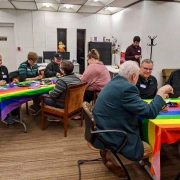
West KY NOW regularly creates inclusive events and programming with the intention of building stronger communities in the region, including a feminist bowling night.
This data presents an opportunity for deeper investments by community groups, care providers, and educators. According to Garnett, closing these gaps looks like building deeper inroads with communities to establish trust between provider and patient.
Other Kentucky-based organizations working to close that trust gap with rural LGBTQ+ communities include AVOL, an organization committed to ending HIV through testing, medical intervention, and community support, and Matthew25, which works with those living with, at risk of, or affected by HIV and other sexually transmitted infections. With four clinics across Southern Indiana and Western Kentucky, Matthew25 serves 25 counties in Kentucky and 12 in Indiana.
“I know a lot of people are scared because of the way they’ve been treated in the past… I’m not going to sit here and pretend like there aren’t doctors and nurses out there that give people hell every time they come in to talk about HIV or other STIs,” said Garnett. “But I can tell you with us, with organizations like AVOL, with Matthew25, everyone I speak to in these organizations is so eager and anxious to help, and excited to be part of people’s lives and make them better.”










 AP
AP Associated Press