KEEP. Story type. Exactly one per story. Standard original reporting, interviews, attribution.

Tag Archive for: Type: Reported

Illustration by Sav Hoyt of a red inflatable pool float shaped like the transgender symbol, floating on blue water

Trans Women Took Their Protest of “Biological” Bathroom Signs Into the Men’s Locker Room

This story first appeared in Queer Cincinnati: Beyond the Binary, published Oct. 23, 2026.

On February 25th, 2025, Ohio Revised Code 3345.90 went into effect, which requires higher education institutions to designate multi-occupant student restrooms, student locker rooms, student show rooms, and student changing rooms, “for the exclusive use by students of the male biological sex only or by students of the female biological sex only.”

In an attempt to abide by this law, the University of Cincinnati (UC) replaced the gendered bathroom signage around campus to state, “Biological Men,” and “Biological Women.”

UC sent out an email the following day in which they recognized that the current signage using the term “biological” was an error.

The email went on to further state, “We recognize that recent signage updates have raised concerns. Please know that our intention was never to withhold important information or create uncertainty. The university’s requirement to comply with the law does not take away from its commitment to creating a learning environment that fosters opportunity and develops educated and engaged citizens.”

As a response to the university, Simone Balachandran aka Simon Brine, associate professor and environmental engineering educator in the department of chemical engineering, called for trans women and allies to show up to the locker rooms in protest. In early March, Brine, along with several other trans women, went into the men’s locker room, stripped down naked, and talked to the cisgender men in the bathroom.

“I felt powerful. I wanted to force them to see what a trans woman’s body looks like. When people see trans bodies, it will change their minds,” Brine said. When asked about her thought process behind the protest, Brine responded, “It is called activist judo. The idea is not to try and win; it is to try and lose, with the reasoning coming from the reality that the law is not going to be in your favor, but you can exploit the loss. I am going to follow the law, and the law allows me to get naked in the locker room and force you into a position where you have to recognize my existence.”

“When we asked the men there what they thought about the law and the sign, all of them thought it was ridiculous and thought we should be in the other locker room. One person even thought they were going into the wrong locker room,” Brine said.

But do trans and gender non-conforming students actually feel that the university is committed to fostering a safe and effective learning environment?

Noah Wardega, a recent UC graduate, does not think so. “My first thought was that it is impractical. How could they even enforce that? But, ever since the policy was put in place, I stopped using the bathrooms on campus.”

When asked about the impact the policy had on their life, Seven Kiener, a senior social work student, said, “It caused me to completely reevaluate my relationship with the service work I was doing for the university. I have completely stepped away from any UC-based groups and changed my plans for grad school so that they no longer include UC.”

It is clear the law has rattled trans people on campus, and when asked how UC can better protect trans students, Eliza Guerra, a university member, said, “We need more classes and instructors teaching queer authors and content without fear of anti-DEI policies.”

But can professors and staff actually do that?

SB 1, the “Advance Higher Education Act,” requires institutional neutrality on controversial political or global matters while also requiring institutions to conduct annual faculty reviews.

So, when the Lemkin Institute for Genocide Prevention and Human Security released its third red flag alert warning that the United States is within the early to middle stages of a genocidal process against trans people, “the goal of which is to completely erase transgender people not only from public life but also from existence in the U.S. and globally,” there is a real question about how professors would even be able to bring this report up.

Brine believes that to present this to a classroom of students, you would have to also present the conservative argument regarding transgender rights.

As of today, UC has since removed “biological” from their bathroom signs, but what were now gender neutral bathrooms have since turned into single-use bathrooms.

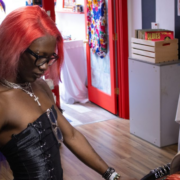
Kenni, with bright red hair, glasses and a black corset top, looks through a clothing rack in a vintage shop, photographed by Harper Thomson

The Orange Dress That Became Pants: How Trans Youth Find Home in Their Clothes

This story first appeared in Queer Cincinnati: Beyond the Binary, published Oct. 23, 2026.

Transgender people from all unique walks of life have a very different relationship with fashion than their cisgender peers. For transgender youth, how they choose to dress themselves can have a wide variety of purposes in their day to day lives. For many trans people, how they dress can often impact how they affirm their own gender, relate their gender expression to others, and protect themselves and their community. With what feels like limited spaces to celebrate transgender bodies, and the constant commentary on trans expression from cisgender peers, transgender youth are looking inwards. Through this they are finding home within themselves and their community through dress.

Stone (They/Them), 23, Hometown: Roebuck, SC

“What item of clothing was a milestone in your transition?”

Stone: This orange dress that I was able to turn into pants. A big thing to me is androgyny. Having a dress and knowing that I can wear whatever with it really brought out that experience. And can I even say it’s mine if I didn’t make it my own? I don’t have enough dresses and skirts but I’ll get there.

With clothing being so attached to gender expression in our society, the ability to modify that clothing can be very important to many trans people. Clothing can determine much of how you’re perceived by others. With most mainstream clothing often being designed around the gender binary, altering garments to be more androgynous/fitting can be deeply fulfilling.

Kenni (She/Her), 22, Hometown: Delhi Township, Ohio

“Do you find home and gender euphoria in clothing that people might imagine to be a bit more physically restrictive, and if so what garments?”

Kenni: Honestly my heels. With my thigh high boots, you have to wear them for a while and work them in, but once you’ve had them for a while I feel like you can do anything in these heels, it feels like I am just wearing some gym shoes.

“Does your dress inform how you feel within your body or do you think it more informs what you can accomplish with your body?”

Kenni: Definitely the latter. Sometimes you have to know you can’t be dancing the absolute most in a little dress, but I will [still] be dancing around busting my ass.

Way (She/Her/Hers), 21, Hometown: Loogootee, Indiana

“How does your career in musical theatre and acting impact your dress and transition?”

Way: Dress in a lot of ways is everything. It’s what the people behind the table like casting directors and artistic directors see first before you even open your mouth. I want to ensure I am representing myself in the most authentic way without dampening who I am.

“Why do you think hyper utilitarian garments (for example carabiners, cargo pants, combat boots) are so popular amongst trans people?”

Way: [In my opinion], queer people are overwhelmingly more common amongst the working class because there is less energy available to try to hide something. We make up a good part of the labor force. There is also this idea of needing to be ready to be equipped to stand up for yourself and being ready to help and protect other queer people.

Clothing not only serves as a means of expression but also for everyday utility. Sporting a more utilitarian look is a form of anti-fashion. Rejecting consumeristic, highly gendered, and rigid fashion standards. Not only for comfort and mobility, but also for the very genuine purpose of expressing one’s authentic identity.

Emmet (They/He), 24, Hometown: Anderson Township, OH

“What was it like growing up queer and trans in Anderson? Did you feel like you had to make any compromises in your dress to be safe?”

Emmet: It was one of those things that was never talked about in my household. I grew up religious and homeschooled so I didn’t get to see a lot until I got my first barista job when I was 18. I was introduced to people that used different pronouns, that were trans and queer. Anderson has gotten better but it’s not the most accepting place. At first when I was newly queer I would definitely ‘tone it down’. As I have grown into dressing how I feel it’s still very scary and intimidating. You never know how people are going to respond to crazy makeup or a shaved head. I am going to look queer no matter what. Travelling around Cincinnati for sure changes how I dress, closer to downtown I really get to go to the max with it.

Elliot (They/He/She), 22, Hometown: Cincinnati, OH

“If dressing ever felt like a costume, when did it stop feeling like a costume?”

Elliot: Looking back in my early transition, I painted on my eyebrows and I would make facial hair with my makeup, it felt like I was performing the most hyper masculine. When 2020 hit, I loved experimenting and playing with makeup and that is when I got a little bit more feminine. It hit me that I didn’t have to perform as much, I could use it as a chance to be more fluid, more for myself than the people around me. It really just matters day to day about how I present myself. That fluidity has allowed me to really find myself and connect to my body.

As fluid as gender identity and expression can be for many transgender people, one of the many utilities of dress can be its ability to change with us. This not only allows for us to accurately portray ourselves to the world at large, but also aids in us being able to break down internal biases and shame. Experimentation and fluidity in one’s dress can become an essential part of the journey towards true self expression.

Thank you to Secondhand Circus and GG for allowing us into your space, and thank you for what you do for the Cincinnati transgender community.

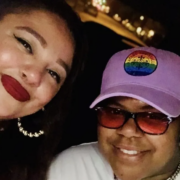
Paulina Helm-Hernández, in red lipstick and a jeweled necklace, and Ashe Helm-Hernandez, in a lavender cap with a rainbow patch and tinted glasses, smile together in a nighttime selfie.

The Information Game: Women’s Soccer, HIV and Belonging for LGBTQIA+ People of Color in Kentucky

On May 29, 1995, R&B group TLC released the song “Waterfalls.” It was the first No. 1 song ever to refer directly to AIDS, spending seven weeks at the Billboard 100 chart’s top spot: a song by three Black women to break the stigma surrounding HIV and to promote safer sex practices.

That same year was also one of the most important years in the history of professional women’s soccer. In 1995, it was the second year of FIFA’s Women’s World Cup, held just two months after TLC released “Waterfalls.” According to the U.S. Soccer archives, women’s soccer had almost no professional leagues in 1995. Most successful American players were competing for colleges and universities; salaries were nearly non-existent, and it was still a year before the Summer Olympics would welcome women’s soccer as a medal event. Women’s soccer at that time was still in its infancy.

Much like women’s soccer athletes from around the world were just beginning to be seen and taken seriously on the world stage, a deadly virus was expanding across LGBTQIA+ communities, at a time when effective treatment remained limited. Thirty years later, these two histories have intersected in a conversation about the National Women’s Soccer League (NWSL), the evolution of HIV treatment and healthcare, and what it truly means to belong. As women’s professional soccer continues to grow, so does the opportunity to examine how the league’s relationship with LGBTQIA+ communities can extend beyond visibility and representation to include education, access to sexual healthcare, and meaningful support.

According to a first-person account by Kevin Garner, published last year by Queer Kentucky, “In [19]80s and ‘90s Kentucky, HIV/AIDS services were concentrated in urban areas such as Louisville and Lexington. As a conservative state, political attitudes and action were slowly emerging.”

Garner pointed to Nazareth Home and Lyndon Lane Nursing Facility as “the only two facilities that would take clients under 40 who were affected by this disease during this time.

“There was a push for prevention.”

An unmet need unevenly shared

In 1995, more than 500,000 AIDS cases were reported nationally, and about 62% of those diagnosed had died by October. A 1992 study found that one in three Kentuckians diagnosed with AIDS in the 12 months between July 1990 and June 1991 died within three months of their diagnosis. Researchers concluded that many patients had not received consistent HIV care before developing AIDS, and they pointed to missed diagnoses, fragmented medical care (across dozens of hospitals and physicians), and gaps in follow-up treatment as major contributors to poor outcomes.

From the 1990s to today, the highest burden of HIV/AIDS deaths in the U.S. has not been evenly shared. Data from the Centers for Disease Control and Prevention (CDC) show, in the early years of the epidemic, AIDS deaths were heavily concentrated among men, especially gay and bisexual men, and the epidemic was especially severe in places like New York, New Jersey, California, and Florida.

By the mid-1990s, AIDS deaths reached their peak: The CDC reported that about 50,628 people died of AIDS in 1995, just before combination HIV treatment became widely available. After those stronger drug combinations arrived in 1996, deaths dropped sharply. Across race, Black Americans became increasingly overrepresented in HIV/AIDS illness and death, and that disparity continues today.

In plain terms, Black communities have carried a much higher share of HIV-related deaths than their share of the U.S. population. By region, the burden shifted over time: Early in the epidemic, AIDS was particularly concentrated in the Northeast, but today the South carries the largest share of both new HIV diagnoses and HIV-related deaths. In 2024, the South accounted for 51% of HIV diagnoses and 53% of HIV-related deaths nationwide.

Community in the crowd

From the 1990s to today, as HIV/AIDS prevention and treatment has changed considerably, so has the sport of women’s soccer in Kentucky. In 2021, Racing Louisville FC began play in the National Women’s Soccer League (NWSL), bringing a major-league professional sports franchise to Louisville for the first time in 41 years. Today, the club plays at the 15,304-seat Lynn Family Stadium, where more than 11,000 people attended a single NWSL match in 2024.

In recent years, increased investment in women’s sports has also meant more “third spaces” – what sociologist Ray Oldenburg described in 1989 as informal gathering spaces outside the home (first place) and work (second place), where people build relationships and community. For longtime LGBTQIA+ fans, who have long existed as the foundation of women’s sports fandoms around the world, stadiums and the communities that gather around us can function as third spaces, offering opportunities to build relationships, express our identities freely, and experience a sense of belonging that may not always be available in other parts of our lives.

I met two of these fans, Paulina Helm-Hernández and Ashe Helm-Hernandez, on a Wednesday night in Louisville. Paulina is a feminist philanthropic advocate whose work spans the Southeast, LGBTQ+, feminist and migrant rights movements. Born in Mexico City, with family from Veracruz, Mexico, she grew up in eastern North Carolina. Ashe, a philanthropic advocate for trans movement work, is originally from Louisville. Their family has been in the city for a century, and they attended Jefferson County Public Schools and the University of Louisville. After spending time away, they returned home with their wife, Paulina, to be closer to family.

Both had been to prior Racing Louisville matches, but Paulina still remembers what struck her the first time friends invited her to a match.

“I attended with some friends that invited us specifically because they’re also Racing Louisville fans, and we made an outing of it as a group of friends,” Paulina said. “It was my first time. My family also grew up, you know, as Mexican, as a Chicana woman, like following and watching soccer, and also one of the favorite sports of the Latino community, and I was a little bit surprised by the lack of racial diversity, to be honest, because I was like, ‘Wait, where are my people at?’ Because my people love soccer, and more and more girls are playing soccer.

“So I do feel like there’s like a little bit of a disconnect between the community and who attended those games,” she said. “Or who attended the games at the time was a couple years ago. So to be fair, I hope that that’s changed.”

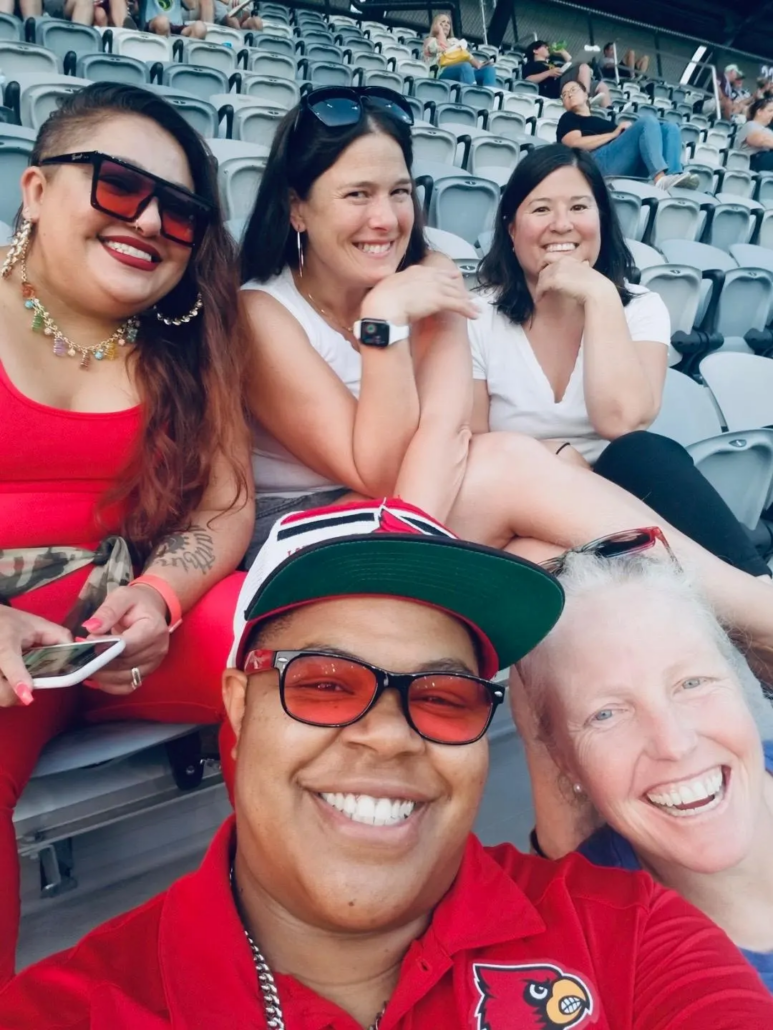
Paulina Helm-Hernández and Ashe Helm-Hernandez smile for a selfie with three friends in the stadium seats at a Racing Louisville game.

Paulina Helm-Hernández, left, and Ashe Helm-Hernandez, front, with friends at a Racing Louisville game. Supplied by Paulina Helm-Hernández and Ashe Helm-Hernandez

Paulina observed a crowd of fans that day considerably less diverse than the city’s larger population. Black residents make up about 23% of the Louisville-Jefferson County metro’s population, and Latino residents about 9%. But Louisville’s diversity has never been evenly distributed across the city. Decades of racial zoning, redlining and other discriminatory housing practices helped produce geographic divisions that remain visible today, with Louisville Metro’s own housing research finding that the city remains segregated by race and ethnicity.

Those divisions also intersect with Louisville’s LGBTQIA+ history. Researchers at the University of Louisville’s Anne Braden Institute have documented race as an important part of understanding queer life and history across Kentucky. Today, Louisville contains some of the state’s strongest LGBTQIA+ community and health infrastructure, but recent survey data from Queer Kentucky suggests that access and belonging remain uneven, even within the state’s largest urban center. Queer Kentucky’s 2025 Community Health Survey found that 65.5% of its 559 LGBTQIA+ respondents reported a strong sense of community belonging, while 11.4% reported low belonging. Respondents living with HIV reported an average belonging score of 3.98, compared with a statewide average of 4.86, the lowest average belonging score of any group measured.

Belonging is a primary indicator of good health. People need access to doctors, medicine, testing and treatment to be well, but research increasingly recognizes that people also need relationships, community and places where they can meaningfully connect with other people. The CDC names social connection an important determinant of physical and mental health, while research cited by the U.S. Surgeon General found that people with a strong sense of community belonging were 2.6 times more likely to report being in good or excellent health than people with a low sense of belonging.

This is especially important for LGBTQIA+ communities, whose rights to love, marry, build families and openly exist continue to be challenged and questioned by elected leaders. For communities whose belonging in public life has repeatedly been contested, having spaces where people can safely gather, build relationships and see themselves reflected is not just about having somewhere to go. Those spaces can become part of what people need to feel connected, supported and well.

That makes the places where LGBTQIA+ people gather part of the conversation about community health, too. A stadium cannot replace a doctor’s office, a testing site or a public health program. But it can do something those institutions cannot always do on their own: regularly bring queer and trans people together around a shared experience and create opportunities for LGBTQIA+ people to feel like they are part of fandom that affirms who they are and who they wish to be in the world.

Still, what Paulina encountered inside the stadium suggested to her that Racing already had much of what it needed to reach a broader community.

“I remember thinking, you know, as a fan of women’s sports, I thought it was a great atmosphere. But I do think, you know, it lacked the cultural diversity that I’m used to in terms of being able to enjoy like those kinds of sporting events, knowing that they’re also a reflection of like not just fanhood, but like what does it actually mean to have infrastructure that like is actually focused on women’s sports and women athletes so that to me you know it’s a mixed bag,” she said. “But I do remember enjoying the game, we had a great time, everybody that worked at the stadium was very welcoming and very warm, and I feel like the space in and of itself… It’s a beautiful arena, and so to me, they have everything in space in terms of the infrastructure, you know, to be able to welcome more people.”

Ashe’s first experience with Racing started differently. A lifelong Louisville sports fan, they showed up dressed for the Louisville team they already knew, but whose colors didn’t match this home team.

“I can go ahead and admit that I totally had on red,” they said. “I had on a University of Louisville ball cap, and my friends busted out laughing at my appearance and quickly took me to the Racing store to get some gear. And so, you know, I was shy. I was like, I didn’t look this team up. My friends invited me out, and I was like, ‘Let’s go! It’s Louisville,’ and I am a diehard University of Louisville fan, and I got that mixed up a bit. So yeah, but lavender is a beautiful color, and I appreciate it very much having some new gear.”

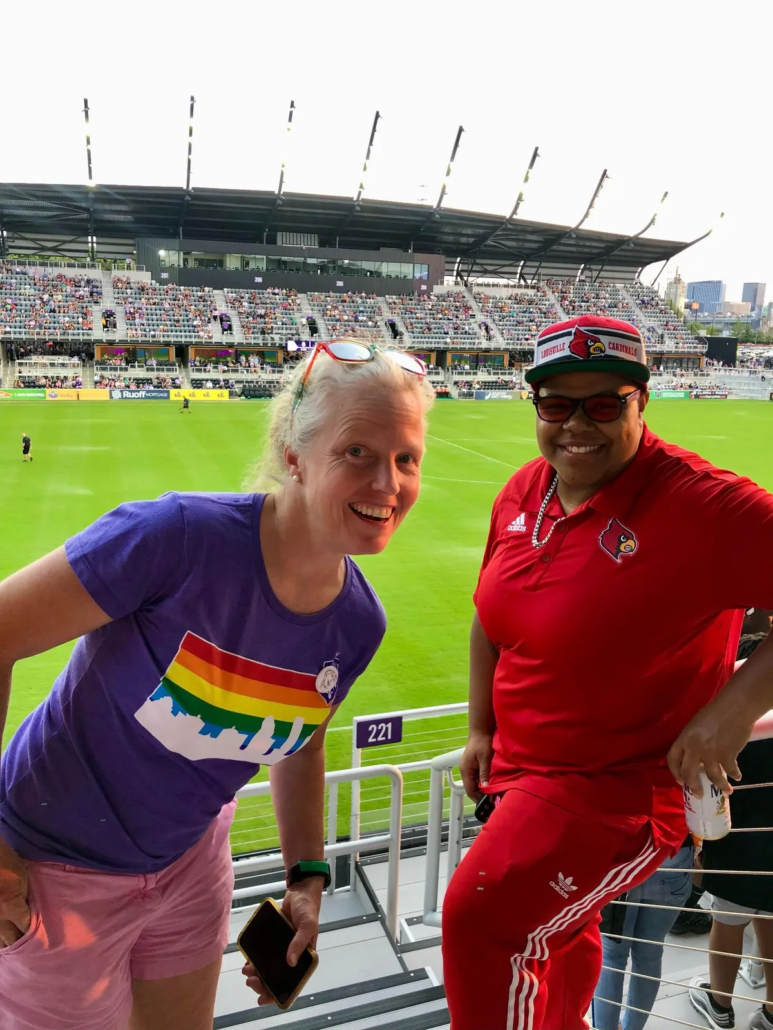
Ashe Helm-Hernandez, wearing a red University of Louisville polo and cap, stands with a friend in a rainbow shirt above the field at a Racing Louisville game.

Ashe Helm-Hernandez, right, in University of Louisville red with a friend at a Racing Louisville game in 2021. Supplied by Paulina Helm-Hernández and Ashe Helm-Hernandez

Soccer as belonging, belonging as care

Their experiences point toward something larger than fandom. In 1995, Kentucky did not have a top-tier professional women’s soccer team or a stadium capable of regularly gathering thousands of women’s soccer fans. Today it does. That growth creates an opportunity that did not exist three decades ago. Professional women’s soccer now has the physical infrastructure, cultural visibility and audience to bring thousands of people together at a time. And some of the communities gathering around women’s sports are the same communities Kentucky’s existing healthcare infrastructure is still struggling to reach.

Queer Kentucky’s 2025 Community Health Survey found that 48.2% of its 559 LGBTQIA+ respondents had never been tested for HIV. Among cisgender women, that figure was 53.6%. Among transgender women, it was 57.7%, and among nonbinary respondents, 50.6%. At the same time, more than one in three respondents statewide reported having no regular healthcare provider, while the U.S. Department of Health and Human Services reports that approximately 1.2 million people in the United States are living with HIV, and one in eight do not know they have the disease.

The relationship between community and HIV prevention is not theoretical. The U.S. Surgeon General’s advisory on social connection notes that stigma surrounding HIV can create barriers to both healthcare and social inclusion, while National Institutes of Health research has found a link between stronger community connections and people taking steps to prevent HIV.

That raises a different question about the economic and social value of professional women’s sports in Kentucky. What if the value of a stadium is not limited to what happens on the field? What if the same infrastructure, built to gather thousands of fans around women athletes, can also become infrastructure for connecting communities to information, testing, prevention and care?

There is already another professional women’s sports league that offers a glimpse of what can happen when that kind of infrastructure is given time to grow.

For Paulina and Ashe, the Women’s National Basketball Association (WNBA) has never been just basketball. Both came of age alongside a league that has now existed for 30 years and watched women’s professional basketball become a place where Black women, queer people and generations of women’s sports fans could see themselves reflected.

Some of Paulina’s earliest experiences in LGBTQ+ movement spaces were already intertwined with women’s basketball. She remembers older lesbians gathering around games and using basketball itself as a language for thinking about organizing and movement building.

“I grew up in an era where people were very like: This is one of the lenses to understand, you know, movement building,” she said.

Three decades later, she sees what women’s professional basketball has become, as more than commercial growth. She called the rise of the WNBA a “social and political win,” describing women’s sports as one of the places where fans can now see “queer excellence” and “feminist excellence” at the highest level.

Ashe remembers that history differently. Growing up playing basketball, some of the women they watched in the earliest years of the WNBA became their heroes.

“I was able to look up to Cheryl Swoopes, and I was able to look up to Cynthia Cooper as people and role models,” they said. “That I could be, that Black women could do that, that they could be on television, that they could play sports, that they could play basketball, that they could sweat, they could be fierce.”

Today, Ashe sees younger players learning whose footsteps they are following, while the players they grew up watching are finally being recognized as living legends.

Their experiences show what can happen when a professional women’s sports league has enough time to become part of a generation’s lives. The NWSL is still building that history. The WNBA was founded in 1996 and began play the following year. In 2026, the league celebrated its 30th season. The NWSL, by comparison, was founded in 2012 and played its first season in 2013. In just over a decade, professional women’s soccer has grown considerably, but that’s still only half the time the WNBA has had to become part of the lives, traditions and communities of its fans.

That difference in time matters when thinking about what Paulina and Ashe described. The impact of the WNBA on their lives cannot be measured only through attendance, television audiences or revenue. They are describing what happens when a professional women’s sports league exists long enough for people to grow up alongside it. Players become childhood heroes. Games become traditions. Fans build relationships with one another.

Queer people find spaces where they see themselves reflected. Over time, a sports league can become part of the social infrastructure of a community.

For Paulina, women’s basketball was woven into LGBTQ+ community life long before the WNBA became a mainstream cultural phenomenon. She remembers gathering at people’s homes to watch games, where basketball brought people together for more than just the competition.

“You just had to get with the program and you had to watch games and you had to go to people’s houses and know that the meetings happen after the game and know you were not allowed to talk through it,” she recalled.

For Ashe, the league’s history is personal. During a recent presentation at work, they shared a photograph of WNBA players from three decades ago with their colleagues: “I told my team that these were my heroes,” Ashe said. Those same athletes who inspired Ashe as a young basketball player are now being celebrated by another generation.

“For me, it’s a very serious moment where players are getting their due, and where younger players are learning whose footsteps they walk in, and they too are being able to recognize living legends,” Ashe said.

Paulina remembers the relationships and organizing that happened around games; Ashe remembers the athletes who showed them what was possible for Black women in professional sports. Together, their experiences illustrate how a league can become part of a community’s history, creating relationships, traditions and a sense of belonging that develop over generations.

Racing Louisville, which joined the league in 2021, is part of a story that is still unfolding, as fans begin building those traditions and relationships that future generations may one day inherit. But just five years after the club began playing in Kentucky, questions have emerged about its long-term future in Louisville.

That possibility raises another question about how communities measure the value of women’s sports institutions. Five years may be enough time to count tickets, calculate attendance and measure revenue. It may not be enough time to measure what happens when a generation grows up with a professional women’s team in its city, when queer fans build traditions around going to games together, when Black and Latine children begin seeing the stadium as somewhere they belong – when community organizations begin treating that stadium as another place where people can be reached.

Lynn Family Stadium represents physical infrastructure. It has more than 15,000 seats and the ability to bring thousands of people together at once. But what Paulina and Ashe describe through their experiences with women’s sports is another kind of infrastructure that takes much longer to build. Relationships, traditions, information networks, chosen family, representation, belonging and trust develop over years as LGBTQIA+ people repeatedly gather in the same places and around the same women’s sports teams.

This work was supported by the 2026 CNP Media Fund. #CNPMediaFund

Live Updates: Election Night 2026 in Queer Kentucky

Live from Queer Kentucky

This page updates all night, with the newest updates at the top.

Queer Kentucky reporter Alejandra O’Connell-Domenech is covering election night for us starting at 6pm est and will post here as results come in.

Tonight we’re following the Kentucky races with the most at stake for LGBTQ+ Kentuckians: the U.S. Senate race, Amendment 1, Kentucky’s six U.S. House seats, the state House and Senate, the mayor’s races in Louisville and Lexington, and city council races. We’ll also post quick updates on the few national races that have everyone’s attention. Bookmark this page and check back often.

What we know

  • Polls close at 6 p.m. Eastern in most of Kentucky. Western Kentucky counties on Central time close an hour later, at 6 p.m. Central, or 7 p.m. Eastern.
  • Mitch McConnell isn’t running, so his U.S. Senate seat is open for the first time since he won it in 1984.
  • For the first time in a Louisville general election, the mayor and Metro Council races are nonpartisan, with no party next to candidates’ names.

Updates below, newest first

11:36 p.m.

“Stay tuned for an update on where things stand tomorrow. Sign up for our newsletter to get all of the updated races. queerkentucky.com/newsletter

11:33 p.m.

Here’s where Kentucky’s biggest races stand as of 11:30 p.m. ET Tuesday. Results are unofficial, and some races are still too close to call.

U.S. SENATE

Republican Andy Barr won Kentucky’s open U.S. Senate seat, defeating Democrat Charles Booker, according to the Associated Press. Barr had 54.9% to Booker’s 43.0% with 99% of votes counted.

U.S. HOUSE

Democrat Zach Dembo flipped Kentucky’s 6th Congressional District, the Central Kentucky seat Barr left to run for Senate, according to the AP. Incumbents and party favorites won the other five districts: James Comer (1st), Brett Guthrie (2nd), Morgan McGarvey (3rd), Ed Gallrein (4th) and Hal Rogers (5th).

AMENDMENT 1

Voters approved Amendment 1, which limits the governor’s power to grant pardons and commutations, about 71% to 29%, according to the AP.

KENTUCKY GENERAL ASSEMBLY

Democrats flipped three Republican-held seats, according to the AP: Christian Furman unseated Sen. Lindsey Tichenor in Senate District 6, and Tim Hall (House District 31) and Aaron Currin (House District 65, Northern Kentucky) won Republican-held House seats. Republicans flipped one Democratic-held seat, House District 95 in Eastern Kentucky.

Several races are still too close to call. In Louisville’s Senate District 36, Democrat Sarah Cole McIntosh leads Sen. Julie Raque Adams by about 4 points, and the Kentucky Democratic Party has claimed the seat; the AP has not called it. Democrats also lead in five more Republican-held House seats: Districts 28, 29, 33, 39 and 48. Republicans keep large majorities in both chambers.

LOUISVILLE MAYOR

Mayor Craig Greenberg won a second term. He claimed victory Tuesday night, and challenger Shameka Parrish-Wright, a Metro Council member, conceded, Louisville Public Media reported. Greenberg led 57.6% to 42.4% with 72% of votes counted, according to the AP.

LEXINGTON

Mayor Linda Gorton won a third and final term over Raquel Carter, 55.1% to 44.9%, according to the AP.

In the 4th District Urban County Council race, challenger Brenda Monarrez leads Council Member Emma Curtis 53.2% to 46.8% with all precincts reporting, according to unofficial results. Neither candidate had publicly commented on the results as of late Tuesday.

Lexington voters also approved three city charter amendments, including higher pay for council members starting in 2031, WEKU reported.

AROUND THE COUNTRY

Democrats had a big night. AP called U.S. Senate races for Democrats Roy Cooper in North Carolina, Annie Andrews in South Carolina, James Talarico in Texas and Sherrod Brown in Ohio, and Decision Desk HQ projects Democrats will control the Senate. In New Hampshire, Chris Pappas became the first openly gay man elected to the U.S. Senate. Democrats are also moving toward control of the U.S. House, the AP reported.

New governors include Amy Acton, Ohio’s first woman elected governor; Gina Hinojosa, Texas’ first Latina governor; and Deb Haaland in New Mexico, the nation’s first Native American woman governor.

Thank you for following along with us tonight.

11:18 p.m.

Democrat Gina Hinojosa has defeated Republican Gov. Greg Abbott to become the next governor of Texas, The 19th reported, calling it a stunning upset. Hinojosa, a state legislator, would be the first Latina to lead the state. She leads 57.1% to 41.7% with an estimated 67% of votes counted, according to the Associated Press, which has not yet called the race.

Source: The 19th News; The Associated Press. 

11:15 p.m.

Democrat James Talarico has won Texas’ open U.S. Senate seat, defeating Republican Attorney General Ken Paxton, according to the Associated Press. Talarico led 59.2% to 39.2% with an estimated 67% of votes counted when AP called the race at 11:03 p.m. ET. He is the first Democrat to win a statewide race in Texas in more than 30 years, AP reported, and the first Texas Democrat elected to the U.S. Senate since 1988, according to the Houston Chronicle.

Source: The Associated Press; the Houston Chronicle

11:14 p.m.

Democrat Deb Haaland has won the race for New Mexico governor, defeating Republican Gregg Hull, according to the Associated Press. Haaland, a member of Laguna Pueblo and former U.S. interior secretary, will be the nation’s first Native American woman governor. She led 56.4% to 43.6% with an estimated 44% of votes counted when AP called the race at 10:40 p.m. ET.

Source: The Associated Press; The 19th News

11:13 p.m.

Democratic socialist Janeese Lewis George has declared victory in the race for mayor of Washington, D.C., The Washington Post reported, putting the nation’s capital alongside New York and Seattle in electing a democratic socialist mayor. Lewis George led with 84.0% of the vote with an estimated 71% counted, according to the Associated Press, which has not yet called the race.

Source: The Washington Post; The Associated Press:

11:12 p.m.

President Donald Trump told The New York Times on Tuesday night that he would accept the results of the midterm elections.

11:11 p.m.

Gov. Andy Beshear congratulated Ohio Governor-elect Amy Acton, whose win the Associated Press called at 10:49 p.m. “My friend, Dr. Amy Acton is a survivor, an advocate, a doctor and now – a governor-elect,” Beshear wrote on Bluesky. “This was a hard race and Amy has proven that we should never mistake kindness for weakness.”

11:10 p.m.

Louisville Mayor Craig Greenberg claimed victory Tuesday night at the Galt House, and challenger Shameka Parrish-Wright, a Metro Council member, conceded about half an hour later, Louisville Public Media reported. Greenberg led 57.6% to 42.4% with an estimated 72% of votes counted, according to the Associated Press, which has not yet called the race.

Source: The Associated Press; Louisville Public Media

11:06 p.m.

In Texas, Democrat James Talarico leads Republican Ken Paxton 59.5% to 39.0% with an estimated 66% of votes counted, according to the Associated Press. Decision Desk HQ has projected Talarico the winner; AP has not called the race. In Ohio, Democrat Sherrod Brown leads Republican Sen. Jon Husted 48.5% to 46.6% with an estimated 87% of votes counted, a margin of about 79,000 votes. AP has not called the Ohio race.

Source: The Associated Press

10:57 p.m.

President Donald Trump released his first reaction to the midterm election results via a post to the social media platform Truth Social. “I wasn’t on the Ballot and if I was, we would have won IN A LANDSLIDE! Thank you for your attention to this matter. President DONALD J. TRUMP,” he wrote. 

10:54 p.m.

Decision Desk HQ projects Democrat Jocelyn Benson will win the Michigan governor’s race. The Associated Press has not called it. With an estimated 27% of votes counted, AP shows Benson with 54.3% to Republican John James’s 44.1%. In Michigan’s U.S. Senate race, Democrat Abdul El-Sayed leads Republican Mike Rogers 52.5% to 45.7% with 28% counted, also uncalled.

Source: Decision Desk HQ; The Associated Press. DDHQ:

10:52 p.m.

Democrat Amy Acton has won the race for Ohio governor, defeating Republican Vivek Ramaswamy, the Associated Press projects. With an estimated 85% of votes counted, Acton has 50.7% to Ramaswamy’s 46.0%. Acton, a physician and Ohio’s former health director, will be the first woman elected governor of Ohio. AP called the race at 10:49 p.m. ET.

Source: The Associated Press.

10:46 p.m.

The Associated Press has called Kentucky Senate District 6 for Democrat Christian Furman, flipping the seat from Republican control. The Kentucky Democratic Party claimed the flip earlier in the night. With the call, AP’s count for the state Senate stands at 29 Republicans and 7 Democrats.

Source: The Associated Press 

10:25 p.m.

In Ohio, Democrats lead both top races with about 79% of the vote counted, according to the Associated Press, though the margins have narrowed. Democrat Sherrod Brown leads Republican Sen. Jon Husted 48.3% to 46.9% in the U.S. Senate race, and Democrat Amy Acton leads Republican Vivek Ramaswamy 50.5% to 46.2% for governor. In Michigan, with about 22% counted, Democrat Abdul El-Sayed leads Republican Mike Rogers 54.4% to 43.9% for U.S. Senate, and Democrat Jocelyn Benson leads Republican John James 56.5% to 42.0% for governor. AP has not called any of the four races.

Source: Associated Press, as of 10:20 p.m.

10:20 p.m.

The Associated Press has called the Lexington mayor’s race for Mayor Linda Gorton, who wins a third term over Raquel Carter, 55.1% to 44.9%, with about 99% of the vote counted. AP called the race at 10:11 p.m.

Source: Associated Press

10:19 p.m.

The Associated Press has called Kentucky’s 6th Congressional District for Democrat Zach Dembo, who flips the Central Kentucky seat from Republican control by defeating Republican Ralph Alvarado. President Trump won the district by about 15 points in 2024. AP called the race at 10:16 p.m.

Source: Associated Press

10:18 p.m.

Decision Desk HQ projects Democrat James Talarico will win Texas’s U.S. Senate race over Republican Ken Paxton, the state’s attorney general. With about 57% of the vote counted, Talarico leads 58.3% to 40.1%, according to the Associated Press, which has not called the race. AP’s analysts noted Talarico is outperforming Kamala Harris’s 2024 showing in every region of the state.

Sources: Decision Desk HQ; Associated Press, as of 10:15 p.m.

10:17 p.m.

In South Carolina, Democrat Annie Andrews, a pediatrician, is projected to win the U.S. Senate seat once held by the late Sen. Lindsey Graham, according to Decision Desk HQ. Andrews leads Republican Sen. Darline Graham, who was appointed to the seat after her brother died in July, 51.0% to 46.9% with about 87% of the vote counted, according to the Associated Press, which has not called the race.

Sources: Decision Desk HQ, via The 19th; Associated Press, as of 10:09 p.m.

10:11 p.m.

Results in Louisville Metro Council races are coming in slowly, with less than 1% of the expected vote counted in each district as of 9:50 p.m., according to the Associated Press. In early returns, District 19 is the closest race, with Anthony Piagentini and Alex Feria separated by about 50 votes. Most of the vote has not been counted, so these numbers are likely to change a lot.

Source: Associated Press, via Louisville Public Media

10:05 p.m.

Democrats are leading or have won several Republican-held state legislative seats. In Northern Kentucky, Democrat Aaron Currin defeated Republican Rep. Stephanie Dietz in House District 65, LINK nky reported; the Associated Press has not yet called the race. AP has called Louisville’s House District 31 for Democrat Tim Hall. Democrat Sarah Cole McIntosh leads Republican state Sen. Julie Raque Adams by about 4 points in Senate District 36 with about 94% of the vote counted, according to the AP. In the House, Democrats Jennifer Hardin (District 33, over GOP Rep. Jason Nemes), Suhas Kulkarni (District 48), Cassie Blausey (District 29) and Almaria Baker (District 28) lead in early returns in the Louisville area. Republicans still hold large majorities in both chambers.

Sources: LINK nky; Associated Press, as of about 10 p.m.

10:02 p.m.

Democrat Charles Booker focused his concession speech in downtown Louisville on hope and community. “We ran a race rooted in the truth,” Booker told supporters, saying he would keep “causing some good trouble” no matter what title he holds, the Kentucky Lantern’s Sarah Ladd reported.

Source: Kentucky Lantern reporter Sarah Ladd. 

10:00 p.m.

In state Senate District 6, Democrat Christian Furman leads Republican Sen. Lindsey Tichenor by about 2 points with about 98% of the expected vote counted, according to the Associated Press. AP has not called the race.

Source: Associated Press, as of about 10 p.m.

9:59 p.m.

In Louisville’s first nonpartisan mayor’s race, Mayor Craig Greenberg leads Shameka Parrish-Wright 57.6% to 42.4% (129,909 to 95,593) in early returns, with about 71% of the expected vote counted, according to the Associated Press. AP has not called the race.

Source: Associated Press, as of 9:50 p.m.

9:51 p.m.

In Highland Heights, incumbent council member Rene Heinrich led the field for six city council seats with 871 votes, according to unofficial results from the Kentucky State Board of Elections with all Campbell County precincts reporting. Heinrich, an attorney, represented James Yates and Will Smith, one of the same-sex couples who sued former Rowan County Clerk Kim Davis after she refused to issue them a marriage license. Deborah Ann Ball (868), Christie Fillhardt (867), Gary Chinn (805), John Braun II (773) and Patricia Hayley (771) round out the top six.

Sources: Kentucky State Board of Elections (unofficial); NPR

9:49 p.m.

In Michigan, Democrat Jeremy Moss won the 11th Congressional District, succeeding Rep. Haley Stevens, and becomes Michigan’s first openly LGBTQ+ member of Congress, The Advocate reported. The Associated Press called the race earlier tonight.

Sources: The Advocate; Associated Press

9:47 p.m.

Gov. Andy Beshear, who chairs the Democratic Governors Association, celebrated Keisha Lance Bottoms’ win in Georgia, writing in a post to Bluesky that she “just made history as the first Black woman governor in the country.”

Source: Andy Beshear

9:40 p.m.

The Lexington Herald-Leader has called the Lexington mayor’s race for Mayor Linda Gorton, who wins a third term over challenger Raquel Carter. Gorton has 55% of the vote to Carter’s 45% (56,203 to 45,869), according to unofficial results from the Kentucky State Board of Elections, with about 70% of the expected vote counted, according to the Associated Press.

Sources: Lexington Herald-Leader; Kentucky State Board of Elections (unofficial); Associated Press

9:40 p.m.

Emma Curtis has narrowed the gap in Lexington’s District 4 Urban County Council race as more ballots were counted, but still trails former council member Brenda Monarrez 3,221 votes to 3,657 (47% to 53%), according to unofficial results from the Kentucky State Board of Elections. Curtis won the newly added absentee ballots in the district. Fayette County is still reporting partial results, and no winner has been declared.

Source: Kentucky State Board of Elections (unofficial), as of 9:35 p.m.

9:36 p.m.

A look at the biggest races outside Kentucky, none called yet, according to the Associated Press:

Ohio: Democrat Sherrod Brown leads Republican Sen. Jon Husted 49.6% to 45.9% in the U.S. Senate race with 58% of the vote counted, a narrower lead than earlier in the night. In the governor’s race, Democrat Amy Acton leads Republican Vivek Ramaswamy 51.5% to 45.3%, also with 58% counted.

Texas: Democrat James Talarico leads Republican Ken Paxton 59.4% to 39.1% in the U.S. Senate race with 53% counted.

Michigan: Democrat Abdul El-Sayed leads Republican Mike Rogers 55.3% to 43.1% with 17% counted.

Maine: Republican Sen. Susan Collins has narrowed the gap with Democrat Troy Jackson, who leads 51.0% to 48.9% with 9% counted.

Iowa: Democrat Josh Turek leads Republican Ashley Hinson 61.0% to 36.7% with 21% counted.

Early counts can shift as more votes come in.

Source: Associated Press, as of 9:35 p.m.

9:33 p.m.

“Central Kentucky, tonight is your night,” Democrat Zach Dembo posted to Bluesky after claiming victory in Kentucky’s 6th Congressional District. Dembo told supporters he had spoken with Republican Ralph Alvarado by phone and wished him and his family well. He said that in Congress he would vote to reverse Medicaid cuts and work to get dark money out of elections. The Associated Press has not officially called the race; Dembo leads 52.2% to 43.8% with about 80% counted.

Sources: Zach Dembo; Lexington Herald-Leader; Kentucky Lantern; Associated Press

9:28 p.m.

Democrat Zach Dembo claimed victory in Kentucky’s 6th Congressional District, telling cheering supporters in Lexington, “We have sent a clear message: the status quo isn’t working,” the Lexington Herald-Leader reported. Dembo said he would be an independent voice in Washington. Gov. Andy Beshear joined him on stage, noting Kentucky will now have two Democratic members of Congress. Republican Ralph Alvarado conceded earlier; the Associated Press has not officially called the race.

Sources: Lexington Herald-Leader; Kentucky Lantern

9:27 p.m.

Democrat Keisha Lance Bottoms is projected to become Georgia’s next governor and the nation’s first Black woman governor, according to Decision Desk HQ, The 19th reported. In Florida, the Associated Press called the governor’s race for Republican Byron Donalds, who will be that state’s first Black governor.

Sources: Decision Desk HQ, via The 19th; Associated Press

9:24 p.m.

In Kentucky’s state legislative races, Democrats lost their last state House seat in Eastern Kentucky but have picked up at least one seat in Louisville and held a competitive Lexington district, Kentucky Public Radio’s Sylvia Goodman reported. Democrat Tim Hall flipped House District 31 in Louisville, the Kentucky Democratic Party said, and several Republican incumbents in Louisville were trailing.

Sources: Kentucky Public Radio reporter Sylvia Goodman; Kentucky Democratic Party

9:22 p.m.

Senator-elect Andy Barr took the stage in Lexington to big applause, calling his win a “victory for Kentucky,” the Kentucky Lantern’s Liam Niemeyer reported.

Source: Kentucky Lantern reporter Liam Niemeyer.

9:21 p.m.

Republican Ralph Alvarado has conceded to Democrat Zach Dembo in Kentucky’s 6th Congressional District, the Kentucky Lantern reported, in a Central Kentucky district President Trump won by about 15 points in 2024. Gov. Andy Beshear took the stage with Dembo to a warm welcome at his victory party in downtown Lexington. Dembo won Fayette County 66% to 31%, the Lexington Herald-Leader reported. The Associated Press has not officially called the race.

Sources: Kentucky Lantern; Lexington Herald-Leader; Associated Press

9:18 p.m.

The Associated Press has called Kentucky’s U.S. Senate race for Republican Andy Barr, who will succeed retiring Sen. Mitch McConnell. Barr defeated Democrat Charles Booker. With about 72% of the vote counted, Barr leads 53.6% to 44.4%. AP called the race at 9:16 p.m.

Source: Associated Press

9:16 p.m.

Decision Desk HQ projects that Democrats will win control of the U.S. House of Representatives. The Associated Press has not yet projected House control.

Source: Decision Desk HQ

9:15 p.m.

Decision Desk HQ projects Democrat Zach Dembo will win Kentucky’s 6th Congressional District, flipping a seat that President Trump carried by about 15 points in 2024. With about 74% of the vote counted, Dembo leads Republican Ralph Alvarado 52.8% to 43.3%, according to the Associated Press, which has not called the race yet. The seat opened when Republican Rep. Andy Barr ran for the U.S. Senate.

Sources: Decision Desk HQ; Associated Press, as of 9:08 p.m.

9:14 p.m.

Democrat Aaron Currin has defeated Republican state Rep. Stephanie Dietz in Kentucky House District 65, which includes Covington, LINK nky reports. Currin has 7,648 votes (53%) to Dietz’s 6,769 (47%) in Kenton County, according to unofficial results from the Kentucky State Board of Elections with all 60 precincts reporting as of 9:07 p.m. ET.

Source: LINK nky 

9:12 p.m.

Here’s where the night’s biggest U.S. Senate races outside Kentucky stand, according to the Associated Press.

Called: Democrat Chris Pappas won in New Hampshire, becoming the first openly gay man elected to the U.S. Senate. Democrat Roy Cooper flipped North Carolina’s Republican-held seat. Democratic Sen. Jon Ossoff won reelection in Georgia, and Republican Sen. Ashley Moody won in Florida.

Not called yet: In Texas, Democrat James Talarico leads Republican Ken Paxton 59.2% to 39.3% with 40% of the vote counted. In Michigan, Democrat Abdul El-Sayed leads Republican Mike Rogers 55.0% to 43.5% with 14% counted. In Ohio, Democrat Sherrod Brown leads Republican Sen. Jon Husted 52.3% to 43.6% with 47% counted. In Maine, Democrat Troy Jackson leads Republican Sen. Susan Collins 55.2% to 44.7% with just 5% counted. In Iowa, polls just closed, and Democrat Josh Turek leads Republican Ashley Hinson with only 5% counted.

Democrats hold 45 Senate seats to Republicans’ 34 in the AP’s count so far, with many races still to be called. Early counts can shift a lot as more votes come in.

Source: Associated Press, as of 9:08 p.m. 

9:11 p.m.

Kentucky voters have approved Amendment 1, the Associated Press projects. The change to the state constitution bars a governor from issuing pardons or commuting sentences from 60 days before a governor’s election until five weeks after it. With about 62% of the vote counted, “yes” leads 70.3% to 29.7%. AP called the measure at 9:05 p.m.

Source: Associated Press

9:10 p.m.

In Lexington’s District 4 Urban County Council race, incumbent Emma Curtis trails former council member Brenda Monarrez 2,447 votes to 2,981 (45% to 55%) with 285 of Fayette County’s 286 precincts reporting, according to unofficial results from the Kentucky State Board of Elections. No winner has been declared.

Source: Kentucky State Board of Elections (unofficial), as of 9:08 p.m.

9:08 p.m.

Governor Beshear congratulated New Hampshirites after Democrats won a critical senate seat in the state. DemocratChris Pappas beat former Republican senator John E. Sununu Tuesday night.

“New Hampshire, you made the right choice tonight,” Beshear wrote on X. “@ChrisPappasNH has always put the people of the Granite State first, and that’s exactly what he’ll do in the Senate.”

8:57 p.m.

Gov. Andy Beshear congratulated Georgia Sen. Jon Ossoff on his reelection. Beshear, who campaigned in Georgia last week, wrote that he saw “Georgian’s enthusiasm for Jon Ossoff” firsthand. “It’s great to see him reelected tonight,” he wrote on Bluesky. 

Source: Andy Beshear

8:56 p.m.

Republicans spent far more than Democrats on Kentucky’s state legislative races, but several Louisville-area races are looking extremely close, Kentucky Public Radio’s Sylvia Goodman reported.

Source: Kentucky Public Radio reporter Sylvia Goodman. 

8:55 p.m.

The Associated Press has called Delaware’s at-large U.S. House race for Democratic Rep. Sarah McBride, the first openly transgender member of Congress, who wins a second term. AP called the race at 8:50 p.m.

Source: Associated Press

8:53 p.m.

In Lexington’s District 4 Urban County Council race, former council member Brenda Monarrez leads incumbent Emma Curtis 2,981 votes to 2,447 (55% to 45%) with 285 of Fayette County’s 286 precincts reporting, according to unofficial results from the Kentucky State Board of Elections. Curtis became the first openly transgender member of the council when she defeated Monarrez in 2024.

Source: Kentucky State Board of Elections (unofficial), as of 8:50 p.m.

8:51 p.m.

The race for Lexington mayor has not been called but incumbent Linda Gorton is leading challenger Raquel E. Carter by more than 10 percentage points with about 70 percent of votes counted.  Gorton has 51, 202 votes while Carter has 40,769 votes as of 8:37 p.m., according to the Associated Press.

Source: The Associated Press

8:46 p.m.

The Associated Press has called two more Kentucky U.S. House races for Republicans. Rep. Brett Guthrie won reelection in the 2nd District over Democrat Megan Wingfield, leading 60.1% to 37.8% with about 52% of the vote counted. In the 4th District, Ed Gallrein, who beat Rep. Thomas Massie in the May primary, defeated Democrat Melissa Strange, leading 53.0% to 42.1% with about 80% counted. AP called the races at 8:42 and 8:43 p.m.

Source: Associated Press

8:43 p.m.

As Fayette County’s Election Day votes come in, Democrat Zach Dembo is leading Republican Ralph Alvarado about 66% to 31% in the county, Louisville Public Media’s Joe Sonka reported. Kamala Harris won Fayette by 17 points in 2024. The AP has not called the 6th District race.

Source: Louisville Public Media reporter Joe Sonka. 

8:41 p.m.

Democrat Roy Cooper defeated Republican Michael Whatley in North Carolina’s U.S. Senate race, flipping a Republican-held seat, the Associated Press reported. He is the first Democrat to win a Senate race in North Carolina in nearly two decades, according to Politico.

Sources: Associated Press; Politico

8:39 p.m.

The Associated Press has not called the Kentucky Senate race between Republican Andy Barr and Democrat Charles Booker.  But Barr is currently in the lead. Decision Desk HQ projects Republican Andy Barr will win the open U.S. Senate seat over Booker. With about half the vote counted, Barr leads 53.2% to 44.7%, according to the AP.

Sources: Decision Desk HQ; Associated Press, as of 8:35 p.m.

8:35 p.m.

“Yes” votes are sweeping the “no” votes leading by more than two to one so far for a Kentucky constitutional amendment that would limit the governor’s pardoning power, according to the Associated Press. 

Queer Kentucky wrote an explainer piece on the amendment earlier this month: https://queerkentucky.com/kentucky-constitutional-amendment-1-2026/

Source: The Associated Press

8:14 p.m.

Lexington’s first results are in, and the District 4 Urban County Council race is close. With about 20% of Fayette County reporting, former council member Brenda Monarrez has 477 votes (51.6%) and incumbent Emma Curtis, Kentucky’s first openly transgender council member, has 447 (48.4%), according to WKYT’s results. The two also faced each other in 2024, when Curtis won 52% to 48%.

Source: WKYT election results, as of 8:07 p.m.

8:05 p.m.

The State Board of Elections’ official results website is still down. When Louisville Public Media’s Justin Hicks called, the board would only say “We are currently down.” Live Associated Press results are on this page below the updates.

Source: Louisville Public Media reporter Justin Hicks. 

8:03 p.m.

The Associated Press has called the race for Kentucky’s 1st Congressional District with Republican James Comer winning his reelection bid for the U.S. House against Democrat Drew Williams. 

Source: The Associated Press. 

7:53 p.m.

Kentucky Democrats are close to losing their last state legislative seat in Eastern Kentucky, Louisville Public Media’s Joe Sonka reported, with Democrat Johnny Ray Turner trailing Republican Tanner Hesterberg by a wide margin in the 95th House District.

Source: Louisville Public Media reporter Joe Sonka.

7:47 p.m.

In his victory speech before a crowd of about 200 at the Galt House in downtown Louisville, Democratic U.S. Rep. Morgan McGarvey said tonight’s results were not about party or about him. “This is about decency over division. This is about compassion over cruelty,” McGarvey said.

Source: Kentucky Lantern reporter Sarah Ladd. 

7:44 p.m.

In an early sign worth watching in the 6th District, Democrat Zach Dembo won the early vote in Jessamine County, which usually votes Republican, Louisville Public Media’s Joe Sonka reported. Fayette County, the district’s largest county, has reported very late in recent elections, and the Kentucky Lantern noted UK is playing at Rupp Arena tonight if anything needs to be driven downtown.

Sources: Louisville Public Media reporter Joe Sonka; Kentucky Lantern reporter McKenna Horsley. 

7:39 p.m.

Rocky Adkins, a Democrat running for governor in 2027, told the Kentucky Lantern at Zach Dembo’s watch party that he expects a good night for Dembo in the 6th Congressional District.

Source: Kentucky Lantern reporter McKenna Horsley.

7:38 p.m.

After Louisville’s early votes were counted, several Republican state lawmakers in Jefferson County were trailing, Louisville Public Media’s Joe Sonka reported. They include state Sen. Julie Raque Adams, who had a large spending advantage over Democrat Sarah Cole McIntosh, and Reps. Jason Nemes, Susan Witten, Ken Fleming and Jared Bauman. Sonka cautioned that early votes in Louisville tend to lean much more Democratic than Election Day votes, so these races could tighten.

Source: Louisville Public Media reporter Joe Sonka. 

7:34 p.m.

Kentucky’s 3rd Congressional District winner Morgan McGarvey issued a statement via social media shortly after the Associated Press called the race. “I can’t thank you enough, Louisville. Serving my hometown in Congress is the honor of a lifetime,” the Democrat posted to X. “I’m excited to continue working for our community and each and every one of you!”

7:24 p.m.

In Georgia, Democrat Bentley Hudgins is poised to become the first out transgender and nonbinary member of the Georgia legislature, The Advocate reported.

Source: The Advocate

7:17 p.m.

Kentucky’s U.S. Senate race has tightened as more counties report. With about 10% of the vote counted, Democrat Charles Booker has 49.5% and Republican Andy Barr has 49.0%, a gap of fewer than 900 votes, according to the Associated Press. Booker’s early lead came largely from Jefferson County reporting first.

Source: Associated Press

7:15 p.m.

The first U.S. Senate call of the night: the Associated Press has called Virginia’s U.S. Senate race for Democratic Sen. Mark Warner. Democrats need a net gain of four seats to win control of the Senate.

Source: Associated Press

7:11 p.m.

The Associated Press has called the race for Kentucky’s 3rd Congressional District. Democrat and incumbent candidate Morgan McGarvey won the contest against Republican Maria Teresa Rodriguez. 

7:08 p.m.

It’s past 7 p.m. EST and polls are officially closed in the remaining parts of Kentucky. Remember, if you are standing in line at your polling place stay in line!

Kentuckians that are standing in line to vote before the official closing time have the legal right to stay in line and cast their ballot.

7:05 p.m.

The Associated Press has called Kentucky’s 5th Congressional District for Republican Rep. Hal Rogers, who wins reelection in Eastern Kentucky over Democrat Ned Pillersdorf.

Decision Desk HQ has also projected wins for Democratic Rep. Morgan McGarvey in Louisville’s 3rd District and Republican Ed Gallrein in the 4th District in Northern Kentucky, who beat Rep. Thomas Massie in the May primary. The AP has not called those two races yet.

Sources: Associated Press; Decision Desk HQ, via Kentucky Public Radio

6:50 p.m.

The race to represent Kentucky’s 6th Congressional District will be one of the most closely watched political contests tonight as Democrat Zach Dembo takes on Republican Ralph Alvarado.

Dembo’s watch party has officially kicked off in Lexington beloved actor and Kentucky resident Steve Zahn in attendance, sources told Queer Kentucky. Alvarado’s watch party is taking place in Winchester, according to the Kentucky Lantern. 

6:25 p.m.

Shortly after the first polls closed, Governor Andy Beshear commended Kentuckians for taking the time to cast their ballots in today’s elections. 

“It takes bravery to put your name on a ballot in hopes of helping your neighbors. Thank you for caring about our commonwealth and our fellow Kentuckians,” Beshear wrote on X. “And a big thank you to everyone who voted. As results roll in, let’s focus on moving Kentucky forward together.”

6:21 p.m.

A White House official said President “The President has left it all out on the field and he’s done everything that was needed,” a White House official told The Hill. “Republicans are in a better spot now than they were four weeks ago.” 

Source: The Hill reporter Julia Manchester. 

6:14 p.m.

The Justice Department sent federal election monitors to Jefferson and Fayette counties today. As of mid-afternoon, the Jefferson County Clerk’s office told the Kentucky Lantern, “we have not had any complaints or calls about monitors.” The clerk’s office said most voters probably wouldn’t know the monitors were there. 

Source: Kentucky Lantern reporter McKenna Horsely. 

6:03 p.m.

It’s past 6 p.m. EST and polls are officially closed in the Eastern Time portion of the state. Remember, if you are standing in line at your polling place stay in line! 

Kentuckians that are standing in line to vote before the official closing time have the legal right to stay in line and cast their ballot. 

6:00 a.m.

Polls are open. Live results and coverage start here at 6 p.m. Eastern.

Live results

Kentucky election results

Results from the Associated Press update automatically. Western Kentucky polls close an hour later, so more results arrive after 7 p.m. Eastern.

Got a question or a tip? Email Queer Kentucky executive director Missy Spears at [email protected].

Close-up of an illustration by Cocoa Durrett of a figure in a long red-orange robe with a green waistband, surrounded by red planets and stars on a deep blue background

Sober and Queer: Finding Community Outside the Bar

This story first appeared in Queer Cincinnati: Beyond the Binary, published Oct. 23, 2026.

In summer 2026, I spent a few weeks researching Cincinnati’s queer nightlife and social events. While doing so, two questions continued to peak my interest: Where exactly do the sober members of our community spend their time, and do they ever feel excluded from nightlife and social spaces due to their sobriety? I set out to speak to individuals who could answer these questions, specifically those who identified as both transgender and sober. In an attempt to bring light to some exclusionary sentiments experienced in bar and club culture, I open these questions to you, the reader. Conducting interviews on the subject in person however, revealed to me that many share the same opinion as I do surrounding queer community events in Cincinnati. Many events found in our local queer community, I’ve found to be generally centered around bar and club culture. Those who don’t participate in substance use can often feel as if they are forced to stand on the sidelines while trying to participate in these events.

Take a look at some recent event calendars for queer events in Cincinnati. You may notice that the majority of them take place in a bar or other 21+ spaces. Midwestern Lesbian’s Cincy Gay Agenda for example states that, for the week of July 6th through July 12th 2026, five out of seven events listed are located at bars, clubs, or breweries. These places are largely centered around the consumption of alcohol, and largely host our queer gatherings. Logically speaking, sober individuals usually understand that they may attend these events without participating in alcohol use. The concern lies in the continuous gathering in these types of establishments where drinking is typically a main activity. Shouldn’t queer people have an equal amount, or more options for community activities that aren’t centered around substance use?

Long nights spent drunk or high have become normal for many. I commonly find it hard to walk into a club anywhere in Cincinnati and find someone sober to socialize with on the dance floor. This can make it very challenging for the sober members of the LGBTQ+ community in our city to find inclusion at these events. It can feel as if you have fallen to the sidelines, fighting an internal battle and ultimately having to make a decision about substance use. I personally am always wondering: would I fit in better here in Cincinnati if I wasn’t sober? How do I have fun with my community without the expectation to participate in substance use? For those of us who spend nights out acting as the perpetual designated driver, where do we fit in?

I found solace in Spyder, age 25, as we met to speak in the basement of the Northside Library. She is a member of a local punk band called Badman, and as a result spends plenty of time in bars and DIY venues across the city. As you can imagine, she finds herself often rubbing elbows with other regular clubgoers. One thing distinguishing herself from the other “regular clubgoers” is the simple fact that she doesn’t drink. Spyder continues to be an active participant in Cincinnati’s queer nightlife, but she also cites that she often feels the pressure to conform. She explains that she feels as if Cincinnati’s nightlife scene is highly substance centered. She states that “maybe it comes down to everybody’s own social anxiety… I think if we had a more level playing field, where drugs and alcohol weren’t an expectation…you would find people who wanted to spend time there”. I asked her what types of alcohol and drug-free events and spaces she would like to see in our city. She suggested events such as community dinners (not only because there is no pressure to use substances in places like these), but also because members of the community who don’t have consistent access to hot food can gather here without the expectation to pay a cover fee. She also noted that she had an idea in the past to start a queer skate club here in Cincinnati, either at a roller rink or local skate park. Both of these are amazing ideas that create a sober space for queer people to gather, with activities that value social interaction over substance use.

I continued to speak with Hugh, age 24, about our shared experiences with substance use and community expectations. Hugh uses medical marijuana for chronic pain, but over the last year has decided to abstain from alcohol. While discussing the pressure we felt from our peers in Cincinnati specifically, Hugh cited his frustrations: “There’s no big explanation, I just don’t want to [drink], and that kind of answer is not acceptable to a lot of people.” In his opinion, alcohol is often used as a “social lubricant” in situations like nightclubs and bars. Oftentimes, there’s just an expectation that you’re going to participate. I asked Hugh the same question I asked Spyder about what kinds of sober spaces in Cincinnati he would like to see. He mentioned that creative outdoor events like the YART (yard art) Sale in Northside have been a safe haven for him. He, and myself, would like to see more creative events like those, specifically events that are lower effort, self-led, and easily accessible. He continues to state that:

“I think there needs to be more casual community events. I think that people are under the assumption that everything needs to be big and super elaborate, and it’s like, you could just have a weekly meeting where you and your friends hang out at a park pavilion and make crafts, and that would be a safe space.”

As many of us are longing for low-effort social spaces to foster community while keeping ourselves sober, conversations like this are extremely important. In future years, I hope that we can begin to see an uptick in events that exist outside the bar. As I see it, these spaces would only create safer community based environments for those of us who choose to abstain from substances. As a sober person myself, I couldn’t agree more with Spyder and Hugh about the social pressures we find ourselves facing, and what we as a community can do to counteract it.

Side-by-side portraits of Louisville mayoral candidates Craig Greenberg, left, and Shameka Parrish-Wright, right, both smiling.

Where do the candidates for Louisville mayor stand on LGBTQ+ issues?

Here’s where Louisville mayoral candidates Craig Greenberg and Shameka Parrish-Wright stand on LGBTQ+ issues ahead of the Nov. 3 election.

This is the first Louisville mayor’s race without party labels on the ballot. A 2024 state law made mayor and Metro Council elections nonpartisan starting this year, so a straight-party vote won’t cover either race. Voters have to pick each one individually. Candidates can still share their party affiliation while campaigning.

Early in-person voting starts Thursday, Oct. 29.

There are five candidates vying for Louisville mayor this year. Mayor Greenberg, who was first elected in 2022, and Parrish-Wright, the District 3 Metro Council member, are both Democrats and will appear on the ballot. Dave Biggers, JusAustin R. Lane, and Jeff Yocum are also running as write-in options for Louisville mayor.

Queer Kentucky reached out to all five candidates and asked them the same six questions about health, education, and other issues important to the LGBTQ+ community. Only Greenberg and Parrish-Wright responded to those questions in writing by publication time. The questions and candidate responses have been lightly edited for style, grammar, and clarity.

Question: What is your stance on gender-affirming care bans?

Greenberg: I do not support bans on gender-affirming care. Everyone deserves access to medical care free from political interference. Decisions about healthcare should remain between individuals, their families, and their doctors.

Parrish-Wright: I oppose bans on gender-affirming care. Healthcare decisions belong with patients, families, and their medical providers, not politicians. As mayor, I would support access to affirming care through city services and speak out against efforts to restrict it.

Question: What is your stance on Medicaid defunding?

Parrish-Wright: I oppose cuts that take healthcare away from people who depend on Medicaid. I would advocate for strong state and federal support and work with local providers to help residents connect with coverage and care.

Greenberg: I strongly oppose cuts to Medicaid that jeopardize access to quality, affordable healthcare. Medicaid is a lifeline for children, seniors, people with disabilities, and their families. We have already seen the impact of Medicaid cuts as a result of chaos in Washington, and these reductions are putting Kentucky families — in both rural and urban communities — at risk. I firmly believe that elected officials should be looking to expand access to affordable healthcare, not take it away from those who depend on it most.

Question: What is your stance on rural healthcare access?

Greenberg: Access to quality, comprehensive healthcare should never depend on where someone lives. Rural Kentucky faces significant barriers to care, including doctor shortages, long distances to receive treatment, and hospital closures. Addressing these challenges requires that we protect Medicaid access, support the providers treating rural communities, and invest in the services that keep people healthy. Addressing this issue should be a top priority for candidates running for office across the Commonwealth.

Parrish-Wright: People in rural communities deserve timely, affordable care. Louisville can be a partner by supporting regional healthcare providers, improving transportation connections, and advocating for the resources rural communities need.

Question: What will you do about the passage of anti-LGBTQ+ legislation?

Parrish-Wright: I would use the mayor’s office to oppose discriminatory legislation publicly, protect LGBTQ+ residents in city services and employment, and work with community organizations to connect people with support. Louisville should be a welcoming city where everyone can live safely and openly.

Greenberg: As mayor, I have consistently stood up for LGBTQ+ Louisvillians through both policy and direct action. Louisville Metro Government has received a 100% score on the Human Rights Campaign’s Municipal Equality Index every year since I took office, reflecting our commitment to nondiscrimination and equitable access to city services.

As mayor, I directed Metro Government to defend Louisville’s Fairness Ordinance in court against a challenge involving a business owner who refused to serve LGBTQ+ clients. In terms of policy, we have worked in coordination with advocates at the Fairness Campaign to oppose legislation that threatens local nondiscrimination protections, including HB 468 during the 2026 legislative session.

My administration also recognizes that representation matters, which is why I have worked intentionally to cultivate a culture in Metro Government that embraces and supports LGBTQ+ employees at all levels of government. I am proud to have appointed the first openly gay deputy mayor in Louisville history, and we proudly fly the Pride flag every day outside of Metro Hall. This effort also extends to supporting LGBTQ+ employees and their families by ensuring our benefits include comprehensive health coverage that fits their needs.

I am committed to improving the lives of LGBTQ+ residents, employees, and families in Louisville. That means embedding equality into our policies, our advocacy, and our leadership. That is a standard I have set and will continue to uphold as mayor of Louisville.

Editor’s note: The case Greenberg refers to was filed in 2019 by Louisville wedding photographer Chelsey Nelson, who sued to avoid having to photograph same-sex weddings. A federal judge ruled in her favor, and in March 2026 Metro Government agreed to pay $800,000 in attorneys’ fees and costs.

Question: What is your stance on “Don’t Say LGBTQ+” classroom policies?

Greenberg: I oppose policies that stigmatize LGBTQ+ people or prevent students from learning in inclusive environments. Every student deserves to feel safe in school, and every family should know their child will be treated with dignity in the classroom. The government should be focused on delivering a quality education for every child, not targeting LGBTQ+ people.

Parrish-Wright: I oppose policies that erase LGBTQIA people from classroom conversations or make students and educators feel unsafe. JCPS is an independent school district, so the mayor cannot set its curriculum, but I would speak up for inclusive, age-appropriate education and support LGBTQIA students and families.

Question: What is your stance on pronouns and bathroom policies?

Parrish-Wright: People should be addressed by the names and pronouns they use, and students should be able to use facilities consistent with their gender identity. I support policies that protect students’ privacy, safety, and dignity.

Greenberg: Students should be free to fully participate in school without fear of harassment or discrimination. School policies should acknowledge students’ identities, uphold privacy, and ensure all students have access to the appropriate facilities. We should focus on creating welcoming environments for all students, and that includes respecting students’ identities.

Kentucky Cities Split Over Flock Cameras as Privacy Concerns Clash With Crime-Fighting Goals

Dozens of law enforcement agencies in Kentucky use Flock cameras to help them solve and deter crime. But as concerns over privacy and data security grow, many municipalities are asking whether to continue using the surveillance technology.

Flock cameras can do more than the average security surveillance camera. Using an automated license plate reader, often referred to as ALPRs, the camera takes a photo of every passing vehicle that it can see. The ALPR records when and where it saw a vehicle, its make and model, and even obscure details like a bumper sticker or a dent on the side passenger door.

Even if a vehicle is not believed to be involved in a crime, Flock cameras still take a picture and keep that information in a database, such as one owned by a police department or a business.

That does not mean that data cannot or will not be shared with others.

Flock Safety CEO Garrett Langley wrote that owners can share data with others one-on-one or choose to join Flock’s National Lookup Network, which allows officers to search for a full license plate number across department cameras nationwide. This is where residents and city leaders become hesitant.

Multiple Kentucky municipalities have chosen not to renew their contracts with Flock following residents’ concerns about potential misuse and privacy violations. Some of these cities include Cynthiana, Hartford and nearly a dozen Northern Kentucky law enforcement departments. The city of Frankfort joined the growing list on Monday, Oct. 12.

“I see the true benefit of the technology for a department and how it can be used for good,” said Frankfort Commissioner Kelly May. “Unfortunately, I believe that we’re just not living in a world where we can trust the parameters that another company puts in place for us to use in our community.”

Commissioners in the city unanimously voted not to renew the city’s contract with Flock once it ends Jan. 1, 2027. Currently, Frankfort has 19 Flock cameras.

Commissioner Rob Richardson, a supporter of Flock, called the surveillance technology one of the “most valuable tools for law enforcement” when it comes to solving crimes. However, he said he would like to see more rules and regulations in place at the state and federal levels.

“I, if I am sitting in this seat, would want to bring back Flock with those parameters because I do believe it keeps our city safer,” said Richardson.

Lexington resident Bobby Stinnett holds a similar view and said he would like to see legislative action at the state level when it comes to who can access Flock data.

“I agree with law enforcement having that tool to utilize those to solve crimes, but at the same time, I also agree that law enforcement should have a warrant to access the information,” Stinnett told Queer Kentucky. “All officers really need to access our phone is a warrant. I would think that it would be the same for Flock data.”

While some cities are ending agreements or plans with Flock, others are continuing to stay with the company, including the Louisville Metro Police Department.

Matt Mudd, a spokesperson for Louisville Mayor Craig Greenberg, said Flock tools have helped police solve multiple violent crimes, including the recent shooting of Kentucky State Police Trooper Hayden Phillips.

“Rapidly apprehending individuals who have committed horrific crimes makes our city safer,” Mudd told Queer Kentucky. “At the same time, Mayor Greenberg shares the community’s concerns regarding personal privacy. Just like with any technology, safeguards must be in place to make sure it is only used in a way that is constitutional and appropriate.”

Every search or search request in LMPD’s Flock database must include the following:

  • An incident report, a computer-aided dispatch report, a warrant, a case number, or other recognized identifying number. If no number exists, a detailed explanation will be required.
  • The case or investigation type.
  • A narrative explaining the investigation, the vehicle’s connection, and why the search is necessary.

Outside agencies, such as the Lexington Police Department or KSP, are allowed to search LMPD’s data but only if they meet the city’s internal requirements.

Other department policies that are being enforced at LMPD:

  • Only assigned members in analytical or investigative positions can conduct independent searches.
  • Before an officer can access the data, they must go through department-approved training, which will require recertification every two years.
  • LMPD’s Audit Unit will flag any suspicious activity or search patterns within the system. Audits will change from occasional/random reviews to mandatory audits by the Audit Unit at least every 90 days.
  • Any suspicious activity must be reported through the chain of command.
  • LMPD does not assist with immigration enforcement

“We also worked with Rep. John Hodgson on House Bill 58, which sets safeguards for how law enforcement agencies can use and store data from technology like Flock cameras, including that data on the cameras can’t be kept for more than 90 days unless it’s being used to investigate a crime,” said Mudd.

H.B. 58 went into effect in July 2026. As Mudd said, the bill addresses how long data can be saved, who can access it, and what the technology can be used for. Even so, the law does not require law enforcement to acquire a judicial warrant to access ALPR data.

“The only thing that’s keeping you having privacy is a warrant,” said Stinnett. “That is a separation from abuse. That’s how you prevent these officers who have been caught misusing Flock.”

Under the new law, violators could face up to one year in jail, plus up to $2,000 in fines.

A Flock license plate reader camera on a pole against a cloudy sunset sky, with power lines in the background.

For LGBTQ+ Kentuckians Already Wary of Police, Flock Cameras Raise New Surveillance Fears

It was a summer of reckoning for police departments across the Commonwealth – especially in Northern Kentucky – as public scrutiny has intensified in recent months over surveillance tech contracts, particularly those including automated license plate reader (ALPR) cameras and other artificial intelligence-powered equipment.

Resistance to police using the cameras, which can capture thousands of images an hour and document vehicles’ make, model, color and other identifying features, has spanned a broad demographic and political spectrum. But for marginalized folks – like Kentucky’s LGBTQ+ communities – the enhanced surveillance poses heightened risk.

Fort Thomas resident Amanda Ross told Queer Kentucky that she’s been “frustrated” to learn how prevalent ALPR cameras have become across Northern Kentucky, the region she’s called home for more than 15 years after growing up in a more rural part of the state.

Like others who have spoken at dozens of public hearings across the area over the last four months, Ross thinks the increased surveillance tactics aren’t warranted in her community where she and her neighbors already feel safe.

“I think it places undue suspicion, and also, what is the need, other than to just surveil?” she asked.

As Queer Kentucky has previously reported, Fort Thomas has historically ranked among Kentucky’s safest cities, according to federal crime data.

Why LGBTQ+ Kentuckians Are Concerned

But as a queer woman, Ross also worries how the cameras could collect data not just on her driving and her location, but also on her personhood, her identity and her beliefs, she said – especially in a time when expressions of queerness and queer solidarity are under intensifying scrutiny.

The Trump administration has included “extremism on migration, race, and gender” and “hostility towards those who hold traditional American views on family” in a list of beliefs it now associates with domestic terrorism and political violence.

“I love bumper stickers. I definitely have a lot of bumper stickers on my car,” she said. “I have the [Human Rights Campaign] ‘Equality’ bumper sticker, and several other, you know, more political bumper stickers. I also have rainbow and LGBTQ+-supporting bumper stickers, and these license plate readers are absolutely going to pick up on that, too.”

Ross worries that ALPR data could include images of the stickers on her car, which could add to an expanding glut of personal information collected on individuals through numerous forms of surveillance today, including online activity.

“I think that they can track that with your activity in life and online,” she said. “I go to the Pride festivals every year. I go to protests of various kinds. I am outspoken online for my beliefs. And I think that, all that combined, and plus having a more [identifiable] vehicle, makes it more of a concern … It’s another drop in the bucket, and it all connects.”

Ross added, “But also, I think that having bumper stickers on your car, it falls under freedom of speech, and I think it’s my right to express myself that way.”

Broadly, bumper stickers fall under protected free speech, with narrow and qualified exceptions for things like obscenity or hate speech, according to First Amendment legal expert David L. Hudson Jr.

But when something as mundane as a rainbow sticker on your rear window could become a surveillance data point, it could also be making a strained relationship between police and the community even more tense.

Queer People and Histories With Authorities

In Covington, where Ross also spends a lot of her free time, police already have a documented trust problem. A clash last summer between (what became close to the department’s full complement of) officers and a group of protesters marching on the Roebling Suspension Bridge was just the latest in a history of community tension, particularly with the local queer community. That incident has resulted in at least one lawsuit against two officers and the city.

It’s part of a broader sense that Ross described: “I see (Covington) police stopping people on the sidewalks or, you know, talking to unhoused people a lot more, and it seems that that’s what they spend their time doing, as opposed to, I don’t know, serving the community in a meaningful way.”

The strain in Covington is particularly palpable with the city’s queer communities. As Queer Kentucky reported earlier this year, the Covington Police Department’s LGBTQ+ liaison, Doug Ullrich, has been accused of misusing his authority and using unnecessary force in several complaints. That came to light in early 2025 after violent dash-cam footage from a traffic stop involving an LGBTQ+ Black man emerged from one of those complaints.

Covington police confirmed to Queer Kentucky that Ullrich is not among the department’s officers trained or permitted to use its cruiser-mounted ALPR cameras or access their data. The city’s board of commissioners earlier this month voted not to include cameras in its new police contract with Axon Enterprise, one of numerous tech companies making headlines this year for their partnerships with police.

When a person who is explicitly assigned to build trust with a marginalized community ends up eroding that trust instead, the mistrust goes systemic, and folks who need help from police might end up not asking, advocates and experts say.

“This is called ‘minority stress theory’ and is particularly relevant to police interactions,” said Dr. Chelsea Esmeier, a clinical psychologist in Northern Kentucky who specializes in working with LGBTQ+ patients.

Minority stress theory argues that health inequalities in vulnerable groups can stem from social stress, like the discrimination they face.

“LGBTQ+ individuals are likely to have a baseline of low trust in police and be reluctant to seek help from them,” Esmeier said. “Documented incidents that bring safety into question aren’t going to help this problem, nor is a lack of transparency/accountability from the department in response.”

With this as their baseline, even the slightest potential for increased surveillance may become a major concern for queer folks encountering law enforcement.

While public outcry has been broad and largely abstract, overall queer communities are at elevated, material risk, according to the Bureau of Justice Statistics, for the specific types of abuses — targeted stalking or violence, particularly involving current or former partners — that are dominating these early cases.

In August, police in the south-Louisville suburb of Shively accused an officer of using the ALPR cameras to perform more than 2,000 searches on an ex-romantic partner, Louisville Public Media reported. News reports and researchers from across the country have tracked as many as 170 cases of ALPR misuse, with as many as 70 (41%) involving some sort of targeted misconduct.

Meanwhile, headlines announcing the arrest in Shively came as mayors and police chiefs across Kentucky canceled or paused their ALPR camera contracts.

They’re headlines that have Kentuckians like Ross worried.

“We’ve already seen so many times that the cameras aren’t being really used to solve crimes; they’re being used to track women who’ve had abortions and follow them out of state,” Ross said. “And I don’t even know how many cops and police officers have used it to track their spouses, partners, exes, and literally stalk them.”

Previous reporting by BJ Bethel contributed to this story.

The blue Roebling Suspension Bridge stretches across the Ohio River from the Covington, Kentucky, riverfront toward the Cincinnati skyline on a sunny day.

Northern Kentucky’s LGBTQ+ Paradox: Legal Protections at Home Contend with Restrictions at the Statehouse(s)

Queer Kentucky’s survey data highlights a region where residents may be physically safer, yet still carry the state’s heaviest mental burden.

LGBTQ+ residents of Northern Kentucky are, on the surface, doing well. They aren’t leaving the state at higher rates, aren’t reporting more violence than their neighbors, and are finding health care providers at rates higher than the state average. By nearly every physical measure, Northern Kentucky seems like it’s doing just fine.

But when you zoom in, Northern Kentucky’s LGBTQ+ residents are experiencing an increased mental health burden nearly 9 percentage points higher than the statewide average. According to the 2025 Queer Kentucky Survey, 43.2% of LGBTQ+ residents in Northern Kentucky report experiencing very negative mental health, reporting higher psychological burdens than their Louisville or Lexington counterparts.

Dig deeper into the data, and the impact of public policy comes into focus: 75% of Northern Kentucky residents say their mental health has been negatively affected by anti-LGBTQ+ policies – 5 percentage points higher than the statewide average – and 58.3% say they’ve lost trust in their elected officials altogether.

These numbers make it worth asking why residents are staying at all.

It starts with local government. Across Northern Kentucky, city halls have built some of the deepest LGBTQ+ infrastructure in the state, one ordinance at a time.

Kentucky’s “fairness ordinances” – local laws banning discrimination based on sexual orientation and gender identity – are where this shows up most. About 1 in 4 cities in Northern Kentucky’s three core counties – Boone, Kenton and Campbell – now has a fairness ordinance on the books, one of the densest concentrations anywhere in the state. Covington passed the region’s first in 2003, followed by Dayton, Bellevue and Highland Heights in 2019, Fort Thomas, Cold Spring and Newport in 2020, Crescent Springs and Fort Mitchell in 2021, and Elsmere in 2022.

Beyond anti-discrimination laws, Covington was also the first city in Kentucky to ban conversion therapy for minors (2020) before Governor Andy Beshear signed an executive order banning it statewide in 2024. Covington also scored a 94 out of 100 on the Human Rights Campaign’s 2025 Municipal Equality Index – one of the highest scores in the state. Local advocacy groups Northern Kentucky Pride and Northern Kentucky Fairness were both active in getting many of those ordinances passed.

In other words, queer residents and allies in Northern Kentucky have worked hard to build real community and real protection for their families and neighbors.

So if Northern Kentucky’s LGBTQ+ residents feel more physically safe and have built a strong community, what’s driving the region’s mental health numbers higher than anywhere else in the state? No single survey question can answer that, but a look at the wider anti-LGBTQ+ policy landscape – with 75% of Northern Kentucky residents’ mental health impacted by it – suggests a few contributing threads.

In 2023, the legislature passed Senate Bill 150, a law banning gender-transition care for minors, mandating school bathroom policy by sex assigned at birth, and barring teachers from discussing sexual orientation or gender identity in the classroom.

The ACLU called it “one of the worst anti-trans laws in the nation,” and, when the bill passed, Northern Kentucky school districts complied quickly.

This law wasn’t just handed down from Frankfort; it was Northern Kentucky-grown. State Sen. John Schickel, representing Boone County, was one of 13 senators who sponsored the bill, alongside two other Northern Kentucky senators, Shelley Funke Frommeyer and Gex Williams. (The bill’s lead sponsor, State Sen. Max Wise, represents Campbellsville, in south-central Kentucky.)

Unlike Louisville or Lexington, where anti-LGBTQ+ legislation largely arrives from rural and exurban districts, the architecture of SB 150 was built partly by Northern Kentucky’s own representatives. In cases like SB 150, local queer residents aren’t watching some distant lawmaker author these bills. Instead, they’re coming from senators in their own backyard.

So while physical violence against LGBTQ+ folks sits at 9.1% in Northern Kentucky – 6.1 percentage points below the state average – there is still a looming anxiety that their safety could be at risk as they watch these policies come in.

Amy Clark, LPCC and Director of Student Counseling Services at Northern Kentucky University, shares, “At the local university counseling center, more than 33% of the overall clientele are LGBTQ+. I have witnessed an increase in anxiety, uncertainty and guardedness. A lot of times it presents as anger – and rightly so – but if you dig below the surface, there’s a genuine feeling of intense fear and sadness.”

And then, just across the Ohio River sits a whole other state with a whole other set of policies.

Before 2023, Northern Kentucky families who wanted gender-affirming care for their kids could drive just minutes into Cincinnati to Children’s Hospital, which had been among the highest-volume providers of gender-affirming care in the country. Then, in 2024, Ohio banned gender-affirming care for minors, just as Kentucky had.

Northern Kentucky families didn’t lose access to this type of care all at once; they had to lose their nearest options one at a time. Louisville’s cross-border option, Indiana, restricted care even earlier, while Lexington never had a comparable one at all.

Northern Kentucky may be the only Kentucky metro where residents watched two specific, physically close options get taken away from them, one after the other.

The region also sits inside Cincinnati’s media market, meaning residents are more likely to keep a pulse on two state legislatures’ worth of anti-LGBTQ+ fights instead of just one. That’s two states’ worth of harmful policy instead of one, likely creating twice the psychological weight to carry.

Ben London, a gay resident living in Northern Kentucky, told Queer Kentucky, “We have been hit with so much news about so many bills in so many states on so many issues that I’m overwhelmed. I am not transgender, but I have transgender friends. [My friend] – probably turned 18 a few years ago and transitioned before that – is a lovely, wonderful person. It makes me angry that he couldn’t get that gender-affirming care today; that’s ridiculous to me.”

What’s happening in Northern Kentucky is a paradox built by two governments at once. It’s a patchwork of city halls that took steps and decided one ordinance at a time to protect their queer neighbors. And yet, it is a region that sits underneath two state capitols that keep deciding otherwise.

That volume is about to increase. With the midterms approaching, both statehouses and the media covering them are likely to get even louder. Northern Kentucky’s LGBTQ+ residents have a say in what happens next, but they shouldn’t have to carry all of it alone.

“[LGBTQ+] individuals are tired of fighting this battle,” Clark said. “Despite the overwhelming discouragement, [they] are still trying to take care of themselves.”

Cover of Queer Cincinnati: Beyond the Binary, a painting of three people seen from above on a bright pink, yellow and green background, by Emil Wiersma

After Death Before Detransition, Trans Youth Across the River Make a Magazine of Their Own

About this magazineQueer Cincinnati: Beyond the Binary is a magazine made by Cincinnati trans and nonbinary youth, modeled on Death Before Detransition, a magazine made by Kentucky trans youth. It is funded by the City of Cincinnati through Community Shares of Greater Cincinnati and managed by regional LGBTQ+ nonprofit publisher Queer Kentucky.

Queer Cincinnati: Beyond the Binary, a free magazine by and for trans and nonbinary young adults ages 18 to 24, launches this week with stories ranging from campus organizing to the search for sober queer spaces.

“I think it’s really important for trans and nonbinary youth to see something from their peers, and also put their own work into the magazine,” 21-year-old co-editor Nyla Davies told Queer Kentucky. “The magazine was completely brought about by trans and nonbinary people, for trans and nonbinary people.”

Davies, a student at the Art Academy of Cincinnati who wants to pursue writing and journalism, helped lead the magazine after Avery Plummer, an adjunct instructor, brought the opportunity to the school. Plummer helped guide Davies through the process of taking the magazine from concept to completion and served as co-editor along the way

Queer Cincinnati: Beyond the Binary, a project that began in April 2026, launches online on October 23 and contains nine articles ranging from 500-1000 words.

For the people who created it, the magazine has a special meaning.

“This article is a good way for me to get my writing out there, and to call other people to make changes at their own institutions,” said 20-year-old Eddy Risimini, a writer for the magazine.

Risimini’s story discusses the hiatus of some of the queer clubs at the University of Cincinnati following anti-DEI legislation like Ohio Senate Bill 1.

Ohio SB1 requires public colleges and universities in the state to “maintain institutional neutrality and ‘intellectual diversity’ on certain ‘controversial beliefs and policies’ including climate policy, electoral politics, foreign policy, immigration, marriage, and abortion.”

Universities and colleges were also impacted by the bill’s elimination of diversity, equity, and inclusion (DEI) offices, departments, and required training. More information about SB1 can be found in Risimini’s piece.

He said that as a student at the school, he hopes the magazine article will help to shine more light on the LGBTQ+ students and community there.

Harper Thomson, a 23-year-old writer and photographer for the project, said her article was intended to shine a light on a subject that may not often be talked about: the lack of sober spaces for queer people in Cincinnati.

“It means a lot to be able to talk about that, and make other people feel like they’re not so alone in that situation,” Thomson said. “I really want people to think more critically about the spaces they spend time in, and consider how accessible those are to everyone around them.”

Thomson went on to say that a lack of spatial consideration can lead to exclusion. She said this doesn’t just apply to sobriety, but also to spaces that are safe for people of color or transgender people.

“Our first goal is to spread joy, but we also know there’s a responsibility to talk about some of the things that not everybody wants to talk about,” Davies said.

The magazine has a lot of stories representing Cincinnati trans youth and their community, but also articles calling out problems in the city, too.

“There are some sad stories, and there’s some community-building stories,” Davies added. “There’s a lot of range in the magazine.”

Thomson said she thinks it’s important to give transgender people a space to speak and to feature a wide variety of transgender voices. The magazine chose writers by using an open call, which Thomson said gave everyone a chance to get their voices out into the world.

“It’s important to remind other people that we do have a voice, and in some ways, we have more power than people in the administration,” Risimini said.

The project also includes various creative elements, with abstract, colorful illustrations of trans and queer sentiments done by several artists. Illustrators include Cocoa Durrett, Kami Pankey, Sav Hoyt, and Ian Johnson. The cover art was painted by Emil Wiersma.

Photos done by Thomson include images from the UC Trans Frat, a queer-owned vintage store called Secondhand Circus, and a piece of artwork that Murray Foust, the late trans Northern Kentucky University student who died earlier this year, had gifted to their partner.

Availability will primarily be online, but some free print copies will be available to the public at the Art Academy of Cincinnati and at the Lesbian Archives.

The Our People Our Vote logo on a bright yellow background with orange and teal stripes, above the words Free, nonpartisan election help for Kentucky voters

Early Voting Starts Oct. 29. Our People Our Vote Wants Kentucky Voters to Have Help at the Polls.

With early voting set for Oct. 29-31, Our People Our Vote is working to make sure Kentucky voters have the help they need at the polls. Organizers call it the largest community-led nonpartisan Election Protection program in the state.

Our People Our Vote, founded in 2022 by Common Ground Kentucky, is a statewide civic engagement program with over 20 partners across the Commonwealth.

Partners of the program are trying to get people to the polls and provide nonpartisan voter education, according to Alicia Hurle, 46, co-executive director of Common Ground.

Alicia Hurle, co-executive director of Common Ground Kentucky, smiling outdoors in a purple top in front of stone steps and trees

Alicia Hurle, co-executive director of Common Ground Kentucky. Photo courtesy of Alicia Hurle

“We really want voters to know that they can be here in Kentucky and they can be supported,” Hurle said. “It really is non-partisan information focused on supporting people to make the choices that they want in the ballot box.”

Education will be provided through door-to-door canvassing, phone calls, texts and postcards.

More nonpartisan education is available on the program’s website, where people can find information and answers about the voting process. A nonpartisan guide is available with candidate information, allowing voters to make informed decisions at the polls.

Hurle said it’s important for voters to check their voter registration and polling location, which can be found on the website.

Volunteers with the program aim to reach out to marginalized communities across the state, according to Hurle. Those include people of color, LGBTQ+ folks, new Americans who are eligible to vote, working-class Kentuckians and people with felony convictions who have had voting rights restored through Gov. Andy Beshear’s 2019 executive order. “Our goal is to focus on those folks that have been locked out of the process and who are not turning out at high rates,” Hurle said. “We really want to support them … we call it voter care.”

Our People Our Vote aims beyond voter registration. It also works to help people get to the polls so that they have a higher chance of voting. “We’re trying to change the electorate in Kentucky through this program,” Hurle said.

Local volunteers will be on the ground in certain polling places for people facing issues such as intimidation or suppression at the polls, and help will be available from the program’s office as well, Hurle said. She added that she loves seeing volunteers working with possible voters, and knowing that support can make a difference for people wanting to get involved. “One person, one vote at a time,” she said.

Volunteers are recruited by partner organizations in Common Ground’s coalition, Hurle said. These groups include the League of Women Voters of Kentucky, the Louisville Urban League, the New Americans Initiative and the Americana Community Center.

Common Ground provides these groups with a list of voters to talk to, as well as digital tools. It also handles mailers so that organizations don’t have to use their own budget, according to Hurle.

“Once folks are plugged in, they’ll be invited to participate in community initiatives either connected to the legislative sessions or local campaigns,” Hurle said.

Hurle reminded voters that early voting is available to all Kentuckians, with polls open Thursday, Friday and Saturday, Oct. 29-31, before Election Day on Nov. 3. During early voting, hours and locations vary by county, and in counties that use vote centers, people can vote at any center instead of an assigned polling place.

“I’ve seen the power of folks getting involved in this way. Voting is the first step in a longer journey to get civically engaged,” Hurle said. “My entry point into this work was knowing that it was my duty to vote, but when I got deeper into the democratic process, I found there’s so many other ways to get involved.”

In recent years, Hurle said she has seen a change where more young and working-class voters have been going to the polls, and she finds joy and motivation in knowing that Our People Our Vote is changing Kentucky to be more representative of its population.

Hurle said there’s a lot of fear and confusion surrounding this election following changes from the federal government, which she thinks can be discouraging for potential voters.

“We’re really encouraging people to defend their vote this year, to show up and to make sure their vote is counted,” Hurle said. “This isn’t a time to shrink away from the process. It’s really a time to lean in.”

Disclosure: Queer Kentucky Executive Director Missy Spears serves as board co-president of Common Ground Kentucky, which founded and runs Our People Our Vote.

A red AIDS ribbon lays on a white background with a syringe of blood next to it.

AVOL Kentucky Is Adding Injectable PrEP. One Shot Can Replace Two Months of Pills.

AVOL Kentucky has worked to support Kentuckians living with HIV for almost four decades. Now, it’s taking its work to the next level and will soon start to offer injectable pre-exposure prophylaxis, most commonly known as PrEP, the newest and longest-lasting option for HIV prevention.

PrEP is a medication that reduces a person’s chances of contracting HIV and can reduce the risk of getting the virus by about 99 percent when taken as prescribed, according to the U.S. Centers for Disease Control and Prevention.

PrEP can be taken in pill form or administered via injection, which provides longer-lasting protection against HIV, according to the Department of Health and Human Services. The Food and Drug Administration has approved two types of injectable PrEP. One is given every two months, and another is administered once every six months.

Some of the benefits of the injectable medication are that users are less likely to miss a dose due to its intermittent schedule, according to Jon Parker, CEO of AVOL Kentucky.

The method also offers more privacy since there are “no medication bottles with patient information,” he added.

The Lexington-based nonprofit has worked hard so it could expand its programs and services for its patients.

AVOL launched nearly 40 years ago as a program of the Gay and Lesbian Services, now the Pride Center, providing services for people living with HIV.

In its early days, AVOL offered “just basic social services and support, and then over time we added housing, support services and permanent housing for people living with HIV,” said Parker.

By about 1993 to 1994, the organization had started to get more involved in HIV prevention and began working to educate communities about the virus and how it could be prevented. The nonprofit offered HIV prevention supplies, Parker said, and drove people to local health departments to get tested. Parker noted that sometimes people had to wait two weeks to get the results of the test and see if they had contracted the virus.

The organization eventually began offering on-site testing so that people could find out their HIV status in minutes.

“So, we’ve come a long way,” said Parker.

Right around the onset of the COVID-19 pandemic, Parker said AVOL Kentucky had learned that other similar organizations in North America were beginning to offer PrEP services and wanted to learn how to do the same.

Initially, he said, the organization said offering PrEP services was “out of reach” for them since at the time they did not provide any other medical services apart from bringing people to get tested for HIV.

“We learned that we could do a lot with contracts with pharmacies and with medical staff, so that we didn’t have to perform the services ourselves,” Parker said. “We could contract and kind of pull together, curate a system that could be responsive to the people we see and get them connected to PrEP.”

AVOL Kentucky was, in part, able to provide PrEP services at this time because of the 340B Drug Price Program, a federal program that requires pharmaceutical manufacturers that participate with Medicaid to sell outpatient prescription drugs at discounted prices to some healthcare organizations that serve low-income and uninsured people.

Parker said that AVOL Kentucky receives some revenue through the program, which is then used to offset operational costs, which has helped them build out their sexual-health services without requiring uninsured clients to pay.

In November 2025, the organization decided that it was time to hire a nurse practitioner to help provide more immediate access to PrEP, HIV, and sexually transmitted infection treatment, according to Parker. And that same month, AVOL Kentucky held its first-ever in-person clinic.

At the end of this past August, AVOL Kentucky had 70 clients who received PrEP services through their in-house, on-site clinic. The organization partners with Q Care Plus, a telehealth provider, to provide another 134 Kentuckians with PrEP and PrEP-related services, according to Parker.

“AVOL’s PrEP navigators work across both telehealth and in-house patients, tracking follow-up timing, scheduling appointments, offering interim HIV and STI testing, and providing ongoing access to prevention supplies,” he told Queer Kentucky.

And more people are turning to AVOL Kentucky for HIV care every month. In September, another 25 people joined the list of regular AVOL Kentucky clients, he added.

“There is no one route for everyone,” Parker said when it comes to connecting people to care. “Every person is unique, and you have to find the route that’s appropriate and achievable for them.”

AVOL Kentucky offers walk-in appointments Monday through Friday and provides most of its STI and HIV prevention and treatment services free of charge, according to its website.

Henderson KY Pride's Haunted Haus of Drag guests Aurora Gozmic, left, and Sinema LaRue in red and black looks.

‘They Can’t Legislate Community’: Henderson KY Pride’s Haunted Haus of Drag Returns Oct. 23

Henderson KY Pride is hosting its annual Halloween drag fundraiser, Haunted Haus of Drag, at the Preston Arts Center on Friday, October 23, under the theme, “Haunted Runway.”

This year’s theme combines “drag performance with horror couture” and will feature special guest Aurora Gozmic, a Chicago-based drag artist and competitor on Season 6 of The Boulet Brothers’ Dragula.

Other guests include Sinema Larue, the “Desert Diva Bearded Queen 26” from Houston, Texas, and the event will be emceed by Louisville entertainer Leah Halston, known as “The Chocolate Thunder” and host of the Play Mates and Play Louisville.

Henderson KY Pride has hosted a Halloween-themed fundraiser since its launch in 2024, which at its core is focused on creating a community for LGBTQ+ people.

“Sometimes that could be the only thing we have to fall back on,” Cooper Beck, founder and executive director of Henderson KY Pride, tells Queer Kentucky. “The government can legislate us all they want, but they can’t legislate community and how we stick together and the joy that comes from community.”

Beck adds, “That’s something that is almost impossible to take away.”

The small nonprofit’s first-ever event in the summer of 2024 drew a larger-than-expected crowd, according to Beck.

The 21-year-old came up with the idea for Henderson KY Pride for a class project during his freshman year at Bellarmine University. He decided that he wanted to host a small LGBTQ+ visibility event in Henderson, which he advertised on Facebook and organized with the help of some volunteers.

“It went kind of hometown viral,” Beck says.

There was so much interest in the Facebook event that Beck decided to change it to a “mini pride” that would be held in a parking lot next to the town’s Chloe Randall Organization. To Beck’s surprise, 400 people showed up to the event.

“There was a clear hunger and need for visibility and community,” he says.

The inaugural event’s high turnout inspired Beck and the volunteers to host another event in order to meet that need for visibility, community, and connection.

Beck and his co-organizers decided to host a Halloween-themed event that October to do “something new to the community” and, again, were surprised by its popularity.

“We didn’t really know what to expect with it. It was kind of like taking a shot in the dark,” Beck says. “But we sold out.”

More than 200 people showed up to the organization’s inaugural Halloween fundraiser, and it “instantly” became one of its most sought-after events of the year, he adds. Turnout at this year’s event is expected to be high.

Haunted Haus of Drag attendees are encouraged to dress up in costume, and there will be a Haunted Runway costume contest with prizes. The event, formerly called ‘Dragula,’ is only for adults 18 years of age and older since the production will include adult themes and content, strong language, loud music, flashing lights, and theatrical effects.

General Admission tickets are $25. Henderson KY Pride Circle members receive $10 off General Admission, bringing the member price to $15. A limited number of VIP tables have also been available, featuring reserved seating for eight guests, early admission, drink tickets, and a private VIP performance by Aurora Gozmic.

A cash bar will be available throughout the evening in partnership with Beverage Barn. Alcohol service is restricted to guests 21 and older with a valid physical ID.

All proceeds from Haunted Haus of Drag benefit Henderson KY Pride and support the nonprofit’s year-round LGBTQ+ programming, advocacy, community events, and resources.

Find out more information here.

Mental health care for trans Kentuckians: Open Doors Counseling Center's entry table with a rainbow "All Welcome" board.

Trans Kentuckians Are Staying Home. The Data Says Community Is What Helps.

Mental health trends in transgender and nonbinary Kentuckians have displayed shifts during recent policy debates.

A 2025 Queer Kentucky survey showed that 34.5% of respondents reported that these recent policy debates have very negatively impacted their mental health.

Some gender expansive Kentuckians told Queer Kentucky that policy debates have led to them feeling like they are at the focal point of society right now, making the simple act of going into public feel daunting.
Hayes Farris, a nonbinary Kentuckian, said when they step out in public, it feels like transgender people are what sit at the forefront of people’s minds.

Farris said part of it is not knowing what people are thinking.

“Is that person looking at me because they are seething inside and hate that I exist? Are they curious? That’s just a heavy mental load to carry around,” they said.

Delgonna Cole, a transgender woman, said she is constantly thinking about what might make her easy to “clock” as transgender in public.

“I’ve had people come up to me at Kroger saying, ‘Hey, I have a question. Are you trans?’” she said. In reference to policy debates about the rights of transgender people, Cole said, “If it wasn’t pushed so intensely, I think I wouldn’t be so constantly afraid of going outside.”

Even healthcare providers for transgender and nonbinary Kentuckians reported seeing changes or responses from their patients reflecting these negative effects.

Dr. Keisa Fallin-Bennett’s practice has included transgender people for around 10 years, and for most of her career, she has been providing her services in Kentucky.

Fallin-Bennett said the impact varies from person to person, but she has heard from several patients that the impacts of recent policy debates have been devastating.

She said there has been a lot of policy debate prior to 2023, but that is where it all really took off.

“People start in a difficult state because of the world and having to accept that the institutions are kind of actively working against them,” Fallin-Bennett said.

Policy changes have led to decreased federal funding for her place of employment, and these changes have altered what is allowed to be provided to transgender patients, according to Fallin-Bennett.

According to the survey, when transgender women are denied healthcare in any aspect, they are more likely to avoid all healthcare. Some of this avoidance may be due to shaken trust in the healthcare system.

Fallin-Bennett discussed the issues that a 2023 Kentucky law stated that neither hormones nor surgery could be provided to transgender patients under 18, but an executive order to cut federal funding for institutions that treat individuals under 19 was signed in 2025 under President Donald Trump.

Under the threat of losing federal funding, Fallin-Bennett’s practice could no longer treat people under 19 years old, and people under that age limit who were already on hormones had to be weaned off.

“Frustrations are really building, and it really erodes the trust that people have in us,” Fallin-Bennett said.

For Cole, after struggling to get endocrinologists to properly prescribe her gender-affirming hormones, she took matters into her own hands.

“They wanted to stop my HRT dose because it got too high… but the levels were lower than a cis teenager’s,” she said. “So I just stopped seeing them, and I started doing DIY.”

Cole said she buys everything online, did extensive research, and measures her blood levels all on her own.

Transgender women report provider refusal at rates of 38.5%, far above the 12.6% statewide average for queer people, according to the QKY survey.

Another factor that gender expansive Kentuckians must think about when it comes to healthcare is finding understanding in their providers.

“I don’t think it’s ever been a question of safety, but more comfortability. I haven’t had any issues where I have felt unsafe, but even then, my therapist doesn’t know what questions to ask,” Jordan Gaither, a nonbinary Kentuckian, said.

Transgender and nonbinary Kentuckians are finding it difficult to cope with the world as it is right now, whether they are coping with self-medication, isolation, therapy or something else.

Gaither said they have had to figure out what they need on their own and come to their therapist with it, rather than being provided the necessary tools to cope.

This points to a potential lack of LGBTQ+ education for mental healthcare providers in Kentucky, but organizations like Open Doors Counseling Center are centered around providing care to queer people and have a queer staff.

Tanya Stephens, who uses no pronouns, only a name, says Open Doors is a great place for finding care as a queer person in Kentucky.

“They do a lot of good things to try to help. I did find a safe feeling place there,” Stephens, a local nurse practitioner, said.

Open Doors Counseling Center is part of a nonprofit organization called Caritas Care Solutions. The center provides identity counseling, trauma and grief counseling, financial therapy and more, and focuses on creating a safe space for LGBTQ+ people.

Finding mental health resources can be difficult in Kentucky. Eve “Sylvie” Derrington, who is nonbinary, said monetary restrictions can be part of the struggle.

“If there were more programs where you pay what you can based on your income, especially oriented to specific communities, that kind of thing would be helpful,” they said.

Derrington said coping is complicated, but it can help: “Trying to find community is a big coping mechanism. We’re not very good at it, but when we do have it, it’s beneficial.”

The Queer Kentucky survey showed that those with a lack of community reported significantly more severe outcomes in every policy impact measure.

Fallin-Bennett echoes that finding. She said that while it might seem easier to isolate right now, community is a crucial coping skill for queer people.

“People have been hit by this issue, and it makes everybody want to stay home. I think it’s the exact time that people need to be gathering with other people as much as their mental health allows,” she said. “We need to be outside of our houses for our mental health and have interaction with other humans… hopefully humans that are in the same boat.”

For Farris, policy debates have had an impact on them and their friends, but the conflict has helped them pull each other closer.

“I think it’s almost made us closer, and we know that community is everything right now,” they said. “I wish more people knew that it’s not a burden to lean on people you love.”

If you or someone you know is in crisis, the 988 Suicide and Crisis Lifeline is available 24/7 by call or text at 988, and restored its specialized “Press 3” service for LGBTQ+ youth on September 30, 2026, after a 14-month shutdown. Trans Lifeline’s peer support hotline is at (877) 565-8860, staffed Monday through Friday, 1 p.m. to 9 p.m. Eastern. The Trevor Project’s counselors are available 24/7 for LGBTQ+ young people at 1-866-488-7386, or by texting START to 678-678.

A landscape image of a woman with space buns standing behind a table, under a tent, vending for an event. She is wearing a yellow t-shirt that says "I [heart] Lesbians"

Kentucky Black Pride Turns 10 in the Park That Sheltered Queer Lexington

Kentucky Black Pride celebrated its 10th anniversary in September with a four-day festival in Lexington aimed at community, resources, and self-expression.

The four days each carried their own program. Thursday opened with Healthy Sexual Talk, a sexual health session marking National Gay Men’s HIV/AIDS Awareness Day, followed by Ladies Night. Friday brought the Mr. and Miss Kentucky Black Pride pageant. Saturday filled Woodland Park with Pride in the Park, the festival’s centerpiece. Sunday closed with community awards and a day party.

Among the first-timers at Woodland Park in Lexington was Tiffany Knight, of Bowling Green, Kentucky, who came to promote her cookie company, Eat Q Cookies.

“Where I am from is not as diverse. This is my first event where it is specifically Black oriented and it is really nice to see the community come together.”
Pride in the Park featured booths from aligning community and health resources, from CASA of Lexington, who are court appointed youth advocates, to the Lexington-Fayette County Health Department, who was on hand to share Narcan, COVID tests and condoms. Local designers sold Pride merchandise from buttons to jean jackets. A drag show followed at 1PM during the park extravaganza.

Kentucky Black Pride was founded in 2016 by Shawn Bumpase, after a conference call with other LGBTQ+ community members about the state of Kentucky’s Black queer community. By January 2017, the organization was official, with a home on South Broadway in Lexington. Kentucky Black Pride, Inc is a 501c3 non-profit organization that provides financial assistance, counseling and other community services.

Why Kentucky Black Pride stays at Woodland Park

Lexington has a storied history with the queer community. Its most notable member being Sweet Evening Breeze, who would perform drag here starting in the 1950s. Breeze is now honored with a downtown mural not far from where she was arrested for cross-dressing in the 1960s. And by 1981, the park hosted queer events supported by the Gay Student Organization of University of Kentucky. The Faulkner Morgan Archive in Lexington preserves that history.

Woodland Park remains the host location of Kentucky Black Pride because of that community support, said co-chair Suga Dawson.

“We stay with Woodland Park because in the 1950’s, before drag was legal, Woodland Park supported the gay community, not just our community,” Dawson said. “So we stay to show respect and support.”

Dawson, in her fourth year with Kentucky Black Pride, helped run the weekend. where she explained what it means to her: “It’s self-expression in a nutshell; the parts of me that aren’t as prevalent when you meet me.”

A festival that works year-round

Kentucky Black Pride hosts its festival each September as part of Roots and Heritage Festival month, but the nonprofit works year-round. Its “Let’s Talk” series gives the Black queer community its own town hall while the organization also supports youth school supplies initiatives.

A drag performer in a sequined black gown raises their arms on stage in front of the 2026 Louisville Pride Festival sign reading "Emboldened, Empowered."

Louisville Pride Put Mental Health Front and Center. The Need Doesn’t End When the Tents Come Down.

Queens took the stage. Artists sold their colorful wares. Vendors of all kinds passed out pamphlets. Louisville Pride returned this year, with queers from all walks of life bustling through a blocked-off section of Bardstown Road on Saturday, September 12.

Louisville Pride Foundation, which also runs the Louisville Pride Center in Old Louisville, organized the event.

National acts performed near tables of local organizations ranging from healthcare organizations, such as Planned Parenthood, to political organizations.
Among those who participated were organizations helping LGBTQ+ people with their mental health or pointing them in the direction of mental health services.

According to the 2025 Queer Kentucky Community Health Survey, roughly 7 in 10 LGBTQ+ Kentuckians have had negative experiences with their mental health due to the current political environment, such as debates around LGBTQ+ rights.

Of queer Louisvillians who responded to the survey, about 32% attributed thoughts of suicide to policy debates around LGBTQ+ people. In fact, the number is 3.9% above the state average. Because of these debates, 8.1% of respondents said they left Kentucky because of it. The survey also found that trans women reported higher rates of suicidal ideation.

Louisville has more queer services than most of Kentucky, but Queer Kentucky’s data suggests they may not be enough because there are also high levels of health risks in the community.

Mandala House Provides Mental Healthcare to Queer Louisville

One featured booth at Louisville Pride was Mandala House, which provides mental healthcare to the community of Louisville. Mandala House has several therapy groups that address the psychological health of minority groups and their various intersectional needs.

“It’s a special place in our hearts, the work we get to do with queer people,” said Mandala House therapist Rachel Archer.

Archer said Mandala House currently runs a variety of therapy groups, such as an adult gender-journey group for individuals 18+ who are questioning their gender or who identify as trans or gender non-conforming. The space provides communal support for one another.

Archer noted that she couldn’t say that the lack of queer-specific spaces as a barrier to queer healthcare’s accessibility was unique to Louisville alone.

Mandala House also provides support letters for trans individuals seeking gender-affirming care, which is often required by providers and insurance companies. For many queer Kentuckians, finding a provider for their healthcare can be a challenge. According to the 2025 Queer Kentucky Community Health Survey, while Louisville has better healthcare access than most of the state for LGBTQ+ Kentuckians, provider refusal still happens.

Kentucky Psychological Foundation: Evidence-Based Connections

Among the vendors, the Kentucky Psychological Foundation was doing outreach. The organization focuses on bringing free mental health resources across Kentucky. It also supports researchers and graduate students with funds to conduct research with marginalized communities.

“We know there is a lot of specifically psychological information that is based in science and research…out there, but it’s not always easily accessible in the community,” board member Dr. Courtney Keim told Queer Kentucky.

“What we really focus on is educating the public about the science in ways that can better the lives of Kentuckians,” Keim said.

The Kentucky Psychological Foundation doesn’t provide mental healthcare, but its sister organization, the Kentucky Psychological Association, is the state professional association for psychologists, whose members provide care.

The Kentucky Psychological Foundation’s site provides a link to a database of members of the Kentucky Psychological Association that are using evidence-based research and follow the American Psychological Association’s guidelines and ethics. This can help address the needs of marginalized communities to find competent care.

“Our foundation is going to provide things based in evidence and research. We are very much against therapies that are not evidence-based. So for example, conversion therapy is not evidence-based. We don’t support that. We only provide evidence-based and culturally competent therapists that understand the marginalized communities they are serving,” said Keim.

So-called “conversion therapy” is a discredited practice and is referred to by the American Psychological Association as attempting “to change a person’s sexual orientation, gender identity, or related behaviors” with practices that “stem from the scientifically discredited belief that being LGBTQ+ is a mental illness that should be cured.” The organization says it causes a significant risk of self-harm, depression, and substance use.

The topic of ‘conversion therapy’ has been a battleground issue statewide between Democratic Governor Andy Beshear and the Republican dominated state legislature when Beshear tried to restrict the harmful practice, but Republicans overturned his attempt.

“A lot of times it is because people who are getting that ‘therapy’ don’t feel that person providing that therapy truly understands them,” said Keim. “One of the things that has been important in psychology is those cultural competencies and making sure those folks who are marginalized find someone who truly sees them.”

At the end of the day, the booths came down. The tents emptied. As the night wound down, a queen took the main stage to perform Dolly Parton’s “I Will Always Love You,” and Louisville Pride ended the way it began, with queens and with community.

If you or someone you know is in crisis, The Trevor Project’s counselors are available 24/7 at 1-866-488-7386, by texting START to 678-678, or by chat at thetrevorproject.org/get-help.

If you or someone you know is struggling, call or text the 988 Suicide & Crisis Lifeline at 988. LGBTQ+ young people can press 3 to reach counselors trained in LGBTQ+ care, an option that returned on Sept. 30, 2026 after it was cut in July 2025. The Trevor Project also offers 24/7 support at 1-866-488-7386 or by texting START to 678-678.

HIV self testing kits sitting on a ledge.

Federal Cuts “Handcuffed” BIPOC Harm Reduction in Kentucky. Communities Are Stepping Up.

In April, the Substance Abuse and Mental Health Services Administration (SAMHSA) released a letter notifying funding recipients that the agency is taking a “clear shift away from harm reduction,” including eliminating funding for fentanyl testing strips, clean syringes and needles, and “overdose hotlines.”

Harm reduction at its core is “a set of practical strategies and ideas aimed at reducing negative consequences associated with drug use,” according to the National Harm Reduction Coalition. The organization further details that some of those strategies could include the safer use, managed use, abstinence, meeting people who use drugs “where they’re at,” and addressing conditions of use along with the use itself.

SAMHSA’s decision has had immediate and life-threatening consequences for Kentucky organizations doing the work to close critical gaps in care for those in need, including for marginalized people.
“When they put this letter out there, they literally just handcuffed a lot of people,” said Shreeta Waldon, executive director of the Kentucky Harm Reduction Coalition (KyHRC), a Louisville-based nonprofit that works to reduce substance use disorder overdoses and deaths.

The letter cited a White House executive order from July 2025 to justify the policy changes. The order, “Ending Crime And Disorder On America’s Streets,” details those changes among a list of other line items including homelessness and crime. “Do not fund programs that fail to achieve adequate outcomes, including so-called ‘harm reduction’ or ‘safe consumption’ efforts,” the order reads.

It describes such strategies like harm reduction as ineffective; however, harm reduction is actually an evidence-backed practice that has been backed by scientific research.

What Kentucky Lost When SAMHSA Cut Harm Reduction Funding

These changes and attacks on harm reduction initiatives have hit the already limited ecosystem of harm reduction services built by and for Black and brown communities.

“SAMHSA award terms are now prohibiting federal grant funds from supporting several traditional harm reduction supplies, including syringes for illicit injection, safer smoking supplies, and fentanyl and other substance test strips,” Waldon explains. “That means that organizations are now navigating a much narrower definition of what federally funded harm reduction can include and not include.”

Recent research revealed that Trump’s elimination of federal funding for programs that provide syringe exchange and other harm reduction interventions will directly contribute to an increase in overdose deaths and non-fatal overdoses. Outcomes that Black and brown communities already feel more intensely.

KyHRC is one of the few groups in the state still delivering harm reduction care and resources for BIPOC communities, despite these concerning changes. In addition to new limitations, Waldon’s group immediately lost a $400,000 grant after the SAMHSA decision. However, instead of deferring programs or shortening their impact, the organization found new ways to deliver care to communities.

KyHRC began working with partners across the country to source harm reduction resources that they no longer could get from federal funding. Waldon mentioned that, among other groups, the Connecticut-based organization Reduce Harm Inc. has supported KyHRC with clean syringes, testing strips, and other supplies that are no longer accessible.

The redefinition of what the government will fund comes after a well-documented body of evidence pointing to harm reduction as a key strategy to prevent drug-related deaths. Studies show that fentanyl testing strips prevent overdoses, and research shows that providing clean syringes prevents the transfer of blood-borne diseases. A 2025 study including 67 communities, some of which were in Kentucky, found that when offered harm reduction strategies, those communities experienced a 15% reduction in non-fatal opioid overdoses and an estimated savings of $190,100 in healthcare spending per community.

Why Black Kentuckians Feel the Cuts Hardest

For Black communities in Kentucky, these new limitations are felt even more deeply than their neighbors. In 2023, the overall number of drug overdose deaths in Kentucky declined for the first time in years, while Black Kentuckians experienced an 8% rise in overdose deaths. Black Kentuckians continue to face worse health outcomes, less access to regular health care, and higher mortality rates compared to other groups. It is these realities that make harm reduction and community resources for Black and brown people all the more critical, according to the organizers delivering care despite greater obstacles.

“If you are trying to give me aid and help me based on the statistics that you have for white people, it’s not going to help me because it’s not made for me,” said Adria (AD) Shouse, a master barber at Well Groomed Barbershop Parlor.

Shouse is a barber with the African American Barbershop and Beauty Salon Initiative (BBSI), a public health program part of Project Ricochet, a nonprofit organization working to improve outcomes for minority youth in Lexington and beyond. BBSI transforms “relationship-rich environments” like barbershops and beauty salons into spaces where communities can get care and education related to diabetes, sexual health, mental health, drug use, and harm reduction.

“I’ve seen changed behavior in people that I’ve been cutting for years that have utilized resources through BBSI,” said Shouse.

BBSI provides community events based out of these safe spaces that bring care, including harm reduction resources, right to the communities who need it. This direct level of intervention is what Shouse says is missing in much of the conversation around BIPOC public health funding.

“The funding is different when it comes to people of color or minorities,” said Shouse. “They’re trying to keep certain communities and certain people in certain places because it works to their advantage.”

Shouse’s clients are predominantly Black men and young people, and in her work she fulfills a material need while offering support for other challenges.

Doulas Trained in Harm Reduction

It is that same model that other community leaders are implementing to provide support for Black pregnant people as well.

Granny’s Birth Initiative (GBI) is a nonprofit based in Louisville that supports Black parental health, partnering the care a pregnant person needs with the harm reduction resources they are unable to find elsewhere. That starts with training their doulas on harm reduction strategies, including trauma-informed care and Narcan usage.

“We make sure that our doulas are trained in that because doulas do provide resource navigation and it should always be non-judgmental support,” said doula Alexa Scisney, founder and executive director of GBI. “We want them to be well trained on not just keeping a straight face, but genuinely and truly understanding the type of resources that are needed.”

Black pregnant people are at least three times more likely to die due to a pregnancy-related condition, compared to their White counterparts. In Kentucky specifically, 82% of pregnancy-related deaths are deemed preventable. About 1 in 20 pregnant people use illicit drugs during pregnancy. This puts the work that GBI does as ground zero for public health progress and reducing harm.

“I know that doulas are an industry that is new to Kentucky, but a doula is somebody that’s supposed to be providing physical, mental, and emotional, non-judgmental support,” said Scisney. “And here at GBI, that non-judgment is something that we really highlight because it is not our job to do harm to people already seeking harm reduction resources. Our doors are always open.”

In addition to the SAMHSA decision, resources for harm reduction in Kentucky have been rocked by funding cuts and lack of consideration for how harm reduction impacts public health. In May, the University of Kentucky announced that it would formally end its HIV/AIDS prevention and treatment organization. The Target4 Project was part of this elimination, which provided HIV/AIDS intervention and services in addition to harm reduction supplies and targeted outreach.

Kentucky public health leaders say they will continue to step up in their communities, despite the new obstacles in front of them.

“Let us be the voice because we are the people who have experienced it. We’re the closest to it. We’re the closest because we live it every day,” said Waldon.

While the Trump administration and SAMHSA cut opportunities and funding, harm reductionists and community leaders continue to show up in new ways for their neighbors. While groups still hope for more permanent and sustainable funding, it is the promise of safer, stronger communities that pushes them forward, they said.

“For me, harm reduction has always been the radical decision to believe that every human being is worth keeping alive before they change, before they recover, before they become who somebody else thinks they should be,” said Waldon.
This work was supported by the 2026 CNP Media Fund. #CNPMediaFund

Lexington councilmember Liz Sheehan, who introduced the city's data center moratorium, speaking on stage.

It’s a Pause, Not a Ban: Liz Sheehan on Lexington’s Data Center Moratorium

During a meeting of the Lexington Fayette Urban County Government Council on June 9, Lexington became the first major Kentucky city to enact a moratorium on data centers.

Councilmember Liz Sheehan, who represents Lexington’s 5th district, introduced the resolution, which passed unanimously and without debate.

Sheehan, who is also Kentucky’s first openly bisexual elected official, spoke with Queer Kentucky to help make sense of the moratorium and shed light on all things data center in the Commonwealth.

The following interview has been edited for length and clarity.

What Lexington’s Data Center Moratorium Actually Does

Tell us a little bit about what a moratorium is, and why it might be a useful legislative tool.

The basic definition of a moratorium is that it’s a pause; in this case, it’s a pause on development approvals around data centers. It allows us to pause any approvals, update our policies and definitions, and then resume development after that.

Some people hear the word moratorium and it sounds scarier than it really is.

I think in our community people are also confusing the term moratorium with a ban. A ban is a [permanent] policy, but a moratorium is temporary.

Why does it seem like these data centers always end up impacting marginalized communities?

It comes down to property values. A development company is going to be thinking about their cost and looking for land that is available at a lower cost to them. Due to historically discriminatory practices like redlining, we’re seeing overlap here on where data centers are going.

We see headlines full of protests against data centers. Do you have any constituents contacting you in support of data centers?

I do have constituents on both sides of this issue. Some people see great benefits in increased technology in our world, including AI. Some folks are concerned about limiting data center development because our modern society is supported by online mechanisms.

If you think about newspapers going out of print and moving online, or online banking, or healthcare records, or social media, our world is increasingly online. So we do need infrastructure to support that, but I think there are disagreements about what that infrastructure looks like and where it can go.

What Lexingtonians Can Do

Is there anything that we can do to reduce the demand for data centers?

Our world is increasingly online, but I do think we can hold companies to higher standards when it comes to negative environmental impact. For instance, there are differences in cooling systems for data centers; a closed-loop system uses less water. Or you can use alternative energy to support the data centers to reduce energy demands of fossil fuels.

Technology changes so fast. I am worried that we are over-developing. For me, it’s also about whether we take a beat and see if we actually need all of this. Because if technology around computing power changes in the next 2-5 years, and now we have all of these humongous data centers built that could occupy half of the space and need half of the energy, do we need to do this now?

Besides public comment, is there anything Lexingtonians can do to express their opinions?

We have a fact form called Engage Lexington where people can go and give comments and learn more. Not everyone can come to the government center (council meetings), and this provides us an opportunity to not only hear from the public but also educate them about what we’re working on so we can get to those nuanced conversations.

We need people to come to the table to talk with us about the specifics of what they want to see and what they don’t want to see. In Lexington, there isn’t an appetite at all for hyperscale data centers; our communities seem to be against them, our developers aren’t looking to develop hyperscale here. But then we do have to figure out what is the (size) threshold for a data center, versus one that we think is too much.

If you want to see energy caps, tell us what you think that energy cap should be; if you want to see square footage changes, tell us what you think that should be. That’s where our conversation is headed, is trying to find that breaking point of what is acceptable and what is not.

We’re really working to find a solution that supports our community, supports our existing businesses, but that isn’t negatively harming our environment.

The Lexington Herald-Leader logo over a black-and-white photograph of stacked newspapers.

Lexington Herald-Leader Layoffs Put Kentucky Local News at Risk McClatchy Media, the parent company of the Lexington Herald-Leader, laid off a total of 13 staff

McClatchy Media Company’s recent round of layoffs will likely speed up the already rapid decline of Kentucky’s media landscape, journalists and journalism experts said.

The journalists who remain at The Herald-Leader are now expected to produce the same quality journalism with roughly half the newsroom staff, according to former staffers. And laid-off journalists are worried about how the loss of reporters will impact communities, particularly more rural parts of the state without many alternative news sources.

“We know that the math says that if you lose this many people who produce stories over a year’s time, that’s not replaceable,” said Benjy Hamm, director of the University of Kentucky’s Institute for Rural Journalism and Community Issues. “Hundreds and hundreds of stories [will] go untold now because of this loss.”

McClatchy laid off a total of 13 Herald-Leader staff–12 reporters and one editor–cutting the newsroom by 52 percent and eliminating entire beats, former Herald-Leader staffers said. Now, seven weeks before the November mid-term elections, the paper has two reporters in charge of covering Lexington city and state politics. And the paper lost its only Eastern Kentucky and environmental reporter.

“The fact that our company has been losing money is no secret, but I think layoffs of this scale were surprising to most people involved,” said Alex Acquisto, an award-winning statewide enterprise reporter covering politics and public health for the Herald-Leader and union guild representative who was laid off last week. She spearheaded the newspaper’s coverage of the COVID-19 pandemic before turning to the effects of climate disasters as well as the impacts of Kentucky’s near-total abortion ban and transgender care bans.

And it’s not just the Lexington Herald-Leader – the media company laid off more than 90 employees across 13 newspapers in eight states last week, including The Miami Herald, The Sacramento Bee, The Kansas City Star, and The Lexington Herald-Leader, Kentucky’s second-largest newspaper.

The newspaper giant has gotten rid of staff and entire newspapers in recent years and has been plagued by debt and declining print revenue, even filing for bankruptcy in 2020. That same year, the formerly family-owned business was sold to the hedge fund Chatham Asset Management. In 2025, the company closed its Washington, D.C. bureau and sold two of its Georgia papers, The Macon Telegraph and The Columbus Ledger-Enquirer, to the state subsidiary of the National Trust for Local News this past July.

Kentucky’s rural press is shrinking with several areas considered news deserts. There are six counties in the Bluegrass state without a single news source and 88 with only one, according to a 2025 report from The State of Local News Project from Northwestern University’s Medill Local News Initiative.

Many small towns in Kentucky, including in Eastern Kentucky, have their own daily newspapers that publish an issue at least once a week, like Whitesburg’s The Mountain Eagle and Louisa’s The Levisa Laser.

But as community newspapers struggled to stay afloat, many of Kentucky’s small communities looked to The Herald-Leader for statewide news and their deep politics coverage to stay informed, journalism experts said.

The daily newspaper’s only reporter based in Eastern Kentucky, Austin R. Ramsey, was one of the staffers impacted by the layoffs.

Acquisto argued that while the layoffs will ultimately hurt the news landscape of Fayette County, the cuts will be more severely felt in rural communities. “That isn’t to say that those communities still won’t look to the Herald-Leader for information, but the type of content that we give them is greatly impacted.”

Jennifer Brown, publisher, editor, and co-founder of the Hopkinsville digital news outlet The Hoptown Chronicle, said that she has relied on The Herald-Leader as a primary source for state political news for years. Most of the region’s available television news comes from stations based in Nashville, she said.

“Many people here are more informed about what’s going on in the Tennessee state government than they are [about] Kentucky,” she said, adding that she is a long-time subscriber to The Lexington Herald-Leader.

Brown worries that the layoffs will impact the newsroom’s institutional knowledge of communities and issues that its reporters have covered for years on their respective beats.

Hamm, the director of the University of Kentucky’s Institute for Rural Journalism and Community Issues said though, that the full picture of how the newspaper’s layoffs will impact its coverage is still unclear. But he argued that the cuts would mean fewer watchdog reporters and less reliable information about how elected officials across the state are doing their jobs.

“There is no gain from cutting half your staff that’s beneficial for readership or the community,” Hamm said.

A spokesperson for McClatchy has yet to respond to a request for comment from Queer Kentucky.

Kentucky drag artists Mars, Venus Knight, and Braya Grey in a composite portrait photograph against a pink background.

From Appalachia to Western Kentucky, Drag Artists Are Building Queer Community Across the Commonwealth Drag artists from Ashland to Bowling Green share their stories of performance, community, and resilience across Kentucky.

From the hills of Appalachia to the bustling bars of Louisville and Lexington, out to western Kentucky’s rural areas, drag artists in Kentucky have unique experiences and stories to tell.

These artists are living embodiments of how different drag can be in the commonwealth, but also how this art is found across it. Recently, these drag performers shared their tales, ideas, dreams, and connection to the drag community statewide with Queer Kentucky.

Eastern Kentucky

“Everyone has a real care and concern for each other. Someone could hate someone’s guts, but they’ll still make sure you’re fed and housed,” Mars, a drag performer from Ashland in Eastern Kentucky, says.

Mars and Dorian Slay, another local performer, say they have collectively faced some issues with bringing drag to Ashland.

Mars said someone connected to the city once complained about a drag show at a local restaurant, and it got a “zoning violation” for being an “adult event.”

The far-right social media account Libs of TikTok then went after the event. Mars said some performers were sent hateful messages, and sometimes death threats.

Although drag performers do receive some negative pushback from the Kentucky public, Dorian says the good outweighs the bad.

“Honestly, the amount of appreciation and love that I’ve experienced here in eastern Kentucky is way greater than the amount of hate,” Dorian says.

Drag artists are performers, but that’s not all there is to drag. Many of these artists participate in local and national activism in a variety of ways.

Both Mars and Dorian have worked with Advocates for Appalachia, an organization that raises money for charities, hosts food drives, and advocates for people in need by taking part in strategy meetings to address local issues. The organization promotes community with a variety of events, such as a book club or their bi-monthly “Yap Sesh” which gives community members a space to vent and feel less alone.

Mars and Dorian said it’s part of how they give back to a community that shows up for their performances and the queer community in general. Despite government pushback, people always turn out in big crowds for their shows in Ashland, Dorian said.

Mars says he has seen his drag have an impact on drag culture in eastern Kentucky, even though he is a trans man who performs in feminine drag.

“The most important thing to me,” he told Queer Kentucky, “is I have a lot of trans men or transmasculine come up to me and say that watching a trans man do feminine drag so confidently has helped them work through… this expectation that we are supposed to be masculine all the time.”

Central Kentucky

In central Kentucky, artists like Benita Bloom, Braya Grey, Koko Taylor, Jen Erocity, Gemini Jewels, and Corabelle Bundy Jolie come from various backgrounds, but they’ve found a home performing in the central Kentucky drag scene.

The artists in this area say there is a freedom to express themselves more openly and with less fear, especially in cities like Lexington and Louisville.

“I think what makes drag special in central Kentucky is the connection that you feel when you enter a drag show,” Gemini Jewels said.

Jen, a Louisville artist, says Louisville is special because there is diversity throughout the city’s drag scene. She says she likes to perform in some of the lesser-known queer spaces in the city, such as Camp Spaceman, Portal and Kaiju.

“I just feel happier with my performance when it’s a more intimate venue,” Jen says.

Corabelle Bundy Jolie, who resides in Lexington, says she enjoys performing at the more obscure locales as well. She says she particularly loves small-town pride festivals and performing at brunches in Frankfort.

“Why can’t the queer community have their own space in some of these little cities?” she asks, acknowledging that it can be difficult for queer people in rural areas to have access to LGBT+ experiences.

In September, Corabelle is performing at Pikeville Pride this year as Ms. Pikeville Pride. She says she’s excited to share her drag with people in a more rural area.

Benita Bloom-Cox, a nonbinary drag artist, says that while central Kentucky is special and diverse, there are aspects of the drag scene that have potential for growth.

They perform as a “bearded queen”, which has occasionally resulted in not getting booked for certain events, they say.

But that hasn’t stopped Benita from expressing their true colors. Instead, those experiences have driven them to show up for those who are not always given the spotlight, they explain.

“It has been great to be able to stand on those stages and represent people you normally don’t see on stage,” they say. “You don’t see nonbinary people out here.”

Artist Braya Grey says her favorite place to perform in Lexington is the Bar Complex, where she is part of the Johnny’s Angels cast.

“I feel very lucky to have grown up in Lexington,” Braya says. “Old-fashioned drag queens here… have taken me under their wing and have helped me grow.”

Braya says she loves Lexington’s queer community because of its diversity.

“It’s few and far between that you are able to perform with so many different layers of people,” she says.

It’s that acceptance of difference that inspired Koko Taylor, a cisgender, straight queen.

“It’s really lovely to be around people that you can be involved with, share life stories with, and laugh at each other,” she says.

Western Kentucky

For those in Western Kentucky, they wear their Kentucky roots with drag pride. For example, queens Gorgina George and Venus Knight share a love for the Bowling Green community.

“Everyone always says, ‘you’re bigger than Bowling Green,’” Venus Knight tells Queer Kentucky. “Bowling Green has always been my home, and I love Bowling Green. Why not live in a place that you love, and then travel to all the places that you enjoy?”

Venus says the community in Bowling Green is special in the way they show up for each other.

“Bowling Green is my kingdom, and I feel that my supporters, my knights as I call them, have been the best that I’ve ever experienced, and they motivate me in a way that uplifts my heart,” Venus says.

She says she also tries to show up for them, including several years ago when she helped raise money for tornado victims affected by the 2021 storms.

Gorgina, who often uses it/its pronouns as part of its drag persona’s backstory about coming to Earth from another planet, says it also feels welcomed in and connected to the Bowling Green community.

“The Bowling Green scene is very interesting in the sense that they want vulnerability from you,” Gorgina says.

Onwards

Across Kentucky, drag artists are blossoming and are also looking to help the next generation. For those thinking about drag?

“Just do it!” Corabelle says.

These artists emphasized the importance of being open to advice from fellow performers, but they also said it’s equally important to remain authentic.

Drag is forever evolving, and each of these performers says they hope the scene begins to embrace diversity more, and that artists show up for each other despite the sometimes competitive nature of drag.

“It’s on us to protect each other,” Braya says,”…[to] build a community that works for each other, for us.”

Kentucky Poet Laureate Silas House stands with arms crossed in front of a composite background featuring a rainbow streak and lush green trees.

“The Songs of Silas” Puts Kentucky Poet Laureate Silas House’s Words to Music The composition premieres September 13 in Louisville.

During the pandemic, Chad Sloan, a Baritone on the faculty of the University of Louisville, read Southernmost, a novel by Kentucky Poet Laureate Silas House.

Sloan fell in love with what he read, and explored more of his poetry.

“As an artist, something that rings true to me is ‘Whatever is the most personal is the most universal.’ It’s very personal poetry to him, but everything he talks about is such a clear expression of his human experience,” he said.

In awe of House’s words, Sloan knew he wanted to put it to song.

“I want to create something that has the same kind of telling stories as a queer artist in the medium that I know, study and teach,” he said. When Sloan first pitched the idea to House over email, House was intrigued.

Over the next four years and over countless Zoom meetings and emails, “The Songs of Silas” emerged — a collection of songs made from House’s poetry and composed by Grammy-winning Louisville Orchestra Director Teddy Abrams and set to Sloan’s classical voice.

Now, “The Songs of Silas” will make its world premiere at the University of Louisville’s Comstock Hall on September 13.

“As soon as I started talking to Chad [Sloan], I trusted him. I could hear the passion he had for music, and the arts, and saying something about Kentucky. So I knew right away that we had common goals in mind. I found his singing and was blown away by it, so it wasn’t hard for me to sign on,” House said about the composition of his poetry that Sloan pitched.

House picked four pieces of his poetry for the song cycle – Gloaming, Little Fire, His Body Appalachia, Cumberland Falls – for the 27-minute-long performance with two movements.

Because of the complexity of composing the music needed, Sloan and House agreed to approach Teddy Abrams for the project. Abrams said yes.

“Having the responsibility of setting that to music and trying to find an emotional language in music that describes his experiences accurately is a deep one and one I’m very proud of,” Abrams said.

The song cycle blends classical voice with Kentucky’s deep cultural roots, pulling inspiration and including improvisations from blues, bluegrass, folk, and musical theater. But Sloan knew the music would be very difficult for the singer and the pianist, and the number of pianists who could do the things in Abrams’ composition was few and far between.

Then came Ahmed Alom.

Alom, a Cuban-born performer and composer based in New York City. His recent work includes collaborations with famed pianist Yuja Wang and the New York Philharmonic, upcoming performances at Aspen Music Festival and leading New York arts institution Caramoor, and the Broadway hit Buena Vista Social Club.

“He hugs you with the piano when you sing, every twist or turn, every emotion, he’s right with you. In the first movement, you might hear sounds of a banjo or cicadas or locusts in the forest that has me coming back to center. He created this sense of place via his music,” Sloan said.

The second movement is 80 percent blues improv piano.

“It’s a really agonizing experience for a singer, wailing through a baritone voice — that placing it inside a blues song worked so well,” Sloan said.

Once he heard the full piece, House said he was overcome with “goosebumps.”

“Sometimes it is a quiet small town at dusk, and sometimes it is a roaring waterfall. He completely captured the feel of what I was trying to do in these poems. The passion that he gives to every word, the feeling. It’s hard for me to listen to it and not tear up when I think of how much work and love they’ve both put into this project,” House said.

‘The Songs of Silas’ will make its world premiere at University of Louisville’s Comstock Hall on September 13. Sloan will also sing the music of Mozart, Debussy, Korngold, and Rouse. This concert is free and open to the public.

Queer Talent Shines in Highview Arts Center’s “And Then There Were None” "Ten strangers. One isolated island. No escape"

The cast is villainous, and there’s plenty of queer octane fueling the production of the classic Agatha Christie murder mystery, And Then There Were None. Adapted from the novel for the stage, the play runs September 4 through September 13, 2026 at the Highview Arts Center in Louisville, Kentucky.
Directed by Joy Beth DeWitt-Riley and produced by Jay Padilla-Hayter, And Then There Were None follows ten strangers who are invited to an isolated island, where they learn that each has been accused of causing someone’s death. As they begin to die one by one – murdered according to the verses of a nursery rhyme – everyone is suspect.

The production aims to keep the audience on edge, delivering twists in the plot – and a few turns on gender. Not surprising, given that Joy Beth DeWitt-Riley, making her directorial debut, got her start in a Shakespeare revue where she played Romeo in Romeo and Juliet. And Rayann Walker, who played opposite her as Juliet, happens to be in the Highview Arts show now playing Mrs. Rogers. The two met in 2024 at Three Witches Shakespeare – a queer, feminist company in Louisville.

Rewriting the Script On and Off Stage

That same approach to gender-fluid casting shows in DeWitt-Riley’s directorial choices, giving the part of Detective William Blore to actor Hannah Blackmore.

“I was so excited when I saw on her audition form that she said she was open to playing characters of any gender,” the director gleefully noted of Blackmore.

“We’re trying to be really inclusive and not discriminate against anybody [around] sexuality, gender, race, and especially body type. That’s one that I think people don’t call out enough, especially in the theater world,” said DeWitt-Riley. “I am a plus-sized girly, so sometimes it is a little bit rough for us out there in the theater world. But we really want everyone to be involved and to be able to participate in the arts.”

The director included a few different words to describe her own sexuality, including bisexual, bi-romantic and she says she’s on the asexual spectrum, as is her husband.

“A lot of people don’t always understand how those two things can go together,” she says. “And I say, well, if you don’t understand it, imagine being it, because that was very confusing for a lot of my life.”

DeWitt-Riley brought her inclusive mindset to the play’s particulars, along with sensitivity to elements from an earlier era that would certainly be found offensive today. The original 1939 title – long since dropped – was based on a minstrel rhyme and used a racial slur. At one point, the play was also called Ten Little Indians. DeWitt-Riley intensely studied the story’s history, and Christie’s biography, in preparation for creating a play that would be gripping, while welcoming to all.

“I think as a queer person, I can’t help but be queer in everything that I do,” the director said. “And the theater has always been such a safe harbor for people that don’t quite fit in other spaces, and so I do think it naturally attracts queer people.”

While the story doesn’t have queer-specific themes, in preparing for the show, some of the cast approached discussions about inner motivations with a queer perspective. It might not be obvious on stage, DeWitt-Riley said, but it’s there.

On the crew side, Matthew Pruitt, stage manager, is an openly gay man. At least half of the cast is queer, including Jesse Barfield, who plays Rogers, as well as Mimi Housewright, who plays one of the leading roles, Vera Claythorne.

“Theater is a reflection of life, and so our queer experiences are being reflected by how we’re presenting ourselves, even when we’re a character. I always say that acting isn’t lying – it’s telling the truth in a different way,” DeWitt-Riley said.

“I’m Done Pretending to Not Be Who I Am”

Mimi Housewright, who identifies as pansexual, came out publicly in 2023 while in a production with Mind’s Eye Theatre.

“I was doing The Addams Family at the time, and I was like, ‘All right, I’m done. I’m done pretending to not be who I am,’” she said, recalling being surrounded by queer folks who were really supportive.

“You know, they loved me the way that I am, and they gave me the encouragement that I needed to publicly come out. Since then, I definitely think that I’ve seen a difference in myself in how I interact in theater settings. It no longer feels specifically like I’m hiding something.”

Playing Uncle Fester was also liberating.

“It was the first time playing a role that wasn’t my gender, and I just felt so free.” She felt like she could do anything. “After that, to me, it just felt like the sky was the limit.” Housewright went on to play Buddy the Elf and Shrek in other shows before landing the part in And Then There Were None.

Housewright said she is super excited about playing Vera.

“She is there as a secretary, and yet you see at the very beginning that she takes charge, she gets everybody in line, even though there’s a couple of characters that don’t really respect her because she’s a woman… ” Everyone has a dark side, and the actor is also drawn to Vera’s inner struggles.

Along with all the possibilities opening up for Housewright recently, she appreciates what she sees all over the Louisville theater community: “Such incredible gender-blind casting and letting people try something out that they normally wouldn’t be in.”

By that, she’s referring not only to gender and to queerness, but to looks.

“I’m not who you would normally cast for an ingénue role, and I do consider Vera an ingénue… it has nothing to do with me being queer or me being large or me being short. None of it. It was all about who I really was – the best person for this character.”

A Coin Flip, a Proposal, and a Few Surprises

In addition to cultivating inclusion, Joy Beth DeWitt-Riley made other directorial tweaks with sensitivity in mind – including scrubbing out some of the script’s misogyny.

“There’s a scene where Vera’s character is freaking out, and a male character comes up and slaps her because she’s being hysterical, and we don’t do that,” DeWitt-Riley says. “I’ve changed it to where he is guiding her to a chair and sitting her down…”

Speaking of switcheroos – one of the biggest and most fun: for each show, a flip of the coin will determine the ending: heads, the 1939 ending in the original novel, or tails, the 1943 stage ending. We don’t want to be spoilers, but suffice it to say that WWII, in all its bleakness, had Agatha Christie devising an alternate wrap-up in the 40s that was, well, slightly less bleak than the war.

And in real-life happy drama, there’s another alert we definitely don’t want to spoil. Word is Mimi Housewright has a girlfriend, and one of them is going to propose to the other. Soon!

“I am friends with both of them, and I keep on talking to both of them, and I know both of their plans – but I can’t share them because it hasn’t happened yet,” DeWitt-Riley teases.

Tickets for Agatha Christie’s “And Then There Were None” at the Highview Arts Center in Louisville, Kentucky, are available on the venue’s ticketing page. The theater is fully physically accessible.

Creating Change 2027 Is Coming to Louisville. Here’s What to Know. Louisville Is Hosting One of the Biggest LGBTQ+ Conferences in the Country.

Editor’s note: This story was published in September 2026. Some details may have changed since then.

A ballroom in the downtown Louisville Marriott was decked out in many colors last week, when organizers at The National LGBTQ Task Force, an advocacy nonprofit, met with local LGBT organization leaders to kick off the road to a national event.

The initial reception brought together local, state and national leaders to begin conversations and strengthen Kentucky connections ahead of the 2027 Creating Change event, which will be held in Louisville on January 27-31, 2027. 

Local musicians and drag performances book-ended a mix-and-mingle event where the Task Force staff revealed the theme for Creating Change in 2027. The event theme is “Radical Imagination: Building Our Destiny.” 

Alicia Hurle, co-executive director of Common Ground Kentucky, made sure to instruct visitors how to pronounce “Louisville.” 

“Loouvull, like you got marbles in your mouth,” she said, to scattered laughter. 

Louisville has a long history of activism, something that Chris Hartman, executive director of Kentucky’s Fairness Campaign, immediately recognized when he stepped up to speak. In 1999, Louisville was the first city in the Commonwealth to pass a fairness ordinance to protect LGBTQ+ people from discrimination. In 2026, organizers defeated every one of the anti-LGBT bills proposed in the Kentucky legislative session. 

Fernando Lopez, Director of Creating Change, praised Kentucky for “having organizing in your blood,” and said they wanted the rest of the country to learn from Kentucky’s successes. 

“I know coalitions are messy, but we work together when it matters,” they said. “If you have an idea, a connection, if you want to bring that into this work, if you have something to teach, we have a lot to learn. Submit your proposals. We want to connect to your volunteers. Our job is to leave every city better than where we found it,” Lopez said.

What is Creating Change? 

The Creating Change annual event will bring the nation’s foremost political and leadership experts to Louisville for skill-building day-long institutes, keynote presentations, awards and workshops. The event aims to allow leaders to share strategies, sharpen skills and build the relationships that power the Creating Change movement. 

The event started in 1988, one year after the 1987 National March on Washington for Lesbian and Gay Rights. Today, Creating Change draws about 3,500 attendees from all over the country. Previous speakers have included civil rights activist Julian Bond, National Farm Workers Association co-founder Dolores Huerta, political activist Ben Jealous, Maryland Gov. Martin O’Malley, former Labor Secretary Shaun Donovan, Bishop Yvette Flunder, journalist and immigration rights activist Jose Antonio Vargas, and transgender actress and LGBTQ+ advocate Laverne Cox.

Proposals for events at Creating Change are open now until Sept. 15, 2026, and registration is available at a variety of levels, including assistance for those with financial difficulties.

“We have a crisis of hope” 

When Task Force President Kierra Johnson finally got up to speak at this event, the room got much quieter.

“We are living in a moment unlike any we’ve seen before, and we have a crisis of hope on our hands,” she said.

“People are confused, they are scared, there is a gaping hole of mistrust and plenty to go around: mistrust of government, mistrust of schools, mistrust of corporations, mistrust of nonprofits,” Johnson said. “And this is the work that we signed up to do. The work is to fill those gaps.”

Over the last five years, Johnson said the state organizations the Task Force has worked with have asked the coalition to come back, which is “not always how things have been.” 

Johnson said the task force has learned to be different: to understand “the difference between being transactional and extractive versus being relational and additive.” 

She stressed the importance of doing things differently now, especially within the faith space, because LGBTQ folks “overwhelmingly identify as spiritual and religious.” Right-wing opposition, she said, is already organizing on a faith path, and “they know how to strategically use faith, and what people think faith is, as a weapon of mass destruction.” 

“The national LGBTQ Task Force is committed to being real with you, to being authentic, to being provocative, which is really hard,” Johnson said. “But we believe you can’t shy away from hard conversations, so we just set the table and say let’s have ‘em.” 

Johnson looked around the room with pride on their face.

“It is resistance to dream right now to claim our destiny, and our agency to build it ourselves,” they said. “This is our home and it is up to us to do it. And we refuse to let anybody else take that away from us. I can’t wait to get into some good trouble with you,” she said.

Beshear’s National Rise Could Mean A Less Hands-On Approach at Home As Kentucky Gov. Andy Beshear goes national, experts say his governing style may shift

Governor Andy Beshear will likely take a less hands-on approach to governing Kentucky as he tries to court a national constituency for a possible presidential run, political experts said.

Beshear has been recognized for his boots-on-the-ground style of governance, like his hands-on approach to managing the December 2021 Western Kentucky tornado outbreak and the 2022 Eastern Kentucky floods.

This approach helped him win reelection in 2023. But Kentuckians will likely not see the same level of day-to-day management from the governor as he spends more time out of state and wades into more national political battles to prove that he is president material.

“Beshear is playing to a much larger constituency and walking around sodden fields in Western Kentucky isn’t going to do him a whole lot of political good at this point,” Stephen Voss, associate professor of political science at the University of Kentucky, told Queer Kentucky.

Beshear’s audience changed after he won his second term as a lame duck governor, said Kyle Kondick, managing editor of Sabato’s Crystal Ball, a nonpartisan weekly newsletter on politics. And he appears to have some interest in running for president.

While Beshear has not officially announced a 2028 presidential campaign, it is widely believed that he is positioning himself for a potential run. In 2023, he said that his gubernatorial re-election campaign may not be his last; he launched a federal super PAC called In This Together PAC in January 2024; he is embarking on a promotional tour for his book Go and Do Likewise, and he has taken part in some high-profile political fights.

“The biggest challenge Beshear faces as a non-grandstanding candidate is he still needs to convince Democratic primary voters that he’s got fight in him, that he’ll take the fight to Trump’s Republican Party,” said Voss.

“We’ll likely continue to see Beshear take positions on issues that might get national attention.”

Beshear recently jumped into the national conversation around the role of the United States Immigration and Customs Enforcement agency. During a Team Kentucky update last week, Beshear called ICE the “worst-trained, most aggressive law enforcement unit” he has ever seen when asked about a $20 million deal with the agency made to purchase shock gloves produced in Lexington.

He then called for every ICE agent to be “withdrawn, retrained, and actually taught what the law does and does not allow.”

These comments come shortly after Beshear has placed public pressure on Republican U.S. Senator Mitch McConnell during his prolonged absence from public life. He also recently entered an online spat with U.S. Senator Rand Paul after he criticized Beshear for not attending the Fancy Farm Picnic, a community festival and church fundraiser that serves as the unofficial start of Kentucky’s campaign season.

Kentuckians should also expect Beshear to make more decisions at home framed for a national Democratic audience, especially on Civil Rights, LGBTQ+ rights, and other values that conflict with the current GOP legislature, experts said.

Voss noted that Beshear will likely not change his position on those issues now that he has broader ambitions.

“Beshear has managed to serve as a voice in favor of LGBTQ+ rights, including trans rights, while doing it in a language that was not particularly provocative and that didn’t evoke a lot of opposition from his more moderate supporters,” he said.

Executive Director of The Fairness Campaign Chris Hartman noted that Beshear has supported LGBTQ+ rights “long before it was popular” and that he believes the governor will continue to do so.

“It’s still not popular, and the governor leaned into the protection of trans youth and their rights while he was running for reelection…and that is really rare.”

Democratic State Senator Keturah Herron added that she does not think Beshear’s stance on policy and governing style will change much throughout the remainder of his term.

“I think the governor will continue to govern Kentucky these last 16 months or so as he did on day one and throughout his term, with love, compassion, focusing on economic growth, public education, and keeping the main thing the main thing,” Herron wrote in an email to Queer Kentucky.

Beshear’s spokesperson Scottie Ellis said that the governor’s main priority will always be serving the people of Kentucky.

“The Governor has proven his commitment to our Commonwealth and his ability to balance the demands of the job and his personal responsibilities by delivering record-breaking investments and new jobs, maintaining safe roadways and bridges, helping the state overcome 16 federally declared weather disasters and more,” Ellis wrote in an email.

“The book tour presents another opportunity for Gov. Beshear to further showcase Kentucky on a national stage, as our commonwealth plays an important part in “Go and Do Likewise.”

The exterior entrance of AVOL Kentucky, Suite 100, photographed at dusk. A black A-frame chalkboard sign in front of the brick and gray-sided building reads "Free AVOL HIV STI Testing" in colorful lettering. String lights hang above the entrance, and bare winter shrubs line the base of the building.

No Doctor, No Test, Refused at the Door: What the Data Shows About LGBTQ+ Health Care in Western Kentucky Survey data points to a crisis in access, education, and trust — and the organizations working to close the gap.

From Mayfield to Paducah to Murray, Western Kentucky is full of life, history, and unique challenges, but when it comes to accessing reliable, informed, and specific health care, LGBTQ+ people in the region face obstacles that other Kentuckians might never feel.

Recently published data from the 2025 Queer Kentucky Community Health Survey reveals that LGBTQ+ people in Western Kentucky are significantly less likely to be receiving routine health care. The survey, which collected data from 559 LGBTQ+ Kentuckians, indicated that 58.2% of respondents in Western Kentucky have no regular healthcare provider.

That number grows even more concerning when you dig into disparities in reference to sexual health. The rate statewide for those who have never tested for HIV is 48.2%. In Western Kentucky, it’s 67.2%.

According to community organizers, these numbers illustrate how education can affect public health. It’s also tied to legislation. In 2023, Kentucky’s Republican State Senate majority passed Senate Bill 150, which implemented anti-trans policies including forcing trans students to use bathrooms and locker rooms that conflict with their gender identity, but it also made teaching about sex education or puberty virtually impossible for certain age groups.

“A lot of the schools still really push an abstinence-only sexual health education… and that has a real limiting and long-lasting impact on people’s view of sex in general,” said Christine Lindner, President of West KY NOW, a local chapter of the National Organization for Women, a feminist membership organization that advances economic justice, reproductive justice, and civil rights.

Without education or access to care, communities are left without the necessary resources to thrive, according to health care providers in the region.

“If people don’t know about things they don’t know to be tested, they don’t know what to look for,” said AJ Garnett, Outreach Director at LivWell, a nonprofit organization providing healthcare, support services, prevention education, and HIV testing to communities in the region. “Being able to educate people when they’re younger, whether it be middle school or high school, would make a world of difference.”

Another contributing factor behind these numbers is the limited resources available in the Western section of the state. The more densely populated areas of Louisville, Lexington, and Bowling Green are all in Central or South Central Kentucky. These areas experience higher concentrations of hospitals, clinics, and places of care. About one in five people in the US live in rural areas, but only 9% of physicians practice in rural communities.

While there are resources in Western Kentucky, including LivWell, they are limited and some LGBTQ+ people in these communities are not comfortable seeking care. Data from the 2025 Queer Kentucky Community Health Survey also indicates deeper issues than just seeing a doctor regularly; the survey also pointed to high levels of discrimination in the region. Almost 13% of respondents statewide reported a provider refusing care due to their LGBTQ+ identity, but in Western Kentucky this number jumps to 30%, the highest in the state.

“No amount of shaking hands and assuring people is going to alleviate years of distrust that they’ve built up for good reason,” said Garnett. “…Sometimes in those very rural areas, people just don’t even know we exist.”

The isolation of LGBTQ+ in rural Kentucky presents real challenges to reaching these communities, but queer people are still finding ways to thrive and build stronger futures.

“I think people don’t realize how large the community is out here in Western Kentucky, but we are really under-resourced and underfunded,” said Lindner. “I think there’s a desire for healthier queer existence, but there’s just a lot of pressure out here.”

West KY NOW regularly creates inclusive events and programming with the intention of building stronger communities in the region, including a feminist bowling night.

This data presents an opportunity for deeper investments by community groups, care providers, and educators. According to Garnett, closing these gaps looks like building deeper inroads with communities to establish trust between provider and patient.

Other Kentucky-based organizations working to close that trust gap with rural LGBTQ+ communities include AVOL, an organization committed to ending HIV through testing, medical intervention, and community support, and Matthew25, which works with those living with, at risk of, or affected by HIV and other sexually transmitted infections. With four clinics across Southern Indiana and Western Kentucky, Matthew25 serves 25 counties in Kentucky and 12 in Indiana.

“I know a lot of people are scared because of the way they’ve been treated in the past… I’m not going to sit here and pretend like there aren’t doctors and nurses out there that give people hell every time they come in to talk about HIV or other STIs,” said Garnett. “But I can tell you with us, with organizations like AVOL, with Matthew25, everyone I speak to in these organizations is so eager and anxious to help, and excited to be part of people’s lives and make them better.”

Voters wait in line to cast their votes.

Kentucky’s 6th Congressional District Is Finally Competitive. What LGBTQ+ Voters Need to Know. The race to replace Andy Barr is closer than anyone expected.

Republican U.S. Rep. Andy Barr has been unbeatable in Kentucky’s 6th Congressional District for seven election cycles, defeating Democratic opponents and defending the GOP’s hold on the district. With Barr easily winning the Republican nomination for U.S. Senate to replace Sen. Mitch McConnell, Barr’s congressional seat, which includes Lexington, Frankfort, and Richmond, is now up for grabs. And for the first time in over a decade, it isn’t guaranteed to stay red.

In November, Kentucky’s 6th will have a choice between Navy veteran, former legislative director to Gov. Andy Beshear, and most recently, Assistant United States Attorney, Democrat Zach Dembo, and former state senator and, most recently, Commissioner of the Tennessee Department of Health, Republican Ralph Alvarado.

While Barr’s winning streak in the 6th was unmatched, this new matchup has drawn the attention of high-profile political players on both sides.

Dembo has been endorsed by Beshear, U.S. Sen. Mark Kelly of Arizona, U.S. Rep. Lauren Underwood of Illinois, the National Education Association, End Citizens United, and several other statewide politicians, national figures, and groups.

On the other side, Alvarado has the backing of President Donald Trump among other Republican leaders. Recent polling puts the two in a tight race. A June 24-28 survey conducted by GQR and commissioned by the Dembo campaign tracks Alvarado leading by just 3%. Andy Barr won the district by 26 points in 2024.

For progressive Kentuckians, this congressional race comes with surprising optimism.

“It’s a rare opportunity that a congressional seat outside of the third is competitive,” said Chris Hartman, executive director of the Fairness Campaign, an LGBTQ+ advocacy organization based in the state. “So every voice is going to matter, and every vote is going to matter in that race.”

The Fairness Campaign has not made an endorsement in the race, and its political action committee, C-FAIR, focuses on local races.

Democratic strategists attribute the race’s competitive nature in part to the candidate that Dembo is, and who he is not.

“He doesn’t have a record that anybody can shoot at as far as votes are taken,” said Jared Smith, a Kentucky-based democratic consultant and partner at Piper and Smith. “I think that for people who normally wouldn’t look at a Democratic candidate, especially some of the quality ones that have run in the past, this is a different story.”

Smith also noted that Dembo is a “prolific fundraiser.” After just 6 months on the campaign trail, Dembo’s campaign recorded over $550,000 in contributions. For comparison, Barr’s most recent general election opponent, Randy Cravens, raised just $2,500 in 2024 ahead of the Democratic primary.

While Dembo has not held elected office himself, his Republican opponent has a track record that voters can point to both in and out of state. Alvarado served as a member of the Kentucky State Senate from 2015 until 2023, when he resigned to take a new role as the commissioner for the Tennessee Department of Health.

In this position, Alvarado, who is a physician, quickly created a reputation for denying funding for HIV-related services. Within days of his time in Tennessee, Alvarado led the state to officially reject a CDC grant that provided millions of dollars to HIV prevention and care programs. A move that worries LGBTQ+ Kentuckians.

“I’m incredibly concerned about Ralph Alvarado’s record around HIV services, around healthcare access and around LGBTQ+ issues and laws and policies that impact the queer community,” said Hartman. “Certainly former Sen. Alvarado was never a vote in favor of LGBTQ issues in the Kentucky General Assembly.”

Democratic strategists imagine that Kentucky’s 6th could be a race that represents a reflection of the president’s low approval rating, which currently sits at around 38%.

“The referendum on the president is all midterms are,” said Smith. “This is a president that ran a campaign on three things. No new wars, prosecute the Epstein files, and bring down the cost of living. And he has done the opposite of all three of those things.”

As voters approach the general election in November, Dembo continues to gain momentum with high-profile supporters who have themselves performed well in the 6th. Democrat Beshear, who endorsed Dembo in May, won the district by about 20 points in 2023.

“I got to work closely with Zach Dembo when he was in my administration, and I assure you he’s the kind of person that will lead with conviction, character, and competence,” Beshear said in his endorsement statement.

Kentucky’s 6th joins a growing list of races that could flip for the first time in years. The Democratic Congressional Campaign Committee is tracking 46 “districts in play” this cycle, including Kentucky’s 6th. Democratic strategists remain hopeful that blue candidates will have a special edge this cycle.

“It’s a unique moment. If anybody tells you that there’s not going to be a blue wave in the fall, they’re not being truthful with you,” said Smith.

A flock license plate reader camera mounted on a pole.

Northern Kentucky Communities Push Back Against Flock Safety Surveillance Cameras. Residents, elected officials, and tech experts are uniting against Flock Safety cameras across Kentucky.

More and more Northern Kentucky police departments are looking to install AI-powered surveillance cameras along public roads and in public spaces, but they’re meeting strong resistance from a diverse range of residents, business owners, tech experts, local activists, political hopefuls and elected officials on both sides of the aisle.

Most recently, at Kenton County Fiscal Court’s July 14 meeting, the message was unified and clear.

“I don’t feel safer in a community with more surveillance,” one county resident told commissioners during public comment. “I don’t feel my family is safer, my neighbors are safer because police have access to more cameras in the community.”

More than a dozen people spoke against Kenton County Police Chief Spike Jones’ request for six Flock Safety-brand automated license plate reader cameras (ALPRs) to monitor vehicles visiting county parks and the jail. No speaker supported installing the cameras, which go beyond reading license plates. Using artificial intelligence, they also record additional identifying characteristics like vehicle make, model, color, and other markings like dents, decals or customizations, and store that information in searchable databases. These cameras document every vehicle that passes, not just vehicles already connected to suspected criminal activity.

The recent pushback in Kenton County is part of a growing chorus of voices across the region (and country) uniting against the new technology.

What exactly are police asking for?

Before public comment, Jones laid out his request, promising the cameras would only monitor entrances to county properties and would not track nearby vehicles on the road. They would not have biometric-screening capability like facial recognition, and local data storage would expire after 30 days unless tagged as part of an investigation by an ALPR-certified officer. They would not be used for traffic enforcement.

“We see this as a way to keep potential predators from coming into our parks and preying on children,” Jones said. “This will add a layer of security for folks coming to enjoy these beautiful spaces that the Court works so hard to maintain.”

Jones presented data showing more than 1,000 reports of “suspicious activity or person” across the county’s seven parks over the last five years. Jones said the cameras would help his stretched roster of officers cover the parks more effectively and shared anecdotes from his peers affirming the cameras’ value.

“It’s not to create an Orwellian society, as some have thought,” Jones said. “But we want to take care of our parks, and other county property, and give our officers, who are spread about the county, the ability to do that.”

Other cities throughout Northern Kentucky, unlike Jones’ request, have Flock cameras positioned on or looking toward public rights-of-way like Dixie Highway and Alexandria Pike. Some of these were placed by the municipalities themselves, while others were placed by county or state agencies, like the Kentucky Transportation Cabinet (KYTC), in spaces or on roads they manage.

‘Not a simple plate check’

The crowd at Kenton County Fiscal Court wasn’t convinced.

“I can think of no better way to deter families from using our great parks than for them to know every time they bring their children to the park, they’re being tracked,” said Michael Staverman, an advocate who has spoken at numerous recent hearings regarding Flock technology and other policing issues throughout Northern Kentucky.

Jordan Baldridge, who’s running for a seat on the county commission, spoke of being a new father and how cameras would keep his child from enjoying their nearby park.

“I have a 10-month-old,” he told the commissioners. “I will not be going to the parks if there’s a Flock surveillance camera.”

Baldridge’s experience working in information technology gave him pause, too.

“Once the AI reads it, it’s there forever. It’s not secure; it’s not safe,” he said. “This is not a simple plate check. This is a government-accessible record of people’s movements.”

Commissioners shared some of their constituents’ concerns about privacy, security and the potential for expansion or legal challenges.

“I struggle with it,” said Commissioner Joe Nienaber of Fort Wright. “It’s an easier pill to swallow when we’re aiming our efforts inside our parks. The thing that scares me is that I know what the intention is today, but what do tomorrow’s people bring?”

“We’re seeing more and more municipalities being sued over these issues,” added Commissioner Beth Sewell of Covington, where multiple Flock cameras went into service in 2025, most deployed by KYTC. “It might be best for us to take this slowly.”

ALPR watchdog DeFlock has mapped hundreds of thousands of the cameras across the U.S., including more than 100 active across Northern Kentucky, on both public and private property. Additionally, Kenton County police and other regional agencies have or are still using cruiser-mounted license plate readers, but those became too expensive for Jones’ department to maintain.

Screenshot from DeFlock map depicting ALPRs across Northern Kentucky (captured Aug. 10, 2026)

Questions have swirled around Flock Safety’s data security in recent months, as cities across the country pause, drop or walk back agreements. Locally, Newport just cancelled its Flock contract after a town hall in July revealed deep and pervasive anxiety over their deployment. Fort Thomas is seeing similar pushback as it considers deploying them.

Driving these concerns are privacy questions of vulnerability, hacking and abuse. In late 2025, reporting by technology news outlet 404 revealed, “Flock left livestreams and administrator control panels…exposed to the open internet, where anyone could watch them, download 30 days’ worth of video archive,” and take other actions. Flock acknowledged the vulnerability but downplayed its seriousness at the time, and said clients’ data has never been shared with state or federal law enforcement, including with the Immigration and Customs Enforcement (ICE).

“If it’s in any way hackable, we don’t want anything to do with that,” Jones said.

As for misconduct, Kentucky law requires agencies to establish written guidelines for using ALPRs that also establish clear penalties for abusing the technology.

“If they’ve abused that privilege, they’d be terminated,” he said. “There are people who have lost their positions and lost their certifications.”

The Institute for Justice, which tracks police misconduct and civil rights violations, has counted more than two dozen cases where officers were accused of using Flock camera data to stalk or harass civilians. The American Civil Liberties Union has accused the company of lying to governments and the public about ways it stores its cameras’ data.

Commissioners also asked about the risk of false identification and wrongful arrest.

At least one such incident has occurred elsewhere in the commonwealth: Leitchfield (Grayson County) police issued an apology in May 2025 after officers stopped and handcuffed a woman whose vehicle was falsely flagged by an ALPR system as stolen. Research reported by Business Insider suggests that one in 10 license plate scans by Flock cameras misidentify the state.

Jones didn’t have specific examples of that on hand, but Kenton County Attorney Stacy Tapke said, “They want to have good probable cause because, if that’s a bad arrest, that ends up in a bad prosecution.”

The fiscal court took no action at the meeting, but said they’d review Jones’ report and return to the topic at a future date. The city of Independence will hold a public information session about its use of Flock cameras on August 17 at 7:00 p.m. at its administration building (5409 Madison Pike).

U.S. Sen. Mitch McConnell (R-KY) speaks at a Senate hearing in Washington, D.C in May 2026.

50 Days, 50 Missed Votes: How McConnell’s Absence Is Stalling Kentucky’s Priorities From the farm bill to defense spending, Sen. Mitch McConnell's prolonged absence has left Kentucky without a decisive vote at a critical moment in Washington.

It has been over 50 days since U.S. Sen. Mitch McConnell was hospitalized after falling in his Washington, D.C., home. During his prolonged absence from public life, the Republican lawmaker has missed 60 roll call votes and the unofficial start of the campaign season, Kentucky’s Fancy Farm Picnic.

In late July, Gov. Andy Beshear, a Democrat, demanded that McConnell make a direct, public verbal address or video appearance to prove he is cognitively and physically able to serve or to resign. McConnell and his office have only released written updates with few details about the senator’s health. On Friday, McConnell released another statement saying that he had been discharged from the rehab center and will be doing physical therapy at home.

In his most recent statement, McConnell did not indicate when he would make a public appearance or return to work.

Beshear noted in his letter to McConnell that the country is facing numerous challenges in his absence that he is required to address as an elected official and former Senate Republican leader.

“President Trump is stuck in a war of his own making and has greatly strengthened the very country he claims is a threat. Prices continue to rise, crushing Americans who are working hard but not getting ahead,” Beshear wrote. “Americans’ voting rights are being eliminated by the Supreme Court and threatened by congressional action.”

Here’s a brief breakdown of how McConnell’s absence is impacting Kentuckians:

Kentuckians will not likely feel an impact on their day-to-day lives yet

Legal and politics experts noted that Kentuckians will likely not notice a difference in their lives just yet since McConnell’s staff is likely taking care of the daily operations required to keep existing federal programs running.

“I doubt there’s much harm being done,” said Al Cross, retired professor emeritus of journalism at the University of Kentucky School of Journalism. “McConnell has a very good staff; they can take care of all the business that Kentucky has.”

Farm Bill, Defense Authorization Act stalled

The long-time Republican senator holds influential positions in several key committees, including the Rules and Administration; Appropriations; and Agriculture, Nutrition, and Forestry committees. His long absence means he is no longer the deciding vote on committee panels where Republicans have a small majority over Democrats, like on the Appropriations Committee.

This means multiple pieces of legislation lawmakers are trying to push out of committee have stalled since McConnell is not present to cast a tie-breaking vote. Committee leaders have also had to repeatedly delay or cancel scheduled markups and hearings for fiscal year funding bills due to the senator’s ill health.

McConnell’s absence has directly impacted the advancement of the federal farm bill, a major package of laws that impacts food and farming across the country, that is renewed roughly once every five years. Arkansas Sen. John Boozman (R ), chair of the Committee on Agriculture, Nutrition, and Forestry, cast a yes vote last week for the bill on McConnell’s behalf. While Senate rules do allow lawmakers the chance to vote by proxy in some cases, Boozman’s by-proxy vote for McConnell did not count due to specific committee rules.

The package sets national policy on agriculture, nutrition, conservation, and rural development, with nutrition being the largest part of it, which includes multiple food assistance programs, like the Supplemental Nutrition Assistance Program (SNAP), formerly known as food stamps.

Nearly 560,000 Kentuckians received SNAP funds in July of this year alone, according to data from the Cabinet for Health and Family Services.

The House-passed version of the package does not expand the program and maintains cuts that were enacted last year. It also supports requiring states with SNAP error rates above 6 percent to cover a percentage of the program’s benefit cost based on a sliding scale. Before, the program was completely federally funded.

McConnell’s weeks-long absence prevented Republicans from having enough votes to move the bill out of committee along party lines ahead of its August recess.

The 84-year-old senator serves as the chairman of the Senate Appropriations Subcommittee on Defense, and his lengthy absence has stalled national defense spending. His absence leaves the committee panel at a 14-14 partisan tie, preventing Republicans from passing defense appropriations or military funding packages against a unified Democratic opposition.

The National Defense Authorization Act for fiscal year 2027 passed the House but has faced delays in the Senate, in part, due to McConnell’s absence. Democrats are opposing the bill in protest of the Trump administration’s ongoing war with Iran and over the bill’s proposed $1.15 trillion budget for national security, which they argue is an excessive increase coupled with cuts to domestic and non-defense programs.

Democrats have also raised concerns over the inclusion of extreme-right provisions targeting the LGBTQ+ community in the annual spending bill and provisions that appear designed to more closely tie together U.S. and Israeli militaries.

A House-passed version of the bill included an anti-transgender amendment that prohibits gender-related medical care under TRICARE, the healthcare program for members of the armed forces and their families. The provision also bars the program from covering the cost of gender-related medical procedures and treatments. Congress also passed an amendment to the bill that bans transgender girls from taking part in female sports at Department of Defense Activity schools.

Republicans hold a small majority in the Senate, at 53-47, and McConnell’s continuing absence has tightened that margin.

Potentially delayed some harmful Trump administration priorities

McConnell’s absence, in general, means that Republican lawmakers hold a little bit less power at the federal level, which some left-leaning elected officials have argued might be useful for the state and the country as a whole.

Gov. Beshear told Bloomberg’s Joe Mathieu that McConnell’s ongoing absence means Republicans potentially can not count on his vote for the SAVE Act if the measure comes to the floor. Under the broader reiteration of the bill dubbed the SAVE America Act, voters would be required to show documents to prove their citizenship in person at the polling sites. Americans who have legally changed their names because of marriage or to better align with their gender identity might find this new requirement particularly challenging to meet.

“Not having Mitch McConnell show up isn’t necessarily a bad thing because he certainly doesn’t show up to help the American people.”

Mitch McConnell behind a podium and pointing.

Mitch McConnell Discharged from Rehab Center, Returns Home for Physical Therapy

Kentucky Republican Sen. Mitch McConnell announced on Tuesday that he had been released from the rehab facility he was staying at following a fall several weeks ago.

“On the advice of my doctors, I’ll maintain an intensive regimen of physical therapy from home during the state work period, and I’ll continue to engage with my staff and colleagues on important Senate business,” he said in a statement.

McConnell, 84, has not made a public appearance since being hospitalized on June 14 following what he described in a statement as a fall that left him “briefly unconscious.”

“My doctors have confirmed that I didn’t break any bones or suffer a concussion. I didn’t have a heart attack or a stroke. I don’t have any tumors or hemorrhages,” he said in a statement in June.

His office published additional statements in late July saying he is still having “intense physical therapy.”

Questions have been raised about his ability to serve the remainder of his term, which ends in January 2027. Conspiracy theories emerged after McConnell’s office released two images of the senator with his wife, Elaine Chao.

Kentucky Gov. Andy Beshear, a likely 2028 presidential contender, has called for McConnell to resign if he cannot serve in office anymore.

“I am calling on you to directly and verbally address the people of Kentucky and provide proof of your capacity to serve, or resign,” Beshear wrote to McConnell late last month, according to the Associated Press.

McConnell’s absence has put a spotlight on a 2024 state law that changed how an empty U.S. Senate seat could be filled. Instead of the governor being allowed to select a temporary senator, it instead requires a special election to serve out the remaining term of the seat. McConnell’s term expires in January 2027.

Beshear vetoed the law, but the GOP-controlled legislature overrode the veto. There are competing claims to what could happen if a vacancy should emerge.

Sen. Mitch McConnell, R-Ky., attends the annual Fancy Farm picnic Saturday, Aug. 2, 2025, in Fancy Farm, Ky. (AP Photo/Mark Humphrey)

What Can a Governor Do If a Sitting Senator Disappears?

It’s been more than six weeks since U.S. Senator Mitch McConnell was hospitalized after a fall in his home in June, raising questions about his ability to serve the remainder of his term, which ends in January 2027. 

Because of McConnell’s absence and the lack of information about his health condition, Kentucky Democratic Gov. Andy Beshear and others have called on McConnell to step aside if he cannot continue in the role. However, Beshear can’t do much to replace the former Republican leader amid his continued absence from public life, legal experts told Queer Kentucky.  

This is not the first time that an elected official has seemingly vanished recently. New Jersey Republican U.S. Rep. Tom Kean Jr. missed more than 140 votes earlier this year during a 142-day absence from public life. He eventually revealed that he had been hospitalized with severe depression. Florida Democratic U.S. Rep. Frederica Wilson was mysteriously absent from public life this year, missing more than 40 House votes due to eye surgery. 

McConnell’s team has released photos and statements to address rumors around the senator’s health, but his team has provided little detail on the status of his recovery. 

Queer Kentucky reached out to Beshear and McConnell’s offices with questions on what the elected officials plan to do next. Neither responded.

Here’s a brief breakdown of what Beshear can do to replace McConnell. 

Apply pressure on McConnell to resign

Beshear does not have any legislatively granted power to remove a U.S. Senator from his post, multiple legal experts said. But what he can do is apply pressure on McConnell and his team to have the senator step down if he is incapacitated and unable to do his job. 

“He has sort of the power of the podium to be able to advocate but no formal power,” said Quinn Yeargain, an associate professor of constitutional and criminal law at Michigan State University. 

This is what Beshear attempted to do earlier this week. On Monday, Beshear sent McConnell a letter giving the Republican senator an ultimatum to prove he can still serve or resign. 

“As Governor of the state you serve, I am calling on you to directly and verbally address the people of Kentucky and provide proof of your capacity to serve, or resign,” Beshear wrote. 

Beshear added in the letter that a Senate vacancy happens when “a senator dies, resigns, or is expelled by a vote of the Senate itself,” and warned that if McConnell did not show proof that he was still fit to serve, he would urge Senate GOP Leader John Thune to begin the process of his expulsion.

Hold a special election if McConnell is forced to leave office

The U.S. Senate can not vote to remove a senator because they are ill, incapacitated, or absent because there is not a recognized constitutional ground that triggers that formal process, legal experts said. 

“It really doesn’t matter if he [McConnell] slips into a vegetative state because he is still alive, and there’s nothing that could be done about that,” said Sanford Levinson, a constitutional law professor at the University of Texas. “That’s a terrible feature of the Constitution.” 

The Senate does have the power to hold a vote to expel a senator for misconduct. But even if that vote were to happen, the Senate would need a two-thirds vote in favor of removing McConnell to expel him from his seat. 

If McConnell leaves office, it’s a bit unclear what Beshear can do to replace him. 

A Kentucky governor used to be able to appoint a temporary U.S. senator from an approved list provided by the departing senator’s political party until a special election was held. 

But Kentucky lawmakers repealed that statute in state law during 2024. Now, the law requires the governor to hold a special election to fill vacancies in Senate or House seats.

Some legal experts argue that under Section 152 of the Kentucky Constitution, a special election must be called to fill a vacant seat if there are more than three months between a vacancy and an election. Monday, August 3 marks that three-month deadline for Beshear. Beshear, however, stated that date “has no legal impact on my options should a vacancy occur this year.” 

The governor is also required by law to issue an official writ or proclamation announcing the special election at least 63 days before the election date, legal experts told Queer Kentucky. And political parties, groups, or independent candidates must file certificates or notifications of nomination at least 56 days before the election. 

But, Yeargain added, there is a legal argument based on a provision in the Kentucky Constitution that states if there is no other way established by law to fill a vacancy, the governor has the power to fill the vacancy. But this argument has not been tested in Kentucky after lawmakers recently changed how such vacancies can be filled, according to Yeargain.  

Beshear could try to rely on this clause to argue that he does have the power to appoint a replacement for McConnell if his seat becomes suddenly vacant. But, Yeargain said, that decision would likely spark a state legal battle in Kentucky state courts and potentially in federal court.  

“It queues up a real conflict,” Yeargain said.

Do nothing

Beshear could also simply not take any steps to replace McConnell. Kentucky has not had a Democratic senator since 1992, which suggests that a Democrat might not be able to win an election to replace McConnell in a special election

Beshear has publicly said McConnell missing votes could actually be a good thing for Democrats since the lawmaker can not do any harm in his absence. 

“McConnell hasn’t been there to vote on the SAVE Act, which would tear voting rights away. He hasn’t been there to vote to support this war in Iran that this president started and shouldn’t be continuing,” Beshear told Bloomberg’s Joe Mathieu.

“Not having Mitch McConnell show up isn’t necessarily a bad thing because he certainly doesn’t show up to help the American people.”