KEEP. Subject. Additive. Bias or mistreatment INSIDE care or service: misgendering, weight bias, racism from a provider, being disbelieved. Access is whether you can get care at all. Discrimination is how you were treated once you did.

Tag Archive for: Subject: Discrimination

Illustration by Sav Hoyt of a red inflatable pool float shaped like the transgender symbol, floating on blue water

Trans Women Took Their Protest of “Biological” Bathroom Signs Into the Men’s Locker Room

This story first appeared in Queer Cincinnati: Beyond the Binary, published Oct. 23, 2026.

On February 25th, 2025, Ohio Revised Code 3345.90 went into effect, which requires higher education institutions to designate multi-occupant student restrooms, student locker rooms, student show rooms, and student changing rooms, “for the exclusive use by students of the male biological sex only or by students of the female biological sex only.”

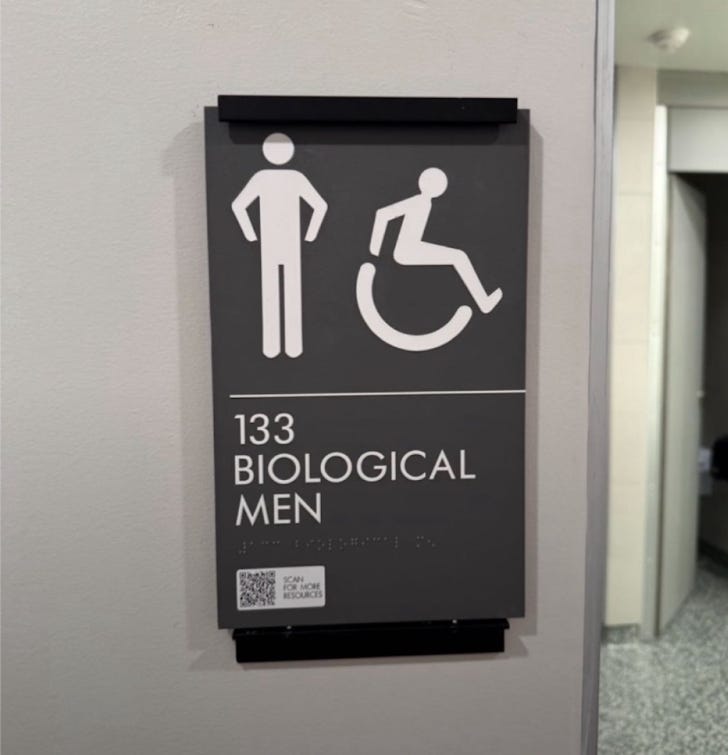
In an attempt to abide by this law, the University of Cincinnati (UC) replaced the gendered bathroom signage around campus to state, “Biological Men,” and “Biological Women.”

UC sent out an email the following day in which they recognized that the current signage using the term “biological” was an error.

The email went on to further state, “We recognize that recent signage updates have raised concerns. Please know that our intention was never to withhold important information or create uncertainty. The university’s requirement to comply with the law does not take away from its commitment to creating a learning environment that fosters opportunity and develops educated and engaged citizens.”

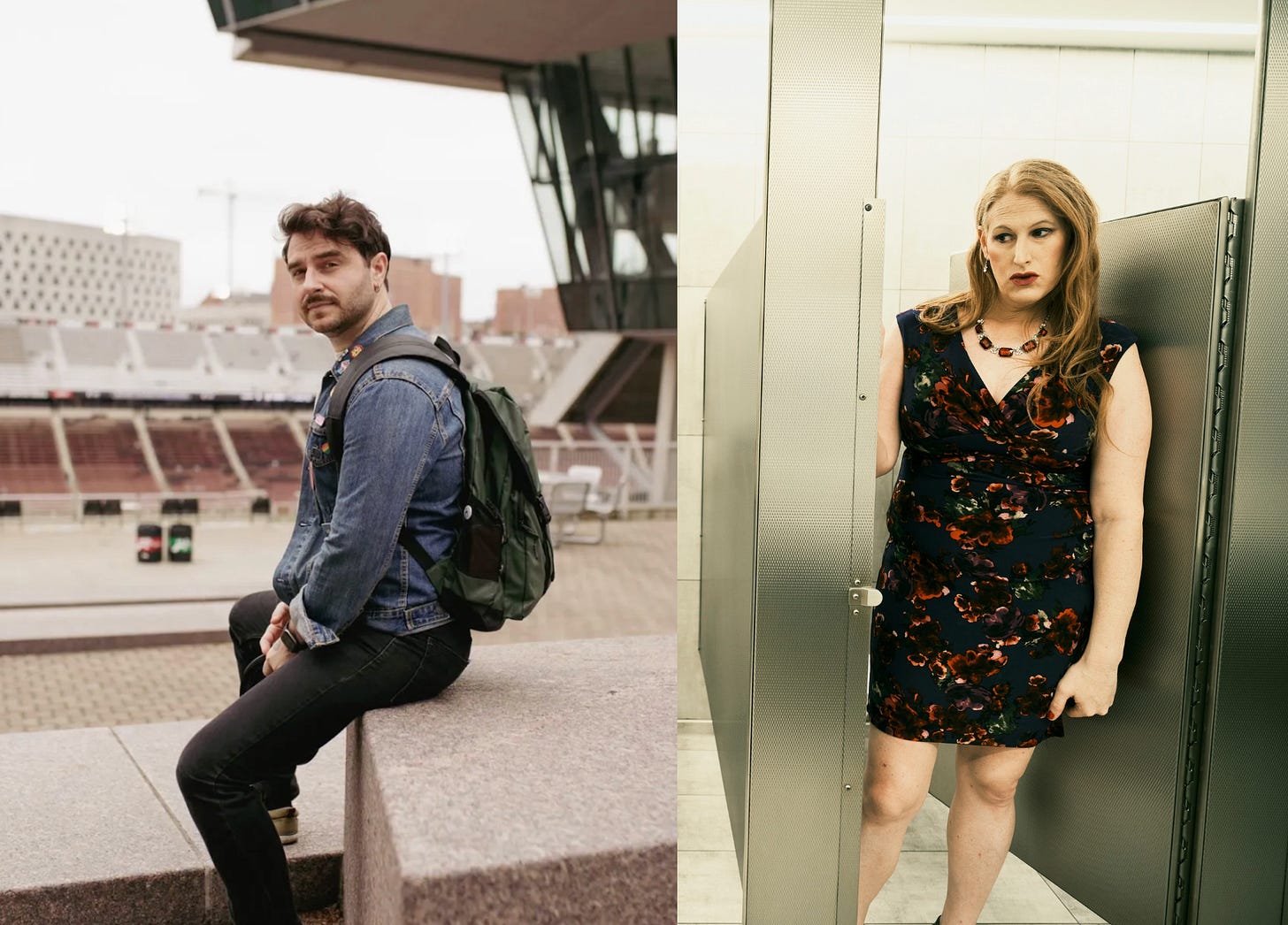
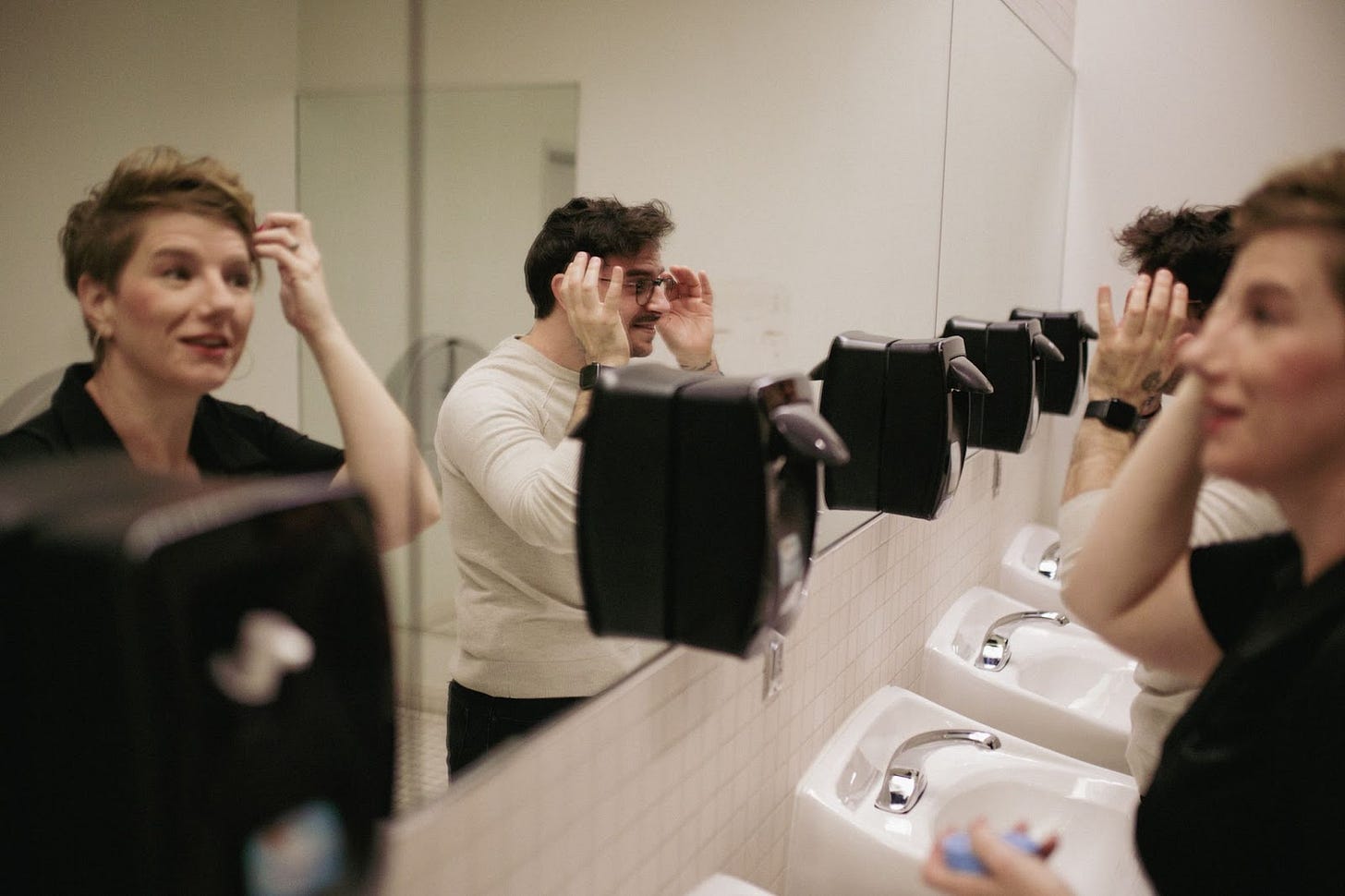
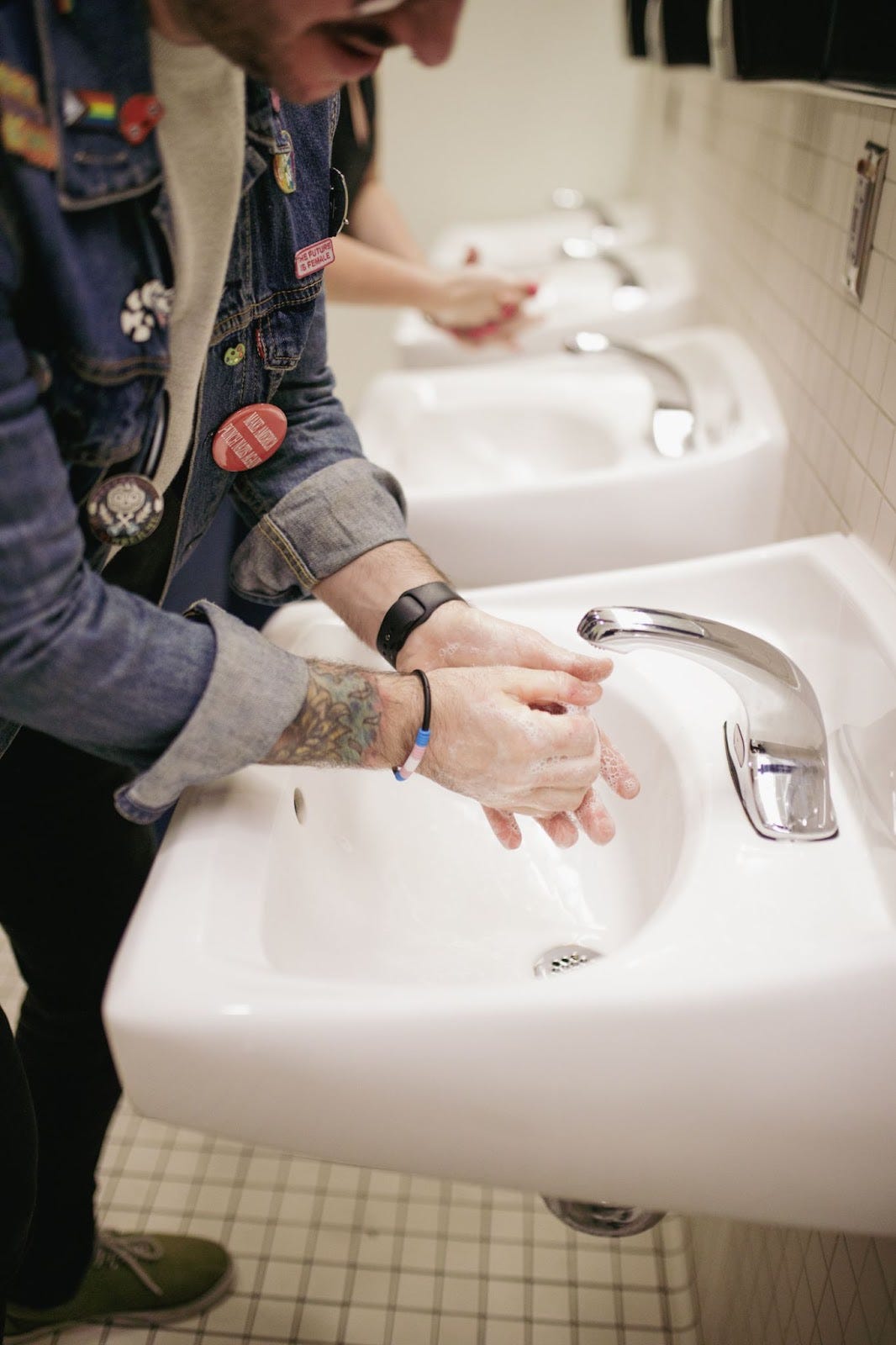
As a response to the university, Simone Balachandran aka Simon Brine, associate professor and environmental engineering educator in the department of chemical engineering, called for trans women and allies to show up to the locker rooms in protest. In early March, Brine, along with several other trans women, went into the men’s locker room, stripped down naked, and talked to the cisgender men in the bathroom.

“I felt powerful. I wanted to force them to see what a trans woman’s body looks like. When people see trans bodies, it will change their minds,” Brine said. When asked about her thought process behind the protest, Brine responded, “It is called activist judo. The idea is not to try and win; it is to try and lose, with the reasoning coming from the reality that the law is not going to be in your favor, but you can exploit the loss. I am going to follow the law, and the law allows me to get naked in the locker room and force you into a position where you have to recognize my existence.”

“When we asked the men there what they thought about the law and the sign, all of them thought it was ridiculous and thought we should be in the other locker room. One person even thought they were going into the wrong locker room,” Brine said.

But do trans and gender non-conforming students actually feel that the university is committed to fostering a safe and effective learning environment?

Noah Wardega, a recent UC graduate, does not think so. “My first thought was that it is impractical. How could they even enforce that? But, ever since the policy was put in place, I stopped using the bathrooms on campus.”

When asked about the impact the policy had on their life, Seven Kiener, a senior social work student, said, “It caused me to completely reevaluate my relationship with the service work I was doing for the university. I have completely stepped away from any UC-based groups and changed my plans for grad school so that they no longer include UC.”

It is clear the law has rattled trans people on campus, and when asked how UC can better protect trans students, Eliza Guerra, a university member, said, “We need more classes and instructors teaching queer authors and content without fear of anti-DEI policies.”

But can professors and staff actually do that?

SB 1, the “Advance Higher Education Act,” requires institutional neutrality on controversial political or global matters while also requiring institutions to conduct annual faculty reviews.

So, when the Lemkin Institute for Genocide Prevention and Human Security released its third red flag alert warning that the United States is within the early to middle stages of a genocidal process against trans people, “the goal of which is to completely erase transgender people not only from public life but also from existence in the U.S. and globally,” there is a real question about how professors would even be able to bring this report up.

Brine believes that to present this to a classroom of students, you would have to also present the conservative argument regarding transgender rights.

As of today, UC has since removed “biological” from their bathroom signs, but what were now gender neutral bathrooms have since turned into single-use bathrooms.

Voters standing in line to cast ballots at a church polling place in Louisville, Kentucky.

These 12 local offices shape your daily life in Kentucky. Here’s what each one does

The United States is sometimes described as 50 different countries wearing a federal government trench coat. Creating change at the national level is like steering a cargo ship: it takes a large amount of power to move a rudder, and it’s slow to shift directions. Creating change at a local or state level, however, is like steering a speedboat: much simpler and quicker to see change take effect.

Local offices are often overlooked on Election Day, but they impact your daily life more directly than you might think. Local governments are meant to meet the needs and solve the problems of their local residents, as well as provide services like roads, clean water, sanitation and police. They also have a large say in the usage of Flock cameras, the building of data centers, whether to cooperate with ICE or DHS, and the fair treatment of trans Kentuckians. If you have strong feelings about your neighborhood, or how you and your neighbors are treated, you should know the basics of each local office before voting.

A heads-up for Louisville and Lexington voters: both cities have merged city-county governments, so their mayors and councils handle most of what the county judge-executive, city council/commission, and fiscal court do elsewhere. And within Jefferson county are smaller cities, like Jeffersontown or St Matthews, with their own mayors and councils.

County offices

County judge-executive

A county judge-executive is a voting member of the county’s fiscal court. Their main job is to create a county budget, allocate the budget as the fiscal court approves and appoint people to lead various county positions. The judge serves a four-year term.

Because the judge-executive builds the budget, this office helps decide whether county law enforcement gets Flock cameras, Axon gear and similar surveillance tools, and what safeguards come with them.

Fiscal court (magistrates or commissioners)

The fiscal court, which includes magistrates or commissioners, is the group that provides services like road repairs, snow removal and sanitation at the county level. Despite its name, the fiscal court isn’t a court of law. It’s the county’s legislative body, like a county council. The fiscal court votes on county ordinances, orders and resolutions, which are then enforced by the judge-executive. Many decisions on ICE agreements, data centers and surveillance spending are made locally, and the fiscal court votes on many of them, within limits set by state law. Fiscal court meetings are open to the public, and members serve four-year terms. A sheriff or jailer can sign some agreements, like those with ICE, themselves, and the fiscal court doesn’t always vote on them.

Jailer

Kentucky is actually the only state in the country that elects jailers, who maintain order within their county’s jail. Jailers transport people to and from court and process people into the jail. The jailer decides whether the jail signs a 287(g) agreement with ICE and whether it voluntarily honors ICE detainers, which are requests, not warrants.

A 2025 state law bars jails and prisons from using public money to provide hormone therapy, but the jailer still decides whether people get HIV medication, PrEP and other prescriptions on time, and whether a trans person is kept safe.

The jailer also decides whether a parent held for ICE can get a notary to sign power-of-attorney or guardianship papers so someone they trust can care for their kids, how people who don’t speak English can communicate and how much help reaches people inside. That last one varies wildly county to county. In more than 40 counties, the elected jailer has no jail to run, and people are held in a neighboring or regional jail. They serve four year terms.

Sheriff

The sheriff decides whether deputies call ICE after a traffic stop, whether the office signs a 287(g) agreement to do immigration enforcement for ICE, and how deputies treat LGBTQ+ people, immigrants, unhoused folks and sex workers. Deputies also serve court papers, make arrests, and carry out many court-ordered evictions. In Kentucky, the sheriff also collects property taxes. Sheriffs serve four-year terms.

County clerk

County clerks are the local government record-makers and record-keepers. They oversee vehicle registration and titles, marriage licenses, property and legal records and elections. If you’re registering a car, getting married, voting or buying a house, you’ll be interacting with a county clerk’s office. County clerks serve four-year terms.

The office has real stakes for queer Kentuckians: in 2015, Rowan County Clerk Kim Davis refused to issue marriage licenses to same-sex couples and was jailed for contempt of court. Voters removed her from office in 2018, and in 2025 the U.S. Supreme Court turned down her request to overturn same-sex marriage.

Courts and prosecutors

County attorney

The county attorney is the one who prosecutes misdemeanors and other lesser offenses in district court, like DUI offenses, traffic violations, assault and petty theft. This is also where most homelessness, misdemeanor drug possession, sex work and protest arrests get charged. Felonies go to the commonwealth’s attorney.

These attorneys also prosecute juvenile cases, including criminal acts, neglect and abuse. They can work with judges to issue emergency protective orders in domestic violence cases, oversee mental commitments and disability cases and more. Most county attorneys are also involved in collecting delinquent child support payments. County attorneys have four-year terms.

Commonwealth’s attorney

These attorneys prosecute felony crimes and cover a judicial circuit, which can include more than one county. They serve six-year terms. A felony is any crime that can be punished by a year or more in prison. This is where the choice to divert or to cage gets made for felony charges, like possession of meth, heroin or fentanyl, and for protests charged as felonies. The commonwealth attorney decides which cases go to a grand jury as felonies, and a felony knocked down to a misdemeanor stays in district court with the county attorney.

Family court judge

Family court judges are the ones who preside over family-related cases such as divorce, domestic violence protective orders, child custody and visitation, adoptions and more. One judge can decide whether a trans parent keeps their kid, or whether a queer person gets a protective order against an abusive partner. Family court judges serve eight-year terms.

District court judge

District judges hear misdemeanors, traffic cases, small claims, probate matters and the first stages of felony cases. District judges also grant adult name changes, a step many trans Kentuckians need before they can update their IDs. They also set bail, which decides who waits for trial at home and who waits in jail. They serve four-year terms.

Judicial races are nonpartisan, so judges’ party affiliations won’t appear on your ballot.

City and schools

City council or commission

The city council is kind of like a city’s board of directors: they function as a city’s legislature and pass laws and ordinances. City council (sometimes called city commission) is in charge of budgets, taxes, passing ordinances like installing stoplights, and zoning. Cities can also pass fairness ordinances, which ban discrimination against LGBTQ+ people in housing, jobs and public places.

Kentucky has no statewide fairness law, so local ordinances fill the gap. Louisville and Lexington passed the first ones in 1999. Most since then have come from city councils, but Woodford County’s fiscal court passed one in 2020. City council meetings are open to the public. Terms vary by city.

School board

Like the city council, a school board governs a local school district by setting policies, providing funding and setting local school tax rates. The school boards also hire the superintendent, set discipline codes and graduation requirements and more. They serve four-year terms.

It’s the seat nobody watches, but school boards set the discipline codes that decide how a school responds when a queer or trans kid gets bullied. They also decide how book challenges get handled and how the district carries out state rules on students’ pronouns and bathrooms.

Mayor

City governments in Kentucky run on one of three models: mayor-council, commission or city manager. In a mayor-council city, the council enacts ordinances, levies taxes and adopts a budget. The mayor runs the city’s daily affairs, oversees personnel, can veto legislation and can cast a tie-breaking vote. Louisville and Lexington have their own forms: Louisville is a consolidated local government and Lexington is an urban county government. Both have a mayor and a council. Mayors serve for a four-year term.

Find your districts

Pull up your sample ballot at ourpeopleourvote.org, or call your county clerk’s office, to see which of these seats are on your ballot this year and which districts you vote in, including your magistrate or commissioner, city council and school board districts.

Seth Rane, Grayson Castellucci and Eddy Risimini, three students in white button-down shirts, laugh together in front of a wall of green leaves.

Pushed to the Edge of Campus, These Trans Students Started Their Own Fraternity

This story first appeared in Queer Cincinnati: Beyond the Binary, published Oct. 23, 2026.

In the spring of my freshman year at the University of Cincinnati (UC), Ohio Senate Bill 1 was moving through the state legislature. The bill, which would take effect on June 27th, 2025, requires Ohio’s public colleges and universities to maintain institutional neutrality and “intellectual diversity” on certain “controversial beliefs and policies” including climate policy, electoral politics, foreign policy, immigration, marriage, and abortion. It also bars faculty from “indoctrinating” students toward a position on these topics, bars the institution itself from taking an official stance, and eliminates diversity, equity, and inclusion (DEI) offices, departments, and required trainings at the same institutions.

UC, however, wasted no time adopting these principles, even before the bill became law. UC President Neville Pinto complied in advance, stating in a public email on February 21st, 2025 that “it is untenable to operate as if noncompliance with these directives is an effective option” and that “we are committed to meet our compliance obligations.” Soon after President Pinto’s address, DEI offices including the LGBTQ+ Center, the Women’s Center, Ethnic Program Services (EPS), and the African American Cultural Resource Center (AACRC) were immediately shut down. Many students, myself included, felt this response failed to address their concerns.

That same spring, the university began replacing bathroom signage with new “biological men” and “biological women” signs. This action was a result of Ohio Senate Bill 104, the “Protect All Students Act,” signed by Governor Mike DeWine in November 2024, which prohibits members of one biological sex from using restrooms designated for the opposite biological sex and erases multi-occupancy restrooms open to any gender. The law does require institutions to provide alternative accommodations, such as single-occupancy facilities, but the bathroom signage UC implemented was worded of their own accord. The new signs were adopted quickly, sending a clear message that transgender, nonbinary, and intersex students were not welcome. Because of this, many students became worried that their university housing options would no longer be viable if the available restrooms did not match their “biological sex.” As a trans man living in freshman dorms at the time, I worried for my housing security.

My fears came true when my fellow trans roommates Seth Rane, Grayson Castellucci, and I were relocated to the margins of campus mid-spring semester. We were originally approached in an email by UC’s Director of Resident Education & Development at the time, Trent Pinto, on February 10th, 2025. Pinto invited us to a “conversation regarding upcoming changes to the residential experience.” This meeting was held at UC’s LGBTQ+ Center before it was dissolved, and its conclusion resulted in two options: 1) Stay in our dorms and travel to the women’s dorms to use the restroom, or 2) Relocate to an off-campus apartment where we would have access to a personal restroom.

Option 1 was an unreasonable request for us. Not only was this option directly invalidating our identities as men, but it was also oversaturating the communal space and required us to travel to a different floor or building to use the restroom. Because of this, my roommates and I conceded to option 2 and were relocated to an apartment near campus. While UC quickly responded to a flood of backlash by removing the bathroom signs, the damage had already been done. What was supposed to be an exciting year to make new friends and invest in our studies instead became a year where we were isolated from our peers and pulled from our classes to accommodate the move to our new apartment.

Amidst the predatory legislation and considerable lack of LGBTQ+ spaces, we quickly realized we were not alone in our isolation and observed an almost solemn environment throughout campus. To combat this, my roommates and I decided to make a change.

One day after class, I came home to Seth and Grayson sharing the idea of starting a queer fraternity: Phi Alpha Gama (PAG). At first, we treated it as a joke. After all, it is customary across university Greek life to exclusively allow one gender (women in sororities, men in fraternities). It seemed absurd to imagine visibly queer or transgender individuals enjoying this same staple of college life, but the more we thought about it, the more we realized that PAG’s existence might be a space that UC’s LGBTQ+ community desperately needed: a space made by queer people for queer people to enjoy without consequence.

A fraternity was the best option for us to organize an LGBTQ+-friendly community because we felt that queer individuals deserved to be included in traditional college experiences that they may otherwise shy away from. We gathered a few close friends to join PAG, but we realized that to expand our community past our small clique, we needed to give our fraternity structure. To do this, we created the governing body of PAG, consisting of the following roles: president, vice president, secretary, recruitment officers, philanthropy chair, social media chair, diversity chair, and grievance officer.

We didn’t expect PAG to be more than a small community at first, but soon, friends of friends came to our parties and told their friends about PAG, and it became a vast network of students where all are welcome. During our recent spring rush campaign, we had a great turnout, with around 30 members present and 10 rushees. We implemented different group bonding activities including ice breaker games and a friendly s’mores roasting competition. However, the main standout of this event came about when several people approached our front yard asking about the event we were hosting. What stood out to me the most was how accommodating the members of PAG were to total strangers. Seeing a community that I helped create foster such a kind and welcoming environment made me realize how important PAG was to creating a safe space for queer and allied individuals to be themselves and make new connections.

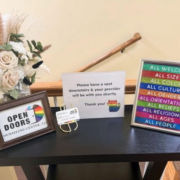
Mental health care for trans Kentuckians: Open Doors Counseling Center's entry table with a rainbow "All Welcome" board.

Trans Kentuckians Are Staying Home. The Data Says Community Is What Helps.

Mental health trends in transgender and nonbinary Kentuckians have displayed shifts during recent policy debates.

A 2025 Queer Kentucky survey showed that 34.5% of respondents reported that these recent policy debates have very negatively impacted their mental health.

Some gender expansive Kentuckians told Queer Kentucky that policy debates have led to them feeling like they are at the focal point of society right now, making the simple act of going into public feel daunting.
Hayes Farris, a nonbinary Kentuckian, said when they step out in public, it feels like transgender people are what sit at the forefront of people’s minds.

Farris said part of it is not knowing what people are thinking.

“Is that person looking at me because they are seething inside and hate that I exist? Are they curious? That’s just a heavy mental load to carry around,” they said.

Delgonna Cole, a transgender woman, said she is constantly thinking about what might make her easy to “clock” as transgender in public.

“I’ve had people come up to me at Kroger saying, ‘Hey, I have a question. Are you trans?’” she said. In reference to policy debates about the rights of transgender people, Cole said, “If it wasn’t pushed so intensely, I think I wouldn’t be so constantly afraid of going outside.”

Even healthcare providers for transgender and nonbinary Kentuckians reported seeing changes or responses from their patients reflecting these negative effects.

Dr. Keisa Fallin-Bennett’s practice has included transgender people for around 10 years, and for most of her career, she has been providing her services in Kentucky.

Fallin-Bennett said the impact varies from person to person, but she has heard from several patients that the impacts of recent policy debates have been devastating.

She said there has been a lot of policy debate prior to 2023, but that is where it all really took off.

“People start in a difficult state because of the world and having to accept that the institutions are kind of actively working against them,” Fallin-Bennett said.

Policy changes have led to decreased federal funding for her place of employment, and these changes have altered what is allowed to be provided to transgender patients, according to Fallin-Bennett.

According to the survey, when transgender women are denied healthcare in any aspect, they are more likely to avoid all healthcare. Some of this avoidance may be due to shaken trust in the healthcare system.

Fallin-Bennett discussed the issues that a 2023 Kentucky law stated that neither hormones nor surgery could be provided to transgender patients under 18, but an executive order to cut federal funding for institutions that treat individuals under 19 was signed in 2025 under President Donald Trump.

Under the threat of losing federal funding, Fallin-Bennett’s practice could no longer treat people under 19 years old, and people under that age limit who were already on hormones had to be weaned off.

“Frustrations are really building, and it really erodes the trust that people have in us,” Fallin-Bennett said.

For Cole, after struggling to get endocrinologists to properly prescribe her gender-affirming hormones, she took matters into her own hands.

“They wanted to stop my HRT dose because it got too high… but the levels were lower than a cis teenager’s,” she said. “So I just stopped seeing them, and I started doing DIY.”

Cole said she buys everything online, did extensive research, and measures her blood levels all on her own.

Transgender women report provider refusal at rates of 38.5%, far above the 12.6% statewide average for queer people, according to the QKY survey.

Another factor that gender expansive Kentuckians must think about when it comes to healthcare is finding understanding in their providers.

“I don’t think it’s ever been a question of safety, but more comfortability. I haven’t had any issues where I have felt unsafe, but even then, my therapist doesn’t know what questions to ask,” Jordan Gaither, a nonbinary Kentuckian, said.

Transgender and nonbinary Kentuckians are finding it difficult to cope with the world as it is right now, whether they are coping with self-medication, isolation, therapy or something else.

Gaither said they have had to figure out what they need on their own and come to their therapist with it, rather than being provided the necessary tools to cope.

This points to a potential lack of LGBTQ+ education for mental healthcare providers in Kentucky, but organizations like Open Doors Counseling Center are centered around providing care to queer people and have a queer staff.

Tanya Stephens, who uses no pronouns, only a name, says Open Doors is a great place for finding care as a queer person in Kentucky.

“They do a lot of good things to try to help. I did find a safe feeling place there,” Stephens, a local nurse practitioner, said.

Open Doors Counseling Center is part of a nonprofit organization called Caritas Care Solutions. The center provides identity counseling, trauma and grief counseling, financial therapy and more, and focuses on creating a safe space for LGBTQ+ people.

Finding mental health resources can be difficult in Kentucky. Eve “Sylvie” Derrington, who is nonbinary, said monetary restrictions can be part of the struggle.

“If there were more programs where you pay what you can based on your income, especially oriented to specific communities, that kind of thing would be helpful,” they said.

Derrington said coping is complicated, but it can help: “Trying to find community is a big coping mechanism. We’re not very good at it, but when we do have it, it’s beneficial.”

The Queer Kentucky survey showed that those with a lack of community reported significantly more severe outcomes in every policy impact measure.

Fallin-Bennett echoes that finding. She said that while it might seem easier to isolate right now, community is a crucial coping skill for queer people.

“People have been hit by this issue, and it makes everybody want to stay home. I think it’s the exact time that people need to be gathering with other people as much as their mental health allows,” she said. “We need to be outside of our houses for our mental health and have interaction with other humans… hopefully humans that are in the same boat.”

For Farris, policy debates have had an impact on them and their friends, but the conflict has helped them pull each other closer.

“I think it’s almost made us closer, and we know that community is everything right now,” they said. “I wish more people knew that it’s not a burden to lean on people you love.”

If you or someone you know is in crisis, the 988 Suicide and Crisis Lifeline is available 24/7 by call or text at 988, and restored its specialized “Press 3” service for LGBTQ+ youth on September 30, 2026, after a 14-month shutdown. Trans Lifeline’s peer support hotline is at (877) 565-8860, staffed Monday through Friday, 1 p.m. to 9 p.m. Eastern. The Trevor Project’s counselors are available 24/7 for LGBTQ+ young people at 1-866-488-7386, or by texting START to 678-678.

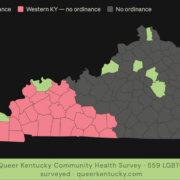
A county map of Kentucky showing which communities have local LGBTQ+ fairness ordinances, with western Kentucky counties highlighted in pink to show the region's lack of protections.

Western Kentucky’s LGBTQ+ Crisis: The Most Harm, the Least Protection Queer Kentucky's survey data reveals a region where nearly every measure of harm is at its worst, and state law still leaves trans Kentuckians out entirely.

LGBTQ+ people living in western Kentucky are experiencing a substantially more dangerous environment than anywhere else in the state, reporting being physically attacked at nearly twice the statewide rate. For trans folks, it goes even further: Kentucky’s hate crime statute has no name for what happens to them when they are attacked. A trans Kentuckian can be assaulted for being trans, and the state may prosecute the harm, but not the reason it was done.

Across the Queer Kentucky survey, western Kentucky ranks first or near first on nearly every measure of harm: LGBTQ+ residents with no health care provider, never tested for HIV, refused care by a provider, physical assault, suicidal ideation, drug use, smoking, feeling unsafe at home and deciding to move away. This is a region where nearly every measure of harm, access and community is at risk. And state policy and protections have failed them time and time again.
29.2% of queer residents in western Kentucky reported at least one instance of physical assault, which they attributed to the overarching anti-LGBTQ+ climate in the state. Overall, the statewide rate of physical assault stands at 15.2%.

54.5% of queer individuals report feeling physically unsafe at home, and 52.2% report feeling unsafe in public. Both are the highest of any region.

But it doesn’t stop at physical assault. In most of western Kentucky, a person who discriminates against and refuses an LGBTQ+ person a job, an apartment or service at a counter faces no legal consequences in doing so.

Across all of Kentucky, 24 communities have local Fairness Ordinances — including western Kentucky’s Paducah in 2018 and Henderson in 2019 — but that’s two of the 24, and they sit 130 miles apart. In between and beyond them, Owensboro, Bowling Green, Hopkinsville, Madisonville, Murray and Mayfield have no local fairness ordinances. On a map of who Kentucky has agreed to protect, most of western Kentucky isn’t on it.

What about larger state protections in Kentucky? It turns out that the state of Kentucky does have a hate crime law that protects sexual orientation. But it’s still reliant on individual judgment, and it still doesn’t protect trans people.

KRS 532.031, passed in 1998, applies when someone commits offenses because of a person’s race, color, religion, sexual orientation or national origin. In 2017, the legislature amended the statute to add a category, extending it to victims targeted for their actual or perceived employment as a peace officer, firefighter or emergency medical services worker.

Gender identity is not on the list.

Nine years ago, when the state legislature reopened the statute to add police and first responders, it still left trans Kentuckians out. For example, if a gay man is assaulted in Paducah, it can legally qualify as a hate crime. But if a trans woman is assaulted on the same block, both the state and law enforcement officers can choose to do nothing. The statute, by not including gender identity, allows law enforcement to turn a blind eye and delegitimize incidents against trans people.

Even within the bounds of discrimination against sexual orientation, this hate crime law does “protect,” the statute has no teeth and the law still does far less than what it implies. It might look and sound substantial, but functions as a performative exercise in the court system. As a result, there are many opportunities to create distance between the assault and any consequence for it. For instance, a judge decides at sentencing whether bias was a primary factor. A finding of bias permits denying probation instead of requiring it. The parole board may delay or deny parole.

It’s subject to discretion and personal biases that could creep in all the way down.

The laws already on the books are only part of it. Kentucky’s 2026 General Assembly may not have passed any anti-LGBTQ+ bills, but the climate in western Kentucky still hasn’t improved.

A bill doesn’t have to pass to embolden violence in its communities. Another factor behind why the climate in Western Kentucky still hasn’t improved. A bill only has to be filed, assigned, debated and covered on the local news, which are all separate moments of exposing a Kentuckian to hear whether or not their queer neighbor has the same rights as they do.

For example, Senate Bill 72 would have let health care providers refuse any treatment that violated their conscience. House Bill 468, pitched as a routine civil rights update, would have stripped the enforcement power from the Kentucky Commission on Human Rights and the 22 local commissions that actually enforce fairness ordinances. Both cleared their chamber of origin before stalling.

If House Bill 468 had passed, it would have taken away the only fairness ordinance protections two cities in Western Kentucky have.

And people are responding the only way the law leaves open to them: they blend in, censor their identity and opinions, or leave the state altogether.

According to the same survey, 18.5% of LGBTQ+ individuals living in Western Kentucky have decided to move out of state due to anti-LGBTQ+ policies; statewide, only 8.1% decide to leave. The compounding burden of assault, health care gaps, housing stress, and drug use appears to translate into a concrete intention to leave. One respondent wrote:

“Currently planning to move out of [the] states to a blue state. I have a lot of trans friends that I am scared for. I want them to go somewhere more blue, more safe, more open minded.”

In the face of so much hardship, western Kentucky remains home to LGBTQ+ advocates who keep showing up anyway. In May 2019, 55 residents in Bowling Green spoke in favor of a Fairness Ordinance, while 31 spoke against it. The commission voted it down 3-2. Advocates put it back on the agenda and have continued pushing for it. When a Fairness Ordinance was voted on in January 2018 in Paducah, residents flooded the city commission meeting, forcing the fire marshal to move the overflow into the adjacent hall to listen through open doors. That ordinance passed 4-1.

The people of western Kentucky continue to fight for the safety of their LGBTQ+ neighbors. But with so few fairness ordinances and statewide protections that stop short of covering them, many LGBTQ+ western Kentuckians remain at risk.

If you or someone you know is struggling, call or text the 988 Suicide & Crisis Lifeline at 988. LGBTQ+ young people can press 3 to reach counselors trained in LGBTQ+ care, an option that returned on Sept. 30, 2026 after it was cut in July 2025. The Trevor Project also offers 24/7 support at 1-866-488-7386 or by texting START to 678-678.

The exterior entrance of AVOL Kentucky, Suite 100, photographed at dusk. A black A-frame chalkboard sign in front of the brick and gray-sided building reads "Free AVOL HIV STI Testing" in colorful lettering. String lights hang above the entrance, and bare winter shrubs line the base of the building.

No Doctor, No Test, Refused at the Door: What the Data Shows About LGBTQ+ Health Care in Western Kentucky Survey data points to a crisis in access, education, and trust — and the organizations working to close the gap.

From Mayfield to Paducah to Murray, Western Kentucky is full of life, history, and unique challenges, but when it comes to accessing reliable, informed, and specific health care, LGBTQ+ people in the region face obstacles that other Kentuckians might never feel.

Recently published data from the 2025 Queer Kentucky Community Health Survey reveals that LGBTQ+ people in Western Kentucky are significantly less likely to be receiving routine health care. The survey, which collected data from 559 LGBTQ+ Kentuckians, indicated that 58.2% of respondents in Western Kentucky have no regular healthcare provider.

That number grows even more concerning when you dig into disparities in reference to sexual health. The rate statewide for those who have never tested for HIV is 48.2%. In Western Kentucky, it’s 67.2%.

According to community organizers, these numbers illustrate how education can affect public health. It’s also tied to legislation. In 2023, Kentucky’s Republican State Senate majority passed Senate Bill 150, which implemented anti-trans policies including forcing trans students to use bathrooms and locker rooms that conflict with their gender identity, but it also made teaching about sex education or puberty virtually impossible for certain age groups.

“A lot of the schools still really push an abstinence-only sexual health education… and that has a real limiting and long-lasting impact on people’s view of sex in general,” said Christine Lindner, President of West KY NOW, a local chapter of the National Organization for Women, a feminist membership organization that advances economic justice, reproductive justice, and civil rights.

Without education or access to care, communities are left without the necessary resources to thrive, according to health care providers in the region.

“If people don’t know about things they don’t know to be tested, they don’t know what to look for,” said AJ Garnett, Outreach Director at LivWell, a nonprofit organization providing healthcare, support services, prevention education, and HIV testing to communities in the region. “Being able to educate people when they’re younger, whether it be middle school or high school, would make a world of difference.”

Another contributing factor behind these numbers is the limited resources available in the Western section of the state. The more densely populated areas of Louisville, Lexington, and Bowling Green are all in Central or South Central Kentucky. These areas experience higher concentrations of hospitals, clinics, and places of care. About one in five people in the US live in rural areas, but only 9% of physicians practice in rural communities.

While there are resources in Western Kentucky, including LivWell, they are limited and some LGBTQ+ people in these communities are not comfortable seeking care. Data from the 2025 Queer Kentucky Community Health Survey also indicates deeper issues than just seeing a doctor regularly; the survey also pointed to high levels of discrimination in the region. Almost 13% of respondents statewide reported a provider refusing care due to their LGBTQ+ identity, but in Western Kentucky this number jumps to 30%, the highest in the state.

“No amount of shaking hands and assuring people is going to alleviate years of distrust that they’ve built up for good reason,” said Garnett. “…Sometimes in those very rural areas, people just don’t even know we exist.”

The isolation of LGBTQ+ in rural Kentucky presents real challenges to reaching these communities, but queer people are still finding ways to thrive and build stronger futures.

“I think people don’t realize how large the community is out here in Western Kentucky, but we are really under-resourced and underfunded,” said Lindner. “I think there’s a desire for healthier queer existence, but there’s just a lot of pressure out here.”

West KY NOW regularly creates inclusive events and programming with the intention of building stronger communities in the region, including a feminist bowling night.

This data presents an opportunity for deeper investments by community groups, care providers, and educators. According to Garnett, closing these gaps looks like building deeper inroads with communities to establish trust between provider and patient.

Other Kentucky-based organizations working to close that trust gap with rural LGBTQ+ communities include AVOL, an organization committed to ending HIV through testing, medical intervention, and community support, and Matthew25, which works with those living with, at risk of, or affected by HIV and other sexually transmitted infections. With four clinics across Southern Indiana and Western Kentucky, Matthew25 serves 25 counties in Kentucky and 12 in Indiana.

“I know a lot of people are scared because of the way they’ve been treated in the past… I’m not going to sit here and pretend like there aren’t doctors and nurses out there that give people hell every time they come in to talk about HIV or other STIs,” said Garnett. “But I can tell you with us, with organizations like AVOL, with Matthew25, everyone I speak to in these organizations is so eager and anxious to help, and excited to be part of people’s lives and make them better.”

Nathan Wilson smiling in sunglasses and a neon cap in front of a Matthew25 mobile health clinic truck

How Rural Kentucky HIV Care Saved Nathan Wilson

He was an HIV patient in Rural Kentucky. Now he helps run the nonprofit that saved his life. Nathan Wilson is on a mission to fight against the stigma of living with HIV in Kentucky and beyond. 

Before Nathan Wilson worked at HIV health nonprofit Matthew25, he was a patient. He was a convicted felon and was in active addiction for more than a decade. Now, Wilson oversees patient experiences as the facilities and project manager for the organization. He serves the same rural Kentucky communities where he once struggled to find care himself.

Matthew25, which celebrates its 30th anniversary this year, works with those living with, at risk of, or affected by HIV and other sexually transmitted infections. With four clinics across Southern Indiana and Western Kentucky, the organization serves 25 counties in Kentucky and 12 in Indiana.

Wilson became a patient with Matthew25 in 2019. He found out he was living with HIV while at a Suboxone clinic. He recalls being told: “Hey, your blood test shows this. You should probably reach out to these people.”

He admits that he wasn’t the best patient at Matthew25 in the first year, but the workers at the organization were patient with him. He made up for it, and four years later, he began working at the nonprofit, first as a driver, transporting patients to appointments and then working the group’s food pantry. He now oversees facilities operations for all four of Matthew25’s clinics. 

“Matthew 25 has changed my life since day one — not only changed it, but saved it,” Wilson says. He said the organization fought for him to get his HIV medications when he was incarcerated. While the group didn’t succeed, the fact that they worked hard to help him had an effect on Wilson.

When he first started working at Matthew25, he wasn’t sure he was “a healthcare facility would hire somebody” like him. 

But now he sees his various roles with the group as a full-circle moment. 

“I spent every day on the road with patients — young, old, different ethnicities, different backgrounds — and it changed my view of how broadly HIV affects people,” Wilson says. “It also broke down a lot of barriers between me and patients, because I am one of them.” 

He says many people he’s met also living with HIV don’t have such robust support systems. 

“A lot of times, you’re just there to listen. People don’t necessarily want advice; they just need somebody to hear them,” Wilson says. “Matthew25 has recognized that from the beginning: that we support system. Sometimes they just need to get something off their chest.”

 Wilson believes his work is a part of a greater impact on their patients.

“I work to make sure we have the best possible experience for both clients and employees. That’s the van someone rides in, the exam room they sit in, the quality of our medical equipment. I want people to feel welcomed and cared for in every detail of their environment.”

He says it’s that care that he was shown at Matthew25 that still stays with him.

“Everywhere else I went, I was treated like an addict or a criminal. I never felt that way here. They strive so hard to meet people where they’re at — without judgment, just focused on providing the medical care you need and whatever support you want,” Wilson says.

Matthew25 is one of a few providers supporting Western Kentucky, offering services in locations outside large urban centers. Geography, Wilson says, plays a large role in obstacles to care for HIV-positive Kentuckians. The organization itself travels about a 200-mile radius to pick a patient up to get them to their HIV care, but also any other medical care they need. 

Another obstacle, Wilson says, is fear. He remembers thinking it was a death sentence when he was told he had HIV. 

“I think a lot of people avoid getting tested because they’re scared of what they’ll find, and worried about cost. What they don’t always know is how many resources exist specifically to help with treatment and suppressing viral load,” he explains. “If we can suppress viral loads in people already living with HIV to the point where there’s no transmission risk, then eventually this ends.” 

Wilson says there’s still stigma surrounding living in the area and a misconception that HIV is only a virus gay men get. He said that while he is a gay man, he also was an IV drug user. Male-on-male sexual intercourse is not the only way a person can contract HIV. 

“I think transmission is still deeply misunderstood, and that misunderstanding costs lives.”

The stigma from the gay community also comes to Wilson’s mind. 

“There’s still so much shame and secrecy around it. I’ve been undetectable for years, but people still treat HIV-positive individuals as if we’re diseased,” Wilson says. “You would think that people who have experienced so much oppression themselves would be more willing to accept others.”

He adds that it’s that specific stigma that makes him want to be open about his status and history: “to show that life doesn’t end with an HIV diagnosis.”

Wilson believes the only way to overcome this stigma and to work to stop the transmission of HIV is to recognize each other’s humanity. 

“People with diabetes aren’t stigmatized for their condition. People with cancer are treated with compassion. People living with HIV deserve the same. And the most important thing to hold onto is this: We could actually see the end of this disease, in my lifetime, or the next,” he says, explaining the need to support HIV medications and PrEP. “Transmission can be stopped. Why would we not want to do everything in our power to make that happen?”

University of Kentucky Queer Students Face Policy Backlash

Queer students at the University of Kentucky are concerned because of policies created by the Trump administration that the university is adopting. While federal policy changes may sometimes seem theoretical, recent research suggests that a lack of perceived university support is linked to worsening mental health among queer students nationwide.

UK has already seen queer student organizations and events targeted by policies handed down by Trump officials. 

University of Kentucky Rolls Back LGBTQ+ Protections

The first sign of a shift in university policy came in April 2025, when Jay Blanton, University of Kentucky’s vice president for university relations and chief communications officer, told the Herald Leader that UK halted LGBTQ+ graduation celebrations “in accordance with state and federal law.” Additionally, the change came in cooperation with state law House Bill 4, which prohibits differential student housing based on factors like gender, the University removed gender-inclusive housing.

Funding Pulled From LGBTQ+ Student Organizations

Then, in October 2025, Kentucky Kernel reported that LGBTQ+ student organizations STEMgiQueers and OUTLaw had UK support and funding to participate in a professional development conference revoked. This was attributed to the University’s attempt to comply with a new directive by the U.S. Department of Education’s Office for Civil Rights regarding the university-endorsed minority organizations and events. During the spring 2026 semester, Carson English, then UK’s Gender Sexuality Alliance (GSA) president, a queer rights activist, and public policy student told Queer Kentucky how these changes were affecting LGBTQ+ UK students urging the university to support LGBTQ+ students. He said he’s seen a change in queer students since the policies. 

“I have noticed a decrease in, you know, student usage of safe spaces on campus. Less students are coming in,” he said. He also feels the concern personally. 

When asked if he believes UK’s campus is more or less safe compared to previous years, English said, “I say a little bit less safe.” 

English self-categorized as someone who can “sort of [straight] pass.” 

He added: “I’m not usually the target of any sort of hate crimes, hate speech, anything like that.”

“I don’t understand why queer groups are being targeted so much,” English said. “I’m not doing anything to harm them. I’m not doing anything to harm anybody… it feels like such a small percentage of the population is being targeted at such a large scale.” 

Anti-LGBTQ+ Groups Gain Ground on Campus

Beyond administrative changes, student organizations described as being anti-LGBTQ+ have seemed to increase their presence perhaps emboldened by UK’s enforcement of arguably inequitable policy. Student representatives for Turning Point USA (TPUSA) have become hard to miss. Even though an investigation has been initiated by UK regarding leaked TPUSA group chat messages claimed to allegedly normalize violence and participate in discriminatory harassment, the group still has increasingly promoted anti-LGBTQ+ messaging, including by highlighting voices like prominent anti-trans activist Riley Gaines.

English said that while he thinks there are more private anti-LGBTQ+ events, most students remained supportive. 

“I think from what I’ve seen, what’s happening is the vast majority of students are not in support of the changes, or are allies, or part of the queer community, and sort of in private spaces, hate speech has increased such as the group chats that were leaked from TPUSA,” he explained.

When asked if he felt supported by the university, English responded, “No.” 

He said he felt that university officials kept deferring blame to the state or federal government, as opposed to being non-complicit, taking accountability, or at least communicating changes better to students. 

“I think the way… that management or the higher-ups of the university are conducting this and managing themselves in this situation is cowardly,” English said.

English graduated this year. As he thinks of the job market that awaits him now, he said that losing the university support leading up to this huge change felt “uneasy.”

University officials did not respond to Queer Kentucky’s request for comment.

He explained that while it’s been difficult for his organization, the GSA’s members have come together. 

“It’s just made us stronger in our convictions,” English said. 

A collage featuring a gloved hand holding multiple syringes against a pink and blue torn paper background with faded text reading "I'm not surprised by the lack of education anymore. I'm just tired. Does this feel safe to me right now?" On the right, a person in sunglasses and a keffiyeh blows bubbles at a protest, shown in a blue-pink duotone.

Barriers, burnout, and resistance: Trans Kentuckians and the fight for healthcare

When clients walk into one of psychotherapist Sebastian Hamilton’s Louisville offices, they enter a cozy haven filled with soft lighting and pillows, nature posters, art supplies, and baskets of fidget toys. A linocut art print hanging on the wall features the Mary Oliver quote: “You only have to let the soft animal of your body love what it loves.”

Hamilton, whose pronouns are he/they, strives to create the kind of supportive environment he experienced with a trans mental health professional when he was exploring his own gender identity. This work has been complicated over the past year amid growing anxieties about state and federal anti-transgender legislation.

Hamilton, who became a Licensed Clinical Social Worker in 2023 — the same year the Kentucky state legislature passed a sweeping ban on gender affirming care for minors — said, “I’ve been seeing an increase in anxiety and exhaustion, especially since Trump’s second term. I see a lot more hopelessness and weariness.”

He has also seen a rise in the primary contributing factors that lead to suicidal ideation: perceived burdensomeness and thwarted belongingness, which he attributed to “this administration’s policies and the ways the administration has made local communities feel less safe for us.”

“I see people at all stages of their transition journey, and there is still so much joy in our community, so much strength. But sometimes, the joy is harder to access because of the ways things are impacting us on the interpersonal and national level when we have new, harmful legislation coming at us daily,” he said.

The impact on trans health and healthcare

2025 marked the sixth consecutive record-breaking year of anti-trans legislation. In Kentucky alone, 18 bills were introduced, including KY HB 495, which banned Medicaid from covering trans healthcare.

Kentucky, 2025

18 anti-trans bills
introduced in 2025
KY HB 495 — banned Medicaid from covering transgender healthcare

Trans Legislation Tracker, translegislation.com

Anti-trans legislation introduced, 2022–2025

State bills vs. national bills — six consecutive record-breaking years

State bills National bills
900
600
300
174
 
2022
556
 
 
2023
716
 
 
2024
1,131
 
 
2025

Trans Legislation Tracker, translegislation.com

In this environment, patients seeking gender-affirming care, such as hormone replacement therapy (HRT) or surgery, are nervous about medical documentation. Colby R. Loew, MD, whose pronouns are she/they, is a queer family medicine physician in Kentucky who is passionate about trans healthcare.

“I love getting to care for my people, my community. I love getting to care for people who, in the past, maybe weren’t so excited about going to the doctor or who were too nervous to even access care,” she said.

However, over the past year, she has noticed increased anxiety in her gender diverse patients regarding medical documentation of pronouns, gender (if it differs from the one assigned at birth), and gender dysphoria.

As a result, Dr. Loew has also become more cautious about the medical codes she uses when charting. Medical codes, or ICD (International Classification of Diseases) codes, are part of an alphanumeric system for documenting patient symptoms and diagnoses.

Loew told Queer Kentucky, “I haven’t really even been using gender dysphoria much as a code because I don’t need to document it that way. I just use hormone replacement therapy.”

Loew sees this as less of a risk. While a diagnosis of gender dysphoria could identify a patient as transgender, cisgender people also receive hormone replacement therapy, such as cisgender women who take testosterone during menopause.

The U.S. Department of Justice’s July subpoena of medical records related to trans healthcare from over 20 healthcare institutions demonstrates that these records are not private or safe from government overreach. Additionally, given the government’s classification of trans people as “Nihilistic Violent Extremists (NVEs)” and extremists who adhere to “radical gender ideology” as seen in a leaked Intelligence Bulletin and a DOJ memo first published by independent journalist Ken Klippenstein, the hesitation to have one’s trans identity documented in medical records makes sense.

“People are scared. They don’t want the government to know they are trans. They don’t want the government coming after them,” Loew said.

Loew mentioned that she also practices more caution when recording names and pronouns in medical charts, asking patients, “Is it okay if I put this on your chart?” Loew explained that “a lot of people are still like ‘hell yeah!’ but lately I’ve had more people saying ‘maybe not right now.’”

Ari, whose pronouns are they/them, is a Louisville-based genderfluid death care worker who spoke with Queer Kentucky under a pseudonym for privacy and safety. At recent doctor’s appointments, they have felt anxious about documentation — not just as a trans person, but as the child of an immigrant navigating a political climate that has targeted multiple minorities at once.

“Some of my anxiety over visiting doctors is not ‘Will I be treated poorly?’ It is ‘Will I be notated in a way that’s going to come back to bite me in the ass later down the line?’”

When a doctor recently switched their name in the system to “Ari (they/them),” it showed up on their prescription. “That partially makes me happy, but also puts up more question marks than anything else. Does this feel safe to me right now?”

Barriers to access

Transgender adults and medical discrimination

1 in 3
delayed or avoided medical care due to fear of discrimination
1 in 2
experienced medical discrimination due to their transgender identity

University of Chicago & Center for American Progress

Genderqueer photographer Emmett Valentín, whose pronouns are they/them, is no stranger to that discrimination. During their teen years in foster care in Kentucky, the state forced them to take birth control despite negative side effects. They suffered from severe endometriosis and PCOS for years before opting for sterilization as treatment. Valentín’s Indigenous identity compounded this mistreatment, they said, recalling America’s legacy of reproductive violence against Indigenous, Black, and marginalized communities.

When Valentín began pursuing HRT, they faced invasive questions, unnecessary testing, and pressure to recount their trauma. “I was terrified of having a health care provider be shitty to me because I’ve had enough healthcare trauma from being assigned female at birth.”

They explained that when they switched from the gender-affirming online prescription service FOLX to an in-person endocrinologist, “She did the whole ‘tell me about all of your trauma,’” to which Emmett replied, “I’m not doing that. You’re not my therapist. I’ve been on this for two years now, and it’s doing great. I just need refill.”

Emmett Valentín’s endocrinologist experience

A timeline of barriers


Step 1
Switched from FOLX to in-person endocrinologist. Faced invasive questions and pressure to recount trauma.
 
Step 2
Slight increase in red blood cell levels. Doctor refuses HRT refill. Refers Emmett to Transform Health Clinic.
 
Step 3
Earliest Transform Health appointment: 9 months away.
 
Weeks later — 12:15 pm
Doctor calls with a cancellation at the Lexington clinic — appointment at 1:30 pm, 75 minutes away.
 
Emmett’s response
“So let me get this straight. You refused to give me a refill, and you’re telling me now, if I drop everything in the middle of my workday and drive over there in record time, then I’m worthy of having healthcare.”

“You have been singlehandedly, absolutely the most invalidating healthcare experience I’ve ever had, and I want you to sit with that.”

Medical providers across all levels have felt the chilling effect of these federal and state level threats. However, both Hamilton and Loew, the mental health and medical providers who spoke with Queer Kentucky, stressed the importance of not caving in to threats or executive orders, which are not legally binding.

Lack of trained physicians

Dr. Loew told Queer Kentucky that trans healthcare was not part of her medical school curriculum. During her residency, supervising physicians were often unwilling to prescribe hormones to trans patients. “It depended on who was there with me as my supervising physician on whether the patient could get what they needed,” she said.

Research corroborates her experience. While studies show that many medical schools do discuss the topic of transgender healthcare, a 2023 study from the Baylor University Medical Center found that this coverage is not comprehensive. A 2025 study with the Journal of Medical Education and Curricular Development found that medical education on transgender health is now at heightened risk of inadequate preparation for future physicians in the wake of Executive Order 14168.

Residency programs

How trans healthcare is covered in medical education

Periodically throughout curriculum52.5%
 
Discrete modules only34.4%
 
Not covered at all10.6%
 

Baylor University Medical Center, 2023 · 160 programs surveyed

Loew disclosed that much of her trans healthcare practice has been self-taught. “The minute I could get my DEA so I could prescribe testosterone, I did.” A DEA, or Drug Enforcement Administration number, allows medical providers to prescribe controlled substances like testosterone.

The training gap

Recognition of the problem vs. action taken

82.4%
of providers named lack of training as a key barrier (National Coalition for LGBTQ+ Health, 2023)

By 2025, providers who sought training:

Any affirming training30%
 
Clinical technique training22%
 

National Coalition for LGBTQ+ Health, 2023 & 2025

23%
of trans people
have found themselves educating their own medical providers about transgender healthcare

Center for American Progress

Tammy, a Louisville resident whose pronouns are she/her, asked to use a pseudonym for safety. At a recent appointment, a nurse questioned how she had breasts without implants, asked how to spell “vaginoplasty” multiple times, then swiveled her chair around and asked, “How do they do that?”

Tammy tried to keep it light: “You should probably ask my doctor. I wasn’t paying attention at the time.”

Years earlier, an endocrinologist told her, “Oh, I guess the estrogen is working” — apparently unaware that estrogen does not eliminate active facial hair follicles, and many trans women like Tammy use electrolysis or laser hair removal to eliminate unwanted body hair. “This wasn’t even just a primary care physician. He was an endocrinologist. At a basic level, he should know how different hormones impact the body, and he just didn’t.”

“I’m not surprised by the lack of education anymore. I’m just tired.”

Trans Kentuckians fear experiences like Valentín’s and Tammy’s could become more common with threats to federal funding for institutions that provide gender-affirming care and empowerment from state and federal governments to deny such care.

Trans Kentuckians refuse to disappear

Despite everything, many trans Kentuckians are hopeful — and organizing.

“Trans people are the least nihilistic people I know,” said Jaz Brown, whose pronouns are he/him. Brown started hormones in March and had top surgery in November. As Trans Health Coordinator for the Kentucky Health Justice Network, he helps people buy binders, apply for medical grants, find housing, and pay electricity bills.

Jaz Brown, Trans Health Coordinator, Kentucky Health Justice Network
“To pursue transition, to pursue gender affirming care is to say ‘Life has meaning. I want to live.’”

Brown urged those struggling to afford care to apply for a grant through KHJN, and drew on a longer history of resistance: “None of this is new. People need to look to their Black elders, their Black trans elders. The government is not going to save us. Organizations are not going to save us. Nonprofits are not going to save us. We have to save ourselves and each other.”

“I think that anticipatory compliance is what the federal administration” wants, Hamilton said. He continued, “Let’s see how many threats we can make to get people to do what we want to do without actually making it a law. Because some of this, we know, if it’s thrown to the courts is going to be thrown back out.”

Valentín finds empowerment in activism. Arrested in 2023 at the Kentucky state capitol while protesting KY SB 150, they shared their mugshot — wearing what they call a “shit-eating grin.” “I would love to see a full socialist revolution in my lifetime, and I am doing all I can to gear towards that.”

Ari hopes to begin microdosing testosterone this year. They limit media consumption, root themselves in community, and draw perspective from their Chinese identity. “This is the year of the Fire Horse. Fire Horse years historically have marked a disruption of the existing order. The last time this cycle occurred was in 1966, the start of China’s Cultural Revolution.”

Looking to past epochs of political upheaval and change is a stirring reminder to trans people, cisgender members of the queer community, and LGBTQ+ allies that oppressors do not grant freedom to the oppressed. Instead, the people must unite, build coalitions, and seize their rights through collective action.

As Leslie Feinberg reminds us in Trans Liberation: Beyond Pink or Blue, “Genuine bonds of solidarity can be forged between people who respect each other’s differences and are willing to fight their enemy together. We are the class that does the work of the world, and can revolutionize it. We can win true liberation.”

If you or someone you know is struggling, call or text the 988 Suicide & Crisis Lifeline at 988. LGBTQ+ young people can press 3 to reach counselors trained in LGBTQ+ care, an option that returned on Sept. 30, 2026 after it was cut in July 2025. The Trevor Project also offers 24/7 support at 1-866-488-7386 or by texting START to 678-678.

A person wearing a black Pride t-shirt reading "Let our trans kids live to become trans adults" at a community gathering in Kentucky

Anti-Trans Teacher Amendment Fails in Kentucky’s 2026 Legislative Session

FRANKFORT — As anticipated, a last-second attempt to keep transgender people from teaching in Kentucky has failed.

Kentucky lawmakers wrapped up the bulk of their 2026 legislative session late Wednesday night, going home without bringing up House Bill 759 — a previously uncontroversial bill around alternative teaching certifications that got a late floor amendment that sought to block trans people from teaching altogether. 

Wednesday night was the deadline for Kentucky’s Republican-dominated legislature to pass any bills that Democrat Gov. Andy Beshear may veto in order to have enough time to override him during the final two days of session later this month.

It is possible HB 759 can come up for a vote during those last two days, but the amendment is still expected to be withdrawn prior to a vote on the unchanged bill. If the amendment somehow gets through, Beshear is likely to veto it and lawmakers would not be able to override him.

With the amendment’s failure, 2026 marked the first legislative session in a few years without any new anti-LGBTQ+ laws in Kentucky. 

Kentucky lawmakers filed nearly a dozen pieces of legislation this year aimed at the LGBTQ+ community, including restricting health care access, blocking trans people from using restrooms tied to their gender identity in government buildings, and limiting drag shows and performers. Almost all of them did not move in the legislative process. 

Sen. Gex Williams, R-Verona, initially filed the anti-trans teacher bill in early March as Senate Bill 351. It sought to keep trans people from getting and keeping teaching certifications, requiring anyone reported as potentially being trans to undergo medical exams and to provide those results to state education officials in order to stay in the classroom. 

Health professionals would’ve also been required to use outdated psychological terms and criteria to diagnose those who are trans, potentially meaning labeling them as “mentally ill” despite modern health standards disagreeing with that assertion. 

SB 351 did not move in the legislative process, and Williams withdrew the bill last week. He quickly filed the same language as a floor amendment to HB 759 in hopes of passing it there. 

Filing an existing but failing bill as a floor amendment is a legislative maneuver called piggybacking, and it is against the Senate’s rules. Sources repeatedly confirmed to Queer Kentucky that the Senate planned on enforcing those rules and Williams would either withdraw the amendment or it would be ruled out of order. 

When lawmakers gaveled in Tuesday, they were quick to take HB 759 off of the consent calendar where it was scheduled for a quick and easy vote, but they never added the bill to the orders of the day so it could get a full floor vote and so the amendment could be formally axed. 

Other resources to stay informed:

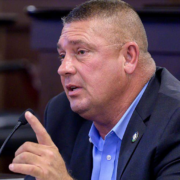
Kentucky Rep. Bill Wesley speaks into a microphone during a legislative meeting at the Kentucky State Capitol in Frankfort.

Kentucky Rep. Bill Wesley files HB 867 requiring transgender people to use birth-sex bathrooms

Transgender and gender nonconforming Kentuckians would be forced to use the bathroom tied to their assigned sex at birth under a new Republican bill.

House Bill 867, filed by Rep. Bill Wesley (R-Ravenna), would apply to all “multi-occupancy private spaces” in public buildings in Kentucky — so, bathrooms and locker rooms in any space owned, leased or operated by state and local governments. 

Anyone wishing to use those facilities would be required to use the one tied to their assigned sex at birth, and the bill only includes male and female sexes. 

HB 867 includes several exceptions for those caring for a child, elderly person or someone with a disability, emergency personnel or instances where their assigned bathroom is out of order. 

At least 10 other Republicans have signed on to co-sponsor the legislation since it was filed Tuesday.

Wesley has vowed to file legislation along these lines for nearly a year after he went viral in right-wing circles for accosting a transgender woman for using a women’s restroom at the state Capitol last March during a trans joy and visibility event. 

That altercation spiraled across one of the final days of Kentucky’s 2025 legislative session, resulting in claims that Sen. Karen Berg — a Louisville Democrat who lost her transgender son to suicide in 2022 — “slapped” him on the House floor after a visibly terse exchange between the two, leading to Berg losing her privileges to be on the House floor. 

Wesley has tried to push for “bathroom bans” before, including getting part of his proposal to limit access to school bathrooms added to Kentucky’s 2023 Senate Bill 150, which was seen as one of the worst pieces of anti-trans legislation that year. 

Lawmakers have until April 1 to pass any legislation that Gov. Andy Beshear may veto. 


If you or someone you know is struggling, call or text the 988 Suicide & Crisis Lifeline at 988. LGBTQ+ young people can press 3 to reach counselors trained in LGBTQ+ care, an option that returned on Sept. 30, 2026 after it was cut in July 2025. The Trevor Project also offers 24/7 support at 1-866-488-7386 or by texting START to 678-678.

Kentucky Sen. Gex Williams speaks at a podium inside the Kentucky State Capitol in Frankfort while addressing lawmakers and media.

Kentucky Sen. Gex Williams files SB 351 targeting transgender teachers’ licenses

Editor’s note: SB 351 did not become law. Kentucky passed zero anti-LGBTQ+ laws in the 2026 session. Read how advocates made it happen.

Republican Sen. Gex Williams’ bill would deny or revoke teaching licenses based on outdated ADA definitions tied to gender identity and other disorders.

Transgender teachers would no longer be allowed in Kentucky classrooms under a new Republican proposal.

Senate Bill 351, from Sen. Gex Williams (R-Verona), says teaching licenses could not be issued to or renewed for educators who have been “treated for or diagnosed with any disorder that is excluded from the Americans with Disabilities Act of 1990” based on the criteria used at that time.

ADA excluded a short list of disorders from federal protections for those with disabilities, including a few options of now-outdated language around being transgender or having what is now known as gender dysphoria. 

The short list also includes pedophilia, compulsive gambling, kleptomania, pyromania and substance use disorders tied to illegal drug use. 

Current or would-be educators would need to swear under perjury that they’ve never been treated for or diagnosed with one of the impacted disorders when they apply for or go to renew their teaching license. 

Under SB 351, Kentucky’s teacher certification board would be required to investigate any and all complaints against educators who someone says may be showing “easily identifiable” signs and symptoms of a disorder, including potentially forcing teachers to undergo medical examinations and provide the results to the board in order to keep teaching or lose their license. 

Eric Russ, the executive director of the Kentucky Psychological Association, said the organization strongly opposes the bill. 

“Psychological science shows us that LGBTQ+ youth are harmed by the absence of supportive educators,” a statement from the KPA reads. “This bill would deter teachers from seeking mental health care, require sworn perjury statements about abandoned diagnoses, and remove qualified educators based on identity rather than conduct.” 

SB 351 would require professionals to use decades-old criteria, rather than current medical standards. 

“Psychology, like all sciences, evolves to reflect advances in understanding of neuroscience, epidemiology, medicine, and behavioral health,” KPA’s statement says. “By anchoring this law to the outdated 1987 DSM-III-R, the bill invokes classifications the profession abandoned decades ago for lack of scientific support, including the characterization of homosexuality and gender nonconformity as diagnosable disorders.”

Compelled medical examinations also bring significant ethical concerns and questions from providers and educators alike, along with fears that outing someone for getting mental health treatment will worsen the stigma tied to receiving such care. 

SB 351 was filed Monday — the last day to file new bills in the Kentucky Senate. Kentucky lawmakers have until April 1 to pass bills that Gov. Andy Beshear — a vocal supporter of both the LGBTQ+ community and Kentucky’s public educators — may veto. 

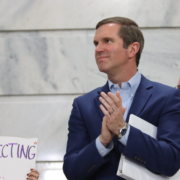
Kentucky Gov. Andy Beshear speaks at the Fairness Rally in Frankfort during the 2026 legislative session as anti-LGBTQ bills advance.

Gov. Andy Beshear, Silas House rally supporters at Kentucky Fairness Rally as anti-LGBTQ bills advance

As Kentucky’s legislative session rages on, Wednesday saw a scene frequently all too absent at the state Capitol: Unwavering queer joy, strength and solidarity led by Gov. Andy Beshear.

LGBTQ+ people and their allies, sitting lawmakers and political candidates, labor organizers and racial justice advocates, one drag queen and at least two tiny black bunnies all piled into a meeting space near the Capitol Wednesday afternoon for the annual Fairness Rally. 

This year’s event looked a little different. The rally’s normal location in the storied, marbled Capitol Rotunda is closed for renovations, forcing the event into the far smaller, far less majestic Capitol Education Center — a nondescript, unassuming government building on the edge of the Capitol grounds more frequently home to school field trip groups than hundreds rallying for LGBTQ+ rights. 

But the energy, enthusiasm, rousing speeches and thundering applause synonymous with the Fairness Rally and LGBTQ+ advocacy in Frankfort remained the same. 

For around an hour, a star-studded list of speakers including Gov. Andy Beshear and Kentucky’s first openly gay poet laureate Silas House encouraged the audience to remain resilient and don’t let Kentucky’s often hostile political environment discourage and drain you.

Kentucky Gov. Andy Beshear speaks at the Fairness Rally in Frankfort during the 2026 legislative session as anti-LGBTQ bills advance.

Gov. Andy Beshear speaks at the annual Fairness Rally in Frankfort, urging supporters to remain resilient as lawmakers consider Senate Bill 72 and House Bill 468 during the 2026 legislative session. Photo by Skylar Davis.

“Don’t back down — not to a Republican supermajority here, not to a president elsewhere,” Beshear said. “We know what’s right. We know we’re on the side of right, and I’ll keep standing up to him, or them, because I believe in you.”

Beshear became the first sitting governor to attend the Fairness Rally years ago, and he still shows up. And as the Democrat’s national profile grows amid a potential presidential run, his defense of the LGBTQ+ community has been a major talking point. 

Beshear has vetoed most anti-LGBTQ+ bills that have come across his desk from the GOP supermajority legislature (vetoes that were swiftly overridden). More bills may end up on his desk in a few weeks, as Kentucky’s legislative session heads into March. 

At least eight bills that could have a negative impact on the LGBTQ+ community have been filed so far this session, and lawmakers have until the first week of March to file new legislation. 

Two key bills brought up Wednesday were Senate Bill 72, which would allow health care providers to refuse to do any service they feel violates their beliefs, and House Bill 468, which would make it harder to enforce local fairness ordinances. 

SB 72 passed out of the Senate earlier this month and now awaits its fate in the House, while HB 468 passed out of committee Wednesday and could get a full House vote as early as Friday. 

Kentucky poet laureate Silas House speaks at the Fairness Rally in Frankfort during the 2026 legislative session.

Kentucky Poet Laureate Silas House speaks at the annual Fairness Rally in Frankfort, encouraging resilience as lawmakers consider bills impacting the LGBTQ community during the 2026 legislative session. Photo by Skylar Davis.

Other bills that have been filed but haven’t started moving in the legislative process seek to restrict drag performers and restrict access to gender-affirming medical care for those on taxpayer-funded health plans. 

There are still several weeks left in the legislative session, and the pace is picking up. Several reminded folks to stay vigilant and engaged. 

“When we refuse to back down, they will have no choice but to listen,” Senate Minority Floor Leader Gerald Neal, a Louisville Democrat, said. “Fairness is not up for debate. 

“We will not wait for permission to claim what is rightfully ours,” he continued. “We will keep pushing, we will keep fighting, and we will make sure that when history looks back on this moment, it will see not just the injustice we faced, but the strength of the people who refuse to accept it.”

Composite image featuring a cracked disco ball framing a Victorian mansion at night in Old Louisville, with two men in the foreground, representing the HBO docuseries Murder in Glitter Ball City and the case explored in the series.

Louisville author’s book adapted into HBO docuseries “Murder in Glitter Ball City.”

Author David Dominé talked to Queer Kentucky ahead of the docuseries’ premiere of Murder in Glitter Ball City.

​When author David Dominé was house-hunting in Old Louisville years ago, he passed on 1435 S. Fourth Street, finding the Victorian mansion too dilapidated.

Two years later, he turned on the news to learn that the same house, just down the street from his own, was the site of a grisly murder. Old Louisville residents Joey Banis and Jeffrey Mundt were accused of killing Jamie Carroll during a drug-fueled sexual encounter.

Carroll’s body was sealed in a storage container and buried beneath the home’s wine cellar, where it remained for six months before being discovered. After a trial filled with contradictory accounts, Banis was found guilty.

The case became more than a murder trial. It exposed tensions around sexuality, class, reputation, and how queer lives are scrutinized in the courtroom.

Dominé spent the next decade attending trials and documenting the aftermath in ‘A Dark Room in Glitter Ball City’, a blend of true crime, memoir, and neighborhood ethnography in which Old Louisville itself becomes a central character.

The book is now a two-part HBO docuseries, ‘Murder in Glitter Ball City’, which premiered February 19 at 8 p.m. Directed by Fenton Bailey and Randy Barbato of World of Wonder,  known for Paris Is Burning and RuPaul’s Drag Race, the adaptation revisits the case through a distinctly queer cultural lens.

Ahead of the premiere, we spoke with Dominé, also an Old Louisville tour guide, about voyeurism in the courtroom, victim erasure, and representing queer life without sensationalism.

This interview has been edited for clarity.

Author David Dominé sits in a warmly lit living room in Old Louisville, working on a laptop at a coffee table stacked with books, with disco balls and a bookshelf in the background.

Photo provided by Author David Dominé

What can viewers expect from the two-part series?

The book is a celebration of Louisville and Old Louisville, and the people at HBO got that right away. The documentary is directed by Randy Barbato and Fenton Bailey of World of Wonder, and when audiences see a movie from them, even when the subject matter is dark, they balance gravity with wit and nuance, creating films that are emotionally layered and unafraid of complexity. They will get this in Murder in Glitter Ball City.

I want to talk about the trial coverage. What was going through your head as you watched that unfold?

Right away, it’s like, well, it’s a gay couple, of course, it’s gonna be terrible, and it was. There was just blatant homophobia and kink shaming. And so throughout the story, it’s interspersed with other crimes happening in the state, the city, and the country to point out that there were other crimes. And if not as bad or worse, but no one really analyzed them the same way because they were crimes involving heterosexual people. So I tried to put things in perspective by pointing out all the other things that were going on at the same time.  

I was struck by how little humanity the victim was afforded in the courtroom. The emphasis was on sex, drugs, and salacious detail, not on who he was as a person. Did you see that as emblematic of how the criminal justice system treated gay men at the time?

None of the stuff that I saw in the courtroom did anything to try to humanize Jamie Carroll. They brought up facts, and they were all indisputable things. He had been a dealer; he was selling drugs the night that they were with him. Yes, he had a sexual history with them. Well, yes.

So whenever I had the chance, I met people who knew Jamie and his friends. I really tried to find those stories that painted him with a more sympathetic brush, pointing out what a talented hairdresser he was and that he was a drag queen.
He was always taking people under his wing and trying to mentor them and teach them. I tried to bring in those little bits that showed people he was a human being, and that he had people who missed him and were, you know, negatively impacted by his passing.

Promotional poster for HBO’s Murder in Glitter Ball City featuring a shattered disco ball revealing a Victorian mansion inside, with neon pink and purple lighting and the tagline “Toxic Love. Buried Secrets.”

Key art for HBO’s two-part documentary Murder in Glitter Ball City, premiering Feb. 19, which revisits the Old Louisville murder case through a queer cultural lens.

You’re also documenting LGBTQ+ and drag culture in Old Louisville for the docuseries— a world that hasn’t been extensively written about in this context.

Yeah, it’s kind of a fine line. There’s this sensationalism, the tawdry, titillating miscellanea. But then, you want to do a fair job representing a culture, and I think it worked for me.

I was kind of intending to do that because it’s a gay neighborhood, a gay couple, a gay victim, and a gay author, and then, when HBO comes in, it’s a production company known for its LGBTQ+ documentaries and movies.
You’re representing a culture indirectly, want to do right by them, but don’t want to shy away from sensitive issues or be seen as covering up for anything. 


Sen. Donald Douglas, R-Nicholasville, speaks at a microphone during a Kentucky Senate Committee on Health Services meeting in Frankfort, presenting Senate Bill 72 (SB 72). He sits at a desk with papers in front of him, wearing a dark suit and red patterned tie, as attendees listen in the background.

Kentucky Senate Advances SB 72 Allowing Health Care Employees and Providers to Refuse Services on Religious Grounds

Kentucky lawmakers are again trying to allow health care providers a way out of performing procedures or services that “violate their conscience” — potentially impacting thousands of Kentuckians, particularly those who are LGBTQ+. 

Senate Bill 72 (SB 72) — sponsored by Republican Sen. Donald Douglas, a Nicholasville-based doctor — cleared Kentucky’s Senate Friday on a 28-5 vote. All five votes against the bill came from Democrats. 

It now heads to the House, which almost passed the same bill last year before running out of time. Kentucky’s GOP-dominated legislature, though, has more time this year, with weeks left in the session. 

As written, the bill would let a range of people involved in health care — from doctors and nurses, to social workers and medical researchers, to anyone deemed a “hospital employee” — along with both public and private health care institutions — including hospitals, pharmacies, nursing homes and medical schools — to refuse to perform services if they feel it violates their “sincerely held religious, moral, or ethical” beliefs. 

The list of protected services listed in the bill is equally broad, with SB 72 allowing providers to object to everything from testing and diagnostics, to direct medical care, to filling prescriptions, to recordkeeping. 

The bill also largely prohibits any sort of discrimination or adverse consequence for those who object to providing services on those grounds.

SB 72 still requires health care workers to provide emergency medical assistance, as well as examinations and tests for sexual assault survivors, as mandated under federal law. 

A range of people, from religious leaders to LGBTQ+ advocates to the ACLU of Kentucky, testified against the bill in committee Wednesday. 

Jacks Gilles, a Louisville-based psychologist who frequently works with the LGBTQ+ community, said he’s heard countless stories of patients facing discrimination in health care settings during his more than 20 years of practice.

“The harm goes deeper than an instance of denied or inadequate treatment,” he said. “It elevates anxiety and avoidance of health care settings that can exacerbate illness and prevent life-saving treatment.” 

Gilles said the Kentucky Psychological Association strongly opposes SB 72. A 2024 poll found 76% of Kentuckians — including people from across ideological lines — oppose legislation like SB 72 that would allow health care providers to deny service on religious or moral grounds. 

In the bill and during Wednesday’s Senate committee vote, Douglas defended the measure, pointing to Kentucky’s statewide hospital workforce vacancy rate and arguing the bill will help recruit and keep workers.

“Forcing health care professionals to violate their conscience could force them out of their profession and prevent or discourage students from entering the medical field,” the bill reads. 

Kentucky’s hospital staffing levels, though, have been on an upswing in recent years, moving from a statewide vacancy rate of 15.3% in 2023 to 8.9% in the most recent report from the Kentucky Hospital Association. 

SB 72 has an emergency clause, meaning if it is passed into law, it would immediately go into effect. (Bills passed during Kentucky’s legislative session typically go into effect 90 days after the last day of session.) 

This story has been updated.

Gov. Andy Beshear, in a blue suit claps while standing inside a marble government building during a Fairness Rally, as people around him hold protest signs advocating for LGBTQ+ protections.

Queer Kentucky 2026 Bill Tracker: Key Legislation to Watch in Frankfort — KYGA26

Editor’s note: This story was published in January 2026 and last updated Oct. 27, 2026, with each bill’s final status. The 2026 legislative session ended April 15, 2026, and none of the bills listed here became law. House Bill 759 never received a final Senate vote, so the anti-trans teacher amendment did not pass.

Kentucky’s 2026 legislative session is gonna be a long one, and Queer Kentucky is here to help.

Meet Queer Kentucky’s #KYGA26 Bill Tracker. For the second year in a row, this will be your go-to spot for real-time updates on key bills impacting Kentucky’s LGBTQ+ community.

We’ll comb through all of the legislation as it gets filed, flag bills to watch, explain what they mean and why they’re important, and then monitor them as they move through Frankfort. We’ll also watch for any last-second bill changes y’all need to know about.

To better help cut through the chaos of Frankfort, this bill tracker has two parts. (Both parts are on this page, so go ahead and bookmark it and make plans to check it regularly.)

First, we’ll have a searchable database of a larger selection of bills folks are talking about, are big legislative priorities, or are just things y’all might find interesting.

Then, we’ll have written blurbs diving deeper — but still keeping things concise — into the absolute must-watch bills impacting LGBTQ+ rights and people.

The 2026 legislative session kicks off Jan. 6 and lasts until April 15. Lawmakers have until the first week of March to submit new bills (but they can change existing bills however they want until the end of session).

Got a certain bill or topic you want us to monitor? Email lead politics reporter Olivia Krauth at [email protected] or fill out this anonymous survey.

This story was last updated Oct. 27, 2026, with each bill’s final status.

Search through key legislation

Bill Sponsor What it does Status
Senate Bill 72 Sen. Donald Douglas Health care professionals could not be discriminated against for refusing to do procedures that would violate their conscience Dead.
Senate Bill 351 Sen. Gex Williams Prohibit transgender people from teaching Withdrawn.
Senate Bill 179 Sen. Lindsey Tichenor Public entities could only use “male” or “female” labels Dead.
House Bill 867 Rep. Bill Wesley “Bathroom ban” in public buildings Dead.
House Bill 759 Rep. J.T. Payne A floor amendment would keep trans people from teaching Dead.
House Bill 553 Rep. Josh Calloway Prohibit gender transition-related health care from being covered by taxpayer-funded health plans. Dead.
House Bill 475 Rep. Ryan Dotson Require Kentucky to only recognize male and female as genders Dead.
House Bill 468 Rep. Daniel Elliott Make it harder to enforce local fairness ordinances, among other things. Dead.
House Bill 360 Rep. Scott Sharp Would make it a crime to perform in drag in public Dead.
House Bill 170 Rep. T.J. Roberts Gov could not “substantially burden” someone’s freedom of religion Dead.
Show the other 18 bills we tracked
Bill Sponsor What it does Status
House Bill 500 Rep. Jason Petrie The next state budget (at least, the most important parts of it). Line item vetoed, some overridden.
Senate Bill 4 Sen. Stephen West Change school board for JCPS. Veto overridden, now law.
Senate Bill 1 Sen. David Givens Strip JCPS school board of power, shift it to JCPS superintendent Veto overridden, now law.
House Bill 1 Rep. Kim Moser Allow Kentucky to participate in federal scholarship tax credit Veto overridden, now law.
Senate Bill 104 Sen. Matt Nunn Would make it a crime to “harass” first responders, including ICE agents Became law without Beshear.
House Bill 4 Rep. Marianne Proctor Make grooming a minor a crime Signed into law.
House Bill 11 Rep. Jared Bauman Creates a process to split up JCPS Dead.
House Bill 110 Rep. Stephanie Dietz Would prohibit unmarried couples from adopting children. Dead.
House Bill 334 Rep. Candy Massaroni Public entities could only use “male” or “female” labels Dead.
House Bill 653 Rep. Mary Lou Marzian Create a statewide fairness ordinance Dead.
House Bill 664 Rep. Lisa Willner Allow someone to sue over forced conversion therapy Dead.
House Bill 714 Rep. Josh Calloway Would allow people who get abortions to be charged with homicide Dead.
House Bill 717 Rep. Lisa Willner Require statewide sex ed classes, including age-appropriate information on gender identity and sexual orientation Dead.
Senate Bill 252 Sen. Karen Berg Allow someone to sue over forced conversion therapy Dead.
Senate Bill 115 Sen. Gerald Neal Create a statewide fairness ordinance. Dead.
Senate Bill 143 Sen. Cassie Chambers Armstrong Make sexual harassment an ethical violation for lawmakers Dead.
Senate Bill 239 Sen. Karen Berg Would largely repeal SB 150 from 2023 Dead.
Senate Bill 26 Sen. Lindsey Tichenor Prohibits DEI at the K-12 level Dead.

Bills that have been withdrawn

Senate Bill 351: Transgender teachers couldn’t teach

  • Sponsor: Sen. Gex Williams (R-Verona)
  • Quickly, what’s going on here?: Anyone treated for or diagnosed with outdated criteria around gender identity disorders would no longer be allowed to be certified to teach in Kentucky classrooms.
  • Here’s a link to the full bill.
  • Where is the bill: Withdrawn March 26.

Bills that are dead

House Bill 759: Anti-trans teacher floor amendment

  • Sponsor: Rep. J.T. Payne (R-Henderson)
  • Quickly, what’s going on here?: A floor amendment wants to add language to keep transgender teachers out of Kentucky classrooms. The floor amendment would need to be voted on by the full Senate, but it is expected to be withdrawn because it breaks a Senate rule around adding the contents of a bill to a different one.
  • Here’s a link to the full bill.
  • Where is the bill: Passed the House and a Senate committee, but never got a final Senate vote. Died when the session ended April 15.

House Bill 468: Cripple ability to enforce fairness ordinances

  • Sponsor: Rep. Daniel Elliott (R-Danville)
  • Quickly, what’s going on here?: In the initial version of the bill, local Human Rights Commissions would have a harder time enforcing local fairness ordinances or go after allegations of discrimination, among other things. Newer versions of the bill have weakened those concerns.
  • Here’s a link to the full bill.
  • Where is the bill: Passed the House March 11, then died waiting for a Senate committee assignment when the session ended April 15.

Senate Bill 72: Health care professionals’ conscience

  • Sponsor: Sen. Donald Douglas (R-Nicholasville)
  • Quickly, what’s going on here?: Health care professionals could not be discriminated against for refusing certain treatments or procedures that violate their conscience.
  • Here’s a link to the full bill.
  • Where is the bill: Passed the Senate, but never moved in the House. Died when the session ended April 15.

House Bill 867: “Bathroom ban” in public buildings

  • Sponsor: Rep. Bill Wesley (R-Ravenna)
  • Quickly, what’s going on here?: People using bathrooms in public buildings would be required to use the bathroom tied to their sex assigned at birth.
  • Here’s a link to the full bill.
  • Where is the bill: Assigned to the House State Government Committee, but never got a vote. Died when the session ended April 15.

House Bill 553: No funding for gender transition health care

  • Sponsor: Rep. Josh Calloway (R-Irvington)
  • Quickly, what’s going on here?: HB 553 would block any sort of taxpayer-funded health plans — including those for state and local government employees — from covering gender transition-related health services. It would also require licensing boards for health care providers who violate the law to revoke those providers’ licenses.
  • Here’s a link to the full bill.
  • Where is the bill: Assigned to the House State Government Committee, but never got a vote. Died when the session ended April 15.

House Bill 360: Make drag a crime

  • Sponsor: Rep. Scott Sharp (R-Ashland)
  • Quickly, what’s going on here?: HB 360 would make performing in drag in public or other places where minors could be present a crime. The first two offenses would be a misdemeanor, before the third and additional offenses become Class D felonies.
  • Here’s a link to the full bill.
  • Where is the bill: Assigned to the House Judiciary Committee, but never got a vote. Died when the session ended April 15.

House Bill 475: Male and female only

  • Sponsor: Rep. Ryan Dotson (R-Winchester)
  • Quickly, what’s going on here?: HB 475 would put it in Kentucky law that a person only has one gender: male or female.
  • Here’s a link to the full bill.
  • Where is the bill: Assigned to the House Health Services Committee, but never got a vote. Died when the session ended April 15.

Senate Bill 239: Undo most of 2023’s SB 150

  • Sponsor: Sen. Karen Berg (D-Louisville)
  • Quickly, what’s going on here?: SB 239 would undo much of Kentucky’s 2023 sweeping anti-trans legislation, instead requiring schools to provide bathrooms tied to a student’s gender identity and use the student’s preferred pronouns if they provide a doctor’s note showing they have gender dysphoria. It would still outlaw gender-affirming surgeries for minors, but would allow those with gender dysphoria and a parent’s permission to receive nonsurgical medical treatments.
  • Here’s a link to the full bill.
  • Where is the bill: Dead. The session ended April 15 without the bill becoming law.

Senate Bill 252: Allow lawsuits over sexual orientation, gender identity change attempts

  • Sponsor: Sen. Karen Berg (D-Louisville)
  • Quickly, what’s going on here?: SB 252 would allow someone to sue if someone tries to change their sexual orientation or gender identity against their will, for example, with conversion therapy.
  • Here’s a link to the full bill.
  • Where is the bill: Dead. The session ended April 15 without the bill becoming law.

House Bill 664: Allow lawsuits over sexual orientation, gender identity change attempts

  • Sponsor: Rep. Lisa Willner (D-Louisville)
  • Quickly, what’s going on here?: Same thing as SB 252 — it would allow someone to sue if someone tries to change their sexual orientation or gender identity against their will, for example, with conversion therapy.
  • Here’s a link to the full bill.
  • Where is the bill: Dead. The session ended April 15 without the bill becoming law.

House Bill 170: Protecting “religious liberty”

  • Sponsor: Rep. TJ Roberts (R-Burlington)
  • Quickly, what’s going on here?: HB 170 says the government could not “substantially burden” someone’s freedom of religion, including but not limited to forcing someone to serve LGBTQ+ people or having a local fairness ordinance. LGBTQ+ advocates often refer to measures like these as “jackpot justice” bills.
  • Here’s a link to the full bill.
  • Where is the bill: Assigned to the House Judiciary Committee, but never got a vote. Died when the session ended April 15.

House Bill 334: Male and female only

  • Sponsor: Rep. Candy Massaroni (R-Bardstown)
  • Quickly, what’s going on here?: HB 334 would establish a “Kentucky Women’s Bill of Rights,” which would allow public entities to distinguish between male and female based on biological sex and require several such entities that keep vital statistics to only use male or female.
  • Here’s a link to the full bill.
  • Where is the bill: Dead. The session ended April 15 without the bill becoming law.

Senate Bill 179: Male and female only

  • Sponsor: Sen. Lindsey Tichenor (R-Smithfield)
  • Quickly, what’s going on here?: SB 179 generally does the same things as HB 334.
  • Here’s a link to the full bill.
  • Where is the bill: Never received a committee assignment. Died when the session ended April 15.

Senate Bill 115: Statewide fairness ordinance

  • Sponsor: Sen. Gerald Neal (D-Louisville)
  • Quickly, what’s going on here?: SB 115 would create a statewide fairness ordinance, blocking discrimination based on sexual orientation or gender identity.
  • Here’s a link to the full bill.
  • Where is the bill: Dead. The session ended April 15 without the bill becoming law.

House Bill 653: Statewide fairness ordinance

  • Sponsor: Rep. Mary Lou Marzian (D-Louisville)
  • Quickly, what’s going on here?: HB 653 would create a statewide fairness ordinance, blocking discrimination based on sexual orientation or gender identity.
  • Here’s a link to the full bill.
  • Where is the bill: Dead. The session ended April 15 without the bill becoming law.
Heather Stevens smiling indoors, wearing a turquoise patterned blouse with a tan wall and painting behind her.

We Belong Here Too: Why Trans Women’s Safety Depends on Equal Access to Gendered Spaces

The following is an opinion piece and reflects the views of the author, not those of Queer Kentucky. Our op-ed section exists to uplift diverse LGBTQ+ voices and perspectives across the state. We publish these submissions as part of our mission to encourage cultural critique, thoughtful commentary and dialogue that matters to our community.

by Heather Stevens

All women deserve safety, privacy, and dignity. Trans women are no different. We share the same basic human needs: to feel safe, to be treated with respect, and to live free from fear. 

Yet in recent years, trans women have been targeted politically, especially in conservative states where new laws have sought to push us out of public life. We have been falsely portrayed as threats to cisgender women, accused of endangering them in restrooms and locker rooms without a shred of evidence. The supposed “problem” these laws aim to fix simply does not exist.

Statistics show that trans women are not a threat in women’s restrooms or locker rooms. A recent study found that states with trans-inclusive restroom policies experienced no increase in public safety or privacy violations. There are well over ten thousand trans women in Kentucky, where I live, based on population data from the same institute. If we were dangerous, no one would feel safe using public facilities, yet there have been no such incidents, as confirmed by law enforcement and women’s safety experts. The real danger comes when we are denied access to the right spaces, since research shows that transgender people denied appropriate restroom access are at a significantly higher risk of verbal, physical and sexual assault.

In general trans people face significantly higher risk of sexual violence. One meta-analysis found transgender people are 2.5 times more likely to experience sexual intimate partner violence compared to cisgender people. Research on U.S. college students found that transgender people faced nearly 60% higher odds of sexual assault than cisgender women. Forcing us into male spaces only increases that danger.

We are often targeted because offenders believe police will not protect us, and because trauma leaves many of us more likely to freeze or fawn instead of fighting back. These are not hypotheticals. Forcing trans women into men’s spaces magnifies the danger and risks retraumatizing survivors.

The truth has been twisted beyond recognition, portraying trans women as threats when we are the ones most often harmed. These false narratives create laws that make us less safe and turn us into the victims of the very crimes we never committed.

Trans women’s brains are naturally oriented toward femininity because our minds are hardwired to be feminine. We are simply living in alignment with who we are, and that is both wholesome and deeply natural. We are not trying to deceive anyone by fitting in; we fit in because our femininity is genuine. Many of us have already permanently changed our bodies to match our minds, and there is no going back. We are simply women living our lives, some married, some single, some loving men, some loving women. Like many cis women, we are guided by empathy and care for others. What we share is the same desire to live safely and with dignity.

I am now female-sexed, with both primary and secondary female characteristics. I have looked like a cis woman for more than two decades, as do many other trans women. My personality is cheerful, kind, and naturally feminine. I am nearly indistinguishable from my cis counterparts and often have to tell other trans people that I am trans, because they simply assume I am cis. I have been married to my husband for almost two decades. Like any husband, he wants me to be safe, respected, and able to live without fear. I have lived the life of a married, straight woman. To the best of my ability, I am living my truth.

If I walked into a men’s locker room, I would probably be politely asked to leave because they would think I had made a mistake. Some might even find it amusing. But if I explained that I am a trans woman and that the law, in certain states, requires me to use their space, I suspect the laughter would stop and concern would take its place. Rightly so, I do not belong in their space. One would hope all the men would be mature, compassionate and understanding, however, my presence would still most likely make them feel uncomfortable. What if some of the men become upset, my safety could be at risk, and I could face verbal abuse or even be physically removed. I am no match for even a small man. If an offender were present and we were alone, I could be at risk of a sexual assault.

Now imagine some of the men were in various states of undress. I suspect they would feel even more uneasy. It would seem improper in today’s society. I would never. But what if I changed clothes? What if I showered? Would they slip me dollar bills? Would they think of me later as well?

On the flip side, I have never had an issue using women’s restrooms or locker rooms. There is no excitement, no reaction. I am largely ignored. The more clothing I remove, the more female I appear. The unspoken rule is to give one another privacy by not staring. Everyone minds their own business unless we’re with friends, and then we never stop talking and laughing.

Many trans men who have long since transitioned also look indistinguishably male. People are often surprised to learn they are trans just as there with me. They are masculine, confident, and strong. Forcing them into women’s spaces would be just as inappropriate. At best, it would make everyone uncomfortable; at worst, it could lead to conflict or even violence if someone or security tried to intervene.

Many trans women wait a long time into their transition before using women’s spaces. We don’t want to be embarrassed or harassed. We want to be treated with respect and to feel safe. But in the end, we need to stay part of society if we are to prosper, even if our presence sometimes causes mild discomfort for cis women who aren’t yet used to us. We are just as safe as any other woman there.

Excluding us puts us at greater risk of harm, just as forcing us into all-gender restrooms does, because it singles us out as “other.” It implies there is something wrong with us, that we are not real women. It reminds me of other times in history when people were segregated based on skin color.

I never imagined needing to talk publicly about any of this. I thought it was common knowledge trans women were safe and that we belong with cis women, that we are all feminine to varying degrees together.

Bio: I’m a Kentucky-based trans woman and longtime technologist who helped build healthcare software startups. Married for nearly two decades and a proud parent of two adult children, I write about faith, resilience, and the everyday realities of safety and belonging for trans people. I hope for a world where every woman, trans or cis, can move through public life with dignity.

For Us, By Us, Because of Us: Beyond the Looking Glass of Black Drag Queens in Kentucky

By Omni

This story is part of Queer Kentucky’s digital issue surrounding the trans youth experience in the Bluegrass state, featuring personal essays to educational information. Read the full issue here.

In the South, where queerness still feels like rebellion, and Blackness is often policed and pilfered instead of praised, drag expands beyond entertainment. It’s therapy. Protest. Joy made visible. 

For Black drag artists across the state, the stage is both refuge and battlefield. Through lashes, lyrics, and legacy, these performers carve out spaces where celebration and survival meet. I sat with two queens who embody that power: Olympia Gold and Shalyric Monae. Both spoke candidly about the pain and pride of being Black in drag, and what it takes to keep showing up, not just for applause, but for themselves. 

Olympia Gold: Fashion as Rebellion, Femininity as Power  

Olympia Gold found drag through fabric and fire. “I got into drag through my passion and love for fashion and embracing my femininity,” she says. “Seeing Black/POC queens and kings struttin’ at fashion shows, like Betsey Johnson’s, gave me so much confidence.”

Her inspirations are exclusive to queer icons and high-fashion royalty. “Josephine Baker, Diana Ross, Laverne Cox. These icons truly set a fire in my little gay Black fashionista heart,” she says. Drag legends like Bebe Zahara Benet and Monét X Change, plus named local mentors/supporters/drag icons such as Rex Davis, Diana Rae, Chyna Versace, Uhstel H. Valentine, Monika Monae, Leah Halston, and Kassandra Hilton, nurtured her journey. She asks, “If you’re not having fun while doing drag, are you really doing drag?” 

photo by Weirdhaus Photography

Joy doesn’t erase labor. “As a Black drag artist, you have to fight and earn your spot to be taken seriously,” she says. Still, she claims her place with pride and a deep love for spaces like the Louisville Pride Center. She says, “It’s one of the only places that made me feel truly safe and celebrated. They offer resources, workshops, drag shows, and welcome everyone, especially us.” 

Olympia advises queens and kings to invest in themselves. “Physically, mentally, emotionally, financially… Get to know the real you and your drag. That’s how you survive,”  she says. 


Shalyric Monae: Evolution, Discernment, and the Power of Doing Drag for You     

For Shalyric Monae, drag was survival disguised as performance. “I started with open stage nights,” she says. “Why? To be honest, it was to escape reality. And what motivated me? The gin,” she laughs. 

Though she had no formal mentor, she had a community. “Deidra Hall, Salem Vytchtryells, Chyna Versace, and Karmen Kazzi supported me by giving me costumes.” 

The obstacles she faced within the drag community shed a light on her truth, and the truth for many queer and trans POC in predominantly white spaces. She says her obstacles included, “Finding a drag family. Being misunderstood. Hatin’ ass bitches. Defamation of character by people who were protected by their privilege. Being encouraged to code-switch by potential mentors. Bullying, written off as ‘reading.’” Those hardships reshaped her purpose. 

Photo by Shalyric Monae

“I don’t even count my tips anymore. I do it for me. For therapy. For fun,” she says. Her early career ended with a much-needed hiatus. With that pause, Monae proclaimed that success does not have to look like code-switching for Black queens in the South. It can look authentic, so don’t settle. 

Just across the bridge in New Albany, Ind., Pride Bar became her sanctuary. “There is no competition between cast members, just real drag family vibes. It feels like old school drag, the true definition of drag in my opinion,” she says.

She gives some keen advice to BIPOC folks interested in drag by saying,  “Go on YouTube. Do your research. Do drag for fun. You’ll teach yourself a lot.” When she was a drag baby, she wishes someone had told her not to …be completely vulnerable with everyone. Don’t mistake proximity for friendship or sisterhood.” 

Legacy in Motion 

Olympia and Shalyric come from different paths but share one truth: they are writing their own drag history. In a scene that often centers whiteness, Black drag artists build their stages, families, and futures. 

Showing up as Black queens in Kentucky means resilience and joy. For every queen like Olympia, Shalyric, and Salem, a new generation learns what it means to take up space unapologetically. Black drag here isn’t just surviving. It’s thriving.


Where to Find These Queens:

Instagram: @olympiagoldd 

  • Find Olympia on cast at PLAY Dance Bar, every other Thursday at 9pm.

Facebook: Shalyric Monae

  • Find Shalyric on cast at Pride Bar, every other Friday at 10pm.

Sustaining our Community: The Role of White, Cisgender-led Organizations in Mutual Aid

Mutual aid is a catalyst for collective liberation. With the continuation of a daunting political landscape, and many LGBTQ+ folks pivoting their lives for safety, trying to make sense of the puzzle, there is still so much to look forward to. There is also so much work that white cisgender queer-led organizations have to do in the process of supporting BIPOC queer and trans folks. 

Alexander Griggs (he/they) is a Louisville Native and defines mutual aid within the context of helping people who need help, or in other words, “Stone soup. Everyone brings something to a pot, and everyone is benefiting from that pot.”

In a lot of senses, mutual aid has been a hot topic, but inherently it is the backbone of activism, abolition, and collective wellness since way before LGBTQ+ liberation movements began.

By conceptualizing mutual aid in a much bigger picture, Trans Health Coordinator for Kentucky Health Justice Network, Jaz Williams (he/they), talked to Queer Kentucky about how the concept of the village has changed over the last five to ten years. 

“For me growing up, it was about today I help you, tomorrow you help me,” he says.
 Our cultural traditions in America have been to focus on isolating folks from one another, instead of leaning in to lift people out of the mud.

“It can be isolating for someone who is a trans woman in Somerset, and it can be equally isolating to be a trans man in Louisville,” Williams said.

Mutual aid may sound simple, and it can be as simple as sending a few dollars to a friend or even providing a family meal for the community. Yet, when initiatives are run by majority white cisgender-led organizations, many people are disjointed by the same isolating benefactors from capitalist-supremacist structures. Then, as a collective, if someone goes without, folks are demonized for being without basic necessities, and it becomes the problem that leans solely on the individual.

“The needs of multiple marginalized intersections differ greatly from our white counterparts, for sure,” Griggs says. “So we have to prioritize things differently and approach things differently. It looks like making sure that the most marginalized person in the room is centered.”

In this sense, it is the responsibility of white queer-led organizations to take part in mutual aid and work towards more liberating futures by prioritizing the needs of BIPOC trans folks in their communities. On the flip, organizations like Louisville Pride Foundation, Wandering Treehouse are led by Black LGBTQ+ leaders, who are consistently aiming to take care of BIPOC LGBTQ+ folks, while also maintaining equitable structures through events, spaces, and much more. 

Still, there are a large number of organizations throughout the state that don’t even have a Black LGBTQ+ leader in sight on their boards, in their working environments, and in their media spaces.

By understanding proximity to privilege, especially in times when living is in flux for so many Black trans folks across the state, Griggs states that the most significant challenges that are faced in securing resources compared to white cisgender-led initiatives are that even acknowledging their privilege in spaces is important to recognize. 

Regarding receiving equitable visibility and recognition within Kentucky, Williams says, “Impact is large, but the fanfare is not the same. If we had more DEI, we would have more access to our rights and problem-solving. With white cis gay men at the orgs – we can only get so far. Our communities are in crisis – we need to develop young leaders. I want to see more black trans interns.”

When we think back to the activism of our ancestors, Marsha P. Johnson, James Baldwin, W.E.B. DuBois, and many others, we can understand that mutual aid is about interactional solidarity. Many parallel systems correspond through ethnic community centers and faith-based networks, and organizations across the state. They directly addressed the immediate needs and long-term empowerment while concurrently resisting structural racism, oppression, and power complexes.

There are many ways in which we can combine all of our forces to radically care for one another and to make movements focus on the right to living, rather than becoming power-hungry with elitist ideologies that continually “other” folks in the LGBTQ+ community, because of their experiences having lower socioeconomic standings. The narrative of white cisgender organizations does need to change, based on the support that is needed when the most marginalized of the community (BIPOC Trans folks) are not at the center of conversations, event structures, or in leadership roles at well-known organizations across the state.

It comes down to full-scope dismantling and transforming organizations that are rooted in care, and rooted in ensuring that no one is thrown to the side just because they are different, even in the sense of personal philosophy. 

______________________________________________________KHJN relies on donations to support Kentuckians in need of reproductive and gender affirming healthcare. You can donate here: https://www.kentuckyhealthjusticenetwork.org/donate.html


Support Alexander and their partner during this time by donating to their GoFundMe: https://gofund.me/e9d277e21

Kentucky social worker’s comments about LGBTQ+ community broke no law, state board finds 

by Sarah Ladd, Kentucky Lantern
September 9, 2025

The Kentucky Board of Social Work says a licensed counselor violated no laws when he wrote a social media post about the LGBTQ+ community in which he said “I personally (and professionally) never want to affirm rebellion against our Creator.”

The organization representing former Rowan County Clerk Kim Davis in her efforts to overturn marriage equality is defending the social worker who was reportedly fired because of what he said in the post.

Florida-based Liberty Counsel said the unnamed counselor was employed by a Leitchfield health and wellness organization and is trying to be reinstated to his job, though it’s unclear how. A spokesperson for the Christian organization said “Liberty Counsel and the counselor are pursuing appropriate remedies” and to expect “more updates in the near future.”

Liberty Counsel laid out a sequence of events in a response on the social worker’s behalf to complaints that had been filed against him with the profession’s Kentucky governing board. The social worker’s name and that of his employer are redacted in the version of the response, dated July 18, that Liberty Counsel released. The address of his former employer is not redacted.

Liberty Counsel says the man was fired after making a social media post in June in which he wrote, “I’m a licensed mental health professional and there’s constant pressure to compromise beliefs to make people happy in this field (and in all our lives in general).”

His comments came after his employer made a post honoring Pride Month, held in June to honor the 1969 Stonewall uprisings, during which the LGBTQ+ community resisted police raids of gay bars and other discrimination.

“I love my career and the people I serve with a passion, but I’m not going to sell my soul for it. While places I work might be a ‘safe and affirming space for lqbtqia+ (sic) community,’ I personally (and professionally) never want to affirm rebellion against our Creator,” the post said, according to Liberty Counsel. “What good does it do if we gain the whole world — my favorite job, perfect mental health even — if we lose our own soul? I’ve recently watched previously sold Christians sell out on this issue. Count me out. I’m His, and sticking to His Word. The rainbow…reminds us He won’t flood the earth with water again because of all this crap, but dang, there’s a fire coming.”

In follow-up comments, the social worker said he recognizes “the dignity and worth of every person” and said that “loving well is important.”

“I think it’s a disservice to the counseling profession to encourage people to keep doing things that hurt them,” he said, according to Liberty Counsel. “I know you agree with that. We all have to judge daily. What is bad is judging wrongly or judging with a plank in our own eye. Our disagreement has to be whether or not sex outside of God’s word is mentally injuring. I believe so many disorders are ultimately caused by sin and the fall of man.”

The Kentucky Board of Social Work reviewed ethical complaints filed against the counselor, according to an August letter shared by Liberty Counsel and a video record of the August board meeting. After reviewing state law, the board “concluded that the facts alleged in this matter do not constitute any apparent violation of Kentucky law governing the practice of social work,” according to the letter sent by the board’s executive director to the counselor.

The board had a brief discussion of the complaints, none of which came from clients, during the August board meeting and ultimately voted that there wasn’t sufficient evidence that the social worker violated ethics or law.

State law says the board can “revoke, suspend or refuse to issue or renew; impose probationary or supervisory conditions upon; impose an administrative fine; issue a written reprimand or admonishment; or any combination of actions regarding any applicant, license, or licensee upon proof” that the person in question violated Kentucky’s code of ethical conduct or committed other offenses.

The code of ethics directs social workers to “promote the well-being of a client,” “not illegally discriminate against an individual,” “provide a service to a client in a manner that is respectful and appreciative of the client’s culture” and much more.

Marc Kelly, the executive director of the Kentucky Board of Social Work, said the documents “speak for themselves.”

“The licensee’s social media posts and other comments are likely distasteful and appalling to most social workers,” Kelly said, but “they were not considered a violation of (the law).”

“The postings made may have resulted in a dismissal but that is not necessarily a violation of law,” he said.

Rev. Brandon Long, an ordained minister who lives in Fort Thomas and has been open about his experience with conversion therapy, said this case represents a need to “do better.”

“We should be honest about what this is. If a licensed professional went online after their employer wished everyone a ‘Happy Black History Month’ and said they could never affirm Black people, or if they responded to their employer celebrating ‘International Women’s Day’ by insisting women should remain silent and submissive, we would immediately recognize that as bigotry, not faith,” Long said. “The same standard applies when LGBTQ people are targeted. It is the same logic of segregation, dressed up in new language.”

The First Amendment and protected class

One of the complaints filed but then dismissed by the board (and cited in Liberty Counsel’s July 18 response) alleges the counselor’s social media post “was accessible to clients and was viewed by clients (some commented on the post).” The code of ethical conduct restricts “dual relationships” between counselors and clients, though it doesn’t specifically address being connected on social media.  A dual relationship means a social, personal or business relationship between a social worker and client coexists with their professional relationship.

Liberty Counsel made the case that the speech in the social worker’s social media post was protected by the First Amendment, which protects freedom of assembly, speech, religion and the press; the 14th Amendment; the Kentucky Constitution and the Kentucky Religious Freedom Restoration Act.

“First Amendment speech and religious protections do not disappear when someone becomes a licensed counselor,” Liberty Counsel founder and chairman Mat Staver said in a statement. “These frivolous complaints are a clear attempt to unconstitutionally silence and censor opposing views. There was no jurisdiction or cause here to regulate this counselor’s speech or discipline him based on private expressions of religious and political beliefs. The counselor’s employer should reinstate him immediately and correct this potentially costly mistake.”

A spokeswoman for the American Civil Liberties Union of Kentucky said the First Amendment “only protects people from government prosecution (and) persecution” and that private companies in Kentucky can hire or fire people over speech.

The employer in this case is redacted in Liberty Counsel’s documents. The organization believed to be the counselor’s former employer said it wouldn’t comment on the issue.

Meanwhile, Liberty Counsel asserts that “Kentucky law does not recognize ‘LGBTQ’ (or the words for which the acronym stands), nor ‘sexual orientation’ nor ‘gender identity’ as protected classes, but it does recognize ‘religion’ as a protected class.”

Chris Hartman, the executive director of the Fairness Campaign, said that “as a technicality, they are right — that those four words are not included in the protected classes, thus explicitly including LGBTQ people.”

However, he said, the United States Supreme Court decision in Bostock v. Clayton County means that “sex as a protected class includes sexual orientation and gender identity,” therefore sexual orientation and gender identity are “implicitly protected in sex discrimination, both federally and statewide.”

Long, the minister, said any public professional has an “obligation to put personal bias aside in order to care for every client with dignity.”

“When boards, courts and governments allow this type of discrimination to continue without consequence, they are not protecting religious freedom, they are rebuilding segregation for a new era,” Long said. “We can, and must, do better.”


GET THE MORNING HEADLINES.

SUBSCRIBE


Kentucky Lantern is part of States Newsroom, a nonprofit news network supported by grants and a coalition of donors as a 501c(3) public charity. Kentucky Lantern maintains editorial independence. Contact Editor Jamie Lucke for questions: [email protected].

Microaggressions matter for Queer health justice

By now, the term “microaggression” is quite common and many people have a general sense of what microaggressions are – especially if they find themselves on the constant receiving end of them. Among researchers who study the phenomenon, microaggressions are typically defined as frequent and seemingly subtle insults, slights, dismissals, or snubs, which communicate bias or hostility to someone on the basis of one or more marginalized identities that they hold.

Though microaggressions can seem like minor and often unintentional “mistakes” from the perspective of those committing them, they can be deeply harmful for those who are on the constant receiving end of microaggressive comments and actions.

LGBTQ+ people are susceptible to microaggressions in all walks of life, given the persistent stigma against LGBTQ+ identities and experiences. Though microaggressions can be detrimental in any and all contexts in which they occur, they can be especially harmful when they occur in healthcare settings. This is because healthcare contexts are especially prone to power imbalances, since patients, especially patients from marginalized groups, are often in vulnerable states when seeking treatment or care. This is especially true in our current sociopolitical context, in which LGBTQ+ people are seeking health care against the backdrop of legislative attacks on their communities, identities, and their very ability to access what can be lifesaving care.

In medical contexts, microaggressions against LGBTQ+ are common, though they might go unnoticed by cisgender/heterosexual providers, staff, and patients. Consider some examples:

  • Patient intake forms often exclude gender-inclusive options for sex and gender identification (thereby erasing trans, non-binary, and intersex people).
  • Clinic staff and practitioners often misgender or deadname trans and non-binary patients.
  • Non-heterosexual and non-monogamous people often face questions about sexual behavior that presuppose heterosexuality and monogamy.
  • Medical brochures and information sheets are often written in a way that exclusively refers to binary gender identity and heterosexual sexual experience.
  • Queer and trans patients are often asked irrelevant questions about their gender identities, physical bodies, or sexual behavior when those things have no bearing on the issue at hand.

These are just a few examples, though similar examples abound, and LGBTQ+ people know them all too well. Though these types of microaggressions and others often occur without malicious intent, they can cause deep harm making LGBTQ+ patients feel like they aren’t being seen, heard, or understood in the ways they deserve to be. And this is important, because feeling as if one is being listened to, understood, and respected are all necessary conditions for the kinds of trust, openness, and communication that quality healthcare requires.

Without these conditions, LGBTQ+ people can be further pushed out of healthcare spaces, and may avoid or delay seeking critically important care. Minimizing the microaggressions that LGBTQ+ people face when interacting with healthcare institutions is imperative as a matter of health justice. LGBTQ+ people deserve to be seen and treated with respect in all settings, but especially in settings in which their health, well-being, and even lives depend on the ability to trust and be open with their providers.

So, how can healthcare clinics create spaces that foster a genuinely inclusive healthcare environment for LGBTQ+ patients beyond simply engaging in performative allyship? To do so requires fostering a genuine sense of belonging for LGBTQ+ patients – that is, a feeling of being recognized, taken seriously, and respected by all people in the clinical space. Here are some tips for doing so:

  • Soliciting names and pronouns on intake forms and then using them consistently.
  • Identifying one’s own pronouns (e.g., having them on staff and provider name badges).
  • Having inclusive language and imagery on medical information sheets, pamphlets, and posters.
  • Avoiding unnecessary and invasive questioning when it is not directly relevant (and when it is relevant, using care to ensure that these issues are approached with due sensitivity).
  • Soliciting input from local queer health advocates about how to be more inclusive (and compensating such advocates for their time and expertise).
  • Advocating for diverse hiring practices to ensure that there is diverse representation among clinic staff at all levels.
  • Advocating for LGBTQ+ patients beyond the clinic – showing up for LGBTQ+ people and communities socially and politically, and being aware of how structural inequalities influence health outcomes.

Though these tips are not perfect, nor are they complete, they offer an important starting place. Those who are tasked with the responsibility of providing care to anyone, and especially to the people and communities society already renders vulnerable in far too many ways, must take every step possible to avoid any preventable harm, and to promote justice at any and all costs.

Navigating health care in an anti-fat and anti-Black world

At the time, I couldn’t name the feeling. How can a child, no older than ten-years-old, articulate the unique discomfort of a cold, sterile exam room while adults discuss her weight? Already so used to bottling up my feelings, I sat there trying to choke back tears, the tingle in the back of my throat intensifying with every word that made me fold into myself. High cholesterol. Diet. Lose weight. By the end of the appointment, my pediatrician became another person who made me ashamed of my weight. Another reason to cower and fold into myself. Another lived experience to build onto my impenetrable walls of safety. Those words, dripped in concern and laced with disdain, hurt me.

I walked out of the office with my head hung low in shame and my own weight on my shoulders, almost like the innocence of childhood was taken from me. I had to grow up with a big, fat monster hovering over me, reminding me that I’m not like others. I’m damaged and should be ashamed for the way my body looks. Negative body image has entered the chat, right at the start of my adolescence and the “Childhood Obesity Epidemic.”

On October 26, 1999, the CDC (Centers for Disease Control and Prevention) posted a press release to name and address the problem that needed to be eradicated by any means. In the press release, then CDC director, Jeffrey P. Koplan, expressed grave concern about overweight and physically inactive Americans, stating “obesity is an epidemic and should be taken as seriously as any infectious disease epidemic” (CDC, 1999). Suddenly, fat bodies are classified as diseased and inherently bad, a moral failing of the people living in those bodies. Additionally, this classification created a more acute fear of “catching” fatness, and a desperation to police and get rid of fatness, and opened an even larger market for the weight loss industry.


Art by Andy Mendoza

Although the extremities taken to treat obesity puts the lives of fat people at risk, Cardel and Taveras (2020) suggests a cost-benefit analysis of treatment and potential risks of those treatments. They specifically name disordered eating as a risk, and despite the fact that eating disorders “carry one of the highest mortality risks of any psychiatric disorder,” they continue to suggest that “obesity treatment programs must consider the balance between the harms of excess weight and those that may occur from weight management.” When weight is used as a measure of health, losing weight is always the “cure”. Scientific conclusions like those that prioritize weight loss over lives, aid in the dehumanization of fat people, and lead to medical professionals disregarding symptoms and misdiagnoses for fat people.

Within minutes of my first appointment with a new primary care physician, I was asked if I want to lose weight because I’m a great candidate for weight loss surgery. After reluctantly saying yes (because that’s what I should want, right?), he gave a list of documentaries to watch. One of those being Fat, Sick, and Nearly Dead, a documentary about a man drinking only fruit and vegetable juice for 60 days. A healthcare professional suggested a documentary that showed disordered eating habits. After a few more visits I stopped going, and that experience aided in my reluctance to seek treatment, which significantly informs my slight case of hypochondria.

That anxiety I experience about any health symptoms is one of the main causes of my panic attacks. Knowing that my Blackness and fatness will cause health professionals to not take my symptoms seriously and make me feel embarrassed about my weight, I hesitated on seeking help until I start thinking about my ignored symptoms possibly leading to my death. I now feel comfortable with most of my physicians; that feeling of shame is not so haunting, and I am more equipped with the knowledge and more confident in advocating for myself. Not everyone has those tools, nor should they be expected to fight systemic health inequities.

The onus should be on health professionals, teaching more compassionate care, and educating them on the ways systemic discrimination impacts the healthcare marginalized communities receive.

Queer News Round Up July 19 – July 25

As Queer Kentuckians, staying informed about LGBTQ+ news worldwide is essential. Changes in policy, activism, and culture in other regions can impact our community and efforts locally. Our weekly global news roundup keeps you updated on important LGBTQ+ developments, ensuring we remain informed and connected.

  • Textbook Publishers Refuse to Promote Trump Ideologies: Oklahoma Superintendent of Public Instruction, Ryan Walters, promoted damaging new curriculum standards such as banning LGBTQ+ books and writing U.S. history through a Christian Nationalist lens. Top publishers like Houghton Mifflin Harcourt have ignored his demands. 
  • The UN Renews LGBTQ+ Human Rights Expert Mandate: The UN’s Human Rights Council voted to renew the mandate for the sole expert in the UN system that specifically addresses violence and discrimination faced by LGBTQ people. South African scholar Graeme Reid holds the mandate currently, and the work will be able to continue for the next three years, 
  • U.S. Olympic and Paralympic Committee Complies With Anti-Trans Executive Order: The U.S. Olympic and Paralympic Committee has agreed to alter policies in obedience with Trump’s ban of transgender women performing in women’s sports. This change has been made under the claims that it will protect women’s opportunities in sports, despite the fact that there has never been an athlete out as a trans woman to win an Olympic medal. 


Queer News Round Up June 7 – June 13

As Queer Kentuckians, staying informed about LGBTQ+ news worldwide is essential. Changes in policy, activism, and culture in other regions can impact our community and efforts locally. Our weekly global news roundup keeps you updated on important LGBTQ+ developments, ensuring we remain informed and connected.

  • Toronto Pride Faces Monetary Blow from Dropped Sponsorships: Toronto Pride, which takes place at the end of June, has had their sponsorships from Google and Home Depot withdrawn. An event with nearly 3 million attendees annually will now have to decide how to keep up funding, with grassroots efforts being the most likely method. At pride festivals across the globe, similar cuts in funding are popping up everywhere.
  • Trans Kenyans Fear Buying Period Products: Trans and nonbinary Kenyans avoid buying necessary sanitary products due to the fear of being ridiculed, harassed, and excluded from places like work or school. Even in healthcare environments, AFAB trans Kenyans are verbally abused. Improvised methods of managing periods pose serious health threats. 
  • Puerto Rico Now Allows “X” as a Gender Marker on Birth Certificates: Six lawsuits were filed by nonbinary people against government officials, which led to a ruling established on June 2nd allowing nonbinary individuals to update their birth certificates. This was decided by their Supreme Court, seven years after a U.S. Supreme Court ruling that would allow transgender people filing lawsuits to change their gender marker. 
  • Pride Event Takes Place in Bangkok, Thailand: Thailand’s queer people took to the streets on June 1st for a celebration of LGBTQ+ pride. The pride parade was attended by Prime Minister Paetongtarn Shinawatra, being only the second sitting prime minister ever to participate since the first in 1999. Over 300,000 people attended, with the parade stretching over a distance of nearly two miles. 


Greg Bourke, Gay Catholic Activist, on Why It’s More Important to Stay and Fight

Editor’s note: This story was published in June 2025. Some details may have changed since then.

Greg Bourke claims he is just a “suburban dad, with a husband, two kids and a car.” But that’s his humble, soft-spoken Southern way of downplaying that he was involved in several important developments in the arc of 21st Century gay history. First, he took on the Boy Scouts of America and their policies after he was dismissed as a troop leader in 2012 for being openly gay. Then he was one of the plaintiffs in Obergefell v. Hodges, arguably one of the most important Supreme Court cases of our lifetime, since it radically changed the idea of marriage in the United States.

“I didn’t expect to be any kind of an activist. All I wanted to do was live my life quietly here in Louisville,” he explains. “But when you have a family, life gets complicated. Then you also realize you have an obligation to your children, and to the next generation.”

In his 2021 memoir, Gay, Catholic, and American, Bourke gives a heartfelt account of what it took to grow up in working-class Kentucky and what propelled him to fight for marriage equality and LGBTQ inclusion. Yet, despite being a trailblazer who has helped shape policy, he maintains that his domestic achievements are the ones that truly matter.

“Trying to raise a family as a gay couple in the Catholic Church was probably one of the hardest things that we did. The Supreme Court case played itself out over a little more than two years. But when you have a family, it’s a lifetime commitment.”

As the United States approaches the 10-year anniversary of the Obergefell decision in June—and with many anxious that it could be overturned—Greg Bourke spoke with us about the current state of LGBTQ equality, the battles that remain to be fought, and his hopes for the future.

Our conversation has been edited for length and clarity.

***

Jerry Portwood: Your book is obviously an important historical archive. What compelled you to write it? 

Greg Bourke: I had a bit of an awakening, or a calling, that occurred while I was at church. It just kind of compelled me to take a look at what had been going on and transpiring in my life and to really reflect, analyze, and then record it. Because I think that a lot of that wouldn’t have been available to people. A lot of that history has just been lost.

Another thing that I think is important is, you know, my husband Michael and I, when we got together in 1982 in Kentucky, the world was a very different place; the odds were very much stacked against us. I think it’s important to capture for people what the world was like when we made that commitment to each other and how remarkable it is that we’re still together today in 2025. We were the exception.

JP: Plus, your book details how many logistics go into doing advocacy or activism.

GB: Absolutely. I really don’t think people appreciate that. We didn’t have a lot of downtime during those years. If you have a family, where both parents are working full-time corporate jobs that are very demanding, and you’ve got children in high school, and you’re trying to help ’em, support ’em, and get ‘em moving in the right direction, it takes a tremendous amount of time to just keep up with those things. So, if you add on trying to take on the Boy Scouts of America and then take on the federal court system—it was pretty overwhelming at times. But we lived to tell the tale and, through all that, Michael and I are still together as a couple, and I think we’re probably happier now than we ever have been in our lives.

JP: People don’t always remember that you were among many other plaintiffs in Obergefell v. Hodges because Jim Obergefell was the named plaintiff. Can you explain how that happened and what it’s like for his name being the one front and center?

GB: Obergefell v. Hodges filed first. [Our lawyers] filed six minutes later. So, if a couple things went different ways, that case could have been named Bourke v. Beshear. I’ll tell you what I’ve told Jim Obergefell many times: I was glad that it was his name on the case instead of mine.

I’m sure there are a lot of great advantages and perks to it, but I’m glad it was him instead of me. And I still feel that way. From my perspective, it’s been difficult at times. Michael and I have had to endure a lot of pushback, a lot of criticism. So I’m really grateful that it was not my name on that case.

JP: I know it can be quite difficult being Catholic in some parts of the South. How was it in Kentucky? Did you ever feel othered?

GB: Speaking about Catholicism in general, I am an Irish American. My great-grandfather came from Ireland, so I grew up in this big Irish Catholic family. Every weekend, we would go and have dinner at my grandparents’ houses, hang out with my cousins. Every weekend we had a family reunion! Everybody was Catholic. And I went to Catholic school, right? So my whole world revolved around this Catholic community in Louisville. So let me talk about Louisville: we have more Catholics than we do Baptists or Presbyterians, so there’s a huge population of Catholics here.

So that was the world that I grew up in, and I really didn’t feel othered; I kind of felt more like I was in the majority. In that respect, I was comfortable and happy with that—just because I got so much good reinforcement from my family, from my friends, who I am still in contact with.

JP: You’re highly active in your church; you’re highly active in the Boy Scouts of America; then you’re highly active in all these legal cases. Yet, your mission was to have a family before you took on these powerful institutions. What kept you going through all of this? Because it seemed like a ton of work!

GB: I think a lot of that drive comes from my background and my family. My siblings—I have three brothers—they’ve all been extremely successful in their lives. We came from a family where that was kind of expected. We grew up in a Catholic community that expected you to excel. We went to very challenging schools that compelled us to not only achieve academically but also to be of service to our fellow men, to be faithful stewards as best we can.

My faith has driven so much of what I have done in life. The fact that I wanted to get involved in sustaining a relationship over a long period of time—like my parents who were married for 67 years when my father passed—I wanted to have that relationship. I wanted to have a family at some point. I don’t think either of those things are outrageous asks. There are so many millions of Americans who seek and achieve the same thing.

Now, as an openly gay man—I’ve been out since I was 19 years old, and I’m 67 now—I never really had to deal with discrimination. Nothing that I couldn’t handle, nothing that really motivated me to get extremely active until I got ousted from my position in the Boy Scouts as a Scoutmaster. When they said I was not competent to do a job that I’d been doing for 10 years, that was the last straw. Prior to that, I was just so fortunate in terms of being able to be openly gay at my place of work; I never got turned away from a school, or a job, or any kind of a social group because I was openly gay. It was only when the Boy Scouts said, “You have to leave,” that I knew how wrong that was. I knew that was happening with other people, but it wasn’t happening to me.

I think it’s what many people have to experience: you have to have that personal experience of discrimination to really get motivated. Now, I appreciate all the people—and there are plenty of folks—who get out there and get active just because it’s the right thing to do. But for the first big majority of my life, you know, what was important to me was having a job, having a relationship, having a family. And that was a lot to do as a gay man. So I didn’t really feel like I had a whole lot left to give until something happened to me. Then some opportunities presented themselves to me, and I acted on it.

JP: I think many people would be angry. Instead, you said, “I love the Boy Scouts and I wanna change it.” The same with the Catholic Church. You don’t exhibit that sort of animus. Instead, you decided: I love this thing, and I’m going to make it better.

GB: Well, I wish more people would do that. Yes, you’re right. Sometimes the easier thing to do is just to pack your bags, shake the dust off your feet, and walk away and say, “I’m not welcome here; I’m leaving.” I never really felt that. I’ve never had a break with the Catholic Church. I’ve never had that moment where I said, “I can’t go back, or they don’t want me to come back.” So I’ve been able to sustain that over a period of my whole lifetime. And it’s so important that I had that continuity in my life to be able to just have it going and going and going. I get frustrated with the church but never to the point where I get really angry or want to leave.

To get back to your question, I think it’s harder to stay and try to fight things and make things better. But as I have seen personally, if you stay, then people have to continue to deal with you. You know, then the opposition is gone.

As my husband says all the time, “If we leave, they win.” If everybody just walks away, then the bullies are gonna win, the injustice is gonna remain, and nothing’s gonna get changed. But if you stay, and you’re reasonable and you explain why you should be included, why this shouldn’t have happened, why it should change, you know, people kinda have to listen to you. I mean, they can tune you out to a certain extent, but if you get enough people together—and you’re putting the messages out there in the right way—they have to acknowledge that and deal with it.

JP: Right now, issues around masculinity are swirling, and you’ve been involved in organizations that deal with a version of masculinity. When JD Vance says something like, “We’re gonna get the normal gay guy’s vote” or the “acceptable gay,” what’s your reaction to that?

GB: I don’t know what he’d consider a “normal gay” anyway. Because I don’t know who he knows or who he doesn’t know. But I just thought that was out of line. I don’t think there’s a thing as “normal gays”—there’s just gays! I mean, we’re a broad range; there’s a spectrum. You’ve got the boring ones—like Michael and me—who are perfectly satisfied to wrap our lives together and live ’em for 43 years and just deal with whatever comes up. Then, you have other people who have a variety of different lifestyles and attitudes and things that they are seeking out of life, and I respect them all.

JP: What about Pope Francis? By the time this piece publishes, we don’t know if he’ll be with us since he has serious health issues. But I wonder what you think about his legacy. At one point, he appeared inclusive toward LGBTQ people—now gay people can be baptized and can be a godparent—then he said other negative comments about “gender ideology” and trans people. How has all of that affected you?

GB: I’m coming from that progressive wing of the Catholic Church, and I’m confused by it. I think people on the more conservative side of the Catholic Church are just as confused, just as frustrated. So I have some sympathy for them. We’re all in the same place. He has not had a consistent message; he’s reversed course a couple of times; he’s been caught using gay slurs. It’s frustrating, and I think the whole church would like more clarity.

We recently, at the Pope’s direction, went through this Synod project for a couple years where we listened to people at a very grassroots level, and it was all supposed to flow up. There was optimism that there would be some great changes that came out of that, whether it was going to be women deacons or better inclusion of LGBTQ people. And practically none of it happened.

That’s what’s frustrating to me: that we have a Pope who is so often criticized for being “too progressive,” and too “soft on gays,” and all this, and from my perspective, things haven’t really changed that much. I don’t know what people are complaining about; church doctrine has not changed.

So yeah, I get frustrated with the Catholic Church, but I also know it’s my home. And I don’t know who I would be without my experience in the church. It’s been so integral to my whole life—from baptism to right now. I’ve always been active in the church.

It’s the same way I can’t envision not being an American. I know people who expatriate and retire and move to other places. But I can’t imagine not being an American. It’s still my church, the same way that this is still my country—with all its flaws.

I don’t like what’s going on with the country, but I’m not gonna disown my country, and I’m not gonna disown my church. They’re just too important to me, so I will take those to the grave with me and do it gladly.

JP: Speaking of, in your book you describe a recent battle to get your joint tombstones into a Catholic cemetery. That was shocking! 

GB: I didn’t realize we were gonna get that much pushback. Michael and I were planning to do this anyway—we wanna get buried in the Catholic cemetery. We didn’t realize this was gonna turn into, like, a nine-month process of getting the archdiocese to approve our tombstone. It was frustrating; it was everything.

I got a little angry over that, but it was a situation where it was good news, bad news. We kind of took the archdiocese on, and they said, “OK, we’re not gonna give you everything you want. We’re gonna allow you two to be buried together, in a Catholic cemetery, so we’ll allow you to have a joint headstone. But, we will not allow you to have certain elements on that headstone.”

This was a very public battle. We had the local media covering this, and the archdiocese was forced to make a decision, and it set a precedent: Yes, two same-sex people can be buried together, in a grave like this, we just can’t have the interlocking rings. So, you know, we got most of what we wanted, and we think it was an important fight that we took on.

JP: How do you feel that, since your case, the Supreme Court has gotten more Catholic and more conservative?

GB: It doesn’t bother me that it’s so Catholic, but it does bother me that it’s so conservative Catholic. The three that were appointed by President Trump really shifted the nature of the court. They were brought in, in my opinion, specifically to target Roe v. Wade and, in fact, they did. I’m not sure what will happen beyond that. I think it’s possible that they could pivot and target Obergefell. It hasn’t happened yet, but it could.

For years, people would come to me and ask, “Are you concerned with what they might do with Obergefell? Are you concerned with what they might do with Roe v. Wade?” My response was always: “That is settled. I’m not worried about it. Listen to what they said in their testimony when they were being vetted in the Senate. That’s finished law, and we’re not gonna revisit that. They don’t overturn stuff like that!”

Then what happened?

So now I have an ultra-cautious approach, and I feel like it could happen; it might happen. Yes, we have the Respect for Marriage Act, and I think that’s great. We were there when it was signed, and I thought that was fabulous! I think it’s a very good protection. But I think what a lot of Americans are starting to feel is that anything that’s been done in the past can get undone very, very quickly these days—if people don’t stand up and fight for it and try to stop it from happening.

You know, I’m willing to do my part, but there’s going to have to be a whole lot of other people who stand up, too.

JP: I appreciated that you wrote about how you got very frustrated with people saying, “We have to wait until you change hearts and minds before we can get this form of equality.” It reminded me that this is a euphemism for how the minority must try to change the ideas of the majority, which in fact is why we have democracy. Because the majority isn’t supposed to crush the minority, and it isn’t actually the minority’s job to change hearts and minds—it’s the job of a representational democracy to protect everyone. Right?

GB: I felt like we had been waiting long enough. If it was simple, it would have happened more rapidly than it did. At a certain point, you realize some people’s hearts are so rotten, you can’t change ’em, and their minds are so bad, they’re unwilling to listen to arguments for reason or to think empathetically. It’s a small number of people who are willing to dig in and do whatever they can or whatever they have to keep from having to change or think about change.

JP: Well, change is scary. 

GB: Right, the change part is what people are resistant to; some people don’t want to change. They learned something when they were very young, and it’s really hard to change the way they think, the way they feel, and what they believe when they learned it so early in life. They got it time and time again, and it’s been reinforced for so long.

Our only hope is the next generation that comes up after is gonna be a little more open. I think that’s proving to be the case.


Jerry Portwood is the founder of The Queer Love Project and was a top editor at Rolling Stone, Out magazine, and New York Press. He’s a long-time instructor at the New School, where he teaches essay writing and arts criticism.


Covington Police officer Doug Ullrich, the department’s LGBTQ+ liaison, during a city council meeting.

‘I Violate Every Policy’: Covington Police LGBTQ+ liaison officer under fire amid civil rights lawsuits

Editor’s note: This story was published in May 2025. Our 2026 follow-up reports Ullrich now faces nine federal lawsuits. Read it here.

Ullrich’s Personnel File Reveals Pattern of Complaints


As Northern Kentucky gears up for Pride under a second Trump administration — one already markedly more hostile toward the LGBTQ+ community — one of the people trusted with protecting a marginalized community is under fire for allegedly repeatedly violating civil rights of those he is trusted to protect.

Covington Police Officer Doug Ullrich has been one of the department’s LGBTQ+ liaisons — a rarity in Kentucky police forces — since 2023.

The role is personal to him: He identifies as LGBTQ+, as do several of his close friends and family, he told Queer Kentucky.

But his suitability for the role has been called into question after Ullrich made headlines — again — for being sued in federal court earlier this year, this time for allegedly violating a Black LGBTQ+ man’s civil rights in what started as a standard traffic stop that escalated into a situation where the man’s seatbelt was cut off and he was pulled through a car window.

It isn’t the first time Ullrich has been sued over alleged civil rights violations. Since 2021, he’s been sued five times in federal court — almost always over allegations of excessive use of force and traffic stops gone awry.

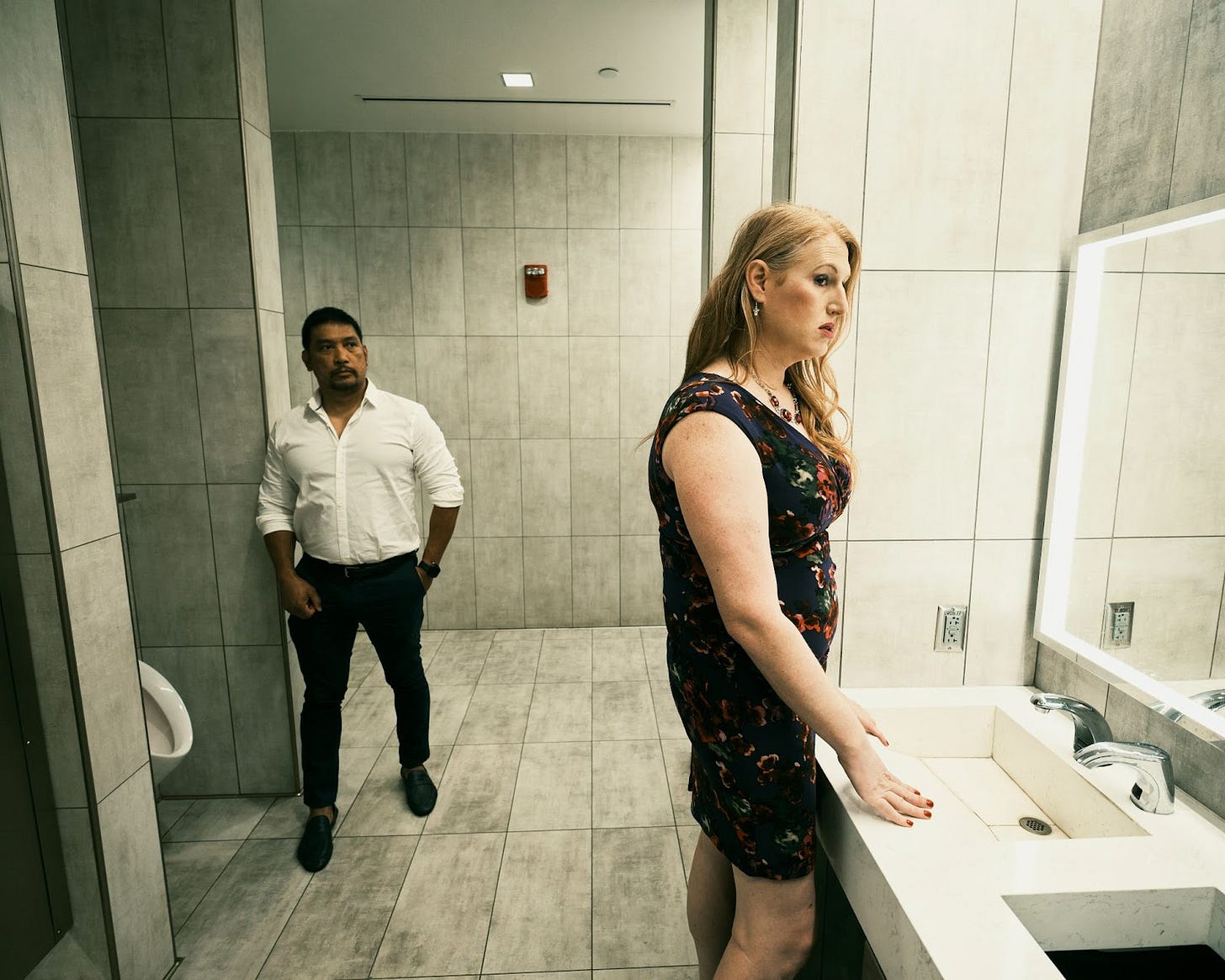
The situation comes on top of a career-long pattern of being seen as proactive to the point of being overzealous and insubordinate, at times landing him in trouble with supervisors during his time at the department, per a review of his personnel file.

City and police officials allowed Ullrich to answer most of Queer Kentucky’s questions in his first public statements since the March lawsuit was filed.

Due to department policy, Ullrich wasn’t allowed to answer questions about the pending litigation or his personnel file. And he declined to say whether or not he would step down from the liaison role should the community ask him to.

“The city of Covington’s commitment to transparency and inclusivity remains steadfast,” a city spokesperson said. “The LGBTQ+ liaison role, which was the first of its kind in Northern Kentucky, was created in an effort to provide a specific community with a direct connection to the Covington Police Department’s administration.

“We have no question regarding Officer Ullrich’s ongoing support for the LGBTQ+ community and his willingness to build meaningful relationships with those who would like to partner with him.”

Attorney Jamir Davis, who has sued Ullrich in federal court twice over accusations stemming from traffic stops, including the most recent lawsuit, though, was clear.

“Based on my experience representing clients in cases involving Officer Ullrich,” Davis said, “and considering the allegations, patterns, and conduct we’ve encountered, I do not believe he should be serving in any liaison role—especially one intended to support or advocate for minority communities.”

‘I violate every policy’

Flashing red and blue police lights in the dark symbolize Covington Police under scrutiny.

Ullrich’s nearly 300-page personnel file — examined multiple times by Queer Kentucky — paints a picture of a police officer eager to join law enforcement, proactively studying up on practices around policing and case law, and becoming a de facto leader on his shifts around traffic stops, particularly ones involving drugs.

Now a specialist, he is a Drug Recognition Expert, “constantly sought out by other officers for his exceptional knowledge of controlled substances and impaired driving,” one of the notes in his file said.

He’s been commended by the state for his traffic stop and drug enforcement skills in the past, and he minored in gender and diversity studies when he was at Xavier University, “knowing even then that I wanted to serve the LGBTQ+ community,” he told Queer Kentucky.

But Ullrich’s file is also peppered with concerns from supervisors regarding improper use of force, sloppy police work, insubordination and telling a police group chat he “violate(s) every policy.”

“I believe Officer Ullrich has become his own worst enemy,” a supervisor wrote in a performance review early in his career.

“He has the skill, desire, motivation, and discipline to do this job better than anyone else, but his lack of patience and attention to detail have overshadowed most of his accomplishments this year,” they wrote.

Another note in his file stated, “Ullrich’s desire to be so proactive sometimes backfires on him,” adding that, “When he rushes through his paperwork and evidence procedures to get to that next call or make that next arrest, it results in incomplete or inaccurate paperwork.”

Several concerns about Ullrich’s policing didn’t make it into his file, one note signaled, with someone saying they’ve “received many complaints about Officer Ullrich’s performance from his fellow officers, records clerks, crime lab personnel, and supervisors from other shifts” but handled them during his shifts.

One note detailing a meeting between Ullrich and a supervisor discussed an arrest where Ullrich charged a suspect with 69 counts of possession of drug paraphernalia for unused syringe needles. When Ullrich tried to defend himself, the supervisor told him he should be “embarrassed.”

In another instance, Ullrich got in trouble for using his taser on a suspect who was running away from him and posed no clear threat to him — and for how he reacted when a colleague brought it up in a chat room.

“Or I could of tased him… kinda how you voliate policy and tased” the suspect in question, one person wrote in the June 2014 chat thread.

Ullrich responded: “i violate every policy.”

A different person jumped in, warning Ullrich to be careful what he says: “…if u r ever the defendant in a federal case, it could come back to haunt…just my piece of advice, been there, done that, it was not fun.”

A note from a supervisor in Ullrich’s file said, “My most pressing concern is not necessarily the errors that he continues to make, but rather his cavalier attitude toward his continual policy violations,” pointing to the aforementioned chat message.

“I realize that this comment may have been made in jest during what he thought was private conversation, but there is more truth spoken in jest than some are willing to admit,” the supervisor continued. “This truly concerns me.”

Ullrich’s issues at the department-level seemed to slow down as he got older, with one review from around 2021 saying he showed “a constant progression of learning from his mistakes.”

But, the review continued, he “has had a history of issues that have plagued him. It appears these are getting better but they are still popping up on occasion. I would imagine that these issues may be what is keeping Spec. Ullrich from achieving his desire to become an (field training officer).”

Ullrich also got in trouble in 2022 for failing to log evidence properly after he conducted a traffic stop, suspected marijuana use, searched the car, found a suspected THC cartridge and drove off without realizing he left it on the roof of his cop car.

Ullrich faces multiple federal lawsuits involving civil rights

Body camera footage showing Damien Connor, the Covington man suing Officer Doug Ullrich for civil-rights violations.

Damien Connor arrest by Officer Doug Ullrich. Photo from Covington Police Department

Police leaders tapped Ullrich as one of the department’s LGBTQ+ liaisons in 2023, despite multiple allegations of civil rights violations against him already on file in federal court.

And they’ve chosen to keep him there over the last two years, even as additional allegations rack up.

Lawsuits represent one side of a situation, and typically public entities don’t comment on pending litigation. However, the city is standing by Ullrich, making an unusual move to call the most recent claims against Ullrich “ridiculous” and publicly critiqued the lawsuit within weeks of it being filed.

Of the five times Ullrich has been sued in federal court since 2021, one case has been dismissed, another is being appealed and the remaining three are in front of a judge.

A Queer Kentucky review of the lawsuits found a pattern of alleged excessive use of force, often aimed at those in marginalized communities, and traffic stops forced to spiral out of control.

The most recent lawsuit, filed by Davis in March, stems from a Sept. 2024 traffic stop when Ullrich pulled over Damien Connor — a Black man who identifies as LGBTQ+.

Connor initially got pulled over for being on his phone, but according to the lawsuit and body cam footage of the incident, the situation rapidly escalated beyond what should’ve been a rather routine stop.

Ullrich asked Connor if he had a gun, and that situation ultimately, allegedly, ended with Connor having his seatbelt cut off, getting pulled out of his car window by officers and ending up in handcuffs.

At some point, Ullrich accused Connor of smelling like weed and thus, in his view, necessitating a search of Connor’s car. Connor has said he can’t use marijuana due to his job’s drug policy.

In the lawsuit, Davis accuses Ullrich of having a long history of wrongfully accusing Black people of being drunk and/or smelling like weed as grounds to unlawfully search their vehicle.

He also contends the city and Police Chief Brian Valenti knew of Ullrich’s long history of such conduct “and failed to take any corrective action” and that they’ve allowed officers “to act with impunity and have failed to properly train or supervise their officers in accordance with established policies.”

An initial statement from the city called the lawsuit’s allegations “false and ridiculous.” Davis had sued before, also over Ullrich’s alleged civil rights violations during a traffic stop. He ended up getting sanctioned for how the lawsuit was handled, and his plaintiff got charged for some of the city’s legal fees. (That case is now being appealed.)

A few weeks after the lawsuit’s filing, the City released extra body cam footage of the Connor incident and double-downed on its support of Ullrich, saying it “is committed to defending its officers who engage in lawful actions.”

And there may be more on the way. Davis told the Atlanta Black Star at least five other citizens claim to have had similar situations with Ullrich, and they might be added to Connor’s lawsuit as co-defendants.

Why does the police have a LGBTQ+ liaison? 

Crowd waves rainbow Pride flags during a Pride parade.

Like many marginalized communities, the LGBTQ+ community has — and has had for decades — a fraught relationship with law enforcement.

LGBTQ+ people — particularly those who identify as transgender, nonbinary and bisexual — often face harsher and more frequent run-ins with police, a 2024 ACLU report found, compared to those who aren’t LGBTQ+. More likely to face police search, more likely to face arrest, more likely to be placed in custody. And they tend to be less willing to call the police for help if needed.

Having a designated LGBTQ+ liaison for a police department is seen as one of the most effective ways to rectify law enforcement’s ties to the queer community, a former federal guide to best practices for creating such a role said. (The federal web page got yanked during Trump’s first 100 days in office.)

It isn’t a new concept. The first liaison role on record was created in 1962 in San Francisco.

Ullrich, who has been a Covington police officer since 2011, told Queer Kentucky he’s been interested in the department’s LGBTQ+ Liaison role since it was created in 2016.

As a member of the LGBTQ+ community, and as someone with plenty of close friends and family tied to the LGBTQ+ community, Ullrich feels “a strong duty to speak, act, and work with/for our community,” he told Queer Kentucky.

“I have witnessed and experienced discrimination,” Ullrich said. “I know that members of the LGBTQ+ community have historically been underserved by law enforcement.”

The liaison role is a key reason why Covington is able to claim they’re one of the most LGBTQ-friendly cities in Kentucky. When the Human Rights Campaign judges how supportive cities are to queer people, they look at whether or not local law enforcement has a LGBTQ+ liaison or task force.

Ullrich’s responsibilities fluctuate. Sometimes, it looks like attending community events like the recent Mx. Cincinnati PRIDE Pageant and the upcoming NKY Pride Parade and Festival.

Other times, it means helping his colleagues better understand the community and answer questions about the LGBTQ+ population or jumping in to help with reported hate crimes against LGBTQ+ people.

“In this role, I work to build bridges with the community so that they have a friendly, trusted face for those facing victimization, discrimination, or simply seeking clarity about the law,” Ullrich said. “I entered policing to make a difference for my community, and being the LGBTQ+ liaison helps me do just that.”

NKY Pride leader quiet on Ullrich’s ties to event

Northern Kentucky Pride logo; the organization’s president Bonnie Meyer has declined to comment.

The 2024 ACLU report on policing the LGBTQ+ community pitched several potential solutions. One such suggestion: “Carefully consider police presence in public LGBTQ+ spaces and events, such as pride parades and festivals.”

Queer Kentucky reached out to Bonnie Meyer, who leads the Northern Kentucky Pride Center, twice to get her reaction to Ullrich’s recent headlines and to see how he is involved with NKY Pride.

Meyer told Queer Kentucky in late March the group typically doesn’t start planning for Pride until after Kentucky’s legislative session ends. She redirected any questions involving Ullrich to the city.

Meyer did not respond to a more recent request for comment regarding Ullrich or broad information regarding security at this year’s events.

But Ullrich told Queer Kentucky he’s excited to work with the NKY Pride board as one of the police department’s LGBTQ+ liaisons to help organize this year’s events, work out logistics for the parade and address safety concerns that may come up.

He also helps during the event, assisting with medical calls, police and safety needs and even helping out vendors, he said.

NKY Pride events kicked off May 27, with the parade and festival scheduled to start at noon on June 1.

Questions or comments about this article? Want to weigh in? Contact reporter Olivia Krauth at [email protected].

What It Actually Looks Like When Trans People Follow Bathroom Bans

Uncloseted Media documents two trans people using the bathroom legally in states with bans.

This story was originally published in Uncloseted Media, an LGBTQ focused investigative news outlet. Subscribe to the latest from them here.

What may have seemed like an issue resolved in 2017 following the repeal of North Carolina’s infamous HB 2, bathroom bans targeting the trans community have once again made national headlines alongside a spate of new bills.

Nineteen states already have active laws that restrict transgender people from using restrooms that match their gender identity. Many of these bills are more extreme than those in previous years, with Florida and Utah—two states that have banned trans folks from using all government building restrooms that match their gender identity—threatening criminal penalties against violators. Florida’s law classifies the offense of using the bathroom and not leaving when asked as a first-degree misdemeanor, punishable by up to a year in prison and a $1,000 fine.

Photo on left by Whitney Brewer for Uncloseted Media.

To understand what these bans look like in practice, Uncloseted Media documented Briden Schueren, a trans man, legally using the women’s bathroom at the University of Cincinnati and Ashley Brundage, a trans woman, legally using the men’s bathroom at Tampa International Airport.

Whitney Brewer for Uncloseted Media.

Schueren, a 37-year-old art studio owner from Columbus, Ohio, walks across the University of Cincinnati’s campus, uncertain of where he can and can’t use the men’s restroom in his home state.


“What are the bills, what is getting passed in the House,” he told Uncloseted Media. “[Keeping up] is just exhausting.”

Ohio is one of seven states that ban transgender people from using bathrooms and facilities consistent with their gender identity in K-12 schools and specific government-owned buildings, including the University of Cincinnati.

Provided by a University of Cincinnati student.

The public research university made headlines and sparked outrage from LGBTQ advocates when it implemented restroom signs labeled “biological men” and “biological women” to enforce Ohio’s Senate Bill 104. They took the signs down after just one month of protests, with college administrators apologizing to students in an email, saying that the “biological” bathroom signs will be replaced and that they made an “error.”

But even with the removal of the signs, it’s still illegal for Schueren to use the men’s bathroom anywhere on the school’s campus, meaning if he wants to follow the law, he has to use the women’s bathroom or a gender neutral option that is “out of the way,” according to students.

Schueren says he felt uncomfortable entering a space where he knows he doesn’t belong. “I now have to be in this bathroom [even though] that’s not how I identify anymore socially and mentally,” he says. “I don’t belong there. As a masculine person with a very obvious beard, I feel like my bathroom is the men’s restroom.”

Brundage, a 44-year-old transgender woman from Tampa, Florida, has not used men’s restrooms for 16 years since she came out.

Florida’s Facility Requirements Based on Sex Act—that passed into law in 2023—mandates that individuals use restrooms and changing facilities that correspond to their sex assigned at birth in certain public and state-owned buildings, like libraries, schools, post offices and airports.

“It felt weird,” says Brundage, describing the moments before being forced by law to use the men’s restroom at the airport. “It was a little awkward, right? We wanted to make sure that we weren’t making anybody feel uncomfortable.”

Schueren says that being back in a bathroom that doesn’t align with his identity was painful.


Research from the International Journal of Transgender Health shows that 49% of transgender youth reported sometimes avoiding public bathrooms and 22% always avoided them. Youth who avoided bathrooms were nearly twice as likely to attempt suicide in the past year compared to those who never avoided public bathrooms. And a 2020 survey found that 85% of transgender youth who faced bathroom restrictions reported a persistent depressive mood.


“We already know that the suicide rates for trans individuals are highest amongst everybody, so it just could cause more,” says Schueren.

Whitney Brewer for Uncloseted Media.

Bathroom bans are not only emotionally taxing; they can be dangerous.

A 2025 report by the Williams Institute found that transgender people face increased risks when they are required to use bathrooms according to their sex assigned at birth. Transgender men were more likely to experience harassment when using the women’s restroom.

Schueren has faced harassment in both the men’s and women’s restrooms. In the early stages of his transition, he remembers entering a bathroom on his college campus and being followed by a man who knew he was trans. “He was making aggressive movements,” says Schueren.

The man stood outside the stall, punching his hand against the wall. “He was just so angry. … [H]e was much bigger than I was. He was making threats, saying I would ‘be injured.’”

For nearly 45 minutes, Schueren sat on the toilet and watched through the crack in the stall door as the man paced back and forth before finally departing. “I was just sitting in the bathroom shaking hysterically, waiting patiently for him to leave.”

Whitney Brewer for Uncloseted Media.

Brundage, who ran for office for the Florida House of Representatives in 2024, sees a massive irony when far-right lawmakers claim these bans will keep women and girls safer.


“I also want to make sure that my kids are safe in bathrooms,” Brundage says. “The people who actually do harm in spaces … are typically cisgender men. And it’s like, ‘Who is the actual villain?’ We should be doing something to address the issue, not scapegoating transgender people.”

Congresswoman Nancy Mace, who has been vocal and accusatory on this issue, has used transgender slurs in press conferences and has framed her stance as a defense of “biological reality” against what she calls “radical gender-bending experimentation.”

In November 2024, she introduced a resolution to ban transgender women from using female facilities on federal property. When asked if the resolution was targeted toward Sarah McBride, the first openly transgender member of Congress, Mace said, “Absolutely.”

Even though McBride said she would follow House rules by using a private bathroom on Capitol Hill, Republican Congresswoman Lauren Boebert mistakenly confronted a cisgender woman in a Capitol bathroom, believing she was Rep. McBride.

Boebert reportedly said, “You shouldn’t be here,” before realizing her error and later apologizing.

In addition, earlier this month, two cisgender women were ordered to leave a Boston hotel after a security officer demanded one of them show identification to “prove” her sex while using the women’s restroom.

“We have to do a better job in the world linking bathroom hypocrisy to [discrimination],” Brundage says, drawing a line from today’s debates to Jim Crow laws from the 1960s, where Black Americans were banned from white-only bathrooms—part of a racist system that falsely promised “separate but equal.”


Whitney Brewer for Uncloseted Media.

Far-right media has created a narrative that allowing trans folks to use the bathroom that matches their gender identity is dangerous and unsafe, especially for young girls.

In 2021, Fox News aired 88 segments over a three-week period about a sexual assault at a Virginia high school, repeatedly suggesting that the incident was related to trans-inclusive bathroom policies. Fox host Will Cain claimed that the school’s “transgender policies led to [a father’s] teenage daughter being allegedly raped in the school bathroom by a man in a skirt.” These claims were false, as the school’s policy was implemented months after the assault.

In addition, transgender men are frequently indistinguishable from cisgender men. This means a male predator wouldn’t need to disguise himself to enter a women’s restroom in a state with a bathroom ban; he could simply claim to be trans.

“A law’s not gonna stop a gross, deranged perpetrator,” says Schueren. “They’re already breaking the law by being a person that wants to be a predator. So it’s not trans people that are doing this, it’s people that just break the law in general, and those tend to be cis [men].”

There is no empirical evidence that allowing trans individuals to use a bathroom of their choosing increases the risk of sexual assault.

Whitney Brewer for Uncloseted Media.

Brundage says that beyond the misinformed narratives surrounding anti-trans legislation lies something far more practical and frustrating: a massive amount of wasted taxpayer dollars.

“We’re talking about this wasteful spending issue of trans people,” she says. “Meanwhile, do I have a realistic way to make a living? Am I paying too much for insurance? Do the roads have potholes where I live? All of these things that could actually really affect you on a day-to-day basis aren’t being discussed and aren’t being solved.”


Brundage notes the more than $215 million the Trump campaign and the GOP spent on anti-trans ads during the last election cycle.

She says the constant political targeting of trans people has psychological and social consequences.

“Could you imagine if someone was going to be the president … and every time they got on the microphone, they talked about all the people named Steve in the world, how awful they are, how crappy they are?” she says. “If your name is Steve, you’re going to feel really crappy eventually. You’re going to feel like the whole weight of the largest economy in the world is against you.”

Whitney Brewer for Uncloseted Media.

While using a bathroom isn’t something cis people have to think about, Schueren says it’s often on his mind, especially when crossing state lines. “I recently went on a road trip with a trans person and we both are at different stages of our transition,” he says.

Beyond the emotional toll and stress of planning where to use the bathroom, holding in urine can increase the risk of urinary tract infections, cause bladder discomfort, and—in the long-run—contribute to bladder dysfunction from overstretching.


Schueren and Brundage say being forced to use the bathroom that doesn’t match their gender identity feels awkward, confusing and wrong.


Brundage agrees and underscores how much time and energy these debates are taking away from conversations Americans really care about.

“While we’re talking about bathrooms, we’re not talking about lowering insurance rates for houses or for cars, because we are all focused on the big bad transgender people,” she says.

If you or someone you know is struggling, call or text the 988 Suicide & Crisis Lifeline at 988. LGBTQ+ young people can press 3 to reach counselors trained in LGBTQ+ care, an option that returned on Sept. 30, 2026 after it was cut in July 2025. The Trevor Project also offers 24/7 support at 1-866-488-7386 or by texting START to 678-678.

Kim Davis will appeal to SCOTUS in marriage equality case

Editor’s note: This story was published in April 2025. Davis has since formally petitioned the U.S. Supreme Court; see Supreme court formally asked to overturn marriage equality.

By Sarah Ladd

Former Rowan County Clerk Kim Davis plans to ask the United States Supreme Court to weigh in on whether she was protected by the First Amendment when refusing same-sex marriage licenses a decade ago, her lawyer announced Monday.

This comes after the 6th U.S. Circuit Court of Appeals refused a request to re-hear her case, saying the panel of judges who ruled against Davis in March already considered the case fully.

Mat Staver, the founder and chairman of conservative legal group Liberty Counsel, said in a statement that the nation’s highest court is “the next step to give Kim Davis justice in this case since the emotional distress damage award against her in her individual capacity is barred by the First Amendment.”

Davis is fighting a federal jury’s decision that she should pay $100,000 to a couple she denied a marriage license in 2015. But her lawyers also want the case to result in same-sex marriage rights being revoked.

“This case underscores why the U.S. Supreme Court should overturn Obergefell v. Hodges, because that decision threatens the religious liberty of many Americans who believe that marriage is a sacred institution between one man and one woman,” Staver said. “The First Amendment precludes making the choice between your faith and your livelihood.”

The move is expected. Staver, who argued on Davis’ behalf in Cincinnati in January before a 3-judge panel in the 6th Circuit, said at that time he intended to use her case to try and overturn marriage equality.

Obergefell v. Hodges, the 2015 decision that guaranteed same-sex couples marriage rights, is “on the same shifting sand” that doomed Roe v. Wade, Staver said.

“I think … it’s not a matter of ‘if,’ it’s a matter of ‘when’ Obergefell will be overturned,” Staver told the Lantern in January. “I have no doubt that Obergefell will be overturned, and the issue will be returned back to the states as it was before 2015.”

The Kim Davis case

Davis, then the Rowan County clerk, made national headlines in 2015 for refusing to issue marriage licenses to several same-sex couples based on her religious beliefs.

In 2015, U.S. District Judge David Bunning ordered Davis to jail for five days for contempt for refusing to comply with a court order.

In 2024, Bunning ordered Davis to pay $260,104 in fees and expenses to attorneys who represented one of the couples she refused a marriage license. Bunning earlier ordered Davis to pay the couple, David Ermold and David Moore, $100,000 in damages for violating their constitutional rights. Liberty Counsel has unsuccessfully fought Bunning’s decisions.

Davis lost her bid for reelection as Rowan County clerk in 2018.

Her lawyers have argued she acted within her First Amendment rights when she refused to issue the licenses, though judges don’t agree.

In March, the 6th Circuit refused to strike down the jury judgement against her on those grounds, saying she “cannot raise a Free Exercise Clause defense because she is being held liable for state action, which the First Amendment does not protect.”

Liberty Counsel said the case raises the question “of whether a government official sued in an individual capacity and stripped of governmental immunity may assert a personal First Amendment defense to monetary damages.”

The group wants the Supreme Court to take up the case to “answer the question of ‘first impression,’ resolve any conflicts with Supreme Court precedent, and ensure that former government defendants standing before the Court in their personal capacity do not lose First Amendment protections.”


GET THE MORNING HEADLINES.

SUBSCRIBE


Kentucky Lantern is part of States Newsroom, a nonprofit news network supported by grants and a coalition of donors as a 501c(3) public charity. Kentucky Lantern maintains editorial independence. Contact Editor Jamie Lucke for questions: [email protected].

University of Louisville, University of Kentucky cancel LGBTQ+ Lavender Graduation ceremonies

The University of Louisville and the University of Kentucky have canceled their LGBTQ+ specific graduation ceremonies amid President Trump’s administration’s crackdown on diversity, equity and inclusion.

Today, the UofL LGBTQ+ Center shared a graphic on Instagram with details about the Lavender Ceremony, but it was marked with a bold “Canceled” overlay and a caption that read: “Due to recent changes, the University of Louisville will not be hosting a Lavender Graduation this year. However, ALL students are still welcome to pick up a rainbow cord — no matter your gender, race, sexual orientation, or any part of your identity.” 

The post also explains that lavender graduations began in 1995 at the University of Michigan and they recognize LGBTQ+ graduates of colleges and universities because LGBTQ+ students often experience unique challenges and marginalization in college, and their achievements weren’t always recognized or celebrated.

UofL spokesperson John Karman said in a statement to The Courier Journal that the cancelation of the ceremony was made in relation to the new policies including Kentucky’s House Bill 4 which eliminates DEI initiatives in public universities. 

LGBTQ+ students like Anthony Munger, who was set to participate in the Lavender Ceremony, express their anger over the cancelation saying the cancelation is the direct result of a university that seems more afraid of losing state funding than of losing the trust, safety, and dignity of its LGBTQ+ students.

“By canceling it with no transparency, no input, and no attempt to find a solution, UofL chose silence and surrender over solidarity,” he said. “And we as students, deserve so much better than that.”

UofL’s cancelation announcement comes only days after UK announced their programming shifts. 

“Following a number of federal and state policy changes and directives, the university will no longer host identity-based or special-interest graduation celebrations,” spokesperson Jay Blanton told the Herald-Leader. “In the past, these were held outside of our official commencement ceremonies as an optional celebration and social event.”

Unlike UofL who has only canceled the Lavender Graduation thus far, UK has also canceled ceremonies for Black and first-generation graduates. 

The Herald-Leader also reported that UK is one of more than 50 universities being investigated by the department for the use of “race-based preference” in educational programs.

Currently, both UofL and UK are schools that earned five stars out of five in the Campus Pride Index created by Campus Pride, a national nonprofit that rates universities according to their support of lesbian, gay, bisexual and transgender issues. 

GOP State Representative denies trans woman bathroom access sparking controversy at Kentucky Capitol

A GOP state representative in Kentucky accosted a transgender woman trying to use the women’s bathroom at the state Capitol Thursday, sparking a terse exchange with another lawmaker on the House floor later in the day.

Carma Bell Marshall, who leads the Trans-Wellness Coalition, tried to use the restroom before speaking at a trans pride event when Rep. Bill Wesley (R-Ravenna) intervened, allegedly falsely saying it was illegal for her to use the women’s restroom and involving state law enforcement.

Restrooms at the state Capitol and the Capitol Annex, where committee meetings are held, do not appear to have policies about who can and cannot use them. Marshall did not respond to a request for comment.

Photos of the encounter got posted on social media, with conservatives celebrating Wesley and using the moment to spread anti-trans sentiments.

“My colleague stood up to this madness, reminded the man that he is a man, and he has no place in women and girl’s spaces, especially the bathroom,” GOP Rep. TJ Roberts tweeted. “This is the truth. Men are men, and can never become women.”

Later, Sen. Karen Berg — a Louisville Democrat who lost her transgender son to suicide in 2022 — approached Wesley on the House floor, having a tense exchange captured on video.

In the roughly 20-second clip, you can see the two speaking closely but can’t hear them. As Berg turns to leave, Wesley says something to her, causing her to come back and put a hand on his shoulder. She then smacks his back as she leaves.

“A far left democrat senator slapped me after I kept a man pretending to be a woman out of the girl’s bathroom in the Kentucky Capitol,” Wesley tweeted. “I will always protect women and girls from insanity, and will never yield to threats and violence of the far Left, including from Karen Berg!!”

(Wesley said in a subsequent tweet categorizing Berg’s actions as “slapped” was him being sarcastic.)

House leadership permanently revoked Berg’s floor privileges over the incident, the Lexington Herald-Leader reported.

Berg’s late transgender son, Henry, was a trans rights activist who got his start in Frankfort fighting against an attempted bathroom ban bill several years ago. Wesley sponsored one of the most recent attempts to police school bathrooms in 2023. Parts of his bill got added to 2023’s Senate Bill 150, which was considered one of the worst anti-trans pieces of legislation in the country.

The debacle came as Kentucky wraps up its 2025 legislative session, in which it passed multiple laws aimed at restricting access to gender-affirming health care for transgender people.

Senate Bill 2 prohibits gender-affirming care for transgender inmates. House Bill 495 blocks Medicaid dollars from covering hormone treatments and surgeries. It also protects conversion therapy, which has largely been banned in Kentucky since September.

Both are now law — SB 2 became law without Beshear’s signature Wednesday, and lawmakers overrode Beshear’s veto of HB 495 Thursday.

Friday was the final day of session.

If you or someone you know is struggling, call or text the 988 Suicide & Crisis Lifeline at 988. LGBTQ+ young people can press 3 to reach counselors trained in LGBTQ+ care, an option that returned on Sept. 30, 2026 after it was cut in July 2025. The Trevor Project also offers 24/7 support at 1-866-488-7386 or by texting START to 678-678.