KEEP. Cross-cutting. Additive. The story is about a law, rule, regulation, or its making. Pair with a beat, never fuse into a health-policy tag.

Tag Archive for: Cross-cutting: Policy

Illustration by Sav Hoyt of a red inflatable pool float shaped like the transgender symbol, floating on blue water

Trans Women Took Their Protest of “Biological” Bathroom Signs Into the Men’s Locker Room

This story first appeared in Queer Cincinnati: Beyond the Binary, published Oct. 23, 2026.

On February 25th, 2025, Ohio Revised Code 3345.90 went into effect, which requires higher education institutions to designate multi-occupant student restrooms, student locker rooms, student show rooms, and student changing rooms, “for the exclusive use by students of the male biological sex only or by students of the female biological sex only.”

In an attempt to abide by this law, the University of Cincinnati (UC) replaced the gendered bathroom signage around campus to state, “Biological Men,” and “Biological Women.”

UC sent out an email the following day in which they recognized that the current signage using the term “biological” was an error.

The email went on to further state, “We recognize that recent signage updates have raised concerns. Please know that our intention was never to withhold important information or create uncertainty. The university’s requirement to comply with the law does not take away from its commitment to creating a learning environment that fosters opportunity and develops educated and engaged citizens.”

As a response to the university, Simone Balachandran aka Simon Brine, associate professor and environmental engineering educator in the department of chemical engineering, called for trans women and allies to show up to the locker rooms in protest. In early March, Brine, along with several other trans women, went into the men’s locker room, stripped down naked, and talked to the cisgender men in the bathroom.

“I felt powerful. I wanted to force them to see what a trans woman’s body looks like. When people see trans bodies, it will change their minds,” Brine said. When asked about her thought process behind the protest, Brine responded, “It is called activist judo. The idea is not to try and win; it is to try and lose, with the reasoning coming from the reality that the law is not going to be in your favor, but you can exploit the loss. I am going to follow the law, and the law allows me to get naked in the locker room and force you into a position where you have to recognize my existence.”

“When we asked the men there what they thought about the law and the sign, all of them thought it was ridiculous and thought we should be in the other locker room. One person even thought they were going into the wrong locker room,” Brine said.

But do trans and gender non-conforming students actually feel that the university is committed to fostering a safe and effective learning environment?

Noah Wardega, a recent UC graduate, does not think so. “My first thought was that it is impractical. How could they even enforce that? But, ever since the policy was put in place, I stopped using the bathrooms on campus.”

When asked about the impact the policy had on their life, Seven Kiener, a senior social work student, said, “It caused me to completely reevaluate my relationship with the service work I was doing for the university. I have completely stepped away from any UC-based groups and changed my plans for grad school so that they no longer include UC.”

It is clear the law has rattled trans people on campus, and when asked how UC can better protect trans students, Eliza Guerra, a university member, said, “We need more classes and instructors teaching queer authors and content without fear of anti-DEI policies.”

But can professors and staff actually do that?

SB 1, the “Advance Higher Education Act,” requires institutional neutrality on controversial political or global matters while also requiring institutions to conduct annual faculty reviews.

So, when the Lemkin Institute for Genocide Prevention and Human Security released its third red flag alert warning that the United States is within the early to middle stages of a genocidal process against trans people, “the goal of which is to completely erase transgender people not only from public life but also from existence in the U.S. and globally,” there is a real question about how professors would even be able to bring this report up.

Brine believes that to present this to a classroom of students, you would have to also present the conservative argument regarding transgender rights.

As of today, UC has since removed “biological” from their bathroom signs, but what were now gender neutral bathrooms have since turned into single-use bathrooms.

Illustration by Kami Pankey of two faces in profile with a speech bubble that reads Protect Black Trans Women

“We Don’t Need Allies That Are Going to Wave a Flag”: A Trans Leader on What Real Support Looks Like

This story first appeared in Queer Cincinnati: Beyond the Binary, published Oct. 23, 2026.

For many transgender Ohioans, recent legislation has reshaped the conversation around healthcare, education, and safety. At the center of these conversations, with a central mission to provide facts around these sometimes confusing subjects, is TransOhio. In the summer of 2026, I conducted an interview with Dara Adkison, the Executive Director of TransOhio, a nonbinary, genderqueer, trans-masculine person who previously served on the TransOhio Board of Directors for two years.

What was the driving force that led to the start of TransOhio?

TransOhio has been around for 21 years in a variety of different iterations. We started in 2005 when there wasn’t a trans organization in the state. We started off as a Zine actually, providing resources, community spaces, and message board kind of stuff. It was a place for different kinds of voices to be heard. We started making zines again recently. We have a rolling admission for when we have enough submissions to put together something cool.

What are some of the tangible ways in which you’ve been able to carry out your mission of protecting and advancing the rights of trans, nonbinary, intersex, and gender nonconforming people in Ohio?

We are hard focused on what is tangible. We don’t do performative at TransOhio. We have a longstanding (over 10 years now) legal clinic for anyone who needs care, all free for any trans person who needs it. We’ve helped over 4000 trans people in Ohio with name changes and gender marker changes. We also have an emergency fund which has exponentially scaled in the last two years. We provide emergency help for people who reach out and might be in a dangerous situation. We have recently passed out $250,000 out to our community statewide. If people are trans in Ohio and are in need of help, we’re gonna help them.

TransOhio’s vision mentions wanting to increase lesbian, gay, bisexual, heterosexual, and ally understanding/cultural awareness of the Ohio transgender community. In your eyes, what does being a good ally to the trans community mean today?

I think that being an ally today is not being afraid to stick your neck out. We don’t need allies that are going to wave a flag, but then be silent when they see a trans person getting yelled at on the street. We don’t need allies that will wear a love wins pin, but then when they see the gender expansive person at their job getting discriminated against they don’t say anything. We need people to be vocal in those small moments that are very large for the people being directly impacted by them. We need people to be vocal with their legislators. That’s where I see allyship.

Your brochure mentions advocating for laws and policies which best protect our most vulnerable community members. In what ways do you advocate for those with intersecting identities, especially when factors other than transphobia (like racism and sexism) are sometimes still very present within trans communities?

At TransOhio, whenever we ourselves are running a program or partnering on an event, we do everything we can to not just make the spaces inclusive, but welcoming. We are very intentional about making sure people from a variety of intersecting identities are in our leadership, and also in the room when we are figuring out plans and programs. As a white trans leader, I am personally very vocal about making sure doors are open. You won’t find me doing an all white panel.

The Cleveland clinic recently agreed to a 20 year ban of gender affirming treatment for patients under the age of 18. This includes puberty blockers, hormone therapy, and other treatments. You’ve made efforts to put out many facts about this settlement. As there are unfortunately more laws being put out very similar to this settlement, how do you counteract the ambiguity? How do you lessen the confusion surrounding them?

Our main tactic for lessening confusion is to try and put out as much correct information as possible. We kind of consider ourselves the disinformation assistance for trans people in Ohio, because we are always going to say what’s correct. I know that can sound a little obnoxious, but we put a lot of time and effort into making sure we are sharing correct information. We also know how much people trust us to be giving them correct information.

For the Cleveland clinic stuff, our main conversation moving forward is what we can do about it? HB68 is still in active litigation, but even if that litigation ends up going our way, then we now have this settlement in place that will affect Cleveland clinic in perpetuity for 20 years. There’s nothing that the courts can do about that. What we can do is make Cleveland Clinic look like idiots for complying in an effort to have no other hospital want to comply excessively in the way that they have. They did not NEED to make this settlement. We don’t want our hospitals caving into the Department of Justice, not about trans healthcare, and not about anyone’s healthcare. Coming back to talking about things good allies can do: Allies who have financial power are the ones that end up getting listened to. This is a great moment for those people to step up and talk to the hospitals and say that we don’t want this kind of compliance. The Cleveland Clinic has made a very intentional choice about who they want to be as a medical leader, not just in Ohio but globally, and they should be shamed for it.

Do people often reach out to your organization for clarity regarding these things? If so, in what manner?

I think it depends what kind of clarity folks are looking for. We definitely have a fairly substantial social media footprint. Regardless of my personal opinion of social media, it is still a very efficient and active way of getting information out, especially in some more rural areas. When we’ve had complex bill conversations, we’ll have discord sessions for open community discussion about potential impacts, potential contingency planning, and generally just answering questions. People also reach out to us with more personal questions. You can reach out via email, messenger, and different chats on various platforms. We don’t recommend approaching myself, or any of our board members if you see us just trying to exist as a queer person out in the world please. Our main inbox [email protected] is a good one.

Aside from the plethora of information that your own organization provides, what other organizations or resources do you often find yourself recommending to trans individuals struggling with staying informed about their rights?

In Cincinnati specifically, Transform provides some really fantastic support services, groups, social programming, or even their free closet. Trans Masc Cincy is [another group] really focusing on trans youth. They have some really great support groups for masc presenting folks. In terms of other places for staying on top of the ever-changing landscape of things, Advocates for Trans Equality (A4TE) nationally advocates for trans rights. They have great information, particularly other kinds of guides existing outside of Ohio. If folks were born in other places sometimes we will send them over to A4TE’s guides.

In your mission you also mention providing social activities that are inclusive and foster pride in the Ohio transgender community. What can someone who might be anxious about attending these events expect from them? What’s a specific and successful activity that you’ve put together?

We are in the 27th year of our annual gathering, the TransOhio Symposium. We are actually having it in Cincinnati this year for the first time. It’s the gathering of about 200-400 trans people over the course of a weekend. It’s a really unique kind of environment. There aren’t a lot of other opportunities to have a social and informational sharing community meal with that many other trans people. When we’re looking at what a successful symposium would look like, it sometimes can be very overwhelming. We have people that come and it’s their first time presenting as themselves in a community space. We have people who it’s their first time meeting other trans people. We have folks who drive in from other states with a parent or friends because they don’t have anything like this near them. We really take responsibility in knowing the kind of safe space that we’re trying to create. It’s all community and trans driven. There’s always a lot of food and quiet spaces. It’s super accessible for people to just relax and take a sec, and you can come and go as you please. This is a core program for us and a major undertaking.

With this magazine we are focused on reaching trans youth. What personal advice do you find yourself giving to trans youth that are particularly struggling with fear and acceptance right now?

I don’t think there’s one perfect thing to say, just because everyone’s experience with their understanding of their gender is so different from person to person. Speaking personally for what I would have said to my younger self is that being unapologetic sooner is extremely freeing. For people that don’t have accepting families it can be so complicated, but giving yourself permission to exist with multiple feelings at once is also okay. You can be frustrated with a parent, and also love them, and also want to be respected, and also be okay with having all those complex feelings and knowing exactly who you are at the same time. It doesn’t have to be binary, just like our genders don’t have to be binary. It’s okay to give yourself permission to evolve and grow and change. I would also strongly encourage reading queer history, because I know I didn’t learn ANY in school. My three favorite quick crash course recommendations would be “Saving Our Own Lives”, “Queer Trans and Mostly Black: a Mutual Aid Story from the Last 50 Years”, “Black on Both Sides”, and “Before we Were Trans”.

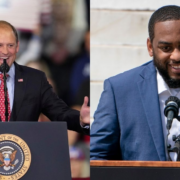
Andy Barr speaks at a podium with Donald Trump behind him, beside a photo of Charles Booker smiling at a microphone.

Meet the Candidates: Andy Barr, Charles Booker Battle for Mitch McConnell’s U.S. Senate Seat

The general election for the United States will take place on November 3, 2026 and a U.S. Senate seat is up for grabs in Kentucky. The two major party-backed politicians running for this position, which has been held by Sen. Mitch McConnell for the last four decades, are Andy Barr (Republican) and Charles Booker (Democrat).

Here’s a breakdown of the two major candidates’ stances on issues impacting queer and non-queer Kentuckians alike, along with known endorsements and financial contributors. Direct statements from Charles Booker are included; Andy Barr did not respond to invitation to comment.

Editor’s note: While this breakdown focuses on the major-party candidates, Christopher Campbell is also running for the seat representing the Kentucky Party, and Thomas Murphy is running as a write-in.

Issue Andy Barr (Republican) Charles Booker (Democrat)

LGBTQ+ Rights

In 2022, Andy Barr voted against the Respect for Marriage Act, implying that it was brought to Congress due to left-wing fear mongering in the wake of the Supreme Court decision in Dobbs v. Jackson (2022), which overturned abortion rights previously protected by Roe v. Wade (1973).

Andy Barr has been endorsed by anti-trans activist Riley Gaines. He believes there are only two genders.

In an Oct. 14 email to Queer Kentucky, Booker said: “In the Senate, I plan to push for policies that allow queer Kentuckians, and all queer Americans, to embrace their full, authentic selves. I would object to policies that aim to restrict who they love and how they live their lives, and take a firm stance against those pushing any type of hateful or discriminatory rhetoric or policies.”

On transgender healthcare: “I’ll say that healthcare is one of my top agenda items. As a Type 1 diabetic who has had to ration my insulin, I know firsthand the importance of accessing high-quality, affordable care, and I pledge to ensure that everyone can get the medication and treatment that they need.”

Border Security/ICE

Barr takes a hard stance on immigration. He has voted in support of the Secure the Border Act multiple times, which would increase the number of border patrol agents on payroll and restarts the process of building the wall along the U.S.-Mexico border.

He stands with the Department of Homeland Security and ICE, according to his June 2026 press release.

Read more on his website.

Booker called for the abolition of ICE on Bluesky in July 2026.

In an Oct. 14 email to Queer Kentucky, Booker said: “If we want a secure, humane border and an immigration system that upholds the American Dream, we should invest in fixing our broken immigration system, not terrorizing hardworking families in our neighborhoods. Once I’m elected, I will stand up against the unchecked cruelty, corruption, and attacks on humanity, and lead for a humane approach to immigration.”

Andy Barr (Republican) Charles Booker (Democrat)

Legislative Experience

Since 2013 Andy Barr has served in some capacity on the following committees as a member of the United States House of Representatives (Ballotpedia):

  • Committee on Financial Services (2013-2026)
  • House Committee on Veterans’ Affairs (2019-2020)
  • Committee on Foreign Affairs (2021-2026)
  • United States House of Representatives Select Committee on the Strategic Competition Between the United States and the Chinese Communist Party (2023-2026)

This list does not include subcommittees.

During his time as a member of the Kentucky House of Representatives from 2019-2020, Charles Booker served on the following committees (Ballotpedia):

  • House Judiciary Committee
  • Economic Development & Workforce Investment Committee
  • House Natural Resources and Energy Committee

This list does not include subcommittees.

Financial Contributors

OpenSecrets is a nonprofit, nonpartisan organization that provides clear, concise data on political fundraising in the United States. Data below was gleaned from Barr’s and Booker’s profiles on this site.

“PAC” — political action committee — is a term used while discussing political fundraising. Here is more information from the Federal Election Commission.

In the 2025-2026 fundraising cycle, 49.62% of Andy Barr’s donations have been from large individual contributors, 19.47% from PACs, and 7.27% from small individual contributors.

Top 5 Organization and Industry Donors:

  • Morgan Stanley (84% Individual, 16% PAC)
  • PNC Financial Services (82% Individual, 18% PAC)
  • FICO (81% Individual, 19% PAC)
  • Blackstone Group (100% Individual)
  • KKR & Co (100% Individual)

Top 5 Industries:

  • Retired
  • Republican/Conservative
  • Commercial banks and bank holding properties
  • Republican leadership/PAC
  • Pro-Israel

In the 2025-2026 fundraising cycle, 59.53% of Charles Booker’s donations have been from small individual contributors, 38.22% from large individual contributors, and 2.25% from PACs.

Top 5 Organization and Industry Donors:

  • RocketGenius Inc (100% Individual)
  • Texas Home Health (100% Individual)
  • Chrysalis Ventures (100% Individual)
  • Bellarmine University (100% Individual)
  • Murphy’s Camera (100% Individual)

Top 5 Industries:

  • Democratic/Liberal
  • Schools & colleges
  • Retired
  • Attorneys & law firms
  • Investors

Endorsements

Individuals’ endorsements: Donald J. Trump, Mary Bunning, Damon Thayer, and Riley Gaines.

Organizational endorsements: the Kentucky Fraternal Order of Police, the U.S. Chamber of Commerce, the Kentucky State Senate Republican Conference, and America First Club.

Individuals’ endorsements: Elizabeth Warren, Andy Beshear, Jacqueline Coleman, and Amy McGrath.

Organizational endorsements: American Federation of Government Employees, Our Revolution, the Working Families Party, and United Auto Workers.

Kentucky Cities Split Over Flock Cameras as Privacy Concerns Clash With Crime-Fighting Goals

Dozens of law enforcement agencies in Kentucky use Flock cameras to help them solve and deter crime. But as concerns over privacy and data security grow, many municipalities are asking whether to continue using the surveillance technology.

Flock cameras can do more than the average security surveillance camera. Using an automated license plate reader, often referred to as ALPRs, the camera takes a photo of every passing vehicle that it can see. The ALPR records when and where it saw a vehicle, its make and model, and even obscure details like a bumper sticker or a dent on the side passenger door.

Even if a vehicle is not believed to be involved in a crime, Flock cameras still take a picture and keep that information in a database, such as one owned by a police department or a business.

That does not mean that data cannot or will not be shared with others.

Flock Safety CEO Garrett Langley wrote that owners can share data with others one-on-one or choose to join Flock’s National Lookup Network, which allows officers to search for a full license plate number across department cameras nationwide. This is where residents and city leaders become hesitant.

Multiple Kentucky municipalities have chosen not to renew their contracts with Flock following residents’ concerns about potential misuse and privacy violations. Some of these cities include Cynthiana, Hartford and nearly a dozen Northern Kentucky law enforcement departments. The city of Frankfort joined the growing list on Monday, Oct. 12.

“I see the true benefit of the technology for a department and how it can be used for good,” said Frankfort Commissioner Kelly May. “Unfortunately, I believe that we’re just not living in a world where we can trust the parameters that another company puts in place for us to use in our community.”

Commissioners in the city unanimously voted not to renew the city’s contract with Flock once it ends Jan. 1, 2027. Currently, Frankfort has 19 Flock cameras.

Commissioner Rob Richardson, a supporter of Flock, called the surveillance technology one of the “most valuable tools for law enforcement” when it comes to solving crimes. However, he said he would like to see more rules and regulations in place at the state and federal levels.

“I, if I am sitting in this seat, would want to bring back Flock with those parameters because I do believe it keeps our city safer,” said Richardson.

Lexington resident Bobby Stinnett holds a similar view and said he would like to see legislative action at the state level when it comes to who can access Flock data.

“I agree with law enforcement having that tool to utilize those to solve crimes, but at the same time, I also agree that law enforcement should have a warrant to access the information,” Stinnett told Queer Kentucky. “All officers really need to access our phone is a warrant. I would think that it would be the same for Flock data.”

While some cities are ending agreements or plans with Flock, others are continuing to stay with the company, including the Louisville Metro Police Department.

Matt Mudd, a spokesperson for Louisville Mayor Craig Greenberg, said Flock tools have helped police solve multiple violent crimes, including the recent shooting of Kentucky State Police Trooper Hayden Phillips.

“Rapidly apprehending individuals who have committed horrific crimes makes our city safer,” Mudd told Queer Kentucky. “At the same time, Mayor Greenberg shares the community’s concerns regarding personal privacy. Just like with any technology, safeguards must be in place to make sure it is only used in a way that is constitutional and appropriate.”

Every search or search request in LMPD’s Flock database must include the following:

  • An incident report, a computer-aided dispatch report, a warrant, a case number, or other recognized identifying number. If no number exists, a detailed explanation will be required.
  • The case or investigation type.
  • A narrative explaining the investigation, the vehicle’s connection, and why the search is necessary.

Outside agencies, such as the Lexington Police Department or KSP, are allowed to search LMPD’s data but only if they meet the city’s internal requirements.

Other department policies that are being enforced at LMPD:

  • Only assigned members in analytical or investigative positions can conduct independent searches.
  • Before an officer can access the data, they must go through department-approved training, which will require recertification every two years.
  • LMPD’s Audit Unit will flag any suspicious activity or search patterns within the system. Audits will change from occasional/random reviews to mandatory audits by the Audit Unit at least every 90 days.
  • Any suspicious activity must be reported through the chain of command.
  • LMPD does not assist with immigration enforcement

“We also worked with Rep. John Hodgson on House Bill 58, which sets safeguards for how law enforcement agencies can use and store data from technology like Flock cameras, including that data on the cameras can’t be kept for more than 90 days unless it’s being used to investigate a crime,” said Mudd.

H.B. 58 went into effect in July 2026. As Mudd said, the bill addresses how long data can be saved, who can access it, and what the technology can be used for. Even so, the law does not require law enforcement to acquire a judicial warrant to access ALPR data.

“The only thing that’s keeping you having privacy is a warrant,” said Stinnett. “That is a separation from abuse. That’s how you prevent these officers who have been caught misusing Flock.”

Under the new law, violators could face up to one year in jail, plus up to $2,000 in fines.

Seth Rane, Grayson Castellucci and Eddy Risimini, three students in white button-down shirts, laugh together in front of a wall of green leaves.

Pushed to the Edge of Campus, These Trans Students Started Their Own Fraternity

This story first appeared in Queer Cincinnati: Beyond the Binary, published Oct. 23, 2026.

In the spring of my freshman year at the University of Cincinnati (UC), Ohio Senate Bill 1 was moving through the state legislature. The bill, which would take effect on June 27th, 2025, requires Ohio’s public colleges and universities to maintain institutional neutrality and “intellectual diversity” on certain “controversial beliefs and policies” including climate policy, electoral politics, foreign policy, immigration, marriage, and abortion. It also bars faculty from “indoctrinating” students toward a position on these topics, bars the institution itself from taking an official stance, and eliminates diversity, equity, and inclusion (DEI) offices, departments, and required trainings at the same institutions.

UC, however, wasted no time adopting these principles, even before the bill became law. UC President Neville Pinto complied in advance, stating in a public email on February 21st, 2025 that “it is untenable to operate as if noncompliance with these directives is an effective option” and that “we are committed to meet our compliance obligations.” Soon after President Pinto’s address, DEI offices including the LGBTQ+ Center, the Women’s Center, Ethnic Program Services (EPS), and the African American Cultural Resource Center (AACRC) were immediately shut down. Many students, myself included, felt this response failed to address their concerns.

That same spring, the university began replacing bathroom signage with new “biological men” and “biological women” signs. This action was a result of Ohio Senate Bill 104, the “Protect All Students Act,” signed by Governor Mike DeWine in November 2024, which prohibits members of one biological sex from using restrooms designated for the opposite biological sex and erases multi-occupancy restrooms open to any gender. The law does require institutions to provide alternative accommodations, such as single-occupancy facilities, but the bathroom signage UC implemented was worded of their own accord. The new signs were adopted quickly, sending a clear message that transgender, nonbinary, and intersex students were not welcome. Because of this, many students became worried that their university housing options would no longer be viable if the available restrooms did not match their “biological sex.” As a trans man living in freshman dorms at the time, I worried for my housing security.

My fears came true when my fellow trans roommates Seth Rane, Grayson Castellucci, and I were relocated to the margins of campus mid-spring semester. We were originally approached in an email by UC’s Director of Resident Education & Development at the time, Trent Pinto, on February 10th, 2025. Pinto invited us to a “conversation regarding upcoming changes to the residential experience.” This meeting was held at UC’s LGBTQ+ Center before it was dissolved, and its conclusion resulted in two options: 1) Stay in our dorms and travel to the women’s dorms to use the restroom, or 2) Relocate to an off-campus apartment where we would have access to a personal restroom.

Option 1 was an unreasonable request for us. Not only was this option directly invalidating our identities as men, but it was also oversaturating the communal space and required us to travel to a different floor or building to use the restroom. Because of this, my roommates and I conceded to option 2 and were relocated to an apartment near campus. While UC quickly responded to a flood of backlash by removing the bathroom signs, the damage had already been done. What was supposed to be an exciting year to make new friends and invest in our studies instead became a year where we were isolated from our peers and pulled from our classes to accommodate the move to our new apartment.

Amidst the predatory legislation and considerable lack of LGBTQ+ spaces, we quickly realized we were not alone in our isolation and observed an almost solemn environment throughout campus. To combat this, my roommates and I decided to make a change.

One day after class, I came home to Seth and Grayson sharing the idea of starting a queer fraternity: Phi Alpha Gama (PAG). At first, we treated it as a joke. After all, it is customary across university Greek life to exclusively allow one gender (women in sororities, men in fraternities). It seemed absurd to imagine visibly queer or transgender individuals enjoying this same staple of college life, but the more we thought about it, the more we realized that PAG’s existence might be a space that UC’s LGBTQ+ community desperately needed: a space made by queer people for queer people to enjoy without consequence.

A fraternity was the best option for us to organize an LGBTQ+-friendly community because we felt that queer individuals deserved to be included in traditional college experiences that they may otherwise shy away from. We gathered a few close friends to join PAG, but we realized that to expand our community past our small clique, we needed to give our fraternity structure. To do this, we created the governing body of PAG, consisting of the following roles: president, vice president, secretary, recruitment officers, philanthropy chair, social media chair, diversity chair, and grievance officer.

We didn’t expect PAG to be more than a small community at first, but soon, friends of friends came to our parties and told their friends about PAG, and it became a vast network of students where all are welcome. During our recent spring rush campaign, we had a great turnout, with around 30 members present and 10 rushees. We implemented different group bonding activities including ice breaker games and a friendly s’mores roasting competition. However, the main standout of this event came about when several people approached our front yard asking about the event we were hosting. What stood out to me the most was how accommodating the members of PAG were to total strangers. Seeing a community that I helped create foster such a kind and welcoming environment made me realize how important PAG was to creating a safe space for queer and allied individuals to be themselves and make new connections.

The Kentucky State Capitol building in Frankfort under a blue sky.

What is the state constitutional amendment Kentucky voters will decide on this November?

The 2026 midterm elections are about a week away on November 3, and soon Kentuckians will get the chance to vote on who they want to represent them in Congress and in local government.

Kentuckians will also have the opportunity to vote on a state constitutional amendment, Amendment 1, when they go to the polls.

But what is a constitutional amendment, and what is Amendment 1 proposing to change?

What is a constitutional amendment and what is Amendment 1?

A constitutional amendment is exactly what it sounds like. It is a formal change, addition, or removal of text from the U.S. or a state’s constitution. 

Amendment 1 is a proposed constitutional amendment of Section 77 of the state constitution that would curb the governor’s pardoning power. 

If approved, Constitutional Amendment 1 would bar governors from issuing pardons and commuting sentences 60 days before a gubernatorial election until the fifth Tuesday after that same election, which is after the inauguration of the next governor. 

It would also amend the language in the section of the Kentucky state constitution regarding gubernatorial pardons to be gender neutral. 

Under the current constitution, governors are barred from granting reprieves or pardons for cases of impeachment.

How did Amendment 1 get on the ballot and who’s behind it?

Republican state Sen. Chris McDaniel has proposed the amendment in the Kentucky General Assembly for the past seven years, and his bill was finally successful in passing through the House and Senate this year. 

Under the Kentucky Constitution, three-fifths of the members of each chamber of the Kentucky General Assembly need to vote in favor of a proposed constitutional amendment for it to appear on a ballot. 

Once it’s on the ballot, then voters get to decide if they want the change or not. The bill was introduced as SB 10 and passed the Senate 36-0 in January. The House passed an amended version 82-12 on April 1, sending the amendment to voters.

Why was Amendment 1 proposed in the first place?

McDaniel proposed the amendment after Republican former Gov. Matt Bevin issued 428 pardons and commutations shortly after losing his reelection bid in 2019 to then-Attorney General Andy Beshear. 

Bevin’s pardoning spree sparked bipartisan backlash, including from then-Senate Majority Leader Mitch McConnell. That backlash set off calls for an investigation. 

Some of those released from incarceration during Bevin’s final days in office had been convicted of violent crimes like rape, murder, and child molestation, The Kentucky Lantern reports. One of Bevin’s pardons came under especially tough scrutiny after The Louisville Courier-Journal reported that family members of Patrick Brian Baker had raised $21,500 at a 2018 fundraiser to help pay off debt from Bevin’s 2015 campaign. Baker was convicted in 2017 of reckless homicide in connection with a 2014 home invasion.

In December 2019, Bevin pardoned Baker, who had been sentenced to 19 years in prison. Donald L. Mills was fatally shot during the 2014 armed home invasion for which Baker was convicted of reckless homicide. The Courier-Journal also reported that Baker’s brother and sister-in-law donated $4,000 to Bevin’s campaign. In his pardon order, Bevin called the evidence against Baker “sketchy at best,” NPR reports. Bevin has denied that financial or political considerations ever played a part in his pardons. 

Reports of Baker’s political connection to Bevin brought renewed attention to the case, and federal authorities brought federal charges against him. In 2022, Baker was sentenced to 42 years in prison for murder. 

“This is just a fundamental issue of justice. It’s one that I’ve been honored to champion for a long time,” McDaniel told The Kentucky Lantern.

How will Amendment 1 appear on the ballot?

Voters will be given the opportunity to vote yes or no on the following:

Are you in favor of limiting a Governor’s ability to grant pardons or commute sentences by prohibiting him or her from granting pardons or commuting sentences during the time period beginning 60 days prior to the general election at which the Governor is elected, and ending when the Governor is sworn in for that term by amending the Constitution of Kentucky as stated below?

It is proposed that Section 77 of the Constitution of Kentucky be amended to read as follows:

(1) The Governor shall have power to:
(a) Remit fines and forfeitures; and
(b) Commute sentences and grant reprieves and pardons, except:
1. In case of impeachment; or
2. For the period beginning sixty days prior to the date of the gubernatorial election and ending the fifth Tuesday succeeding the election.

(2) The Governor shall file with each application therefor a statement of the reasons for his or her decision thereon, which application and statement shall always be open to public inspection.

(3) In cases of treason, the Governor shall have power to grant reprieves until the end of the next session of the General Assembly, in which the power of pardoning shall be vested; but he or she shall have no power to remit the fees of the Clerk, Sheriff or Commonwealth’s Attorney in penal or criminal cases.

The blue Roebling Suspension Bridge stretches across the Ohio River from the Covington, Kentucky, riverfront toward the Cincinnati skyline on a sunny day.

Northern Kentucky’s LGBTQ+ Paradox: Legal Protections at Home Contend with Restrictions at the Statehouse(s)

Queer Kentucky’s survey data highlights a region where residents may be physically safer, yet still carry the state’s heaviest mental burden.

LGBTQ+ residents of Northern Kentucky are, on the surface, doing well. They aren’t leaving the state at higher rates, aren’t reporting more violence than their neighbors, and are finding health care providers at rates higher than the state average. By nearly every physical measure, Northern Kentucky seems like it’s doing just fine.

But when you zoom in, Northern Kentucky’s LGBTQ+ residents are experiencing an increased mental health burden nearly 9 percentage points higher than the statewide average. According to the 2025 Queer Kentucky Survey, 43.2% of LGBTQ+ residents in Northern Kentucky report experiencing very negative mental health, reporting higher psychological burdens than their Louisville or Lexington counterparts.

Dig deeper into the data, and the impact of public policy comes into focus: 75% of Northern Kentucky residents say their mental health has been negatively affected by anti-LGBTQ+ policies – 5 percentage points higher than the statewide average – and 58.3% say they’ve lost trust in their elected officials altogether.

These numbers make it worth asking why residents are staying at all.

It starts with local government. Across Northern Kentucky, city halls have built some of the deepest LGBTQ+ infrastructure in the state, one ordinance at a time.

Kentucky’s “fairness ordinances” – local laws banning discrimination based on sexual orientation and gender identity – are where this shows up most. About 1 in 4 cities in Northern Kentucky’s three core counties – Boone, Kenton and Campbell – now has a fairness ordinance on the books, one of the densest concentrations anywhere in the state. Covington passed the region’s first in 2003, followed by Dayton, Bellevue and Highland Heights in 2019, Fort Thomas, Cold Spring and Newport in 2020, Crescent Springs and Fort Mitchell in 2021, and Elsmere in 2022.

Beyond anti-discrimination laws, Covington was also the first city in Kentucky to ban conversion therapy for minors (2020) before Governor Andy Beshear signed an executive order banning it statewide in 2024. Covington also scored a 94 out of 100 on the Human Rights Campaign’s 2025 Municipal Equality Index – one of the highest scores in the state. Local advocacy groups Northern Kentucky Pride and Northern Kentucky Fairness were both active in getting many of those ordinances passed.

In other words, queer residents and allies in Northern Kentucky have worked hard to build real community and real protection for their families and neighbors.

So if Northern Kentucky’s LGBTQ+ residents feel more physically safe and have built a strong community, what’s driving the region’s mental health numbers higher than anywhere else in the state? No single survey question can answer that, but a look at the wider anti-LGBTQ+ policy landscape – with 75% of Northern Kentucky residents’ mental health impacted by it – suggests a few contributing threads.

In 2023, the legislature passed Senate Bill 150, a law banning gender-transition care for minors, mandating school bathroom policy by sex assigned at birth, and barring teachers from discussing sexual orientation or gender identity in the classroom.

The ACLU called it “one of the worst anti-trans laws in the nation,” and, when the bill passed, Northern Kentucky school districts complied quickly.

This law wasn’t just handed down from Frankfort; it was Northern Kentucky-grown. State Sen. John Schickel, representing Boone County, was one of 13 senators who sponsored the bill, alongside two other Northern Kentucky senators, Shelley Funke Frommeyer and Gex Williams. (The bill’s lead sponsor, State Sen. Max Wise, represents Campbellsville, in south-central Kentucky.)

Unlike Louisville or Lexington, where anti-LGBTQ+ legislation largely arrives from rural and exurban districts, the architecture of SB 150 was built partly by Northern Kentucky’s own representatives. In cases like SB 150, local queer residents aren’t watching some distant lawmaker author these bills. Instead, they’re coming from senators in their own backyard.

So while physical violence against LGBTQ+ folks sits at 9.1% in Northern Kentucky – 6.1 percentage points below the state average – there is still a looming anxiety that their safety could be at risk as they watch these policies come in.

Amy Clark, LPCC and Director of Student Counseling Services at Northern Kentucky University, shares, “At the local university counseling center, more than 33% of the overall clientele are LGBTQ+. I have witnessed an increase in anxiety, uncertainty and guardedness. A lot of times it presents as anger – and rightly so – but if you dig below the surface, there’s a genuine feeling of intense fear and sadness.”

And then, just across the Ohio River sits a whole other state with a whole other set of policies.

Before 2023, Northern Kentucky families who wanted gender-affirming care for their kids could drive just minutes into Cincinnati to Children’s Hospital, which had been among the highest-volume providers of gender-affirming care in the country. Then, in 2024, Ohio banned gender-affirming care for minors, just as Kentucky had.

Northern Kentucky families didn’t lose access to this type of care all at once; they had to lose their nearest options one at a time. Louisville’s cross-border option, Indiana, restricted care even earlier, while Lexington never had a comparable one at all.

Northern Kentucky may be the only Kentucky metro where residents watched two specific, physically close options get taken away from them, one after the other.

The region also sits inside Cincinnati’s media market, meaning residents are more likely to keep a pulse on two state legislatures’ worth of anti-LGBTQ+ fights instead of just one. That’s two states’ worth of harmful policy instead of one, likely creating twice the psychological weight to carry.

Ben London, a gay resident living in Northern Kentucky, told Queer Kentucky, “We have been hit with so much news about so many bills in so many states on so many issues that I’m overwhelmed. I am not transgender, but I have transgender friends. [My friend] – probably turned 18 a few years ago and transitioned before that – is a lovely, wonderful person. It makes me angry that he couldn’t get that gender-affirming care today; that’s ridiculous to me.”

What’s happening in Northern Kentucky is a paradox built by two governments at once. It’s a patchwork of city halls that took steps and decided one ordinance at a time to protect their queer neighbors. And yet, it is a region that sits underneath two state capitols that keep deciding otherwise.

That volume is about to increase. With the midterms approaching, both statehouses and the media covering them are likely to get even louder. Northern Kentucky’s LGBTQ+ residents have a say in what happens next, but they shouldn’t have to carry all of it alone.

“[LGBTQ+] individuals are tired of fighting this battle,” Clark said. “Despite the overwhelming discouragement, [they] are still trying to take care of themselves.”

A computer screen showing license plate reader software results. The same plate number is logged four times on different dates by different cameras, each entry with a close-up of the plate and a photo of the white car it belongs to.

Flock cameras in Kentucky: How license plate readers get approved and how you can track them

Automated license plate reader (ALPR) cameras — widely known by one brand name, Flock — aren’t new technology, and they’re not the only kind of surveillance equipment modern police departments use across the commonwealth. Agencies have used body-worn cameras, cruiser-mounted cameras, gunshot-detection systems (like ShotSpotter), cellular signal interceptor (commonly known as “stingray”) technology, and others for decades.

But as artificial intelligence (AI) increases these devices’ reach and power to surveil the public, local officials face growing questions about how they adopt and deploy police technology in their communities.

What are “Flock cameras,” and how else are police using them?

ALPRs are small, nondescript cameras, usually mounted underneath a solar panel (some are mounted to police cruisers instead). The cameras typically face one direction with a wide-angle frame, and, while stationary, some possess basic pan/zoom capabilities (often multiple cameras will sit facing various directions at a single location).

The video images capture and catalogue numerous identifying features of vehicles that pass, including make, model, color, license plate number and other identifying features like body damage/irregularities, decals or bumper stickers. While some manufacturers’ cameras are capable of facial recognition and even more sophisticated data collection, these are much more common in private security and smart home systems like Google Nest, Ring or Wyze. Police can, however, use Flock cameras to track people walking, as reporting elsewhere in the country has shown, a feature the company has downplayed. With the integration of AI, ALPR cameras are now often plugged into statewide, interstate or national databases that the AI software can process and interpret nearly instantaneously.

Police departments often describe the cameras as a valuable tool for solving crimes and finding missing people and stolen property. Privacy and civil liberties advocates warn the technology carries risks of mistakes and abuse, as reporting by Queer Kentucky and others has documented.

Unlike highway traffic cameras, ALPRs can be installed almost anywhere in a community. ALPR watchdog DeFlock has cataloged more than 100,000 of the cameras across the U.S. (including Flock, Motorola and Genetec, among other unidentified manufacturers) many surveilling city parks, Main Street districts and other common public areas. Readers can check the map to see reported cameras near them.

How are these contracts approved in the first place?

Many of these cameras were approved and installed without much public to-do.

Kentucky jurisdictions vary widely in the details of their budget processes, but they usually follow the same broad patterns. Like most government contracts, agreements with Flock, Axon and other police tech companies usually originate with a police department or sheriff’s office, as they’re budgeting for departments’ resources. Then, once a draft of the terms is laid out, they’ll require approval from the legislative body: city council, commission, metro council, fiscal court (the county’s governing body), etc.

Sometimes these police contracts are passed as one part of a larger city or county budget. Sometimes they’re considered as stand-alone items. Sometimes a police contract will be introduced as part of a larger budget before getting broken out as its own item, for more focused and thorough consideration. If the contract is below a certain dollar amount, it might not require a vote at all (this is less common for larger contracts).

Cameras can also come into a community without a government contract at all. Private businesses, homeowners associations (HOAs) and other property owners can buy their own ALPRs and share access with police. Police departments can also get cameras through grants, free trial periods or donations, which may get less public attention.

Because these decisions often happen during routine meetings, as one item among many, residents have reported not learning about a contract until cameras appear in their neighborhood.

How can you track these contracts?

Cameras owned by a local police department or sheriff’s office generally require approval from local elected officials, such as a city council or county fiscal court. Cameras owned by private businesses, HOAs or state agencies may not, even when police can access their data. While each city and county handles budgets differently, there are steps you can take to stay informed:

  1. Check your city or county’s website for its council or fiscal court meeting schedule. If it doesn’t publish meeting agendas, find contact information for your city clerk or a similar city administrator. Ask to be added to the distribution list for council announcements and agendas.
  2. Examine agenda items — presentations, motions, ordinances, etc. — either introduced by or related to the police department. This will show you what sorts of funding and resources police are considering for your community.
  3. Ask your elected officials directly about this issue, either in person at a meeting or by phone or email. Elected officials vote on these contracts and can answer questions about them.
  4. Attend public hearings, even if you don’t feel comfortable speaking. Public meetings are where officials hear directly from residents. If no public hearing is planned on a contract, you can ask officials to hold one.
  5. Ask your police department or sheriff’s office for its ALPR policy. A 2026 Kentucky law, House Bill 58, requires law enforcement agencies that use ALPRs to adopt a written policy and make it public. The law also generally caps how long captured plate data can be kept at 90 days.
  6. File an open records request. Under the Kentucky Open Records Act, you can request your city’s or county’s contracts and data-sharing agreements with ALPR vendors.
A red AIDS ribbon lays on a white background with a syringe of blood next to it.

AVOL Kentucky Is Adding Injectable PrEP. One Shot Can Replace Two Months of Pills.

AVOL Kentucky has worked to support Kentuckians living with HIV for almost four decades. Now, it’s taking its work to the next level and will soon start to offer injectable pre-exposure prophylaxis, most commonly known as PrEP, the newest and longest-lasting option for HIV prevention.

PrEP is a medication that reduces a person’s chances of contracting HIV and can reduce the risk of getting the virus by about 99 percent when taken as prescribed, according to the U.S. Centers for Disease Control and Prevention.

PrEP can be taken in pill form or administered via injection, which provides longer-lasting protection against HIV, according to the Department of Health and Human Services. The Food and Drug Administration has approved two types of injectable PrEP. One is given every two months, and another is administered once every six months.

Some of the benefits of the injectable medication are that users are less likely to miss a dose due to its intermittent schedule, according to Jon Parker, CEO of AVOL Kentucky.

The method also offers more privacy since there are “no medication bottles with patient information,” he added.

The Lexington-based nonprofit has worked hard so it could expand its programs and services for its patients.

AVOL launched nearly 40 years ago as a program of the Gay and Lesbian Services, now the Pride Center, providing services for people living with HIV.

In its early days, AVOL offered “just basic social services and support, and then over time we added housing, support services and permanent housing for people living with HIV,” said Parker.

By about 1993 to 1994, the organization had started to get more involved in HIV prevention and began working to educate communities about the virus and how it could be prevented. The nonprofit offered HIV prevention supplies, Parker said, and drove people to local health departments to get tested. Parker noted that sometimes people had to wait two weeks to get the results of the test and see if they had contracted the virus.

The organization eventually began offering on-site testing so that people could find out their HIV status in minutes.

“So, we’ve come a long way,” said Parker.

Right around the onset of the COVID-19 pandemic, Parker said AVOL Kentucky had learned that other similar organizations in North America were beginning to offer PrEP services and wanted to learn how to do the same.

Initially, he said, the organization said offering PrEP services was “out of reach” for them since at the time they did not provide any other medical services apart from bringing people to get tested for HIV.

“We learned that we could do a lot with contracts with pharmacies and with medical staff, so that we didn’t have to perform the services ourselves,” Parker said. “We could contract and kind of pull together, curate a system that could be responsive to the people we see and get them connected to PrEP.”

AVOL Kentucky was, in part, able to provide PrEP services at this time because of the 340B Drug Price Program, a federal program that requires pharmaceutical manufacturers that participate with Medicaid to sell outpatient prescription drugs at discounted prices to some healthcare organizations that serve low-income and uninsured people.

Parker said that AVOL Kentucky receives some revenue through the program, which is then used to offset operational costs, which has helped them build out their sexual-health services without requiring uninsured clients to pay.

In November 2025, the organization decided that it was time to hire a nurse practitioner to help provide more immediate access to PrEP, HIV, and sexually transmitted infection treatment, according to Parker. And that same month, AVOL Kentucky held its first-ever in-person clinic.

At the end of this past August, AVOL Kentucky had 70 clients who received PrEP services through their in-house, on-site clinic. The organization partners with Q Care Plus, a telehealth provider, to provide another 134 Kentuckians with PrEP and PrEP-related services, according to Parker.

“AVOL’s PrEP navigators work across both telehealth and in-house patients, tracking follow-up timing, scheduling appointments, offering interim HIV and STI testing, and providing ongoing access to prevention supplies,” he told Queer Kentucky.

And more people are turning to AVOL Kentucky for HIV care every month. In September, another 25 people joined the list of regular AVOL Kentucky clients, he added.

“There is no one route for everyone,” Parker said when it comes to connecting people to care. “Every person is unique, and you have to find the route that’s appropriate and achievable for them.”

AVOL Kentucky offers walk-in appointments Monday through Friday and provides most of its STI and HIV prevention and treatment services free of charge, according to its website.

Mental health care for trans Kentuckians: Open Doors Counseling Center's entry table with a rainbow "All Welcome" board.

Trans Kentuckians Are Staying Home. The Data Says Community Is What Helps.

Mental health trends in transgender and nonbinary Kentuckians have displayed shifts during recent policy debates.

A 2025 Queer Kentucky survey showed that 34.5% of respondents reported that these recent policy debates have very negatively impacted their mental health.

Some gender expansive Kentuckians told Queer Kentucky that policy debates have led to them feeling like they are at the focal point of society right now, making the simple act of going into public feel daunting.
Hayes Farris, a nonbinary Kentuckian, said when they step out in public, it feels like transgender people are what sit at the forefront of people’s minds.

Farris said part of it is not knowing what people are thinking.

“Is that person looking at me because they are seething inside and hate that I exist? Are they curious? That’s just a heavy mental load to carry around,” they said.

Delgonna Cole, a transgender woman, said she is constantly thinking about what might make her easy to “clock” as transgender in public.

“I’ve had people come up to me at Kroger saying, ‘Hey, I have a question. Are you trans?’” she said. In reference to policy debates about the rights of transgender people, Cole said, “If it wasn’t pushed so intensely, I think I wouldn’t be so constantly afraid of going outside.”

Even healthcare providers for transgender and nonbinary Kentuckians reported seeing changes or responses from their patients reflecting these negative effects.

Dr. Keisa Fallin-Bennett’s practice has included transgender people for around 10 years, and for most of her career, she has been providing her services in Kentucky.

Fallin-Bennett said the impact varies from person to person, but she has heard from several patients that the impacts of recent policy debates have been devastating.

She said there has been a lot of policy debate prior to 2023, but that is where it all really took off.

“People start in a difficult state because of the world and having to accept that the institutions are kind of actively working against them,” Fallin-Bennett said.

Policy changes have led to decreased federal funding for her place of employment, and these changes have altered what is allowed to be provided to transgender patients, according to Fallin-Bennett.

According to the survey, when transgender women are denied healthcare in any aspect, they are more likely to avoid all healthcare. Some of this avoidance may be due to shaken trust in the healthcare system.

Fallin-Bennett discussed the issues that a 2023 Kentucky law stated that neither hormones nor surgery could be provided to transgender patients under 18, but an executive order to cut federal funding for institutions that treat individuals under 19 was signed in 2025 under President Donald Trump.

Under the threat of losing federal funding, Fallin-Bennett’s practice could no longer treat people under 19 years old, and people under that age limit who were already on hormones had to be weaned off.

“Frustrations are really building, and it really erodes the trust that people have in us,” Fallin-Bennett said.

For Cole, after struggling to get endocrinologists to properly prescribe her gender-affirming hormones, she took matters into her own hands.

“They wanted to stop my HRT dose because it got too high… but the levels were lower than a cis teenager’s,” she said. “So I just stopped seeing them, and I started doing DIY.”

Cole said she buys everything online, did extensive research, and measures her blood levels all on her own.

Transgender women report provider refusal at rates of 38.5%, far above the 12.6% statewide average for queer people, according to the QKY survey.

Another factor that gender expansive Kentuckians must think about when it comes to healthcare is finding understanding in their providers.

“I don’t think it’s ever been a question of safety, but more comfortability. I haven’t had any issues where I have felt unsafe, but even then, my therapist doesn’t know what questions to ask,” Jordan Gaither, a nonbinary Kentuckian, said.

Transgender and nonbinary Kentuckians are finding it difficult to cope with the world as it is right now, whether they are coping with self-medication, isolation, therapy or something else.

Gaither said they have had to figure out what they need on their own and come to their therapist with it, rather than being provided the necessary tools to cope.

This points to a potential lack of LGBTQ+ education for mental healthcare providers in Kentucky, but organizations like Open Doors Counseling Center are centered around providing care to queer people and have a queer staff.

Tanya Stephens, who uses no pronouns, only a name, says Open Doors is a great place for finding care as a queer person in Kentucky.

“They do a lot of good things to try to help. I did find a safe feeling place there,” Stephens, a local nurse practitioner, said.

Open Doors Counseling Center is part of a nonprofit organization called Caritas Care Solutions. The center provides identity counseling, trauma and grief counseling, financial therapy and more, and focuses on creating a safe space for LGBTQ+ people.

Finding mental health resources can be difficult in Kentucky. Eve “Sylvie” Derrington, who is nonbinary, said monetary restrictions can be part of the struggle.

“If there were more programs where you pay what you can based on your income, especially oriented to specific communities, that kind of thing would be helpful,” they said.

Derrington said coping is complicated, but it can help: “Trying to find community is a big coping mechanism. We’re not very good at it, but when we do have it, it’s beneficial.”

The Queer Kentucky survey showed that those with a lack of community reported significantly more severe outcomes in every policy impact measure.

Fallin-Bennett echoes that finding. She said that while it might seem easier to isolate right now, community is a crucial coping skill for queer people.

“People have been hit by this issue, and it makes everybody want to stay home. I think it’s the exact time that people need to be gathering with other people as much as their mental health allows,” she said. “We need to be outside of our houses for our mental health and have interaction with other humans… hopefully humans that are in the same boat.”

For Farris, policy debates have had an impact on them and their friends, but the conflict has helped them pull each other closer.

“I think it’s almost made us closer, and we know that community is everything right now,” they said. “I wish more people knew that it’s not a burden to lean on people you love.”

If you or someone you know is in crisis, the 988 Suicide and Crisis Lifeline is available 24/7 by call or text at 988, and restored its specialized “Press 3” service for LGBTQ+ youth on September 30, 2026, after a 14-month shutdown. Trans Lifeline’s peer support hotline is at (877) 565-8860, staffed Monday through Friday, 1 p.m. to 9 p.m. Eastern. The Trevor Project’s counselors are available 24/7 for LGBTQ+ young people at 1-866-488-7386, or by texting START to 678-678.

HIV self testing kits sitting on a ledge.

Federal Cuts “Handcuffed” BIPOC Harm Reduction in Kentucky. Communities Are Stepping Up.

In April, the Substance Abuse and Mental Health Services Administration (SAMHSA) released a letter notifying funding recipients that the agency is taking a “clear shift away from harm reduction,” including eliminating funding for fentanyl testing strips, clean syringes and needles, and “overdose hotlines.”

Harm reduction at its core is “a set of practical strategies and ideas aimed at reducing negative consequences associated with drug use,” according to the National Harm Reduction Coalition. The organization further details that some of those strategies could include the safer use, managed use, abstinence, meeting people who use drugs “where they’re at,” and addressing conditions of use along with the use itself.

SAMHSA’s decision has had immediate and life-threatening consequences for Kentucky organizations doing the work to close critical gaps in care for those in need, including for marginalized people.
“When they put this letter out there, they literally just handcuffed a lot of people,” said Shreeta Waldon, executive director of the Kentucky Harm Reduction Coalition (KyHRC), a Louisville-based nonprofit that works to reduce substance use disorder overdoses and deaths.

The letter cited a White House executive order from July 2025 to justify the policy changes. The order, “Ending Crime And Disorder On America’s Streets,” details those changes among a list of other line items including homelessness and crime. “Do not fund programs that fail to achieve adequate outcomes, including so-called ‘harm reduction’ or ‘safe consumption’ efforts,” the order reads.

It describes such strategies like harm reduction as ineffective; however, harm reduction is actually an evidence-backed practice that has been backed by scientific research.

What Kentucky Lost When SAMHSA Cut Harm Reduction Funding

These changes and attacks on harm reduction initiatives have hit the already limited ecosystem of harm reduction services built by and for Black and brown communities.

“SAMHSA award terms are now prohibiting federal grant funds from supporting several traditional harm reduction supplies, including syringes for illicit injection, safer smoking supplies, and fentanyl and other substance test strips,” Waldon explains. “That means that organizations are now navigating a much narrower definition of what federally funded harm reduction can include and not include.”

Recent research revealed that Trump’s elimination of federal funding for programs that provide syringe exchange and other harm reduction interventions will directly contribute to an increase in overdose deaths and non-fatal overdoses. Outcomes that Black and brown communities already feel more intensely.

KyHRC is one of the few groups in the state still delivering harm reduction care and resources for BIPOC communities, despite these concerning changes. In addition to new limitations, Waldon’s group immediately lost a $400,000 grant after the SAMHSA decision. However, instead of deferring programs or shortening their impact, the organization found new ways to deliver care to communities.

KyHRC began working with partners across the country to source harm reduction resources that they no longer could get from federal funding. Waldon mentioned that, among other groups, the Connecticut-based organization Reduce Harm Inc. has supported KyHRC with clean syringes, testing strips, and other supplies that are no longer accessible.

The redefinition of what the government will fund comes after a well-documented body of evidence pointing to harm reduction as a key strategy to prevent drug-related deaths. Studies show that fentanyl testing strips prevent overdoses, and research shows that providing clean syringes prevents the transfer of blood-borne diseases. A 2025 study including 67 communities, some of which were in Kentucky, found that when offered harm reduction strategies, those communities experienced a 15% reduction in non-fatal opioid overdoses and an estimated savings of $190,100 in healthcare spending per community.

Why Black Kentuckians Feel the Cuts Hardest

For Black communities in Kentucky, these new limitations are felt even more deeply than their neighbors. In 2023, the overall number of drug overdose deaths in Kentucky declined for the first time in years, while Black Kentuckians experienced an 8% rise in overdose deaths. Black Kentuckians continue to face worse health outcomes, less access to regular health care, and higher mortality rates compared to other groups. It is these realities that make harm reduction and community resources for Black and brown people all the more critical, according to the organizers delivering care despite greater obstacles.

“If you are trying to give me aid and help me based on the statistics that you have for white people, it’s not going to help me because it’s not made for me,” said Adria (AD) Shouse, a master barber at Well Groomed Barbershop Parlor.

Shouse is a barber with the African American Barbershop and Beauty Salon Initiative (BBSI), a public health program part of Project Ricochet, a nonprofit organization working to improve outcomes for minority youth in Lexington and beyond. BBSI transforms “relationship-rich environments” like barbershops and beauty salons into spaces where communities can get care and education related to diabetes, sexual health, mental health, drug use, and harm reduction.

“I’ve seen changed behavior in people that I’ve been cutting for years that have utilized resources through BBSI,” said Shouse.

BBSI provides community events based out of these safe spaces that bring care, including harm reduction resources, right to the communities who need it. This direct level of intervention is what Shouse says is missing in much of the conversation around BIPOC public health funding.

“The funding is different when it comes to people of color or minorities,” said Shouse. “They’re trying to keep certain communities and certain people in certain places because it works to their advantage.”

Shouse’s clients are predominantly Black men and young people, and in her work she fulfills a material need while offering support for other challenges.

Doulas Trained in Harm Reduction

It is that same model that other community leaders are implementing to provide support for Black pregnant people as well.

Granny’s Birth Initiative (GBI) is a nonprofit based in Louisville that supports Black parental health, partnering the care a pregnant person needs with the harm reduction resources they are unable to find elsewhere. That starts with training their doulas on harm reduction strategies, including trauma-informed care and Narcan usage.

“We make sure that our doulas are trained in that because doulas do provide resource navigation and it should always be non-judgmental support,” said doula Alexa Scisney, founder and executive director of GBI. “We want them to be well trained on not just keeping a straight face, but genuinely and truly understanding the type of resources that are needed.”

Black pregnant people are at least three times more likely to die due to a pregnancy-related condition, compared to their White counterparts. In Kentucky specifically, 82% of pregnancy-related deaths are deemed preventable. About 1 in 20 pregnant people use illicit drugs during pregnancy. This puts the work that GBI does as ground zero for public health progress and reducing harm.

“I know that doulas are an industry that is new to Kentucky, but a doula is somebody that’s supposed to be providing physical, mental, and emotional, non-judgmental support,” said Scisney. “And here at GBI, that non-judgment is something that we really highlight because it is not our job to do harm to people already seeking harm reduction resources. Our doors are always open.”

In addition to the SAMHSA decision, resources for harm reduction in Kentucky have been rocked by funding cuts and lack of consideration for how harm reduction impacts public health. In May, the University of Kentucky announced that it would formally end its HIV/AIDS prevention and treatment organization. The Target4 Project was part of this elimination, which provided HIV/AIDS intervention and services in addition to harm reduction supplies and targeted outreach.

Kentucky public health leaders say they will continue to step up in their communities, despite the new obstacles in front of them.

“Let us be the voice because we are the people who have experienced it. We’re the closest to it. We’re the closest because we live it every day,” said Waldon.

While the Trump administration and SAMHSA cut opportunities and funding, harm reductionists and community leaders continue to show up in new ways for their neighbors. While groups still hope for more permanent and sustainable funding, it is the promise of safer, stronger communities that pushes them forward, they said.

“For me, harm reduction has always been the radical decision to believe that every human being is worth keeping alive before they change, before they recover, before they become who somebody else thinks they should be,” said Waldon.
This work was supported by the 2026 CNP Media Fund. #CNPMediaFund

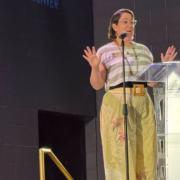
Lexington councilmember Liz Sheehan, who introduced the city's data center moratorium, speaking on stage.

It’s a Pause, Not a Ban: Liz Sheehan on Lexington’s Data Center Moratorium

During a meeting of the Lexington Fayette Urban County Government Council on June 9, Lexington became the first major Kentucky city to enact a moratorium on data centers.

Councilmember Liz Sheehan, who represents Lexington’s 5th district, introduced the resolution, which passed unanimously and without debate.

Sheehan, who is also Kentucky’s first openly bisexual elected official, spoke with Queer Kentucky to help make sense of the moratorium and shed light on all things data center in the Commonwealth.

The following interview has been edited for length and clarity.

What Lexington’s Data Center Moratorium Actually Does

Tell us a little bit about what a moratorium is, and why it might be a useful legislative tool.

The basic definition of a moratorium is that it’s a pause; in this case, it’s a pause on development approvals around data centers. It allows us to pause any approvals, update our policies and definitions, and then resume development after that.

Some people hear the word moratorium and it sounds scarier than it really is.

I think in our community people are also confusing the term moratorium with a ban. A ban is a [permanent] policy, but a moratorium is temporary.

Why does it seem like these data centers always end up impacting marginalized communities?

It comes down to property values. A development company is going to be thinking about their cost and looking for land that is available at a lower cost to them. Due to historically discriminatory practices like redlining, we’re seeing overlap here on where data centers are going.

We see headlines full of protests against data centers. Do you have any constituents contacting you in support of data centers?

I do have constituents on both sides of this issue. Some people see great benefits in increased technology in our world, including AI. Some folks are concerned about limiting data center development because our modern society is supported by online mechanisms.

If you think about newspapers going out of print and moving online, or online banking, or healthcare records, or social media, our world is increasingly online. So we do need infrastructure to support that, but I think there are disagreements about what that infrastructure looks like and where it can go.

What Lexingtonians Can Do

Is there anything that we can do to reduce the demand for data centers?

Our world is increasingly online, but I do think we can hold companies to higher standards when it comes to negative environmental impact. For instance, there are differences in cooling systems for data centers; a closed-loop system uses less water. Or you can use alternative energy to support the data centers to reduce energy demands of fossil fuels.

Technology changes so fast. I am worried that we are over-developing. For me, it’s also about whether we take a beat and see if we actually need all of this. Because if technology around computing power changes in the next 2-5 years, and now we have all of these humongous data centers built that could occupy half of the space and need half of the energy, do we need to do this now?

Besides public comment, is there anything Lexingtonians can do to express their opinions?

We have a fact form called Engage Lexington where people can go and give comments and learn more. Not everyone can come to the government center (council meetings), and this provides us an opportunity to not only hear from the public but also educate them about what we’re working on so we can get to those nuanced conversations.

We need people to come to the table to talk with us about the specifics of what they want to see and what they don’t want to see. In Lexington, there isn’t an appetite at all for hyperscale data centers; our communities seem to be against them, our developers aren’t looking to develop hyperscale here. But then we do have to figure out what is the (size) threshold for a data center, versus one that we think is too much.

If you want to see energy caps, tell us what you think that energy cap should be; if you want to see square footage changes, tell us what you think that should be. That’s where our conversation is headed, is trying to find that breaking point of what is acceptable and what is not.

We’re really working to find a solution that supports our community, supports our existing businesses, but that isn’t negatively harming our environment.

A county map of Kentucky showing which communities have local LGBTQ+ fairness ordinances, with western Kentucky counties highlighted in pink to show the region's lack of protections.

Western Kentucky’s LGBTQ+ Crisis: The Most Harm, the Least Protection Queer Kentucky's survey data reveals a region where nearly every measure of harm is at its worst, and state law still leaves trans Kentuckians out entirely.

LGBTQ+ people living in western Kentucky are experiencing a substantially more dangerous environment than anywhere else in the state, reporting being physically attacked at nearly twice the statewide rate. For trans folks, it goes even further: Kentucky’s hate crime statute has no name for what happens to them when they are attacked. A trans Kentuckian can be assaulted for being trans, and the state may prosecute the harm, but not the reason it was done.

Across the Queer Kentucky survey, western Kentucky ranks first or near first on nearly every measure of harm: LGBTQ+ residents with no health care provider, never tested for HIV, refused care by a provider, physical assault, suicidal ideation, drug use, smoking, feeling unsafe at home and deciding to move away. This is a region where nearly every measure of harm, access and community is at risk. And state policy and protections have failed them time and time again.
29.2% of queer residents in western Kentucky reported at least one instance of physical assault, which they attributed to the overarching anti-LGBTQ+ climate in the state. Overall, the statewide rate of physical assault stands at 15.2%.

54.5% of queer individuals report feeling physically unsafe at home, and 52.2% report feeling unsafe in public. Both are the highest of any region.

But it doesn’t stop at physical assault. In most of western Kentucky, a person who discriminates against and refuses an LGBTQ+ person a job, an apartment or service at a counter faces no legal consequences in doing so.

Across all of Kentucky, 24 communities have local Fairness Ordinances — including western Kentucky’s Paducah in 2018 and Henderson in 2019 — but that’s two of the 24, and they sit 130 miles apart. In between and beyond them, Owensboro, Bowling Green, Hopkinsville, Madisonville, Murray and Mayfield have no local fairness ordinances. On a map of who Kentucky has agreed to protect, most of western Kentucky isn’t on it.

What about larger state protections in Kentucky? It turns out that the state of Kentucky does have a hate crime law that protects sexual orientation. But it’s still reliant on individual judgment, and it still doesn’t protect trans people.

KRS 532.031, passed in 1998, applies when someone commits offenses because of a person’s race, color, religion, sexual orientation or national origin. In 2017, the legislature amended the statute to add a category, extending it to victims targeted for their actual or perceived employment as a peace officer, firefighter or emergency medical services worker.

Gender identity is not on the list.

Nine years ago, when the state legislature reopened the statute to add police and first responders, it still left trans Kentuckians out. For example, if a gay man is assaulted in Paducah, it can legally qualify as a hate crime. But if a trans woman is assaulted on the same block, both the state and law enforcement officers can choose to do nothing. The statute, by not including gender identity, allows law enforcement to turn a blind eye and delegitimize incidents against trans people.

Even within the bounds of discrimination against sexual orientation, this hate crime law does “protect,” the statute has no teeth and the law still does far less than what it implies. It might look and sound substantial, but functions as a performative exercise in the court system. As a result, there are many opportunities to create distance between the assault and any consequence for it. For instance, a judge decides at sentencing whether bias was a primary factor. A finding of bias permits denying probation instead of requiring it. The parole board may delay or deny parole.

It’s subject to discretion and personal biases that could creep in all the way down.

The laws already on the books are only part of it. Kentucky’s 2026 General Assembly may not have passed any anti-LGBTQ+ bills, but the climate in western Kentucky still hasn’t improved.

A bill doesn’t have to pass to embolden violence in its communities. Another factor behind why the climate in Western Kentucky still hasn’t improved. A bill only has to be filed, assigned, debated and covered on the local news, which are all separate moments of exposing a Kentuckian to hear whether or not their queer neighbor has the same rights as they do.

For example, Senate Bill 72 would have let health care providers refuse any treatment that violated their conscience. House Bill 468, pitched as a routine civil rights update, would have stripped the enforcement power from the Kentucky Commission on Human Rights and the 22 local commissions that actually enforce fairness ordinances. Both cleared their chamber of origin before stalling.

If House Bill 468 had passed, it would have taken away the only fairness ordinance protections two cities in Western Kentucky have.

And people are responding the only way the law leaves open to them: they blend in, censor their identity and opinions, or leave the state altogether.

According to the same survey, 18.5% of LGBTQ+ individuals living in Western Kentucky have decided to move out of state due to anti-LGBTQ+ policies; statewide, only 8.1% decide to leave. The compounding burden of assault, health care gaps, housing stress, and drug use appears to translate into a concrete intention to leave. One respondent wrote:

“Currently planning to move out of [the] states to a blue state. I have a lot of trans friends that I am scared for. I want them to go somewhere more blue, more safe, more open minded.”

In the face of so much hardship, western Kentucky remains home to LGBTQ+ advocates who keep showing up anyway. In May 2019, 55 residents in Bowling Green spoke in favor of a Fairness Ordinance, while 31 spoke against it. The commission voted it down 3-2. Advocates put it back on the agenda and have continued pushing for it. When a Fairness Ordinance was voted on in January 2018 in Paducah, residents flooded the city commission meeting, forcing the fire marshal to move the overflow into the adjacent hall to listen through open doors. That ordinance passed 4-1.

The people of western Kentucky continue to fight for the safety of their LGBTQ+ neighbors. But with so few fairness ordinances and statewide protections that stop short of covering them, many LGBTQ+ western Kentuckians remain at risk.

If you or someone you know is struggling, call or text the 988 Suicide & Crisis Lifeline at 988. LGBTQ+ young people can press 3 to reach counselors trained in LGBTQ+ care, an option that returned on Sept. 30, 2026 after it was cut in July 2025. The Trevor Project also offers 24/7 support at 1-866-488-7386 or by texting START to 678-678.

The ‘Family Safety’ Pretense: Flock Cameras and Northern Kentucky Parks Northern Kentucky residents pushed back hard against AI-powered surveillance cameras. And in some cities, they won.

When Kenton County’s police chief asked his fiscal court this summer for money to install six automated license plate reader (ALPR) cameras at the entrances to the county’s parks, his primary reasoning was to make those parks safer.

“We see this as a way to keep potential predators from coming into our parks and preying on children,” Chief Spike Jones said at the July 14 meeting.

Commissioner Jon Draud of Edgewood seemed to agree that it was a problem.

“There’s a lot of weird people that hang out at parks,” he said in response to Jones’ report, which stated the cameras would only point into the parks – not the general right-of-way – and only record vehicle data entering and exiting.

The report cited more than 1,000 calls for “suspicious person/vehicle” in the county’s parks since 2021, by far the most common type of call in those areas. Figures showing how many of those calls resulted in arrest or charges were not immediately available.

Vague commentary aside (Draud did not elaborate on who he meant by “weird people”), the story sounds reasonable enough on its surface. It aligns with police departments across the country making the case that the emerging technology is a game-changer for both investigating and deterring crime. Flock Safety’s website is populated by dozens of accounts of these types of cameras’ role in facilitating or expediting case closures.

The game-changing element is the AI-powered data collection and analysis that act as what police officials call a “force multiplier,” allowing departments to do more with stretched resources and pooled intelligence.

“It has changed how we do police work,” Lexington Police Commander Matt Greathouse told Kentucky Law Enforcement magazine. “Not only in Lexington and Fayette County, but all these counties now have some sort of Flock camera. What’s great about that is we can share that information across those jurisdictional boundaries, which we have discussed in many cases.”

Even Kentucky police agencies that have decided to discontinue their use of the cameras stressed the technology’s value. When announcing its decision in July to cancel its contract with Flock, the Newport Police Department said, “The city’s decision should not be interpreted as opposition to emerging public safety technologies or as a reflection that [ALPRs] lack public safety value.”

A ‘permanent dragnet’ for the ‘safest’ cities?

Residents and business owners across Northern Kentucky have been asking leaders why the cameras are needed — and whether the potential threats to their privacy are worth the returns in fighting crime — when they already feel safe.

At an August 17 public hearing, Independence Police Chief Brian Ferayorni spoke to his department’s initial deployment of 10 cameras in 2024, after a pilot the year prior. He purchased five more in 2025 and another five again this past June. He said 17 of those cameras were active at the time of the hearing.

“We are utilizing these ALPR cameras to identify and arrest criminals that come to the city to victimize our citizens and deter others who plan on doing the same,” he told more than 100 people in attendance and more watching the meeting from home.

The city council has approved Ferayorni’s contracts with Flock each of the last three budget cycles, with little fanfare. According to city contracts obtained by Link NKY, each camera costs roughly $3,000 per year, plus initial installation fees ranging from $650 to $1,250 each, depending on location. The first 10 cameras and their installation cost $68,900 over a 24-month period. The second and third contracts waived the installation fees, totalling $30,000 a batch, each for 24-month terms. In total so far, the city has spent nearly $130,000 on the cameras for four years of service from 2024 into 2028, when the most recently signed contract would expire.

Ferayorni defended the cost with a list of more than 30 recent cases he said the cameras assisted in solving since their deployment. Most common among those were stolen vehicles (10); missing persons, drugs and assaults and threats made up the next third (three each), with a variety of other one- or two-off cases comprising the remaining dozen.

Independence resident Zach Ford looked at FBI crime statistics prior to the meeting. While praising the chief for keeping the city “probably the best…in the commonwealth,” he said he couldn’t square a request for more cameras with the safety he feels police officers and more traditional tools already provide.

“We are among 80 percent for the safest cities in Kentucky, and that’s without Flock cameras,” he said during the three-hour public hearing, where, like in other recent meetings across Northern Kentucky, dozens stood up to speak against the city’s use of the cameras, with no one speaking in their favor.

Home security tech site SafeWise aggregates FBI crime data to rank cities by per-capita crime rates. It ranked Independence as the commonwealth’s fifth overall safest city in 2026, aligning with the figures Ford shared and making Independence the top-ranked among its Northern Kentucky peers. Neighboring Taylor Mill is the only other NKY city in the site’s top 10 for the year. A similar federal crime data aggregate site, Crime by City, ranks Independence as Kentucky’s safest, followed by Fort Thomas and Erlanger also in the top five. Newport and Florence had two of the commonwealth’s highest crime rates per capita among reporting cities, alongside Bowling Green, Owensboro and the Louisville metro.

“We have cities that are close to us with higher crime rates that are saying our Fourth Amendment’s more important,” Ford said, referring to Newport officials citing a recent U.S. Supreme Court case (Chatrie vs. United States) which they said could have future implications on how AI-powered ALPR networks could constitute unconstitutional searches.

While the Chatrie case did not consider ALPR cameras specifically, it challenged police’s authority to mass-obtain mobile device location data through so-called “geofence” warrants, as part of a criminal investigation (in this case, of a bank robbery in Virginia). The justices reaffirmed court precedent by holding that the suspect’s geolocation data tied to his cell phone constituted private, Fourth Amendment-protected information. Flock Safety maintains their cameras’ constitutionality, citing dozens of recent lower-court rulings throughout the U.S. affirming their position that the still, discrete images captured by the cameras in public areas do not fall under Fourth Amendment protection.

Court opinions aside, public opinion largely holds these cameras violate their rights.

Around the same time Ford was addressing Independence leaders, about 10 miles north in Fort Mitchell, resident Ashley Chaiken was expressing her concerns to her city council.

“Law enforcement has solved crime without the violation of our Fourth Amendment right,” Chaiken said. “Extreme cases do not justify a permanent dragnet of surveillance on the entire population.”

Less than 24 hours after Chaiken and others’ comments in Fort Mitchell, Mayor Greg Pohlgeers announced in a Facebook post that he was ending their contract with Flock, “effective immediately.” Less than a week following the meeting in Independence, their mayor issued a similar statement, announcing the city would be removing its cameras, but that he “continue[s] to believe [their] original decision to utilize this technology was a sound one.”

Fort Thomas, also frequently listed among Kentucky’s safest cities, has scheduled a public hearing on September 2 to discuss their use of the cameras, with scrutiny and pushback already coalescing online.

‘How much crime has been stopped?’

Serious crime in Kentucky has been shrinking for several years, since even before the commonwealth’s first Flock cameras went into service in 2022, according to both federal crime data and Kentucky State Police’s annual reporting, although there’s some variation.

Overall crime has shrunk steadily since 2019, achieving roughly a 23-percent reduction in the seven-year period, with nearly 10-percent reductions in “serious crime” in both 2024 and 2025. Both state and federal data sets show a steeper drop in property crime than in violent crime, but they differ on how violence has progressed: While federal data show cases like homicide and assault returning to 2019 levels after a spike during the height of the COVID-19 pandemic, state police data show violent crime is up by 10 percent statewide compared to pre-pandemic, after topping out in 2023.

Year Overall (FBI) Overall (KSP) Violent (FBI) Violent (KSP) Property (FBI) Property (KSP)
2019 100 100 100 100 100 100
2020 99 96 128 110 96 96
2021 90 92 129 106 86 85
2022 80 84 98 101 78 78
2023 87 91 102 113 85 84
2024 77 84 97 109 75 75
2025 78 110 67

Crime statistics indexed against 2019 levels. Sources: FBI Uniform Crime Reporting; Kentucky State Police annual reports.

Federal and state police data vary somewhat in their categorizations of crimes and reporting methods, which, along with differently sized data sets, could partially account for the discrepancy in violent crime rates.

Compared to the rest of the country, U.S. News and World Report currently ranks Kentucky’s violent crime rate as seventh lowest, according to FBI city-crime data, with below-average property crime rates, as well. For crime overall, Kentucky ranks 28th, on the lower end of the crime-heavier half.

Kentucky’s overall per-capita crime rate is lower than four of its neighboring seven states, with only Ohio, Illinois and Virginia ranking safer. Those rankings hold when zoomed in on property crime, and only Illinois and Virginia rank safer for violent crime.

For Chaiken, it’s not adding up.

“The pros for these cameras are supposedly that they stop crimes and help solve crimes,” she said. “How much crime has been stopped in Fort Mitchell? How many crimes have been solved solely based on data from the ALPR cameras in Fort Mitchell?”

Voters wait in line to cast their votes.

Kentucky’s 6th Congressional District Is Finally Competitive. What LGBTQ+ Voters Need to Know. The race to replace Andy Barr is closer than anyone expected.

Republican U.S. Rep. Andy Barr has been unbeatable in Kentucky’s 6th Congressional District for seven election cycles, defeating Democratic opponents and defending the GOP’s hold on the district. With Barr easily winning the Republican nomination for U.S. Senate to replace Sen. Mitch McConnell, Barr’s congressional seat, which includes Lexington, Frankfort, and Richmond, is now up for grabs. And for the first time in over a decade, it isn’t guaranteed to stay red.

In November, Kentucky’s 6th will have a choice between Navy veteran, former legislative director to Gov. Andy Beshear, and most recently, Assistant United States Attorney, Democrat Zach Dembo, and former state senator and, most recently, Commissioner of the Tennessee Department of Health, Republican Ralph Alvarado.

While Barr’s winning streak in the 6th was unmatched, this new matchup has drawn the attention of high-profile political players on both sides.

Dembo has been endorsed by Beshear, U.S. Sen. Mark Kelly of Arizona, U.S. Rep. Lauren Underwood of Illinois, the National Education Association, End Citizens United, and several other statewide politicians, national figures, and groups.

On the other side, Alvarado has the backing of President Donald Trump among other Republican leaders. Recent polling puts the two in a tight race. A June 24-28 survey conducted by GQR and commissioned by the Dembo campaign tracks Alvarado leading by just 3%. Andy Barr won the district by 26 points in 2024.

For progressive Kentuckians, this congressional race comes with surprising optimism.

“It’s a rare opportunity that a congressional seat outside of the third is competitive,” said Chris Hartman, executive director of the Fairness Campaign, an LGBTQ+ advocacy organization based in the state. “So every voice is going to matter, and every vote is going to matter in that race.”

The Fairness Campaign has not made an endorsement in the race, and its political action committee, C-FAIR, focuses on local races.

Democratic strategists attribute the race’s competitive nature in part to the candidate that Dembo is, and who he is not.

“He doesn’t have a record that anybody can shoot at as far as votes are taken,” said Jared Smith, a Kentucky-based democratic consultant and partner at Piper and Smith. “I think that for people who normally wouldn’t look at a Democratic candidate, especially some of the quality ones that have run in the past, this is a different story.”

Smith also noted that Dembo is a “prolific fundraiser.” After just 6 months on the campaign trail, Dembo’s campaign recorded over $550,000 in contributions. For comparison, Barr’s most recent general election opponent, Randy Cravens, raised just $2,500 in 2024 ahead of the Democratic primary.

While Dembo has not held elected office himself, his Republican opponent has a track record that voters can point to both in and out of state. Alvarado served as a member of the Kentucky State Senate from 2015 until 2023, when he resigned to take a new role as the commissioner for the Tennessee Department of Health.

In this position, Alvarado, who is a physician, quickly created a reputation for denying funding for HIV-related services. Within days of his time in Tennessee, Alvarado led the state to officially reject a CDC grant that provided millions of dollars to HIV prevention and care programs. A move that worries LGBTQ+ Kentuckians.

“I’m incredibly concerned about Ralph Alvarado’s record around HIV services, around healthcare access and around LGBTQ+ issues and laws and policies that impact the queer community,” said Hartman. “Certainly former Sen. Alvarado was never a vote in favor of LGBTQ issues in the Kentucky General Assembly.”

Democratic strategists imagine that Kentucky’s 6th could be a race that represents a reflection of the president’s low approval rating, which currently sits at around 38%.

“The referendum on the president is all midterms are,” said Smith. “This is a president that ran a campaign on three things. No new wars, prosecute the Epstein files, and bring down the cost of living. And he has done the opposite of all three of those things.”

As voters approach the general election in November, Dembo continues to gain momentum with high-profile supporters who have themselves performed well in the 6th. Democrat Beshear, who endorsed Dembo in May, won the district by about 20 points in 2023.

“I got to work closely with Zach Dembo when he was in my administration, and I assure you he’s the kind of person that will lead with conviction, character, and competence,” Beshear said in his endorsement statement.

Kentucky’s 6th joins a growing list of races that could flip for the first time in years. The Democratic Congressional Campaign Committee is tracking 46 “districts in play” this cycle, including Kentucky’s 6th. Democratic strategists remain hopeful that blue candidates will have a special edge this cycle.

“It’s a unique moment. If anybody tells you that there’s not going to be a blue wave in the fall, they’re not being truthful with you,” said Smith.

A flock license plate reader camera mounted on a pole.

Northern Kentucky Communities Push Back Against Flock Safety Surveillance Cameras. Residents, elected officials, and tech experts are uniting against Flock Safety cameras across Kentucky.

More and more Northern Kentucky police departments are looking to install AI-powered surveillance cameras along public roads and in public spaces, but they’re meeting strong resistance from a diverse range of residents, business owners, tech experts, local activists, political hopefuls and elected officials on both sides of the aisle.

Most recently, at Kenton County Fiscal Court’s July 14 meeting, the message was unified and clear.

“I don’t feel safer in a community with more surveillance,” one county resident told commissioners during public comment. “I don’t feel my family is safer, my neighbors are safer because police have access to more cameras in the community.”

More than a dozen people spoke against Kenton County Police Chief Spike Jones’ request for six Flock Safety-brand automated license plate reader cameras (ALPRs) to monitor vehicles visiting county parks and the jail. No speaker supported installing the cameras, which go beyond reading license plates. Using artificial intelligence, they also record additional identifying characteristics like vehicle make, model, color, and other markings like dents, decals or customizations, and store that information in searchable databases. These cameras document every vehicle that passes, not just vehicles already connected to suspected criminal activity.

The recent pushback in Kenton County is part of a growing chorus of voices across the region (and country) uniting against the new technology.

What exactly are police asking for?

Before public comment, Jones laid out his request, promising the cameras would only monitor entrances to county properties and would not track nearby vehicles on the road. They would not have biometric-screening capability like facial recognition, and local data storage would expire after 30 days unless tagged as part of an investigation by an ALPR-certified officer. They would not be used for traffic enforcement.

“We see this as a way to keep potential predators from coming into our parks and preying on children,” Jones said. “This will add a layer of security for folks coming to enjoy these beautiful spaces that the Court works so hard to maintain.”

Jones presented data showing more than 1,000 reports of “suspicious activity or person” across the county’s seven parks over the last five years. Jones said the cameras would help his stretched roster of officers cover the parks more effectively and shared anecdotes from his peers affirming the cameras’ value.

“It’s not to create an Orwellian society, as some have thought,” Jones said. “But we want to take care of our parks, and other county property, and give our officers, who are spread about the county, the ability to do that.”

Other cities throughout Northern Kentucky, unlike Jones’ request, have Flock cameras positioned on or looking toward public rights-of-way like Dixie Highway and Alexandria Pike. Some of these were placed by the municipalities themselves, while others were placed by county or state agencies, like the Kentucky Transportation Cabinet (KYTC), in spaces or on roads they manage.

‘Not a simple plate check’

The crowd at Kenton County Fiscal Court wasn’t convinced.

“I can think of no better way to deter families from using our great parks than for them to know every time they bring their children to the park, they’re being tracked,” said Michael Staverman, an advocate who has spoken at numerous recent hearings regarding Flock technology and other policing issues throughout Northern Kentucky.

Jordan Baldridge, who’s running for a seat on the county commission, spoke of being a new father and how cameras would keep his child from enjoying their nearby park.

“I have a 10-month-old,” he told the commissioners. “I will not be going to the parks if there’s a Flock surveillance camera.”

Baldridge’s experience working in information technology gave him pause, too.

“Once the AI reads it, it’s there forever. It’s not secure; it’s not safe,” he said. “This is not a simple plate check. This is a government-accessible record of people’s movements.”

Commissioners shared some of their constituents’ concerns about privacy, security and the potential for expansion or legal challenges.

“I struggle with it,” said Commissioner Joe Nienaber of Fort Wright. “It’s an easier pill to swallow when we’re aiming our efforts inside our parks. The thing that scares me is that I know what the intention is today, but what do tomorrow’s people bring?”

“We’re seeing more and more municipalities being sued over these issues,” added Commissioner Beth Sewell of Covington, where multiple Flock cameras went into service in 2025, most deployed by KYTC. “It might be best for us to take this slowly.”

ALPR watchdog DeFlock has mapped hundreds of thousands of the cameras across the U.S., including more than 100 active across Northern Kentucky, on both public and private property. Additionally, Kenton County police and other regional agencies have or are still using cruiser-mounted license plate readers, but those became too expensive for Jones’ department to maintain.

Screenshot from DeFlock map depicting ALPRs across Northern Kentucky (captured Aug. 10, 2026)

Questions have swirled around Flock Safety’s data security in recent months, as cities across the country pause, drop or walk back agreements. Locally, Newport just cancelled its Flock contract after a town hall in July revealed deep and pervasive anxiety over their deployment. Fort Thomas is seeing similar pushback as it considers deploying them.

Driving these concerns are privacy questions of vulnerability, hacking and abuse. In late 2025, reporting by technology news outlet 404 revealed, “Flock left livestreams and administrator control panels…exposed to the open internet, where anyone could watch them, download 30 days’ worth of video archive,” and take other actions. Flock acknowledged the vulnerability but downplayed its seriousness at the time, and said clients’ data has never been shared with state or federal law enforcement, including with the Immigration and Customs Enforcement (ICE).

“If it’s in any way hackable, we don’t want anything to do with that,” Jones said.

As for misconduct, Kentucky law requires agencies to establish written guidelines for using ALPRs that also establish clear penalties for abusing the technology.

“If they’ve abused that privilege, they’d be terminated,” he said. “There are people who have lost their positions and lost their certifications.”

The Institute for Justice, which tracks police misconduct and civil rights violations, has counted more than two dozen cases where officers were accused of using Flock camera data to stalk or harass civilians. The American Civil Liberties Union has accused the company of lying to governments and the public about ways it stores its cameras’ data.

Commissioners also asked about the risk of false identification and wrongful arrest.

At least one such incident has occurred elsewhere in the commonwealth: Leitchfield (Grayson County) police issued an apology in May 2025 after officers stopped and handcuffed a woman whose vehicle was falsely flagged by an ALPR system as stolen. Research reported by Business Insider suggests that one in 10 license plate scans by Flock cameras misidentify the state.

Jones didn’t have specific examples of that on hand, but Kenton County Attorney Stacy Tapke said, “They want to have good probable cause because, if that’s a bad arrest, that ends up in a bad prosecution.”

The fiscal court took no action at the meeting, but said they’d review Jones’ report and return to the topic at a future date. The city of Independence will hold a public information session about its use of Flock cameras on August 17 at 7:00 p.m. at its administration building (5409 Madison Pike).

U.S. Sen. Mitch McConnell (R-KY) speaks at a Senate hearing in Washington, D.C in May 2026.

50 Days, 50 Missed Votes: How McConnell’s Absence Is Stalling Kentucky’s Priorities From the farm bill to defense spending, Sen. Mitch McConnell's prolonged absence has left Kentucky without a decisive vote at a critical moment in Washington.

It has been over 50 days since U.S. Sen. Mitch McConnell was hospitalized after falling in his Washington, D.C., home. During his prolonged absence from public life, the Republican lawmaker has missed 60 roll call votes and the unofficial start of the campaign season, Kentucky’s Fancy Farm Picnic.

In late July, Gov. Andy Beshear, a Democrat, demanded that McConnell make a direct, public verbal address or video appearance to prove he is cognitively and physically able to serve or to resign. McConnell and his office have only released written updates with few details about the senator’s health. On Friday, McConnell released another statement saying that he had been discharged from the rehab center and will be doing physical therapy at home.

In his most recent statement, McConnell did not indicate when he would make a public appearance or return to work.

Beshear noted in his letter to McConnell that the country is facing numerous challenges in his absence that he is required to address as an elected official and former Senate Republican leader.

“President Trump is stuck in a war of his own making and has greatly strengthened the very country he claims is a threat. Prices continue to rise, crushing Americans who are working hard but not getting ahead,” Beshear wrote. “Americans’ voting rights are being eliminated by the Supreme Court and threatened by congressional action.”

Here’s a brief breakdown of how McConnell’s absence is impacting Kentuckians:

Kentuckians will not likely feel an impact on their day-to-day lives yet

Legal and politics experts noted that Kentuckians will likely not notice a difference in their lives just yet since McConnell’s staff is likely taking care of the daily operations required to keep existing federal programs running.

“I doubt there’s much harm being done,” said Al Cross, retired professor emeritus of journalism at the University of Kentucky School of Journalism. “McConnell has a very good staff; they can take care of all the business that Kentucky has.”

Farm Bill, Defense Authorization Act stalled

The long-time Republican senator holds influential positions in several key committees, including the Rules and Administration; Appropriations; and Agriculture, Nutrition, and Forestry committees. His long absence means he is no longer the deciding vote on committee panels where Republicans have a small majority over Democrats, like on the Appropriations Committee.

This means multiple pieces of legislation lawmakers are trying to push out of committee have stalled since McConnell is not present to cast a tie-breaking vote. Committee leaders have also had to repeatedly delay or cancel scheduled markups and hearings for fiscal year funding bills due to the senator’s ill health.

McConnell’s absence has directly impacted the advancement of the federal farm bill, a major package of laws that impacts food and farming across the country, that is renewed roughly once every five years. Arkansas Sen. John Boozman (R ), chair of the Committee on Agriculture, Nutrition, and Forestry, cast a yes vote last week for the bill on McConnell’s behalf. While Senate rules do allow lawmakers the chance to vote by proxy in some cases, Boozman’s by-proxy vote for McConnell did not count due to specific committee rules.

The package sets national policy on agriculture, nutrition, conservation, and rural development, with nutrition being the largest part of it, which includes multiple food assistance programs, like the Supplemental Nutrition Assistance Program (SNAP), formerly known as food stamps.

Nearly 560,000 Kentuckians received SNAP funds in July of this year alone, according to data from the Cabinet for Health and Family Services.

The House-passed version of the package does not expand the program and maintains cuts that were enacted last year. It also supports requiring states with SNAP error rates above 6 percent to cover a percentage of the program’s benefit cost based on a sliding scale. Before, the program was completely federally funded.

McConnell’s weeks-long absence prevented Republicans from having enough votes to move the bill out of committee along party lines ahead of its August recess.

The 84-year-old senator serves as the chairman of the Senate Appropriations Subcommittee on Defense, and his lengthy absence has stalled national defense spending. His absence leaves the committee panel at a 14-14 partisan tie, preventing Republicans from passing defense appropriations or military funding packages against a unified Democratic opposition.

The National Defense Authorization Act for fiscal year 2027 passed the House but has faced delays in the Senate, in part, due to McConnell’s absence. Democrats are opposing the bill in protest of the Trump administration’s ongoing war with Iran and over the bill’s proposed $1.15 trillion budget for national security, which they argue is an excessive increase coupled with cuts to domestic and non-defense programs.

Democrats have also raised concerns over the inclusion of extreme-right provisions targeting the LGBTQ+ community in the annual spending bill and provisions that appear designed to more closely tie together U.S. and Israeli militaries.

A House-passed version of the bill included an anti-transgender amendment that prohibits gender-related medical care under TRICARE, the healthcare program for members of the armed forces and their families. The provision also bars the program from covering the cost of gender-related medical procedures and treatments. Congress also passed an amendment to the bill that bans transgender girls from taking part in female sports at Department of Defense Activity schools.

Republicans hold a small majority in the Senate, at 53-47, and McConnell’s continuing absence has tightened that margin.

Potentially delayed some harmful Trump administration priorities

McConnell’s absence, in general, means that Republican lawmakers hold a little bit less power at the federal level, which some left-leaning elected officials have argued might be useful for the state and the country as a whole.

Gov. Beshear told Bloomberg’s Joe Mathieu that McConnell’s ongoing absence means Republicans potentially can not count on his vote for the SAVE Act if the measure comes to the floor. Under the broader reiteration of the bill dubbed the SAVE America Act, voters would be required to show documents to prove their citizenship in person at the polling sites. Americans who have legally changed their names because of marriage or to better align with their gender identity might find this new requirement particularly challenging to meet.

“Not having Mitch McConnell show up isn’t necessarily a bad thing because he certainly doesn’t show up to help the American people.”

Mitch McConnell behind a podium and pointing.

Mitch McConnell Discharged from Rehab Center, Returns Home for Physical Therapy

Kentucky Republican Sen. Mitch McConnell announced on Tuesday that he had been released from the rehab facility he was staying at following a fall several weeks ago.

“On the advice of my doctors, I’ll maintain an intensive regimen of physical therapy from home during the state work period, and I’ll continue to engage with my staff and colleagues on important Senate business,” he said in a statement.

McConnell, 84, has not made a public appearance since being hospitalized on June 14 following what he described in a statement as a fall that left him “briefly unconscious.”

“My doctors have confirmed that I didn’t break any bones or suffer a concussion. I didn’t have a heart attack or a stroke. I don’t have any tumors or hemorrhages,” he said in a statement in June.

His office published additional statements in late July saying he is still having “intense physical therapy.”

Questions have been raised about his ability to serve the remainder of his term, which ends in January 2027. Conspiracy theories emerged after McConnell’s office released two images of the senator with his wife, Elaine Chao.

Kentucky Gov. Andy Beshear, a likely 2028 presidential contender, has called for McConnell to resign if he cannot serve in office anymore.

“I am calling on you to directly and verbally address the people of Kentucky and provide proof of your capacity to serve, or resign,” Beshear wrote to McConnell late last month, according to the Associated Press.

McConnell’s absence has put a spotlight on a 2024 state law that changed how an empty U.S. Senate seat could be filled. Instead of the governor being allowed to select a temporary senator, it instead requires a special election to serve out the remaining term of the seat. McConnell’s term expires in January 2027.

Beshear vetoed the law, but the GOP-controlled legislature overrode the veto. There are competing claims to what could happen if a vacancy should emerge.

An empty wooden chair under a single spotlight on a dark stage.

Kentucky’s Competing Laws Make a Senate Vacancy Anything But Simple

Editor’s note: This story was published in August 2026. Sen. Mitch McConnell returned to the Senate on Sept. 14, 2026, casting his first vote since his June hospitalization.

Republican Sen. Mitch McConnell’s extended hospital stay has sparked more than conspiracy theories and proof-of-life memes. It’s raised a question Kentucky politicians and officials are grappling with: If a vacancy were to occur, who decides who will represent Kentucky in the U.S. Senate? 

McConnell, 84, has not made a public appearance since being hospitalized on June 14 following what he described in a statement as a fall that left him “briefly unconscious.” “My doctors have confirmed that I didn’t break any bones or suffer a concussion. I didn’t have a heart attack or a stroke. I don’t have any tumors or hemorrhages,” he said. His office published additional statements in late July saying he is still having “intense physical therapy.”

While his office has issued assurances that McConnell is stable and pushing through a rigorous regimen of physical therapy, two recently released bedside photos with his wife Elaine Chao have been mocked for their “staged” vibes, fueling speculation ranging from claims that the senator is on life support to suggestions that he is purposely convalescing to avoid dealing with the SAVE Act. For some, his absence at Fancy Farm was the last straw, and Kentucky Gov. Andy Beshear has been leading the charge among Democrats to call for the senator’s resignation. Were he to do so, what follows isn’t straightforward.

“It’s actually pretty complicated,” Joshua A. Douglas, a professor and associate dean for research at the University of Kentucky Rosenberg College of Law, told Queer Kentucky. “And I think there’s a decent chance the issue could end up in the courts.”

To be clear, McConnell may be absent from the Senate floor, but he still has the seat — though senators are not permitted to vote when absent. McConnell has missed 46 votes since being hospitalized, and the empty chair has generated interest in an unresolved constitutional question involving Kentucky law and competing U.S. constitutional provisions.

Wielding a vote, a senator can affect federal legislation like the Equality Act, approve funding for programs including HIV prevention and treatment, and influence judicial confirmations that could be highly consequential for LGBTQ+ rights, such as marriage equality and trans protections.

In Kentucky, competing state laws are creating uncertainty about how a vacancy would be filled, should one arise — typically, this would happen as a result of death, resignation or expulsion from the Senate.

“Before 2024, Kentucky law allowed the governor to appoint a successor if there is a vacancy from a list of three people provided by the outgoing senator’s party,” explained Douglas. “But the legislature passed a new law in 2024, House Bill 622, that takes away the governor’s authority to fill a vacancy.”

That bill had been introduced in the wake of McConnell’s February 28, 2024, announcement that he would step down as Senate Republican leader, while serving the remainder of his term. While the bill was winding its way through Kentucky’s General Assembly, Beshear, a Democrat, vetoed it, but Kentucky’s GOP-controlled House and Senate overrode the veto.

“So, if there is a vacancy, the governor would call a special election,” said Douglas.

But it’s tricky.

“The Kentucky Constitution Section 152 seems to contradict this,” Douglas told Queer Kentucky, quoting the provision’s language: “Vacancies in all offices for the state at large, or for districts larger than a county, shall be filled by appointment of the governor.”

And it gets more complicated when the 17th Amendment to the U.S. Constitution is taken into account. It establishes a federal framework, but how that framework interacts with Kentucky’s constitution and current statute is where things get murky.

The amendment permits a governor to make a temporary appointment until the vacancy is filled by election, if state law allows such appointments. Most states permit a governor to make a temporary appointment as per the 17th Amendment, and Kentucky law allowed this for about 80 years, until 2021, when McConnell and fellow Republicans backed a bill that was passed by the Republican-controlled legislature, which restricted how Beshear might fill a vacancy.

Per Kentucky’s current statute (HB 622), that would involve a special election. The person would only serve for the remainder of the current term, said Douglas. There would still be a regular election for the term that starts January 3, 2027, when the next U.S. Congress begins.

“Hence the contradiction,” he said, “The 17th Amendment says the legislature may authorize the governor to appoint a temporary replacement, the Kentucky Constitution says the governor appoints one, and the Kentucky legislature now says there must be a special election after the new law.”

Timing adds another layer of uncertainty.

While the current law says that there is a 63-day deadline for notice and a 56-day deadline for filing, Douglas said he doesn’t see a deadline requirement for the governor to call the special election.

“I don’t see anything in the law providing a deadline for when the Governor must call the special election. But the 63-day notice and 56-day deadline for filing certainly impacts this all.”

Considering that November 3 is the scheduled general election day to determine who will replace McConnell at the end of his term, Beshear would have to issue a “proclamation” that sheriffs receive by September 1. County sheriffs are responsible for giving public notice of elections. So Candidates would need to file by September 8 if the special election were to be held by November 3.

If those deadlines are not met, it’s unclear when the special election would be held to fill the remainder of McConnell’s term, should the seat become vacant. That raises the question as to whether the special election could be held on or after the scheduled general election on November 3 to determine who serves the new six-year Senate term starting January 2027.

All things considered, given the latest change in current law enacted by Republican legislators in 2024 (HB 622), the most likely outcome would be a special election with a good chance the matter gets taken up by the Kentucky court system – potentially working its way from Circuit Court to Kentucky Court of Appeals to the Supreme Court of Kentucky – to address the question as to whether the governor has the constitutional authority or obligation to make a temporary appointment.

As for working its way up to SCOTUS? It probably won’t reach the U.S. Supreme Court, because it’s really a matter of Kentucky constitutional law, and also, the 17th Amendment permits a state legislature (governor) to make a temporary appointment – but doesn’t require it.

With Republicans holding a narrow majority of 53-47, even a temporary vacancy – or a Democrat appointee – could affect legislation and political dynamics for the whole country. While Republican U.S. Rep. Andy Barr and Democrat Charles Booker are on course to challenge each other in the general election for McConnell’s seat, it’s not a given that they would be selected to face off against each other in a special election. That uncertainty of timing, authority, and eventually who is on the ballot is probably going to remain unresolved until McConnell’s seat becomes vacant or his term simply ends. 

Sen. Mitch McConnell, R-Ky., attends the annual Fancy Farm picnic Saturday, Aug. 2, 2025, in Fancy Farm, Ky. (AP Photo/Mark Humphrey)

What Can a Governor Do If a Sitting Senator Disappears?

It’s been more than six weeks since U.S. Senator Mitch McConnell was hospitalized after a fall in his home in June, raising questions about his ability to serve the remainder of his term, which ends in January 2027. 

Because of McConnell’s absence and the lack of information about his health condition, Kentucky Democratic Gov. Andy Beshear and others have called on McConnell to step aside if he cannot continue in the role. However, Beshear can’t do much to replace the former Republican leader amid his continued absence from public life, legal experts told Queer Kentucky.  

This is not the first time that an elected official has seemingly vanished recently. New Jersey Republican U.S. Rep. Tom Kean Jr. missed more than 140 votes earlier this year during a 142-day absence from public life. He eventually revealed that he had been hospitalized with severe depression. Florida Democratic U.S. Rep. Frederica Wilson was mysteriously absent from public life this year, missing more than 40 House votes due to eye surgery. 

McConnell’s team has released photos and statements to address rumors around the senator’s health, but his team has provided little detail on the status of his recovery. 

Queer Kentucky reached out to Beshear and McConnell’s offices with questions on what the elected officials plan to do next. Neither responded.

Here’s a brief breakdown of what Beshear can do to replace McConnell. 

Apply pressure on McConnell to resign

Beshear does not have any legislatively granted power to remove a U.S. Senator from his post, multiple legal experts said. But what he can do is apply pressure on McConnell and his team to have the senator step down if he is incapacitated and unable to do his job. 

“He has sort of the power of the podium to be able to advocate but no formal power,” said Quinn Yeargain, an associate professor of constitutional and criminal law at Michigan State University. 

This is what Beshear attempted to do earlier this week. On Monday, Beshear sent McConnell a letter giving the Republican senator an ultimatum to prove he can still serve or resign. 

“As Governor of the state you serve, I am calling on you to directly and verbally address the people of Kentucky and provide proof of your capacity to serve, or resign,” Beshear wrote. 

Beshear added in the letter that a Senate vacancy happens when “a senator dies, resigns, or is expelled by a vote of the Senate itself,” and warned that if McConnell did not show proof that he was still fit to serve, he would urge Senate GOP Leader John Thune to begin the process of his expulsion.

Hold a special election if McConnell is forced to leave office

The U.S. Senate can not vote to remove a senator because they are ill, incapacitated, or absent because there is not a recognized constitutional ground that triggers that formal process, legal experts said. 

“It really doesn’t matter if he [McConnell] slips into a vegetative state because he is still alive, and there’s nothing that could be done about that,” said Sanford Levinson, a constitutional law professor at the University of Texas. “That’s a terrible feature of the Constitution.” 

The Senate does have the power to hold a vote to expel a senator for misconduct. But even if that vote were to happen, the Senate would need a two-thirds vote in favor of removing McConnell to expel him from his seat. 

If McConnell leaves office, it’s a bit unclear what Beshear can do to replace him. 

A Kentucky governor used to be able to appoint a temporary U.S. senator from an approved list provided by the departing senator’s political party until a special election was held. 

But Kentucky lawmakers repealed that statute in state law during 2024. Now, the law requires the governor to hold a special election to fill vacancies in Senate or House seats.

Some legal experts argue that under Section 152 of the Kentucky Constitution, a special election must be called to fill a vacant seat if there are more than three months between a vacancy and an election. Monday, August 3 marks that three-month deadline for Beshear. Beshear, however, stated that date “has no legal impact on my options should a vacancy occur this year.” 

The governor is also required by law to issue an official writ or proclamation announcing the special election at least 63 days before the election date, legal experts told Queer Kentucky. And political parties, groups, or independent candidates must file certificates or notifications of nomination at least 56 days before the election. 

But, Yeargain added, there is a legal argument based on a provision in the Kentucky Constitution that states if there is no other way established by law to fill a vacancy, the governor has the power to fill the vacancy. But this argument has not been tested in Kentucky after lawmakers recently changed how such vacancies can be filled, according to Yeargain.  

Beshear could try to rely on this clause to argue that he does have the power to appoint a replacement for McConnell if his seat becomes suddenly vacant. But, Yeargain said, that decision would likely spark a state legal battle in Kentucky state courts and potentially in federal court.  

“It queues up a real conflict,” Yeargain said.

Do nothing

Beshear could also simply not take any steps to replace McConnell. Kentucky has not had a Democratic senator since 1992, which suggests that a Democrat might not be able to win an election to replace McConnell in a special election

Beshear has publicly said McConnell missing votes could actually be a good thing for Democrats since the lawmaker can not do any harm in his absence. 

“McConnell hasn’t been there to vote on the SAVE Act, which would tear voting rights away. He hasn’t been there to vote to support this war in Iran that this president started and shouldn’t be continuing,” Beshear told Bloomberg’s Joe Mathieu.

“Not having Mitch McConnell show up isn’t necessarily a bad thing because he certainly doesn’t show up to help the American people.” 

Senator Mitch McConnell, seated, smiles alongside his wife, former U.S. Secretary of Transportation Elaine Chao, who stands beside him with her hand on his shoulder in an office setting

Mitch McConnell’s Health: Why Congress Owes You Nothing

Editor’s note: This column was published in July 2026. Sen. Mitch McConnell returned to the Senate on Sept. 14, 2026, casting his first vote since his June hospitalization.

The views and opinions expressed in submissions to Queer Kentucky are those of the authors and do not necessarily reflect the official policy or position of Queer Kentucky. Any content provided by our submissions or regular columnists are of their opinion. As a reader, you are always welcome to submit your op-eds through our submission form.

Where is Mitch? Who is my senator right now? Is he even alive?

Following a rather prolonged absence from his job, questions arose as to the whereabouts (and breathing status) of the senior senator from Kentucky, Mitch McConnell.

The questions themselves were not unfounded. Given his age, 84, and his numerous lost battles with gravity, coupled with his on-air moments of freezes that earned the moniker “Glitch McConnell”, voters in the Commonwealth of Kentucky were curious what is up, and what information is owed to us in situations like this?

As people around the country joined in, the short and probably infuriating answer to what information was owed is: Nothing at all.

Unlike the presidency, which operates under strict succession protocols and medical reporting, Congress functions under a veil of legally protected secrecy. Getting a straight answer when a member goes missing in action isn’t just difficult—the system was explicitly engineered that way.

In comparison, if the President undergoes a routine procedure under anesthesia, the 25th Amendment triggers a formal, temporary transfer of executive power to the vice president. The White House physician releases a detailed medical memo, and the public is kept informed.

For a sitting United States Senator or Representative, no such accountability exists.

Members of Congress are independent constitutional officers under Article I of the U.S. Constitution. In other words, members of Congress are independent contractors of our votes. They are Uber drivers for a republic democracy.

Since they are not executive employees, no similar medical mandates exist for health disclosures. There is no statute, House rule, or Senate regulation forcing a legislator to disclose hospital stays, medical diagnoses, or cognitive declines.

And, since the people who elect them are their technical bosses, remember Uber, neither the Speaker of the House nor the Senate Majority Leader has the constitutional authority to declare a colleague “incapacitated.” A member is either sworn in or the seat is vacant—there is no formal “sick leave.” If called to work, taking a vote on the Capitol floor or in committee, an absence just amounts to a missed vote. Similar to someone who missed a flight, got stuck in traffic, or had a stomach ache, it is just business as usual.

Unless a member voluntarily resigns, dies, or faces an extraordinary two-thirds expulsion vote by their peers (see George Santos…diva), the seat remains theirs—even if it sits empty for months while constituents go completely unrepresented.

When a seat finally becomes vacant, federalism, our lovely split function of government, places the rules into two wildly different systems.

The House of Representatives is fairly straightforward. Article I, Section 2 mandates that House vacancies must be filled through special elections called by the state’s governor. Governors cannot hand-pick a temporary replacement. If a representative steps down or passes away, that congressional district simply goes without a voice until voters go to the polls.

The Senate, where the Mitch of it all arises, is a little, or, lot more confusing. Under the 17th Amendment, state legislatures decide how Senate vacancies are handled. Most delegate temporary appointment power to their governor, but state laws vary wildly:

Governors in states like California or New York have unrestricted appointments and can immediately appoint anyone of their choosing to fill the seat until the next general election. Strangely enough, Kentucky’s process has seen a pretty recent development. In 2024, Kentucky lawmakers passed House Bill 622 that took away the Governor’s power to appoint a temporary replacement. Under the revised law, the Governor issues a proclamation calling an election, with the winner serving the remainder of the unexpired term.

Further complicating matters, Section 152 of the Kentucky Constitution authorizes the Governor to appoint a replacement. The 17th Amendment already says that state legislatures can determine how this issue is handled, which conflicts with the state Constitution. Adherence to the 2024 law may seem to follow the 17th Amendment, but how does that fit within the framework of the state Constitution?

Is there a reason for the differing succession laws and little to no requirement for transparency? Due to the openness of the federal law (17th Amendment), state legislatures routinely manipulate succession laws right before an aging or ill senator steps down to favor their own party, see the 2024 bill. State control creates deep inequality: A constituent in one state might get an appointed senator within days, while a constituent in a neighboring state endured a half-year vacancy awaiting a special election.

The absence of clarity in some states and the lack of time to prepare for death or incapacitation has actually moved the needle of progress. Before modern primary elections, state party bosses solved sudden Senate vacancies using a cynical political convention known as the “Widow’s Succession.” Governors who wanted to avoid bloody primary fights over a vacant seat would appoint the deceased senator’s widow. The widow was expected to act as a quiet “placeholder”—keeping the chair warm, voting the party line, and stepping aside when the next official election arrived. This patronizing political trick unintentionally cracked open the door for women in the federal government.

In 1922, the United States had our first female senator. As a publicity stunt to appeal to the newly allowed-to-vote women, Rebecca Latimer Felton was appointed after the death of Sen. Thomas E. Watson. She was sworn in and served for a whopping 24 hours before her elected male successor took over—becoming the first woman in the U.S. Senate.

But getting back to the current Mitch predicament, none of these succession issues matter if the “proof of life” photo shared along with a statement purporting to assuage concerns and rumors, are to be believed.

Therein lies the issue: Many question why nothing has come out besides that photo and limited information. The act itself has done little to tamp down speculation, and the public is clamoring for something more. The public struggle to get clear information about absent leaders boils down to a structural conflict: individual constitutional privacy vs. democratic accountability.

Because the U.S. Constitution provides no mandate for medical transparency in Congress, disclosures remain entirely voluntary. Combined with 50 distinct state succession laws, the system inherently shields politicians—leaving constituents guessing until an official resignation occurs or an empty seat forces the government’s hand.

At the core of the issue is a fundamental clash of rights. While voters naturally expect transparency from those elected to represent them, members of Congress are individually protected by federal privacy laws like HIPAA. Because there is no statutory mandate or constitutional requirement forcing federal legislators to publish personal medical logs or report extended hospitalizations, any updates released to the public are purely voluntary.

Politically, the incentives are overwhelmingly aligned toward silence. A lawmaker’s power in Washington relies heavily on perceived strength, committee seniority, and vote counts. Admitting to a severe illness or long-term cognitive decline can instantly trigger primary challenges, provoke calls for resignation, or jeopardize their party’s tight legislative margins. As a result, congressional communications staff routinely resort to vague press statements or prolonged silence, framing absences as routine rest rather than significant incapacity.

Kentuckians demand answers. Americans demand answers. Unfortunately, within our political system, no answers are owed to either.

University of Kentucky Queer Students Face Policy Backlash

Queer students at the University of Kentucky are concerned because of policies created by the Trump administration that the university is adopting. While federal policy changes may sometimes seem theoretical, recent research suggests that a lack of perceived university support is linked to worsening mental health among queer students nationwide.

UK has already seen queer student organizations and events targeted by policies handed down by Trump officials. 

University of Kentucky Rolls Back LGBTQ+ Protections

The first sign of a shift in university policy came in April 2025, when Jay Blanton, University of Kentucky’s vice president for university relations and chief communications officer, told the Herald Leader that UK halted LGBTQ+ graduation celebrations “in accordance with state and federal law.” Additionally, the change came in cooperation with state law House Bill 4, which prohibits differential student housing based on factors like gender, the University removed gender-inclusive housing.

Funding Pulled From LGBTQ+ Student Organizations

Then, in October 2025, Kentucky Kernel reported that LGBTQ+ student organizations STEMgiQueers and OUTLaw had UK support and funding to participate in a professional development conference revoked. This was attributed to the University’s attempt to comply with a new directive by the U.S. Department of Education’s Office for Civil Rights regarding the university-endorsed minority organizations and events. During the spring 2026 semester, Carson English, then UK’s Gender Sexuality Alliance (GSA) president, a queer rights activist, and public policy student told Queer Kentucky how these changes were affecting LGBTQ+ UK students urging the university to support LGBTQ+ students. He said he’s seen a change in queer students since the policies. 

“I have noticed a decrease in, you know, student usage of safe spaces on campus. Less students are coming in,” he said. He also feels the concern personally. 

When asked if he believes UK’s campus is more or less safe compared to previous years, English said, “I say a little bit less safe.” 

English self-categorized as someone who can “sort of [straight] pass.” 

He added: “I’m not usually the target of any sort of hate crimes, hate speech, anything like that.”

“I don’t understand why queer groups are being targeted so much,” English said. “I’m not doing anything to harm them. I’m not doing anything to harm anybody… it feels like such a small percentage of the population is being targeted at such a large scale.” 

Anti-LGBTQ+ Groups Gain Ground on Campus

Beyond administrative changes, student organizations described as being anti-LGBTQ+ have seemed to increase their presence perhaps emboldened by UK’s enforcement of arguably inequitable policy. Student representatives for Turning Point USA (TPUSA) have become hard to miss. Even though an investigation has been initiated by UK regarding leaked TPUSA group chat messages claimed to allegedly normalize violence and participate in discriminatory harassment, the group still has increasingly promoted anti-LGBTQ+ messaging, including by highlighting voices like prominent anti-trans activist Riley Gaines.

English said that while he thinks there are more private anti-LGBTQ+ events, most students remained supportive. 

“I think from what I’ve seen, what’s happening is the vast majority of students are not in support of the changes, or are allies, or part of the queer community, and sort of in private spaces, hate speech has increased such as the group chats that were leaked from TPUSA,” he explained.

When asked if he felt supported by the university, English responded, “No.” 

He said he felt that university officials kept deferring blame to the state or federal government, as opposed to being non-complicit, taking accountability, or at least communicating changes better to students. 

“I think the way… that management or the higher-ups of the university are conducting this and managing themselves in this situation is cowardly,” English said.

English graduated this year. As he thinks of the job market that awaits him now, he said that losing the university support leading up to this huge change felt “uneasy.”

University officials did not respond to Queer Kentucky’s request for comment.

He explained that while it’s been difficult for his organization, the GSA’s members have come together. 

“It’s just made us stronger in our convictions,” English said. 

Senate Minority Leader Mitch McConnell, R-Ky., left, speaks with Kentucky Gov. Andy Beshear during a ceremony in the Rotunda at the Kentucky State Capitol in Frankfort, Ky., Jan. 2, 2024.

Gov. Andy Beshear demands answers about McConnell and his health amid hospitalization

Kentucky Democratic Gov. Andy Beshear sent a letter to Republican U.S. Sen. Mitch McConnell’s office in Washington, D.C., demanding more information about the senator and his health. 

“Over the last several weeks, Kentuckians have grown increasingly concerned about the current state of your health and wellbeing, and ability to hold office in the United States Senate,” the letter, addressed to McConnell, 84, said. 

Beshear, who is considered a possible 2028 presidential contender, said, “As Governor, I request that you fully update Kentuckians regarding the current status of your health. As public officeholders, we have made a commitment to our constituents to do our best to represent them and to always be transparent. I believe this requires clear communication about one’s ability to serve.”

The letter comes after growing concerns over McConnell’s health after he was admitted to a hospital on June 14. His office has refused various media requests asking for an update on his condition or what type of treatment McConnell is undergoing. McConnell has faced numerous health issues in recent years. 

Rumors have swirled that the former Senate Majority leader was brain dead. In recent days, GOP lawmakers have come forward saying they’ve spoken to McConnell at length. 

McConnell’s absence has put a spotlight on a 2024 state law that changed how an empty U.S. Senate seat could be filled. Instead of the governor being allowed to select a temporary senator, it instead requires a special election to serve out the remaining term of the seat. McConnell’s term expires in January 2027.

Beshear vetoed the law, but the GOP-controlled legislature overrode the veto. 

Supreme Court upholds state laws banning transgender girls and women from school athletic teams

The Supreme Court on Tuesday upheld state laws barring transgender girls and women from playing on school athletic teams, in another setback for transgender people.

The court’s six-justice conservative majority, which has repeatedly ruled against transgender Americans in the past year, ruled that state bans in Idaho and West Virginia don’t violate the Constitution. The court unanimously agreed that barring transgender girls and women also doesn’t run afoul of the federal law known as Title IX, which prohibits sex discrimination in education.

Justice Brett Kavanaugh wrote for the court that, “states may maintain women’s and girls’ sports for biological females.”

More than two dozen other Republican-led states have adopted bans on female transgender athletes, and the decision seems certain to extend to them as well.

Left unresolved by the outcome are lawsuits challenging state laws and regulations in Connecticut, California and elsewhere that permit transgender athletes to compete consistent with their gender identity.

Becky Pepper-Jackson, a 16-year-old high school sophomore in Bridgeport, West Virginia, has been taking puberty-blocking medication, has publicly identified as a girl since age 8 and has been issued a West Virginia birth certificate recognizing her as female. She is the only transgender person who has sought to compete in girls sports in West Virginia.

Pepper-Jackson has progressed from a back-of-the-pack cross-country runner in middle school to statewide champion in the shot put. She beat the second-place finisher by two feet in last month’s West Virginia championship meet.

In the Idaho case, Lindsay Hecox sued over the state’s first-in-the-nation ban for the chance to try out for the women’s track and cross-country teams at Boise State University in Idaho. She didn’t make either squad because “she was too slow,” her lawyer, Kathleen Hartnett, told the court during arguments in January, but she competed in club-level soccer and running.

Prominent women in sports have weighed in on both sides. Tennis champion Martina Navratilova, swimmers Summer Sanders and Donna de Varona and beach volleyball player Kerri Walsh Jennings are supporting the state bans. Soccer stars Megan Rapinoe and Becky Sauerbrunn and basketball players Sue Bird and Breanna Stewart back the transgender athletes.

In 2020, the Supreme Court ruled LGBTQ people are protected by a landmark federal civil rights law that prohibits sex discrimination in the workplace, finding that “sex plays an unmistakable role” in employers’ decisions to punish transgender people for traits and behavior they otherwise tolerate.

But last year, the six conservative justices on the nine-member court declined to apply the same sort of analysis when they upheld state bans on gender-affirming care for transgender minors.

The states supporting the prohibitions on transgender athletes argued there is no reason to extend the ruling barring workplace discrimination to Title IX.

Idaho’s law, state Solicitor General Alan Hurst said, is “necessary for fair competition because, where sports are concerned, men and women are obviously not the same.”

Lawyers for Pepper-Jackson argued that such distinctions generally make sense but that their client has none of those advantages because of the unique circumstances of her early transition. In Hecox’s case, her lawyers wanted the court to dismiss the case because she had forsworn trying to play on women’s teams.

NCAA president Charlie Baker told Congress in 2024 that he was aware of only 10 transgender athletes out of more than half a million students on college teams. But despite the small numbers, the issue has taken on outsize importance.

Baker’s NCAA and the U.S. Olympic and Paralympic Committees banned transgender women from women’s sports after President Donald Trump, a Republican, signed an executive order aimed at barring their participation.

The public generally is supportive of the limits. An Associated Press-NORC Center for Public Affairs Research poll conducted in October 2025 found that about 6 in 10 U.S. adults “strongly” or “somewhat” favored requiring transgender children and teenagers to compete only on sports teams that match the sex they were assigned at birth, not the gender they identify with, while about 2 in 10 were “strongly” or “somewhat” opposed and about one-quarter did not have an opinion.

About 2.1 million adults, or 0.8%, and 724,000 people ages 13 to 17, or 3.3%, identify as transgender in the U.S., according to the Williams Institute at the UCLA School of Law.

A collage featuring a gloved hand holding multiple syringes against a pink and blue torn paper background with faded text reading "I'm not surprised by the lack of education anymore. I'm just tired. Does this feel safe to me right now?" On the right, a person in sunglasses and a keffiyeh blows bubbles at a protest, shown in a blue-pink duotone.

Barriers, burnout, and resistance: Trans Kentuckians and the fight for healthcare

When clients walk into one of psychotherapist Sebastian Hamilton’s Louisville offices, they enter a cozy haven filled with soft lighting and pillows, nature posters, art supplies, and baskets of fidget toys. A linocut art print hanging on the wall features the Mary Oliver quote: “You only have to let the soft animal of your body love what it loves.”

Hamilton, whose pronouns are he/they, strives to create the kind of supportive environment he experienced with a trans mental health professional when he was exploring his own gender identity. This work has been complicated over the past year amid growing anxieties about state and federal anti-transgender legislation.

Hamilton, who became a Licensed Clinical Social Worker in 2023 — the same year the Kentucky state legislature passed a sweeping ban on gender affirming care for minors — said, “I’ve been seeing an increase in anxiety and exhaustion, especially since Trump’s second term. I see a lot more hopelessness and weariness.”

He has also seen a rise in the primary contributing factors that lead to suicidal ideation: perceived burdensomeness and thwarted belongingness, which he attributed to “this administration’s policies and the ways the administration has made local communities feel less safe for us.”

“I see people at all stages of their transition journey, and there is still so much joy in our community, so much strength. But sometimes, the joy is harder to access because of the ways things are impacting us on the interpersonal and national level when we have new, harmful legislation coming at us daily,” he said.

The impact on trans health and healthcare

2025 marked the sixth consecutive record-breaking year of anti-trans legislation. In Kentucky alone, 18 bills were introduced, including KY HB 495, which banned Medicaid from covering trans healthcare.

Kentucky, 2025

18 anti-trans bills
introduced in 2025
KY HB 495 — banned Medicaid from covering transgender healthcare

Trans Legislation Tracker, translegislation.com

Anti-trans legislation introduced, 2022–2025

State bills vs. national bills — six consecutive record-breaking years

State bills National bills
900
600
300
174
 
2022
556
 
 
2023
716
 
 
2024
1,131
 
 
2025

Trans Legislation Tracker, translegislation.com

In this environment, patients seeking gender-affirming care, such as hormone replacement therapy (HRT) or surgery, are nervous about medical documentation. Colby R. Loew, MD, whose pronouns are she/they, is a queer family medicine physician in Kentucky who is passionate about trans healthcare.

“I love getting to care for my people, my community. I love getting to care for people who, in the past, maybe weren’t so excited about going to the doctor or who were too nervous to even access care,” she said.

However, over the past year, she has noticed increased anxiety in her gender diverse patients regarding medical documentation of pronouns, gender (if it differs from the one assigned at birth), and gender dysphoria.

As a result, Dr. Loew has also become more cautious about the medical codes she uses when charting. Medical codes, or ICD (International Classification of Diseases) codes, are part of an alphanumeric system for documenting patient symptoms and diagnoses.

Loew told Queer Kentucky, “I haven’t really even been using gender dysphoria much as a code because I don’t need to document it that way. I just use hormone replacement therapy.”

Loew sees this as less of a risk. While a diagnosis of gender dysphoria could identify a patient as transgender, cisgender people also receive hormone replacement therapy, such as cisgender women who take testosterone during menopause.

The U.S. Department of Justice’s July subpoena of medical records related to trans healthcare from over 20 healthcare institutions demonstrates that these records are not private or safe from government overreach. Additionally, given the government’s classification of trans people as “Nihilistic Violent Extremists (NVEs)” and extremists who adhere to “radical gender ideology” as seen in a leaked Intelligence Bulletin and a DOJ memo first published by independent journalist Ken Klippenstein, the hesitation to have one’s trans identity documented in medical records makes sense.

“People are scared. They don’t want the government to know they are trans. They don’t want the government coming after them,” Loew said.

Loew mentioned that she also practices more caution when recording names and pronouns in medical charts, asking patients, “Is it okay if I put this on your chart?” Loew explained that “a lot of people are still like ‘hell yeah!’ but lately I’ve had more people saying ‘maybe not right now.’”

Ari, whose pronouns are they/them, is a Louisville-based genderfluid death care worker who spoke with Queer Kentucky under a pseudonym for privacy and safety. At recent doctor’s appointments, they have felt anxious about documentation — not just as a trans person, but as the child of an immigrant navigating a political climate that has targeted multiple minorities at once.

“Some of my anxiety over visiting doctors is not ‘Will I be treated poorly?’ It is ‘Will I be notated in a way that’s going to come back to bite me in the ass later down the line?’”

When a doctor recently switched their name in the system to “Ari (they/them),” it showed up on their prescription. “That partially makes me happy, but also puts up more question marks than anything else. Does this feel safe to me right now?”

Barriers to access

Transgender adults and medical discrimination

1 in 3
delayed or avoided medical care due to fear of discrimination
1 in 2
experienced medical discrimination due to their transgender identity

University of Chicago & Center for American Progress

Genderqueer photographer Emmett Valentín, whose pronouns are they/them, is no stranger to that discrimination. During their teen years in foster care in Kentucky, the state forced them to take birth control despite negative side effects. They suffered from severe endometriosis and PCOS for years before opting for sterilization as treatment. Valentín’s Indigenous identity compounded this mistreatment, they said, recalling America’s legacy of reproductive violence against Indigenous, Black, and marginalized communities.

When Valentín began pursuing HRT, they faced invasive questions, unnecessary testing, and pressure to recount their trauma. “I was terrified of having a health care provider be shitty to me because I’ve had enough healthcare trauma from being assigned female at birth.”

They explained that when they switched from the gender-affirming online prescription service FOLX to an in-person endocrinologist, “She did the whole ‘tell me about all of your trauma,’” to which Emmett replied, “I’m not doing that. You’re not my therapist. I’ve been on this for two years now, and it’s doing great. I just need refill.”

Emmett Valentín’s endocrinologist experience

A timeline of barriers


Step 1
Switched from FOLX to in-person endocrinologist. Faced invasive questions and pressure to recount trauma.
 
Step 2
Slight increase in red blood cell levels. Doctor refuses HRT refill. Refers Emmett to Transform Health Clinic.
 
Step 3
Earliest Transform Health appointment: 9 months away.
 
Weeks later — 12:15 pm
Doctor calls with a cancellation at the Lexington clinic — appointment at 1:30 pm, 75 minutes away.
 
Emmett’s response
“So let me get this straight. You refused to give me a refill, and you’re telling me now, if I drop everything in the middle of my workday and drive over there in record time, then I’m worthy of having healthcare.”

“You have been singlehandedly, absolutely the most invalidating healthcare experience I’ve ever had, and I want you to sit with that.”

Medical providers across all levels have felt the chilling effect of these federal and state level threats. However, both Hamilton and Loew, the mental health and medical providers who spoke with Queer Kentucky, stressed the importance of not caving in to threats or executive orders, which are not legally binding.

Lack of trained physicians

Dr. Loew told Queer Kentucky that trans healthcare was not part of her medical school curriculum. During her residency, supervising physicians were often unwilling to prescribe hormones to trans patients. “It depended on who was there with me as my supervising physician on whether the patient could get what they needed,” she said.

Research corroborates her experience. While studies show that many medical schools do discuss the topic of transgender healthcare, a 2023 study from the Baylor University Medical Center found that this coverage is not comprehensive. A 2025 study with the Journal of Medical Education and Curricular Development found that medical education on transgender health is now at heightened risk of inadequate preparation for future physicians in the wake of Executive Order 14168.

Residency programs

How trans healthcare is covered in medical education

Periodically throughout curriculum52.5%
 
Discrete modules only34.4%
 
Not covered at all10.6%
 

Baylor University Medical Center, 2023 · 160 programs surveyed

Loew disclosed that much of her trans healthcare practice has been self-taught. “The minute I could get my DEA so I could prescribe testosterone, I did.” A DEA, or Drug Enforcement Administration number, allows medical providers to prescribe controlled substances like testosterone.

The training gap

Recognition of the problem vs. action taken

82.4%
of providers named lack of training as a key barrier (National Coalition for LGBTQ+ Health, 2023)

By 2025, providers who sought training:

Any affirming training30%
 
Clinical technique training22%
 

National Coalition for LGBTQ+ Health, 2023 & 2025

23%
of trans people
have found themselves educating their own medical providers about transgender healthcare

Center for American Progress

Tammy, a Louisville resident whose pronouns are she/her, asked to use a pseudonym for safety. At a recent appointment, a nurse questioned how she had breasts without implants, asked how to spell “vaginoplasty” multiple times, then swiveled her chair around and asked, “How do they do that?”

Tammy tried to keep it light: “You should probably ask my doctor. I wasn’t paying attention at the time.”

Years earlier, an endocrinologist told her, “Oh, I guess the estrogen is working” — apparently unaware that estrogen does not eliminate active facial hair follicles, and many trans women like Tammy use electrolysis or laser hair removal to eliminate unwanted body hair. “This wasn’t even just a primary care physician. He was an endocrinologist. At a basic level, he should know how different hormones impact the body, and he just didn’t.”

“I’m not surprised by the lack of education anymore. I’m just tired.”

Trans Kentuckians fear experiences like Valentín’s and Tammy’s could become more common with threats to federal funding for institutions that provide gender-affirming care and empowerment from state and federal governments to deny such care.

Trans Kentuckians refuse to disappear

Despite everything, many trans Kentuckians are hopeful — and organizing.

“Trans people are the least nihilistic people I know,” said Jaz Brown, whose pronouns are he/him. Brown started hormones in March and had top surgery in November. As Trans Health Coordinator for the Kentucky Health Justice Network, he helps people buy binders, apply for medical grants, find housing, and pay electricity bills.

Jaz Brown, Trans Health Coordinator, Kentucky Health Justice Network
“To pursue transition, to pursue gender affirming care is to say ‘Life has meaning. I want to live.’”

Brown urged those struggling to afford care to apply for a grant through KHJN, and drew on a longer history of resistance: “None of this is new. People need to look to their Black elders, their Black trans elders. The government is not going to save us. Organizations are not going to save us. Nonprofits are not going to save us. We have to save ourselves and each other.”

“I think that anticipatory compliance is what the federal administration” wants, Hamilton said. He continued, “Let’s see how many threats we can make to get people to do what we want to do without actually making it a law. Because some of this, we know, if it’s thrown to the courts is going to be thrown back out.”

Valentín finds empowerment in activism. Arrested in 2023 at the Kentucky state capitol while protesting KY SB 150, they shared their mugshot — wearing what they call a “shit-eating grin.” “I would love to see a full socialist revolution in my lifetime, and I am doing all I can to gear towards that.”

Ari hopes to begin microdosing testosterone this year. They limit media consumption, root themselves in community, and draw perspective from their Chinese identity. “This is the year of the Fire Horse. Fire Horse years historically have marked a disruption of the existing order. The last time this cycle occurred was in 1966, the start of China’s Cultural Revolution.”

Looking to past epochs of political upheaval and change is a stirring reminder to trans people, cisgender members of the queer community, and LGBTQ+ allies that oppressors do not grant freedom to the oppressed. Instead, the people must unite, build coalitions, and seize their rights through collective action.

As Leslie Feinberg reminds us in Trans Liberation: Beyond Pink or Blue, “Genuine bonds of solidarity can be forged between people who respect each other’s differences and are willing to fight their enemy together. We are the class that does the work of the world, and can revolutionize it. We can win true liberation.”

If you or someone you know is struggling, call or text the 988 Suicide & Crisis Lifeline at 988. LGBTQ+ young people can press 3 to reach counselors trained in LGBTQ+ care, an option that returned on Sept. 30, 2026 after it was cut in July 2025. The Trevor Project also offers 24/7 support at 1-866-488-7386 or by texting START to 678-678.

A collage of the Louisville Metro Council chamber tinted in pink and blue, with a torn paper effect overlaid, symbolizing the divided community response to Louisville's proposed Trans Safe Haven ordinance.

A Louisville Ordinance Promises to Protect The Transgender Community. Some Advocates Aren’t So Sure.

Editor’s note: This story was published in June 2026. Some details may have changed since then.

A Louisville ordinance meant to protect transgender people from state and federal crackdowns is heading to a committee hearing this week. The law would declare Louisville a safe haven for transgender people.

But discussions between those who wrote the ordinance, LGBTQ+ organizations and other stakeholders across the city have been fraught. A debate has raged over whether or not the ordinance will actually help the community it aims to protect.

It continues to face what two local leaders in talks called “an impasse”.

In a press conference in April this year, District 6 Louisville Metro Democratic Councilmember and Democratic Socialists of America (DSA) member J.P. Lyninger (he/him) introduced the “Safe Haven Law,” that would protect the rights of transgender and gender non-conforming people” He highlighted the support for the ordinance by quoting more than 3,000 signatures from local organizations and residents.

What the Trans Safe Haven Ordinance Would Do

Ordinances like the Trans Safe Haven come on the heels of real concerns that impact gender non-conforming and BIPOC transgender communities as state legislatures continue to introduce and pass anti-LGBTQ+ legislation and normalize anti-trans rhetoric. The Buckeye Flame, an LGBTQ+ news organization covering Ohio’s communities, reported Cleveland Heights and Athens were two cities that voted to enact trans safe haven resolutions.

An ordinance differs from a resolution in that a resolution is a formal statement of a city’s position or policy on an issue, while ordinances are permanent laws that govern jurisdictions and agencies and include penalties. Resolutions are largely symbolic gestures, and ordinances regulate people and property in the city.

The ordinance, drafted in collaboration with Lyninger’s legislative assistant Nick Conder (they/them) and Dare (she/her), a staffer who is a member of the DSA, aims to do approximately five things to offer protections to trans people. Conder said it was modeled on sanctuary city ordinances that were passed in cities to protect immigrants and their rights.

According to the ordinance, Louisville Metro would not use city resources, defined in the ordinance as “time spent by Metro employees, officers, or contractors while on duty, or the use of Metro Government property,” to:

  • Detaining persons for seeking or providing gender-affirming healthcare.
  • Providing information about a person’s gender identity as a transgender or gender non-conforming person to the federal government or any state or local government.
  • Restricting the ability of transgender or gender non-conforming people to access any public accommodations, programs, or services provided by Louisville Metro Government, based on their gender identity.
  • Not to prohibit entertainment by male or female impersonators or prohibitions on performers wearing non-stereotypical dress or costume based upon the entertainer’s actual or perceived gender.
  • Sections V, VI and VII detail training on provisions that would be provided to Metro Government employees, and disciplinary policies up to and including termination for employees who violate the ordinance. 

The ordinance defines gender non-conforming clothing as “Clothing, hairstyles, makeup, or accessories that deviate from traditional societal expectations of how a person should appear based upon their assigned sex at birth.”

But significant gaps persist.

The extent of what constitutes “gender-affirming care” has not been detailed, and how this would impact medical providers and grassroots groups working to bring healthcare to trans and gender non-conforming people. What constitutes “sensitive information” is undefined under the ordinance, which could span medical records, legal documents, birth certificates. But there are no further specifics on training, agencies involved and disciplinary measures.

From Resolution to Ordinance: How the Draft Took Shape

Meetings with community members, DSA members and LGBTQ+ organizations in the city were described as “contentious” by attendees who spoke to Queer Kentucky. Discussions about the ordinance first emerged in 2025 and have evolved around the strategy, approach and language within it.

While organizers and grassroots groups acknowledged that the intentions behind the ordinance were good, an overarching concern remains: whether the draft ordinance – numbering five pages – is robust enough to ensure the safety of the community, the timing of the legislation and the potential for blowback from anti-trans conservatives at the state and local level, regardless of the legislation passing or failing.  

Nick Conder, Lyninger’s legislative assistant who co-authored the ordinance, said it was initially submitted as a resolution, but was rewritten as an ordinance, with input from the Jefferson County Attorney’s Office, and introduced at the end of March 2026.

The idea of a trans safe haven sanctuary policy received attention soon after December 2024, shortly after President Trump was elected. 

“Especially in the beginning of last year, there was a flurry of executive orders that seemed to be kind of confusing, and states were passing laws. Kentucky has relatively unfriendly laws towards trans people,” Conder said. 

In early conversations about the ordinance, Conder said they got the impression that people mostly wanted to see the city take a stance on using the city government to enforce transphobic federal policies or to comply with out-of-state transphobic policies. The DSA has also received the backing of many student groups, has members and representatives who are transgender

But timing matters, said many LGBTQ+ groups and nonprofits in the city. Discussions around the timing of the legislation have gone by the wayside, according to some community members, leaders and activists of organizations that have had a long-standing presence in the LGBTQ+ community.

“Why Now?” The Debate Over Timing and Risk

For many years, a familiar face has emerged at rallies, legislators’ offices and the Kentucky State Capitol’s rotunda. Chris Hartman, executive director of the Fairness Campaign, has been part of the coalition of leading advocacy and lobbying efforts to thwart anti-LGBTQ+ bills, engage with communities and legislators, and push for laws that protect LGBTQ+ Kentuckians.

The Kentucky Legislature has, according to Hartman, been using the LGBTQ+ community as a boogeyman. And the possibility of being hypervisible due to the proposed Louisville ordinance, “could put a target on our backs.”

“Upon deep analysis, this is a symbolic piece of local legislation only, and it is not worth the risk of what could happen in Frankfort to pass a straw man ordinance,” Hartman said.

“As we look at the proposed ordinance and particularly in consultation with transgender leaders, and leaning on the leadership on Black trans leaders in Kentucky, we determined that the ordinance would not have an impact on their lives.”

He added, “It is trying to pre-empt state and federal laws, the likely, and instead the likeliest outcome that a successful ordinance passage would have would be retribution from conservative lawmakers in Frankfort who would see it as an opportunity to advance really egregious anti-trans legislation, which they are always considering doing, but as this year, you know, we can have success even in trying times.

Conder, co-author of the legislation, views this impasse as a clash of political strategies. Playing defense and trying not to provoke the legislature, they said, works most of the time, but it doesn’t work 100% of the time. They see trying and failing to pass legislation as a part of the process.

“If you’re not ever gaining any ground, you’re dying by inches,” Conder said.

Some Trans Leaders Say the Ordinance Misses the Mark

When Alden Jones (they/them), a trans academic based in Louisville, first asked people if they’d heard of the trans safe haven ordinance, they heard positive responses. They were excited at the prospect of an ordinance that would protect trans people in Louisville.

“People had signed on, but [I asked] “did you read it?” and then I read it, and then I wasn’t anymore,” they said.

They attended the most recent meeting in April and said they had noticed a power differential. 

They said they were concerned about the lack of voices in community input around the ordinance. They’re also in favor of solutions like a needs assessment or wider study around concerns of transgender Kentuckians across socio-economic classes, race, and material realities. But the space for that conversation, Alden finds, is limited.

“If you are trying to get something done, and you meet resistance, you don’t wait for the resistance to come to you with solutions. You seek out the solutions and the amendments from established organizations,” they said.

The lack of definition on terms like “gender affirming care” or “information” or how they would be used against trans people without further explanation worries Jones.

“I think we can work together to get something going socially and work on an ordinance that helps real things. I just want the things that help us to benefit everyone so it helps them,” Jones said.

Jaz Williams, (he/him), Trans Health Director at the Kentucky Health Justice Network and a Black trans person, directly works in providing resources for gender-affirming care, which is mentioned in the ordinance.

The fundamental disagreement he has with the DSA is the lack of an intersectional approach to the ordinance. “Being trans and being seen as trans is different for Black and brown communities. The biggest harm is visibility.” In one meeting, Williams said he observed an unequal racial dynamic in a DSA meeting that included trans members. 

Gender affirming care is hard to get. One thing Williams pointed out was the sudden mention of Flock cameras brought up in meetings by DSA members that could potentially be used to track trans people getting gender affirming care, though there is no documented evidence of it happening, nor is it in the current ordinance.

“It doesn’t make sense. Because anyone who is getting subpoenaed from another state for travel for healthcare, unless that state they’re travelling to they get the healthcare in, isn’t going to comply. The mom of the trans kid who takes her kid to Illinois once every couple of months for puberty blockers: It doesn’t matter that she goes dark in Louisville, say we even comply with that. The moment she ends up in Indiana and Illinois, they’re not going to comply. What does it do to protect people?” he said.

The DSA members who authored the legislation did not reach out to KHJN, he said. “It’s problems that aren’t there. It’s a problem that we haven’t experienced yet. And if these are problems, we don’t have the apparatus for it.”

“It only fearmongers and creates problems where they’re not there. And if anything, it gives their enemies the playbook that they didn’t know they had,” he said.

What a Stronger Ordinance Could Look Like

For Tamarra Wieder, the Director of Planned Parenthood Kentucky, any legislation that could potentially impact rural communities by a new preemption from the Kentucky legislature should be centered around marginalized and impacted communities, even if it’s a Louisville Metro Council ordinance.

“I think when there are Black and brown trans Kentuckians, when there are rural voices who are not feeling centered in a conversation, who are especially not centered in a conversation that is going to impact their futures. I think that’s when we take a pause, and we need to find a middle ground on making sure that whatever is being moved forward best centers their needs, especially on a piece of legislation that is going to get a lot of attention from the opposition.” 

For over 25 years, Louisville has had a Fairness Ordinance in place, thanks to a coalition of organizers across the state. The ordinance has now spread to 23 other cities in Kentucky. Wieder says fairness is a successful movement-building model that focuses on building coalitions.

“There’s still the Fairness Coalition that is across the Commonwealth, you know. We haven’t really seen DSA [operate] in the same way that Fairness has,” Wieder added.

Wieder doesn’t see this process as an impasse, but she’s been trying to push for more discussion and a potential redraft.

“We can listen to the Trans Health Kentucky Network, see what they’re hearing, and see what’s needed. We can look at what the students are feeling. We can see where the gaps from the fairness ordinances are,” she said.

The ordinance is set to come up in a Louisville Metro Council committee hearing on Wednesday, June 3. 

 

Two overlapping Polaroid-style mirror selfies of Cain Culto, shot in black and white with a soft, hazy quality, set against a dark background.

Cain Culto Was Sent to Conversion Therapy. He Came Out a Pop Star.

In a time of political backsliding, artists are at the forefront fighting against white patriarchal ideals with acts of rebellious queerness and authenticity. One singer in particular, Cain Culto, blends unapologetic queerness and witchy aesthetic—long fingernails, grills with tusks, and jockstraps—with music that takes on themes of sexuality, battling colonialism, and healing his
inner child.

But Cain Culto wasn’t always singing about wearing a “lil’ femme fit,” growing up in Kentucky, and how there are “too many Klu Klux Kardashians” as he does on his hit single KFC Santería.

Before he became Cain Culto, he was Andrew Padilla, a biblical studies major in a Christian rock band singing the lyrics “My shadow side and my wicked ways / My selfish heart, all my sinful days”.

The evolution from Andrew Padilla in the white evangelical church to Cain Culto exploring his Colombian and Nicaraguan heritage through music was a tough journey through repression, conversion therapy, and an eventual mental breakdown.

Worries about conversion therapy have started once again after the Supreme Court of the United States ruled 8-1 in favor of Kaley Chiles, a mental health counselor in Colorado. She filed a lawsuit against the state of Colorado, claiming that the law banning conversion therapy in Colorado infringed on her freedom of speech.

This now opens the door to allow Conversion therapy, the practice of trying to change someone’s sexuality or gender identity on the basis that it can be “cured”, to be allowed for minors once again. And while research shows this kind of “therapy” is extremely damaging for those under 18—LGBTQ+ youth who experienced conversion therapy are more than twice as likely to attempt suicide—even adults who undergo this pseudoscience practice are left emotionally scarred.

In regard to this ruling, major scientific outlets such as the American Psychiatric Association state that “Being LGBTQ+ is not a mental illness or disorder. Conversion therapy — efforts to change sexual orientation and gender identity — is not a legitimate therapeutic treatment. Leading health care entities, the APA among them, have concluded that these are potentially
harmful, discredited practices and are not supported by scientific evidence.”

Unfortunately, this kind of practice is not unknown for children of Christian evangelist parents. Singer Cain Culto experienced this kind of therapy as an impressionable 20-year-old college student, and while he uses this experience to fuel his art and heal, this “therapy” was mentally tumultuous and emotionally scarring. But music was the throughline before and after the fall.

Also read: Fried Chicken and Jockstraps: “KFC Santería” singer Cain Culto finds queerness in Kentucky Latin Art-Pop music

Cain Culto on ‘Same-Sex Attraction’ Therapy in the Church

Andrew Padilla was a man of the church and a Christian singer long before he became Cain Culto, the jock strap-wearing, long-nailed queer pop star. As a 20-year-old student of biblical studies and a leader at his church, he wanted to spread “the word of Jesus and help the world”.

But his homosexuality, or “same-sex attraction” (SSA), as it was referred to in his ministry, was a major detriment to his social and clerical position. Remembering this time in his life, Culto talks about how his church taught him that “you are not
your desires,” he said. To be gay, in their eyes, was not who he was as a person but a problem to be solved.

“And so they said, I struggle with ‘same sex attraction’, and so I never came out to my parents. There was just so much secrecy and so much isolation in that,” he said.

Growing up in an evangelical household, he knew that coming out to his parents wasn’t an option, and feared that if he did, he would end up in conversion therapy against his will. “It was really sad as a young adult and teenager, just never being able to experience romance or dating. I witnessed my peers experience, and how beautiful that was. But if I was going to be a godly young man, that was just not in my story.”

To fight his attractions while studying at his university in 2018, he began opening up to his church mentors about his SSA and they advised conversion therapy.

The Church Outsourced His ‘Healing’ to an Ex-Gay Ministry

The general feeling in the church at the time, Culto explains, was one of uncertainty in how to deal with those experiencing SSA. His church outsourced its therapy, recommending an ex-gay Brazilian ministry for artists and creatives that hoped to “reclaim the rainbow back for God” (“So cringe,” he remembers.) So he then started working with a mix of therapists, all of whom felt a
little off.

“I remember I first connected with this one guy over Zoom briefly. He was essentially a counselor for people who are attracted to the same sex,” he recounted. But Culto wasn’t swayed.

“And I remember leaving that Zoom call, thinking… ‘he was the success story?’” Seeing this depressed Brazilian man over Zoom, Cain couldn’t help but think he was a product of severe repression.

“I think repression does so much trauma to the mind, and I think you feel that in one person, not only their sexual repression, but it kind of stems out into every aspect of their being.”

He was eventually connected with an older female therapist in the church, and while she was nice and her intentions were good, she was quick to shame Culto’s femininity, he said.

“I don’t know if you know anything about Scientology: it’s essentially trying to get into a meditative state and kind of realize what’s the root of your malfunctions with your system. It’s very pseudoscience in a lot of ways,” Cain recalls, though the therapy wasn’t rooted in Scientology’s specific practices.

During these ‘inner healing’ sessions, they told him he was rejecting his masculinity and sought to find the reason for his gayness: was it due to past traumas? Sexual assault as a child? The message was clear: something must have caused his ‘condition.’

“So I was doing that (conversion therapy sessions), and it’s interesting to see the timeline of how quickly after I started that therapy that my mental health spiraled.”

Soon after, Culto said, came the nervous breakdown.

How Conversion Therapy Led to a Mental Breakdown

Like many people during the coronavirus pandemic, Culto started to gain a different perspective on what mattered to him. He was deeply enmeshed with the church’s cruel, shame-based practices rooted in Christian fundamentalism and white evangelical ideals. That was the turning point –his authentic self and who the church wanted him to be were incompatible.

“There was a split that happened within me,” Culto explains, reflecting on having to compartmentalize his queerness with his youth pastor persona.

“Since childhood, I think that I had to process this split in order to survive in these communities. And then therapy only severed that even more so…” Trying to drown out his same sex attraction caused him to finally be hospitalized for a week in a psychedelic psychotic episode where he thought he was seeing God.

Cain Culto sits shirtless in a leather chair in a gritty, dimly lit room, wearing black shorts, white knee-high socks, and black gloves, with his head resting in one hand in a pose of quiet introspection.

Cain Culto photographed in Vancouver. Photo by Xinger Xanger.


Looking back, he can see that power over sexuality is the ultimate way that evangelical spaces control their congregation, and that “once the sexual self is repressed, you are so much more vulnerable to manipulation and leadership.” Even “Cain Culto,” his alter ego created after these therapies, leans into the idea of cult leaders and cult tactics, and how leaders consciously or
unconsciously use them.

This was a major turning point for him, and he began to search for answers outside of the church. And one of the answers came in the form of his violin.

How Music Became Cain Culto’s Path Out of the Church

Music was always a big part of Cain’s life: going to radio broadcast WoodSongs to listen to folk and bluegrass musicians with his father, playing the violin at a performing arts school in Lexington, Kentucky, and eventually becoming a member of the Christian music group Ecclesia. Music became his medium and means for self-expression.

So when his world crumbled around him, his music became his escape path to embrace his queerness fully and to confront the “shit from these therapies”. His music began to evolve from his 3-person Christian group praising God and asking for forgiveness, to writing songs with titles like “Sold My Devil,” “WitchyMan,” and even covering Madonna’s “Like A Prayer”.


A black and white portrait of Cain Culto standing in front of a stained glass-style mural, wearing a frayed textured jacket and looking directly into the camera with a piercing, confident expression.

Six years later, Cain still uses his music to process the trauma of repression by confronting the darkness and embracing his inner demons. Photo by Xinger Xanger.


Cain regards his art as a practice of processing his own shame from this experience, which can be seen especially in his early work. “Cain Culto, as a music project and kind of my artistic practice, is trying to undo these things, the things that I was taught to be ashamed of, to be afraid of within myself, embracing those things truly, finally.”

Six years later, Cain still uses his music to process the trauma of repression by confronting the darkness and embracing his inner
demons. Cain wants those who’ve suffered from conversion therapy to look outside the small Christian bubble you were born into, be curious, and know that nothing about your true self is as dire as this ideology is making it seem.

If you or someone you know is struggling, call or text the 988 Suicide & Crisis Lifeline at 988. LGBTQ+ young people can press 3 to reach counselors trained in LGBTQ+ care, an option that returned on Sept. 30, 2026 after it was cut in July 2025. The Trevor Project also offers 24/7 support at 1-866-488-7386 or by texting START to 678-678.

Advocates meet with a Kentucky lawmaker in his Frankfort office during the 2026 legislative session. A photographer documents the visit, which included a Martin Luther King Jr. tribute display and a "We Can Do It!" poster on the wall.

Kentucky Passed Zero Anti-LGBTQ+ Laws in 2026. Here’s How Advocates Made It Happen.

When Kentucky lawmakers wrapped up the 2026 legislative session earlier this month, they gaveled out and went home without passing a single anti-LGBTQ+ bill.

It is a reprieve from a heavy onslaught of high-profile, targeted laws coming out of Frankfort over the last few years — years that saw measures limiting access to gender-affirming care, kicking transgender girls and women from sports teams, and reversing a short-lived ban on “conversion therapy.” 

The legislature — where four of every five seats are held by a Republican — didn’t even show much appetite for such legislation this year, with only two of the 10 anti-LGBTQ+ bills filed getting any sort of vote. 

Kentucky’s uneventful session clashes with a federal landscape that is increasingly toxic towards the LGBTQ+ community, particularly those who are transgender or gender-non-conforming, and as hundreds of bills are being considered in other states after a record-breaking year of anti-trans legislation. 

So, what worked?

Advocates pointed to two key things: The work of existing groups with the power to directly lobby lawmakers, and the voices of everyday Kentuckians who spoke up throughout the session.

“Nothing ‘just happens’ in Frankfort,” ACLU of Kentucky spokesperson Eric King said. 

A final status update on anti-LGBTQ+ bills


Kentucky lawmakers filed ten anti-LGBTQ+ bills during the 2026 legislative session.

Of those, only two — Senate Bill 72, which would’ve given health care professionals clearance to refuse to provide any treatment that violated their conscience, and House Bill 468, which initially would’ve made it more difficult to enforce local fairness ordinances — got any sort of vote.

Both passed out of a committee and went on to pass out of their chamber of origin, before not moving in the other chamber.

The remaining eight bills covered everything from additional limits on gender-affirming health care access, to requiring Kentucky to only recognize two genders, to ways to make it easier to sue a city over its fairness ordinance. Many of these have been filed in previous sessions in some capacity, where they also saw little to no success. 

Some touched on hot topics from recent years, including the unsuccessful resurrection of an anti-drag bill and a measure to implement a “bathroom ban” for government buildings sparked by a 2025 incident in which a Republican lawmaker accosted a transgender woman using the women’s restroom at the state Capitol. Despite fervor, both past and present, around both, neither bill advanced.

A high-profile Senate bill to kick trans teachers out of classrooms got withdrawn without getting a committee assignment. Its bill sponsor filed it as a last-second floor amendment, but it too died without a vote.

Here’s how everything shook out. 


Bill Sponsor What it does Status
Senate Bill 72 Sen. Donald Douglas Health care professionals could not be discriminated against for refusing to do procedures that would violate their conscience Passed the Senate, died in the House.
Senate Bill 351 Sen. Gex Williams Prohibit transgender people from teaching Withdrawn.
Senate Bill 179 Sen. Lindsey Tichenor Public entities could only use “male” or “female” labels Never received a committee assignment.
House Bill 867 Rep. Bill Wesley “Bathroom ban” in public buildings Assigned to a committee, but did not receive a vote.
House Bill 759 Rep. J.T. Payne A floor amendment would keep trans people from teaching Died without removing the floor amendment.
House Bill 553 Rep. Josh Calloway Prohibit gender transition-related health care from being covered by taxpayer-funded health plans. Assigned to a committee, but did not receive a vote.
House Bill 475 Rep. Ryan Dotson Require Kentucky to only recognize male and female as genders Assigned to a committee, but did not receive a vote.
House Bill 360 Rep. Scott Sharp Would make it a crime to perform in drag in public Assigned to a committee, but did not receive a vote.
House Bill 170 Rep. T.J. Roberts Gov could not “substantially burden” someone’s freedom of religion Assigned to a committee, but did not receive a vote.
House Bill 468 Rep. Daniel Elliott Would make it more difficult to enforce fairness ordinances Passed the House, died in the Senate.

Who lobbied Kentucky lawmakers on anti-LGBTQ+ bills?


Millions of dollars are spent each year to lobby Kentucky lawmakers in Frankfort, hoping to better a bill’s chances of passing, stop legislation, or at least weaken its blow.

A Queer Kentucky analysis of public lobbying records for the first three months of the 2026 legislative session (aka, all but the final three days) found nearly 40 different groups or organizations that lobbied lawmakers on at least one anti-LGBTQ+ bill at one point in the session.

As a collective, the organizations on file range from everything from insurance associations to The Kentucky Center for the Arts foundation to those representing breweries who host drag shows.

A variety of faith-based coalitions, education groups, and social justice-focused organizations regularly lobbied on these bills, as did a series of health-related groups representing psychologists, social workers, doctors and at least one hospital chain.

Lobbying records don’t typically explicitly say a group’s stance on a bill, just that they reported lobbying on it. And some of the bills on this year’s anti-LGBTQ+ list had ramifications outside of the LGBTQ+ community.

Some of the groups known to oppose LGBTQ+ rights, like the Alliance Defending Freedom’s lobbying arm, ADF Action, reported only lobbying on one or two anti-LGBTQ+ bills this session.

But three groups easily outnumbered the rest, with two of those groups being pro-LGBTQ+ and the other not.


A smiling woman in a light blue cap holds a handmade sign reading "Make America Great Again With LGBTQ+ Pride" featuring a rainbow and the words "Love Wins" and "Love is Love" during a crowded public hearing.

A supporter holds a handmade LGBTQ+ pride sign during a public hearing at the Kentucky Capitol Annex during the 2026 legislative session. Photo by Skylar Davis.

The Fairness Campaign and Kentucky Competes, a group that lobbies on LGBTQ+ issues from a business and economic development angle, routinely lobbied in favor of LGBTQ+ issues. The Family Foundation, a socially conservative group, typically lobbied against the same bills, as frequently as the Fairness Campaign and Kentucky Competes lobbied for them.

“The Fairness Campaign has worked hard in recent years to strengthen relationships on both sides of the aisle and encourage state lawmakers to focus on kitchen table issues that positively impact all Kentuckians, rather than engage in divisive culture wars that harm our most vulnerable communities,” Chris Hartman, the leader of the LGBTQ+ advocacy organization the Fairness Campaign, said.

This year’s success “is thanks to that intentional and difficult relationship building,” he continued,  and was bolstered by an “expanded lobbying team.”

Eric Russ, who leads the Kentucky Psychological Association, said their group has also worked on developing relationships with lawmakers so they can be “an ongoing trusted source of mental healthcare information for policymakers.”

KPA, Russ said, “works hard to ensure legislators understand both the psychological science of gender and sexual identity and the impact legislative policy has on the mental health of people in those communities.”

One example is the group’s quick statement opposing SB 351, the anti-trans teacher bill, which “helped legislators and other advocates understand the problems with the bill’s mechanisms and its wide-ranging impact.”

Thanks to quick pushback to the bill both when it was first filed and later in session when the bill sponsor tried to sneak it into a different bill at the last minute, the concept never budged in the legislative process.

Showing up still possible, still critical


2026’s legislative session was the first where the Capitol and the House and Senate chambers were closed to the public.

The Capitol’s closure — due to multi-year renovations — sparked concerns of weakened transparency and limited moments to make voices heard over legislation. Heading into the session, advocates and lawmakers told crowds at Queer Kentucky’s legislative preview panels that showing up — even if it is just to watch a committee meeting or briefly talk to a lawmaker in the Capitol Annex, which remained open — could have major impact. 

“It really does matter that people show up,” Hartman said at an early December panel in Newport. “Every time we can fill the chamber with bodies, it gives more people pause than you might know.”

Several groups ultimately were still able to rally the troops, show up in Frankfort and contact their lawmakers.

“Anti-LGBTQ+ and anti-immigrant bills didn’t pass in the 2026 legislative session because of well-organized, relentless advocacy across sectors,” King with the ACLU explained. “Directly impacted people showed up and testified. Coalitions mobilized calls and emails. Volunteers put in the work, day after day.”

Dr. Jacks Gilles, a psychologist based in Louisville, testified against SB 72, one of the only anti-LGBTQ+ bills that made it to a committee hearing. The bill would have allowed a broad range of medical practitioners to refuse to perform services if they felt it violated their “sincerely held religious, moral, or ethical” beliefs.

They said that the bill would have taken away the necessary checks and balances already set by licensure boards, and create more of a power differential between medical professionals and patients. That would lead to people, especially LGBTQ+ people, avoiding medical settings.

“Several of us have had experiences of surgeons coming in before the surgery and asking us to pray for us, but when you take a vulnerable situation and ask them to engage in their religious practice, it’s from a lack of understanding of holding differences as medical providers and still maintaining dignity,” they said.

No one in committee testified in favor of the bill, they said, aside from the lawmakers who supported the bill.

“I would like to encourage getting people involved by voting, coming out to Frankfort and having conversations with lawmakers, even if it’s not to testify against a bill. It’s helpful as well to not feel so isolated,” they said.

Kentucky Gov. Andy Beshear speaks at a podium during a press conference, with an American flag and Team Kentucky branding visible in the background.

Kentucky’s 2026 Legislative Session Is Finally Wrapping Up — Here’s What to Know

This story will be updated throughout the day.

Kentucky’s 2026 legislative session is officially — finally — coming to a close.

Lawmakers will spend Tuesday and Wednesday in Frankfort, overriding any vetoes from Gov. Andy Beshear, passing any last-second bills and wrapping things up before heading home for the year. 

Things will kick off at 10 a.m. Tuesday when the Senate gavels in, and everything must adjourn by 11:59 p.m. Wednesday (but they don’t have to stay that late). 

All of this year’s anti-LGBTQ+ legislation is already dead, but Queer Kentucky will still keep y’all updated about anything you need to know about using this handy-dandy live blog. So, bookmark it now and check back frequently for the latest from the state Capitol. 

Got a question on a legislative issue or want us to look into a bill for you? Drop a note in Queer Kentucky’s politics survey or contact lead politics writer Olivia Krauth directly at [email protected]. 

New posts will appear below this line, with the newest stuff being first. Be sure to scroll down to see any older content you may have missed. 

11:35 p.m. Wednesday — It is done.

Kentucky’s 2026 legislative session is officially DONE.

This session marks the first in a few years where no anti-LGBTQ+ bills became law in Kentucky.

Signing off, y’all — it has been a gift!

— Olivia.

11:15 p.m. Wednesday — Welp, that’s it

To anyone who has been following this live blog religiously, I apologize for how boring it has been, but rest assured, it is basically over.

It looks like the Senate and maybe the House are done for the night, so lawmakers are starting to go home, with a select few left behind to basically handle legalese and paperwork.

9:05 p.m. Wednesday — We’re still here

Remember how I said the end was near? Five hours ago? Yeah, we’re still going.

In my defense, last year, things were wrapped up early in the afternoon.

Things aren’t really happening — we’ve mainly had dinner break, and then discussed a few resolutions.

4 p.m. Wednesday — Just chillin’

Since we last spoke, the legislature has done a few things like eat lunch and get a few last-minute bills through committee, but it has overall been pretty chill.

The end is near, but I’m just not sure *how* near it is.

11:55 a.m. Wednesday — And we’re back

Happy Sine Die Day to those who celebrate! That just means this is the final day of Kentucky’s 2026 legislative session, and lawmakers must wrap everything up before midnight.

The House started at 10 a.m. and the Senate at 11 a.m. They dealt with all of the veto overrides Tuesday, so today should be a rather simple, short day.

8:05 p.m. Tuesday — See you tomorrow

The House and Senate are done for the day. The Senate will be back at 11 a.m. and the House starts a bit earlier at 10 a.m.

From what I can tell, they’ve gotten through all of the veto overrides, but still have a few things left to handle before they close out session. Last year, they finished the session early in the afternoon, so let’s see what they do this year.

6:50 p.m. Tuesday — Coming back from dinner

We’re slowly coming back from dinner break to the Senate not agreeing with the House’s changes on that big housing bill — Senate Bill 9 — I mentioned earlier today.

This means they’re doing a conference committee between the House and Senate to try and reach a compromise on the topic. Who knows what they’ll come up with, or when they’ll share that info with us.

3:55 p.m. Tuesday — Still rockin’ and rollin’

We’re really moving at a brisk pace today. Both chambers are basically done with all of the veto overrides, with just a few more left in the Senate. It looks like it might be an early end for the day, because I’m not totally sure what else they have left to do.

12:50 p.m. Tuesday — And the Senate is done with overrides

With a supermajority, the veto override process is generally pretty easy — a bit time-consuming, but typically easy for the Republicans.

The Senate had 10 Senate bills facing vetoes today, and overrode all of them in less than an hour. Now those bills will head to the House for the same process. (And once the House is done with their bills, they’ll head to the Senate.)

Of the Senate bills that got vetoed, several were education related. Two changed the power and makeup of the JCPS school board, and another would make it easier for outside education service providers — those often in charge of charter schools — to run public schools.

Meanwhile, the House is working through their veto overrides. They’ve already overridden vetoes on bills that would protect firearm dealers from lawsuits tied to guns and to allow 18-year-olds to carry concealed weapons.

12:30 p.m. Tuesday — Bills to watch

Just because it is the final two days of session does not mean lawmakers can’t pass new legislation. They can definitely do that, but they won’t have a chance to override Beshear should he veto it, so basically anything they pass now needs to be uncontroversial.

One big thing to watch is Senate Bill 9 — an omnibus housing package aimed at making it easier to build housing, therefore hopefully making it more affordable. This was a Republican priority bill in the Senate, but the House added a ton of stuff to it at the last minute before the veto period and the Senate didn’t agree to their changes before the veto period started.

Typically, that spells death for a bill, but Sen. Robby Mills (R-Henderson) — the bill’s sponsor — posted on social media that he hopes to still see the bill through by the end of session.

Of course, we’re still keeping an eye on House Bill 759 — the uncontroversial teacher certification bill that got a last-second anti-trans teacher amendment. The bill never got a vote, so the amendment hasn’t formally been struck down yet, but it fully expected to be dead. There’s still a chance the original HB 759 bill will get a vote in the last two days here, so we’ll keep you posted on that.

12:15 p.m. Tuesday — Rockin’ and rollin’

Hello, friends, welcome to the second to last day of the legislative session!

The Senate has been up and at ‘em for a bit, and they’re currently running through a series of veto overrides of various bills Beshear vetoed over the last two weeks. The House gavels in at noon and should start doing the same.

OK, what is a veto override and how does it work? When the legislature sends Beshear bills to consider, he can veto them — aka basically say no and explain why. But the legislature can override him with a simple majority vote — and they have about 80% of all seats in the House and Senate.

Both the House and Senate have to vote to override a veto, so two separate votes, and then they send the bill to the Secretary of State’s office to become law.

Other resources to stay informed:

A person wearing a black Pride t-shirt reading "Let our trans kids live to become trans adults" at a community gathering in Kentucky

Anti-Trans Teacher Amendment Fails in Kentucky’s 2026 Legislative Session

FRANKFORT — As anticipated, a last-second attempt to keep transgender people from teaching in Kentucky has failed.

Kentucky lawmakers wrapped up the bulk of their 2026 legislative session late Wednesday night, going home without bringing up House Bill 759 — a previously uncontroversial bill around alternative teaching certifications that got a late floor amendment that sought to block trans people from teaching altogether. 

Wednesday night was the deadline for Kentucky’s Republican-dominated legislature to pass any bills that Democrat Gov. Andy Beshear may veto in order to have enough time to override him during the final two days of session later this month.

It is possible HB 759 can come up for a vote during those last two days, but the amendment is still expected to be withdrawn prior to a vote on the unchanged bill. If the amendment somehow gets through, Beshear is likely to veto it and lawmakers would not be able to override him.

With the amendment’s failure, 2026 marked the first legislative session in a few years without any new anti-LGBTQ+ laws in Kentucky. 

Kentucky lawmakers filed nearly a dozen pieces of legislation this year aimed at the LGBTQ+ community, including restricting health care access, blocking trans people from using restrooms tied to their gender identity in government buildings, and limiting drag shows and performers. Almost all of them did not move in the legislative process. 

Sen. Gex Williams, R-Verona, initially filed the anti-trans teacher bill in early March as Senate Bill 351. It sought to keep trans people from getting and keeping teaching certifications, requiring anyone reported as potentially being trans to undergo medical exams and to provide those results to state education officials in order to stay in the classroom. 

Health professionals would’ve also been required to use outdated psychological terms and criteria to diagnose those who are trans, potentially meaning labeling them as “mentally ill” despite modern health standards disagreeing with that assertion. 

SB 351 did not move in the legislative process, and Williams withdrew the bill last week. He quickly filed the same language as a floor amendment to HB 759 in hopes of passing it there. 

Filing an existing but failing bill as a floor amendment is a legislative maneuver called piggybacking, and it is against the Senate’s rules. Sources repeatedly confirmed to Queer Kentucky that the Senate planned on enforcing those rules and Williams would either withdraw the amendment or it would be ruled out of order. 

When lawmakers gaveled in Tuesday, they were quick to take HB 759 off of the consent calendar where it was scheduled for a quick and easy vote, but they never added the bill to the orders of the day so it could get a full floor vote and so the amendment could be formally axed. 

Other resources to stay informed: