KEEP. Cross-cutting. Additive. The story is built on numbers, a survey, or a dataset. Pair with a beat, never fuse into a health-data tag.

Tag Archive for: Cross-cutting: Data

Paulina Helm-Hernández, in red lipstick and a jeweled necklace, and Ashe Helm-Hernandez, in a lavender cap with a rainbow patch and tinted glasses, smile together in a nighttime selfie.

The Information Game: Women’s Soccer, HIV and Belonging for LGBTQIA+ People of Color in Kentucky

On May 29, 1995, R&B group TLC released the song “Waterfalls.” It was the first No. 1 song ever to refer directly to AIDS, spending seven weeks at the Billboard 100 chart’s top spot: a song by three Black women to break the stigma surrounding HIV and to promote safer sex practices.

That same year was also one of the most important years in the history of professional women’s soccer. In 1995, it was the second year of FIFA’s Women’s World Cup, held just two months after TLC released “Waterfalls.” According to the U.S. Soccer archives, women’s soccer had almost no professional leagues in 1995. Most successful American players were competing for colleges and universities; salaries were nearly non-existent, and it was still a year before the Summer Olympics would welcome women’s soccer as a medal event. Women’s soccer at that time was still in its infancy.

Much like women’s soccer athletes from around the world were just beginning to be seen and taken seriously on the world stage, a deadly virus was expanding across LGBTQIA+ communities, at a time when effective treatment remained limited. Thirty years later, these two histories have intersected in a conversation about the National Women’s Soccer League (NWSL), the evolution of HIV treatment and healthcare, and what it truly means to belong. As women’s professional soccer continues to grow, so does the opportunity to examine how the league’s relationship with LGBTQIA+ communities can extend beyond visibility and representation to include education, access to sexual healthcare, and meaningful support.

According to a first-person account by Kevin Garner, published last year by Queer Kentucky, “In [19]80s and ‘90s Kentucky, HIV/AIDS services were concentrated in urban areas such as Louisville and Lexington. As a conservative state, political attitudes and action were slowly emerging.”

Garner pointed to Nazareth Home and Lyndon Lane Nursing Facility as “the only two facilities that would take clients under 40 who were affected by this disease during this time.

“There was a push for prevention.”

An unmet need unevenly shared

In 1995, more than 500,000 AIDS cases were reported nationally, and about 62% of those diagnosed had died by October. A 1992 study found that one in three Kentuckians diagnosed with AIDS in the 12 months between July 1990 and June 1991 died within three months of their diagnosis. Researchers concluded that many patients had not received consistent HIV care before developing AIDS, and they pointed to missed diagnoses, fragmented medical care (across dozens of hospitals and physicians), and gaps in follow-up treatment as major contributors to poor outcomes.

From the 1990s to today, the highest burden of HIV/AIDS deaths in the U.S. has not been evenly shared. Data from the Centers for Disease Control and Prevention (CDC) show, in the early years of the epidemic, AIDS deaths were heavily concentrated among men, especially gay and bisexual men, and the epidemic was especially severe in places like New York, New Jersey, California, and Florida.

By the mid-1990s, AIDS deaths reached their peak: The CDC reported that about 50,628 people died of AIDS in 1995, just before combination HIV treatment became widely available. After those stronger drug combinations arrived in 1996, deaths dropped sharply. Across race, Black Americans became increasingly overrepresented in HIV/AIDS illness and death, and that disparity continues today.

In plain terms, Black communities have carried a much higher share of HIV-related deaths than their share of the U.S. population. By region, the burden shifted over time: Early in the epidemic, AIDS was particularly concentrated in the Northeast, but today the South carries the largest share of both new HIV diagnoses and HIV-related deaths. In 2024, the South accounted for 51% of HIV diagnoses and 53% of HIV-related deaths nationwide.

Community in the crowd

From the 1990s to today, as HIV/AIDS prevention and treatment has changed considerably, so has the sport of women’s soccer in Kentucky. In 2021, Racing Louisville FC began play in the National Women’s Soccer League (NWSL), bringing a major-league professional sports franchise to Louisville for the first time in 41 years. Today, the club plays at the 15,304-seat Lynn Family Stadium, where more than 11,000 people attended a single NWSL match in 2024.

In recent years, increased investment in women’s sports has also meant more “third spaces” – what sociologist Ray Oldenburg described in 1989 as informal gathering spaces outside the home (first place) and work (second place), where people build relationships and community. For longtime LGBTQIA+ fans, who have long existed as the foundation of women’s sports fandoms around the world, stadiums and the communities that gather around us can function as third spaces, offering opportunities to build relationships, express our identities freely, and experience a sense of belonging that may not always be available in other parts of our lives.

I met two of these fans, Paulina Helm-Hernández and Ashe Helm-Hernandez, on a Wednesday night in Louisville. Paulina is a feminist philanthropic advocate whose work spans the Southeast, LGBTQ+, feminist and migrant rights movements. Born in Mexico City, with family from Veracruz, Mexico, she grew up in eastern North Carolina. Ashe, a philanthropic advocate for trans movement work, is originally from Louisville. Their family has been in the city for a century, and they attended Jefferson County Public Schools and the University of Louisville. After spending time away, they returned home with their wife, Paulina, to be closer to family.

Both had been to prior Racing Louisville matches, but Paulina still remembers what struck her the first time friends invited her to a match.

“I attended with some friends that invited us specifically because they’re also Racing Louisville fans, and we made an outing of it as a group of friends,” Paulina said. “It was my first time. My family also grew up, you know, as Mexican, as a Chicana woman, like following and watching soccer, and also one of the favorite sports of the Latino community, and I was a little bit surprised by the lack of racial diversity, to be honest, because I was like, ‘Wait, where are my people at?’ Because my people love soccer, and more and more girls are playing soccer.

“So I do feel like there’s like a little bit of a disconnect between the community and who attended those games,” she said. “Or who attended the games at the time was a couple years ago. So to be fair, I hope that that’s changed.”
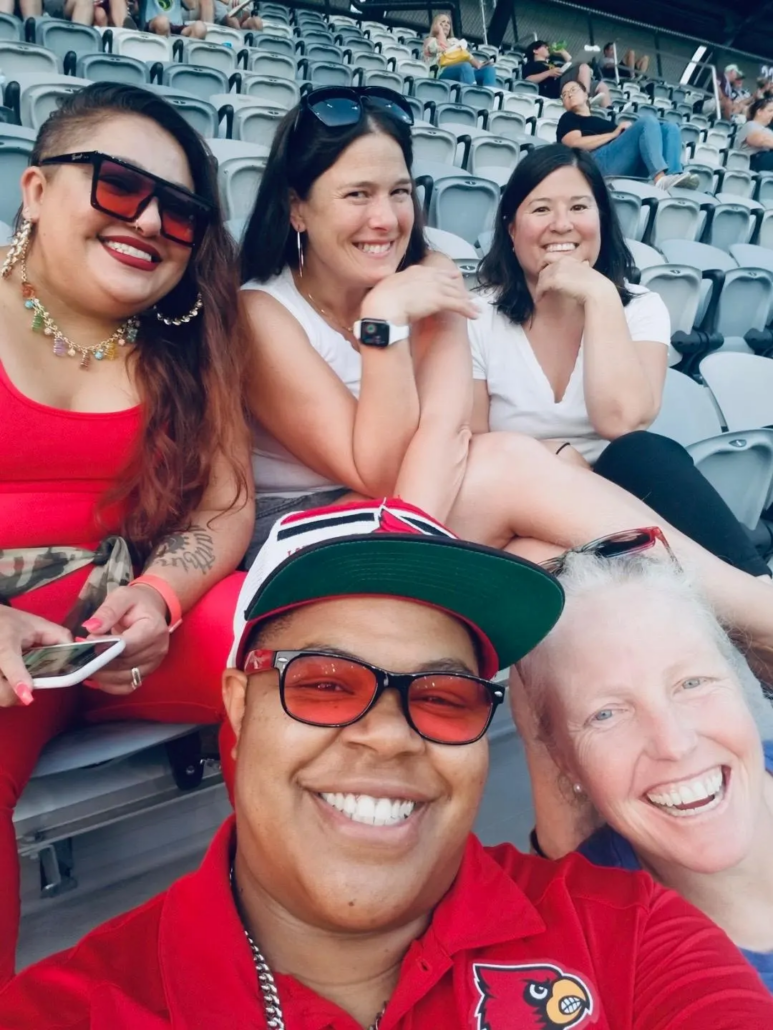
Paulina Helm-Hernández and Ashe Helm-Hernandez smile for a selfie with three friends in the stadium seats at a Racing Louisville game.

Paulina Helm-Hernández, left, and Ashe Helm-Hernandez, front, with friends at a Racing Louisville game. Supplied by Paulina Helm-Hernández and Ashe Helm-Hernandez

Paulina observed a crowd of fans that day considerably less diverse than the city’s larger population. Black residents make up about 23% of the Louisville-Jefferson County metro’s population, and Latino residents about 9%. But Louisville’s diversity has never been evenly distributed across the city. Decades of racial zoning, redlining and other discriminatory housing practices helped produce geographic divisions that remain visible today, with Louisville Metro’s own housing research finding that the city remains segregated by race and ethnicity.

Those divisions also intersect with Louisville’s LGBTQIA+ history. Researchers at the University of Louisville’s Anne Braden Institute have documented race as an important part of understanding queer life and history across Kentucky. Today, Louisville contains some of the state’s strongest LGBTQIA+ community and health infrastructure, but recent survey data from Queer Kentucky suggests that access and belonging remain uneven, even within the state’s largest urban center. Queer Kentucky’s 2025 Community Health Survey found that 65.5% of its 559 LGBTQIA+ respondents reported a strong sense of community belonging, while 11.4% reported low belonging. Respondents living with HIV reported an average belonging score of 3.98, compared with a statewide average of 4.86, the lowest average belonging score of any group measured.

Belonging is a primary indicator of good health. People need access to doctors, medicine, testing and treatment to be well, but research increasingly recognizes that people also need relationships, community and places where they can meaningfully connect with other people. The CDC names social connection an important determinant of physical and mental health, while research cited by the U.S. Surgeon General found that people with a strong sense of community belonging were 2.6 times more likely to report being in good or excellent health than people with a low sense of belonging.

This is especially important for LGBTQIA+ communities, whose rights to love, marry, build families and openly exist continue to be challenged and questioned by elected leaders. For communities whose belonging in public life has repeatedly been contested, having spaces where people can safely gather, build relationships and see themselves reflected is not just about having somewhere to go. Those spaces can become part of what people need to feel connected, supported and well.

That makes the places where LGBTQIA+ people gather part of the conversation about community health, too. A stadium cannot replace a doctor’s office, a testing site or a public health program. But it can do something those institutions cannot always do on their own: regularly bring queer and trans people together around a shared experience and create opportunities for LGBTQIA+ people to feel like they are part of fandom that affirms who they are and who they wish to be in the world.

Still, what Paulina encountered inside the stadium suggested to her that Racing already had much of what it needed to reach a broader community.

“I remember thinking, you know, as a fan of women’s sports, I thought it was a great atmosphere. But I do think, you know, it lacked the cultural diversity that I’m used to in terms of being able to enjoy like those kinds of sporting events, knowing that they’re also a reflection of like not just fanhood, but like what does it actually mean to have infrastructure that like is actually focused on women’s sports and women athletes so that to me you know it’s a mixed bag,” she said. “But I do remember enjoying the game, we had a great time, everybody that worked at the stadium was very welcoming and very warm, and I feel like the space in and of itself… It’s a beautiful arena, and so to me, they have everything in space in terms of the infrastructure, you know, to be able to welcome more people.”

Ashe’s first experience with Racing started differently. A lifelong Louisville sports fan, they showed up dressed for the Louisville team they already knew, but whose colors didn’t match this home team.

“I can go ahead and admit that I totally had on red,” they said. “I had on a University of Louisville ball cap, and my friends busted out laughing at my appearance and quickly took me to the Racing store to get some gear. And so, you know, I was shy. I was like, I didn’t look this team up. My friends invited me out, and I was like, ‘Let’s go! It’s Louisville,’ and I am a diehard University of Louisville fan, and I got that mixed up a bit. So yeah, but lavender is a beautiful color, and I appreciate it very much having some new gear.”
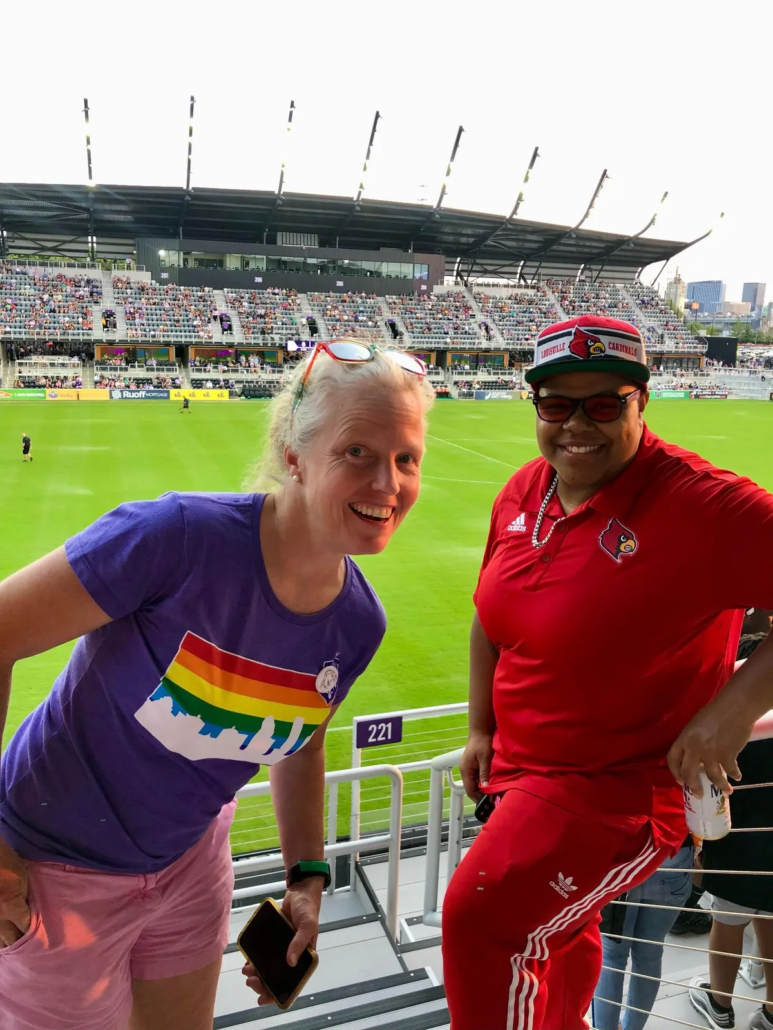
Ashe Helm-Hernandez, wearing a red University of Louisville polo and cap, stands with a friend in a rainbow shirt above the field at a Racing Louisville game.

Ashe Helm-Hernandez, right, in University of Louisville red with a friend at a Racing Louisville game in 2021. Supplied by Paulina Helm-Hernández and Ashe Helm-Hernandez

Soccer as belonging, belonging as care

Their experiences point toward something larger than fandom. In 1995, Kentucky did not have a top-tier professional women’s soccer team or a stadium capable of regularly gathering thousands of women’s soccer fans. Today it does. That growth creates an opportunity that did not exist three decades ago. Professional women’s soccer now has the physical infrastructure, cultural visibility and audience to bring thousands of people together at a time. And some of the communities gathering around women’s sports are the same communities Kentucky’s existing healthcare infrastructure is still struggling to reach.

Queer Kentucky’s 2025 Community Health Survey found that 48.2% of its 559 LGBTQIA+ respondents had never been tested for HIV. Among cisgender women, that figure was 53.6%. Among transgender women, it was 57.7%, and among nonbinary respondents, 50.6%. At the same time, more than one in three respondents statewide reported having no regular healthcare provider, while the U.S. Department of Health and Human Services reports that approximately 1.2 million people in the United States are living with HIV, and one in eight do not know they have the disease.

The relationship between community and HIV prevention is not theoretical. The U.S. Surgeon General’s advisory on social connection notes that stigma surrounding HIV can create barriers to both healthcare and social inclusion, while National Institutes of Health research has found a link between stronger community connections and people taking steps to prevent HIV.

That raises a different question about the economic and social value of professional women’s sports in Kentucky. What if the value of a stadium is not limited to what happens on the field? What if the same infrastructure, built to gather thousands of fans around women athletes, can also become infrastructure for connecting communities to information, testing, prevention and care?

There is already another professional women’s sports league that offers a glimpse of what can happen when that kind of infrastructure is given time to grow.

For Paulina and Ashe, the Women’s National Basketball Association (WNBA) has never been just basketball. Both came of age alongside a league that has now existed for 30 years and watched women’s professional basketball become a place where Black women, queer people and generations of women’s sports fans could see themselves reflected.

Some of Paulina’s earliest experiences in LGBTQ+ movement spaces were already intertwined with women’s basketball. She remembers older lesbians gathering around games and using basketball itself as a language for thinking about organizing and movement building.

“I grew up in an era where people were very like: This is one of the lenses to understand, you know, movement building,” she said.

Three decades later, she sees what women’s professional basketball has become, as more than commercial growth. She called the rise of the WNBA a “social and political win,” describing women’s sports as one of the places where fans can now see “queer excellence” and “feminist excellence” at the highest level.

Ashe remembers that history differently. Growing up playing basketball, some of the women they watched in the earliest years of the WNBA became their heroes.

“I was able to look up to Cheryl Swoopes, and I was able to look up to Cynthia Cooper as people and role models,” they said. “That I could be, that Black women could do that, that they could be on television, that they could play sports, that they could play basketball, that they could sweat, they could be fierce.”

Today, Ashe sees younger players learning whose footsteps they are following, while the players they grew up watching are finally being recognized as living legends.

Their experiences show what can happen when a professional women’s sports league has enough time to become part of a generation’s lives. The NWSL is still building that history. The WNBA was founded in 1996 and began play the following year. In 2026, the league celebrated its 30th season. The NWSL, by comparison, was founded in 2012 and played its first season in 2013. In just over a decade, professional women’s soccer has grown considerably, but that’s still only half the time the WNBA has had to become part of the lives, traditions and communities of its fans.

That difference in time matters when thinking about what Paulina and Ashe described. The impact of the WNBA on their lives cannot be measured only through attendance, television audiences or revenue. They are describing what happens when a professional women’s sports league exists long enough for people to grow up alongside it. Players become childhood heroes. Games become traditions. Fans build relationships with one another.

Queer people find spaces where they see themselves reflected. Over time, a sports league can become part of the social infrastructure of a community.

For Paulina, women’s basketball was woven into LGBTQ+ community life long before the WNBA became a mainstream cultural phenomenon. She remembers gathering at people’s homes to watch games, where basketball brought people together for more than just the competition.

“You just had to get with the program and you had to watch games and you had to go to people’s houses and know that the meetings happen after the game and know you were not allowed to talk through it,” she recalled.

For Ashe, the league’s history is personal. During a recent presentation at work, they shared a photograph of WNBA players from three decades ago with their colleagues: “I told my team that these were my heroes,” Ashe said. Those same athletes who inspired Ashe as a young basketball player are now being celebrated by another generation.

“For me, it’s a very serious moment where players are getting their due, and where younger players are learning whose footsteps they walk in, and they too are being able to recognize living legends,” Ashe said.

Paulina remembers the relationships and organizing that happened around games; Ashe remembers the athletes who showed them what was possible for Black women in professional sports. Together, their experiences illustrate how a league can become part of a community’s history, creating relationships, traditions and a sense of belonging that develop over generations.

Racing Louisville, which joined the league in 2021, is part of a story that is still unfolding, as fans begin building those traditions and relationships that future generations may one day inherit. But just five years after the club began playing in Kentucky, questions have emerged about its long-term future in Louisville.

That possibility raises another question about how communities measure the value of women’s sports institutions. Five years may be enough time to count tickets, calculate attendance and measure revenue. It may not be enough time to measure what happens when a generation grows up with a professional women’s team in its city, when queer fans build traditions around going to games together, when Black and Latine children begin seeing the stadium as somewhere they belong – when community organizations begin treating that stadium as another place where people can be reached.

Lynn Family Stadium represents physical infrastructure. It has more than 15,000 seats and the ability to bring thousands of people together at once. But what Paulina and Ashe describe through their experiences with women’s sports is another kind of infrastructure that takes much longer to build. Relationships, traditions, information networks, chosen family, representation, belonging and trust develop over years as LGBTQIA+ people repeatedly gather in the same places and around the same women’s sports teams.

This work was supported by the 2026 CNP Media Fund. #CNPMediaFund
The blue Roebling Suspension Bridge stretches across the Ohio River from the Covington, Kentucky, riverfront toward the Cincinnati skyline on a sunny day.

Northern Kentucky’s LGBTQ+ Paradox: Legal Protections at Home Contend with Restrictions at the Statehouse(s)

Queer Kentucky’s survey data highlights a region where residents may be physically safer, yet still carry the state’s heaviest mental burden.

LGBTQ+ residents of Northern Kentucky are, on the surface, doing well. They aren’t leaving the state at higher rates, aren’t reporting more violence than their neighbors, and are finding health care providers at rates higher than the state average. By nearly every physical measure, Northern Kentucky seems like it’s doing just fine.

But when you zoom in, Northern Kentucky’s LGBTQ+ residents are experiencing an increased mental health burden nearly 9 percentage points higher than the statewide average. According to the 2025 Queer Kentucky Survey, 43.2% of LGBTQ+ residents in Northern Kentucky report experiencing very negative mental health, reporting higher psychological burdens than their Louisville or Lexington counterparts.

Dig deeper into the data, and the impact of public policy comes into focus: 75% of Northern Kentucky residents say their mental health has been negatively affected by anti-LGBTQ+ policies – 5 percentage points higher than the statewide average – and 58.3% say they’ve lost trust in their elected officials altogether.

These numbers make it worth asking why residents are staying at all.

It starts with local government. Across Northern Kentucky, city halls have built some of the deepest LGBTQ+ infrastructure in the state, one ordinance at a time.

Kentucky’s “fairness ordinances” – local laws banning discrimination based on sexual orientation and gender identity – are where this shows up most. About 1 in 4 cities in Northern Kentucky’s three core counties – Boone, Kenton and Campbell – now has a fairness ordinance on the books, one of the densest concentrations anywhere in the state. Covington passed the region’s first in 2003, followed by Dayton, Bellevue and Highland Heights in 2019, Fort Thomas, Cold Spring and Newport in 2020, Crescent Springs and Fort Mitchell in 2021, and Elsmere in 2022.

Beyond anti-discrimination laws, Covington was also the first city in Kentucky to ban conversion therapy for minors (2020) before Governor Andy Beshear signed an executive order banning it statewide in 2024. Covington also scored a 94 out of 100 on the Human Rights Campaign’s 2025 Municipal Equality Index – one of the highest scores in the state. Local advocacy groups Northern Kentucky Pride and Northern Kentucky Fairness were both active in getting many of those ordinances passed.

In other words, queer residents and allies in Northern Kentucky have worked hard to build real community and real protection for their families and neighbors.

So if Northern Kentucky’s LGBTQ+ residents feel more physically safe and have built a strong community, what’s driving the region’s mental health numbers higher than anywhere else in the state? No single survey question can answer that, but a look at the wider anti-LGBTQ+ policy landscape – with 75% of Northern Kentucky residents’ mental health impacted by it – suggests a few contributing threads.

In 2023, the legislature passed Senate Bill 150, a law banning gender-transition care for minors, mandating school bathroom policy by sex assigned at birth, and barring teachers from discussing sexual orientation or gender identity in the classroom.

The ACLU called it “one of the worst anti-trans laws in the nation,” and, when the bill passed, Northern Kentucky school districts complied quickly.

This law wasn’t just handed down from Frankfort; it was Northern Kentucky-grown. State Sen. John Schickel, representing Boone County, was one of 13 senators who sponsored the bill, alongside two other Northern Kentucky senators, Shelley Funke Frommeyer and Gex Williams. (The bill’s lead sponsor, State Sen. Max Wise, represents Campbellsville, in south-central Kentucky.)

Unlike Louisville or Lexington, where anti-LGBTQ+ legislation largely arrives from rural and exurban districts, the architecture of SB 150 was built partly by Northern Kentucky’s own representatives. In cases like SB 150, local queer residents aren’t watching some distant lawmaker author these bills. Instead, they’re coming from senators in their own backyard.

So while physical violence against LGBTQ+ folks sits at 9.1% in Northern Kentucky – 6.1 percentage points below the state average – there is still a looming anxiety that their safety could be at risk as they watch these policies come in.

Amy Clark, LPCC and Director of Student Counseling Services at Northern Kentucky University, shares, “At the local university counseling center, more than 33% of the overall clientele are LGBTQ+. I have witnessed an increase in anxiety, uncertainty and guardedness. A lot of times it presents as anger – and rightly so – but if you dig below the surface, there’s a genuine feeling of intense fear and sadness.”

And then, just across the Ohio River sits a whole other state with a whole other set of policies.

Before 2023, Northern Kentucky families who wanted gender-affirming care for their kids could drive just minutes into Cincinnati to Children’s Hospital, which had been among the highest-volume providers of gender-affirming care in the country. Then, in 2024, Ohio banned gender-affirming care for minors, just as Kentucky had.

Northern Kentucky families didn’t lose access to this type of care all at once; they had to lose their nearest options one at a time. Louisville’s cross-border option, Indiana, restricted care even earlier, while Lexington never had a comparable one at all.

Northern Kentucky may be the only Kentucky metro where residents watched two specific, physically close options get taken away from them, one after the other.

The region also sits inside Cincinnati’s media market, meaning residents are more likely to keep a pulse on two state legislatures’ worth of anti-LGBTQ+ fights instead of just one. That’s two states’ worth of harmful policy instead of one, likely creating twice the psychological weight to carry.

Ben London, a gay resident living in Northern Kentucky, told Queer Kentucky, “We have been hit with so much news about so many bills in so many states on so many issues that I’m overwhelmed. I am not transgender, but I have transgender friends. [My friend] – probably turned 18 a few years ago and transitioned before that – is a lovely, wonderful person. It makes me angry that he couldn’t get that gender-affirming care today; that’s ridiculous to me.”

What’s happening in Northern Kentucky is a paradox built by two governments at once. It’s a patchwork of city halls that took steps and decided one ordinance at a time to protect their queer neighbors. And yet, it is a region that sits underneath two state capitols that keep deciding otherwise.

That volume is about to increase. With the midterms approaching, both statehouses and the media covering them are likely to get even louder. Northern Kentucky’s LGBTQ+ residents have a say in what happens next, but they shouldn’t have to carry all of it alone.

“[LGBTQ+] individuals are tired of fighting this battle,” Clark said. “Despite the overwhelming discouragement, [they] are still trying to take care of themselves.”

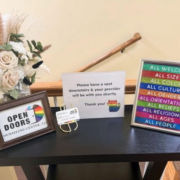
Mental health care for trans Kentuckians: Open Doors Counseling Center's entry table with a rainbow "All Welcome" board.

Trans Kentuckians Are Staying Home. The Data Says Community Is What Helps.

Mental health trends in transgender and nonbinary Kentuckians have displayed shifts during recent policy debates.

A 2025 Queer Kentucky survey showed that 34.5% of respondents reported that these recent policy debates have very negatively impacted their mental health.

Some gender expansive Kentuckians told Queer Kentucky that policy debates have led to them feeling like they are at the focal point of society right now, making the simple act of going into public feel daunting.
Hayes Farris, a nonbinary Kentuckian, said when they step out in public, it feels like transgender people are what sit at the forefront of people’s minds.

Farris said part of it is not knowing what people are thinking.

“Is that person looking at me because they are seething inside and hate that I exist? Are they curious? That’s just a heavy mental load to carry around,” they said.

Delgonna Cole, a transgender woman, said she is constantly thinking about what might make her easy to “clock” as transgender in public.

“I’ve had people come up to me at Kroger saying, ‘Hey, I have a question. Are you trans?’” she said. In reference to policy debates about the rights of transgender people, Cole said, “If it wasn’t pushed so intensely, I think I wouldn’t be so constantly afraid of going outside.”

Even healthcare providers for transgender and nonbinary Kentuckians reported seeing changes or responses from their patients reflecting these negative effects.

Dr. Keisa Fallin-Bennett’s practice has included transgender people for around 10 years, and for most of her career, she has been providing her services in Kentucky.

Fallin-Bennett said the impact varies from person to person, but she has heard from several patients that the impacts of recent policy debates have been devastating.

She said there has been a lot of policy debate prior to 2023, but that is where it all really took off.

“People start in a difficult state because of the world and having to accept that the institutions are kind of actively working against them,” Fallin-Bennett said.

Policy changes have led to decreased federal funding for her place of employment, and these changes have altered what is allowed to be provided to transgender patients, according to Fallin-Bennett.

According to the survey, when transgender women are denied healthcare in any aspect, they are more likely to avoid all healthcare. Some of this avoidance may be due to shaken trust in the healthcare system.

Fallin-Bennett discussed the issues that a 2023 Kentucky law stated that neither hormones nor surgery could be provided to transgender patients under 18, but an executive order to cut federal funding for institutions that treat individuals under 19 was signed in 2025 under President Donald Trump.

Under the threat of losing federal funding, Fallin-Bennett’s practice could no longer treat people under 19 years old, and people under that age limit who were already on hormones had to be weaned off.

“Frustrations are really building, and it really erodes the trust that people have in us,” Fallin-Bennett said.

For Cole, after struggling to get endocrinologists to properly prescribe her gender-affirming hormones, she took matters into her own hands.

“They wanted to stop my HRT dose because it got too high… but the levels were lower than a cis teenager’s,” she said. “So I just stopped seeing them, and I started doing DIY.”

Cole said she buys everything online, did extensive research, and measures her blood levels all on her own.

Transgender women report provider refusal at rates of 38.5%, far above the 12.6% statewide average for queer people, according to the QKY survey.

Another factor that gender expansive Kentuckians must think about when it comes to healthcare is finding understanding in their providers.

“I don’t think it’s ever been a question of safety, but more comfortability. I haven’t had any issues where I have felt unsafe, but even then, my therapist doesn’t know what questions to ask,” Jordan Gaither, a nonbinary Kentuckian, said.

Transgender and nonbinary Kentuckians are finding it difficult to cope with the world as it is right now, whether they are coping with self-medication, isolation, therapy or something else.

Gaither said they have had to figure out what they need on their own and come to their therapist with it, rather than being provided the necessary tools to cope.

This points to a potential lack of LGBTQ+ education for mental healthcare providers in Kentucky, but organizations like Open Doors Counseling Center are centered around providing care to queer people and have a queer staff.

Tanya Stephens, who uses no pronouns, only a name, says Open Doors is a great place for finding care as a queer person in Kentucky.

“They do a lot of good things to try to help. I did find a safe feeling place there,” Stephens, a local nurse practitioner, said.

Open Doors Counseling Center is part of a nonprofit organization called Caritas Care Solutions. The center provides identity counseling, trauma and grief counseling, financial therapy and more, and focuses on creating a safe space for LGBTQ+ people.

Finding mental health resources can be difficult in Kentucky. Eve “Sylvie” Derrington, who is nonbinary, said monetary restrictions can be part of the struggle.

“If there were more programs where you pay what you can based on your income, especially oriented to specific communities, that kind of thing would be helpful,” they said.

Derrington said coping is complicated, but it can help: “Trying to find community is a big coping mechanism. We’re not very good at it, but when we do have it, it’s beneficial.”

The Queer Kentucky survey showed that those with a lack of community reported significantly more severe outcomes in every policy impact measure.

Fallin-Bennett echoes that finding. She said that while it might seem easier to isolate right now, community is a crucial coping skill for queer people.

“People have been hit by this issue, and it makes everybody want to stay home. I think it’s the exact time that people need to be gathering with other people as much as their mental health allows,” she said. “We need to be outside of our houses for our mental health and have interaction with other humans… hopefully humans that are in the same boat.”

For Farris, policy debates have had an impact on them and their friends, but the conflict has helped them pull each other closer.

“I think it’s almost made us closer, and we know that community is everything right now,” they said. “I wish more people knew that it’s not a burden to lean on people you love.”

If you or someone you know is in crisis, the 988 Suicide and Crisis Lifeline is available 24/7 by call or text at 988, and restored its specialized “Press 3” service for LGBTQ+ youth on September 30, 2026, after a 14-month shutdown. Trans Lifeline’s peer support hotline is at (877) 565-8860, staffed Monday through Friday, 1 p.m. to 9 p.m. Eastern. The Trevor Project’s counselors are available 24/7 for LGBTQ+ young people at 1-866-488-7386, or by texting START to 678-678.

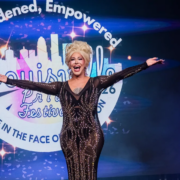
A drag performer in a sequined black gown raises their arms on stage in front of the 2026 Louisville Pride Festival sign reading "Emboldened, Empowered."

Louisville Pride Put Mental Health Front and Center. The Need Doesn’t End When the Tents Come Down.

Queens took the stage. Artists sold their colorful wares. Vendors of all kinds passed out pamphlets. Louisville Pride returned this year, with queers from all walks of life bustling through a blocked-off section of Bardstown Road on Saturday, September 12.

Louisville Pride Foundation, which also runs the Louisville Pride Center in Old Louisville, organized the event.

National acts performed near tables of local organizations ranging from healthcare organizations, such as Planned Parenthood, to political organizations.
Among those who participated were organizations helping LGBTQ+ people with their mental health or pointing them in the direction of mental health services.

According to the 2025 Queer Kentucky Community Health Survey, roughly 7 in 10 LGBTQ+ Kentuckians have had negative experiences with their mental health due to the current political environment, such as debates around LGBTQ+ rights.

Of queer Louisvillians who responded to the survey, about 32% attributed thoughts of suicide to policy debates around LGBTQ+ people. In fact, the number is 3.9% above the state average. Because of these debates, 8.1% of respondents said they left Kentucky because of it. The survey also found that trans women reported higher rates of suicidal ideation.

Louisville has more queer services than most of Kentucky, but Queer Kentucky’s data suggests they may not be enough because there are also high levels of health risks in the community.

Mandala House Provides Mental Healthcare to Queer Louisville

One featured booth at Louisville Pride was Mandala House, which provides mental healthcare to the community of Louisville. Mandala House has several therapy groups that address the psychological health of minority groups and their various intersectional needs.

“It’s a special place in our hearts, the work we get to do with queer people,” said Mandala House therapist Rachel Archer.

Archer said Mandala House currently runs a variety of therapy groups, such as an adult gender-journey group for individuals 18+ who are questioning their gender or who identify as trans or gender non-conforming. The space provides communal support for one another.

Archer noted that she couldn’t say that the lack of queer-specific spaces as a barrier to queer healthcare’s accessibility was unique to Louisville alone.

Mandala House also provides support letters for trans individuals seeking gender-affirming care, which is often required by providers and insurance companies. For many queer Kentuckians, finding a provider for their healthcare can be a challenge. According to the 2025 Queer Kentucky Community Health Survey, while Louisville has better healthcare access than most of the state for LGBTQ+ Kentuckians, provider refusal still happens.

Kentucky Psychological Foundation: Evidence-Based Connections

Among the vendors, the Kentucky Psychological Foundation was doing outreach. The organization focuses on bringing free mental health resources across Kentucky. It also supports researchers and graduate students with funds to conduct research with marginalized communities.

“We know there is a lot of specifically psychological information that is based in science and research…out there, but it’s not always easily accessible in the community,” board member Dr. Courtney Keim told Queer Kentucky.

“What we really focus on is educating the public about the science in ways that can better the lives of Kentuckians,” Keim said.

The Kentucky Psychological Foundation doesn’t provide mental healthcare, but its sister organization, the Kentucky Psychological Association, is the state professional association for psychologists, whose members provide care.

The Kentucky Psychological Foundation’s site provides a link to a database of members of the Kentucky Psychological Association that are using evidence-based research and follow the American Psychological Association’s guidelines and ethics. This can help address the needs of marginalized communities to find competent care.

“Our foundation is going to provide things based in evidence and research. We are very much against therapies that are not evidence-based. So for example, conversion therapy is not evidence-based. We don’t support that. We only provide evidence-based and culturally competent therapists that understand the marginalized communities they are serving,” said Keim.

So-called “conversion therapy” is a discredited practice and is referred to by the American Psychological Association as attempting “to change a person’s sexual orientation, gender identity, or related behaviors” with practices that “stem from the scientifically discredited belief that being LGBTQ+ is a mental illness that should be cured.” The organization says it causes a significant risk of self-harm, depression, and substance use.

The topic of ‘conversion therapy’ has been a battleground issue statewide between Democratic Governor Andy Beshear and the Republican dominated state legislature when Beshear tried to restrict the harmful practice, but Republicans overturned his attempt.

“A lot of times it is because people who are getting that ‘therapy’ don’t feel that person providing that therapy truly understands them,” said Keim. “One of the things that has been important in psychology is those cultural competencies and making sure those folks who are marginalized find someone who truly sees them.”

At the end of the day, the booths came down. The tents emptied. As the night wound down, a queen took the main stage to perform Dolly Parton’s “I Will Always Love You,” and Louisville Pride ended the way it began, with queens and with community.

If you or someone you know is in crisis, The Trevor Project’s counselors are available 24/7 at 1-866-488-7386, by texting START to 678-678, or by chat at thetrevorproject.org/get-help.

If you or someone you know is struggling, call or text the 988 Suicide & Crisis Lifeline at 988. LGBTQ+ young people can press 3 to reach counselors trained in LGBTQ+ care, an option that returned on Sept. 30, 2026 after it was cut in July 2025. The Trevor Project also offers 24/7 support at 1-866-488-7386 or by texting START to 678-678.

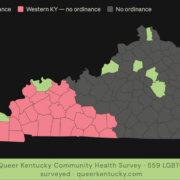
A county map of Kentucky showing which communities have local LGBTQ+ fairness ordinances, with western Kentucky counties highlighted in pink to show the region's lack of protections.

Western Kentucky’s LGBTQ+ Crisis: The Most Harm, the Least Protection Queer Kentucky's survey data reveals a region where nearly every measure of harm is at its worst, and state law still leaves trans Kentuckians out entirely.

LGBTQ+ people living in western Kentucky are experiencing a substantially more dangerous environment than anywhere else in the state, reporting being physically attacked at nearly twice the statewide rate. For trans folks, it goes even further: Kentucky’s hate crime statute has no name for what happens to them when they are attacked. A trans Kentuckian can be assaulted for being trans, and the state may prosecute the harm, but not the reason it was done.

Across the Queer Kentucky survey, western Kentucky ranks first or near first on nearly every measure of harm: LGBTQ+ residents with no health care provider, never tested for HIV, refused care by a provider, physical assault, suicidal ideation, drug use, smoking, feeling unsafe at home and deciding to move away. This is a region where nearly every measure of harm, access and community is at risk. And state policy and protections have failed them time and time again.
29.2% of queer residents in western Kentucky reported at least one instance of physical assault, which they attributed to the overarching anti-LGBTQ+ climate in the state. Overall, the statewide rate of physical assault stands at 15.2%.

54.5% of queer individuals report feeling physically unsafe at home, and 52.2% report feeling unsafe in public. Both are the highest of any region.

But it doesn’t stop at physical assault. In most of western Kentucky, a person who discriminates against and refuses an LGBTQ+ person a job, an apartment or service at a counter faces no legal consequences in doing so.

Across all of Kentucky, 24 communities have local Fairness Ordinances — including western Kentucky’s Paducah in 2018 and Henderson in 2019 — but that’s two of the 24, and they sit 130 miles apart. In between and beyond them, Owensboro, Bowling Green, Hopkinsville, Madisonville, Murray and Mayfield have no local fairness ordinances. On a map of who Kentucky has agreed to protect, most of western Kentucky isn’t on it.

What about larger state protections in Kentucky? It turns out that the state of Kentucky does have a hate crime law that protects sexual orientation. But it’s still reliant on individual judgment, and it still doesn’t protect trans people.

KRS 532.031, passed in 1998, applies when someone commits offenses because of a person’s race, color, religion, sexual orientation or national origin. In 2017, the legislature amended the statute to add a category, extending it to victims targeted for their actual or perceived employment as a peace officer, firefighter or emergency medical services worker.

Gender identity is not on the list.

Nine years ago, when the state legislature reopened the statute to add police and first responders, it still left trans Kentuckians out. For example, if a gay man is assaulted in Paducah, it can legally qualify as a hate crime. But if a trans woman is assaulted on the same block, both the state and law enforcement officers can choose to do nothing. The statute, by not including gender identity, allows law enforcement to turn a blind eye and delegitimize incidents against trans people.

Even within the bounds of discrimination against sexual orientation, this hate crime law does “protect,” the statute has no teeth and the law still does far less than what it implies. It might look and sound substantial, but functions as a performative exercise in the court system. As a result, there are many opportunities to create distance between the assault and any consequence for it. For instance, a judge decides at sentencing whether bias was a primary factor. A finding of bias permits denying probation instead of requiring it. The parole board may delay or deny parole.

It’s subject to discretion and personal biases that could creep in all the way down.

The laws already on the books are only part of it. Kentucky’s 2026 General Assembly may not have passed any anti-LGBTQ+ bills, but the climate in western Kentucky still hasn’t improved.

A bill doesn’t have to pass to embolden violence in its communities. Another factor behind why the climate in Western Kentucky still hasn’t improved. A bill only has to be filed, assigned, debated and covered on the local news, which are all separate moments of exposing a Kentuckian to hear whether or not their queer neighbor has the same rights as they do.

For example, Senate Bill 72 would have let health care providers refuse any treatment that violated their conscience. House Bill 468, pitched as a routine civil rights update, would have stripped the enforcement power from the Kentucky Commission on Human Rights and the 22 local commissions that actually enforce fairness ordinances. Both cleared their chamber of origin before stalling.

If House Bill 468 had passed, it would have taken away the only fairness ordinance protections two cities in Western Kentucky have.

And people are responding the only way the law leaves open to them: they blend in, censor their identity and opinions, or leave the state altogether.

According to the same survey, 18.5% of LGBTQ+ individuals living in Western Kentucky have decided to move out of state due to anti-LGBTQ+ policies; statewide, only 8.1% decide to leave. The compounding burden of assault, health care gaps, housing stress, and drug use appears to translate into a concrete intention to leave. One respondent wrote:

“Currently planning to move out of [the] states to a blue state. I have a lot of trans friends that I am scared for. I want them to go somewhere more blue, more safe, more open minded.”

In the face of so much hardship, western Kentucky remains home to LGBTQ+ advocates who keep showing up anyway. In May 2019, 55 residents in Bowling Green spoke in favor of a Fairness Ordinance, while 31 spoke against it. The commission voted it down 3-2. Advocates put it back on the agenda and have continued pushing for it. When a Fairness Ordinance was voted on in January 2018 in Paducah, residents flooded the city commission meeting, forcing the fire marshal to move the overflow into the adjacent hall to listen through open doors. That ordinance passed 4-1.

The people of western Kentucky continue to fight for the safety of their LGBTQ+ neighbors. But with so few fairness ordinances and statewide protections that stop short of covering them, many LGBTQ+ western Kentuckians remain at risk.

If you or someone you know is struggling, call or text the 988 Suicide & Crisis Lifeline at 988. LGBTQ+ young people can press 3 to reach counselors trained in LGBTQ+ care, an option that returned on Sept. 30, 2026 after it was cut in July 2025. The Trevor Project also offers 24/7 support at 1-866-488-7386 or by texting START to 678-678.

The exterior entrance of AVOL Kentucky, Suite 100, photographed at dusk. A black A-frame chalkboard sign in front of the brick and gray-sided building reads "Free AVOL HIV STI Testing" in colorful lettering. String lights hang above the entrance, and bare winter shrubs line the base of the building.

No Doctor, No Test, Refused at the Door: What the Data Shows About LGBTQ+ Health Care in Western Kentucky Survey data points to a crisis in access, education, and trust — and the organizations working to close the gap.

From Mayfield to Paducah to Murray, Western Kentucky is full of life, history, and unique challenges, but when it comes to accessing reliable, informed, and specific health care, LGBTQ+ people in the region face obstacles that other Kentuckians might never feel.

Recently published data from the 2025 Queer Kentucky Community Health Survey reveals that LGBTQ+ people in Western Kentucky are significantly less likely to be receiving routine health care. The survey, which collected data from 559 LGBTQ+ Kentuckians, indicated that 58.2% of respondents in Western Kentucky have no regular healthcare provider.

That number grows even more concerning when you dig into disparities in reference to sexual health. The rate statewide for those who have never tested for HIV is 48.2%. In Western Kentucky, it’s 67.2%.

According to community organizers, these numbers illustrate how education can affect public health. It’s also tied to legislation. In 2023, Kentucky’s Republican State Senate majority passed Senate Bill 150, which implemented anti-trans policies including forcing trans students to use bathrooms and locker rooms that conflict with their gender identity, but it also made teaching about sex education or puberty virtually impossible for certain age groups.

“A lot of the schools still really push an abstinence-only sexual health education… and that has a real limiting and long-lasting impact on people’s view of sex in general,” said Christine Lindner, President of West KY NOW, a local chapter of the National Organization for Women, a feminist membership organization that advances economic justice, reproductive justice, and civil rights.

Without education or access to care, communities are left without the necessary resources to thrive, according to health care providers in the region.

“If people don’t know about things they don’t know to be tested, they don’t know what to look for,” said AJ Garnett, Outreach Director at LivWell, a nonprofit organization providing healthcare, support services, prevention education, and HIV testing to communities in the region. “Being able to educate people when they’re younger, whether it be middle school or high school, would make a world of difference.”

Another contributing factor behind these numbers is the limited resources available in the Western section of the state. The more densely populated areas of Louisville, Lexington, and Bowling Green are all in Central or South Central Kentucky. These areas experience higher concentrations of hospitals, clinics, and places of care. About one in five people in the US live in rural areas, but only 9% of physicians practice in rural communities.

While there are resources in Western Kentucky, including LivWell, they are limited and some LGBTQ+ people in these communities are not comfortable seeking care. Data from the 2025 Queer Kentucky Community Health Survey also indicates deeper issues than just seeing a doctor regularly; the survey also pointed to high levels of discrimination in the region. Almost 13% of respondents statewide reported a provider refusing care due to their LGBTQ+ identity, but in Western Kentucky this number jumps to 30%, the highest in the state.

“No amount of shaking hands and assuring people is going to alleviate years of distrust that they’ve built up for good reason,” said Garnett. “…Sometimes in those very rural areas, people just don’t even know we exist.”

The isolation of LGBTQ+ in rural Kentucky presents real challenges to reaching these communities, but queer people are still finding ways to thrive and build stronger futures.

“I think people don’t realize how large the community is out here in Western Kentucky, but we are really under-resourced and underfunded,” said Lindner. “I think there’s a desire for healthier queer existence, but there’s just a lot of pressure out here.”

West KY NOW regularly creates inclusive events and programming with the intention of building stronger communities in the region, including a feminist bowling night.

This data presents an opportunity for deeper investments by community groups, care providers, and educators. According to Garnett, closing these gaps looks like building deeper inroads with communities to establish trust between provider and patient.

Other Kentucky-based organizations working to close that trust gap with rural LGBTQ+ communities include AVOL, an organization committed to ending HIV through testing, medical intervention, and community support, and Matthew25, which works with those living with, at risk of, or affected by HIV and other sexually transmitted infections. With four clinics across Southern Indiana and Western Kentucky, Matthew25 serves 25 counties in Kentucky and 12 in Indiana.

“I know a lot of people are scared because of the way they’ve been treated in the past… I’m not going to sit here and pretend like there aren’t doctors and nurses out there that give people hell every time they come in to talk about HIV or other STIs,” said Garnett. “But I can tell you with us, with organizations like AVOL, with Matthew25, everyone I speak to in these organizations is so eager and anxious to help, and excited to be part of people’s lives and make them better.”

The ‘Family Safety’ Pretense: Flock Cameras and Northern Kentucky Parks Northern Kentucky residents pushed back hard against AI-powered surveillance cameras. And in some cities, they won.

When Kenton County’s police chief asked his fiscal court this summer for money to install six automated license plate reader (ALPR) cameras at the entrances to the county’s parks, his primary reasoning was to make those parks safer.

“We see this as a way to keep potential predators from coming into our parks and preying on children,” Chief Spike Jones said at the July 14 meeting.

Commissioner Jon Draud of Edgewood seemed to agree that it was a problem.

“There’s a lot of weird people that hang out at parks,” he said in response to Jones’ report, which stated the cameras would only point into the parks – not the general right-of-way – and only record vehicle data entering and exiting.

The report cited more than 1,000 calls for “suspicious person/vehicle” in the county’s parks since 2021, by far the most common type of call in those areas. Figures showing how many of those calls resulted in arrest or charges were not immediately available.

Vague commentary aside (Draud did not elaborate on who he meant by “weird people”), the story sounds reasonable enough on its surface. It aligns with police departments across the country making the case that the emerging technology is a game-changer for both investigating and deterring crime. Flock Safety’s website is populated by dozens of accounts of these types of cameras’ role in facilitating or expediting case closures.

The game-changing element is the AI-powered data collection and analysis that act as what police officials call a “force multiplier,” allowing departments to do more with stretched resources and pooled intelligence.

“It has changed how we do police work,” Lexington Police Commander Matt Greathouse told Kentucky Law Enforcement magazine. “Not only in Lexington and Fayette County, but all these counties now have some sort of Flock camera. What’s great about that is we can share that information across those jurisdictional boundaries, which we have discussed in many cases.”

Even Kentucky police agencies that have decided to discontinue their use of the cameras stressed the technology’s value. When announcing its decision in July to cancel its contract with Flock, the Newport Police Department said, “The city’s decision should not be interpreted as opposition to emerging public safety technologies or as a reflection that [ALPRs] lack public safety value.”

A ‘permanent dragnet’ for the ‘safest’ cities?

Residents and business owners across Northern Kentucky have been asking leaders why the cameras are needed — and whether the potential threats to their privacy are worth the returns in fighting crime — when they already feel safe.

At an August 17 public hearing, Independence Police Chief Brian Ferayorni spoke to his department’s initial deployment of 10 cameras in 2024, after a pilot the year prior. He purchased five more in 2025 and another five again this past June. He said 17 of those cameras were active at the time of the hearing.

“We are utilizing these ALPR cameras to identify and arrest criminals that come to the city to victimize our citizens and deter others who plan on doing the same,” he told more than 100 people in attendance and more watching the meeting from home.

The city council has approved Ferayorni’s contracts with Flock each of the last three budget cycles, with little fanfare. According to city contracts obtained by Link NKY, each camera costs roughly $3,000 per year, plus initial installation fees ranging from $650 to $1,250 each, depending on location. The first 10 cameras and their installation cost $68,900 over a 24-month period. The second and third contracts waived the installation fees, totalling $30,000 a batch, each for 24-month terms. In total so far, the city has spent nearly $130,000 on the cameras for four years of service from 2024 into 2028, when the most recently signed contract would expire.

Ferayorni defended the cost with a list of more than 30 recent cases he said the cameras assisted in solving since their deployment. Most common among those were stolen vehicles (10); missing persons, drugs and assaults and threats made up the next third (three each), with a variety of other one- or two-off cases comprising the remaining dozen.

Independence resident Zach Ford looked at FBI crime statistics prior to the meeting. While praising the chief for keeping the city “probably the best…in the commonwealth,” he said he couldn’t square a request for more cameras with the safety he feels police officers and more traditional tools already provide.

“We are among 80 percent for the safest cities in Kentucky, and that’s without Flock cameras,” he said during the three-hour public hearing, where, like in other recent meetings across Northern Kentucky, dozens stood up to speak against the city’s use of the cameras, with no one speaking in their favor.

Home security tech site SafeWise aggregates FBI crime data to rank cities by per-capita crime rates. It ranked Independence as the commonwealth’s fifth overall safest city in 2026, aligning with the figures Ford shared and making Independence the top-ranked among its Northern Kentucky peers. Neighboring Taylor Mill is the only other NKY city in the site’s top 10 for the year. A similar federal crime data aggregate site, Crime by City, ranks Independence as Kentucky’s safest, followed by Fort Thomas and Erlanger also in the top five. Newport and Florence had two of the commonwealth’s highest crime rates per capita among reporting cities, alongside Bowling Green, Owensboro and the Louisville metro.

“We have cities that are close to us with higher crime rates that are saying our Fourth Amendment’s more important,” Ford said, referring to Newport officials citing a recent U.S. Supreme Court case (Chatrie vs. United States) which they said could have future implications on how AI-powered ALPR networks could constitute unconstitutional searches.

While the Chatrie case did not consider ALPR cameras specifically, it challenged police’s authority to mass-obtain mobile device location data through so-called “geofence” warrants, as part of a criminal investigation (in this case, of a bank robbery in Virginia). The justices reaffirmed court precedent by holding that the suspect’s geolocation data tied to his cell phone constituted private, Fourth Amendment-protected information. Flock Safety maintains their cameras’ constitutionality, citing dozens of recent lower-court rulings throughout the U.S. affirming their position that the still, discrete images captured by the cameras in public areas do not fall under Fourth Amendment protection.

Court opinions aside, public opinion largely holds these cameras violate their rights.

Around the same time Ford was addressing Independence leaders, about 10 miles north in Fort Mitchell, resident Ashley Chaiken was expressing her concerns to her city council.

“Law enforcement has solved crime without the violation of our Fourth Amendment right,” Chaiken said. “Extreme cases do not justify a permanent dragnet of surveillance on the entire population.”

Less than 24 hours after Chaiken and others’ comments in Fort Mitchell, Mayor Greg Pohlgeers announced in a Facebook post that he was ending their contract with Flock, “effective immediately.” Less than a week following the meeting in Independence, their mayor issued a similar statement, announcing the city would be removing its cameras, but that he “continue[s] to believe [their] original decision to utilize this technology was a sound one.”

Fort Thomas, also frequently listed among Kentucky’s safest cities, has scheduled a public hearing on September 2 to discuss their use of the cameras, with scrutiny and pushback already coalescing online.

‘How much crime has been stopped?’

Serious crime in Kentucky has been shrinking for several years, since even before the commonwealth’s first Flock cameras went into service in 2022, according to both federal crime data and Kentucky State Police’s annual reporting, although there’s some variation.

Overall crime has shrunk steadily since 2019, achieving roughly a 23-percent reduction in the seven-year period, with nearly 10-percent reductions in “serious crime” in both 2024 and 2025. Both state and federal data sets show a steeper drop in property crime than in violent crime, but they differ on how violence has progressed: While federal data show cases like homicide and assault returning to 2019 levels after a spike during the height of the COVID-19 pandemic, state police data show violent crime is up by 10 percent statewide compared to pre-pandemic, after topping out in 2023.

Year Overall (FBI) Overall (KSP) Violent (FBI) Violent (KSP) Property (FBI) Property (KSP)
2019 100 100 100 100 100 100
2020 99 96 128 110 96 96
2021 90 92 129 106 86 85
2022 80 84 98 101 78 78
2023 87 91 102 113 85 84
2024 77 84 97 109 75 75
2025 78 110 67

Crime statistics indexed against 2019 levels. Sources: FBI Uniform Crime Reporting; Kentucky State Police annual reports.

Federal and state police data vary somewhat in their categorizations of crimes and reporting methods, which, along with differently sized data sets, could partially account for the discrepancy in violent crime rates.

Compared to the rest of the country, U.S. News and World Report currently ranks Kentucky’s violent crime rate as seventh lowest, according to FBI city-crime data, with below-average property crime rates, as well. For crime overall, Kentucky ranks 28th, on the lower end of the crime-heavier half.

Kentucky’s overall per-capita crime rate is lower than four of its neighboring seven states, with only Ohio, Illinois and Virginia ranking safer. Those rankings hold when zoomed in on property crime, and only Illinois and Virginia rank safer for violent crime.

For Chaiken, it’s not adding up.

“The pros for these cameras are supposedly that they stop crimes and help solve crimes,” she said. “How much crime has been stopped in Fort Mitchell? How many crimes have been solved solely based on data from the ALPR cameras in Fort Mitchell?”

Queer Kentucky 2026 Health Survey featured graphic with text "Be Counted" on dark background with data visualization network

2026 LGBTQ Kentucky Survey Is Live – Take It Now

Editor’s note: This story was published in May 2026. The survey was open until the end of June 2026 and is now closed.

Things feel heavier in 2026?

Help us collect the data that will fuel the studies and reporting around it.

In a political climate that’s actively trying to erase LGBTQ+ Kentuckians, data about our existence is one of the most powerful tools we have, and it’s imperative we keep up with it.

Queer Kentucky first partnered with The Moore Lab, led by Drs. Justin X. Moore and Sydney P. Howard, alongside collaborating researchers Drs. Keith J. Watts and Rachel H. Farr, to launch this survey in 2024, and collected responses from more than 3,600 Kentuckians. At the time, it was one of the most comprehensive studies of LGBTQ+ Kentuckians ever conducted.

It may not seem important, but according to the National Library of Medicine, “a clear, inclusive, and accurate approach to the collection of demographic information in clinical research and medical practice is critical to understanding the healthcare needs of a specific population.”

LGBTQ+ individuals experience “undue psychological harm” when their identities are not captured accurately in survey data, the NIH abstract reads, so surveys like this one can help normalize more inclusive coverage for queer people throughout the country.

The survey is live now until the end of June 2026. Click here to participate in the survey.

Why the 2026 LGBTQ Kentucky Survey Matters

Collectively, more than 4,000 Kentuckians have responded to these surveys, and the data has been used by researchers and journalists. Data like this is essential for more accurate and inclusive reporting about LGBTQ+ Kentuckians, and ease of access allows journalists, researchers and advocates a bigger incentive to highlight queer Kentuckians in their stories.

Researcher Dr. Sydney Howard pointed out that “drive-by” research is quite common, where surveys take place but data isn’t returned to communities. This survey is not like that: the data is compiled in a dashboard for Kentuckians and those writing about Kentucky to utilize throughout journalism, policy making, academic publishing, and PhD studies.

“We are so excited for this next iteration to be released,” she said. “We know now is a scary time, but we are good stewards of the data, and we want to be able to give the data back to the community.”

Why Does Filling Out the 2026 Survey Matter?

For Moore, an epidemiologist, datasets like this survey matter immensely in creating more consistency across medical research, such as cancer research. In many surveys, questions on sexual orientation are optional, so the data is inconsistent. So how can medical professionals study rates of diseases like cervical cancer or lung cancer in the LGBTQ+ community?

“Representation matters,” Moore said, “And we need people to be accounted for. It’s clear and apparent that from a national standpoint, there are some trying to silence or mute the lived experiences of people who are here and have healthcare needs and are also at risk.”

What Does the Data Show Us?

Curious what our previous data shows? You can explore our 2024 data dashboard here, or read a story about it here. In 2024, 3,674 responses were collected, mostly from individuals identifying as gay (52.83%) or queer (11.85%).

For HIV Testing and PrEP Usage, nearly 70% of responders reported testing for HIV and about 66% reported using PrEP. When you isolate Appalachian respondents though those numbers drop to only 32% reported using PrEP and 50% of respondents testing for HIV. The 2025 data dashboard will be available soon.

“If people in Kentucky are doing this kind of research and making these kinds of connections, I think it’s a great model to adapt across the U.S.”, said Howard. “It doesn’t have to be federal level, it can be grassroots level like at Queer Kentucky. Hopefully, studies like this will inspire other researchers to do the same thing in their areas as well.”

Queer Kentucky is the only LGBTQ newsroom in the Commonwealth, and in 2025, we took a 42% funding cut. Click here to help support our journalism.

Advocates meet with a Kentucky lawmaker in his Frankfort office during the 2026 legislative session. A photographer documents the visit, which included a Martin Luther King Jr. tribute display and a "We Can Do It!" poster on the wall.

Kentucky Passed Zero Anti-LGBTQ+ Laws in 2026. Here’s How Advocates Made It Happen.

When Kentucky lawmakers wrapped up the 2026 legislative session earlier this month, they gaveled out and went home without passing a single anti-LGBTQ+ bill.

It is a reprieve from a heavy onslaught of high-profile, targeted laws coming out of Frankfort over the last few years — years that saw measures limiting access to gender-affirming care, kicking transgender girls and women from sports teams, and reversing a short-lived ban on “conversion therapy.” 

The legislature — where four of every five seats are held by a Republican — didn’t even show much appetite for such legislation this year, with only two of the 10 anti-LGBTQ+ bills filed getting any sort of vote. 

Kentucky’s uneventful session clashes with a federal landscape that is increasingly toxic towards the LGBTQ+ community, particularly those who are transgender or gender-non-conforming, and as hundreds of bills are being considered in other states after a record-breaking year of anti-trans legislation. 

So, what worked?

Advocates pointed to two key things: The work of existing groups with the power to directly lobby lawmakers, and the voices of everyday Kentuckians who spoke up throughout the session.

“Nothing ‘just happens’ in Frankfort,” ACLU of Kentucky spokesperson Eric King said. 

A final status update on anti-LGBTQ+ bills


Kentucky lawmakers filed ten anti-LGBTQ+ bills during the 2026 legislative session.

Of those, only two — Senate Bill 72, which would’ve given health care professionals clearance to refuse to provide any treatment that violated their conscience, and House Bill 468, which initially would’ve made it more difficult to enforce local fairness ordinances — got any sort of vote.

Both passed out of a committee and went on to pass out of their chamber of origin, before not moving in the other chamber.

The remaining eight bills covered everything from additional limits on gender-affirming health care access, to requiring Kentucky to only recognize two genders, to ways to make it easier to sue a city over its fairness ordinance. Many of these have been filed in previous sessions in some capacity, where they also saw little to no success. 

Some touched on hot topics from recent years, including the unsuccessful resurrection of an anti-drag bill and a measure to implement a “bathroom ban” for government buildings sparked by a 2025 incident in which a Republican lawmaker accosted a transgender woman using the women’s restroom at the state Capitol. Despite fervor, both past and present, around both, neither bill advanced.

A high-profile Senate bill to kick trans teachers out of classrooms got withdrawn without getting a committee assignment. Its bill sponsor filed it as a last-second floor amendment, but it too died without a vote.

Here’s how everything shook out. 


Bill Sponsor What it does Status
Senate Bill 72 Sen. Donald Douglas Health care professionals could not be discriminated against for refusing to do procedures that would violate their conscience Passed the Senate, died in the House.
Senate Bill 351 Sen. Gex Williams Prohibit transgender people from teaching Withdrawn.
Senate Bill 179 Sen. Lindsey Tichenor Public entities could only use “male” or “female” labels Never received a committee assignment.
House Bill 867 Rep. Bill Wesley “Bathroom ban” in public buildings Assigned to a committee, but did not receive a vote.
House Bill 759 Rep. J.T. Payne A floor amendment would keep trans people from teaching Died without removing the floor amendment.
House Bill 553 Rep. Josh Calloway Prohibit gender transition-related health care from being covered by taxpayer-funded health plans. Assigned to a committee, but did not receive a vote.
House Bill 475 Rep. Ryan Dotson Require Kentucky to only recognize male and female as genders Assigned to a committee, but did not receive a vote.
House Bill 360 Rep. Scott Sharp Would make it a crime to perform in drag in public Assigned to a committee, but did not receive a vote.
House Bill 170 Rep. T.J. Roberts Gov could not “substantially burden” someone’s freedom of religion Assigned to a committee, but did not receive a vote.
House Bill 468 Rep. Daniel Elliott Would make it more difficult to enforce fairness ordinances Passed the House, died in the Senate.

Who lobbied Kentucky lawmakers on anti-LGBTQ+ bills?


Millions of dollars are spent each year to lobby Kentucky lawmakers in Frankfort, hoping to better a bill’s chances of passing, stop legislation, or at least weaken its blow.

A Queer Kentucky analysis of public lobbying records for the first three months of the 2026 legislative session (aka, all but the final three days) found nearly 40 different groups or organizations that lobbied lawmakers on at least one anti-LGBTQ+ bill at one point in the session.

As a collective, the organizations on file range from everything from insurance associations to The Kentucky Center for the Arts foundation to those representing breweries who host drag shows.

A variety of faith-based coalitions, education groups, and social justice-focused organizations regularly lobbied on these bills, as did a series of health-related groups representing psychologists, social workers, doctors and at least one hospital chain.

Lobbying records don’t typically explicitly say a group’s stance on a bill, just that they reported lobbying on it. And some of the bills on this year’s anti-LGBTQ+ list had ramifications outside of the LGBTQ+ community.

Some of the groups known to oppose LGBTQ+ rights, like the Alliance Defending Freedom’s lobbying arm, ADF Action, reported only lobbying on one or two anti-LGBTQ+ bills this session.

But three groups easily outnumbered the rest, with two of those groups being pro-LGBTQ+ and the other not.


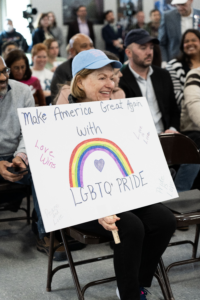
A smiling woman in a light blue cap holds a handmade sign reading "Make America Great Again With LGBTQ+ Pride" featuring a rainbow and the words "Love Wins" and "Love is Love" during a crowded public hearing.

A supporter holds a handmade LGBTQ+ pride sign during a public hearing at the Kentucky Capitol Annex during the 2026 legislative session. Photo by Skylar Davis.

The Fairness Campaign and Kentucky Competes, a group that lobbies on LGBTQ+ issues from a business and economic development angle, routinely lobbied in favor of LGBTQ+ issues. The Family Foundation, a socially conservative group, typically lobbied against the same bills, as frequently as the Fairness Campaign and Kentucky Competes lobbied for them.

“The Fairness Campaign has worked hard in recent years to strengthen relationships on both sides of the aisle and encourage state lawmakers to focus on kitchen table issues that positively impact all Kentuckians, rather than engage in divisive culture wars that harm our most vulnerable communities,” Chris Hartman, the leader of the LGBTQ+ advocacy organization the Fairness Campaign, said.

This year’s success “is thanks to that intentional and difficult relationship building,” he continued,  and was bolstered by an “expanded lobbying team.”

Eric Russ, who leads the Kentucky Psychological Association, said their group has also worked on developing relationships with lawmakers so they can be “an ongoing trusted source of mental healthcare information for policymakers.”

KPA, Russ said, “works hard to ensure legislators understand both the psychological science of gender and sexual identity and the impact legislative policy has on the mental health of people in those communities.”

One example is the group’s quick statement opposing SB 351, the anti-trans teacher bill, which “helped legislators and other advocates understand the problems with the bill’s mechanisms and its wide-ranging impact.”

Thanks to quick pushback to the bill both when it was first filed and later in session when the bill sponsor tried to sneak it into a different bill at the last minute, the concept never budged in the legislative process.

Showing up still possible, still critical


2026’s legislative session was the first where the Capitol and the House and Senate chambers were closed to the public.

The Capitol’s closure — due to multi-year renovations — sparked concerns of weakened transparency and limited moments to make voices heard over legislation. Heading into the session, advocates and lawmakers told crowds at Queer Kentucky’s legislative preview panels that showing up — even if it is just to watch a committee meeting or briefly talk to a lawmaker in the Capitol Annex, which remained open — could have major impact. 

“It really does matter that people show up,” Hartman said at an early December panel in Newport. “Every time we can fill the chamber with bodies, it gives more people pause than you might know.”

Several groups ultimately were still able to rally the troops, show up in Frankfort and contact their lawmakers.

“Anti-LGBTQ+ and anti-immigrant bills didn’t pass in the 2026 legislative session because of well-organized, relentless advocacy across sectors,” King with the ACLU explained. “Directly impacted people showed up and testified. Coalitions mobilized calls and emails. Volunteers put in the work, day after day.”

Dr. Jacks Gilles, a psychologist based in Louisville, testified against SB 72, one of the only anti-LGBTQ+ bills that made it to a committee hearing. The bill would have allowed a broad range of medical practitioners to refuse to perform services if they felt it violated their “sincerely held religious, moral, or ethical” beliefs.

They said that the bill would have taken away the necessary checks and balances already set by licensure boards, and create more of a power differential between medical professionals and patients. That would lead to people, especially LGBTQ+ people, avoiding medical settings.

“Several of us have had experiences of surgeons coming in before the surgery and asking us to pray for us, but when you take a vulnerable situation and ask them to engage in their religious practice, it’s from a lack of understanding of holding differences as medical providers and still maintaining dignity,” they said.

No one in committee testified in favor of the bill, they said, aside from the lawmakers who supported the bill.

“I would like to encourage getting people involved by voting, coming out to Frankfort and having conversations with lawmakers, even if it’s not to testify against a bill. It’s helpful as well to not feel so isolated,” they said.

Anti-Trans Legislation: A Time of Uncertainty for Queer People in America

This story is part of Queer Kentucky’s digital issue surrounding the trans youth experience in the Bluegrass state, featuring personal essays to educational information. Read the full issue here.

While 2025 is only halfway over, it has already broken the record for anti-trans legislation in the US. A second Trump administration, and annual record breaking numbers of anti-LGBTQ+ legislation are threatening years of legislative progress. This year, more than 940 anti-trans bills have been proposed in legislatures in nearly every state so far, according to the Trans Legislation Tracker.

Several anti-trans and anti-LGBTQ+ legislation trackers are in circulation, and all have different definitions of what is considered to be anti-trans or anti-LGBTQ+. The Trans Legislation Tracker, which this article references, tracks legislation that aims to block trans people’s access to education, healthcare, legal recognition, and to exist in the public sphere without fear of discrimination or harassment. 

The highest number of bills this year introduced surround education, with more than 250 legislative acts that have been filed. These bills focus on denying students the use of preferred names and pronouns, forcing students out of the closet, and banning education on gender identity in schools. Healthcare is another target, with 194 bills under review. These work to limit or deny gender-affirming care for minors and adults. 

Texas saw the highest number of anti-trans bills so far this year, with a total of 130 bills filed — nearly double that of the second-highest state, Missouri. One of these bills in Texas, which was passed by the House, excludes transgender people from the state records. House Bill 229, labeled “Women’s Bill of Rights,” explicitly defines gender as the sex assigned at birth based on reproductive organs. Only one amendment submitted by democrats was accepted, which clarifies how intersex individuals fit into these categories. 

Kentucky’s legislature considered 18 anti-trans bills, according to the Trans Legislation Tracker, during its 2025 legislative session, which ended in late March.

Transgender and gender non-conforming people can no longer use state or federal programs like Medicaid to cover gender-affirming care. Legislation filed to remove strides made by LGBTQ+ activists were bills like HB154, which would prevent healthcare providers from accepting payment for gender-affirming care from state or federal programs like Medicaid. For transgender Kentuckians, this poses a major financial problem, as Kentucky is often listed in the top 10 of most impoverished states, with about 1 in 6 Kentuckians living in poverty. Cutting access to government-assisted insurance for gender-affirming care is a threat to its accessibility. A different bill passed into law blocks incarcerated individuals from accessing such care.

Another major legislative decision in Kentucky was a bill that reversed Gov. Andy Beshear’s executive order, which banned conversion therapy in the state. This bill went as far as to block him from attempting to ban it again for the remainder of his time in office. 

While the record-breaking number of filed anti-trans legislation is alarming, only 12.4% has become law thus far. The majority of these attempted bills don’t make it to law. That being said, the 12.4% that have passed have had devastating consequences for the trans community, limiting accessibility to education and healthcare.

The influx of regressive legislation has caused a culture of fear and unrest in the hearts of the transgender community. Hormone replacement therapy and other forms of gender-affirming care have been said to save the lives of many, for both adults and transgender youth. Protests are occurring regularly around the United States to stand up for the rights of transgender people nationwide, such as the “Hands off!” protests. Many people are pursuing legal action to combat anti-trans legislation. Checking in on trans friends, neighbors, and family is becoming more crucial, as well as participating in protests and communicating with representatives. 


Researcher creates study to explore mental health and resilience of LGBTQ+ youth in Appalachian Kentucky

Editor’s note: This story was published in June 2025. Some details may have changed since then.

According to the Appalachian Regional Commission, Kentucky has 1.2 million residents over 54 Appalachian counties. However, a general search on the website using keywords like “LGBT” or “queer” provides zero results. 

“If we don’t have the data, then we can’t know how to meet the needs, address the inequalities, or support individuals,” said Holden Dillman, a licensed clinical social worker and doctoral student at the University of Kentucky who lives in Eastern Kentucky and provides telehealth psychotherapy to individuals and couples across the state—particularly those in the LGBTQ+ community—through Bridge Counseling and Wellness, based in Louisville.

Dillman is working on a new study called We Are Here, focusing on the unique mental health challenges and resilience of sexual and gender minority youth in Appalachia.

According to a 2017 report by the American Psychological Association on Sexual Identity and Risk Behaviors Among Adolescents in Rural Appalachia, LGBQ+ youth showed higher signs of risks including bullying, poor mental health outcomes, substance abuse problems and lower academic achievement. 

The study, conducted in two western North Carolina high schools, had over 2,000 students participate in the Youth Risk Behavior Survey created by the Centers for Disease Control and Prevention. Of the students who answered the survey, LGBTQ+ students were at five times the risk for reporting suicide risk factors and perceived a lower level of school and community support than their heterosexual counterparts. 

Despite providing a snapshot of the region’s youth population, the study left some gaps. One of the gaps included any insight into the transgender experience, with the only sex options on the survey being male or female.

“Right now, the research isn’t as diverse as what it could be,” said Dillman, who has been working with a limited dataset, adding, “there’s not a lot of data that from a national kind of perspective really speaks to this experience.”

Dillman will use a mixed methods study approach, looking at information from a national secondary dataset as quantitative data and primary interviews from recruited participants in Appalachia as qualitative data.

His goal is to focus on the intersection of self-esteem, acceptance, and regional culture within the Appalachia youth ranging in ages 12 to 32. 

For the interview portion of the study, participants will be asked a set of open-ended questions, aimed at providing deeper conversations. “The goal is to get to the essence of the lived experience,” said Dillman, about creating a space for people to reflect on impacts both internally and externally. 

Only individuals who are currently living or lived in the Appalachian region through their adolescence will qualify to participate in an interview for the study. 

As a native Southeastern Kentuckian, for Dillman it was important to name the study We Are Here because it fights back against a “sad story of trauma” often referenced with Appalachian queer-lived experiences. 

“We’re not just surviving anymore, we’re actually thriving in a lot of ways,” he said. 

To expand the reach of the study set to begin receiving applicants in June, Dillman has partnered with Queer Kentucky. 

For Dillman, the collaboration goes beyond the research. He hopes the results will lead to tangible change by “working together to make sure that it’s being translated to benefit the communities that it involves.”

Some of the ways Dillman hopes it’ll create change include by informing policies and interventions that better support the well-being of youth in rural communities.

Almost a year since his start in assembling the We Are Here study, Dillman plans to start interviews in July and said the process could last up to six months. For interested applicants, the interest form is now live.

“We’re at a point in academia, in research and in science where person-centered research is validated and it is reliable,” he said.

If you or someone you know is struggling, call or text the 988 Suicide & Crisis Lifeline at 988. LGBTQ+ young people can press 3 to reach counselors trained in LGBTQ+ care, an option that returned on Sept. 30, 2026 after it was cut in July 2025. The Trevor Project also offers 24/7 support at 1-866-488-7386 or by texting START to 678-678.

Queer Kentucky, Moore Lab launch interactive data dashboard featuring experiences of 3,000+ LGBTQ+ Kentuckians

Curious about what is important to LGBTQ+ Kentuckians? Check out this groundbreaking survey.

Queer Kentucky Southeastern Media Study explores importance of LGBTQ+ Visibility

For decades, queer media has served as an important source of community, news, culture, and entertainment for LGBTQ+ people across the U.S. From historic underground zines like DPN: Diseased Pariah News fighting misinformation surrounding HIV/AIDS in the ’90s, to legacy publications like Andy Warhol’s celebrity culture-focused Interview Magazine, to hyperlocal outlets like The Dallas Voice and yours truly, Queer Kentucky, these platforms have shaped the community’s relationship with one another and the way they consume media.

Queer Kentucky was founded in 2018 when LGBTQ+ coverage lacked within local publications. The organization gained traction quickly because people were hungry for queer media. Many LGBTQ+ people said they had only ever seen queer media as a coastal city privilege, so seeing their own neighbors’ stories highlighted in a popular, queer-run, and local publication gave them a strong sense of community and pride.

As a leader in Southeastern LGBTQ+ media, Queer Kentucky recognized the need to highlight the importance of queer media in the region. To better understand its impact, we collected data to assess the challenges, opportunities, and value these publications bring to the LGBTQ+ community. Our goal was to explore the Southern queer media landscape and measure how it resonates with its audience.

We engaged with 11 publications across the Southeast, gathering insights from publishers, staff reporters, and their audiences. Our survey covered everything from demographic data to the depth of connection readers feel with print media versus digital platforms.

Our study found that most LGBTQ+ media consumers are under 35, with many identifying as queer or nonbinary. For them, LGBTQ+ media plays a key role in building self-esteem and community. This is especially true in the Southeast, where rising anti-LGBTQ+ rhetoric makes queer media feel even more vital. Younger readers, in particular, see it as a necessary tool for visibility and support. However, older readers are also well represented, with 20% of respondents being 66 years of age or above. And to our surprise, LGBTQ+ publications have a large cis-het readership, making up 26% of survey respondents.

Readers describe intense connection and validation coming from queer media. It’s a lifeline and a lens through which to learn about themselves and the world around them. For all publications surveyed and mentioned in our results, online is the primary method of reading. However, local media and major national publications are still picked up in print by a quarter to a third of readership.

“A physical manifestation of the stories makes them tangible. It’s not just content tracking to break its way into your social media stream and maybe keeping my attention for 30 secs,” said a survey respondent. “I have a person’s life story in my hands, it makes them real and I think it pushes people who may not otherwise open to queer stories to pause and see them.”

The top reason LGBTQ+ people turn to queer media is advocacy and civic awareness, with 67% of respondents citing it as their primary motivation. Queer media amplifies global issues through an LGBTQ+ lens, offering perspectives often missing from mainstream coverage. It also plays a crucial role in affirming identities, making individuals feel safe, seen, and represented. Additionally, it serves as an essential resource for education on LGBTQ+ topics, from politics to health and wellness.

“Learning about different legislation that threatens the LGBTQ community and what we can do to reach out to our legislators to try to stop it,” said another respondent. 

Queer media isn’t just about content—it’s about creating safe spaces. Younger readers (45 and under) see LGBTQ+ media as essential for building community and fostering a sense of security. They rely on it to discover aligned businesses, events, and connect with like-minded peers. Many credit queer media, especially social media, with helping them understand their identities and continue to seek it out as they grow. In turn, they trust these platforms to guide them toward safe spaces, both online and in person.

This need for safe spaces is even more urgent in the Southeast, where many readers say they feel queer communities are under attack and in need of financial, political, and emotional support. 

Visibility is harder to come by, especially for younger queer Southerners, making LGBTQ+ media a crucial counter-narrative in a region often perceived as hostile. With fewer political representatives advocating for them, queer media plays a vital role in educating both LGBTQ+ and straight audiences on the challenges these communities face. 

Despite the growing need for queer media in the Southeast, publishers say they face mounting challenges in keeping their outlets afloat. Rising material costs, an increasing demand for political coverage, and the desire to fairly compensate queer writers all add to the strain.

Funding is a persistent hurdle, but the value of queer media extends far beyond just event listings—it fosters community, provides education, and creates spaces where LGBTQ+ people feel seen and supported. Publishers also say that nonprofit and corporate grants should recognize this impact, understanding that queer media helps individuals find their identity while also educating broader audiences. 

Meanwhile, advertisers should take note: this audience is deeply loyal and will actively support businesses that invest in the community. In a region where queer voices are more critical than ever, sustaining and supporting LGBTQ+ media isn’t just a financial decision—it’s an investment in visibility, advocacy, and the future of queer life in the South.

Want the fine details? Read the full study here.

Thank you to our participants: Queerency, Dallas Voice, Focus Mid-South, Connect, QnotesCarolinas, The Georgia Voice, Wussy Magazine, Skirt Magazine SoFlo, OutClique Magazine, and Reckon.


Who asked for this? New poll signals Kentuckians don’t want lawmakers blocking gender-affirming health care

Kentucky’s Republican-dominated legislature spent some of its final veto-proof minutes Friday prioritizing bills aimed at taking away gender-affirming health care for some transgender Kentuckians, stifling debate and rushing votes as a midnight deadline drew near. 

But guess what a majority of Kentucky voters don’t think is a priority? 

That’s right — blocking transgender Kentuckians from accessing gender-affirming health care. 

A new poll, released last week, found Kentuckians are much more likely to want their lawmakers to prioritize things like public education and affordable health care than going after the transgender community. 

Pollster Mason-Dixon teamed up with the Fairness Campaign, a pro-LGBTQ+ organization, to talk to hundreds of Kentuckians at the end of February to see where their priorities are. They talked to 625 registered voters and the poll has a margin of error of plus or minus 4 percentage points.

Of the topics they asked a statewide group representative of Kentucky’s voter registration breakdown, restricting access to gender-affirming health care for transgender people ranked last. 

For example, 93% of people said expanding access to affordable health care was a high or very high priority. Meanwhile, about two-thirds of folks said barring transgender Kentuckians on Medicaid from accessing gender-affirming health care was a low or very low priority. 

Also more popular with respondents? Focusing on improving disaster relief efforts and bolstering funding for public schools. 


“The Kentucky General Assembly is once again prioritizing politics over the people of Kentucky,” Chris Hartman, the executive director of the Fairness Campaign, said in a press release. 

“Kentucky voters care about what matters to their real lives—access to affordable healthcare, public education, and disaster relief,” he continued. “Instead, Kentucky lawmakers are fast tracking a sneak attack on Transgender Kentuckians. They would be wise to listen to Kentucky voters and prioritize the values that unite us, not divide us.”

This isn’t the first time Kentucky voters have sided with the LGBTQ+ community. In 2023, as debates over pronouns in schools and gender-affirming care for minors raged in Frankfort, a different poll showed more than 70% of people opposed anti-transgender legislation. 

The latest poll came as lawmakers rushed to get more than 100 bills through the legislature and onto Gov. Andy Beshear’s desk ahead of a veto period. Among the bills they passed are House Bill 495, which would undo a current ban on conversion therapy and block transgender people on Medicaid from accessing gender-affirming care like hormone therapy and surgeries, and Senate Bill 2, which would place similar health care restrictions on Kentucky’s 67 transgender inmates. 

Beshear is expected to veto both bills, but the legislature will be able to override any of his vetoes when they return to Frankfort to close out the session March 27 and 28. 


Painting a Picture of HIV Prevalence in Rural Kentucky

The article is from our special issue on Mpox. You can access the full issue here.

In a previous article, we saw that only an estimated 28.8% of Kentuckians have been tested for HIV at least once in their lives. This means that around a quarter of Kentuckians know their status … or have known it. STI testing, like any other form of responsible self-improvement, is best performed routinely and with intention. One doesn’t go to therapy once and declare himself trauma-free or take a look at the weather one day and declare that it’s always sunny from now on—so why are we so quick to take one test and be done with the whole affair? The answer is a complex web of cultural stigma and access to healthcare in the Bluegrass state. 

Stigma around HIV rages strong due to its connection with the LGBTQ+ community (let’s not forget that HIV/AIDS was originally called “gay cancer“) and intravenous drug users. In the United States, anti-LGBTQ+ sentiment rages strong due to flame-fanning from right-wing evangelicals, politicians, and social media personalities. Similarly, the public’s association with intravenous drug users and those living with addiction is very negative—particularly in areas where drug use is pervasive and heavily associated with violent crime. The negative associations people have with these two communities translates to stigma—literally “a mark of shame.” If one’s only understanding of HIV is that it’s a disease for “queers and addicts,” but your math teacher or your congressman comes out as HIV+, one is likely to transfer those associations onto them: to stigmatize them, or apply that mark of shame. The prospect of suddenly losing reputation or standing within one’s community is terrifying, and that deters people from getting necessary care. While there are some protections in place for people taking and receiving results of an HIV test, they may not be enough to ensure people feel safe enough to test in the first place. 

Add to this fear of stigma to the legal ramifications of knowingly spreading HIV—which is still a Class-D felony offense in the state—and there are very real ramifications to being diagnosed with HIV. You can’t unknow something like that, so diagnosis opens up a whole can of worms beyond one’s individual health. 

All of these compounding issues mean that getting tested isn’t as simple as it may seem for Kentuckians. Up until June 2023, even selling or distributing home HIV tests was considered a felony. This was overturned thanks to the work of the HIV Is Not A Crime Coalition, powered by the Fairness Campaign. At-home testing provides the privacy, ease, and accuracy necessary for more Kentuckians to be regularly informed about their status, and to act accordingly.

Beyond the issues of stigmatization, legal persecution, and access to testing, Kentucky faces an additional barrier to effective HIV treatment and prevention: an epidemic of intravenous drug use. A 2019 by Kentucky Public Health and the CDC found that of 220 U.S. counties at risk for an HIV/HepC outbreak among intravenous drug users, 54 of those (24.5%) were in Kentucky. 

via TheKentuckyLantern

A number of concrete steps have been taken to reduce harm within the region, namely increasing the accessibility of syringe services programs (SSPs). Syringes are single-use tools—they should not be used more than once or, even worse, shared. Generally speaking, people using intravenous drugs are focused on other things and don’t have tens of spare needles lying around in sterile conditions. SSPs allow them to reduce the potential harm associated with these activities by safely disposing of used needles, getting access to clean ones, and ultimately offering screening, treatment, and support. These, too, were illegal until 2015. 

As we’ve seen, the statistics paint a negative picture of HIV in Kentucky—low STI literacy rates, stigmatization, legal barriers, and other factors have often blocked meaningful progress. But in the last decade, Kentucky residents on both the local and state levels have organized to make meaningful strides in preventing, treating, and destigmatizing HIV across the state. But there is still work to do! If you’re inspired by all this progress and want to ensure we keep moving forward, join local activist groups like the Fairness Campaign or AVOL and carry on the work that has been done in the name of health and wellbeing. 

The article is from our special issue on Mpox. You can access the full issue here.

HIV in Kentucky: Interactions with Mpox, Vaccines, & Public Health

The article is from our special issue on Mpox. You can access the full issue here.

The 2022 mpox outbreak disproportionately impacted gay men and those living with HIV. Was this some cosmic hate crime or just a side-effect of our community’s tendency to spread our love far and wide? In this article, we’ll unpack the relationship between three diseases—smallpox, mpox, and HIV—and their role in contemporary vaccine research and public safety. 

Routine vaccination for smallpox ended in the 1970s due to the WHO’s declaration that smallpox was eradicated. No more disease meant no more worries—we thought. Global vaccination rates against smallpox fell dramatically, sometimes as dramatically as 95% to 5% of the total population (based on studies from Denmark and Spain). We know there is at least some cross-immunity to mpox generated from smallpox; one study even found a connection between smallpox vaccination and resistance to mpox, even when the vaccines were administered a decade or more earlier. If we connect the dots, diminishing vaccination rates for smallpox could mean diminishing immunity from mpox. This is one reason current vaccination efforts are so important—if you haven’t been vaccinated against smallpox, you’ve got a heightened risk of contracting mpox. 

While prior mpox infections had been relatively constrained to regions of Africa, the 2022 outbreak was an anomaly. These new variants disproportionately targeted gay men (94% of total infections) and those living with HIV (41% of total infections). This isn’t due to some cosmic hate crime (though I haven’t personally ruled that option out), it’s likely due to the connection between multiple sexual partners and mpox transmission. More sexual encounters means more chances to contract, statistically speaking. 

For those with HIV, mpox vaccines have shown very few possible reactions with HIV medications. While there is no demonstrated connection between being HIV+ and one’s odds of contracting mpox, the immunocompromisation that comes with longer-term HIV and AIDS would put them at greater risk for experiencing a severe and potentially fatal mpox infection without the vaccine. While some “live” vaccines may pose a risk to the immunocompromised, both major vaccines on the market today—Jynneos and ACAM2000—use “dead” viruses which are incapable of causing infection. Vaccines which use a weakened, as opposed to dead, virus may lead to further infection to those with weakened immune systems, but this is highly dependent on the individual and their specific health factors. Being immunocompromised may also reduce the efficacy of certain vaccines, since vaccination’s primary goal is stimulating the immune system.  

HIV and vaccination have a long history, going back as far as 1984 when HIV was identified as the cause of AIDS. At this time, government officials declared a 2–3 year window between this discovery and the development of a functional vaccine. This estimate has proved wrong, to the tune of decades. There was indeed a trial in 1986, though this was fraught with controversy. Daniel Zagury, leader of the trial, was the first person to try the vaccine and would later have charges levied against him for medical misconduct when three of the trial participants, in the late stages of AIDS, died during the trial. These charges were ultimately dismissed, with the understanding that all medical trials carry with them some amount of risk and the participants all gave informed consent regarding that risk. Since this initial trial, there have been several subsequent attempts to develop a vaccine against HIV, each powered by new discoveries around the virus’s structure, behavior, and interaction with other systems within the body. 

While we don’t have a vaccine to eradicate HIV just yet, we do have preventative PrEP and many treatments for treating an HIV infection before it can develop into AIDS. In Kentucky, only an estimated 28.8% of residents have been tested for HIV at least once in their lifetime. Combine this with an estimated 8.6% of those Kentuckians testing positive for HIV, and we get a clearer picture. If there are 4.5M residents in Kentucky, 28.8% of whom know their status one way or another (1.3M), we’re left with 3.2M who don’t know and who may not be engaging in preventative measures. PrEP use has been steadily climbing since its release in 2012, with an estimated 4,500 Kentuckians routinely using it. Those who have more sex with more people and who use intravenous drugs may be at higher risk of contracting HIV—but regardless, not knowing your status (and perhaps not being aware that you don’t know) is an issue of community safety. HIV may have had its terrifying, pandemic-era time in the spotlight, but it is no less of a concern than mpox, COVID, or any other disease that draws attention, resources, and action. We can all do our part in preventing the spread of HIV by using PrEP, knowing our status, and keeping one another safe and healthy. 

The article is from our special issue on Mpox. You can access the full issue here.

No Blue Balls in the Bluegrass State: 2024 Cruising Trends with Sniffies Download

Since 2018, Sniffies has been putting queers on the map. Literally. The web app uses a geolocation interface that helps cruisers – mostly queer men – find one another through a real-time, often anonymous exchange of physical traits and sexual preferences. Grindr meets Nextdoor.

Sniffies is certainly a grower, with some reports estimating user counts at more than 900,000. In a 2021 Slate interview with Rhodes Murphy, Chief Marketing Officer Eli Martin said Sniffies got its name from an earlier site intended for trading underwear. The domain, Martin said, was too good not to keep.

In whiffing range of the second T**** administration, there’s something uplifting about queer people having access to something so unabashedly cheeky, sex-positive, and communal. Vanilla hermit that I am, I’d never logged into the Sniffies site before this assignment. I’ve dabbled with Grindr – I’m still bitter about the weed you stole in 2012, Derek – and some of my earliest stomping grounds were in the chatrooms of Myspace and Yahoo. I’ve decided cruising isn’t for me, but I’m no judge of fellow adults in pursuit of what safely and fully satisfies them.

Looking at Sniffies for the first time, I can understand the appeal. Daily use of the site would make me so much better at geography than any educator ever could. You learn a good deal about your neighborhood, and the interactive map is easy to explore. Zoom in on a park and see who is chatting about arriving there, or who is waiting. See who in your city is willing to host. Who around the corner might share your kinks, or offer something you’ve pondered trying?

I knew I was a short walk from two Little Free Libraries, but I didn’t realize I was also a block away from a glory hole. New cruisers pop up with their individual desires and offers for connection. They declare who they are, where they’re headed, when they’ve arrived, and what they want. Click individual profiles or locations, and you’ll find little left to the imagination: age, height, weight, penis size, body type, persona (Guy Next Door, for example, which I’d argue applies to everyone).

A leather daddy is parked and ready; here’s the color and make of his car. Across town is a bisexual trucker in his backseat, and the door is unlocked. A sporty pup is waiting in a stall. The restroom, the park, the apartment two streets away … all over, queer adults are engaging in queer adult behavior. And even though hookups aren’t exactly for me, I know plenty of people who thrive on them. I’ll be the last one to turn my nose up at their fun.


So here’s the Sniffies Download 2024, highlighting the site’s trends with metrics and the results of Kentuckians sniffing around and finding out.

Top Cruising Spots

The park (good old Cherokee, I’d wager) and the intriguing “Others” tied for second-best cruising spots, making restrooms the state’s most frequented cruising locale. Last year’s top spot was the airport. Cruisers may be flying less, but they’re certainly getting around. Altogether, not a far cry from the top cruising spots of the 1480s in Florence, Italy: streets, private homes, workshops, and taverns (courtesy of Michael Rocke’s remarkable Forbidden Friendships). 

Restroom (25%)

Park (21%)

Residential Tower (17%)

Gym (10%)

Bar (6%)

Others (21%)

Kink Breakdown

Appropriately, edging is slowly reaching the top spot – Sniffies reported it as the site’s top kink in the nation last year. As for Kentucky’s favorite individual kink, I’m not sure what “porn” really entails. Watching porn together, reenacting it? I’m even more curious about the 41% lumped together as “Others” … it’s giving Lost. (And that show edged us for years.)

Porn (8.6%)

Facials (7.1%)

Cum-play (7.0%)

Edging (6.8%)

Groups (6.4%)

Gloryholes (5.5%)

Freeballing (5.2%)

Sex-toys (5.2%)

Spanking (3.7%)

Age-play (3.6%)

Others (41%)

Position Breakdown

The obliging nature of being vers lends itself to cruising, so it makes sense to see that position top this category (this time around). Interestingly, tops bumped into second place after ranking below bottoms in 2023. 

Also, it seems you’ll have an easier time finding a legendary Pokémon on Sniffies than a sub top (2%) or a power bottom (1%). And if Bernie’s right, that the one percent really does own a third of the country’s wealth … well, I can’t think of anyone more deserving than power bottoms.

Vers (21%)

Top (18%)

Bottom (15%)

Vers-top (12%)

Vers-bottom (11%)

Bottom-sub (10%)

Top-dom (5%)

Side (5%)

Top-sub (2%)

Power-bottom (1%)

Horniest Cities (Most Sessions)

Putting the “Oh!” in 502, Louisville again ranks as the horniest city with the most Sniffies sessions in Kentucky. Are y’all surprised? No. Is Louisville horny? Well, look at the numbers: an average of 6,028 cruising sessions a day in 2024. How La Grange – with a population around 10,400 – is just behind Lexington, I do not know. I’m impressed. I’m intimidated. I’m a little scared. And as a Louisvillian, I must be horny.

Sessions in 2024:

Louisville (2.2M)

Lexington (999k)

La Grange (960k)

Most Attended Group


Wishin’ and hopin’ and jerkin’ and suckin’
Pumpin’ and dumpin’ each night in his arms …

Most Attended Group will always be Orgy’s to lose, so there’s no room for surprise to see it finish first. Sidenote: Lewis Carroll wrote the riddle, Why is a raven like a writing desk? This assignment has prompted me to wonder what the difference is between a “cum dump” and a “pump and dump.” After destroying my google algorithm and disturbing the poor FBI agent monitoring me, I may have an answer. Cum-dumping prioritizes penetrative partners ejaculating inside their receptive partners. Pump and dumps, not to be confused with pump-and-dump securities fraud, are essentially one-night stands that rhyme. No emotional connection, just the erection.

Orgy (229)

Jerkin and Suckin (159)

Cum dump (140)

Pump and dump (122)

xxxperience (109)

Hotel Pump and Dump (104)

Sexual Orientation Breakdown

This is a pronounced lead for the gays compared to 2023, when bisexual and straight-curious people represented the majority of cruisers. What inspired this surge of gayness? Chappell Roan? The eclipse? The sex scenes from Fellow Travelers? Perhaps the curious cruisers put down their reservations and picked up their gay cards. (Welcome! Took you long enough, but we’re happy to have you.)

Gay (63%)

Bi (20%)

Bicurious (8%)

Straight-curious (5%)

Straight (4%)

Dick Size: 6.9 inches

Inflation strikes again. Sniffies’ average penis size in 2023 was reported at 6.2 inches, or 15.75 centimeters if you’re feeling British. Researchers continue to find the average erect penis actually flexes somewhere between 5.1 and 5.5 inches long and 4.6 to 4.8 inches thick. (But you know what? Fantasy is fun. Exaggerate away! Life is short. Not mine though. Mine’s huge.)

City with Most Increased Activity from 2024

La Grange, the Kindness Capital of Kentucky, continues to soar with the most sessions growth at 880%. That number follows a staggering 2,717% increase from 2023. Louisville and Lexington trail behind La Grange here, but keep in mind that 568% and 736% growth, respectively, involve much larger populations. (Please note: I am not a size queen or mathematician.)

Sessions growth in 2024:

La Grange (+880%)

Lexington (+736%)

Louisville (+568%)

2024 Kentucky General Assembly Wrapped: Horoscope Edition

by Olivia Krauth and Tigresse Bleu

While it doesn’t dictate every trait we have, our Sun sign rules over our ego — our brightest selves, and areas where we could potentially truly come to life or hold power.

How does this play out in a place known for wielding intense levels of power (and also some ego)? Queer Kentucky analyzed the zodiac signs of Kentucky’s state lawmakers in hopes of gaining some level of clarity as to why Frankfort is the way it is. 

With the 2025 legislative session coming up, here are the top signs represented in Frankfort in 2024, as analyzed by an astrologer and a politics reporter.

So, who really holds the power in Frankfort?


Through public bios and social media, we figured out the zodiac signs for all but one of the state lawmakers in office at the end of the 2024 legislative session. 

Here’s a breakdown of how heavily each zodiac sign was represented (or not) in Frankfort:

  1. Gemini — 18 lawmakers.
  2. Aries — 15.
  3. Cancer and Capricorn — 14 each.
  4. Scorpio — 12.
  5. Sagittarius and Taurus — 11 each.
  6. Leo and Virgo — 10 each.
  7. Libra — 8.
  8. Aquarius and Pisces — 7 each.

But there were some differences between who gets elected and who gets trusted with power. Only about one-third of lawmakers are in a leadership position within their chamber or committee. 

Cancer, Gemini and Taurus tied for the most number of leadership roles, but Taurus and Cancer had the biggest portions of their signs in power. 

But what about the top signs overall? Let’s begin.

TIE: Sagittarius and Taurus — 11 lawmakers each

Sagittarius is infectious, bringing its naturally diplomatic and charming energy to Frankfort.

Its mutable energy makes it flexible, allowing it to either take control or a backseat when needed. Often, you can mold Sags into whatever you want or need. 

Some notable Sags:

  • Senate Majority Whip Mike Wilson — R-Bowling Green
  • Outgoing Sen. Denise Harper Angel — D-Louisville — Once told her husband he made her “miss roll call because I couldn’t unmute because you were fucking cussing” in a hot mic moment.

Then we have Taurus: careful and particular, accountable and responsible. Taurus’ placement in the zodiac emphasizes matters of the land, what is natural and material possessions — peak “down to earth.”

When it comes to Frankfort, a Taurus’ fixed energy can make it either a strong, steady force or a tyrant. 

Some notable Tauruses:

  • Senate Minority Caucus Chair Reggie Thomas — D-Lexington
  • House Banking and Insurance Chair Rep. Michael Meredith — R-Oakland — The guy who made sports betting happen.

Scorpio — 12 lawmakers


Next up is Taurus’ sister sign, Scorpio. A Scorpio’s energy is more hidden — complex, with a lot bubbling underneath the surface while coming off eerily calm. 

A water sign, they still acknowledge emotion, but while also being dominant and fearless. They’re not careless but can be cunning. 

Some notable Scorpios:

  • House Majority Caucus Chair Suzanne Miles — R-Owensboro
  • Rep. Savannah Maddox — R-Dry Ridge

TIE: Cancer and Capricorn — 14 lawmakers each


These sister signs know how to take charge and are seen as the “mom and dad” of the zodiac — the caretakers but with different approaches. 

Capricorn typically takes a more structured and stern approach, and tends to think big picture. 

It is the earthy “ring leader” of the zodiac and knows how to maturely execute missions. It’s superhuman how much Capricorn can take on and handle. It can turn mishaps and burdens into gold.


Some notable Capricorns:

  • The top two Senate leaders, Senate President Robert Stivers and Senate President Pro Tem David Givens.
  • Sen. Karen Berg — D-Louisville — Fierce advocate of LGBTQ+ rights. 
  • Rep. Jennifer Decker — R-Waddy — The mastermind behind some of Frankfort’s most high-profile bills in recent years, including some aimed at diversity, equity and inclusion in education. 


Cancer is more of a boss than its given credit for. They can lead just like a Cap, but a Cancer’s biggest strength is often its ability to provide comfort. 

Cancers love a soothing environment and will proactively (and sometimes aggressively) work to protect that comfort. Cancers are not afraid to fight or defend, and they’re dedicated and loyal. 

Some notable Cancers:

  • House Speaker Pro Tem David Meade — R-Stanford.
  • Incoming Senate Majority Floor Leader Max Wise — R-Campbellsville — The mastermind behind 2023’s Senate Bill 150, which banned gender-affirming care for transgender youth.
  • Senate A&R Chair Chris McDaniel — R-Ryland Heights — One of the heaviest influences on the state budget.

Aries — 15 lawmakers

It makes sense Aries would be one of the top signs in Frankfort given its natural confidence and leadership skills.

Known to be a trailblazer and a self-starter, Aries can balance out a team by “just going for it.” They also tend to have strong decision-making skills and a charm that can get them in or out of most situations.

Some notable Aries:

  • House Leaders Speaker of the House David Osborne and House Majority Whip Jason Nemes.
  • Incoming House Minority Floor Leader Pamela Stevenson — D-Louisville — The first Black woman to lead a party in either chamber. 
  • Rep. Keturah Herron — D-Louisville — The first openly LGBTQ+ state rep in Kentucky.

The Geminis — 18 lawmakers.


The sign known to be wishy-washy or even two-faced turns out to be the one with the most power in Frankfort.

Geminis thrive anywhere it can spread its truth, so political environments make sense. It can be daring and inquisitive, willing to be the one to bring up the elephant in the room.

Some notable Geminis:

  • Senate Minority Whip David Yates — D-Louisville — Once took a chop from a pro wrestler on the Senate steps.
  • Rep. Nick Wilson — R-Williamsburg — The guy who accidentally tried to make it legal for you to have sex with your first cousin without it being considered incest (he fixed it, though); also once won Survivor.
  • Rep. Kim Moser — R-Taylor Mill — Once told the world Kentuckians aren’t a bunch of Neanderthals when the house was considering banning gender-affirming care for transgender kids; has gotten shit for it in campaign mailers ever since.


How much money has supported Amendment 2…and by who?

Kentucky’s battle over a proposed constitutional amendment on whether or not public dollars should go to private schools is shaping up to be incredibly, incredibly expensive.

More than $12 million has been raised across a series of political issue groups in Kentucky aimed at advocating for or against Amendment 2, according to the most recent state campaign finance numbers.

And that’s just what is coming from Kentucky-based groups. Add in millions from federal PACs, and Amendment 2 is easily on track to be the most expensive constitutional amendment fight in Kentucky’s history. (For reference, the 2022 abortion amendment ended up costing somewhere around $7 million or so.)

How much has been raised in Kentucky’s Amendment 2 fight?

For simplicity’s sake, I’m going to focus mainly on state-level issue committees registered to raise and spend money on Amendment 2 with the Kentucky Registry of Election Finance, aka KREF, for much of this article.

But it is important to note right off the bat that the Protect Freedom PAC, a conservative federal PAC, has spent around $4 million on ads in favor of Amendment 2 thus far — making it one of the biggest spenders in the race. Those exact numbers, though, are much harder to track because the PAC and others like it don’t have to register and provide updated numbers to KREF, where you can search through campaign spending records in Kentucky.

You can read more about outside spending from Kentucky Public Radio and the Kentucky Lantern.

Ahead of Election Day, there are 10 state-level issue groups registered in Kentucky, but one appears to be created just to donate to a different group, so I’m going to focus on the other nine.

Between those groups, $12,140,516.83 has been raised. About two-thirds of the money raised comes from groups opposed to Amendment 2, with the remaining third from supporters.

Of that, $10,035,649.97 has already been spent. Supporters have spent more of their money thus far, spending about 88% of their donations, while opponents have spent around 80%.

Who are the players in Kentucky’s Amendment 2 fight?

The folks supporting Amendment 2 — so the ones who want to see public dollars go to private schools — are:

  • Kentucky Students First
  • Citizens Alliance For Better Schools
  • Americans For Prosperity – Kentucky
  • Empower Kentucky Parents

And the ones against Amendment 2 are:

  • Protect Our Schools KY
  • Democratic Socialists Against Amendment 2
  • What About Us
  • Kentuckians For Public Education, Inc.
  • The People’s Campaign

That’s a lot — which ones are, like, the main players?

Not all of those groups have raised much money, even this close to the election. Some haven’t raised or spent anything at all.

Here are the top groups ranked by how much money they’ve raised:

  1. Protect Our Schools KY — against — $7,057,037.48
  2. Kentucky Students First — for — $2,525,525.00
  3. Empower Kentucky Parents — for — $1,250,001.00
  4. Kentuckians For Public Education — against — $975,025.00
  5. Americans For Prosperity Kentucky — for — $327,828.35

But raising money and spending it are two different things. Some groups report spending almost every cent, while anti-Amendment 2 group Protect Our Schools KY still has more than $1 million left in the tank.

OK, but who are these people?

Americans For Prosperity — Kentucky is an issues committee, unsurprisingly, tied to Americans For Prosperity, a libertarian political advocacy group.

Kentucky Students First comes from Charles Leis, a well-known school choice advocate who leads EdChoice Kentucky. EdChoice played a critical role in getting education opportunity account legislation passed a few years ago. That bill would create a tax loophole for those who donate to third-party groups who provide private school scholarships to middle- and low-income students. The courts later decided it was unconstitutional.

Empower Kentucky Parents is tied to the American Federation for Children, which calls itself “the national leader in school choice.”

Protect Our Schools KY is tied to several folks in Kentucky’s public education landscape. Its leader is Tom Shelton, a former superintendent who plays a critical role with the Council for Better Education, a group representing Kentucky school districts that has successfully sued to block previous attempts at school choice measures.

Kentuckians For Public Education, Inc. is run by Eric Hyers, one of Gov. Andy Beshear’s top political strategists. Beshear’s PAC, In This Together, is one of the few donors to this group, as is a pro-Beshear PAC called Heckbent. Hence maybe why the governor has appeared in TV ads and mailers for them.

Where is the money coming from?

When you look just at the state-level groups, a whole lot of the money is coming from teachers unions.

Actually, the National Education Association is the top single donor across all groups with nearly $5.7 million donated. That’s about 47% of all money raised before factoring in any federal PAC money. Add in Kentucky-based teachers unions and that figure jumps up to $6.3 million — 52% of the total.

A pro-school choice group also tied to Leis, the leader of EdChoice Kentucky, called the Kentucky Education Freedom Fund came in a distant second for state-level groups, spending nearly $1.4 million.

Of course, don’t forget the roughly $4 million the Protect Freedom PAC has spent, which would alone be good enough for second place in spending in this race.

But what about the regular people?

Individuals collectively donated nearly $1 million at the state level, making up 8.2% of all donations.

There are two ways to look at this: by dollars and by people. We’re going to do both.

Nearly all of the individual donations came from supporters of Amendment 2 — we’re talking, like, 93% of the money. But, based on the number of donations, there are way more opponents to Amendment 2 than there are supporters.

Talking dollars, the average individual Amendment 2 supporter gave $12,274. The average Amendment 2 opponent gave about $107. (Even when you look at the medians, there is still a big difference: $100 vs. $25.)

That’s because the pro-Amendment 2 side saw some massive donations. William Yung, the leader of NKY-based hotel company Columbia Sussex, for example, single-handedly donated half-a-mil. And Matth Toebben, the founder of a NKY construction company, spent $100,000.

Toebben has also apparently gone off on his own to personally sponsor ads in newspapers in favor of Amendment 2. When you click on the online version of the ad, it takes you to an op-ed he wrote in late October in favor of the measure, where he says the future of Kentucky without school choice will be “bleak.”

Meanwhile on the opponents’ side, the largest single individual donation was $10,000 from Jennifer Moore, the founder of a Louisville law firm.

And then talking people, there were around 74 folks donating individually to support Amendment 2. As for the opposition? Around 484 folks.

Basically, it is a battle between a smaller group of wealthy men who can drop five- or six-figures for political causes and hundreds of more middle-class folks who don’t really have that kind of money.

How do I find election finance numbers in Kentucky?

Want to go through the numbers yourself? Here’s a quick runthrough of how to find and search campaign donations and expenses in Kentucky:

  • You’re going to start by heading to the KREF website.
  • On the left hand panel, you’re going to find the link that says “Search Election Finance Statements.” Click on that.
  • It should hopefully take you to a page with a line of search options at the top. You can search by candidate, organization, office, donor and expenses.
  • From there, just plug in what you’re looking for in the side panel. You can fill out as much or as little of it as you want.
  • Then go through the results to your heart’s content. Want to download the data into a spreadsheet? There should be a small export link on each page on the right hand side.
  • If you want to go through Amendment 2 spending, you should go to the organization tab, set the search functions to focus on active organizations and ones labeled as issue committees. Then find the ones that say they’re advocating for or against Amendment 2 — they should be clearly labeled in the group descriptions.

Obviously, there is a lot of information available and the platform can get a little wonky sometimes, but this is the general overview of finding election finance numbers.

When do election finance numbers come out in Kentucky?

It is important to note that groups are supposed to turn in their final pre-election finance numbers in mid-to-late October, so both the amounts raised and spent are expected to go up considerably by Election Day.

Candidates and organizations don’t have to report any more campaign expenses or donations before Election Day, but they have to report stuff following the election:

Everyone has to post a financial report by Dec. 9. This is called the 30-day post-General report.
If a candidate has debt and/or leftover money on that report, they also have to file a report by Jan. 7, 2025. This is called the 60-day post-General report.

You can see a full schedule of when reports are due on KREF’s website.

Southern LGBTQ+ nonprofits receive most funding from outside of region

In 2019, LGBTQ+ nonprofits received 0.13% of all charitable donations, despite roughly one in six gen z adults identifying as LGBTQ+. The number of people identifying as queer continues to grow as younger generations are generally more educated, open, and accepting of all sexualities, genders, and orientations.

Despite younger populations becoming more accepting, states and legislations in the United States are targeting LGBTQ+ communities by taking away rights, healthcare, or even the ability to exist in public. A growing number of people identify as queer, while the resources and rights of those people are jeopardized. Why aren’t LGBTQ+ nonprofits getting the support and resources non-LGBTQ+ organizations receive? More than ever, LGBTQ+ focused nonprofits need more funding to continue fighting for LGBTQ+ people to exist.

LGBTQ Funders analyzed the total funds awarded nationwide to queer nonprofits in 2018, divided it by the estimated number of adults who identify as lesbian, gay, bisexual, or transgender in the nation, and calculated a total of $8.70 in funding per queer adult in the US. Broken down per state, the median grant dollar per queer adult (GDQ) was $3.72.

This metric does not account for queer children – who are in disproportionate need of support and resources, especially those living in conservative regions. Not all queer adults need assistance, but this metric demonstrates how little resources are allocated to LGBTQ+ adults. There are currently not enough resources to fully address the issues these communities face economically, socially, culturally, and politically. 

Funding granted to LGBTQ+ nonprofit organizations in the South has steadily increased, “yet 56 percent of 2018 regional funds were from foundations not located in the South and seven of the ten largest funders were national funders based outside of the region” (LGBTQ Funders). The South received the most funding per region but continues to have a lower GDQ than the Pacific or Northeast region.

This consistent increase in funding is considered a success, despite the tremendous work left to achieve equality. To address the specific deep rooted stigma, homophobia, transphobia, and other challenges that exist in the South, LGBTQ+ organizations need additional directed funding. Without support from their own regional foundations, the South’s LGBTQ+ communities will continue to be in danger. 

In 2023, the South reported the highest rates of considered suicide, attempted suicide, and experienced symptoms of Depression among LGBTQ young people across the nation (Trevor Project), yet the GDQ stands at a still shockingly low $8.77. By state, some funding is even lower – leaving less resources to be shared with queer people in need. Kentucky’s GDQ is $.72, while the rate of Kentuckian LGBTQ+ individuals experiencing poverty was 28% in 2016 according to the Williams Institute. With less than $10 to be shared per queer adult in the South, and less than $1 in Kentucky, the gap in funding can’t provide long term solutions. 

USA Giving reported the majority of charitable dollars in 2022 were donated to religious organizations (27%), human services (14%), education (13%), grant making foundations (11%), and health (10%). It’s unclear how much of this funding is shared with LGBTQ+ individuals, and due to antigay and anti-transgender beliefs, some religious and human service organizations withhold necessary care and resources to those with different ideologies.

To ensure the queer populations in your area receive support, research local LGBTQ+ organizations in your city, state, region, and country. If you’re able, support through monetary donations, in kind, buying merchandise, volunteer opportunities, events, and sharing information on social media. Donating to LGBTQ+ founded or focused nonprofits guarantees your donations are shared with queer populations, and with more funds given to queer organizations, a safer space to come out as queer is created without the threat of losing organizational support and financial security.

LGBTQ+ organizations can ensure continued support for those in their community who live outside of heteronormativity and cisnormativity. Everyone deserves to be themselves, and many need more than an additional $10 to feel safe enough to do so.  

If you or someone you know is struggling, call or text the 988 Suicide & Crisis Lifeline at 988. LGBTQ+ young people can press 3 to reach counselors trained in LGBTQ+ care, an option that returned on Sept. 30, 2026 after it was cut in July 2025. The Trevor Project also offers 24/7 support at 1-866-488-7386 or by texting START to 678-678.

Groups, goo and La Grange: A Kentucky Sniffies Download

2023 was a mild-to-wild year for me. 

If I summarized my experience with hook-up apps in 2023, spotify-wrapped-style, my top artists would be … well let’s not overshare TOO much, but my playtime would be uhm… several dozens of hours. Seeking out fixes and fucks in the digital space takes a lot of time and energy, and the experience can be hit-and-miss. I’m not looking at it as a negative or positive, but rather a fact of my queer existence and my adventurous 2023. 

Cruising is a gay man’s old reliable, but it’s looked a lot different in recent years. We’ve journeyed from using the hankey code in public parks and seedy bars (OK, some of us still do this); to Craigslist personals and OKCupid chats; to Grindr chirps and “into?” messages. If any of this progress can be considered an improvement, that’s anyone’s guess. 

Grindr changed the game. It was 2008. No longer would I have to wait hours to solicit a grainy dick pic and address out of a man much older than me. Hundreds of headless torsos representing potential new friends and lovers were at my fingertips, their photos lovingly annotated with their relative distance from me. 

Although Grindr still plays a role in my life whether I like it or not, the digital age and a growing, diversifying hookup culture has birthed a new platform: Sniffies.

In late 2022, Sniffies had us locked and loaded with no end in sight. The platform began swelling in popularity within Kentucky’s borders throughout 2023. The map-based meetup platform for gay, bi, and curious guys is leading the charge on bringing the idea of “cruising” to the digital sphere. Once you log into the blue map, you’ll see plenty of available nude profiles with the usual stats (age, weight, height, fetishes, etc.), but with a little something extra. 

Sniffies provides popular cruising locations for guys to meet up, cruise, group up, play, and bounce. These locations include parks, airports, arcades and more. 

Picture it, 1970s Louisville Cherokee Park… but brought to the digital playground. Gone are the days of knowing someone is 1,200 feet away, because now on Sniffies, you can find someone’s ass-up profile pic geo-located with precision (unless the user opts out of this feature). 

Now, enough about the app, let’s dive into the slutty data that Sniffies is revealing about how their users spent their time hooking up and getting together in 2023.

The Sniffies DownLoad 2023 highlights Sniffies data and metrics over the course of the year to reveal how the platform was used and spotlights key trends exhibited by users in America and across the globe.

Key data highlights include Horniest City, Favorite Places to Cruise, Most Active Day on the Platform, Most Popular Position, MVK (Most Valuable Kinks) and many more.

After I saw that Sniffies was posting this data about some of the larger regions of the world, I couldn’t help but wonder, what all went down in the bluegrASS? I reached out to Sniffies’ CMO and Creative Director, Eli Martin and he and his team pulled some very fascinating data for me. 

“Thrilled to witness our users constantly evolving. This year, we noticed a fascinating surge in activity from our straight-curious users and those diving deeper into their personal kinks. Sniffies is the go-to for the curious, and we’re eager to forge more connections within our vibrant cruising community in 2024,” shares Martin, unpacking the data from Sniffies Download 2023.

Below, you will see the top cruising spots in Kentucky (they are kept in categories so as not to compromise the safety of people), top kinks, top position, horniest city, biggest dick size, and a couple of other surprises.

Top Cruising spots

  • Airport
  • Department store
  • Arcade

Ok, this surprises me a little about the Airport. If we’re talking about SDF, there’s truly only one bathroom that has an insignificant amount of people in it at all times. Everywhere else is packed from urinal to urinal. Department store? I have heard of a store or two in Kentucky that have bathrooms with doors that go to the floor for the stall, but the divider still has that understall gap. Maybe you’ve seen them? And when it comes to “Arcades” I don’t think we’re talking about Z Bar in Louisville. We’re talking VIDEO arcades.

Top Kinks

  • Groups
  • Cum-play
  • Sex-toys
  • Porn
  • Edging

Boys will be boys? That’s all I’ve really got for top kinks. I guess the more the merrier.

Top Position

  • Vers
  • Bottom
  • Top
  • Vers-Bottom
  • Bottom-sub
  • Vers-top

At least we live in a state where the majority of cruisers want the best of both worlds. Who has time for strict tops and bottoms anymore? 

Horniest Cities (Most sessions)

  • Louisville
  • La Grange
  • Lexington
  • Georgetown
  • Campbellsville

OK. Yes, Louisville is Kentucky’s most populated city, so this makes sense. La Grange, not too far outside of Louisville, but it’s a pretty sleepy place if you ask me — I guess very cruisey too. I’m very surprised Lexington wasn’t number two here. As the second largest city, and a MASSIVE college town, you’d think it’d be more horny than La Grange. And Georgetown? It is just an extension of Lexington. But, Campbellsville? I know some of my best friends are liiiiiving for this statistic. Campbellsville sits in Taylor County. This is a town that once thought about defunding its public library because a bunch of queer people came to talk on a panel during pride month (I am queer people). There are around 70 churches in this town of 11,426 and it is home to Campbellsville University, a private Christian University. Anyway, go off, Campbellsville. 

Sexuality

  • Bi
  • Straight-curious
  • Gay
  • Bicurious
  • Straight

This one shockingly doesn’t surprise me. For one, the bi-sexual demographic is the largest in alphabet soup, so the checks out. This is your reminder that as badly as you want that bisexual bro to only be into male ass, you can’t always get what you want.

OK, straight-curious and bi-curious, I resent yall. Some of you stay curious for years. At what point have you tickled that curious tingle enough to know where you stand on the kinsey?

Gays, well yeah, this is “your territory”

I was fascinated by seeing “straight.” However, we need to be inclusive of those that are trans and nonbinary straights! And…whatever the cis-hets are doing I guess.

Rookie of the year

  • La Grange up 2717%

That’s a shit ton more cruising action in one year.

Dick size

  • Most common 6.2in

And just for my genuine curiosity. The average American dick size is 5.1 – 5.5.

Three Kentucky Cities, Companies Score 100 on Their Respective HRC Equality Indexes

Three Kentucky cities scored 100 on the twelfth edition of the Municipal Equality Index, the only comprehensive nationwide assessment of LGBTQ+ equality in the areas of municipal policies, laws and services.

The three cities are Covington, Lexington, and Louisville. The Municipal Equality Index scores the 50 state capitals, the 200 largest cities in the United States, the five largest cities or municipalities in each state, the cities home to the state’s two largest public universities, 75 cities and municipalities that have high proportions of same-sex couples, and 98 cities selected by HRC and Equality Federation state groups, members, and supporters. 

The 2023 MEI shows a record-breaking 129 cities scoring the highest possible marks on the index–increasing the national average score–even in the face of state laws and policies that seek to shut transgender people and youth out of public life. Earlier this year, HRC declared a first-in-its-history “National State of Emergency for LGBTQ+ Americans,” citing the proliferation of hate against the LGBTQ+ community (particularly transgender people), legislative attacks on gender-affirming care, and growing numbers of extreme politicians fighting to turn back the clock on LGBTQ+ rights.

Also, four Kentucky-based companies scored 100 on the 2023-2024 Corporate Equality Index, the nation’s foremost benchmarking survey and report measuring company policies and practices related to LGBTQ+ workplace equality for more than two decades.

Brown-Forman Corp, GE Appliances, Humana, and Lexmark companies earned a score of 100 and will be honored with HRC’s Equality 100 Award as Leaders in LGBTQ+ Workplace Inclusion.

Recently, Melissa Rift, Master Taster for Old Forester (a Brown-Forman brand) joined Queer Kentucky’s board and will be working on the events committee.

Throughout the CEI’s 21-year history, criteria have evolved to ensure more robust, inclusive policies for LGBTQ+ workers. This was especially important for this report, as we conclude an historically damaging year for the LGBTQ+ community – especially for Black and Brown trans and nonbinary families. The HRC Foundation’s 6th iteration of the CEI criteria centers those who are most marginalized by focusing on expanding gender-affirming health care and workplace policies, ensuring equality in LGBTQ+ spousal and partner benefits, centering LGBTQ+ intersectionality through training and data collection best practices, and greater scrutiny on corporate social responsibility — raising the bar for LGBTQ+ equality in the workplace.

The companies participating in the 2023-2024 CEI stepped up–and overwhelmingly committed to driving greater inclusion for the transgender and non-binary community. A record-breaking 95 percent of participating businesses have non-discrimination protections specific to gender identity, up from 5 percent in the inaugural edition in 2002. These critical non-discrimination protections cover millions of employees in the U.S. and around the globe. In addition, 70 percent of all CEI-rated employers have instituted gender transition guidelines with supportive policies and documentation guidance to proactively support transitioning employees, their managers, and their colleagues.

What President Biden’s Student Debt Plan Relief Didn’t Take Into Account 

by Emma Koenig
she/her
[email protected]

On August 24th, President Biden announced a three-part plan to provide students with loan debt relief. The three-part plan promises debt relief to current loan holders, the creation of a more manageable loan system for current and future borrowers, and future protection by reducing the overall cost of school. The forgiveness plan states the Department of Education will provide up to $20,000 in debt cancellation to Pell Grant recipients with loans held by the Department of Education and up to $10,000 in debt cancellation to non-Pell Grant recipients. 

Biden’s plan fails to account for the disproportionate effect student debt has on LGBTQ+ borrowers compared to non-LGBTQ+ adults. An estimated 2.9 million adults hold more than $93.2 billion in federal student loans. Williams Institute conducted a study and found over one-third of LGBTQ adults have student debt, and 16% of those borrowers owe more than $50,000. Not only are they more likely than non-LGBTQ+ adults to have federal student loans (35.4% vs. 23.2%), but if broken down further, different minorities are affected more severely. Over half (51%) of transgender students take on student loans, on average Black students finish school with $25,000 more debt than their white classmates, and students intersecting many minority groups feel these disadvantages compiled. 

Not only are LGBTQ+ students taking on more debt, but they are paid less. Gay men earn 10% to 32% less than similarly qualified heterosexual men, and although gay and bisexual women are generally paid the same as their heterosexual counterparts, they still usually make less than all similarly qualified men. This pay gap adds pressure to the already financially disadvantaged communities. With less income, it will take longer to pay back loans. The loans will collect more interest over time and create additional debt. Many other intersectional elements such as lower rates of family support and higher rates of unemployment make it statistically more challenging for LGBTQ+ students to pay for their schooling. 

Until the above issues are addressed and improved, to assist LGBTQ+ communities, use the following information and resources to educate and empower yourself and your community. 

1. Research and learn available options to restructure and refinance current loans to receive lower interest rates and monthly payments. 

2. Apply for grants and scholarship opportunities available for LGBTQ students to lessen or remove the need to take out student loans. 

3. Use Banks and banking services specifically designed for and by the LGBT+ community, such as Daylight, which helps to support, educate, develop smarter habits, and connect with a community. 

4. If you are not able to get your parents to sign or give information for financial aid services (FAFSA) forms, select the “I am unable to provide information about my parent(s)” option. Unfortunately, this will not allow you to receive financial aid but allows an

unsubsidized Direct Loan which offers lower interest rates and more flexible repayment options. 

5. Allies can support and donate to nonprofit organizations that assist in offering grants and scholarships to LGBTQ+ students.