

Appalachian Poet Samantha Ratcliffe Uses Words to Reclaim Queer Identity in Kentucky


Appalachian poet Samantha Ratcliffe embraces her roots through poetry and songwriting to showcase the rich cultural history of the region.
After her parents’ divorce as a child, she was a “deeply dramatic” sixth grader who began to write poetry in class, often landing her in trouble. She filled two notebooks with her words during that time. She approached her teacher and asked if her poetry was worth submitting to a school writing competition. Her teacher then marked the poem up in red ink and returned it to her, stating that that is how a real poem should look.
“I’ve been obsessed with defying the idea of ‘real poetry’ ever since,” Ratcliffe said.
Appalachian Poet Samantha Ratcliffe Finds Her Voice
Born in Pikeville, KY, Ratcliffe uses her Appalachian roots to showcase the fight against hatred in Southern communities. She draws a lot of her inspiration from fellow Kentuckian bell hooks, who focused many of her writings on feminist thinking, race, and social class. Some of her poetry speaks to injustices enacted against Appalachia, as capitalism destroyed many people’s livelihoods. She reiterated the sentiment that the need to create in Appalachia was driven by a drive to exist and to reinvent harmful stereotypes placed upon the region.
The Appalachian region includes a prolific coal industry, in which the workers were exploited and abused by the systems that forced them to work. Thus, today’s economy in Appalachia has been severely affected by the past hardships.
“It’s almost like you’re traveling through a wooded area, but it is your woods. It’s like Kentucky- this South, is our woods. But it’s a reclaiming of that space in a remembrance of our ancestors as we go along this literary path together,” Ratcliffe said.
From Poetry to Songwriting as Fields May
Ratcliffe is also a songwriter. In high school, she dated a boyfriend who introduced her to punk music and started a band with her. “So, as gently as he could, he suggested that maybe he should write the lyrics because he understood punk better than I did. And at that young age, he was probably right!” Ratcliffe said. But her love of riot grrrl music pushed her to write and perform her own songs after the band’s sets. “I was deeply inspired by other local femme and trans artists at the time who made me feel like it was possible for me too,” she said. Now, she has over 50 songs under her belt and releases music under the name Fields May.
Ratcliffe is currently pursuing her MFA in Poetry at the University of Kentucky, where she works as a graduate instructor teaching creative writing classes. Before starting her graduate studies, she worked as an English and creative writing high school teacher.
At 16 years old, she found herself in the Lexington punk scene, where she would sell self-published poetry books called zines that she had collected from across the country. Since then, she has been involved with small press publishing and has attempted to learn as much as she can about the process.
Ratcliffe also runs Hill Writers Collective, a monthly reading series she’s led for more than three years that spotlights two Appalachian authors each month in free, community-centered events. Information on upcoming readings is available on her website and Instagram.
“Often it feels like publishing is unreachable, but I believe it’s one of our oldest mechanisms of collectivism. I’ll never stop talking about how special the literary community is in Kentucky,” Ratcliffe said.
Queer Identity and Appalachian Roots in “Common Wealth”
Currently, she is working on a book of poetry for her thesis, titled “Common Wealth.” The book explores themes of queer identity and Appalachian upbringing, subjects that regularly fuel Ratcliffe’s creative practice. Appalachian roots are based in rising against oppressors, said Ratcliffe. She integrates those ideas into her work, demonstrating what it’s like to live as an openly queer person.
In one poem, Ratcliffe describes a time she had a conversation at the kitchen table with a friend who had just gotten top surgery. The kitchen table presents a feeling of home and Appalachia, regardless of some of the conflicting beliefs held by Ratcliffe and by the region, she said. “There are so many reasons to be scared in life. You could spend your whole life inside, spend your whole life closeted, you could spend your whole life never coming out and living your true life as a queer, trans person. If you don’t say ‘rear against this hatefulness and the selfishness of capitalism,’ you’re actually hurting yourself more in the end. It’s a fake safety,” said Ratcliffe, who was quick to add that she sees this as reflecting her own journey rather than a judgment of anyone else’s — staying closeted, she said, is often a matter of safety, not fear.
That belief is what drives her writing. “Writing is something that I have to do to see myself and the world. And I write about queer, trans, and Appalachian identities because I know those folks as beautiful. I want the world to see us as fully as I see us,” Ratcliffe said. “My biggest advice to aspiring writers is to seek out Appalachian and queer writers not just to improve your own skills, but to understand yourself, where you’re from, and all the places you’ve yet to go.”
In her unpublished poem, “Quilting,” she writes about the deep connection Kentuckians have with one another and how the world has strung them together. “My family taught me that we take in those who need, we feed those who need. There’s always a place at the table for everyone,” Ratcliffe said.
Quilting
This blanket, a family
of pine trees reaching across
the night’s rustling to sooth your
sleeplessness. Bound self of words,
holding the poetry and the poverty
like simile.
Ratcliffe’s lives loudly and proudly as a queer person, and wants Kentuckians to be proud “There are so many of us (queer people) who are literally taking care of your people, teaching your kids, so we’re just here all the time,” said Ratcliffe. “You may not see us, but we’re still part of this Commonwealth and we’re still a beating heart in our connected story,” she said.
You can read more of Ratcliffe’s poetry and listen to her music here.



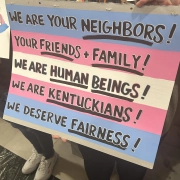






 Photo Credit: Creative Commons