
QUEER KENTUCKY | KENTUCKY'S ONLY LGBTQ+ NEWSROOM

Tag Archive for: lgbtq

A person wearing a black Pride t-shirt reading "Let our trans kids live to become trans adults" at a community gathering in Kentucky

Anti-Trans Teacher Amendment Fails in Kentucky’s 2026 Legislative Session

FRANKFORT — As anticipated, a last-second attempt to keep transgender people from teaching in Kentucky has failed.

Kentucky lawmakers wrapped up the bulk of their 2026 legislative session late Wednesday night, going home without bringing up House Bill 759 — a previously uncontroversial bill around alternative teaching certifications that got a late floor amendment that sought to block trans people from teaching altogether. 

Wednesday night was the deadline for Kentucky’s Republican-dominated legislature to pass any bills that Democrat Gov. Andy Beshear may veto in order to have enough time to override him during the final two days of session later this month.

It is possible HB 759 can come up for a vote during those last two days, but the amendment is still expected to be withdrawn prior to a vote on the unchanged bill. If the amendment somehow gets through, Beshear is likely to veto it and lawmakers would not be able to override him.

With the amendment’s failure, 2026 marked the first legislative session in a few years without any new anti-LGBTQ+ laws in Kentucky. 

Kentucky lawmakers filed nearly a dozen pieces of legislation this year aimed at the LGBTQ+ community, including restricting health care access, blocking trans people from using restrooms tied to their gender identity in government buildings, and limiting drag shows and performers. Almost all of them did not move in the legislative process. 

Sen. Gex Williams, R-Verona, initially filed the anti-trans teacher bill in early March as Senate Bill 351. It sought to keep trans people from getting and keeping teaching certifications, requiring anyone reported as potentially being trans to undergo medical exams and to provide those results to state education officials in order to stay in the classroom. 

Health professionals would’ve also been required to use outdated psychological terms and criteria to diagnose those who are trans, potentially meaning labeling them as “mentally ill” despite modern health standards disagreeing with that assertion. 

SB 351 did not move in the legislative process, and Williams withdrew the bill last week. He quickly filed the same language as a floor amendment to HB 759 in hopes of passing it there. 

Filing an existing but failing bill as a floor amendment is a legislative maneuver called piggybacking, and it is against the Senate’s rules. Sources repeatedly confirmed to Queer Kentucky that the Senate planned on enforcing those rules and Williams would either withdraw the amendment or it would be ruled out of order. 

When lawmakers gaveled in Tuesday, they were quick to take HB 759 off of the consent calendar where it was scheduled for a quick and easy vote, but they never added the bill to the orders of the day so it could get a full floor vote and so the amendment could be formally axed. 

Other resources to stay informed:

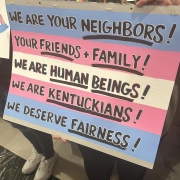
The image shoes a poster made of the colors of the trans pride flag and it reads "We are your neighbors, your friends and family, we are human beings, we are Kentucky, we deserve fairness"

SESSION IS OVER: Costly crime bill to become law, anti-DEI bills officially dead for now

Today is the infamous sine die, which is the action that officially ends this legislative session. This legislative session has included at least 14 anti-LGBTQ+ bills, with anti-DEI bills being particularly publicly controversial. Of all of the bills, only 1 of the anti-LGBTQ bills passed. 

House Bill 5, a broad-reaching crime bill, will become law despite Gov. Andy Beshear’s veto. HB 5 has been opposed by statewide and national advocacy organizations including the Fairness Campaign and the American Civil Liberties Union. Also profiled by both organizations were HB 9 and SB 6, anti-DEI bills that were dead, resuscitated at the last second, and then left to be gasping for air again. This is to say they did not pass for now, but the sponsors of these bills seek to continue advocating for this kind of policy.

Additionally, as reported by McKenna Horsley with the Kentucky Lantern, the Senate did concur with a House floor amendment to Senate Bill 191, a postsecondary funding bill, that would prohibit the use of “any race-based metrics or targets in the formulas” for the higher education funding model. 

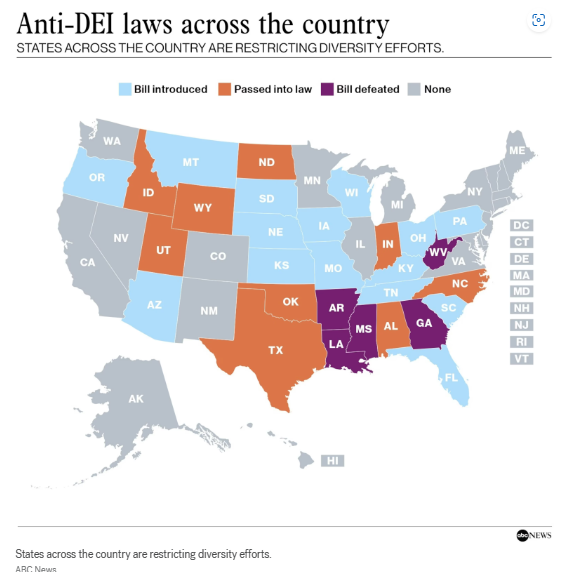
This was one area where anti-DEI language was able to be quietly implemented, which follows a national trend of conservative politicians restricting DEI efforts (below).

There were many developments with SB 6 and HB 9, the anti-DEI bills of this legislative session. SB 6 was infused into HB 9 by Rep. Jennifer Decker, R-Waddy, without consulting the sponsor of SB 6, Republican Whip Mike Wilson of Bowling Green. 

This action caused controversy within the Republican Party, as they could not agree on the constitutionality of Rep. Decker’s more regulatory and extreme additions. The Senate did not go along with the sweeping changes made in the House, causing the clock to run out on the possibility of sweeping anti-DEI legislation in the 2024 legislative session. 

The bill that will become law was HB 5, which proponents called the “Safer Kentucky Act.” Opponents say it criminalizes the poor and unhoused, dubbing it the “Suffer Kentucky Act.” 

The Kentucky Center for Economic Policy did an analysis of HB 5, giving 5 leading effects of the potential law:

  1. Increases criminal penalties for fentanyl in numerous ways
  2. Criminalizes Kentuckians for being poor and unhoused
  3. Creates harsher penalties for violent crime that do not make us safer and are not an appropriate response to current conditions
  4. Expands felonies, enhances penalties and restricts personal liberties, among other provisions
  5. Spends a large amount of state and local financial resources on these tried and failed approaches to public safety

LGBTQ+ communities already have “higher rates of poverty, lower rates of home ownership, and higher rates of homelessness” according to the Williams Institute at UCLA School of Law. 

As well, LGBTQ+ communities “face widespread discrimination in housing, mortgage lending, and homeless shelters and services.” 

These compounding impacts of discrimination and marginalization have a greater impact on Black, Brown, and Indigenous members of the LGBTQ+ community, as well as people identifying as LGBTQ+ and living with disabilities. 

Further, the Trevor Project reports the key findings on how homelessness and housing instability are tied to queerness,

“Nearly half (44%) of Native/Indigenous LGBTQ youth have experienced homelessness or housing instability at some point in their life, compared to 16% of Asian American/Pacific Islander youth, 27% of White LGBTQ youth, 27% of Latinx LGBTQ youth, 26% of Black LGBTQ youth, and 36% of multiracial LGBTQ youth. 

Homelessness and housing instability were reported at higher rates among transgender and nonbinary youth, including 38% of transgender girls/women, 39% of transgender boys/men, and 35% of nonbinary youth, compared to 23% of cisgender LGBQ youth.”

The Nation published an article covering Kentucky’s HB 5, and in that article the “Safer Kentucky Act” was referenced as the “cruelest criminal-justice bill in America.”

HB 5 was publicly opposed by more than 100 Kentucky groups, urging lawmakers to reject the bill. The legislation will cost Kentucky more than $1 billion over a decade, and much of that cost would come from the finances to require longer prison sentences. 

If Kentucky was a country, it would have the 7th highest rate of incarceration in the world. The international scale of Kentucky’s high rate of incarceration was in a report by the Prison Policy Initiative, shared in 2021. This bill will only further populate Kentucky’s already chronically overpopulated jails.

With the amount of public controversy around this bill, more information regarding the source of the bill was requested. A Kentucky Public radio analysis exposed that many of the sources provided as support for this bill are from a policy report in Georgia, not Kentucky constituents, policy writers, or community members. Further, multiple writers of the quoted sources claim that their academic work was used out of context for political gain.

Pin It on Pinterest