KEEP. Story type. Exactly one per story. One person or org at the center.

Tag Archive for: Type: Profile

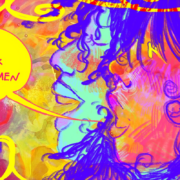
Illustration by Kami Pankey of two faces in profile with a speech bubble that reads Protect Black Trans Women

“We Don’t Need Allies That Are Going to Wave a Flag”: A Trans Leader on What Real Support Looks Like

This story first appeared in Queer Cincinnati: Beyond the Binary, published Oct. 23, 2026.

For many transgender Ohioans, recent legislation has reshaped the conversation around healthcare, education, and safety. At the center of these conversations, with a central mission to provide facts around these sometimes confusing subjects, is TransOhio. In the summer of 2026, I conducted an interview with Dara Adkison, the Executive Director of TransOhio, a nonbinary, genderqueer, trans-masculine person who previously served on the TransOhio Board of Directors for two years.

What was the driving force that led to the start of TransOhio?

TransOhio has been around for 21 years in a variety of different iterations. We started in 2005 when there wasn’t a trans organization in the state. We started off as a Zine actually, providing resources, community spaces, and message board kind of stuff. It was a place for different kinds of voices to be heard. We started making zines again recently. We have a rolling admission for when we have enough submissions to put together something cool.

What are some of the tangible ways in which you’ve been able to carry out your mission of protecting and advancing the rights of trans, nonbinary, intersex, and gender nonconforming people in Ohio?

We are hard focused on what is tangible. We don’t do performative at TransOhio. We have a longstanding (over 10 years now) legal clinic for anyone who needs care, all free for any trans person who needs it. We’ve helped over 4000 trans people in Ohio with name changes and gender marker changes. We also have an emergency fund which has exponentially scaled in the last two years. We provide emergency help for people who reach out and might be in a dangerous situation. We have recently passed out $250,000 out to our community statewide. If people are trans in Ohio and are in need of help, we’re gonna help them.

TransOhio’s vision mentions wanting to increase lesbian, gay, bisexual, heterosexual, and ally understanding/cultural awareness of the Ohio transgender community. In your eyes, what does being a good ally to the trans community mean today?

I think that being an ally today is not being afraid to stick your neck out. We don’t need allies that are going to wave a flag, but then be silent when they see a trans person getting yelled at on the street. We don’t need allies that will wear a love wins pin, but then when they see the gender expansive person at their job getting discriminated against they don’t say anything. We need people to be vocal in those small moments that are very large for the people being directly impacted by them. We need people to be vocal with their legislators. That’s where I see allyship.

Your brochure mentions advocating for laws and policies which best protect our most vulnerable community members. In what ways do you advocate for those with intersecting identities, especially when factors other than transphobia (like racism and sexism) are sometimes still very present within trans communities?

At TransOhio, whenever we ourselves are running a program or partnering on an event, we do everything we can to not just make the spaces inclusive, but welcoming. We are very intentional about making sure people from a variety of intersecting identities are in our leadership, and also in the room when we are figuring out plans and programs. As a white trans leader, I am personally very vocal about making sure doors are open. You won’t find me doing an all white panel.

The Cleveland clinic recently agreed to a 20 year ban of gender affirming treatment for patients under the age of 18. This includes puberty blockers, hormone therapy, and other treatments. You’ve made efforts to put out many facts about this settlement. As there are unfortunately more laws being put out very similar to this settlement, how do you counteract the ambiguity? How do you lessen the confusion surrounding them?

Our main tactic for lessening confusion is to try and put out as much correct information as possible. We kind of consider ourselves the disinformation assistance for trans people in Ohio, because we are always going to say what’s correct. I know that can sound a little obnoxious, but we put a lot of time and effort into making sure we are sharing correct information. We also know how much people trust us to be giving them correct information.

For the Cleveland clinic stuff, our main conversation moving forward is what we can do about it? HB68 is still in active litigation, but even if that litigation ends up going our way, then we now have this settlement in place that will affect Cleveland clinic in perpetuity for 20 years. There’s nothing that the courts can do about that. What we can do is make Cleveland Clinic look like idiots for complying in an effort to have no other hospital want to comply excessively in the way that they have. They did not NEED to make this settlement. We don’t want our hospitals caving into the Department of Justice, not about trans healthcare, and not about anyone’s healthcare. Coming back to talking about things good allies can do: Allies who have financial power are the ones that end up getting listened to. This is a great moment for those people to step up and talk to the hospitals and say that we don’t want this kind of compliance. The Cleveland Clinic has made a very intentional choice about who they want to be as a medical leader, not just in Ohio but globally, and they should be shamed for it.

Do people often reach out to your organization for clarity regarding these things? If so, in what manner?

I think it depends what kind of clarity folks are looking for. We definitely have a fairly substantial social media footprint. Regardless of my personal opinion of social media, it is still a very efficient and active way of getting information out, especially in some more rural areas. When we’ve had complex bill conversations, we’ll have discord sessions for open community discussion about potential impacts, potential contingency planning, and generally just answering questions. People also reach out to us with more personal questions. You can reach out via email, messenger, and different chats on various platforms. We don’t recommend approaching myself, or any of our board members if you see us just trying to exist as a queer person out in the world please. Our main inbox [email protected] is a good one.

Aside from the plethora of information that your own organization provides, what other organizations or resources do you often find yourself recommending to trans individuals struggling with staying informed about their rights?

In Cincinnati specifically, Transform provides some really fantastic support services, groups, social programming, or even their free closet. Trans Masc Cincy is [another group] really focusing on trans youth. They have some really great support groups for masc presenting folks. In terms of other places for staying on top of the ever-changing landscape of things, Advocates for Trans Equality (A4TE) nationally advocates for trans rights. They have great information, particularly other kinds of guides existing outside of Ohio. If folks were born in other places sometimes we will send them over to A4TE’s guides.

In your mission you also mention providing social activities that are inclusive and foster pride in the Ohio transgender community. What can someone who might be anxious about attending these events expect from them? What’s a specific and successful activity that you’ve put together?

We are in the 27th year of our annual gathering, the TransOhio Symposium. We are actually having it in Cincinnati this year for the first time. It’s the gathering of about 200-400 trans people over the course of a weekend. It’s a really unique kind of environment. There aren’t a lot of other opportunities to have a social and informational sharing community meal with that many other trans people. When we’re looking at what a successful symposium would look like, it sometimes can be very overwhelming. We have people that come and it’s their first time presenting as themselves in a community space. We have people who it’s their first time meeting other trans people. We have folks who drive in from other states with a parent or friends because they don’t have anything like this near them. We really take responsibility in knowing the kind of safe space that we’re trying to create. It’s all community and trans driven. There’s always a lot of food and quiet spaces. It’s super accessible for people to just relax and take a sec, and you can come and go as you please. This is a core program for us and a major undertaking.

With this magazine we are focused on reaching trans youth. What personal advice do you find yourself giving to trans youth that are particularly struggling with fear and acceptance right now?

I don’t think there’s one perfect thing to say, just because everyone’s experience with their understanding of their gender is so different from person to person. Speaking personally for what I would have said to my younger self is that being unapologetic sooner is extremely freeing. For people that don’t have accepting families it can be so complicated, but giving yourself permission to exist with multiple feelings at once is also okay. You can be frustrated with a parent, and also love them, and also want to be respected, and also be okay with having all those complex feelings and knowing exactly who you are at the same time. It doesn’t have to be binary, just like our genders don’t have to be binary. It’s okay to give yourself permission to evolve and grow and change. I would also strongly encourage reading queer history, because I know I didn’t learn ANY in school. My three favorite quick crash course recommendations would be “Saving Our Own Lives”, “Queer Trans and Mostly Black: a Mutual Aid Story from the Last 50 Years”, “Black on Both Sides”, and “Before we Were Trans”.

A field of corn glowing in the sun.

At Black Soil KY’s Farmacy Markets, Narcan Sits Beside the Produce

From the war on drugs to the legacy of the crack era, Black people in the U.S. have been systemically and perpetually harmed by both drug use and public health disparities. That sobering reality is also true in Kentucky, where a Lexington nonprofit is working to build safer futures by changing how support is delivered, integrating harm reduction into already effective agricultural programming.

“We are trying to think outside of the box around crafting unique, one-of-a-kind programming while providing a critical community need,” said Ashley C. Smith, Executive Director and Co-founder of Black Soil KY.

Established in 2017 by Smith and her husband, Trevor Claiborn Sr., the organization’s mission is to “reconnect Black Kentuckians to their heritage and legacy in agriculture” through programming, events, and community building.

From food access to harm reduction

Since its founding, Black Soil KY has worked with farmers and community partners to host events that make agricultural education and fresh food more accessible to Black communities across the state. While the organization was effective at increasing access and education around food, Smith saw an opportunity to develop programming rooted in the idea that drug abuse, food insecurity, and public health are intersectional problems that demand intersectional solutions.

In 2023, the number of drug overdose deaths in Kentucky declined for the first time since 2018, according to the Kentucky Injury Prevention and Research Center, but not every community felt that progress. That same year, Black Kentuckians experienced an 8% rise in overdose deaths. More broadly, Black people in America are 46% more likely to die from a drug overdose compared to other groups, the U.S. Department of Health and Human Services reports.

The opioid crisis is not the only harm felt more intensely by Black communities in the state. Kentucky currently ranks as the state with the second-highest rate of food insecurity in the country, the Kentucky Center for Economic Policy reports. Data indicates that Black communities across the state are nearly twice as likely to be food insecure, compared to White Kentuckians, according to Feeding America.

These are the disparities that Black Soil KY intended to close with a new approach to community care.

In 2024, in partnership with The Foundation for a Healthy Kentucky, a nonprofit that works to reduce health disparities while promoting health equity across the state, Black Soil KY acquired funding from Vital Strategies, a global public health organization, to begin integrating harm reduction into its already effective portfolio of programming.

Harm reduction is a spectrum of strategies that are intended to minimize the harmful nature of drug use. Such strategies include providing clean syringes, sexual health testing, contraceptives, fentanyl testing strips, counseling, mental health support programs, and more. Harm reduction aims to minimize the harmful effects of drug use rather than ignore them.

First, the organization went to the farmers. In 2024, the nonprofit trained 30 small and mid-size farms on harm reduction, including signs of overdose, Narcan usage, and how to respond to the substance abuse they might come across in their work. The organization saw farmers as a priority because of how inseparable their work is from the communities they serve, and how intrinsically connected they are to an individual’s well-being, according to Smith.

“We trained Kentucky small- to mid-sized farms: farmers, farm operators, and their families around how to be harm reduction first responders,” Smith said. “They oftentimes live in rural communities, but travel to urban communities to make deliveries… And we were hearing stories from farmers who make deliveries in communities afflicted by substance use and abuse disorders.”

After they built the training model for farmers, Black Soil KY expanded their harm reduction programs into their other community-centered events. In 2024, the group first began including harm reduction supplies as part of their free food distribution in Central Kentucky. After seeing the success of these resources, Black Soil KY opened two neighborhood “farmacy market” locations in Lexington in 2025.

The “farmacy markets” were a first-of-its-kind concept, providing harm reduction supplies and educational materials right alongside fresh food directly within communities. Alongside fresh produce, these markets provide communities with tampons, condoms, and harm reduction necessities, including Narcan and fentanyl testing strips.

“All of these steps, these multidisciplinary, interdisciplinary approaches are really seeing people for who they are and meeting them where they’re at, while also increasing their recovery capital around their nutrition and their health and their wellness,” Smith said.

This year, the organization launched its “Shop N’ Learn Community Series,” a partnership with Vital Strategies and the Kentucky Department of Public Health, part of a broader effort to combat rising overdose rates among BIPOC and underserved populations. The monthly event is “focused on expanding awareness and implementation of harm reduction strategies to often overlooked, hard-to-reach, underrepresented communities in relation to harm reduction and recovery care.” Individuals who attend a “Shop N’ Learn” event also receive a $40 gift card.

The series has been hosted in part by guest speakers, who share their own testimonies and expertise around recovery and healing.

“I am from the community, and I had an opportunity to go share my lived experience with the same community that I was brought up in — as terrifying as that is for me being only three years sober,” said Tywanna White, a recovery coach with Voices of Hope, a recovery community center in Lexington. “I said yes to an opportunity to be able to carry the message. The people in the audience had so many questions, and I was able to educate them on some things that I was taught from this same community.”

White was one of the featured speakers at a “Shop N’ Learn” event in June. According to White, this programming is exactly what it takes to dismantle health disparities facing Black Kentuckians.

“Seeing those faces looking right back at me wanting to be open, it shifted something. It told me that there’s a need for this…” said White. “I didn’t have any voices trying to help educate me on my substance use. It was so normalized. So no one even knew that I was struggling because it’s so normalized in the Black community.”

According to Smith, around 10,000 community members showed up at their events in 2024 and 2025. The impact, beyond attendance, speaks for itself. Smith said attendees of their programs report progress.

“We’ve really been able to see a lot of positive outcomes like reducing interpersonal and inter-communal violence,” Smith said.

Civic engagement as harm reduction

This programming is just the beginning of how Black Soil KY plans to build deeper inroads across communities that need care. Civic engagement is among the many solutions Black Soil KY is exploring to heighten awareness of health disparities.

In 2024, just 48% of Black Kentuckians voted in the general election. That is compared to over 70% of White Kentuckians. There is a growing body of research pointing to a strong correlation between civic engagement and public health: The more engaged a community is, the healthier they are. Black Soil KY identified these disparities and created new programming to empower Black communities in Kentucky to have a stronger say in what policies and people are given a platform.

In September, Black Soil KY, in partnership with the Lexington Urban League Young Professionals, a network of young professionals advancing public service and professional development, is exploring how civic engagement will take center stage as a new harm reduction topic in their “Shop N’ Learn” series.

For the first time, the workshop will focus on how to participate in elections and the importance of voting. The workshop will bring folks together who have overcome or are currently working through substance abuse, and support them in getting registered to vote while providing educational materials on the choices they have in November.

“We can really facilitate getting everyone active and engaged. And we truly believe that’s also a part of harm reduction: being active in your community,” said Smith.

Black Soil KY’s programming has become a staple in communities, with leaders celebrating how the organization addresses both a person’s material needs while safeguarding their emotional and physical well-being.

“A person wants to be heard, they want to be seen, they want to feel like they’re human. And so it starts with getting to know the people off paper, knowing what it is they need at that moment, and then focusing on removing the substance later…” said White. “I think it’s a beautiful thing to incorporate harm reduction in these same communities where harm happens and also center it around food. That is the medicine.”
This work was supported by the 2026 CNP Media Fund. #CNPMediaFund

Mercury Stardust leans over a wooden table with a toolkit, holding a hammer, and wearing an apron that say "HANDY MA'AM."

Homeownership Is Radical, Says Mercury Stardust. Her Book Tour Hits Louisville Oct. 8

As trans people continue to be the topic of political ads and legislative attacks, one author delivers a powerful account of how homeownership can be one of the community’s most powerful pathways to liberation, including right here in Kentucky.

“One of the most radical things that we can do is take up space,” said Mercury Stardust, an author, speaker, DIY educator, and content creator. “For trans people specifically, we minimize ourselves for our own safety. We try to make sure that when we go out, we’re always with friends, or we’re only going to places that have safe bathrooms. We almost try to take ourselves out of society for our own safety.”

In Stardust’s brand new book, “Lost and Found: A Compassionate Guide to Homeownership,” she challenges this minimization by demystifying the path to owning your own home.
“Homeownership looks different for every single person,” said Stardust, also known to her millions of followers as the “Trans Handy Ma’am.” “And because people who are within the queer community, especially the trans community, might feel extra layers of marginalization, it can often feel like an impossibility to have a home of any kind. But homeownership is no longer the picket white fence with a two-acre yard and a dog named Lassie. Homeownership now looks different for everybody.”

From Repair Videos to a Homeownership Guide

In 2021, Stardust began her journey as a content creator focused on the support she wished was accessible to her. Stardust started making short-form videos primarily answering home maintenance questions from viewers who felt too afraid to ask these questions anywhere else, including women, trans people, and queer people. With over 15 years of experience in the maintenance field, Stardust’s compassionate guidance took off.

Stardust’s new project is a continuation of her 2023 New York Times bestseller, “Safe & Sound: A Renter-Friendly Guide to Home Repair.” The 2023 project was primarily focused on how renters can safely and autonomously accomplish home repair and renovations, while this second book is all about the process of owning your own place. According to Stardust, the books are designed for anyone who feels like they can’t find the support they need to feel safe in their home, for trans people, queer people, single moms, and countless other readers who are looking for more compassion in the rental or homeownership process.

Mercury Stardust’s Louisville Book Tour Stop Is Oct. 8

Starting in mid-September, Stardust took to the road to promote her new book project in nine cities across the country. From Seattle to Atlanta to Salt Lake City, Stardust is meeting readers at libraries and local bookstores for conversations about how her new project can support a new generation of queer homeowners.

On Oct. 8, Stardust’s tour comes to the Northeast Regional Library in Louisville, Kentucky. Stardust made it clear that stopping in red and purple states like Kentucky was a priority. Bringing her story to places where trans people are forced to feel small is in part what keeps her writing.

“I think it’s important to bring this community that I developed around kindness and compassion to all places that I’m able to,” said Stardust. “Let’s go to places that aren’t traditionally friendly to the LGBTQ community, and let’s make sure that we uplift those communities because we almost exclusively do these tours with independent bookstores that are queer-focused. So if we’re able to connect people with their local communities through the bookstore and libraries, that’s building an infrastructure that can strengthen those communities.”

Stardust’s new book revolves around her own lived experience of purchasing a home and creating a space that felt like her own. In the book, she unpacks how readers can navigate the same process that she felt alone in, from offers to inspections to renovations, and closing. Stardust hopes readers leave her writing feeling more prepared to build the futures that they deserve.

“My message to people who are like, ‘that can never be me,’ is to redefine and reexamine what homeownership might look like in the 21st century,” said Stardust. “As someone who never thought that she would see herself being a homeowner until just a couple of years ago because of my first book. You just really never know. And if an opportunity lands in your lap, I hope you’re ready for it.”

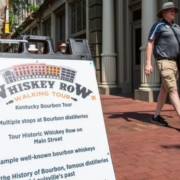
A Whiskey Row Walking Tour sandwich board sign on a brick sidewalk in downtown Louisville as a man in a sun hat walks past.

Whiskey Row Walking Tour: Louisville Native Drew Shryock Shares Bourbon, History, and Pride

Whiskey Row Walking Tour founder and owner Drew Shryock is a lifelong Louisvillian, a proud gay man, and a bourbon lover. He also considers himself a community builder, especially after spending 22 years working for Louisville’s Economic Development Department. Now retired, Shryock knows his city inside and out.

Shryock leads tourists through the city’s historic Main Street, celebrating the culture, the people, and the places that make Louisville unlike anywhere else in the country — or the Commonwealth. He’ll also tell you, with a grin, that Kentucky makes about 95 percent of the world’s bourbon.

“There are a few other states that make the other 5%, but we call that artificial bourbon,” he says, “because we make the real thing here in Kentucky.”
Culturally and fiscally, bourbon is a staple for the Bluegrass state, as Kentucky Bourbon remains a key and substantial contributor to the state’s economy, with a $10.6 billion industry supporting nearly 24,000 jobs. Personally, for Shryock, his love of the craft started from a young age. He fondly remembers Sunday family dinners with his mother and grandmother, who sipped highball cocktails while preparing the meal.

“One time I asked my mom, ‘Can I have a sip of that?’ She said, ‘Yes, you can have a little sip.’ And that was my first exposure to bourbon. And I fell in love with it. I hate to say that, but I did,” he tells Queer Kentucky.

He believes he came by his now-matured love of the spirit naturally.

“If you’re born in Kentucky, bourbon’s basically in your blood. It really is,” he says.

How the Whiskey Row Walking Tour Started

After leaving the workforce, Shryock took time off to recover from his 9-5 days. After about 6 months, he started helping out as a driver for visitors on the Kentucky Bourbon Trail. He enjoyed meeting folks from all over and hearing their stories, but he also found that distillery visits weren’t always a guarantee.

“People would say things like, ‘We tried to get into such-and-such distillery downtown, but it was full, and we couldn’t get in. We tried to go to this distillery, and it was full.’ So, I kept thinking: there’s got to be an [easier] way I can take people into these distilleries,” he says.

So, he tried something new.

“I met with several distilleries individually. I basically cold-called them. I explained who I was, my history with bourbon, my history with the city…and asked them if they would be interested in being part of my walking tour downtown. And that’s when I came up with the concept of the Whiskey Row Walking Tour in downtown Louisville,” Shryock says.

As his knowledge grew, so did his love of the craft.

“Going to the distilleries, meeting the people who work at the distilleries, and getting to know some of the master distillers at the same time…sparked my passion,” says Shryock.

What Happens on the Tour

The Whiskey Row Walking Tour has now been operating for more than four years. Intimate groups of up to twelve people gather at the Kentucky Bourbon Trail gift shop inside the Frazier Kentucky History Museum to start. From there, he leads the group on a two-hour stroll down Main Street – better known as Whiskey Row. Guests sip their way through some of the city’s most iconic pours, including tastings at Bardstown Bourbon Company and the Evan Williams Bourbon Experience, the first distillery back on Whiskey Row since before Prohibition.

He acts as a conductor of stops and stories along a theoretical railroad (or, just about six blocks or so) of distillery stops, allowing each business’s guide to take center stage during tours. He fills the in-between time with jokes, fun facts, and a few tricks.

Shryock also turns Main Street itself into the lesson. He tells guests about how Louisville is home to the country’s second-largest collection of cast-iron storefronts, and walks guests past the sites of former distilleries.

“I wear a name tag that’s a magnet, so I’ll take the magnet off my name tag, walk right up to those cast-iron buildings, and it adheres right to the middle,” he says.

“When I take my magnet off and put it on the cast-iron metal, they just go crazy,” he adds with a laugh.

After a few pours and countless inside stories, the tour ends in the pre-Prohibition heart of Whiskey Row, between Brook, First and Second streets, where names like Old Forester and Pappy Van Winkle’s W.L. Weller & Sons once operated until being shut down in 1920. By the last stop, the group that started out as strangers usually leaves as friends, with a new appreciation for Kentucky’s favorite spirit and the city that made it famous.

“You take a group of complete strangers, and they’re all enjoying each other’s company by the end,” he says. Of course, the bourbon helps, he jokes. “Once we do that first tasting, barriers start melting… And by the time we do the second and third tasting, you would think they were all friends. That’s what I love about it.”

Showing Up as Himself

When meeting folks from all over, Shryock says he may run into guests who don’t always agree with his “lifestyle” or sexual orientation. But that does not stop him from being authentic in how he shows up.

“Not everybody has to accept you. You have to accept yourself first,” he says.

He hopes to encourage folks to confront their biases, simply by spending time with him on a tour.

“I’m very proud of who I am as an individual. And I’m very proud of my sexual orientation,” he tells Queer Kentucky. “The more exposure we have around [other kinds of] people, the more walls get broken down… So they say, ‘This is a good tour. I really liked him. Maybe I need to start reevaluating some things in my life, the way I view people.’”

As for Bourbon & Belonging and its importance, the idea of belonging is what is most important to him. Shryock says it’s reassuring to see more safe spaces being intentionally created for queer folks. In the 80s and 90s, Shryock recalls gay-owned bars acting as safe havens for him and his gay friends.

“That was really the only safe space where we could gather without the fear of being harassed, or some type of physical violence happening to you…We knew there was safety being there, and we all kind of had each other’s back,” he says.

He appreciates how queer people can exist without as much ridicule, but still recognizes there is work to be done.

“Thank goodness it isn’t how it used to be,” Shryock says.

The Whiskey Row Walking Tour runs from Friday to Sunday, October 2nd-4th. You can book your spot here.

Shryock is most excited to expose more folks to his favorite city: “As a native Louisvillian, I’m very proud of our city, and I love to show it off.”

Disclosure: Bourbon & Belonging is produced by Queer Kentucky.

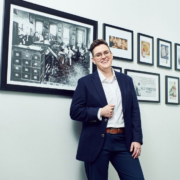
Old Forester Master Taster Melissa Rift in a suit, leaning against a wall of bourbon plaques.

Old Forester’s Melissa Rift Took the Long Way to Master Taster, and Found Belonging in Bourbon

From her back porch in Louisville, Old Forester’s Master Taster Melissa Rift guided me through how to enter the world of bourbon. She suggested starting with cocktails, like whiskey sours and highballs, then working up to lower-proof pours in the 80-90 proof range. She said that while her personal favorite pour changes with the seasons, she’s come to appreciate the art of drinking on the rocks and is usually either drinking a 100-proof bourbon or rye these days.

She shared a trick she learned from Old Forester’s Master Distiller Chris Morris, where you use small ice cubes with a double pour, so the drink gets slightly slushy. The result, she said, tastes similar to sweet tea.

Rift’s knowledge of and passion for bourbon are palpable, and it’s clear why the country’s first brand to bottle bourbon chose her to be its primary storyteller. However, her path to master taster was not a direct one.

Melissa Rift’s Unconventional Path Into Bourbon

While Rift was born in Louisville, she spent her formative years in North Dallas. She returned to the Bluegrass State in her 20s for a master’s degree in social work and marriage and family therapy from the University of Louisville. Although her studies focused on counseling, a few side gigs and some time spent exploring the Bourbon Trail changed the trajectory of her career.

“Accessing bourbon by way of the Bourbon Trail was just a recipe for sucking me into [the industry] because it totally spoke to what I loved,” said Rift.

With a newly sparked interest in bourbon and a need for extra cash, Rift started taking work that kept her close to the industry. She drove Louisville’s Thirsty Pedaler and bartended at a brewery. Eventually, she landed a role as a distillery tour guide, which quickly became full-time, launching a career in bourbon.

Over the following years, Rift built a diverse set of skills. She became deeply familiar with the history of bourbon, learned about brand management and even launched a single barrel program, which deepened her understanding of production and tasting.

“I had gained this unique skill in being able to translate the technical side of bourbon to all audiences,” said Rift. “Because I had just fallen into the industry and done all these different things over the course of seven to ten years, I was well suited to step into the master taster role.”

Rift became Old Forester’s master taster in November 2022, a role combining all the pieces of her unconventional path through the industry. According to Rift, the role of master taster marries the technical side of whiskey production with brand education and consumer experiences.

When talking about her place in bourbon, Rift said she’s thankful for those who came before her.

“By the time I get engaged in the industry, there is a lot of equality happening. There’s a lot more women in the workforce. There’s a lot more interest in diversifying who you have working on your brands to be able to speak to different audiences,” said Rift. “I always say, especially, from a women in the workplace perspective, there was definitely one, maybe two cohorts ahead of me that really kicked the doors down.”

While Rift credited the cohorts ahead of her with kicking the doors down, she continues to widen that gap. Rift has been out for her entire career, speaks openly about her family and identity, advocates for inclusivity and is vocal about what she expects from employers. Overall, Rift said she’s been able to work around and among many like-minded people, and said she’s found that the bourbon industry today is a welcoming and surprisingly gay place to be.

What Bourbon and the Queer Community Share

For Rift, the connection between the bourbon industry and the queer community runs deeper than a shared love of Kentucky’s signature spirit.

“Bourbon’s all about storytelling. If you think about the way the queer community thrives and survives, it is by way of storytelling. That’s like how we exist. It’s how we carry traditions forward,” said Rift. “Resilience is also a theme that is shared between bourbon and the queer community. There’s so many parallels you can find in the way that bourbon has existed, that queer people have existed.”

Rift’s own unconventional path into the industry plays into that idea of resilience, and proves that there’s not a right way to enter the world of bourbon. For her, bourbon is all about the stories and traditions people carry forward, and the communities built along the way.

See Melissa Rift at Bourbon & Belonging

Old Forester will host the Whiskey Row Garden Party on Friday, Oct. 2, from 6:30 to 8:30 p.m. at 119 W. Main St. in Louisville, with seasonal cocktails, hors d’oeuvres and live music on the rooftop terrace. The event is free, but capacity is limited. Details and RSVP at bourbonandbelonging.com.

Bourbon & Belonging: Kentucky’s Queer Bourbon Week will take place October 1-4, 2026, across Kentucky. For the full slate of events, visit bourbonandbelonging.com.

Disclosure: Bourbon & Belonging is produced by Queer Kentucky, and Old Forester is a sponsor of the event. Melissa Rift is a former member of the Queer Kentucky board of directors.

Related Stories

Seymour Hiney performs at a Smoke & Queers queer burlesque show in a sequined outfit with red fringe, arms raised on stage.

Smoke & Queers: How a Queer Burlesque Troupe Built a Stage for Everyone Else

There is a performance troupe where the rules are simple: You have to be queer. You have to be courageous, or at least act like you are. Why will you need that courage? Well, to take your clothes off, of course. Oh, and you can’t use any real flames in performances – purely for safety purposes. This stage is called Smoke & Queers, a queer burlesque performance troupe that has dazzled audiences in Cincinnati and Northern Kentucky since 2019.

The tease-filled concept numbers, the rhinestone costumes, the steamy reveals, and the reclaimed bodies are a result of those rules. Smoke & Queers, which showcases burlesque, drag, and draglesque, is preparing for the Rhinestone Rodeo on October 3rd at Second Sight Spirits in Ludlow, which is part of this year’s Bourbon & Belonging Kentucky’s Queer Bourbon Week. We sat down with four of the troupe’s producers to talk about group origins, what the stage gives back to them, and why an art form built on undressing has always had far more to say than anything about bodies, alone.

A Short History of Burlesque, and Why Queerness Was Always Underneath It

To understand what Smoke & Queers is doing, it helps to understand the history of burlesque. That history, however, is less agreed upon than many would think.

The simplified version taught in many dance history classes points to Aristophanes, the ancient Greek playwright, as the father of satire and comedy, which ties directly into the word burlesque’s meaning: a literary or dramatic work that mocks a serious subject through comic imitation, or a style of variety show entertainment featuring comedy, dance, and striptease. His shows poked fun at serious matters, in the way that today’s burlesque performances can act as political statements. Burlesque historian and performer Bella Sin, who has spent years researching and rewriting the way this art form’s history gets told, pushed back on that origin during a lecture at the Ohio State Library Archives in May of 2025.

Instead, she traced its roots further but also wider, to ritual dance in ancient Sumer, to fertility rites among the Mexica people of Mexico, to Japanese legend involving a goddess who strips and dances to tease a deity out of hiding, and to Vaudeville, the Parisian variety show tradition that exploded across the United States and the rest of the Americas by the 1800s.

Lydia Thompson is frequently credited as the woman who brought burlesque to the United States when she toured with her troupe British Blondes in the 1860s, scandalizing audiences by wearing flesh colored tights and showing bare ankles. (Those audiences would never survive a Smoke & Queers show.) But burlesque already existed in the U.S. before she arrived. What Thompson actually did was confront the controversy around her show unapologetically, which is arguably what has kept burlesque relevant today.

Queerness runs through this same history rather than sitting beside it. Drag and burlesque have been intertwined for as long as either has existed as a formal tradition, sharing performers, stages, and aesthetics. Hedy Jo Star, a trans burlesque performer and author who was publicly open about her transition in the 1950s, performed for years in the traveling Jewel Box Revue. She later became a costume designer whose work helped define the rhinestone-heavy look burlesque and drag are known for today. Sin said queer nightlife scenes in Mexico, France, and Germany overlapped heavily with burlesque circuits, and plenty of performers throughout the twentieth century were queer even when it was not safe to say so publicly.

By the 1940s, moral panic and anti-obscenity laws had pushed burlesque out of the mainstream and into the smaller, underground and fringe corners of American entertainment. The revival that followed in the 90s and early 2000s is usually called neo-burlesque, and it is the direct ancestor of the scene Smoke & Queers belongs to. This movement brought the tease and the theatrics back into the light, while also opening the door for a much wider range of people to define what the art form could be: performers of every size, race, gender identity, and sexuality. As burlesque researcher Alyssa Stover of Ohio State University’s Dance Department put it, at its core, it is about more than a striptease. It is about curating a safe space and bringing together people who have been cast down and cast out elsewhere in society.

The Performers

Salem Le Fay (she/her) describes herself as witchy, unbothered, and incredibly seductive. She has been a performer her whole life in one form or another, and has been building her burlesque persona for almost four years now. She also genderbends into The Baron, a drag king alter ego with his own pronouns, he/they, and his own vibe, proof that Salem’s magic transcends genres.

The ethereal Andro Hathaway (they/them) is the one with vintage taste. They started performing burlesque in 2022, close to four and a half years ago now, though like the rest of the troupe, they have been performing in some form their entire life. Andro’s burlesque is less about broadcasting and more about processing, with lots of sparkles and an old-school aesthetic.

Long-time performance artist Seymour Hiney (he/they) is camp personified and, by a wide margin, the most tenured performer in the room. Seymour has been performing in some drag or burlesque-adjacent capacity since 2010, sixteen years ago now, which started, fittingly, with Rocky Horror Picture Show shadow casts before becoming a drag king. A hybrid of both drag and burlesque, called ‘draglesque,’ followed, and every once in a while, they will pivot to a neo-burlesque number under the stage name The Groke. The continued inspiration stems from a lifetime of dance and musical performance, stretching back to childhood.

Dolly Partner (she/they) is feral in the best possible way, feisty, and proud of her Kentuckian roots. She has her own drag king alter ego too, Donny Partner. Dolly grew up in Central Kentucky, where she says she simply was not exposed to the different shapes queerness can take, and she is candid that finding burlesque became an education in exactly that, opening doors that growing up in a smaller, more conservative part of the state had kept closed. She had tried more traditional performance routes first, theater, dance, the usual paths, and none of it stuck the way she wanted it to. Burlesque is where she shines.

The Troupe

Smoke & Queers was started in 2019 as an amateur troupe by performers Christina Coobatis and Clarity Amrein in the Tri-State area who wanted to shake up the local burlesque scene, which was dominated by traditional ideals. They realized there was not a space built for them. So, they built one.

“There was not a group out here that was for [queer folks] to perform in,” Dolly said. This wasn’t an accusation against what already existed, just a recognition that it was not enough, Dolly said.

That space now features drag kings, burlesque, and draglesque, and flow artists under one expressive and colorful roof.

Six years later, the troupe’s performers list is 300 people deep with artists of all genres. The troupe puts on two to five shows a month, anchored by recurring nights like Amore After Dark at Second Story in Covington, and Kings and Things at Tokyo Kitty in Cincinnati, the city’s only regular drag king night.

Seymour holds onto that fact with real pride.

“Drag kings do not get the stage time or attention drag queens do. So it’s been really important to me to continue to have that space for drag kings and drag things … I want to make space for gender expansiveness,” Seymour said.

The troupe also creates opportunities for newcomers. Producers and seasoned performers host student workshops, classes, and showcases to encourage more queer artists to take up space in the community. Students learn the art of the tease, how to create intentional reveals, and the way a good number is built.

“Mentorship is my favorite part of all of this,” Seymour said.

For Salem, it is passing along all that burlesque has given her, including knowing she inspired others to enter the art form.

“I want more of that, and to help people see what they can do,” Salem said. “It is for everyone.”

As far as the acts, you will see a little bit of everything and anything at a Smoke & Queers show. Sometimes, a showgirl will start on stage in a Nemo-inspired onesie and strip down to a belt filled with bedazzled fish. You may also see a drag queen lip-syncing to a new pop song while collecting singles from audience members, bringing attendees directly into the experience. You may or may not see a drag king perform to a classic country song, using bales of hay as props. Also, you can get weird. In fact, it’s even encouraged.

“The weirder, the better, in my opinion,” Dolly said.

Self-Discovery and Radical Self-Expression

Ask any of the four producers what burlesque actually does for them, and the answers stop being about just the performance.

For Salem, the stage is where she can show up fully.

“People always assume I’m just like this straight cis person,” she said, and burlesque, along with the persona she built to counter that assumption, has helped her internalize her queerness and be proud of it. “I love performing for anyone who is not a man.”

Salem says she never planned on any of this, and said, “hell, yeah”, when asked if this art form made her more confident.

“I never expected to be in this position whatsoever, and it is so awesome. I don’t know what my life would be without it,” she said.

Andro’s numbers have acted as a form of artistic therapy and personal exploration.

“Andro is very centered in exploring my sapphicness and my gender flexibility. It’s kind of more internal for me. So I’m trying to express… things that I’m working through, and translating that to the stage,” they explained.

Andro grew up Catholic, with a body they were taught could only ever belong to a future husband, never to themself. Burlesque became the undoing of that, they said, and a reclaiming of their body, for themselves, and passing that lesson onto others as a show producer.

“[With] newer performers, you see them also getting that same kind of thing out of it. I think that’s really beautiful to see people unlearn these toxic things that are thrust upon them in purity culture,” Andro said.

Dolly’s performances are filled with symbolism and nods to her Kentuckian roots. Her Rhapsody in Bluegrass piece, the one she will perform at the upcoming Rhinestone Rodeo, digs into the gap between expectation and reality. Her costume is styled in a more traditional burlesque fashion, featuring a stunning blue corset and fun fringe pieces. What folks see, however, is more feral and unhinged, including a cigarette stuffed in her rhinestone bra.

“It’s a gap that can be read through queerness, or womanhood with what you expect, and what you get,” she said, honoring the complexities of the queer experience.

Underneath the concept work is also something more personal. Dolly grew up with an eating disorder, and finding a release into being comfortable in her body in all of its stages has been, in her words, “transformational.”

“Nudity is just like, a beautiful thing. So why not explore it both in a sexy and a humorous way? Like being funny is sexy,” she said. It’s also helped her to be more unapologetic. “Recently, I gained a lot of weight, but I’m still out here showing my body because every body is sexy,” she said.

Seymour spoke about the importance of representing different types of people, and views performing as a channel to celebrate the “diversity of bodies, all of them being equally praised and applauded.”

As a person of color, too, this added layer speaks to a greater mission of reclaiming a body that is often overlooked within Eurocentric beauty standards.

“As a brown person in particular, it’s a way to sort of decolonize my body,” Seymour said.

The performers all agreed that Smoke & Queers is culturally important in 2026, as attempts to pass anti-drag laws in the United States continue in various states, including Ohio and Kentucky.

“Any sort of thing celebrating a [queer] body in a sexual way, or even just in a neutral way, is sort of radical in today’s atmosphere. The added wrinkle of us being a queer burlesque and drag troupe and making a space for bodies that are currently trying to be legislated out of existence is extra important,” Seymour said.

As for the whole, taking-off-the-clothes-thing, Seymour said, you do get used to it.

“I’ve been doing this for so long now, I don’t even think about the body element of it and the nudity. I just think, ‘Oh, that was a really cool way to tease. Oh, that was a really cool reveal’.”

The Rhinestone Rodeo will feature a Western-themed revue of variety acts, and Kentucky bourbon culture woven throughout. In fact, the event is taking place at Second Sight Spirits in Ludlow, which is one of the stops on the official Kentucky Bourbon Trail. Expect great drinks, creative numbers and the colorful chaos the troupe is known for on October 3rd at 9pm.

Grab tickets here.

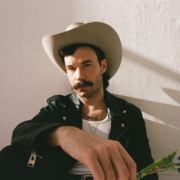
Queer country and Lavender Cowboy singer-songwriter Andrew Sa in a promotional photo, wearing a white cowboy hat and black leather jacket.

Lavender Cowboy Andrew Sa Brings Queer Country to Louisville Sa will play Louisville’s The Monarch on Sept. 18

​Queer country singer-songwriter Andrew Sa will bring his debut solo album of originals, “American Rough,” released June 26 via Bloodshot Records, to Louisville this month, playing at The Monarch alongside local musician KJ Olsen on Sept. 18.

This will be the 40-year-old California native’s first time in the Bluegrass region.

“I’ve been having the time of my life being able to perform in other places for total strangers and have them enjoy it and buy records,” Sa said. “[People] feel seen through [my music], and that is like the greatest gift that I feel like I’m able to receive anywhere and everywhere.”

Queer people are connecting to Sa’s sound because he embodies the “Lavender Cowboy” subgenre of country music, which reimagines and challenges ideas of masculinity in country music and society at large.

The term “Lavender Cowboy” originated from a 1923 poem by American editor and publisher Harold Hersey about an unmanly cowboy “with only two hairs on his chest.” Over the years, the poem has shown up in country-western movies like Oklahoma Cyclone and has served as the foundational theme for music artists like Patrick Haggerty’s first openly queer band, “Lavender Country.”

In a tribute song to Haggerty on “American Rough,” called “Lavender Cowboy,” Sa sings:

“Lavender cowboy, stranger in your hand,

Wander the highways with your ragged angel band,

And come out singing when you can.”

Modern alpha male-centered country music is commonly known for its tackle box toting, beer guzzling, and women-objectifying lyrics—often referred to as toxic masculinity. Sa is the antithesis of this, and he says his edge is tenderness.

Rather than celebrating conventional tropes of American machismo, softness lies at the center of “American Rough.” Sa’s unique style comes through in that softness, and he draws inspiration from the women of country gold, like one of his favorites, Patsy Cline.

When Sa was about 4 years old, his mother left him with his grandparents to pursue a different life away from motherhood and a white picket fence. During drives in their town car, Sa heard Cline’s weeping vocals for the first time and instantly connected with the yearning in her voice.

“I can only imagine that I was trying to understand what it meant to be left, you know, what it meant to be relatively abandoned as a child by my mother,” he said. “I think that country does such a good job of expressing that kind of yearning, you know, loss and longing, and I was just drawn to that so young.”

Sa joked that he’s “not a bad bitch and has never been a bad bitch.” He told the producer of his 10-track LP, acclaimed indie-folk artist H.C. McEntire, that he was worried that he had no bite.

“I was entering into this arena where everyone’s posturing, and it’s all about, you know, being bad and having an attitude—especially in country music and pop country,” he said.

The late Dolly Parton once said, “Find out who you are and do it on purpose,” and Sa has done just that, with McEntire calling his tenderness his superpower. Sa said he carries Parton’s quote into his performances.

While on stage, Sa said he encourages people to let go and embrace the emotions his music evokes. On one end of the spectrum, he encourages tears. On the other end, Sa said he is a jokester and wants to make people laugh, too.

“I want them to run toward romance. I want them to lean into tenderness. Yeah, that’s what I want,” he said.

For more information on Andrew Sa, check out his website. Sa’s show at The Monarch is free and open to the public. Doors open at 7 p.m., and the show begins at 8 p.m. Attendees are encouraged to make donations to the artists. The Monarch is a BYOB establishment, so come prepared!

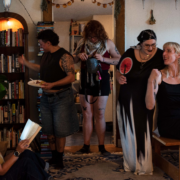
A group filled with smiles and love gathers in a home filled with books and decor.

Nobody’s Free Until Everybody’s Free: The Queer Print Magazine Imagining Liberation Together

If you’re looking for “diverse expressions of diverse lives” that take a hammer to the binary, look no further: nymph(o) delivers bold and sensual offerings with a distinctly 1980s indie-magazine vibe.

The Ohio-based LGBTQ+ print publication, initially launched in 2021, publishes sex-positive art and writing that wraps around this premise: “actions lead movements, but so do images, words, and the people who create them.”

Cover art painted by Kentucky artist Cierra Evans.

Cover art painted by Kentucky artist Cierra Evans.

Issue #4, slated for release on August 29, takes inspiration from civil rights activist Fannie Lou Hamer’s inspiring quote, “Nobody’s free until everybody’s free.”

“All of the writing, poetry, visual art, photography is exploring this theme and reckoning with the notion that the queer community can’t experience liberation without collective liberation – liberation for all,” says nymph(o) founder and editor Avery Plummer.

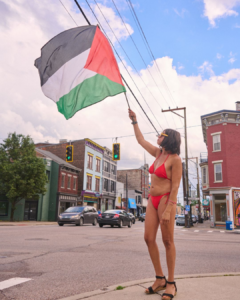
The new issue features a variety of essays and art, including a piece on activist Simone Brine, a trans immigrant and University of Cincinnati professor, known for staging street corner protests clad in a red bikini – advocating for what nymph(o) describes as “trans civil rights, Palestinian liberation, and an end to violence and deportations by the U.S. Immigration and Customs Enforcement (ICE).”

Portraits of Sylvia Ebeid by Chris Sifri, entitled “You Can’t Look But Please Touch,” in the issue invite a glance, as do images of local 1990s drag king troupe H.I.S Kings.


Photo of Simone Brine by Sophia Daughtery Muñoz

Photo of Simone Brine by Sophia Daughtery Muñoz

Plummer pairs a poem by Ohio Lesbian Archives co-founder Phebe Beiser, now in her 70s, alongside a nude portrait of the writer – reflecting the multigenerational spirit of the publication.

Each issue incorporates art and thought outside the confines of the present, linking contemporary queer conversations to the past.

“It’s a queer sex-positive magazine, but it’s also an investigation into the ways that contemporary domination forces are affecting queer liberation, and how we can work with one another in our communities to really fight for one another and envision new worlds,” says Plummer, who brings her experience working with the archives to the project.

The queer artist, writer and archivist at heart cites the groundbreaking 1980s lesbian erotica magazine On Our Backs as inspiration for creating nymph(o). Conscious of “standing on so many people’s shoulders,” Plummer draws on an earlier sex-positive movement in a modern, degendered way.

She is deliberate with the language she uses to describe a magazine that aims to embrace the community it represents.

“It’s not a lesbian erotic magazine by any means,” she says. “It’s an expression of different variations of queer sexuality and queer lives.”

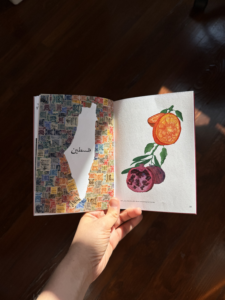
Opened page of the new nymph(o) magazine.

Photo provided by Avery Plummer.

For the inaugural issue released in 2021, Plummer snagged interviews with On Our Backs co-founder, the late Debi Sundahl, as well as performance artist and former sex worker Annie Sprinkle. On receiving physical photos from Sundahl back then to scan for the magazine, she says, “I was nervous to handle them!”

Issue #2 threw a spotlight on queer happiness with the theme Fighting for Joy, and included a moving tribute to the concept that “a child is a gift” as rendered by a parent amid a wave of anti-trans violence; Finding Purpose comic art by Fiona Avocado (thought bubble: “What P.O.S. News am I Going to Read Today”); and intimate playful portraits by Jessica Tanzer, known for focusing her lens on the beauty in what viewers “might otherwise imagine is ‘threatening’ subject matter.”

Issue #3, themed Queer Space, featured photography by Sophia Muñoz and Del LaGrace Volcano, including Volcano’s 1995 intersex coming-out “Self Portrait with Bluebeard;” a conversation with HIV health educator Ariel Shaw; and writing by queer, nonbinary, Latine artist Jacq Garcia, whose work explores the intersections of community, fatness, food and sexuality.

All serve as counterpoint to fraught times that demand a chance to dream, create, and then repeat.

Plummer, who holds a master’s degree in art history from Ohio University, is a surrealist movement enthusiast, drawn to expressions of dreams as an extension of reality.

“I think that notion really fits with a lot of what queer folks are doing, particularly in local community organizing, because they’re dreaming and they’re building these things that don’t exist, and certainly don’t exist within the systems that are supposedly built to serve us and then don’t,” she says.

Working with Plummer, Maddy McFadden brings an eye for visual layout to the role of creative director and has a hand in editing as well as the non-credited art.

Published exclusively in print, nymph(o) will be available at the mag’s launch event on August 29 at Cincinnati’s Village Green Foundation, which facilitates affordable food and transportation for Cincy’s Northside – also featured in the issue.

Following the launch, nymph(o) will be available for purchase on Queer Kentucky’s website. Queer Kentucky also serves as a proud fiscal sponsor, with the venture supported through the ArtsWave Pride Grant Program.

TBALLER, Northern Kentucky artist, poses in leopard print and a vintage fur coat during a photoshoot.

NKY Artist TBALLER Explores Music, Fashion and Funk

TBALLER doesn’t just make music, he puts on a show. The Northern Kentucky artist has spent nine years honing a sound he calls “funky, bold, genre-bending pop,” pulling from Prince, Jimi Hendrix, and the deep funk roots of nearby Cincinnati. This year, he is hitting the stage harder than ever, headlining a DIY-regional tour of small venues across Kentucky.

Along the way, TBALLER built a loyal, largely queer fanbase who connect with his boldness, love of fashion, and self-expression. That connection has pushed him to explore his own identity, both in the studio and in the world. We caught up with him to talk influences, community, and what’s next as he works on his first EP.

Portions of this interview have been edited for brevity and clarity. 

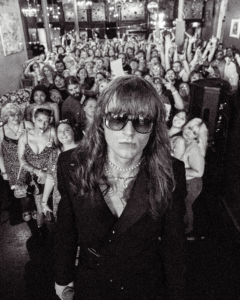
TBALLER performs before a packed, cheering crowd at a live show in Kentucky.

Photo by: Max G @barelymanic

Northern Kentucky Artist on Sound, Style and Self-Expression

Richie: Hey TBALLER! Nice to meet you. What brought you to making music? How would you define your musical style?

TBALLER: Hello! Nice to meet you as well! Originally, I started making music because a friend of mine made a song, and for some reason, I decided to drop a diss track about him sort of as a joke. From there, I found out I like making music and stuck with it. 

Richie: What are your main musical inspirations? 

TBALLER: Some of my main music inspirations are Prince, Jimi Hendrix, Ohio Players, P-Funk, Michael Jackson, Tyler, The Creator, Hall & Oates, and many more. Geographically speaking, I think Cincinnati has had the greatest on my music. and I am greatly inspired by funk music, which has deep roots in Cincinnati.

On Queerness, Community and What’s Next

Richie: What’s your connection to the queer community?

TBALLER: After posting my music on TikTok, I gained a pretty large Queer fanbase. I love seeing them out at my shows, and it makes me feel good that I can provide a safe space for not just my Queer fans but all of my fans to enjoy themselves and have a good time. I take pride in that. I also think specifically my Queer fans have helped me feel more comfortable to loudly express myself. or that, I am eternally grateful.

Richie: How have you explored your identity through making music? How has it changed how you perceive yourself?

TBALLER: Every time I make a new song, I learn a bit more about myself. How I like to dress, how I like to dance. Even reflecting on decisions I’ve made and learning from mistakes. I get all this time to say how I truly feel over an instrumental, and sometimes I pick out things that I didn’t even know I felt. The studio is the one place where it’s all about me and I can’t be wrong. I think mainly I’ve learned that I don’t know nearly as much about myself as I previously thought, and I’m very excited to get to know more.

Richie: Why do you like making dance music? Why do you think it’s important, especially in these times?

TBALLER: I like to dance! I also love to entertain. I’m very inspired by the performers who really made an effort to put on a show. My fans paid their hard-earned money to come see me, so I’ll be damned if I don’t give ‘em a show, and the best way to do that in my mind is give them something they can dance to. 

Before I started performing, it was just a natural inclination towards more upbeat [music] but now I’ve doubled down. With the negative political state of our country and the current president in office, it seems like things are going backwards and getting more hateful. Not to mention, it seems like everyone is struggling financially right now. It’s incredibly important to have an outlet where you can kind of forget about your troubles and just focus on enjoying yourself in the present moment. I feel like making time to let loose can help us get through the tough times and remind us that we are [all] human.

Richie: Where do you hope your music will take you? 

TBALLER: I want to be great. I want to have albums and songs and performances and a career that moves lots of people and makes them feel something. I want to express myself as loudly as possible, and I want to learn as much about myself and this world as I possibly can through my music.

To keep up with TBALLER, follow him on social media here. His next show is August 22nd in Lexington. You can grab tickets here. 

Nathan Wilson smiling in sunglasses and a neon cap in front of a Matthew25 mobile health clinic truck

How Rural Kentucky HIV Care Saved Nathan Wilson

He was an HIV patient in Rural Kentucky. Now he helps run the nonprofit that saved his life. Nathan Wilson is on a mission to fight against the stigma of living with HIV in Kentucky and beyond. 

Before Nathan Wilson worked at HIV health nonprofit Matthew25, he was a patient. He was a convicted felon and was in active addiction for more than a decade. Now, Wilson oversees patient experiences as the facilities and project manager for the organization. He serves the same rural Kentucky communities where he once struggled to find care himself.

Matthew25, which celebrates its 30th anniversary this year, works with those living with, at risk of, or affected by HIV and other sexually transmitted infections. With four clinics across Southern Indiana and Western Kentucky, the organization serves 25 counties in Kentucky and 12 in Indiana.

Wilson became a patient with Matthew25 in 2019. He found out he was living with HIV while at a Suboxone clinic. He recalls being told: “Hey, your blood test shows this. You should probably reach out to these people.”

He admits that he wasn’t the best patient at Matthew25 in the first year, but the workers at the organization were patient with him. He made up for it, and four years later, he began working at the nonprofit, first as a driver, transporting patients to appointments and then working the group’s food pantry. He now oversees facilities operations for all four of Matthew25’s clinics. 

“Matthew 25 has changed my life since day one — not only changed it, but saved it,” Wilson says. He said the organization fought for him to get his HIV medications when he was incarcerated. While the group didn’t succeed, the fact that they worked hard to help him had an effect on Wilson.

When he first started working at Matthew25, he wasn’t sure he was “a healthcare facility would hire somebody” like him. 

But now he sees his various roles with the group as a full-circle moment. 

“I spent every day on the road with patients — young, old, different ethnicities, different backgrounds — and it changed my view of how broadly HIV affects people,” Wilson says. “It also broke down a lot of barriers between me and patients, because I am one of them.” 

He says many people he’s met also living with HIV don’t have such robust support systems. 

“A lot of times, you’re just there to listen. People don’t necessarily want advice; they just need somebody to hear them,” Wilson says. “Matthew25 has recognized that from the beginning: that we support system. Sometimes they just need to get something off their chest.”

 Wilson believes his work is a part of a greater impact on their patients.

“I work to make sure we have the best possible experience for both clients and employees. That’s the van someone rides in, the exam room they sit in, the quality of our medical equipment. I want people to feel welcomed and cared for in every detail of their environment.”

He says it’s that care that he was shown at Matthew25 that still stays with him.

“Everywhere else I went, I was treated like an addict or a criminal. I never felt that way here. They strive so hard to meet people where they’re at — without judgment, just focused on providing the medical care you need and whatever support you want,” Wilson says.

Matthew25 is one of a few providers supporting Western Kentucky, offering services in locations outside large urban centers. Geography, Wilson says, plays a large role in obstacles to care for HIV-positive Kentuckians. The organization itself travels about a 200-mile radius to pick a patient up to get them to their HIV care, but also any other medical care they need. 

Another obstacle, Wilson says, is fear. He remembers thinking it was a death sentence when he was told he had HIV. 

“I think a lot of people avoid getting tested because they’re scared of what they’ll find, and worried about cost. What they don’t always know is how many resources exist specifically to help with treatment and suppressing viral load,” he explains. “If we can suppress viral loads in people already living with HIV to the point where there’s no transmission risk, then eventually this ends.” 

Wilson says there’s still stigma surrounding living in the area and a misconception that HIV is only a virus gay men get. He said that while he is a gay man, he also was an IV drug user. Male-on-male sexual intercourse is not the only way a person can contract HIV. 

“I think transmission is still deeply misunderstood, and that misunderstanding costs lives.”

The stigma from the gay community also comes to Wilson’s mind. 

“There’s still so much shame and secrecy around it. I’ve been undetectable for years, but people still treat HIV-positive individuals as if we’re diseased,” Wilson says. “You would think that people who have experienced so much oppression themselves would be more willing to accept others.”

He adds that it’s that specific stigma that makes him want to be open about his status and history: “to show that life doesn’t end with an HIV diagnosis.”

Wilson believes the only way to overcome this stigma and to work to stop the transmission of HIV is to recognize each other’s humanity. 

“People with diabetes aren’t stigmatized for their condition. People with cancer are treated with compassion. People living with HIV deserve the same. And the most important thing to hold onto is this: We could actually see the end of this disease, in my lifetime, or the next,” he says, explaining the need to support HIV medications and PrEP. “Transmission can be stopped. Why would we not want to do everything in our power to make that happen?”

Black-and-white portrait of Appalachian poet Samantha Ratcliffe in glasses, set against a painted mountain landscape.

Appalachian Poet Samantha Ratcliffe Uses Words to Reclaim Queer Identity in Kentucky

Appalachian poet Samantha Ratcliffe embraces her roots through poetry and songwriting to showcase the rich cultural history of the region.

After her parents’ divorce as a child, she was a “deeply dramatic” sixth grader who began to write poetry in class, often landing her in trouble. She filled two notebooks with her words during that time. She approached her teacher and asked if her poetry was worth submitting to a school writing competition. Her teacher then marked the poem up in red ink and returned it to her, stating that that is how a real poem should look.

“I’ve been obsessed with defying the idea of ‘real poetry’ ever since,” Ratcliffe said.

Appalachian Poet Samantha Ratcliffe Finds Her Voice

Born in Pikeville, KY, Ratcliffe uses her Appalachian roots to showcase the fight against hatred in Southern communities. She draws a lot of her inspiration from fellow Kentuckian bell hooks, who focused many of her writings on feminist thinking, race, and social class. Some of her poetry speaks to injustices enacted against Appalachia, as capitalism destroyed many people’s livelihoods. She reiterated the sentiment that the need to create in Appalachia was driven by a drive to exist and to reinvent harmful stereotypes placed upon the region.

The Appalachian region includes a prolific coal industry, in which the workers were exploited and abused by the systems that forced them to work. Thus, today’s economy in Appalachia has been severely affected by the past hardships.

“It’s almost like you’re traveling through a wooded area, but it is your woods. It’s like Kentucky- this South, is our woods. But it’s a reclaiming of that space in a remembrance of our ancestors as we go along this literary path together,” Ratcliffe said.

From Poetry to Songwriting as Fields May

Ratcliffe is also a songwriter. In high school, she dated a boyfriend who introduced her to punk music and started a band with her. “So, as gently as he could, he suggested that maybe he should write the lyrics because he understood punk better than I did. And at that young age, he was probably right!” Ratcliffe said. But her love of riot grrrl music pushed her to write and perform her own songs after the band’s sets. “I was deeply inspired by other local femme and trans artists at the time who made me feel like it was possible for me too,” she said. Now, she has over 50 songs under her belt and releases music under the name Fields May.

Ratcliffe is currently pursuing her MFA in Poetry at the University of Kentucky, where she works as a graduate instructor teaching creative writing classes. Before starting her graduate studies, she worked as an English and creative writing high school teacher.

At 16 years old, she found herself in the Lexington punk scene, where she would sell self-published poetry books called zines that she had collected from across the country. Since then, she has been involved with small press publishing and has attempted to learn as much as she can about the process.

Ratcliffe also runs Hill Writers Collective, a monthly reading series she’s led for more than three years that spotlights two Appalachian authors each month in free, community-centered events. Information on upcoming readings is available on her website and Instagram.

“Often it feels like publishing is unreachable, but I believe it’s one of our oldest mechanisms of collectivism. I’ll never stop talking about how special the literary community is in Kentucky,” Ratcliffe said.

Queer Identity and Appalachian Roots in “Common Wealth”

Currently, she is working on a book of poetry for her thesis, titled “Common Wealth.” The book explores themes of queer identity and Appalachian upbringing, subjects that regularly fuel Ratcliffe’s creative practice. Appalachian roots are based in rising against oppressors, said Ratcliffe. She integrates those ideas into her work, demonstrating what it’s like to live as an openly queer person.

In one poem, Ratcliffe describes a time she had a conversation at the kitchen table with a friend who had just gotten top surgery. The kitchen table presents a feeling of home and Appalachia, regardless of some of the conflicting beliefs held by Ratcliffe and by the region, she said. “There are so many reasons to be scared in life. You could spend your whole life inside, spend your whole life closeted, you could spend your whole life never coming out and living your true life as a queer, trans person. If you don’t say ‘rear against this hatefulness and the selfishness of capitalism,’ you’re actually hurting yourself more in the end. It’s a fake safety,” said Ratcliffe, who was quick to add that she sees this as reflecting her own journey rather than a judgment of anyone else’s — staying closeted, she said, is often a matter of safety, not fear.

That belief is what drives her writing. “Writing is something that I have to do to see myself and the world. And I write about queer, trans, and Appalachian identities because I know those folks as beautiful. I want the world to see us as fully as I see us,” Ratcliffe said. “My biggest advice to aspiring writers is to seek out Appalachian and queer writers not just to improve your own skills, but to understand yourself, where you’re from, and all the places you’ve yet to go.”

In her unpublished poem, “Quilting,” she writes about the deep connection Kentuckians have with one another and how the world has strung them together. “My family taught me that we take in those who need, we feed those who need. There’s always a place at the table for everyone,” Ratcliffe said.

Quilting

This blanket, a family

of pine trees reaching across

the night’s rustling to sooth your

sleeplessness. Bound self of words,

holding the poetry and the poverty

like simile.

Ratcliffe lives loudly and proudly as a queer person, and wants Kentuckians to be proud “There are so many of us (queer people) who are literally taking care of your people, teaching your kids, so we’re just here all the time,” said Ratcliffe. “You may not see us, but we’re still part of this Commonwealth and we’re still a beating heart in our connected story,” she said.

You can read more of Ratcliffe’s poetry and listen to her music here.

Portrait of Melissa Helton against a blue and pink tinted mountain landscape.

Appalachian Poet Melissa Helton on Queerness, Rage, and Finding Home in Kentucky

Melissa Helton may be an Ohio native with dual US/UK citizenship, but now she’s proud to call Kentucky her “found home.”

Helton did not come into her queerness until she was raising a family in the state. She would read WLW (Women Loving Women) literature “for research,” which led her and others to begin questioning her sexuality.  And that discovery led to creative expression in a safe space – writers in the Appalachian community who embraced her.

“Honest” is the word she uses to describe her writing, as she wants to represent the positivity and community stemming from Appalachia. But her rage plays a part too.

“I don’t know what else to do with my rage except turn it into art and somehow try to survive it,” said Helton.

Appalachia has been stereotyped as impoverished and lacking in education, but Helton uses her writing to create a new narrative.

“It’s a tightrope of being authentic and wanting to show the nuance and the reality of the place or the life, knowing that people who want to do you harm will use it against you,” Helton said. 

Her work focuses on love and her identity as a bisexual person and addresses bi-phobic and pan-phobic rhetoric with the hope of challenging harmful beliefs held by some in the LGBTQ+ community. 

In an unpublished poem, “Advice to the Newly Polyamorous,” Helton uses that tightrope to demonstrate the thin line she must walk in order to convey her truth. She writes, in the poem, about the truth she lives in her identity and how she must account for the ways in which people may use it against her.


“If you are bisexual+, you are perpetuating

a stereotype that we’re all non-monogamous

and promiscuous and can’t choose or commit

to just one partner.

Don’t let that shit get you down.

It’s not your responsibility to always be the good example,

to disprove the presuppositions.”


Melissa said she did not understand her queerness at first. She believed she was seeing beauty in women and non-binary individuals through an artistic lens, but it instead developed into learning more about who she is as a person. 

“[Someone asked] ‘Do you have queer tendencies?’ and it wasn’t until my mid-30’s and someone asked me that question that I was like, maybe this isn’t just living with an artistic eye, that maybe I do have the ability to love people of different genders,” said Helton.

Motherhood, Menopause and Rage


Her work also focuses on themes of motherhood, menopause and rage towards the American political system. Helton said that she uses her writing as an escape and a way to cope with the less-than-ideal situations life brings. This includes navigating the harsh changes within the female body, parenting young children and maintaining the right to one’s own body in the current political climate.

“A Middle-Aged Woman Rages” will be Helton’s debut collection of poetry. The collection focuses on the previously mentioned themes and allows her to explore and process them. She has written about these themes in previous works, but visiting them again allows for deeper processing and understanding.

Immigration is another undercurrent in her work. Helton’s father is an immigrant from the United Kingdom and she feels as if she has a complicated relationship with the current attacks towards immigrants and immigration that are rooted in racism.

“[This is] The privilege and the position I have for interrogating my white immigration history when my people aren’t being targeted,” said Helton. “So how do I responsibly look at that in our current culture that is hostile towards immigrants and their families when they’re not white, when they’re not Christian?”

Education takes precedence in the representation of Appalachia


The welcoming community within Appalachia is at the forefront of Helton’s pieces, as she has garnered a found family and home within the mountains of Appalachia.

Helton works as the literary arts director at the Hindman Settlement School. The school, established in 1902, has now developed into a non-profit organization providing education for the creative arts for students in the area.

The Ironwood Writers Studio is a program Helton is involved with, which takes place at the Hindman Settlement School. The camp, designed for writers aged 14-19, creates and fosters a safe space to learn and grow as people and as creatives. 

“When my high school writers turn in their evaluations at the end of the Ironwood Writers Studio and they say they felt respected, safe, accepted, and valued, that is all the legacy I’ll ever need,” said Helton. “When they say they are going to sign up for a creative writing class at school, that’s a victory. When a student says they finally met other kids who “get it,” I know we’re on the right path.”

The school allows for Appalachian culture to be preserved and for its rich history to be understood for what it actually is and not the stereotypes that the region has been given, said Helton.

The writing community has embraced her. She has found a group of like-minded writers at the school, but also in her writing circles and peers that writing has allowed her access to.

Helton did not come out as bisexual until she was raising a family in the region and the support from those around her in the Appalachian writing community allowed her to understand her identity fully. 

“The queer Appalachian writers, they’re the ones who help me be brave. Without them and their support, I don’t think I would be as brave, especially when I see the brave things they write,” said Helton. “They make me want to stand up and want to say my part of the story as well.”

Her personal writing community creates a safety net, which is as important as ever in a time of such tension, she said. 

“[The Appalachian writing community] really has been such an accepting community. The scholars are very diverse, very celebratory of identity, and having the writers made me feel like Appalachia was home,” said Helton. “If I didn’t have that network of writers, I don’t know if this would be my forever home, but with them, I can’t imagine living anywhere else.”

As her writing evolves, Helton is looking to write more essays and fiction. Her pieces are also moving to focus more on immigration, as current political actions target those individuals. 

“We write to process and understand; we write to quarantine things; and we write to remember. Art is a core human experience, however creativity expresses itself in our lives. We do it to process the world and we do it to process our interaction with the world,” said Helton.

Sandra Carpenter, Executive Director of Louisville Youth Group, smiling in front of a brick wall. The Louisville Youth Group logo appears to the right.

Louisville Youth Group Director Wants to Reach Rural Kentucky’s Youth

While attending Eastern Kentucky University (EKU), Sandra Carpenter came out as lesbian and joined queer and feminist organizations. That’s where her love for providing support to both LGBTQIA+ youth in metropolitan and rural areas began.

Carpenter was recently appointed as the Executive Director of the Louisville Youth Group, one of Kentucky’s well known LGBTQ+ organizations, and the oldest queer QTBIPOC organization for youth in the south. Now, her mission as director is to reach more rural parts of the state.

“I continued throughout my entire adult life as an out lesbian, so that has been something that has been interesting in terms of reconciling my rural roots with kind of more of the metropolitan queer culture. That is where a lot of my focus is on making sure that we are resources for both kids here in Louisville and continue to also try to build out that network of brave spaces for kids who may also be in more rural parts of the state,” said Carpenter. 

Louisville Youth Group (LYG) is a Kentucky-based nonprofit dedicated to empowering and protecting LGBTQIA+ youth and has been active for 35 years providing youth with brave, safe and affirming spaces in which they can connect, develop leadership skills and advocate for themselves. 

Carpenter has a decade worth of experience in management and communications that she plans to bring into this role. 

“Whenever I came back to Louisville, my big goal was really to get back into this scene where I could use both my research and communication skills alongside my nonprofit experience,” said Carpenter. “I really just wanted to find a professional home where I could merge both in terms of what my values are and what the work is.” 

Her background ranges from working with Greater Louisville Inc. as the Community and Talent Engagement Manager to serving as the Communications Coordinator for the Louisville Pride Foundation. 

Carpenter believes in the strong impact that strategic storytelling has on extending reach and highlighting LGBTQIA+ communities’ voices. 

Carpenter said LYG’s storied history is hugely important in terms of making sure that the actual experiences of youth they serve are being heard.  

“Be that through advocacy, in terms of allowing experiences to be shared so that we can advocate for the best interest, but also just allowing folks in our organization, like through our youth leadership council, to have a real voice within the organization,” said Carpenter.

With growing political discrimination against the LGBTQIA+ community across the country, especially in the south, the importance of extending the reach of available resources to more communities is important to Carpenter. That’s why she wants to expand LYG’s footprint to include more rural areas in Kentucky to bridge the urban-rural divide that exists.

“Being from Eastern Kentucky, and realizing that LYG has such a presence here in the Louisville community, I think that we can become more known as a resource,” said Carpenter. “We could see more queer and trans youth organizations and resources being developed throughout Kentucky and Southern Indiana.”

While still in the works, Sandra  said she has strong intentions to work with existing GSAs (Gay Straight Alliance) groups across the state and to provide additional assistance to creating GSAs in other communities that request those resources. 

“My personal mission is to continue to create safe and brave spaces. These spaces are going to challenge folks in ways that help them grow,” said Carpenter. 

Carpenter’s work is driven by giving youth the space to become exactly who they are without fear. She draws from experiences she faced when she was aware of her identity as a high-schooler in rural Kentucky but felt unsafe for her to come out at that time, even with a supportive family.

“It was tricky for me to come out until I was able to find a community where I could see other people and hear from other people who shared my experiences,” said Carpenter.

Carpenter hasn’t been in this role long, but hearing of the years of impact LYG has had on the community feels heartening. “I’ve already heard from folks who’ve said if it weren’t for LYG, I would not be where I am today and it gave them the space to become exactly who they are,” said Carpenter. 

“For whatever work that I’m doing,” Carpenter said, “I want it to be intersectional and not just like in kind of the buzzwordy way. I actually want voices to be heard and to matter to actually have a stake in the decisions that we make. I want to make sure that we are both intergenerational and diverse.”


A close-up of a green handwritten tag on the colorful community loom that reads, "Rest in peace Murry… your legacy lives on through your art. You are my role model for wanting to pursue art as a trans man myself."

NKU Remembered Murry Foust With a Degree. His Community Is Honoring Him With Much More.

A community is finding ways to honor Murry Foust, the transgender Northern Kentucky University art student who went missing and was later found dead in Wilder, Kentucky, almost a month later.

Foust was a 22-year-old artist from Crescent Springs, Kentucky. In the weeks since they were found, the outpouring of love from the Cincinnati and Northern Kentucky art community has taken shape in gallery showings, community art programs, and the establishment of a scholarship fund that has already exceeded its goal.

Foust, who went by he/they pronouns, was described by those who knew him as thoughtful, warm, and genuinely talented. He was an accomplished potter and painter, and a musician equally at home with guitar, piano, songwriting, and singing. He had a deep love for nature, animals, and the outdoors, and, friends say, the gift of making people feel seen.

“Murry was someone who celebrated and encouraged your art, no matter who you were,” Bee Wang said, a friend and former artistic collaborator of Foust’s.


Two attendees add rows of fabric to the community loom at Art After Dark at the Cincinnati Art Museum on May 29th, 2026. Photo credit: Mikhayla Hughes-Shaw


The community’s outpouring of support started from the beginning. “When they went missing, my first thought was, how do I keep myself and others in community so we can process and grieve together instead of on our own? Well, Murry loved art. Let’s do Art for Murry,” Wang said. 

Art For Murry took root across the area in May as friends, fellow artists, and strangers shared in creativity and community through simple art events. The goal was to raise awareness about Foust, while also giving folks a safe space to process. The events were a success at both The Pique Gallery and Art Equals in Covington, KY, and led to the creation of a community loom.

“I was so moved to see how many people came together to offer resources and time to make sure we kept their art [alive],” Wang said. 

A vibrant painted portrait of Murry Foust with green hair, tongue out, and a playful expression, displayed on an easel at a pop-up gallery alongside an artist statement and smaller photo of Foust.

Murry Foust’s work was featured in a pop-up gallery at the Cincinnati Art Museum as part of the May Art After Dark Queer Art Fest. Photo credit:
Mikhayla Hughes-Shaw

Just days after his loss, Foust’s sculptural and mixed media work was featured at the Cincinnati Art Museum as part of a pop-up gallery, alongside other local artists at the museum’s monthly ‘Art After Dark’ event.  The theme for May was a Queer Art Fest that celebrated the local LGBTQ+ community with visual art displays, drag performances and various local queer vendors. Attendees from Northern Kentucky and the Greater Cincinnati area were also invited to participate in weaving the community loom from the initial ‘Art For Murry’ events. Various threads, strings and fabrics were available to use, making the piece unique in color and different textures. 

“It’s such a wonderful symbolism of the connection we make in community with one another,” Wang said. “We also used mostly donated secondhand materials and scrap fabrics, similar to how Murry liked to use unconventional materials in their art, and were mindful of environmental impacts of materials being used.”

The loom traveled to four locations in the Cincy/NKY community, with Art After Dark marking its final stop, and its completion. “The loom went from one third full to fully filled and folks at the end had to just tie pieces and tags on. Seeing the loom so full of love for Murry and the community made my own heart feel so full,” Wang said. He supervised the project during the event, and said the stories attendees shared while weaving the loom were impactful.

A close-up of a person's hand touching the colorful Art for Murry community loom, with handwritten tags reading "Murry Never Forgotten," "Thank you for sharing your light with the world. You will live on in the community of hearts that you touched. Love you always," and other notes of remembrance woven into the fabric.

An attendee adds a row of fabric to the community loom at Art After Dark at the Cincinnati Art Museum on May 29th, 2026 built in honor of Murry Foust. Photo credit:
Mikhayla Hughes-Shaw


“People stopped just to tell me their stories of their connection to Murry or art or just the wider situation of how scary it is to be trans in our current society. As a trans immigrant myself, what really keeps me going right now really is community, to have supportive folks around, showing up with love and no judgement,” Wang said. 

One tag on the loom read in part: “Rest in peace Murry…You are my role model.”


A bold, layered mixed media painting featuring expressive figures, a crucifix in red, cosmic and natural imagery, and the hand-lettered text "My suffering is not beautiful, but my survival is."

A mixed media piece by Murry Foust on display at the Cincinnati Art Museum’s Art After Dark. Photo credit: Mikhayla Hughes-Shaw


Northern Kentucky University, where Murry was set to graduate from in May, held a memorial on June 3rd in the Corbett Theater Lobby of the Fine Arts building. The university displayed pieces of work from Foust during the service, and awarded the Foust family with the late student’s Integrative Media and Spatial Arts degree, with a focus in both painting and spatial arts. The university said they plan to display Foust’s artwork in the NKU Fine Arts Center through September for students and community members to enjoy.

The Foust family has remained active and vocal through the Facebook group “Murry Foust Missing Information Hub,” publicly thanking those who attended the memorial, donated to the scholarship, and showed support in the recent weeks. Foust’s family launched a crowdfunding campaign online to establish a scholarship at NKU for art students, setting an initial goal of $25,000 for an endowment. That goal has already been surpassed, with donations now exceeding $27,000 and still climbing. Some of Foust’s original artwork has been auctioned to help grow the fund.


A close-up of a glazed ceramic sculpture by Murry Foust featuring three conjoined faces with hollow eyes, intricate blue and white painted markings, and a dark brown glaze, displayed at the Cincinnati Art Museum pop-up gallery.

Foust’s art was on display at the event, including this sculpture showing many faces on one piece. “Their style of art is very intense, often diving into both their inner world and critiquing the world they were experiencing,” friend Bee Wang said about their work. Photo credit: Mikhayla Hughes-Shaw


Wang said he intends to keep showing up for Murry. He’s keeping their art alive by sharing videos from their time together on his Instagram account, which show Murry in their element – the pottery studio. He also shared their plans to “create a queer spiritual retreat space”, specifically for queer folks wanting to find a spiritual community. “I wanted to bring in elements of Chinese tea ceremonies, and they were going to make teacups. I still want to honor that and build this space in honor of them one day,” Wang said. 

In the loom, across the gallery walls, and the scholarship that will carry his name forward, Murry Foust’s presence is already woven in. “Even in their passing, Murry is still bringing communities together through art, and that’s the legacy that they are leaving with us,” Wang said. 

A close-up of a Cinema Systers Film Festival badge on a green lanyard featuring the rainbow lips logo and dates May 22–25, 2025, worn over a "Save the Lesbians" t-shirt with a "Butch" name patch. Description: A Cinema Systers 2025 festival badge hangs from the signature green lanyard, displaying the rainbow lips logo and website CinemaSysters.com. The attendee's "Butch" name patch and "Save the Lesbians" shirt perfectly capture the joyful, unapologetic spirit of the Cinema Systers community in Paducah, Kentucky.

Paducah’s Cinema Systers Is America’s Only Lesbian Film Festival — And It’s Turning 10

It all started with an acorn. Now, it’s the United States’ only lesbian film festival.

Laura Petrie founded Cinema Systers – a four-day film festival in Paducah, Kentucky connecting lesbian creatives through workshops, open mics, film screenings, dinners, dances, and more – in 2016, following an inspirational visit to Michigan to participate in the Michigan Womyn’s Music Festival. 

At the event, Petrie was given an acorn and instructed to plant it in her hometown in the name of forging new spaces for women and their passions. For Petrie, that acorn is the Cinema Systers Film Festival. 

“We’re celebrating a decade here of something unusual,” Petrie said. “We’re starved to see our stories on screen. We’re not victims or villains or stereotypes. We can have joyous stories, come together, and celebrate each other.”

A Festival Built on Sapphic Storytelling

For the past ten years, Petrie has platformed hundreds of artists and their work through Cinema Systers. Now, named on the 2026 Curve Power List as an empowering figure in the arts, Petrie hopes to continue summoning like-minded lesbians and sapphic filmmakers from across the globe to Paducah to celebrate Cinema Systers’ ten year anniversary.  

Each year, guests enjoy four days surrounded by Paducah’s lovely nature, participating in workshops and open mics hosted by prolific lesbians, and escaping the pressures of performing for male and straight audiences. 

“I wanted to dedicate a weekend to lesbian films,” Petrie said. “It doesn’t have to be lesbian content, but the perspective of a lesbian filmmaker. We want to uplift the visions and voices of the sapphic filmmakers.”


Four women wearing Cinema Systers festival lanyards sit together on a dimly lit panel stage, with one woman gesturing as she speaks to the group.

Laura Petrie discusses sapphic filmmaking during a Cinema Systers Film Festival event in Paducah, Kentucky. Photo credit: Cinema Systers.


Since the festival’s invention a decade ago, Cinema Systers has featured films spanning genres, countries, and perspectives. Previously, films from France, Germany, and the UK have graced Maiden Alley Cinema’s vintage screens. Whether these works of lesbian art are animations, documentaries, or horror shorts, Petrie believes they create safe spaces for women and “normalize our lifestyle and existence” as queer people. 

Although this year’s festival is jam-packed with additional anniversary celebrations, Petrie’s favorite part of the event remains the same: hearing the emotion, joy, and relief of women in the theaters.

“I love to hear the women’s laughter, the collective sighs. The recognition of things that the mainstream might not get in the dialogue, on the screen; things we can laugh at collectively and know that we’re safe.” 

Petrie, raised on a horse farm twenty minutes outside the city, believes Paducah is “the perfect spot for that.” Paducah is not only the home for Cinema Systers, but one of only nine UNESCO Creative Cities: places where creativity, culture, and cooperation thrive. At the confluence of the Ohio and Tennessee rivers, Paducah represents the bridge between southern comfort and artistic innovation. Fans traveling in to view films can also visit Paducah’s National Quilt Museum, its historic lowertown, and the many thriving restaurants, breweries, and boutiques located downtown – some of which provide discounts to Cinema Systers patrons. 

“Women return year after year, and bring friends,” Petrie said. “It’s a homecoming. A community, a family.”

Workshops That Turn Audiences Into Filmmakers

Dr. Marie Cartier, a professor of Women and Gender Studies at California State University Northridge, travels to Kentucky each spring to attend the festival, teach filmmaking workshops, and indulge in Paducah’s charming southern setting. 

“Go get your discount and go through the quilt museum, eat the ice cream, see the sunset, walk by the water. I really look forward every year to doing those things in Paducah,” Cartier said. “But more importantly, being with my friends that I’ve now met, that I see every year.” 

An aerial view of a dimly lit bar and event venue filled with Cinema Systers festival attendees mingling at tables and a bar, with purple-clothed display tables in the foreground.

Cinema Systers festival attendees gather for a social event at a Paducah, Kentucky venue during the annual film festival. Photo credit: Cinema Systers.

Cinema Systers’ 2026 lineup features a musical performance from The Grace Theisen Trio, a poetry reading from E. Nina Jay, and over twenty unique films made by and for the sapphic perspective. 

Cartier will be teaching a filmmaking workshop on transitioning between scenes, but she’s previously taught participants how to direct actors, make short films, and write scripts. Her goal is always the same: to transform moviegoers into filmmakers.

“Many times now, people go, ‘oh, I could do a film. I could do it.’ And then the next year, they have something on screen,” Cartier said. “It’s a really big accomplishment of Paducah. It’s a great place to go as an accomplished filmmaker; it’s a great place to go as a beginning filmmaker.”

Petrie’s passion extends further than just film – she’s a committed advocate for building belonging, growing communities, and celebrating queer identities. 

“I think Laura had a vision ten years ago,” Cartier said. “A lot of people can have a vision and not be able to carry it through. And she had a vision and she has really done the footwork to make it happen.” 

Beyond the Festival: A Nonprofit, a Farm, and a Community

Cinema Systers isn’t the only space she’s carved out for queer Kentuckians. 

Petrie founded the nonprofit My Syster’s Art, Inc. to help produce Cinema Systers and other filmmaking events, such as filmmaking workshops tailored to uplift the often underrepresented voices of queer women, women of color, and other marginalized women. In 2016, she renovated her 34-acre property into The Art Farm: a women’s retreat designed for creatives to disappear and produce work while surrounded by the gorgeous Paducah scenery. 

Whether on her farm, through her nonprofit, or during Cinema Systers, Petrie is committed to creating safe, celebratory spaces for marginalized women – allowing them to tell their own stories, embrace their identity, and unite with a community of queer moviegoers, artists, and Kentuckians. 

“Be ready to feel loved and joyous from the first event,” Petrie said. “Because you’re going to find your sisterhood: artists who have similar points of view to our own, which is a perspective you don’t see on mainstream tv and movies.”

Lesbians and queer women eager to experience Petrie’s vision of community, celebration, and creativity can now purchase tickets to the Cinema Systers Film Festival, which runs from May 21st to May 24th. 

Two overlapping Polaroid-style mirror selfies of Cain Culto, shot in black and white with a soft, hazy quality, set against a dark background.

Cain Culto Was Sent to Conversion Therapy. He Came Out a Pop Star.

In a time of political backsliding, artists are at the forefront fighting against white patriarchal ideals with acts of rebellious queerness and authenticity. One singer in particular, Cain Culto, blends unapologetic queerness and witchy aesthetic—long fingernails, grills with tusks, and jockstraps—with music that takes on themes of sexuality, battling colonialism, and healing his
inner child.

But Cain Culto wasn’t always singing about wearing a “lil’ femme fit,” growing up in Kentucky, and how there are “too many Klu Klux Kardashians” as he does on his hit single KFC Santería.

Before he became Cain Culto, he was Andrew Padilla, a biblical studies major in a Christian rock band singing the lyrics “My shadow side and my wicked ways / My selfish heart, all my sinful days”.
The evolution from Andrew Padilla in the white evangelical church to Cain Culto exploring his Colombian and Nicaraguan heritage through music was a tough journey through repression, conversion therapy, and an eventual mental breakdown.

Worries about conversion therapy have started once again after the Supreme Court of the United States ruled 8-1 in favor of Kaley Chiles, a mental health counselor in Colorado. She filed a lawsuit against the state of Colorado, claiming that the law banning conversion therapy in Colorado infringed on her freedom of speech.

This now opens the door to allow Conversion therapy, the practice of trying to change someone’s sexuality or gender identity on the basis that it can be “cured”, to be allowed for minors once again. And while research shows this kind of “therapy” is extremely damaging for those under 18—LGBTQ+ youth who experienced conversion therapy are more than twice as likely to attempt suicide—even adults who undergo this pseudoscience practice are left emotionally scarred.

In regard to this ruling, major scientific outlets such as the American Psychiatric Association state that “Being LGBTQ+ is not a mental illness or disorder. Conversion therapy — efforts to change sexual orientation and gender identity — is not a legitimate therapeutic treatment. Leading health care entities, the APA among them, have concluded that these are potentially
harmful, discredited practices and are not supported by scientific evidence.”

Unfortunately, this kind of practice is not unknown for children of Christian evangelist parents. Singer Cain Culto experienced this kind of therapy as an impressionable 20-year-old college student, and while he uses this experience to fuel his art and heal, this “therapy” was mentally tumultuous and emotionally scarring. But music was the throughline before and after the fall.

Also read: Fried Chicken and Jockstraps: “KFC Santería” singer Cain Culto finds queerness in Kentucky Latin Art-Pop music

Cain Culto on ‘Same-Sex Attraction’ Therapy in the Church

Andrew Padilla was a man of the church and a Christian singer long before he became Cain Culto, the jock strap-wearing, long-nailed queer pop star. As a 20-year-old student of biblical studies and a leader at his church, he wanted to spread “the word of Jesus and help the world”.

But his homosexuality, or “same-sex attraction” (SSA), as it was referred to in his ministry, was a major detriment to his social and clerical position. Remembering this time in his life, Culto talks about how his church taught him that “you are not

your desires,” he said. To be gay, in their eyes, was not who he was as a person but a problem to be solved.

“And so they said, I struggle with ‘same sex attraction’, and so I never came out to my parents. There was just so much secrecy and so much isolation in that,” he said.

Growing up in an evangelical household, he knew that coming out to his parents wasn’t an option, and feared that if he did, he would end up in conversion therapy against his will. “It was really sad as a young adult and teenager, just never being able to experience romance or dating. I witnessed my peers experience, and how beautiful that was. But if I was going to be a godly young man, that was just not in my story.”

To fight his attractions while studying at his university in 2018, he began opening up to his church mentors about his SSA and they advised conversion therapy.

The Church Outsourced His ‘Healing’ to an Ex-Gay Ministry

The general feeling in the church at the time, Culto explains, was one of uncertainty in how to deal with those experiencing SSA. His church outsourced its therapy, recommending an ex-gay Brazilian ministry for artists and creatives that hoped to “reclaim the rainbow back for God” (“So cringe,” he remembers.) So he then started working with a mix of therapists, all of whom felt a
little off.

“I remember I first connected with this one guy over Zoom briefly. He was essentially a counselor for people who are attracted to the same sex,” he recounted. But Culto wasn’t swayed.

“And I remember leaving that Zoom call, thinking… ‘he was the success story?’” Seeing this depressed Brazilian man over Zoom, Cain couldn’t help but think he was a product of severe repression.

“I think repression does so much trauma to the mind, and I think you feel that in one person, not only their sexual repression, but it kind of stems out into every aspect of their being.”

He was eventually connected with an older female therapist in the church, and while she was nice and her intentions were good, she was quick to shame Culto’s femininity, he said.

“I don’t know if you know anything about Scientology: it’s essentially trying to get into a meditative state and kind of realize what’s the root of your malfunctions with your system. It’s very pseudoscience in a lot of ways,” Cain recalls, though the therapy wasn’t rooted in Scientology’s specific practices.

During these ‘inner healing’ sessions, they told him he was rejecting his masculinity and sought to find the reason for his gayness: was it due to past traumas? Sexual assault as a child? The message was clear: something must have caused his ‘condition.’

“So I was doing that (conversion therapy sessions), and it’s interesting to see the timeline of how quickly after I started that therapy that my mental health spiraled.”

Soon after, Culto said, came the nervous breakdown.

How Conversion Therapy Led to a Mental Breakdown

Like many people during the coronavirus pandemic, Culto started to gain a different perspective on what mattered to him. He was deeply enmeshed with the church’s cruel, shame-based practices rooted in Christian fundamentalism and white evangelical ideals. That was the turning point –his authentic self and who the church wanted him to be were incompatible.

“There was a split that happened within me,” Culto explains, reflecting on having to compartmentalize his queerness with his youth pastor persona.

“Since childhood, I think that I had to process this split in order to survive in these communities. And then therapy only severed that even more so…” Trying to drown out his same sex attraction caused him to finally be hospitalized for a week in a psychedelic psychotic episode where he thought he was seeing God.

Cain Culto sits shirtless in a leather chair in a gritty, dimly lit room, wearing black shorts, white knee-high socks, and black gloves, with his head resting in one hand in a pose of quiet introspection.

Cain Culto photographed in Vancouver. Photo by Xinger Xanger.


Looking back, he can see that power over sexuality is the ultimate way that evangelical spaces control their congregation, and that “once the sexual self is repressed, you are so much more vulnerable to manipulation and leadership.” Even “Cain Culto,” his alter ego created after these therapies, leans into the idea of cult leaders and cult tactics, and how leaders consciously or
unconsciously use them.

This was a major turning point for him, and he began to search for answers outside of the church. And one of the answers came in the form of his violin.

How Music Became Cain Culto’s Path Out of the Church

Music was always a big part of Cain’s life: going to radio broadcast WoodSongs to listen to folk and bluegrass musicians with his father, playing the violin at a performing arts school in Lexington, Kentucky, and eventually becoming a member of the Christian music group Ecclesia. Music became his medium and means for self-expression.

So when his world crumbled around him, his music became his escape path to embrace his queerness fully and to confront the “shit from these therapies”. His music began to evolve from his 3-person Christian group praising God and asking for forgiveness, to writing songs with titles like “Sold My Devil,” “WitchyMan,” and even covering Madonna’s “Like A Prayer”.


A black and white portrait of Cain Culto standing in front of a stained glass-style mural, wearing a frayed textured jacket and looking directly into the camera with a piercing, confident expression.

Six years later, Cain still uses his music to process the trauma of repression by confronting the darkness and embracing his inner demons. Photo by Xinger Xanger.


Cain regards his art as a practice of processing his own shame from this experience, which can be seen especially in his early work. “Cain Culto, as a music project and kind of my artistic practice, is trying to undo these things, the things that I was taught to be ashamed of, to be afraid of within myself, embracing those things truly, finally.”

Six years later, Cain still uses his music to process the trauma of repression by confronting the darkness and embracing his inner
demons. Cain wants those who’ve suffered from conversion therapy to look outside the small Christian bubble you were born into, be curious, and know that nothing about your true self is as dire as this ideology is making it seem.

If you or someone you know is struggling, call or text the 988 Suicide & Crisis Lifeline at 988. LGBTQ+ young people can press 3 to reach counselors trained in LGBTQ+ care, an option that returned on Sept. 30, 2026 after it was cut in July 2025. The Trevor Project also offers 24/7 support at 1-866-488-7386 or by texting START to 678-678.

Period Y’all founder Skylar Davis stands in front of a truck filled with donated menstrual products while supporting efforts to combat period poverty in Kentucky.

Period Y’all founder Skylar Davis leads Kentucky fight against period poverty

What started as an extension of the Garrard County Food Bank has grown into Kentucky’s leading defense against period poverty: the lack of access to products, resources, and educational materials which ensure a safe and comfortable menstrual cycle. 

Skylar Davis is the founder of Period Y’all, a nonprofit initiative advocating for reproductive justice and accessible period products for all Kentuckians. Founded in 2022, Period Y’all has established period pantries – boxes stocked with period products free for the public – in three counties, donated products to over a hundred schools in the Appalachian region, and educated countless members of the community about the importance of reproductive autonomy. 

Previously, Davis poured her passion for advocacy and reproductive justice into policy work, hoping to combat bills threatening reproductive rights. She found herself disheartened by the constant negativity and decided to search for a way to “bring some joy.”

A bright pink Period Y’all pantry stocked with free menstrual products stands outside a building in Kentucky to provide public access to period supplies.

A Period Y’all pantry stocked with free menstrual products provides public access to pads and tampons for community members in Kentucky. Photo provided by Skylar Davis.

“I really wanted to do something that was meaningful,” Davis said. “To be able to fight for something more positive. Even if it takes years to pass.”

Inspired by Change Today, Change Tomorrow’s “Friday Period” project, which encouraged members of the community to claim free period supplies every Friday, Davis returned to her hometown in Garrard County to establish Period Y’all.

“The first time, I came with one folding table and probably 40 boxes of pads and tampons that people had donated,” Davis said. “And then it grew once I realized how great the need was. It wasn’t just period products, but hygiene products and incontinence products for the elderly.”

Now, with period pantries in Paducah, Berea, and Garrard, dozens of communities can access products, information, and assistance to help manage their menstrual cycles.

“It’s cool to see the variety of people that are thankful for the products,” Davis said. “It’s not just women in the community. It’s grandmothers who are caring for their grandchildren; maybe they’re on a fixed income, so they don’t have the extra money for the products. It’s mothers. It’s teens that come through and ask us for stuff. Men will ask for their partners and know what their partners use.”

McKenna Newman, a Period Y’all volunteer and fellow Garrard County native, teamed up with Davis to “help bring menstrual equality to anyone in need.”

“Growing up in Garrard County, many girls, including myself, had to get creative managing our periods,” Newman said. “Whether it be financially or the mental and physical burden we all had dealing with it. It is a shame rooted in women and no one should be embarrassed of this natural process.”

Reusable pink pouches filled with menstrual products labeled Period Y’all sit inside a tote bag as part of efforts to distribute free period supplies in Kentucky.

Reusable pouches filled with menstrual products prepared by Period Y’all for distribution to communities across Kentucky. Photo provided by Skylar Davis.

Following its success in Garrard County, over 30 requests for pantries arose across the Commonwealth. Davis plans to open 13 additional period pantries in locations such as Richmond, Somerset, Morehead, Hazard, Louisville, and more.

“When Period Y’all first started, we were doing monthly pop-ups… The products we had, we were able to source through donations, cold calling, and advertising on social media,” Newman said. “All it took was one Facebook post, and now, here we are, four years later, providing hygiene products to schools across Kentucky.”

Recalling her experience with policy work, Davis hopes to empower students to make informed choices about their bodies, health, and their administration.

“Within the next few years, I’m really hoping to get more students involved in shaping the education side of the work,” Davis said. “They’re the ones that are experiencing this in school. They don’t have access to products because it’s not in their school’s budget.”

Since the implementation of Senate Bill 150, schools have restricted students from discussions surrounding gender and sexuality – something that affects all students, regardless of identity. Students experiencing their period in school are only allowed to receive certain pre-approved products, while their teachers have been warned to avoid explaining what periods are.

“People don’t realize the correlation between attacks on trans people and LGBTQ people and those who have periods,” Davis said. “These attacks hurt all of us, not just a marginalized group of people. We can fight back against all of this harmful legislation.”

To join Period Y’all’s crusade against period poverty, Davis and Newman encourage volunteers to participate in “packing parties” – where packages of free pads and tampons are assembled – or to host a product drive. 

“If you ever wanted to get involved with reproductive advocacy… Create a conversation. Make a post. Start a group. Connect with other people,” Newman said. “Your voice is your best tool. Be loud, be proud, and don’t be ashamed! Societal shame around periods is one of the many reasons we have a crisis surrounding women’s health.”

Interested in establishing a Period Pantry in your city, hosting a product drive, or donating menstrual products to support underserved Kentuckians? Contact Skylar Davis to support Period Y’all!


Midwestern lesbian Barbie Party

Cincinnati’s Midwestern Lesbian celebrates anniversary, expands pop-up events to other Ohio cities

This story was produced in collaboration with The Buckeye Flame, with support from Queen City Charities.

The LGBTQ+ events company announced plans to expand while celebrating “Sapphic Sips” series anniversary.

Last year, during Midwestern Lesbian’s inaugural “Sapphic Sips” Anniversary Party, guests were invited to pick up the receiver of a cherry-red rotary telephone.

Between party games, Valentine-themed cocktails​​ and live music from the Cincinnati-based band Boy Clothes, partygoers left quiet, often deeply personal messages about their lives and experiences as sapphics and lesbians.

“Thank you to Midwestern Lesbian and to sapphics and lesbians for changing my life,” a voice says through light static – a low beep, then another message:

“Being present, being together, we need this now more than ever,” a different voice says. “I think we all deserve the smiles and the laughter and a night of having comfort and ease with each other. I love you all.”

Midwestern Lesbian founder Kelsey Ference – who runs the Cincinnati-based LGBTQ+ events company with her partner, photographer Caitlin Chrisenée – kept those messages in mind while planning the second annual Valentine’s Day-themed “Sapphic Sips” anniversary celebration.

The recurring pop-up event for queer women and femmes is Midwestern Lesbian’s “bread and butter” – and the Valentine’s Day anniversary iteration the undeniable highlight.

This year, more than 200 people bought tickets to the event, designed and produced specifically for lesbians and sapphics.

With more than 50,000 followers across Instagram and TikTok, a new brick-and-mortar office and a growing demand for LGBTQ+ events, Ference is ready to take Midwestern Lesbian on the road – recreating the experience of belonging and celebration for LGBTQ+ Ohioans across the state.

Midwestern Lesbian is born

Midwestern Lesbian and Partner — Kelsey Ference and Caitlin Dunkley (Photo by Caitlin Chrisenée Photo)

Kelsey Ference and Caitlin Dunkley (Photo by Caitlin Chrisenée Photo)

While working at a Cincinnati brewery, Ference created a weekly calendar for taproom events.

It sparked an idea: “I thought ‘Why don’t we have something like this so can easily find events that are safe for the LGBTQ+ community?’” she said.

After producing a successful drag brunch for Rhinegeist Brewery, the Hard Rock Casino Cincinnati reached out asking Ference to help plan a drag brunch.

She agreed to produce the entire event.

“I did that for about nine months,” Ference said. “Then sports betting became legal. Our drag brunches were on Sundays, and they decided Sundays are for football and sports betting.”

But Ference she wasn’t ready to stop producing queer events – and had already tapped into an appetite and demand for drag and other LGBTQ+ events across the city.

“I created an LLC,” she said. “That’s how Midwestern Lesbian was born.”

Full-time Midwestern Lesbian

In 2024, Ference quit her job to focus on Midwestern Lesbian full-time.

This year, she and Chrisenée opened a brick-and-mortar space in Over-the-Rhine, where they work together during the week and invite guests to drop in between 10 a.m. and 4 p.m. for crafts and community.

“It’s just the two of us.” Ference said. “We have help from volunteers sometimes, but mostly everything that we do is just the two of us and it’s crazy but it’s a lot of fun and we love doing it.”

In addition to “Sapphic Sips”, which is hosted at different LGBTQ+-friendly venues across the city — Midwestern Lesbian’s upcoming pop-events include Queer Karaoke Night at Tokyo Kitty,  Sapphic Pottery Workshop in partnership with Queen City Clay and Sapphic Kicks, an annual sapphic kickball game at Salway Park in collaboration with HotMess Sports Cincinnati.

Ference also runs the Cincinnati Gay Agenda Instagram page, where Midwestern Lesbian’s full weekly event calendar now lives.

Homemakers Hangout, a weekly event for the entire LGBTQ+ community hosted by Midwestern Lesbian. (Photo by Caitlin Chrisenée Photo)

Homemakers Hangout, a weekly event for the entire LGBTQ+ community hosted by Midwestern Lesbian. (Photo by Caitlin Chrisenée Photo)

‘Sapphic Sips’ signature event

Ference and Chrisenée started the “Sapphic Sips” series on Valentine’s Day 2024, hosting the first event at Liberty’s Bar & Bottle Shop in Cincinnati’s Over-the-Rhine neighborhood.

The pair expected about 30 guests. 

Instead, more than 100 people showed up.

“Safe spaces that are designated for specific groups can be taken over by groups that just want to have that experience,” Ference said. “That’s the reason why we don’t have any lesbian bars in Cincinnati anymore.”

“Because there’s no lesbian bar in Cincinnati, it hit 7 o’clock and it’s like the floodgates opened.” Ference said. “It was insane. “Caitlin and I looked at each other and we knew this was something we had to continue doing.”

“Sapphic people in Cincinnati didn’t have a space to go,” Ference added. “So we created one by doing this pop-up and just going to different spaces that are supportive of our community and want to support us and have people learn about the sapphic community and how much we need a space like this in Cincinnati.”

Kelsey Ference and Caitlin Dunkley (Photo by Caitlin Chrisenée Photo)

Kelsey Ference and Caitlin Dunkley (Photo by Caitlin Chrisenée Photo)

Everyone is welcome

While Ference considers “Sapphic Sips” Midwestern Lesbian’s main event series, the group also hosts year-round events designed for the entire LGBTQ+ community.

“We host events every Wednesday at Homemakers Bar where everybody in the queer community and allies are welcome,” Ference said. “Basically, the only events that are specific are the ones that are labeled, like our Late Bloomer[an Evening for Sapphics 30 and Older] or Sapphic Speed Dating events.”

“Anything that specifically says sapphic is for sapphics,” Ference said. “Otherwise, the queer community is welcome to pretty much anything.”

Midwestern Lesbian hits the road

On Feb. 14, 2026, more than 200 guests attended the “Sapphic Sips” Second Anniversary party at Rhinegeist Brewery’s Clubhouse.

Featuring DJ Nymph, and a “Sappho’s Disco” theme, Chrisenée’s photos capture dozens of queer people dancing and laughing.

The images reveal a carefully crafted space – lush with deep reds and pinks – where sapphics and lesbians are safe, smiling and present in their joy.

Ference said she wants to bring that experience to other LGBTQ+ people across the state.

“We’re hoping to expand throughout Ohio this year,” she told The Buckeye Flame. “We’re hoping to host an event in Columbus as our first stop over the next few months, and then hopefully Dayton, Cleveland and whoever else will have us.”

“We want people to get excited and give us ideas,” Ference said. “Where do people want to see us? If there are any spaces that want to host us, we would love to get in contact with anyone who wants to partner.”

Still, Ference finds it hard to believe Midwestern Lesbian’s roots were truly accidental.

“I never expected this to become my full-time job,” she said. “But I created this for our community because it’s something I wanted myself – so I know there are other people in other places who want this too.” 🔥

Queer Clay Day hosted by Midwestern Lesbian. (Photo by Caitlin Chrisenée Photo)

Queer Clay Day hosted by Midwestern Lesbian. (Photo by Caitlin Chrisenée Photo)

Ignite Action

  • To view a full weekly list of LGBTQ+ events across Cincinnati, click here.
  • To follow Midwestern Lesbian on Instagram, click here.
  • To follow Midwestern Lesbian on TikTok, click here.
  • To follow Cincy Gay Agenda on Instagram, click here.
  • To apply for your LGBTQ+-owned business to be featured on Cincy Gay Agenda’s Instagram page, click here.
  • To submit an event to Cincy Gay Agenda, click here.
  • If you are a young LGBTQ+ person in crisis, please contact the Trevor Project: 866-4-U-Trevor.


Composite image featuring a cracked disco ball framing a Victorian mansion at night in Old Louisville, with two men in the foreground, representing the HBO docuseries Murder in Glitter Ball City and the case explored in the series.

Louisville author’s book adapted into HBO docuseries “Murder in Glitter Ball City.”

Author David Dominé talked to Queer Kentucky ahead of the docuseries’ premiere of Murder in Glitter Ball City.

​When author David Dominé was house-hunting in Old Louisville years ago, he passed on 1435 S. Fourth Street, finding the Victorian mansion too dilapidated.

Two years later, he turned on the news to learn that the same house, just down the street from his own, was the site of a grisly murder. Old Louisville residents Joey Banis and Jeffrey Mundt were accused of killing Jamie Carroll during a drug-fueled sexual encounter.

Carroll’s body was sealed in a storage container and buried beneath the home’s wine cellar, where it remained for six months before being discovered. After a trial filled with contradictory accounts, Banis was found guilty.

The case became more than a murder trial. It exposed tensions around sexuality, class, reputation, and how queer lives are scrutinized in the courtroom.

Dominé spent the next decade attending trials and documenting the aftermath in ‘A Dark Room in Glitter Ball City’, a blend of true crime, memoir, and neighborhood ethnography in which Old Louisville itself becomes a central character.

The book is now a two-part HBO docuseries, ‘Murder in Glitter Ball City’, which premiered February 19 at 8 p.m. Directed by Fenton Bailey and Randy Barbato of World of Wonder,  known for Paris Is Burning and RuPaul’s Drag Race, the adaptation revisits the case through a distinctly queer cultural lens.

Ahead of the premiere, we spoke with Dominé, also an Old Louisville tour guide, about voyeurism in the courtroom, victim erasure, and representing queer life without sensationalism.

This interview has been edited for clarity.

Author David Dominé sits in a warmly lit living room in Old Louisville, working on a laptop at a coffee table stacked with books, with disco balls and a bookshelf in the background.

Photo provided by Author David Dominé

What can viewers expect from the two-part series?

The book is a celebration of Louisville and Old Louisville, and the people at HBO got that right away. The documentary is directed by Randy Barbato and Fenton Bailey of World of Wonder, and when audiences see a movie from them, even when the subject matter is dark, they balance gravity with wit and nuance, creating films that are emotionally layered and unafraid of complexity. They will get this in Murder in Glitter Ball City.

I want to talk about the trial coverage. What was going through your head as you watched that unfold?

Right away, it’s like, well, it’s a gay couple, of course, it’s gonna be terrible, and it was. There was just blatant homophobia and kink shaming. And so throughout the story, it’s interspersed with other crimes happening in the state, the city, and the country to point out that there were other crimes. And if not as bad or worse, but no one really analyzed them the same way because they were crimes involving heterosexual people. So I tried to put things in perspective by pointing out all the other things that were going on at the same time.  

I was struck by how little humanity the victim was afforded in the courtroom. The emphasis was on sex, drugs, and salacious detail, not on who he was as a person. Did you see that as emblematic of how the criminal justice system treated gay men at the time?

None of the stuff that I saw in the courtroom did anything to try to humanize Jamie Carroll. They brought up facts, and they were all indisputable things. He had been a dealer; he was selling drugs the night that they were with him. Yes, he had a sexual history with them. Well, yes.

So whenever I had the chance, I met people who knew Jamie and his friends. I really tried to find those stories that painted him with a more sympathetic brush, pointing out what a talented hairdresser he was and that he was a drag queen.
He was always taking people under his wing and trying to mentor them and teach them. I tried to bring in those little bits that showed people he was a human being, and that he had people who missed him and were, you know, negatively impacted by his passing.

Promotional poster for HBO’s Murder in Glitter Ball City featuring a shattered disco ball revealing a Victorian mansion inside, with neon pink and purple lighting and the tagline “Toxic Love. Buried Secrets.”

Key art for HBO’s two-part documentary Murder in Glitter Ball City, premiering Feb. 19, which revisits the Old Louisville murder case through a queer cultural lens.

You’re also documenting LGBTQ+ and drag culture in Old Louisville for the docuseries— a world that hasn’t been extensively written about in this context.

Yeah, it’s kind of a fine line. There’s this sensationalism, the tawdry, titillating miscellanea. But then, you want to do a fair job representing a culture, and I think it worked for me.

I was kind of intending to do that because it’s a gay neighborhood, a gay couple, a gay victim, and a gay author, and then, when HBO comes in, it’s a production company known for its LGBTQ+ documentaries and movies.
You’re representing a culture indirectly, want to do right by them, but don’t want to shy away from sensitive issues or be seen as covering up for anything. 


Dr. Bobbie Glass with shoulder-length light brown hair takes a selfie in a school hallway. She is wearing a teal top and layered necklaces. Behind her on a cinderblock wall is a black sign reading “106 Classroom Dr. Glass” with Braille beneath it, and a plaque that says “A Gift by WHAS Crusade for Children.”

Louisville Advocate Dr. Bobbie Glass Joins The Trevor Project’s Sharing Space Mental Health Series

Louisville educator and transgender advocate Dr. Bobbie Glass has been invited to appear on Sharing Space, a national series produced by The Trevor Project that centers conversations on LGBTQ+ mental health and lived experience.

Sharing Space brings LGBTQ+ people with lived experience into facilitated conversations with licensed mental health professionals. Episodes focus on topics including suicide prevention, crisis response, and the impact of conversion therapy. 

Glass said the series is urgently needed.

“A series like Sharing Space is needed right now because silence is still killing people- quietly, privately, and often without witnesses,” she said. A Queer Kentucky 2024 survey of over 3,600 LGBTQ Kentuckians, found that 26% of trans Kentuckians felt extremely unsafe in public due to political debate and rhetoric around anti-LGBTQ legislation. That number rises to 40% in for trans Appalachians.  

With anti-transgender legislation at historic levels, the question of how transgender youth are supported has become increasingly important.

“The most important thing to understand is this: supporting trans youth does not require expertise, special language, or perfection. It requires presence, courage, and consistency.

A colorful illustrated graphic divided into four panels featuring cartoon portraits labeled Rajee Narinesingh, Ella Marques, Dr. Bobbie Glass, and Jimi. The words “Trans Gurus” appear in the center. One panel includes a background with the transgender pride flag and the words “Trans Girl.”

One of the simplest and most powerful things people can do is interrupt harm when they hear it,” Glass says. 

“Allyship sometimes looks as simple as saying, “That’s not okay,” and refusing to let cruelty pass as normal.”

At the same time, renewed attention has focused on conversion therapy and the ongoing debate over how, and whether, the practice should be regulated. Dr Glass is a survivor of conversion therapy and uses that language intentionally.

“Conversion therapy doesn’t try to change behavior,” Dr Glass said. “It tries to replace a human being. For many of us, that replacement demand creates a level of despair that is difficult to describe unless you’ve lived inside it.”

She described the harm caused by those practices as ongoing and personal.

“I’m horrified by the number of times I tried to end my life under the weight of being told that my authentic self was completely incompatible with love, faith, and belonging,” she said.

“I am alive today not because conversion therapy worked, but because I survived it,” she said. “Others did not.”

The Trevor Project reported that 13% of LGBTQ youth nationally are exposed to conversion therapy. 

Kentucky currently has no statewide ban on conversion therapy. In 2024, Governor Andy Beshear issued an executive order prohibiting state or federal funds from going to conversion therapy practices for minors. The following year, state legislators passed HB495, which reversed his executive order. 

Glass said Sharing Space differs from many mental health discussions by centering people with lived experience rather than speaking about LGBTQ+ communities from the outside.

Screenshot of Dr. Bobbie Glass speaking in a video for The Trevor Project. She is seated on a couch wearing a navy blue dress, gesturing with one finger raised as she talks. On-screen text reads, “There’s no therapy in telling kids.” The YouTube Shorts interface is visible, showing the account @TheTrevorProject and engagement icons along the right side.

Screenshot of Dr. Bobbie Glass speaking in a video for The Trevor Project. She is seated on a couch wearing a navy blue dress, gesturing with one finger raised as she talks. On-screen text reads, “There’s no therapy in telling kids.” The YouTube Shorts interface is visible, showing the account @TheTrevorProject and engagement icons along the right side.

“Instead of experts speaking about LGBTQ+ people, Sharing Space allows people with lived experience to speak from inside the reality, in the presence of licensed mental health professionals who understand the risks involved,” she said.

“The harm of conversion therapy isn’t theoretical,” Dr Glass said. “It lives in bodies, in fear, and in years stolen from people who were never broken.”

According to data from The Trevor Project’s national youth mental health survey, 45 percent of LGBTQ+ youth seriously considered attempting suicide in the past year. Rates are significantly higher among transgender and nonbinary youth.

Dr Glass also addressed the conditions facing transgender and gender diverse youth in Kentucky.

“Supporting trans youth in Kentucky is not optional, symbolic, or political- it is lifesaving,” she said.

“Trans youth do not need to be ‘fixed,’” Dr Glass said. “They need to be protected, believed, and allowed to exist without fear.”

Dr Glass’s appearance on Sharing Space comes alongside her ongoing work in Kentucky. She was recently named an ambassador with the Mayor’s Office for Women in Louisville, a six-month civic engagement and training program focused on city policy and systems. “Being named an ambassador isn’t symbolic- it’s an invitation into the work of changing systems,” Dr Glass explains. She also serves on the boards of the Fairness Campaign in Louisville and CHNK Behavioral Health/One Quest Health in Covington. She is also a co-host of Trans Gurus on YouTube, a global platform with over 135,000 subscribers that offers affirmation and support to transgender people worldwide.

“At its best, Sharing Space does something simple and radical,” Dr Glass said. “It reminds people that they are not broken, not alone, and not required to disappear in order to be loved.”


If you or someone you know is struggling, call or text the 988 Suicide & Crisis Lifeline at 988. LGBTQ+ young people can press 3 to reach counselors trained in LGBTQ+ care, an option that returned on Sept. 30, 2026 after it was cut in July 2025. The Trevor Project also offers 24/7 support at 1-866-488-7386 or by texting START to 678-678.

John Brooks seated on a wooden box in a gallery, wearing a blue shirt and bright green shoes, with large figurative drawings displayed on the wall behind them and a black dog lying on a rug in the foreground.

Kentucky Artist John Brooks Creates a Living Archive of Queer Memory in “Islands Are Not Forever”

Frankenstein, a childhood photo of himself, and the Hollywood sign are all depicted alongside each other in Kentucky-born artist John Brooks’ 38-panel artwork “Islands Are Not Forever.”

The artwork contains massive panels portraying nude figures, pop culture icons and personal memories, all of which reinforce the central theme of memory and our past experiences. Beginning in August of 2023, Brooks states that the artwork will continue until he dies and it will continue to shift and adapt to his current life and memories. 

Artist John Brooks seated in front of large figurative drawings, surrounded by mixed-media artwork exploring memory, identity, and queer themes.

Photo by Sam Ramirez @foxhunter

A drawing that took a lifetime to create

28 panels will be on display at the Weston Art Gallery in Cincinnati, Ohio from Jan. 30 to Mar. 15. As Brooks continues to add more panels to the piece, the overall meaning changes as more details are added.

“Islands Are Not Forever” uses photography in a collage format to piece together different aspects of Brooks’ life into one piece. The title, which comes from the poem “Summer” by W.S. Merwin, encapsulates the longevity of our memories and what we will forget and what will become a formative part of our identities. 

“I like the idea of using something that has a history and something that has a weight and recontextualizing that in an effort to create some kind of new narrative, or the hint of a narrative,” Brooks said. “I’m interested in feelings, really. That’s kind of what the human experience is based on.

Close-up of artist John Brooks’ torso and hands, wearing pink drawstring pants and holding two pink pencils, with a blurred artwork visible in the background.

Photo by Sam Ramirez @foxhunter

While the drawing depicts a multitude of ideas and symbols, they are all equally important to one another. Each figure holds some form of symbolism, whether it be personal to Brooks or a widely known symbol in modern-day culture. A common question he is asked is “what’s happening,” but the artwork is left for the viewer to use their own interpretations and meanings. 

“It’s not a math problem, there’s not an answer. I think it’s totally natural and understandable for people to look at the work and to want to know what’s happening. But I think of the work as having the hint, or the sense of a narrative, rather than a particular narrative,” Brooks said.

He states that the work has been described as “non-hierarchical,” meaning that the details complement one another, rather than attempting to battle for the spotlight. By placing these motifs beside one another, the narrative is built upon rather than becoming more convoluted. 

JOHN BROOKS Islands Are Not Forever XXI, XXII and XXIII, 2025 Courtesy the artist and Diane Rosenstein Gallery, Los Angeles / © John Brooks

JOHN BROOKS
Islands Are Not Forever XXI, XXII and XXIII, 2025
Courtesy the artist and Diane Rosenstein Gallery, Los Angeles / © John Brooks

Southern artistry is as important as ever

Queer artists from the South will always be important, Brooks notes. In a time of such political division, it is necessary that the artists understand their roles and that they continue to create in such uncertain times. 

“I understand how frustrating and demoralizing it can be sometimes living in a place where it feels like you’re working so hard to make things better and so many people are opposing you,” Brooks said for Southern artists. “I just want to emphasize how important it is for that to happen.”

As Brooks’ artistry progresses and evolves, he states that he embraces the uncertainty of his career and how that will guide him in his future pieces. That theme is depicted within “Islands Are Not Forever,” as each new panel that is added to the overall work will change how it is seen and will add context for earlier panels. 

“As a person who is interested in living, I think to deny what’s happening in your work is not responsible. As my work got more personal in the last 7, 8, whatever years, it has become queerer. This work, and these drawings, are very queer. There are queer icons, there are queer people of all different types, there are non-queer people,” Brooks said. “I feel like the work, just as it exists and as it presents itself, is very openly queer and that is something that feels necessary.”

Heather Shaw and Lilly Jean Coiner embrace during their wedding portraits outdoors, with Coiner wearing a white wedding gown and veil and Shaw wearing a black suit while holding a bouquet of dark flowers. Brick buildings and tall grasses are visible in the background.

TikTok Comedian Heather Shaw Marries Kentucky Attorney Lilly Jean Coiner in Louisville New Year’s Eve Wedding

Lilly Jean Coiner – self-described as a “Kentucky girl, attorney, and lover of life” –  DM’d stand-up comedian and TikTok personality Heather Shaw with one question: “Will you marry me?” 

Four years later, the power couple tied the knot in a glamorous ceremony on New Year’s Eve at 21c Museum Hotel in Louisville, Kentucky. 

“We met in the very traditional way,” Shaw said. “Tale as old as time: Instagram DMs.”

Since starting her comedy career, Shaw has captivated nearly three million TikTok followers with her stand-up, podcast, and uncanny resemblance to actor Jim Carrey. While Shaw toured and entertained, Coiner studied law at the University of Kentucky.

Heather Shaw and Lilly Jean Coiner share a kiss under a black umbrella on a rainy day, holding each other closely. Both are dressed in dark clothing, standing outdoors with a soft, overcast sky behind them, creating an intimate and romantic moment.

Heather Shaw and Lilly Jean Coiner share a kiss during their engagement photo shoot, celebrating their decision to get engaged ahead of their New Year’s Eve wedding in Louisville, Kentucky. Photo by @brizzyroseandemma.

“We texted, we messaged, and then we did the lesbian thing where we had a six hour FaceTime,” Shaw said. “And from then on, we’ve been in love forever.”

“It was instantaneous,” Coiner added.

The couple met in person for the first time in Nashville, Tennessee, on New Year’s Eve, where they celebrated a three-day-long first date. Now, New Year’s Eve is immortalized as their wedding anniversary: a date they chose to reduce stress and ensure family could attend.

“We wanted to make sure everyone could come. It’s a holiday, everyone’s got the time off,” Coiner said. “Everybody being there to celebrate us is going to feel amazing. We’re very lucky.”

The couple also “prioritized food” when searching for the perfect wedding venue, citing excitement over 21c’s “great menu and cocktails.” Shaw, a vegan of six years, and Coiner, a foodie, frequently hunt for the best restaurants while traveling for Shaw’s stand-up performances.

“I’m excited to get everyone together,” Shaw said. “Her family, my family, mixing them all together.”

“We’re really excited [for the wedding], and we feel really supported by our family and friends,” Coiner said. 

Heather Shaw and Lilly Jean Coiner pose together at their wedding reception, smiling while holding champagne glasses. Shaw wears a white wedding dress, and Coiner wears a black tuxedo, standing in front of an ornate white wall with warm lighting and a table of stacked coupe glasses nearby.

Heather Shaw and Lilly Jean Coiner celebrate their New Year’s Eve wedding at 21c Museum Hotel in Louisville, Kentucky, sharing champagne during their reception. Photo by @brizzyroseandemma.

Coiner’s family – and their legacy in Kentucky – helped solidify their decision to get married in Louisville and stay within the state for the foreseeable future. Plans for 2026 include boosting Shaw’s comedy career, raising their two dogs and cat, and traveling to St. Lucia to celebrate their honeymoon.

“I think we both really help each other,” Coiner said. “I can really easily get so locked in, and she helps me remember: [I’m] just a human person. It’s not a big deal. She helps me feel more free to laugh about stuff.” 

“People think it’s funny, but it really makes perfect sense,” Shaw said. “We bounce off each other perfectly. We need someone who’s the complete opposite. It’s fun to be with someone very smart.”

Despite Shaw’s success as a professional comedian, she admits that Coiner typically inspires the laughter in the relationship.

“She’s way funnier than me. She’s way funnier than me,” Shaw praised Coiner. “I couldn’t be with an unfunny person. We have a good thing going.”

Heather Shaw and Lilly Jean Coiner walk hand in hand down a staircase during their wedding celebration. Shaw wears a black tuxedo and raises her fist in celebration, while Coiner wears a white wedding gown. Candles line the steps, with floral arrangements and gallery walls visible behind them.

Heather Shaw and Lilly Jean Coiner make their celebratory entrance during their New Year’s Eve wedding at 21c Museum Hotel in Louisville, Kentucky, holding hands as they descend the stairs together. Photo by @brizzyroseandemma.

After the wedding celebration, Shaw will return to the stage in January to tape her first comedy special in Janesville, Wisconsin. In the meantime, she practices her hour of material at Planet of the Tapes, beloved for its “weekend comedy shows, live music, film club meetups, [and] art shows.”

“I’m really excited to just put my mind out there. Here’s my hour of jokes, here’s what I can do as a performer.”

When she’s not performing on stage or going viral on TikTok, Shaw uploads weekly episodes of her podcast, “Heather Shaw is Kidding.”

“I get to roast celebrities. It’s awesome, it’s fun, it’s not serious,” Shaw said.

“I think it’s a good exercise for you,” Coiner said. “I’ve noticed from watching her write. It really stimulates her.”

Fans of Shaw’s comedy can visit Shaw’s website to review her tour dates, access additional content, and connect with her on social media – all things Coiner encourages people to do.

“Shoutout to Heather Shaw comedy,” Coiner said in support of her wife. “Follow her! Like her stuff! Listen to her podcast!”

Kaleigh Basso sits outside Set & Setting, her queer independent bookstore in Louisville, beside a colorful hand-painted sign welcoming visitors to the shop.

Set & Setting Owner Kaleigh Basso Is Redefining What a Queer Bookstore Looks Like in Louisville, recommends these 5 books

Kaleigh Basso has always wanted to work in a queer bookstore. Now, she owns and operates Set & Setting: one of the quirkiest and most unapologetically queer independent bookstores in Louisville.

Set & Setting Queer Bookstore in Louisville.

Set & Setting Brings DIY Queer Bookstore to Louisville

Since moving to her new location within ARTPORTAL, Basso has hosted several colorful events inviting local readers, writers, and artists to exchange advice, supplies, and company. She’s also fulfilled a secondary dream of becoming a barista: serving coffee, tea, and baked goods to customers and visitors hoping to snack while honing their craft. 

“I’m not interested in doing it the same way that every other [Queer] bookstore or every other small business does things,” Basso said. “I’ve always been sort of very DIY, very scrappy, very adaptable. And I think that from the previous location in a small studio to now being what is basically a book stand, it lends itself really well to being a different business model that feels new, but is also very clearly not interested in the way things should be done.”

From its name (inspired by research conducted on psychedelic drugs) to its products (indie chapbooks, snarky stickers, and aesthetically pleasing stationery), Set & Setting prides itself on providing an unorthodox, wholly original approach to a book-buying space.

How Kaleigh Basso’s Identity Shapes the Queer Bookstore’s Curation and Community

“As a queer autistic woman, it definitely influences the way that I curate, the way that I run the business, the way that I present the business to other people, and also the way that I interact with customers,” Basso said.

Basso’s unique approach to running her queer bookstore also draws a unique crowd of people, including “a lot of gays, a lot of weirdos, and a lot of crafters.”

“Everyone that comes in is very appreciative of the variety in the curation,” Basso said. “It’s a lot of people who care a lot, and that’s always kind of what I’m going for. I want people who want to be earnest and be in a space that feels good.”

Since starting Set & Setting in 2021, Basso has also formed a meaningful relationship with the Midwest Pages to Prisoners initiative: “An all-volunteer effort that strives to encourage self-education among prisoners in the United States.”

Those interested in supporting Set & Setting’s quest to provide books for the incarcerated can purchase materials on their Bookshop wishlist.

“I’m always trying to figure out ways to do more that helps people,” Basso said. 

A Community Hub for Queer Bookstore Readers, Writers and Artists

Basso also helps her community by using her queer bookstore’s space to host unique social events. In the month of December, queer bookstore Set & Setting happily welcomed writers, readers, and artists to participate in a Read & Sip, Writing Salon, and Collage Night. 

To keep up with Set & Setting’s event schedule, consider following their Instagram or subscribing to Basso’s Substack, where she updates readers on the behind-the-scenes of running a small business. 

Readers interested in surrounding themselves with queer literature and queer authors can explore Basso’s recommendations below!


5 Queer Titles Recommended by Set & Setting Queer Bookstore


Open Throat follows a queer mountain lion living beneath the Hollywood sign as they struggle to survive starvation, wildfires, and droughts. 

“I love how strange it is to have the perspective of a queer mountain lion,” Basso said.


“I love novels written by poets, but this one just blew me away,” Basso said. 

“Martyr!” was shortlisted for the 2024 National Book Award for Fiction and labelled a New York Times bestseller. Recently, it was selected for Set & Setting’s monthly bookclub, where it also received great praise from its readers.

“It’s about a young orphan in his late 20s trying to figure out what it is to die a meaningful death,” Basso said. “It’s a little surreal and it’s very beautiful.”


“Chain Gang All Stars” is a dystopian novel critiquing the prison industrial complex, the entertainment industry, and capitalism. Its sapphic main characters must fight against other inmates in televised gladiator matches in order to entertain the nation and possibly secure their freedom. 

“[“Chain Gang All Stars”] takes something that is rooted in the things we are seeing and witnessing now,” Basso said. “In the way that dystopian literature does, it asks: what if we took that to its extreme?”


Lee Mandelo, a local trans author, describes his 2024 novella as “equal parts historical horror, trans romance, and blood-soaked revenge, all set in 1920s Appalachia.” 

At only 153 pages, “The Woods All Black” is a perfect choice for readers craving a small dose of scares. 


“Space Story” by Fiona Ostby is a graphic novel that uses color to help readers differentiate between its three main characters: a lesbian couple and their teenage daughter. Trapped on a dying Earth, the family must find a way to escape to a space station and reunite after tragedy separates them. 

Set & Setting is open from Tuesday to Saturday and located within ARTPORTAL at 1512 Portland Ave. in Louisville. However, customers can go through Set & Setting’s Bookshop account to search for, order, and ship titles not always available in-store – as well as support an independent bookstore and its seller. 


Chase Maus, a Kentucky pastry chef and Season 12 contestant on Food Network’s Holiday Baking Championship, smiles on the show’s holiday themed kitchen set.

Kentucky Pastry Chef Chase Maus Competes on Food Network’s Season 12 of “Holiday Baking Championship”

Editor’s note: Season 12 of Holiday Baking Championship aired on Food Network in November and December 2025.

Kentucky-bred pastry chef Chase Maus grew up watching Food Network after school. This holiday season, the 31-year-old is competing on its biggest stage.

Maus, a former Covington bakery owner now living in Santa Fe, New Mexico, is a contestant on Season 12 of Food Network’s “Holiday Baking Championship,” which premiered Nov. 3. The season centers on a “Naughty vs. Nice” holiday village, where bakers face fast-paced technical challenges and elaborate main-heat builds.

“It is such a vulnerable experience,” Maus told Queer Kentucky. “You are putting not only your personality on display, because it is reality television, but also the work you are doing and the work your life is based around.”

From Covington’s Rose & Mary Bakery to the National Baking Stage

Before he was crafting mulled-spice tarts and coconut chess pie for a national audience, Maus was drawing weekend lines down the block in Northern Kentucky.

He co-owned and ran Rose & Mary Bakery in Covington, where customers routinely waited in freezing temperatures for a chance at his croissants, pies and pastries.

“The line at the bakery was so insane that I do not even think I would stand in it,” he said. “People were dedicated. They stood outside in 10-degree weather for an hour. At that point I thought, holy crap. We have created something out of our hands.”

Freshly baked croissants sit on display inside Rose and Mary Bakery in Covington, Kentucky, the former bakery run by pastry chef Chase Maus.

Fresh croissants rest on a tray at Rose and Mary Bakery in Covington, Kentucky. The shop, once operated by pastry chef Chase Maus, became known for its long weekend lines and creative pastries.

The success of Rose & Mary created an unsustainable workload for Maus. He lived above the bakery and sometimes worked from 2 a.m. to 7 p.m. He said friendships and family relationships suffered, and the partnership with the bakery’s investor grew sour — eventually leading to the closure of the bakery.

“I felt like I had shot my ego in the face,” he said. “The namesake of the bakery was no longer mine. I left with nothing.”

After closing Rose & Mary, he took several months off to take a break from his passion and mourn his loss. He eventually joined the Otto’s Restaurant Group, where he helped open a small bakery inside Mama’s and handled desserts and bread service for the company. The job, he said, helped him recover.

“It was an awesome kitchen and a good group of people,” he said. “It allowed me to lick my wounds and get back into the kitchen.”

Inside Season 12 of Holiday Baking Championship and How the Competition Works

“Holiday Baking Championship” is one of Food Network’s flagship competition shows. Each season, professional and home bakers face themed preheat challenges and larger main-heat bakes requiring multiple components and elaborate holiday displays. Judges taste and critique each dish, sending one baker home nearly every week.

During Season 12, bakers are divided into Team Naughty and Team Nice in a holiday village setting, with team wins occasionally providing immunity.

On paper, bakers have about two and a half hours for most main heats. In reality, Maus said, the clock feels crushing.

“Watching the show, it is easy to think, ‘Two and a half hours is plenty of time,’” he said. “But it does not feel that way. You are in a kitchen you do not know, with one walk-through before baking. Everyone is equally scared.”

He added the emotional vulnerability is even more intense than the technical pressure.

“It is really hard to stand in front of Food Network personalities and famous pastry chefs and have them pick apart your plate,” he said.

In the first episode, Maus bakes a brown butter coconut chess pie, a spin on a traditional Kentucky dessert, helping Team Nice win the week and secure immunity. As the season continues, bakers tackle themes ranging from holiday cocktails to Chrismukkah, blending Christmas and Hanukkah elements into plated desserts.

What Competing on Holiday Baking Championship Really Feels Like

Contestants from Season 12 of Food Network’s Holiday Baking Championship pose together on the show’s festive holiday kitchen set.

Season 12 contestants of Food Network’s Holiday Baking Championship gather on the show’s holiday village set, where they compete in the Naughty vs. Nice themed baking competition.

When Maus watched Episode 3 with friends, an installment he said he does not feel he “shines in.”

“Watching it again is so hard,” he said. “It is such a vulnerable experience. You know exactly what happened, but reliving it is tough.”

He wishes viewers better understood the emotional reality of competition baking.

“I wish people could see the humans running around and thinking,” he said. “Some people online can be so harsh. If I had the bravery to dive into Reddit, which I do not, I know people would have a lot to say about contestants’ mess ups or their looks.”

He hopes fans cheering for him will extend empathy to the entire cast.

“If you are watching the show and you are a fan of Chase, do not be so hard on the other contestants,” he said. “It is still television. It is edited, even though the baking is real.”

Keeping results secret has been one of the season’s biggest challenges.

“It is so hard,” he said. “You want to justify things or explain what happens next, and you just cannot. I have to sit on my hands.”

How Kentucky Roots and Queer Identity Shape Chase Maus’ Baking Style

Tray of blueberry crumble cheesecake danishes topped with powdered sugar at a bakery.

Blueberry crumble cheesecake danishes sit freshly baked and dusted with powdered sugar at a local bakery, showcasing one of its popular laminated pastries.

Maus’ baking is grounded in Kentucky traditions and French pastry mechanics. He gravitates toward pies, laminated doughs and anything built around cold butter and mechanical leavening.

“Pie would be one thing I am known for, but croissants were the backbone of Rose & Mary,” he said.

He often incorporates bourbon into recipes, citing Woodford Reserve, Basil Hayden, Elijah Craig and Wild Turkey 101 as family staples.

“Bourbon is a rite of passage in my family,” he said.

Maus said his queerness also shaped his path into food.

“At the same time that I was coming out as a gay man, I was also deciding to leave behind everything I thought I wanted to do and lean into food,” he said. “As I developed my queer self, I stepped into this world of artistry and creation.”

That influence shows most clearly in his plating and decoration.

“There is a very clear, colorful, expressive way in which I decorate or plate something,” he said. “It ties to my queerness and my desire to be different and not fit into a box.”

Community support and next steps

Since the season premiered, Maus’ phone has been flooded with messages from former classmates, teachers and longtime Covington customers.

“It has been overwhelming in the best ways,” he said. “People I have not heard from in years are reaching out. It has been really fun to host watch parties with my friends and my boyfriend.”

Santa Fe slows down in the winter, giving him time to plan what comes next. Maus is at work on a pie-focused cookbook he describes as “fun, sassy, creative” and partly self-help inspired. 

He is also exploring additional competitions, pursuing awards and thinking about where he and his boyfriend may eventually settle.

“I am very open to what that looks like,” he said. “In the long run, there might be a move in my future. One day I want to get back to having my own thing.”

Where that future lands, he said, is still unfolding. But stepping onto the Food Network stage has reminded him of something he needed to feel again after closing his first bakery.

“I grew up watching these shows,” he said. “I felt like I should push myself to dream again. Now I am just trying to enjoy it and see where it takes me.”

Actor and writer Jen Tullock smiles in a warmly lit portrait, wearing a dark jacket and gold hoop earrings. The Kentucky-born star of Severance and playwright of Nothing Can Take You From the Hand of God poses against a soft backdrop, reflecting her grounded, expressive personality and creative spirit.

Kentucky Roots and Queer Faith: Jen Tullock’s ‘Nothing Can Take You From the Hand of God’

Walking into Jen Tullock’s New York City apartment feels less like meeting a TV star and more like dropping by your queer best friend’s place on a Sunday afternoon. It’s warm and lived-in with artful decor, a quiet playlist humming, and Tullock padding around asking if I’ve eaten. Within minutes, the chatter turns to Kentucky: favorite Bourbons (she calls out Russell’s as a favorite), the gay migration to Paducah, which distilleries are the gayest (facts), and who still makes proper chicken and dumplings. It’s cozy and conversational in that uniquely Kentucky way.

A Love Letter to Kentucky, Faith, and Queer Identity

I was there to talk about her play, “Nothing Can Take You From the Hand of God“, which I had been blown away by the night before and is just about to wrap a twice-extended run at Playwrights Horizons, in Manhattan’s Theater District, on November 16. 

If you only know Jen from her role as Devon on Apple TV’s Severance, you’ve gotten a glimpse at her incredible range, but this stage work hits different. Nothing Can Take You From the Hand of God is bold, tender, and so very Kentucky. The story focuses on a queer writer, Frances, who returns to her Louisville roots hoping to eliminate any legal pushback from the folks she discusses in her bestselling memoir, but once home, she’s forced to reckon with the people, faith, and memories that shaped her. 

What sets it apart from other reflections on growing up gay in a deeply red state is that it isn’t an escape narrative pointing the blame on the “ignorant rednecks” that we’ve seen too often. It’s a love letter. Underneath the pain and trauma is an unmistakable love and protectiveness that causes her to rethink forgiveness, faith, and blame. 

“I have met more bigoted people in coastal progressive communities who are immovable in their worldview, but because of their perceived education or their perceived worldliness, they think, oh, I’m an open-minded and malleable person,” she explains. 

The play is a sharp, funny, and deeply human unraveling of memory and truth, with Tullock artfully playing all twelve characters herself: preachers, mothers, lovers, and brothers. “The play isn’t about leaving the bad place for the good one,” she says. “It’s about learning that harm and holiness can exist anywhere.”

Actor and writer Jen Tullock poses against a plain white background wearing a crisp white button-down shirt. The Kentucky-born creator of Nothing Can Take You From the Hand of God and star of Apple TV’s Severance looks directly at the camera with a calm, confident expression.

Jen Tullock. Photo by Jordan Best

Finding Grace and Humor in Queer Southern Storytelling

When asked what parts of Kentucky she carries with her, Tullock says, “Oh, my God, the food, Appalachian music. I think the working class history of the state at large. But also, my dad’s family is from Paducah, and then further back, Appalachia proper, like, they’re from the sticks.” She continues, “And I think that there is such compassionate and folksy Americana in the state of Kentucky.” 

Tullock talks about Kentucky, and the South, the way so many of us do — complicated, protective, and proud. 

“There is an inherently kind and community-driven and plucky vibe to Kentucky that is so much a part of my DNA,” she says. “My 90-year-old grandmother from Little Rock asked me my pronouns last time I saw her. She was like, ‘I just found out about misgendering people and I wanted to make sure I’ve never misgendered you.’” Jen continues, “I point to that part of Kentucky, and just that part of the country in general, where there is, depending on what household you go to, generally, a willingness to learn and grow that is rooted in the warmth of that part of the country that I don’t find in other places.”

It was on a missionary trip to Ethiopia in her homeschooled junior year of high school that Tullock came out to herself, only to enter public school for the first time her senior year. With her parents away in Poland, it was her English teacher who took her under her wing, going so far as to offer Jen a place to live so she wouldn’t be alone during this time. 

“Yeah, it’s always an English teacher,” she laughed. “I saw a tweet the other day that was like, ‘Oh, you’re queer. Were you best friends with your art teacher or English teacher in school?’ And then mine adopted me. So when I go home to Kentucky, it’s to her house.” 

Twenty years later, she still finds herself switching between her various homes. 

“When I’m with my friends, they’re like, ‘Oh my God, I was raised in LA. What was Kentucky like?’ I’m like, it was fucking great and you don’t understand,” she says. We have the best bourbon, and there’s amazing music, and the Ohio River is really cool, and you don’t get it. And then when I’m home, I’m like, you guys, you can’t be drinking Diet Coke anymore. It’s so bad for your digestive tract. I just turn into a fucking asshole. So it’s like I kind of code-switch between the two in a way that I’m trying to marry them now as I’m older. And trying to be as authentic as possible. But you know, I. Both places. I’ve been forged in the fires in both places.”

Jen Tullock stands against a plain white background wearing a white button-down shirt and black pants. The Kentucky-born actor and writer, known for Severance and her play Nothing Can Take You From the Hand of God, looks confidently at the camera with a relaxed posture.

Jen Tullock. Photo by Jordan Best.

Bringing Kentucky’s Heart to a National Stage

When asked about bringing the show home, she didn’t hesitate. Touring plans are in motion with London as the first stop, and Kentucky is on her wish list. Not as a victory lap, but as an offering. She wants audiences here to feel safe and seen inside it. 

When I asked what she hopes folks carry out of the theater, she said something that stuck with me: “healing isn’t a straight line. You think you’ve buried the beach ball; it pops back up.” 

Before I left, I promised her a bourbon tour at one of our queerest distilleries next time she’s in Kentucky, while she offered to hold my luggage until I needed to be at the airport — embodying Southern hospitality like Kentuckians do. However it lands, “Nothing Can Take You From the Hand of God” is unmistakably one of ours: a story born from the Bluegrass, and told with love for our people.

“Nothing Can Take You From the Hand of God” runs through November 16 at Playwright’s Theater located at 416 West 42nd Street, New York, NY 10036. Limited seats are still available and can be purchased here.

Judge Lewis Grant Paisley stands in a Kentucky courtroom wearing judicial robes and a red tie.

Judge Lewis Grant Paisley: Kentucky Man Who Advanced LGBTQ+ Rights Remembered for Courage and Allyship

Throughout his life and career, Judge Lewis Grant Paisley of Lexington, committed himself to uplifting and supporting those who were most marginalized in his community. Last week, Paisley, 80, passed away from complications of Parkinson’s Disease on October 27. However, his legacy has already made a lasting impact in Kentucky’s history. 

Paisley is most known for bravely ruling Kentucky’s fourth degree sodomy law as unconstitutional in 1986. His landmark ruling was appealed and, after years of litigation, the Kentucky Supreme Court affirmed his ruling in the landmark case of Commonwealth v. Wasson in 1993. This was a decade before the United States Supreme Court would invalidate sodomy laws nationwide in the 2003 case of Lawrence v. Texas.

Paisley’s 1986 Ruling Paved the Way for LGBTQ+ Legal Protections in Kentucky

Paisley’s ruling and the subsequent Kentucky Supreme Court ruling are memorialized in a historic marker in downtown Lexington (one of only four LGBTQ historic markers in the state, dedicated in 2018). 

Jeffrey Wasson’s attorney, Ernesto Scorsone, shared how impactful Paisley’s ruling was for the case, LGBTQ+ Kentuckians, and the state at-large.

“It recognizes the rich tradition we have in Kentucky of protecting the rights of privacy of individuals, particularly their privacy rights in the home,” Scorsone told the Lexington Herald-Leader in 1986. “The cases he [Paisley] cites, some of the language in them is really remarkable at just how strong the court system has felt toward the right to privacy, particularly in people’s homes.”

This ruling was a risky move for Paisley to make. At a time when anti-LGBTQ+ sentiment was at an all time high due to the HIV/AIDS crisis, Paisley courageously stood up for the right to privacy for LGBTQ+ Kentuckians. 

As a result of this support, he was viciously attacked while running against a homophobic candidate during his 1991 campaign. Despite the onslaught of hatred facing him, Paisley won the election and remained steadfast in his support for all of those in the Lexington community. The bravery of being such a strong ally for the LGBTQ+ community during a time of intense oppression remains incredibly admirable to this day. 

Despite the stereotypes of Kentucky as a deeply homophobic state, the Commonwealth has continually served as the site of milestone successes in the fight for LGBTQ+ rights. This sense of legal and community support from allies to the LGBTQ+ community was also later seen with the historic passage of the Fairness Ordinance in Louisville and Lexington on July 9, 1999. 

Judge Lewis Grant Paisley reads a document while seated in a courtroom gallery, wearing glasses, a suit, and a patterned tie.

Judge Lewis Grant Paisley, remembered for his landmark ruling advancing LGBTQ+ rights in Kentucky. Photo provided by Ernesto Scorsone.

A Legacy of Allyship and Justice That Still Inspires Kentucky’s LGBTQ+ Community

Paisley’s life and legacy reminds us that allyship is a crucial aspect of LGBTQ+ activism and fighting for equal rights under the law. After the judge’s death, Scorsone emphasized the importance of having more LGBTQ allies like Paisley:

“Judge Paisley was a Vietnam veteran and had no contact with the LGBTQ community. And yet, he had no hesitation in finding that queer Kentuckians deserved to be treated fairly and that the concepts of ‘equal protection of the law’ and ‘privacy’ extended to us, just like everyone else,” he said. “His ruling was based on justice and fairness. We mourn his passing. We need more Lewis Paisleys right now.”

Judge Paisley’s legacy is one of justice, kindness, allyship, and courage, and he will be deeply missed. You can view his full obituary below.

https://www.legacy.com/us/obituaries/kentucky/name/lewis-paisley-obituary?id=59914514 

Drag performers Penny Tration, left, and Molly Mormen, right, pose together inside Rosie’s Tavern in Covington, Kentucky.

Penny Tration and Molly Mormen Reflect on Drag, Identity and Queer Life in Northern Kentucky

photos by Logan Oleson

At Rosie’s Tavern in Covington, local drag icon Penny Tration — a RuPaul’s Drag Race Season 5 alum and founder of Cincinnati’s Cabaret — sat down with fellow entertainer Molly Mormen—Empress XXV and XXVIII of the Imperial Sovereign Queen City Court of the Buckeye Empire, Miss Gay Miami Valley Ohio 2023 and a Northern Kentucky resident—for a candid conversation about life, identity and the region’s queer culture. In their discussion, Penny invited Molly to reflect on how her drag persona reclaims parts of herself once suppressed by a strict Mormon upbringing, the evolving art of drag in the Midwest, and the sense of belonging she’s found in Northern Kentucky’s LGBTQ+ community. Together, their exchange offers a vivid portrait of resilience, creativity and the powerful role drag plays in shaping local queer spaces.

Photo by Logan Oleson | @l.o.foto

Inside Covington’s Queer Culture: Penny Tration and Molly Mormen Reflect on Drag and Community

Penny: I feel like people know who Molly Mormen is on stage, but who does Molly Mormen think Molly Mormen is?

Molly: Molly Mormen is everything that Michael Wilson hated about himself or wasn’t allowed to be growing up Mormon in Utah. It’s taken me forty years to turn that pain and resentment on its head and change it into something I think is pretty special. Molly gives me permission to be confident and display all the beautiful, broken pieces of myself in a way that is fun and fabulous.

Molly: Molly gets permission to do the things that Michael can’t do working a nine to five in an office. It gives me a chance to step back from that corporate world and let my hair down. Well, at least the three hairs I have left.

Penny: Ha, all three of them, huh?

Molly: Yes, having so few left helps me glue my wigs down. But ultimately, when I look at myself holistically, I’m not sure I know how to definitively separate myself into clean, distinct parts. Michael and Molly are two halves that make a whole. They help each other because they are codependent and complement one another.

Penny: Yes, I totally agree. I hear some entertainers talk about their “drag life” versus their “real life” and I don’t relate to that. I only have a life.

Molly: True, but I don’t think about it in terms of separate lives; drag versus real life. I look at it as two jobs for the same person. The first time I sat down and spoke to you about doing drag years ago, was in your old studio in Pendleton and I asked how much you loved it and you said, “It’s a job.”

Penny: It is, that’s exactly right!

Drag performer Molly Mormen lines up a shot on a pool table at Rosie’s Tavern in Covington, Kentucky, (Northern Kentucky) wearing a gold ruffled gown and red jewelry.

Drag performer Molly Mormen lines up a shot on a pool table at Rosie’s Tavern in Covington, Kentucky.

Molly: And that shocked me, so I doubled down and said, “but you love your job, right?” And you shot back, “it’s my job, do you love your job?” Now, as I look back on that meeting, more than 13 years later, I have to agree. It’s a job. Sure, there are parts of it I truly enjoy, but it’s a lot. As an older entertainer, you learn there’s so much to this craft. At this point, I’ve learned I need to track expenses, pay taxes, build connections, invest time and energy and money into my craft. It’s not just a hobby or a casual thing I do in my spare time, it’s a business that requires a lot of time, effort, and energy.

Penny: So, I know how you ended up here, like logistically, but how is it that you decided Northern Kentucky was it, and where you wanted to be?

Molly: Well, the short answer is that I wanted to say I lived in “the South.” After moving to Cincinnati for work, I lived up in the suburbs in West Chester and hated the commute, then I moved closer to the city, but when it was time again for a change, I knew I wanted to cross the river and move to Kentucky. I figured it was time to get my Colonel Sanders on. I mean, being from Utah, KFC was my only frame of reference for Kentucky.

Penny: For you, was moving to this part of the country something you wanted to do? Was it an escape or more a situation of convenience?

Drag performers Penny Tration and Molly Mormen sit and talk beside a pool table under a Budweiser sign at Rosie’s Tavern in Covington, Kentucky.

Drag performers Penny Tration and Molly Mormen sit and talk at Rosie’s Tavern in Covington.

Molly: Honestly, a little bit of both. I graduated college at the tail end of the recession and had a really hard time finding a job. When I finally found one, it wasn’t great but it was for a huge national company. Shortly after I decided to come out to my family, and it went really poorly. I knew I needed to leave Utah, so I applied for an internal role within the company and two months later I was sitting on the 20th floor of the Kroger building in downtown Cincinnati. At the time, I told myself that even if it didn’t work out, I was close enough to several other cities in Ohio and Kentucky and could even go up to Chicago or to the East Coast for other work opportunities if I wanted. Now, I’ve built a life here that I love, I’m not sure I’d ever leave.

Penny: What is your sense of the direction that the art of drag is taking now, especially in this area?

Molly: My first experience seeing drag of any kind was on television. Growing up, I would watch re-runs of “The Dame Edna Experience” with my Scottish mother. One of my favorite movies was Mrs. Doubtfire; in fact, I went as her for Halloween in the eighth grade. I’ve always been fascinated with the idea of transformation. Like you said, it’s almost magical, but it’s always been more than just the physical transformation for me, it’s also about the ability to leverage drag as an outlet to be more than who others said I was capable of being. More funny, more outrageous, freer to simply be more than the box I was put in as a young Mormon boy in the suburbs of Salt Lake City. As I grew into myself and decided to pursue drag in my late 20s, I realized that I wanted to embody the traditional old school style of the artform. You know, the over-exaggerated hair, breasts, and makeup. Along with the sequins and sparkle, I wanted to be glamorous and campy. After seeing you and your cast at my first in-person show at The Cabaret all those years ago, I got to see how dazzling drag could be and I knew I was hooked.

From Mormon Roots to Genderqueer Realness: Molly Mormen’s Journey Through Drag and Self-Discovery

Molly: One of the hardest things I’ve had to learn over the last 12 or 13 years of my career is that even if I don’t think I could do someone else’s style or type of drag, if they can do it, and it fulfills their need to be artistic and express themselves, that’s a fabulous thing for them. And as a person who produces a lot of different types of drag shows for a multitude of different audiences, I think booking a diverse cast is the best way to marry the art of drag for the entertainer and the experience of drag for the customer. I don’t necessarily have to like, understand, or participate in it, but as long as a new drag artist respects what I do, I can respect what they do, and I think that that’s the direction that drag really needs to go here and in general.


Drag performer Molly Mormen plays a pinball machine at Rosie’s Tavern in Covington, Kentucky, wearing a jeweled crown, blue wig, and sparkling gown.

Drag performer Molly Mormen plays a pinball machine at Rosie’s Tavern in Covington, Kentucky, wearing a jeweled crown, blue wig, and sparkling gown.

The Art of Drag in Northern Kentucky: Building Connection, Creativity, and Queer Belonging

Penny: Driving to Rosie’s here in Northern Kentucky for today’s interview was pretty incredible. I haven’t been to Covington in at least five years, probably before the pandemic, and I was amazed at how much it has changed. It just feels different. Has that been your experience too?

Molly: I’ve only lived here for about three years, but I can tell you I’ve come to love this community for two different reasons. One is because it’s really and truly a regional melting pot. We get the influence of, you know, more southern cities and sensibilities, along with the stalwart midwestern influence, along with a hint of East Coast attitude. And, secondly, what I have found here more than anywhere else I’ve lived, is that Northern Kentucky has the best sense of community that I’ve felt since leaving Utah. It’s better here than anywhere else I’ve found during my time living in the area. It’s something that I’ve really come to cherish.

Penny: We are about an hour and a half from four or five really large regional cities. What is your advice for other entertainers who may want to come and perform in Cincinnati?

Molly: This industry is about relationships. Like any other business, it’s about how you carry yourself and the relationships you build along the way. But it’s more than just reaching out to a show director, it’s about how you act in a dressing room, how you treat your bar staff and a venue’s management. The way you treat others in our community can, more often than not, determine your success in this industry. Building positive relationships with others helps you build connections. So, if you want to work somewhere, you better be willing to get out and support the venue and its entertainers and staff who work there, too.

Penny: What do you wish people outside of the queer community understood about drag?

Molly: The art of drag has literally been around thousands of years, right? It doesn’t matter how much you pound on your bible behind the pulpit, or get on your conservative news station, you cannot change history as much as you wish to re-write it. Humanity has been watching men perform as women in nearly every culture and every age. Whether it was ancient Greek plays, to Kabuki and Shakespeare, women’s roles were played by men. Today we blur the lines a bit more, with both drag queens and kings being played by people of all genders, but the results are the same. We are here to do a job, and our job is to entertain audiences. Who those audiences are determines the type of drag or performance we typically do, but it’s all to the same end. Art is meant to be consumed, and I’ve said it for years, there are as many different ways to do drag as there are artists who put on a face full of makeup and walk out on stage. We’ve been around forever, and we’re not going anywhere.

Drag performers Penny Tration and Molly Mormen sit at the bar inside Rosie’s Tavern in Covington, Kentucky, dressed in glamorous gold and patterned outfits while holding cocktails.

Drag performers Penny Tration and Molly Mormen sit at the bar inside Rosie’s Tavern in Covington, Kentucky.

Penny: You mentioned drag today allows for a lot more flexibility with gender. How has your relationship with gender changed since you started doing drag?

Molly: That’s a loaded question. I’ve always been drawn more to women. Not really romantically, but in my platonic relationships. I always felt jealous of how they could express themselves physically in so many more ways than the traditional, masculine man traditionally can. For years, I yearned for a way to express myself as beautifully as they did. Now, the longer I do drag, the more I realize that there isn’t a clear delineation between my gender expression. There are some months I’m in drag five nights a week. I think it’s impossible not to constantly evaluate and re-evaluate my own gender and how I choose to express it when I’m spending half my time in women’s clothes. Ultimately, I’ve landed on identifying as genderqueer. Sometimes I want to feel beautiful and glamorous and drag allows me to do that. Other times I enjoy feeling more masculine. I hate the term non-binary; it sounds too mechanical. I am not a computer running on binary code, but being genderqueer allows a lot more fluidity and flexibility in my identity and expression.

Penny: Drag has been that opportunity for self-discovery for years. A lot of our trans friends started doing drag as an outlet for their self-expression and used it to springboard into their authentic selves.

Molly: Exactly, it’s almost like that outdated expression for gay folks who came out in stages. We used to hear people say, “Bi now, gay later,” right? But I think drag can actually serve as that steppingstone for those who are yearning to transition into their authentic selves. It’s not that way for everyone, but I’m glad it’s there to help those who need it.

Drag performer Molly Mormen poses dramatically on a pool table in a shimmering gold gown at Rosie’s Tavern in Covington, Kentucky.

Drag performer Molly Mormen poses on a pool table at Rosie’s Tavern in Covington, Kentucky.

Penny: Before we close, is there anything else that you would like to say to our friends across Kentucky?

Molly: Most of the shows I host end with a short message. It’s what ultimately became Gay Church, a show I’ve hosted off and on for years at various venues. RuPaul ends every episode of Drag Race by saying, “if you can’t love yourself, how the hell are you going to love someone else.” I think that’s bullshit. I believe it is a lot easier to love other people than it is to love yourself. I am living proof of that. So, my message to all the queer folks in Kentucky and anyone else who reads this, is that you are loved, you are worthy of everything you yearn for, and you are perfect. I know that can be hard to believe, but if you need a reminder next time you see me, let me know and I will tell you how fucking fabulous you are.

An Interview with Em Joy: Program Director for Louisville Youth Group

This story is part of Queer Kentucky’s digital issue surrounding the trans youth experience in the Bluegrass state, featuring personal essays to educational information. Read the full issue here.

With the recent removal of many DEI initiatives from larger organizations and school districts, the future of queer safe spaces in Kentucky has become uncertain. During this time, organizations that uphold queer acceptance and advocate for systemic change are crucial. One organization, Louisville Youth Group (LYG), provides safe spaces for queer youth while also pushing for broader social justice. I sat down with Em Joy, LYG’s program director, to discuss their work and mission.

Our conversation began regarding how LYG addresses the unique needs and experiences of queer youth. Joy had this to say…

We’ve recently expanded our age range downward for younger kids and families—and upward to support young adults. After COVID, many felt unprepared for adulthood. Most queer spaces are bars or clubs, which aren’t accessible or appropriate for everyone, so we wanted LYG to be a place where young adults could find friends, support, and mentorship.

In addition to age-based support, we offer identity-specific groups. Our trans, non-binary, and intersex group focuses on social and emotional well-being, giving youth space to discuss gender identity, expression, and bodily autonomy.

We also run Melanin MagiQ, a group for Black and Brown youth. It’s a space without white peers to talk openly about intersecting identities and how racism impacts their lives. The group was developed with input from our youth of color, especially in response to BLM and the push for racial justice.

We also run our Beyond Labels Resource Closet, where youth can access gender-affirming items—like binders, tuckwear, dresses, and makeup—free of charge. Everything is donated or grant-funded. We help youth explore identity in a supportive environment.

As our conversation continued, our discussion moved towards the subject of trust, and how it’s built between LYG and the youth they serve. When building trust with young people who may feel isolated or misunderstood, Joy says that…

I’ve worked with young people most of my career. The biggest thing is to meet them exactly where they are. Kids—and adults—have big feelings. I try to offer guidance and coping tools. I’m trained in therapeutic approaches and remind youth they’re not alone. If no other adult affirms them, I want to be the one who does—and show them there are others who will, too.

As we were chatting about how organizations reflect the diversity of queer youth, Joy poses the question of “what social or systemic barriers are preventing access?” We discussed Louisville Youth Group’s approach in addressing these barriers…

One thing I’m constantly considering is: who are we serving—and who aren’t we reaching? What social or systemic barriers are preventing access?

We continually evaluate our services to meet our community’s needs. We’re also intentional about how we recruit mentors. It’s not just about being good with youth—we reduce barriers so marginalized mentors can get involved. Volunteering requires financial stability many BIPOC, disabled, or low-income folks don’t have. We offer financial incentives for Black and Brown mentors.

Our main space is in an older church building, so unfortunately, it’s not fully accessible—especially for those who can’t use stairs. But for off-site events, we choose fully accessible locations.

Inside our space, we’ve made it as sensory-friendly as possible. Many of our youth are neurodivergent, so we offer fidget toys, soft lighting, weighted blankets, and a sensory room to decompress with mentor or peer support.

Having discussed the ways LYG serves its community of queer youth, we began examining how LYG simultaneously pushes for broader systemic changes.

One major way we push for systemic change is through training and outreach. We offer professional development to nonprofits, churches, and businesses—any space youth might show up. We teach LGBTQ+ basics and help audit internal policies. Discrimination is often systemic. We help institutions become more inclusive.

And while we work on systems, we stay grounded in our core: creating safe space. If a kid can’t be safe at home, school, or church—they can come to us. We will always be that space.

Even as a small organization, we’re very active. We’ve been around since 1990, and for most of our history, we were entirely volunteer-run. Paid staff only came in the last 10–15 years.

We table at community events, schools, and festivals to build visibility—local Pride events, farmers markets, high school career fairs, and more. We want young people and families to know we exist. And honestly, we’re often the most popular table—because we’re one of the only visibly queer groups there. That visibility matters.

This year, we’re proud to partner with Louisville Public Media and WFPK for Waterfront Wednesdays. We’re sponsoring the kids’ activity space with crafts, games, and support—while wearing our “Protect Trans Youth” shirts and showing families what affirming adults look like.

Parents come up to us all the time—some hearing about us for the first time, some already familiar and grateful. It’s affirming to see how much community support we have, despite what the media suggests.

Finally, we talked through ways our readers can get involved, both in the work of LYG and the broader objectives they pursue…

There are a few big ways. First: volunteer. We’re always looking for mentors and folks to help grow our community relationships. Second: donate. That doesn’t just mean money. Donations of snacks, books, clothes, and art supplies go directly to our youth. Even a few boxes of chips can help feed our kids. We also have a wish list at Carmichael’s Bookstore—if you order from it, you get 20% off. And finally—advocate. Show up to school board meetings. Speak out for trans youth. Go to Frankfort. Meet with legislators—not just during big bills, but all year. If you share identities with those in power, use that to push for real change.

Most importantly, make every space you’re in more inclusive. Listen to kids. Respect their self-determination. Support their autonomy. Be the adult they can trust.

Through my conversation with Joy, the vital role LYG plays in the lives of queer youth in Kentucky became undeniably clear. Between the resources they offer, the diverse community they foster, and the guidance they provide, Louisville Youth Group remains an indispensable asset of Kentucky’s queer community.

While we closed out the interview, Joy shared a message of hope with us…

“To close, I want to share a message of hope. We’ve been here a long time. No matter what happens in government or culture, we will continue to exist. We’re here, we’re queer, and we’re not going anywhere.”

For Us, By Us, Because of Us: Beyond the Looking Glass of Black Drag Queens in Kentucky

By Omni

This story is part of Queer Kentucky’s digital issue surrounding the trans youth experience in the Bluegrass state, featuring personal essays to educational information. Read the full issue here.

In the South, where queerness still feels like rebellion, and Blackness is often policed and pilfered instead of praised, drag expands beyond entertainment. It’s therapy. Protest. Joy made visible. 

For Black drag artists across the state, the stage is both refuge and battlefield. Through lashes, lyrics, and legacy, these performers carve out spaces where celebration and survival meet. I sat with two queens who embody that power: Olympia Gold and Shalyric Monae. Both spoke candidly about the pain and pride of being Black in drag, and what it takes to keep showing up, not just for applause, but for themselves. 

Olympia Gold: Fashion as Rebellion, Femininity as Power  

Olympia Gold found drag through fabric and fire. “I got into drag through my passion and love for fashion and embracing my femininity,” she says. “Seeing Black/POC queens and kings struttin’ at fashion shows, like Betsey Johnson’s, gave me so much confidence.”

Her inspirations are exclusive to queer icons and high-fashion royalty. “Josephine Baker, Diana Ross, Laverne Cox. These icons truly set a fire in my little gay Black fashionista heart,” she says. Drag legends like Bebe Zahara Benet and Monét X Change, plus named local mentors/supporters/drag icons such as Rex Davis, Diana Rae, Chyna Versace, Uhstel H. Valentine, Monika Monae, Leah Halston, and Kassandra Hilton, nurtured her journey. She asks, “If you’re not having fun while doing drag, are you really doing drag?” 

photo by Weirdhaus Photography

Joy doesn’t erase labor. “As a Black drag artist, you have to fight and earn your spot to be taken seriously,” she says. Still, she claims her place with pride and a deep love for spaces like the Louisville Pride Center. She says, “It’s one of the only places that made me feel truly safe and celebrated. They offer resources, workshops, drag shows, and welcome everyone, especially us.” 

Olympia advises queens and kings to invest in themselves. “Physically, mentally, emotionally, financially… Get to know the real you and your drag. That’s how you survive,”  she says. 


Shalyric Monae: Evolution, Discernment, and the Power of Doing Drag for You     

For Shalyric Monae, drag was survival disguised as performance. “I started with open stage nights,” she says. “Why? To be honest, it was to escape reality. And what motivated me? The gin,” she laughs. 

Though she had no formal mentor, she had a community. “Deidra Hall, Salem Vytchtryells, Chyna Versace, and Karmen Kazzi supported me by giving me costumes.” 

The obstacles she faced within the drag community shed a light on her truth, and the truth for many queer and trans POC in predominantly white spaces. She says her obstacles included, “Finding a drag family. Being misunderstood. Hatin’ ass bitches. Defamation of character by people who were protected by their privilege. Being encouraged to code-switch by potential mentors. Bullying, written off as ‘reading.’” Those hardships reshaped her purpose. 

Photo by Shalyric Monae

“I don’t even count my tips anymore. I do it for me. For therapy. For fun,” she says. Her early career ended with a much-needed hiatus. With that pause, Monae proclaimed that success does not have to look like code-switching for Black queens in the South. It can look authentic, so don’t settle. 

Just across the bridge in New Albany, Ind., Pride Bar became her sanctuary. “There is no competition between cast members, just real drag family vibes. It feels like old school drag, the true definition of drag in my opinion,” she says.

She gives some keen advice to BIPOC folks interested in drag by saying,  “Go on YouTube. Do your research. Do drag for fun. You’ll teach yourself a lot.” When she was a drag baby, she wishes someone had told her not to …be completely vulnerable with everyone. Don’t mistake proximity for friendship or sisterhood.” 

Legacy in Motion 

Olympia and Shalyric come from different paths but share one truth: they are writing their own drag history. In a scene that often centers whiteness, Black drag artists build their stages, families, and futures. 

Showing up as Black queens in Kentucky means resilience and joy. For every queen like Olympia, Shalyric, and Salem, a new generation learns what it means to take up space unapologetically. Black drag here isn’t just surviving. It’s thriving.


Where to Find These Queens:

Instagram: @olympiagoldd 

  • Find Olympia on cast at PLAY Dance Bar, every other Thursday at 9pm.

Facebook: Shalyric Monae

  • Find Shalyric on cast at Pride Bar, every other Friday at 10pm.

Black Wonderland Builds Joyful Black Queer Community Across Cincinnati, NKY and Beyond

Editor’s note: This story was published in September 2025. Some details may have changed since then.

When Latoya Watson moved back to her home in Ohio after years of living in Washington D.C., the culture shock was immediate. Although she grew up in the Midwest, she had forgotten about the lack of spaces for Black people to show up authentically and connect with one another.

“In D.C., everywhere you look you saw Black queer folks taking up space, having joy and community,” she said. “When I got to Cincinnati, I noticed the absence of spaces for Black queer people to show up as ourselves and let our hair down.”

This realization led Watson to create Black Wonderland. What began as community Sunday Fundays has since grown into a movement of events rooted in joy, connection and visibility. Black Wonderland hosts monthly events ranging from Beyoncé “Cowboy Carter”–themed parties with Black DJs and vendors to outdoor gatherings and quick-connect socials such as “speed-friending” and speed-dating.

Black Wonderland attendees dancing at a recent event.

Watson said hosting the events in public spaces is intentional, allowing the community to be visible. One of the venues, Homebase Tavern, was recently recognized by the Lesbian Bar Project as an official lesbian bar.

“It is so much bigger than just dancing and connecting,” she said. “Right now is the time to speak up and have a voice because we will just get left behind, so having these parties in the open is important. I really wanted to have my events somewhere where people can see us.” 

Although based in Cincinnati, Black Wonderland draws audiences from across the region, including Lexington, Louisville, Chicago, Indianapolis, Cleveland and Columbus. The Ohio River doesn’t divide the community, Watson said, but creates an ecosystem where people naturally move between cities to attend events.

“By building Black Wonderland here in Cincinnati, we’re showing what’s possible when a community is built with intention,” she said. “We are not just a party series—we are building a movement rooted in joy, curiosity, and connection. And the fact that people are willing to travel hours to be part of it reminds me how urgent and necessary this work really is.”

Watson said she is deliberate in her planning, choosing vendors, DJs and partners who align with Black Wonderland’s vision of Black joy. She says her goal is always to raise the voices of those who are often overlooked and create opportunities for them to shine.

“I’ve even developed what I think of as a values matrix or a guide I use to make sure potential collaborators align with our mission,” she said. “At its core, it asks one key question: Do they truly understand the why behind what we’re building?”

Creating Black and queer centered events doesn’t come without challenges—specifically when it comes to funding. Watson is currently funding the events out of her own pocket which she says is an unsustainable model for Black Wonderland.

“Historically, Black-led queer spaces have had less access to sponsorships and institutional resources, which can make it harder to scale our ideas,” she said. “I’m working to change that by building partnerships with people and organizations who are truly invested in creating a more equitable, thriving community.”

Outside of Black Wonderland and in reference to the Cincinnati LGBTQ+ at large, Watson says the same few voices and organizations are at the table making decisions that affect everyone, while communities like those in attendance at Black Wonderland aren’t invited or fully considered.

“Queer Black folks have always been at the forefront of liberation, though our contributions aren’t always recognized,” she said. “Part of my work with Black Wonderland is to change that narrative and create a visible, vibrant space that reminds people we are here, we matter, and we deserve to be part of shaping the spaces that impact us.” 

DJ Trub (left), Latoya Watson (center), and DJ K Chantà (right) at a Black Wonderland event.

Watson envisions Black Wonderland becoming a regional hub for Black queer joy and connection, offering spaces for people to explore, grow and build community together. She emphasized that the project’s growth will remain collaborative, shaped by ongoing conversations with the community through events, social media and feedback. 

“Being intentional is at the core of everything we do,” she said. “Black Wonderland isn’t just about throwing events; it’s about creating a movement. Every gathering is rooted in purpose and driven by community.”


Next Event:

Glow & Flow: Friday Night at Queen City Radio
Sept 26 from 7-11pm | Free
https://www.facebook.com/events/786425270463929/

Black Wonderland Socials:

Facebook: https://www.facebook.com/blackwonderlandgroup

Instagram: instagram.com/black.wonder.land

Website: https://blackwonderland.org

Email: [email protected]