QUEER KENTUCKY | KENTUCKY'S ONLY LGBTQ+ NEWSROOM

Tag Archive for: Lexington

TBALLER, Northern Kentucky artist, poses in leopard print and a vintage fur coat during a photoshoot.

NKY Artist TBALLER Explores Music, Fashion and Funk

TBALLER doesn’t just make music, he puts on a show. The Northern Kentucky artist has spent nine years honing a sound he calls “funky, bold, genre-bending pop,” pulling from Prince, Jimi Hendrix, and the deep funk roots of nearby Cincinnati. This year, he is hitting the stage harder than ever, headlining a DIY-regional tour of small venues across Kentucky.

Along the way, TBALLER built a loyal, largely queer fanbase who connect with his boldness, love of fashion, and self-expression. That connection has pushed him to explore his own identity, both in the studio and in the world. We caught up with him to talk influences, community, and what’s next as he works on his first EP.

Portions of this interview have been edited for brevity and clarity. 

TBALLER performs before a packed, cheering crowd at a live show in Kentucky.

Photo by: Max G @barelymanic

Northern Kentucky Artist on Sound, Style and Self-Expression

Richie: Hey TBALLER! Nice to meet you. What brought you to making music? How would you define your musical style?

TBALLER: Hello! Nice to meet you as well! Originally, I started making music because a friend of mine made a song, and for some reason, I decided to drop a diss track about him sort of as a joke. From there, I found out I like making music and stuck with it. 

Richie: What are your main musical inspirations? 

TBALLER: Some of my main music inspirations are Prince, Jimi Hendrix, Ohio Players, P-Funk, Michael Jackson, Tyler, The Creator, Hall & Oates, and many more. Geographically speaking, I think Cincinnati has had the greatest on my music. and I am greatly inspired by funk music, which has deep roots in Cincinnati.

On Queerness, Community and What’s Next

Richie: What’s your connection to the queer community?

TBALLER: After posting my music on TikTok,I gained a pretty large Queer fanbase.I love seeing them out at my shows, and it makes me feel good that I can provide a safe space for not just my Queer fans but all of my fans to enjoy themselves and have a good time. I take pride in that. I also think specifically my Queer fans have helped me feel more comfortable to loudly express myself. or that, I am eternally grateful.

Richie: How have you explored your identity through making music? How has it changed how you perceive yourself?

TBALLER: Every time I make a new song, I learn a bit more about myself. How I like to dress, how I like to dance. Even reflecting on decisions I’ve made and learning from mistakes. I get all this time to say how I truly feel over an instrumental, and sometimes I pick out things that I didn’t even know I felt. The studio is the one place where it’s all about me and I can’t be wrong. I think mainly I’ve learned that I don’t know nearly as much about myself as I previously thought, and I’m very excited to get to know more.

Richie: Why do you like making dance music? Why do you think it’s important, especially in these times?

TBALLER: I like to dance! I also love to entertain. I’m very inspired by the performers who really made an effort to put on a show. My fans paid their hard-earned money to come see me, so I’ll be damned if I don’t give ‘em a show, and the best way to do that in my mind is give them something they can dance to. 

Before I started performing, it was just a natural inclination towards more upbeat [music] but now I’ve doubled down.With the negative political state of our country and the current president in office, it seems like things are going backwards and getting more hateful. Not to mention, it seems like everyone is struggling financially right now. It’s incredibly important to have an outlet where you can kind of forget about your troubles and just focus on enjoying yourself in the present moment. I feel like making time to let loose can help us get through the tough times and remind us that we are [all] human.

Richie: Where do you hope your music will take you? 

TBALLER: I want to be great. I want to have albums and songs and performances and a career that moves lots of people and makes them feel something. I want to express myself as loudly as possible, and I want to learn as much about myself and this world as I possibly can through my music.

To keep up with T Baller, follow him on social media here. His next show is August 22nd in Lexington. You can grab tickets here. 

A blue handkerchief hanging from the back left pocket of blue jeans

Lavender to Watermelons: Safe Signaling in Kentucky

From Oscar Wilde to Kentucky lesbians, LGBTQ+ people have used certain signals to know who is family or an ally or not.

In 1981, Queer visibility was on the rise. But even with many U.S cities seeing pride parades in the streets, homosexuality was still criminalized within the Commonwealth. Knowing who your friends were back then wasn’t just political – it was life-saving.

And for young L.J. Phillips, an Eastern Kentucky native, remaining in the closet in her small town wasn’t a choice at all. She couldn’t wear boy clothes or behave indiscreetly. She couldn’t even admit to her parents why she wouldn’t be attending prom with any of the nice young men down the road.

“I couldn’t tell anyone that I was a lesbian,” Phillips, now in her 60s, told Queer Kentucky. “But I still wanted to be recognized.”

Phillips would tie a light blue bandana around her head before she left in the mornings to hold her hair back. Once out of the home, she’d remove it from her head and tuck it in her back pocket on the right side

“I didn’t know what all of the colors meant. I just knew it was a gay thing,” she explained.

What she was doing was using the hankie code, which was popularized by lesbian and gay communities in the 70s and 80s as a physical marker of sexual preferences. It indicated to other queer individuals what you were interested in, while still maintaining plausible deniability in a conservative society. Only those who were aware of the hankie code, such as other LGBTQ+ folks, would recognize the gesture for what it was.

This method of using discreet symbols to flag allyship and sameness is known as a form of safe signaling. Codes have been utilized by queer communities for decades. For example, lavender became tied to people who were or had been thought to be queer by the 19th-Century, including Oscar Wilde and even Abraham Lincoln, according to CNN. It was then embraced by the LGBTQ+ community over time and the color was even worn during the Stonewall riots as a marker of pride.

In Kentucky, a newsletter dating back to the ‘80s centering gay rights activism and titled “The Lavender Letter,” used the historical implication of the color to indicate their context. Other notable symbols include the Pink Triangle, a reclaimed emblem from Nazi Germany, and the Lambda, a Greek letter representing the gay liberation movement. In 1985, Lexington’s first week-long Pride event, the Lambda replaced the L in the city name, honoring a long-used historical queer symbol.

According to Josh Porter, an archivist at Faulkner Morgan, a Lexington-based nonprofit devoted to sharing Kentucky-focused LGBTQ+ narratives, these symbols “became part of the language” for LGBTQ+ folks, allowing for subtle identification of other community members and allies.

These symbols weren’t just utilized by individuals, but by businesses, as well, to signal that their establishment was safe for gay patrons. Bar Complex, in Lexington, Kentucky, was one of these establishments. When first opened in 1939 as the Mayfair Bar, the business used lavender on its original sign to discreetly indicate itself as gay-friendly at a time when homosexuality was a criminal act. The Mayfair Bar became known as a safe place for queer folks to gather.

In 1963, the bar was reopened as The Gilded Cage by two gay men, John Hill and Estel Wilson,, beginning a trend of queer ownership throughout its history until it became the modern-day Bar Complex near the Northside district in Lexington. Today, it’s a mainstay in Lexington’s LGBTQ+ community – hosting drag shows, queer-themed nights, and welcoming individuals of any and all sexual orientations and gender identities.

As political policy swayed in favor of queer rights nationwide, with same-gender sexual acts decriminalized in Kentucky in 2003 and marriage equality legalized in the U.S.in 2015, the need for safe signaling dwindled. Symbols like the rainbow flag were repurposed, becoming publicly representative of LGBTQ+ pride and often used during June’s Pride Month by businesses to express support for the queer community. For a time, it seemed that the need for safe signaling was largely in the past. According to Porter, the 2000’s saw “the rainbow getting used in everything. It was the rise of rainbow capitalism, where [queer] signals gained popularity.” While Josh agrees that these symbols still indicate solidarity – such as a pride flag hanging outside a business, indicating progressive values from the owners or employees – Porter notes that these symbols became visibly “representative of anything queer,” no longer used with discretion.

However, with the recent introduction of various anti-LGBTQ+ legislation, including Kentucky house bills requiring exclusive bathroom use from the designated biological sex, as well as executive orders made by President Donald Trump, mandating that gender be determined by the binary identity assigned at birth, safe signaling has returned to the queer community – albeit in a new form. As Portner notes, the signals we use are a “barrier to entry,” recognizable to other queer individuals beyond mainstream rainbow capitalism Special emojis, internet bios, and unique attire are being used as modern signals, while known iconography, such as the pride flag, no longer operates with the same discretion. And discretion, Porter says, is key.

“Putting pronouns in your bio can sometimes be outing yourself as a queer person, a trans person, and could possibly put you in danger,” Porter noted. With an increasing number of anti-DEI bills proposed and passed, such as House Bill 4 in Kentucky, which prohibits postsecondary education institutions from providing differential treatment or benefits on the basis of an individual’s religion, race, sex, color, or national origin, publicly publishing information regarding your gender identity or sexuality could create an unsupportive, potentially unsafe, environment.

Now, in 2026, twenty-two-year-old Shepherdsville local, Adam Turner, said he feels the pressure of being gay in a red state. He told Queer Kentucky he’s cautious with how much he shares about his identity and beliefs, though he doesn’t want to be invisible, either.

“I put a watermelon sticker on my car,” Adam said, “because it’s just a watermelon, but people who know what it means know what it means. It’s Palestinian support. But, also, you know, support for political views that align with that. Progressive views.”

While flagging allyship and sameness has been a historically successful way to identify trusted others, the social and political conditions that necessitate safe signaling are less than ideal.

“The dream is to not have to have these signals,” Porter said.

Rebecca Chastain smiles at the camera wearing a Corbin Pride t-shirt, overlaid against a purple-tinted photo of vendor tents and attendees at a previous Corbin Pride event.

She Almost Canceled Corbin Pride. White Nationalists Won’t Stop Her Now.

A couple of weeks ago, Rebecca Chastain was ready to cancel Corbin Pride. 

In her second year running the event, Chastain already faced a growing anti-LGBTQ+ political environment nationally. Locally, Corbin Pride had also faced backlash from online harassment last year and a separate protest supporting LGBTQ+ rights in 2023 was targeted by alleged Ku Klux Klan (KKK) members.

The last straw for Chastain was when a community member told her they had heard rumors that white nationalists were already planning to target the Pride event whenever it was going to be held. 

The white nationalists, Chastain said, were supposedly going to “remind us who Corbin belongs to.”

Combined with organizing the event largely alone, the rumor pushed Chastain to consider canceling Corbin Pride altogether. “If I’m busy helping someone over here, I can’t deal with a threat by myself at the same time,” she said.

“It really is hearsay,” Chastain admitted. But because of Corbin’s history and her own experience, she decided she needed to take it seriously and made an announcement with her concerns on Corbin Pride’s Facebook Page

Corbin’s history of white nationalism


Corbin, Kentucky’s history is rife with the legacy of white nationalism. It has a reputation for being a sundown town — a locale that was once known to be dangerous for Black people at night. In 1919, an armed group of hundreds of white people racially cleansed more than 200 Black people from Corbin. Going home to home, the mob forced Black residents from their houses and into rail cars out of the city. 

It’s a legacy that many in Corbin still grapple with today. Some have organized racial justice events through a group called the Sunup Initiative since 2018. In 2019, Corbin officially recognized the 100th anniversary of the racial violence.

But clashes with white supremacists still occur.

In June 2023, several Corbin residents gathered at a local park to protest anti-LGBTQ+ legislation. It was disrupted when a couple of men approached some participants, hurled homophobic slurs and one flashed a Ku Klux Klan membership card before reaching for a gun. 

“They wanted to come there and bait us into fighting them so they could get away with murder,” one of the protesters told Queer Kentucky at the time.

The man told one of those protesting, “I’ll burn you and that sign,” referring to a Pride flag.

That recent history isn’t lost on Chastain. In a recent interview, Chastain told Queer Kentucky that she received death threats and harassing messages last year and had her and a fellow organizer’s social media accounts hacked.

“Corbin is a sundown town,” Chastain said, “so it’s not a surprise to get harassed online.”

The Pride, Chastain said, seems to be “ruffling some feathers.” 

This upcoming event will be the third Corbin Pride. “I think people want a change. That’s the response I’ve gotten from so many people, not just from Corbin, but from across the state,” she explained.

Corbin Pride usually brings in between 100 and 150 people. It’s a place where people can experience a safe space in an area where those are few and far between. The event hosts drag performances, has HIV screenings from a local health department, and features LGBTQ+ vendors selling their goods. 

“Every person that I’ve talked to in this area, they all feel the same way — that we don’t have any representation, there’s nowhere for us to be visible,” Chastain said.

“The price of community is inconvenience”


Thinking that people would be upset at her posts announcing her plans to scrap Corbin Pride this year, Chastain instead found a community looking to provide her the support to go on. 

She tells Queer Kentucky that people from Louisville and Lexington have offered their support and so have organizers from other Pride events across the state who are facing similar challenges. 

“I’m honestly at the point of burnout in year two. It’s exhausting to try to do this by yourself while dealing with threats and having your accounts hacked,” Chastain said. The offers of support have comforted her.

“Especially in rural areas, the demographic for queer focus is just so much smaller. If we can all kind of come together and help each other out whenever we’re putting on our events, I think that goes a long way,” Chastain said.

Chastain is hoping that those who have come forward will be able to push Corbin Pride to new heights.She said she’s found people who are sincere in wanting to help and that she’s helping to form a committee for future events. 

“The price of community is inconvenience,” she said. “Money will come. But we have to have the people.”

For Chastain, the answer to the targeting of Corbin Pride and the current anti-LGBTQ+ sentiment lies in queer organizing inspired by Marsha P. Johnson, a prominent queer liberation activist, and her fight on the frontlines of Stonewall. In places like Corbin where local ordinances and policies often don’t carve out protections for LGBTQ+ people, community members coming together and showing up is crucial, she says. 

“I think the first line of defense is building that mutual aid, is building that community,” Chastain said.

Corbin Pride 2026 is scheduled for September 26 from 12 p.m. to 4 p.m. Those wanting to be involved can message the Corbin Pride Facebook page.

Attendees smile and pose at Lexington’s ‘Last WednesGays’ queer meetup inside a local bar, a monthly LGBTQIA+ networking event creating a safe, inclusive community space.

Lexington Meetup ‘Last WednesGays’ creates Safe Space for Queer Community

At the end of every month, a local Lexington bar hosts a safe space for queer networking and friendship building. ‘Last WednesGays,” started by Andrew Shayde, is a positive, fun, hangout space for queer individuals to meet others in the community and create lifelong connections.

Originally started in Portland, Oregon, Shayde contacted the original organizers and brought the event to Lexington in 2019. Since then, the meetup has had 22 events, raised over $10,000 for charity and brings together roughly 125 people at every meeting. 

After taking a break in 2020 due to the pandemic, the meetup started back up in March 2025. Offering a comfortable, laid-back energy, ‘Last WednesGays’ showcases various LGBTQIA+-friendly bars in Lexington.

Shayde is the Chief Development Officer for AVOL, a Kentucky-based resource providing care and support to those living with HIV. ‘Last WednesGays’ currently donates 10% of the revenue from the bar to a charity, the current recipient of which is AVOL.

“It’s just for folks to get out and meet new people, shake a hand, see an old friend, make a new friend,” said Shayde. 

Many of the Lexington queer events are held at inconvenient times for many attendees and can create uncomfortable atmospheres, such as loud music and low lighting. ‘Last WednesGays’ combats this issue by using a sensory-friendly atmosphere, such as by utilizing dimmed lighting and low music. 
The meetup brings in a vast array of people, spanning sexualities, gender expressions and identities and ages. Because of these inclusions, attendees feel like they belong in the space.

“A lot of folks are not night owls. They want to be social and get involved in the community and meet new people, but sometimes some folks can find that hard to do,” said Shayde. “I just wanted to add to the menu, the options, of queer events in Central Kentucky.”

‘Last WednesGays’ travels from various bars in Lexington, giving attendees the opportunity to see different parts of the city. Past events have been hosted at bars such as The Break Room, Centro, Goodfellas and Wildcat Saloon. By hosting the meetup, these bars also signal that they are queer-friendly and a safe space for the community to gather at.

Shayde recounted one memory he had while hosting the meetup, where a bar defended and protected its queer patrons. After meeting some regulars of The Break Room, they were initially met with acceptance, but hate quickly spread.

“As our crowd grew, those gentlemen went out and stood around a firepit outside. At one point during the event, someone came in and was like ‘One of these men is being pretty crappy,’ so I went to the owner, told them what was happening. The owner went out there, to his regular who he knew by first name, and said, ‘Get out of my bar and never come back ever again,’ Shayde said. “The Break Room has since hung a rainbow flag in the bar and it is still there, to this day.”

So far, all of the bars that the event has been hosted at have immensely enjoyed the space that the meetups create. All of the bars, according to Shayde, have contacted him after the event and stated that they want to host again. 

Overall, the meetup creates a safe and inviting space for LGBTQ+ individuals in Lexington. By creating new friends and relationships, queer joy is reinforced through the community built by ‘Last WednesGays.’

“I am blessed in a lot of ways. I have a great little friend group and a supportive family and I realize that that is privilege and it is luck and not everyone has that and I want everyone to have that,” said Shayde. “That can be chosen family and you can find chosen family at ‘Last WednesGays.’”

‘Last WednesGays’ happens on the last Wednesday of every month. The next event will take place on Jan. 28 at The Burl.
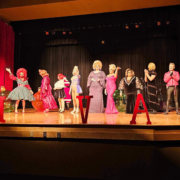
A lineup of drag performers stands across a brightly lit stage at the Slay Bells holiday show, wearing festive gowns, wigs, and glamorous costumes. Large red letters spell out “IVA” in front of them, with oversized Christmas ornaments decorating the background. Red curtains frame the stage as the performers pose and interact during the fundraiser for Moveable Feast Lexington.

Slay Bells Holiday Drag Show Returns to Lexington’s Lyric Theatre Dec. 7 to Support Moveable Feast

A beloved Lexington tradition returns to the Lyric Theatre on December 7. Slay Bells, a Holiday Drag + Variety Show is not just a great chance to see top-notch local queer talent, it’s also a fundraiser for Moveable Feast Lexington

MFL is the only nonprofit in Lexington delivering hot, freshly prepared meals every weekday to low-income folks with HIV/AIDS and those in hospice care as well as their families. The mission is simple; feed neighbors in need and nourish our community. Though Moveable Feast has already distributed over 800,000 meals, there’s been an influx of requests for meals, so this fundraising event is more important than it’s ever been.

Local Celebrity Drag Performers Shine as Slay Bells Returns to the Lyric Theatre

One of the most beloved Slay Bells traditions is to feature first time celebrity drag performers. Many Lexingtonians are still going gaga for Vice Mayor Dan Wu, who brought down the house during his sizzling debut. Many supporters are also excited to see what Silas House, Terry Mullins, and Andrew Shayde bring to the stage this year. 

While Shayde is no stranger to being in the spotlight, he is excited to paint his face, fluff up the wig, and try something completely different.  

“Looking back into LGBTQ history, whether it was police brutality, political violence, faith-based persecution, or a deadly epidemic, humor helped our community cope in some really dark times,” he said. “That tradition of coming together for a common good, and to find some joy among each other, still happens.” 

Shayde encourages folks to hold hope for the future while finding joy, where one can, in the present. 

“Slay Bells is a perfect example; we can step into a theater, and if just for a moment, laugh our cares away all to help some of our most vulnerable friends. While much of the world has turned away from HIV activism, there are many soldiers left out here still putting in the work, ensuring these folks are fed and healthy,” he said. “Moveable Feast is still saving lives. Let’s join ’em by showing up, donating, and by God, having some great laughs together.”

Three emcees will grace the stage, all beloved queens of The Imperial Court of Kentucky, the organization that produces Slay Bells. Helena Handbasket, Uma Jewels and Petty Poussey are no strangers to stepping up for the community and have been longtime supporters of Moveable Feast Lexington.

When asked about why Slay Bells matters, Jewels said “Slay Bells is an excellent way for drag to reach audiences it might not always meet. It’s a tame-enough show for folks of all ages, it supports a truly vital organization, and it provides an opportunity for drag artists to give back to the community.”

The ladies will be joined on stage not only by local celebrity guests, but also award-winning comedienne Mandee McKelvey, a menagerie of Kentucky drag queens, and local musicians. 

There is also a silent auction and reception preempting the event giving the audience a chance to bid on curated items like rare art, locally made goodies, and weekend getaways. Thanks to local artists and small businesses, the auction is a great way to pay it forward while finding unique items and experiences for the holiday season. The best part is, profits from the event go directly to Moveable Feast’s mission.

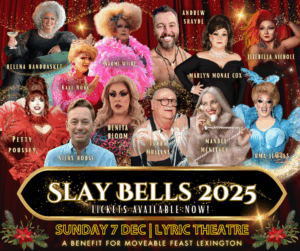
Promotional graphic for Slay Bells 2025 featuring a collage of drag performers and special guests against a red and gold holiday-themed backdrop. Pictured are Helena Handbasket, Kasi Nova, Naomi Wilde, Andrew Shayde, Marlyn Monae Cox, Jezebella Nichole, Petty Poussey, Silas House, Benita Bloom, Terry Mullins, Mandee McKelvey, and Uma Jewels. The text reads “Slay Bells 2025. Tickets Available Now. Sunday 7 Dec | Lyric Theatre. A Benefit for Moveable Feast Lexington.”

Featured performers and special guests for Slay Bells 2025, the annual holiday fundraiser for Moveable Feast Lexington.

Moveable Feast Lexington Relies on Slay Bells to Support Its Vital HIV Meal Program

This mission has been supported faithfully by Terry Mullins, Moveable Feast’s former executive director, now director of client services, for three decades. Mullins is also former president of the Tri-State Gay Rodeo, president and founding member of ActOut Lexington, and as legend has it, helped open Crossings as their very first bartender. Despite everything Mullins has done for our community in Eastern and Central Kentucky, he has never performed in drag in a Slay Bells production. 

Thanks to support from Isaiah Screech, Emperor 39 of the Imperial Court, Mullins is now ready to let his inner diva out to play. Screech has been integral in the planning and coordination of this year’s event and is no stranger to creating fantastic event experiences.

“Slay Bells is more than a holiday-themed drag show—it’s a space where queer identity, artistry, and joy are celebrated openly. Events like this create a sense of belonging and visibility for LGBTQ+ folks, especially during a season that can feel isolating for some,” stated Isaiah after a recent programming team meeting. He is working with 6 other volunteers from both Moveable Feast and Imperial Court who are working diligently to make this magic a reality.

With so much doom and gloom in the news, Lexingtonians are excited for an opportunity to come together and spread the love through joy, art, and a whole lot of glitter. More performers will be announced in the days to come, but get your tickets now while they’re still available! For tickets and more information, visit feastlex.org/event/slay-bells-2025


Pin It on Pinterest