Adrian Williams of KY Tenants Is Helping Kentucky Renters Fight Back


This profile is a part of a series celebrating LGBTQ+ leadership in Kentucky ahead of Creating Change 2027 in Louisville, the National LGBTQ Task Force’s annual conference.
Growing up in Jacksonville, Florida, Adrian Williams, executive director of KY Tenants, experienced housing insecurity firsthand after their parents divorced, leading to their home being foreclosed on.
They, their mother and their sister lived with family friends until they could get into Section 8 housing.
“The experience of being a kid, and not really having a solid place that felt like my own was its own experience,” Williams told Queer Kentucky. “But as I grew older, and I was watching my mom working two to three jobs to keep a roof over our heads – and then things would happen, like she would get laid off, or someone would get sick, and we would be living with other people again.”
Williams added: “I grew up being deeply aware that the housing system wasn’t working for everyday people.”
The path to KY Tenants began when Williams moved to Lexington in 2019 for a job at the University of Kentucky as a cataloging and metadata librarian. In 2021, they joined KY Tenants when the tenant-led organization launched to fight for safe, high-quality housing, housing security and permanently affordable housing in Kentucky.
Working the phone banks, they heard stories. People had gotten sick. Some had lost spouses. Others lost jobs.
“I joined because I had experienced it myself,” they said, “and I wanted to be a part of making it different – of changing our housing system so that tenants and poor and working class folks have direct control over housing situations.”
It was an education on tenants’ rights, policies, and why things were not working.
Today, Williams wields that knowledge and lived experience leading KY Tenants, which is primarily active in Lexington and Morehead, with statewide aspirations.
KY Tenants organizes and trains tenants to negotiate, or escalate, with landlords for improved conditions and fair leases through tenant unions at the building, property or neighborhood level. Williams described the effort as working off of three pillars: tenant power, tenant protections, and social housing.
What does tenant power look like?
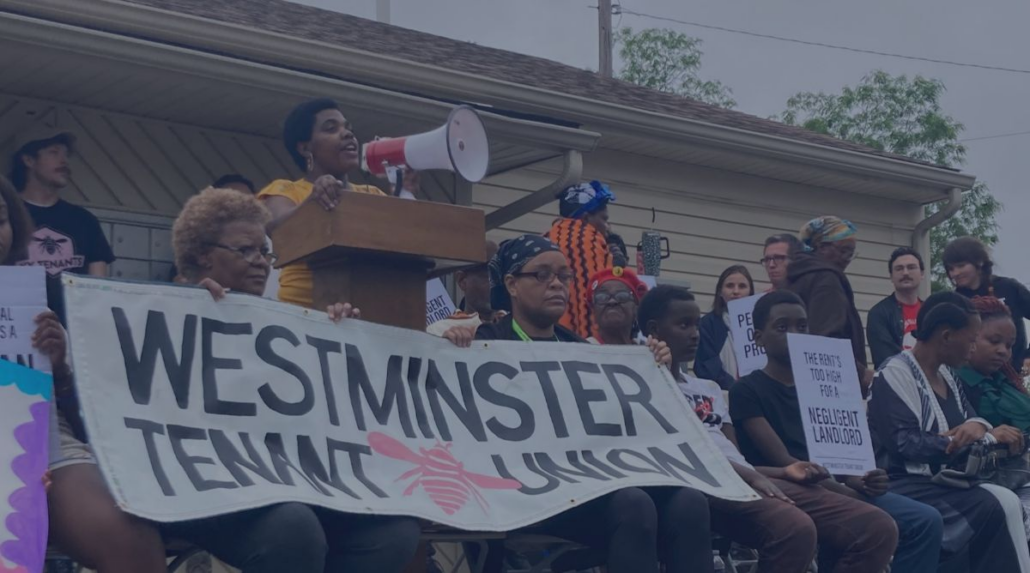
Westminster Tenants Union launched in 2025 as a supermajority of tenants at Westminster Village Apartments. They organized to win about $50,000 in property improvements, including stove replacements and plumbing repairs.
Organizers also won a lawsuit on behalf of Swahili-speaking tenants at Westminster Village. Williams said the landlord had mismanaged recertification paperwork involving housing choice vouchers. Tenants who could not read English were unaware they were being improperly overcharged, and faced thousands of dollars in back rent that they didn’t actually owe.
This story exists because of readers like you. Give $5 a month to keep Queer Kentucky free.
Other victories include winning $1.8 million in public funding in 2023 for a right to counsel pilot program to benefit people facing eviction; and securing a 2024 ban on source-of-income discrimination, including housing vouchers.
This year, its Morehead State University chapter won after students fought for more maintenance workers and to get mold addressed in the dorms.
The Morehead community chapter has also been rocking the community land trust: when a nonprofit acquires land and property, taking it off the speculative market so residents can become long-term leaseholders.
“We have to be able to have these alternative housing systems so that people can stay and fight,” Williams said.
KY Tenants is never going it alone.
The organization gets support from Legal Aid of the Bluegrass (LABG) and pro bono assistance from attorneys, while building coalitions with organizations like the Madison County Tenants Union.
In 2023, KY Tenants partnered with Common Ground Kentucky to launch the Grass Roots Impact Training (GRIT) program to meet the need of local and regional organizing training; the political collective Black Leadership Action Coalition of Kentucky (BLACK) joined as a co-collaborator in 2025.
“The GRIT program trains and coaches everyday Kentuckians in our movement spaces on organizing fundamentals, in service of scaling up the base-building and power-building capacity of our movement across the state,” Williams told Queer Kentucky. “Our program puts on daylong and multi-day trainings throughout the year that build the hard and soft skills our leaders need to build power in their communities. We then provide coaching to participants afterward so they can continue developing those skills.”
While different organizations exist to do different work and cannot always work together, coordination remains essential, Williams explained.
“You might win by yourself, but it’s difficult to hold your wins by yourselves,” they said.
As a queer person, Williams’ work is informed by deeply political sensibilities shaped by their earlier work as an academic librarian focused on LGBTQ+ context, histories, and languages.
They have learned not to make assumptions.
“The person you see in front of you is not the fullness of that person, and it is always worth it to be open and curious about their point of view and where they’re coming from, and meeting them where they’re at,” Williams said.
“We’re all on this journey of transformation and healing and discovery … We can bring tension into the room, and we can again have grace for where we’re at, and have grace for the fact that as long as someone is trying and working to be moved and to move others, that’s progress.”
More Creating Change coverage
Queer Kentucky is a media partner of Creating Change 2027, the National LGBTQ Task Force conference coming to Louisville Jan. 27 to 31, 2027.
Keep reading
 Fayette County Families Take Kentucky’s Anti-Trans Law SB 150 to State Court
 Op-ed: Being trans in Flemingsburg, Kentucky, isn’t just isolating. It’s also freeing.
 These 12 local offices shape your daily life in Kentucky. Here’s what each one does
 What does a city council or city commission do in Kentucky?
 What does a school board do in Kentucky?