
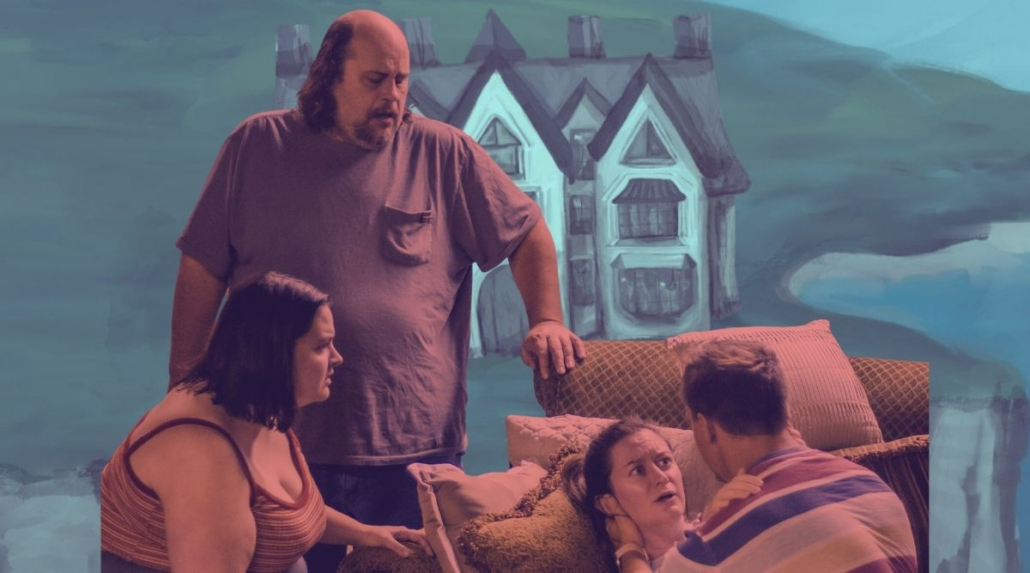
 Highview Arts Center
Queer Talent Shines in Highview Arts Center’s “And Then There Were None” "Ten strangers. One isolated island. No escape"


The cast is villainous, and there’s plenty of queer octane fueling the production of the classic Agatha Christie murder mystery, And Then There Were None. Adapted from the novel for the stage, the play runs September 4 through September 13, 2026 at the Highview Arts Center in Louisville, Kentucky.
Directed by Joy Beth DeWitt-Riley and produced by Jay Padilla-Hayter, And Then There Were None follows ten strangers who are invited to an isolated island, where they learn that each has been accused of causing someone’s death. As they begin to die one by one – murdered according to the verses of a nursery rhyme – everyone is suspect.
The production aims to keep the audience on edge, delivering twists in the plot – and a few turns on gender. Not surprising, given that Joy Beth DeWitt-Riley, making her directorial debut, got her start in a Shakespeare revue where she played Romeo in Romeo and Juliet. And Rayann Walker, who played opposite her as Juliet, happens to be in the Highview Arts show now playing Mrs. Rogers. The two met in 2024 at Three Witches Shakespeare – a queer, feminist company in Louisville.
Rewriting the Script On and Off Stage
That same approach to gender-fluid casting shows in DeWitt-Riley’s directorial choices, giving the part of Detective William Blore to actor Hannah Blackmore.
“I was so excited when I saw on her audition form that she said she was open to playing characters of any gender,” the director gleefully noted of Blackmore.
“We’re trying to be really inclusive and not discriminate against anybody [around] sexuality, gender, race, and especially body type. That’s one that I think people don’t call out enough, especially in the theater world,” said DeWitt-Riley. “I am a plus-sized girly, so sometimes it is a little bit rough for us out there in the theater world. But we really want everyone to be involved and to be able to participate in the arts.”
The director included a few different words to describe her own sexuality, including bisexual, bi-romantic and she says she’s on the asexual spectrum, as is her husband.
“A lot of people don’t always understand how those two things can go together,” she says. “And I say, well, if you don’t understand it, imagine being it, because that was very confusing for a lot of my life.”
DeWitt-Riley brought her inclusive mindset to the play’s particulars, along with sensitivity to elements from an earlier era that would certainly be found offensive today. The original 1939 title – long since dropped – was based on a minstrel rhyme and used a racial slur. At one point, the play was also called Ten Little Indians. DeWitt-Riley intensely studied the story’s history, and Christie’s biography, in preparation for creating a play that would be gripping, while welcoming to all.
“I think as a queer person, I can’t help but be queer in everything that I do,” the director said. “And the theater has always been such a safe harbor for people that don’t quite fit in other spaces, and so I do think it naturally attracts queer people.”
This story exists because of readers like you. Give $5 a month to keep Queer Kentucky free.
While the story doesn’t have queer-specific themes, in preparing for the show, some of the cast approached discussions about inner motivations with a queer perspective. It might not be obvious on stage, DeWitt-Riley said, but it’s there.
On the crew side, Matthew Pruitt, stage manager, is an openly gay man. At least half of the cast is queer, including Jesse Barfield, who plays Rogers, as well as Mimi Housewright, who plays one of the leading roles, Vera Claythorne.
“Theater is a reflection of life, and so our queer experiences are being reflected by how we’re presenting ourselves, even when we’re a character. I always say that acting isn’t lying – it’s telling the truth in a different way,” DeWitt-Riley said.
“I’m Done Pretending to Not Be Who I Am”
Mimi Housewright, who identifies as pansexual, came out publicly in 2023 while in a production with Mind’s Eye Theatre.
“I was doing The Addams Family at the time, and I was like, ‘All right, I’m done. I’m done pretending to not be who I am,’” she said, recalling being surrounded by queer folks who were really supportive.
“You know, they loved me the way that I am, and they gave me the encouragement that I needed to publicly come out. Since then, I definitely think that I’ve seen a difference in myself in how I interact in theater settings. It no longer feels specifically like I’m hiding something.”
Playing Uncle Fester was also liberating.
“It was the first time playing a role that wasn’t my gender, and I just felt so free.” She felt like she could do anything. “After that, to me, it just felt like the sky was the limit.” Housewright went on to play Buddy the Elf and Shrek in other shows before landing the part in And Then There Were None.
Housewright said she is super excited about playing Vera.
“She is there as a secretary, and yet you see at the very beginning that she takes charge, she gets everybody in line, even though there’s a couple of characters that don’t really respect her because she’s a woman… ” Everyone has a dark side, and the actor is also drawn to Vera’s inner struggles.
Along with all the possibilities opening up for Housewright recently, she appreciates what she sees all over the Louisville theater community: “Such incredible gender-blind casting and letting people try something out that they normally wouldn’t be in.”
By that, she’s referring not only to gender and to queerness, but to looks.
“I’m not who you would normally cast for an ingénue role, and I do consider Vera an ingénue… it has nothing to do with me being queer or me being large or me being short. None of it. It was all about who I really was – the best person for this character.”
A Coin Flip, a Proposal, and a Few Surprises
In addition to cultivating inclusion, Joy Beth DeWitt-Riley made other directorial tweaks with sensitivity in mind – including scrubbing out some of the script’s misogyny.
“There’s a scene where Vera’s character is freaking out, and a male character comes up and slaps her because she’s being hysterical, and we don’t do that,” DeWitt-Riley says. “I’ve changed it to where he is guiding her to a chair and sitting her down…”
Speaking of switcheroos – one of the biggest and most fun: for each show, a flip of the coin will determine the ending: heads, the 1939 ending in the original novel, or tails, the 1943 stage ending. We don’t want to be spoilers, but suffice it to say that WWII, in all its bleakness, had Agatha Christie devising an alternate wrap-up in the 40s that was, well, slightly less bleak than the war.
And in real-life happy drama, there’s another alert we definitely don’t want to spoil. Word is Mimi Housewright has a girlfriend, and one of them is going to propose to the other. Soon!
“I am friends with both of them, and I keep on talking to both of them, and I know both of their plans – but I can’t share them because it hasn’t happened yet,” DeWitt-Riley teases.
Tickets for Agatha Christie’s “And Then There Were None” at the Highview Arts Center in Louisville, Kentucky, are available on the venue’s ticketing page. The theater is fully physically accessible.
Keep reading
 Federal Cuts “Handcuffed” BIPOC Harm Reduction in Kentucky. Communities Are Stepping Up.
 Homeownership Is Radical, Says Mercury Stardust. Her Book Tour Hits Louisville Oct. 8
 Whiskey Row Walking Tour: Louisville Native Drew Shryock Shares Bourbon, History, and Pride
 Louisville Roller Derby Double Header: Camp Crystal Skate
 Old Forester’s Melissa Rift Took the Long Way to Master Taster, and Found Belonging in Bourbon



 National LGBTQ Task Force
 WAVE Foundation