KEEP. Beat. Additive. How people live: bars, food, faith, sports, relationships, community, history, and arts coverage of every kind. One of three beats, matching the site’s three top-level categories: Health, Civic, Culture. Absorbed Beat: Arts Oct 7 2026; when the art itself is the subject, add Subject: Arts on top.

Tag Archive for: Beat: Culture

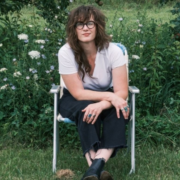
Willow, with long, wind-blown reddish hair and glasses, smiles in a selfie outdoors under a cloudy sky, headphones around her neck.

Op-ed: Being trans in Flemingsburg, Kentucky, isn’t just isolating. It’s also freeing.

The views and opinions expressed in submissions to Queer Kentucky are those of the authors and do not necessarily reflect the official policy or position of Queer Kentucky. Any content provided by our submissions or regular columnists are of their opinion. As a reader, you are always welcome to submit your op-eds through our submission form.

Medically transitioning while living in Flemingsburg is horrifying. You wonder not if people are going to notice the changes but when; there is only so long that you can hide it or at least for me the need to express myself as who I am. Towns like this have a monoculture. Most of them expect certain things: everyone is cis, heterosexual, and a misogynistic God. For most people this is a very comfortable life, but that is not how my brain is wired. Your brain wonders: Will people accept me? When you have political ads, preachers condemning us as abominations, the one thing that sticks with me is I witnessed people believe the litter box rumors. Even before I knew that I was a trans girl, this drove me insane.

How does one find community here of all places? Most of us have to look outside, usually to a college town or a major city, for it. But why must it be that way? Can we change hearts and minds here? I would like to think that but sadly I don’t think that will happen anytime soon. There are not a lot of us, society is a numbers game and we are the prey. All of us have to find safety in each other. Maybe one day there will be a support network for LGBT+ people for small towns like this one, but I fear that it will be met with othering and hostility.

So why am I writing this if it’s so dire out there? I personally believe that one voice can make a difference to at least one person. It is worth it! Or maybe it’s just me trying to tell the world, “Hey, I am here.” Will you take my hand and go on this journey with me? Some of you might not understand it but can I at least have your empathy? I’m not hurting anyone. I can’t believe adults are out here demonizing trans children not because of their moral values but because of a media campaign.

At the end of the day, we all just want our voices heard. Maybe one day Kentucky will grow to accept us for who we are but that is not the reality we live in, so we must find each other. As a group, we tell each other our struggles and our experiences. I am just one voice but it is my voice and I just want it to be heard. I got lucky that I had help getting started on this journey, but I can’t afford an Uber to Planned Parenthood every three months, so I am forced to use the local hospital for blood work to send out there. It’s been a bit of a headache but worth it in the end even if I end up having to go back there the next week because for some reason they have not sent it.

This life has been a bit isolated but very freeing. The one thing that I can say for certain is that this path has been very freeing. I never thought I would ever reach a point where I am happy for myself for the first time. No matter what happens this is who I am and nothing can change that.

About the author: Willow (she/her) has lived in Flemingsburg for nine years and has been medically transitioning for about nine months.
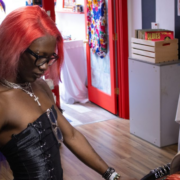
Kenni, with bright red hair, glasses and a black corset top, looks through a clothing rack in a vintage shop, photographed by Harper Thomson

The Orange Dress That Became Pants: How Trans Youth Find Home in Their Clothes

This story first appeared in Queer Cincinnati: Beyond the Binary, published Oct. 23, 2026.

Transgender people from all unique walks of life have a very different relationship with fashion than their cisgender peers. For transgender youth, how they choose to dress themselves can have a wide variety of purposes in their day to day lives. For many trans people, how they dress can often impact how they affirm their own gender, relate their gender expression to others, and protect themselves and their community. With what feels like limited spaces to celebrate transgender bodies, and the constant commentary on trans expression from cisgender peers, transgender youth are looking inwards. Through this they are finding home within themselves and their community through dress.

Stone (They/Them), 23, Hometown: Roebuck, SC

“What item of clothing was a milestone in your transition?”

Stone: This orange dress that I was able to turn into pants. A big thing to me is androgyny. Having a dress and knowing that I can wear whatever with it really brought out that experience. And can I even say it’s mine if I didn’t make it my own? I don’t have enough dresses and skirts but I’ll get there.

With clothing being so attached to gender expression in our society, the ability to modify that clothing can be very important to many trans people. Clothing can determine much of how you’re perceived by others. With most mainstream clothing often being designed around the gender binary, altering garments to be more androgynous/fitting can be deeply fulfilling.

Kenni (She/Her), 22, Hometown: Delhi Township, Ohio

“Do you find home and gender euphoria in clothing that people might imagine to be a bit more physically restrictive, and if so what garments?”

Kenni: Honestly my heels. With my thigh high boots, you have to wear them for a while and work them in, but once you’ve had them for a while I feel like you can do anything in these heels, it feels like I am just wearing some gym shoes.

“Does your dress inform how you feel within your body or do you think it more informs what you can accomplish with your body?”

Kenni: Definitely the latter. Sometimes you have to know you can’t be dancing the absolute most in a little dress, but I will [still] be dancing around busting my ass.

Way (She/Her/Hers), 21, Hometown: Loogootee, Indiana

“How does your career in musical theatre and acting impact your dress and transition?”

Way: Dress in a lot of ways is everything. It’s what the people behind the table like casting directors and artistic directors see first before you even open your mouth. I want to ensure I am representing myself in the most authentic way without dampening who I am.

“Why do you think hyper utilitarian garments (for example carabiners, cargo pants, combat boots) are so popular amongst trans people?”

Way: [In my opinion], queer people are overwhelmingly more common amongst the working class because there is less energy available to try to hide something. We make up a good part of the labor force. There is also this idea of needing to be ready to be equipped to stand up for yourself and being ready to help and protect other queer people.

Clothing not only serves as a means of expression but also for everyday utility. Sporting a more utilitarian look is a form of anti-fashion. Rejecting consumeristic, highly gendered, and rigid fashion standards. Not only for comfort and mobility, but also for the very genuine purpose of expressing one’s authentic identity.

Emmet (They/He), 24, Hometown: Anderson Township, OH

“What was it like growing up queer and trans in Anderson? Did you feel like you had to make any compromises in your dress to be safe?”

Emmet: It was one of those things that was never talked about in my household. I grew up religious and homeschooled so I didn’t get to see a lot until I got my first barista job when I was 18. I was introduced to people that used different pronouns, that were trans and queer. Anderson has gotten better but it’s not the most accepting place. At first when I was newly queer I would definitely ‘tone it down’. As I have grown into dressing how I feel it’s still very scary and intimidating. You never know how people are going to respond to crazy makeup or a shaved head. I am going to look queer no matter what. Travelling around Cincinnati for sure changes how I dress, closer to downtown I really get to go to the max with it.

Elliot (They/He/She), 22, Hometown: Cincinnati, OH

“If dressing ever felt like a costume, when did it stop feeling like a costume?”

Elliot: Looking back in my early transition, I painted on my eyebrows and I would make facial hair with my makeup, it felt like I was performing the most hyper masculine. When 2020 hit, I loved experimenting and playing with makeup and that is when I got a little bit more feminine. It hit me that I didn’t have to perform as much, I could use it as a chance to be more fluid, more for myself than the people around me. It really just matters day to day about how I present myself. That fluidity has allowed me to really find myself and connect to my body.

As fluid as gender identity and expression can be for many transgender people, one of the many utilities of dress can be its ability to change with us. This not only allows for us to accurately portray ourselves to the world at large, but also aids in us being able to break down internal biases and shame. Experimentation and fluidity in one’s dress can become an essential part of the journey towards true self expression.

Thank you to Secondhand Circus and GG for allowing us into your space, and thank you for what you do for the Cincinnati transgender community.

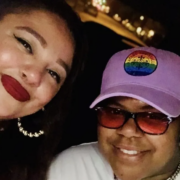
Paulina Helm-Hernández, in red lipstick and a jeweled necklace, and Ashe Helm-Hernandez, in a lavender cap with a rainbow patch and tinted glasses, smile together in a nighttime selfie.

The Information Game: Women’s Soccer, HIV and Belonging for LGBTQIA+ People of Color in Kentucky

On May 29, 1995, R&B group TLC released the song “Waterfalls.” It was the first No. 1 song ever to refer directly to AIDS, spending seven weeks at the Billboard 100 chart’s top spot: a song by three Black women to break the stigma surrounding HIV and to promote safer sex practices.

That same year was also one of the most important years in the history of professional women’s soccer. In 1995, it was the second year of FIFA’s Women’s World Cup, held just two months after TLC released “Waterfalls.” According to the U.S. Soccer archives, women’s soccer had almost no professional leagues in 1995. Most successful American players were competing for colleges and universities; salaries were nearly non-existent, and it was still a year before the Summer Olympics would welcome women’s soccer as a medal event. Women’s soccer at that time was still in its infancy.

Much like women’s soccer athletes from around the world were just beginning to be seen and taken seriously on the world stage, a deadly virus was expanding across LGBTQIA+ communities, at a time when effective treatment remained limited. Thirty years later, these two histories have intersected in a conversation about the National Women’s Soccer League (NWSL), the evolution of HIV treatment and healthcare, and what it truly means to belong. As women’s professional soccer continues to grow, so does the opportunity to examine how the league’s relationship with LGBTQIA+ communities can extend beyond visibility and representation to include education, access to sexual healthcare, and meaningful support.

According to a first-person account by Kevin Garner, published last year by Queer Kentucky, “In [19]80s and ‘90s Kentucky, HIV/AIDS services were concentrated in urban areas such as Louisville and Lexington. As a conservative state, political attitudes and action were slowly emerging.”

Garner pointed to Nazareth Home and Lyndon Lane Nursing Facility as “the only two facilities that would take clients under 40 who were affected by this disease during this time.

“There was a push for prevention.”

An unmet need unevenly shared

In 1995, more than 500,000 AIDS cases were reported nationally, and about 62% of those diagnosed had died by October. A 1992 study found that one in three Kentuckians diagnosed with AIDS in the 12 months between July 1990 and June 1991 died within three months of their diagnosis. Researchers concluded that many patients had not received consistent HIV care before developing AIDS, and they pointed to missed diagnoses, fragmented medical care (across dozens of hospitals and physicians), and gaps in follow-up treatment as major contributors to poor outcomes.

From the 1990s to today, the highest burden of HIV/AIDS deaths in the U.S. has not been evenly shared. Data from the Centers for Disease Control and Prevention (CDC) show, in the early years of the epidemic, AIDS deaths were heavily concentrated among men, especially gay and bisexual men, and the epidemic was especially severe in places like New York, New Jersey, California, and Florida.

By the mid-1990s, AIDS deaths reached their peak: The CDC reported that about 50,628 people died of AIDS in 1995, just before combination HIV treatment became widely available. After those stronger drug combinations arrived in 1996, deaths dropped sharply. Across race, Black Americans became increasingly overrepresented in HIV/AIDS illness and death, and that disparity continues today.

In plain terms, Black communities have carried a much higher share of HIV-related deaths than their share of the U.S. population. By region, the burden shifted over time: Early in the epidemic, AIDS was particularly concentrated in the Northeast, but today the South carries the largest share of both new HIV diagnoses and HIV-related deaths. In 2024, the South accounted for 51% of HIV diagnoses and 53% of HIV-related deaths nationwide.

Community in the crowd

From the 1990s to today, as HIV/AIDS prevention and treatment has changed considerably, so has the sport of women’s soccer in Kentucky. In 2021, Racing Louisville FC began play in the National Women’s Soccer League (NWSL), bringing a major-league professional sports franchise to Louisville for the first time in 41 years. Today, the club plays at the 15,304-seat Lynn Family Stadium, where more than 11,000 people attended a single NWSL match in 2024.

In recent years, increased investment in women’s sports has also meant more “third spaces” – what sociologist Ray Oldenburg described in 1989 as informal gathering spaces outside the home (first place) and work (second place), where people build relationships and community. For longtime LGBTQIA+ fans, who have long existed as the foundation of women’s sports fandoms around the world, stadiums and the communities that gather around us can function as third spaces, offering opportunities to build relationships, express our identities freely, and experience a sense of belonging that may not always be available in other parts of our lives.

I met two of these fans, Paulina Helm-Hernández and Ashe Helm-Hernandez, on a Wednesday night in Louisville. Paulina is a feminist philanthropic advocate whose work spans the Southeast, LGBTQ+, feminist and migrant rights movements. Born in Mexico City, with family from Veracruz, Mexico, she grew up in eastern North Carolina. Ashe, a philanthropic advocate for trans movement work, is originally from Louisville. Their family has been in the city for a century, and they attended Jefferson County Public Schools and the University of Louisville. After spending time away, they returned home with their wife, Paulina, to be closer to family.

Both had been to prior Racing Louisville matches, but Paulina still remembers what struck her the first time friends invited her to a match.

“I attended with some friends that invited us specifically because they’re also Racing Louisville fans, and we made an outing of it as a group of friends,” Paulina said. “It was my first time. My family also grew up, you know, as Mexican, as a Chicana woman, like following and watching soccer, and also one of the favorite sports of the Latino community, and I was a little bit surprised by the lack of racial diversity, to be honest, because I was like, ‘Wait, where are my people at?’ Because my people love soccer, and more and more girls are playing soccer.

“So I do feel like there’s like a little bit of a disconnect between the community and who attended those games,” she said. “Or who attended the games at the time was a couple years ago. So to be fair, I hope that that’s changed.”
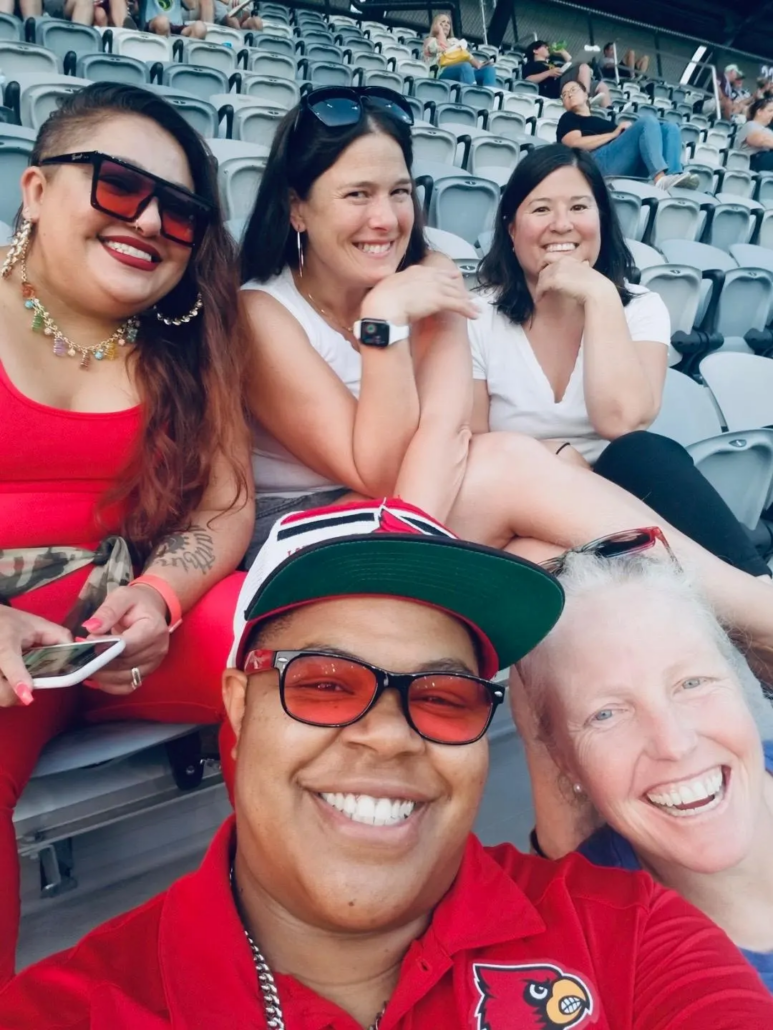
Paulina Helm-Hernández and Ashe Helm-Hernandez smile for a selfie with three friends in the stadium seats at a Racing Louisville game.

Paulina Helm-Hernández, left, and Ashe Helm-Hernandez, front, with friends at a Racing Louisville game. Supplied by Paulina Helm-Hernández and Ashe Helm-Hernandez

Paulina observed a crowd of fans that day considerably less diverse than the city’s larger population. Black residents make up about 23% of the Louisville-Jefferson County metro’s population, and Latino residents about 9%. But Louisville’s diversity has never been evenly distributed across the city. Decades of racial zoning, redlining and other discriminatory housing practices helped produce geographic divisions that remain visible today, with Louisville Metro’s own housing research finding that the city remains segregated by race and ethnicity.

Those divisions also intersect with Louisville’s LGBTQIA+ history. Researchers at the University of Louisville’s Anne Braden Institute have documented race as an important part of understanding queer life and history across Kentucky. Today, Louisville contains some of the state’s strongest LGBTQIA+ community and health infrastructure, but recent survey data from Queer Kentucky suggests that access and belonging remain uneven, even within the state’s largest urban center. Queer Kentucky’s 2025 Community Health Survey found that 65.5% of its 559 LGBTQIA+ respondents reported a strong sense of community belonging, while 11.4% reported low belonging. Respondents living with HIV reported an average belonging score of 3.98, compared with a statewide average of 4.86, the lowest average belonging score of any group measured.

Belonging is a primary indicator of good health. People need access to doctors, medicine, testing and treatment to be well, but research increasingly recognizes that people also need relationships, community and places where they can meaningfully connect with other people. The CDC names social connection an important determinant of physical and mental health, while research cited by the U.S. Surgeon General found that people with a strong sense of community belonging were 2.6 times more likely to report being in good or excellent health than people with a low sense of belonging.

This is especially important for LGBTQIA+ communities, whose rights to love, marry, build families and openly exist continue to be challenged and questioned by elected leaders. For communities whose belonging in public life has repeatedly been contested, having spaces where people can safely gather, build relationships and see themselves reflected is not just about having somewhere to go. Those spaces can become part of what people need to feel connected, supported and well.

That makes the places where LGBTQIA+ people gather part of the conversation about community health, too. A stadium cannot replace a doctor’s office, a testing site or a public health program. But it can do something those institutions cannot always do on their own: regularly bring queer and trans people together around a shared experience and create opportunities for LGBTQIA+ people to feel like they are part of fandom that affirms who they are and who they wish to be in the world.

Still, what Paulina encountered inside the stadium suggested to her that Racing already had much of what it needed to reach a broader community.

“I remember thinking, you know, as a fan of women’s sports, I thought it was a great atmosphere. But I do think, you know, it lacked the cultural diversity that I’m used to in terms of being able to enjoy like those kinds of sporting events, knowing that they’re also a reflection of like not just fanhood, but like what does it actually mean to have infrastructure that like is actually focused on women’s sports and women athletes so that to me you know it’s a mixed bag,” she said. “But I do remember enjoying the game, we had a great time, everybody that worked at the stadium was very welcoming and very warm, and I feel like the space in and of itself… It’s a beautiful arena, and so to me, they have everything in space in terms of the infrastructure, you know, to be able to welcome more people.”

Ashe’s first experience with Racing started differently. A lifelong Louisville sports fan, they showed up dressed for the Louisville team they already knew, but whose colors didn’t match this home team.

“I can go ahead and admit that I totally had on red,” they said. “I had on a University of Louisville ball cap, and my friends busted out laughing at my appearance and quickly took me to the Racing store to get some gear. And so, you know, I was shy. I was like, I didn’t look this team up. My friends invited me out, and I was like, ‘Let’s go! It’s Louisville,’ and I am a diehard University of Louisville fan, and I got that mixed up a bit. So yeah, but lavender is a beautiful color, and I appreciate it very much having some new gear.”
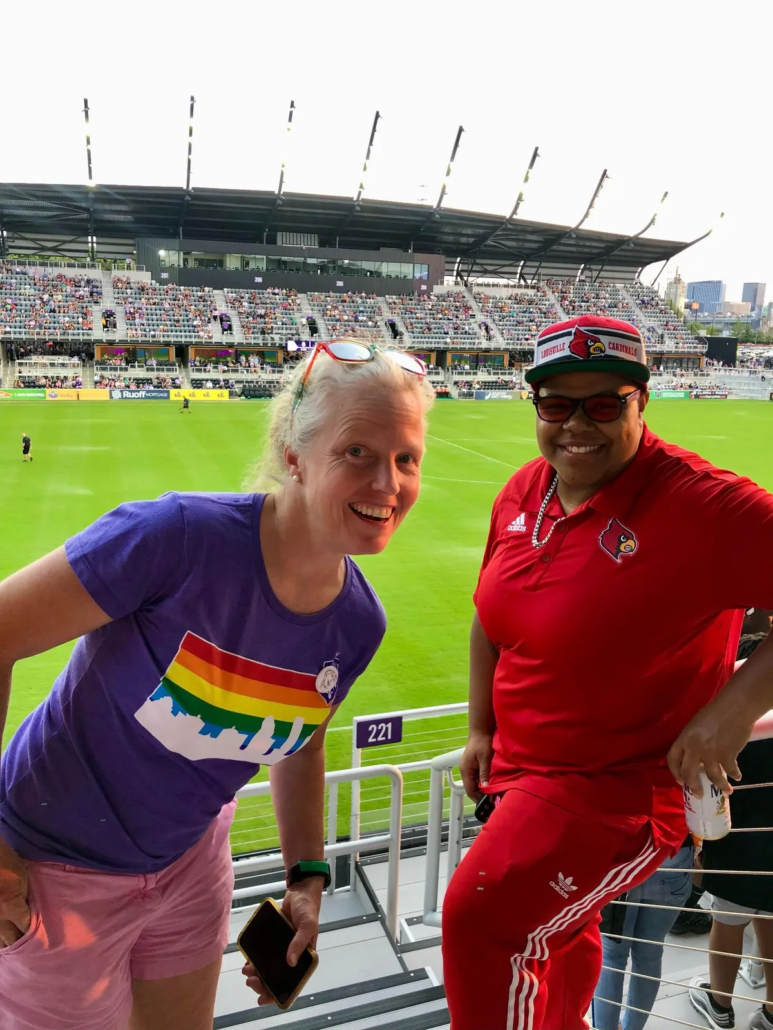
Ashe Helm-Hernandez, wearing a red University of Louisville polo and cap, stands with a friend in a rainbow shirt above the field at a Racing Louisville game.

Ashe Helm-Hernandez, right, in University of Louisville red with a friend at a Racing Louisville game in 2021. Supplied by Paulina Helm-Hernández and Ashe Helm-Hernandez

Soccer as belonging, belonging as care

Their experiences point toward something larger than fandom. In 1995, Kentucky did not have a top-tier professional women’s soccer team or a stadium capable of regularly gathering thousands of women’s soccer fans. Today it does. That growth creates an opportunity that did not exist three decades ago. Professional women’s soccer now has the physical infrastructure, cultural visibility and audience to bring thousands of people together at a time. And some of the communities gathering around women’s sports are the same communities Kentucky’s existing healthcare infrastructure is still struggling to reach.

Queer Kentucky’s 2025 Community Health Survey found that 48.2% of its 559 LGBTQIA+ respondents had never been tested for HIV. Among cisgender women, that figure was 53.6%. Among transgender women, it was 57.7%, and among nonbinary respondents, 50.6%. At the same time, more than one in three respondents statewide reported having no regular healthcare provider, while the U.S. Department of Health and Human Services reports that approximately 1.2 million people in the United States are living with HIV, and one in eight do not know they have the disease.

The relationship between community and HIV prevention is not theoretical. The U.S. Surgeon General’s advisory on social connection notes that stigma surrounding HIV can create barriers to both healthcare and social inclusion, while National Institutes of Health research has found a link between stronger community connections and people taking steps to prevent HIV.

That raises a different question about the economic and social value of professional women’s sports in Kentucky. What if the value of a stadium is not limited to what happens on the field? What if the same infrastructure, built to gather thousands of fans around women athletes, can also become infrastructure for connecting communities to information, testing, prevention and care?

There is already another professional women’s sports league that offers a glimpse of what can happen when that kind of infrastructure is given time to grow.

For Paulina and Ashe, the Women’s National Basketball Association (WNBA) has never been just basketball. Both came of age alongside a league that has now existed for 30 years and watched women’s professional basketball become a place where Black women, queer people and generations of women’s sports fans could see themselves reflected.

Some of Paulina’s earliest experiences in LGBTQ+ movement spaces were already intertwined with women’s basketball. She remembers older lesbians gathering around games and using basketball itself as a language for thinking about organizing and movement building.

“I grew up in an era where people were very like: This is one of the lenses to understand, you know, movement building,” she said.

Three decades later, she sees what women’s professional basketball has become, as more than commercial growth. She called the rise of the WNBA a “social and political win,” describing women’s sports as one of the places where fans can now see “queer excellence” and “feminist excellence” at the highest level.

Ashe remembers that history differently. Growing up playing basketball, some of the women they watched in the earliest years of the WNBA became their heroes.

“I was able to look up to Cheryl Swoopes, and I was able to look up to Cynthia Cooper as people and role models,” they said. “That I could be, that Black women could do that, that they could be on television, that they could play sports, that they could play basketball, that they could sweat, they could be fierce.”

Today, Ashe sees younger players learning whose footsteps they are following, while the players they grew up watching are finally being recognized as living legends.

Their experiences show what can happen when a professional women’s sports league has enough time to become part of a generation’s lives. The NWSL is still building that history. The WNBA was founded in 1996 and began play the following year. In 2026, the league celebrated its 30th season. The NWSL, by comparison, was founded in 2012 and played its first season in 2013. In just over a decade, professional women’s soccer has grown considerably, but that’s still only half the time the WNBA has had to become part of the lives, traditions and communities of its fans.

That difference in time matters when thinking about what Paulina and Ashe described. The impact of the WNBA on their lives cannot be measured only through attendance, television audiences or revenue. They are describing what happens when a professional women’s sports league exists long enough for people to grow up alongside it. Players become childhood heroes. Games become traditions. Fans build relationships with one another.

Queer people find spaces where they see themselves reflected. Over time, a sports league can become part of the social infrastructure of a community.

For Paulina, women’s basketball was woven into LGBTQ+ community life long before the WNBA became a mainstream cultural phenomenon. She remembers gathering at people’s homes to watch games, where basketball brought people together for more than just the competition.

“You just had to get with the program and you had to watch games and you had to go to people’s houses and know that the meetings happen after the game and know you were not allowed to talk through it,” she recalled.

For Ashe, the league’s history is personal. During a recent presentation at work, they shared a photograph of WNBA players from three decades ago with their colleagues: “I told my team that these were my heroes,” Ashe said. Those same athletes who inspired Ashe as a young basketball player are now being celebrated by another generation.

“For me, it’s a very serious moment where players are getting their due, and where younger players are learning whose footsteps they walk in, and they too are being able to recognize living legends,” Ashe said.

Paulina remembers the relationships and organizing that happened around games; Ashe remembers the athletes who showed them what was possible for Black women in professional sports. Together, their experiences illustrate how a league can become part of a community’s history, creating relationships, traditions and a sense of belonging that develop over generations.

Racing Louisville, which joined the league in 2021, is part of a story that is still unfolding, as fans begin building those traditions and relationships that future generations may one day inherit. But just five years after the club began playing in Kentucky, questions have emerged about its long-term future in Louisville.

That possibility raises another question about how communities measure the value of women’s sports institutions. Five years may be enough time to count tickets, calculate attendance and measure revenue. It may not be enough time to measure what happens when a generation grows up with a professional women’s team in its city, when queer fans build traditions around going to games together, when Black and Latine children begin seeing the stadium as somewhere they belong – when community organizations begin treating that stadium as another place where people can be reached.

Lynn Family Stadium represents physical infrastructure. It has more than 15,000 seats and the ability to bring thousands of people together at once. But what Paulina and Ashe describe through their experiences with women’s sports is another kind of infrastructure that takes much longer to build. Relationships, traditions, information networks, chosen family, representation, belonging and trust develop over years as LGBTQIA+ people repeatedly gather in the same places and around the same women’s sports teams.

This work was supported by the 2026 CNP Media Fund. #CNPMediaFund

The four members of the band Wax Factory, dressed in black with red ties and a black dress, pose against a red backdrop.

Kentuckiana Pride Foundation’s SHINE Gala returns to the Speed Art Museum Nov. 13

The Kentuckiana Pride Foundation proudly presents the 2nd Annual SHINE Gala on Friday, Nov. 13, from 7 to 11 p.m. at the Speed Art Museum in Louisville, bringing together community leaders, businesses and supporters for an unforgettable evening dedicated to strengthening the LGBTQIA+ community.

Kentucky Lt. Gov. Jacqueline Coleman and Louisville Deputy Mayor Chan Kemper are scheduled to attend this year’s celebration, highlighting the importance of community partnerships and inclusion.

At the heart of the SHINE Gala is the foundation’s ambitious goal of establishing a $1 million endowment fund to provide long-term financial support for LGBTQIA+ nonprofits, small businesses, community leaders and organizations throughout Kentucky and Southern Indiana.

Guests will enjoy live entertainment by Louisville’s own Wax Factory, performing crowd favorites from the 1960s through today.

The foundation proudly recognizes My Financing USA as the presenting sponsor, along with supporting sponsors Chill Bar Highlands, Big Bar, Highland Tap Room, Jefferson County Teachers Association, attorney Matthew Coogle and Louisville Tourism.

Dr. Timothy S. Weyrauch, president of the Kentuckiana Pride Foundation, emphasizes the importance of building a lasting legacy of community support through the SHINE Gala and its endowment initiative.

Event details

  • Event: 2nd Annual SHINE Gala
  • Date: Friday, Nov. 13, 2026
  • Time: 7 to 11 p.m.
  • Location: Speed Art Museum, Louisville
  • Tickets and table sponsorships: theshinegala.org

For media inquiries, contact Todd Smith, director of communications for the Kentuckiana Pride Foundation and the SHINE Gala, at [email protected].

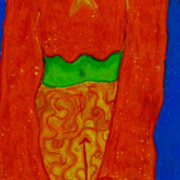
Close-up of an illustration by Cocoa Durrett of a figure in a long red-orange robe with a green waistband, surrounded by red planets and stars on a deep blue background

Sober and Queer: Finding Community Outside the Bar

This story first appeared in Queer Cincinnati: Beyond the Binary, published Oct. 23, 2026.

In summer 2026, I spent a few weeks researching Cincinnati’s queer nightlife and social events. While doing so, two questions continued to peak my interest: Where exactly do the sober members of our community spend their time, and do they ever feel excluded from nightlife and social spaces due to their sobriety? I set out to speak to individuals who could answer these questions, specifically those who identified as both transgender and sober. In an attempt to bring light to some exclusionary sentiments experienced in bar and club culture, I open these questions to you, the reader. Conducting interviews on the subject in person however, revealed to me that many share the same opinion as I do surrounding queer community events in Cincinnati. Many events found in our local queer community, I’ve found to be generally centered around bar and club culture. Those who don’t participate in substance use can often feel as if they are forced to stand on the sidelines while trying to participate in these events.

Take a look at some recent event calendars for queer events in Cincinnati. You may notice that the majority of them take place in a bar or other 21+ spaces. Midwestern Lesbian’s Cincy Gay Agenda for example states that, for the week of July 6th through July 12th 2026, five out of seven events listed are located at bars, clubs, or breweries. These places are largely centered around the consumption of alcohol, and largely host our queer gatherings. Logically speaking, sober individuals usually understand that they may attend these events without participating in alcohol use. The concern lies in the continuous gathering in these types of establishments where drinking is typically a main activity. Shouldn’t queer people have an equal amount, or more options for community activities that aren’t centered around substance use?

Long nights spent drunk or high have become normal for many. I commonly find it hard to walk into a club anywhere in Cincinnati and find someone sober to socialize with on the dance floor. This can make it very challenging for the sober members of the LGBTQ+ community in our city to find inclusion at these events. It can feel as if you have fallen to the sidelines, fighting an internal battle and ultimately having to make a decision about substance use. I personally am always wondering: would I fit in better here in Cincinnati if I wasn’t sober? How do I have fun with my community without the expectation to participate in substance use? For those of us who spend nights out acting as the perpetual designated driver, where do we fit in?

I found solace in Spyder, age 25, as we met to speak in the basement of the Northside Library. She is a member of a local punk band called Badman, and as a result spends plenty of time in bars and DIY venues across the city. As you can imagine, she finds herself often rubbing elbows with other regular clubgoers. One thing distinguishing herself from the other “regular clubgoers” is the simple fact that she doesn’t drink. Spyder continues to be an active participant in Cincinnati’s queer nightlife, but she also cites that she often feels the pressure to conform. She explains that she feels as if Cincinnati’s nightlife scene is highly substance centered. She states that “maybe it comes down to everybody’s own social anxiety… I think if we had a more level playing field, where drugs and alcohol weren’t an expectation…you would find people who wanted to spend time there”. I asked her what types of alcohol and drug-free events and spaces she would like to see in our city. She suggested events such as community dinners (not only because there is no pressure to use substances in places like these), but also because members of the community who don’t have consistent access to hot food can gather here without the expectation to pay a cover fee. She also noted that she had an idea in the past to start a queer skate club here in Cincinnati, either at a roller rink or local skate park. Both of these are amazing ideas that create a sober space for queer people to gather, with activities that value social interaction over substance use.

I continued to speak with Hugh, age 24, about our shared experiences with substance use and community expectations. Hugh uses medical marijuana for chronic pain, but over the last year has decided to abstain from alcohol. While discussing the pressure we felt from our peers in Cincinnati specifically, Hugh cited his frustrations: “There’s no big explanation, I just don’t want to [drink], and that kind of answer is not acceptable to a lot of people.” In his opinion, alcohol is often used as a “social lubricant” in situations like nightclubs and bars. Oftentimes, there’s just an expectation that you’re going to participate. I asked Hugh the same question I asked Spyder about what kinds of sober spaces in Cincinnati he would like to see. He mentioned that creative outdoor events like the YART (yard art) Sale in Northside have been a safe haven for him. He, and myself, would like to see more creative events like those, specifically events that are lower effort, self-led, and easily accessible. He continues to state that:

“I think there needs to be more casual community events. I think that people are under the assumption that everything needs to be big and super elaborate, and it’s like, you could just have a weekly meeting where you and your friends hang out at a park pavilion and make crafts, and that would be a safe space.”

As many of us are longing for low-effort social spaces to foster community while keeping ourselves sober, conversations like this are extremely important. In future years, I hope that we can begin to see an uptick in events that exist outside the bar. As I see it, these spaces would only create safer community based environments for those of us who choose to abstain from substances. As a sober person myself, I couldn’t agree more with Spyder and Hugh about the social pressures we find ourselves facing, and what we as a community can do to counteract it.

Poster for the Louisville Roller Derby season closer showing a skater in a star helmet and number 42 jersey mid-stride, with Nov. 7 bout times at Triple Crown Pavilion.

Louisville Roller Derby closes its 2026 season with a double header Nov. 7

All good things come to an end, including Louisville Roller Derby’s 2026 season. But don’t worry, you have one more chance to see Louisville Roller Derby in action at the Season Closer Double Header on Saturday, Nov. 7.

Louisville Junior Roller Derby hits the track at 2 p.m. against St. Louis Junior Roller Derby. LRD’s Bourbon Brawlers take on the Bloomington Blockheads at 4:30 p.m. Doors open to the public at 1 p.m.

Tickets start at $20 for adults and $12 for children 7 to 12. Children under 7 are admitted free of charge. Group pricing, season passes and sliding-scale options are also available.

The Triple Crown Pavilion, the official home of Louisville Roller Derby, offers free parking and full concessions, including a bar. The bout will be held on the ground floor with no need for stairs or elevators and is located near major highway exits. Seating and closed captioning will be provided. Fans are also welcome to visit local vendor and nonprofit booths.

Event details

  • Event: Louisville Roller Derby Season Closer Double Header
  • Date: Saturday, Nov. 7, 2026
  • Time: Doors open at 1 p.m. First bout at 2 p.m., second bout at 4:30 p.m.
  • Location: Triple Crown Pavilion, 1780 Plantside Dr., Jeffersontown
  • Tickets: $20 for adults, $12 for children 7 to 12, free for children under 7

About Louisville Roller Derby

LRD is Louisville’s first and only flat track roller derby league. Established in 2005, LRD is a 501(c)(3) nonprofit organization. It is a diverse league coming together from Louisville and Southern Indiana to pursue excellence through competition and athleticism. Members work together to passionately promote roller derby and foster the spirit of the sport while providing marketable sports entertainment for the greater Louisville Metro area. The league received its highest honor in 2009, when Louisville Roller Derby became an official member of the Women’s Flat Track Derby Association (WFTDA).

For more information, ticket purchases or to get involved, visit Louisville Roller Derby’s website or contact “Groucho Sparx” at [email protected].

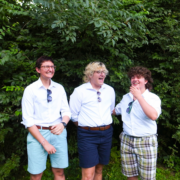
Seth Rane, Grayson Castellucci and Eddy Risimini, three students in white button-down shirts, laugh together in front of a wall of green leaves.

Pushed to the Edge of Campus, These Trans Students Started Their Own Fraternity

This story first appeared in Queer Cincinnati: Beyond the Binary, published Oct. 23, 2026.

In the spring of my freshman year at the University of Cincinnati (UC), Ohio Senate Bill 1 was moving through the state legislature. The bill, which would take effect on June 27th, 2025, requires Ohio’s public colleges and universities to maintain institutional neutrality and “intellectual diversity” on certain “controversial beliefs and policies” including climate policy, electoral politics, foreign policy, immigration, marriage, and abortion. It also bars faculty from “indoctrinating” students toward a position on these topics, bars the institution itself from taking an official stance, and eliminates diversity, equity, and inclusion (DEI) offices, departments, and required trainings at the same institutions.

UC, however, wasted no time adopting these principles, even before the bill became law. UC President Neville Pinto complied in advance, stating in a public email on February 21st, 2025 that “it is untenable to operate as if noncompliance with these directives is an effective option” and that “we are committed to meet our compliance obligations.” Soon after President Pinto’s address, DEI offices including the LGBTQ+ Center, the Women’s Center, Ethnic Program Services (EPS), and the African American Cultural Resource Center (AACRC) were immediately shut down. Many students, myself included, felt this response failed to address their concerns.

That same spring, the university began replacing bathroom signage with new “biological men” and “biological women” signs. This action was a result of Ohio Senate Bill 104, the “Protect All Students Act,” signed by Governor Mike DeWine in November 2024, which prohibits members of one biological sex from using restrooms designated for the opposite biological sex and erases multi-occupancy restrooms open to any gender. The law does require institutions to provide alternative accommodations, such as single-occupancy facilities, but the bathroom signage UC implemented was worded of their own accord. The new signs were adopted quickly, sending a clear message that transgender, nonbinary, and intersex students were not welcome. Because of this, many students became worried that their university housing options would no longer be viable if the available restrooms did not match their “biological sex.” As a trans man living in freshman dorms at the time, I worried for my housing security.

My fears came true when my fellow trans roommates Seth Rane, Grayson Castellucci, and I were relocated to the margins of campus mid-spring semester. We were originally approached in an email by UC’s Director of Resident Education & Development at the time, Trent Pinto, on February 10th, 2025. Pinto invited us to a “conversation regarding upcoming changes to the residential experience.” This meeting was held at UC’s LGBTQ+ Center before it was dissolved, and its conclusion resulted in two options: 1) Stay in our dorms and travel to the women’s dorms to use the restroom, or 2) Relocate to an off-campus apartment where we would have access to a personal restroom.

Option 1 was an unreasonable request for us. Not only was this option directly invalidating our identities as men, but it was also oversaturating the communal space and required us to travel to a different floor or building to use the restroom. Because of this, my roommates and I conceded to option 2 and were relocated to an apartment near campus. While UC quickly responded to a flood of backlash by removing the bathroom signs, the damage had already been done. What was supposed to be an exciting year to make new friends and invest in our studies instead became a year where we were isolated from our peers and pulled from our classes to accommodate the move to our new apartment.

Amidst the predatory legislation and considerable lack of LGBTQ+ spaces, we quickly realized we were not alone in our isolation and observed an almost solemn environment throughout campus. To combat this, my roommates and I decided to make a change.

One day after class, I came home to Seth and Grayson sharing the idea of starting a queer fraternity: Phi Alpha Gama (PAG). At first, we treated it as a joke. After all, it is customary across university Greek life to exclusively allow one gender (women in sororities, men in fraternities). It seemed absurd to imagine visibly queer or transgender individuals enjoying this same staple of college life, but the more we thought about it, the more we realized that PAG’s existence might be a space that UC’s LGBTQ+ community desperately needed: a space made by queer people for queer people to enjoy without consequence.

A fraternity was the best option for us to organize an LGBTQ+-friendly community because we felt that queer individuals deserved to be included in traditional college experiences that they may otherwise shy away from. We gathered a few close friends to join PAG, but we realized that to expand our community past our small clique, we needed to give our fraternity structure. To do this, we created the governing body of PAG, consisting of the following roles: president, vice president, secretary, recruitment officers, philanthropy chair, social media chair, diversity chair, and grievance officer.

We didn’t expect PAG to be more than a small community at first, but soon, friends of friends came to our parties and told their friends about PAG, and it became a vast network of students where all are welcome. During our recent spring rush campaign, we had a great turnout, with around 30 members present and 10 rushees. We implemented different group bonding activities including ice breaker games and a friendly s’mores roasting competition. However, the main standout of this event came about when several people approached our front yard asking about the event we were hosting. What stood out to me the most was how accommodating the members of PAG were to total strangers. Seeing a community that I helped create foster such a kind and welcoming environment made me realize how important PAG was to creating a safe space for queer and allied individuals to be themselves and make new connections.

A performer in a striped shirt sings on an outdoor stage at night while the crowd raises their hands.

Love Out Loud Fest returns to Louisville with pay-what-you-can fall edition Nov. 12

Love Out Loud Fest is returning to Louisville with a fall twist! Founded by Kayleigh Knies, also known as Tayzzy, Love Out Loud Fest: Fall Edition will take place on Thursday, Nov. 12, from 5 to 10 p.m. at Jubilee Field, bringing the community together for an evening of live music, local vendors, interactive experiences and fall festivities.

Following the success of its inaugural event in July, which welcomed more than 250 attendees, Love Out Loud Fest is continuing its mission of creating welcoming, inclusive spaces where people can connect, celebrate individuality and experience community without the pressure of high admission costs.

This fall edition will feature live performances from Had! (Detroit), Shanay Morant (New York City), Just Joey (Gary, Indiana), Tonio and Tayzzy. Attendees can also explore local vendors, food trucks, face painting, tarot readings, raffles and more.

Guests are encouraged to bring their costumes back out for a special costume contest featuring a $100 cash prize! The festival will also host a community food drive, inviting attendees to bring canned goods and nonperishable food items to help give back to those in need.

Love Out Loud Fest: Fall Edition is a family-friendly community event. Children are welcome when accompanied by a parent or legal guardian. With a pay-what-you-can admission model, the festival aims to make arts, music and meaningful community experiences accessible to everyone.

As temperatures drop, guests are encouraged to dress warmly and prepare for an outdoor event.

“Love Out Loud is about creating a space where people feel welcome, supported, and free to be themselves. We want to bring people together through music, creativity, and community while making sure everyone has an opportunity to be part of something meaningful,” said founder Tayzzy.

Whether you’re coming for the music, shopping with local vendors, entering the costume contest, or simply looking to connect with your community, Love Out Loud Fest: Fall Edition invites everyone to come as they are and leave with a little more love.

Event details

  • Event: Love Out Loud Fest: Fall Edition
  • Date: Thursday, Nov. 12, 2026
  • Time: 5 to 10 p.m.
  • Location: Jubilee Field, 529 E. Burnett Ave., Louisville
  • Admission: Pay what you can
  • Activities: Live music, food trucks, local vendors, face painting, tarot, raffles, costume contest and community food drive
  • Social media: Instagram @loveoutloudfest

For media inquiries, sponsorship opportunities or additional event information, contact Love Out Loud Fest through Instagram at @loveoutloudfest.

About Love Out Loud Fest

Love Out Loud Fest is a Louisville-based community festival founded by Tayzzy with a mission to create inclusive, accessible experiences that celebrate music, individuality, creativity and connection.

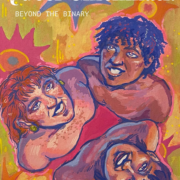
Cover of Queer Cincinnati: Beyond the Binary, a painting of three people seen from above on a bright pink, yellow and green background, by Emil Wiersma

“You Are Not Alone”: A Letter From the Trans Youth Who Made This Magazine

This story first appeared in Queer Cincinnati: Beyond the Binary, published Oct. 23, 2026.

Dear Reader,

As you flip through the pages of the very first issue of the Trans Cincinnati Magazine, I wish to inspire each and every one of you to find hope and community in the stories we have curated.

This magazine is an accumulation of authentic voices, anecdotes of trans joy, and critiques on current predatory legislation. Experiences ranging from liberation, to discrimination, to connection made within the community are depicted. I am more than eager to spotlight residents of the beautiful city of Cincinnati and their real, unembellished trans experiences. I also want to thank Queer Kentucky for the opportunity to expand their outreach to the state of Ohio, giving us the chance to spotlight important resources within our state. Additionally, I would like to mention TransOhio, Transform, Trans Masc Cincy, and Equitas Health. These organizations work to carve out a rightful place for trans youth. Whether that be through creating gathering spaces for the queer community, helping folks understand how to secure affirming care, or simply providing a safe space for those with intersecting identities, these organizations all show up for trans Cincinnatians.

In a world where trans youth are so often made to be silenced, a publication like this is extremely important. The statements within each article are testimonies about trans lives from actual trans individuals. From start to finish, this collection was brought to life by trans youth, for trans youth. Our writers and artists have poured talent, beauty, and truth into this project, and love can be felt throughout every page. When presented with the chance to work as co-editor of this project, I leaped at the opportunity. I am proud to be a part of this community, and to be completely surrounded by visionaries in my day to day life. I am consistently reminded of the radiance that exists in Cincinnati’s trans youth, along with the ambition to actively create a future in which all identities are honored and respected. What you are about to read is not only proof of that ambition, but documentation of firsthand interactions with the current cultural/social state of the world.

If you are not trans and reading this, take it as an opportunity for education and understanding. Question the ignorance you may possess surrounding trans identities. Allow this set of articles to dismantle harmful beliefs and behaviours. If you fall anywhere under the trans umbrella and are reading this, take it as an opportunity to see trans love, joy, and strength reflected back upon yourself. Allow the support of our community to uplift and empower you. So much beauty exists within your identity. Hold onto that love, beauty, and power. Despite those who misunderstand you, despite those with hate in their hearts, despite challenges you are bound to face throughout life. We fight together for your right to be your authentic self. Let these stories act as a vehicle of joy, as something to remind you that you are not alone, and you are worthy of care.

Nyla Davies, Co-Editor

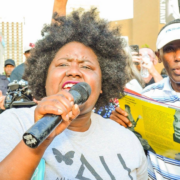
A speaker holds a microphone and addresses a crowd at an outdoor rally as people gather behind her.

Talesha Wilson Is Changing the World. Louisville’s West End is Her Headquarters.

Editor’s note: This story was originally published by The National LGBTQ Task Force on October 15, 2026, and is republished here with permission. It profiles Talesha Wilson, a local ambassador for Creating Change 2027.

As a hometown hero, beloved community organizer, and content creator, Talesha Wilson’s light is a beacon for Louisville residents who would like to know themselves, and their city, as deeply as Wilson does. The Task Force is thrilled to have her join us as an Ambassador for Creating Change 2027.

Wilson’s role in the community isn’t easy, requiring a balancing act between acting as a courageous problem-solver who engages the everyday community member and a curious leader who questions the integrity of systems that claim to advance Black equity.

“We live in a world that is headstrong on making our lives difficult – when we try to live easy, soft, gentle lives with each other,” Wilson said.

It is the central reason Wilson is a local ambassador for Creating Change 2027, which will take place less than 10 minutes from her local high school.

“I don’t want to be this unique leader. I don’t want to be this thing that feels unachievable, like you can’t touch it,” Wilson said. “You can touch everything that I’m doing because we are right here with each other. I’m in the hood with my cousins. I’m also in the boardrooms with the people. You can be anyone and do this work, and that’s the type of movement leader that I am wanting to be and exude.”

Always BlackAF

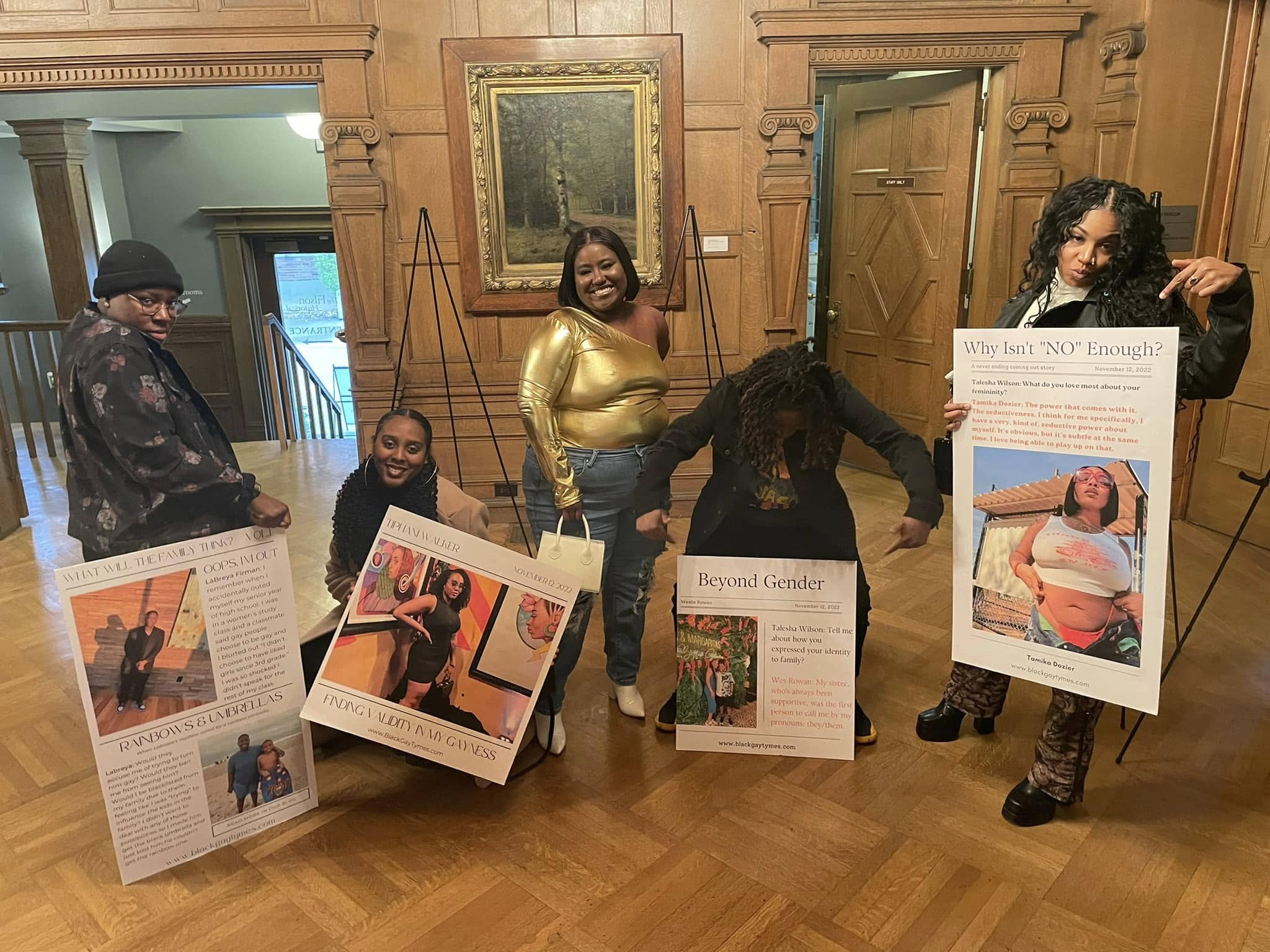
Five people pose in a wood-paneled room with poster boards from an exhibit, including boards titled "Beyond Gender" and "Why Isn't NO Enough?"
(Source: Talesha Wilson via The National LGBTQ Task Force)

As the co-executive director of Black Leadership Action Coalition of Kentucky Action Fund (BlackAF), Wilson’s pride begins in Louisville’s West End. She grew up with a hustler as a father and fearless go-getter for a mother, as both instilled an unapologetic demeanor built by confidence, community, and self-knowing.
“My daddy – he cooked, he did carpentry, renovated homes and was a barber. He was a hustler and he cared about the specifics,” Wilson said. “My mother always allowed me the freedom to speak up, say what’s on my mind. She was very big on ‘Say whatever you need to say to me, because if you can speak up to me, you can speak up to other people.’”

But, for Wilson, growing up in Louisville’s Blackest area also meant recognizing they were the least prioritized. “But, in my lived experience, it’s fun, it’s joy. We are loud. We eat. We talk. We make sure our neighbors are good,” Wilson explained. “That is the story that I want other people in the city to know. West End Louisville is Black culture.”

Her first act of resistance took place at Central High School, when a beloved Pan-Africana teacher Mr. X, was reprimanded during Black History Month for his support of reparations. Wilson worked with her classmates to stage a protest in support of X.

“We [walked] out of the class, right at 1 p.m. since school was over at 2:20,” Wilson said. “I was willing to take that risk. I had an advantage here because with my grandma and mama I wouldn’t be in any trouble. I’m willing to be a voice for my folks…and, over time, I’ve learned how to build their skills and confidence to speak up for themselves.”

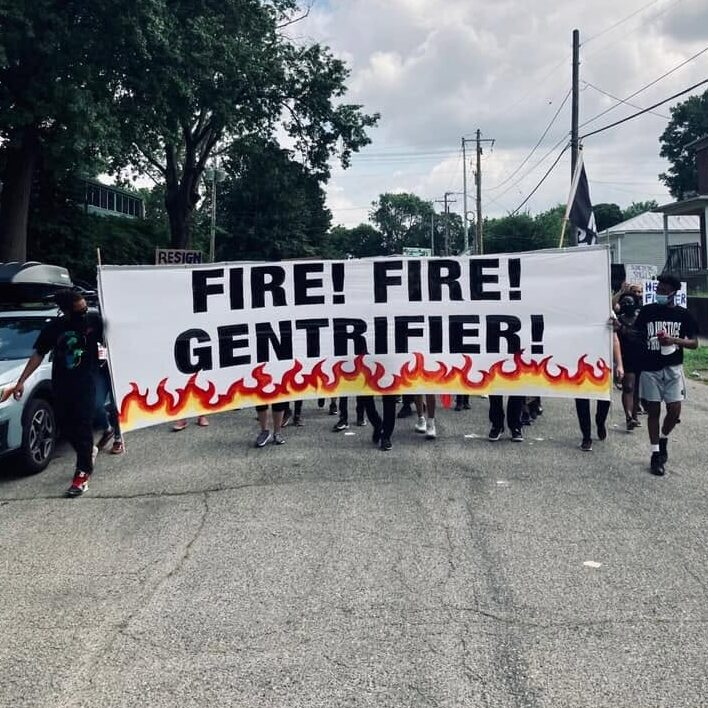
Marchers carry a large banner reading "Fire! Fire! Gentrifier!" down a street in summer 2020.
During Summer 2020, Wilson and Louisville activists called out then-Mayor Fischer for allowing businesses to gentrify Louisville’s East Market District. (Source: Talesha Wilson via The National LGBTQ Task Force)

Wilson Paves The Way

Wilson continued her advocacy work throughout college, serving as an ambassador for the University of Louisville’s LGBTQ+ center. She also interned under Marian Vassar, the executive director of the university’s diversity and equity efforts.

“People weren’t talking about racism, sexism, homophobia, transphobia. People were uncomfortable with being called in to check their implicit biases, and I was helping people navigate those conversations,” Wilson explained. “I started my own community organization called Diversity at The Table where we talked about how gender, race, class and sexuality all intersect with each other on a regular basis.”

Then, tragedy struck on the backdrop of COVID-19. Breonna Taylor was murdered by the Louisville Police Department under the guise of arresting her partner Kenneth Walker, sparking outrage in Wilson’s hometown and across the world. “A friend of mine that I went to high school with kept talking about it, kept talking about Kenneth,” Wilson said. “I didn’t know Kenneth intensely, but me and him rode the same bus [in high school.]”

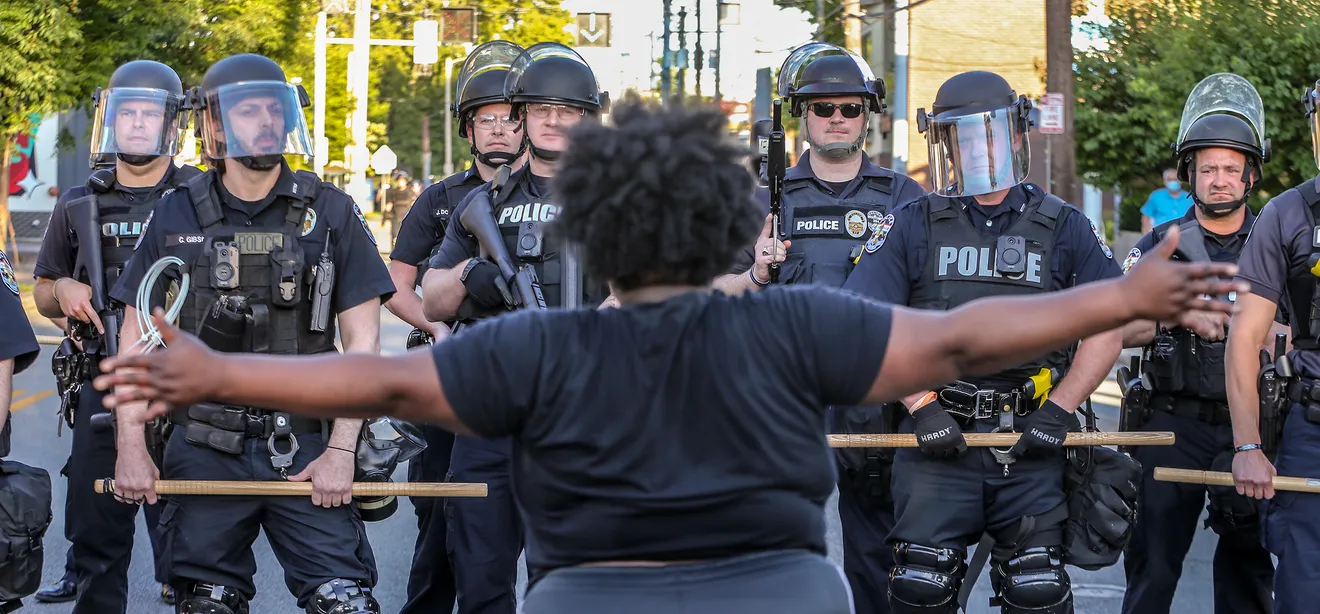
A protester stands with arms outstretched facing a line of police officers in riot gear holding batons.
Talesha Wilson protests in the name of police brutality in light of Breonna Taylor’s death in Louisville. The images inspired the world to fight for justice against anti-Black racism. (Source: Courier Journal via The National LGBTQ Task Force)

Wilson sprung into action, protesting downtown while the Louisville Courier Journal shared jarring images of tanks, military involvement, and officers in protest gear. “It was a war zone, so chaotic, so scary. We were not prepared,” Wilson recalled. Tensions from the protest led to a mass community call-in where Wilson and other politically engaged activists gathered to discuss safety precautions. “I was trying to find venues but I said, ‘I’m just going to open up my backyard, we’re going to have direct action training.’”

“There were so many white people asking, ‘What do you need?’ I was there to tell them what we needed; water, juice, stuff to help with tear gas. We need snacks. We needed everything. I grabbed my poster pads to roll out what they thought needed to be discussed. We talked about, if you’re going to be down there protesting, how to be safe and effective.”

The protests of Summer 2020 actualized Wilson’s mission to normalize advocacy both for the community and individuals. Her work ballooned into other local entities becoming involved such as local churches and community spaces who opened their doors to host those trainings.

“There was no political home at that time, but we were trying to build it,” Wilson said.

Wilson then focused her advocacy through facilitation, as she collected resources after calls for long-term infrastructure investment to engage folks consistently.

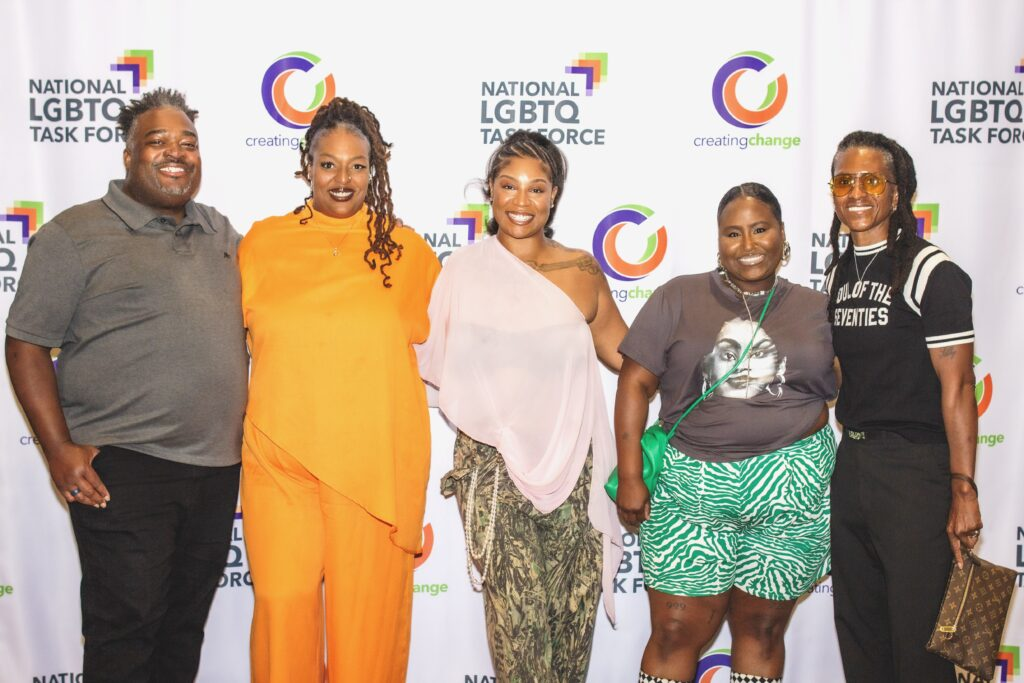
Five people pose in front of a National LGBTQ Task Force and Creating Change backdrop at the Creating Change Kickoff Mixer.
Talesha Wilson and fellow Black, queer movement leaders attend the Creating Change Kickoff Mixer in August 2026 at the convening’s host hotel. (Source: Matthew Pruitt via The National LGBTQ Task Force)

Her current work as co-executive director for BLACKAF reflects this mission, as the organization offers civic engagement, leadership development, and community dialogues on local issues such as community violence/safety, mental health, community care, and a “We Keep Us Safe” series that details how we get to liberation for the Black community.

Now, as one of Creating Change’s local ambassadors, Wilson hopes to build concerted efforts to merge conversations and identities, “where solutions must be intersectional.”

“I really want to get more urban Black gay people to experience Creating Change. I want them to bring that razzle dazzle and that’s what’s missing in Kentucky’s queer spaces,” Wilson said. “If we really want to win, some things are going to need to be shaken up. Get uncomfortable. Be willing and able to respond to questions that haven’t been asked before. I want Black urban gay folks there because we bring all of that. We deserve seats at those tables too.”

About Amber D. Dodd

Amber D. Dodd (she/her) serves as the producer for the National LGBTQ Task Force. She is an award-winning editor, curator, and journalist whose specialty lies in contextualizing Black America. Her work captures similar frameworks, including the Missing & Murdered Indigenous Persons Movement. She owns her own creative brand, blaQplight., a media company that captures authentic Black, queer experiences through education, entertainment, and empowerment.

Amber’s former roles include serving as Howard Magazine Editor, The Spokesman-Review’s Racial-Equity Reporter, and a Culture Freelance Reporter for the Afro-American Newspapers. She is a nonfiction writer, independent communications consultant, and a DJ. Her works can be read in Bi+ Women’s Quarterly Magazine, SWERV Magazine, and the Federal D. Glover Community Wellness Network in Oakland.

This story first appeared on The National LGBTQ Task Force. Republished with permission.

Cover of Queer Cincinnati: Beyond the Binary, a painting of three people seen from above on a bright pink, yellow and green background, by Emil Wiersma

After Death Before Detransition, Trans Youth Across the River Make a Magazine of Their Own

About this magazineQueer Cincinnati: Beyond the Binary is a magazine made by Cincinnati trans and nonbinary youth, modeled on Death Before Detransition, a magazine made by Kentucky trans youth. It is funded by the City of Cincinnati through Community Shares of Greater Cincinnati and managed by regional LGBTQ+ nonprofit publisher Queer Kentucky.

Queer Cincinnati: Beyond the Binary, a free magazine by and for trans and nonbinary young adults ages 18 to 24, launches this week with stories ranging from campus organizing to the search for sober queer spaces.

“I think it’s really important for trans and nonbinary youth to see something from their peers, and also put their own work into the magazine,” 21-year-old co-editor Nyla Davies told Queer Kentucky. “The magazine was completely brought about by trans and nonbinary people, for trans and nonbinary people.”

Davies, a student at the Art Academy of Cincinnati who wants to pursue writing and journalism, helped lead the magazine after Avery Plummer, an adjunct instructor, brought the opportunity to the school. Plummer helped guide Davies through the process of taking the magazine from concept to completion and served as co-editor along the way

Queer Cincinnati: Beyond the Binary, a project that began in April 2026, launches online on October 23 and contains nine articles ranging from 500-1000 words.

For the people who created it, the magazine has a special meaning.

“This article is a good way for me to get my writing out there, and to call other people to make changes at their own institutions,” said 20-year-old Eddy Risimini, a writer for the magazine.

Risimini’s story discusses the hiatus of some of the queer clubs at the University of Cincinnati following anti-DEI legislation like Ohio Senate Bill 1.

Ohio SB1 requires public colleges and universities in the state to “maintain institutional neutrality and ‘intellectual diversity’ on certain ‘controversial beliefs and policies’ including climate policy, electoral politics, foreign policy, immigration, marriage, and abortion.”

Universities and colleges were also impacted by the bill’s elimination of diversity, equity, and inclusion (DEI) offices, departments, and required training. More information about SB1 can be found in Risimini’s piece.

He said that as a student at the school, he hopes the magazine article will help to shine more light on the LGBTQ+ students and community there.
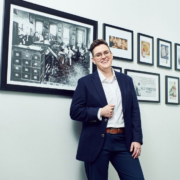
Harper Thomson, a 23-year-old writer and photographer for the project, said her article was intended to shine a light on a subject that may not often be talked about: the lack of sober spaces for queer people in Cincinnati.
“It means a lot to be able to talk about that, and make other people feel like they’re not so alone in that situation,” Thomson said. “I really want people to think more critically about the spaces they spend time in, and consider how accessible those are to everyone around them.”

Thomson went on to say that a lack of spatial consideration can lead to exclusion. She said this doesn’t just apply to sobriety, but also to spaces that are safe for people of color or transgender people.

“Our first goal is to spread joy, but we also know there’s a responsibility to talk about some of the things that not everybody wants to talk about,” Davies said.

The magazine has a lot of stories representing Cincinnati trans youth and their community, but also articles calling out problems in the city, too.

“There are some sad stories, and there’s some community-building stories,” Davies added. “There’s a lot of range in the magazine.”

Thomson said she thinks it’s important to give transgender people a space to speak and to feature a wide variety of transgender voices. The magazine chose writers by using an open call, which Thomson said gave everyone a chance to get their voices out into the world.

“It’s important to remind other people that we do have a voice, and in some ways, we have more power than people in the administration,” Risimini said.

The project also includes various creative elements, with abstract, colorful illustrations of trans and queer sentiments done by several artists. Illustrators include Cocoa Durrett, Kami Pankey, Sav Hoyt, and Ian Johnson. The cover art was painted by Emil Wiersma.

Photos done by Thomson include images from the UC Trans Frat, a queer-owned vintage store called Secondhand Circus, and a piece of artwork that Murray Foust, the late trans Northern Kentucky University student who died earlier this year, had gifted to their partner.

Availability will primarily be online, but some free print copies will be available to the public at the Art Academy of Cincinnati and at the Lesbian Archives.

Rural Appalachian LGBTQ+ students shouldn’t have to choose between opportunity and belonging

The views and opinions expressed in submissions to Queer Kentucky are those of the authors and do not necessarily reflect the official policy or position of Queer Kentucky. Any content provided by our submissions or regular columnists are of their opinion. As a reader, you are always welcome to submit your op-eds through our submission form.

For students leaving rural Appalachian Kentucky communities, college is often framed as a pathway out of small towns and toward opportunity. But for many LGBTQ+ students from these communities, that pathway isn’t just about academics; it’s about survival, negotiation and the search for belonging in spaces that were never fully designed with them in mind.

For many, choosing college isn’t just about rankings, majors or cost. It’s about asking harder questions: Will I be safe? Will I be accepted? Will I have a community where I can authentically exist? Imagine being accepted to multiple top universities, each offering opportunities for a bright future, yet none can guarantee safety, belonging or a supportive environment. Rural communities across Appalachia are often deeply rooted and connected to their place. While that can foster strong support systems, it can also limit access to resources and acceptance for marginalized identities. Students carry those experiences with them as they consider where to go next.

Recent political shifts only intensify this process. Conversations around diversity, equity and inclusion (DEI) have become polarized and, in some cases, restricted across institutions. For LGBTQ+ students, especially those from rural backgrounds, these changes shape daily life, influencing whether they stay safe, supported or seen on campus.

What emerges is a pattern of conditional belonging. Many students arrive with cautious optimism, only to encounter environments where support exists but is inconsistent. Resources may be limited or restricted. Faculty and staff may be well-intentioned but not always equipped. Policies may exist on paper but feel distant in practice. The result is constant navigation, or code-switching, to determine when to be visible and where it is safe to fully exist as an authentic member of the LGBTQ+ community.

And yet, students are not passive. They create spaces of belonging through friendships, student organizations and online communities, often filling gaps institutions leave behind. This gap between institutional promises and lived experiences matters. Students should not have to choose between opportunity and belonging.

So tell us your story. How were you able to be your authentic self as a queer person while choosing a college? How did you find your community and build welcoming spaces on campus? What has your academic journey looked like, and how have you built your true lived experience?

This study is looking for those stories. If you’re an LGBTQ+ undergraduate student, 18 or older, from a rural Appalachian Kentucky community, you’re invited to take part in a research study on how identity, place and the current political climate shaped your choice of a public four-year college or university. Participation involves a 45- to 90-minute virtual interview, with questions provided in advance. If this resonates with your experience, your participation matters to this work. Real change doesn’t happen in silence. It happens when those most impacted are heard.

Participation is confidential. Names, phone numbers, emails and identifying information will not be shared outside of the research findings.

To learn more or to participate, contact Channing Lawson at [email protected].

About the researcher: Channing Lawson (He, Him, His) I am a bisexual man from a small rural Appalachian community of Eastern Kentucky. Currently pursuing my doctoral degree in higher education at Morehead State University, where I’m researching what factors LGBTQ+ students from rural Appalachian communities of Eastern Kentucky consider when choosing a public four-year post-secondary institution especially in the current political climate.

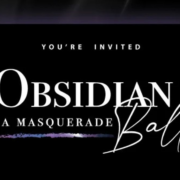
JustFundKY to host first Obsidian Ball, a masquerade gala in Lexington

JustFundKY has long been known for our memorable and inspiring events, so we’re thrilled to announce our inaugural gala, the Obsidian Ball, a luminous celebration of courage, community and Kentucky’s unwavering commitment to equity. Before the invention of silvered glass mirrors, polished obsidian was used as a looking glass. It provides a deep, dark reflection that requires the viewer to look closely. A core value throughout the LGBTQ+ community is the act of radical self-reflection and authenticity. By coming out and living openly, queer individuals act as a mirror to society, forcing it to reflect on its own definitions of gender, love and family. It is a reflective surface that demands truth over superficiality. Designed to be vibrant, modern and unmistakably us, the Obsidian Ball invites guests to gather, glow and give in support of LGBTQ+ Kentuckians.

We invite you to join us for cocktails, entertainment, dancing and so much more. Tickets include passed hors d’oeuvres and an open bar. All event proceeds benefit JustFundKY, a community-powered LGBTQ+ fund based in Kentucky, dedicated to resourcing grassroots leaders, organizations and movements that are building a more just, joyful and equitable Commonwealth for all.

This new event is an extension of that mission. It is not just a fundraiser, but a celebration of community, resilience and possibility. By sponsoring or attending this event, you are making a visible commitment to LGBTQ+ people across Kentucky and helping ensure that vital, community-led work continues to thrive — today and for generations to come.

The Obsidian Ball, a masquerade, runs from 7:30 to 11:30 p.m. Friday, Oct. 23, at Harper Hall, 177 N. Upper St. in Lexington. Masks are optional. The night will also include the presentation of the first Lewis Paisley Award, which honors a person in our community or an ally who shows courage on behalf of the LGBTQ+ community. Tickets are available at showpass.com/obsidian-ball.

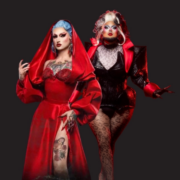
Henderson KY Pride's Haunted Haus of Drag guests Aurora Gozmic, left, and Sinema LaRue in red and black looks.

‘They Can’t Legislate Community’: Henderson KY Pride’s Haunted Haus of Drag Returns Oct. 23

Henderson KY Pride is hosting its annual Halloween drag fundraiser, Haunted Haus of Drag, at the Preston Arts Center on Friday, October 23, under the theme, “Haunted Runway.”

This year’s theme combines “drag performance with horror couture” and will feature special guest Aurora Gozmic, a Chicago-based drag artist and competitor on Season 6 of The Boulet Brothers’ Dragula.

Other guests include Sinema Larue, the “Desert Diva Bearded Queen 26” from Houston, Texas, and the event will be emceed by Louisville entertainer Leah Halston, known as “The Chocolate Thunder” and host of the Play Mates and Play Louisville.

Henderson KY Pride has hosted a Halloween-themed fundraiser since its launch in 2024, which at its core is focused on creating a community for LGBTQ+ people.

“Sometimes that could be the only thing we have to fall back on,” Cooper Beck, founder and executive director of Henderson KY Pride, tells Queer Kentucky. “The government can legislate us all they want, but they can’t legislate community and how we stick together and the joy that comes from community.”

Beck adds, “That’s something that is almost impossible to take away.”

The small nonprofit’s first-ever event in the summer of 2024 drew a larger-than-expected crowd, according to Beck.

The 21-year-old came up with the idea for Henderson KY Pride for a class project during his freshman year at Bellarmine University. He decided that he wanted to host a small LGBTQ+ visibility event in Henderson, which he advertised on Facebook and organized with the help of some volunteers.

“It went kind of hometown viral,” Beck says.

There was so much interest in the Facebook event that Beck decided to change it to a “mini pride” that would be held in a parking lot next to the town’s Chloe Randall Organization. To Beck’s surprise, 400 people showed up to the event.

“There was a clear hunger and need for visibility and community,” he says.

The inaugural event’s high turnout inspired Beck and the volunteers to host another event in order to meet that need for visibility, community, and connection.

Beck and his co-organizers decided to host a Halloween-themed event that October to do “something new to the community” and, again, were surprised by its popularity.

“We didn’t really know what to expect with it. It was kind of like taking a shot in the dark,” Beck says. “But we sold out.”

More than 200 people showed up to the organization’s inaugural Halloween fundraiser, and it “instantly” became one of its most sought-after events of the year, he adds. Turnout at this year’s event is expected to be high.

Haunted Haus of Drag attendees are encouraged to dress up in costume, and there will be a Haunted Runway costume contest with prizes. The event, formerly called ‘Dragula,’ is only for adults 18 years of age and older since the production will include adult themes and content, strong language, loud music, flashing lights, and theatrical effects.

General Admission tickets are $25. Henderson KY Pride Circle members receive $10 off General Admission, bringing the member price to $15. A limited number of VIP tables have also been available, featuring reserved seating for eight guests, early admission, drink tickets, and a private VIP performance by Aurora Gozmic.

A cash bar will be available throughout the evening in partnership with Beverage Barn. Alcohol service is restricted to guests 21 and older with a valid physical ID.

All proceeds from Haunted Haus of Drag benefit Henderson KY Pride and support the nonprofit’s year-round LGBTQ+ programming, advocacy, community events, and resources.

Find out more information here.

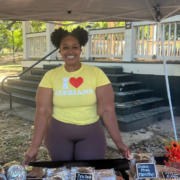
A landscape image of a woman with space buns standing behind a table, under a tent, vending for an event. She is wearing a yellow t-shirt that says "I [heart] Lesbians"

Kentucky Black Pride Turns 10 in the Park That Sheltered Queer Lexington

Kentucky Black Pride celebrated its 10th anniversary in September with a four-day festival in Lexington aimed at community, resources, and self-expression.

The four days each carried their own program. Thursday opened with Healthy Sexual Talk, a sexual health session marking National Gay Men’s HIV/AIDS Awareness Day, followed by Ladies Night. Friday brought the Mr. and Miss Kentucky Black Pride pageant. Saturday filled Woodland Park with Pride in the Park, the festival’s centerpiece. Sunday closed with community awards and a day party.

Among the first-timers at Woodland Park in Lexington was Tiffany Knight, of Bowling Green, Kentucky, who came to promote her cookie company, Eat Q Cookies.

“Where I am from is not as diverse. This is my first event where it is specifically Black oriented and it is really nice to see the community come together.”
Pride in the Park featured booths from aligning community and health resources, from CASA of Lexington, who are court appointed youth advocates, to the Lexington-Fayette County Health Department, who was on hand to share Narcan, COVID tests and condoms. Local designers sold Pride merchandise from buttons to jean jackets. A drag show followed at 1PM during the park extravaganza.

Kentucky Black Pride was founded in 2016 by Shawn Bumpase, after a conference call with other LGBTQ+ community members about the state of Kentucky’s Black queer community. By January 2017, the organization was official, with a home on South Broadway in Lexington. Kentucky Black Pride, Inc is a 501c3 non-profit organization that provides financial assistance, counseling and other community services.

Why Kentucky Black Pride stays at Woodland Park

Lexington has a storied history with the queer community. Its most notable member being Sweet Evening Breeze, who would perform drag here starting in the 1950s. Breeze is now honored with a downtown mural not far from where she was arrested for cross-dressing in the 1960s. And by 1981, the park hosted queer events supported by the Gay Student Organization of University of Kentucky. The Faulkner Morgan Archive in Lexington preserves that history.

Woodland Park remains the host location of Kentucky Black Pride because of that community support, said co-chair Suga Dawson.

“We stay with Woodland Park because in the 1950’s, before drag was legal, Woodland Park supported the gay community, not just our community,” Dawson said. “So we stay to show respect and support.”

Dawson, in her fourth year with Kentucky Black Pride, helped run the weekend. where she explained what it means to her: “It’s self-expression in a nutshell; the parts of me that aren’t as prevalent when you meet me.”

A festival that works year-round

Kentucky Black Pride hosts its festival each September as part of Roots and Heritage Festival month, but the nonprofit works year-round. Its “Let’s Talk” series gives the Black queer community its own town hall while the organization also supports youth school supplies initiatives.

A packed Louisville crowd applauds two Time Slip Theatre performers standing on a runway stage beneath a cluster of pink and purple disco balls.

Time Slip Theatre Opens 13th Year of ‘Rocky Horror’ With a Witchy Twist

Time Slip Theatre, a 501(c)(3) theatre company best known for its productions of “The Rocky Horror Show,” opens its 13th annual production Oct. 16-31 at PLAY Louisville. For year 13, the company is putting a spooky, witch-inspired spin on the “Rocky” fans know and love.

The naive Brad and Janet descend on a journey of exploration and liberation at the castle of Dr. Frank N Furter in this irreverent show, known for its hysterical send-up of 1950s sci-fi B-movies as well as its unapologetic celebration of individuality and being true to yourself. Time Slip Theatre’s production of the timeless cult classic is a full-scale performance with live actors, not a movie screening, and includes all the hits and one-liners “Rocky” fans have come to expect.

Directed by Remy Sisk, the show runs Oct. 16-31 at PLAY Louisville, 1011 E. Washington Street. Single general admission tickets are $15 and tables of four are $75. Tickets and tables are available at timesliptheatre.org. The show stars drag queen May O’Nays as Dr. Frank N Furter and features Fairness Campaign Director Chris Hartman as the Narrator Oct. 16, 29, 30 and 31. Celebrated visual artist and muralist Wylie Caudill will take on the Narrator Oct. 23 and 24.
“I’m thrilled to have the privilege of opening year 13 of our production of ‘Rocky Horror,’” said Time Slip Theatre Artistic Director and director of “Rocky Horror” Remy Sisk. “It’s an honor to be able to uphold the ‘Rocky’ legacy here in Louisville, and we have a few spooky surprises planned for lucky number 13!”

In addition to the live show, Time Slip is performing shadow casts throughout October. These are events where the film “Rocky Horror Picture Show” is played and Time Slip’s troupe acts out the scenes in front of the screen. The remaining shadow cast dates are Oct. 22 at Time Slip Theatre and Oct. 28 at The Last Refuge.

As Louisville’s resident “Rocky” troupe, the company has performed at a multitude of events throughout the years. In the past, the company has performed its shadow cast and live selections for stars of the original film Barry Bostwick, Patricia Quinn and “Little” Nell Campbell. Time Slip also tours the show to PLAY’s Nashville location ahead of opening in Louisville.

Time Slip Theatre is a 501(c)(3) nonprofit with a mission to enhance the cultural landscape of Louisville while increasing arts education accessibility to students.

Fans can stay up to date by following Time Slip Theatre on social media and @rockyhorrorlouisville on Instagram.

This announcement was provided by Time Slip Theatre.

A drag performer in a sequined black gown raises their arms on stage in front of the 2026 Louisville Pride Festival sign reading "Emboldened, Empowered."

Louisville Pride Put Mental Health Front and Center. The Need Doesn’t End When the Tents Come Down.

Queens took the stage. Artists sold their colorful wares. Vendors of all kinds passed out pamphlets. Louisville Pride returned this year, with queers from all walks of life bustling through a blocked-off section of Bardstown Road on Saturday, September 12.

Louisville Pride Foundation, which also runs the Louisville Pride Center in Old Louisville, organized the event.

National acts performed near tables of local organizations ranging from healthcare organizations, such as Planned Parenthood, to political organizations.
Among those who participated were organizations helping LGBTQ+ people with their mental health or pointing them in the direction of mental health services.

According to the 2025 Queer Kentucky Community Health Survey, roughly 7 in 10 LGBTQ+ Kentuckians have had negative experiences with their mental health due to the current political environment, such as debates around LGBTQ+ rights.

Of queer Louisvillians who responded to the survey, about 32% attributed thoughts of suicide to policy debates around LGBTQ+ people. In fact, the number is 3.9% above the state average. Because of these debates, 8.1% of respondents said they left Kentucky because of it. The survey also found that trans women reported higher rates of suicidal ideation.

Louisville has more queer services than most of Kentucky, but Queer Kentucky’s data suggests they may not be enough because there are also high levels of health risks in the community.

Mandala House Provides Mental Healthcare to Queer Louisville

One featured booth at Louisville Pride was Mandala House, which provides mental healthcare to the community of Louisville. Mandala House has several therapy groups that address the psychological health of minority groups and their various intersectional needs.

“It’s a special place in our hearts, the work we get to do with queer people,” said Mandala House therapist Rachel Archer.

Archer said Mandala House currently runs a variety of therapy groups, such as an adult gender-journey group for individuals 18+ who are questioning their gender or who identify as trans or gender non-conforming. The space provides communal support for one another.

Archer noted that she couldn’t say that the lack of queer-specific spaces as a barrier to queer healthcare’s accessibility was unique to Louisville alone.

Mandala House also provides support letters for trans individuals seeking gender-affirming care, which is often required by providers and insurance companies. For many queer Kentuckians, finding a provider for their healthcare can be a challenge. According to the 2025 Queer Kentucky Community Health Survey, while Louisville has better healthcare access than most of the state for LGBTQ+ Kentuckians, provider refusal still happens.

Kentucky Psychological Foundation: Evidence-Based Connections

Among the vendors, the Kentucky Psychological Foundation was doing outreach. The organization focuses on bringing free mental health resources across Kentucky. It also supports researchers and graduate students with funds to conduct research with marginalized communities.

“We know there is a lot of specifically psychological information that is based in science and research…out there, but it’s not always easily accessible in the community,” board member Dr. Courtney Keim told Queer Kentucky.

“What we really focus on is educating the public about the science in ways that can better the lives of Kentuckians,” Keim said.

The Kentucky Psychological Foundation doesn’t provide mental healthcare, but its sister organization, the Kentucky Psychological Association, is the state professional association for psychologists, whose members provide care.

The Kentucky Psychological Foundation’s site provides a link to a database of members of the Kentucky Psychological Association that are using evidence-based research and follow the American Psychological Association’s guidelines and ethics. This can help address the needs of marginalized communities to find competent care.

“Our foundation is going to provide things based in evidence and research. We are very much against therapies that are not evidence-based. So for example, conversion therapy is not evidence-based. We don’t support that. We only provide evidence-based and culturally competent therapists that understand the marginalized communities they are serving,” said Keim.

So-called “conversion therapy” is a discredited practice and is referred to by the American Psychological Association as attempting “to change a person’s sexual orientation, gender identity, or related behaviors” with practices that “stem from the scientifically discredited belief that being LGBTQ+ is a mental illness that should be cured.” The organization says it causes a significant risk of self-harm, depression, and substance use.

The topic of ‘conversion therapy’ has been a battleground issue statewide between Democratic Governor Andy Beshear and the Republican dominated state legislature when Beshear tried to restrict the harmful practice, but Republicans overturned his attempt.

“A lot of times it is because people who are getting that ‘therapy’ don’t feel that person providing that therapy truly understands them,” said Keim. “One of the things that has been important in psychology is those cultural competencies and making sure those folks who are marginalized find someone who truly sees them.”

At the end of the day, the booths came down. The tents emptied. As the night wound down, a queen took the main stage to perform Dolly Parton’s “I Will Always Love You,” and Louisville Pride ended the way it began, with queens and with community.

If you or someone you know is in crisis, The Trevor Project’s counselors are available 24/7 at 1-866-488-7386, by texting START to 678-678, or by chat at thetrevorproject.org/get-help.

If you or someone you know is struggling, call or text the 988 Suicide & Crisis Lifeline at 988. LGBTQ+ young people can press 3 to reach counselors trained in LGBTQ+ care, an option that returned on Sept. 30, 2026 after it was cut in July 2025. The Trevor Project also offers 24/7 support at 1-866-488-7386 or by texting START to 678-678.

Missy Spears speaks into a microphone at an outdoor event, with drag performers standing behind her.

How Missy Spears’ Humor and Advocacy Evolved Into Powerful Local Leadership

Editor’s note: This story was originally published by The National LGBTQ Task Force on October 1, 2026, and is republished here with permission. It profiles Missy Spears, Queer Kentucky’s executive director.

“I’m a queer kid with a traumatic childhood, we end up really funny.”

For activist Missy Spears, comedy is ever-present. A viral moment of social media posts poking fun at a public mishap. The way a politician vehemently denies silly allegations purported by The Onion.

“I apologize for him,” Spears says, as her cat waltzes into her camera. “He’s very emotional.” Political satire surpasses species, as she helped the animal department fix 40 cats under her first self-led, community project – a TNR campaign “Cut Your Balls Off Covington.”
There’s always room to work, too. “I wrote a grant for $500 to get those cats fixed,” Spears said. “My background is from running my own projects in the community for eight years. Then I worked at one nonprofit for a year and consulted for another.”

Humor, she says, opens more doors than tough talks or too-long-didn’t-read social media posts. What was once cheeky political satire has turned into a life dedicated to elevating LGBTQ+ communities. “At first, it was just saying things on the Internet that other people were too scared to say to see if I could forward along or force conversations, then it turned into finding ways to raise money for causes,” Spears said. “Humor can be a good BS barometer.”

Missy Spears, executive director of Queer Kentucky, in a portrait headshot.
Missy Spears serves as the executive director of Queer Kentucky, the state’s only LGBTQ+ newsroom. Her impact has led her to becoming a trusted leader within the Creating Change 2027 Local Ambassador Program. (Photo by Ryan Grant)

It adds an edge to Missy’s decade of advocacy through an indomitable work ethic, people-first attitude, and multi-faceted leadership as executive director of Queer Kentucky, the state’s only LGBTQ+ newsroom.

LOL, JK

Spears was always politically engaged, including establishing a pantry with local queers in Covington and raising funds for queer-related causes.

A jokester at heart, she created a local “Cards Against Covington” parody of Cards Against Humanity in 2015. “This was just one example of using satire to call attention,” Spears said.

The party-favorite tests gamers on how quirky and crass they can be, compiling answers that turn historic misfortune into comedic oddity. Using real-life events of Covington, Kentucky’s history, the game poked fun at local entities such as University of Cincinnati naming its practice field after well-known racist Marge Schott and the city’s brash history of redlining.

“We sold a couple thousand of them throughout the city in a relatively short time, and it was…. an effective way to at least start a conversation.”

Spears witnessed an accidental synergy that created and rallied folks to sharpen their political education.

“Progressives were on an upswing of power, the Obergefell v. Hodges opinion, and the Me Too Movement was just about to take off,” she said, calling the 2010s a “perfect storm” of pop culture for political jabs and collective accountability.

The game’s reception influenced city officials to speak with Spears to clear up any misconceptions about their work and their current goals for the city. In turn, Spears became a trusted community source that Covington and neighboring cities could engage with. “I realized very quickly when I started to say things on Facebook, enough people would comment that a city official would respond to my page,” Spears said. “It was the power of people talking about these folks and poking fun at things would make them pay attention and sometimes change. That’s where and how I built my network; I just made fun of so many politicians that they would have meetings with me and form relationships.”

What Can Grow Bigger From This?

In March 2018, Spencer Jenkins created Queer Kentucky as a means of blog-era storytelling through vibrant magazine writing. But, as attacks on trans communities accelerated, Queer Kentucky’s mission matured.

“I also never thought my little queer blog would develop into a sustainable nonprofit recognized across the globe,” Jenkins said in a 2023 statement released by the Northern Kentucky Tribune.

Recognizing Spears’ outreach, advocacy and effectiveness, Jenkins announced her as executive director. Under Spears’ leadership, fun, buzzing moments evolved into hard news that queer Kentuckians could be educated and informed by.

“Our focus on queer health, particularly queer physical and mental health, cultural health, and civic health, is coming at a crucial time for an at-risk population that has been under attack for quite some time,” Spears said in the announcement.

Missy Spears at the NLGJA annual conference in 2026.
Missy Spears at the NLGJA Conference in 2026. (Source: NLGJA)

The stories Queer Kentucky tells, she says, not only dispel harmful misconceptions, it unites queer pockets of the state by prioritizing the needs and future of their communities. Three years later, recent stories include stories surrounding a police officer’s multiple federal lawsuits and a how-to guide on where to find HIV-competent doctors throughout the state.

“As long as you know your community, you can figure out what stories people need,” said Spears. “It’s why we launched a research project in 2024 with The Moore Lab researchers who helped us track the lived experiences of Kentuckians including discrimination, health access, and questions about HIV and PREP+, substance use and harm reduction.” Their coverage has earned recognition from GLAAD, including two nominations for Outstanding Independent Journalism and Best Print Article.

Given the newsroom’s success, Queer Kentucky shares the gospel to whoever’s willing to listen. Spears, along with fellow newsroom leaders, appear in journalistic spaces to discuss their success in niche storytelling.

Missy Spears, far left, on the NLGJA panel “If We Built Journalism Today, Would We Call it a Newsroom?” in San Francisco.
Missy Spears (far left) participates in the NLGJA “If We Built Journalism Today, Would We Call it a Newsroom?” panel at the annual conference in San Francisco. (Source: NLGJA)

“It’s been incredible to see us get writers from The Advocate, The Hill, and Washington Post writing for Queer Kentucky, but we still have folks born and bred in Kentucky that have no journalism experience like myself,” Spears said. “I love it because it’s like no one can tell the story better than someone that’s living there for a lot of these things.”

While 2027 looms, Spears has started counting down the days until Creating Change. She’s using her role as an ambassador to spread the news of The National LGBTQ Task Force coming to town, while encouraging Kentucky’s regional organizations to work together during the largest LGBTQ+ movement skill-building event.

“They get to learn from organizations that have more resources and ask; what have they found that worked? What skill sets or software could they tell us about? Is there anything that we can take from what they’re doing and scale it down? I would really love for folks outside of Kentucky to attend Creating Change to question their own stereotypes about red, Southern states,” Spears said. “I also really hope they learn how to pronounce Louisville.”

Missy Spears hugs National LGBTQ Task Force staff at the Creating Change kickoff mixer in August 2026.
Missy Spears hugs The Task Force staff at the Creating Change Kickoff Mixer in August 2026. (Source: The National LGBTQ Task Force)

This story first appeared on The National LGBTQ Task Force. Republished with permission.

Kris-and-Billy-at-the-convenience-store

‘Teenage Sex and Death at Camp Miasma’ Review: Queer Pleasure, Excess and a Bowling Green Theater

Warning: Spoilers ahead.

I knew very little about Teenage Sex and Death at Camp Miasma when I decided to accompany a friend to the theater. I had seen the iconic poster and knew I adored the work of both Hannah Einbinder and Gillian Anderson. I knew the storyline was queer – a real selling point for me. I had absorbed a handful of press tour clips from social media, watching Einbinder and Anderson riff off one another, but revealing very little about the actual film. Shortly before going to the theater, I viewed the trailer which, as trailers do, primed me for this unhinged viewing experience. I was ready.

Film poster for Teenage Sex and Death at Camp Miasma (2026), showing two blood-covered women walking through snow

Film poster. Teenage Sex and Death at Camp Miasma (2026). Courtesy of MUBI.

As I sat there in a movie theater in Bowling Green, KY, nestled between two friends, waiting for the opening credits to roll, I felt a heady anticipation. We were about to embark on a journey. This film, an ode to and commentary on slasher films, owed at least a little something to the legacy of a filmmaker who was raised right here in Bowling Green. John Carpenter’s Halloween (1978) is one of the most well-known films in the genre, but my friends and I were about to engage with something new – something that would both honor and critique this beloved category of films.

I had so many questions as I waited for the film to begin. What would this film be? Would I be brave enough to watch it as a relatively wimpy horror viewer? Would this film be queer enough? Would it join the ranks of the growing list of films and TV shows that are slowly but surely filling the gaping hole in my heart that yearned for media like this as a young queer person? How amazing was it that we had arrived here together to watch a film that ten or twenty years ago would have been unlikely to screen in this very theater?

So many of these questions would be answered by the time the credits rolled.
Writer/director Jane Schoenbrun’s latest film came to play. The unhinged nature of slasher films is celebrated throughout. Jump scares and gory deaths set the tone, simultaneously fueling Kris (Hannah Einbinder) as she envisions what her reboot of the franchise could look like. As a Sundance darling and burgeoning writer/director, Kris has a chance to remake this outdated film into what she thinks it should have been, addressing the elephant in the room: negative commentary about transgender and gender-queer individuals and perhaps the queer community as a whole. Kris must find the intersection between her love for the franchise and her desire to update it for a new audience. This film documents that journey – one that becomes much more personal than Kris anticipated.

This film about filmmaking has everything a fan of slasher films could want – from jump scares to over-the-top gore. In one of the opening scenes of the film, geysers of blood literally shoot up as high as the tree line, as an unsuspecting victim meets their end. We view this death, and their companion’s death, from a distance. After all, we have to be pretty far away to appreciate the height of the enormous blood geyser. That, and we are allowed to appreciate this seemingly normal setting, two people out on a walk with their dog (the dog lives, worry not!) for just a few moments before the killer, Little Death, arrives and colors the scene red.

Little Death is as entertaining as any other slasher villain, but they also add something to this genre as a gender-fluid character who presents an almost child-like energy whenever they appear on screen. Little Death brings death, but they also bring joy and playfulness, trotting along like they’re heading off towards an imaginary battle.

The killer Little Death emerges from a dark lake at night in Teenage Sex and Death at Camp Miasma (2026)

Little Death emerges from the lake. Teenage Sex and Death at Camp Miasma (2026). Courtesy of MUBI.

A synonym for the orgasm, “Little Death,” not only brings pain in this film, but pleasure – and intense pleasure at that. As the final girl from the original film, Billy (Gillian Anderson) says, “If it gets too real, you can always turn it off.” Consent is sexy, after all, and Little Death is on their way to penetrate you – a concept that Kris finds alluring in her sexual fantasies. She seems drawn to the helplessness of a final girl lead, the killer advancing, running from them with her breasts bouncing under a thin t-shirt, death waiting to overtake her. Throughout the film, Little Death and Billy both help bring this fantasy to life.

Excess is also a heavy element of this film in multiple categories. Excess of gore, of course, as we see comedically enormous amounts of blood spurting from Little Death’s victims. Excess of food as Kris loads her cart with snacks early in the film, as Billy greets her with two giant buckets of KFC chicken which she carefully stacks on a serving tray, as, covered in blood, Kris and Billy load their cart at the convenience store, ready for another movie night in. Excess of Camp Miasma sequels. Excess of snow. Excess of pleasure. The film asks us to chase this concept of excess, feel it, embody it. After all, it’s there for the taking.

Kris and Billy, covered in blood, face each other beside a cooler case in a convenience store in Teenage Sex and Death at Camp Miasma (2026)

Kris and Billy at the convenience store. Teenage Sex and Death at Camp Miasma (2026). Courtesy of MUBI.

Teenage Sex and Death at Camp Miasma comments upon this excess, particularly in terms of critiquing Hollywood for the mountain of sequels and reboots that have been greenlit over the last few decades. Resurrecting old intellectual property (IP) is a core business strategy for the industry and this film isn’t going to shy away from that concept, notably commenting on the “zombie IP” – IP that has been deemed too problematic to reboot – of this fictional slasher franchise.

This film couches pleasure in excess as Billy and Kris lay on a pile of brightly colored snack packages, their limbs entwined, Billy’s hand down Kris’ shorts. There is excess in the buckets of blood that emerge from their bodies as Billy brings Kris to orgasm towards the end of the film, inviting both pleasure and pain – and Little Death – into their space simultaneously, as Little Death penetrates them and Kris climaxes, replicating Billy’s experience from the earlier film. “Little death,” indeed.

But it’s not pleasure that is critiqued as excess here, rather it is a celebration of pleasure, of what arouses you, what moves you to the brink. This is the sort of excess we crave – pleasure outside of society’s expectations and boundaries. It’s up to Kris and Billy what is “okay” for them to do with one another. It’s not up to us. We do not get to place judgment on their choices or behaviors. We do not need to feel comfortable with what is happening between them. We’re simply the viewers – voyeurs – bringing a little something extra to the experience for Kris and Billy. After all, part of this is about being watched and the pleasure that can bring. We have their consent.

Kris and Billy sit side by side watching a film in Teenage Sex and Death at Camp Miasma (2026)

Kris and Billy view the film. Teenage Sex and Death at Camp Miasma (2026). Courtesy of MUBI.

This film was horrifying, yes, but not in the classic sense. I didn’t jump in my seat, I didn’t feel my heart racing in fear, I didn’t feel the need to cover my eyes. Instead, my adrenaline rose as I anticipated the next moment, the next thing the leads would do or say, as I watched them grow more intimate with one another. My pulse rose as I anticipated Little Death’s emergence from the lake – a coming out – something to celebrate, it seemed, rather than a horrific development. Perhaps Little Death isn’t a villain after all and, rather, someone who we seek to understand through the lens of their experience.

One thing is certain, Teenage Sex and Death at Camp Miasma flipped horror on its head, allowing a wider audience to appreciate what so many have appreciated for decades – human pleasure and violence intimately entwined together on screen – concepts so very connected to one another in this bloody escapade.

Jessica L. Folk (she/her) is a screenwriter and an Associate Professor of Scriptwriting at Western Kentucky University. Her favorite way to watch a film is to pause it a million times to chat with her wife about what they just witnessed on screen. Luckily, her wife also enjoys this.

Local LGBTQ+ Media Giving Day, Thursday, October 8, 2026, a national day of giving for local LGBTQ+ newsrooms.

Queer newsrooms are being bought, stripped, and shut down. We’re still here.

In February, equalpride laid off top editors across The Advocate, Out and Pride.com. Days later, the same company bought Them from Condé Nast. By April it had cut Them’s contributors too, leaving a publication that spent most of a decade covering trans life without a full-time staff writer.

That isn’t one company having a bad year. It’s what this field looks like right now. Queer outlets are being consolidated, stripped for parts, or quietly wound down at the exact moment our communities are the subject of more legislation and more manufactured controversy than at any point I can remember.

Kentucky isn’t insulated from it. In September, the Lexington Herald-Leader lost 12 reporters and an editor, and the paper’s eastern Kentucky beat went with them. Six Kentucky counties have no news source at all, and 88 have only one, according to Northwestern University’s Medill Local News Initiative. None of that is good news for us. A thinner press here doesn’t make Queer Kentucky stronger, it makes the state quieter.

So here’s where that leaves us. We built this newsroom because mainstream outlets overlooked queer Kentuckians, got our stories wrong, or treated our lives as a debate. All of that is still true. What’s also true is that we aren’t only reporting for queer people anymore. As the papers around us thin out, we’re one of the few left paying attention to a lot of this state. That isn’t a role we asked for, and it’s bigger than we are.

On Thursday, Oct. 8, we’re asking for help alongside newsrooms carrying the same weight.

Queer Kentucky is taking part in Local LGBTQ+ Media Giving Day, a national day of giving for local queer media, organized through News is Out with the Local Media Foundation. The money goes into one pot and is divided among the participating newsrooms. You don’t have to pick a favorite. The campaign opens with $5,000 in matching funds from the Bob Ross Foundation, so gifts on Thursday stretch further than what you give.

This year the organizers expanded the day to bring in more newsrooms, and Kentucky is on the list. Eighteen of us are in it together: legacy papers like the Washington Blade and the Bay Area Reporter that have been publishing for decades, statewide nonprofits like LOOKOUT in Arizona and The Buckeye Flame, and radio and podcast shops like E3 Radio and The Gaily Show that prove this field was never only print. Every one of them is linked at the bottom of this story.

Those are the outlets we read. Being asked into this room says Kentucky counts in the national picture of queer media and we are proud to be included in this group.

Three ways to show up Thursday

Give. One gift, divided across every participating newsroom, and stretched by $5,000 in matching funds while they last: givebutter.com/LGBTQMediaGivingDay2026

Subscribe. If money is tight, your attention still counts. Sign up for our newsletter.

Share this. Most people have never heard of a giving day for queer media.

And go read the others. Pick one you’ve never read and subscribe to them instead of us. We mean it.

Bay Area Reporter · The Buckeye Flame · Dallas Voice · E3 Radio · The Gaily Show · Los Angeles Blade · LOOKOUT · News is Out · OutSFL · Philadelphia Gay News · Pride Source / Between The Lines · QNotes Carolinas · Seattle Gay News · Tagg Magazine · Uncloseted Media · Washington Blade · Windy City Times

Mercury Stardust leans over a wooden table with a toolkit, holding a hammer, and wearing an apron that say "HANDY MA'AM."

Homeownership Is Radical, Says Mercury Stardust. Her Book Tour Hits Louisville Oct. 8

As trans people continue to be the topic of political ads and legislative attacks, one author delivers a powerful account of how homeownership can be one of the community’s most powerful pathways to liberation, including right here in Kentucky.

“One of the most radical things that we can do is take up space,” said Mercury Stardust, an author, speaker, DIY educator, and content creator. “For trans people specifically, we minimize ourselves for our own safety. We try to make sure that when we go out, we’re always with friends, or we’re only going to places that have safe bathrooms. We almost try to take ourselves out of society for our own safety.”

In Stardust’s brand new book, “Lost and Found: A Compassionate Guide to Homeownership,” she challenges this minimization by demystifying the path to owning your own home.
“Homeownership looks different for every single person,” said Stardust, also known to her millions of followers as the “Trans Handy Ma’am.” “And because people who are within the queer community, especially the trans community, might feel extra layers of marginalization, it can often feel like an impossibility to have a home of any kind. But homeownership is no longer the picket white fence with a two-acre yard and a dog named Lassie. Homeownership now looks different for everybody.”

From Repair Videos to a Homeownership Guide

In 2021, Stardust began her journey as a content creator focused on the support she wished was accessible to her. Stardust started making short-form videos primarily answering home maintenance questions from viewers who felt too afraid to ask these questions anywhere else, including women, trans people, and queer people. With over 15 years of experience in the maintenance field, Stardust’s compassionate guidance took off.

Stardust’s new project is a continuation of her 2023 New York Times bestseller, “Safe & Sound: A Renter-Friendly Guide to Home Repair.” The 2023 project was primarily focused on how renters can safely and autonomously accomplish home repair and renovations, while this second book is all about the process of owning your own place. According to Stardust, the books are designed for anyone who feels like they can’t find the support they need to feel safe in their home, for trans people, queer people, single moms, and countless other readers who are looking for more compassion in the rental or homeownership process.

Mercury Stardust’s Louisville Book Tour Stop Is Oct. 8

Starting in mid-September, Stardust took to the road to promote her new book project in nine cities across the country. From Seattle to Atlanta to Salt Lake City, Stardust is meeting readers at libraries and local bookstores for conversations about how her new project can support a new generation of queer homeowners.

On Oct. 8, Stardust’s tour comes to the Northeast Regional Library in Louisville, Kentucky. Stardust made it clear that stopping in red and purple states like Kentucky was a priority. Bringing her story to places where trans people are forced to feel small is in part what keeps her writing.

“I think it’s important to bring this community that I developed around kindness and compassion to all places that I’m able to,” said Stardust. “Let’s go to places that aren’t traditionally friendly to the LGBTQ community, and let’s make sure that we uplift those communities because we almost exclusively do these tours with independent bookstores that are queer-focused. So if we’re able to connect people with their local communities through the bookstore and libraries, that’s building an infrastructure that can strengthen those communities.”

Stardust’s new book revolves around her own lived experience of purchasing a home and creating a space that felt like her own. In the book, she unpacks how readers can navigate the same process that she felt alone in, from offers to inspections to renovations, and closing. Stardust hopes readers leave her writing feeling more prepared to build the futures that they deserve.

“My message to people who are like, ‘that can never be me,’ is to redefine and reexamine what homeownership might look like in the 21st century,” said Stardust. “As someone who never thought that she would see herself being a homeowner until just a couple of years ago because of my first book. You just really never know. And if an opportunity lands in your lap, I hope you’re ready for it.”

A Whiskey Row Walking Tour sandwich board sign on a brick sidewalk in downtown Louisville as a man in a sun hat walks past.

Whiskey Row Walking Tour: Louisville Native Drew Shryock Shares Bourbon, History, and Pride

Whiskey Row Walking Tour founder and owner Drew Shryock is a lifelong Louisvillian, a proud gay man, and a bourbon lover. He also considers himself a community builder, especially after spending 22 years working for Louisville’s Economic Development Department. Now retired, Shryock knows his city inside and out.

Shryock leads tourists through the city’s historic Main Street, celebrating the culture, the people, and the places that make Louisville unlike anywhere else in the country — or the Commonwealth. He’ll also tell you, with a grin, that Kentucky makes about 95 percent of the world’s bourbon.

“There are a few other states that make the other 5%, but we call that artificial bourbon,” he says, “because we make the real thing here in Kentucky.”
Culturally and fiscally, bourbon is a staple for the Bluegrass state, as Kentucky Bourbon remains a key and substantial contributor to the state’s economy, with a $10.6 billion industry supporting nearly 24,000 jobs. Personally, for Shryock, his love of the craft started from a young age. He fondly remembers Sunday family dinners with his mother and grandmother, who sipped highball cocktails while preparing the meal.

“One time I asked my mom, ‘Can I have a sip of that?’ She said, ‘Yes, you can have a little sip.’ And that was my first exposure to bourbon. And I fell in love with it. I hate to say that, but I did,” he tells Queer Kentucky.

He believes he came by his now-matured love of the spirit naturally.

“If you’re born in Kentucky, bourbon’s basically in your blood. It really is,” he says.

How the Whiskey Row Walking Tour Started

After leaving the workforce, Shryock took time off to recover from his 9-5 days. After about 6 months, he started helping out as a driver for visitors on the Kentucky Bourbon Trail. He enjoyed meeting folks from all over and hearing their stories, but he also found that distillery visits weren’t always a guarantee.

“People would say things like, ‘We tried to get into such-and-such distillery downtown, but it was full, and we couldn’t get in. We tried to go to this distillery, and it was full.’ So, I kept thinking: there’s got to be an [easier] way I can take people into these distilleries,” he says.

So, he tried something new.

“I met with several distilleries individually. I basically cold-called them. I explained who I was, my history with bourbon, my history with the city…and asked them if they would be interested in being part of my walking tour downtown. And that’s when I came up with the concept of the Whiskey Row Walking Tour in downtown Louisville,” Shryock says.

As his knowledge grew, so did his love of the craft.

“Going to the distilleries, meeting the people who work at the distilleries, and getting to know some of the master distillers at the same time…sparked my passion,” says Shryock.

What Happens on the Tour

The Whiskey Row Walking Tour has now been operating for more than four years. Intimate groups of up to twelve people gather at the Kentucky Bourbon Trail gift shop inside the Frazier Kentucky History Museum to start. From there, he leads the group on a two-hour stroll down Main Street – better known as Whiskey Row. Guests sip their way through some of the city’s most iconic pours, including tastings at Bardstown Bourbon Company and the Evan Williams Bourbon Experience, the first distillery back on Whiskey Row since before Prohibition.

He acts as a conductor of stops and stories along a theoretical railroad (or, just about six blocks or so) of distillery stops, allowing each business’s guide to take center stage during tours. He fills the in-between time with jokes, fun facts, and a few tricks.

Shryock also turns Main Street itself into the lesson. He tells guests about how Louisville is home to the country’s second-largest collection of cast-iron storefronts, and walks guests past the sites of former distilleries.

“I wear a name tag that’s a magnet, so I’ll take the magnet off my name tag, walk right up to those cast-iron buildings, and it adheres right to the middle,” he says.

“When I take my magnet off and put it on the cast-iron metal, they just go crazy,” he adds with a laugh.

After a few pours and countless inside stories, the tour ends in the pre-Prohibition heart of Whiskey Row, between Brook, First and Second streets, where names like Old Forester and Pappy Van Winkle’s W.L. Weller & Sons once operated until being shut down in 1920. By the last stop, the group that started out as strangers usually leaves as friends, with a new appreciation for Kentucky’s favorite spirit and the city that made it famous.

“You take a group of complete strangers, and they’re all enjoying each other’s company by the end,” he says. Of course, the bourbon helps, he jokes. “Once we do that first tasting, barriers start melting… And by the time we do the second and third tasting, you would think they were all friends. That’s what I love about it.”

Showing Up as Himself

When meeting folks from all over, Shryock says he may run into guests who don’t always agree with his “lifestyle” or sexual orientation. But that does not stop him from being authentic in how he shows up.

“Not everybody has to accept you. You have to accept yourself first,” he says.

He hopes to encourage folks to confront their biases, simply by spending time with him on a tour.

“I’m very proud of who I am as an individual. And I’m very proud of my sexual orientation,” he tells Queer Kentucky. “The more exposure we have around [other kinds of] people, the more walls get broken down… So they say, ‘This is a good tour. I really liked him. Maybe I need to start reevaluating some things in my life, the way I view people.’”

As for Bourbon & Belonging and its importance, the idea of belonging is what is most important to him. Shryock says it’s reassuring to see more safe spaces being intentionally created for queer folks. In the 80s and 90s, Shryock recalls gay-owned bars acting as safe havens for him and his gay friends.

“That was really the only safe space where we could gather without the fear of being harassed, or some type of physical violence happening to you…We knew there was safety being there, and we all kind of had each other’s back,” he says.

He appreciates how queer people can exist without as much ridicule, but still recognizes there is work to be done.

“Thank goodness it isn’t how it used to be,” Shryock says.

The Whiskey Row Walking Tour runs from Friday to Sunday, October 2nd-4th. You can book your spot here.

Shryock is most excited to expose more folks to his favorite city: “As a native Louisvillian, I’m very proud of our city, and I love to show it off.”

Disclosure: Bourbon & Belonging is produced by Queer Kentucky.

Louisville Roller Derby skaters at the Camp Crystal Skate Halloween double header

Louisville Roller Derby Double Header: Camp Crystal Skate

Do you like scary movies? Do you see dead people? Come and play with LRD… forever and ever… and ever. Kick off the spooky season on Saturday, October 3 at Triple Crown Pavilion with Louisville Roller Derby‘s “Camp Crystal Skate” double header. Wear your most chilling costumes, frightening fits, and ghoulish getups to this Halloween-themed bout… if you dare!

Louisville Junior Roller Derby’s spookiest little skaters hit the track at 2 p.m. vs. Vette City Junior Roller Derby. The scary showdown between Camp Crystal Skate’s “Camp Counselors” and “Machete Mayhem” starts at 4:30 p.m. Doors open to the public at 1 p.m.

Tickets start at $20 for adults and $12 for children 7 to 12. Children under 7 are admitted free of charge. Group pricing, season passes and sliding-scale options are also available.

The Triple Crown Pavilion, the official home for Louisville Roller Derby, offers free parking and full concessions, including a bar. The bout will be held on the ground floor with no need for stairs or elevators and is located near major highway exits. Seating and closed captioning will be provided. Fans are also welcome to visit local vendor and nonprofit booths.

Event Details

  • Date: Oct. 3, 2026
  • Time: Doors open 1 p.m. | First bout 2 p.m. | Second bout 4:30 p.m.
  • Location: Triple Crown Pavilion, 1780 Plantside Dr., Jeffersontown, KY 40299
  • Tickets: $20 for adults, $12 for children 7 to 12, free for children under 7

About Louisville Roller Derby

LRD is Louisville’s first and only flat track roller derby league. Established in 2005, LRD is a 501(c)(3) nonprofit organization. They are a diverse league coming together from Louisville and Southern Indiana to pursue excellence through competition and athleticism. They work together to passionately promote roller derby and foster the spirit of the sport while providing marketable sports entertainment for the greater Louisville Metro area. They received their highest honor in 2009 when Louisville Roller Derby acquired status as an official member of the Women’s Flat Track Derby Association (WFTDA).

For more information, ticket purchases, or to get involved, visit Louisville Roller Derby’s website.

Attendees at the 2025 Boone County KY Pride Festival in Florence, Kentucky

Boone County KY Pride Festival Returns During LGBTQ+ History Month

Sunday, October 4th from noon to 4 p.m. is the 3rd Annual Boone County KY Pride Festival at the Y’Alls Stadium in Florence, 7950 Freedom Way. The Boone County KY Pride Festival celebrates LGBTQ+ Boone County residents and creates a joyful, safe space for everyone, regardless of identity or background. All are welcome and this is an all-ages event.

Attendees can enter the festival with a free ticket and enjoy live entertainment, browsing vendors and community resources, family friendly activities, and the OneQuest Health Wellness Zone. Over 70 vendors and community organizations will be present, dozens of different entertainers will perform on two stages. Ballpark food will be available to purchase, as well as water and sodas.

The Boone County KY Pride Festival is during LGBTQ+ History Month, celebrated annually in October. To celebrate this locally, LGBTQ+ history and information will be available, including the Faulkner Morgan Archive, the Ohio Lesbian Archives, art from Josie at Ballyshannon Middle School, and a reading from Kentucky author Willie Carver.

Sponsors of the Festival include the Fairness Campaign, Farm Haven, Interact for Health, Just Fund KY, and Kentuckians for the Commonwealth. Additional support for volunteers is from the Kentucky Colonels Good Works Program and Schneider Electric.

About the Boone County Pride Steering Team

The Boone County Pride Steering Team is a group of Boone County LGBTQ+ residents and allies, advocates, and pastors focused on creating a Boone County that is inclusive and fair for all neighbors who identify as LGBTQ+.

For free tickets to the Festival and more information visit BooneKYPride.

Old Forester Master Taster Melissa Rift in a suit, leaning against a wall of bourbon plaques.

Old Forester’s Melissa Rift Took the Long Way to Master Taster, and Found Belonging in Bourbon

From her back porch in Louisville, Old Forester’s Master Taster Melissa Rift guided me through how to enter the world of bourbon. She suggested starting with cocktails, like whiskey sours and highballs, then working up to lower-proof pours in the 80-90 proof range. She said that while her personal favorite pour changes with the seasons, she’s come to appreciate the art of drinking on the rocks and is usually either drinking a 100-proof bourbon or rye these days.

She shared a trick she learned from Old Forester’s Master Distiller Chris Morris, where you use small ice cubes with a double pour, so the drink gets slightly slushy. The result, she said, tastes similar to sweet tea.

Rift’s knowledge of and passion for bourbon are palpable, and it’s clear why the country’s first brand to bottle bourbon chose her to be its primary storyteller. However, her path to master taster was not a direct one.

Melissa Rift’s Unconventional Path Into Bourbon

While Rift was born in Louisville, she spent her formative years in North Dallas. She returned to the Bluegrass State in her 20s for a master’s degree in social work and marriage and family therapy from the University of Louisville. Although her studies focused on counseling, a few side gigs and some time spent exploring the Bourbon Trail changed the trajectory of her career.

“Accessing bourbon by way of the Bourbon Trail was just a recipe for sucking me into [the industry] because it totally spoke to what I loved,” said Rift.

With a newly sparked interest in bourbon and a need for extra cash, Rift started taking work that kept her close to the industry. She drove Louisville’s Thirsty Pedaler and bartended at a brewery. Eventually, she landed a role as a distillery tour guide, which quickly became full-time, launching a career in bourbon.

Over the following years, Rift built a diverse set of skills. She became deeply familiar with the history of bourbon, learned about brand management and even launched a single barrel program, which deepened her understanding of production and tasting.

“I had gained this unique skill in being able to translate the technical side of bourbon to all audiences,” said Rift. “Because I had just fallen into the industry and done all these different things over the course of seven to ten years, I was well suited to step into the master taster role.”

Rift became Old Forester’s master taster in November 2022, a role combining all the pieces of her unconventional path through the industry. According to Rift, the role of master taster marries the technical side of whiskey production with brand education and consumer experiences.

When talking about her place in bourbon, Rift said she’s thankful for those who came before her.

“By the time I get engaged in the industry, there is a lot of equality happening. There’s a lot more women in the workforce. There’s a lot more interest in diversifying who you have working on your brands to be able to speak to different audiences,” said Rift. “I always say, especially, from a women in the workplace perspective, there was definitely one, maybe two cohorts ahead of me that really kicked the doors down.”

While Rift credited the cohorts ahead of her with kicking the doors down, she continues to widen that gap. Rift has been out for her entire career, speaks openly about her family and identity, advocates for inclusivity and is vocal about what she expects from employers. Overall, Rift said she’s been able to work around and among many like-minded people, and said she’s found that the bourbon industry today is a welcoming and surprisingly gay place to be.

What Bourbon and the Queer Community Share

For Rift, the connection between the bourbon industry and the queer community runs deeper than a shared love of Kentucky’s signature spirit.

“Bourbon’s all about storytelling. If you think about the way the queer community thrives and survives, it is by way of storytelling. That’s like how we exist. It’s how we carry traditions forward,” said Rift. “Resilience is also a theme that is shared between bourbon and the queer community. There’s so many parallels you can find in the way that bourbon has existed, that queer people have existed.”

Rift’s own unconventional path into the industry plays into that idea of resilience, and proves that there’s not a right way to enter the world of bourbon. For her, bourbon is all about the stories and traditions people carry forward, and the communities built along the way.

See Melissa Rift at Bourbon & Belonging

Old Forester will host the Whiskey Row Garden Party on Friday, Oct. 2, from 6:30 to 8:30 p.m. at 119 W. Main St. in Louisville, with seasonal cocktails, hors d’oeuvres and live music on the rooftop terrace. The event is free, but capacity is limited. Details and RSVP at bourbonandbelonging.com.

Bourbon & Belonging: Kentucky’s Queer Bourbon Week will take place October 1-4, 2026, across Kentucky. For the full slate of events, visit bourbonandbelonging.com.

Disclosure: Bourbon & Belonging is produced by Queer Kentucky, and Old Forester is a sponsor of the event. Melissa Rift is a former member of the Queer Kentucky board of directors.

Related Stories

Attendees at the Winchester Pride + Inclusion Festival on Depot Street in downtown Winchester

Community Celebrates Return of Winchester Pride and Inclusion Festival with this Year’s Theme: The Story of US

On Saturday October 3rd, the Winchester Pride + Inclusion Festival will return to Depot Street. Building on the success of last year’s festival with approximately 1000 attendees, local festival organizers at A Life Worth Celebrating are gearing up for an even bigger turnout this year with support from Humanists of Winchester and Emmanuel Episcopal Church. This year’s theme “The Story of US” is exemplified by a large roster of community outreach groups, local nonprofits, artists, crafters, and performers. The goal is simple, a free day of fun where every attendee feels welcome to add their page to Winchester’s storybook.

“This year we are really focused on the local aspect, telling our stories, sharing our talents, and exemplifying the best Clark County, and our neighbors, have to offer,” stated Ned Butler Royse, President + Policy Director for A Life Worth Celebrating. This year’s festival includes more women-led organizations and women-owned businesses than prior years.

“We are making sure this free festival is a worthwhile and fulfilling experience for everyone. Assuring folks have safe access to community resources, wellness, and mental health providers is just as important as putting on a good show or supporting our local businesses. We do our best when we are all given the opportunity to thrive.” Ned Butler Royse added.

Many local businesses also plan to show their pride for our town. Specials at Abettor Brewing, Tacos Luna y Mas, and The Crystal Coven are already in the works. Other businesses are also interested in expanding the party across the weekend. A successful tourism boom was created by last year’s festival, where almost 20% of attendees came from out of town, many visiting for the first time. When polled, the majority of businesses on Main Street and Lexington Rd saw an uptick in sales, new customers, and more foot traffic than usual thanks to the draw from last year’s Winchester Pride + Inclusion Festival.

“The festival is a huge value add for Downtown Winchester, especially for folks who don’t see themselves or their culture reflected in other gatherings around town. We are creating a space that is interactive, inspiring, and safe for all who want to join in the fun. We took the feedback from last year and built upon our existing plans to add more comfort and accessibility to the festival. You can dance or just sit back and enjoy the performances. Either way, we want you to feel included and know you belong here right here in Winchester.” Ned added, in reference to the expanded reach of this year’s event.

With respect to self-care and wellness, Kurma Yoga will be hosting a free community yoga class for all ages and aptitudes at 10am under the awning on Depot Street, preceding the festival setup. Later in the day, over a dozen local outreach groups will have booths focused on sharing resources. A Life Worth Celebrating plans to continue to grow the festival in this direction year over year, citing that cost should never be a barrier to entry for this festival.

Beginning at 2pm, The All Over Crafter will host a DIY button making station and Flash and Flourish Photography will have a photobooth available to capture the magic. First time vendor The Cookie Jukebox and returning coffee master Morning Glow Coffee will join other food trucks to showcase their culinary talents. This is also the first year the festival will host an outdoor art gallery, featuring the visual media of local artist Jeffery Hale as well as a community art project.

This year’s performances begin at 2:10pm including three variety shows plus the music stylings of Queen Aster, He’s Dead Jim, and Unky Bones. There will also be a community speaker session led by former KY Teacher of the Year and local author Willie Carver Jr, with additional speakers and dance parties throughout the day.

For those interested in attending, be sure to RSVP to the event and follow A Life Worth Celebrating on social media for updates. To savor the best experience, attendees are encouraged to come to yoga under the awning at 10am, explore Downtown Winchester, and then join the party at 2pm when the Festival opens on Depot Street!

Seymour Hiney performs at a Smoke & Queers queer burlesque show in a sequined outfit with red fringe, arms raised on stage.

Smoke & Queers: How a Queer Burlesque Troupe Built a Stage for Everyone Else

There is a performance troupe where the rules are simple: You have to be queer. You have to be courageous, or at least act like you are. Why will you need that courage? Well, to take your clothes off, of course. Oh, and you can’t use any real flames in performances – purely for safety purposes. This stage is called Smoke & Queers, a queer burlesque performance troupe that has dazzled audiences in Cincinnati and Northern Kentucky since 2019.

The tease-filled concept numbers, the rhinestone costumes, the steamy reveals, and the reclaimed bodies are a result of those rules. Smoke & Queers, which showcases burlesque, drag, and draglesque, is preparing for the Rhinestone Rodeo on October 3rd at Second Sight Spirits in Ludlow, which is part of this year’s Bourbon & Belonging Kentucky’s Queer Bourbon Week. We sat down with four of the troupe’s producers to talk about group origins, what the stage gives back to them, and why an art form built on undressing has always had far more to say than anything about bodies, alone.

A Short History of Burlesque, and Why Queerness Was Always Underneath It

To understand what Smoke & Queers is doing, it helps to understand the history of burlesque. That history, however, is less agreed upon than many would think.

The simplified version taught in many dance history classes points to Aristophanes, the ancient Greek playwright, as the father of satire and comedy, which ties directly into the word burlesque’s meaning: a literary or dramatic work that mocks a serious subject through comic imitation, or a style of variety show entertainment featuring comedy, dance, and striptease. His shows poked fun at serious matters, in the way that today’s burlesque performances can act as political statements. Burlesque historian and performer Bella Sin, who has spent years researching and rewriting the way this art form’s history gets told, pushed back on that origin during a lecture at the Ohio State Library Archives in May of 2025.

Instead, she traced its roots further but also wider, to ritual dance in ancient Sumer, to fertility rites among the Mexica people of Mexico, to Japanese legend involving a goddess who strips and dances to tease a deity out of hiding, and to Vaudeville, the Parisian variety show tradition that exploded across the United States and the rest of the Americas by the 1800s.

Lydia Thompson is frequently credited as the woman who brought burlesque to the United States when she toured with her troupe British Blondes in the 1860s, scandalizing audiences by wearing flesh colored tights and showing bare ankles. (Those audiences would never survive a Smoke & Queers show.) But burlesque already existed in the U.S. before she arrived. What Thompson actually did was confront the controversy around her show unapologetically, which is arguably what has kept burlesque relevant today.

Queerness runs through this same history rather than sitting beside it. Drag and burlesque have been intertwined for as long as either has existed as a formal tradition, sharing performers, stages, and aesthetics. Hedy Jo Star, a trans burlesque performer and author who was publicly open about her transition in the 1950s, performed for years in the traveling Jewel Box Revue. She later became a costume designer whose work helped define the rhinestone-heavy look burlesque and drag are known for today. Sin said queer nightlife scenes in Mexico, France, and Germany overlapped heavily with burlesque circuits, and plenty of performers throughout the twentieth century were queer even when it was not safe to say so publicly.

By the 1940s, moral panic and anti-obscenity laws had pushed burlesque out of the mainstream and into the smaller, underground and fringe corners of American entertainment. The revival that followed in the 90s and early 2000s is usually called neo-burlesque, and it is the direct ancestor of the scene Smoke & Queers belongs to. This movement brought the tease and the theatrics back into the light, while also opening the door for a much wider range of people to define what the art form could be: performers of every size, race, gender identity, and sexuality. As burlesque researcher Alyssa Stover of Ohio State University’s Dance Department put it, at its core, it is about more than a striptease. It is about curating a safe space and bringing together people who have been cast down and cast out elsewhere in society.

The Performers

Salem Le Fay (she/her) describes herself as witchy, unbothered, and incredibly seductive. She has been a performer her whole life in one form or another, and has been building her burlesque persona for almost four years now. She also genderbends into The Baron, a drag king alter ego with his own pronouns, he/they, and his own vibe, proof that Salem’s magic transcends genres.

The ethereal Andro Hathaway (they/them) is the one with vintage taste. They started performing burlesque in 2022, close to four and a half years ago now, though like the rest of the troupe, they have been performing in some form their entire life. Andro’s burlesque is less about broadcasting and more about processing, with lots of sparkles and an old-school aesthetic.

Long-time performance artist Seymour Hiney (he/they) is camp personified and, by a wide margin, the most tenured performer in the room. Seymour has been performing in some drag or burlesque-adjacent capacity since 2010, sixteen years ago now, which started, fittingly, with Rocky Horror Picture Show shadow casts before becoming a drag king. A hybrid of both drag and burlesque, called ‘draglesque,’ followed, and every once in a while, they will pivot to a neo-burlesque number under the stage name The Groke. The continued inspiration stems from a lifetime of dance and musical performance, stretching back to childhood.

Dolly Partner (she/they) is feral in the best possible way, feisty, and proud of her Kentuckian roots. She has her own drag king alter ego too, Donny Partner. Dolly grew up in Central Kentucky, where she says she simply was not exposed to the different shapes queerness can take, and she is candid that finding burlesque became an education in exactly that, opening doors that growing up in a smaller, more conservative part of the state had kept closed. She had tried more traditional performance routes first, theater, dance, the usual paths, and none of it stuck the way she wanted it to. Burlesque is where she shines.

The Troupe

Smoke & Queers was started in 2019 as an amateur troupe by performers Christina Coobatis and Clarity Amrein in the Tri-State area who wanted to shake up the local burlesque scene, which was dominated by traditional ideals. They realized there was not a space built for them. So, they built one.

“There was not a group out here that was for [queer folks] to perform in,” Dolly said. This wasn’t an accusation against what already existed, just a recognition that it was not enough, Dolly said.

That space now features drag kings, burlesque, and draglesque, and flow artists under one expressive and colorful roof.

Six years later, the troupe’s performers list is 300 people deep with artists of all genres. The troupe puts on two to five shows a month, anchored by recurring nights like Amore After Dark at Second Story in Covington, and Kings and Things at Tokyo Kitty in Cincinnati, the city’s only regular drag king night.

Seymour holds onto that fact with real pride.

“Drag kings do not get the stage time or attention drag queens do. So it’s been really important to me to continue to have that space for drag kings and drag things … I want to make space for gender expansiveness,” Seymour said.

The troupe also creates opportunities for newcomers. Producers and seasoned performers host student workshops, classes, and showcases to encourage more queer artists to take up space in the community. Students learn the art of the tease, how to create intentional reveals, and the way a good number is built.

“Mentorship is my favorite part of all of this,” Seymour said.

For Salem, it is passing along all that burlesque has given her, including knowing she inspired others to enter the art form.

“I want more of that, and to help people see what they can do,” Salem said. “It is for everyone.”

As far as the acts, you will see a little bit of everything and anything at a Smoke & Queers show. Sometimes, a showgirl will start on stage in a Nemo-inspired onesie and strip down to a belt filled with bedazzled fish. You may also see a drag queen lip-syncing to a new pop song while collecting singles from audience members, bringing attendees directly into the experience. You may or may not see a drag king perform to a classic country song, using bales of hay as props. Also, you can get weird. In fact, it’s even encouraged.

“The weirder, the better, in my opinion,” Dolly said.

Self-Discovery and Radical Self-Expression

Ask any of the four producers what burlesque actually does for them, and the answers stop being about just the performance.

For Salem, the stage is where she can show up fully.

“People always assume I’m just like this straight cis person,” she said, and burlesque, along with the persona she built to counter that assumption, has helped her internalize her queerness and be proud of it. “I love performing for anyone who is not a man.”

Salem says she never planned on any of this, and said, “hell, yeah”, when asked if this art form made her more confident.

“I never expected to be in this position whatsoever, and it is so awesome. I don’t know what my life would be without it,” she said.

Andro’s numbers have acted as a form of artistic therapy and personal exploration.

“Andro is very centered in exploring my sapphicness and my gender flexibility. It’s kind of more internal for me. So I’m trying to express… things that I’m working through, and translating that to the stage,” they explained.

Andro grew up Catholic, with a body they were taught could only ever belong to a future husband, never to themself. Burlesque became the undoing of that, they said, and a reclaiming of their body, for themselves, and passing that lesson onto others as a show producer.

“[With] newer performers, you see them also getting that same kind of thing out of it. I think that’s really beautiful to see people unlearn these toxic things that are thrust upon them in purity culture,” Andro said.

Dolly’s performances are filled with symbolism and nods to her Kentuckian roots. Her Rhapsody in Bluegrass piece, the one she will perform at the upcoming Rhinestone Rodeo, digs into the gap between expectation and reality. Her costume is styled in a more traditional burlesque fashion, featuring a stunning blue corset and fun fringe pieces. What folks see, however, is more feral and unhinged, including a cigarette stuffed in her rhinestone bra.

“It’s a gap that can be read through queerness, or womanhood with what you expect, and what you get,” she said, honoring the complexities of the queer experience.

Underneath the concept work is also something more personal. Dolly grew up with an eating disorder, and finding a release into being comfortable in her body in all of its stages has been, in her words, “transformational.”

“Nudity is just like, a beautiful thing. So why not explore it both in a sexy and a humorous way? Like being funny is sexy,” she said. It’s also helped her to be more unapologetic. “Recently, I gained a lot of weight, but I’m still out here showing my body because every body is sexy,” she said.

Seymour spoke about the importance of representing different types of people, and views performing as a channel to celebrate the “diversity of bodies, all of them being equally praised and applauded.”

As a person of color, too, this added layer speaks to a greater mission of reclaiming a body that is often overlooked within Eurocentric beauty standards.

“As a brown person in particular, it’s a way to sort of decolonize my body,” Seymour said.

The performers all agreed that Smoke & Queers is culturally important in 2026, as attempts to pass anti-drag laws in the United States continue in various states, including Ohio and Kentucky.

“Any sort of thing celebrating a [queer] body in a sexual way, or even just in a neutral way, is sort of radical in today’s atmosphere. The added wrinkle of us being a queer burlesque and drag troupe and making a space for bodies that are currently trying to be legislated out of existence is extra important,” Seymour said.

As for the whole, taking-off-the-clothes-thing, Seymour said, you do get used to it.

“I’ve been doing this for so long now, I don’t even think about the body element of it and the nudity. I just think, ‘Oh, that was a really cool way to tease. Oh, that was a really cool reveal’.”

The Rhinestone Rodeo will feature a Western-themed revue of variety acts, and Kentucky bourbon culture woven throughout. In fact, the event is taking place at Second Sight Spirits in Ludlow, which is one of the stops on the official Kentucky Bourbon Trail. Expect great drinks, creative numbers and the colorful chaos the troupe is known for on October 3rd at 9pm.

Grab tickets here.

S.G. Goodman sits in a folding lawn chair in a field of wildflowers, wearing a white T-shirt, black wide-leg jeans and black boots.

S.G. Goodman Brings Her Kentucky Tour Home This Week

Singer-songwriter S.G. Goodman is coming to town. The Hickman, Kentucky, native is making two stops in the Commonwealth this week. She’s appearing at the Bourbon & Beyond festival this Thursday, Sept. 24, at the Highland Festival Grounds at the Kentucky Exposition Center before making her way north to Newport to play the Southgate House Revival on Friday, Sept. 25.

Goodman’s current tour spans the South, a sure nod to her commitment to place-making, honoring of home, and love of the spaces that made her. Her third solo album, Planting by the Signs, was released in 2025 and pays homage both to the sound of folk tradition and to Appalachia’s movements through life as guided by the moon and stars.

The Southgate House Revival (SGHR) show takes place in the stunning Sanctuary room, which houses the original organ from when it was a church and is flanked by magnificent stained-glass windows. While the SGHR was formerly a Methodist Episcopal church, its repurposed space also holds true to the spiritual influence that erected its walls.

Goodman’s Southern Baptist upbringing is apparent in her music, and in many ways, reclaimed in her unique sound. The artist, an up-and-coming queer icon in her own right, was named the 2023 Emerging Act of the Year by the Americana Music Association. But more than that, she gives voice and name to many Southern queers who found a love for music in the church and have grown up to find their identity at odds with the values they were raised with.

By marrying the spirit of her faith tradition with a raw and fresh sound in the folk genre, she honors her home while making listeners across the region feel that their space, too, can be held. Goodman seamlessly balances the complexity of rural, Southern, queer identity in a fashion that is so familiar to many, and offers a representation outside the region that makes us proud.

She’s surely one to continue watching, and this series of shows is an opportunity for folks to have their “I was there when…” moment with an artist who graced the cover of Queer Kentucky’s very last print issue in 2025.

Bourbon & Beyond is the annual music festival celebrating Kentucky’s famous spirit with dozens of musical acts on each of its four days. Both weekend and day passes are still available for purchase.

Goodman is joined in Newport by opener Abby Hamilton, whose debut album, #1 Zookeeper (of the San Diego Zoo), is a musical match made in heaven. Hamilton is a Kentuckian too, hailing from Nicholasville.

The Southgate House Revival hosts live music seven nights a week across three spaces within the venue. S.G. Goodman goes on at 8 p.m.; doors open at 7 p.m.

Kentucky drag artists Mars, Venus Knight, and Braya Grey in a composite portrait photograph against a pink background.

From Appalachia to Western Kentucky, Drag Artists Are Building Queer Community Across the Commonwealth Drag artists from Ashland to Bowling Green share their stories of performance, community, and resilience across Kentucky.

From the hills of Appalachia to the bustling bars of Louisville and Lexington, out to western Kentucky’s rural areas, drag artists in Kentucky have unique experiences and stories to tell.

These artists are living embodiments of how different drag can be in the commonwealth, but also how this art is found across it. Recently, these drag performers shared their tales, ideas, dreams, and connection to the drag community statewide with Queer Kentucky.

Eastern Kentucky

“Everyone has a real care and concern for each other. Someone could hate someone’s guts, but they’ll still make sure you’re fed and housed,” Mars, a drag performer from Ashland in Eastern Kentucky, says.

Mars and Dorian Slay, another local performer, say they have collectively faced some issues with bringing drag to Ashland.

Mars said someone connected to the city once complained about a drag show at a local restaurant, and it got a “zoning violation” for being an “adult event.”

The far-right social media account Libs of TikTok then went after the event. Mars said some performers were sent hateful messages, and sometimes death threats.

Although drag performers do receive some negative pushback from the Kentucky public, Dorian says the good outweighs the bad.

“Honestly, the amount of appreciation and love that I’ve experienced here in eastern Kentucky is way greater than the amount of hate,” Dorian says.

Drag artists are performers, but that’s not all there is to drag. Many of these artists participate in local and national activism in a variety of ways.

Both Mars and Dorian have worked with Advocates for Appalachia, an organization that raises money for charities, hosts food drives, and advocates for people in need by taking part in strategy meetings to address local issues. The organization promotes community with a variety of events, such as a book club or their bi-monthly “Yap Sesh” which gives community members a space to vent and feel less alone.

Mars and Dorian said it’s part of how they give back to a community that shows up for their performances and the queer community in general. Despite government pushback, people always turn out in big crowds for their shows in Ashland, Dorian said.

Mars says he has seen his drag have an impact on drag culture in eastern Kentucky, even though he is a trans man who performs in feminine drag.

“The most important thing to me,” he told Queer Kentucky, “is I have a lot of trans men or transmasculine come up to me and say that watching a trans man do feminine drag so confidently has helped them work through… this expectation that we are supposed to be masculine all the time.”

Central Kentucky

In central Kentucky, artists like Benita Bloom, Braya Grey, Koko Taylor, Jen Erocity, Gemini Jewels, and Corabelle Bundy Jolie come from various backgrounds, but they’ve found a home performing in the central Kentucky drag scene.

The artists in this area say there is a freedom to express themselves more openly and with less fear, especially in cities like Lexington and Louisville.

“I think what makes drag special in central Kentucky is the connection that you feel when you enter a drag show,” Gemini Jewels said.

Jen, a Louisville artist, says Louisville is special because there is diversity throughout the city’s drag scene. She says she likes to perform in some of the lesser-known queer spaces in the city, such as Camp Spaceman, Portal and Kaiju.

“I just feel happier with my performance when it’s a more intimate venue,” Jen says.

Corabelle Bundy Jolie, who resides in Lexington, says she enjoys performing at the more obscure locales as well. She says she particularly loves small-town pride festivals and performing at brunches in Frankfort.

“Why can’t the queer community have their own space in some of these little cities?” she asks, acknowledging that it can be difficult for queer people in rural areas to have access to LGBT+ experiences.

In September, Corabelle is performing at Pikeville Pride this year as Ms. Pikeville Pride. She says she’s excited to share her drag with people in a more rural area.

Benita Bloom-Cox, a nonbinary drag artist, says that while central Kentucky is special and diverse, there are aspects of the drag scene that have potential for growth.

They perform as a “bearded queen”, which has occasionally resulted in not getting booked for certain events, they say.

But that hasn’t stopped Benita from expressing their true colors. Instead, those experiences have driven them to show up for those who are not always given the spotlight, they explain.

“It has been great to be able to stand on those stages and represent people you normally don’t see on stage,” they say. “You don’t see nonbinary people out here.”

Artist Braya Grey says her favorite place to perform in Lexington is the Bar Complex, where she is part of the Johnny’s Angels cast.

“I feel very lucky to have grown up in Lexington,” Braya says. “Old-fashioned drag queens here… have taken me under their wing and have helped me grow.”

Braya says she loves Lexington’s queer community because of its diversity.

“It’s few and far between that you are able to perform with so many different layers of people,” she says.

It’s that acceptance of difference that inspired Koko Taylor, a cisgender, straight queen.

“It’s really lovely to be around people that you can be involved with, share life stories with, and laugh at each other,” she says.

Western Kentucky

For those in Western Kentucky, they wear their Kentucky roots with drag pride. For example, queens Gorgina George and Venus Knight share a love for the Bowling Green community.

“Everyone always says, ‘you’re bigger than Bowling Green,’” Venus Knight tells Queer Kentucky. “Bowling Green has always been my home, and I love Bowling Green. Why not live in a place that you love, and then travel to all the places that you enjoy?”

Venus says the community in Bowling Green is special in the way they show up for each other.

“Bowling Green is my kingdom, and I feel that my supporters, my knights as I call them, have been the best that I’ve ever experienced, and they motivate me in a way that uplifts my heart,” Venus says.

She says she also tries to show up for them, including several years ago when she helped raise money for tornado victims affected by the 2021 storms.

Gorgina, who often uses it/its pronouns as part of its drag persona’s backstory about coming to Earth from another planet, says it also feels welcomed in and connected to the Bowling Green community.

“The Bowling Green scene is very interesting in the sense that they want vulnerability from you,” Gorgina says.

Onwards

Across Kentucky, drag artists are blossoming and are also looking to help the next generation. For those thinking about drag?

“Just do it!” Corabelle says.

These artists emphasized the importance of being open to advice from fellow performers, but they also said it’s equally important to remain authentic.

Drag is forever evolving, and each of these performers says they hope the scene begins to embrace diversity more, and that artists show up for each other despite the sometimes competitive nature of drag.

“It’s on us to protect each other,” Braya says,”…[to] build a community that works for each other, for us.”

Queer country and Lavender Cowboy singer-songwriter Andrew Sa in a promotional photo, wearing a white cowboy hat and black leather jacket.

Lavender Cowboy Andrew Sa Brings Queer Country to Louisville Sa will play Louisville’s The Monarch on Sept. 18

​Queer country singer-songwriter Andrew Sa will bring his debut solo album of originals, “American Rough,” released June 26 via Bloodshot Records, to Louisville this month, playing at The Monarch alongside local musician KJ Olsen on Sept. 18.

This will be the 40-year-old California native’s first time in the Bluegrass region.

“I’ve been having the time of my life being able to perform in other places for total strangers and have them enjoy it and buy records,” Sa said. “[People] feel seen through [my music], and that is like the greatest gift that I feel like I’m able to receive anywhere and everywhere.”

Queer people are connecting to Sa’s sound because he embodies the “Lavender Cowboy” subgenre of country music, which reimagines and challenges ideas of masculinity in country music and society at large.

The term “Lavender Cowboy” originated from a 1923 poem by American editor and publisher Harold Hersey about an unmanly cowboy “with only two hairs on his chest.” Over the years, the poem has shown up in country-western movies like Oklahoma Cyclone and has served as the foundational theme for music artists like Patrick Haggerty’s first openly queer band, “Lavender Country.”

In a tribute song to Haggerty on “American Rough,” called “Lavender Cowboy,” Sa sings:

“Lavender cowboy, stranger in your hand,

Wander the highways with your ragged angel band,

And come out singing when you can.”

Modern alpha male-centered country music is commonly known for its tackle box toting, beer guzzling, and women-objectifying lyrics—often referred to as toxic masculinity. Sa is the antithesis of this, and he says his edge is tenderness.

Rather than celebrating conventional tropes of American machismo, softness lies at the center of “American Rough.” Sa’s unique style comes through in that softness, and he draws inspiration from the women of country gold, like one of his favorites, Patsy Cline.

When Sa was about 4 years old, his mother left him with his grandparents to pursue a different life away from motherhood and a white picket fence. During drives in their town car, Sa heard Cline’s weeping vocals for the first time and instantly connected with the yearning in her voice.

“I can only imagine that I was trying to understand what it meant to be left, you know, what it meant to be relatively abandoned as a child by my mother,” he said. “I think that country does such a good job of expressing that kind of yearning, you know, loss and longing, and I was just drawn to that so young.”

Sa joked that he’s “not a bad bitch and has never been a bad bitch.” He told the producer of his 10-track LP, acclaimed indie-folk artist H.C. McEntire, that he was worried that he had no bite.

“I was entering into this arena where everyone’s posturing, and it’s all about, you know, being bad and having an attitude—especially in country music and pop country,” he said.

The late Dolly Parton once said, “Find out who you are and do it on purpose,” and Sa has done just that, with McEntire calling his tenderness his superpower. Sa said he carries Parton’s quote into his performances.

While on stage, Sa said he encourages people to let go and embrace the emotions his music evokes. On one end of the spectrum, he encourages tears. On the other end, Sa said he is a jokester and wants to make people laugh, too.

“I want them to run toward romance. I want them to lean into tenderness. Yeah, that’s what I want,” he said.

For more information on Andrew Sa, check out his website. Sa’s show at The Monarch is free and open to the public. Doors open at 7 p.m., and the show begins at 8 p.m. Attendees are encouraged to make donations to the artists. The Monarch is a BYOB establishment, so come prepared!