Cain Culto Was Sent to Conversion Therapy. He Came Out a Pop Star.


In a time of political backsliding, artists are at the forefront fighting against white patriarchal ideals with acts of rebellious queerness and authenticity. One singer in particular, Cain Culto, blends unapologetic queerness and witchy aesthetic—long fingernails, grills with tusks, and jockstraps—with music that takes on themes of sexuality, battling colonialism, and healing his
inner child.
But Cain Culto wasn’t always singing about wearing a “lil’ femme fit,” growing up in Kentucky, and how there are “too many Klu Klux Kardashians” as he does on his hit single KFC Santería.
Before he became Cain Culto, he was Andrew Padilla, a biblical studies major in a Christian rock band singing the lyrics “My shadow side and my wicked ways / My selfish heart, all my sinful days”.
The evolution from Andrew Padilla in the white evangelical church to Cain Culto exploring his Colombian and Nicaraguan heritage through music was a tough journey through repression, conversion therapy, and an eventual mental breakdown.
Worries about conversion therapy have started once again after the Supreme Court of the United States ruled 8-1 in favor of Kaley Chiles, a mental health counselor in Colorado. She filed a lawsuit against the state of Colorado, claiming that the law banning conversion therapy in Colorado infringed on her freedom of speech.
This now opens the door to allow Conversion therapy, the practice of trying to change someone’s sexuality or gender identity on the basis that it can be “cured”, to be allowed for minors once again. And while research shows this kind of “therapy” is extremely damaging for those under 18—LGBTQ+ youth who experienced conversion therapy are more than twice as likely to attempt suicide—even adults who undergo this pseudoscience practice are left emotionally scarred.
In regard to this ruling, major scientific outlets such as the American Psychiatric Association state that “Being LGBTQ+ is not a mental illness or disorder. Conversion therapy — efforts to change sexual orientation and gender identity — is not a legitimate therapeutic treatment. Leading health care entities, the APA among them, have concluded that these are potentially
harmful, discredited practices and are not supported by scientific evidence.”
Unfortunately, this kind of practice is not unknown for children of Christian evangelist parents. Singer Cain Culto experienced this kind of therapy as an impressionable 20-year-old college student, and while he uses this experience to fuel his art and heal, this “therapy” was mentally tumultuous and emotionally scarring. But music was the throughline before and after the fall.
Cain Culto on ‘Same-Sex Attraction’ Therapy in the Church
Andrew Padilla was a man of the church and a Christian singer long before he became Cain Culto, the jock strap-wearing, long-nailed queer pop star. As a 20-year-old student of biblical studies and a leader at his church, he wanted to spread “the word of Jesus and help the world”.
But his homosexuality, or “same-sex attraction” (SSA), as it was referred to in his ministry, was a major detriment to his social and clerical position. Remembering this time in his life, Culto talks about how his church taught him that “you are not
your desires,” he said. To be gay, in their eyes, was not who he was as a person but a problem to be solved.
“And so they said, I struggle with ‘same sex attraction’, and so I never came out to my parents. There was just so much secrecy and so much isolation in that,” he said.
Growing up in an evangelical household, he knew that coming out to his parents wasn’t an option, and feared that if he did, he would end up in conversion therapy against his will. “It was really sad as a young adult and teenager, just never being able to experience romance or dating. I witnessed my peers experience, and how beautiful that was. But if I was going to be a godly young man, that was just not in my story.”
To fight his attractions while studying at his university in 2018, he began opening up to his church mentors about his SSA and they advised conversion therapy.
The Church Outsourced His ‘Healing’ to an Ex-Gay Ministry
The general feeling in the church at the time, Culto explains, was one of uncertainty in how to deal with those experiencing SSA. His church outsourced its therapy, recommending an ex-gay Brazilian ministry for artists and creatives that hoped to “reclaim the rainbow back for God” (“So cringe,” he remembers.) So he then started working with a mix of therapists, all of whom felt a
little off.
“I remember I first connected with this one guy over Zoom briefly. He was essentially a counselor for people who are attracted to the same sex,” he recounted. But Culto wasn’t swayed.
“And I remember leaving that Zoom call, thinking… ‘he was the success story?’” Seeing this depressed Brazilian man over Zoom, Cain couldn’t help but think he was a product of severe repression.
“I think repression does so much trauma to the mind, and I think you feel that in one person, not only their sexual repression, but it kind of stems out into every aspect of their being.”
He was eventually connected with an older female therapist in the church, and while she was nice and her intentions were good, she was quick to shame Culto’s femininity, he said.
“I don’t know if you know anything about Scientology: it’s essentially trying to get into a meditative state and kind of realize what’s the root of your malfunctions with your system. It’s very pseudoscience in a lot of ways,” Cain recalls, though the therapy wasn’t rooted in Scientology’s specific practices.
During these ‘inner healing’ sessions, they told him he was rejecting his masculinity and sought to find the reason for his gayness: was it due to past traumas? Sexual assault as a child? The message was clear: something must have caused his ‘condition.’
“So I was doing that (conversion therapy sessions), and it’s interesting to see the timeline of how quickly after I started that therapy that my mental health spiraled.”
Soon after, Culto said, came the nervous breakdown.
How Conversion Therapy Led to a Mental Breakdown
Like many people during the coronavirus pandemic, Culto started to gain a different perspective on what mattered to him. He was deeply enmeshed with the church’s cruel, shame-based practices rooted in Christian fundamentalism and white evangelical ideals. That was the turning point –his authentic self and who the church wanted him to be were incompatible.
“There was a split that happened within me,” Culto explains, reflecting on having to compartmentalize his queerness with his youth pastor persona.
“Since childhood, I think that I had to process this split in order to survive in these communities. And then therapy only severed that even more so…” Trying to drown out his same sex attraction caused him to finally be hospitalized for a week in a psychedelic psychotic episode where he thought he was seeing God.
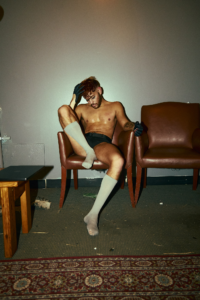
Cain Culto photographed in Vancouver. Photo by Xinger Xanger.
Looking back, he can see that power over sexuality is the ultimate way that evangelical spaces control their congregation, and that “once the sexual self is repressed, you are so much more vulnerable to manipulation and leadership.” Even “Cain Culto,” his alter ego created after these therapies, leans into the idea of cult leaders and cult tactics, and how leaders consciously or
unconsciously use them.
This was a major turning point for him, and he began to search for answers outside of the church. And one of the answers came in the form of his violin.
How Music Became Cain Culto’s Path Out of the Church
Music was always a big part of Cain’s life: going to radio broadcast WoodSongs to listen to folk and bluegrass musicians with his father, playing the violin at a performing arts school in Lexington, Kentucky, and eventually becoming a member of the Christian music group Ecclesia. Music became his medium and means for self-expression.
So when his world crumbled around him, his music became his escape path to embrace his queerness fully and to confront the “shit from these therapies”. His music began to evolve from his 3-person Christian group praising God and asking for forgiveness, to writing songs with titles like “Sold My Devil,” “WitchyMan,” and even covering Madonna’s “Like A Prayer”.
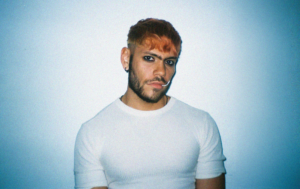
Six years later, Cain still uses his music to process the trauma of repression by confronting the darkness and embracing his inner demons. Photo by Xinger Xanger.
Cain regards his art as a practice of processing his own shame from this experience, which can be seen especially in his early work. “Cain Culto, as a music project and kind of my artistic practice, is trying to undo these things, the things that I was taught to be ashamed of, to be afraid of within myself, embracing those things truly, finally.”
Six years later, Cain still uses his music to process the trauma of repression by confronting the darkness and embracing his inner
demons. Cain wants those who’ve suffered from conversion therapy to look outside the small Christian bubble you were born into, be curious, and know that nothing about your true self is as dire as this ideology is making it seem.