Penny Tration and Molly Mormen Reflect on Drag, Identity and Queer Life in Northern Kentucky


photos by Logan Oleson
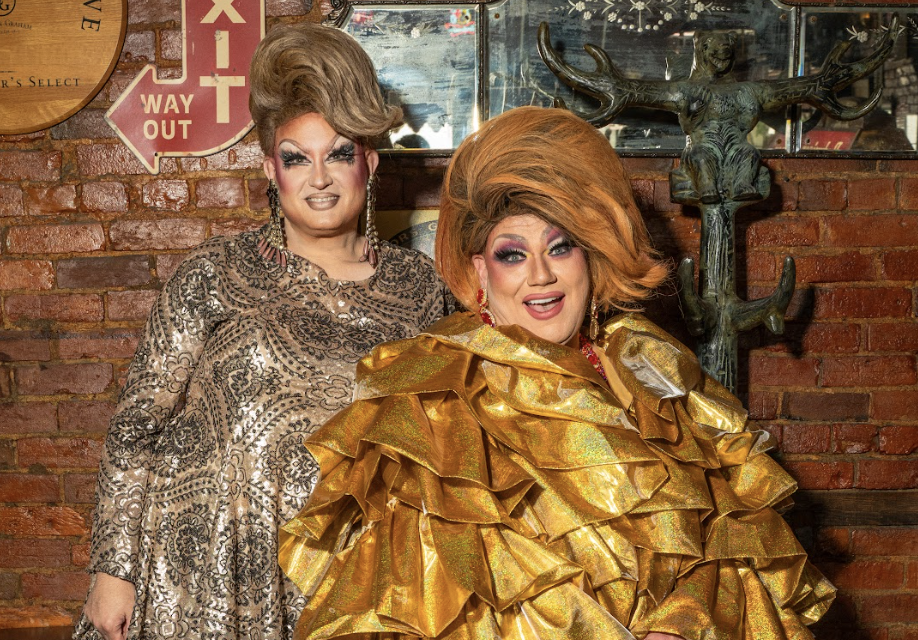
At Rosie’s Tavern in Covington, local drag icon Penny Tration — a RuPaul’s Drag Race Season 5 alum and founder of Cincinnati’s Cabaret — sat down with fellow entertainer Molly Mormen—Empress XXV and XXVIII of the Imperial Sovereign Queen City Court of the Buckeye Empire, Miss Gay Miami Valley Ohio 2023 and a Northern Kentucky resident—for a candid conversation about life, identity and the region’s queer culture. In their discussion, Penny invited Molly to reflect on how her drag persona reclaims parts of herself once suppressed by a strict Mormon upbringing, the evolving art of drag in the Midwest, and the sense of belonging she’s found in Northern Kentucky’s LGBTQ+ community. Together, their exchange offers a vivid portrait of resilience, creativity and the powerful role drag plays in shaping local queer spaces.
Photo by Logan Oleson | @l.o.foto
Inside Covington’s Queer Culture: Penny Tration and Molly Mormen Reflect on Drag and Community
Penny: I feel like people know who Molly Mormen is on stage, but who does Molly Mormen think Molly Mormen is?
Molly: Molly Mormen is everything that Michael Wilson hated about himself or wasn’t allowed to be growing up Mormon in Utah. It’s taken me forty years to turn that pain and resentment on its head and change it into something I think is pretty special. Molly gives me permission to be confident and display all the beautiful, broken pieces of myself in a way that is fun and fabulous.
Molly: Molly gets permission to do the things that Michael can’t do working a nine to five in an office. It gives me a chance to step back from that corporate world and let my hair down. Well, at least the three hairs I have left.
Penny: Ha, all three of them, huh?
Molly: Yes, having so few left helps me glue my wigs down. But ultimately, when I look at myself holistically, I’m not sure I know how to definitively separate myself into clean, distinct parts. Michael and Molly are two halves that make a whole. They help each other because they are codependent and complement one another.
Penny: Yes, I totally agree. I hear some entertainers talk about their “drag life” versus their “real life” and I don’t relate to that. I only have a life.
Molly: True, but I don’t think about it in terms of separate lives; drag versus real life. I look at it as two jobs for the same person. The first time I sat down and spoke to you about doing drag years ago, was in your old studio in Pendleton and I asked how much you loved it and you said, “It’s a job.”
Penny: It is, that’s exactly right!
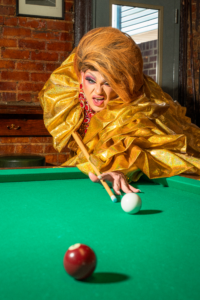
Drag performer Molly Mormen lines up a shot on a pool table at Rosie’s Tavern in Covington, Kentucky.
Molly: And that shocked me, so I doubled down and said, “but you love your job, right?” And you shot back, “it’s my job, do you love your job?” Now, as I look back on that meeting, more than 13 years later, I have to agree. It’s a job. Sure, there are parts of it I truly enjoy, but it’s a lot. As an older entertainer, you learn there’s so much to this craft. At this point, I’ve learned I need to track expenses, pay taxes, build connections, invest time and energy and money into my craft. It’s not just a hobby or a casual thing I do in my spare time, it’s a business that requires a lot of time, effort, and energy.
Penny: So, I know how you ended up here, like logistically, but how is it that you decided Northern Kentucky was it, and where you wanted to be?
Molly: Well, the short answer is that I wanted to say I lived in “the South.” After moving to Cincinnati for work, I lived up in the suburbs in West Chester and hated the commute, then I moved closer to the city, but when it was time again for a change, I knew I wanted to cross the river and move to Kentucky. I figured it was time to get my Colonel Sanders on. I mean, being from Utah, KFC was my only frame of reference for Kentucky.
Penny: For you, was moving to this part of the country something you wanted to do? Was it an escape or more a situation of convenience?
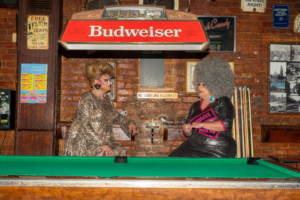
Drag performers Penny Tration and Molly Mormen sit and talk at Rosie’s Tavern in Covington.
Molly: Honestly, a little bit of both. I graduated college at the tail end of the recession and had a really hard time finding a job. When I finally found one, it wasn’t great but it was for a huge national company. Shortly after I decided to come out to my family, and it went really poorly. I knew I needed to leave Utah, so I applied for an internal role within the company and two months later I was sitting on the 20th floor of the Kroger building in downtown Cincinnati. At the time, I told myself that even if it didn’t work out, I was close enough to several other cities in Ohio and Kentucky and could even go up to Chicago or to the East Coast for other work opportunities if I wanted. Now, I’ve built a life here that I love, I’m not sure I’d ever leave.
Penny: What is your sense of the direction that the art of drag is taking now, especially in this area?
Molly: My first experience seeing drag of any kind was on television. Growing up, I would watch re-runs of “The Dame Edna Experience” with my Scottish mother. One of my favorite movies was Mrs. Doubtfire; in fact, I went as her for Halloween in the eighth grade. I’ve always been fascinated with the idea of transformation. Like you said, it’s almost magical, but it’s always been more than just the physical transformation for me, it’s also about the ability to leverage drag as an outlet to be more than who others said I was capable of being. More funny, more outrageous, freer to simply be more than the box I was put in as a young Mormon boy in the suburbs of Salt Lake City. As I grew into myself and decided to pursue drag in my late 20s, I realized that I wanted to embody the traditional old school style of the artform. You know, the over-exaggerated hair, breasts, and makeup. Along with the sequins and sparkle, I wanted to be glamorous and campy. After seeing you and your cast at my first in-person show at The Cabaret all those years ago, I got to see how dazzling drag could be and I knew I was hooked.
From Mormon Roots to Genderqueer Realness: Molly Mormen’s Journey Through Drag and Self-Discovery
Molly: One of the hardest things I’ve had to learn over the last 12 or 13 years of my career is that even if I don’t think I could do someone else’s style or type of drag, if they can do it, and it fulfills their need to be artistic and express themselves, that’s a fabulous thing for them. And as a person who produces a lot of different types of drag shows for a multitude of different audiences, I think booking a diverse cast is the best way to marry the art of drag for the entertainer and the experience of drag for the customer. I don’t necessarily have to like, understand, or participate in it, but as long as a new drag artist respects what I do, I can respect what they do, and I think that that’s the direction that drag really needs to go here and in general.
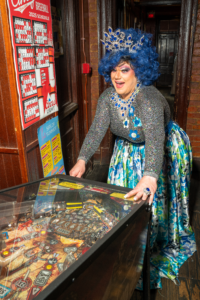
Drag performer Molly Mormen plays a pinball machine at Rosie’s Tavern in Covington, Kentucky, wearing a jeweled crown, blue wig, and sparkling gown.
The Art of Drag in Northern Kentucky: Building Connection, Creativity, and Queer Belonging
Penny: Driving to Rosie’s here in Northern Kentucky for today’s interview was pretty incredible. I haven’t been to Covington in at least five years, probably before the pandemic, and I was amazed at how much it has changed. It just feels different. Has that been your experience too?
Molly: I’ve only lived here for about three years, but I can tell you I’ve come to love this community for two different reasons. One is because it’s really and truly a regional melting pot. We get the influence of, you know, more southern cities and sensibilities, along with the stalwart midwestern influence, along with a hint of East Coast attitude. And, secondly, what I have found here more than anywhere else I’ve lived, is that Northern Kentucky has the best sense of community that I’ve felt since leaving Utah. It’s better here than anywhere else I’ve found during my time living in the area. It’s something that I’ve really come to cherish.
Penny: We are about an hour and a half from four or five really large regional cities. What is your advice for other entertainers who may want to come and perform in Cincinnati?
Molly: This industry is about relationships. Like any other business, it’s about how you carry yourself and the relationships you build along the way. But it’s more than just reaching out to a show director, it’s about how you act in a dressing room, how you treat your bar staff and a venue’s management. The way you treat others in our community can, more often than not, determine your success in this industry. Building positive relationships with others helps you build connections. So, if you want to work somewhere, you better be willing to get out and support the venue and its entertainers and staff who work there, too.
Penny: What do you wish people outside of the queer community understood about drag?
Molly: The art of drag has literally been around thousands of years, right? It doesn’t matter how much you pound on your bible behind the pulpit, or get on your conservative news station, you cannot change history as much as you wish to re-write it. Humanity has been watching men perform as women in nearly every culture and every age. Whether it was ancient Greek plays, to Kabuki and Shakespeare, women’s roles were played by men. Today we blur the lines a bit more, with both drag queens and kings being played by people of all genders, but the results are the same. We are here to do a job, and our job is to entertain audiences. Who those audiences are determines the type of drag or performance we typically do, but it’s all to the same end. Art is meant to be consumed, and I’ve said it for years, there are as many different ways to do drag as there are artists who put on a face full of makeup and walk out on stage. We’ve been around forever, and we’re not going anywhere.

Drag performers Penny Tration and Molly Mormen sit at the bar inside Rosie’s Tavern in Covington, Kentucky.
Penny: You mentioned drag today allows for a lot more flexibility with gender. How has your relationship with gender changed since you started doing drag?
Molly: That’s a loaded question. I’ve always been drawn more to women. Not really romantically, but in my platonic relationships. I always felt jealous of how they could express themselves physically in so many more ways than the traditional, masculine man traditionally can. For years, I yearned for a way to express myself as beautifully as they did. Now, the longer I do drag, the more I realize that there isn’t a clear delineation between my gender expression. There are some months I’m in drag five nights a week. I think it’s impossible not to constantly evaluate and re-evaluate my own gender and how I choose to express it when I’m spending half my time in women’s clothes. Ultimately, I’ve landed on identifying as genderqueer. Sometimes I want to feel beautiful and glamorous and drag allows me to do that. Other times I enjoy feeling more masculine. I hate the term non-binary; it sounds too mechanical. I am not a computer running on binary code, but being genderqueer allows a lot more fluidity and flexibility in my identity and expression.
Penny: Drag has been that opportunity for self-discovery for years. A lot of our trans friends started doing drag as an outlet for their self-expression and used it to springboard into their authentic selves.
Molly: Exactly, it’s almost like that outdated expression for gay folks who came out in stages. We used to hear people say, “Bi now, gay later,” right? But I think drag can actually serve as that steppingstone for those who are yearning to transition into their authentic selves. It’s not that way for everyone, but I’m glad it’s there to help those who need it.

Drag performer Molly Mormen poses on a pool table at Rosie’s Tavern in Covington, Kentucky.
Penny: Before we close, is there anything else that you would like to say to our friends across Kentucky?
Molly: Most of the shows I host end with a short message. It’s what ultimately became Gay Church, a show I’ve hosted off and on for years at various venues. RuPaul ends every episode of Drag Race by saying, “if you can’t love yourself, how the hell are you going to love someone else.” I think that’s bullshit. I believe it is a lot easier to love other people than it is to love yourself. I am living proof of that. So, my message to all the queer folks in Kentucky and anyone else who reads this, is that you are loved, you are worthy of everything you yearn for, and you are perfect. I know that can be hard to believe, but if you need a reminder next time you see me, let me know and I will tell you how fucking fabulous you are.