QUEER KENTUCKY | KENTUCKY'S ONLY LGBTQ+ NEWSROOM

Tag Archive for: Politics

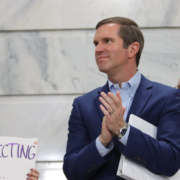
Gov. Andy Beshear, in a blue suit claps while standing inside a marble government building during a Fairness Rally, as people around him hold protest signs advocating for LGBTQ+ protections.

Queer Kentucky 2026 Bill Tracker: Key Legislation to Watch in Frankfort — KYGA26

Kentucky’s 2026 legislative session is gonna be a long one, and Queer Kentucky is here to help.

Meet Queer Kentucky’s #KYGA26 Bill Tracker. For the second year in a row, this will be your go-to spot for real-time updates on key bills impacting Kentucky’s LGBTQ+ community.

We’ll comb through all of the legislation as it gets filed, flag bills to watch, explain what they mean and why they’re important, and then monitor them as they move through Frankfort. We’ll also watch for any last-second bill changes y’all need to know about.

To better help cut through the chaos of Frankfort, this bill tracker has two parts. (Both parts are on this page, so go ahead and bookmark it and make plans to check it regularly.)

First, we’ll have a searchable database of a larger selection of bills folks are talking about, are big legislative priorities, or are just things y’all might find interesting.

Then, we’ll have written blurbs diving deeper — but still keeping things concise — into the absolute must-watch bills impacting LGBTQ+ rights and people.

The 2026 legislative session kicks off Jan. 6 and lasts until April 15. Lawmakers have until the first week of March to submit new bills (but they can change existing bills however they want until the end of session).

Got a certain bill or topic you want us to monitor? Email lead politics reporter Olivia Krauth at [email protected] or fill out this anonymous survey.

This story was last updated Jan. 6 at 10:15 p.m.

Search through key legislation

Learn more about key bills as they arise:

No LGBTQ-focused bills have been filed yet. 

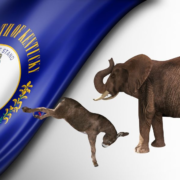
Illustration symbolizing Kentucky’s 2026 ballot, representing Republican and Democratic parties and Kentucky House and Senate candidates.

What Will Be on Your 2026 Ballot? Know your Kentucky House and Senate Candidates

Nearly every seat in Frankfort will be up for grabs in 2026, and Queer Kentucky is here to help you make sense of what Kentucky House and Senate candidates could be on your ballot

Kentucky’s state legislature has 138 seats — 38 in the Senate and 100 in the House. All of the spots in the House and half of those in the Senate are up for election in 2026.

It can be a lot to track, so we’re rolling out a set of searchable databases so you can see who is running, who isn’t, and which districts might be especially interesting to watch over the next few months.

Candidates have until Jan. 9 to file to run. Kentucky’s 2026 primaries are May 19, and that’s when Democratic and Republican voters will pick their respective party’s candidates for the November election. (Third-party folks, you may not have anything to vote on in May, but your candidates do get until early June to file to run.)

Both Kentucky’s state House and Senate districts are based on where you live. You can find out which districts you live in here, and then search through our databases to see who is running to represent you. Only the even-numbered state Senate districts will be on the ballot in 2026.

We’ll keep updating these trackers as people jump in the races. Looking for similar info about Kentucky’s federal races? We’ve got you covered here.

Who is running for Kentucky state Senate?

Who is running for Kentucky state House?

Which Kentucky state Senators are running again in 2026?

Which Kentucky state Representatives are running again in 2026?

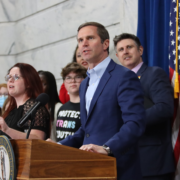
Gov. Andy Beshear and Fairness Campaign Executive Director Chris Hartman speak at an LGBTQ rights rally during Kentucky’s General Assembly in Frankfort. 2026 Legislative session starts tomorrow.

Closed Chambers, Big Decisions: What Kentucky’s 2026 Legislative Session Means for the LGBTQ+ Community

At last, Kentucky’s 2026 legislative session is upon us. 

This year’s session starts on tomorrow, and lawmakers will meet almost daily until April 15. Hundreds of bills and resolutions are expected to be filed, including measures to create the state’s next two-year budget.

Here’s what you need to know as #KYGA26 gets underway.


When do Kentucky lawmakers meet during the 2026 legislative session?

Lawmakers are scheduled to meet almost every business day from Jan. 6 to April 1, then take a quick break so Gov. Andy Beshear can sign or veto legislation, and then finish the session on April 14 and 15.

You can see the full calendar on the LRC’s website.

Typically, the House and Senate gavel in to discuss and vote on bills at 4 p.m. on Mondays, 2 p.m. Tuesdays through Thursdays, and 9 a.m. on Fridays. 

Lawmakers often spend the mornings meeting in committees, where they learn about new bills, receive feedback, and then give bills their first vote. Most committees are scheduled to meet somewhere between 8 a.m. and noon, Tuesdays through Thursdays. You can view the full standing committee schedule here

All of these times can change, and surprise meetings can and will pop up, so it helps to pay attention to the legislative calendar on the LRC’s website. This is where you can see which committees are meeting each day, what they’re scheduled to discuss, plus when and where they’ll meet. You can also follow the LRC on social media for more real-time updates. 

Where is Kentucky’s 2026 legislative session?

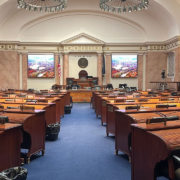
Kentucky’s state Capitol is closed thanks to multi-year renovations, so the House and Senate will meet in a temporary structure built in the Capitol’s parking lot in Frankfort.

Committee meetings will still take place in the Capitol Annex, which is right behind the Capitol and adjacent to the new temporary chambers.

What do the Capitol renovations mean for public access? 

The public will no longer be able to watch in-person as the House and Senate debate and vote on bills. When building the temporary House and Senate chambers, they did not include galleries — the public viewing area — in their plans. 

Instead, certain committee rooms in the Capitol Annex will be designated live-watch zones where the public can watch a livestream of what’s happening in the House and Senate’s temporary chambers. 

The Capitol’s closure also means protests, rallies and other events typically held in the Capitol rotunda will need to find a new venue. 

How can I follow along? 

You can show up in-person to watch committee meetings, testify or protest at those meetings, rally in the halls of the Annex or outside the building as lawmakers walk to their temporary chambers, and/or watch a livestream of something happening next door in Frankfort.

Panelists at Queer Kentucky’s legislative preview panels repeatedly said showing up in-person if you can, even if it’s just in the Annex for a committee meeting, is perhaps the best way to advocate for yourself and causes you’re interested in. 

But there are other ways to stay connected to what’s happening in Frankfort:

  • Watch the livestreams from KET or the LRC’s YouTube page anywhere you have internet access, or watch the replays afterwards.
  • Follow your favorite politics reporters on social media — media will still be able to be on the floor of the House and Senate chambers.
  • Sign up for advocacy groups’ and news outlets’ alerts to know what is the breaking news, especially around the topics you care about. 
  • See if your lawmakers are active on social media or publish a newsletter with updates about how they voted during the session. 

What will lawmakers focus on during Kentucky’s legislative session?

2026 is an even-numbered year, which means Kentucky’s legislature must craft its next two-year state budget. That will almost certainly be the highest priority for lawmakers, but expect budget talks to be a bit of a slow burn over the first two months or so of session before the final details get hammered out as session winds down.

Outside of the budget, here’s a quick look at some of the key issues that could come up:

  • Data centers and what restrictions (if any) they should have
  • Preparation for looming federal changes to things like SNAP benefits and Medicaid
  • How Kentucky can address its lack of affordable housing
  • Making child care more accessible or, if Beshear gets his way, offering universal preschool 
  • Prohibiting diversity, equity and inclusion efforts in K-12 education
  • Legislation aimed at the state’s largest two school districts (Jefferson and Fayette counties) following lawmakers’ dissatisfaction with the districts’ financial woes and low test scores

When it comes to LGBTQ-focused legislation that could gain traction this year, here’s a short list:

  • “Jackpot justice” measures that could threaten local fairness ordinances
  • Measures allowing health professionals to opt out of treating someone on the basis of religious or moral grounds
  • Additional attempts to restrict drag performances and artists
  • A “bathroom bill” restricting which bathrooms Capitol visitors can use after a GOP lawmaker confronted a transgender woman for using the women’s restroom in the Capitol at the end of the 2025 legislation session. 

What will Queer Kentucky cover this session?

You tell us! Fill out this survey and let us know what topics and bills interest you most. Or you can contact lead political writer Olivia Krauth at [email protected]

Want to help fund our journalism? Become a Queer Kentucky Bedfellow.

State Rep. Lisa Willner speaks at Queer Kentucky’s Queer Politics in the Bluegrass panel in Louisville, joined by policy expert Jackie McGranahan, Sen. Karen Berg, and Fairness Campaign Executive Director Chris Hartman.

Inside Kentucky’s 2026 Legislative Session: Takeaways From Two LGBTQ+ Legislative Preview Panels

Kentucky’s 2026 legislative session starts in less than a month, and Queer Kentucky has already been helping Kentuckians prepare for it. 

Queer Kentucky — the state’s only LGBTQ-focused newsroom — held two legislative preview panels in December, one in Newport and the other in Louisville. 

Attendees heard from folks well-versed in all things Frankfort, including the Fairness Campaign’s Chris Hartman, policy experts Cara Stewart and Jackie McGrahanan, lawmakers Rep. Lisa Willner and Sen. Karen Berg, and even me, Queer Kentucky’s lead political reporter. 

Weren’t able to make it to one of the panels? No worries — here’s a rundown of what you missed. 

How does session work? 

Policy expert Kara Stewart speaks to a packed audience at Queer Kentucky’s Queer Politics in the Bluegrass legislative preview panel in Newport, with panelists seated beside her inside Roebling Books.

Policy expert Cara Stewart speaks to a packed audience at Queer Kentucky’s Queer Politics in the Bluegrass legislative preview panel in Newport, Fairness Campaign Executive Director Chris Hartman and Queer Kentucky political reporter Olivia Krauth beside her inside Roebling Books. Photos by Murphy Meador Communications

Kentucky’s 2026 legislative session starts Jan. 6 and runs until mid-April. Lawmakers will meet nearly every business day during that timeframe, and are expected to file hundreds of bills. 

Since the session lasts so long — 60 total working days — the legislature is typically pretty slow to start in January, but things tend to start to heat up in February and hit a fever pitch in March. 

The upcoming session is a budget session, so lawmakers’ top priority will be deciding what to include — or not — in the state’s next two-year budget. 

What are the top LGBTQ+ bills to watch for?

Logan Richardson and Spencer Jenkins listen during Queer Kentucky’s Queer Politics in the Bluegrass legislative preview panel in Newport, seated among community members at the event. Photos by Murphy Meador Communications.

Covington Resident Logan Richardson and Queer Kentucky Editor-in-Chief Spencer Jenkins listen during Queer Kentucky’s Queer Politics in the Bluegrass legislative preview panel in Newport, seated among community members at the event. Photos by Murphy Meador Communications.

The GOP-dominated legislature did away with prefiling bills — aka making proposed legislation available to the public before session starts — a few years ago, so no one knows exactly what LGBTQ+ legislation could get filed in 2026. 

But Hartman noted a few bills that have been filed in the past that we might see again:

  • Measures allowing healthcare workers to refuse to treat or serve someone based on religious or moral beliefs, potentially meaning discrimination against LGBTQ+ people.
  • “Jackpot justice” legislation that could make it easier to sue cities or counties with fairness ordinances.
  • Anti-drag bills aimed at stifling public drag shows, potentially putting businesses, nonprofits, Pride festivals and performers at risk, depending on how the legislation is worded.

Getting involved is critical

Panelists including State Rep. Lisa Willner, policy experts Jackie McGranahan and Cara Stewart, Sen. Karen Berg, and Fairness Campaign Executive Director Chris Hartman smile and engage during Queer Kentucky’s Queer Politics in the Bluegrass panel event.

Panelists including State Rep. Lisa Willner, policy experts Jackie McGranahan and Cara Stewart, Sen. Karen Berg, and Fairness Campaign Executive Director Chris Hartman smile and engage during Queer Kentucky’s Queer Politics in the Bluegrass panel event. Photo by Murphy Meador Communications.

From last-second bill changes to critical meetings held during normal working hours, the legislature doesn’t exactly make it easy to make your voice heard, panelists noted. 

And the upcoming session marks the first of at least a few years where the Capitol will be closed for renovations, shutting down a key rally and protest area and limiting the public’s chances to interact directly with lawmakers. 

That’s why it is even more important to show up how you can to support or push back against legislation, panelists said. Although the Capitol will be closed, the Capitol Annex — where all of the committee meetings take place and where bills get their first votes and often see the most change and discussion — will still be open to the public. 

“It really does matter that people show up,” Hartman said at the Newport panel. You can sign up to testify against a bill, too, but “just your physical presence is powerful. Every time we can fill the chamber with bodies, it gives more people pause than you might know.” 

Any day you can show up in-person is worth it, Stewart noted in Newport. And when you’re there, remember only a little bit of facetime with a lawmaker can make a large difference.

“Find a way to be honest,” Stewart said. “Find a way to be, you know, authentic to yourself, your own experience, and share something about you because that’s hard to deny.”

Willner, a Democrat representing part of Louisville, said, “We need to change who’s in the seats, but the people there who are in the seats now, there are times when their hearts and minds have been changed.

“It’s because you show up,” she continued. “It’s because the community turns out; it’s because people are willing to sit down with people who wish you didn’t exist and show them that, in fact, you do.”

Can’t make it to Frankfort? You can still write or call your lawmakers, share information about bills on social media, or encourage others who can get to the Capitol to do so. 

Rally around state and local candidates

Community members fill a local bookstore in Newport for Queer Kentucky’s Queer Politics in the Bluegrass legislative preview panel, with panelists seated at the front discussing Kentucky’s 2026 legislative session.

Community members fill Roebling Books in Newport for Queer Kentucky’s Queer Politics in the Bluegrass legislative preview panel, with panelists seated at the front discussing Kentucky’s 2026 legislative session. Photo by Murphy Meador Communications.

On top of the legislative session, 2026 also brings several midterm elections ranging from Congressional seats to candidates for Frankfort to local school boards and city councils. 

Republicans hold a supermajority at the state-level in Kentucky, and 119 of the 138 seats in Kentucky’s House and Senate will be on the ballot next year. 

While it is unlikely Democrats could snag a majority in either chamber, there are still several seats that could be flipped or at least considered at play. Berg, for example, said she believes around 11 of the 19 state Senate seats up for election already have strong Democratic candidates who could make it a real contest. 

But candidates need help, and several panelists encouraged attendees to help door knock or otherwise support candidates who support the LGBTQ+ community. That potentially includes some of the more moderate Republicans in Frankfort who have broken ranks with their party to support LGBTQ+ people in past votes and now face primary challengers because of it. 

You can also run for office, particularly local office, yourself. Kentucky’s deadline to file for a seat that has a partisan primary election is Jan. 9. 

Help shape Queer Kentucky’s politics reporting in 2026 by filling out this survey


What happens to marginalized groups in a DOGE Eat KOGE World?

Since originality is dead and redundancy is in—Kentucky has been quick to join the list of states mirroring the new, and legally questionable, Department of Governmental Efficiency or DOGE at the state level. 

The proposed Kentucky Senate Bill 257 (SB 257) aims to establish the Office of Government Efficiency within the Auditor of Public Accounts, tasked with evaluating and recommending improvements to the efficiency, cost-effectiveness, and performance of state government agencies, programs, and operations. 

Aiming to cut waste and be more efficient is good. I am annoyingly known to be very efficient with how much I have to talk, aiming for fewer words because I don’t love hearing my own voice. I also have had relationships struggle because of my incessant need to be efficient…like looking up the EXACT time to head to dinner based on traffic patterns– so far be it from me to criticize anyone wanting to work at efficiency. I am one of you.

But what the proposed Kentucky office, or KOGE as they wish to be called, doesn’t factor in are the possible inadvertent negative impacts on marginalized groups, including LGBTQ individuals and people of color. 

As history has shown, when the costs start getting cut—stuff for people who are of the lesser regarded class, aka the others, are often first on the chopping block. Efficiency initiatives often lead to budget cuts or restructuring of programs deemed non-essential. Services specifically supporting marginalized communities, such as LGBTQ health programs or minority outreach initiatives, might be at risk if they are not prioritized, thereby reducing access to critical resources for these populations.

A primary focus on cost-cutting may also neglect to factor in the importance of equity. Yes equity, that word some people are now trying to paint as a negative when really it is anything but. A valid concern with KOGE is how it would handle programs and services designed to address systemic disparities which pose a risk of being undervalued if their benefits are not immediately quantifiable in economic terms, potentially exacerbating existing inequalities. Further, without explicit inclusion of diverse perspectives in the evaluation process, the unique needs of marginalized groups might be overlooked. This oversight can result in recommendations that do not account for the challenges faced by these communities, leading to policies that are not inclusive.

A more tangible fear I hold relates to an office I hold dear to my heart. As the former Executive Director of the Kentucky Commission on Human Rights, I value the mission and purpose of the agency. Past state budgets, not so much. And I know firsthand the importance of the work being done there to this day. When we can look to the federal model of DOGE that has used an approach that seems kind to call “control find” as its guiding practice, I fear what happens to an agency that’s main mission is to “safeguard all individuals within the state from discrimination.”  When the federal version is closing buildings referencing the Civil Rights Movement or looking for things that use the word women, or Black, or queer and laying them out for more scrutiny—what happens with an agency tasked with protecting people who are discriminated against for being a woman, or Black, or queer? Does KOGE make it easier to fire or choose to not hire a queer or Black applicant? Even if that isn’t the intention, the chilling effect on the work of an agency can be pretty severe. On top of open discrimination, this can lead to increased unemployment among populations already facing employment challenges.

Kentucky rarely leads on things outside of bourbon, basketball, and horses. The desire to be one of the first states to emulate DOGE at the state level is befuddling. Why rush? State legislatures already have sweeping authority to monitor and provide oversight of the same things KOGE seeks to address. Does it have a cool name that gets a tweet, sorry X, from Elon Musk? Probably not, but the purpose can be carried out without endangering vital services to marginalized communities. But then again, isn’t it super-efficient to have multiple offices doing the same thing?


Crunch time: Follow along on the last day before the veto period in Frankfort

It is crunch time in Frankfort: Friday is the last day Kentucky’s Republican-dominated legislature can pass bills and know they’ll be able to override any vetoes from Democratic Gov. Andy Beshear. 

Read: Any anti-LGBTQ+ legislation needs to pass today, otherwise it is dead for 2025. 

Here’s a general outline of what to watch for Friday, plus an outline of where things go from here. We’ll be updating this story throughout the day, too, so go ahead and bookmark this page and keep an eye on our socials for the latest. 


11:42 p.m.: House OKs more health care restrictions for transgender Kentuckians

Kentucky’s House also just voted to block gender-affirming health care from transgender inmates in Kentucky — all 67 of them. This one will also go to Beshear’s desk for consideration.

They approved Senate Bill 2 on a 73-12 vote with mere minutes remaining before the veto period.

Minority Whip Rep. Lindsey Burke (D-Lexington) called out GOP leadership for calling the bill after just passing HB 495, which also restricts access to gender-affirming care — and did so with such little time left on the clock.

“What a wasteful piece of legislation, what a waste of our time when we actually could do something to help instead of hurt,” Burke said.

11:09 p.m.: House OKs blocking health care from some transgender Kentuckians

After using a swift legislative move to stifle debate on HB 495 at the 11th-hour, the GOP-dominated legislature will be sending a bill to both block gender-affirming health care from transgender Kentuckians on Medicaid and prohibit bans on conversion therapy to the governor’s desk.

Five House Democrats spoke against the bill before GOP leadership ended debate and immediately called for a vote on the bill. It passed on a 67-19 vote, with Rep. Kim Banta being the lone Republican to join the Dems in voting against the bill.


10:41 p.m.: Clock is ticking, y’all

Checking in real fast to confirm that my prior statement of this being a long night is true.

My eyes are on the House right now, which needs to take action on basically all of the bills I told y’all to watch tonight in the next, um, 80 minutes or so.  Anything controversial must be passed by midnight in order to withstand a potential Beshear veto, so the clock is ticking.

The House just started debating House Bill 495, which would ban transgender Kentuckians on Medicaid from accessing gender-affirming health care as well as prohibit bans on conversion therapy.

Stay tuned here and you can watch live on KET, if you’d like.


6:30 p.m.: A last-second Senate change aimed at transgender inmates

It has been a long day and it is expected to be an even longer night. Lawmakers gaveled in this morning and have largely been bouncing between closed door caucus meetings, last-second committee hearings to hammer out final details of a handful of bills and votes on a variety of topics.

This morning, the Senate changed an uncontroversial bill initially aimed at mental health facilities — House Bill 392 — to require inmates to use facilities tied to their assigned sex at birth. The House needs to agree with the changes in order for it to advance to Beshear’s desk for consideration.


What to expect in Kentucky’s legislature Friday

Expect a dizzying rush of legislation mixed with random, at times lengthy, periods of downtime as lawmakers meet with their caucuses behind closed doors. 

Also, you should probably expect an incredibly long day — the Senate starts at 9 a.m. and the House at 10 a.m., and they have until midnight to pass whatever they’d like. 


What are the bills to watch on Friday?

Queer Kentucky has been tracking LGBTQ-focused legislation all session, and only a handful of the bills are still at play this late into the legislative session. 

The biggest one to watch Friday is House Bill 495. This is the one that initially wanted to just undo Beshear’s ban on conversion therapy, but then suddenly also wanted to block transgender Kentuckians on Medicaid from receiving gender-affirming health care. 

HB 495 passed out of the Senate Thursday, and now the House needs to approve the new health care ban language before the legislature sends the bill to Beshear’s desk. 

And then two bills — Senate Bill 2 and Senate Bill 132 — could get a House vote Friday. SB 2 would block gender-affirming health care for transgender inmates, and SB 132 would allow health care providers to refuse to offer certain treatments if they don’t want to for religious or moral reasons. 

You might also want to keep an eye on House Bill 392, which is poised for a Senate vote on Friday. It is about mental health facilities and has sailed through the legislature thus far. However, Senate Majority Whip Mike Wilson (R-Bowling Green) — the sponsor of SB 2 — added a floor amendment that would, if passed, require inmates to use facilities tied to the sex they were assigned to at birth. 

The Senate may not approve it, but it is worth watching. Like HB 495, this would need to go back to the House for approval before it goes to the governor if it gets changed.


And what if the House doesn’t like these changes? 

I will try to make this as conversational as possible. 

OK, so, if the two chambers don’t agree on something, it goes to a thing called a conference committee. Basically, a group of lawmakers talk about the bill and can change around its parts to try and reach a compromise. But they can’t add anything new in; they’ve gotta work with what they’ve got.

But if this doesn’t work, then they get to go to a free conference committee. Now, they can kinda do whatever to reach a compromise. They can add, subtract, multiply, divide, whatever it takes to strike a deal.

Typically, the free conference committee works, so I’ll be honest, I’m not sure if there is a step after that other than the bill failing to pass. 

And I’ll remind y’all that in this situation, they’d be trying to do all of this in a day that is typically the legislature’s busiest. 


What happens after Friday?

Everyone is in a rush because the veto period starts at, like, 12:01 a.m. Saturday. This is a block of time dedicated to Beshear reviewing everything passed thus far, and vetoing what he doesn’t like. (Of course, he can also sign things into law, or let them become law without his signature.)

There are then two days of the legislative session left — March 27 and 28 — where the legislature can override those vetoes. So, the GOP-heavy legislature needs to pass anything controversial now so they get the last say. 

They can still pass stuff on those last two days, but then Beshear gets the last say — not them. 


Let’s look at the final full week of Kentucky’s 2025 legislative session

This article was originally published by The Gallery Press by Olivia Krauth

This is the final full week of Kentucky’s 2025 legislative session and, honestly, thank God for that.

The GOP-dominated legislature has until 11:59 p.m. Eastern Friday night to pass anything controversial before a 10-day veto period starts. That’s when Gov. Andy Beshear — known supporter of DEI efforts and the LGBTQ+ community — can reject bills sent to him for consideration to be law, but lawmakers would still have two days at the end of the month to override him.

If anything anti-DEI or anti-LGBTQ+ *doesn’t* make it to Beshear by then, I would tell you it is safe to assume it is dead and won’t become law. But also this is Frankfort and apparently we can randomly try and block needed health care from transgender Kentuckians at 8:30 in the morning, so.

A note of caution: There is so, so, so much going on in Kentucky politics right now. For this evening, I’m focusing on the five bills left on the Queer Kentucky bill tracker I’ve been running all session that are still considered alive because what an absolute day for going after the LGBTQ+ community.

As always, you can fill out this survey real fast to let me know what questions you have or what bills you’d like an update on. (And yes, you can also submit people for the potential Best Dressed of #KYGA25 list.)

OK, let’s begin.


FRANKFORT, March 7 – Rep. Ryan Dotson, R-Winchester, (left) confers with Rep. David Hale, R-Wellington, during Friday’s House session. (Photo: LRC Public Information)

OK, seriously?

We can start with the way some Republicans decided to take a bill that already sought to prohibit bans on conversion therapy — a discredited attempt at counseling kids out of being anything other than straight — and then somehow add a section barring Medicaid funds from covering gender-affirming health care for transgender Kentuckians.

They did this literally at 8:30 a.m. Wednesday in front of a Senate committee, which proceeded to pass the new bill (House Bill 495sponsored by GOP Rep. David Hale).

Hale, to his credit, explained the committee substitute of the bill, which radically altered the bill with all of the new we’re-taking-away-your-health-care language, in the committee.

It was interesting to hear Hale present and defend this sudden change because just last week, he seemed to be defending a parent’s right to choose their child’s health care. Now, he’s defending the state’s right to choose your health care, regardless of age. Wonder what changed.

However, he was — and has been — praised for working to make the conversion therapy part of the bill stronger, per Dem Sen. Karen Berg. But the new section yanking away health care was a no-go.

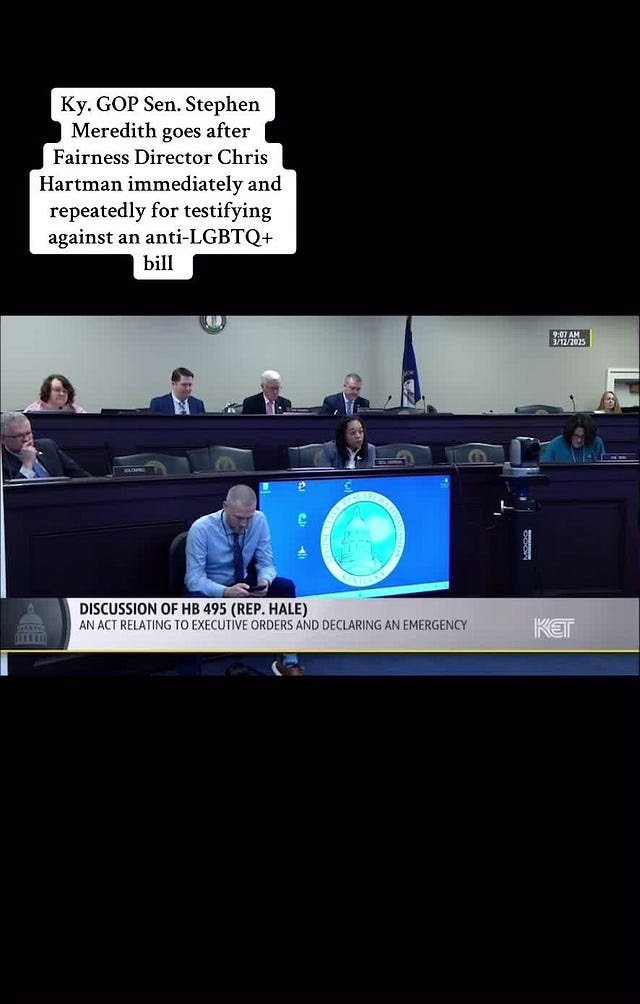
The HB 495 committee vote also included committee chair GOP Sen. Stephen Meredith yelling at Fairness Campaign director Chris Hartman mere *syllables* into Hartman’s testimony against the bill.

I’ve seen plenty of high tensions in Frankfort, but Meredith’s audacity might be unprecedented.

HB 495 now has two readings in the Senate, meaning it could get a full Senate vote as early as Thursday morning, actually, since both the House and Senate decided to gavel in at 9 a.m. instead of the normal 2 p.m.

If it passes the Senate, the House needs to agree with the changes the Senate made to their bill before it gets sent to Beshear’s desk where it will almost absolutely be vetoed.

But here’s the thing: Some Republicans in the House already tried to make the whole blocking Medicaid funds situation a thing several weeks ago and the bill went nowhere. Not even when HB 495 was up for a House vote last week did they try to add this language to it.

So, why now? And will the Senate be interested in it?

And if the Senate approves it, the House has to agree with the changes — will they? Will they do so by Friday night? If they don’t, will a conference committee — a group of lawmakers tasked with finding a compromise — be successful in time?

And if the conference committee fails, what will the free conference committee — the group that basically gets to take the bill and do whatever they want to it — come up with? And will they reach a solution in time?

Is it really worth it to them to spend that much time during the next two legislative days? We’ll see.

It is entirely possible that adding this language about Medicaid will cause the entire thing to collapse, therefore allowing Beshear’s ban on conversion therapy to stay in place. But again, we’ll see.


FRANKFORT, March 12 – Senate Democratic Floor Leader Gerald A. Neal, D-Louisville, speaks on House Bill 4, an act related to diversity, equity and inclusion initiatives, on the Senate floor Wednesday. (Photo: LRC Public Information)

Does anyone know when slavery ended?

Kentucky’s GOP-dominated Senate easily approved — with an assist from Dem Sen. Robin Webb, who also voted in favor of the measure — this year’s marquee anti-diversity, equity and inclusion bill, House Bill 4.

HB 4 is aimed at college campuses, and despite this being a high-profile topic for the last two sessions and the bill actually not changing a ton since being filed last month, I’m still not sure if anyone is 100% sure what exactly it does and doesn’t do.

Generally, it is aimed at not forcing any policy designed to be based on religion, race, sex, color or national origin. It wants to do away with DEI offices. It wants to foster intellectual diversity, though, that is safe.

But, just like with so many other bills sparked by the GOP’s culture wars, even with attempts to make its language specific and after months of discussion, it still isn’t totally clear.

And when things like this aren’t clear, it often has a chilling effect on educators and admins.

Wednesday’s Senate vote was, um, interesting. Some Dems, like Louisville Dem Sen. Karen Berg, shared lengthy, personal stories about how DEI impacted them directly. Republican Sen. Donald Douglas, who is Black, rattled off a list of historical facts, including sharing that slavery ended in 1805. Dem Sen. Reggie Thomas, who is also Black, later corrected him regarding slavery facts.

And apparently there was an off-camera fight between legislative leaders, captured by the Kentucky Lantern’s McKenna Horsley.

McKenna Horsley @mckennahorsley.bsky.social

Some party leaders are having a heated discussion.

View on Bluesky

I could write an entire other newsletter about the energy, the body language, Sen. Karen Berg’s shawl version of a Snuggie (?), the last second appearance of Sen. Cassie Chambers Armstrong — everything — in this clip, but I am tired and so therefore I will move on (for now).

This one is off to Beshear, who has 10 days to decide what he wants to do with it. (Spoiler: He will most likely veto it.)


More on LGBTQ+ issues

Senate Bill 2

SB 2, which would block gender-affirming health care for the 67 or so transgender inmates in Kentucky, passed a House committee Wednesday.

This is a top priority bill for the Senate GOP — all 31 Republican senators signed on as a cosponsor — but it looks like it might not have the time to pass the House. It needs three readings across three days, like all bills, and it needed its first reading on Wednesday in order to pass by Friday. And it got that first reading. So we’ll see how this goes.

But while Beshear is pretty pro-LGBTQ+, I don’t know if he’s gone on record regarding this particular issue. It might be possible that he won’t veto it, and therefore Republicans have a bit of extra time.

Senate Bill 132

This one would basically allow health care professionals to refuse to do certain medical procedures if those procedures violate their values. So, think, if their religious values include not believing LGBTQ+ people are real, they could refuse to provide needed gender-affirming health care. Same idea goes for abortions.

This passed out of a House committee and got that first reading Wednesday, so this also could pass Friday.

Senate Bill 60

SB 60 is very much like SB 132, but it extends the religious liberty thing to basically everything — not just health care.

It is almost safe to say this one is dead. It could’ve been heard in committee Wednesday, and yet they didn’t put it on the agenda. It also doesn’t have any of its three readings in the House, and there are only two legislative days left before the veto period, so … the math.


Oh, and also

For reasons I have not seen publicly and/or widely articulated, apparently Grimace was terrorizing the Kentucky Capitol Annex Wednesday.

As if the session itself wasn’t a terror enough.

Apparently, there is also an uprising regarding an alleged recent decision to stop the Capitol Annex snack shop (a small place with a gas station-like assortment of snacks and drinks so you don’t pass out in Frankfort and/or for those of us who have a fear of the Capitol Annex cafeteria) from offering *checks notes* hot food?

Obviously, I will keep y’all updated with such incredibly passing matters, especially as the veto period approaches.


Some programming notes

Just a bunch of repeats from last week:

  • If you’re a paid sub, PLEASE double-check what card you have on file so any and all payments go through. Several of y’all signed up for annual subscriptions last March, so those should be renewing soon and I’d hate for you to lose access at the worst possible moment of session.
  • It is fully party time in Frankfort, but party time in Frankfort does not come cheap. If you’d like to chip in a few bucks for gas or a Celsius via Venmo, I’d be forever grateful (but no pressure, seriously). My Venmo is right here.
  • Also, please take a second and share this newsletter with a friend and/or on your social media feeds! As I said, it is fully party time in Frankfort, and the more folks we have reading + sharing The Gallery Pass, the better the party. Plz + thx!

Where can you find me?

  • For live updates: Either Twitter or BlueSky.
  • For video recaps/explainers/answering your questions: TikTok.
  • For aesthetically pleasing things to add to your Insta story: My professional Instagram.
  • For full-length articles: Queer Kentucky.
  • For regular recaps + analysis: The Gallery Pass. (Please tell your friends to subscribe!)
  • To send me ideas and tips: Use this survey. It is anonymous and you can fill it out as often as you’d like.
  • To support my work: Venmo. (Again, no pressure.)

Aight, my party people, we will talk when we talk next. If you see me in Frankfort and I’m not sobbing in my car, feel free to come up and say hi! I have friendship bracelets!

Toodles!

The image shoes a poster made of the colors of the trans pride flag and it reads "We are your neighbors, your friends and family, we are human beings, we are Kentucky, we deserve fairness"

SESSION IS OVER: Costly crime bill to become law, anti-DEI bills officially dead for now

Today is the infamous sine die, which is the action that officially ends this legislative session. This legislative session has included at least 14 anti-LGBTQ+ bills, with anti-DEI bills being particularly publicly controversial. Of all of the bills, only 1 of the anti-LGBTQ bills passed. 

House Bill 5, a broad-reaching crime bill, will become law despite Gov. Andy Beshear’s veto. HB 5 has been opposed by statewide and national advocacy organizations including the Fairness Campaign and the American Civil Liberties Union. Also profiled by both organizations were HB 9 and SB 6, anti-DEI bills that were dead, resuscitated at the last second, and then left to be gasping for air again. This is to say they did not pass for now, but the sponsors of these bills seek to continue advocating for this kind of policy.

Additionally, as reported by McKenna Horsley with the Kentucky Lantern, the Senate did concur with a House floor amendment to Senate Bill 191, a postsecondary funding bill, that would prohibit the use of “any race-based metrics or targets in the formulas” for the higher education funding model. 

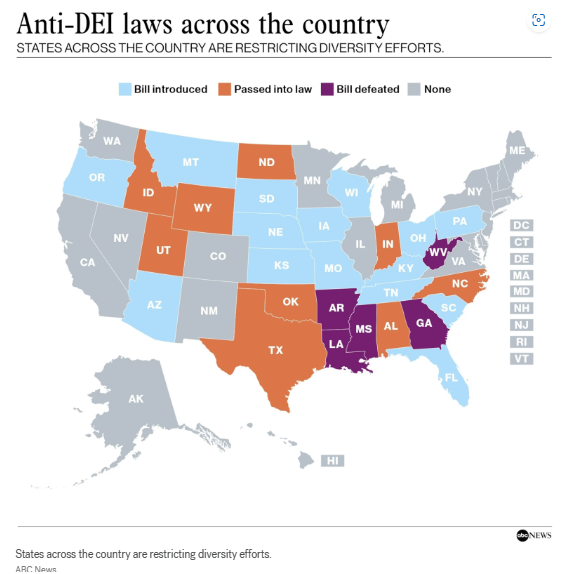
This was one area where anti-DEI language was able to be quietly implemented, which follows a national trend of conservative politicians restricting DEI efforts (below).

There were many developments with SB 6 and HB 9, the anti-DEI bills of this legislative session. SB 6 was infused into HB 9 by Rep. Jennifer Decker, R-Waddy, without consulting the sponsor of SB 6, Republican Whip Mike Wilson of Bowling Green. 

This action caused controversy within the Republican Party, as they could not agree on the constitutionality of Rep. Decker’s more regulatory and extreme additions. The Senate did not go along with the sweeping changes made in the House, causing the clock to run out on the possibility of sweeping anti-DEI legislation in the 2024 legislative session. 

The bill that will become law was HB 5, which proponents called the “Safer Kentucky Act.” Opponents say it criminalizes the poor and unhoused, dubbing it the “Suffer Kentucky Act.” 

The Kentucky Center for Economic Policy did an analysis of HB 5, giving 5 leading effects of the potential law:

  1. Increases criminal penalties for fentanyl in numerous ways
  2. Criminalizes Kentuckians for being poor and unhoused
  3. Creates harsher penalties for violent crime that do not make us safer and are not an appropriate response to current conditions
  4. Expands felonies, enhances penalties and restricts personal liberties, among other provisions
  5. Spends a large amount of state and local financial resources on these tried and failed approaches to public safety

LGBTQ+ communities already have “higher rates of poverty, lower rates of home ownership, and higher rates of homelessness” according to the Williams Institute at UCLA School of Law. 

As well, LGBTQ+ communities “face widespread discrimination in housing, mortgage lending, and homeless shelters and services.” 

These compounding impacts of discrimination and marginalization have a greater impact on Black, Brown, and Indigenous members of the LGBTQ+ community, as well as people identifying as LGBTQ+ and living with disabilities. 

Further, the Trevor Project reports the key findings on how homelessness and housing instability are tied to queerness,

“Nearly half (44%) of Native/Indigenous LGBTQ youth have experienced homelessness or housing instability at some point in their life, compared to 16% of Asian American/Pacific Islander youth, 27% of White LGBTQ youth, 27% of Latinx LGBTQ youth, 26% of Black LGBTQ youth, and 36% of multiracial LGBTQ youth. 

Homelessness and housing instability were reported at higher rates among transgender and nonbinary youth, including 38% of transgender girls/women, 39% of transgender boys/men, and 35% of nonbinary youth, compared to 23% of cisgender LGBQ youth.”

The Nation published an article covering Kentucky’s HB 5, and in that article the “Safer Kentucky Act” was referenced as the “cruelest criminal-justice bill in America.”

HB 5 was publicly opposed by more than 100 Kentucky groups, urging lawmakers to reject the bill. The legislation will cost Kentucky more than $1 billion over a decade, and much of that cost would come from the finances to require longer prison sentences. 

If Kentucky was a country, it would have the 7th highest rate of incarceration in the world. The international scale of Kentucky’s high rate of incarceration was in a report by the Prison Policy Initiative, shared in 2021. This bill will only further populate Kentucky’s already chronically overpopulated jails.

With the amount of public controversy around this bill, more information regarding the source of the bill was requested. A Kentucky Public radio analysis exposed that many of the sources provided as support for this bill are from a policy report in Georgia, not Kentucky constituents, policy writers, or community members. Further, multiple writers of the quoted sources claim that their academic work was used out of context for political gain.

Ban Conversion Therapy Kentucky loses tax exempt status, leadership questioned by former advocates 

UPDATE: On April 11, the Kentucky Youth Law Project, an organization working to enhance legal protections for queer youth, denounced BCTK’s actions and called for its executive director, Rebecca Blankenship, and its one lobbyist, Michael Frazier to resign immediately.

“In these difficult times, it is imperative that all nonprofit organizations scrupulously follow the laws, rules and regulations. Organizations that fail to do this risk losing their credibility and support within our community. And organizations that continue to collect donor funds after they have been declared ineligible for tax-exempt status are misleading their supporters,” Elston said.

The full statement can be read here.

Louisville, KYBan Conversion Therapy Kentucky (BCTK), a group founded in 2017, recently announced it will “reevaluate and restructure” the organization as its efforts no longer center on a conversion therapy ban in Kentucky. Former advisers and organizers now criticize the group’s 2024 lobbying efforts and loss of non-profit status, calling the actions “gross oversight” and “deeply saddening.” 

Kia Nishida, a former organizer for BCTK who cut ties in 2021, said the group’s leaders are unjustly benefiting from the support of LGBTQ+ people and their allies while supporting legislation that can be damaging to queer people. “I’m frustrated,” Nishida explained. “They’re using the name we worked so hard to build to make it seem like they’re supporting LGBTQ+ folks when that is not the case.”

In a March 29 social media post BCTK described its shift in focus saying changes began in 2023. This year, BCTK reported lobbying Senate Bill 6 and House Bill 9 according to a March 27 update from the Kentucky Legislative Ethics Commission. The organization also noted lobbying on conversion therapy and anti-LGBTQ+ legislation.

The two specific bills had a similar focus, targeting diversity, equity and inclusion. Senate Bill 6 is commonly referred to as the anti-DEI bill and House Bill 9 sought to ban DEI in higher education. You can read Queer Kentucky’s extensive reporting on this legislation from reporter Belle Townsend here

Ban Conversion Therapy Kentucky is currently led by executive director Rebecca Blankenship of Berea, Kentucky. Queer Kentucky reached out to BCTK for comment from Blankenship and the group’s sole lobbyist Michael Frazier. In an email, Blankenship addressed their lobbying efforts saying, “Ban Conversion Therapy Kentucky opposed the first two versions of SB6 and took no position on HB9 or the third version of SB6.”

Rebecca Blankenship, Executive Director, Ban Conversion Therapy Kentucky

This contradicts the previously mentioned documentation from the Kentucky Legislative Ethics Commission which notes BCTK’s lobbying efforts on HB9. When asked to clarify this discrepancy, Blankenship said, “HB9 should not be listed on BCTK. Either Michael or I made a mistake filling out the KLEC forms. I’ll correct it with KLEC. HB9 is not part of the lobbying efforts for BCTK.”

Blankenship is also the Assistant Executive Director for the Kentucky Students Rights Coalition. In that capacity, Blankenship said she testified against the original version of SB6. After legislators made amendments, she became a strong supporter of the bill and even wrote a letter to the House Judiciary Committee. She said, “ I believe the hype and anger that surrounded that bill was much more a reaction to the racist rhetoric employed by some of the bill’s supporters than to the bill’s actual impact, which was almost universally misunderstood and which the bill’s numerous exceptions and qualifications would have made pretty narrow. DEI officers get paid $100,000 a year to wear a suit and do mostly nothing.” 

ACLU-KY and The Fairness Campaign, Kentucky’s leading LGBTQ+ advocacy groups, have publicly denounced these bills saying they suppress free speech and deny students’ rights.

BCTK is no longer an active non-profit registered in Kentucky, having been administratively dissolved by the Kentucky Secretary of State for failing to file mandated annual reports. BCTK is no longer an active non-profit registered in Kentucky. Still, BCTK requested donations asking folks to “help us protect LGBT youth” as recently as February without communicating its change in status or policy focus to donors or stakeholders. When asked to address these concerns, Blankenship responded, “Of course I can’t comment on any legal matters. BCTK is not actively soliciting or receiving donations of any kind.”

BCTK’s sole lobbyist in 2024 was Michael Frazier

BCTK’s sole lobbyist in 2024 was Michael Frazier, founder and director of the Kentucky Student Rights Coalition. He reportedly received $2,800 to lobby on behalf of the BCTK in 2024.

Frazier publicly supported SB6 and HB9; while he was only paid to lobby on behalf of BCTK in 2024, he spoke out in favor of both anti-DEI bills under his title with the Kentucky Students Rights Coalition. Frazier provided testimony in March supporting Senate Bill 6, saying DEI funding would be better used in scholarship dollars, among other things. 

While those formerly involved with BCTK question these actions, there is currently no prohibition in Kentucky’s Legislative Ethics Code on a lobbyist or group lobbying both sides of a particular issue or bill.

Former BCTK Adviser Patti Piatt said the organization’s recent actions are “Antithetical to their mission” and “absolutely heartbreaking.” The outspoken advocate for LGBTQ+ Kentuckians left BCTK in 2021 citing concerns with new leadership. She told Queer Kentucky, “I would like to see a change in leadership. People more dedicated to the cause should be in charge of this organization.”

While the next steps for BCTKY are unclear, the organization’s work in Frankfort this year has been contrary to leading LGBTQ+ advocacy work in the Commonwealth.

Queer Kentucky will continue updating this story as it unfolds. For questions, please reach out to [email protected] / [email protected]

Pin It on Pinterest