Queer Cycling Groups in Kentucky and Ohio Claim Space on the Streets, Build Community


Queer cyclists say that showing up on the road where they often feel ostracized by the automobile supermajority feels like a political fight for their rights—one that mirrors the broader LGBTQ+ struggle beyond the pavement. That sense of resistance has inspired local groups to turn cycling into both community and cause. Three cycling groups across Kentucky and Ohio are securing their spot on the streets by creating queer visibility through community rides and acts of service.
COVINGTON: Queers with Gears
Julia Keister, founder of the Covington cycling group Queers with Gears, moved to Kentucky from New York City where cycling was her main form of transportation. She was baffled by the lack of safety for cyclists in the state, which inspired her to become an advocate for the community.
“Getting on a bike and riding in any city is a political act—especially in Kentucky cities and midwestern cities where cyclists or people that use alternative forms of transportation don’t have as many rights or aren’t seen, or have the access that someone in a car has,” she said.
Keister’s concerns for cyclists’ safety are backed by Kentucky Transportation Cabinet data which shows that there were 707 highway fatalities in 2024, including 110 pedestrians and cyclists. Covington is working towards cyclist inclusion and installed its first bike lane this summer. Keister says this is a win for both the cycling community and LGBTQ+ folks. The new bike lane covers a 0.52-mile stretch of West Fourth Street between Garrard and Johnson streets.
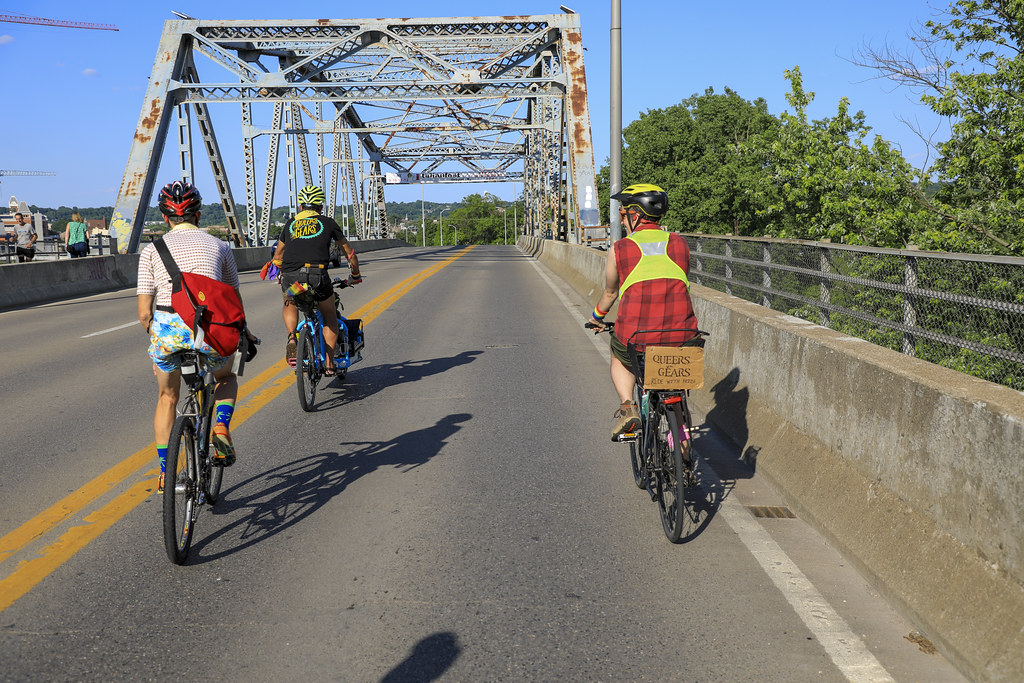
photo by Caitlin Sparks
“Queerness and access to transportation are things that make the world more inclusive and it doesn’t cost much to ride a bike,” she said. “It’s so much greener than other forms of transportation and the community building through riding with other people is important.”
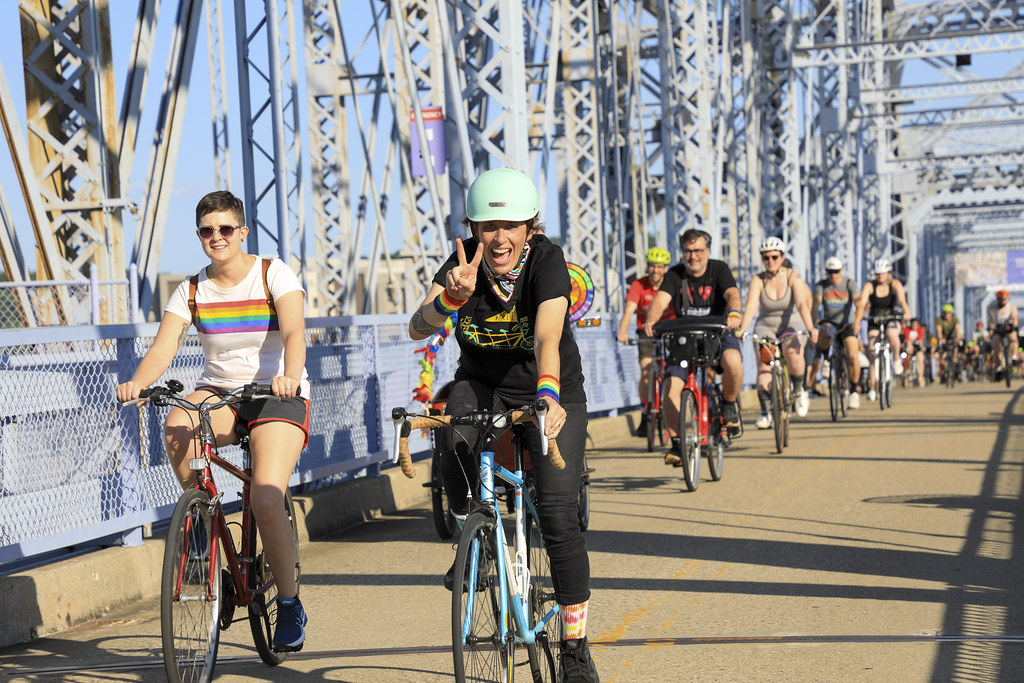
Covington’s annual Queers with Gears ride began in June 2021 as a cycling and Pride celebration with a goal of creating a safe and inclusive experience for all levels of cyclists.
“We go at a parade pace and go down streets that are visible and easy to ride,” Keister said. “We try to ride by queer destinations, whether they’re bars or community centers or places with rainbow crosswalks, and we try to incorporate queer history in the ride as well.”
CINCINNATI: Queer Cincy Cycling
Queers with Gears Covington has grown each year and now partners with Cincinnati’s Queer Cincy Cycling for their annual Pride Ride. Wives Jess Heller and April Pitman founded Queer Cincy Cycling in August of 2024.
Heller and Pitman set out to create a group that they said had been craving and describe it as an “LGBTQ+ cycling community that also addresses the gap in pace options.” While many non-queer-centered cycling groups ride at either 8 mph or 18 mph, their rides maintain a more inclusive middle ground of under 14 mph.
The group meets once a month and rotates meeting spots between Friendship Park in Cincinnati and 50 West Brewing Company in Newton, Ohio. They ride in both Cincinnati and Northern Kentucky.

Keister and Heller said that the physical activity that their cycling groups provide serves as both a coping outlet and a foundation for community. They added that outdoor recreation creates visibility beyond traditional alcohol-centered LGBTQ+ spaces, such as bars and clubs, and helps foster connections in places where people may not typically interact with queer communities.
“Cycling may not traditionally intersect with LGBTQ+ identities, but that’s exactly the space we aim to expand,” Heller said. “There’s a growing conversation around ‘third spaces’—places outside of home and work where people can come together. LGBTQ+ individuals need more of these spaces that nurture and support our active, healthy lifestyles.”
LOUISVILLE: Queers with Gears
Another cycling group, Queers with Gears in Louisville, which is not affiliated with Covington’s Queers with Gears, grounds their community building through social rides and service work to marginalized populations and local LGBTQ+ nonprofits.
After organizing a Pride-themed ride for a general cycling group, Jaime Meyers said that participants told them it was their first time riding in a social group, which inspired Meyers to create Louisville’s Queers with Gears.
“We saw other cities successfully creating intentionally-closed cycling spaces for marginalized groups—women, people of color, people with disabilities, and we wanted to create something similar for our city,” they said. “We just celebrated our two-year anniversary in July!”
The Louisville group meets frequently. The schedule varies based on the personal schedules of their multiple volunteer lead riders. Meyers explained that lead riders have specialized expertise in different forms of cycling, including road, urban and mountain biking. The group also plans overnight trips with group leaders who have expertise in kayaking and camping.

photo provided by Queers with Gears Louisville
“For something like this to remain sustainable, I try not to exhaust anyone by always doing the same thing or overcommitting anyone,” Meyers said. “All our rides are posted on a monthly schedule to our Instagram and then we do a reminder post the week of. Bigger trips or anything overnight we give around a 30-day heads up for people to plan around work or other things.”
Queers with Gears Louisville also tries to involve other communities to educate, collaborate, and provide services. The group bikes in the Kentuckiana Pride Parade every year and their recent anniversary ride raised $1,000 for Louisville Youth Group, a Louisville-based organization that caters to LGBTQ+ youth. Along with fundraising, they partner twice a month with Old Louisville Brewery and Louisville Outreach for the Unsheltered to distribute meals and harm-reduction supplies, including Narcan, to people experiencing homelessness who are hard to reach by car.
While all three cycling groups across Kentucky and Ohio have different approaches to their social rides, one thing is certain—as queer people and cyclists, claiming space, creating community and inclusion are of the utmost importance to them. Their missions emphasize empowering queer people in their bodies and with each other.
“The freeing feeling of taking back space on the street and existing in a way that might upset some cars, that is noticed by all cars, is synonymous with the feeling of being open with who you are and how you experience life in this world as someone who is queer,” Myers said. “We may upset some, but our existence is undeniable to all and we have every right to feel just as comfortable in our bodies as anyone else.”