‘Til Our Lungs Give Out: Trans Appalachian Love


This story is part of Queer Kentucky’s digital issue surrounding the trans youth experience in the Bluegrass state, featuring personal essays to educational information. Read the full issue here.
Past queer generations sought love through the veils of lavender marriages and speak-easies, Friends of Dorothy and color-coded handkerchiefs. Stigma was rampant, and trust was often dangerous – think of Oscar Wilde’s betrayal that landed him in jail. Love was complicated. Love was terrifying. Love often got you killed, especially if you identified within the trans-umbrella.
I started my late teenage years as a non-conforming girl, having grown up as a tomboy. I didn’t mind being perceived in any particular way, and I wore what I felt like wearing. If I had known more about pronouns, I likely would have been open to being called anything. In a small town in rural Appalachia, I didn’t learn about gender identity until I was about to graduate high school, and even then, I only somewhat knew about binary trans identities. I didn’t identify as trans until college, though the term only somewhat fit. I didn’t entirely feel like a girl, sure. I just didn’t want to further understand why the term ‘man’ didn’t seem to fit me, either.
I never knew my direction. I didn’t even really know myself or how to start. It took a dorky Ohio boy to show me how.
I had a relationship for most of my college life, from seventeen to twenty-three, where I tried desperately to be better: more masculine, more attractive, but less outspoken, less independent. I was too much and not enough – all the time. According to the countless hinted remarks, I was less attractive as a feminine girl, but I was less intelligent as a man. I was often accused of being irritable when I was on testosterone, yet I was also told I was way better as Alek. I was fine as my previous self, it was claimed through gritted teeth, but now I was improved.
I knew that I could never become attractive in their eyes, not without giving up on myself. The creeping realization that I wasn’t binary was something that I often shoved away, because it wasn’t possible for a possibly-nonbinary-me and a relationship to coexist.
Or so I thought.
Now, two years later, I have given up on trying labels. I am just me. I am just Alek.
I realized this because of my current relationship with Sean, a man who transitioned over a decade ago, who went through similar struggles with dating. Too often, people in our community find themselves transitioning while in a relationship, only to discover that partners lose attraction at the same rate that we gain happiness. Too often, our trans friends settle for anything that looks like tolerance. I’ve often heard – and thought – the false notion that maybe mistreatment and cheating are okay, because ‘It’s better than nothing’.
I am discovering that I will no longer settle into an identity that doesn’t quite fit anymore. The joys of a trans-for-trans (t4t) relationship are that we understand each other fearlessly. And, even if we cannot fully place ourselves in the shoes of the other’s identity, we love regardless and accept every aspect. Explaining myself to him doesn’t feel like a coming-out. It feels like coming home.
In spite of previous situations similar to my own, Sean has never settled for a version of himself that doesn’t fit his truth, and he has never entertained someone who would prefer him to be different. I admire him because he has always been Sean, and has felt like a man from day one regardless of outside opinions. I sometimes feel like nothing, and sometimes like anything. What I do know is that I am me – everyone else can take their guesses. We are different in expression, but the same in heart. I tell him the inside details about getting top surgery, and he helps me inject my B-12 in the same way he does his testosterone. I know he’s more careful with me than he is with his own injections, though I often feel this may be a universal trans experience. Let me learn the rocky steps so you don’t have to. The messy injections, the nicked veins – all so I won’t have to experience it.
I used to worry that he might one day lose interest in me. Maybe I will not be masculine enough, or maybe I will not be feminine enough. Every time I express this, he squints in confusion. He’s not overly chatty on most days, but his answer is quizzically firm enough that my worries melt away: “No?”
No waste of flowery language, no novella-length text reassuring me that I’m oh-so-perfect, no love bombs thrown to disarm me. Sometimes it’s simple: sometimes people just love you. Not your body, not your hair, just you. Every frizzed curl, every chipped tooth, every masculine and feminine, and everything in between day.
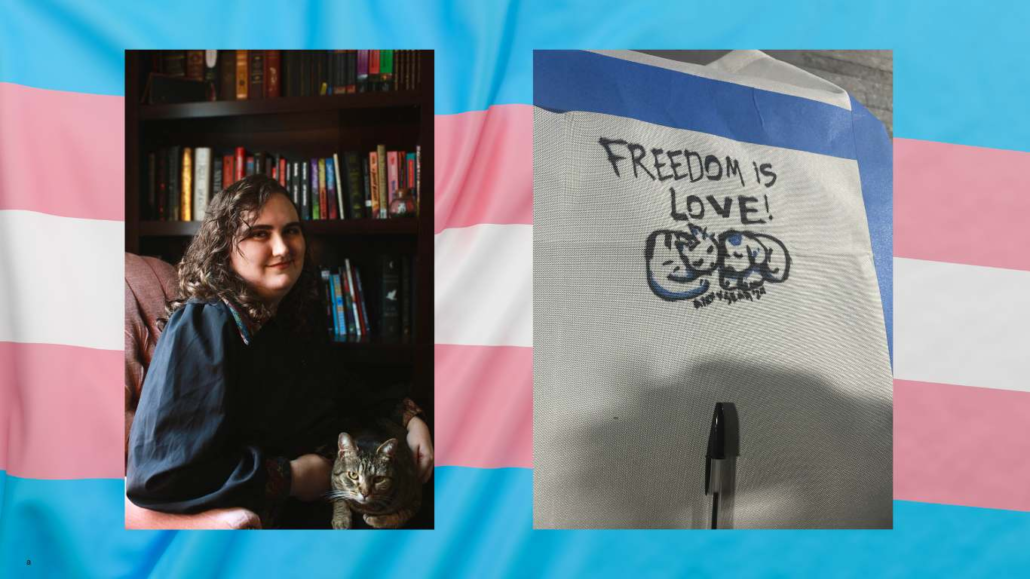
[photo provided by Aleksander Perris, drawn by Sean.]
All my life, I wanted a love that would be celebrated, a relationship where we could be loud like everyone else. I think that in today’s age, trans people need to be more unapologetic than ever before. He and I take life at our own pace and carve out our own rules. I find myself receiving the love that I used to beg for without having to ask at all.
I often think about fate, about love, and soulmates. Princesses in towers, curses lifted, glass coffins opened. Honorable, beautiful nonsense. Too often, we think that this sort of happy ending is not for us. However, trans people do not have to be okay with tolerance that only reaches the surface level of our identity. Cis hetero love, in my experience, often has caveats and compromises, with long histories of attraction tied to sexism. This is not to say that all cis hetero couples are unhappy or shallow, but this is to say that plenty of hetero men have hard boundaries on body hair, makeup, hair color, wardrobe, money status, and more. In the 60s, a woman should be quiet. In the 2020s, a woman should stop being so loud and bossy and go back to tradition. The demands are endless.
T4T love in my experience is more fluid. Maybe someone isn’t typically your type but they have the perfect personality, and you could see them becoming something long-term. Oftentimes, the trans community is willing to try if the connection is there. It’s less of an act of ‘making an exception’ and more so the acceptance that maybe love can just be love. The beautiful thing about loving outside of the standard idea of romance is that you can pave your own rules. You don’t have to have the white picket fence unless you dream of it.
The biggest and first difference I ever noticed about T4T relationships is that, after swiping right on Tinder, the first thing Sean and I discussed was ‘What are you looking for?’ Is it children, marriage, or friendship? Is it nothing important or everything? There were no expectations or assumptions, and he still shows me that our relationship can be a canvas for what we want life to be. I don’t exactly dream of a white picket fence, but I often dream of dancing in the kitchen to Tyler Childers, the first song he ever showed me that reminded him of me. There is no ball and chain, but there certainly is freedom.