Transgender Life at the University of Kentucky


This story is part of Queer Kentucky’s digital issue surrounding the trans youth experience in the Bluegrass state, featuring personal essays to educational information. Read the full issue here.
Experiencing life as a transgender person is inherently different from moving through it as a cisgender person. As a nonbinary person, I had to learn how to maneuver many facets of the education system.
Growing up in rural Scott County, K-12 was incredibly difficult for me. For a long time, I experienced a lot of harassment and bullying, which caused me to view myself very negatively. It also framed my view of the world, making me think that everywhere and everyone would treat me with disdain for being myself. It wasn’t only students who treated me that way, but some of my teachers who joined in on the bullying.
When I graduated from high school, I decided to attend the University of Kentucky, near my hometown. I expected it to be so similar to my prior school experience, but it was way different than what I had imagined.
I began my undergraduate degree in media arts Studies at the University of Kentucky in 2020. I barely spoke on my first day, and for the first few years of my experience. When walking to classes, I spent more time staring at the ground instead of looking at people’s faces. I did my best to make myself look small, or even more so, invisible. I rarely participated in class discussions. I took every footstep so carefully, someone watching would likely think I was walking over a decaying rope bridge. Anytime people started laughing, my head would dart toward them, thinking it was directed at me. Truthfully, though, it never was.
As my experience at UK continued, my perspective started to change. My professors were interested in what I was thinking and wanted me to share my ideas with my peers. Instead of being shut down or laughed at when I spoke, I was encouraged to speak more and louder. I slowly became brave enough to use my voice more and more, and I was shocked when I wasn’t being laughed at or harassed later about what I had said. I started feeling like my opinion held value for one of the first times in my life.
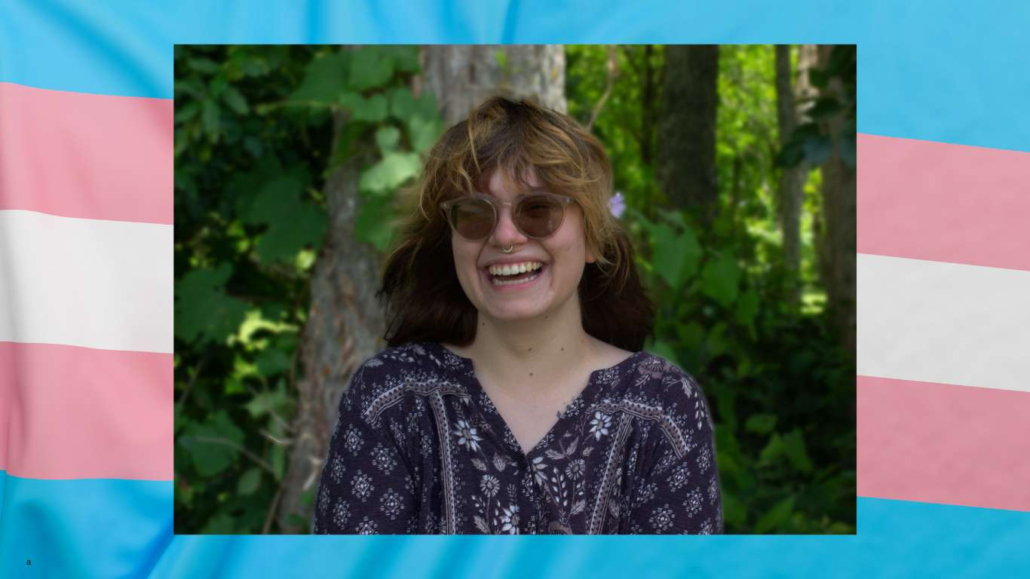
It became increasingly common for professors to state their pronouns and ask everyone else on the introduction day of each course. When I started college, I was terrified for anyone to know I was transgender in any capacity, but as it became more normalized to discuss, I found myself openly saying, “Hi, I’m Jules, and my pronouns are they/them.” I started feeling proud of my identity. Something that changed throughout my experience as a nonbinary person at university was my bravery. I’d always found it easy to stand up for other queer and trans people, but never myself. Because of how supported and safe my professors made me feel, I started correcting my peers when they misgendered me. No one ridiculed me when I did this; instead, they quickly apologized, corrected themselves, and moved on.
Many of my classes discussed gender identity concerning many topics. I learned a lot about how society is tailored, largely using the gender binary to maintain present power structures. I understood then just how valid my unique experience is from societal standards. University was eye-opening, and it showed me a world far more vast than the small, narrow-minded society I had previously experienced.
I was studying media creation, and with that comes conversations about including diversity in media projects, and the ethics of the content being created. For myself, it showed that LGBTQ+ people and POC are being brought to the forefront of the conversation. LGBTQ+ people are often creativity-minded, so through my photography classes I found many queer and trans friends. We built community with one another that way, and helped each other navigate through some of the trials of early adulthood.
Having so many friends who had experienced my struggle, I was inspired to start doing what I could to make a difference. I attended protests whenever possible for the rights of many diverse groups, and for larger, international political movements. I started using my social media accounts almost solely to spread political and social justice awareness. While I wasn’t super involved in on-campus organizations due to social anxiety and other mental health issues I was dealing with throughout college, I found my own ways to generate change. Personally, one of the most important ways to generate this change was showing up for the queer people in my life however I could.
University life can be eye opening and life-changing for transgender people. I didn’t expect myself to build such a supportive community, particularly from school, but I did. I created a place in the world, and others gave me space to do that. The experience can vary from person to person, and it depends on which university is chosen to attend. I attended university in one of the only blue cities in the state, and I slowly felt very comfortable and supported by my environment. It was worth every late night and the stress spent on my assignments. Finding acceptance and community is a big deal for trans people, and has the power to bring something rare and important to the table: hope.