QUEER KENTUCKY | KENTUCKY'S ONLY LGBTQ+ NEWSROOM

Tag Archive for: transgender

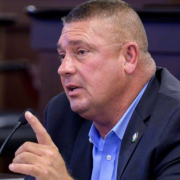
Kentucky Rep. Bill Wesley speaks into a microphone during a legislative meeting at the Kentucky State Capitol in Frankfort.

Kentucky Rep. Bill Wesley files HB 867 requiring transgender people to use birth-sex bathrooms

Transgender and gender nonconforming Kentuckians would be forced to use the bathroom tied to their assigned sex at birth under a new Republican bill.

House Bill 867, filed by Rep. Bill Wesley (R-Ravenna), would apply to all “multi-occupancy private spaces” in public buildings in Kentucky — so, bathrooms and locker rooms in any space owned, leased or operated by state and local governments. 

Anyone wishing to use those facilities would be required to use the one tied to their assigned sex at birth, and the bill only includes male and female sexes. 

HB 867 includes several exceptions for those caring for a child, elderly person or someone with a disability, emergency personnel or instances where their assigned bathroom is out of order. 

At least 10 other Republicans have signed on to co-sponsor the legislation since it was filed Tuesday.

Wesley has vowed to file legislation along these lines for nearly a year after he went viral in right-wing circles for accosting a transgender woman for using a women’s restroom at the state Capitol last March during a trans joy and visibility event. 

That altercation spiraled across one of the final days of Kentucky’s 2025 legislative session, resulting in claims that Sen. Karen Berg — a Louisville Democrat who lost her transgender son to suicide in 2022 — “slapped” him on the House floor after a visibly terse exchange between the two, leading to Berg losing her privileges to be on the House floor. 

Wesley has tried to push for “bathroom bans” before, including getting part of his proposal to limit access to school bathrooms added to Kentucky’s 2023 Senate Bill 150, which was seen as one of the worst pieces of anti-trans legislation that year. 

Lawmakers have until April 1 to pass any legislation that Gov. Andy Beshear may veto. 


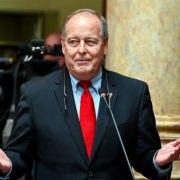
Kentucky Sen. Gex Williams speaks at a podium inside the Kentucky State Capitol in Frankfort while addressing lawmakers and media.

Kentucky Sen. Gex Williams files SB 351 targeting transgender teachers’ licenses

Republican Sen. Gex Williams’ bill would deny or revoke teaching licenses based on outdated ADA definitions tied to gender identity and other disorders.

Transgender teachers would no longer be allowed in Kentucky classrooms under a new Republican proposal.

Senate Bill 351, from Sen. Gex Williams (R-Verona), says teaching licenses could not be issued to or renewed for educators who have been “treated for or diagnosed with any disorder that is excluded from the Americans with Disabilities Act of 1990” based on the criteria used at that time.

ADA excluded a short list of disorders from federal protections for those with disabilities, including a few options of now-outdated language around being transgender or having what is now known as gender dysphoria. 

The short list also includes pedophilia, compulsive gambling, kleptomania, pyromania and substance use disorders tied to illegal drug use. 

Current or would-be educators would need to swear under perjury that they’ve never been treated for or diagnosed with one of the impacted disorders when they apply for or go to renew their teaching license. 

Under SB 351, Kentucky’s teacher certification board would be required to investigate any and all complaints against educators who someone says may be showing “easily identifiable” signs and symptoms of a disorder, including potentially forcing teachers to undergo medical examinations and provide the results to the board in order to keep teaching or lose their license. 

Eric Russ, the executive director of the Kentucky Psychological Association, said the organization strongly opposes the bill. 

“Psychological science shows us that LGBTQ+ youth are harmed by the absence of supportive educators,” a statement from the KPA reads. “This bill would deter teachers from seeking mental health care, require sworn perjury statements about abandoned diagnoses, and remove qualified educators based on identity rather than conduct.” 

SB 351 would require professionals to use decades-old criteria, rather than current medical standards. 

“Psychology, like all sciences, evolves to reflect advances in understanding of neuroscience, epidemiology, medicine, and behavioral health,” KPA’s statement says. “By anchoring this law to the outdated 1987 DSM-III-R, the bill invokes classifications the profession abandoned decades ago for lack of scientific support, including the characterization of homosexuality and gender nonconformity as diagnosable disorders.”

Compelled medical examinations also bring significant ethical concerns and questions from providers and educators alike, along with fears that outting someone for getting mental health treatment will worsen the stigma tied to receiving such care. 

SB 351 was filed Monday — the last day to file new bills in the Kentucky Senate. Kentucky lawmakers have until April 1 to pass bills that Gov. Andy Beshear — a vocal supporter of both the LGBTQ+ community and Kentucky’s public educators — may veto. 

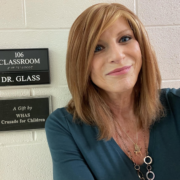
Dr. Bobbie Glass with shoulder-length light brown hair takes a selfie in a school hallway. She is wearing a teal top and layered necklaces. Behind her on a cinderblock wall is a black sign reading “106 Classroom Dr. Glass” with Braille beneath it, and a plaque that says “A Gift by WHAS Crusade for Children.”

Louisville Advocate Dr. Bobbie Glass Joins The Trevor Project’s Sharing Space Mental Health Series

Louisville educator and transgender advocate Dr. Bobbie Glass has been invited to appear on Sharing Space, a national series produced by The Trevor Project that centers conversations on LGBTQ+ mental health and lived experience.

Sharing Space brings LGBTQ+ people with lived experience into facilitated conversations with licensed mental health professionals. Episodes focus on topics including suicide prevention, crisis response, and the impact of conversion therapy

Glass said the series is urgently needed.

“A series like Sharing Space is needed right now because silence is still killing people- quietly, privately, and often without witnesses,” she said. A Queer Kentucky 2024 survey of over 3,6000 LGBTQ Kentuckians, found that 26% of trans Kentuckians felt extremely unsafe in public due to political debate and rhetoric around anti-LGBTQ legislation. That number rises to 40% in for trans Appalachians.  

With anti-transgender legislation at historic levels, the question of how transgender youth are supported has become increasingly important.

“The most important thing to understand is this: supporting trans youth does not require expertise, special language, or perfection. It requires presence, courage, and consistency.

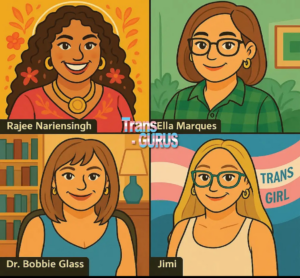
A colorful illustrated graphic divided into four panels featuring cartoon portraits labeled Rajee Narinesingh, Ella Marques, Dr. Bobbie Glass, and Jimi. The words “Trans Gurus” appear in the center. One panel includes a background with the transgender pride flag and the words “Trans Girl.”

One of the simplest and most powerful things people can do is interrupt harm when they hear it,” Glass says. 

“Allyship sometimes looks as simple as saying, “That’s not okay,” and refusing to let cruelty pass as normal.”

At the same time, renewed attention has focused on conversion therapy and the ongoing debate over how, and whether, the practice should be regulated. Dr Glass is a survivor of conversion therapy and uses that language intentionally.

“Conversion therapy doesn’t try to change behavior,” Dr Glass said. “It tries to replace a human being. For many of us, that replacement demand creates a level of despair that is difficult to describe unless you’ve lived inside it.”

She described the harm caused by those practices as ongoing and personal.

“I’m horrified by the number of times I tried to end my life under the weight of being told that my authentic self was completely incompatible with love, faith, and belonging,” she said.

“I am alive today not because conversion therapy worked, but because I survived it,” she said. “Others did not.”

The Trevor Project reported that 13% of LGBTQ youth nationally are exposed to conversion therapy. 

Kentucky currently has no statewide ban on conversion therapy. In 2024, Governor Andy Beshear issued an executive order prohibiting state or federal funds from going to conversion therapy practices for minors. The following year, state legislators passed HB495, which reversed his executive order. 

Glass said Sharing Space differs from many mental health discussions by centering people with lived experience rather than speaking about LGBTQ+ communities from the outside.

Screenshot of Dr. Bobbie Glass speaking in a video for The Trevor Project. She is seated on a couch wearing a navy blue dress, gesturing with one finger raised as she talks. On-screen text reads, “There’s no therapy in telling kids.” The YouTube Shorts interface is visible, showing the account @TheTrevorProject and engagement icons along the right side.

Screenshot of Dr. Bobbie Glass speaking in a video for The Trevor Project. She is seated on a couch wearing a navy blue dress, gesturing with one finger raised as she talks. On-screen text reads, “There’s no therapy in telling kids.” The YouTube Shorts interface is visible, showing the account @TheTrevorProject and engagement icons along the right side.

“Instead of experts speaking about LGBTQ+ people, Sharing Space allows people with lived experience to speak from inside the reality, in the presence of licensed mental health professionals who understand the risks involved,” she said.

“The harm of conversion therapy isn’t theoretical,” Dr Glass said. “It lives in bodies, in fear, and in years stolen from people who were never broken.”

According to data from The Trevor Project’s national youth mental health survey, 45 percent of LGBTQ+ youth seriously considered attempting suicide in the past year. Rates are significantly higher among transgender and nonbinary youth.

Dr Glass also addressed the conditions facing transgender and gender diverse youth in Kentucky.

“Supporting trans youth in Kentucky is not optional, symbolic, or political- it is lifesaving,” she said.

“Trans youth do not need to be ‘fixed,’” Dr Glass said. “They need to be protected, believed, and allowed to exist without fear.”

Dr Glass’s appearance on Sharing Space comes alongside her ongoing work in Kentucky. She was recently named an ambassador with the Mayor’s Office for Women in Louisville, a six-month civic engagement and training program focused on city policy and systems. “Being named an ambassador isn’t symbolic- it’s an invitation into the work of changing systems,” Dr Glass explains. She also serves on the boards of the Fairness Campaign in Louisville and CHNK Behavioral Health/One Quest Health in Covington. She is also a co-host of Trans Gurus on YouTube, a global platform with over 135,000 subscribers that offers affirmation and support to transgender people worldwide.

“At its best, Sharing Space does something simple and radical,” Dr Glass said. “It reminds people that they are not broken, not alone, and not required to disappear in order to be loved.”


People hold a Progress Pride flag during an LGBTQ+ gathering as Kentucky lawmakers consider House Bill 553 affecting gender-affirming care.

Kentucky House Bill 553 bill could strip insurance coverage for gender-affirming care from thousands

Access to gender-affirming health care for LGBTQ+ Kentuckians may be further restricted under a new bill filed Tuesday.

A 2025 law in Kentucky prohibited Medicaid dollars from covering gender-affirming hormone treatments and surgeries. This year’s House Bill 553, filed by Republican Rep. Josh Calloway, seeks to expand those restrictions to most taxpayer-funded health plans and to far more services. 

If passed as written, that would mean those on state and local government employee health plans, those working at public colleges and universities, KCHIP and Medicaid, and more, would no longer be able to have such services covered under their health insurance. 

HB 553 also uses a much more broad definition of what counts as a “gender transition service,” blocking basically every “surgical, medical, mental health, or pharmaceutical” service “performed for the purpose of altering the appearance of an individual’s sex or validating or affirming an individual’s perception of the individual’s sex, if that appearance or perception is inconsistent with the individual’s sex.” 

This includes any drug and any sort of counseling or therapy, the bill says. 

There are specific carveouts for intersex people and those who wish to detransition. 

The bill also would require licensing boards for health care providers to revoke providers’ licenses if found to be in violation of the law, and prohibits resource centers in schools from giving referrals for gender transition services. 

As of Tuesday night, an impact statement examining exactly how many people tied to state-level health plans the bill could impact and any potential savings or extra costs could result from the bill was still being prepared. 

Calloway filed a similar bill last year, but it never got a committee hearing — the first big step in the legislative process for House bills. 

Mia Kopp and Mulanie Flowers, Kentucky transgender beauty queens, representing the state at Miss International Queen USA 2026.

Two Kentucky Transgender Beauty Queens Head to Miss International Queen USA in Atlantic City

Two beauty queens, Mia Kopp and Mulanie Flowers, will be representing Kentucky at the annual Miss International Queen – USA (MIQ-USA). The pageant celebrates transgender women and highlights their glamour, history and pride within their community. 

After initially debuting in Las Vegas, MIQ-USA was described by Vegas 411 Review as “the new crown jewel in Las Vegas shows.” The pageant was then moved to Atlantic City, where it will spotlight the beauty of transgender women from across the United States. Next year, the competition will take place from March 26-27, 2026, in Atlantic City. 

Originally founded in 2004 in Thailand, MQI-USA aims to “create equal[ity] and acceptance in society” and “raise the standard of Transgender girl contest[s] to be accepted by the general public,” according to their website

The festivities include a press conference where the contestants are introduced, a state costume competition, a talent competition, and leadership and personal growth workshops. The final night will consist of swimsuit and evening gown competitions, finally ending in an interview highlighting the intelligence and charisma of the competitors. The final evening will be hosted by transgender icon Mimi Marks and National Director of MIQ-USA Todd Montgomery. 

Midori Monet, the winner of last year’s Miss International Queen pageant, will be in attendance at MIQ-USA. She is the third winner from the United States to win the international title, and she will pass her crown to the next winner of MIQ-USA at the end of the festivities.

The pageant aims to celebrate transgender women, while also providing positive support and awareness. In a time where the transgender community is consistently attacked by the media, the competition is a safe haven for transgender women to represent themselves. 

Mia Kopp highlights mental health advocacy on a national level

Mia Kopp, Kentucky transgender beauty queen and mental health advocate, competing in Miss International Queen USA 2026.

Photo provided by Project Publicity

Mia Kopp is one of the competitors from Kentucky. She was born in France, moved to Mexico and now resides in Kentucky, working as a transportation manager at UPS. She chose to participate in the pageant because of its platform for hope and empowerment in the transgender community. 

“It’s a platform of hope and giving everybody in our community a voice. A voice of empowerment, a voice of all these hopes and dreams that people sometimes give up on and Miss International Queen USA is that,” Kopp told Queer Kentucky. “It’s that hope. It’s that equity. It’s that promotion of human rights and that was my inspiration.”

Kopp is also an avid advocate for mental health. She had struggled with depression and anxiety and she wants others in the transgender community to know that they “are not alone.” By providing more resources and reassurance, she states that when humans heal themselves, they also heal their souls. Mental health resources are important for prioritizing the safety of transgender people and she hopes to use her platform to raise more awareness.

“When you know your value, when you know your power, that makes you see that success in your life. That gives you the meaning and purpose of yourself around people, or around your friends and your family,” said Kopp. “That’s how I want to show myself to people and it’s how I love myself as well.”

She also volunteers with the Louisville Pride Foundation and hosts weekly trans haven discussions. These discussions play a vital role in her mental health advocacy work, as she states that these spaces are integral to the protection of the community of transgender people.

“I just volunteer because that’s the way that I can commit my brain and my body and my soul to things that made me leave that dark space that I was living,” said Kopp. 

Poetry from Mulanie Flowers takes center stage 

Mulanie Flowers, Kentucky transgender poet and beauty queen, representing the state at Miss International Queen USA 2026.

Photo provided by Project Publicity

Poet Mulanie Flowers will also be representing Kentucky at MIQ-USA. Originally from Liberia, Flowers immigrated to the US at the age of 2. She participated in a variety of extracurricular activities in school, such as cheerleading, chess and debate. Now, she is a poet and competing for the title of Miss International Queen.

After an experience with the ballroom culture of Chicago, Flowers began performing drag and was introduced to the MIQ pageant. She was introduced to the competition through a mutual friend and allowed herself to feel more confident within he pageant. 

“It’s a pageant for trans women, like us. It just basically puts us [trans women] out there, gets our stories out there,” said Flowers. “It just shows us to the world in a different light. I was like ‘that’s such an amazing opportunity.’”

Flowers has also been writing poetry since the age of 10. As she has grown up in the church, she has allowed herself to express her feelings in her free time. As she has explored other art forms, she continued to be drawn back to the power of words within poetry. If she were to win the title of Miss International Queen USA, she hopes to use her platform to create a book of poetry highlighting transgender voices. 

Her poem, “Her,” is about seeing herself transition and was the first poem she ever performed. She states that the piece is about “saying goodbye to the boy and saying hello to the woman I knew I was going to be.”

The competition allowed her to build her confidence and to showcase herself in new ways, not only for her, but her other sisters in the competition, including Mia Kopp.

“I feel like a lot of times trans people are misunderstood because people don’t understand them, they feel like everything should be under this one category, in this one umbrella, but there’s so so many different ways to be the person that you are,” said Flowers. “So I just hope that everybody just from this entire experience, this entire journey, watching me, they just see that ‘she’s just a girl’ and ‘I’m just a girl’ and that we’re all just normal people trying to co-exist.”

Mia Kopp and Mulanie Flowers will both be representing Kentucky in Atlantic City, New Jersey, from March 26-27, 2026, at The Concert Venue at Harrah’s.

Click here for tickets and more information about the pageant. 

Pin It on Pinterest