This story includes references to sexual violence which may be distressing to some readers. If you or someone you know needs support, resources can be found here.
This story is in partnership with Uncloseted Media, an LGBTQ focused investigative news outlet. Subscribe to their latest here.
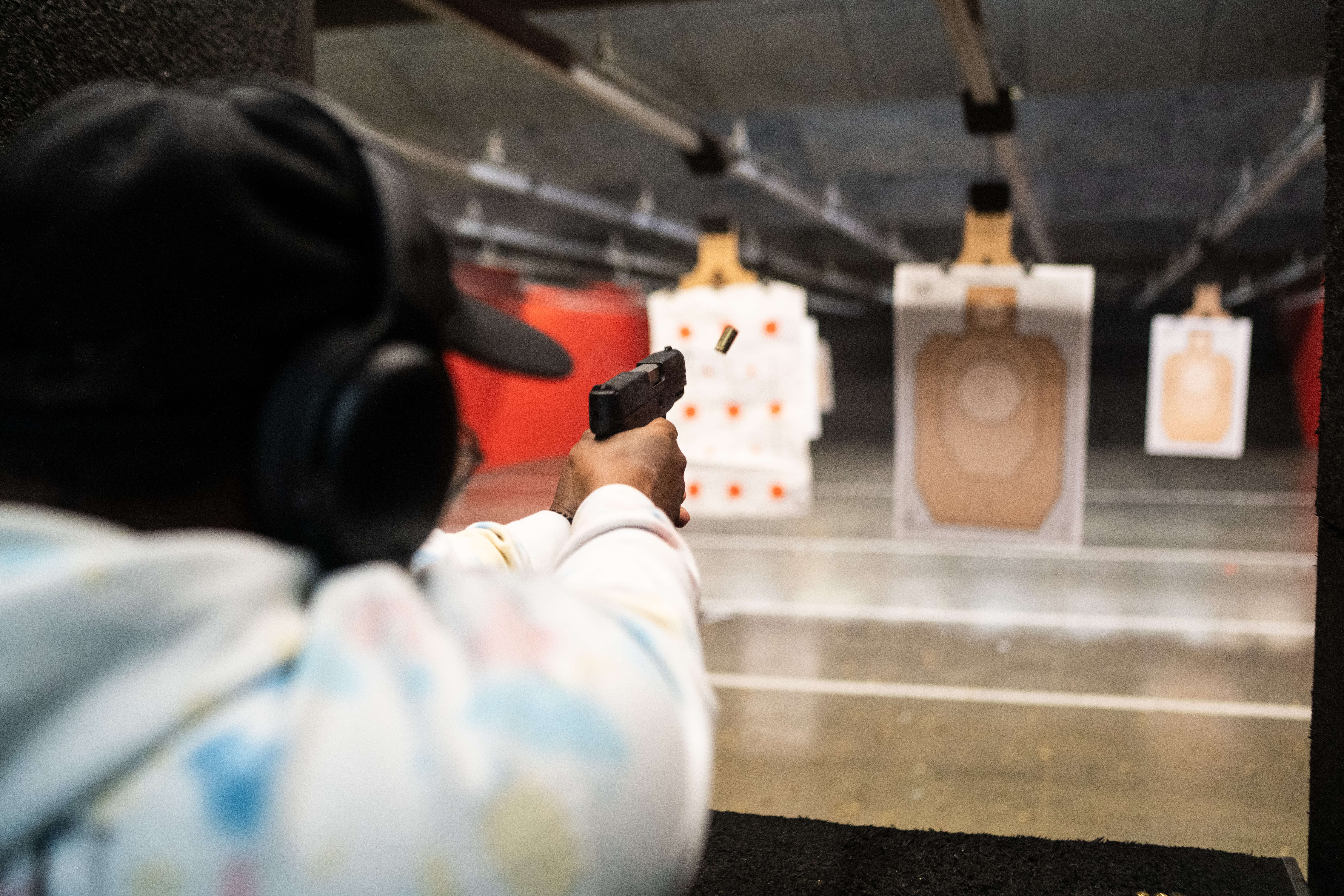
Every month, Xian Brooks heads to Range USA in Louisville to practice his shot.
“We can talk about ‘community’ and ‘showing up for each other’ all day, but when it matters most, you only have yourself, and you need to be able to count on that [to defend yourself],” Brooks, a 42-year-old who was born and raised in Kentucky, told Queer Kentucky and Uncloseted Media.
Misinformation and Political Rhetoric Paint Trans People as Threats
Like many other trans people of color in the red and rural state of Kentucky, Brooks recognizes that he’s more likely to be a target because of his gender identity and the color of his skin.
That’s in part because of the history the state has when it comes to gun violence. In 2023, for example, Zachee Imanitwitaho—known to her friends as Zachee—was shot and killed outside of the JBS Foods plant where she worked in Louisville. The gunman and Zachee’s coworker, Edilberto Lores-Reyes, confessed to killing her.
While Reyes’ official motive remains unknown, Zachee’s killing represents an alarming trend of a sharp increase in anti-trans violence.
In particular, homicides of trans people in the U.S. nearly doubled between 2017 and 2023 with a total of 263 victims, according to Everytown for Gun Safety’s Transgender Homicide Tracker.
In those six years, 73% of the victims were killed with a gun.

Xian Brooks, a Black transgender man from Louisville, Kentucky, advocates for firearm safety and self-defense education in the trans community. Photo by Natosha Via for Queer Kentucky and Uncloseted Media.
Despite these numbers, the rhetoric and policies of the federal government paint trans people as perpetrators of gun violence. Within hours of the killing of far-right Trump ally and anti-LGBTQ activist Charlie Kirk, rumors circulated that a transgender person was responsible. In the aftermath, conservatives, including South Carolina Rep. Nancy Mace, called for the institutionalization of trans people.
And after the mass shooting in Minneapolis in August that killed two children, it was reported that the Justice Department was discussing stripping gun rights away from trans people. However, the National Rifle Association pushed back, saying they will not “support any policy proposals that implement sweeping gun bans that arbitrarily strip law-abiding citizens of their Second Amendment rights.”
This swath of misinformation has put trans people on edge as Americans have been manipulated to view them as a threat to their safety. It’s causing many trans people in Kentucky to arm up or find other ways to defend themselves.
Steve Drayton, a founding member of Pink Pistols of the Bluegrass, a Lexington, Kentucky chapter of the national LGBTQ gun rights group, says he has seen an increase in trans members in the months since Kirk was killed.
“It brought the focus back onto the transgender community, and not rightfully so,” he told Queer Kentucky and Uncloseted Media. “If only we put this kind of focus on every other type of murder. They’re taking a group of individuals and painting them as awful people, which they’re not. They’re educated, they’re teachers, they’re firefighters, they’re human beings. They’re wives, they’re husbands.”
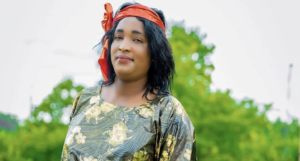
Zachee Imanitwitaho, a transgender woman from Louisville, Kentucky, was killed outside her workplace in 2023. Her death sparked renewed conversations about anti-trans violence in the state. Photo: Facebook
While the false narrative around trans people as disproportionately likely to commit gun violence was already simmering in America, Kirk’s murder took it to a boil. Trump-affiliated conservative groups like The Oversight Project, a venture incubated by the Heritage Foundation, have urged the Federal Bureau of Investigation to create a new category of terrorism called “Transgender Ideology-Inspired Violent Extremism.” And a Trump executive order from September designated Antifa as a domestic terrorist group.
In the order, Trump references the gender identity of trans terrorists but never of cisgender terrorists, describing “a transgender Antifa terrorist,” “a deranged transgender individual” and “a transgender individual whose manifesto included plans to ‘kill Donald Trump.’”
“I’ve gotten a lot more tense,” says Brooks. “I’m more distrustful, and my head is on a swivel more. I always know where the exits are when I go somewhere.”
Brooks says he started carrying his Taurus G2C instead of keeping it at his home in 2018 after two Black people were gunned down and killed because of their race at a Kroger in suburban Louisville.
“Miss Vicki was my mom’s neighbor,” says Brooks, referring to one of the victims. “During [the altercation], there was a person in the parking lot that had a firearm that tried to neutralize the threat. If I had taken my mom to the grocery store that day, my firearm would have been locked up and not with me.”
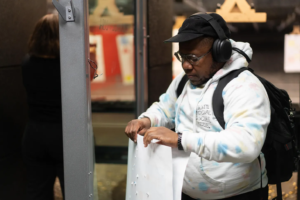
Xian Brooks, a Black transgender man from Louisville, Kentucky, practices shooting at Range USA. Photo by Natosha Via for Queer Kentucky and Uncloseted Media.
Trans Kentuckians Embrace Gun Safety and Self-Defense Education
Brooks grew up in Louisville’s West End in the Shawnee neighborhood, which experiences a disproportionate amount of violence. According to 2023 research by the Whitney Strong Organization and the University of Louisville, homicide rates are more than five times higher than in the rest of Louisville and 10 times higher than the U.S. average. His family rejected the idea of owning and using firearms because of the amount of violence they endured.
“A lot of us were taught to fear guns because a lot of people’s family members were dying by guns,” he told Queer Kentucky and Uncloseted Media. “It was taught that guns were not toys. We couldn’t have water guns, pop guns or even [play] finger guns.”
But as a Black trans man in today’s political climate, Brooks made the decision to start carrying.
While he says his race causes him to fear for his safety the most, his fears of violence due to his trans identity have been increasing since the 2024 presidential election.
“Nothing is hypothetical anymore,” he says. “I don’t think anybody should be too comfortable.”

Photo by Natosha Via for Queer Kentucky and Uncloseted Media.
That’s part of the reason Brooks is now advocating for gun safety and education for trans people and people of color. While Brooks isn’t a licensed educator, he feels he has no choice but to help and wishes politicians weren’t fueling a climate that is putting his community in danger. “I’m down to take any Black or trans person to the gun range on me. Let’s go. You can meet my firearm and talk about them. We can talk about gun safety and teach you what to expect.”
Sarah Moore, senior manager of news and research at GLAAD and lead for the group’s ALERT Desk, which tracks anti-LGBTQ extremism, says that more than half of reports to the desk from June 2024 to June 2025 involved anti-trans incidents.
“It’s coming out in both violent and nonviolent actions,” Moore told Uncloseted Media and Queer Kentucky. “Whether that be protests, online harassment or actual acts of violence against the community, as well as the legislation that we’re seeing that’s attempting to govern trans people’s bodies and lives.”
According to the Trans Legislation Tracker, there have been 286 anti-trans laws passed in the U.S. since 2022, with 122 of them passing in 2025. In Kentucky alone, there have been five laws passed this year on top of the infamous Senate Bill 150 from 2023, which bans gender-affirming care for minors, implements anti-LGBTQ censorship in Kentucky schools and prohibits trans students from using bathrooms and facilities that match their gender identity.
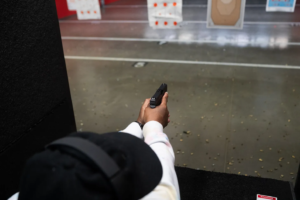
Xian Brooks practices target shooting at Range USA in Louisville, Kentucky. Photo by Natosha Via for Queer Kentucky and Uncloseted Media.
Moore says there is “a very direct correlation to these acts of [anti-trans] violence” and the political rhetoric and policies of the U.S. government.
She said that earlier this year in Seattle, a trans woman was attacked by a group of men while walking down the street. While they were assaulting her, they were yelling slurs and shouting “Semper Fi,” the official motto of the United States Marine Corps. The woman asked them why they were attacking her and explained to them that she was a military veteran. “Trump kicked people like you out of the military,” the men responded.
“We’re seeing examples like that where people will actually cite directly these acts of federal or state-level legislation as part of their justification for acts of violence against the community,” says Moore.
Living on Guard: Trans Kentuckians Respond to Fear with Preparedness
When Trump took office last year, Alex, a 32-year-old trans man in Louisville, Kentucky, who requested anonymity because of safety concerns, says he purchased a second gun because he saw his community becoming the “scapegoat to all of America’s problems.”
“Now, I have taken a self-defense course, conceal carry my firearm, keep those kitty ear knuckle things on my keychain, and have a knife,” he told Queer Kentucky and Uncloseted Media. “I always know at least two or three ways to exit any situation I am in.”
Unlike Brooks, Alex chooses to carry in situations that he deems are more dangerous, like when he travels rural Kentucky with his trans wife.
“Getting sideways glances from people [in a small town Walmart] who can see that I’m somewhere on the queer spectrum—I carry in case they were to follow me to my car and/or pick a fight,” he says. “Additionally, if they don’t clock me, but were to clock my partner and if someone decided to start trouble there, that would not be tolerated.”
The Trump administration’s portrayal that Alex and other trans people in Kentucky are more likely to commit acts of violence is simply false. According to the Gun Violence Archive, there were 5,748 mass shooting incidents in the U.S. between Jan. 1, 2013 and Sept. 15, 2025. Of those, just 0.1% of them—or five in total—involved a trans shooter.
According to a 2021 study by the Williams Institute at the UCLA School of Law, transgender people are more than four times as likely as cisgender people to experience violent victimization, including rape, sexual assault and aggravated or simple assault.
Alex was raped when he was 26 and says the trauma of the situation compels him to prepare for future victimization. “We are a means to an end,” he says. “It’s very disheartening and I work every day to not internalize their ideas about me. We are not dangerous, we are not wasted space, we just want to exist and be safe.”
Julie, a 33-year-old Louisville transgender woman who requested to use only her first name for safety reasons, agrees. Since 2021, she has carried a concealed weapon. She says fear of transgender people is nothing new.
“They’ve been scared of us the whole time and also, people are scared of guns,” she says. “So if you take the boogeyman, which is trans people right now, and then you say they have guns and they’re shooting at Christian people. You know what I mean? That’s what it is.”
Julie says transgender people are peaceful and wishes the politicians would leave them alone. She says that if a transgender person, or anyone, is buying a gun out of emotional fear and feels afraid to leave the house, they should check in with themselves or reconsider the purchase.

Photo by Natosha Via for Queer Kentucky and Uncloseted Media.
“The last option is to point a gun at somebody. It’s the sixth, seventh, eighth, ninth option. Before you draw your gun, you can always reason with somebody, and you can always reason with them after you draw your gun,” she says. “You can reason with them while you’re pointing, but you cannot reason with somebody after you shoot them. And that is very important to think about.”