
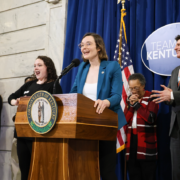
The Power of Trans Visibility: Councilwoman Emma Curtis
On the evening of November 5, 2024, as polling sites closed and results began trickling in for local Kentucky races, Emma Curtis, a then 28-year-old Lexington resident, anxiously awaited news of her bid for the Lexington-Fayette Urban County Council, District 4 seat. Curtis, one of over a dozen LGBTQ+ candidates on the ballot in different races that year, received a text message from her best friend that read, “Congratulations councilwoman,” moments before her campaign team could confirm the results.
“She beat us to it by about a minute,” said Curtis about the 60-seconds between the message arriving and confirming the results with her team in disbelief.
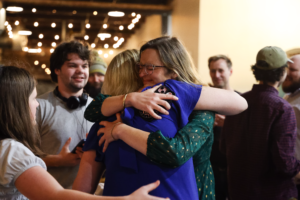
Election night, Emma Curtis hugs State Representative Anne Donworth after finding out the results. Photo Credit: Karrie Bickett
After months of campaigning, on the evening of Election Day, Curtis became the first transgender person to be elected to a city council seat in Kentucky. The historical moment also made her the second transgender person to hold public office in the state. The first was Rebecca Blankenship, who was elected to the Berea Independent School District Board in November 2022.
As a trans advocate, Curtis has made significant strides in her first 67 days in office. Initially recognized locally for her work in the LGBTQ+ community, she now sees her role as much broader. “I am humanizing trans people,” Curtis states, reflecting on her impact. She believes her presence in office is normalizing trans leadership, as community members increasingly focus on local issues like potholes and clearer roads, seeking solutions from capable leaders regardless of their sexual or gender identity. Curtis calls it getting the job done and “a quiet form of activism.”
While fulfilling the duties her constituents elected her to do, she doesn’t forget what made District 4 feel like home. “I felt safe to be who I am,” Curtis said. Remembering that sentiment, she believes trans elected officials can do both; serve their constituents and protect LGBTQ+ rights.
“I will fight to make sure that Lexington continues to be a place where we welcome diversity as an asset,” Curtis said. Recently, she listened to her community’s request to keep the principles under diversity, equity and inclusion initiatives in place and was able to keep the diversity officer role in Fayette County. Despite the new Trump administration revoking DEI efforts nationwide.
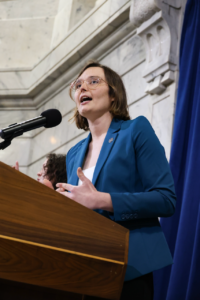
Councilwoman Curtis addresses a crowd at the 2025 Fairness Rally. Photo credit: Kira Meador
Curtis’s election reflects a growing trend of LGBTQ+ representation in local government, something that once inspired her. On November 7, 2017 Curtis watched Senator Danica Roem, a transgender elected official, win her election in Virginia. The televised moment empowered Curtis to begin her transition.
“I had no excuse,” said Curtis about finding hope from Senator Roems win, at the same time the first Trump administration was underway.
Just like Senator Roem served as a source of inspiration for Curtis, she hopes her win will do the same for others. “I think that my experience is proof of the value in visibility,” Curtis said, hoping other trans youth will feel compelled to pursue elected office.
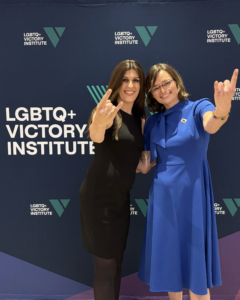
Senator Danica Roem and Councilwoman Emma Curtis at the LGBTQ+ Victory Institute. Photo credit: Victory Institute
“Right now trans Kentuckians, Queer Kentuckians, are not in the rooms where decisions are being made about our lives and our bodies,” acknowledged Curtis, about the current state of Kentucky and anti-trans bills on the agenda.
Despite the fear of these bills moving forward, Curtis still wants Queer youth to know, “if we continue to show up and do the work, we are eventually going to win.” In an Instagram post shared earlier this year on Curtis’s account, she looked back at a time she too felt unwelcomed in the Senate. The image from 2023 shows Curtis watching from the Gallery of the Kentucky State Capitol, as the Senate passed the Senate Bill 150, targeting LGBTQ+ youth, specifically trans youth.
Curtis recalls feeling “powerless” in that moment. The same post includes another image; Curtis this year entering the Senate Chambers with a smile on her face as a councilwoman. Part of the caption reading, “Keep showing up. Keep doing the work. Especially when it feels impossible.”
As Curtis becomes a household name for Kentuckians, many knowing her for the first time in her councilwoman role, she still describes herself as, “a big ole dork, who loves punk rock and loves Kentucky, and wants to leave this place better than I found it.”