QUEER KENTUCKY | KENTUCKY'S ONLY LGBTQ+ NEWSROOM

Tag Archive for: history

From Archive To Action: The queer, sex-positive magazine bridging print media, history, and activism

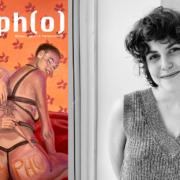
Avery Plummer was finishing her Master’s degree in Art History at Ohio University, considering her thesis, and the COVID-19 pandemic obliterated all opportunities for interpersonal community. In the spell of isolation, she was figuring out her own identity as a queer woman in an increasingly terrifying landscape to be a member of the LGBTQ+ community. And then she found On Our Backs magazine. 

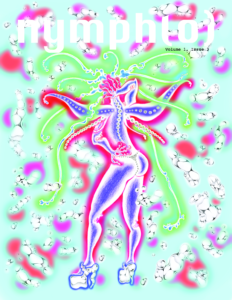
On Our Backs is a vintage lesbian porn magazine, starkly contrasted with its smutty contemporaries (like Playboy) that centered on women, sexual health, education, and advocacy. She channeled this inspiration and created the first issue of nymph(o) magazine to serve as her masters thesis, and still continues the project today. nymph(o) is a modern, sex positive print-only publication that centers queer experience, joy, sexuality, and a masterfully vast breadth of diverse voices on glossy paper in a visually breathtaking delivery system. 

Nothing is off limits in nymph(o). Photos, interviews, poetry, and comics find themselves snugly nestled within its pages. Life is given to the voices of people across gender identities, sexual spectrums, ability levels, ages, and experiences. This is a matter of ethics and principle for Plummer, who conducts herself with this posture in all aspects of her life, but especially in this area. 

When asked about how she navigates the sometimes-problematic attitudes and ideas of our queer forebears, she waxes about honoring our collective past and looking to these blueprints for context and inspiration while building the world we desire to live within. 

Cover Art by Maddy McFadden

“Constantly looking at things through a critical lens, we can’t accept everything as fact. I had to do this specifically with On Our Backs, it was very white. It was not as trans as something you might see today …There can be a gentleness in that critique, but not accepting it as fact,” she says. 

This is a hard line, and clearly a well-protected boundary for Plummer. It’s of critical importance for her to include as many stories as possible in nymph(o), and to do so with veneration. Utilizing so many elements in this magazine not only makes it a significantly more fun read, it serves the purpose of capturing the work of its subjects exactly as the artists intend their words to be shared; however a contributor wants to tell their story is how it is told within her pages. 

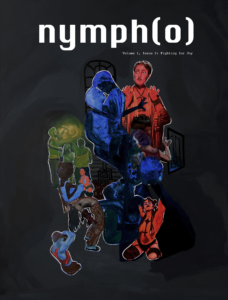
Each issue begins with a loose theme. Concepts like “fighting for joy” or “queer spaces” become the backbone of a deeply collaborative process. She opens submissions for contributions, but will also seek out specific people if there is a topic she knows she has to cover. This duality of reliance on community, while opening the scope, results in multiplicity of content that leaves readers with a satisfyingly juicy experience. 

Between her acting as curator, her partner, Maddy, serving as creative director, and a network of artists, there is “room to devolve,” as she says. This is a piece of art, showcasing the miraculous ways queer people can work together, challenge each other, and craft something cohesive and celebratory. 

While this project may have started as her thesis, it has evolved into an antithesis of the way media is consumed in the modern timeline. In times where endless scrolling is seen as the work, and reposting is tantamount with organizing, nymph(o) is a defiant, stunning piece of revolutionary art that begs us to slow down and immerse ourselves; to linger awhile, languish in textures, and move our eyes across its substantial pages. 

She says, “Context gets left out of many conversations [on social media],” and print media is a way to create a larger body of work that exists only within the spaces it’s meant to belong. The Internet has its virtues of accessibility, which has certainly activated many members of the community, and saved the lives of queer people all over the world. But print media can be something by communities, for communities, away from normative gazes. Creating and preserving spaces for our eyes only bears importance, and can serve as a pivotal organizing space. 

Cover Art by Denver Bastion

“That’s how you move in stealth, that’s how you get these large groups of people to know about things, but not the groups you’re targeting. It’s free from the constraints of a social media platform that is run by the oppressor. There’s a lot of power in it. Where the struggle happens and it falls flat is the ability to access the information,” she says. Plummer laments the lack of grassroots gatherings in the era of social media, and how organizers prompt us to check their social media to know when things are happening, but the exposed nature of that can be a pitfall. Print media is powerful, because it’s made (often by hand) by us, for us, and only has to be seen and loved by the people whose power it is meant to uplift.

Yet the main motivation for nymph(o) being a physical piece of media seems to be rooted in Plummer’s abiding love for archival work. We met to chat in the Ohio Lesbian Archives, a treasure trove of books, magazines, and ephemera meticulously assembled to document the movements of queer people in Ohio. She volunteers at the OLA, and it’s abundantly clear that ensuring the preservation of our history is the key to unlocking a future of liberation. 

The Ohio Lesbian Archive was the womb that birthed nymph(o), and feels very much like a hallowed and sacred ground from which to birth the next queer freedom movement. Its original home was above the iconic Crazy Ladies Bookstore, and has independently housed thousands of pieces of history for over thirty years. 

When I asked Plummer about how archives are activist spaces, she brings up what she calls “The precarious imprecarity” of LGBTQ+ communities. She says, “Archiving is activism because archivism is proof. We have been and always will be here, it’s literal proof of that. When we’re seeing increasing efforts to erase that history and evidence, these grassroots archives become so important. They can’t erase that. Keeping pieces of proof outside of a higher institution. We’re not connected to a university that can cut their DEI funding. We’re keeping this open to the community.” 

Art by Mallory Stowe

The OLA is home to “Jill’s Journals”, which are quite simply the personal journals of a lesbian named Jill. They’re only available to be viewed in the archive, and they’re a real treat. Plummer loves these journals, saying “[we have been] amazing, whimsical creatures throughout history,” and capturing these seemingly mundane moments are powerful ways to remain connected to the humanness, whimsy, aesthetics, and humor of our people. 

When we look upon the world-shattering efforts of Act Up and are inspired by culture-shifting work done in the past, it can be easy to forget that queer people are hilarious, queer people made grocery lists, queer people ran errands. A reminder that there has always been a resilience resting within the daily movements of life is how revolutions are carried out. Archives preserve that, and do so in a physical space where community happens. Collective knowledge and skills are shared, strengthening the solidarity between us all in a way human beings can only do when sharing the air of a room together.  

nymph(o) magazine’s next issue is in the works, and the Ohio Lesbian Archives has open visiting hours biweekly on Wednesday from 6:30-8:30 & Sunday from 11:30-1:30.

The Downstairs Club: A History of the Segregated Queer Haven in Kenton County

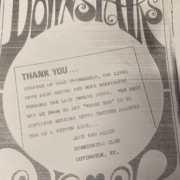
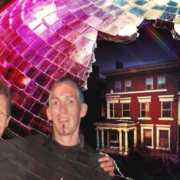
Along the winding stretch of Madison Pike—known locally as the 3-L Highway, just outside of Covington—where gas stations, roadside diners, and farm stands dotted the landscape, one unassuming building held a secret. At first glance, 456 Madison Pike looked like little more than a modest bar tucked into the hillside, its roof barely visible from the parking lot. But for those in the know, this was The Downstairs Club—one of the most infamous and cherished queer gathering places in the region from the late 1950s through the 1970s.

Hidden in the rolling hills of Kenton County, its remote location offered a paradoxical mix of isolation and protection. Beneath the cover of darkness, LGBTQ patrons from Kentucky and Ohio found more than a bar; they found a sanctuary. Here, in this smoky underground haven, affection could unfold freely, forging deeper connections and strengthening a community that so often had to exist in secrecy. Unlike the fleeting, often dangerous encounters in surveilled parks or shadowed street corners, The Downstairs Club offered something rare—embraces without fear, conversation without pretense, and the simple yet radical act of being seen.

Longtime patron Scott Parker, who threw a reunion for former patrons The Downstairs Club at Below Zero in 2016, recalled that the bar welcomed icons like Little Richard and Jimi Hendrix, describing it as “known from coast to coast for its uniqueness and the very special place that it was.” He was interviewed for a story about the reunion put out by the Cincinnati Chamber of Commerce Newsletter that year, “This was in the 1960s and early ’70s when, in more liberal parts of the country like Los Angeles, dancing was not allowed in gay bars and nightclubs,” he said. “Nowhere in the city of Los Angeles was dancing allowed. Now you can understand how unique The Downstairs Club was during this period. It was truly ‘one of a kind’ and ahead of the times.”

The club had first opened under the name The Jochebo, a moniker derived from the first three letters of the names of its founders—the Speakes family. John T. “Jack” Speakes, a former U.S. Army corporal, and his wife, Helen, had already operated another queer-friendly bar, The Riviera (not to be confused with a different bar of the same name that opened in the 1970s). Their son, Bobby Combs, became a fixture in the local queer scene, earning the nickname, “Darling of The Downstairs Club,” for his quick wit and charm. He later ran That Darn Pussy Cat, a Newport go-go bar that law enforcement targeted for allegedly existing “specifically and entirely to encourage, incite, create, permit, and entice persons who practice homosexuality.”

For years, it was an open secret that the Speakes family had ties to what remained of organized crime in the region—connections that, for a time, seemed to shield them from police interference. But that protection unraveled in 1962 as both Cincinnati and Covington sought to suppress the city’s growing and undeniable queer subculture.

In June, a Kenton County judge denied Jack and Helen Speakes an entertainment permit for The Jochebo Club, citing illegal operation and fostering obscenity. Testimony from law enforcement officers painted a damning picture, and the judge condemned the club for defying state laws. Local newspapers echoed the court’s outrage, labeling the venue a den of vice frequented by “sex deviates” and “so-called queers.”

Yet despite these legal battles, The Downstairs Club remained resilient. In May 1965, The Cincinnati Enquirer alluded to its endurance, questioning delays in legal proceedings against regional gambling dens and remarking, “Understand that there is a basement bar in Kenton County that is getting its fair share of homosexuals as customers.” By 1968, Kentucky’s Alcoholic Beverage Control Board vowed to crack down on “taverns that cater to homosexuals” in Northern Kentucky. That same month, The Enquirer issued another thinly veiled warning:

“While Covington Police are cracking down on gambling and vice in their city, they might also take a look at a basement night spot that is crowded nightly with homosexuals. Narcotics agents might also take a look at the place.”

Yet, for reasons unknown, The Downstairs Club remained largely untouched after 1962. Whether due to lingering political connections, selective enforcement, or sheer luck, the club continued to operate, providing a rare and vital refuge for its patrons.

For all its reputation as a liberated space, the club, like most LGBTQ venues of the era, remained deeply segregated. Even after the end of legal segregation, de facto barriers persisted—Black gay men and women were often required to have white co-signers or present multiple forms of ID to gain entry.

Cincinnati activist Mary Ann Lederer, whose visit to The Downstairs Club helped inspire her activism and the founding of the city’s first gay rights organization in 1967, was dismayed to discover the club’s strict enforcement of racial boundaries. She recalled in an interview with local lesbian activist Phebe Beiser in a publication entitled Dinah the 1980s:

“I felt I should boycott the place, but this was the only gay bar I really enjoyed. I had waited many years to find it and didn’t want to give it up,” she said. “I decided to integrate it from the inside out. I went back and talked to the owner’s son, who was gay. He seemed to wish it were integrated but thought this was impossible. After all, Kentucky in the early ’60s was really South.” 

It was published in Dinah, a local lesbian publication that ran throughout the 1970s and 1980s and & To the Roots, a periodical that ran briefly for two or three issues in 1988.  “To The Roots.”  Dinah: “Interview with an Activist.” Summer 1988. Issue 1 Volume 1. Interview by Phebe Beiser of Ohio Lesbian Archives.  publication of the Lesbian Activist Bureau, Inc. Page 16.

For all its defiance of mainstream social norms, The Downstairs Club upheld the same racial exclusions that pervaded much of American society. This reality complicates any nostalgic view of the club, forcing us to reckon with the exclusion embedded in queer spaces of the past. For many, this underground refuge remained just that—a refuge, but only for those who met its unspoken criteria.

By the 1970s, the club finally desegregated, following other businesses in slowly adapting to social change. Yet the legacy of segregation in queer spaces lingers, with Black and white LGBTQ social circles often remaining divided to this day.

The Downstairs Club’s eventual closure remains somewhat shrouded in mystery, as is often the case with clandestine spaces that exist on the margins of legality. Some accounts suggest that as LGBTQ rights gained more visibility and larger cities offered more welcoming environments, the need for a hidden, rural sanctuary diminished. Others speculate that law enforcement pressure, or perhaps a shift in ownership, led to its end. Whatever the reason, by the late 1970s, the club had faded into history, leaving behind only memories and scattered mentions in legal records and personal accounts.

The story of The Downstairs Club is one of resilience, secrecy, and the relentless need for spaces where queer people—against all odds—could find community, even in the most unexpected corners of America. It was a place of laughter, of love, of dancing in defiance of a world that demanded silence. It was a place where, for a few precious hours, people could shed the masks they wore in their daily lives and simply exist. But it was also a place where the wounds of racism and exclusion mirrored the broader struggles within the LGBTQ community itself.

Remembering The Downstairs Club means remembering both its triumphs and its failings. It means honoring those who built, defended, and ultimately lost this sanctuary. And it means continuing the fight for spaces where everyone, regardless of race, gender, or sexuality, can find a home.

Pin It on Pinterest