
QUEER KENTUCKY | KENTUCKY'S ONLY LGBTQ+ NEWSROOM

Tag Archive for: business

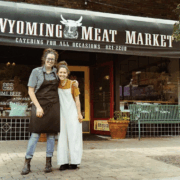
Wives Shelbi and Ashley Nation, known as the Nation wives, stand arm in arm in front of Wyoming Meat Market. They are smiling, wearing work aprons, and standing on the brick sidewalk beneath the shop’s black awning that reads “Wyoming Meat Market.” A bench and storefront windows are visible behind them.

Inside Reka’s, Covington’s Lesbian-Owned Whole-Animal Butchery Reviving Italian Traditions

There are few butcheries in the region offering high quality meat sourced from local farmers, unique and experimental sandwich recipes, and imported Italian groceries – and there may only be one owned by a married pair of queer women. Introducing Reka’s: a butchery prioritizing a whole-animal approach located at 401 Scott St. in Covington. 

A Lesbian-Owned Butchery Rooted in Family and Italian Heritage

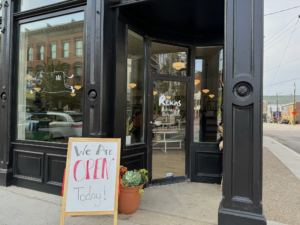
Exterior of Rekas Butchery and Delicatessen in Covington, Kentucky, with a sidewalk sign reading “We Are Open Today” in front of the shop’s black storefront and glass door.

    Photo provided by Rekas Butchery and Delicatessen.

Wives Shelbi and Ashley Nation opened Reka’s in 2024 with the goal of celebrating Shelbi’s great-grandmother’s legacy as a chef and business owner in the male-dominated meat industry. When developing a sister location to their original butchery, Wyoming Meat Market, they borrowed her name – Reka – and her classic Italian recipes. 

“Our roots go back not only to Italy and our Italian heritage, but also to our family members,” Ashley Nation said. “We’re female and we’re business owners. [We’re] something against the norm.” 

Also against the norm is their whole-animal approach: a way to ensure quality control and sustainable practices from the farm to the butchery. The Nations were inspired by the original owner of Wyoming Meat Market, who started the trend in the 1920s. By ordering a whole cow only once a week, butchers can intentionally utilize it to its fullest extent and avoid food waste.

“The idea is that a whole cow can feed a community and nothing goes to waste,” Nation said. “Get a cow once a week, butcher it, and the community would come feed off of it. Whatever we didn’t sell that week, we would grind and make burgers and have a community grill-out, and that still happens in Wyoming.”

“We do that because we know the cow. We know what our cows eat. We know where they live. We know everything about them,” Ashley Nation said. “When you talk to our butchers here… They can tell you just about anything… people really care about their food, and I think that goes a long way.”

A Whole-Animal Philosophy That Connects Food and Community

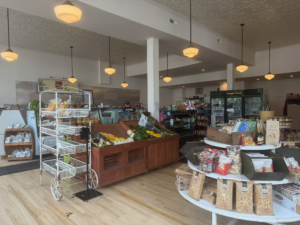
Interior of Reka’s butchery and market, showing displays of fresh produce, Italian groceries, dry goods, and a refrigerated case labeled Fresh Food. Wooden floors, pendant lights, and organized shelves create a clean and welcoming shopping space.

The interior of Reka’s shows a bright, organized market space featuring fresh produce, Italian pantry items, local meats, and prepared foods. Photo provided by Reka’s.

The whole-animal approach corroborates more than just Reka’s commitment to sustainability and meat quality. It also showcases their devotion to their local community, which they aspire to connect with further in future years.

“Especially with the holidays coming around, we’re trying to plan a holiday pop-up,” Nation said. Currently, Reka’s boasts a wide Thanksgiving menu complete with a whole turkey and side dish bundle. “We definitely have plans to be a part of the community.”

With the recent government shutdown pausing food assistance, the Nations feel called to provide for the community and give back to its members now more than ever. Reka’s is sending donations of non-perishable items and a percentage of item sales to Be Concerned in Covington, a food pantry serving eight counties in Northern Kentucky.

“With SNAP coming to an end, we’re partnering with local food banks and starting a food drive,” Nation said. “We want to help our neighbors.” 

Since introducing themselves to their Northern Kentucky “neighbors” over a year ago, Reka’s has developed a strong community of regulars: some who visit the shop every day, twice a day.

“We focus heavily on what our customers want,” Nation notes receiving requests for aged Parmesan cheese and Italian holiday cakes – all things they’re happy to provide. “We’ll have the lunch crowd, so some people come in and get a sandwich… then they’ll come back after work and get chicken or steak.”

Creating Safety, Acceptance, and Belonging for LGBTQ Customers

Whether customers visit to explore the shelves of imported groceries, place orders for their families’ dinners, or snag what Nation calls “bomb sandwiches” for their lunch break, they all share something Nation briefly feared they wouldn’t – a respect for her and her wife’s relationship. 

“There’s still, as always, a bit of ‘what are people gonna say?’” Nation said. 

When beginning their business, Nation worried referring to Shelbi, the primary butcher and founder of Reka’s, as her wife might provoke stares or judgement. Instead, she’s found herself “pleasantly surprised” by the reception from customers.

“If I just say ‘my wife’ – I used to be worried to say that term – people don’t even flinch,” Nation said. “That’s really, really nice, because that’s something that, as a business owner, you really don’t know if that’s gonna affect your business. At this point, if it does, then I don’t really want them as a customer anyways.”

Despite being perhaps the country’s only whole-animal, queer female-owned butchery, Reka’s originality and innovation doesn’t contradict their desire to be a “safe space” for many queer shoppers in the area.

“It’s really fun to have people come in and tell their stories, and just explain how happy they are that we’re here,” Nation said. “It makes me feel really good.”

In the future, Reka’s hopes to partner with Covington Pride to show their appreciation to the community and introduce everyone to the fascinating Italian flavors they offer in store. Until then, customers hoping to sample imported snacks, order extra sides for their Thanksgiving feast, or try a sandwich with a unique fusion of flavors can visit Reka’s from Tuesday to Saturday each week!

Neonatal Clinicians, Entrepreneurs Develop LullaFeed to Support Infants with Feeding Challenges

An infant must meet several criteria before being discharged from the hospital, including stable vital signs, maintaining a consistent body temperature, and getting enough nutrition – ideally from a breast or bottle. But what happens when an infant struggles to feed?

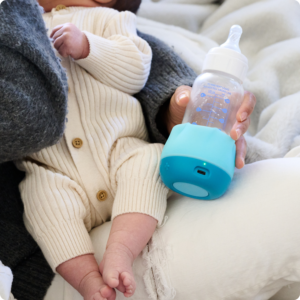
Two neonatal clinicians and entrepreneurs, Michael Detmer and Rebekah Gossom, founded a business, Louisville-based Innovative Therapeutix, and developed a solution: LullaFeed, a detachable device that connects to the bottom of a baby bottle and supports infants with feeding difficulties by playing soothing lullabies recorded in the voice of a parent or guardian.

“Lullabies have a repeating refrain or chorus and babies like that because it’s predictable and they can expect what is coming next and there’s nothing in the form of the song that is “alerting to them,” Detmer said. “It allows the baby to settle in and not be alarmed by what’s to come next.” 

Lullabies are soft, steady, and slow at 60-70 BPM which is the resting heart rate of an adult and the average suck rate of a newborn. They also have a descending soothing melodic line with very limited instrumentation which babies prefer because it is least alerting. 

“We found that the babies were responding to music and would actually change their suck behavior on the breast or bottle and become entrained to the music,” he said. “Entrained meaning, they would synchronize their sucking to the tempo of the music.”

With the concept of LullaFeed proved as a solution in the hospital NICU by Detmer singing lullabies during feeding, Detmer and Gossom knew their next step would be to help more caretakers by creating an actual product for at home feeding.

“Parents need something like this to help them continue giving this care once they get home,” Detmer said. “I asked myself, ‘Why don’t we build something that pairs with feeding?’ and we sat down with a napkin and planned out what we could build.”

After many prototypes through a “fail fast” method, the neonatal entrepreneurs found the sweet spot for their design. The product contains multiple sensors used to detect infant feeding patterns and when feeding is detected, the parent’s pre-recorded voice plays back to the infant via an embedded speaker. 

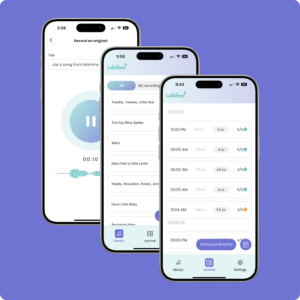
LullaFeed pairs with a companion app that allows users to record themselves singing a lullaby at the appropriate tempo. The app also tracks feeding data, enabling parents to monitor how much their baby consumes over time.

Gossom said LullaFeed is important to her because she knows first hand the impact it will have on infants who are struggling with eating. 


“I have seen the power of music work like magic on the patients I work with- music helps calm and organize babies so they feed better and it helps relax parents during these stressful times too,” she said. 

LullaFeed currently has a waitlist of almost 400 people wanting to purchase their product. But who makes up these people?

“Parents are interested, but also those that are looking for baby shower gifts (family and friends) and two-thirds of the parents that have signed up don’t even have a baby with a feeding issue,” Detmer said. “They’re looking for something to support their infant’s feeding in new environments or by a different feeder, such as day care.”

Funding and What’s Next for LullaFeed

The company has raised a total of $1.26 million in grants, through the crowdfund investment platform Wefunder, and from other investors including Render Capital, Kentucky Science & Technology Corporation (KSTC)/Keyhorse Capital, and CATO Neonatal Innovations, Inc.

The suggested retail price for LullaFeed is expected to be between $80 and $100, though it has not been finalized, Detmer said. The company plans to bring the product to market this summer, with a limited test launch to select customer groups earlier in the spring.

They also plan to initially sell its products on its website and through Amazon, with future availability on baby registry sites and potentially on e-commerce platforms for big-box retailers. In addition to LullaFeed, Detmer said the goal is to help infants grow into the best versions of themselves through multiple products, while supporting parents in raising strong, healthy children.

“We will need more investors after going to market this summer  to scale this and to expand to grow the business,” Detmer said. “In terms of longer term plans, we have several product ideas in addition to this which are in our roadmap to develop.”

Pin It on Pinterest