
Kentuckian Tommy Heleringer stars in new queer movie “Throuple”


Desire is complex, and often queer desire leans as far into that complexity as possible. When one’s desire paths are stripped of what society calls “normal” and you’re left to consider what you really want, the answer can be surprising. The deep humanity of queer love is at the heart of “Throuple,” a recently-released feature film starring Michael Doshier and Kentucky native Tommy Heleringer.
“Throuple” focuses on, well, a throuple and its complications shared by Michael, who plays a younger version of himself, and a married couple played by Tommy Heleringer as Connor and Stanton Plummer-Cambridge as Georgie. I spoke with Doshier and Heleringer to get their insights after viewing “Throuple.” (I had an opening joke planned for my three-way interview, but I chickened out of telling it.)
Though it’s certainly a grabby title and it seems easy to simplify this film to the countercultural image at its heart, this film is not simple. As Heleringer put it, the film is honest and “presents a world unto itself and there isn’t really a heterosexual eye looking down upon anything,” no outside critic editorializing on the individuals’ choices. Though the characters experience their own versions of a shame brought on by normative culture, as Heleringer says, “I think that’s sort of revolutionary that we’re bypassing any sort of permission or contradiction” to what the characters in their world are experiencing.
Heleringer, who grew up Catholic, knows something about that critical eye from personal experience. He was born and raised in Louisville, though he has since moved away to pursue acting. Like many queer people from religious backgrounds, Heleringer didn’t find many expressive outlets in his immediate world.
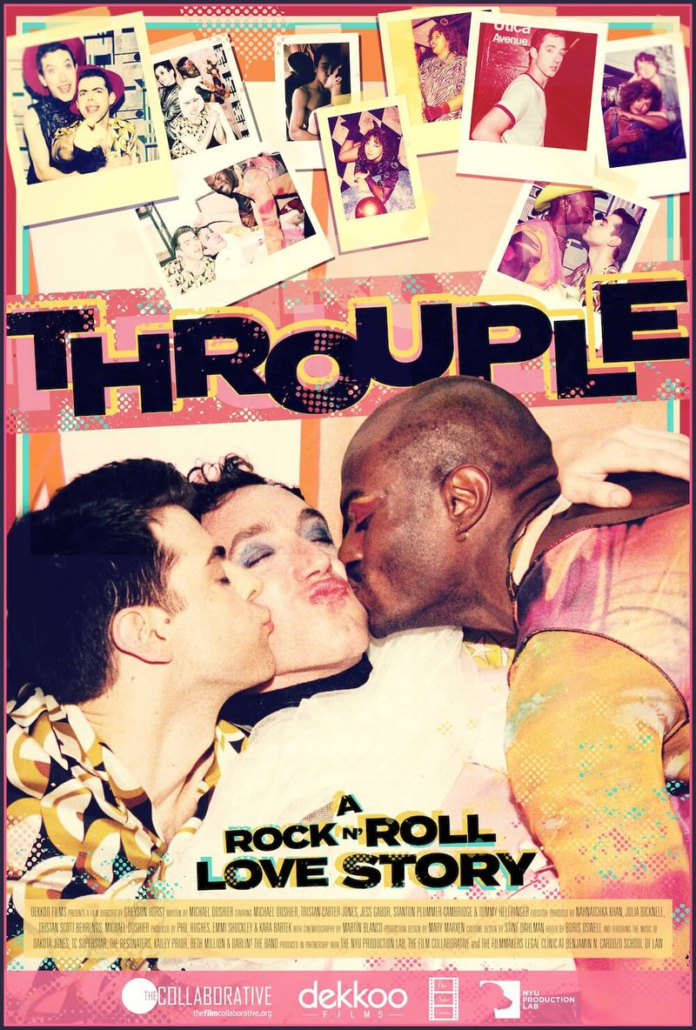
“Throuple” movie poster
“I spent most of my time in our basement playing with toys, dancing to Madonna’s ‘Immaculate Collection,’ and watching our VHS copy of ‘The Wizard of Oz,’” he said. “My whole world was my family and school and the roads outside the car window that took me to and from them. I was a gay kid and for many years was very hurt that my religion called me ‘inherently disordered.’ I knew to survive I had to leave. I had to find a new world.”
The struggles and humanity of the characters is really at “Throuple’s” core—even though it’s listed as one of the 4 best sex movies of 2024 in Esquire. “Throuple” paints fully-realized and complex portraits of people tracing their converging and diverging desire paths, which are often unknown to the person discovering themselves. For instance, the couple Georgie and Connor embark on an open marriage early in the movie and quickly realize it won’t be as simple as having sex with other people and keeping everything else “normal.” Michael, their first encounter, is an awkward, attention-seeking younger man whom the couple accompany home after a concert. Michael gets cold feet, quickly followed by uncertainty from Connor and Georgie, yet almost as soon as everyone is packed up to go their separate ways, they fall into bed again.
The in-and-out again (pun intended) relationships among these three are tied up with similar dynamics among Michael’s other, more platonic “throuple” formed with his best friend, Tristan (played by the real-life Tristan Carter-Jones) and her partner Abby (played by Jess Gabor). Though Tristan and Abby love Michael as a friend, his constant need for attention and seeming lack of self-awareness get in the way of their own deepening relationship, which comes into tension just as Abby proposes to Tristan. Of the real-world version of his relationship with Tristan, Michael Doshier relates, “It was like ten years of being each other’s primary partner. And I think that for a lot of queer people, chosen family is a beautiful thing, but…it’s really intimate. It was the complexity that we were trying to master.”

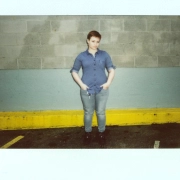
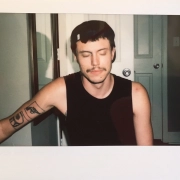
Image credit: Michael Doshier, Stanton Plummer-Cambridge, and Tommy Heleringer in “Throuple.”
In some ways, the film was the real-life Michael Doshier’s way of reckoning with his younger self’s character flaws. “I’m feeling less and less like Michael every day, which I think is a good thing,” said Doshier. “That means I’m growing because he, famously, is staying stagnant. I wasn’t very good at expressing myself very clearly and what I was feeling and what I was wanting.”
This story exists because of readers like you. Give $5 a month to keep Queer Kentucky free.
The character Michael’s self-obsession hides deep insecurities about his own lovability and self-worth that emerge in his relationships and his personal explorations of artistic passion. He struggles and blooms as a singer and songwriter while pursuing his multiple desires, platonic and sexual alike.
Creative expression often couples with identity exploration, and it seems to have done so for Tommy Heleringer. “When I was very little, my Dad would introduce me to people as ‘This is my son, Tommy; he’s going to be an actor,’” he said. Even as a child in a small “bubble” of a Catholic community, and before he knew it himself, theatre and its expressive power felt like home to Heleringer. “I would put on plays in the basement with my siblings and cousins,” he said. “I played the Wicked Witch of the West in our eighth grade production of ‘The Wizard of Oz.’ I did plays in high school. Acting seemed there from the beginning.”
At the core of every “Throuple” character’s development is communication, which Heleringer identified as the key to exploring his character, Connor, and the key to relationships in general. “I’ve been in an incredible relationship now for almost nine years, but in the very beginning, like the first year, I’d just not say nothing!” he laughed, “assuming people can guess my mind. I was lucky to find someone for whom the games did not work at all. It was only going to work with a lot of honesty.”
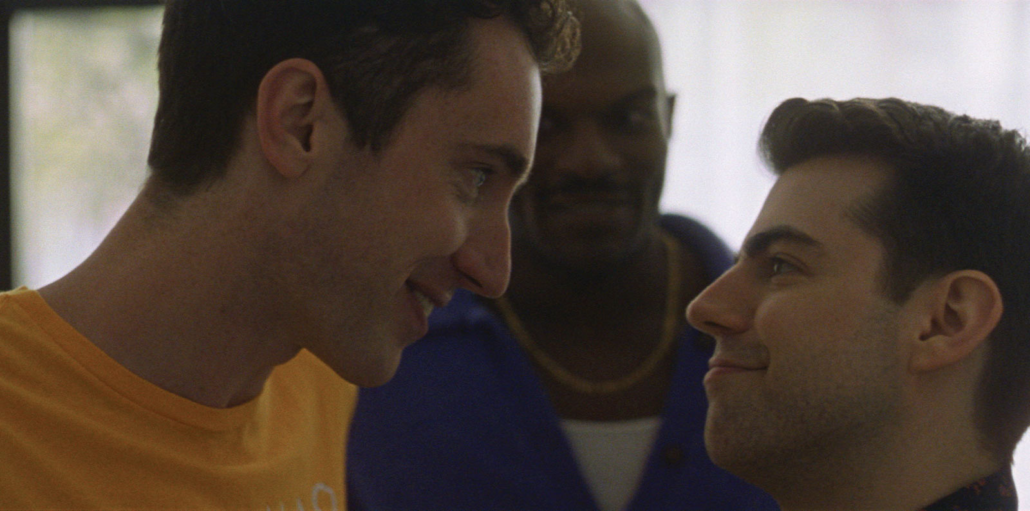
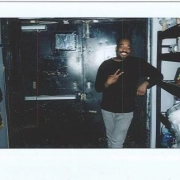
Image credit: Michael Doshier, Stanton Plummer-Cambridge, and Tommy Heleringer in “Throuple.”
By the end of the film, Michael is still at the center of all these dynamic relationships but his position and connection to his sense of self have shifted. He’s far from done with his journey, and “Throuple” brings us to a place of understanding with him that there is no wrapping up desire; it’s winding and complicated, and that’s its beauty.
“The fantasy of a throuple is sort of burst,” said Heleringer. Doshier added, “ I would say I’ve never felt more convinced that it’s a very legitimate structure that’s working for a lot of people. It’s just another relationship, and it all feels very normcore in a way that I think would surprise a lot of people who haven’t given this a lot of thought. That’s been the thesis statement of ‘Throuple’ since the very first draft; it’s just about learning that you have a right to go after the desires of your heart.” At the moment, Doshier’s creative desires involve work on a new feature film set in Missouri, while Heleringer is starring in a one-person performance of Tennessee Williams’s “The Glass Menagerie.”
More than mid-way through the film, Connor says to Georgie, “I want you to experience every possible joy that is within you.” In this moment, the film wished into being a reality where we’re all just humans desiring. This is the strength of “Throuple,” for me: it’s an attempt to empower the viewer by taking away categories and leaving us with just the beauty of connection.
“Throuple” is now streaming on Amazon, Dekkoo, and other platforms.
Keep reading
 Early Voting Starts Oct. 29. Our People Our Vote Wants Kentucky Voters to Have Help at the Polls.
 Time Slip Theatre Opens 13th Year of ‘Rocky Horror’ With a Witchy Twist
 Louisville Pride Put Mental Health Front and Center. The Need Doesn’t End When the Tents Come Down.
 Federal Cuts “Handcuffed” BIPOC Harm Reduction in Kentucky. Communities Are Stepping Up.
 Homeownership Is Radical, Says Mercury Stardust. Her Book Tour Hits Louisville Oct. 8