
Kentucky Passed Zero Anti-LGBTQ+ Laws in 2026. Here’s How Advocates Made It Happen.
When Kentucky lawmakers wrapped up the 2026 legislative session earlier this month, they gaveled out and went home without passing a single anti-LGBTQ+ bill.
It is a reprieve from a heavy onslaught of high-profile, targeted laws coming out of Frankfort over the last few years — years that saw measures limiting access to gender-affirming care, kicking transgender girls and women from sports teams, and reversing a short-lived ban on “conversion therapy.”
The legislature — where four of every five seats are held by a Republican — didn’t even show much appetite for such legislation this year, with only two of the 10 anti-LGBTQ+ bills filed getting any sort of vote.
Kentucky’s uneventful session clashes with a federal landscape that is increasingly toxic towards the LGBTQ+ community, particularly those who are transgender or gender-non-conforming, and as hundreds of bills are being considered in other states after a record-breaking year of anti-trans legislation.
So, what worked?
Advocates pointed to two key things: The work of existing groups with the power to directly lobby lawmakers, and the voices of everyday Kentuckians who spoke up throughout the session.
“Nothing ‘just happens’ in Frankfort,” ACLU of Kentucky spokesperson Eric King said.
A final status update on anti-LGBTQ+ bills
Kentucky lawmakers filed ten anti-LGBTQ+ bills during the 2026 legislative session.
Of those, only two — Senate Bill 72, which would’ve given health care professionals clearance to refuse to provide any treatment that violated their conscience, and House Bill 468, which initially would’ve made it more difficult to enforce local fairness ordinances — got any sort of vote.
Both passed out of a committee and went on to pass out of their chamber of origin, before not moving in the other chamber.
The remaining eight bills covered everything from additional limits on gender-affirming health care access, to requiring Kentucky to only recognize two genders, to ways to make it easier to sue a city over its fairness ordinance. Many of these have been filed in previous sessions in some capacity, where they also saw little to no success.
Some touched on hot topics from recent years, including the unsuccessful resurrection of an anti-drag bill and a measure to implement a “bathroom ban” for government buildings sparked by a 2025 incident in which a Republican lawmaker accosted a transgender woman using the women’s restroom at the state Capitol. Despite fervor, both past and present, around both, neither bill advanced.
A high-profile Senate bill to kick trans teachers out of classrooms got withdrawn without getting a committee assignment. Its bill sponsor filed it as a last-second floor amendment, but it too died without a vote.
Here’s how everything shook out.
Who lobbied Kentucky lawmakers on anti-LGBTQ+ bills?
Millions of dollars are spent each year to lobby Kentucky lawmakers in Frankfort, hoping to better a bill’s chances of passing, stop legislation, or at least weaken its blow.
A Queer Kentucky analysis of public lobbying records for the first three months of the 2026 legislative session (aka, all but the final three days) found nearly 40 different groups or organizations that lobbied lawmakers on at least one anti-LGBTQ+ bill at one point in the session.
As a collective, the organizations on file range from everything from insurance associations to The Kentucky Center for the Arts foundation to those representing breweries who host drag shows.
A variety of faith-based coalitions, education groups, and social justice-focused organizations regularly lobbied on these bills, as did a series of health-related groups representing psychologists, social workers, doctors and at least one hospital chain.
Lobbying records don’t typically explicitly say a group’s stance on a bill, just that they reported lobbying on it. And some of the bills on this year’s anti-LGBTQ+ list had ramifications outside of the LGBTQ+ community.
Some of the groups known to oppose LGBTQ+ rights, like the Alliance Defending Freedom’s lobbying arm, ADF Action, reported only lobbying on one or two anti-LGBTQ+ bills this session.
But three groups easily outnumbered the rest, with two of those groups being pro-LGBTQ+ and the other not.
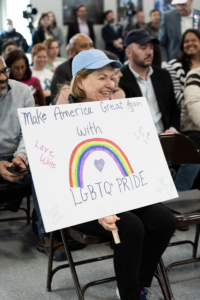
A supporter holds a handmade LGBTQ+ pride sign during a public hearing at the Kentucky Capitol Annex during the 2026 legislative session. Photo by Skylar Davis.
The Fairness Campaign and Kentucky Competes, a group that lobbies on LGBTQ+ issues from a business and economic development angle, routinely lobbied in favor of LGBTQ+ issues. The Family Foundation, a socially conservative group, typically lobbied against the same bills, as frequently as the Fairness Campaign and Kentucky Competes lobbied for them.
“The Fairness Campaign has worked hard in recent years to strengthen relationships on both sides of the aisle and encourage state lawmakers to focus on kitchen table issues that positively impact all Kentuckians, rather than engage in divisive culture wars that harm our most vulnerable communities,” Chris Hartman, the leader of the LGBTQ+ advocacy organization the Fairness Campaign, said.
This year’s success “is thanks to that intentional and difficult relationship building,” he continued, and was bolstered by an “expanded lobbying team.”
Eric Russ, who leads the Kentucky Psychological Association, said their group has also worked on developing relationships with lawmakers so they can be “an ongoing trusted source of mental healthcare information for policymakers.”
KPA, Russ said, “works hard to ensure legislators understand both the psychological science of gender and sexual identity and the impact legislative policy has on the mental health of people in those communities.”
One example is the group’s quick statement opposing SB 351, the anti-trans teacher bill, which “helped legislators and other advocates understand the problems with the bill’s mechanisms and its wide-ranging impact.”
Thanks to quick pushback to the bill both when it was first filed and later in session when the bill sponsor tried to sneak it into a different bill at the last minute, the concept never budged in the legislative process.
Showing up still possible, still critical
2026’s legislative session was the first where the Capitol and the House and Senate chambers were closed to the public.
The Capitol’s closure — due to multi-year renovations — sparked concerns of weakened transparency and limited moments to make voices heard over legislation. Heading into the session, advocates and lawmakers told crowds at Queer Kentucky’s legislative preview panels that showing up — even if it is just to watch a committee meeting or briefly talk to a lawmaker in the Capitol Annex, which remained open — could have major impact.
“It really does matter that people show up,” Hartman said at an early December panel in Newport. “Every time we can fill the chamber with bodies, it gives more people pause than you might know.”
Several groups ultimately were still able to rally the troops, show up in Frankfort and contact their lawmakers.
“Anti-LGBTQ+ and anti-immigrant bills didn’t pass in the 2026 legislative session because of well-organized, relentless advocacy across sectors,” King with the ACLU explained. “Directly impacted people showed up and testified. Coalitions mobilized calls and emails. Volunteers put in the work, day after day.”
Dr. Jacks Gilles, a psychologist based in Louisville, testified against SB 72, one of the only anti-LGBTQ+ bills that made it to a committee hearing. The bill would have allowed a broad range of medical practitioners to refuse to perform services if they felt it violated their “sincerely held religious, moral, or ethical” beliefs.
They said that the bill would have taken away the necessary checks and balances already set by licensure boards, and create more of a power differential between medical professionals and patients. That would lead to people, especially LGBTQ+ people, avoiding medical settings.
“Several of us have had experiences of surgeons coming in before the surgery and asking us to pray for us, but when you take a vulnerable situation and ask them to engage in their religious practice, it’s from a lack of understanding of holding differences as medical providers and still maintaining dignity,” they said.
No one in committee testified in favor of the bill, they said, aside from the lawmakers who supported the bill.
“I would like to encourage getting people involved by voting, coming out to Frankfort and having conversations with lawmakers, even if it’s not to testify against a bill. It’s helpful as well to not feel so isolated,” they said.