GLAAD I Found You: Erik and Roderick Davis on how Removing the Mask Improved their Vision, Allowing Love to come in
By Darian Aaron
For many couples, the COVID-19 pandemic was a test, resulting in either a pass or a fail in quarantine. Dr. Roderick Davis, 42, director of financial aid and scholarships at a private HBCU in Louisville, KY, tells GLAAD he can pinpoint the moment in March 2020 when he confronted a hard truth about himself and his preparation for a next chapter with Erik Davis, 44, a pharmacy specialist and content creator who had not yet entered his life.
“My pastor at the church I was attending preached this sermon—’ Some of y’all are going to come into the pandemic this way, and you’re going to leave the pandemic another way,” Roderick recalls.
“I was like, ‘Well, what does that mean for me?’ When the Centers for Disease Control and Prevention (CDC) announced that we were going to have to wear a mask, I said to myself, ‘Well, no, that’s not going to work for me because I’ve been wearing a mask my entire life,” Roderick remembers. “One of these masks is gonna have to come off.”
The mask Roderick knew he had to remove was one worn as a shield of protection from the shame and disapproval of relatives, strangers, and most of all—spiritual rejection and eternal damnation from leaders in the Church of God in Christ—the Black Pentecostal denomination in which he was raised. Roderick says he could no longer hide what was clear to him internally, but he admits that by coming out, it was also clear to him that retreating back into the closet would not be an option once he verbalized his truth.
“I was engaged to a woman, and in the back of my mind, a voice kept whispering that I couldn’t be the person who marries someone while hiding my true self,” Roderick said. “Taking off the mask meant finally coming out, facing my deepest fears, and choosing my own happiness over a life lived in silence.”
While Roderick may be considered a late bloomer, Erik removed his mask nearly two decades earlier, a pact he made with himself after beginning his freshman year at the University of Mississippi.
“I wrote my parents a letter stating my sexuality,” Erik said. “My hands shook with fear—I’d heard stories of kids getting kicked out, and I desperately hoped my family wouldn’t turn away. Deep down, I believed they’d accept me, even as I braced myself for heartbreak.”
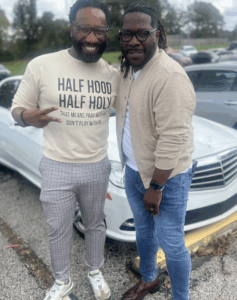
Photo courtesy of The Davises
But as a product of the Black Baptist church experience, Erik says he couldn’t be certain he’d meet the same fate as other gay young adults still financially dependent on their parents.
“The process of writing that letter was excruciating because I knew, once I sent it, there was no turning back,” Erik said, his voice trembling even in the memory.
Fast forward—post-Erik’s collegiate career and a divorce from his first husband—in the solitude and social distancing era of a global pandemic, he scrolls through Instagram and a picture of a man appears on his feed, changing the trajectory of his life. The man in the photo was Roderick.
“I slid into his DMs because when someone starts liking [multiple photos in a row], and then they go back and like old photos,” Roderick said, admitting his curiosity was piqued.
Through meticulous internet sleuthing, Roderick uncovered the stranger on the other side of the screen on his mobile device, along with a glaring red flag: Erik’s husband.
“I don’t do the whole breaking up of a happy home type situation. So if you’re still married, you can slide right up out of my DMs,” Roderick recalls telling Erik.
Roderick didn’t know at the time that Erik’s two-year marriage had ended in divorce, but he would soon find out, providing an entry point for the two to talk.
“Going through a divorce, you always think, I’ll never get married again. My heart was bruised, but I was open. I hadn’t expected to find someone after the pain of my last relationship, but when I met Rod, I felt a spark—something undeniable. He stirred my spirit and gave me hope for new beginnings,” Erik said.
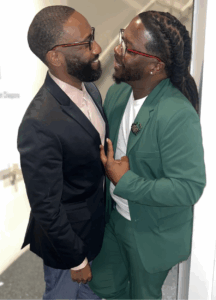
Photo courtesy of The Davises
“We immediately started having some of the hard conversations up front,” Roderick said. “What are your triggers? What are your non-negotiables? What are your deal breakers? We talked about all those things up front so there would be no surprises at the end.”
The couple tells GLAAD they communicated online for three weeks and dated for six months before they knew they’d met their forever. Both living in Tennessee at the time, Roderick says Erik was intentional about seeing if their online chemistry was real.
“Erik drove [from Memphis] to Nashville within the first week of us even talking,” Roderick said. “We grew an attachment fast. Erik came into the relationship very sure of himself and what he wanted. Me, on the other hand, I was like, ‘No, bro—we got to slow this thing down because I ain’t ready,” Roderick said.
A year later, Roderick was more than ready.
“Having someone promise to protect and walk with you—that’s what I needed to just say, you know what, let’s do what we need to do,” Roderick said.
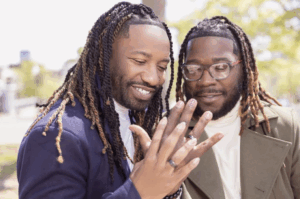
Photo courtesy of The Davises
A Couple of Forevers
In September 2022, inside an apartment clubhouse overlooking AutoZone Park, home of the minor league baseball team the Memphis Redbirds, surrounded by family and friends, Erik proposed.
“Timing is part of God’s perfect plan,” Roderick said, reflecting on how he and Erik moved in the same circles for years but never connected until later. In hindsight, they believe their marriage was destined, and their friends and families reaction confirmed it.
“They were super excited,” Erik said. “Rod came into the family like a brother to my brothers and like a son to my Dad. It was perfect. They bonded and became close so fast. I was like, ‘Wow, this is nothing but God,’ because my previous relationship wasn’t like that.”
While Roderick says his bonus mom was ecstatic about the pending nuptials, his Dad was initially less than enthusiastic.
“We actually hit a bump after Erik asked me to marry him,” Roderick says of his relationship with his Dad. “We stopped talking for a few months. It wasn’t until the day of my wedding that he told me that he was releasing me. He said, “Well, I’ve been your protector since I had you. On the day of my wedding, he was like, ‘I’m finally going to release you. So, make sure this is really what you want to do.’ And he pulled me to the side, not even 30 minutes before I walked down the aisle to tell me that he was releasing me to Erik.”
On October 9, 2023, in front of 160 witnesses, Erik and Roderick committed their lives to each other in an elegant and unplugged ceremony at The Gin at Nesbit, a rustic barnhouse wedding venue in Nesbit, MS. For both grooms, the day was an out-of-body experience.
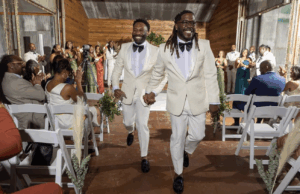
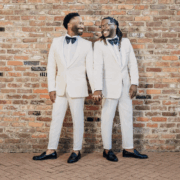
Erik Davis (left) and Dr. Roderick Davis (right) exit their wedding ceremony at The Gin Nesbit on October 9, 2023. (Photo by Cary Clayton Media)
“I can’t remember what everybody wore. I don’t remember any of that. But I do remember the feeling I had of being calmer when I said I do,” Roderick said.
Each groom walked down the aisle separately and to different songs—Roderick to “Here In This Moment,” by Brian Nhira, and Erik to “Everytime I Close My Eyes,” by Babyface, featuring Mariah Carey and Kenny G.
“Waiting for him at the altar, it was like no one else was there but him walking down the aisle with those white teeth,” Erik said.
Now, two years after saying I do, and settling into married life, constant attacks by anti-marriage equality politicians on the right are threatening to upend Erk and Roderick’s union and the right for LGBTQ couples nationwide to marry. It’s a conversation they tell GLAAD they can’t believe our country is still having.
“We weren’t afraid that our marriage would suddenly disappear, but there was a real, heavy moment of wondering why our love and commitment are still something people felt should be questioned or debated,” they said. “It stirred up old feelings we thought we had moved past—feelings of being seen as less than, or as conditional.”
“In my vows, I said, Erik, you’ve set me free. I felt like I had been a caged bird for a long time,” Roderick said. “But now I am able to breathe.”
“I needed Roderick in my life to grow,” Erik said. “I needed him to be there for me. He’s my rock.”