KEEP. Modifier and region. Appalachian identity, culture, or the region as such. Inside Kentucky, use it alongside a Kentucky region (usually eastern-kentucky); the two overlap and can always be combined. For stories set in Appalachia outside Kentucky (e.g. West Virginia, Southwest Virginia, East Tennessee), appalachia can stand as the story’s region on its own. Updated Oct 10 2026.

Tag Archive for: Modifier: Appalachia

No Regrets: Kristin Smith’s journey from Williamsburg to wanderlust to home in Wrigley’s Taproom

photos by Jon Cherry

Along Main Street in downtown Corbin, across the street from White Rabbit Records and bookended between the pinball museum and  a local coffee shop called Folktales, Wrigley’s Taproom & Eatery celebrated its ninth birthday earlier this year. That party was, in some ways, the culmination of star chef Kristin Smith’s return to Eastern Kentucky more than 15 years ago. 

The move home for Smith (she/they) wasn’t part of their plan: Smith was at seminary school in San Francisco back in 2008 when she got a call from her grandfather. 

“I’ve got stomach cancer,” he told her. “I need to know what to do with the farm.” 

The conversation spun Smith into nightmares for a week. She feared not only losing the sixth-generation homestead, but its legacy. She was close to her grandfather, spending summers working in the garden and preserving foods in the kitchen. While it surprised her to learn she cared so much, the clues were close by: her bedside table held two books that epitomized the early aughts locavore movement – The Omnivore’s Dilemma by Michael Pollan and Animal, Vegetable, Miracle by Barbara Kingsolver – and months earlier, she’d joined a community-supported agriculture (CSA) cropshare, connecting her more intimately with the farm that grew her veggies. She was curious if the movement had made it back to her region. 

“I never thought I would go home. Because I was Appalachian, and if you want to make something of yourself, you leave. There was nothing here for us at the time that I was growing up. That was the narrative we all told ourselves,” said Smith from the upstairs office of her restaurant. They decided to try it for five years. If she ended up miserable, at least she’d given it a good go. 

“There’s this innate part of me that I cannot live with any regret; it’s kind of how I’ve always made decisions,” Smith told me. “I didn’t want this to feel like this will be a core regret in my life.”

When they got there, the third of an acre garden had become a bit of a dump. A trio of parked cars rusted on top of it. She was tilling silverware and old rugs out of the soil. She started a CSA with about 25 members, but when that stalled, they quickly pivoted to managing the herd of her grandfather’s 100 lucrative beef cattle staring at her over the garden fence. She went with her cows to the local butcher and learned every part of the process; she bought heritage hogs no longer raised nearby. She met a group of local female farmers through the county extension agency, and together they started a farmer’s market. One of the local food boosters was a woman named Melissa, who eventually became Smith’s wife. 

“I had in me this small business merchant DNA,” said Smith. She loved the community of people who visited her at the market. She started cooking the beef and pork so her customers could try the pricier meats, selling burgers and pork belly tacos. At Kroger, kids pointed at her and called her “the taco lady.” She sold out every weekend. 

The attention caused two other food vendors to approach her and ask her to go in on a restaurant with them. Initially, she refused, but one day they pulled back the sheet rock hiding an old Wrigley’s Spearmint sign and convinced her to come check out the building. Across one half of the downtown room was the original eccentric marketing campaign from the chewing gum company founded in 1891; William Wrigley Jr., the company’s founder, had distributed promotional booklets that told the story of the Spearmen – small, elfin characters who wore monochromatic clothes and triangular hats. In Wrigley’s taproom, the titular character dons an orange cloak and cap, pointing towards a pack of gum near the front window. 

It was bare bones, but Smith couldn’t say no. The historic sign, the high ceilings, the big open space for a long community table – it all felt right to her. She knew if she drove by later and saw someone else in charge, she’d regret it, and she couldn’t live with regrets. 

“I walked in and I thought, oh, this is something special,” said Smith. It took a year to pull the restaurant together, and Smith had no formal training, but as they said, as an Appalachian agricultural family isolated in the hills, they’d been primed to learn to cook. Growing up, there were two restaurants in her hometown – The Ribeye, an old-school steakhouse with a glowing salad bar and steaks served sizzling in cast-iron skillets, and G&E Drive-In, a patio above the Cumberland River where burgers and fries were delivered by servers on roller-skates. 

She said her family visited the establishments about once a month; all other farming, processing, canning, and cooking happened at home. She wanted her restaurant to embody the same aesthetic: local food, grown and harvested near the property. She buys meat from Whitley County, sources from five local farms, and grows her own garlic, peppers, tomatoes, and edible flowers for the taproom. 

“Entertainment here is to make a big meal and sit around the table for hours telling stories,” said Smith. “That’s what I still try to create at the Wrigley.” 

Today, she sees the space as a “table for all people.” A sign above the door says the Wrigley Taproom & Eatery “strives to CARE for and NURTURE our community in mind, body and spirit, one INSPIRED plate at a time.” 

“No matter what, you are welcome here as long as you do not cause harm to anyone else,” said Smith. “I want to have a place of dialogue because I think that’s the only way we’re going to go forward. And it happens on a daily basis. We have totally different spectrums of people sitting right next to each other. And it’s beautiful.”

But it took a while for Smith to get to a place where she too could embody her full spectrum. When they left home initially for college, they didn’t go far, just across the state border to a small Christian university in East Tennessee. There, they majored in religious studies and after graduation, she moved to China for a three-year stint as a missionary under the Southern Baptist International Mission Board. 

“Joining up as a missionary was probably part of me trying to save myself,” Smith reflected. She was eventually kicked out of the program because she confessed to having fallen  in love with a fellow female-identifying missionary. The experience nearly destroyed her. She moved out to San Francisco for seminary school, but she was conflicted about what came next. “I think I had more questions than I had answers,” she said.  

The experience scarred her, and after she moved home, she was quiet about her relationship with Melissa. If they wanted to go on public dates, they’d head to bigger cities. In 2021, about six years after opening her restaurant, Smith put up a rainbow flag for the first time behind the bar during Pride month. 

“I don’t know if I necessarily started this business out thinking we’d be a safety beacon,” said Smith. “But it became more and more clear to me, when my wife and I were going to Lexington or Knoxville or Louisville just to be on dates, that it was  something I could foster in my own restaurant. If we need that, there might be a lot of others who might not have the access or ability to leave. So that became a lot more intentional.” 

Still, she was nervous, and on July 1, she took the flag down and breathed a sigh of relief, thinking okay, they made it through. She and her team suffered no blowback. In 2022, she hung the Pride flag again and planned to remove it again, but her staff begged her to keep it up. She said part of her initial hesitation was mental, but she’s also lost friendships and experienced family strain due to her sexuality and her same-sex marriage. 

But then, in 2023, legislation started changing, removing rights for transgender people in the LGBTQ+ community. 

“It scared me,” said Smith. “I thought we were going backwards instead of forwards.”

For years, the restaurant had two single-use gender-neutral bathrooms, but Smith wanted to do more to make sure trans and nonbinary people  knew they were welcome. So she changed the flag again, putting up an all-inclusive Rainbow flag that highlighted equality for the trans community and BIPOC folks that took up the brick wall behind the bar year-round. 

“If I go down because I welcome trans men and women, I’m okay with it. I’ve also been here nine years, and I think I’ve proven a lot for myself and our community,” said Smith. “But the fear is there, everyday, that it could happen.” 

Owning a restaurant and running a farm isn’t an easy combination. During the Covid-19 pandemic, as restaurants were forced to shutter their doors, Smith thought she’d lose Wrigley’s. 

“It was like gasping for air everyday,” said Smith. “It was like someone had it out for us, the whole industry.”

Then, the 2021 floods hit, and tore down her fencing. She chose to sell most of her cattle instead of paying the $40,000 required to repair it. Then, the 2022 floods covered almost half her farm along the Cumberland River and washed away her four breedstock hogs: Dolly Porkton, Reba Bacontire, Hammy Wynette, and Porker Wagner (Though she’s not sure they’re all gone; half a year after the flood she was driving to Dollar General down the road from her house and saw Hammy Wynette in the cornfield chowing down). 

Some days, she’s surprised the doors to Wrigley’s are still open, but she says she owes the success to her incredible staff, who she calls “salt of the earth people” and “the community that values us enough and our work and who we are that has kept us here.”

“I don’t know how I caught lightning in a bottle, but I did.” 

These days, Smith said she’s working on contentment, on settling into the life she’s built. 

“Restaurateur and farmer, those are two very masochistic careers,” Smith told me. “The to-do list is forever.” But she wants to model a better work-life balance not only for herself but for her staff. She’s choosier on projects. She’s learning how to say no. She spends more of her days working for six to eight hours instead of sun up to sun down. More time with her wife. More board games. More weekends sitting on the porch over a two hour breakfast. 

Wrigley’s is known not only for its inventive dishes – when we visited, they were celebrating Tiki Week over Corbin’s spring break, allowing parents who couldn’t travel to still experience an escape with rum-themed cocktails and mahi mahi on the menu – but also for its hospitality, for its community table, and for its tendency to lean into difficult conversations instead of gloss over them. Smith, a chatty, engaged listener, quick to laugh and grin, is perhaps the perfect host to bring that community to Corbin. 

Across the bar from the rainbow flag, an American flag hangs above the gender-neutral bathrooms. Here, framing the fluorescent EXIT sign, Smith painted a phrase that perhaps embodies her take on a complex life: “Every EXIT is an entrance somewhere.” 

We can’t forget about the people of Whitesburg

photos by Samuel Greenhill

The spirit, fight, and resilience of Michele Hobbs.

Nothing that I describe to you, from her nonstop energy to her multiple successful businesses to the Bourbon that we initially intended to speak about, sums Michele Hobbs up better than her insistence on turning all conversations to the people of Whitesburg, Kentucky.

So let’s start with Whitesburg. Located in Letcher County and right on the Kentucky/Virginia border, Whitesburg is the home of 2,321 working-class and working-poor Kentuckians. It’s the place where Michele spent a large part of her childhood running around outdoors, fishing, and learning what community is all about. And if you look at Michele’s life now, it’s still filled with a lot of running around outdoors, fishing, and showing others what community is about.

Now living in Cincinnati, Michele returns to Whitesburg regularly to take her young kids fishing in the same waters that she grew up in. After the 2022 flooding that decimated parts of Whitesburg, it’s a place that she’s returned to time and time again with food, supplies, and an army of community behind her. 

When news of the flooding broke, Michele didn’t ask what she could do. She just did it. “The flood happened overnight July 27th. In Letcher County, where I call home, my family was in line with a direct hit in the floods. We turned to friends, businesses and strangers to bring attention and help to the people of Letcher County. Although the path of destruction ran from before Jackson and through Whitesburg, we chose to focus on Letcher County, specifically, Isom and Blackey. This is where I have family, and had people I could trust, whom I could work directly with, therefore getting aid in immediately.”

Using her own network and resources to provide immediate aid, Michele started fundraising for the region, ultimately raising over $5500 in just five days. Money that funded essentials, including the purchase of 60 charcoal grills complete with charcoal for each grill, as well as a truck that helped haul it all to a temporary warehouse. Michele worked with NKY State Representative Rachel Roberts to get power to that building, a building that is still being used to this day. 

During those first few days, Michele’s friend Suzy DeYoung, founder of La Soupe, a Cincinnati-based nonprofit dedicated to fighting food insecurity and waste, had been in contact with her friends at the World Central Kitchen. In only three days, they were set up in the IGA parking lot in Isom, Kentucky, cooking meals for thousands each day and teaching others in the community how to replicate their efforts. Michele recalls, “LaSoupe began making multiple trips a week to Letcher County with hundreds of meals, donating to pantries, schools and families. Suzy built a coalition of friends to help, and soon she was teaching the folks at the CANE Kitchen in Whitesburg how to feed hundreds of people out of the little volunteer kitchen… They were feeding 2000 people 3 meals a day!”

With their needs outgrowing the 60 grills they brought down, Michele knew they needed to work fast to scale their grassroots operation. A few days later, 504 more grills, a semi-truck of charcoal, and pallets of cleaning supplies came pouring in thanks to partnerships with regional corporations. The months that followed included rebuilding efforts within the community, as well as additional fundraising events, including an all day festival called “Hope for the Hills” that raised $22,000 for the area and was held at Michele’s very own OTR Stillhouse at Knox Joseph Distillery.

The OTR Stillhouse, located in the Over-the-Rhine neighborhood of Cincinnati, was opened to the public in 2021 and serves as the home of Knox Joseph Distillery, the creator of award-winning Bourbon, blended whiskies, and gins. When Michele decided to purchase the giant building at 2017 Branch Street, and the previous home of the Standard Ice Manufacturing Company, it was intended to be a warehouse for her quickly scaling pet food brand Pet Wants. A lifelong hustler, entrepreneur, and expert of identifying industry needs, Pet Wants launched as pet food store catering to the growing demand for high-quality, allergy-friendly pet food. From its humble beginnings tabling at events and growing to a single brick and mortar within Cincinnati’s legendary Findlay Market, Pet Wants exploded into a nationally known brand with over a hundred franchises, making Michele one of the few LGBTQ+ and female entrepreneurs receiving national attention for her work. 

Never one to shy away from identifying an opportunity, those plans changed when Michele discovered the aquifer of fresh, clean water that ran below the building, a discovery that caused her to pivot toward her lifelong dream of owning a Bourbon distillery. Almost a decade later, Michele now runs one of the few LGBTQ+ and female-owned distilleries in the country: A sprawling venue where Michele’s commitment to family and community can take on a life of its own. Supported by her wife Amanda, she has created a space designed to serve as a community hub, fueled by a desire to create an environment so welcoming and inclusive that it has the power to pull people out of their caves and into community. Fundraisers, concerts, and Pride markets happen regularly here, as do special one-time events like a screening of the Indigo Girls documentary and a private gathering of local leaders, bartenders, and business owners focused on creating an emergency response system for the LGBTQ+ community. 

Living in a world still finding its footing since the height of the pandemic, Michele’s story is a reminder of the power of human connection, the importance of community engagement, and the resilience of the entrepreneurial spirit. And the eternal truth that Kentucky stays with you forever.


JD Vance, Donald Trump answer to the rural-urban divide while organizers in Kentucky work to build bridges beyond elections

The “rural-urban divide” has been named a major fault line in American politics. This conversation leaves people quaking every presidential election, when rural swing states are often named as the deciding factor of the national vote.

JD Vance, venture capitalist and senator from Ohio, has been named Donald Trump’s running mate for November’s presidential election. Vance wrote “Hillbilly Elegy,” a best-selling memoir that received reviews naming the self-proclaimed “Appalachian” tale as exploitative, stereotypical, and unrepresentative of the region holding 13 states and 25 million people. Silas House, LGBTQ+ Kentuckian and chair of Appalachian Studies at Berea College, says the book “played to bogus notions on the left and right about the impoverished region.” 

National coverage of Vance’s appointment as Trump’s running mate has theorized he was appointed to appeal to the “working class, rural white voters” that helped Trump win his first election. So, it can be said that the rural-urban divide will have more national political attention than ever as we enter into the 2024 election. As outside cameras, dollars, and opinions enter working class, rural communities across the United States, there are people already organizing here who are rooted in a love of a place and its people – without November as a primary focus.

Spotlight or not, there is year-round work going into bridging rural and urban communities: sewing solidarity and connection amongst neighbors who share a common love for a common place. In the case of the Rural-Urban Exchange Program (RUX), that love is for Kentucky. 

RUX works to bridge divides and build connections among Kentuckians by meeting people, exploring place, and cultivating partnerships through annual weekend intensives and other programs. Although Kentucky’s population is only allegedly 3.4% LGBTQ+, the program boasts that 40% of applicants this year are LGBTQ+, according to Savannah Barrett, co-founder of RUX. 

Barrett said to Queer Kentucky  that “everything is infinitely richer because queer people are a part of this. RUX is like an ecosystem: diversity makes us stronger.”

With Black, Brown, Indigenous, LGBTQ+, and other historically marginalized people often targeted and or suppressed in states like Kentucky, RUX aims to use representation, care, and shared values to foster a welcoming space for all Kentuckians. RUX bridges relationships across differences, but most importantly, it uplifts a Kentucky story that is as “exciting, diverse, and complex as the communities RUX serves.”

While Barrett is not queer, the Steering Committee leading the program has diverse representation, including LGBTQ+ folks. Barrett shares that having diverse people at the front of the room and in places of leadership, not just included as an afterthought, is a key to making a place actually inclusive. 

For many marginalized folks in rural areas, there is a feeling of loving a place, but not feeling like it loves you back. Barrett discusses this in the context of reflecting on her western Kentucky home with her eastern Kentucky friends.  

“We realized there are a lot of us who feel tied to place, but also don’t feel like we could be our full selves in the communities we came from,” she says 

From her personal friends to people involved with RUX, Barrett explains that it’s not a common experience that people are invited to talk about who they are as queer people and who they are as Kentuckians in the same breath. 

For these reasons and more, RUX has been designed to invite people to show up as their full selves. 

Levi House grew up in southeastern Kentucky, moved to Louisville at 18, and has lived in more urban places since. As a trans man, he has often felt that push and pull with his rural community. 

Because of the space created and the discussions he had in RUX, House was brought hope about his complex relationship with home. This was mostly through being exposed to LGBTQ+ organizers living in rural areas across the state– living in places he did not think had many queer folks or safe spaces for them.

“As a queer person who left the rural place where I was raised, I have always felt a responsibility and desire to go back to where I am from– to the land and to the people,” House says.

He not only recognizes the responsibility to his home that RUX helped him reckon. House continues, “RUX feels really powerful. There are so many powerful people involved. It empowers me to step into my responsibility, to be aware of everything happening in Kentucky, and to work with all kinds of people to make it better.”

Bayley Amburgey is an organizer living in Louisville, originally from eastern Kentucky. She works in non-profits, and organizes outside of work through mutual aid and art. RUX has greatly expanded her network in many ways she did not expect. 

She says, “Being Black and queer, you can usually assume how people feel about you. You have to be able to gauge that as a safety measure. I didn’t expect to make besties with someone like Papa Tom, a white man in his 80s.” But, she did. 

RUX has helped Amburgey to knock down walls, and also to realize some walls were never really there in the first place. This has supported Amburgey in expanding her network across Kentucky, especially as someone who recognizes that opportunities and resources are often gate kept from marginalized groups, as well as younger organizers like herself. This program bridges multiple gaps for her. 

Amburgey repeated throughout our conversation that we cannot discount people. She says that people are experts on their lives, even if you disagree with their interpretation. For her, division is sewn by reducing each other to stereotypes. The antidote to this is listening to each other, humanizing each other, and seeing each other’s hearts. 

She says, “You can show me data points all day about the community I grew up in and the community I live in now. But, if everyone who lives there says that is not their experience, what is the data really offering other than stereotypes to throw money at?”

Partisan politics asks us to tune in when the voting booths are out, to make issues black or white, to pick a side, and to fight with our people in the process. Building community infrastructure asks us to hold complexities, to pitch in where we can, to love our communities, and to fight for our people, year-round. 

As narratives about rural and urban communities are elevated by this presidential election, Kentucky’s Rural-Urban Exchange Program is actively challenging and expanding the boiled-down narratives about the communities they serve.

My Lived Experience as an Atheist in the Qmmunity

by Himothy Hazardus

I think some would say I had a unique experience growing up as a queer Appalachian atheist in rural Kentucky. I’ve always presented masculine of center despite being born a biological female. I’m a textbook transgender man, but my relationship with religion is undeniably intertwined with my identity just as much, if not more, than my LGBT status. 

A lot of the cynicism I display that people attribute to my atheism really comes from my lived experiences, and particularly, my proximity to death. I was raised in the back of a funeral home because my stepdad was a mortician—yet somehow I never saw one damn ghost the entire time we lived there! Trust me, I went looking, too. I’ve also watched so many family members pass away from cancer. My home county ranks #22 for highest cancer rates in the nation. My father struggled with suicidality for most of his life. A few times, I even witnessed his attempts on his life. All of this has made for a very complex relationship with death – and thus, religion. 

Religion arose to help us cope with our mortality. People have prayed to gods for centuries for the promise of Heaven, or everlasting life after death. As an atheist, there’s not a day that goes by I don’t wish I could believe in something to give me comfort in knowing my life would go on after death. 

I don’t believe de-conversion, or the loss of faith in a religion, is an event we always have control over. I think it happens to us. A lot of people have asked me, “What would it take to make you believe?” And at some point in my atheism, I accepted that nothing could convince me. Perhaps I haven’t hallucinated enough to be sure of my position.

Another way I battle with this idea is that I’m aware I’m free from divine persecution for being queer, but I will never get a chance to experience everlasting life. I’ve seen so much suffering occur before my eyes, yet I can still see an inherent preciousness about life that I can’t quite explain. I cling onto life from the sheer unlikelihood of it, yet sometimes being aware seems like a burden I didn’t ask for. For these reasons, my atheism comforts and terrifies me in the same breath. 

There are pros and cons to being both theistic and not. All that aside, theism affects us all differently. I’d say my journey was a bit off the beaten path. Though my stepfather was a Cherokee native, he still believed in a deity. After his death, my mother, a lifelong Southern Baptist, was roped into the Pentecostal church, which is very popular in my neck of the woods. Though they have some very charming features, their services can be a bit intense and jarring to some. To 11-year-old me, it was just another Tuesday. Once I got away from Eastern Kentucky, I learned how outsiders see them. 

While I was in the throes of God’s wrath, my relationship with religion was shaped by my queerness. I hit puberty around the time my mother really got into God. She would often mail off her last dollar to a televangelist who promised blessings that would never come. Even as a child, it infuriated me that someone would profit from someone else’s grief and hopelessness. These experiences, oddly enough, gave me a sense of empathy for the vulnerability that fundamentalists prey on. I understand why my mother flocked to it. Her husband had just died, and we were in financial ruin—about to lose everything. She was reaching up for hope because she couldn’t find it by reaching out. 

In the midst of all this, we were all discovering Something Wasn’t Right about me. I was increasingly masculine acting and presenting. I remember my older sister telling my mother once that she thought I was gay, and my mom scolded her for the suggestion. I remember being so attached to the idea of being a man. I often dreamt about it and woke up sorely disappointed. For a period, the Pentecostal church managed to stomp that out of me with the fire-and-brimstone mantra. I often wish there was more I could do to stop this religious trauma from occurring. 

Unfortunately some things we can’t change, but I want to change what I can. I do that by stepping out of my comfort zone with my activism. I’m generally not a very extroverted individual, but if telling my story helps someone relate to growing up queer in the South, I think I can say I’ve done something. 

When I think of the atheist experience in relation to queerness, it’s not some hyper-intellectual explanation that I think of. My perspective comes from a place of resilience, and I think a lot of queer folks can relate to that. Rejecting the popular notion that we should hate who we are is a radical act. Sometimes this gets overlooked when we focus on the falsehood of religion rather than the actual harm it creates.

Between giving the poverty-ridden hillbillies of Appalachia false hope and preaching the young into conformity, religion made my environment toxic. Leaving it behind is liberating beyond comprehension when you come from a place of oppression. Once I traded the lies for real hope, it really changed things for me. I was able to propel myself forward while I watched everyone around me being held back. 

That’s why I think it’s so important that we reach into these rural communities and give them the tools and resources they need to create space for these stories to be told, for these conversations to be had. I started a chapter of the Secular Student Alliance at my college, Morehead State University. It was distinctly different from other groups by being more of a support group than an academic or activist group. A lot of the people who came to our meetings were healing from a lifetime of religious trauma. This created a tight bond among us that I didn’t really see in more urban groups.

The differences in experiences among queer atheists are stark and deserve to be acknowledged. It can never hurt to spread a sense of empathy in our communities whether it be for one group or another. I think if I had to have a goal in writing this, it would be that. I know I’m always hungry for a new perspective, and atheists are typically curious individuals. All this to say it’s a changing world. Let’s make it change for the better. 

Himothy Hazardus is a Grant Accountant at the only HBCU in Kentucky. They became involved with American Atheists in 2017 while organizing against the homophobic Kim Davis with the Secular Student Alliance in Morehead, Kentucky. In 2019, he was awarded Diversity Program of the Year at Morehead State University. He continues to be involved in local activism with Lexington Atheists, and Frontrunners Lex, an LGBTQ+ run/walk group. 

This article was featured in the 2022 Q3 edition of American Atheists magazine. All rights reserved.

If you or someone you know is struggling, call or text the 988 Suicide & Crisis Lifeline at 988. LGBTQ+ young people can press 3 to reach counselors trained in LGBTQ+ care, an option that returned on Sept. 30, 2026 after it was cut in July 2025. The Trevor Project also offers 24/7 support at 1-866-488-7386 or by texting START to 678-678.

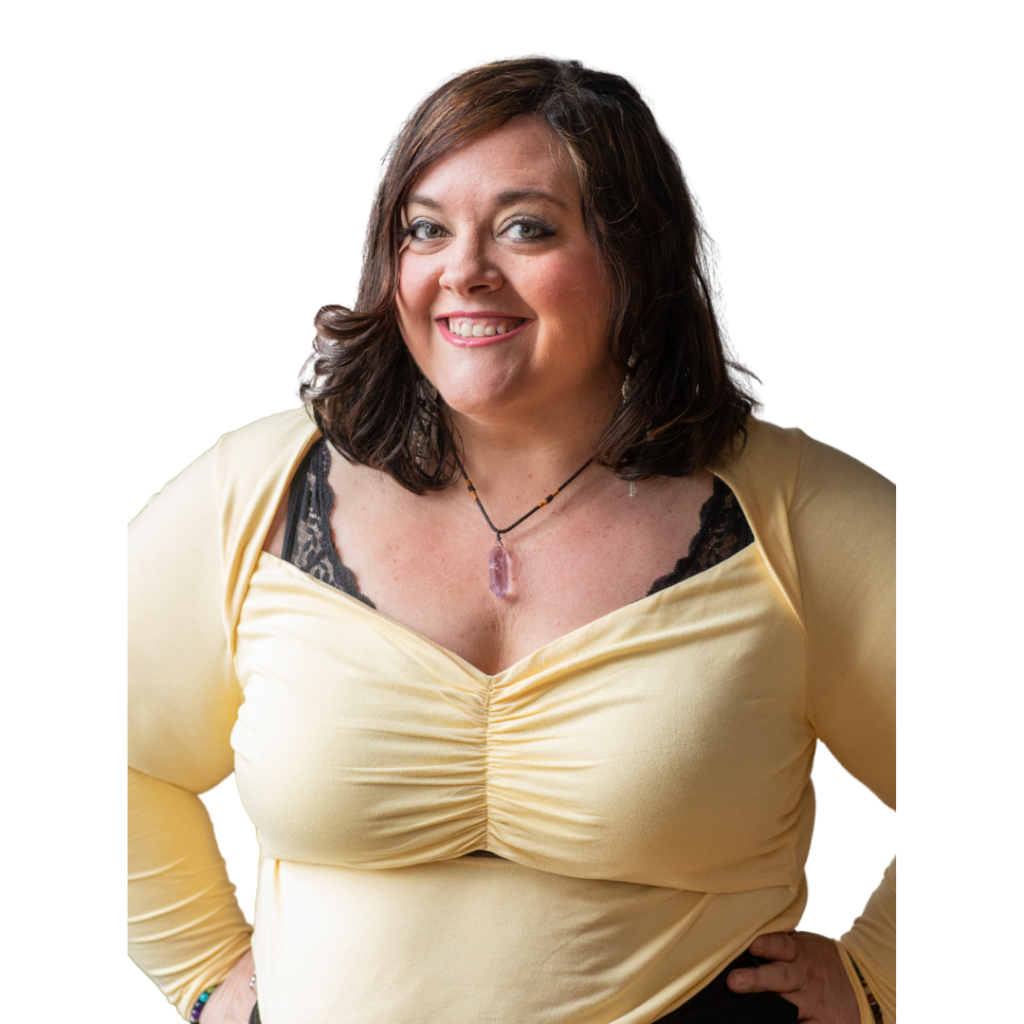
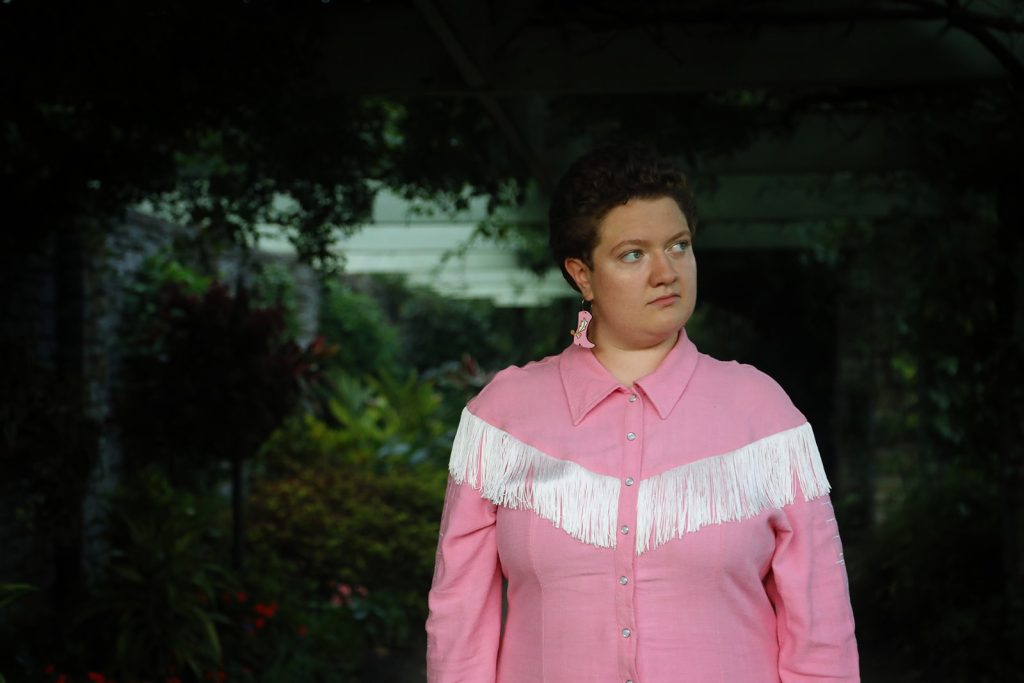
Communing with the Divine: Trans Folk Artist Larah Helayne to Headline 2023 Queer Kentucky x Mile Wide Pride Kick-Off Party

Story by Sydni Hampton she/they

Photos by Ash

When I first met Larah Helayne (they/he) at a bar during a show I was performing in, I was just drinking up the compliments and praise a drag queen receives throughout the night. I had no idea this random introduction would lead to me ending up being a self-proclaimed STAN of one of Kentucky’s brightest songwriters. Before I’m anything else, I’m a huge fan of Larah’s. Their music has touched me in ways I can only describe as life-altering. I count myself extremely lucky to call Larah a close personal friend now, because that means I can demand to hear the demos of whatever they’re working on.

I discovered his first body of work, “Roots,” on Spotify when they followed me on Instagram and I saw in their bio they had a link to the album. I listened to every song, but it was “Roots” that really resonated with me. Helayne is a proud queer Appalachian. “Roots,” released in 2018, spoke to me as a fellow Kentucky queer, and someone who champions the importance of Kentucky queers staying in the state to effect change and inspire the next generation of scared queer kids, like us, who’d have been so pleased when growing up to see queer and “othered” adults thriving.

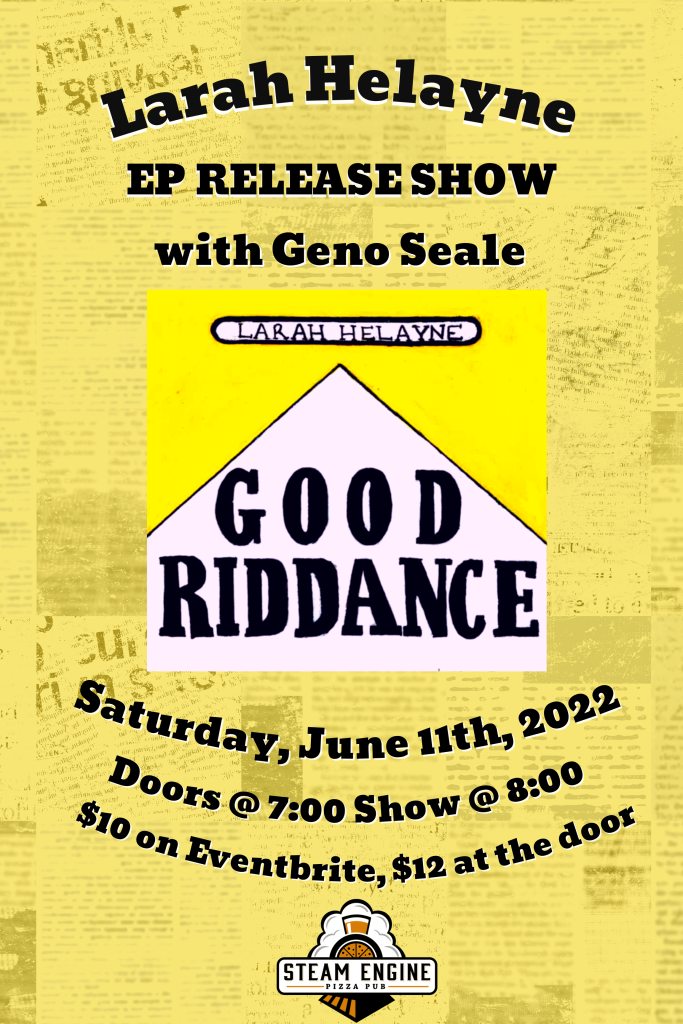
Helayne has been very busy since then. They have since released a second EP, “GOOD RIDDANCE,” in June 2022; have toured around the eastern United States promoting the EP; playing South by Southwest; and have most recently wrapped up touring with Paisley Fields. Despite being busy, Helayne never stops creating. Now, they are working on their first LP. One of the new pieces is called “Communing with the Divine.” The song celebrates their transmasc lover and his body as it exists, wishing they could “teach him how to love his body, if only you could see it through my eyes.” When I first heard the song, I wept. I’m a hopeful romantic and the song captures so purely the love they feel for their partner, and it feels relatable to anyone who’s ever loved someone who experiences dysphoria. 

Helayne’s songwriting always captures the nuance in existing and loving as a queer person. Rather than simply singing about the pain and hardship queer people experience, he chooses to also celebrate their queerness, their transness, and their roots in the Bluegrass. These themes continue to be present in what is shaping up to be their best record yet.

I sat with Larah and we talked about their upcoming record, their big move to NYC in pursuit of a label, and challenges they’ve faced as a trans masc artist in the Bluegrass.

SH: So, diva, what’s the tea with this record? When do we finally get to hear it?

LH: Well, I’ve independently released my records, and it’s been very difficult. Everything’s done, I’ve written the songs, I just need help getting into the studio to record everything properly.

SH: What is it that you need? A label?

LH: Yeah, I’m hoping that moving to New York I can find a label or make connections to help me get in the rooms I need to be in.

SH: It breaks my heart to see you go. New York could be the spot for you, though.

LH: Yeah, I love Kentucky, but I’ve had so many challenges due to being queer, and even more when I came out as trans. I’ve lost out on gigs since coming out, some that I’ve worked for years and suddenly I’m no longer welcome. Then there have been others that I’ve gotten pushback, including the one I wanted you there for. I was told ticket sales were low, but they were not and what really happened is they were afraid of protesting. I think New York will pose fewer challenges for me.

SH: I didn’t know all of that. I know there for a time you were doing really well here.

LH: During Pride season, yeah. My favorite gigs are ones where I’m [the only] musician, and I’m surrounded by drag queens and queer people. Those gigs are seasonal, though. When I visit New York, I can line up gigs [like that.]

SH: I am manifesting for you. I hope that you get to make this record. You know I lost it hearing the demos.

LH: I wanted to write a tactful, beautiful depiction of T4T (transgender for transgender) relationships. Simple Southern Life has a few love songs-

SH: Well, Communing with the Divine is MY T4T anthem.

LH: After this I want to make a disco record.

SH: Please are you kidding? We LOVE the nightlife. We LOVE to boogie.

LH: On the disco round. Yeah, a disco record. I have so much I want to do. I want to make the music I want to make, I want to share my connections with other Appalachian artists. I want to just exist and not be scared all the time and start a life with my partner where we can grow and thrive. I think time away from Kentucky will also remind me of the things I love about it. Touring taught me so much; I made so many friends on tour and now we are all scattered across the country. Part of growing up is figuring out how to exist with your heart torn in little pieces all over the world. I know I’ll miss it here. It’s true.

Larah and I ended the pseudo-interview here and began making plans to see each other before they came to town for the Queer Kentucky x Mile Wide Pride Kick Off Event, and I did, in fact, cry at ‘Communing with the Divine.’

Take a listen to Larah’s music here and if you’d like to support Larah in securing studio time to master this new record, you can donate via Venmo @LarahHelayne.

Queer-led Appalachian Arts Alliance transforms Hazard

Photos by Bearykah Shaw

Hazard made a decision in 2013: they wanted more art in their community, and an arts organization to spur it on. With recent funding from the Foundation for Appalachian KY, they had the means to make it happen. “The arts in the schools were dwindling every single day,” Tim Deaton – Executive Director of the organization that came to life out of this consensus – recounts the formative steps taken to build up the art scene: “A group of concerned citizens wanted to see the arts thrive in the community. They wanted a place for the arts to have a house.” 

The Appalachian Arts Alliance was formed, but fell into a rut of stagnancy over a few years’ time. Deaton – originally a member of the Board of Directors – moved to the position of Executive Director in 2019. He’d noticed the lull in programming and sought to revitalize things. Despite a paycut and a lack of nonprofit know-how, he knew it was the best move. “[I thought] ‘I should just resign and take this job myself’. I wasn’t expecting other people to say, ‘You know, you’re right’”. 

As soon as Deaton took on his new role of Executive Director, the pandemic hit. Along with nearly every other business and organization at that time, the Appalachian Arts Alliance had to shut down. In response to this road block, Deaton sank all his energy into working on the dilapidated Artstation building, where the bulk of AAA’s programming takes place: “I’m an extreme extrovert. I like to be around people and be busy. Through COVID I came to the building every day and worked with the construction crew.” 

The work paid off. On July 11, 2020 the Artstation hosted an open house to 150 people in their courtyard. There was an unmatched fervor for the programming on deck. “The timing of it was the biggest catalyst. People were feeling so scared and alone because of the pandemic,” recalls Deaton. The isolation brought on by COVID stirred up an increased demand for intracommunal activity. “The citizens in the community showed up and showed out.” 

Deaton helped breathe new life into the Appalachian Arts Alliance – a once immobile arts org, spinning its wheels, in debt over a ramshackle building. It now serves as a busy hub for learning, creativity, and connection: ”It’s grown and grown. We are now out of capacity to host anything else. Between our individual events for the community, classes, and office hours, we have zero space.” 

But the AAA does not work single-handedly. It is integrated within Hazard, acting as a bullhorn for its residents. Deaton explains their multi-faceted approach: “[There are] so many different ways that our programming comes about. Sometimes it comes from someone walking in off the street and saying ‘Hey, have you heard of this type of art? I would love to do that.’ We’ll look for people across the state who do that type of art or craft, and if we don’t find someone, we learn it and teach it ourselves. We ask our community a lot: what do you want more of? Visual art? Community events? This kind of class?”

They are a conduit for fostering new ideas, while also serving as host – providing infrastructure for new visions to take life. The benefits reaped by this kind of robust arts programming are innumerable. The Appalachian Arts Alliance tethers the communal fabric of Eastern KY together. They offer a bridge to the history of Hazard. They conjure self-esteem in shy, curious kids. They inject color and life into the city’s streets.  

When asked how art changes a community, Deaton doesn’t miss a beat: “We are prolonging our heritage and passing that on to other generations. We also work on developing confidence in children. Having a student who is doubting themselves or is confused or uneasy and having them work through that and develop confidence has the ripple effect of developing initiative [for them] to do bigger and better things.” 

AAA sees the Artstation as a place where all are welcome, an inclination toward self-expression need be the only prerequisite for admission. Deaton – gay himself – recognizes the importance of providing support for marginalized folks who may often feel ostracized.

“If you’re in the LGBTQ community you’ve [probably] been hassled, and it can be scary to be comfortable in your own skin. One of the biggest things that I preach is: it doesn’t matter what you do or say, we are here to accept you as you come. There is zero tolerance for any harassing or bullying – anything but love or respect. And if you can’t get down with that then that isn’t the place for you.”

AAA facilitates a space where belonging and creativity lock in side by side, and from there, a special magic can unfold: “Through that we’ve kind of become the place for weirdos. No matter what line you come up in an improv or song you sing, we are going to applaud you at the end. A lot of orgs focus on perfection or extreme discipline, that’s not what we do here. [We want you] to be comfortable in your learning and be comfortable with what you share with us. We’re all human and none of the other stuff matters.” 

Tyler Childers’ newest single depicts gay love in rural Appalachia

Editor’s note: This story was published in July 2023. Some details may have changed since then.

PRESS RELEASE

A person standing next to a horse

Description automatically generated

July 27, 2023—Rustin’ In The Rain, the new album from renowned singer, songwriter and musician Tyler Childers, will be released September 8 on Hickman Holler Records/RCA Records (pre-order/pre-save).

Of the album, Childers shares, “This is a collection of songs I playfully pieced together as if I was pitching a group of songs to Elvis. Some covers, one co-write, and some I even wrote in my best (terrible) Elvis impersonation, as I worked around the farm and kicked around the house. I hope you enjoy listening to this album as much as I enjoyed creating it. Thank you. Thank you very much.”

In advance of the release, the first single, “In Your Love,” is out today—watch the song’s official music video HERE. Written and creative directed by Silas House (with a story idea by House and Jason Kyle Howard), the video was directed by Bryan Schlam and stars Colton Haynes and James Scully and depicts a timeless love story of two men set in rural Appalachia in the 1950s.  

House is a New York Times bestselling author, current Poet Laureate of Kentucky and recipient of the 2022 Duggins Prize—the largest award for an LGBTQ writer in the nation. Of the video, he shares, “As a gay teenager who loved country music, I could have never imagined seeing myself in a video. That visibility matters. There have always been LGBTQ people in rural places and finally we’re seeing that portrayed in a country music video. Tyler and I both felt the attention to detail about rural life was very important, so we made sure that the house and the people looked realistic for the time period instead of the stereotypes of country people that have become so ingrained in the public consciousness. We used our own family pictures as references. We wanted to tell as complex a story as we could in four minutes, not only about a gay couple, but also about rural people. We wanted to show their joy and their sorrow—all the things that make up a complex life. Too often simplistic notions are pushed about both rural and LGBTQ people, so we did everything we could to make this story as rich and layered as possible.” 

A group of people sitting on grass

Description automatically generated

Tyler Childers and The Food Stamps, photo credit: Sam Waxman

Childers and his longtime band, The Food Stamps—James Barker (pedal steel), Craig Burletic (bass), CJ Cain (guitar), Rodney Elkins (drums), Chase Lewis (keyboards) and Jesse Wells (guitar, fiddle)—are currently in the midst of a 30-date sold-out nationwide tour. Upcoming stops include two nights at Radio City Music Hall, Boston’s Leader Bank Pavilion, DC’s Merriweather Post Pavilion, two nights at Colorado’s Red Rocks Amphitheatre as well as two newly announced New Year’s Eve shows at Lexington’s Rupp Arena. The Rupp Arena shows will be available for pre-sale beginning next Wednesday, August 2 at 10:00am local time with general on-sale starting Thursday, August 3 at 10:00am local. See below for complete tour details.

The new album follows last year’s triple album, Can I Take My Hounds to Heaven?, which featured eight songs presented in three distinct sonic perspectives—Hallelujah, Jubilee and Joyful Noise. Released to widespread acclaim, Esquire praised, “Who’s doing it better than Childers in roots music these days? No one,” while the Associated Press declared, “fearless exuberance…one of country music’s most compelling and unpredictable artists” and NPR Music asserted, “eight songs so good he had to record them thrice.” Before Hounds, Childers released 2020’s Grammy-nominated surprise album, Long Violent History, which NPR Music called an “explicit and remarkable stand in solidarity.” His two previous releases, 2019’s #1 Country Squire as well 2017’s RIAA Platinum debut, Purgatory, were released to overwhelming critical and commercial acclaim. In the years since his debut, Childers has earned two Grammy nominations and has been featured on “CBS This Morning,” “The Tonight Show Starring Jimmy Fallon” “Jimmy Kimmel Live!,” “Late Night with Seth Meyers,” NPR Music’s Tiny Desk Concert series and “Anthony Bourdain: Parts Unknown.” 

TYLER CHILDERS CONFIRMED TOUR DATES
BOLD on-sale August 3 at 10:00am local time

August 2—New York, NY—Radio City Music Hall* (SOLD OUT)

August 3—New York, NY—Radio City Music Hall* (SOLD OUT)

August 5—Boston, MA—Leader Bank Pavilion (SOLD OUT) 

August 6—Portland, ME—Thompson’s Point† (SOLD OUT)

August 10—Philadelphia, PA—The Met (SOLD OUT) 

August 11—Columbia, MD—Merriweather Post Pavilion‡ (SOLD OUT)

August 13—Raleigh, NC—The Red Hat Amphitheater+ (SOLD OUT)

August 15—Charlotte, NC—Charlotte Metro Credit Union Amphitheatre# (SOLD OUT)

August 16—Charlotte, NC—Charlotte Metro Credit Union Amphitheatre# (SOLD OUT)

August 18—Wilmington, NC—Live Oak Bank Pavilion at Riverfront Park+ (SOLD OUT)

August 19—Charleston, SC—Credit One Stadium+ (SOLD OUT)

August 20—Bethel, NY—Catbird Music Festival

September 21-23—Lewisburg, WV—Healing Appalachia

September 27—Morrison, CO—Red Rocks Amphitheatre+ (SOLD OUT)

September 28—Morrison, CO—Red Rocks Amphitheatre^ (SOLD OUT)

September 30—Greenwood Village, CO—Fiddler’s Green Amphitheatre§ (SOLD OUT)

December 30—Lexington, KY—Rupp Arena 

December 31—Lexington, KY—Rupp Arena

*with special guest Elle King 

†with special guest Margo Price

‡with special guests Drive-By Truckers and Abby Hamilton

#with special guest S.G. Goodman

+with special guests S.G. Goodman and Abby Hamilton

^with special guests S.G. Goodman and Wayne Graham

§with special guests Wynonna Judd and The Travelin’ McCourys

www.tylerchildersmusic.com 

For more information, please contact Asha Goodman 615.320.7753,
Catherine Snead 615.320.7753 or Carla Sacks 212.741.1000 at Sacks & Co., [email protected], [email protected] or [email protected].

Queer activists stare down a barrel of hate in Eastern Kentucky park

by Spencer Jenkins
[email protected]

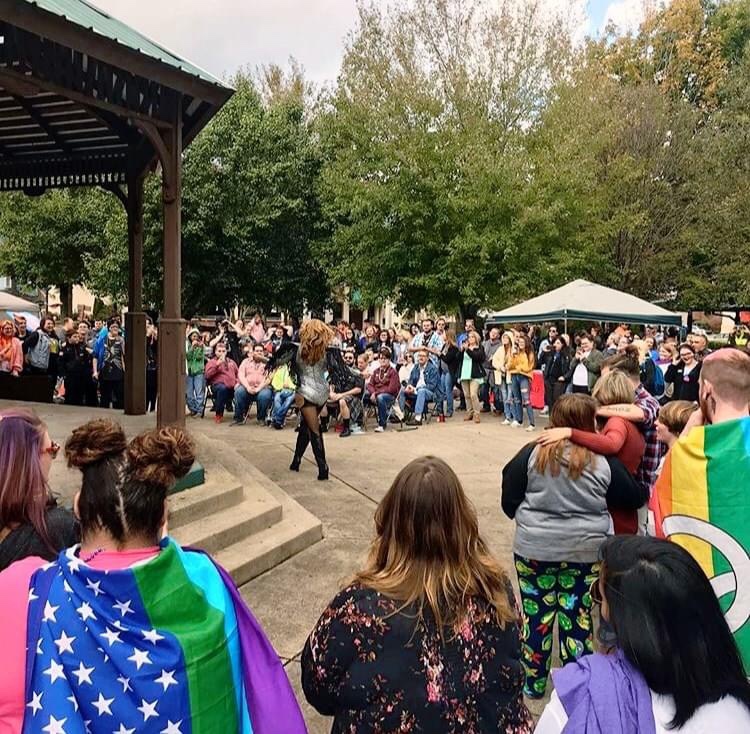
At Sanders Park in Corbin, KY, members and activists of the LGBTQ+ community rallied together on June 3rd to support one another. What should have been an uplifting event turned unsettling when faced with animosity and hate.

LGBTQ+ activist Trent Osborne said he and his friends were having a peaceful protest in direct action against hateful legislation plaguing Kentucky and the rest of the United States.

“The goal originally was to get a lot of people to come together and show that there’s a community in Corbin that will protect you,” Osborne said.  “I think is necessary, especially because it doesn’t feel like there are enough resources for people that are queer or LGBTQ.”

photo by Jonas Ray

Not too long into the celebration, Osborne’s friend, James Hensley, was approached by two men, and an altercation ensued. According to Osborne, two men approached —  one on a motorcycle and the other in a car. 

“They flipped us off and proceeded to pull over and approach us as if planned,” he said. “They began spouting slurs and hateful slander. The F-slur was said on multiple occasions when the two men approached, they each had their hands on their guns which were hidden in their pockets.” 

Osborne immediately noticed and confronted them, “asking why on earth they’d need to have weapons as none of us were armed nor threatening them,” he said. 

In the video that has gone semi-viral on social media, James can be seen bucking up with one of the men. One man appears to admit to carrying and shows a Ku Klux Klan membership card and spews threats in James’ direction.https://www.tiktok.com/t/ZTRoETWLM/

TRIGGER WARNING: VIDEO HAS HOMOPHOBIC SLURS AND AN IMAGE OF GUN

“I called him out for proudly brandishing a KKK card, and when I did, they laughed and were proud to be members,” Osborne said. “They even proudly proclaimed to be homophobic and racist. At one point the man who later pulled his weapon in the altercation looked at me and said, “I’ll burn you and that sign (a pride sign).”

In the video we can see the man with the card put it into James’ face and touch him, so James attempted to move his hand away from him. In doing so, the man began to slap at James, and then ultimately reached for his weapon, and unstrapped the holster in his pocket on the back of his pants. It can also be seen that the LGBTQ+ activists called him out for this. They begin screaming to others for help because there is now a gun threat. 

Hensley said he believed exactly what the men were doing.

“They wanted to come there and bait us into fighting them so they could get away with murder,” he said. After I smacked his hand away, I’ll be honest, I was ready to fight. Then, I noticed his hand on his gun.”

photo by Jonas Ray

Eventually, the video shows one of the agitators yelling, “come take care of these faggots then!” when the gun officially leaves the holster of one of the agitators.

The police demanded the man drop his weapon, and confiscated both it and the other man’s gun, which wasn’t holstered and just hidden in his shorts pocket. 

“They take the guns apart and remove the bullets that were in the chamber and ready” Osborne said. “The police then did  an investigation to find out what is happening, then ask us to leave as we have no permit, and they escort the men to their vehicles, giving their weapons back and send them off.” 

The Corbin area is also the birthplace of the bestselling novelist, Silas House. The Lark Ascending author is vocal about LGBTQ+ rights in our state and said this incident is especially sad for him to see.

“I know how hard so many people in Corbin have worked to make the town more welcoming and progressive,” House said. “There’s so much great grassroots work happening there. And I’m especially proud of these young people because they are brave to be among the first to do this kind of rally in Southeastern Kentucky. It’s one thing to speak up in places like Lexington and Louisville, but quite another to do it in a place where there is limited anonymity and often much more pushback.”

The identities of the agitating men have not been officially released an no arrests have been made. Attempts for comment from the Corbin Police Department were unsuccessful by publication time.

HEALTH EQUITY: Tegan and Sara Foundation, GLMA bring LGBTQ+ Healthcare Directory to Americans and Canadians

by Sophia Lee
she/they
[email protected]

When we think about healthcare, we often think about the doctors and nurses that care for us in times of need. However, we rarely think about all the environmental components that go into acquiring and producing a genuine medical care experience. Does my doctor understand the importance of my pronouns? Can they prescribe hormone replacement therapy (HRT) for me? Do they actually care about the health disparities that come with being BIPOC?

Steps in fresh off the runway, the LGBTQ+ Healthcare Directory.

“There is no escaping how broken the US healthcare system is,” said Jessica Halem, Senior Director of eidos, an LGBTQ+ Health Initiative at the University of Pennsylvania.” “This directory is like a lifeboat in really rocky waters. These are complicated conversations, systems, and structures that we have to work to change so that people are getting what they need and deserve. But in the meantime, we all deserve dental care, we all deserve a pap smear, we all deserve cancer screenings, hormone therapy, and good therapists to help us navigate the waters. Consider this just the lifeboat to get you there while you’re riding out those waves.”

Jessica Halem, Senior Director of eidos, an LGBTQ+ Health Initiative at the University of Pennsylvania

These are the types of questions many queer folk ask themselves before searching for the right type of care. The answers can often be discouraging to people looking for providers that can give affirming, inexpensive, and equitable care. Despite there being several healthcare professionals who can provide these things, there are limitations preventing access to them. Many providers don’t currently have themselves listed as LGBTQ-affirming, weight-inclusive, sex-positive, racially equitable, etc. If they do, there are very few ways for us as patients to find them other than through word of mouth.

With the combined help of GLMA: Health Professionals Advancing LGBTQ Equality and The Tegan and Sara Foundation (the Tegan and Sara Foundation also funded projects for Queer Kentucky), compassionate individuals, including Jessica Halem, have begun to bridge the gap between queer folx and their affirming healthcare access. Halem, along with a team of several sponsors and collaborators, has worked tirelessly to put together a resource that all LGBTQ+ individuals may use to address any of their healthcare needs. 

Halem, located in Philadelphia, Pennsylvania, was born and raised in Kent, Ohio. She is an impacted individual who actively advocates for LGBTQ+ healthcare justice. She currently serves on the Board of the Tegan and Sara Foundation and, previously, ran the Lesbian Community Cancer Project in Chicago. You can learn more about her passion for queer healthcare here.

“We went through a lot of conversations about research on what to call this. A lot of the research that we heard from people was sometimes we can get a little too creative with our naming. We sort of went down that road about calling it something fun or euphemistic, and a lot of what we heard from patients was ‘I just want clarity. I want transparency. I want trust and honesty, I want to know what this is.’ And that’s why we went with the very simple name, LGBTQ+ Healthcare Directory.

LGBTQ+ Healthcare Directory logo

“What you see in front of you is a website that is trying to never be a place that causes more harm, or more pain than what LGBTQ+ people are already facing when it comes to the healthcare system. I’ve been doing this work for over 20 years. We have a lot of trauma. We have a lot of discrimination and bias that we are constantly juggling in our healthcare system. So as queer and trans people who built this, we are trying to minimize and never create more harm. So what you see is hopefully a great deal of honesty, transparency, and ease of use, so that this doesn’t cause more pain. We don’t want anyone to get anxious using this website, we want it to be low anxiety,” Halem stated. 

The LGBTQ+ Healthcare Directory is a free, online database of any healthcare providers who cater to the LGBTQ+ community. This resource provides aid to any individual experiencing healthcare disparities. The website itself is easily navigable with there being multiple options for search routes, including searching via zip code, specific health need, care topics (gender-affirming care, trans & nonbinary health, etc.), and six provider approaches. These six categories include trauma-informed care, sex-positive, racial equity, informed consent, weight-inclusive, and harm reduction. 

“These kinds of approaches, we believe, are really where the future of LGBTQ+ healthcare is going. We want this directory to be future-oriented. We want to see more providers signing up, who are weight inclusive. We want to see more providers taking responsibility for things like trauma-informed care and harm reduction. I know in Kentucky, you all are leading the way in thinking about harm reduction. And we think about that on many levels, right? We think about that when it comes to drugs and alcohol, but we could think about harm reduction approaches on many levels when it comes to our health and wellness. We’re trying to create a movement of providers committed to healthcare the way we know that people really would need it, be responsive, and best served,” Halem recounted the thoughtfulness that went into the creation of these categories. 

The directory itself first began as a project by GLMA that started “when the internet began,” according to Halem. GLMA started out as a collective of LGBTQ+ healthcare professionals with a membership directory that all staff has access to use when people would call in looking for an LGBTQ+ doctor. It was never a resource that was widely available to the public but over the course of 15 years, GLMA began expanding this online through their own website, then into the directory itself as a result of the advancements in technology over time. 

On the provider side of things, healthcare professionals can utilize the website to sign up as they please. Providers can put as much or as little information as they choose, and they can even choose to remain anonymous. Halem and her team are hoping to grow this database as a way to increase education and access for LGBTQ+ individuals seeking care as well as providers looking to expand their knowledge on these subjects.

“HIV has a certification – that’s a test they all take. We don’t have anything like that for LGBTQ+ healthcare. We don’t have that for trans healthcare or gender-affirming care. We don’t have it for any other aspect of LGBTQ+ care. And we’re working on that. Our hope for this year, 2023, is to really engage in a major public relations push to reach a diverse range of providers of every kind. We want to see not just MDS and DEOs but we want to see nurse practitioners, physical therapists, and dentists. We want to see every kind of healthcare provider, who is ready to make a difference in LGBTQ+ people’s lives, join this directory, join the movement, become a part of what is this growing LGBTQ healthcare movement,” Halem said.

The directory also features a resources section, where users can read articles about different healthcare subjects to help them assess what their needs may look like before they seek out a provider. 

“We would love to see the entire state of Kentucky and Appalachia, in general, be a part of this. I would love to see this directory full of providers from Appalachia. I would love to make sure that those queer and trans folks living in Appalachia could find a provider and I know they might have to drive or travel far, but I know, for people in Appalachia, if there is the right kind of doctor that you need to get great care that is sensitive and appropriate for your life, people are willing to travel. So let’s get as many providers from around Appalachia as we can!” she said.

Spread the word about this new, amazing resource for queer folx, and find an LGBTQ+ healthcare provider near you with the directory now. If you are a provider in the Kentucky area and beyond, please join. https://lgbtqhealthcaredirectory.org/login/?signup=true&redirect_uri=%2Fverify

The Lesser-Known Pioneer: Lige Clarke and the queer legacy left behind

by Brandon Cooper
he/him
[email protected]

It was just two months since the United States was plunged into World War II. Temperatures were below zero in the hollers of East Kentucky and, while a nation mourned, James and Corinne Clarke of Cave Branch Hollow in Hindman, Kentucky, welcomed a son to the world. Elijah ‘Lige’ Clarke would live out his days as a leader in the Gay Rights Movement – one deeply ahead of his time.

Who was Lige Clarke?

After graduating from Eastern Kentucky University, Clarke joined the United States Army. By the 1960s, he was working in the U.S. Army’s Chief of Staff’s office at the Pentagon and held nine different security clearances (the lowest of which, he’d brag, being Top Secret). Clarke worked a highly sensitive government post while actively protesting the U.S. at a time when very real, physical and professional consequences could occur. 

Clarke and his partner, Jack Nichols met in Washington, D.C. at a gay bar called “The Hideaway.”

Through their activism and other queer networking, Clarke and Nichols quickly grew to gay stardom amongst urban queer communities. Clarke joined a small group of Mattachine Society members in Washington, D.C. — one of the first nationwide groups for LGBTQ people that began during the “homophile” movement of the 1950s. The D.C. chapter staged the first openly gay picket in front of the White House on April 17, 1965 (four years before the Stonewall Uprising). Clarke allegedly hand-painted nine of the ten signs displayed at the protest, and his activism was only just beginning. 

The Activist & Writer

In the 1950s, Senator Joseph McCarthy stoked mass fear and paranoia about gangs of gays taking over the American government from within – the lavender scare. The outcome? Mass firings of gays and lesbians from government jobs, enraged hatred towards difference, and angry queers. Clarke and his network took action.

Despite taking some of the greatest risk of his protesting peers, Clarke was often accused of “not being serious enough about his activism.” Perhaps much of this discontentment in the early queer movements held for Clarke was rooted in their lack of understanding of his Appalachian foundations. 

Clarke’s queer identity, and his persona overall, was largely influenced by his Appalachian upbringing. Clarke often rejected the idea of marriage and had concern for his cohorts’ incessance on equality. For Clarke, liberation for queers would come only “when society in general became sexually liberated.” Discounting labels and ‘cornering,’ when asked what his sexual preference was, Clarke simply stated, “My preference is for Jack Nichols.”

It was his understanding of society, and patience for progress, that allowed Clarke to speak and write emphatically about social and political happenings in the queer community. In the book, I Have More Fun with you Than Anybody, co-authored by his partner, Jack Nichols, Clarke and Nichols allude to the inefficacy of extremism – from any side of a battle: “right-wingers, we know, are only slightly more demented than left-wingers.” 

Clarke was proud of Appalachia, proud of his home, and proud to share it. He was said to have used his ‘hillbillyness’ strategically, leaning into the stereotypes held about Appalachians. 

He was temperate – reserved. 

A co-founder of, GAY, the Nation’s first LGBTQ newspaper, Clarke used his “lived beliefs” to take on large social and political issues while centering his work around personal identities.

A Legacy Continues

Now, 80 years since Clarke’s birth, Lora Smith, chief strategy officer for the Foundation for Appalachian Kentucky, and Baylen Campbell, director of community impact for Invest Appalachia, co-founded the Lige Clarke Liberation Fund to memorialize and continue Clarke’s legacy. The fund, an arm of the Foundation for Appalachian Kentucky, will share the work and ideas of the “lesser-known pioneer,” Campbell said. 

Smith added that she is optimistic about the future for queer Appalachians. Growing up in Southeastern Kentucky, many queer folks were told their only option would be to get out. “Now…folks [her] age and younger [are] returning to the mountains to live and build better communities.” Which is exactly why building the infrastructure – social and physical – for queer people to succeed and thrive in Appalachia is so important.

The need for queer people in Appalachia is broad, Campbell explained. 

“It is important to build support and infrastructure for long-term stability for queer Appalachians,” he said making a nod to Clarke’s dedication to community-centric solutions. “He never stopped coming home – never.” 

The work Smith, Campbell, and Clarke’s nephew, Eric Rhein, are doing is particularly important given the recent attacks on queer people in conservative areas like Appalachian Kentucky.

Queer people in Appalachia have notably stood up for their communities – even when their communities disparaged them. Smith described this as “modeling a different type of acceptance and compassion – giving people the empathy that maybe you yourself were not shown – is a special part of the queer Appalachian community.”

Political, social, and economic solutions require perspective and understanding.

The fund’s first group of grantees was announced in Hazard at the Big Idea Fest in the fall of 2022. Funds of $5,000 was dispersed for flood relief to queer farmers, Holliday Farms. The STAY Project: Appalachian LoveFest received $1,500 for its music and art festival for youth in Harlan, Kentucky. The fund also provided Pikeville Pride $1,000 to support their local efforts.

“It’s important to us to ground the fund in Lige’s legacy as a means to acknowledge that queer and trans folks have always been a part of mountain communities and there are queer and trans people in Appalachia’s future,” Smith said. “We want to support fostering, developing, and promoting queer leadership within regional nonprofits, support the creation of queer spaces, art and media, and provide queer youth with financial and other resources to seek educational and personal development opportunities that they might not otherwise have access to.”

Political, social, and economic solutions require perspective and understanding – they require that all stakeholders have a seat at the table. For many queer Appalachians, the resources they need to build their seats are simply lacking. The Lige Clarke Liberation Fund honors a pioneer of the gay rights movement – a son of Appalachia – and carries his legacy on to build the strong, liberated Appalachian communities Clarke envisioned. 

Eastern Kentucky floods: Stepping up to help friends in need

by David C Dixon
he/him
[email protected]

Imagine being over a hundred miles from home and wake up to your watch buzzing flood warning. That was my experience last Thursday morning. Living near the Poor Fork of the Cumberland River, this isn’t unusual after heavy rains. Thankfully, Cumberland did not experience any major flooding or damage this go around, but our friends and family in surrounding counties did. Several agencies across the Commonwealth and beyond have stepped up to help including Cumberland and its residents. Scrolling through social media, there are posts from people all over offering their services and support. 

In this time of need, folks aren’t asking political party, religious affiliation, or sexual identity, they are asking the only question that should be asked, “how can we help?”

A Facebook post from Assistant Whitesburg Police Chief Justin Hunsucker went viral asking for assistance with police vehicles after several departments lost numerous vehicles to flood damage. Departments not only from Kentucky but from other states have stepped up to not only provide vehicles, but to provide manpower so officers could rest and attend to their families and their own damages.

Scott Edwards, Mayor of Hurricane, WV said, “After hearing about the devastating floods that affected our friends in Eastern Kentucky, I made contact with the Whitesburg Police Department to find out what was needed and what we could do to help. I was told about the loss of police cruisers in the city and Letcher County, so I called my Police Chief and we decided to donate one of our spare cars.” 

The Office of Emergency Management from Hurricane, WV stepped up to send the Mobile Infrastructure Response Team. Edwards noted, “this team is currently working on water lines, water plant, sewer lines, clearing roads and other needed tasks.” 

Edwards remarked, “We are blessed here in Hurricane, WV and are thankful we are able to help others. We continue to think of our friends in Eastern Kentucky and look forward to a full recovery in the future.”
A town ravaged by a tornado in the late 90s hasn’t forgotten that folks came to their aid and they want to pay it forward. Mount Washington, Kentucky is providing personnel relief and cruisers to the area. Police Chief Tim Morris said, “our community was devastated by a tornado in the late 90’s and so many people reached out to help us. The Mayor and city leaders were involved back then and have not forgotten. We all must reach out to help one another in a time of need and that’s all we’re doin!” Morris added, “Mayor, Barry Armstrong, is the deciding factor that allows me to do what I do. We all work together so well and no one person looks for any credit. This isn’t about that for us. Purely about helping others in need.”

In nearby Harlan County, local educator Gina Stewart and some of her friends and colleagues quickly got to work to organize an online auction to provide donations to the relief efforts in Letcher County. Several local businesses and entrepreneurs have donated their services or items to the cause. Stewart said, “We are doing the auction to help those in Letcher County that so desperately need our help. We are all one tragic event away from being in the same shape. I hope if the roles were reversed, Letcher County would do the same for us.”

Former Secretary of State, Allison Lundgren Grimes visited the area to provide assistance and donations. Grimes said, “You don’t have to have a title behind your name to make a difference.It’s in these darkest of times that we the brightest of stars.  Indeed, right now it’s ordinary folks that are doing extraordinary things. I hope to lead by example and encourage others to do the same.  Our fellow Kentuckians are hurting and we, collectively, can help heal.”

State Representative Cherlynn Stevenson, a Knott County native knew she had to “come home” and help. “It was a no brainer,” she commented. She organized relief efforts through Toy Chest, a nonprofit board she sits on along with efforts of AFT120 and private donations. Her group traveled with a Uhaul full of supplies along with some coloring books and crayons to occupy the kiddos. Stevenson remarked, “We need to pull together and work together, the spirit of unity is strong across the commonwealth.”

Traveling to Eastern Kentucky was Jenn Ward. While driving through Breathitt County, we saw two heifers and a big bull on the side of the road. We pulled over, realizing they were out, to see if we could get them back in. Going into action, the group of ladies was able to get the cattle back into their field and use an old gate that had been washed up to stretch out and connect it to some barbed wire to keep the cattle off the highway. About the time we were finished, the jailer and the animal control officer pulled up behind us. They looked a little concerned, so I immediately raised my hand and yelled, “It’s ok, she’s a farmer, and we’re teachers, and she’s a representative, we’re just trying to help!” And we all laughed. It was said that the man who owned the cattle had lost everything in the flood. 

Ward reflected on her day, “The people we met and saw today had an undeniable spirit of survival and strength that you could just feel welling.” “Flood ravaged Eastern Kentucky will need a lot of help, but I have no doubt they will build back better, because that’s just who they are.”

Kelly Green has offered to come and help folks clear their driveways and roads. When asked why, he replied, “That’s an easy one. I grew up in Jenkins and even though I don’t live there any longer I still love my hometown people. I grew up with them. They’re my family. There was no chance that I was not going to help. So in the end these mountains will always be home and I’ll always come back to help.”

Eastern Kentucky will overcome and recover from this tragedy with a little help from friends near and far. Mountain people are resilient and strong.

Great Meadows Foundation uplifts Queer artists alongside Queer Kentucky: Ceirra Evans

by J. Cletus Wilcox
he/him
[email protected]

Visual artists are a vital part of Kentucky’s Queer community. Thanks to the Great Meadows Foundation, which was launched in 2016 by contemporary art collector and  philanthropist Al Shands (1928-2021) in order to critically strengthen and support visual  art in Kentucky, Queer Kentucky will be featuring interviews with a number of these  artists.

It is the quest of the artist to explore and to report back to the world. Artists are storytellers at their core and Ceirra Evans is cut from this cloth. Through her work as a painter, Evans dives deep into herself and her own journey examining the complicated and often difficult experiences of coming of age queer in rural America. Her work tells stories rarely told. Stories of selflessness and sacrifice and the healing that is possible between two worlds seemingly at odds.

Originally from Bath County, Kentucky, Evans moved to Louisville in 2017. She is a graduate of Spalding University with a Bachelor’s degree in liberal arts. Evans’ artistic practice lies within the intersection of painting and storytelling. Her stories are deeply personal and reflective of her own experiences growing up queer in the hills of Appalachia. Following a narrative that is ultimately moving towards forgiveness and healing between herself and her home, Evans’ work has a vulnerability to it that is both direct and yet gently passive. She describes her earlier work as an expression of cynicism towards Appalachia and acknowledges that many of the subjects in these paintings are her kin. It is this commitment towards uninhibited self-expression that makes Evan’s storytelling tangible and truly special.

For Evans the story comes first. She credits her double major in art and history with giving her a more complex vernacular to develop the content of her work but it is evident that her strength in storytelling also comes from her ability to self-reflect and to think deeply about her life and the people and places that fill it. Evans’ newer body of work is a step towards a posture of empathy rather than cynicism. She chooses to find the binding commonality between her own queerness and the conservatism of rural America. For Evans, it is the “shirt off of the back” selflessness of her upbringing that connects her to home. This blending of queer narratives and Appalachian culture gives specificity to her artistic self-expression moving her towards authenticity and away from “performative queerness”. Evans’ work creates spaces for queer rural America to exist. Her paintings fundamentally challenge the pigeon-holed identities of queerness only existing in metropolitan spaces and the presumptions that hate and homophobia are the bread and butter of the South.

Evans’ storytelling is deeply autobiographical. Navigating through ideas and experiences of femininity and masculinity within her self she is able to unveil and challenge the boundaries of normative gender identity. Evans’ work looks closely and honestly at the ways in which femininity and masculinity are taught by the examples of matriarchs. Examining these more complex and nuanced sides of gender identity within her paintings allows space for healing and reconciliation. This merging of polarities seems to be central to Evans’ work. Whether it is through her painting practice or her own journey into authenticity Evans’ aim is to pull from the best of two worlds. Namely her queer community and the community of her childhood.

“Sweetness” / 40×30″ / oil on canvas

Queer storytelling for Evans is inextricably bound to stories from Appalachia and how could it be any different? As queer people the context of our upbringing informs our unique expression of ourselves. Our trauma, our identities and our roads toward forgiveness and self-acceptance all originate from our experiences of home.

Evans’ newer body of work, entitled “The Shirt Off My Back”, explores the commonalities between the selflessness of Appalachian culture and the ways in which she has learned to love and connect with other women. These paintings, although still works in progress, are intimate and vulnerable. Evans’ use of a softer palette and more painterly and figurative techniques give the viewer a quieter yet more sophisticated look into the stories she is telling. Whereas her earlier work was composed of a stronger primary based palette and a looser style of painting that seemed to scream out her narratives her newer work whispers softly, inviting us to more closely investigate what is being said.

Evans is a generous artist. The narratives and emotions that run through her work leave little to guess. Inspired by the illustrations of artists like Rockwell, Evans aims to push the feeling of the painting directly to the surface. In this way her work has an accessibility to it that can only be described as Southern hospitality. Indeed access is an important part of how Evans presents herself as an artist. She has made it an aspiration to show her work primarily within the region honoring the connection between her creative practice and its’ subject matter. Keeping the work accessible to the communities who’s stories she is telling seems to be just as necessary to her process as the actual painting itself.

“No Politics at the Table” / 36×36 / oil on canvas

There is a utility to Evans’ work that moves beyond aesthetics. The vulnerability and honesty of her storytelling is validating and gives real visibility to rural queerness. In the telling of her own stories Evans’ paintings also bring up ideas of permission and self-acceptance. Permission to tell the difficult stories of one’s life. Permission to be seen amidst all of our imperfections. Permission to be just as we are. It is this acknowledgement of inherent value and worthiness that pushes Evans’ work towards a higher purpose.

“It’s Okay to Go Home” / 35×48” / Oil on canvas

For Evans’, truth and sincerity are pivotal to her creative practice. She credits her success as an artist to this commitment to forthrightness. Alongside her ability to be vulnerable in her work she has a clear understanding that some things are not meant to be shared. Evans does admittedly set boundaries for her self expression. She paints what she is clear about, saving the unexplored or the under-explored for quieter self reflection. Evans’ ability to patiently develop an intimate understanding of the stories she’s telling speaks to her maturity as an artist and as a person.

Evans’ work and the stories she tells are necessities in the movement towards inclusion. Her paintings give a voice to her home and to the journey of coming of age queer in rural America.

Silas House awarded Duggins Prize for LGBTQ+ writers during Pride Month

Photo by Bradley Quinn

Make no mistake, Kentucky’s Silas House has influenced our work at Queer Kentucky since writer and publisher, Sarah Gardiner, introduced his work to QKY founder, Spencer Jenkins in 2018.

We are beyond proud to congratulate House on receiving the Duggins Prize for Outstanding Mid-Career Novelist, the largest prize given to an LGBTQ writer in the United States. The award is given annually by Lambda Literary to two novelists.

House is the nationally bestselling author of the novels–Clay’s Quilt, 2001; A Parchment of Leaves, 2003; The Coal Tattoo, 2005; Eli the Good, 2009; and Same Sun Here (co-authored with Neela Vaswani) 2012, and Southernmost (June 2018)–as well as a book of creative nonfiction–Something’s Rising, co-authored with Jason Howard, 2009; and three plays. His new novel, Lark Ascending, will be published on September 27, 2022.

House is one of the most visible Queer Appalachians and is using his platform to uplift unaccounted voices, mainly in rural areas.

“I’ve been a published writer for about 20 years now and if I have done anything worthwhile in that time I hope that I have made another LGBTQ person—especially those living in rural places—feel seen and heard the way previous winners of this prize…made me feel seen and heard as a young gay man living in a rural place,” House said in his acceptance speech, filmed for the Lambda Literary Awards, which will happen virtually this year due to the Covid pandemic.

Silas House’s interview with Lambda Literary by Mia Tran

Are there any LGBTQ writers or books that you count as formative influences to you as a writer? How did you discover them?

Dorothy Allison was the first writer I ever read who was exploring issues of class and queerness and her work completely transformed me and made me feel like my story was valid, too. Jim Grimsley’s Dream Boy is foundational to me, and is a story I could relate to on many layers. I grew up devouring Tennessee Williams’ plays and James Baldwin’s novels–the fact that they lived so openly as gay men in that era meant a lot to me. Alice Walker’s The Color Purpleblew my mind wide open in every way possible–about sexuality, race, gender, religion, history. I found these books and writers by constantly studying bookstore and library shelves, hoping for an occasional gay story to show up.

What does a writing day look like for you?

I am always writing in my head and a big part of my process is thinking about my characters and really getting to know them and often walking through the world in their mindsets.  My best writing happens when I am taking walks. As far as getting words down on the page, I don’t have any kind of schedule for that. I just write when the spirit moves me, except when I’m finishing a novel.  When that happens I’m writing in a kind of fever for hours at a time. 

Are there other LGBTQ writers working today whose work you particularly admire?

Carter Sickels’ The Prettiest Star is a beautiful and important novel about the rural queer experience.  The poetry of Jericho Brown. Jeanette Winterson’s writing is a touchstone for me. Colm Toibín’s work, especially The Blackship Lighthouse.  I think Robert Jones Jr.’s The Prophets is one of the most important novels of this century so far.  It is magnificent. And in my opinion Helen Humphries is one of the most underrated novelists of our time. The lovely novels of Rachel Harper. I recently read Douglas Stuart’s Young Mungo and it gutted me in all the best ways.  

What’s next for you?

My new novel, Lark Ascending, comes out this September. It’s a novel that centers on deep grief, which I think most of have been experiencing on an epic scale for the past few years, whether it be about witnessing environmental devastation, the pandemic, or the increasingly vitriolic and bigoted politicians who have been doing so much grandstanding. But I wanted to shoot that through with light, and hope, and its core is a very tender love story between two young men set against a near-future backdrop where love, relationships and sex between queer people have been outlawed.

Newly founded LGBTQ+ Appalachian fund aims to increase resources for Queer community

by Spencer Jenkins
he/him
[email protected]

Appalachia has a newly founded LGBTQ+ fund that will ensure queer youth and leaders have the tools and resources they need to build a more just, diverse and vibrant region.

Co-founded by Lora Smith and Baylen Campbell, the Lige Clarke Liberation Fund honors his life’s work by supporting LGBTQ+ activism, leadership, and infrastructure in his home region — Appalachian Kentucky.

Lora Smith and Baylen Campbell

Lige Clarke was born Elijah Haydn “Lige” Clarke on February 22nd, 1942, right outside the town of Hindman, in Knott County, Eastern Kentucky. He graduated from Eastern Kentucky University, then later served in the U.S. army, and began his activism within explicitly gay journalism in 1965. Lige was beloved by his family, and was consistently described as a free thinker, a dreamer, and an activist.

Lige Clarke and his partner Jack Nicols, Union Square, 1972

In an interview with KY Inno, Smith, chief strategy officer at the Foundation for Appalachian Kentucky, said she was able to reconnect with Clarke’s nephew, Eric Rhein, during Pride 2019 in Lexington, Kentucky. She asked him about creating the liberation fund to help LGBTQ+ activists like Clarke.

According to KY Inno, The Foundation for Appalachian Kentucky is prioritizing supporting entrepreneurship in the coming years, continuing the work it started during the coronavirus pandemic.

“We can make grants directly to small businesses, and then that’s a great way to get them connected to the work of the Foundation, with Appalachian Impact Fund, and we also have a business accelerator called Invest 606 that sits at the Foundation, which does pitch contests and provides technical assistance,” Smith told KY Inno. “We have this whole entrepreneurial ecosystem that offers all kinds of technical assistance, zero- to low-interest lending and other grant dollars. We very much want to know that pipeline of queer-owned businesses in the region so that we have visibility.”

In a Facebook post from June 10, Smith added that she and Campbell have been met with resistance for this work, including some really disappointing and hurtful experiences with leaders in the region, but the response to the Lige Clarke Liberation Fund has been met with overwhelming enthusiasm and positivity.

“Supporting queer people — especially youth — leads to more viable and caring communities and can save lives. Love will overcome fear and life will persevere,” she said. “If you can throw some dollars our way, please do! Grantmaking starts in the fall.”

Contrary to popular belief, stated on the Foundation for Appalachina Kentucky website, Appalachian Kentucky has a vibrant LGBTQ+ community with a new generation of young leaders and nascent nonprofit organizations working to shape the region to be more inclusive. Lacking are the tools and resources to enable these nonprofits, writers, advocates, educators, and community organizers to drive this work.

Campbell, of Hazard, Ky., and director of community impact for Invest Appalachia, said the intent really is to support folks in Eastern Kentucky because there is a great, robust queer community that is often overlooked and underserved.

“Because there are fewer social services, legal protections, and community spaces that center the queer community and queer life,” he said. “Queer Appalachians, especially youth, face increased rates of homelessness, mental health issues, substance abuse, suicide, and more.”

For more information on this fund and donation details, click here.

If you or someone you know is struggling, call or text the 988 Suicide & Crisis Lifeline at 988. LGBTQ+ young people can press 3 to reach counselors trained in LGBTQ+ care, an option that returned on Sept. 30, 2026 after it was cut in July 2025. The Trevor Project also offers 24/7 support at 1-866-488-7386 or by texting START to 678-678.

Appalachian singer, artist debuts sophomore EP during Pride month

by Leah Bomar
she/her
[email protected]

Larah Helayne’s (they/them) sophomore release Good Riddance is a stirring compilation of banjo pop songs heavy with pain and healing. The follow up to their teenage debut Roots, written as a love letter to Appalachia, debuts live Saturday, June 11 at Steam Engine Room in Irvine, Kentucky.  The EP release show featuring the single State Line is a love letter of a different sort.  

On their website the banner declares “Queer Country: for the adolescent and adventurous.”  Larah can be seen wearing a frilly pink button-down shirt and skirt, a classic country western get-up complete with pink cowboy boot earrings setting off their short natural curly hair.       

Erica Chambers Photography : https://www.ericachambers.com/

Growing up in small town, super conservative Mount Sterling, came with challenges still presenting today.  Even while booking shows in their hometown, Larah was denied the request to have a drag queen emcee the event because the venue owners felt it would be “too much.”

“I’m very much reviled and hated here. It all started in high school when I wanted to start a GSA (Gay Straight Alliance club), and I was very militant about it,” They said. “I built a whole community around it and also worked with a sex education agency passing out condoms and Plan B.”

Many of the songs on both Good Riddance and Roots were written during these high school years, but because of the pandemic and life, Larah decided to wait before releasing their second album.

“This year, I got doxed by Ben Shapiro, who made a video with my face as a thumbnail.  I didn’t even want to put out a record while I’m getting death threats every day,” Larah said.

But the time has come where Larah is stepping out in all their full glory to promote this moving collection of songs and is sending out the call for support from others who desire to live their life in full authenticity, even in a rural, country town.

“Me living my life as an out queer person is resistance. That’s my advocacy. I am giving younger queers permission to exist. Releasing these songs has been very healing for my inner teenager.”

Many of Larah’s songs focus on the fun, freedom and shared experience of growing up.  Here’s to High School off the Roots album captures the insecurities of adolescence where the popular kids are hicks and even the misfits have cliques.  Lyrics like Here’s to hoping we survive are often used on TikTok’s videos and as Instagram quotes, especially during graduation time.

Larah Helayne’s (they/them) sophomore release Good Riddance is a stirring compilation of banjo pop songs heavy with pain and healing. The follow up to their teenage debut Roots, written as a love letter to Appalachia, debuts live Saturday, June 11 at Steam Engine Room in Irvine, Kentucky.  The EP release show featuring the single “State Line” is a love letter of a different sort.  

“Ever since I can remember I’ve always been obsessed with adolescence. It’s something I romanticized and couldn’t wait for, and it was everything I hoped it would be and more.  Being a teenager can be the most traumatic experience in the world and people deserve songs that honor how awful and wonderful it all is.  I needed someone to commiserate with me. I like to give my younger self and young people the space to feel whatever they’re feeling.”

Larah is also publishing a chat book to go with the record featuring a collection of poems, writings, and reflections about the songs. Copies will be sold at their concerts. Grab a copy and support this Kentucky musician on her rise to represent everything that is sweet, beautiful and loving about being a queer young person in country music.

“I had support coming out, but not everyone does. I hope I can be that and an ally, even if it is just a song. I just dropped out of college to pursue music full time. I feel so free and I’m going for it.”

History: Celebrating Eastern Kentucky’s gay rights pioneer Lige Clarke

by Emma Johansen
they/them/she/her
[email protected]

This February marks the 80th birthday of an icon in Kentucky LGBTQ history: Lige Clarke!

Lige Clarke was born Elijah Haydn “Lige” Clarke on February 22nd, 1942, right outside the town of Hindman, in Knott County, Eastern Kentucky. He graduated from Eastern Kentucky University, then later served in the U.S. army, and began his activism within explicitly gay journalism in 1965. Lige was beloved by his family, and was consistently described as a free thinker, a dreamer, and an activist.

As part of the U.S. army, Clarke worked at the Pentagon in the Office of the Joint Chiefs of Staff. In the aftermath of the Lavender Scare – a national campaign started by Senator Joseph McCarthy to expel suspected gay people, communists, and socialists out of governmental positions – Clarke had joined a small group of Mattachine Society members in Washington D.C. The Mattachine Society was one of the first nationwide groups for LGBTQ people that began during the “homophile” movement of the 1950s, and chapters were formed across the country. The Washington D.C. chapter, in particular, would stage the first openly gay picket in front of the White House on April 17th, 1965 (four years before the Stonewall Uprising). Clarke allegedly hand-painted nine of the ten signs displayed at the protest, and his activism was only just beginning.

Lige Clarke on Cocoa Beach, Florida, 1974.

Clarke met his partner, Jack Nichols, in Washington D. C. in 1964 and, together, they formed new chapters of the Mattachine Society across the region by establishing the East Coast Homophile Organization (ECHO). Nichols, Clarke, and their network of organizers would also stage pickets and protests in front of the State Department before moving to New York City in 1968. There, Clarke and Nichols wrote for the “New York Notes” column for the monthly Los Angeles Advocate (later shortened to the Advocate). The couple also created “The Homosexual Citizen” column in the newly established, sexually explicit magazine, Screw.

Clarke and Nichols signed on this column under “Lige and Jack,” without surnames, as this was their first publication in a non-gay magazine, but the column ran until 1973.

In 1969, Clarke and Nichols founded the United States’ first gay weekly publication, aptly titled GAY. Though GAY wasn’t associated with any particular organization, it reached a large fanbase and had astounding commercial success. At the magazine’s peak in the early 1970s, more people bought GAY than the Advocate nationwide.

Lige Clarke’s sophomore yearbook photo, Eastern Kentucky University, 1962.

Clarke and Nichols would later publish a memoir about their lives together, titled I Have More Fun with You than Anybody, in 1972. When he wasn’t writing, Lige taught Hatha Yoga in Manhattan and read the poetry of Walt Whitman. Despite traveling all around the world, Clarke was always welcome back home. His sister, Shelbianna Rhein, described Clarke as “everyone’s favorite;” he was especially beloved by his mother, his nieces, and his nephews. Shelbi also stated, in an interview with Gay Today alongside Jack Nichols, that their upbringing in Appalachia was a massive influence on Clarke’s creative, free spirit: “Despite the lack of museums, dance studios, and other advantages children on the ‘outside’ of the mountains enjoyed, we grew up in a nurturing environment with a rich culture of mountain ballads, art, simple values, and people who cared about each other.” Dr. Cate Fosl, in the Kentucky LGBTQ Historic Context Narrative, published for the National Park Service in 2016, argues that his roots in Eastern Kentucky, and the economic decline he witnessed there, further “fueled his outrage at any injustice.”

Lige Clarke and Jack Nichols posing for the cover of their second book together, “Roommates Can’t Always Be Lovers; an Intimate Guide to Male-Male Relationships,” 1974.

Lige Clarke and Jack Nichols posing for the cover of their second book together, “Roommates Can’t Always Be Lovers; an Intimate Guide to Male-Male Relationships,” 1974.

Mere days after the Stonewall Uprisings, Lige Clarke published a call to arms for the emerging gay liberation movement within the pages of GAY on July 8th, 1969. As a member of the homophile movement and Mattachine Society, Clarke hoped “that ‘Gay Power’ will not become a call for separation, but for sexual integration, and that the young activists will read, study, and make themselves acquainted with all of the facts that will help them carry the sexual revolt triumphantly into the councils of the U.S. government, into the anti-homosexual churches, into the offices of anti-homosexual psychiatrists, into the city government, and into the state legislatures which make our manner of love-making a crime.”

While on a trip to Mexico with two other gay men, Lige Clarke was murdered under mysterious circumstances on February 11th, 1975, at the age of 32. Shelbi describes the aftermath of her brother’s murder as a solemn, but warm union between the two families in Lige’s life: “The townspeople were lovingly hospitable to Lige’s gay friends who traveled to Hindman for his funeral, served as pallbearers, and carried his coffin up the hill to our woodland family cemetery; they welcomed his friends into their homes, provided them with home-cooked meals, and invited them to visit often. People in Hindman still remember Lige and speak of him with admiration and love.” His grave overlooks Highway 550 on the edge of Hindman’s city limits, and Clarke eternally rests overlooking the mountains he loved.

When asked about her brother’s legacy, Shelbi Rhein responded: “Whether dealing with sexuality or any other facets of one’s life, Lige would encourage people to be – to do – to love – to give and receive freely without fear of what others think. He would encourage us to live fully each day; and, he would say to us, with his broad smile, ‘Remember who you are.’”

References

Bullough, Vern L. Before Stonewall: Activists for Gay and Lesbian Rights in Historical Context. United Kingdom: Harrington Park Press, 2002.

Fosl, Catherine, et al. “Kentucky LGBTQ Historic Context Narrative.” Report for the Kentucky LGBT Heritage Initiative, prepared by the University of Louisville Anne Braden Institute for Social Justice Research 2016.

Gay Press, Gay Power: The Growth of LGBT Community Newspapers in America. United States: Prairie Avenue Productions and Windy City Media Group, 2012.

HOME Appalachia to kick off with first virtual entrepreneur meetup

by Josh Little
he/him
[email protected]

The LGBTQ+ business community continues to grow in Eastern Kentucky and HOME Appalachia has made it their mission to foster that growth. The LGBTQ+ centered organization will host its first virtual meetup at 3 p.m. on Sunday, January 30.

“This is an opportunity for LGBT entrepreneurs and innovators to come together and get to know each other and really start building the community that is lacking in [Eastern Kentucky,] said Tasha Sams (they/them), founder of HOME Appalachia, regarding the upcoming event.

The session, to be hosted virtually on Zoom, will be an informal way for entrepreneurs, innovators, and artists in the Eastern Kentucky community to become aware of one another as well as, to familiarize themselves with HOME Appalachia, which hopes to open its brick-and-mortar co-working and event space in Pikeville in the near future.

Tasha Sams, founder of HOME Appalachia

Sams said that although there seems to be a lack of entrepreneurial startups in Eastern Kentucky in comparison to other cities in Kentucky such as Covington, Lexington, and Louisville, the lack of LGBTQ+ startups in Eastern Kentucky is top of mind for HOME.

“Obviously, I am approaching this from a very specialized lens, we’re looking at the LGBTQ+ community, but that’s a community that I think is wildly talented, is wildly underserved and marginalized, and I think the first step is coming together and really putting the building blocks together to form a strong community,” said Sams, which she said inspired the idea for the upcoming virtual meeting.

Sams hopes the initial meetup will usher in a strong LGBTQ+ entrepreneurial business network in Eastern Kentucky that will “in the long run connect in with the awesome work that is being done across the state” via organizations such as Queer Kentucky and Story Louisville.

WHO SHOULD ATTEND

The virtual event is targeted at individuals and entrepreneurs who are even remotely interested in contributing to the LGBTQ+ business community in the Eastern Kentucky region.

“We are looking at individuals in our community who have already started small businesses, but also individuals who are wondering what it’s like to start a small business,” said Sams.

The event is designed around the LGBTQ+ community in Eastern Kentucky; however, according to Sams, it is not limited to individuals in that area, noting that they have been contacted by others in the greater Appalachia area who have expressed interest.

“We are starting with Eastern Kentucky, but that certainly doesn’t limit anyone from that tri-state Appalachian area that we are working in,” said Sams.

WHAT IS HOME

HOME Appalachia is a concept developed by Sams and was initially intended to resemble an LGBTQ+ entertainment venue, but that idea continued to develop, grow, and evolve into what it is today as they moved forward in research and conversations with the community.

“I took a step back and I really thought about, well, what is it that I’m seeing as a pattern? What is it that I’m seeing as a true need? That’s when I really started to think about what it would mean to center LGBTQ+ folks around what they can bring to their communities and what they are already bringing to their communities,” said Sams. “I think the sure-fire way to do that, in a positive way, that is really hard to argue with, is through economic development, small businesses and entrepreneurship.”

Essentially, HOME Appalachia will be a co-working and event space to promote the ideas and livelihoods of members of the LGBTQ+ community in Eastern Kentucky.

Those interested in HOME Appalachia’s mission or who want to learn more are encouraged to attend the virtual meet-up on January 30. The registration link can be found on HOME Appalachia’s Facebook page, where the event is listed, or on Instagram @homeappalachia. The event is free and open to the public.

Country queen snags All-Star crown, furthers conversation on the rural Queer voice

by Jay K.W. Stringer
she/they/he
[email protected]

Country Queers are becoming more and more visible in the media but, the question is, who is truly listening?

Georgian RuPaul’s Drag Race girl and trans icon Kylie Sonique Love recently entered the “All Star Hall of Fame” after competing against three fellow southern queens. During her time on the show, Love was not shy when discussing her southern-otherness, at one point describing herself as “country as a biscuit.” The regional camaraderie shared by the cast was further exemplified by their group performance in the pop-country crossover, “This Is Our Country” (now available on iTunes—ping).  

In her verse, Love exemplified her sing-song Georgian accent specifically when she said, “I’m gon’ use my twang when I need to yell.”  This “twang” Love refers to is a regional accent heard in many voices within southern and Appalachian states. Speaking with a twang is a political act capable of invoking kinship or alienation, depending on who hears it.  

Twangs are not the only distinguishable sounds in the sonic conglomerate of the United States. The range of dialects vary greatly depending on regions, states, and local communities, experienced and exhibited differently depending on geographical and sociological influences. From the Bostonian soft “a” such as in “park your car in Harvard yard” to the elongated vowels in the stylistic “Valley Girl” lexicon, nuances in speech patterns are as unique as thumbprints. Yet, the rural southern and Appalachian voice is often pigeonholed as the only variation in American speech and, worse yet, further shoehorned into one homogenized sound. 

Regardless of how subtle or exaggerated one’s rural accent is, sounding different from the majority of people heard on television or in the street is not a flaw. Dr. Jennifer Cramer, department chair of Linguistics at the University of Kentucky, maintains that dialects are as numerous and individualized as ice-cream flavors.

“And there is no such thing as flavorless ice-cream,” she said. 

In other words, accents are not deviations in language, rather, an integral part of communication. Everyone who uses their voice has a distinct sound whether they realize it or not.

While having an accent is not unique, it is a uniquely common occurrence for rural people to be told their distinct sound is obtuse. According to Cramer,  there is an abundance of evidence that supports the notion that listeners draw conclusions about the whole of a speaker’s identity just by hearing “one word.” 

Silas House, novelist and author of notable Appalachian works, fiction faculty at the Spalding School of Creative Writing and the NEH Chair at Berea College, said he believes it is a shared experience for southerners and Appalachians to have their voice singled-out at least once in their lifetime. 

“People will make a joke about your accent and expect you to go along with it,” he said. 

Accent stigma may frequently begin in jest but it is important to note that the nature of rejecting someone’s identity by means of silencing or shaming their voice is insidious. Ironically enough, Cramer said her Louisvillian tongue earned her the nickname “Kentucky” while studying linguistics and language in Indiana. Even while working in a field which celebrates language variances, her accent led to instances of professional gatekeeping when others expressed she sounded like a “rube.”

The reach of accent shaming spans far and wide.

House said many of his students over the years have confided in him about instances when their voices have been pointed-out and mocked by other professors — experiences House said has happened to him as well. Once a colleague suggested he deliver lectures without his notable Laurel County dialect in a situation he described as, “Someone from an upper class telling me I sounded poor and stupid.”

Despite how innocently occurrences of accent stigma manifest themselves, the consequences of voice shaming leaves permanent damage on the speaker.  No institution of higher learning, workplace, or media outlet is absolutely free from this form of stigma. Nowhere in America is safe for Appalachian and southern dialect speakers. 

While this has emotional implications, accent stigma can jeopardize much more than mental health.

As Cramer puts it,  “Most everyday folks feel perfectly comfortable openly discriminating against language…There are no legal protections for language.”

Since accent does not qualify as a listed class protecting applicants from potential discrimination, employers are well within their legal rights to pass on job candidates because of their voice. Applicants without a neutralized voice are in fact at the mercy of an interviewer’s unconscious bias and commitment to inclusion.

In order to better secure job opportunities, many rural folks opt to mask their accent in a process called “style-switching.” There are even programs and courses offered at schools and workplaces which offer curriculums of “accent reduction” methods. These types of courses promise students that they can boost professionalism and enhance corporate desirability. Alabama based Theatre and Communications professor, NeilDavid Seibel, is one such student of these kinds of programs.

“Sadly, I lost my home accent,” Seibel said of the Northern-Kentucky dialect he once used. 

The amalgamation of Appalachian and Midwestern influences he grew up speaking is now “a nostalgic memory” after his theatre training resulted in the loss of his regional sound. 

“I don’t blame my teachers at all,” he said. “There wasn’t [the idea of] code-switching back in the day.”

Siebel said while working in New York, he never experienced discrimination based on his accent. In fact, he admitted he and his cohort felt a sense of pride when locals said they did not sound like they were from Kentucky. It wasn’t until he returned to the south that he realized that his home accent had stayed behind, lost completely on those with whom he once shared a linguistic homeplace.  

“It broke my heart,” he said. 

Despite the loss of his native speech pattern, he maintains that he does not resent the program he attended for  delivering on the promise of installing a “corporate dialect where you can fit in anywhere,” a tool that did serve to benefit his career.  

The overarching disdain of rural dialects in favor of neutralized ones–thus its subsequent erasure–is not a new epidemic, just an untreated one. In 1911, Louisville-born Cora Wilson-Stewart opened fifty “moonlight schools” in Appalachia to improve literacy in the region. However, regional dialect became a casualty of the curriculum, reinforcing the persistent belief that “twangs” impede on the English language and only serve as unfortunate markers of identity.

While accent stigma may not seem relevant to everyone,  examining the intersections of unmitigated negative  reactions to the quality of someone’s speech reveals the roots of voice based discrimination runs deeper than the southern and Appalachian United States.

Many members of the LGBTQ+ community all around the country are all-too-familiar with the social consequences of “sounding gay” in cis/heteronormative society. On the subject of “gay voice,” Seibel believes the joyful abandonment of masculine communication norms makes the LGBTQ+ male voice stand out from their straight, cisgender counterparts. 

“I think [we] tend to see things in a slightly different way and [so] we enjoy the musicality and range and different resonances,” he said. 

According to Seibel, the affectation of “gay voice” is not enjoyed by the majority of cis/hetero males because, “Gay men aren’t afraid to go where straight man can’t.”

While internalized homophobia within the community can lead to the rejection of those who take advantage of this liberated speech pattern (i.e. the “masc for masc” mentality), it is generally employed by many in Queer circles online or out loud. However, those who share the rural and queer voice may find themselves left out of the conversation altogether. 

Lucas Simpson, a marriage and family counseling graduate student from Danville, said his time mingling with non-Kentuckians and non-southern Queers while in undergrad caused him to hyper-fixate on his “nasally, country-bumpkin” voice in a way he never had before.

“I don’t know where my accent ends and my gay voice begins,” he said. 

Though Simpson identifies as bisexual, he says fellow Queers dismiss his sexuality by citing his voice. 

For those with hybrid speech patterns, it can be dangerous to speak authentically. There is no clear path to safety when homophobic locals or metro-normative LGBTQ+ folks reject different aspects of this voice. Simpson says he often finds that the marriage of his country and queer sound doubles the scrutiny, leaving him rejected twice as much. The systemic issues of classism and bigotry often manifest in the unregulated world of accent stigma and voice-shaming forcing rural queers to decide whether they will embrace or suppress their identities.

House believes this dual snubbing happens because rural LGBTQ+ people do not neatly fit the mold of mainstream Queerness.

“[As rural queers] we’re often told our voice doesn’t matter,” he said. 

House said he too commonly faces wariness from other LGBTQ+ people due to his pronounced attachment to his rural roots. Aside from the subject matter he speaks on in his works, his attachment to Appalachia is richly defined by the way he speaks aloud. To some, the melodic quality of his voice reminds them of home. To others, perhaps his voice conjures images of political oppression.  Either way, House said it’s time to shrug off the “classist” assumptions of poverty, stupidity, and especially complacency toward social inequality that is attached to the Appalachian voice. 

“It’s just a way of letting the rest of the country off the hook,” he said regarding the idea that racist remarks are only said with southern twangs. “The whole country is racist.”

Linguists like Dr. Cramer suggests the end to dialect based oppression follows the deconstruction of the belief that Standard American English (SAE) is a naturally acquired, inherently perfect language.

“It can’t be true that the Kentucky language is not the same as some standard you’re holding it to,” she said. 

This harmful belief can be replaced with the acknowledgment that regional dialects follow their own rules and can even make up for the failures of SAE. For example, Cramer points out that “y’all” pluralizes “you” in a way SAE cannot do without gendering the subjects. 

“You may describe that as a way Standard American English is lacking in the pronoun paradigm,” she said. 

The masculinity in “you guys” is “bleached just by saying it a bunch” whereas “y’all” encompasses all genders within the word.

Perhaps the induction of tumbling, twang-talking Kylie Sonique Love’s into mainstream Drag Race royalty will help steer rural queers and their language into a place of validation in our communities. This does appear to be a part of the All Stars Winner’s royal objective, as she made it clear that she was ready to rewrite the story surrounding the shame she once felt about her accent. While we cannot control the acceptance of our Queer identities from non-Queers, we are perfectly in command of our own biases toward each other.

One thing is certain, however: many of the country’s ears are being exposed to the rich resource of the rural queer voice for the first time. Time will tell if others will come to hear rural queers shout their voices from the mountaintops, or, like the mountaintops themselves, if they will come to completely remove them.

Virgie native uplifts Kentucky and Tennessee LGBTQ+ voices through bar, advocacy

Wendy McCown-Williams

Even though Wendy McCown-Williams is a politically-appointed member of the Putnam County Election Commission and a business owner, she weighs her business decisions out against how it could be viewed.

For McCown-Williams, operating Cookeville’s only gay bar, Club Temptation, means being constantly aware that she owns a gay bar in a town of 33,000 people.

Every business decision has to be weighed against possible negative attention. When she hosted a cookout for regular customers and employees, she made a conscious decision not to allow children at the bar, fearful of the backlash. When she decided to put up Joe Biden election signs, Trump supporting-customers stopped coming.

Living in a rural community, McCown-Williams was aware she was many people’s first impression of a trans person, which pushed her into being a public figure. She now serves on the Putnam County Election Commission. — Patch.com

What do you identify as? Why? Or why don’t you identify as anything?
I identify as I have lived for the past 21 years, a pre-op Trans woman. When I began my transition in the mid 90’s my mentors made it very clear that if they were going to help me transition then I had to put in the hard work and sacrifices. At the time I was living in Cincinnati, Ohio and being Trans was still considered a mental illness. I has to not only see a psychologist but also a psychiatrist in order to receive paperwork to then go to a doctor for hormone replacement. I really owe major gratitude to Sirrocco and Meshell for the guidance and resources to start the journey to be my authentic self.

What does the word Queer mean to you?
I will be honest the word “Queer” has very harsh and dark memories for me. Growing up in the 80’s and being bullied in grade school and high-school in Eastern Kentucky that word was used to bash, bully and degrade me weekly. Being the “queer” or the “queer” boy was how those that saw me “different” were able to put me down and shame me. I understand that today’s youth has taken back the word for the positive but it’s not a word I use and I still cringe when I hear it.

Where are you from and explain what it was like growing up/living in Kentucky?
I was born and raised in Virgie, Ky (Pikeville) until I graduated Shelby Valley High School in 1992 and then attended Eastern Kentucky University from 92-95 in Richmond, Kentucky. I grew up in an age before the internet and there was NO representation of LGBT people on television that I was are of.

If you were at all “different’ you were bullied and shamed for feeling or acting that way. I remember clearly being in grade school and during recess being on the merry-go-round while the girls would say “boys can’t push” then the boys would get mad because I wasn’t pushing OR playing “house” and being told that boy’s can’t be the mother. I never knew why I was “different” but the teasing and bullying started around 6th grade. My freshman year at Virgie High School was the darkest memories I have. I was bullied relentlessly my entire year.

I would eat lunch alone, sit on the bus alone, and just tried to be invisible. I then discovered I could mask it all by being the outgoing person who tried to make people laugh. I also became good friends with a group of girls (Michelle, Kristy, Shawn, Bubbles) who served as a buffer from me and the teasing. I struggled but was able to “fit in” my last few years of high school. I also of course struggled at home trying to be the “son” that my father wanted and that caused a lot of headache and anxiety. I eventually went to live with my great grandparents and life became easier though it was always in the back of my head.

My grandparents were Old Regular Baptist so religion was prominent in the household and I was reminded constantly that people who were homosexual were seen as sinners and doomed to hell. So obviously it made things even more difficult. Once I graduated in 1992 I then went to college and my life changed, for the better. I was finally able to meet and see people from all walks of life. I became friends with a guy who was gay and he introduced me to my first gay bar and drag show. I finally felt like I was part of something, even though going to said bars was still not safe and still very taboo. Drag eventually helped me become who I was always meant to be, Wendy. Going to E.K.U and traveling to Morehead for weekend trips to the Driftwood and Stonewall in Huntington, WV or eventually the Bar Complex and Club 141 in Lexington, Ky really helped me out of some dark moments.

What would you say to anyone struggling to come into their own identity?
It will take time but it will be OK! Obviously LGBT youth have so much more references, resources and people to identify with then my generation did but it will still take time to grasp and understand, I’m still learning. Don’t expect everyone around you, especially your family, to want to be 100% supportive from the start. Your self identity is unique to YOU so don’t let others pressure you into labels or a lifestyle that you aren’t comfortable with. Take the time to get to know yourself and reflect on what makes you happy. I promise you it gets better.

How does your own identity run how you carry yourself? Or does it?
From a visible standpoint I had to make the inside match the outside in order to be happy, so my identity as Wendy needed to be a total package. My personality is more of how I carry myself and I try not to to let me being a Trans woman be the only thing people see me as. I am a complex person with a lot going on.

What issues do you see in the queer community?
I think the biggest issue I see in the LGBT community is the divide we have among our own community. Politically if you are moderate and don’t 100% support and or understand the progressive side then you are looked down on. Many gay men and lesbian women still have issues with Trans women. We are often seen as the entertainment on a weekend at the local gay bar or told we just couldn’t cut it as men so we decided to become women. Then some radical feminist believe our rights somehow will come at the expense of women’s rights. No group of people will agree all the time but I hope that our common struggles can continue to bring us together.

What do you think would solve those issues?
I honestly don’t think there is a solution to solve those issues or fractions within the community. We just have to understand that our experiences will be different but we are all fighting for the same acceptance.

Do you feel excluded from the “mainstream” queer community? Why or why not?
I have never been a person who needed to be part of a group to feel included. I think Trans woman and men are making bigger strides across mainstream which is helping us become more visible whether it be Trans shows like POSE or seeing Trans people on mainstream shows like Laverne Cox and Candis Cayne. Though the inclusion is going slowly at least we are being more involved in society and entertainment.

Where do you feel “at your best” (safe, happy, fabulous, comfortable, etc)
I feel the safest, happy, fabulous, and comfortable when I am in gay bars especially my own, Club Temptation in Cookeville, TN. Gay bars have been the backbone and safe environment for LGBT individuals since Stonewall. These bars are the places we come out, meet our chosen family, raise money for our community, laugh and cry. When I am on stage or emceeing I am using my presence to let that person who is in the audience for the first time know they are safe or use it as a way to educate those that have never met a Trans person. Communities need these places so support your local LGBT bar.

Who influenced the life you live now?
I have had many mentors and influences in my youth ranging from mentors like Meshell, Sirrocco, Ashley and the list goes on. I was blessed when I moved to Florida to meet a older Trans woman, Miss Robin, who helped me get my life together and transition further. Politically I have been influenced by Hillary Clinton and of course my mother and great- grandmother Mazie who never shunned me for being ‘different’ which helped me know it was o.k. to eventually be who I am now. Finally I hope that I have been an influence for those coming up behind me and will continue using my platform to do that.

Kickstarter launched for Appalachian LGBTQ+ restaurant, entertainment venue

(PIKEVILLE, KY) – LGBTQ+ Eastern Kentuckians have long lacked spaces designated specifically for them to gather in a safe and friendly environment; however, one individual, backed by a supportive community, is hoping to change that.

London native Tasha Sams, and a team of others, are working to bring HOME Appalachia to life.

HOME Appalachia is an arts and entertainment venue concept that will be welcoming to all and would be a safe space for the LGBTQ+ community.

“When we think about development and growth, we know that diversity is integral to innovation. When we restrict who can participate, we restrict which problems can be solved — and most importantly, how they are solved,” Sams said. “The lack of diversity, and of welcoming people and communities, not only holds us back, but nearly ensures that the problems we face will never be solved in a sustainable way. The data is clear. Too many Eastern Kentuckians have left in order to find acceptance and community, when their talent and skill are needed. It’s time to go HOME.”

Home Appalachia is seeking funding through various channels to make this project come to life. Sams launched a Kickstarter campaign today for the business to crowdsource funding to contribute to the project’s acceleration. Those interested in supporting the cause can learn more and donate here: HOME Appalachia.

Pikeville Pride, 2018

Sams has been meeting with local leaders, entrepreneurs, and community members in the Pikeville area and beyond to gain support, research locations, and gather ideas on what the community would like to see in the business.

Jeffery Justice, Business Retention and Expansion Manager for the City of Pikeville, helped Sams scout some downtown properties to house the business.

“We are glad that Tasha has decided to look to Pikeville for this venue. Tasha has a wealth of entrepreneurial experience that would lend itself well to our community as we build capacity for our local businesses to scale and grow,” Justice said.

Additionally, Sams has been working with Ryan Jones, Director of Innovation at Shaping Our Appalachian Region (SOAR), to strengthen the buildout and to incorporate new ideas.

Sams said the project is on track to be completed within the next year and will be able to welcome individuals to Pikeville from all across the region. For more information about HOME Appalachia, or how you can help make the business succeed, contact HOME Appalachia at homeky.co

A Carter County Queer Kentuckian stars on FOX hit TV show, ‘Hell’s Kitchen’

Brittani Ratcliff

What does the word queer mean to you?

Queer to me is an amazing ‘umbrella term’ for humans who defy the societal spectrum of orientations and identities. It’s great for inclusivity and I love it for that purpose! In the past, queer has been used as a slur. But in modern age, we’ve began to reclaim that word and make it a powerful statement.

How do you identify?

Growing up, I didn’t know how to identify. I knew I had a strong draw to the opposite gender but it was rarely talked about in my small town. I had no knowledge of the queer community until I was well into my teens. I began identifying as bisexual in college, dated a few men. But quickly realized that my primary attraction was to women. I’ve been happily out as a lesbian for almost 9 years.

What are your pronouns? Why are they important?

Pronouns can be one of the most powerful ways that we portray our identities. Realizing what your specific pronouns are and asking those around us to use and respect those pronouns give us a sense of inclusion and acceptance. My pronouns are predominantly she/her but I do have days where I wake up and feel more like they/them. I’m lucky to be surrounded by a wonderful support system who respects my pronouns.

Where are you originally from and explain how was it growing up/living in Kentucky?

I’m originally from Carter County, KY. I spent most of my K-12 years in Grayson, KY. Being from such a small, conservative town, I can say it wasn’t always easy. Growing up, the LGBTQ community was almost nonexistent. Occasionally you’d hear whispers from adults, gossip about a fellow community member, using slurs such as ‘fag’ and ‘butch’ to describe them with the emphasis on negativity. Those of us who knew who we were would hear these things from parents, grandparents, preachers and education staff. That just drove us further into the closet and sometimes denial of our own person. It was better to hide than to be subjected to the judgment, knowing good and well that we would not be accepted.

What would you say to any person struggling to come into their own identity?

It makes me sad to even say this, but even in our modern society, the struggle is a part of finding ourselves. Use this time to take everything in. Explore every nook and cranny of your being, don’t fear it. I know it’s hard, wondering if you’ll ever fit in or be accepted. But not to worry, when you find who you are there is a whole community of us who are waiting with open arms to welcome you home.

How does your own identity run how you carry yourself? Or does it?

I personally don’t believe that my identity has a lot to do with how I carry myself. I’ve been confident in who I am and how I identify for years. That confidence has helped to build up the other parts of me that make up who I am as a whole. My identity is only a small fraction of that.

What issues do you see in the queer community?

Even within our own community, I’m still seeing issues of acceptance. That’s not who we are as a group or what we represent. I see bisexuals who are questioned and made to feel invalid due to their identity. And when do we start talking about the T in LGBTQ and the daily problems they face WITHIN their own community? When do we start realizing that we’re hurting our own people by not wholly accepting those who identify beyond the LGB? It’s time to start looking inward and cleaning up the mess in our own backyard.

What do you think would solve those issues?

Communication is key. The more we talk openly, the more we verbalize and stand up for those who have been fighting the same battles of acceptance and love, the better off we will be. As a community, we already deal with so much animosity from society and what they expect us to be, why are we still alienating those who understand us more than anyone else?

Do you feel excluded from the “mainstream” queer community? Why or why not?

I must be excluded from the ‘mainstream’ queer community, because I don’t even know what that entails! I have noticed that with the rise of certain social media apps (ie: TikTok), that there’s more exclusion within our community than I could even begin to imagine! The pressure to conform as a certain type of lesbian for example (masc, femme, stem, etc.) and the stereotypes that go along with those identities. It should be okay for me to wake up one morning and feel more feminine that usual or more masculine and those rare days where I feel I embody both genders. Why is there so much pressure to conform to baseless stereotypes, even within the community in which we should feel the safest to be our true selves?

Who influenced the life you live now?

I like to feel like I’m the most influential person in the life I live now. I no longer live a life of conformity. I’m comfortable, free and enjoying my life as myself. But I would be wrong if I didn’t give my family the credit they deserve. The love and acceptance of my mother and sisters has given me the freedom to do exactly as I please. They encourage me and support me in every aspect of my life. Without them, I wouldn’t be the person I am today. I wouldn’t be proud or confident, I would be a shell of myself. And for that, I am so thankful.

I’m so proud to be able to represent on a National level not only the state of Kentucky but our LGBTQ community. Being on Hell’s Kitchen has given me a platform unlike any other I have had the joy to experience in my life. The confidence that I have within my identity has played a very strong part in my confidence in the kitchen. I hope to make our community and state proud with every episode. Hell’s Kitchen airs on Thursdays at 8pm est on FOX!

We Owe It to Marsha: Avoiding Rainbow Capitalism During Pride Month

The views and opinions expressed in submissions to Queer Kentucky are those of the authors and do not necessarily reflect the official policy or position of Queer Kentucky. Any content provided by our submissions or regular columnists are of their opinion. As a reader, you are always welcome to submit your op-eds through our submission form.

by Lucia Burton

June! Pride month! While June is a time for us to celebrate our identities and experiences, I cannot give this list of organizations to donate to without acknowledging the state that our country is in, and the racial significance that comes with Pride. The entire reason that June is Pride month is because of the Stonewall Riots, and the entire reason that the Stonewall Riots took place was because of the bravery of Marsha P. Johnson, a Black trans woman who started it all. The “P” in Johnson’s name stood for “pay it no mind.” We, the queer community, owe it to her and others who shouldered the beginnings of the Pride movement, one that is still very much alive today because of her legacy.

During June, many enormous corporations and name-brand companies churn out billions of dollars worth of rainbow-sprinkled merchandise to market to the LGBTQ+ community; however, the huge capital they earn from it goes straight back into their heteronormative, capitalist, whitewashed, patriarchal pockets instead of going to queer organizations or coalitions. This is rainbow capitalism: such corporations are profiting off the backs of the queer community as they gain their income off the marginalization of them, with none of the earnings going towards any organizations who are doing the hard work of creating support networks, resources, and community for queer people. Such massive revenue wouldn’t be possible if such toxic, deadly, and rampant ostracization, hate, and prejudice did not exist in the first place. They are appropriating an LGBTQ+ symbol for their own benefit, using it as a means to increase their own street cred and dollars.

In order to avoid supporting these companies, here is a list of alternative, local entities that are piloted by queer people for queer people. Put your money where your mouth is. Walk the walk. Show up. We owe it to Marsha.

Editor’s note: This is by no means the ONLY organizations that should be donated to. This is a small sampling of organizations. Tag any and all orgs in the comments that should also be recognized.

Kentucky Black Pride

A statewide organization, Kentucky Black Pride centers the lived experiences of queer, Black people — necessitating their place in the common discourse of race, gender, and sexuality. With a chapter based in Louisville, the mission of Kentucky Black Pride is to “educate, provide outreach services, and organize a Pride event for the LGBTQ community of color.” The importance, belonging, and need of organizations such as Kentucky Black Pride cannot be stated enough, now and always. To donate, email [email protected].

Sis Got Tea

Sis Got Tea, a black-owned, LGBTQ-owned, woman-owned tea shop in Louisville, is one of the first sober queer spaces in the city. Founded by Louisville local Arielle Clark, Sis Got Tea is a radical space that not only offers gourmet tea — it also serves as a space for learning, listening, meeting, working, and resting. While it is a tea shop, it also holds community events (that are specifically Black-focused and LGBTQ+-focused), and offers its space up for group rental as well. While Sis Got Tea is not yet a brick-and-mortar location, when it does open, it would be the first sober LGBTQ+ space in Louisville. To donate, click here.

Louisville Youth Group

Started in 1990, Louisville Youth Group (LYG) is an organization that centers its effort around queer youth in Kentucky. Its programming and mission revolve around three pillars: safety (providing a safe physical space for LGBTQ+ youth to socialize with others in the community), growth (programming that is designed to increase interpersonal skills, emotional awareness and intelligence, and leadership skills), and activism (education on the various forms that activism can take and its importance in the community). To donate, click here.

Kentuckiana AIDS Alliance

The Kentuckiana AIDS Alliance is a unique group of “advocates and providers” who have joined together to use their power and knowledge to assist those affected with AIDS. They are able to help thousands through offering housing assistance; adult life skills workshops; children’s programs; free legal services; funding for patient healthcare, dental care, and eye care; case management services; support groups and fitness programs; sexual health screening; and basic food, toiletries, and necessities. They are able to do so through public donations, and will only be able to continue these life-changing services through your support. To donate, click here.

AVOL Kentucky

Basing its efforts in Lexington, AVOL (AIDS Volunteers of Lexington) offers services such as housing and financial assistance, case management, health screenings, and general support to families in Central and Eastern Kentucky. Through these efforts, they hope to achieve five main goals by 2023: increase the number of people who live with HIV to be aware of their diagnosis and health status; decrease the number of new HIV infections; increase the accessibility and maintenance of medical care for those affected with HIV; increase the number of people who have reached viral suppression of AIDS; and work to eliminate health disparities and the stigma that comes along with HIV. To donate, click here.

Louisville Pride Foundation

At the center of Louisville Pride Foundation’s work is collaboration, empowerment, and celebration. Through a strong response to COVID-19, they have sustained their community through virtual drag shows, online weekly community conversations, and a video-streamed queer game night. Under normal conditions, they would be the driving force of the annual Louisville Pride Festival in June; however, due to present conditions, they are adapting and fostering community to the best of their ability. To donate, click here.

Big Sandy LGBT+ Safe Zone

A huge problem facing the queer community is inadequate representation and resources for those in non-urban areas. Historically, extreme prejudice, systemic violence, and isolation have plagued rural queer folks for years. Based in Pikeville, Kentucky, Big Sandy LGBT+ Safe Zone is an organization that is at the center of this struggle, providing support, resources, and connection to Appalachian queer folks. To donate, email [email protected].

PFLAG of Central Kentucky

While the majority of LGBTQ+ organizations exist as a direct action resource for queer individuals, PFLAG of Central Kentucky is a support group specifically for parents, families, and friends of those who are a member of the queer community. Governed and led by other LGBTQ people, it is a great resource for those who are ready to learn how to be an effective, educated, loving ally to the queer community. The end result is a world where a marginalized community feels safe and inclusive. According to PFLAG, research has shown that LGBTQ+ youth who have strong support networks and have better mental health and physical health than those without. To donate, click here.

Louisville Trans Men

Louisville Trans Men was founded as an effort to honor, recognize, and focus on the unique lived experience of trans men. The group is open to those who identify as trans men, FTM, transmasculine, genderqueer, gender non-conforming, masculine of center, or questioning. The organization provides insight and support in navigating what can be intimidating barriers to inclusion, such as legal recognition of one’s identity. They teach trans and GNC communities how to legally execute a name change on legal & government documents, update your name on property documents, how to find an affirming healthcare provider, and create community networks of support. To donate, click here.

Pikeville man, Big Sandy Safe Zone advocate to be honored at Queer Kentucky Awards in June

Kyle May

Kyle lived in a small eastern KY town that does not have a big acceptance to the LGTB community. Struggling himself with feeling comfortable in the community Kyle took it upon himself to create the Big Sandy Safe Zone. It started out as him as some member and now is compete with a full board and is awarded grants. He offers others in the LGTB community a safe place to speak and socialize and feel accepted. He has great plans for expanding and creating a center for everyone to meet at and offer counseling, etc.

What do you identify as? Why? Or why don’t you identify as anything?
I identify as a gay male because I am attracted to men and I identify as a man.

What does the word Queer mean to you?
Queer has several meanings to me and usually depends on the context in which it is used. It could be used as an umbrella term, similar to the word gay, when referencing the collect LGBTQ+ community. Additionally, it could be used as a way of describing how one identifies typically with people whose gender and affectional orientation do not fit into distinct categories. Lastly, it could be used in a derogatory manner which is how I mostly heard the word queer being used in my home town growing up.

Where are you from and explain what it was like growing up/living in Kentucky?
I am from Pikeville, KY. I was raised in a conservative Christian home where deviating from the mold was forbidden. I was taught over and over again that homosexuality was a sin, I was going to Hell, I was an abomination, and I would contract AIDS and die. I never heard anything positive about the LGBTQ+ community which made me grow up in a cloud of depression and anxiety trying to hide and change who I am.

What would you say to anyone struggling to come into their own identity?
I would say “Live life for yourself and be happy.”

How does your own identity run how you carry yourself? Or does it?
I don’t think my identity alone runs how I carry myself. I think how I was treated because of my identity is what motivates me to live the way I do now. If I had grown up in an environment where I was encouraged to explore and accept who I am, I doubt I would have such strong passion or drive to advocate on behalf of the LGBTQ+ community today. I hold fast to the belief that if I could just help one person get through life without having to feel the emotional pain I endured growing up, or at least help ease the pain for someone, everything I have done will be worth it.

What issues do you see in the queer community?
I think our community experiences issues with trauma and a lack of resources made available to them throughout the state to help them heal from these experiences. I also think that our community experiences significant amounts of mental health conditions as well as severe loneliness and isolation.

What do you think would solve those issues?
I think increasing access to mental health treatment, physical health treatment, and other community resources that are LGBTQ+ affirming would help.

Do you feel excluded from the “mainstream” queer community? Why or why not?
Not necessarily. I believe that I am very much a part of the mainstream LGBTQ+ community when I want to be.

Where do you feel “at your best” (safe, happy, fabulous, comfortable, etc)
I spend a lot of time at home alone, with friends, or at the gay bars. I also feel safe at my place of employment. They are very LGBTQ+ affirming.

Who influenced the life you live now?
Honestly? Myself. At some point I decided to stop living the life everyone else wanted for me and started shifting my focus toward the life I wanted for myself. I guess if I had to give credit to anyone, my family influenced who I am today due to the ways they have already treated me and the way I processed and reacted to it all. I tend to live an opposite life of how they have lived which, I must say, tends to work out pretty well for me. I have had minimal role models in my life. I have navigated most of life on my own with the help and support of friends.

Climate change is important topic for this Queer Kentuckian

Casey

What do you identify as? Why? Or why don’t you identify as anything?
I am a non-binary lesbian because I personally do not subscribe to a male or female identity but sexually identify as lesbian.

What does the word Queer mean to you?
It means taking a weapon (a harmful word) from my oppressor and making it my own as to ensure they can no longer harm me.

Where are you from and explain what it was like growing up/living in Kentucky?
I was raised in Wilmore and currently live in Lancaster. Growing up and living in Kentucky has been challenging (and blood at times) but it has helped me build character. I started working on natural gas lines in Hazard at age 13 and became a volunteer EMT at age 19. Now, I currently operate the first and only residential and commercial curbside compost service. As a queer person who used to work in the fossil fuel industry, my identity as an environmentalist is parallel to my identity as an Appalachian.

What would you say to anyone struggling to come into their own identity?
Self care and safety is important. You might not ALWAYS feel prideful of who you are and your sexuality but remember that pride is fluid and ever-changing, but living out your true self is not always so.

How does your own identity run how you carry yourself? Or does it?
I am seen as confident and blunt. My ability to be obviously queer in unfriendly spaces has helped me socially and politically.

What issues do you see in the queer community?
Climate change, fascism, and community connection.

What do you think would solve those issues?
Following your own interests and heart, whether it be focusing in climate change, veteran wellfare, racial justice, etc. It is important to do what fills your soul with purpose and joy.

Do you feel excluded from the “mainstream” queer community? Why or why not?
Absolutely because I am not particularly interest in club culture, pop culture, or even hipster culture. I enjoy being with my compost piles and other folks who enjoy talking about climate change.

Where do you feel “at your best” (safe, happy, fabulous, comfortable, etc)
I feel at my best in the garden or in front of a classroom or group of politicians.

Who influenced the life you live now?
My mother, who helped gently push me out of the closet. She has always been my biggest advocate and has always pushed me to live a life of integrity and grace.

Knox County trans woman stays true to self despite opposition

Lu Fields, Barbourville

What do you identify as? Why? Or why don’t you identify as anything?

I am a Proud Transgendered Woman from the small city called Barbourville in the County of Knox.

What does the word Queer mean to you?

Queer has many meanings to me as a Trans Woman who proudly fights for all LGBT and minorities.

I’ve heard the word Queer in the derogatory form my entire life.

I have been called the word Queer many times as well in a hurtful way! I believe however the word is best defined by me personally as happy and openly proud!

Where are you from and explain what it was like growing up/living in Kentucky?

I grew up in Barbourville, Kentucky. My entire life I’ve fought for equality and to simply be treated as a human being. My first memory of hate is scorched in to my memory like an iron burning flesh.

I was in the fourth grade when a bully relentlessly attacked me. My father told me I had to fight back or he would whip me when I got home.

The boy started poking and hitting me first thing the next morning so I fought back “after he stabbed a pencil through my hand” which I bear the scars of still to this day! Instead of the teacher reprimanding the student who had hit me everyday the teacher grabs my arm dragging me into the hallway! She beat me with a paddle so severely it fractured my tailbone & legs!

As I cried in pain she told me I’d learn to act like a lil boy or get beat every day!

What would you say to anyone struggling to come into their own identity?

Dig deep inside yourself to find your loudest voice because you’ll need it! Surround yourself with only positive people to lift you when you are challenged or have fallen!

Stay Strong like a Willow Tree as my grandmother used to tell me! The Willow branch bends but does not break she’d say! To me that meant take time to listen to understand their perception. Take time to inform and educate but do not allow them to harm you with negativity until you break!

Bend like a branch in the wind but never let them break you!

How does your own identity run how you carry yourself? Or does it?

I carry myself with such Pride. I do so for many reasons. One of the most important reasons is there are people watching that are struggling and may see you as a light.

What issues do you see in the queer community?

I hate that there is division in the Queer Community over silly things! We should all love and support each other! I also think there should be more outreach for the struggling youth! Finally, we should have an education program in place for disease prevention and drug abuse!

What do you think would solve those issues?

Love is the only answer for bringing us together to stand against such hate in these hostile times in our country! By loving each other we can stand stronger & former against these assaults! The more united we are the fewer the numbers would be caught in situations that allow abuse! These situations are not limited to verbal & physical abuse either.

We could help solve a lot of this recruitment by traffickers who exploit our abused LGBT members! Our community feels so alone & isolated that most simply want to be loved!

Do you feel excluded from the “mainstream” queer community? Why or why not?

I don’t feel excluded but it’s because I travel so frequently to other areas in the United States making new friends. These friends make my alliances stronger not only for me but everyone in my LGBT community!

Where do you feel “at your best” (safe, happy, fabulous, comfortable, etc)

I made a promise to myself a very long time ago to live my best life. I have never lived in true fear until this administration took office!

Now I’m constantly waiting for new laws stripping my rights daily! Even though I am fearful of the growing hate I live my best life!

We must be bigger! We must be better and we must rise!

Who influenced the life you live now?

My biggest influence was probably my Grandmother. My grandma loved me endlessly and always told me to be proud of myself! She always loved me just as I was! I will be forever thankful for feeling loved enough to simply be me!

Happy Pride y’all — Jarred Johnson

by Jarred Johnson

Before this week, it had been years since I heard the word “faggot” used as a slur. There on a crowded subway car in New York on my commute home, a man bumped into another. “Back off me, faggot,” he said.

Knocked back, bones rattled, fear webbed out in my gut. Muscle memory took me back ten years.

The word spit at me in the locker room before soccer practice, yelled at me by boys in my neighborhood, breathed down my neck by the player I guarded in middle school basketball. It was a poison, a parasite, an image of myself I ran from for twenty years and parts of which I am secretly still running from.

I grew up gay in the Christian south, in Appalachia, in a culture where masculinity was strong, rugged, calloused and emotionless. Exclusively. This view carried over into the church. Every Wednesday while I led worship in youth group, men from the congregation met for a class called “Man Up” about being the godly authorities they were commanded to be.

This map shows Appalachia. The pink heart is home.

“Our culture is attacking what it means to be a man,” the pastor said from the pulpit. “We have to take that back.”

The ad printed and hung on an easel in the foyer each week showed a black-and-white photo of a man’s flexed back. Entering church each Sunday, I was reminded of my sinfulness: my stomach bottomed out when I saw that picture. I liked those muscles. I was an abomination.

In church and school I was taught to “Love the sinner; hate the sin.” My whole life I went to a private, nondenominational Christian school. Five days a week we had Bible class. I remember a lesson in 8th grade in which my teacher compared queer people to pedophiles. “If homosexuals can say they were born that way, so can a child sex offender,” he said.

Church and school were my only social circles. Since I went to a Christian school, this meant I was taught about god six days a week. Even in poor eastern Kentucky, privileged parents would pay a hefty price to send their kids to Christian school. These parents, including my own, wanted their kids taught Christian values and protected from a threatening secular worldview invasive in our culture through academia, politics and media.

In my rural, Christian bubble, homophobia was rampant. I was called a fag for liking volleyball, for the clothes I wore, for the way I spoke and walked, for liking music and theater and for writing. I cannot decipher to what extent my interests were innate and to what extent they were products of homophobia itself — my attempts to find environments where masculine predators were absent.

I first downloaded gay apps when I was sixteen. My first crushes were on boys I met on Tumblr from other states and countries. With no prospect of actually meeting them, I fully dove into the fantasies of being with them, exchanging regular photos and messages.

My first date with a guy was at the local mall in 10th grade when I dragged one of my best girl friends and the only liberal in my high school along with me to meet a boy from a different school who had messaged me on Facebook. The rumors about my sexuality obviously reached further than just my social circle.

He was too feminine. Convinced being with someone like him would out me, I never saw him again. Years later and much more comfortable with myself, returning to Somerset to visit family, I found him on Grindr. “I’m much more masc now,” he bragged.

Despite all of this, I denied my sexuality until I was twenty. I pursued girls and had girlfriends. I understood my feelings for men to be deviant and shameful — something I should deny and squelch.

The spring semester of my sophomore year of college I studied in Berlin. Distanced for the first time from home and culture, I allowed myself to try on gayness for the first time. I went on dates. I told my new friends I was gay. I knew then I would never try dating women again. Interestingly, at the same time I was embracing my sexuality for the first time, I started loving where I was from, even though I grew up convinced I was different than everyone else there.

Shortly after my return from Germany I came out to my parents. In dramatic fashion, the three of us seated around our kitchen table, I told them I was gay. Their response was simple and has not changed: “You’re not,” my mom said curtly. “You’re confused.”

City Hall in Saarbruecken, Germany, where I lived in 2017 when the country legalized gay marriage.

That night as I sat in the bathroom mulling over the traumatic events of the night I listened to my mother and father talk downstairs. “Should we cut him off? Stop paying his car insurance and his cell phone bill?” my mother asked.

“No, Annie. We can’t do that,” my dad answered.

That moment pulses like an electric wire in my head, coming back to me occasionally uninvited and unannounced. How different things could have been had that question lingered in the air longer, had my father answered differently.

I love my family and my hometown, but because I am gay I am exiled from them. I would not be welcomed by many in the community or in many workplaces. Since there is no law protecting LGBT people from workplace discrimination, I could even be fired for it. Since I am single, finding a partner would be incredibly difficult. The mental and emotional stress of being surrounded by people who deny my existence and scoff when I am being my most true self would make me miserable.

In some ways I am lucky. I still have a relationship with all of my family. My mother and I talk every morning. My father writes me letters inside Christmas cards mailed to his mattress store months ago, and we chat on the phone. But beneath the surface are underlying tensions that sometimes rip to the surface and push us apart for a time.

Recently, on a day I was home sick from work, my mom called to tell me about a dream she had the night before. In it she saw an older gay man kiss me, opening his mouth so wide that my entire head fit in it, replacing the head of her son with his unrecognizable, distorted, sideways face.

“I was yelling ‘What happened to my son?!’” she said. “Where is my son?!”

This is how she feels about me. That I have lost my way. That I am completely different than I was before I came out.

Events like these happen often with my mother. When she visited New York and found out the volleyball league I am in is a gay league, when my sister showed her a photo of me in makeup, when visiting her and she caught me looking at a shirtless man on instagram.

My first gay volleyball team; my first vibrant gay community.

These moments are not isolated. They are strung together tightly, an undercurrent rushing beneath every laugh we share and sweet word we exchange. Beneath our love for one another is the knowledge that I am something that hurts her deeply — that she will never accept the fullness of who I am, will never acknowledge that pivotal, intimate part of me as anything other than a sinful misunderstanding that I wrongfully decided was my identity.

“Disgusting” and an “abomination” are the words my mother most often uses when describing me and this vital part of my identity. When I have tried arguing with her about why I do not believe being gay is wrong, attempting to show her scholarship refuting traditional interpretations of the Bible verses she uses to justify her fears and hatred, she refuses to even look at my sources. Fully convinced she is right and that nothing can change her mind, the conversation is left with nowhere to go. From a majority of Christians this is the same attitude I have encountered.

The same goes for most of my immediate family: my sisters, my nieces, aunts, uncles, cousins. We love each other. That is understood. But we do not talk about my being gay. They do not support this. The politicians they elect create laws and policies that make life more difficult for me.

I recognize things will get worse. The day will certainly come when I want to be home for Christmas or Thanksgiving with my boyfriend or husband, and that will not be possible. I do not know what will happen then.

One Sunday while living in Chicago I tried going to an open-and-affirming church. In an indie theater I worshipped besides queer and trans folk. The pastor invited me to coffee that week. “I am so sorry for the way the church has treated you,” she said to me while we chatted in a café. “The church has denied itself all the contributions of the LGBT community.”

Being fabulous at Chicago Pride. Clock the eyeshadow.

I thought back to my times leading worship in high school. Perhaps I could have continued this had I not felt unwelcome.

It is time the church recognizes that its stance toward homosexuality is not commanded by God. The “Christian” stance toward homosexuality is based in culture and fear, not in the Bible, which is merely used as a justification for many Christians’ culturally-imparted disdain, misunderstanding and fear of queer and trans people.

For centuries, the church’s stance on homosexuality has sank its fangs into the way we see queer people. The church is directly to blame for tearing apart the families of queer people and for the deaths of members of the LGBT community: the lives lost to suicides and addictions, homelessness, severe depression, anxiety and other mental health disorders.

Responding to a Facebook status I created in June 2018 about the bullying I endured in school, a former teacher of mine who was also a pastor messaged me. “I am so sorry,” he wrote. “If I had known that was going on, I would have done something.”

But what would you have done? It was your religion and your leadership that cultivated the hatred and fear of me that my peers expressed. It was your Bible that they used to justify their actions. It was the culture you created in the hallways of that school, in the locker rooms and bathrooms, in your classroom, even, in your textbooks and assignments, that allowed their cruelty to thrive and blossom. Your indifference toward this hatred, your denial that sexual orientations other than heterosexual even existed, your ignorance of queer people and how they lived, your prudishness toward sex in general, the blind back you turned when you heard a student say “That’s gay” as a pejorative — these actions condoned my predators and encouraged their actions.

—

This Pride season I reflect back on the long, painful journey that has led to me where I am: from Christian eastern Kentucky to Germany to Chicago and now to New York. To me, Pride contains all of that story.

Unabashedly and irrevocably, I am an Eastern Kentuckian, an Appalachian and a Southerner. I carry these identities in my blood and on my tongue: “Howdy,” I like to start emails; “Tschüss, ya’ll,” I say to my German coworkers when I leave for the day.

I often think about the subtle ways that falling asleep each night to the sound of beagles barking and cicadas singing — waking to the smell of switchgrass and little bluestem, the sun rising over the rolling foothills of the Appalachians, barely another home in sight — affected me and made me different from my friends who grew up in suburbs and cities. That will always be who I am and where I am from, and I trust that one day I will return someplace close to there.

This is not much different from my sexuality. Reflecting back on my boyhood, I recognize I am different now. Now, without shame and as unchangeable as where I am from, I embrace my queerness. I wear it in the gait of my hips, the flick of my wrist and the lilt of my voice.

This weekend, wearing a rainbow button-up, daisy dukes and a rhinestone belt, I will celebrate Pride in New York in 2019, the 50th anniversary of the Stonewall Riots where queer and trans people of color paved the way for my own more subtle liberation: the recognition that being who I am and from where I am from are not discrepancies, but interwoven identities, tangled tightly together like strands of DNA or the tributaries of the Cumberland River.

Like the cicadas of my boyhood or a church choir, my voice rises, joining the thousands of queer folk surrounding me, becoming a chorus. “Happy Pride, Ya’ll,” I sing.

If you or someone you know is struggling, call or text the 988 Suicide & Crisis Lifeline at 988. LGBTQ+ young people can press 3 to reach counselors trained in LGBTQ+ care, an option that returned on Sept. 30, 2026 after it was cut in July 2025. The Trevor Project also offers 24/7 support at 1-866-488-7386 or by texting START to 678-678.

Big Sandy LGBT+ Safe Zone to host Pride Picnic in Floyd County

PRESTONSBURG — The Big Sandy LGBT+ Safe Zone, Inc. is hosting a Pride Picnic on Monday, June 24th. The event will be held at the Dewey Dam Spillway at Shelter #4.  

Kyle May, president and founder of BSSZ, said the picnic came about because a community member suggested having a Pride Picnic so that the community could come together and have fun while getting to know the board members (leadership of the organization/those representing the area and community) and to network with one another.

“We know that socialization with other people who identify as LGBT+ or as an ally is important for people within the LGBT+ community, particularly those in rural communities, because of the strong feelings of loneliness and isolation experienced by people,” May said.

BSSZ will have balloons marking the shelter to help identify at which location we will be gathering.  

The picnic will begin around 6 p.m. and last until approximately 8 p.m.  BSSZ will be offering FREE pizza and other foods/nonalcoholic beverages.  

There will be games, activities, and plenty of time to socialize with each other.  The BSSZ Pride Picnic is a family-friendly event open to the general public, including, but not limited to, people who identify as LGBT+, friends and family of people who identify as LGBT+, and allies of the LGBT+ community.  

The Pride Picnic is important to have because it allows people in LGBT+ community to know that they are not alone, said May. It also emphasizes the fact that we belong in communities no matter where we live.

“I have noticed that LGBTQ+ acceptance has been evolving in Eastern Kentucky,” he said. “There are more LGBTQ+ resources making their way into the area and there are more people confidently and visibly supporting the LGBTQ+ community.”

Folks are more than welcome to bring sealed foods or supplies if you would like to contribute, however, it is not necessary.  For more information, please contact BSSZ at [email protected].

Facing the Queer truth, embracing self

Sarah, Elkhorn City

I grew up in Elkhorn City, Kentucky. My childhood was spent playing in the mountains, riding ATVs and horses, and collecting Hot Wheels. I was always a tomboy and hated wearing the frilly dresses my grandmother made me wear to church every Sunday. That just wasn’t who I was, and I just never felt comfortable in feminine clothing.  Despite that, I was expected to fit into a very traditional feminine mold and follow the status quo: grow up, meet a boy, marry him, and have a family.  

I was fortunate to grow up with friends who had same-sex parents.  Going to sleepovers at those houses taught me that two women CAN have a family and that their family was just as normal as mine.  Despite having that experience, the cognitive dissonance during my adolescence was real.  I had boyfriends and I felt attracted to them, but something was missing. My first crushes were the Pink Power Ranger, Laura Dern in Jurassic Park, Clarice Starling, Gwen Stefani, and Sporty Spice.  All powerful women, yet the idea of dating a girl seemed so foreign, so taboo, so far out of my grasp.

I suppressed it. I dated men. I married one. Then I met a woman who made me realize what was missing all along, and everything came grinding to a halt.  I realized that I’m the only one in control of my life and my identity. It was time to step out into the sunlight.

Coming out of the closet at 29 years old was not my plan, but I couldn’t stay contained in that little heteronormative box any longer. One day everything hit me: I couldn’t do this anymore. My mental health was at an all-time low and I felt hopeless. Helpless. I woke up wishing I was dead. I went to sleep hoping for another life.  I have a master’s degree, I have a fulfilling career as a social worker, and I’m a homeowner.  Why was I so damn miserable?  

The answer was staring me in the face. I had to live my truth.  I came out – and it felt exactly like the moment Dorothy steps into Oz for the first time.  My life went from black and white to color.

I’ve lived in Louisville for the last few years and I have surrounded myself with a loving group of queer folk from all kinds of backgrounds.  I can’t say how lucky I am to have this community. I have learned so much from these friends who are gay, bi, pan, lesbian, trans, non-binary, and HIV+ and I truly credit them with the courage it took to walk out of that closet with my head held high.  

My only goal in life is to be the person I needed when I was younger, and I’m finally taking steps to do that.  Embrace who you are and love yourself for it.

If you or someone you know is struggling, call or text the 988 Suicide & Crisis Lifeline at 988. LGBTQ+ young people can press 3 to reach counselors trained in LGBTQ+ care, an option that returned on Sept. 30, 2026 after it was cut in July 2025. The Trevor Project also offers 24/7 support at 1-866-488-7386 or by texting START to 678-678.

Feminist Friday: The Appalshop Part 1

 by Jordan Roach

Tucked back in Whitesburg, Ky., there is a large unassuming, wood clad, building holding a treasure trove of resources, history and culture.  The Appalshop, while it’s been a constant staple of Eastern Kentucky’s culture for nearly 50 years, there is a big chance many people haven’t heard about it.

If you are looking for an expressive hub of mountain Kentucky culture, I’d have to say this is where you’ll find it. They host events, have a radio station with many diverse shows, camps, readings, archives and workshops. You want DIY? This is the spot. The first time I found out about Appalshop was at Pikeville’s Pride. They sent up a booth and I learned about some of their histories and filled out a survey on a safe space they are creating. The next week I was at a reading of “Biscuits and Blisters,” written and read by Misty Skaggs. Afterward, I talked to her mom, who gave me earrings and told me stories about the quilt that covered their table, her artistic inspirations, and traveling to readings with her daughter. On Friday, Nov. 9, I went to see a show put on by the Girls Rock Camp benefit, supporting both the camp and All Access EKY.

Girls Rock Camp is for girls and gender variant youth who want to play music. Having gone to a similar camp in Ohio when I was a preteen, Girls Rock had a special place in my heart. This is the third year of Girls Rock Camp (hosted by Appalshop’s radio station WMMT), and this year they teamed up All Access EKY. All Access EKY is an organization focused on informing and finding birth control resources for anyone who needs either in this region. The bands Slutpill (a local band), Slugpit (a band formed during the camp), and Hedonista (from North Carolina, but with members from the area) performed. During this benefit All Access EKY was providing information on various birth control options, and also had created interlude videos for between sets detailing information on sexual health specifically as it pertained to Kentucky. What was particularly nice is this was an all ages event. There were families supporting their younger family members playing music, and families with kids dancing in the aisles to loud punk music about the necessity of safe access to abortions. There is something very comforting about the normalization of both queer culture and discussions on safe sex in rural Appalachian Kentucky.

I was lucky enough to get to meet and talk to so many wonderful people who have come together to create what feels like to me, a very organic Queer space. This includes the director of WMMT and one of their staff who hosts a radio show. Really, I felt both quite blessed and comfortable in this space, which is one of the first places I’ve discovered out here in Eastern Kentucky that makes me feel that way. I’ve named this Appalshop part 1 because it is my hope to go back and speak with the people who know this place best and learn about the Appalshop’s 50 years of cultural influence in this region.

To me, it feels like this place has always been this way, but I know many people have put in the footwork to create this rural Queer space and it is in my plans to explore further what came into play to make Appalshop what it is today. This won’t be the last y’all hear about Appalshop, and if you have time, definitely check out the work they do.

Making an LGBT+ Hub in Appalachia

by Jordan Roach-Calderone  

Kyle May has always wanted to help people at some capacity, in college he studied counseling. Now he’s currently working in mental health at the Mountain Comprehensive Care Center, as their Healing Program Clinical director, focusing on getting grant assistance to help people in this region who have survived trauma. That’s pretty much just the tip of the iceberg of Kyle’s dedication to helping create a more healing environment in Appalachia. May talked about the stigma of mental health struggles and how people in this area, even though largely affected, are simply just not getting the help they need. From this dream and motivation to sustain and uplift rural Appalachian people he has recently begun another journey, The Big Sandy LGBT+  Safe Zone.

  What’s interesting about the creation of this center is, it was not something he had always planned on doing. His idea grew from a class he took a few years ago while getting his Masters degree, during a class on grant writing they had to create a program they wanted to get funding for.  About a year ago, after hearing from and meeting like-minded people he realized that this center could be made into a reality. Folks around here, both allies and queer people saw a need, so the work came off the page and into the world. May said he’s been very excited by all the support he’s getting from the community, and that when he started putting together real plans and telling others about the center, “It just snowballed and got way more traction than originally thought,”

Kyle said he didn’t receive very much support growing up and realizing he was gay and it didn’t really make him feel any less isolated. This center could change that for many younger queer people in the community, who just need a place to go to find help and support. May hasn’t just thought about the immediate future of getting the center started, he has a whole plan for the future and hopes of what could be.

“My goal is to have a brick and mortar location that people can come to that will house a variety of different services like events or resources in that location.” May said. “Eventually if it grows big enough, have different locations so that there are different services and resources across the region.”

  Currently, the goal is to service the Big Sandy region, which includes Floyd, Johnson, Magoffin, Martin, and Pike counties. Now, he is only a few days away from being officially incorporated, he and a board of three people will then file for not for profit status. Even while the dream has not been fully realized, he and his center have also come in to support Pikeville’s first Pride celebration. He hopes that next year once the Big Sandy LQBT+ Safe Zone is really off the ground that they can do more by either being the parent organization or a financial sponsor for the event. It’s not just the center that Kyle sees as being his goal, it’s creating a sustainable and supportive community for people in this region. He hopes one day it grows beyond him, maybe even being able to hire staff and creating job security for some of the folks around here. By creating a hub that all the various LGBT+ groups, clubs, and organizations can maybe find a home together.  

  As for now, their small board is looking to expand from three to nine members, and maybe some folks who just want to help actualize this dream. Right now they are keeping a low profile, and building a strong foundation. The organization’s Facebook group is private, but Kyle said if you find him on Facebook and message him about wanting to help he’ll add you to the group. If you aren’t on Facebook and still want to throw your hat in the ring to help, email them at [email protected].