KEEP. Subject. Additive. Pair with a beat, never fuse. Alcohol and drug use, addiction, chemsex, overdose, and recovery and sobriety (this tag covers recovery too). Harm-reduction stories may carry both harm-reduction and substance-use. Added Oct 10 2026.

Tag Archive for: Subject: Substance use

A field of corn glowing in the sun.

At Black Soil KY’s Farmacy Markets, Narcan Sits Beside the Produce

From the war on drugs to the legacy of the crack era, Black people in the U.S. have been systemically and perpetually harmed by both drug use and public health disparities. That sobering reality is also true in Kentucky, where a Lexington nonprofit is working to build safer futures by changing how support is delivered, integrating harm reduction into already effective agricultural programming.

“We are trying to think outside of the box around crafting unique, one-of-a-kind programming while providing a critical community need,” said Ashley C. Smith, Executive Director and Co-founder of Black Soil KY.

Established in 2017 by Smith and her husband, Trevor Claiborn Sr., the organization’s mission is to “reconnect Black Kentuckians to their heritage and legacy in agriculture” through programming, events, and community building.

From food access to harm reduction

Since its founding, Black Soil KY has worked with farmers and community partners to host events that make agricultural education and fresh food more accessible to Black communities across the state. While the organization was effective at increasing access and education around food, Smith saw an opportunity to develop programming rooted in the idea that drug abuse, food insecurity, and public health are intersectional problems that demand intersectional solutions.

In 2023, the number of drug overdose deaths in Kentucky declined for the first time since 2018, according to the Kentucky Injury Prevention and Research Center, but not every community felt that progress. That same year, Black Kentuckians experienced an 8% rise in overdose deaths. More broadly, Black people in America are 46% more likely to die from a drug overdose compared to other groups, the U.S. Department of Health and Human Services reports.

The opioid crisis is not the only harm felt more intensely by Black communities in the state. Kentucky currently ranks as the state with the second-highest rate of food insecurity in the country, the Kentucky Center for Economic Policy reports. Data indicates that Black communities across the state are nearly twice as likely to be food insecure, compared to White Kentuckians, according to Feeding America.

These are the disparities that Black Soil KY intended to close with a new approach to community care.

In 2024, in partnership with The Foundation for a Healthy Kentucky, a nonprofit that works to reduce health disparities while promoting health equity across the state, Black Soil KY acquired funding from Vital Strategies, a global public health organization, to begin integrating harm reduction into its already effective portfolio of programming.

Harm reduction is a spectrum of strategies that are intended to minimize the harmful nature of drug use. Such strategies include providing clean syringes, sexual health testing, contraceptives, fentanyl testing strips, counseling, mental health support programs, and more. Harm reduction aims to minimize the harmful effects of drug use rather than ignore them.

First, the organization went to the farmers. In 2024, the nonprofit trained 30 small and mid-size farms on harm reduction, including signs of overdose, Narcan usage, and how to respond to the substance abuse they might come across in their work. The organization saw farmers as a priority because of how inseparable their work is from the communities they serve, and how intrinsically connected they are to an individual’s well-being, according to Smith.

“We trained Kentucky small- to mid-sized farms: farmers, farm operators, and their families around how to be harm reduction first responders,” Smith said. “They oftentimes live in rural communities, but travel to urban communities to make deliveries… And we were hearing stories from farmers who make deliveries in communities afflicted by substance use and abuse disorders.”

After they built the training model for farmers, Black Soil KY expanded their harm reduction programs into their other community-centered events. In 2024, the group first began including harm reduction supplies as part of their free food distribution in Central Kentucky. After seeing the success of these resources, Black Soil KY opened two neighborhood “farmacy market” locations in Lexington in 2025.

The “farmacy markets” were a first-of-its-kind concept, providing harm reduction supplies and educational materials right alongside fresh food directly within communities. Alongside fresh produce, these markets provide communities with tampons, condoms, and harm reduction necessities, including Narcan and fentanyl testing strips.

“All of these steps, these multidisciplinary, interdisciplinary approaches are really seeing people for who they are and meeting them where they’re at, while also increasing their recovery capital around their nutrition and their health and their wellness,” Smith said.

This year, the organization launched its “Shop N’ Learn Community Series,” a partnership with Vital Strategies and the Kentucky Department of Public Health, part of a broader effort to combat rising overdose rates among BIPOC and underserved populations. The monthly event is “focused on expanding awareness and implementation of harm reduction strategies to often overlooked, hard-to-reach, underrepresented communities in relation to harm reduction and recovery care.” Individuals who attend a “Shop N’ Learn” event also receive a $40 gift card.

The series has been hosted in part by guest speakers, who share their own testimonies and expertise around recovery and healing.

“I am from the community, and I had an opportunity to go share my lived experience with the same community that I was brought up in — as terrifying as that is for me being only three years sober,” said Tywanna White, a recovery coach with Voices of Hope, a recovery community center in Lexington. “I said yes to an opportunity to be able to carry the message. The people in the audience had so many questions, and I was able to educate them on some things that I was taught from this same community.”

White was one of the featured speakers at a “Shop N’ Learn” event in June. According to White, this programming is exactly what it takes to dismantle health disparities facing Black Kentuckians.

“Seeing those faces looking right back at me wanting to be open, it shifted something. It told me that there’s a need for this…” said White. “I didn’t have any voices trying to help educate me on my substance use. It was so normalized. So no one even knew that I was struggling because it’s so normalized in the Black community.”

According to Smith, around 10,000 community members showed up at their events in 2024 and 2025. The impact, beyond attendance, speaks for itself. Smith said attendees of their programs report progress.

“We’ve really been able to see a lot of positive outcomes like reducing interpersonal and inter-communal violence,” Smith said.

Civic engagement as harm reduction

This programming is just the beginning of how Black Soil KY plans to build deeper inroads across communities that need care. Civic engagement is among the many solutions Black Soil KY is exploring to heighten awareness of health disparities.

In 2024, just 48% of Black Kentuckians voted in the general election. That is compared to over 70% of White Kentuckians. There is a growing body of research pointing to a strong correlation between civic engagement and public health: The more engaged a community is, the healthier they are. Black Soil KY identified these disparities and created new programming to empower Black communities in Kentucky to have a stronger say in what policies and people are given a platform.

In September, Black Soil KY, in partnership with the Lexington Urban League Young Professionals, a network of young professionals advancing public service and professional development, is exploring how civic engagement will take center stage as a new harm reduction topic in their “Shop N’ Learn” series.

For the first time, the workshop will focus on how to participate in elections and the importance of voting. The workshop will bring folks together who have overcome or are currently working through substance abuse, and support them in getting registered to vote while providing educational materials on the choices they have in November.

“We can really facilitate getting everyone active and engaged. And we truly believe that’s also a part of harm reduction: being active in your community,” said Smith.

Black Soil KY’s programming has become a staple in communities, with leaders celebrating how the organization addresses both a person’s material needs while safeguarding their emotional and physical well-being.

“A person wants to be heard, they want to be seen, they want to feel like they’re human. And so it starts with getting to know the people off paper, knowing what it is they need at that moment, and then focusing on removing the substance later…” said White. “I think it’s a beautiful thing to incorporate harm reduction in these same communities where harm happens and also center it around food. That is the medicine.”
This work was supported by the 2026 CNP Media Fund. #CNPMediaFund
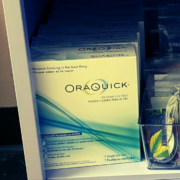
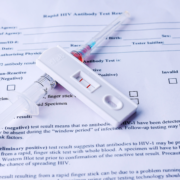
HIV self testing kits sitting on a ledge.

Federal Cuts “Handcuffed” BIPOC Harm Reduction in Kentucky. Communities Are Stepping Up.

In April, the Substance Abuse and Mental Health Services Administration (SAMHSA) released a letter notifying funding recipients that the agency is taking a “clear shift away from harm reduction,” including eliminating funding for fentanyl testing strips, clean syringes and needles, and “overdose hotlines.”

Harm reduction at its core is “a set of practical strategies and ideas aimed at reducing negative consequences associated with drug use,” according to the National Harm Reduction Coalition. The organization further details that some of those strategies could include the safer use, managed use, abstinence, meeting people who use drugs “where they’re at,” and addressing conditions of use along with the use itself.

SAMHSA’s decision has had immediate and life-threatening consequences for Kentucky organizations doing the work to close critical gaps in care for those in need, including for marginalized people.
“When they put this letter out there, they literally just handcuffed a lot of people,” said Shreeta Waldon, executive director of the Kentucky Harm Reduction Coalition (KyHRC), a Louisville-based nonprofit that works to reduce substance use disorder overdoses and deaths.

The letter cited a White House executive order from July 2025 to justify the policy changes. The order, “Ending Crime And Disorder On America’s Streets,” details those changes among a list of other line items including homelessness and crime. “Do not fund programs that fail to achieve adequate outcomes, including so-called ‘harm reduction’ or ‘safe consumption’ efforts,” the order reads.

It describes such strategies like harm reduction as ineffective; however, harm reduction is actually an evidence-backed practice that has been backed by scientific research.

What Kentucky Lost When SAMHSA Cut Harm Reduction Funding

These changes and attacks on harm reduction initiatives have hit the already limited ecosystem of harm reduction services built by and for Black and brown communities.

“SAMHSA award terms are now prohibiting federal grant funds from supporting several traditional harm reduction supplies, including syringes for illicit injection, safer smoking supplies, and fentanyl and other substance test strips,” Waldon explains. “That means that organizations are now navigating a much narrower definition of what federally funded harm reduction can include and not include.”

Recent research revealed that Trump’s elimination of federal funding for programs that provide syringe exchange and other harm reduction interventions will directly contribute to an increase in overdose deaths and non-fatal overdoses. Outcomes that Black and brown communities already feel more intensely.

KyHRC is one of the few groups in the state still delivering harm reduction care and resources for BIPOC communities, despite these concerning changes. In addition to new limitations, Waldon’s group immediately lost a $400,000 grant after the SAMHSA decision. However, instead of deferring programs or shortening their impact, the organization found new ways to deliver care to communities.

KyHRC began working with partners across the country to source harm reduction resources that they no longer could get from federal funding. Waldon mentioned that, among other groups, the Connecticut-based organization Reduce Harm Inc. has supported KyHRC with clean syringes, testing strips, and other supplies that are no longer accessible.

The redefinition of what the government will fund comes after a well-documented body of evidence pointing to harm reduction as a key strategy to prevent drug-related deaths. Studies show that fentanyl testing strips prevent overdoses, and research shows that providing clean syringes prevents the transfer of blood-borne diseases. A 2025 study including 67 communities, some of which were in Kentucky, found that when offered harm reduction strategies, those communities experienced a 15% reduction in non-fatal opioid overdoses and an estimated savings of $190,100 in healthcare spending per community.

Why Black Kentuckians Feel the Cuts Hardest

For Black communities in Kentucky, these new limitations are felt even more deeply than their neighbors. In 2023, the overall number of drug overdose deaths in Kentucky declined for the first time in years, while Black Kentuckians experienced an 8% rise in overdose deaths. Black Kentuckians continue to face worse health outcomes, less access to regular health care, and higher mortality rates compared to other groups. It is these realities that make harm reduction and community resources for Black and brown people all the more critical, according to the organizers delivering care despite greater obstacles.

“If you are trying to give me aid and help me based on the statistics that you have for white people, it’s not going to help me because it’s not made for me,” said Adria (AD) Shouse, a master barber at Well Groomed Barbershop Parlor.

Shouse is a barber with the African American Barbershop and Beauty Salon Initiative (BBSI), a public health program part of Project Ricochet, a nonprofit organization working to improve outcomes for minority youth in Lexington and beyond. BBSI transforms “relationship-rich environments” like barbershops and beauty salons into spaces where communities can get care and education related to diabetes, sexual health, mental health, drug use, and harm reduction.

“I’ve seen changed behavior in people that I’ve been cutting for years that have utilized resources through BBSI,” said Shouse.

BBSI provides community events based out of these safe spaces that bring care, including harm reduction resources, right to the communities who need it. This direct level of intervention is what Shouse says is missing in much of the conversation around BIPOC public health funding.

“The funding is different when it comes to people of color or minorities,” said Shouse. “They’re trying to keep certain communities and certain people in certain places because it works to their advantage.”

Shouse’s clients are predominantly Black men and young people, and in her work she fulfills a material need while offering support for other challenges.

Doulas Trained in Harm Reduction

It is that same model that other community leaders are implementing to provide support for Black pregnant people as well.

Granny’s Birth Initiative (GBI) is a nonprofit based in Louisville that supports Black parental health, partnering the care a pregnant person needs with the harm reduction resources they are unable to find elsewhere. That starts with training their doulas on harm reduction strategies, including trauma-informed care and Narcan usage.

“We make sure that our doulas are trained in that because doulas do provide resource navigation and it should always be non-judgmental support,” said doula Alexa Scisney, founder and executive director of GBI. “We want them to be well trained on not just keeping a straight face, but genuinely and truly understanding the type of resources that are needed.”

Black pregnant people are at least three times more likely to die due to a pregnancy-related condition, compared to their White counterparts. In Kentucky specifically, 82% of pregnancy-related deaths are deemed preventable. About 1 in 20 pregnant people use illicit drugs during pregnancy. This puts the work that GBI does as ground zero for public health progress and reducing harm.

“I know that doulas are an industry that is new to Kentucky, but a doula is somebody that’s supposed to be providing physical, mental, and emotional, non-judgmental support,” said Scisney. “And here at GBI, that non-judgment is something that we really highlight because it is not our job to do harm to people already seeking harm reduction resources. Our doors are always open.”

In addition to the SAMHSA decision, resources for harm reduction in Kentucky have been rocked by funding cuts and lack of consideration for how harm reduction impacts public health. In May, the University of Kentucky announced that it would formally end its HIV/AIDS prevention and treatment organization. The Target4 Project was part of this elimination, which provided HIV/AIDS intervention and services in addition to harm reduction supplies and targeted outreach.

Kentucky public health leaders say they will continue to step up in their communities, despite the new obstacles in front of them.

“Let us be the voice because we are the people who have experienced it. We’re the closest to it. We’re the closest because we live it every day,” said Waldon.

While the Trump administration and SAMHSA cut opportunities and funding, harm reductionists and community leaders continue to show up in new ways for their neighbors. While groups still hope for more permanent and sustainable funding, it is the promise of safer, stronger communities that pushes them forward, they said.

“For me, harm reduction has always been the radical decision to believe that every human being is worth keeping alive before they change, before they recover, before they become who somebody else thinks they should be,” said Waldon.
This work was supported by the 2026 CNP Media Fund. #CNPMediaFund
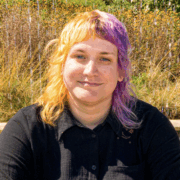
Nathan Wilson smiling in sunglasses and a neon cap in front of a Matthew25 mobile health clinic truck

How Rural Kentucky HIV Care Saved Nathan Wilson

He was an HIV patient in Rural Kentucky. Now he helps run the nonprofit that saved his life. Nathan Wilson is on a mission to fight against the stigma of living with HIV in Kentucky and beyond. 

Before Nathan Wilson worked at HIV health nonprofit Matthew25, he was a patient. He was a convicted felon and was in active addiction for more than a decade. Now, Wilson oversees patient experiences as the facilities and project manager for the organization. He serves the same rural Kentucky communities where he once struggled to find care himself.

Matthew25, which celebrates its 30th anniversary this year, works with those living with, at risk of, or affected by HIV and other sexually transmitted infections. With four clinics across Southern Indiana and Western Kentucky, the organization serves 25 counties in Kentucky and 12 in Indiana.

Wilson became a patient with Matthew25 in 2019. He found out he was living with HIV while at a Suboxone clinic. He recalls being told: “Hey, your blood test shows this. You should probably reach out to these people.”

He admits that he wasn’t the best patient at Matthew25 in the first year, but the workers at the organization were patient with him. He made up for it, and four years later, he began working at the nonprofit, first as a driver, transporting patients to appointments and then working the group’s food pantry. He now oversees facilities operations for all four of Matthew25’s clinics. 

“Matthew 25 has changed my life since day one — not only changed it, but saved it,” Wilson says. He said the organization fought for him to get his HIV medications when he was incarcerated. While the group didn’t succeed, the fact that they worked hard to help him had an effect on Wilson.

When he first started working at Matthew25, he wasn’t sure he was “a healthcare facility would hire somebody” like him. 

But now he sees his various roles with the group as a full-circle moment. 

“I spent every day on the road with patients — young, old, different ethnicities, different backgrounds — and it changed my view of how broadly HIV affects people,” Wilson says. “It also broke down a lot of barriers between me and patients, because I am one of them.” 

He says many people he’s met also living with HIV don’t have such robust support systems. 

“A lot of times, you’re just there to listen. People don’t necessarily want advice; they just need somebody to hear them,” Wilson says. “Matthew25 has recognized that from the beginning: that we support system. Sometimes they just need to get something off their chest.”

 Wilson believes his work is a part of a greater impact on their patients.

“I work to make sure we have the best possible experience for both clients and employees. That’s the van someone rides in, the exam room they sit in, the quality of our medical equipment. I want people to feel welcomed and cared for in every detail of their environment.”

He says it’s that care that he was shown at Matthew25 that still stays with him.

“Everywhere else I went, I was treated like an addict or a criminal. I never felt that way here. They strive so hard to meet people where they’re at — without judgment, just focused on providing the medical care you need and whatever support you want,” Wilson says.

Matthew25 is one of a few providers supporting Western Kentucky, offering services in locations outside large urban centers. Geography, Wilson says, plays a large role in obstacles to care for HIV-positive Kentuckians. The organization itself travels about a 200-mile radius to pick a patient up to get them to their HIV care, but also any other medical care they need. 

Another obstacle, Wilson says, is fear. He remembers thinking it was a death sentence when he was told he had HIV. 

“I think a lot of people avoid getting tested because they’re scared of what they’ll find, and worried about cost. What they don’t always know is how many resources exist specifically to help with treatment and suppressing viral load,” he explains. “If we can suppress viral loads in people already living with HIV to the point where there’s no transmission risk, then eventually this ends.” 

Wilson says there’s still stigma surrounding living in the area and a misconception that HIV is only a virus gay men get. He said that while he is a gay man, he also was an IV drug user. Male-on-male sexual intercourse is not the only way a person can contract HIV. 

“I think transmission is still deeply misunderstood, and that misunderstanding costs lives.”

The stigma from the gay community also comes to Wilson’s mind. 

“There’s still so much shame and secrecy around it. I’ve been undetectable for years, but people still treat HIV-positive individuals as if we’re diseased,” Wilson says. “You would think that people who have experienced so much oppression themselves would be more willing to accept others.”

He adds that it’s that specific stigma that makes him want to be open about his status and history: “to show that life doesn’t end with an HIV diagnosis.”

Wilson believes the only way to overcome this stigma and to work to stop the transmission of HIV is to recognize each other’s humanity. 

“People with diabetes aren’t stigmatized for their condition. People with cancer are treated with compassion. People living with HIV deserve the same. And the most important thing to hold onto is this: We could actually see the end of this disease, in my lifetime, or the next,” he says, explaining the need to support HIV medications and PrEP. “Transmission can be stopped. Why would we not want to do everything in our power to make that happen?”

So, I’m A ‘Terrorist’: The War on Transgender People

The following is an opinion piece and reflects the views of the author, not those of Queer Kentucky. Our op-ed section exists to uplift diverse LGBTQ+ voices and perspectives across the state. We publish these submissions as part of our mission to encourage cultural critique, thoughtful commentary and dialogue that matters to our community.

The horror sets in on what we all knew would come. A poem by Martin Niemöller plays out like a guide. We’ve seen the Wehrmacht begin its march. Taking blame for violence caused by the Reich. Next, they will come, and they won’t stop with us. 

In January I wrote an article about my feelings just before Trump’s inauguration.  Sharing my dreams that I was just being over dramatic and Project 2025 was all but the boogie man, a myth with no real cause for fear. If only I could wake up from this nightmare instead. Project 2025 is real, and we have seen its implementation every step of the way. From gutting government funding and resources to mass kidnappings by masked men. It’s far too late for dreaming.

“He would never get away with it.” “Even other republicans don’t like Trump.” “The rich will get mad when they lose money.” Blah blah blah. He can and he will get away with it. No amount of infighting, lost bonus packages, or client list will stop what is coming. Our democracy has been dismantled in mere months. Checks and balances thrown away with the bathwater. So please, leave behind the ifs and buts. 

Some aspects of Project 2025 have shifted. What was originally moving toward labeling queer and trans people as pedophiles has now taken a detour— we’re being reframed as a terrorist threat, or as they’re now calling it, “Nihilistic violent extremist” I can only assume this detour is a distraction from the numerous allegations of pedophilia involving members of the current administration. I have no doubt they’ll circle back to the original narrative in due time.

There are many things the Reich is still pushing for as planned from Project 2025: removing all records of trans people from government sites, making passports require assigned birth sex, removing gender-affirming care from Medicaid, making rules to ban trans people from sports, removing trans people from the armed forces, the DOJ looking for a way to ban trans people from owning guns, as well as banning trans people from getting passports at all so we have no way to flee the country for asylum. The list goes on — but hey, they did make sure to remove all reports showing that conservative white cis males are the largest group committing acts of domestic terrorism. Wouldn’t want those great people getting mixed up with us awful trans terrorists, would we?

So what makes me, a trans woman whose only act of violence being the time she hit a home intruder over the head with a thermos, a Nihilistic violent extremist? Before transitioning and getting sober, I could see myself being nihilistic at times. Transitioning gave my life meaning, sobriety has given it purpose. If you could classify any of my beliefs as extremist, it would be the equality, socialist, anti-capitalist, and anti-tyranny views that I share with Jesus as is taught in the Bible. Beliefs that I would never kill for, though I am willing to die for them. Another thing we share.

What would violence from trans people even change? Yes, it would seem the legal system has completely failed us, and we are left on our own in the world’s eyes and protesting without action changes nothing. Do we riot like Stonewall across each state? As if that wouldn’t make everything the right is saying about us true in their eyes. Giving the Reich even more cause to have ICE disappear us or just shoot us down in the streets like. 

One percent of the U.S. population isn’t capable of making any changes on their own. At least not the 1% of trans people in the U.S. It’s not like trans people are the 1% with all the wealth. Is it really that we are all Nihilistic violent extremists or is it just that we are the smallest minority they can go after, knowing we have no way of fighting back, let alone being capable of defending ourselves? It won’t stop with us, it won’t stop with you, it will only stop when one man owns the world in full. 

This isn’t the first dictator to pop up on this pale blue dot, and it won’t be the last. Even after Trump is gone another will come in his place. We were taught the entire playbook used in the rise of tyranny, yet we fell to it just as easily as all those before us. Replace Judaism with Transgenderism, us versus them, them versus us. Copy, paste, repeat, repeat, and repeat. As long as power and wealth exist, so too will the hatred of others. No matter how long power and dictators exist, being trans will outlive them all.

Since the Stone Age we have found burials, reports, and tells of two-spirited, third and fourth gendered people. Some even under a religious cause. Are we to believe that even before the Bible every trans person ever has been evil and violent? That this is some kind of political movement and ideology passed down in a secret knights templar style cult? (Though they were a pretty gay group of guys and I don’t mean happy). No, that would be a childish and ignorant belief. One I don’t even believe Trump himself has, only that we are an easy target to prey on from his dictatorship manual.

So, should us trans people be the ones to stand up and fight back against this dictatorship? No. It is our allies that will need to begin this battle. It is the people reading this with empathy—others, fathers, sisters, brothers, friends, and everyone with a trans person in your life that will need to be our shield.  Trans people are not violent, and we are weak in numbers. Our fight would not last without you. Your children, your siblings, your friends and your loved ones will be tortured and killed. Next, they will come for you, as they came for us.

Acid, Ache, and the Grief Behind the Glamour: A reflection on substance abuse, recovery, and the ghosts, glitter, and grime in between.

Content note: This story discusses suicide, substance use, sexual assault and an eating disorder. Support resources are listed at the end.

This story is part of Queer Kentucky’s digital issue surrounding the trans youth experience in the Bluegrass state, featuring personal essays to educational information. Read the full issue here.

Photos and story by D.L.

It was 2023. The world had been ending for three years, but my world was ceasing to exist. My family home burned to bits two years prior, my uncle’s breath was flattened by fentanyl months later, and my grandfather had just been crushed by cancer. Death followed me like a dog. In my new adulthood, I fled Louisville, thinking it might not find me. I was 19, suicidal, and believed if I wanted to survive, I needed to be numbed. 

Then I tripped.

On acid, I was anything but numb. I was honest with myself. Despite the fact that I was tripping to forget the grief that defined my life, I spent most of my trips remembering the people I’d lost. I could remember their laughs without shutting down. I could remind myself that I’ll never see them again and somehow survive. I felt halfway-human again. 

When I tripped, I acknowledged death and grief as part of the incomprehensible human experience and accepted it the same way I accepted any mind-fuck on psychedelics. When I was sober, only two things mattered:

  1. People I love are dead.
  2. There’s something I can put in my body that makes me feel like I’ll survive that.

I spent seven weekends straight searing my brain too stupid to hurt. I avoided sobriety in an effort to evade sadness and how scared I was. In public, I was uncomfortable. At home, I was anxious, like every second spent sober was grief catching up. 

On acid, I soaked in a technicolor, spiraled version of my world. I felt everything completely. Every touch was 200 volts of pure, white-hot pleasure. Every emotion was an energetic pulse of ecstasy. I saw heart-shattering beauty in everything and everyone. I had never felt so connected to music, strangers, and myself. 

At first, it felt glamorous. I was doing drugs in a big city, mentally unravelling and surrounded by sweat-soaked, sparkling strangers and brain-buzzing bass, held together by nothing but torn fishnets, pasties, and a pink feather boa. I had more fun than fear and got high on the glory of parading my body while destroying it. 

I’d never shown so much skin. I grew up bulimic, and before I started raving, the most positive relationship I’d had with my body was centered more on acceptance than any sort of love or confidence. Being chronically ill, I also had a complex relationship with my body and the physical pain that comes with living in it. 

It shocked me how supportive the community is. I understand the push toward body neutrality, but to be seen so clearly and to have my style, creativity, and appearance complimented constantly was cathartic. It was impossible not to feel good about myself when beautiful women were saying I was the sexiest person they’d ever seen. 

Besides that, I enjoyed the freedom of getting to be topless in rave and festival spaces regardless of my gender. I liked that even if they wouldn’t remember them (typical), nobody looked at me weirdly for saying that my partner and I use they/them pronouns, because to do so wouldn’t uphold PLUR(R) – Peace, Love, Unity, Respect, and (the often omitted) Responsibility. 

With this newfound confidence and freedom, my outfits became increasingly revealing. I knew outwardly, to many, I looked like a party girl who was doing too much for attention. But I adored the euphoria that came from being myself, being comfortable in my skin, and feeling seen. 

At my first raves and festivals, I pretended there were no preconceived notions about my body or gender. I felt like a ninety-percent-naked, genderless fairy flitting around the woods, surrounded by people who only noticed the music, not my body. 

This was delusional. I was groped and misgendered often, sometimes by people I considered friends. People who sexually assaulted me were seeing and enjoying my body and outfits from a place of perversion, not expression. I’m not ashamed of sexuality and value it both in my presentation and as nature, but being groped while incapacitated on drugs is obviously neither a sensual nor consensual experience, and showed me how I was truly perceived: a nearly-naked woman too high to defend myself. 

I can’t say I’ve never harmed people on drugs. I let relationships fizzle out because I was putting more energy into escapism than I was into any of the living people I love. I was selfish. My brain was curdled. Even sober, I was an alien disconnected from everyone – and ironically, it was because of the drugs I took to feel connected to people. 

On acid, I was no better. I was incoherent and often either too affectionate or standoffish. I prayed that people considered my uncomfortable behavior whimsical (at best) or wooky (at worst), but looking back, I was just sloppy. I felt like my substance use couldn’t be as bad as it felt because friends were still seeking me out at events, still saying they loved me, still saying I was fun to party with. But I woke up steeped in shame after every night out. 

Maybe I was fun. Truthfully, I wouldn’t remember. And that was the much larger issue. My feelings on the subject are best summarized by the way my friend explained her sobriety from cocaine: “I’m tired of having no memory of the best nights of my life.” And I’m tired of the memories I do have being shrouded by shame. 

For me, the most euphoric part about any rave is being so overtaken by the love for the music and people that I forget to care about how I look dancing and just move and feel. I deserve to be present in that, and I want to remember it. 

In the darkest depths of my addiction, I needed to understand that the false dichotomy of drugs being “good” or “bad” wasn’t going to save me. More than I needed to quit any substance, I needed to sit with the reality that I was using drugs to distort. Being constantly high was destroying me, but so was stifling the hurt beneath it. 

Two years later, I’m able to find beauty in the world and can feel what is distinctly ugly, painful, and difficult without the buffer of substances – I love the complex, grief-filled world and body I live in enough to not chemically sever myself from them every chance I get.

If you or someone you know is struggling, call or text the 988 Suicide & Crisis Lifeline at 988. LGBTQ+ young people can press 3 to reach counselors trained in LGBTQ+ care, an option that returned on Sept. 30, 2026 after it was cut in July 2025. The Trevor Project also offers 24/7 support at 1-866-488-7386 or by texting START to 678-678.

Death Before Detransition: Queer Kentucky’s Trans Youth Issue

From the Queer Kentucky archive. This digital special issue is one of our past special projects. Today Queer Kentucky is Kentucky’s LGBTQ+ newsroom, reporting every day. Read the latest news.

Digital special issue, 2025

Protect. Trans. Youth.

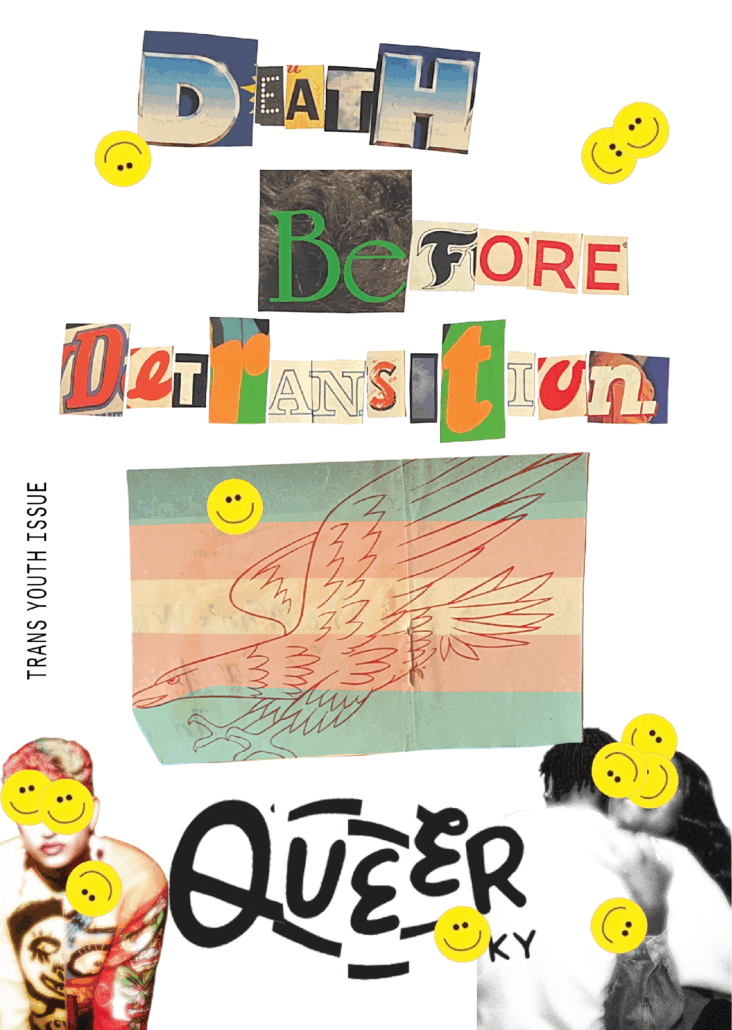
Cover of Death Before Detransition: The Trans Youth Issue

Death Before Detransition is Queer Kentucky’s 2025 trans youth issue, made by more than 15 trans young people across Kentucky. It grew out of a Charles and Jack Endowment Fund Grant from the Community Foundation of Louisville, at a time when anti-trans laws such as Kentucky’s Senate Bill 150 were reshaping daily life for trans youth. Queer Kentucky’s two cisgender leaders handed the project to a trans editor, who calls the collection testimony and resistance.

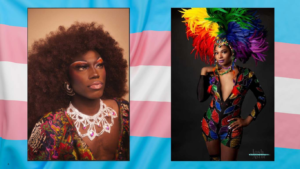
Gray Hawkins explains first steps into HRT, Leo Figgs asks why bathroom bans exist, and Sage Barr and Mo Viviane share a byline on disability and activism. Jules Crawley writes about trans life at the University of Kentucky and the year’s anti-trans bills, Omni talks with Black drag artists Olympia Gold and Shalyric Monae, and Noel Mitchell offers voice tips for singers on testosterone. Pieces by D.L., Aleksander Perris and Fiona Jones complete the issue. Mo Viviane edited it, El Bruner designed it, and Executive Director Missy Spears and Editor-in-Chief Spencer Jenkins guided the project.

Inside this issue

12 stories you can read online, free.

In the news

What other outlets said about this project.

See all special projects

Queer Kentucky launches harm reduction lockers across the Bluegrass State

When Crickett Diggs was working his opening shift at the Old Louisville Coffee Co Op last month, a customer alerted him of a man slumped over a table on the coffee shop’s outdoor patio—seemingly unconscious from a drug overdose.

“They were turning blue,” Diggs said. “I know what the death rattle sounds like and I heard it.”

Fortunately, the Old Louisville Coffee Co Op keeps naloxone, a medication used to rapidly reverse the effects of an opioid overdose, on hand for emergencies. Diggs and the customer administered naloxone several times before paramedics arrived to stabilize the man.

“I thought I was going to have a deceased person on my patio,” Diggs said. “If we wouldn’t have gotten Narcan in his system he would’ve died.”

The Old Louisville Coffee Co Op is among many businesses across the country that have begun carrying naloxone and other harm reduction supplies as a reaction to the increase of overdoses in public spaces. Because of the increase in demand for harm reduction supplies, organizations like Queer Kentucky are now keeping businesses across the Bluegrass State stocked and ready for overdose emergencies.

A Queer Kentucky Harm Reduction Locker.

In 2024, 1,410 Kentuckians lost their lives to overdose deaths marking a 30.2% decrease from the previous year. The sharp decline continues a downward trend in overdose deaths, which dropped by 9.8% in 2023 and 2.5% in 2022. Kentucky Gov. Andy Beshear credits harm reduction practices, including the distribution of Narcan, as playing a role in decreasing overdose deaths.

“As a journalism organization, we’ve really expanded our content around substance use in the Queer community, including a full digital issue on harm reduction earlier this year,” said Missy Spears, Queer Kentucky’s executive director. “Providing direct resources is not in our normal workday, but we view these lockers as our way of giving back to the community and filling a critical need that we saw being unmet.”

Each locker is designed for discretion as they are about the height of an end table and placed in inconspicuous areas of local businesses that serve at-risk populations. Each locker contains basic harm reduction supplies including free naloxone (generic Narcan), test strips for both fentanyl and xylazine, bandages, condoms, HIV self-testing kits, pregnancy tests, sunscreen, and aloe. 

Harm reduction supplies in a QKY harm reduction locker.

“Someone can overdose at any time and fentanyl is in everything,” Diggs said. “Everyone deserves a second chance and everyone deserves to be able to change their life. No one deserves to die from a drug overdose.”

In addition to the basic supplies, businesses can also opt to carry safer smoking and snorting kits too. These kits decrease the risk of spreading diseases including HIV and hepatitis.

So far, Queer Kentucky has installed six harm reduction lockers in Northern Kentucky at both Roebling Books locations, Old Kentucky Bourbon Bar, and OLLA Taqueria. Some participating businesses have chosen not to market their harm reduction lockers.

Critics of harm reduction lockers argue that providing access to clean pipes and other supplies encourages drug use and increases substance use in their communities, calling the practice unsafe.

“Some of our partners are operating on a ‘if you know, you know’ basis to avoid harassment,” Spears said. “Some businesses serve communities that have less experience around harm reduction models, so we feel like it’s better to quietly exist for those who need it in those spaces versus bring a lot of attention to it, along with the potential for pushback.” 

Queer Kentucky Executive Director Missy Spears with a QKY harm reduction locker.

Julia Keister, owner of Roebling Books, says she wants everyone to know that harm reduction supplies can be found under their roof.

“Everyone can benefit from the lockers, so I believe they should be as accessible and public as possible,” she said. “Oftentimes, taking precautions to prevent harm is not something that can be planned or predicted, so being able to see where the lockers are located is important and could even be life-saving.”

In a 2024 NPR article, it was reported that a study conducted in southern Nevada suggests Narcan in vending machines contributed to a 15% reduction in overdose deaths in the first year of operations. In Cincinnati, research found 24/7 access to supplies was associated with a slower spread of HIV.

Keister understands the research and says she’s acting accordingly.

“Much like offering people a bathroom, or a cup of water, being able to provide free and safe harm reduction seems like a basic human right that every business should want to make readily available,” she said.

LGBTQ+ youth have lost a lifeline. What now?

If you or a loved one are in crisis, please call the National Suicide Prevention Lifeline at 1-800-273-TALK (8255), or contact the Crisis Text Line by texting TALK to 74174.

This story was originally published in Uncloseted Media, an LGBTQ-focused investigative news outlet.

When Arden was 16, they called a suicide crisis hotline “thinking their life was over.”

They were in an abusive relationship, regularly self-harming, and felt that nothing was helping. “It was terrifying,” they told Uncloseted Media.

“If it weren’t for the hotline, I would have killed myself.”

Since that day, Arden, now 24 years old and living in Brooklyn, has used various crisis helplines. When the 988 national suicide prevention hotline launched a “Press 3” option in 2022 for LGBTQ+ youth, they immediately started using the resource.

Arden, who identifies as nonbinary, says the LGBTQ+ hotline workers “respected their identity” and were understanding that they are not a woman. “It was really affirming for a very troubling time in my life.”

Since then, Arden has “Pressed 3” more times than they can remember, seeking help for everything from dealing with the loss of their friend, who died by suicide, to “stupid cliquey gay people stuff.”

“I remember when my friend had killed himself and I was dealing with a lot. I called them and they talked to me for over an hour because I was really upset,” they say. “When I called the hotline, it was a last resort. I was really at my wits’ end.”

Arden — whose last call to the lifeline was two weeks ago — is one of 1.3 million callers and chatters the LGBTQ+ youth hotline has served since it launched, according to federal data. The legislation that greenlit the national program, signed by Trump in 2020 during his first term, explicitly recognized that LGBTQ+ youth are more than “4 times more likely to contemplate suicide than their peers, with 1 in 5 LGBTQ+ youth and more than 1 in 3 transgender youth reporting attempting suicide.”

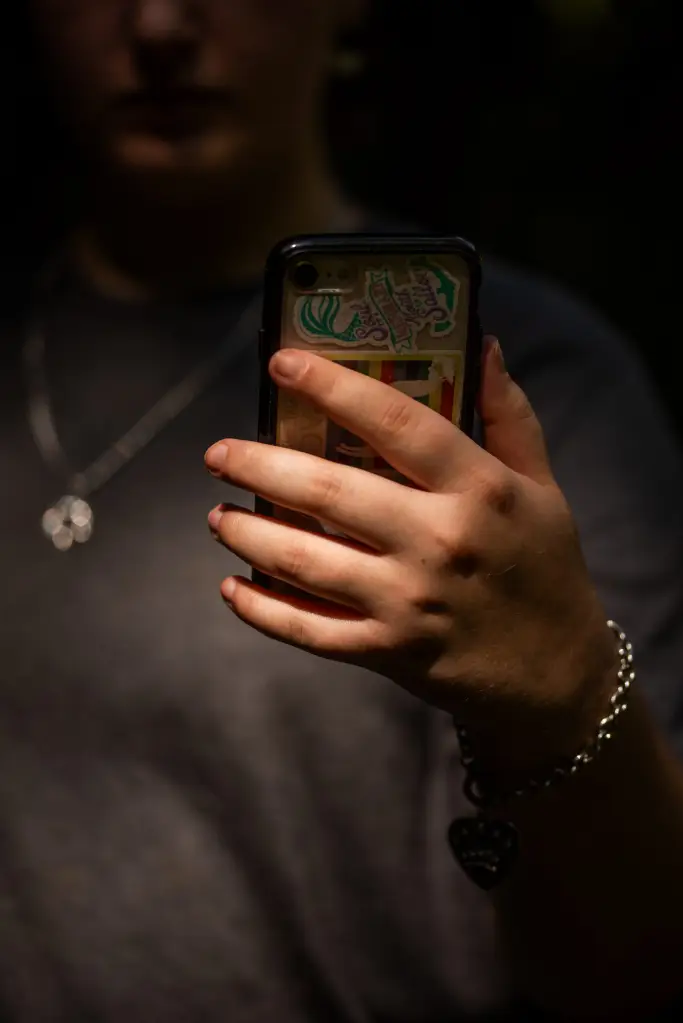
A close up of a hand holding a phone.
Kaoly Gutierrez/Uncloseted Media

This new option to “Press 3” allowed queer youth in crisis the ability to directly connect with counselors from a set of specialized LGBTQ+ crisis centers. These counselors are trained in cultural competency and often bring lived experience, providing identity‑affirming, empathetic support for challenges like coming out, discrimination or mental health crises.

Despite the hotline’s success, the Trump administration announced last month that they would be shutting it down on July 17, claiming that the service had run out of congressionally directed funding. The Substance Abuse and Mental Health Services Administration said in an email to Uncloseted Media that “continued funding of the Press 3 option threatened to put the entire 988 Suicide & Crisis Lifeline in danger of massive reductions in service.”

There are no plans, however, to shut down the other hotline options, including the Veterans Crisis Line, the Spanish Language Line and the Native and Strong Lifeline. And while Congress spent $33 million on the LGBTQ+ service last year, the cost of continuing it represents merely 0.006 percent of the $510 billion that suicide and self-harm costs the U.S. yearly.

“This is absolutely a mistake,” a suicide prevention call center director told Uncloseted Media. “We are concerned that this will result in increased suicide rates for LGBTQ+ youth.”

Why we need option 3

The director’s concern is supported by a 2022 research brief that found that queer college students with access to LGBTQ-specific services were 44% less likely to attempt suicide than those without it. Research also shows that a hotline specific to LGBTQ+ services increases the likelihood of queer youth calling.

“It’s true for any direct service,” Harmony Rhoades, associate research professor of sociology at Washington University, told Uncloseted Media. “People who are in substance use recovery want to work with people who’ve gone through recovery themselves because they understand what that experience is. Culturally, there is not a lot of understanding of the specific experiences of someone who is LGBTQ+ and without specific training, a crisis counselor isn’t going to be able to know the language that’s going to feel affirming.”

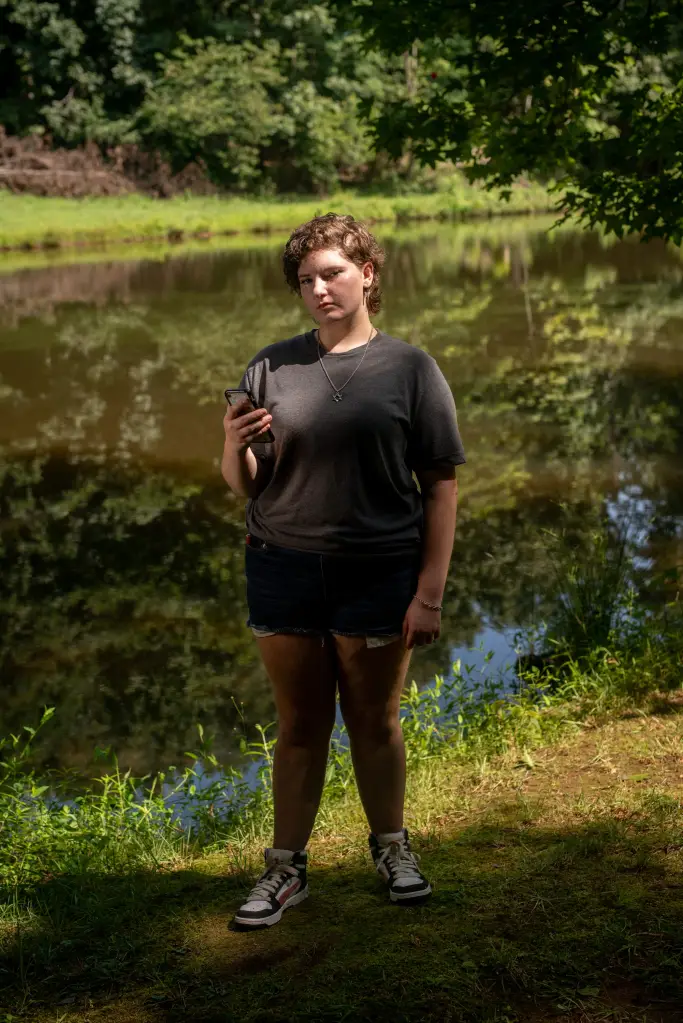
A person stands holding a phone by a pond.
Kaoly Gutierrez/Uncloseted Media

“Connecting with someone who gets it was really helpful. … Because at home, I was so isolated and I didn’t really interact with other queer people,” says Genna Brown, who used the Trevor Project’s chat function at 10 years old.

“I was an extremely self-loathing, suicidal kid who was under the impression that God hated me and I was gonna burn in hell for eternity,” Brown, now 15 and living in High Point, North Carolina, told Uncloseted Media.

“I only used the chat feature because I was scared my parents would hear me. We shared a wall,” she says. “I was spiraling really bad. I’d just realized I was crushing on girls, and I thought I was going to burn in hell for all eternity because that is what we are taught.”

Raised in a Southern Baptist church, Brown never felt safe at home, where her father would regularly spit slurs like “faggots” and “queers.” At church, every sermon was about Sodom and Gomorrah or about how “real love” only existed between a man and a woman.

“I grew up knowing the number one thing not to be was one of the ‘dirty queers,’” she says. “I kept thinking, I can kill myself now and go to hell, or live longer and still go to hell. I used to have panic attacks at 9, 10 years old, just thinking about burning in hell perpetually.”

Brown remembers Caitlin, the chat counselor who helped her, being the first ever to tell her that queer love was valid.

“She told me she’d been with her girlfriend for seven years. I didn’t even believe queer people could be happy. … It broke my brain in the best possible way,” says Brown, who is now out and proud to her parents, who have come around, and to most of her friends on social media.

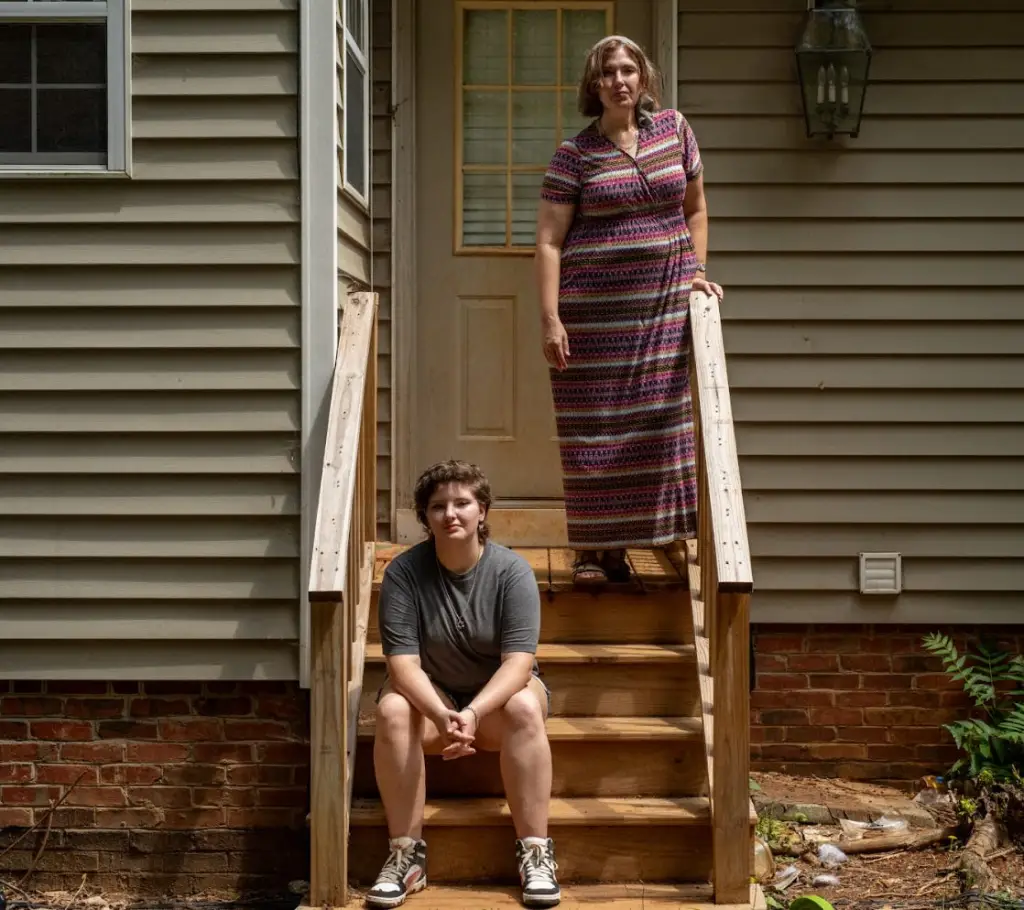
A person sits at the bottom of outside stairs, with another person standing at the top of them.
Genna and her Mom, Melanie.
Kaoly Gutierrez/Uncloseted Media

Arden had a similar experience. “The queer line is better than the regular line,” they say. “I feel like it’s less like going through a checklist on the queer line.”

As a survivor of sexual assault, Arden says knowing that the counselors on the other line were trained in LGBTQ-specific trauma made it easier to reach out for help. “My voice doesn’t pass per se but they still respected my identity,” they say.

LGBTQ-specific resources for youth are critical, with 41 percent seriously considering suicide in 2024. In addition, queer youth are disproportionately affected by a litany of mental health issues and trauma, including physical and sexual assault, anxiety, depression, eating disorders, bullying and addiction.

“It’s not like we’re cherry-picking some random group,” says Rhoades. “If we are going to fund [suicide prevention], there is no reason we should do it inefficiently by not effectively targeting the people who need it most. So yes, they need specific suicide prevention services.”

While the hotline focuses on LGBTQ+ youth, they don’t turn away adults who need help. Joshua Dial, 36, says that when he called 988, he was often connected to the LGBTQ+ youth hotline after mentioning that he’s gay.

“I always walked away feeling better after I called,” he says. “There have been times when I spoke to the regular 988 crisis people, and they helped too. But they didn’t understand quite as much.”

Dial, a Lutheran who lives in Stillwater, Oklahoma, says he wasn’t always comfortable being open about his sexual orientation to his religious community and that the only way to meet other gay people was on hook-up and dating apps, which he notes are “not for emotional support.”

“I wouldn’t be talking to my pastor about getting on Grindr. I can’t go to my pastor and tell them what I did last weekend,” he says.

Dial, who was raised to believe that homosexuality is a sin, has experienced depression since the age of 16 and has also struggled with bipolar disorder, addiction and PTSD. “My addiction was getting worse, and the only constant was that the line was always available,” he says. “I didn’t have any other options, but I knew that if I called the hotline, I would get help.”

Dial says the emotional support he received through these phone calls kept him from self-harm and suicide. “There are times when I called that number and was this close to taking a handful of pills, this close to slitting my wrist, this close to buying a gun to shoot myself. And I talked to those people, and they not only understood, but they gave me the empowerment of knowing that someone had my back.”

How cutting option 3 affects the whole system

While the cuts are only meant to affect the hotline’s support for LGBTQ+ youth, crisis center employees say they’ll impact the entire 988 network.

“This being rifted does very much mean less capacity for 988 as a whole,” says the suicide prevention call center director. “Everyone will be affected.”

“When the LGBTQ+ hotline opened up, it really lowered the volume on the mainstream counselors,” a 988 hotline counselor in Washington state told Uncloseted Media. “It seemed really helpful, and I didn’t get a lot of LGBTQ+ chats after that point.”

The counselor at the Washington state center says they are about to lay off 42 counselors from their LGBTQ+ hotline. They say these roles won’t be replaced on the main 988 line due to a hiring freeze. Because of this, counselors expect the number of calls they receive to double, which could dramatically increase wait times. The Washington state center did not respond to a request for comment.

Even without the cuts, wait times are an issue. A 17-year-old caller from Virginia says that even the 10 minutes they had to wait for their call to be answered were painful. “I was worried that nobody would want to talk to me. I was just feeling hopeless,” they say. “There’s this one resource that I’m supposed to be able to have access to 24/7, but it just isn’t as accessible as it should be. For some people, those 10 minutes are crucial.”

In a 2009 study of 82 patients referred to a psychiatric university hospital after a suicide attempt, nearly half reported that the period between their first thought of suicide and their actual attempt had lasted 10 minutes or less, underscoring how shorter wait times can be a matter of life and death.

“If we are not able to catch someone during the time that suicidal thoughts have appeared and intervene as quickly as possible, they could start figuring out how they’re going to kill themselves and make it happen,” says the suicide prevention call center director. “And a lot of folks have access to means that can result in instant death like firearms.”

What can be done?

With the “Press 3” option gone, Rhoades worries that the current spate of anti-LGBTQ+ legislation and hateful rhetoric toward the community will affect how counselors without queer-specific training will provide care.

“We’re living in an unprecedented time where anti-LGBTQ+ hatred is being normalized,” she says. “It absolutely affects how young people are treated. And it filters down to crisis counselors.”

As Congress and the Trump administration prepare to shut down “Press 3” on July 17 in an effort to save money, many believe that it will have the reverse effect.

“They just want these people to die. … That’s the message I got,” says a hotline operator in Washington state, adding that the administration is “not looking at the bigger picture.”

Representatives and advocates are fighting for more LGBTQ+ mental health services. Kansas Rep. Sharice Davids reintroduced a bill last month dedicated to LGBTQ+ mental health resources. “By increasing access to mental health support for our children and teens, we can save lives,” Davids said in a press release. And last weekend, hundreds of people protested in front of Trump Tower in an effort to save the hotline.

Arden says they wouldn’t be here today without the line’s support. “I’ve been struggling for a long time in my life [with] self-harm and I’ve been clean almost two years now,” they say. “I would definitely not be clean if it weren’t for the hotline and I would probably hurt myself again.”

If you or someone you know is struggling, call or text the 988 Suicide & Crisis Lifeline at 988. LGBTQ+ young people can press 3 to reach counselors trained in LGBTQ+ care, an option that returned on Sept. 30, 2026 after it was cut in July 2025. The Trevor Project also offers 24/7 support at 1-866-488-7386 or by texting START to 678-678.

Keeping Our Community Safe: Queer Kentucky Installs Harm Reduction Lockers in Local Businesses

This story is part of a digital issue of Queer Kentucky surrounding Harm Reduction and its intersection with the LGBTQ+ community.⁠ Check out the full digital issue here.

In the Queer community especially, you are more likely to know someone struggling with substance use than not. Maybe it’s a friend or family member. Maybe it’s yourself. The thread of substance use, like it or not, is one that runs through our community. Substance use remains a significant challenge for our people, leading to shame, loneliness, isolation, and a proliferation of unsafe practices. For this reason, Queer Kentucky is partnering with the Foundation for a Healthy Kentucky to launch our Harm Reduction Locker Initiative.

Last year, we held several Community Conversations on Substance Use across the state. We heard firsthand how the stigma against substance use and lack of real support can negatively affect members of our community, leading to far worse mental and physical health outcomes than our cisgender and heterosexual counterparts. We heard the call loud and clear: Queer Kentuckians are in need of resources for keeping themselves and each other safe.

At the core of this initiative is a desire to meet people where they are. We recognize that sobriety is the safest form of harm reduction, but how can we support the people who aren’t there yet or aren’t interested in total abstinence? How can we provide resources and show love in a way that makes them feel less alone? In a way that lets them know they are welcome in our spaces? That they have a community no matter where they are on their journey? Enter our locker initiative.

These aren’t your high school lockers. Our harm reduction lockers are cute. They are brightly colored, the size of a small end table, and are purposefully designed to lower the stigma often associated with substance use. To make them even more appealing, each locker will be decked out with a custom design and text by Kentucky artist Levi River House.  Each locker is stocked with essential harm reduction supplies, including OD prevention tools such as fentanyl test strips, safe sex supplies, HIV self-test kits, pregnancy tests, and other resources critical for community members currently experiencing substance use. But these lockers go beyond their functional purpose; they illustrate a message of respect and solidarity.

Our lockers are being placed in bathrooms around the state thanks to over a dozen of our small business and organizational partners, including Roebling Books & Coffee locations in NKY and the Louisville Pride Foundation. By placing harm reduction supplies in accessible yet private locations, these lockers play a crucial role in protecting vulnerable populations, helping to reduce harm and prevent avoidable health crises.  Harm reduction is not about judgment; it’s about compassion, understanding, and keeping people alive.  

Thanks to our incredible partners, the lockers will be accessible in community-oriented settings where people already feel safe and welcome. Whether they’re a local coffee shop, an LGBTQ+ community center, neighborhood bar, or cute retailer, our partners are diverse in both what they offer and where they’re located. This allows us to reach, assist, and educate a large segment of the population. One of the biggest barriers around help is stigma, and these lockers will help facilitate conversations and inspire other forms of grassroots advocacy to create long-lasting systemic change.

Together, we can reshape the narrative around harm reduction and ensure that every member of our community has the opportunity to access resources and support.

For more information about partnering with Queer Kentucky’s harm reduction locker initiative, please email [email protected].  

To view Queer Kentucky’s digital magazine covering harm reduction in the LGBTQ community, visit here.

Rewriting Recovery: How Cannabis Helped One Kentuckian In Her Sobriety Journey

This story is part of a digital issue of Queer Kentucky surrounding Harm Reduction and its intersection with the LGBTQ+ community.⁠ Check out the full digital issue here.

Three years ago, Liz Freedman got sober from the substances that ruled her life starting when she was 12.

“I’m bipolar so I’ve kind of always just had this really bad anxiety,” she said. “When I was a kid I had anger issues, but I wasn’t actually angry. I was just sad and needed something to take me away.”

For Freedman, it started with huffing household chemicals. But that quickly led to abusing pills and alcohol. 

“I would do anything I could. That is what my life revolved around,” she said. “I ended up getting addicted to meth, Adderall and cocaine in my 20s. I also drank very heavily and I also used benzos.”

When she was 28, Freedman woke up one day and realized how unmanageable and dangerous her addiction was. She said she had hit so many “bottoms” by this point, but this day was when she finally decided she wanted to be more present in her life. So she went to rehab.

“ I got sober and I was abstinent from all mood and mind altering things for about two years,” Freedman said. 

In her sobriety Freedman also learned how to manage her bipolar disorder and other mental health struggles, the original reason she turned to drugs and alcohol for relief. But she wasn’t cured of anxiety, trouble sleeping, and flashbacks, so she started thinking about using cannabis as a way to relax her mind.

“I asked myself a lot of questions before I pursued a medical marijuana license,” she said. “ I felt so much shame because of what I personally felt I had heard in AA rooms.”

Programs like Alcoholics and Narcotics Anonymous promote complete abstinence from any mind altering drug.    

“I don’t want to speak down about AA because I know it helps some people, but I believe that the rhetoric can be very harmful,” Freedman said. “So I’m asking myself in those moments, why has it been so demonized in my brain to take a mood or mind altering substance when it could be so incredibly helpful?”

Freedman says for her, using marijuana feels very different from other drugs and alcohol. She uses it when she wants to calm down a little. 

“Sometimes it’s part of my daily routine, sometimes it’s not,” she said. “I don’t feel the phenomenon of craving with marijuana. I just feel like with marijuana, it doesn’t take it all away. It just soothes it. Whereas when you pop a pill, I personally disappear.” 

Freedman ended up getting a medical marijuana license so she could buy cannabis at dispensaries. She wanted to know what she was buying and wanted to use products with more CBD than THC (the psychoactive component in cannabis) to help her relax. For the last year, she’s considered herself California Sober, a popular term for people who don’t use any drugs or alcohol except marijuana. 

Even though sobriety programs like AA or rehab centers still stress complete abstinence, more people in the recovery world see marijuana use as a way to help people in recovery avoid more harmful substances. 

Dr. Peter Grinspoon is a cannabis specialist at Massachusetts General Hospital, an instructor at Harvard Medical School, and a recovering opioid addict. In an op-ed from 2023, Dr. Grinspoon wrote about how using cannabis is not a “slippery slope” for every addict. The common wisdom in many recovery circles (and the true experience for many addicts) is that using marijuana lowers your inhibitions. This could lead to wanting to use the substances that were more harmful. 

But Grinspoon writes this is not true for everyone in recovery and shouldn’t always be looked at as a relapse: 

“Using medicinal cannabis to transition away from more dangerous drugs, such as alcohol or heroin, is an increasingly popular and accepted form of harm reduction. I have had tremendous success in my clinical practice transitioning people from both medicinal opioids and alcohol to cannabis. I find cannabis to be particularly efficacious, because it can help treat or palliate many of the symptoms that may have helped incite and fuel the addiction to these other drugs in the first place, such as anxiety, insomnia, chronic pain, and trauma.”

He also writes that the abstinence model in AA isn’t very effective-only 5-10% of people who attempt it stay sober.

That doesn’t mean cannabis is completely harmless. People under 25 using marijuana could impair her brain development. Pregnant or nursing people shouldn’t use cannabis, and it’s dangerous to drive when you’re high (according to the Substance Abuse and Mental Health Administration). But if the choice is between heroin or smoking a joint to take the edge off of a bad week, Dr. Grinspoon says for some people cannabis is a good option. 

Being completely sober for two years helped Freedman understand what her mind and emotions were like free from substances. And even with re-introducing marijuana, she still feels the clarity and peace she found in sobriety. 

“I feel like if you are struggling with addiction, you can’t go wrong with a period of abstinence because I feel you gain a tremendous amount of wisdom and self awareness,” she said. “But  I think addiction is a spectrum. I think we all have our own needs for that, and I think to judge or to down anyone in any way for how she are getting better is out of this world.”

“It Could Be Me”: Art Scisney on Healing, Harm Reduction, and Humanity

This story is part of a digital issue of Queer Kentucky surrounding Harm Reduction and its intersection with the LGBTQ+ community.⁠ Check out the full digital issue here.

Artilla “Art” Scisney didn’t imagine himself on the frontlines of Louisville’s public health movement—but looking back, every moment led him here. As a Black gay man raised in Louisville, Art grew up feeling like he had to compartmentalize who he was to survive. “I had a very closed-off mindset to who I actually am,” he says. “I wasn’t out. I didn’t feel safe to be. And as a person of color, there weren’t many spaces where I saw myself reflected.”

Even after coming out in college, Art struggled with grief and the pressure to live up to expectations that didn’t fit. “My dad is a manly man,” he explains. “His thing was always like, ‘sometimes you’ve got to see things through, you’ve got to tough it out.’” That message, compounded by societal expectations, led Art into a 20-year career in corporate management that slowly took a toll on his mental health.

After graduating from Western Kentucky University with a degree in interdisciplinary studies, a flexible academic path that combined social and behavioral sciences, giving him tools to better understand community dynamics and human behavior– Art spent nearly two decades at a chain of grocery stores, climbing the ladder into middle management. But the corporate grind and constant pressure to perform, conform, and suppress his empathy began wearing him down mentally and emotionally. 

“I was a great manager, my associates loved me—but they wanted me to be more aggressive,” Art says. “They wanted me to take the empathy out of it. That’s not who I am.” 

For years, Art balanced on a tightrope—striving to please bosses, colleagues, and his community. The expectations piled up until his mental health reached a breaking point. It was during the pandemic that Art experienced his first panic attack, a clear sign that something had to change.

Taking a leap of faith, Art left his secure job, choosing personal wellness over financial security and familial expectations. In doing so, he stepped away from a career that demanded detachment and conformity, and into work that celebrates compassion, connection, and authenticity. Harm reduction gave him something corporate life never could: the freedom to lead with empathy. “Now, I get to make real connections,” he says. “I get to talk to people, listen to their stories, and offer help without judgment. That’s the kind of work I was always meant to do.”

Now serving as a harm reduction specialist and health education coordinator with the UK Target 4 Region 5 team (kirpky.com)—a program under the Kentucky Income Reinvestment Program focused on expanding HIV and Hepatitis C prevention—Art works at the frontline of Louisville’s community health efforts, particularly reaching underserved LGBTQ+ individuals and communities of color. For Art, harm reduction isn’t just handing out clean syringes or providing HIV testing—it’s about restoring dignity, humanity, and choice to people society often overlooks or actively stigmatizes. 

Art’s approach is straightforward, empathetic, and real. 

“Harm reduction is anything that reduces risk or damage in someone’s life,” he explains. “The easiest example is when you get in a car and you put on your seatbelt—that’s harm reduction. It’s not saying you’re going to get in a wreck, but if you do, you’ve got something in place to help protect you.” For Art, that principle carries over to every part of his job. “We’re out here helping people who might be houseless, who use substances, who are living with HIV or at risk for it—and we’re doing it without judgment. We’re saying, ‘You deserve to be safe. You deserve to live another day. You deserve care, even if no one else has told you that.’”

He has seen firsthand how stigma around HIV and substance use disproportionately impacts Black gay men and trans women, individuals often overlooked by traditional public health messaging. According to the CDC (2023), Black Americans accounted for approximately 40% of new HIV infections, despite comprising only 13% of the U.S. population, highlighting the stark racial disparities rooted deeply in structural inequities. Similarly, LGBTQ individuals, particularly Black gay men, face higher risks of substance use disorders due to intersectional stressors such as racism, homophobia, and economic inequality (https://www.samhsa.gov/sites/default/files/covid19-behavioral-health-disparities-black-latino-communities.pdf)

“Public health information mostly comes from white doctors or government officials,” Art notes candidly. “Our community is rightfully skeptical. When someone who looks like them talks openly, clearly, and honestly about these issues, it hits differently. They listen.” This assertion aligns with research indicating increased healthcare engagement when the provider shares a similar background or identity with the patient (https://pmc.ncbi.nlm.nih.gov/articles/PMC10872498/).

Art understands deeply the intersections of identity, health, and social pressures. His lived experience is his greatest asset. “People think they’re above certain things, but it could be you. It could be me,” he says earnestly. “Life happens. Sometimes the direction takes us somewhere we never intended to go.” His voice carries an unmistakable authenticity, shaped by his own struggles with mental health and self-acceptance. “When someone is at their lowest point, it only takes one moment- one coping mechanism- to change everything,” Art explains. “We’re all just trying to survive, one way or another.”

In his role, Art doesn’t just provide resources; he empowers individuals to reclaim their humanity. Whether it’s a person experiencing homelessness trying to survive the night or someone newly diagnosed with HIV fearing the worst, Art’s presence offers reassurance, respect, and hope. He fiercely believes in second chances and meeting people exactly where they are, helping them chart their paths forward.

Art acknowledges the challenges- misinformation, stigma, judgmental attitudes- but his conviction never wavers. To skeptics, harm reduction may seem counterintuitive, but its practical approaches include distributing clean syringes to prevent disease transmission, providing testing and education to reduce the spread of HIV and other infections, offering minor wound care to prevent severe infections, and linking individuals to support services like housing, food, and healthcare. 

Harm reduction doesn’t condone harmful behaviors; rather, it pragmatically acknowledges that such behaviors exist and seeks to minimize their adverse effects on individuals and communities. 

“Harm reduction isn’t about promoting drug use or reckless behavior. It’s about ensuring people have safer options until they’re ready or able to change,” he clarifies passionately. “It’s humanizing people who’ve been dehumanized.”

Through honesty, empathy, and real talk, Art continues reshaping Louisville’s understanding of harm reduction. He bridges gaps long left open by traditional public health, particularly for Black queer communities. For Art, this work isn’t just a job; it’s a calling rooted deeply in personal experience, compassion, and a relentless belief in human dignity.

As Art reflects, he distills his philosophy into a simple but powerful ethos: 

“If you can’t help someone, at least don’t do harm. It’s that easy.”

Art’s journey and his current work illuminate critical realities about the intersectionality of race, sexual orientation, and health outcomes. His story underlines the importance of diverse, authentic voices in public health, illustrating vividly that true harm reduction involves recognizing and dismantling systemic barriers, addressing stigma, and elevating community-driven solutions to create lasting change.

Photo Essay: Finding Euphoria through fentanyl testing

This photo essay is part of a special digital issue of Queer Kentucky surrounding harm reduction and its intersection with the LGBTQ+ community. Read the full issue here.

Harm reduction strategies have played a significant role in Kentucky’s efforts to combat substance use and overdose deaths. In 2024, the state reported 1,410 drug overdose fatalities—a 30.2% decrease from the previous year and the third consecutive annual decline. This progress is attributed to expanded access to treatment, widespread distribution of naloxone, fentanyl test strips and the implementation of syringe exchange programs.

Fentanyl test strips are an important harm reduction tool, allowing people who use drugs to detect the presence of fentanyl before using. As fentanyl continues to drive overdose deaths—accounting for nearly 70% of Kentucky’s overdose fatalities in 2023—the strips help individuals make safer choices. They are especially important for marginalized groups, including LGBTQ+ people, who often face greater barriers to healthcare and support.

The following photo essay by Jon Cherry shows an individual using harm reduction practices while preparing cocaine.


Navigating the In-Between: Ryan Jones discusses the critical importance of the Kentucky Harm Reduction Coalition

This story is part of a digital issue of Queer Kentucky surrounding Harm Reduction and its intersection with the LGBTQ+ community.⁠ Check out the full digital issue here.

Ryan Jones still remembers his family handing him a one-way ticket to Louisville in his hometown of Richmond, Va. Struggling with substance abuse, Jones was told he was either going to go to Louisville to enter a recovery program or he was going to be cut off from the family’s resources. Begrudgingly, Jones took the ticket, which—while he may not have known at the time—was also his first step toward a new life, one defined not by substances but by affecting real, positive change. 

Today, Jones works as an administrator with the Kentucky Harm Reduction Coalition, an organization that strives to “reduce substance use disorder overdoses and deaths, the stigma associated with substance use disorder, and to offer harm reduction solutions.” Jones is over two years clean, has a loving and revitalized relationship with his family, and now spends his days working to curtail the dangerous consequences of substance use, building a more hopeful future not only for himself but also for countless others.

Jones was raised by his grandfather in Richmond as the oldest of 17 grandkids. As a kid, he recalls having been a bit spoiled growing up by his grandpa, a prominent pastor in their Virginia community. While he remembers it being hurtful at the time to hear such a direct ultimatum given by his family about getting clean, looking back on it now, he says, “I didn’t realize it, but when they were sending me out here, it was harm reduction that they used—you know, to be able to meet me where I was—which caused me to actually do a lot of life-altering changes in my life that enabled me to begin to really be a productive citizen again.”

During his journey through recovery in Louisville, Jones discovered the KYHRC and began to understand the idea of harm reduction in general. Learning about the very concept—the practice of mitigating the negative impacts and consequences of drug use and its associated risks—opened his eyes to different avenues of aid. While many may see drug use in a binary of clean or using, Jones was able to understand modalities of assistance that met people in the in-between, helping them make safer choices and reduce the risk of more dire outcomes. “Utilizing harm reduction allowed me to be able to navigate through life a lot easier,” he attests. “It meant that anybody that I talked to wasn’t going to judge me or look down upon me.”

The day Jones made his own decision to stop using altogether was Valentine’s Day 2023, and with it coming on the heels of tempestuous family conflict and challenging personal reflection, he remembers that “it was definitely the best kind of love I could have ever given myself.” Eight months later, he began working at the KYHRC. Given Jones’s clerical background, he was originally hired as a project manager for the coalition’s Health and Wellness Lounge, a safe and welcoming space that provides harm reduction resources to those looking for it. He was provided a budget, a timeline, and from there took the opportunity to prove himself. “I went in with everything I got,” he says. “And I was able to meet the time constraints as well as stay under the budget that they wanted me to spend. And so they were like, ‘You know what, you’re a keeper right here.’”

Now, Jones works day to day to advance the work of the KYHRC. As an administrator, he gets the phone calls, the emails, the “Contact Us” forms from the website. He also works in distribution and outreach—as the coalition is located in Downtown Louisville, they’re mindful of broadening their orbit beyond the immediate area. “That allows us to be able to send out safe use tools, condoms, fentanyl test strips, different things of that nature to be able to, you know, reduce the harm out there,” he explains. “And so we send out thousands and thousands of utensils and tools on a daily basis. … We also want to make sure that we’re reaching people that are outside of our downtown community. So we’re able to actually mail them these tools to be able to assist them in their daily living.”

Indeed, getting the tools of harm reduction to those who need it most is at the very center of the KYHRC’s mission; Naloxone (brand name: Narcan) distribution is one of their primary forms of aid. They also offer training around how and when to use Naloxone to ensure that those who need it don’t just have it, but also understand it. Additionally, the organization offers services focused on syringes, hepatitis C and HIV testing, mobile outreach, fentanyl and xylazine test strips and the aforementioned Health and Wellness Lounge, which provides a safe space for those looking for support on their journey to better health. Kiosks located on their campus allow the community free access to test strips and Naloxone as well as informational materials on harm reduction and substance use.

While critical for any population, these services, Jones notes, are of particular import to LGBTQ folks. As an individual who is HIV-positive, Jones understands that what the KYHRC offers is so imperative to those who may be more susceptible to the dangers of unsafe practices. “You know, everyone isn’t as safe as they may claim to be,” he says. “Everyone may not be practicing the best safety. And so it’s very important to utilize safe tools. Being able to practice these skills will actually help to prevent the spread of any diseases or, you know, anything that is contractible by sharing utensils.”

Jones, having been through recovery himself, sees the need in the community not only for the KYHRC’s services but also for the education around the definition of harm reduction. “A lot of people really think, when they hear harm reduction, they think, ‘Y’all giving away drugs,’” he says. “No, we’re not. We’re not giving away drugs. No, what we are doing is making sure that if you choose not to go into abstinence recovery that you are able to at least assist yourself until you are ready or until you want to at least make a small change or take the steps to where you may want to go.”

By sharing his story and working every day with people who are in similar places to where he once was, Jones hopes to enact real change in his community, change he has the power to affect because he has lived through it. “If I can at least help somebody, one person a day, I’m adding to the change,” he says. “And I often tell people I want to be the change. I don’t just want to hear about the change. I don’t just want to talk about the change. I want to be the change.” And with his empowering outlook, unshakable tenacity and commitment to action, there’s no question he’s making a genuine difference, a difference that impacts not only individuals in the immediate but also the upward trajectory of better health and more intentional compassion in Louisville and beyond.

Space for Liberation: Community, Policy, and Harm Reduction in Kentucky

This story is part of a digital issue of Queer Kentucky surrounding Harm Reduction and its intersection with the LGBTQ+ community.⁠ Check out the full digital issue here.

When we discuss harm reduction, a few common examples spring to mind: needle exchanges, fentanyl testing strips, and education about the health impacts of substance use. But in the Bluegrass State, we don’t stop at these discrete interventions. Harm reduction leaders across the region are advocating for an even more potent strategy: organizing their communities to target the systemic causes of harm, not just their symptoms. 

For Shreeta Waldon, Executive Director of the Kentucky Harm Reduction Coalition, successful harm reduction is about listening and empowering people. 

“What I do is liberate you to live the life you want to live—the kind that makes you say ‘I want to get up and live today,'” says Waldon. “My job is to make space for each person’s liberation, for themselves—not the liberation I imagine for them.”

Waldon’s work with KyHRC directly serves those impacted by substance use and addiction. Their work aims to provide resources which contribute to an individual’s personal liberation, whatever form that may take. Liberation, in this sense, means the freedom to make decisions for oneself—a personal freedom that substance use disorder can often eradicate. 

“We fight for humanity. I got a degree to help people live,” says Waldon. “People who use drugs need the same things as everyone else. Harm reduction is an ecosystem of recovery. We’re all part of this.” 

Kentucky’s “ecosystem of recovery” has many pieces, but Waldon emphasizes the importance of creating a cohesive whole through inter-organization collaboration.

“Over the last fifteen years, we’ve all been driving in our lane,” says Waldon. “‘I’m doing my job, this is how it’s going to be done.’ Nobody talks about how to pivot with each other. A coalition is about coming together with organizations and people—it’s a dance.”

Waldon’s vision for a more collaborative ecosystem was recently illustrated by a major legislative win, led by Jon Parker, executive director of AVOL Kentucky, and Chris Hartman, executive director of the Fairness Campaign. In the wake of the COVID-19 pandemic of 2020, Parker and Hartman were discussing the current state of HIV/AIDS advocacy in the region. With lockdowns occurring, in-person HIV testing had been disrupted. The obvious answer was to mail HIV self-test kits to people in need, but Parker noted that Kentucky considered that a felony. 

“Sometimes these laws get written and hidden and nobody’s looking at them,” said Parker of the obscure law. “If we don’t raise our voices, it won’t change.”

The obscure law, KRS 367.175, was a small, miscellaneous list of “other unlawful acts,” primarily prohibiting trade monopolies. Tucked within this statute was a clause that prohibited the “sale, delivery, holding, [and advertising]” of HIV self-tests. The HIV Is Not A Crime Coalition, powered by the Fairness Campaign, successfully advocated for this clause to be struck with the signing of a bipartisan bill (HB349) in June, 2023.

This situation highlights the need for policy to keep up with public health. When policy lags behind—or worse, prohibits—effective healthcare, we need to (1) notice, and (2) advocate for change. 

Ernesto Scorsone, vice president of JustFundKY, is no stranger to this advocacy. As a former judge and state senator, Scorsone has a long history of protecting LGBTQ+ Kentuckians, from the eradication of anti-sodomy laws, to fairness ordinances and beyond. The seasoned advocate has this advice for Kentuckians looking to make a meaningful change in their communities:

“What we need is local organizing,” he says. “The fight for queer people is not over with any legislative progress. We have to be proactive—we have to push the envelope. We have to be involved at the local level—that’s where you can be most effective. Neighbor-to-neighbor, members of the same faith community, that’s where we really have an impact.” 

Liberation can take many forms, but this much is clear: harm reduction requires both immediate interventions and long-term political advocacy. These local leaders are doing the work, pounding the pavement, and working to realize their dream of a healthier Kentucky. Especially in these troubling times, the only way forward is through. To sit back is to slide back, and too much is at stake for us to remain silent. Act up, get loud, and join the fight for liberation today. 

You’re in good company. 

To the Homies that Will… Some Notes on Harm Reduction

This story is part of a digital issue of Queer Kentucky surrounding Harm Reduction and its intersection with the LGBTQ+ community.⁠ Check out the full digital issue here.

Picture this: It’s 2015, you’re twenty-one years old, it’s a Saturday night in Louisville, and you were invited to some mansion party. The floor is shaking from the bass; there is glitter all over the place; there are folks dressed in leather; you are wearing only a plaid t-shirt and some jeans and have somehow lost your shoes. There is sex happening in the bathroom, someone is putting their ass in a cake on a picnic table in the front yard, and someone hands you a glow stick bracelet with a knowing nod. 

You’ve never been in a situation like this, but feel inclined to ride it out. Some of the night passes, and a cute person is sitting on a wooden swing in the backyard, looking at you with the eyes and offering you a light blue pill. Next thing you know, you are lying on the ground with them, and your hair is acting as a pillow against the grass. Maybe you think to yourself, “Yeah, this is it. This is what I needed.” 

Now, picture this: You are at a queer bar on a busy corner street. You and your friends have just downed so many PBRs that none of you can feel your face anymore. Now, you have to go to the bathroom. Someone is standing by the door, sweating and pacing. You’re an empath, so you start to feel uncomfortable with them. They’re scratching their arms. The door opens, and they go in. 

You wait a while and knock on the door, asking if they’re okay. No answer. You really have to pee. You check to see if the door is unlocked and open it. They’re passed out on the floor. You crouch, move your hand over their mouth, and feel no breath. There is a needle that is covered in black goo and blood next to the toilet. You yell for help, and a person runs in. They ask if they are breathing; you answer, “No.” They rummage through their purse, pull out a spray, and put it up the person’s nose. “If she doesn’t wake up in a few minutes, we call an ambulance.” Two minutes pass, and the person jolts awake. 

What did you learn? To take care of others and ourselves is of the utmost importance. Even when we aren’t sure what to do, we have tools. Seeing that person on the floor with a black goo’ed-up needle tripped me to understand that there are safe ways for people to do their drugs. As someone who was medically transitioning at the time, I received more than enough clean needles to share with others. I carried them everywhere I went after that. I found friends who had access to Narcan, and I carry that everywhere. 

It’s not my place to sit in judgment, nor do I tolerate anyone else sitting in judgment for me for my previous drug use. Whether you are using drugs for fun or survival, the fact is – use them safely. That’s the real T on harm reduction.  

Queer folks have been the most vulnerable population, most directly impacted by unsafe substance use, and the most in need of community care.  From the AIDS crisis to the ongoing criminalization of sex work and drug use, we know what it’s like to be abandoned by government constituents, public health workers, social workers, organizations that utilize us for clout, and family members who want to care for us when it’s convenient.

Queer folks, particularly Trans-BIPOC folks, are disproportionately affected by homelessness, poverty, and substance use. We have a more challenging time accessing quality, non-judgemental care. These factors make the spread of disease easier within our communities. 

When we talk about harm reduction, we’re talking about protecting each other from HIV, Hepatitis B & C, overdoses, and many other risks associated with substance use. When we talk about harm reduction, we’re talking about needle exchanges, safe injection sites, fentanyl test strips, all of which make sure no one gets left behind because of a choice they made. We’re talking about acknowledging the trauma, discrimination, and mental health implications that often lead to substance use. Instead of punishing people for coping, we should be prioritizing and providing safer ways for them to do so.

When we realize our collective power to care and share care, we can make the world a much better place. Many of us didn’t ask to be on this planet, and somehow, we aid to be here. We must ensure safety in understanding, restorative care, and overall health and well-being. This is for everyone.

So, for the homies that will… 

Here are some practical steps to reduce harm in your life and in the lives of all you may come across:

  1. Carry Narcan: Opioid overdoses are killing our folks, and a dose of Narcan can literally bring someone back from limbo.  
  2. Support Needle Exchanges: These programs aren’t just about providing clean needles; they’re about making sure that people are using drugs as safely as possible. It’s not just “here’s a syringe, good luck” – it’s about education on safer injection practices, reducing the risk of infections and abscesses, and providing people with alcohol wipes and sharps disposal containers. It’s about making sure that no one is reusing or sharing needles, which cuts down the transmission of HIV and Hep C. Many needle exchanges serve as community hubs, offering health screenings, overdose prevention training, and connections to housing and support services.   
  3. Know Your Substances: If you’re going to do drugs (or be with people who do), educate yourself. Know the differences between drugs, understand the risks of mixing them, and test them for contaminants. You never want to think you’re doing one drug but actually be doing something much harder.
  4. Create Safe Spaces: Whether it’s a house party or one night out, designate a sober person to check in with everybody; bring water or snacks, and get you home safely if need be.
  5. Decriminalize and Destigmatize: Support decriminalization efforts, advocate for safe consumption spaces, and don’t treat people like they’re less worthy of respect, dignity, and a quality life because they use drugs or have in the past.

We’ve come a long way from the days when the media only showed drug users as tragic figures doomed to die. But we need more stories, ones that don’t just focus on the struggle but also on the community, resilience, and radical care that harm reduction exemplifies. Queer history is built on mutual aid, and that doesn’t just mean throwing dollars at each other. During the height of the AIDS crisis, when the government wouldn’t lift a finger, it was queer folks, sex workers, and activists who distributed medication, educated one another, and built networks of care. That’s what we needed then, and it’s what we still need today.

At the end of the day, it’s about real, radical love. It’s about making sure that when the party’s over, everyone makes it home safely. 

photo provided by Mo Viviane

Mo Viviane (she/they) – Born in Lebanon, Kentucky. She is an artist who focuses on expansion while using ancestral tools of storytelling, sound frequency, and much more. Their work focuses on the abstractions of life and death and the correspondence to the creativity process. She utilizes laughter and crying as medicine, hoping to make the world a more sustainable and loving place.

If you want to read more from them, their poetry chapbook titled death:ing is out for purchase, and you can find them on Medium and Instagram by visiting: linktr.ee/moviviane.


How Apps Like Grindr and Sniffies Are Fueling the Meth Crisis Among Gay Men

This story is part of a digital issue of Queer Kentucky surrounding Harm Reduction and its intersection with the LGBTQ+ community.⁠ Check out the full digital issue here. This story is also in partnership with  Uncloseted Media, an LGBTQ focused investigative news outlet. Subscribe to their latest here.

Chemsex and Party and Play culture have ravaged the gay community for decades. Considering the history of this problem, are hook-up apps doing enough to combat the epidemic on their platforms?

At 21 years old, Robert McAllister remembers unlocking his phone in Louisville, Kentucky, to a grid of bodies on Grindr, the gay hook-up app. 

To the average American, many terms and symbols in user bios read like a foreign language: PnP, Tina and parTy, or the crystal ball, ice cream and diamond emoji. At the time, McAllister also had no clue what these terms meant. 

After chatting with multiple men, he met up with one of them later that night. Before they started having sex, the guy pulled a plastic bag of white powder out of his backpack and asked McAllister if he wanted to partake. 

“He snorted it like cocaine. And for whatever reason, I was like, ‘Oh, well, cocaine isn’t that bad,’ so I tried some,” McAllister, now 27, told Uncloseted Media and Queer Kentucky. 

Photo by Jon Cherry for Queer Kentucky and Uncloseted Media

The powder he snorted was actually crystal meth, a highly addictive drug that can ravage the body and mind and lead to psychosis, organ failure and irreversible brain damage.

“I remember thinking, ‘Wow, I want to do that all the time,’” says McAllister. “I wanted to feel that good all the time. At home, at work, it didn’t matter if I was hooking up with someone or not. It became a daily habit immediately.”

He says the addiction got so bad that the only people he would interact with for months would be the hookups he used with. “I would seek out people that had it in their profile,” says McAllister, who was addicted to meth for four years. “I would invite them to my apartment to use with me just because I didn’t have anybody else around. At that point I had lost my job, my family really didn’t want anything to do with me, and so the app was my excuse for social interaction.” 

McAllister’s experience is common. Party and Play (PnP) culture, also known as chemsex, is exactly what it sounds like: the use of drugs like GHB, ketamine and meth to enhance sexual desire, arousal and pleasure. The practice is most prevalent amongst gay and bi men, who use meth or similar drugs at three times the rate of heterosexual men, according to a 2014 study from the United Kingdom.

photo by Jon Cherry for Queer Kentucky and Uncloseted Media

For 25% of the guys who engage in PnP culture like McAllister, it becomes a severe problem. 

While drug overdose deaths in the United States declined slightly in 2023 for the first time since 2018, deaths from psychostimulants like meth rose, killing 36,251 Americans in 2023. That’s just over 3,000 lives a month, or 100 lives a day. And the epidemic is even worse in rural states like Kentucky.

As meth addiction continues to devastate the gay community, hook-up apps like Grindr and Sniffies —which make hundreds of millions of dollars a year—are where PnP culture thrives. One 2023 survey found that 91% of dating app users had a negative experience with drugs and one in four dating app users deleted an app because of drug-related concerns. 

“[Dating apps] are making lots of money from this community and the biggest problem that [we are] facing is not HIV, it is drug addiction,” says Ignacio Labayen de Inza, CEO and co-founder of Controlling Chemsex, a charity that provides interventions for chemsex users. “People are overdosing, people are suicidal, people are suffering from sexual assaults, they are psychotic, they are losing jobs, they are ending up homeless. And Grindr is the biggest vehicle that people use to get these drugs.”

So what are the apps doing to combat an epidemic that has been exacerbated by the easy access to meth on their platforms? 

Photo by Jon Cherry for Queer Kentucky and Uncloseted Media

The Risk of Hook-Up Apps

Smartphone hook-up apps, which hit the mainstream in the 2010s, have long been associated with a greater risk for sexually transmitted infections (STIs) among queer men. But emerging research suggests they also facilitate drug use among queer men, 15% of whom have used meth within the last year and 23% of whom have used it at least once in their lifetime. A 2017 study found that gay hook-up apps, including Grindr, “significantly increased motivational substance use” and approximately one in 10 of dating app users engaged in substance use after being persuaded on the apps. 

The apps know this is a problem. Sniffies is an app which features an interactive map known for its anonymity and showcases pictures of user’s genitals and butts nearby. In an email to Uncloseted Media and Queer Kentucky, they wrote that their users are significantly more likely to engage in chemsex and meth use compared to users on other platforms. They say a notable percentage of their users have reported deleting their accounts due to drug-related concerns. Recognizing this, Sniffies introduced Profile Fields, “allowing users to explicitly state their boundaries and the safety tools they carry, ensuring that everyone can make informed decisions about their encounters.”


Still, in addition, Sniffies—which has seen “explosive regional growth” in 2024—does not allow users to filter for other people’s drug preferences. In a data report that Sniffies pulled for Queer Kentucky, 18% of users selected “No PNP” under their drug preferences.

One of the major problems is that these apps enable easy access to the drugs, according to Kentucky-based Grindr users Uncloseted Media and Queer Kentucky spoke with.

“You can see it everywhere on dating apps,” says Chris Hackenberg, who first used meth at 19 years old during a Grindr hook-up. He says the drug “opened a door” to a “level 1,000 happiness.”

“It started becoming a slippery slope when I started finding [meth] everywhere,” he says. “Eventually, every hookup, I would try to find Tina [meth], and it just kept getting progressively worse to where [it] engulfed my whole life.” 

Hackenberg, now 23, remembers staying up for seven days driving around Florida looking to PnP. From Jacksonville to Orlando to Miami, he would drive for hours searching for a new place to geolocate himself on Grindr to find a new selection of men who were ready to use meth with him.

“I think Grindr and Sniffies turn a blind eye to all these drugs. Grindr is so well-known for finding drugs. It’s just so easy,” he says. 

What Are the Apps Doing?

The epidemic of crystal meth addiction and PnP culture among gay men has been an issue since the late 1990s, long before smartphones. But the most dramatic increase in meth-related deaths and usage occurred from around 2015 to 2019, when it soared by 180%. At the same time, Grindr exploded in popularity: In 2015, it was reported to have 10.5 million global users and make $38.1 million in sales. 

Grindr and Sniffies declined multiple requests for an interview for this story. Instead, Grindr directed Uncloseted Media to their work with a UK nonprofit, The Love Tank, that provides “safer chillouts” guides on their website for information on sexualized drug use. In the guide, they provide information on harm reduction, such as how to check in with yourself before you use, how to determine proper dosage and how to handle overdoses. 

In an email, The Love Tank told Uncloseted Media and Queer Kentucky that Grindr promotes their guides through inbox and pop-up broadcast messages on the app, but only in the UK region. 

Screenshot of their pop-up. Courtesy of Grindr.


Screenshot of their popup. Courtesy of Grindr.


In the U.S., Grindr works with the nonprofit Building Online Healthy Communities and has a similar pop-up for all users. 

Labayen de Inza, of Controlling Chemsex, says that this is not enough. “Clearly pop-ups and guides aren’t working because the problem [of chemsex addiction] is still an issue,” he says. “If I’m horny, I’m not going to check my pop-ups. And sometimes people are not ‘planning to chill.’ Sometimes people are having horrible psychosis and paranoia and looking for help. People tell me, ‘I want to stop. I have to stop, or I’m going to die.’ The guides aren’t going to help with that.”

In the past, Grindr has gotten bad press for allowing drug dealers to use the app. In 2022, detectives that conducted a Florida investigation titled “Swipe Left for Meth” charged 68 suspects for selling drugs on Grindr and other hook-up apps, causing nearly 280 grams of meth to be seized—the equivalent of roughly 1,400 doses. 

Since then, Grindr’s community guidelines say they have cracked down on banning profiles “centered around or mainly consisting of drug content” and that they prohibit images that are focused on advertising or promoting drug use as well as “emojis commonly associated with buying/ selling.” However, users say that simply putting a capital T, which is not banned, somewhere in their bios is enough to signal that they’re ready to PnP. 

And these bans may not work: Uncloseted Media found five references to PnP after using the app for only 15 minutes in Louisville, Kentucky. 

Screenshots from Grindr

Sniffies, meanwhile, has a resource page with instructions on how to use chemical drugs safely as well as links to harm reduction resources like syringe access and overdose prevention. Labayen De Inza questions, though, whether users will ever seek out a resource page while using the apps. 

Users we spoke with say they wish the apps had a feature where you could filter out folks who are looking to engage in PnP. One 2023 survey by Sniffies’ public health partner found that four out of five participants wanted to be able to filter by drug use practices. 

Legal Immunity

While it is likely that illegal drug use is occurring on these apps, they have Section 230 immunity, meaning that Grindr and Sniffies aren’t liable for any illegal activity that occurs on their apps and aren’t liable for the addictions stemming from the platforms. 

“No one wants to do anything,” Labayen de Inza says. “It’s really difficult to digest the fact that organizations know what is happening to the community. We cannot do very much because we are working on pride parades or HIV prevention. Those are important things. … But lots of people won’t be able to go to the parade because they will be psychotic or they will be suicidal [because of meth addiction].” 

Labayen de Inza, who is in recovery for chemsex addiction, has spent six years on Grindr connecting with folks who have questions about drug use. He says he spoke with over 13,000 users in his first year.

He also surveyed Grindr users in 2019 and found that 10% of the 2,000 respondents were using meth. Of those who said they had used, 90% had a premium subscription to the app, far higher than the roughly 7.5% of all users who pay. 

“I wish I could tell the CEO what is happening [on their] platform,” he says. “If you are human, the pain I see every day would make you cry. We have a responsibility to the community to change something.”

Uncloseted Media requested an interview with Grindr CEO George Arison and he declined. 

Apps Become Triggers: 

Users in recovery from meth also report risking relapse on Grindr and Sniffies. 

Hackenberg started recovery in 2023 after he contracted HIV from injecting meth with a hookup. He says he still can’t use Grindr or Sniffies without relapsing, which is difficult because they are his go-to platforms for meeting guys. “I would try to get on the apps after moving to make friends, but I just couldn’t do it,” he says. “As soon as I start going on Grindr, I get the same head buzz as I did when I would smoke Tina. Every time I’ve relapsed, it was facilitated by the apps,” he says, adding that he has slipped “a few times” in his two years of recovery. 

Mark Just, a 44-year-old finance analyst, started using meth as a way to build community in rural South Carolina, which only had “a bookstore and a park” as queer-friendly spots. “I mean, that was the only avenue to meet people,” he told Uncloseted Media and Queer Kentucky. 

“You’re in the lion’s den on those apps,” he says. “You just have to be really honest about your sobriety and be okay with getting blocked when people don’t read about it in your bio.” 

Now 20 years sober and in a relationship, he says when he tried using the apps to meet people, he had to be careful. “The question comes once you match and you’re chatting,” he says. “PnP or parTy or the puff emoji. I was just trying to meet people, but it would come up over and over again. … 1 in 3 guys would ask.” 

“The temptation is powerful,” he says. “It’s like giving up Krispy Kreme donuts and then someone showing up to your house with a dozen of your favorite donuts. Your body goes into craving mode, even though you haven’t been exposed to it in so long.”

“In a perfect world, they should make it similar to Tinder, where they don’t show you people that you aren’t interested in based on your demographic. So filtering people based on [drug use] would be helpful.” 

What Do We Do?

Ignacio Labayen de Inza says that the apps have to be a part of the solution because they are the ones providing a space where users can easily access the drug. 

He thinks resources for support and harm reduction for chemsex need to be front and center on the apps and constantly visible. “There needs to be a pinned square called ‘Chem Sex Support’ so people know exactly where to go for help and they don’t have to leave the app,” he says. He and his team, who are grant-funded and offer their services for free, are already providing this resource to Grindr users but are constantly getting banned from the app because it violates the app’s user guidelines. 

“The reality is that people are desperate and they don’t know where to go,” he says. “Chemsex support is very unavailable.”

Example of intervention on Grindr, courtesy of Controlling Chemsex.

“There needs to be a bigger conversation,” says Christian Parker, executive director of the community nonprofit Gay & Sober. “The epidemic of meth in the gay community is a perfect storm. There is loneliness, isolation, and stigma all tied together.”

Sean Young, executive director of the University of California Institute for Prediction Technology, says that the apps don’t bear all the responsibility, but silence is not working.

“I think it’s the responsibility of the technology company to have a safe environment, which right now they’re not,” he says. “But the apps don’t have the knowledge about substance use to know how to do these types of interventions, and it could backfire if they tried to start doing this. The solution to this is that technology companies should come to the table with public health officials and with individuals who are using the apps and start a conversation.”

“I would love to have the opportunity to speak with someone from Grindr,” says Labayen de Inza. “To say, ‘Let’s work together. Let’s do something effective.’” 

photo by Jon Cherry for Queer Kentucky and Uncloseted Media

McAllister, who became addicted to meth after his first time trying it with a Grindr hookup, says that education, online support and—most importantly—a destigmatization about meth use would have helped him be more careful. 

“If I had some information about meth, then I could have at least made a decision,” he says. “It’s all still somewhat taboo and behind closed doors so I had no idea what it was when I first used it.” 

“The dating apps are just enabling that by saying ‘Yes, you can put that [PnP] tagline in your profile,’ but they’re not doing anything to educate people about what that means. We’ll just turn a blind eye to it and let people do it,” he says. 

If you or someone you know is struggling, call or text the 988 Suicide & Crisis Lifeline at 988. LGBTQ+ young people can press 3 to reach counselors trained in LGBTQ+ care, an option that returned on Sept. 30, 2026 after it was cut in July 2025. The Trevor Project also offers 24/7 support at 1-866-488-7386 or by texting START to 678-678.

Introducing Our Harm Reduction Issue: Letter from the Executive Director

This story is part of a digital issue of Queer Kentucky surrounding Harm Reduction and its intersection with the LGBTQ+ community.⁠ Check out the full digital issue here.

Did you know that members of the LGBTQ+ community are almost twice as likely to develop substance use disorder as their heterosexual counterparts? And this was before 2025. Before the increased legislative attacks. Before the funding cuts. Before the increased stress and discrimination.

Over the past year, Queer Kentucky has taken steps to better support community members suffering from substance use disorder, including hosting a series of community conversations around substance use, supporting more sober events, advocating for more NA options at all events, adding substance use questions to our first IRB-approved survey, and launching “Stories of Hope,” a reoccurring column telling first-person stories of recovery. Today, this work takes the form of storytelling, as we bring you a free, fully digital magazine centered around harm reduction models in our community. 

This digital issue is intimate. It features first-person accounts, transparent photography, and profiles that showcase harm reduction in action. We’re focusing our attention on important discussions regarding the stigma around harm reduction; the role the community plays in helping our neighbors find healing; and the many, uniquely personal definitions of what harm reduction is and how to do it.  And speaking to that last point is none other than RuPaul’s Drag Race finalist Lexi Love, who shares what her version of recovery is.

Here in the Commonwealth, we know all too well the challenges our communities face. Every day, we battle a new healthcare barrier. Our overdose rates are among the highest in the country. Stigma continues to prevent those seeking help from searching for and accessing it. And this list doesn’t even touch on the systemic discrimination, lack of affirming care, and unique vulnerabilities that come from living at the intersection of multiple marginalized identities. We know what we’re up against, but we also know that we’re the ones best suited to help one another through it all. 

Queer Kentucky’s harm reduction work doesn’t stop with this issue, either. In June, we’ll be launching a new program that will put resources directly into the hands of those who need them most.  We know that harm reduction, coupled with other forms of support, provides a lifeline: empathy, not judgment. Meaningful solutions to complex problems. Above all, empowering people to live the lives they want for themselves, rather than simply succumbing to the hand they have been dealt. 

This is Queer Kentucky’s 2025 Harm Reduction Issue. 

Signed, 

Missy Spears, Executive Director

Lexi Love enters rehab for substance abuse, emotional therapy

Editor’s note: This story was published in May 2025. Some details may have changed since then.

Lexi Love, Louisville’s “Roller-Derby Doll” and RuPaul’s Drag Race Season 17 finalist, has entered rehab for substance abuse and emotional therapy at a treatment center in Texas.

Yesterday, Love posted on her Instagram saying, “I was brave enough to take my mental, physical and emotional health serious for the first time ever. I am in rehab and will be gone for a while.”

After the post went public, longtime friend and manager TJ Liedel told Entertainment Weekly that past trauma led to recent issues with substance abuse and her current treatment.

In a recent exclusive interview with Queer Kentucky, Love discussed her previous decision to practice harm reduction rather than complete abstinence, but Liedel has confirmed to EW that her perspective has shifted and she is seeking abstinence from all substances. He adds that Love may seek an additional 30 days in rehab once she completes her first month in the Texas facility.

Love, who was forced out of her home as a teenager after her family discovered she was queer, says the family rejection enabled her to slip into the world of hard drugs. With nowhere to go and no support system, she found herself on the streets.

“Once you’re homeless, and once you have no running water, electricity…[using drugs] just becomes a way to distract yourself from everything,” she said. “Something turns into a distraction, and then it turns into a lifestyle, and it’s very difficult.”

Love was open about her struggles with addiction on Drag Race, referring to herself as a “frequent flyer”—a term for regular meth users; however Liedel said that meth was not a factor in her decision to enter rehab. 

Not long after she took home the title of Season 17 second runner-up, she announced on her Instagram that she was going to take a step back from the spotlight to nurture her mental, physical, and emotional well-being while also transforming her relationship with her “inner-saboteur.”

“This journey isn’t one I can take alone,” she writes. “I know I’ll need help, guidance, and grace along the way — and I’m so grateful to have the love and support of this incredible community behind me.”

A few days after sharing her message with fans, she posted a stitched video featuring Amy Winehouse singing, “They tried to make me go to rehab and I said…,” which then cuts to a clip of Lexi responding, “OK, let’s go.”

Love promises to come back stronger for her fans, writing, “Y’all better get ready for what’s coming.”

Love, who is living with HIV, would also love to let the Queer Kentucky audience know about HIV resources for those struggling to find care. She would like to direct people to Mistr.com, ViivHealthcare, and Planned Parenthood. If you or someone you know is struggling with substance abuse, please contact the SAMHSA helpline at 1-800-662-HELP.

From Spotlight to Shadow and Back Again: A tale of love, addiction and self-love

Content note: This story discusses addiction and suicide. Support resources are listed at the end.

The shit-show that was life was not always so. Early in life I came to realize I was blessed with God-given talents. How did I know they were from God? Well, the talents I possessed, no one in my family possessed. No one could draw, paint, or sculpt. No one could dance, sing, or act. No one could create stories and put them to paper. So, where did these gifts that came naturally come from? My only explanation was: if it was not genetics then it must have been given by something bigger than myself; a higher power.

Of all the gifts, dance was my passion. The closest I felt to God was in the studio sweating from the execution of intricate combinations of rhythm and physical prowess. I felt the embrace of God as I turned the empty space of a stage into a canvas on which I could create visions charged with emotion, depth, and vibrancy.

With dance I could be unapologetically myself. It was my therapist, my best friend, my companion, and my lover. My first true addiction. Countless hours of literal blood, sweat, and tears made for a journey that sent me to the stars; I believed I was invincible, that nothing could get past my armor and ground me. I was sorely mistaken. I was injured during a rehearsal for the spring concert at the school I attended.

photo by Ryan Grant

Knee crushed by the misguided desires of a ballerina donning her newest dance skirt without considering her partner or the dancer’s code. You never change the dancer or rehearsal code unless discussed with all who are accountable. Vanity once again preyed and fed on the defenseless, taking no prisoners. Within mere seconds I went from center stage of a prominent gilded theatre to a sterile and cold operating theatre.

My career was derailed, not to mention, what I believed, my life. Makes for one hell of a resentment, coupled with a full on “back-turn” to my higher power. This is when my faith in God started to wane. This is when I turned my back on God and eventually dropped my basket. I slowly became addicted to my painkillers, of which I slowly washed down with copious amounts of booze. Yeah, I’m that type. I couldn’t have just one, in any capacity. Consistently living with the knowledge that I was a failure gnawed at my core; like the Nosferatu.

Depression imprisoned me in a dark and cold cell. I was lost, and grieved over the death of the most important spiritual entity of my life. Delusion set in, and I convinced myself after a year that I had processed and healed from the event. The only thing that healed was my body. My heart, soul, and spirit were far from it. I used drugs and alcohol to mask and dull the pain of failure, the ridicule of defeat, and the utter confusion and loss of identity. When one skill set is injured another one steps in to compensate. Another talent took center stage: the actor. I could change my mask at the drop of a hat. Though I could not soar to the rafters anymore, at least physically, I could still cut a rug. I embarked on a new journey fueled by drugs, alcohol, and denial wrapped up in makeup, rhinestones, and stilettoes. I had arrived! I was a glamorous drag queen. That’s what was projected on the outside: confidence, invincibility, and grand fearlessness. On the inside I was a frightened, empty, and lonely shell of a human being.

It wasn’t long before my facade started to fray and unravel, leaving me cowering at the bottom of the darkest emotional pit, devouring myself to the marrow. I single-handedly accomplished every single hedonistic, criminal, and pathetic manipulative act I swore I would never do. I betrayed my very moral fiber. I tore everything I stood for down into a pile of shit. Looking up to the light above; I wondered, “Isn’t that where I came from?” The spotlight. It came to mind that I belonged there, in the light. This would be the first step toward recovery. It happened decades ago. Yet, it took its sweet precious time to set in, so to speak. The journey has been just that: a journey. One that I wouldn’t trade for the world.

Photo by Ryan Grant

I managed to claw and climb my way out, breaking my Lee press-ons and Jimmy Choo’s on the way. I took the boy out of the dress and put on a new layer of costume, hiding the addiction I clung to. I became quite the functioning alcoholic. I buried my emotions and feigned well-being all the while donning a car salesman smile. My skills of manipulation blossomed so as to put a Venus flytrap to shame. This went on for decades through careers and relationships, each well crafted, groomed, and toxic in their own right. It was a deplorable spectacle of desperation and self-loathing.

Near the end of the show, what I thought to be the final act, I had become so isolated and despondent, so saturated with booze and self-pity that I couldn’t recognize the creature in the mirror. The show had gone from a gloriously optimistic musical filled with lights and laughter to a grotesquerie filled with misery and hopelessness; the darkest of Greek tragedies. I longed for the release of it. So much so that I didn’t realize I was subconsciously, systematically, and slowly committing suicide.

With the help of family, a dear friend, therapy, and what I would later come to understand was God, I finally started to wake. It was very important for me to understand that it wasn’t the script that life wrote for me that was the problem. It was me. It was always me. I’m an alcoholic; I’m wired differently. Much like being a homosexual, I did not choose to be. I simply am. It has now been almost three years since that day. I have relapsed once in that time which lasted seven months. I wasn’t finished yet. I still hadn’t been convinced that I could be, much less deserved to be healthy, to love myself again. God had other plans for me. You see, even though I turned my back on God, it didn’t turn its back on me; it never left. I was always being watched over, for there are many occasions I should have not been able to get up and walk away from.

It hasn’t always been easy, life still gets lifey, but it is simple if I stop trying to run the show, put in some action, gratefully play my part and follow the suggestions of a better equipped director. I keep my lipstick around; sometimes you must send in the clowns.

Thank goodness for dress rehearsals. With a new director, an ever-changing cast, and a few rewrites, the shit-show has transformed. Due to the fertilizing power of itself, it is an ever-evolving and thriving garden of love, hope, and serenity. I am eternally grateful to have a leading role in it. No matter what, life will happen, and the show must go on.

If you or someone you know is struggling, call or text the 988 Suicide & Crisis Lifeline at 988. LGBTQ+ young people can press 3 to reach counselors trained in LGBTQ+ care, an option that returned on Sept. 30, 2026 after it was cut in July 2025. The Trevor Project also offers 24/7 support at 1-866-488-7386 or by texting START to 678-678.

A Toast to Champagne: finding power through dance, community and sobriety

I’ve been attending drag shows since the first time someone sponsored me at The Connection. That may date me a bit, but also shows my long-standing appreciation for performers in this city. From the moment I saw Champagne walk on stage at PLAY Louisville, probably the same age as I was when I was invited to my first drag show, I recognized her star power. She commanded attention with effortless dancing, a perfect mug, and her captivating looks.

I first saw her perform in 2018 at Jade Jolie’s Drag Me to Hell competition. She had just graduated high school and was on stage three months later. In her words, “Kind of iconic, honestly.” She met her future drag mother, Uhstel H. Valentine, before she even knew what drag was. “She was just this tall goddess; you could see her across the crowd at Pride. I got a picture with her in my little homemade tie-dye pride shirt,” she laughs.

photo by Kaybee Photo

Her introduction to drag, like many others, came from RuPaul’s Drag Race. “Sophomore year I wanted to be a makeup artist,” she tells me, as she glues rhinestones onto black lace fabric in her kitchen. “I saw season four of Drag Race and was like – ‘oh my god – this is the coolest thing ever.’” We laugh, as she states that she didn’t want to be a drag queen, only a makeup artist. “Being young I thought drag meant you just wanted to be a woman … spoiler alert.”

For her first performance, she spent two weeks choreographing a routine to “It’s Not Right, But It’s Okay” (the Thunderpuss Remix, for the girls who know) because she saw Sasha Velour perform it. “It’s always that dance background,” she says. Her dancing roots go back to seventh grade when she was living in Pekin, Indiana. “I moved schools and they didn’t have a dance team, just this rinky-dink studio somewhere in town. I’d hang out after school, and eventually got a group of people together and we started a dance team. We didn’t have a real instructor – just tutorials online. We must’ve been pretty good because they let us perform in front of the whole school.” She shrugs as she smirks proudly.

photo by Kaybee Photo

Anyone who has seen Champagne perform knows how skilled she is. Even if you haven’t seen her perform, you’ve probably come across one of her viral videos from Drag Brunch at Le Moo, some videos reaching over six million views. She moves with grace and calculation, twirling and kicking over her head, dropping down into the splits, and perfecting any choreography from her favorite artists. “Anything Gaga,” she says when I ask who she loves to channel. “She’s just such a huge influence to me and I think to a lot of other Queer people. Gaga has always been a symbol of strength and self-expression for those struggling to fit in. Also I love a good Lana song — it’s a slow burn, a dramatic moment in the spotlight as the main character.”

As for the fine line between Champagne and Nova, her day-to-day self, she says it’s less distinct than it used to be. “When I first started drag, Champagne was a character, a way to express my feminine side, and eventually [became] my trans awakening,” she explains. “But now, it’s hard to separate the two lives. Drag is my job, but I still feel like there’s a difference when I’m ‘on’ compared to when I’m with my close friends. I’m bubbly and outgoing in public, but with my fiancé Nick or friends I can be more reserved.”

Champagne’s thoughts on the local drag scene reflect a deep awareness of the challenges the Queer community faces. “A lot of people say they support Queer art, but sometimes only online. I appreciate liking a post or sharing a video, but are they fighting for the trans and Queer community outside of that?” She pauses, her voice thoughtful. “It’s stopping misinformation when you’re not in your vacuum. Is it a performance online or is it who you are?”

On the topic of laws affecting Queer and trans people, she expresses concern, particularly around bathroom laws and restrictions on gender affirming care. “I haven’t directly experienced it but it’s worrisome, especially for young people transitioning.” She feels proud that at 25, younger trans people look up to her, and that she can be someone that she didn’t have in her own life during her transition. “I have people who are like, ‘I just started hormones, and seeing you live your life so authentically inspires me.’” “It just makes me feel good. I never thought of myself like that.”

photo by Kaybee Photo

Without the luxury of as many trans elders in her life, she cites influences: “My sisters Sydni Hampton and Eris Jolie gave me good advice when I was first transitioning… advice I hope to continue with those who come after me.”

We talk about her sobriety, which she’s very open about. “I think it’s important for people to know that everyone struggles, but there’s always a path for them to grow and change,” she reflects. “I don’t feel like a completely new person, but I feel healthier, more compassionate, and I can focus on my journey. I’m still a bitch sometimes, but I’m a kinder one,” she laughs. “Sobriety isn’t a buzzkill. It opens your eyes to how you can have fun without substances. And having the solid support system of my chosen family has been key for me.”

It’s clear that Champagne has big plans for the future. “I want to audition for Drag Race, getting sober I feel like my mind is so clear on that goal.” She continues, “I would love to produce my own show, a space for people to perform in a more artsy out-of-the-box way.” She adds, “I’d also love to see more Queer sober spaces – places where we can hang out without needing substances. Why can’t we just go bowling or have a Queer arcade?”

Lexi Love Opens Up about Meth Experience and Power of Self Love

Earlier this year, Queer Kentucky spoke with Lexi Love about substance use and harm reduction. This story is part of a digital issue of Queer Kentucky surrounding Harm Reduction and its intersection with the LGBTQ+ community. Read the whole issue here.

Sobriety and recovery look different for everyone, whether that means living “California sober,” cutting out one or two substances, or choosing full abstinence. With methamphetamine (colloquially, meth) holding a growing number of LGBTQ+ people in a vice grip, one queer activist and newly rising star is destigmatizing harm reduction through personal awareness and her own safer practices.

Lexi Love, Louisville’s “Roller-Derby Doll” and RuPaul’s Drag Race Season 17 contestant, says it’s time for LGBTQ+ people to have hard conversations about substance use disorder, particularly chemsex or to some known as, party-and-play (or PNP) culture. And Love herself isn’t excluded from those hard conversations, having faced homelessness and battled addiction before her time on Drag Race. 

“I have had my hands in every single recreational drug that you can think of—I’ve tried it all,” she tells Queer Kentucky. “But I think what’s most prevalent in our community is, of course, the use of crystal methamphetamine, GHB and those types of party sex drugs.”

Love, who was forced out of her home as a teenager after her family discovered she was queer, says the family rejection served as the catalyst for her slipping into the world of hard drugs. With nowhere to go and no support system, she found herself on the streets.

“Once you’re homeless, and once you have no running water, electricity…[using drugs] just becomes a way to distract yourself from everything,” she recalls. “Something turns into a distraction, and then it turns into a lifestyle, and it’s very difficult.”

Love struggles to pinpoint her darkest moment because she says there were too many. But she recalls her late friend, Cody, who introduced her to the darker, more dangerous side of the LGBTQ+ meth scene—an experience so unsettling it ultimately scared her away from that world. Love credits Cody’s actions for ridding meth from her life and wishes she could have helped prevent his death with the knowledge she now has.

photo by Josh Astor

“We are gonna have to have a long, hard conversation about intimacy, love, and sex,” Love says, “because these are the three main problems that the gay community [will try to fix] with crystal meth.”

In Love’s Meet the Queens video, she shared that everything she does is “surrounding love and making others feel loved,” emphasizing the importance of human connection in a world where it’s increasingly slipping away.

For her, using meth was the missing puzzle piece during a time when she struggled to love herself and with intimacy. And what does RuPaul say? “If you can’t love yourself, how in the hell you gonna love somebody else?”

“People that have been missing certain types of love and affection in their life, and now they’re searching for it in other ways so a lot of this stems, I think, from love and affection and not receiving it,” she says. “Meth is an upper and makes you feel uninhibited. You’re all of a sudden not worrying about all of your concerns and worries in the world.”

Having moved away from meth, Love explains that she isn’t “Sober Judy,” but has paved a way for a happy life through practicing harm reduction. For Love, sobriety isn’t about abstinence, but stability. She defines sobriety as the ability to be a functioning part of society. She believes that addiction isn’t just about using substances but about finding effective coping mechanisms. Working in clubs and bars, Love says she is often offered every drug imaginable and as a result she must be careful in her own workspace.

Love has been candid about her struggles with addiction on Drag Race, referring to herself as a “frequent flyer”—a term for regular meth users—yet her openness has made her a target for ridicule.

In RuPaul’s Drag Race Season 17, Episode 9, titled “Heavens to Betsy,” theater and flapper queen Suzie Toot joins the other contestants in the iconic “Reading Challenge.” When it’s her turn to take a jab at Love, she said, “You’re just steps away from reaching your dreams—12 steps exactly,” referencing the Alcoholics Anonymous program. She follows up with, “I’ve never met anyone who works harder than Lexi Love’s liver.”

While the reading challenge is a playful chance to throw sharp, below-the-belt digs at fellow contestants, Toot’s words also reflect a broader stigma faced by those practicing harm reduction rather than full abstinence—often dismissed as not being “truly” sober.

Photo provided by MTV

“It doesn’t affect me,” Love says about judgment from others. “You don’t know what you’re talking about. This isn’t your problem, and therefore I really don’t care about your opinion because those people are the ones that have always judged me and never wanted me to succeed—so they can suck my big toe.”

Substance use is a serious issue across the U.S., with 1,984 Kentuckians losing their lives to drug overdose in 2023 — a rate of 45.9 deaths per 100,000 residents. The 2023 Kentucky Drug Overdose Fatality Report shows fentanyl was involved in 79.1% of overdose deaths, while methamphetamine contributed to 55.2%, making them the leading substances in overdose fatalities across the state.

Queer people, like with most progressive social movements, are at the forefront of promoting harm reduction, often disbursing Naloxone and fentanyl test strips in sacred queer spaces to prevent overdose deaths. Love says that bars that understand that drug usage may happen within their facility are being smart and want to keep their patrons as safe as possible.

“I see lots of things happening. I see lots of little baggies being passed around, and that does make me extremely nervous for the people I’m performing for, she says.

The Season 17 second runner-up recently announced on her Instagram that she is taking a step back from the spotlight to nurture her mental, physical, and emotional well-being while also transforming her relationship with her “inner-saboteur.”

Lexi Love’s Instagram

“This journey isn’t one I can take alone,” she writes. “I know I’ll need help, guidance, and grace along the way — and I’m so grateful to have the love and support of this incredible community behind me.”

A few days after sharing her message with fans, she posted a stitched video featuring Amy Winehouse singing, “They tried to make me go to rehab and I said…,” which then cuts to a clip of Lexi responding, “OK, let’s go.”

Queer Kentucky reached out to Love’s public relations team at Metro Public Relations to confirm whether she is entering rehab, but they have not responded.

And for those still struggling? Lexi Love has a message for you:

“I love you. I’m sorry. And whenever you feel like this is too much or thinking ‘what am I doing?’ And maybe thinking that it’s too late to turn back? It’s never too late to turn back, never too late to turn back one more time. It is never too late to turn back. Ever, ever, ever, ever, ever, ever.”

Love, who is living with HIV, would also love to let the Queer Kentucky audience know about HIV resources for those struggling to find care. She would like to direct people to Mistr.com, ViivHealthcare, and Planned Parenthood.

Lexi Love advances to RuPaul’s Drag Race Season 17 Finale

Last Friday, RuPaul eliminated flapper queen Suzie Toot, narrowing the competition to four finalists in the Season 17 finale of RuPaul’s Drag Race—including Kentucky’s own Lexi Love.

Love, PLAY Louisville’s “Roller-Derby Doll” playmate, is competing for the coveted title of “America’s Next Drag Superstar” and a grand prize of $200,000.

Throughout the competition Love has served look after look while also opening up about her personal struggles with addiction and homelessness. As the oldest queen on the show at 34, Love has earned the nickname “Auntie” from her fellow contestants and quickly became a fan favorite.

The queens Love will compete against in the finale are Sam Starr, Onya Nerve, and Jewels Sparkles. The finale will air on Friday, April 18 at 8 p.m. on MTV.

Painting a Picture of HIV Prevalence in Rural Kentucky

The article is from our special issue on Mpox. You can access the full issue here.

In a previous article, we saw that only an estimated 28.8% of Kentuckians have been tested for HIV at least once in their lives. This means that around a quarter of Kentuckians know their status … or have known it. STI testing, like any other form of responsible self-improvement, is best performed routinely and with intention. One doesn’t go to therapy once and declare himself trauma-free or take a look at the weather one day and declare that it’s always sunny from now on—so why are we so quick to take one test and be done with the whole affair? The answer is a complex web of cultural stigma and access to healthcare in the Bluegrass state. 

Stigma around HIV rages strong due to its connection with the LGBTQ+ community (let’s not forget that HIV/AIDS was originally called “gay cancer“) and intravenous drug users. In the United States, anti-LGBTQ+ sentiment rages strong due to flame-fanning from right-wing evangelicals, politicians, and social media personalities. Similarly, the public’s association with intravenous drug users and those living with addiction is very negative—particularly in areas where drug use is pervasive and heavily associated with violent crime. The negative associations people have with these two communities translates to stigma—literally “a mark of shame.” If one’s only understanding of HIV is that it’s a disease for “queers and addicts,” but your math teacher or your congressman comes out as HIV+, one is likely to transfer those associations onto them: to stigmatize them, or apply that mark of shame. The prospect of suddenly losing reputation or standing within one’s community is terrifying, and that deters people from getting necessary care. While there are some protections in place for people taking and receiving results of an HIV test, they may not be enough to ensure people feel safe enough to test in the first place. 

Add to this fear of stigma to the legal ramifications of knowingly spreading HIV—which is still a Class-D felony offense in the state—and there are very real ramifications to being diagnosed with HIV. You can’t unknow something like that, so diagnosis opens up a whole can of worms beyond one’s individual health. 

All of these compounding issues mean that getting tested isn’t as simple as it may seem for Kentuckians. Up until June 2023, even selling or distributing home HIV tests was considered a felony. This was overturned thanks to the work of the HIV Is Not A Crime Coalition, powered by the Fairness Campaign. At-home testing provides the privacy, ease, and accuracy necessary for more Kentuckians to be regularly informed about their status, and to act accordingly.

Beyond the issues of stigmatization, legal persecution, and access to testing, Kentucky faces an additional barrier to effective HIV treatment and prevention: an epidemic of intravenous drug use. A 2019 by Kentucky Public Health and the CDC found that of 220 U.S. counties at risk for an HIV/HepC outbreak among intravenous drug users, 54 of those (24.5%) were in Kentucky. 

via TheKentuckyLantern

A number of concrete steps have been taken to reduce harm within the region, namely increasing the accessibility of syringe services programs (SSPs). Syringes are single-use tools—they should not be used more than once or, even worse, shared. Generally speaking, people using intravenous drugs are focused on other things and don’t have tens of spare needles lying around in sterile conditions. SSPs allow them to reduce the potential harm associated with these activities by safely disposing of used needles, getting access to clean ones, and ultimately offering screening, treatment, and support. These, too, were illegal until 2015. 

As we’ve seen, the statistics paint a negative picture of HIV in Kentucky—low STI literacy rates, stigmatization, legal barriers, and other factors have often blocked meaningful progress. But in the last decade, Kentucky residents on both the local and state levels have organized to make meaningful strides in preventing, treating, and destigmatizing HIV across the state. But there is still work to do! If you’re inspired by all this progress and want to ensure we keep moving forward, join local activist groups like the Fairness Campaign or AVOL and carry on the work that has been done in the name of health and wellbeing. 

The article is from our special issue on Mpox. You can access the full issue here.

Chemsex: Understanding the Risks, Realities, and Resources for LGBTQ+ Communities

Editor’s note: This story was published in January 2025. Data, programs, meeting times and contact details may have changed since then, so check with the organizations listed for the latest information.

Have you heard the term “chemsex?” Maybe you’ve seen phrases like “party and play” or been asked, “you PnP?” or “parTy?” Perhaps during a late-night scroll, you’ve noticed a “🎉” next to a Grindr profile and questioned what it meant. Whatever the coded language, it all boils down to one thing: getting high and having sex.

Let’s talk terms and definitions:

Chemsex: refers to using drugs to enhance and intensify sexual experiences. While “chems” can include substances like poppers, marijuana, or alcohol, the term primarily centers around four main drugs: ketamine, GHB/GBL, cocaine, and of course, crystal methamphetamine.

Ketamine is a dissociative anesthetic used medically for pain relief and anesthesia, and recreationally for its hallucinogenic and euphoric effects, with emerging applications in mental health treatment.

GHB/GBL: GHB (“liquid ecstasy”) and its stronger cousin GBL (a cleaning solvent-turned-party drug) are used for euphoria and relaxation—but mess up the dose, and it’s less party, and more falling out of consciousness…and possible death.

Cocaine: OK, we probably all know a little about coke, but for the sake of argument, let’s define. Cocaine is a powerful stimulant that gives a quick energy boost and heightened alertness, but can quickly lead to intense crashes and cravings once it wears off. 

Methamphetamine: We’ve all seen Breaking Bad, right? Meth is a supercharged stimulant that hijacks your brain unlike any other stimulant, flooding it with an insane rush of dopamine. A high to remember, but a steep price to pay each time. If you’re a millennial, I know you’ve seen the Montana Meth Project, you know what this drug can do to a human.


Prevalence

Anthony Munger, community health manager for the Louisville Pride Foundation, said there is a lack of data focusing on substance use within the LGBTQ+ community in the United States, particularly concerning methamphetamine use and chemsex activities.

“Accurate data about LGBTQ individuals and substance use, particularly around chemsex, is essential because our experiences are unique yet often universal within our community,” he said. “Substances as a coping mechanism against daily discrimination, and without data, policies and resources can’t effectively help us. This data makes our struggles visible and helps create safer practices that are tailored and evidence-based.”

According to the 2020 National Survey on Drug Use and Health by the Substance Abuse and Mental Health Services Administration, approximately 3% of lesbian, gay, or bisexual adults aged 26 and older in the U.S. reported using methamphetamine in 2020.

Adam Neff, M.D., internal medicine and pediatrics primary care physician, Baptist Health, says he sees several LGBTQ+ patients and only a small number of them have come forward about their addictions or participation in chemsex and methamphetamine activities.

“It’s something we don’t ask about as providers whether it’s from a lack of knowledge or hesitancy,” he said. “There is a lot of shame that comes along with this and it can be hard for patients to open up.”

Neff adds that general education to the community, but especially providers would benefit those struggling with chemsex and addiction.

“It’s a tricky area to navigate without the patient feeling super shamed,” he said.

According to a 2023 report from the  Kentucky Office of Drug Control Policy and Kentucky Agency for Substance Abuse Policy, methamphetamine was found in 1,095 drug overdose deaths, representing 55.2% of the total drug overdose deaths and out of those overdoses, 840 involved Fentynal. What does this mean? Meth is being cut with fentanyl…allegedly. 


Health Risks

Chemsex poses significant physical risks, including a heightened likelihood of sexually transmitted infections (STIs) and HIV due to impaired judgment and condomless sex. Prolonged sexual activity, which can happen while under the influence, can cause physical trauma, such as tearing or bleeding, increasing infection susceptibility.

Neff noted that individuals engaging in chemsex may make it more likely to  neglect essential routines like taking daily PrEP or HIV treatment, which reduce the risk of acquiring or transmitting HIV, respectively, or using doxy-PEP, which reduces the risk of gonorrhea, syphilis, and chlamydia. 

“Set an alarm to ensure you don’t miss medication doses as you come down,” he advised.

Drugs like GHB and GBL carry additional risks due to their narrow safety margin, increasing the likelihood of overdose, unconsciousness, or death.

The mental health impact of chemsex can be as severe as its physical consequences. The highly addictive nature of chemsex can lead to dependency, creating a cycle that is difficult to break. The comedown from these drugs often results in anxiety, depression, or even psychosis and paranoia, contributing to ongoing mental health struggles.


Harm Reduction and Resources

If someone is going to participate in chemsex, there are a few things they can do to reduce the harm that can occur during the experience:

Plan Ahead: Set boundaries around substance use, sexual activity, and time limits.

Know Your Substances: Understand the effects, dosages, and interactions of the drugs you’re using. Avoid mixing substances, especially depressants like GHB/GBL and alcohol.

Utilize PrEP, Doxy-PEP: Stay consistent with preventive medications to reduce the risk of HIV and STIs.

HIV treatment: If HIV-positive, stay consistent with medications.

Inform a Trusted Friend: Let someone know your plans and check in periodically.

Stay Hydrated and Nourished: Drink water regularly and eat light meals to maintain energy levels.

Use Protection: Use condoms and lubricants to reduce the risk of STIs and physical trauma.

Use clean supplies: Supplies like syringes and water should be sterile to reduce the risk of HIV, Hep C and other bacterial infections.

Monitor Doses: Keep track of how much and how often you’re using substances to avoid overdosing.

Have Naloxone and fentanyl test strips on Hand: If opioids are involved, ensure someone knows how to use naloxone in case of an overdose. Test strips can help identify if fentanyl is present.

Set Alarms for Medications: Don’t skip doses of PrEP, antiretrovirals, or other necessary medications.

Practice Aftercare: Rest, rehydrate, and nourish your body. Plan for mental recovery, including coping with potential anxiety or depression.

Seek Support: If struggling with dependency or mental health, reach out to harm reduction organizations or support groups.

If you are seeking support in quitting chemsex / methamphetamine or practicing harm reduction please know that there is help locally and internationally.

The Louisville Pride Foundation has a “Queer Men and Meth” support group that meets every Thursday at 7 p.m. at 1244 South Third Street (The LGBTQ+ Center)

Harm reduction supplies including fentanyl test strips and narcan can also be obtained at the LGBTQ+ Center. They will also connect you with therapists and substance use disorder treatment if desired.

Crystal Meth Anonymous Meetings

Harm Reduction Services in Louisville (Syringe exchange and more)

Northern Kentucky Harm Reduction Services

Louisville’s Lexi Love Joins RuPaul’s Drag Race Season 17

RuPaul has birthed another fierce litter of drag queens for the 17th season of RuPaul’s Drag Race, but one queen stands out among the rest of them—she’s a Louisville Doll.

Lexi Love, PLAY Louisville’s “Roller-Derby Doll” playmate, is among 14 queens competing for the coveted title of “America’s Next Drag Superstar” and a grand prize of $200,000.

“Everything that I do is surrounding love and making others feel loved,” she said in the RPDR “Meet the Queens” video. But when it comes to competition, she said that she’s not just “another pretty girl.”
“My drag style, I am a hardcore entertainer but I want to make sure that I tell you a story in that three and a half minutes that I’m performing,” she said. “You need to feel a beginning, a middle, a climax and an end. But to be honest baby, I look like another pretty girl a lot of the times and people don’t think I’m going to do anything special, so gotta keep them guessin!”

In a press release from the show on Wednesday, Lexi was described as a queen who knows how to bring the energy: “As a performer, Lexi knows how to turn the party up — but she’s also someone you’d love to kick it with. Having survived a period of homelessness and drug addiction, she has emerged a stronger and more independent queen, and is ready for the re-birth of Lexi to take over the world!”

She’s the fifth queen from Kentucky, fourth from Louisville and second Playmate to appear on the show.

Dusty Ray Bottoms appeared in Season 10, while Scarlet Envy appeared  in Season 11 before returning to the franchise on All Stars 6 and UK vs. the World: Season 2. Monica Beverly Hillz, Owensboro, appeared on Season 5. Former Louisville Playmate Jade Jolie competed in the show’s fifth season. 

The Rest of Season 17:

  • Acacia Forgot – Los Angeles, Calif.
  • Arrietty – Seattle, Wash.
  • Crystal Envy – Asbury Park, N.J.
  • Hormona Lisa – Chattanooga, Tenn.
  • Jewels Sparkles – Tampa, Fla.
  • Joella – Los Angeles, Calif.
  • Kori King – Boston, Mass.
  • Lana Ja’Rae – New York, N.Y.
  • Lucky Starzzz – Miami, Fla.
  • Lydia B. Kollins – Pittsburgh, Pa.
  • Onya Nurve – Cleveland, Ohio
  • Sam Star – Leeds, Ala.
  • Suzie Toot – Fort Lauderdale, Fla.


Northern Kentucky, Cincinnati BLINK with big gay lights

Having grown up in Louisville, I was convinced — and a part of me still is — that Jefferson County reigns supreme in the Bluegrass. I’ve spent plenty of time gaying it up in Lexington and way too much time in Bowling Green and its surrounding counties as a WKU student, and ventured off to areas of our Appalachian region, but Northern Kentucky? Who was she? An extension of Cincinnati? Barely a blip on my radar and certainly not a destination to tickle my pickle. 

Queer Kentucky Executive Director, Missy Spears (left), Editor-in-Chief Spencer Jenkins (right)

Sure, I’ve driven to and through Cincinnati more times than I can count, always gawking at the “Florence Y’all” water tower and giving the whole spiel about why it says “y’all” instead of “mall”… you know the drill.

But 2024 has been the year of Northern Kentucky for me — or at least Covington — and I’ve got Queer Kentucky’s executive director, Missy Spears and BLINK to thank for that. Let’s dive in.

Between the rainbow crosswalks linking up its queer and queer-adjacent bars and shops, I didn’t find the small-minded small town folk I expected. Instead, I found a crew of weirdos — the best kind. People selling taxidermied animals, vintage bookstores straight out of the 1950s where it feels like you could light up a cigarette and no one would care, and oh, the restaurants! Louisville may always get the “foodie” nod, but have you tried Mama’s or Goodfella’s on Covington’s Mainstrasse? It’s a whole vibe.

One of the big draws this year was BLINK, the massive light and art festival that transforms both Cincinnati and Covington into a surreal, neon-drenched wonderland. It’s like the entire city becomes a living, breathing art installation, with murals, projections, and light shows taking over buildings, bridges, and streets. 

It’s a sensory overload in the best possible way, and wandering through Covington and Cincinnati during BLINK, I realized how much this place had to offer. Though BLINK isn’t exclusively queer, it’s drenched in bright, flashy attractions, and with DJ Boywife and Siri Imani doing their things at a couple of the events — it’s definitely a little gay. Plus, I found BLINK to be an incredibly sober-friendly experience for folks in recovery. One night, a group of my sober Judys and I beebopped around downtown Cinci and Covington, soaking in the lights and energy instead of substances.


Five Favorite Installations:

THE MUSIC HALL EXPERIENCE – OK, I  immersed myself in this work of art twice. The official BLINK installation created by Chaske Haverkos, Susan Kosti, Lightborne and AVextended brought big ole crowds to its doors. The installation has theater organist Trent Simms playing a medley of new and classic songs on the 1927 Mighty Wurlitzer Organ while dazzling exterior building projections and interior glowing lights entertain the eye for about a five minute show to remember.


PARALUNA: This trance-inducing experience by artist Christopher Schardt, is a 28-foot-wide disc covered in over 14,000 full-color LEDs. As it spins, it puts on a mesmerizing display that taps into the eye’s persistence of vision. The vibrant patterns are perfectly choreographed to classical music, creating a visual and auditory spectacle. Laying beneath the spinning glow, surrounded by friends and strangers, a sense of community formed while a drone show lit up the distance. It was lights everywhere, paired with dramatic classical music — a surreal, immersive scene.


BARTER BOAT: Barter Boat, created by Radar Art, is an interactive installation where visitors can trade objects with the artists. These items then become part of a rotating inventory that travels to the installation’s next location. The project challenges the U.S.’s single-use consumer culture by exploring the emotional, artistic, and personal value people find in everyday objects. Barter Boat began in Minneapolis and has since visited more than 10 states.

The installation operates much like a carnival game, but without cost, and everyone leaves with a prize. Visitors are encouraged to bring a meaningful object they don’t mind carrying for the rest of the festival. In return, they’ll trade for an item previously collected at another Barter Boat stop.


BIOMIMICRY: Aesthetically, this looked like a disco ball being built in the shape of a house. This was my favorite in Newport, and Newport had some amazing works. The artist, Hotaru Visual Guerrilla, takes inspiration from nature to develop sustainable solutions in fields such as architecture. It adheres to key life principles, including building from the ground up, optimizing, embracing diversity, adapting, symbiosis, and improving the biosphere. This project examines the intersections of nature and technology, creating abstract compositions where architectural and organic structures blend, resulting in new forms of animated architecture.


VANISHING PORTRAIT: Another Covington favorite with lots of smoky portraits. Tucked away in a parking garage in downtown Covington, this experience was very different from the rest, using smoke, light and video portraits to create movement. The artists at Drive Media House, say that The Vanishing Portrait is a city wide portrait of citizens of Cincinnati transitioning one to another. Captured on video in studio and portrayed on a cascading wall of fog.


Needless to say, I’ve fallen a little in love with the NKY region. And with festivals like BLINK lighting the way, I know I’ll be back — this time, with Covington firmly tickling my pickle.

My HIV is 20: A Lexington Man’s Journey Living with HIV

My HIV is 20 this year. I tested positive in September 2004. It was my habit to get tested during my birth month, and start my new year with a clean bill of health. The day I tested positive was a work day. At the time, the AIDS Volunteers of Lexington (AVOL) was in downtown Lexington and I walked there during my lunch, assuming I’d test negative like all the other times I’d been tested. The test was new — rather than having blood drawn and going through the two week nightmare of waiting for results, AVOL used a saliva test, where a cotton swab was run around your mouth, followed by just a few minutes of waiting.

I don’t remember what was said to me by the volunteer after he told me I’d tested positive. I walked back to work, told my boss, and fell apart. She hugged me as I sobbed and then let me go home for the rest of the day. 

Ben and Paul (not their real names), my two best friends at the time, were both HIV+, and both were my ex’s. I was lucky to have them when I tested positive. They helped me get settled in my new reality, and through those friendships I saw that being HIV+ was not what I was taught it would be. Though Ben started taking AZT when he was first diagnosed in the 1990s – 17 pills a couple of times a day – by 2004,  HIV was no longer the disease of Kaposi Sarcoma and young men turning into skeletons. By the time I contracted the disease, living with HIV was akin to having diabetes – a manageable chronic disease. However, unlike diabetes, HIV was still a disease shrouded in fear, hyperbole, and misinformation. (I can’t think of another disease in which I would feel the need to use pseudonyms to talk about other people with that disease.) I talk a lot about being HIV+, and often don’t realize how uncomfortable it makes other people for me to do so. It is still another closet that I have to come out of when I choose to.

My relationship with Ben helped me get a doctor. After contracting HIV, Ben was referred to a Dr. Sam Matheny at the University of Kentucky. According to local gay lore, Dr. Matheny had worked with “Patient Zero,” the HIV patient to whom all HIV cases in the 1980s purportedly (and mistakenly) could be traced.

As Ben’s partner, Dr. Matheny and I knew each other fairly well. I often went with Ben to his doctor appointments. When I contracted HIV, Dr. Matheny offered to be my doctor as well. HIV and the care of those who have it has always been a matter of community. The LGBTQ+ community cared for patients, struggled for medicines, shared what medicines were available, and still today groups like Lexington’s Moveable Feast provide meals to homebound people living with HIV. 

The medical wisdom in 2004 for people living with HIV was to undergo testing every 3 to 6 months, monitor their CD4 count and viral load, and delay prescribing medication until those levels dropped below a certain threshold. So, I continued to live my life. However, whereas before contracting HIV, I was sexually active, having sex NOW became difficult. I felt responsible to disclose my status regardless of the level of the relationship standing in front of me. It became clear fairly quickly that if I would simply shut up, I could continue the sex life that I’d had. I saw men having sex with other men who had HIV, but did not disclose it. 

After several rejections, I started dating a young man, let’s call him Ken, who had been abandoned in Lexington and was living in one of Lexington’s homeless shelters. I helped him get a place and I felt grateful – yes, gross – that he would date me. I let him isolate me from my friends. He was emotionally and physically abusive. To cope, I started to drink. Alcohol was a great solution until it wasn’t. I was working two jobs, neither particularly well. The stress and alcohol began to affect my health. My CD4 count started to lower. Dr. Matheny decided it was time to start medication.

I started with a medication called Atripla, which was a combination drug made up of Efavirenz, Emtricitabine, and Tenofovir. One of Atripla’s most common side effects was vivid dreaming, and, indeed, I dreamed vividly. There were nights when I couldn’t tell the difference between having my eyes open in the dark and when my eyes were closed. It affected my sleep and my daily mental state, though also at the time I was drinking heavily. The mixing of Atripla with alcohol equaled a blackout that wiped my memory clean. If I wanted to remember something I would attempt to write it down in my journal or on a piece of paper for the morning, though many times, my “handwriting” while drunk was just a storm of squiggly lines.

Thankfully, Ken eventually moved west. Honestly that time period is such a blur of alcohol and abuse and Atripla, that I’m not sure of the dates. I got sober, for the first time, in 2012, and in 2014, I won the opportunity through my work to live in Greece for a month. Thanks to my connections to other gay men with HIV, I was able to get enough of my medication to take with me, so I wouldn’t need to somehow get my prescription refilled while in Greece. It was after that trip, that I asked my doctor to change to Genvoya, a drug similar to Atripla but without the vivid dreaming. Sober and on the new meds I was able to sleep.

On Atripla, my CD4 had gone up and stayed stable, and I had reached what is currently the most sought after effect of HIV medications: I’d become undetectable. Meaning that there is so little virus in my bloodstream that the virus is not growing in my body but is also untransmittable to my hypothetical partners. 

Coming out in the 1990s, as a gay kid in a homophobic, sexphobic society, “safe sex” education focused on ways of not contracting what was then called STDs and not getting your girlfriend pregnant. There was not a coherent, intelligent conversation about being a homosexual in the high schools of western Kentucky in 1994, oddly enough. It was pretty well-assumed that I would “get HIV.” That as a gay person — amazing how the “kid” is dropped from your identity as soon as you come out, or your parents find out, or you are outed — it was my destiny or my punishment from the Christian god. I have been so used to the stigma associated with being gay living in Kentucky that I’ve been mostly surprised that I’ve not had to deal – much – with the stigma of being HIV+. 

Dating, I tend to sero-sort, meaning I usually date only HIV+ men. It is just easier. The lack of information that gay men tend to have concerning HIV seems to come from a simple lack of experience with HIV. Most gay men today are so far removed from the “plague” of the 1980s and 90s. When I came out in the 90s, the only media that involved gay men typically centered around HIV, living with it, partners dying from it, Angel dancing in the streets with it. That isn’t the case now. It seems like that late 80s, early 90s world in which HIV/AIDS was constantly breathing down your neck just disappeared, and all those people who died from it never existed. I find myself jealous of younger generations who, even with all the problems we are currently facing, have that space to live in, and, perhaps, I had some hand in creating it for them.

Dr. Matheny has retired. I am part of the Ryan White Project at the University of Kentucky’s Bluegrass Care Clinic. My CD4 count is 1,141 and I am still undetectable. I still take Genvoya among other pills for other non-HIV-related health issues. I dream a regular amount. I’ve been sober for a handful of years and also single. There are commercials for HIV and PrEP on TV. Life simply goes on.

1 Million Strong is giving sober spaces a VIP upgrade

Attending Louder Than Life this weekend? Check out the 1 Million Strong tent.


The music industry, a hub of entertainment and creativity, is also a sector riddled with substance abuse, much like our own queer community. With 56 percent of industry professionals grappling with addiction, there has been a push to address the severe lack of safe (and fun) sober spaces in music. This is where 1 Million Strong steps into the limelight, with its mission to create inclusive sober spaces, encourage open conversations about recovery, and support the one million people impacted by addiction.

So, how does 1 Million Strong make this possible? By leveraging the power of community. The organization brings together people at music festivals to offer a sober and supportive environment. These spaces are for attendees who want a break from the crowd (and the sun) in a substance-free environment without sacrificing a great spot to listen to music. The tent I visited at the Bourbon and Beyond festival in Louisville last weekend was large, easy to find, and in a great location for the main stages. The multiple large fans, beautiful decor, and free cold and delicious drinks made it as welcoming (or more) than even VIP experiences, and it felt like it was designed to encourage friendly conversations between neighbors. In addition to this main tent was a second, smaller location on a quieter end of the festival for recovery meetings multiple times a day, with times clearly marked on signs for concertgoers.

“We want people to have a conversation about this. We don’t want to shy away from it,” says 1 Million Strong spokesperson Kevin Beerman. “There’s only so much stigma around addiction and recovery, so it’s one of those things that we want people to come check us out, whether they’re in recovery, whether they’re an ally or not, just to talk about it, get it out in the open, and not shy away from it. Because if we continue to make it an isolating experience, then we’re not going to be able to tackle the problem that 48 million Americans are dealing with right now, and I don’t think any of us have any interest in perpetuating that any longer.”

Illustrating this impact, Kevin shares the story of an individual less than a year into recovery who found himself in that tent just days earlier. His friends were excited to attend Bourbon and Beyond and he didn’t want to miss out, but on attending a festival with friends he found himself surrounded by vendors selling triggering drinks and felt himself on uncertain ground. However, on finding the 1 Million Strong tent, he gained a supportive tool that helped him get through the weekend. This tent, filled with people in recovery and allies of these individuals, paved the way for him to enjoy the music without any fear.

Kevin says, “It made him realize and it made him feel like he was gonna be able to escape if he was starting to feel shaky. He’d find supportive people here. He’d find other people in recovery. He’d find allies like myself. So he can come here and be around people who are going to make him feel safe and supported and very empowered to just like, chill and enjoy the music, which is what we all want.”

Music, a powerful unifying force, can drive individuals suffering from addiction to recovery. It becomes a force of connection, community, and belonging, which are essential elements of recovery. If individuals suffering from addiction and in recovery believe that they cannot attend such events without triggering their addiction, they risk isolation, something 1 Million Strong aims to counter actively.

Inclusivity is another crucial aspect of 1 Million Strong’s mission. With queer individuals dealing with a substance abuse problem at a rate substantially higher than our straight peers, it is important to provide safe spaces which are not simultaneously alcohol or drug-laden environments like bars. By focusing on LGBTQ support, 1 Million Strong ensures that substance abuse recovery doesn’t have to come at the cost of identity.

1 Million Strong is powered by The Phoenix, a sober, active community that uses the power of events to positively impact recovery. They have an online portal for free sober events across the country, and allow volunteers to set up their own events as well.

Personalized Recovery: Gay SOKY men share their ongoing paths to recovery

art by Ceirra Evans

The path of addiction and recovery is not linear. 

That is something that Lucas Blackburn and Josh Shaw can attest to in their recovery journeys. Currently, Blackburn has been sober for nearly four years, and Shaw has been sober for six and a half years. Despite this, it wasn’t always this way. 

The two gay men grew up in the south: Blackburn from Old Hickory, Tennessee, and Shaw from Munfordville.

Alcohol was something that the two men said they were used to being around, but they themselves did not start drinking until their 20s. Blackburn says one of his co-workers started buying alcohol for him, and he could tell within a year of drinking that he knew he was an alcoholic. 

In 2002, Blackburn was admitted to the hospital where he remained sober for 30 days.

Blackburn met his partner in 2003, and by the end of that year, he wanted Blackburn to move in with him with the terms that he quit drinking.

“I finally went to a 12 step program in April 2004,” he said, adding that he stayed with the program for a year, and then spent two years on his own before relapsing again.

In 2008, Blackburn and his partner moved to Louisiana, where he started another program before another relapse. From 2011 to 2020, Blackburn went to eight different rehabs, never staying sober for more than six months. 

It wasn’t until the couple moved to Bowling Green that he was able to complete a 12 step program and stick to it.  Shaw says he grew up around alcohol and drugs, as his family members were users. When he was younger, his goal was to not follow in their footsteps.

At 19, he started drinking, and started going to clubs and bars in Louisville. Shaw says alcohol gave him the push to go on the dance floor, sing karaoke, and interact with other gay men. At 22, Shaw experienced heartbreak and used alcohol to cope. At 29, he started recovery for the first time.

The breaking point was when Shaw’s mother told him to leave after he had driven to her home under the influence. That was the moment he decided to seek help.

“She’d never done that before,” he said. “It came across me … if I don’t do something right now, my life’s not going to get any better.”

Shaw completed 30 days in a rehab and went to stay at a Sober Living Home. He moved out a year later, but continued going to meetings.

He started college at Bowling Green Tech working on his General Education classes. He made friends there and began going out with them to bars. Shaw said he would drink RedBulls.

art by Ceirra Evans https://ceirraevans.com/

“I was a year and a half sober and I decided at a drag show to have a shot of whiskey,” he said.

This was when his addiction gradually made its way back into Shaw’s life, and drinking became the main focus again as he attended Western Kentucky University.

Eventually Shaw returned to the same program he had been through before. He graduated from WKU with his bachelor’s degree and completed his program steps. Shaw lived in a Sober Living House again and worked part time at a Zaxby’s in order to have a work schedule that allowed him to have meetings with his sponsor. 

At this point he had five DUIs and was driving a scooter.

“I was battling my ego every day, thinking I deserve better,” he said. 

Shaw then went to get his master’s degree and worked as a therapist for the center that he started recovery in. Shaw and Blackburn both now sponsor others recovering. Shaw’s professional career works with those in recovery as well. Blackburn said sponsoring others in recovery helps himself as well as the people he sponsors. 

Shaw and Blackburn are not alone in their struggles.

Those in the LGBTQ community statistically face higher odds to have substance addictions. 

Mithra Salmassi, the Educational Content Editor for Partnership to End Addiction, a nonprofit that works to provide support to families of those who might be going through addiction, said research shows the LGBTQ community is twice as likely to use substances over their heterosexual peers.

Salmassi said that trans individuals and LGBTQ people of color are even more at risk.

Salmassi cites SAMHSA, The Substance Abuse and Mental Health Services Administration, who puts out national surveys on drug use and health every year.

Salmassi said the 2021-2022 survey only looked at sexual minority individuals, but did not include non-binary or trans individuals. 

“They found that sexual minority individuals, who are 18 and older, are more likely to have had a substance use disorder in the past year,” she said. “About a third of bisexual males, bisexual females and gay males have had a substance abuse disorder in the past year, almost twice as likely to have been heavy drinkers, two to three times more likely to use marijuana and are twice as likely to have misused stimulants like cocaine and meth.”

Salmassi said that data has only recently been collected studying the abuse habits of the LGBTQ community, adding that there has been a lack of specialized services for those needs.

“For trans individuals, a big problem is inpatient treatment,” she said, adding that there’s a lack of gender neutral facilities.

However, the situation is improving.

“I think there’s more training for professionals on working with the LGBTQ population,” she said. “There is definitely a movement, especially in the past few years, as people have become more aware of the particulars of someone’s identity, especially a marginalized individual. I would say we are generally moving in a good direction.”

Salmassi, Shaw, and Blackburn encourage LGBTQ individuals struggling with addiction to seek help.

“Don’t feel like you have to adapt to what other people are doing,” said Shaw. “Recovery is personalized. It really is.”

“In order for us to get sober, we have to admit that we have a problem,” Blackburn said. 

Overdose alert in Lexington

by Lantern staff, Kentucky Lantern
September 20, 2024

The Lexington-Fayette County Health Department has issued an overdose alert for Lexington.

The health department reports a spike in suspected nonfatal drug overdoses with 24 reported in four days, Sept 17-20, according to information from the Overdose Detection Mapping Application System (ODMAP).

“This is an important time to carry naloxone, used to reverse opioid overdoses, especially if you or someone you know has substance use disorder,” said the department’s communications officer Kevin Hall in a news release Friday. “Fentanyl has been found in all types of regulated drugs, so naloxone may help regardless of the drug taken.”

The department’s Harm Reduction Program provides naloxone to anyone who needs it. Naloxone kits are available 11 a.m.-5 p.m. Mondays, 3-6:30 p.m. Wednesdays and 11 a.m.-5 p.m. Thursdays in the Dr. Rice C. Leach Community Room at the Lexington-Fayette County Health Department, 650 Newtown Pike. People picking up the free naloxone also receive a 10-15-minute class in how to use it.

The department recommends:

Don’t use drugs alone If you or someone you know needs help with substance use disorder, visit https://findhelpnowky.org/ky to search for available treatment options (or call 1-833-859-4357 during business hours or 1-800-854-6813 after business hours) Check in on friends, family members, neighbors and others to share this information Call 911 if you suspect an overdose.

Kentucky Lantern is part of States Newsroom, a nonprofit news network supported by grants and a coalition of donors as a 501c(3) public charity. Kentucky Lantern maintains editorial independence. Contact Editor Jamie Lucke for questions: [email protected]. Follow Kentucky Lantern on Facebook and X.