KEEP. Project. Queer Cincinnati: Beyond the Binary, the 2026 digital magazine made by Cincinnati trans and nonbinary youth (City of Cincinnati grant via Community Shares). Landing page /special-projects/queer-cincinnati/.

Tag Archive for: Project: Queer Cincinnati Trans Youth

Illustration by Sav Hoyt of a red inflatable pool float shaped like the transgender symbol, floating on blue water

Trans Women Took Their Protest of “Biological” Bathroom Signs Into the Men’s Locker Room

This story first appeared in Queer Cincinnati: Beyond the Binary, published Oct. 23, 2026.

On February 25th, 2025, Ohio Revised Code 3345.90 went into effect, which requires higher education institutions to designate multi-occupant student restrooms, student locker rooms, student show rooms, and student changing rooms, “for the exclusive use by students of the male biological sex only or by students of the female biological sex only.”

In an attempt to abide by this law, the University of Cincinnati (UC) replaced the gendered bathroom signage around campus to state, “Biological Men,” and “Biological Women.”

UC sent out an email the following day in which they recognized that the current signage using the term “biological” was an error.

The email went on to further state, “We recognize that recent signage updates have raised concerns. Please know that our intention was never to withhold important information or create uncertainty. The university’s requirement to comply with the law does not take away from its commitment to creating a learning environment that fosters opportunity and develops educated and engaged citizens.”

As a response to the university, Simone Balachandran aka Simon Brine, associate professor and environmental engineering educator in the department of chemical engineering, called for trans women and allies to show up to the locker rooms in protest. In early March, Brine, along with several other trans women, went into the men’s locker room, stripped down naked, and talked to the cisgender men in the bathroom.

“I felt powerful. I wanted to force them to see what a trans woman’s body looks like. When people see trans bodies, it will change their minds,” Brine said. When asked about her thought process behind the protest, Brine responded, “It is called activist judo. The idea is not to try and win; it is to try and lose, with the reasoning coming from the reality that the law is not going to be in your favor, but you can exploit the loss. I am going to follow the law, and the law allows me to get naked in the locker room and force you into a position where you have to recognize my existence.”

“When we asked the men there what they thought about the law and the sign, all of them thought it was ridiculous and thought we should be in the other locker room. One person even thought they were going into the wrong locker room,” Brine said.

But do trans and gender non-conforming students actually feel that the university is committed to fostering a safe and effective learning environment?

Noah Wardega, a recent UC graduate, does not think so. “My first thought was that it is impractical. How could they even enforce that? But, ever since the policy was put in place, I stopped using the bathrooms on campus.”

When asked about the impact the policy had on their life, Seven Kiener, a senior social work student, said, “It caused me to completely reevaluate my relationship with the service work I was doing for the university. I have completely stepped away from any UC-based groups and changed my plans for grad school so that they no longer include UC.”

It is clear the law has rattled trans people on campus, and when asked how UC can better protect trans students, Eliza Guerra, a university member, said, “We need more classes and instructors teaching queer authors and content without fear of anti-DEI policies.”

But can professors and staff actually do that?

SB 1, the “Advance Higher Education Act,” requires institutional neutrality on controversial political or global matters while also requiring institutions to conduct annual faculty reviews.

So, when the Lemkin Institute for Genocide Prevention and Human Security released its third red flag alert warning that the United States is within the early to middle stages of a genocidal process against trans people, “the goal of which is to completely erase transgender people not only from public life but also from existence in the U.S. and globally,” there is a real question about how professors would even be able to bring this report up.

Brine believes that to present this to a classroom of students, you would have to also present the conservative argument regarding transgender rights.

As of today, UC has since removed “biological” from their bathroom signs, but what were now gender neutral bathrooms have since turned into single-use bathrooms.
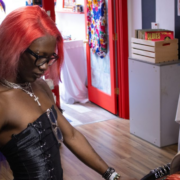
Kenni, with bright red hair, glasses and a black corset top, looks through a clothing rack in a vintage shop, photographed by Harper Thomson

The Orange Dress That Became Pants: How Trans Youth Find Home in Their Clothes

This story first appeared in Queer Cincinnati: Beyond the Binary, published Oct. 23, 2026.

Transgender people from all unique walks of life have a very different relationship with fashion than their cisgender peers. For transgender youth, how they choose to dress themselves can have a wide variety of purposes in their day to day lives. For many trans people, how they dress can often impact how they affirm their own gender, relate their gender expression to others, and protect themselves and their community. With what feels like limited spaces to celebrate transgender bodies, and the constant commentary on trans expression from cisgender peers, transgender youth are looking inwards. Through this they are finding home within themselves and their community through dress.

Stone (They/Them), 23, Hometown: Roebuck, SC

“What item of clothing was a milestone in your transition?”

Stone: This orange dress that I was able to turn into pants. A big thing to me is androgyny. Having a dress and knowing that I can wear whatever with it really brought out that experience. And can I even say it’s mine if I didn’t make it my own? I don’t have enough dresses and skirts but I’ll get there.

With clothing being so attached to gender expression in our society, the ability to modify that clothing can be very important to many trans people. Clothing can determine much of how you’re perceived by others. With most mainstream clothing often being designed around the gender binary, altering garments to be more androgynous/fitting can be deeply fulfilling.

Kenni (She/Her), 22, Hometown: Delhi Township, Ohio

“Do you find home and gender euphoria in clothing that people might imagine to be a bit more physically restrictive, and if so what garments?”

Kenni: Honestly my heels. With my thigh high boots, you have to wear them for a while and work them in, but once you’ve had them for a while I feel like you can do anything in these heels, it feels like I am just wearing some gym shoes.

“Does your dress inform how you feel within your body or do you think it more informs what you can accomplish with your body?”

Kenni: Definitely the latter. Sometimes you have to know you can’t be dancing the absolute most in a little dress, but I will [still] be dancing around busting my ass.

Way (She/Her/Hers), 21, Hometown: Loogootee, Indiana

“How does your career in musical theatre and acting impact your dress and transition?”

Way: Dress in a lot of ways is everything. It’s what the people behind the table like casting directors and artistic directors see first before you even open your mouth. I want to ensure I am representing myself in the most authentic way without dampening who I am.

“Why do you think hyper utilitarian garments (for example carabiners, cargo pants, combat boots) are so popular amongst trans people?”

Way: [In my opinion], queer people are overwhelmingly more common amongst the working class because there is less energy available to try to hide something. We make up a good part of the labor force. There is also this idea of needing to be ready to be equipped to stand up for yourself and being ready to help and protect other queer people.

Clothing not only serves as a means of expression but also for everyday utility. Sporting a more utilitarian look is a form of anti-fashion. Rejecting consumeristic, highly gendered, and rigid fashion standards. Not only for comfort and mobility, but also for the very genuine purpose of expressing one’s authentic identity.

Emmet (They/He), 24, Hometown: Anderson Township, OH

“What was it like growing up queer and trans in Anderson? Did you feel like you had to make any compromises in your dress to be safe?”

Emmet: It was one of those things that was never talked about in my household. I grew up religious and homeschooled so I didn’t get to see a lot until I got my first barista job when I was 18. I was introduced to people that used different pronouns, that were trans and queer. Anderson has gotten better but it’s not the most accepting place. At first when I was newly queer I would definitely ‘tone it down’. As I have grown into dressing how I feel it’s still very scary and intimidating. You never know how people are going to respond to crazy makeup or a shaved head. I am going to look queer no matter what. Travelling around Cincinnati for sure changes how I dress, closer to downtown I really get to go to the max with it.

Elliot (They/He/She), 22, Hometown: Cincinnati, OH

“If dressing ever felt like a costume, when did it stop feeling like a costume?”

Elliot: Looking back in my early transition, I painted on my eyebrows and I would make facial hair with my makeup, it felt like I was performing the most hyper masculine. When 2020 hit, I loved experimenting and playing with makeup and that is when I got a little bit more feminine. It hit me that I didn’t have to perform as much, I could use it as a chance to be more fluid, more for myself than the people around me. It really just matters day to day about how I present myself. That fluidity has allowed me to really find myself and connect to my body.

As fluid as gender identity and expression can be for many transgender people, one of the many utilities of dress can be its ability to change with us. This not only allows for us to accurately portray ourselves to the world at large, but also aids in us being able to break down internal biases and shame. Experimentation and fluidity in one’s dress can become an essential part of the journey towards true self expression.

Thank you to Secondhand Circus and GG for allowing us into your space, and thank you for what you do for the Cincinnati transgender community.

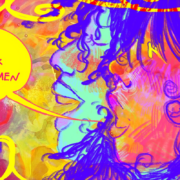
Illustration by Kami Pankey of two faces in profile with a speech bubble that reads Protect Black Trans Women

“We Don’t Need Allies That Are Going to Wave a Flag”: A Trans Leader on What Real Support Looks Like

This story first appeared in Queer Cincinnati: Beyond the Binary, published Oct. 23, 2026.

For many transgender Ohioans, recent legislation has reshaped the conversation around healthcare, education, and safety. At the center of these conversations, with a central mission to provide facts around these sometimes confusing subjects, is TransOhio. In the summer of 2026, I conducted an interview with Dara Adkison, the Executive Director of TransOhio, a nonbinary, genderqueer, trans-masculine person who previously served on the TransOhio Board of Directors for two years.

What was the driving force that led to the start of TransOhio?

TransOhio has been around for 21 years in a variety of different iterations. We started in 2005 when there wasn’t a trans organization in the state. We started off as a Zine actually, providing resources, community spaces, and message board kind of stuff. It was a place for different kinds of voices to be heard. We started making zines again recently. We have a rolling admission for when we have enough submissions to put together something cool.

What are some of the tangible ways in which you’ve been able to carry out your mission of protecting and advancing the rights of trans, nonbinary, intersex, and gender nonconforming people in Ohio?

We are hard focused on what is tangible. We don’t do performative at TransOhio. We have a longstanding (over 10 years now) legal clinic for anyone who needs care, all free for any trans person who needs it. We’ve helped over 4000 trans people in Ohio with name changes and gender marker changes. We also have an emergency fund which has exponentially scaled in the last two years. We provide emergency help for people who reach out and might be in a dangerous situation. We have recently passed out $250,000 out to our community statewide. If people are trans in Ohio and are in need of help, we’re gonna help them.

TransOhio’s vision mentions wanting to increase lesbian, gay, bisexual, heterosexual, and ally understanding/cultural awareness of the Ohio transgender community. In your eyes, what does being a good ally to the trans community mean today?

I think that being an ally today is not being afraid to stick your neck out. We don’t need allies that are going to wave a flag, but then be silent when they see a trans person getting yelled at on the street. We don’t need allies that will wear a love wins pin, but then when they see the gender expansive person at their job getting discriminated against they don’t say anything. We need people to be vocal in those small moments that are very large for the people being directly impacted by them. We need people to be vocal with their legislators. That’s where I see allyship.

Your brochure mentions advocating for laws and policies which best protect our most vulnerable community members. In what ways do you advocate for those with intersecting identities, especially when factors other than transphobia (like racism and sexism) are sometimes still very present within trans communities?

At TransOhio, whenever we ourselves are running a program or partnering on an event, we do everything we can to not just make the spaces inclusive, but welcoming. We are very intentional about making sure people from a variety of intersecting identities are in our leadership, and also in the room when we are figuring out plans and programs. As a white trans leader, I am personally very vocal about making sure doors are open. You won’t find me doing an all white panel.

The Cleveland clinic recently agreed to a 20 year ban of gender affirming treatment for patients under the age of 18. This includes puberty blockers, hormone therapy, and other treatments. You’ve made efforts to put out many facts about this settlement. As there are unfortunately more laws being put out very similar to this settlement, how do you counteract the ambiguity? How do you lessen the confusion surrounding them?

Our main tactic for lessening confusion is to try and put out as much correct information as possible. We kind of consider ourselves the disinformation assistance for trans people in Ohio, because we are always going to say what’s correct. I know that can sound a little obnoxious, but we put a lot of time and effort into making sure we are sharing correct information. We also know how much people trust us to be giving them correct information.

For the Cleveland clinic stuff, our main conversation moving forward is what we can do about it? HB68 is still in active litigation, but even if that litigation ends up going our way, then we now have this settlement in place that will affect Cleveland clinic in perpetuity for 20 years. There’s nothing that the courts can do about that. What we can do is make Cleveland Clinic look like idiots for complying in an effort to have no other hospital want to comply excessively in the way that they have. They did not NEED to make this settlement. We don’t want our hospitals caving into the Department of Justice, not about trans healthcare, and not about anyone’s healthcare. Coming back to talking about things good allies can do: Allies who have financial power are the ones that end up getting listened to. This is a great moment for those people to step up and talk to the hospitals and say that we don’t want this kind of compliance. The Cleveland Clinic has made a very intentional choice about who they want to be as a medical leader, not just in Ohio but globally, and they should be shamed for it.

Do people often reach out to your organization for clarity regarding these things? If so, in what manner?

I think it depends what kind of clarity folks are looking for. We definitely have a fairly substantial social media footprint. Regardless of my personal opinion of social media, it is still a very efficient and active way of getting information out, especially in some more rural areas. When we’ve had complex bill conversations, we’ll have discord sessions for open community discussion about potential impacts, potential contingency planning, and generally just answering questions. People also reach out to us with more personal questions. You can reach out via email, messenger, and different chats on various platforms. We don’t recommend approaching myself, or any of our board members if you see us just trying to exist as a queer person out in the world please. Our main inbox [email protected] is a good one.

Aside from the plethora of information that your own organization provides, what other organizations or resources do you often find yourself recommending to trans individuals struggling with staying informed about their rights?

In Cincinnati specifically, Transform provides some really fantastic support services, groups, social programming, or even their free closet. Trans Masc Cincy is [another group] really focusing on trans youth. They have some really great support groups for masc presenting folks. In terms of other places for staying on top of the ever-changing landscape of things, Advocates for Trans Equality (A4TE) nationally advocates for trans rights. They have great information, particularly other kinds of guides existing outside of Ohio. If folks were born in other places sometimes we will send them over to A4TE’s guides.

In your mission you also mention providing social activities that are inclusive and foster pride in the Ohio transgender community. What can someone who might be anxious about attending these events expect from them? What’s a specific and successful activity that you’ve put together?

We are in the 27th year of our annual gathering, the TransOhio Symposium. We are actually having it in Cincinnati this year for the first time. It’s the gathering of about 200-400 trans people over the course of a weekend. It’s a really unique kind of environment. There aren’t a lot of other opportunities to have a social and informational sharing community meal with that many other trans people. When we’re looking at what a successful symposium would look like, it sometimes can be very overwhelming. We have people that come and it’s their first time presenting as themselves in a community space. We have people who it’s their first time meeting other trans people. We have folks who drive in from other states with a parent or friends because they don’t have anything like this near them. We really take responsibility in knowing the kind of safe space that we’re trying to create. It’s all community and trans driven. There’s always a lot of food and quiet spaces. It’s super accessible for people to just relax and take a sec, and you can come and go as you please. This is a core program for us and a major undertaking.

With this magazine we are focused on reaching trans youth. What personal advice do you find yourself giving to trans youth that are particularly struggling with fear and acceptance right now?

I don’t think there’s one perfect thing to say, just because everyone’s experience with their understanding of their gender is so different from person to person. Speaking personally for what I would have said to my younger self is that being unapologetic sooner is extremely freeing. For people that don’t have accepting families it can be so complicated, but giving yourself permission to exist with multiple feelings at once is also okay. You can be frustrated with a parent, and also love them, and also want to be respected, and also be okay with having all those complex feelings and knowing exactly who you are at the same time. It doesn’t have to be binary, just like our genders don’t have to be binary. It’s okay to give yourself permission to evolve and grow and change. I would also strongly encourage reading queer history, because I know I didn’t learn ANY in school. My three favorite quick crash course recommendations would be “Saving Our Own Lives”, “Queer Trans and Mostly Black: a Mutual Aid Story from the Last 50 Years”, “Black on Both Sides”, and “Before we Were Trans”.

Close-up of an illustration by Cocoa Durrett of a figure in a long red-orange robe with a green waistband, surrounded by red planets and stars on a deep blue background

Sober and Queer: Finding Community Outside the Bar

This story first appeared in Queer Cincinnati: Beyond the Binary, published Oct. 23, 2026.

In summer 2026, I spent a few weeks researching Cincinnati’s queer nightlife and social events. While doing so, two questions continued to peak my interest: Where exactly do the sober members of our community spend their time, and do they ever feel excluded from nightlife and social spaces due to their sobriety? I set out to speak to individuals who could answer these questions, specifically those who identified as both transgender and sober. In an attempt to bring light to some exclusionary sentiments experienced in bar and club culture, I open these questions to you, the reader. Conducting interviews on the subject in person however, revealed to me that many share the same opinion as I do surrounding queer community events in Cincinnati. Many events found in our local queer community, I’ve found to be generally centered around bar and club culture. Those who don’t participate in substance use can often feel as if they are forced to stand on the sidelines while trying to participate in these events.

Take a look at some recent event calendars for queer events in Cincinnati. You may notice that the majority of them take place in a bar or other 21+ spaces. Midwestern Lesbian’s Cincy Gay Agenda for example states that, for the week of July 6th through July 12th 2026, five out of seven events listed are located at bars, clubs, or breweries. These places are largely centered around the consumption of alcohol, and largely host our queer gatherings. Logically speaking, sober individuals usually understand that they may attend these events without participating in alcohol use. The concern lies in the continuous gathering in these types of establishments where drinking is typically a main activity. Shouldn’t queer people have an equal amount, or more options for community activities that aren’t centered around substance use?

Long nights spent drunk or high have become normal for many. I commonly find it hard to walk into a club anywhere in Cincinnati and find someone sober to socialize with on the dance floor. This can make it very challenging for the sober members of the LGBTQ+ community in our city to find inclusion at these events. It can feel as if you have fallen to the sidelines, fighting an internal battle and ultimately having to make a decision about substance use. I personally am always wondering: would I fit in better here in Cincinnati if I wasn’t sober? How do I have fun with my community without the expectation to participate in substance use? For those of us who spend nights out acting as the perpetual designated driver, where do we fit in?

I found solace in Spyder, age 25, as we met to speak in the basement of the Northside Library. She is a member of a local punk band called Badman, and as a result spends plenty of time in bars and DIY venues across the city. As you can imagine, she finds herself often rubbing elbows with other regular clubgoers. One thing distinguishing herself from the other “regular clubgoers” is the simple fact that she doesn’t drink. Spyder continues to be an active participant in Cincinnati’s queer nightlife, but she also cites that she often feels the pressure to conform. She explains that she feels as if Cincinnati’s nightlife scene is highly substance centered. She states that “maybe it comes down to everybody’s own social anxiety… I think if we had a more level playing field, where drugs and alcohol weren’t an expectation…you would find people who wanted to spend time there”. I asked her what types of alcohol and drug-free events and spaces she would like to see in our city. She suggested events such as community dinners (not only because there is no pressure to use substances in places like these), but also because members of the community who don’t have consistent access to hot food can gather here without the expectation to pay a cover fee. She also noted that she had an idea in the past to start a queer skate club here in Cincinnati, either at a roller rink or local skate park. Both of these are amazing ideas that create a sober space for queer people to gather, with activities that value social interaction over substance use.

I continued to speak with Hugh, age 24, about our shared experiences with substance use and community expectations. Hugh uses medical marijuana for chronic pain, but over the last year has decided to abstain from alcohol. While discussing the pressure we felt from our peers in Cincinnati specifically, Hugh cited his frustrations: “There’s no big explanation, I just don’t want to [drink], and that kind of answer is not acceptable to a lot of people.” In his opinion, alcohol is often used as a “social lubricant” in situations like nightclubs and bars. Oftentimes, there’s just an expectation that you’re going to participate. I asked Hugh the same question I asked Spyder about what kinds of sober spaces in Cincinnati he would like to see. He mentioned that creative outdoor events like the YART (yard art) Sale in Northside have been a safe haven for him. He, and myself, would like to see more creative events like those, specifically events that are lower effort, self-led, and easily accessible. He continues to state that:

“I think there needs to be more casual community events. I think that people are under the assumption that everything needs to be big and super elaborate, and it’s like, you could just have a weekly meeting where you and your friends hang out at a park pavilion and make crafts, and that would be a safe space.”

As many of us are longing for low-effort social spaces to foster community while keeping ourselves sober, conversations like this are extremely important. In future years, I hope that we can begin to see an uptick in events that exist outside the bar. As I see it, these spaces would only create safer community based environments for those of us who choose to abstain from substances. As a sober person myself, I couldn’t agree more with Spyder and Hugh about the social pressures we find ourselves facing, and what we as a community can do to counteract it.

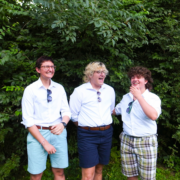
Seth Rane, Grayson Castellucci and Eddy Risimini, three students in white button-down shirts, laugh together in front of a wall of green leaves.

Pushed to the Edge of Campus, These Trans Students Started Their Own Fraternity

This story first appeared in Queer Cincinnati: Beyond the Binary, published Oct. 23, 2026.

In the spring of my freshman year at the University of Cincinnati (UC), Ohio Senate Bill 1 was moving through the state legislature. The bill, which would take effect on June 27th, 2025, requires Ohio’s public colleges and universities to maintain institutional neutrality and “intellectual diversity” on certain “controversial beliefs and policies” including climate policy, electoral politics, foreign policy, immigration, marriage, and abortion. It also bars faculty from “indoctrinating” students toward a position on these topics, bars the institution itself from taking an official stance, and eliminates diversity, equity, and inclusion (DEI) offices, departments, and required trainings at the same institutions.

UC, however, wasted no time adopting these principles, even before the bill became law. UC President Neville Pinto complied in advance, stating in a public email on February 21st, 2025 that “it is untenable to operate as if noncompliance with these directives is an effective option” and that “we are committed to meet our compliance obligations.” Soon after President Pinto’s address, DEI offices including the LGBTQ+ Center, the Women’s Center, Ethnic Program Services (EPS), and the African American Cultural Resource Center (AACRC) were immediately shut down. Many students, myself included, felt this response failed to address their concerns.

That same spring, the university began replacing bathroom signage with new “biological men” and “biological women” signs. This action was a result of Ohio Senate Bill 104, the “Protect All Students Act,” signed by Governor Mike DeWine in November 2024, which prohibits members of one biological sex from using restrooms designated for the opposite biological sex and erases multi-occupancy restrooms open to any gender. The law does require institutions to provide alternative accommodations, such as single-occupancy facilities, but the bathroom signage UC implemented was worded of their own accord. The new signs were adopted quickly, sending a clear message that transgender, nonbinary, and intersex students were not welcome. Because of this, many students became worried that their university housing options would no longer be viable if the available restrooms did not match their “biological sex.” As a trans man living in freshman dorms at the time, I worried for my housing security.

My fears came true when my fellow trans roommates Seth Rane, Grayson Castellucci, and I were relocated to the margins of campus mid-spring semester. We were originally approached in an email by UC’s Director of Resident Education & Development at the time, Trent Pinto, on February 10th, 2025. Pinto invited us to a “conversation regarding upcoming changes to the residential experience.” This meeting was held at UC’s LGBTQ+ Center before it was dissolved, and its conclusion resulted in two options: 1) Stay in our dorms and travel to the women’s dorms to use the restroom, or 2) Relocate to an off-campus apartment where we would have access to a personal restroom.

Option 1 was an unreasonable request for us. Not only was this option directly invalidating our identities as men, but it was also oversaturating the communal space and required us to travel to a different floor or building to use the restroom. Because of this, my roommates and I conceded to option 2 and were relocated to an apartment near campus. While UC quickly responded to a flood of backlash by removing the bathroom signs, the damage had already been done. What was supposed to be an exciting year to make new friends and invest in our studies instead became a year where we were isolated from our peers and pulled from our classes to accommodate the move to our new apartment.

Amidst the predatory legislation and considerable lack of LGBTQ+ spaces, we quickly realized we were not alone in our isolation and observed an almost solemn environment throughout campus. To combat this, my roommates and I decided to make a change.

One day after class, I came home to Seth and Grayson sharing the idea of starting a queer fraternity: Phi Alpha Gama (PAG). At first, we treated it as a joke. After all, it is customary across university Greek life to exclusively allow one gender (women in sororities, men in fraternities). It seemed absurd to imagine visibly queer or transgender individuals enjoying this same staple of college life, but the more we thought about it, the more we realized that PAG’s existence might be a space that UC’s LGBTQ+ community desperately needed: a space made by queer people for queer people to enjoy without consequence.

A fraternity was the best option for us to organize an LGBTQ+-friendly community because we felt that queer individuals deserved to be included in traditional college experiences that they may otherwise shy away from. We gathered a few close friends to join PAG, but we realized that to expand our community past our small clique, we needed to give our fraternity structure. To do this, we created the governing body of PAG, consisting of the following roles: president, vice president, secretary, recruitment officers, philanthropy chair, social media chair, diversity chair, and grievance officer.

We didn’t expect PAG to be more than a small community at first, but soon, friends of friends came to our parties and told their friends about PAG, and it became a vast network of students where all are welcome. During our recent spring rush campaign, we had a great turnout, with around 30 members present and 10 rushees. We implemented different group bonding activities including ice breaker games and a friendly s’mores roasting competition. However, the main standout of this event came about when several people approached our front yard asking about the event we were hosting. What stood out to me the most was how accommodating the members of PAG were to total strangers. Seeing a community that I helped create foster such a kind and welcoming environment made me realize how important PAG was to creating a safe space for queer and allied individuals to be themselves and make new connections.

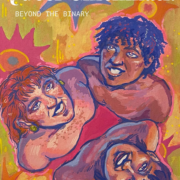
Cover of Queer Cincinnati: Beyond the Binary, a painting of three people seen from above on a bright pink, yellow and green background, by Emil Wiersma

“You Are Not Alone”: A Letter From the Trans Youth Who Made This Magazine

This story first appeared in Queer Cincinnati: Beyond the Binary, published Oct. 23, 2026.

Dear Reader,

As you flip through the pages of the very first issue of the Trans Cincinnati Magazine, I wish to inspire each and every one of you to find hope and community in the stories we have curated.

This magazine is an accumulation of authentic voices, anecdotes of trans joy, and critiques on current predatory legislation. Experiences ranging from liberation, to discrimination, to connection made within the community are depicted. I am more than eager to spotlight residents of the beautiful city of Cincinnati and their real, unembellished trans experiences. I also want to thank Queer Kentucky for the opportunity to expand their outreach to the state of Ohio, giving us the chance to spotlight important resources within our state. Additionally, I would like to mention TransOhio, Transform, Trans Masc Cincy, and Equitas Health. These organizations work to carve out a rightful place for trans youth. Whether that be through creating gathering spaces for the queer community, helping folks understand how to secure affirming care, or simply providing a safe space for those with intersecting identities, these organizations all show up for trans Cincinnatians.

In a world where trans youth are so often made to be silenced, a publication like this is extremely important. The statements within each article are testimonies about trans lives from actual trans individuals. From start to finish, this collection was brought to life by trans youth, for trans youth. Our writers and artists have poured talent, beauty, and truth into this project, and love can be felt throughout every page. When presented with the chance to work as co-editor of this project, I leaped at the opportunity. I am proud to be a part of this community, and to be completely surrounded by visionaries in my day to day life. I am consistently reminded of the radiance that exists in Cincinnati’s trans youth, along with the ambition to actively create a future in which all identities are honored and respected. What you are about to read is not only proof of that ambition, but documentation of firsthand interactions with the current cultural/social state of the world.

If you are not trans and reading this, take it as an opportunity for education and understanding. Question the ignorance you may possess surrounding trans identities. Allow this set of articles to dismantle harmful beliefs and behaviours. If you fall anywhere under the trans umbrella and are reading this, take it as an opportunity to see trans love, joy, and strength reflected back upon yourself. Allow the support of our community to uplift and empower you. So much beauty exists within your identity. Hold onto that love, beauty, and power. Despite those who misunderstand you, despite those with hate in their hearts, despite challenges you are bound to face throughout life. We fight together for your right to be your authentic self. Let these stories act as a vehicle of joy, as something to remind you that you are not alone, and you are worthy of care.

Nyla Davies, Co-Editor