KEEP. Subject. Additive. Syringe services, naloxone, overdose prevention, drug policy.

Tag Archive for: Subject: Harm reduction

A landscape image of a woman with space buns standing behind a table, under a tent, vending for an event. She is wearing a yellow t-shirt that says "I [heart] Lesbians"

Kentucky Black Pride Turns 10 in the Park That Sheltered Queer Lexington

Kentucky Black Pride celebrated its 10th anniversary in September with a four-day festival in Lexington aimed at community, resources, and self-expression.

The four days each carried their own program. Thursday opened with Healthy Sexual Talk, a sexual health session marking National Gay Men’s HIV/AIDS Awareness Day, followed by Ladies Night. Friday brought the Mr. and Miss Kentucky Black Pride pageant. Saturday filled Woodland Park with Pride in the Park, the festival’s centerpiece. Sunday closed with community awards and a day party.

Among the first-timers at Woodland Park in Lexington was Tiffany Knight, of Bowling Green, Kentucky, who came to promote her cookie company, Eat Q Cookies.

“Where I am from is not as diverse. This is my first event where it is specifically Black oriented and it is really nice to see the community come together.”
Pride in the Park featured booths from aligning community and health resources, from CASA of Lexington, who are court appointed youth advocates, to the Lexington-Fayette County Health Department, who was on hand to share Narcan, COVID tests and condoms. Local designers sold Pride merchandise from buttons to jean jackets. A drag show followed at 1PM during the park extravaganza.

Kentucky Black Pride was founded in 2016 by Shawn Bumpase, after a conference call with other LGBTQ+ community members about the state of Kentucky’s Black queer community. By January 2017, the organization was official, with a home on South Broadway in Lexington. Kentucky Black Pride, Inc is a 501c3 non-profit organization that provides financial assistance, counseling and other community services.

Why Kentucky Black Pride stays at Woodland Park

Lexington has a storied history with the queer community. Its most notable member being Sweet Evening Breeze, who would perform drag here starting in the 1950s. Breeze is now honored with a downtown mural not far from where she was arrested for cross-dressing in the 1960s. And by 1981, the park hosted queer events supported by the Gay Student Organization of University of Kentucky. The Faulkner Morgan Archive in Lexington preserves that history.

Woodland Park remains the host location of Kentucky Black Pride because of that community support, said co-chair Suga Dawson.

“We stay with Woodland Park because in the 1950’s, before drag was legal, Woodland Park supported the gay community, not just our community,” Dawson said. “So we stay to show respect and support.”

Dawson, in her fourth year with Kentucky Black Pride, helped run the weekend. where she explained what it means to her: “It’s self-expression in a nutshell; the parts of me that aren’t as prevalent when you meet me.”

A festival that works year-round

Kentucky Black Pride hosts its festival each September as part of Roots and Heritage Festival month, but the nonprofit works year-round. Its “Let’s Talk” series gives the Black queer community its own town hall while the organization also supports youth school supplies initiatives.

A field of corn glowing in the sun.

At Black Soil KY’s Farmacy Markets, Narcan Sits Beside the Produce

From the war on drugs to the legacy of the crack era, Black people in the U.S. have been systemically and perpetually harmed by both drug use and public health disparities. That sobering reality is also true in Kentucky, where a Lexington nonprofit is working to build safer futures by changing how support is delivered, integrating harm reduction into already effective agricultural programming.

“We are trying to think outside of the box around crafting unique, one-of-a-kind programming while providing a critical community need,” said Ashley C. Smith, Executive Director and Co-founder of Black Soil KY.

Established in 2017 by Smith and her husband, Trevor Claiborn Sr., the organization’s mission is to “reconnect Black Kentuckians to their heritage and legacy in agriculture” through programming, events, and community building.

From food access to harm reduction

Since its founding, Black Soil KY has worked with farmers and community partners to host events that make agricultural education and fresh food more accessible to Black communities across the state. While the organization was effective at increasing access and education around food, Smith saw an opportunity to develop programming rooted in the idea that drug abuse, food insecurity, and public health are intersectional problems that demand intersectional solutions.

In 2023, the number of drug overdose deaths in Kentucky declined for the first time since 2018, according to the Kentucky Injury Prevention and Research Center, but not every community felt that progress. That same year, Black Kentuckians experienced an 8% rise in overdose deaths. More broadly, Black people in America are 46% more likely to die from a drug overdose compared to other groups, the U.S. Department of Health and Human Services reports.

The opioid crisis is not the only harm felt more intensely by Black communities in the state. Kentucky currently ranks as the state with the second-highest rate of food insecurity in the country, the Kentucky Center for Economic Policy reports. Data indicates that Black communities across the state are nearly twice as likely to be food insecure, compared to White Kentuckians, according to Feeding America.

These are the disparities that Black Soil KY intended to close with a new approach to community care.

In 2024, in partnership with The Foundation for a Healthy Kentucky, a nonprofit that works to reduce health disparities while promoting health equity across the state, Black Soil KY acquired funding from Vital Strategies, a global public health organization, to begin integrating harm reduction into its already effective portfolio of programming.

Harm reduction is a spectrum of strategies that are intended to minimize the harmful nature of drug use. Such strategies include providing clean syringes, sexual health testing, contraceptives, fentanyl testing strips, counseling, mental health support programs, and more. Harm reduction aims to minimize the harmful effects of drug use rather than ignore them.

First, the organization went to the farmers. In 2024, the nonprofit trained 30 small and mid-size farms on harm reduction, including signs of overdose, Narcan usage, and how to respond to the substance abuse they might come across in their work. The organization saw farmers as a priority because of how inseparable their work is from the communities they serve, and how intrinsically connected they are to an individual’s well-being, according to Smith.

“We trained Kentucky small- to mid-sized farms: farmers, farm operators, and their families around how to be harm reduction first responders,” Smith said. “They oftentimes live in rural communities, but travel to urban communities to make deliveries… And we were hearing stories from farmers who make deliveries in communities afflicted by substance use and abuse disorders.”

After they built the training model for farmers, Black Soil KY expanded their harm reduction programs into their other community-centered events. In 2024, the group first began including harm reduction supplies as part of their free food distribution in Central Kentucky. After seeing the success of these resources, Black Soil KY opened two neighborhood “farmacy market” locations in Lexington in 2025.

The “farmacy markets” were a first-of-its-kind concept, providing harm reduction supplies and educational materials right alongside fresh food directly within communities. Alongside fresh produce, these markets provide communities with tampons, condoms, and harm reduction necessities, including Narcan and fentanyl testing strips.

“All of these steps, these multidisciplinary, interdisciplinary approaches are really seeing people for who they are and meeting them where they’re at, while also increasing their recovery capital around their nutrition and their health and their wellness,” Smith said.

This year, the organization launched its “Shop N’ Learn Community Series,” a partnership with Vital Strategies and the Kentucky Department of Public Health, part of a broader effort to combat rising overdose rates among BIPOC and underserved populations. The monthly event is “focused on expanding awareness and implementation of harm reduction strategies to often overlooked, hard-to-reach, underrepresented communities in relation to harm reduction and recovery care.” Individuals who attend a “Shop N’ Learn” event also receive a $40 gift card.

The series has been hosted in part by guest speakers, who share their own testimonies and expertise around recovery and healing.

“I am from the community, and I had an opportunity to go share my lived experience with the same community that I was brought up in — as terrifying as that is for me being only three years sober,” said Tywanna White, a recovery coach with Voices of Hope, a recovery community center in Lexington. “I said yes to an opportunity to be able to carry the message. The people in the audience had so many questions, and I was able to educate them on some things that I was taught from this same community.”

White was one of the featured speakers at a “Shop N’ Learn” event in June. According to White, this programming is exactly what it takes to dismantle health disparities facing Black Kentuckians.

“Seeing those faces looking right back at me wanting to be open, it shifted something. It told me that there’s a need for this…” said White. “I didn’t have any voices trying to help educate me on my substance use. It was so normalized. So no one even knew that I was struggling because it’s so normalized in the Black community.”

According to Smith, around 10,000 community members showed up at their events in 2024 and 2025. The impact, beyond attendance, speaks for itself. Smith said attendees of their programs report progress.

“We’ve really been able to see a lot of positive outcomes like reducing interpersonal and inter-communal violence,” Smith said.

Civic engagement as harm reduction

This programming is just the beginning of how Black Soil KY plans to build deeper inroads across communities that need care. Civic engagement is among the many solutions Black Soil KY is exploring to heighten awareness of health disparities.

In 2024, just 48% of Black Kentuckians voted in the general election. That is compared to over 70% of White Kentuckians. There is a growing body of research pointing to a strong correlation between civic engagement and public health: The more engaged a community is, the healthier they are. Black Soil KY identified these disparities and created new programming to empower Black communities in Kentucky to have a stronger say in what policies and people are given a platform.

In September, Black Soil KY, in partnership with the Lexington Urban League Young Professionals, a network of young professionals advancing public service and professional development, is exploring how civic engagement will take center stage as a new harm reduction topic in their “Shop N’ Learn” series.

For the first time, the workshop will focus on how to participate in elections and the importance of voting. The workshop will bring folks together who have overcome or are currently working through substance abuse, and support them in getting registered to vote while providing educational materials on the choices they have in November.

“We can really facilitate getting everyone active and engaged. And we truly believe that’s also a part of harm reduction: being active in your community,” said Smith.

Black Soil KY’s programming has become a staple in communities, with leaders celebrating how the organization addresses both a person’s material needs while safeguarding their emotional and physical well-being.

“A person wants to be heard, they want to be seen, they want to feel like they’re human. And so it starts with getting to know the people off paper, knowing what it is they need at that moment, and then focusing on removing the substance later…” said White. “I think it’s a beautiful thing to incorporate harm reduction in these same communities where harm happens and also center it around food. That is the medicine.”
This work was supported by the 2026 CNP Media Fund. #CNPMediaFund

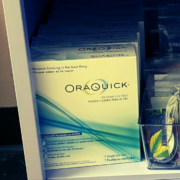
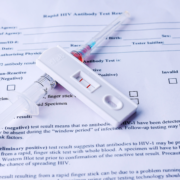
HIV self testing kits sitting on a ledge.

Federal Cuts “Handcuffed” BIPOC Harm Reduction in Kentucky. Communities Are Stepping Up.

In April, the Substance Abuse and Mental Health Services Administration (SAMHSA) released a letter notifying funding recipients that the agency is taking a “clear shift away from harm reduction,” including eliminating funding for fentanyl testing strips, clean syringes and needles, and “overdose hotlines.”

Harm reduction at its core is “a set of practical strategies and ideas aimed at reducing negative consequences associated with drug use,” according to the National Harm Reduction Coalition. The organization further details that some of those strategies could include the safer use, managed use, abstinence, meeting people who use drugs “where they’re at,” and addressing conditions of use along with the use itself.

SAMHSA’s decision has had immediate and life-threatening consequences for Kentucky organizations doing the work to close critical gaps in care for those in need, including for marginalized people.
“When they put this letter out there, they literally just handcuffed a lot of people,” said Shreeta Waldon, executive director of the Kentucky Harm Reduction Coalition (KyHRC), a Louisville-based nonprofit that works to reduce substance use disorder overdoses and deaths.

The letter cited a White House executive order from July 2025 to justify the policy changes. The order, “Ending Crime And Disorder On America’s Streets,” details those changes among a list of other line items including homelessness and crime. “Do not fund programs that fail to achieve adequate outcomes, including so-called ‘harm reduction’ or ‘safe consumption’ efforts,” the order reads.

It describes such strategies like harm reduction as ineffective; however, harm reduction is actually an evidence-backed practice that has been backed by scientific research.

What Kentucky Lost When SAMHSA Cut Harm Reduction Funding

These changes and attacks on harm reduction initiatives have hit the already limited ecosystem of harm reduction services built by and for Black and brown communities.

“SAMHSA award terms are now prohibiting federal grant funds from supporting several traditional harm reduction supplies, including syringes for illicit injection, safer smoking supplies, and fentanyl and other substance test strips,” Waldon explains. “That means that organizations are now navigating a much narrower definition of what federally funded harm reduction can include and not include.”

Recent research revealed that Trump’s elimination of federal funding for programs that provide syringe exchange and other harm reduction interventions will directly contribute to an increase in overdose deaths and non-fatal overdoses. Outcomes that Black and brown communities already feel more intensely.

KyHRC is one of the few groups in the state still delivering harm reduction care and resources for BIPOC communities, despite these concerning changes. In addition to new limitations, Waldon’s group immediately lost a $400,000 grant after the SAMHSA decision. However, instead of deferring programs or shortening their impact, the organization found new ways to deliver care to communities.

KyHRC began working with partners across the country to source harm reduction resources that they no longer could get from federal funding. Waldon mentioned that, among other groups, the Connecticut-based organization Reduce Harm Inc. has supported KyHRC with clean syringes, testing strips, and other supplies that are no longer accessible.

The redefinition of what the government will fund comes after a well-documented body of evidence pointing to harm reduction as a key strategy to prevent drug-related deaths. Studies show that fentanyl testing strips prevent overdoses, and research shows that providing clean syringes prevents the transfer of blood-borne diseases. A 2025 study including 67 communities, some of which were in Kentucky, found that when offered harm reduction strategies, those communities experienced a 15% reduction in non-fatal opioid overdoses and an estimated savings of $190,100 in healthcare spending per community.

Why Black Kentuckians Feel the Cuts Hardest

For Black communities in Kentucky, these new limitations are felt even more deeply than their neighbors. In 2023, the overall number of drug overdose deaths in Kentucky declined for the first time in years, while Black Kentuckians experienced an 8% rise in overdose deaths. Black Kentuckians continue to face worse health outcomes, less access to regular health care, and higher mortality rates compared to other groups. It is these realities that make harm reduction and community resources for Black and brown people all the more critical, according to the organizers delivering care despite greater obstacles.

“If you are trying to give me aid and help me based on the statistics that you have for white people, it’s not going to help me because it’s not made for me,” said Adria (AD) Shouse, a master barber at Well Groomed Barbershop Parlor.

Shouse is a barber with the African American Barbershop and Beauty Salon Initiative (BBSI), a public health program part of Project Ricochet, a nonprofit organization working to improve outcomes for minority youth in Lexington and beyond. BBSI transforms “relationship-rich environments” like barbershops and beauty salons into spaces where communities can get care and education related to diabetes, sexual health, mental health, drug use, and harm reduction.

“I’ve seen changed behavior in people that I’ve been cutting for years that have utilized resources through BBSI,” said Shouse.

BBSI provides community events based out of these safe spaces that bring care, including harm reduction resources, right to the communities who need it. This direct level of intervention is what Shouse says is missing in much of the conversation around BIPOC public health funding.

“The funding is different when it comes to people of color or minorities,” said Shouse. “They’re trying to keep certain communities and certain people in certain places because it works to their advantage.”

Shouse’s clients are predominantly Black men and young people, and in her work she fulfills a material need while offering support for other challenges.

Doulas Trained in Harm Reduction

It is that same model that other community leaders are implementing to provide support for Black pregnant people as well.

Granny’s Birth Initiative (GBI) is a nonprofit based in Louisville that supports Black parental health, partnering the care a pregnant person needs with the harm reduction resources they are unable to find elsewhere. That starts with training their doulas on harm reduction strategies, including trauma-informed care and Narcan usage.

“We make sure that our doulas are trained in that because doulas do provide resource navigation and it should always be non-judgmental support,” said doula Alexa Scisney, founder and executive director of GBI. “We want them to be well trained on not just keeping a straight face, but genuinely and truly understanding the type of resources that are needed.”

Black pregnant people are at least three times more likely to die due to a pregnancy-related condition, compared to their White counterparts. In Kentucky specifically, 82% of pregnancy-related deaths are deemed preventable. About 1 in 20 pregnant people use illicit drugs during pregnancy. This puts the work that GBI does as ground zero for public health progress and reducing harm.

“I know that doulas are an industry that is new to Kentucky, but a doula is somebody that’s supposed to be providing physical, mental, and emotional, non-judgmental support,” said Scisney. “And here at GBI, that non-judgment is something that we really highlight because it is not our job to do harm to people already seeking harm reduction resources. Our doors are always open.”

In addition to the SAMHSA decision, resources for harm reduction in Kentucky have been rocked by funding cuts and lack of consideration for how harm reduction impacts public health. In May, the University of Kentucky announced that it would formally end its HIV/AIDS prevention and treatment organization. The Target4 Project was part of this elimination, which provided HIV/AIDS intervention and services in addition to harm reduction supplies and targeted outreach.

Kentucky public health leaders say they will continue to step up in their communities, despite the new obstacles in front of them.

“Let us be the voice because we are the people who have experienced it. We’re the closest to it. We’re the closest because we live it every day,” said Waldon.

While the Trump administration and SAMHSA cut opportunities and funding, harm reductionists and community leaders continue to show up in new ways for their neighbors. While groups still hope for more permanent and sustainable funding, it is the promise of safer, stronger communities that pushes them forward, they said.

“For me, harm reduction has always been the radical decision to believe that every human being is worth keeping alive before they change, before they recover, before they become who somebody else thinks they should be,” said Waldon.
This work was supported by the 2026 CNP Media Fund. #CNPMediaFund

Nathan Wilson smiling in sunglasses and a neon cap in front of a Matthew25 mobile health clinic truck

How Rural Kentucky HIV Care Saved Nathan Wilson

He was an HIV patient in Rural Kentucky. Now he helps run the nonprofit that saved his life. Nathan Wilson is on a mission to fight against the stigma of living with HIV in Kentucky and beyond. 

Before Nathan Wilson worked at HIV health nonprofit Matthew25, he was a patient. He was a convicted felon and was in active addiction for more than a decade. Now, Wilson oversees patient experiences as the facilities and project manager for the organization. He serves the same rural Kentucky communities where he once struggled to find care himself.

Matthew25, which celebrates its 30th anniversary this year, works with those living with, at risk of, or affected by HIV and other sexually transmitted infections. With four clinics across Southern Indiana and Western Kentucky, the organization serves 25 counties in Kentucky and 12 in Indiana.

Wilson became a patient with Matthew25 in 2019. He found out he was living with HIV while at a Suboxone clinic. He recalls being told: “Hey, your blood test shows this. You should probably reach out to these people.”

He admits that he wasn’t the best patient at Matthew25 in the first year, but the workers at the organization were patient with him. He made up for it, and four years later, he began working at the nonprofit, first as a driver, transporting patients to appointments and then working the group’s food pantry. He now oversees facilities operations for all four of Matthew25’s clinics. 

“Matthew 25 has changed my life since day one — not only changed it, but saved it,” Wilson says. He said the organization fought for him to get his HIV medications when he was incarcerated. While the group didn’t succeed, the fact that they worked hard to help him had an effect on Wilson.

When he first started working at Matthew25, he wasn’t sure he was “a healthcare facility would hire somebody” like him. 

But now he sees his various roles with the group as a full-circle moment. 

“I spent every day on the road with patients — young, old, different ethnicities, different backgrounds — and it changed my view of how broadly HIV affects people,” Wilson says. “It also broke down a lot of barriers between me and patients, because I am one of them.” 

He says many people he’s met also living with HIV don’t have such robust support systems. 

“A lot of times, you’re just there to listen. People don’t necessarily want advice; they just need somebody to hear them,” Wilson says. “Matthew25 has recognized that from the beginning: that we support system. Sometimes they just need to get something off their chest.”

 Wilson believes his work is a part of a greater impact on their patients.

“I work to make sure we have the best possible experience for both clients and employees. That’s the van someone rides in, the exam room they sit in, the quality of our medical equipment. I want people to feel welcomed and cared for in every detail of their environment.”

He says it’s that care that he was shown at Matthew25 that still stays with him.

“Everywhere else I went, I was treated like an addict or a criminal. I never felt that way here. They strive so hard to meet people where they’re at — without judgment, just focused on providing the medical care you need and whatever support you want,” Wilson says.

Matthew25 is one of a few providers supporting Western Kentucky, offering services in locations outside large urban centers. Geography, Wilson says, plays a large role in obstacles to care for HIV-positive Kentuckians. The organization itself travels about a 200-mile radius to pick a patient up to get them to their HIV care, but also any other medical care they need. 

Another obstacle, Wilson says, is fear. He remembers thinking it was a death sentence when he was told he had HIV. 

“I think a lot of people avoid getting tested because they’re scared of what they’ll find, and worried about cost. What they don’t always know is how many resources exist specifically to help with treatment and suppressing viral load,” he explains. “If we can suppress viral loads in people already living with HIV to the point where there’s no transmission risk, then eventually this ends.” 

Wilson says there’s still stigma surrounding living in the area and a misconception that HIV is only a virus gay men get. He said that while he is a gay man, he also was an IV drug user. Male-on-male sexual intercourse is not the only way a person can contract HIV. 

“I think transmission is still deeply misunderstood, and that misunderstanding costs lives.”

The stigma from the gay community also comes to Wilson’s mind. 

“There’s still so much shame and secrecy around it. I’ve been undetectable for years, but people still treat HIV-positive individuals as if we’re diseased,” Wilson says. “You would think that people who have experienced so much oppression themselves would be more willing to accept others.”

He adds that it’s that specific stigma that makes him want to be open about his status and history: “to show that life doesn’t end with an HIV diagnosis.”

Wilson believes the only way to overcome this stigma and to work to stop the transmission of HIV is to recognize each other’s humanity. 

“People with diabetes aren’t stigmatized for their condition. People with cancer are treated with compassion. People living with HIV deserve the same. And the most important thing to hold onto is this: We could actually see the end of this disease, in my lifetime, or the next,” he says, explaining the need to support HIV medications and PrEP. “Transmission can be stopped. Why would we not want to do everything in our power to make that happen?”

Queer Cycling Groups in Kentucky and Ohio Claim Space on the Streets, Build Community

Queer cyclists say that showing up on the road where they often feel ostracized by the automobile supermajority feels like a political fight for their rights—one that mirrors the broader LGBTQ+ struggle beyond the pavement. That sense of resistance has inspired local groups to turn cycling into both community and cause. Three cycling groups across Kentucky and Ohio are securing their spot on the streets by creating queer visibility through community rides and acts of service.

COVINGTON: Queers with Gears

Julia Keister, founder of the Covington cycling group Queers with Gears, moved to Kentucky from New York City where cycling was her main form of transportation. She was baffled by the lack of safety for cyclists in the state, which inspired her to become an advocate for the community.

“Getting on a bike and riding in any city is a political act—especially in Kentucky cities and midwestern cities where cyclists or people that use alternative forms of transportation don’t have as many rights or aren’t seen, or have the access that someone in a car has,” she said. 

Keister’s concerns for cyclists’ safety are backed by Kentucky Transportation Cabinet data which shows that there were 707 highway fatalities in 2024, including 110 pedestrians and cyclists. Covington is working towards cyclist inclusion and installed its first bike lane this summer. Keister says this is a win for both the cycling community and LGBTQ+ folks. The new bike lane covers a 0.52-mile stretch of West Fourth Street between Garrard and Johnson streets.

photo by Caitlin Sparks

“Queerness and access to transportation are things that make the world more inclusive and it doesn’t cost much to ride a bike,” she said. “It’s so much greener than other forms of transportation and the community building through riding with other people is important.” 

Covington’s annual Queers with Gears ride began in June 2021 as a cycling and Pride celebration with a goal of creating a safe and inclusive experience for all levels of cyclists.

“We go at a parade pace and go down streets that are visible and easy to ride,” Keister said. “We try to ride by queer destinations, whether they’re bars or community centers or places with rainbow crosswalks, and we try to incorporate queer history in the ride as well.”


CINCINNATI: Queer Cincy Cycling

Queers with Gears Covington has grown each year and now partners with Cincinnati’s Queer Cincy Cycling for their annual Pride Ride. Wives Jess Heller and April Pitman founded Queer Cincy Cycling in August of 2024. 

Heller and Pitman set out to create a group that they said had been craving and describe it as an “LGBTQ+ cycling community that also addresses the gap in pace options.” While many non-queer-centered cycling groups ride at either 8 mph or 18 mph, their rides maintain a more inclusive middle ground of under 14 mph.

The group meets once a month and rotates meeting spots between Friendship Park in Cincinnati and 50 West Brewing Company in Newton, Ohio. They ride in both Cincinnati and Northern Kentucky.

Keister and Heller said that the physical activity that their cycling groups provide serves as both a coping outlet and a foundation for community. They added that outdoor recreation creates visibility beyond traditional alcohol-centered LGBTQ+ spaces, such as bars and clubs, and helps foster connections in places where people may not typically interact with queer communities.

“Cycling may not traditionally intersect with LGBTQ+ identities, but that’s exactly the space we aim to expand,” Heller said. “There’s a growing conversation around ‘third spaces’—places outside of home and work where people can come together. LGBTQ+ individuals need more of these spaces that nurture and support our active, healthy lifestyles.”


LOUISVILLE: Queers with Gears

Another cycling group, Queers with Gears in Louisville, which is not affiliated with Covington’s Queers with Gears, grounds their community building through social rides and service work to marginalized populations and local LGBTQ+ nonprofits.

After organizing a Pride-themed ride for a general cycling group, Jaime Meyers said that participants told them it was their first time riding in a social group, which inspired Meyers to create Louisville’s Queers with Gears.

“We saw other cities successfully creating intentionally-closed cycling spaces for marginalized groups—women, people of color, people with disabilities, and we wanted to create something similar for our city,” they said. “We just celebrated our two-year anniversary in July!”

The Louisville group meets frequently. The schedule varies based on the personal schedules of their multiple volunteer lead riders. Meyers explained that lead riders have specialized expertise in different forms of cycling, including road, urban and mountain biking. The group also plans overnight trips with group leaders who have expertise in kayaking and camping.

photo provided by Queers with Gears Louisville

“For something like this to remain sustainable, I try not to exhaust anyone by always doing the same thing or overcommitting anyone,” Meyers said. “All our rides are posted on a monthly schedule to our Instagram and then we do a reminder post the week of. Bigger trips or anything overnight we give around a 30-day heads up for people to plan around work or other things.” 

Queers with Gears Louisville also tries to involve other communities to educate, collaborate, and provide services. The group bikes in the Kentuckiana Pride Parade every year and their recent anniversary ride raised $1,000 for Louisville Youth Group, a Louisville-based organization that caters to LGBTQ+ youth. Along with fundraising, they partner twice a month with Old Louisville Brewery and Louisville Outreach for the Unsheltered to distribute meals and harm-reduction supplies, including Narcan, to people experiencing homelessness who are hard to reach by car.

While all three cycling groups across Kentucky and Ohio have different approaches to their social rides, one thing is certain—as queer people and cyclists, claiming space, creating community and inclusion are of the utmost importance to them. Their missions emphasize empowering queer people in their bodies and with each other.

“The freeing feeling of taking back space on the street and existing in a way that might upset some cars, that is noticed by all cars, is synonymous with the feeling of being open with who you are and how you experience life in this world as someone who is queer,” Meyers said. “We may upset some, but our existence is undeniable to all and we have every right to feel just as comfortable in our bodies as anyone else.”

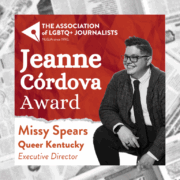
Queer Kentucky Executive Director Missy Spears wins national journalism award

WASHINGTON, DC (August 5, 2025) – Today, NLGJA: The Association of LGBTQ+ Journalists announced that Missy Spears, Executive Director of Queer Kentucky, is the recipient of the prestigious 2025 Jeanne Córdova Award.
“Missy Spears is an undeniable leader in our community, demonstrating the power journalists have to improve public life every single day,” said NLGJA: The Association of LGBTQ+ Journalists Executive Director Adam Pawlus. “Her extensive work has helped cover all things Kentucky, from the legislature to addiction prevention. It is an honor to recognize her and her lifesaving work with the Jeanne Córdova Award.”
The award is named for Córdova, who was a journalist and the editor and publisher of Lesbian Tide, which chronicled the 1970s lesbian feminist movement. The Jeanne Córdova Award recognizes the achievement of an LGBTQ+ woman for a current body of work in journalism and/or opinion, with an emphasis on but not exclusively coverage of issues of importance to the LGBTQ+ community, in any medium and on any platform.
Missy Spears serves as the Executive Director of Queer Kentucky, a nationally recognized journalism outlet that amplifies the voices, stories and issues of LGBTQ+ individuals in a deeply red state. At Queer Kentucky, Spears spearheaded the expansion of its political reporting, first by launching consistent coverage of the Kentucky Legislature through a queer lens. Later, she directed the creation of the widely celebrated Queer Election Guide, a free, downloadable resource that combines commentary and eye-catching illustrations to explain the impact of local seats on LGBTQ+ lives. In addition to civics, Spears works to expand reporting around public health, leading to several partnerships dedicated to a successful statewide education campaign for mpox vaccines, the installation of twelve life-saving harm reduction lockers in areas of Kentucky heavily impacted by addiction, and a collaboration with researchers to release results of their groundbreaking IRB-approved survey of 3,600+ LGBTQ+ Kentuckians via a public data dashboard. This supports academic research and fact-based reporting at a time when queer data is increasingly at risk of erasure.
In addition to her work with Queer Kentucky, Spears serves as co-founder and co-manager of the volunteer-run COVunity Free Fridge program which provides food to more than 11,000 people annually in Covington, KY. She is in her final term as co-President of the Board of Directors for the Kentucky Civic Engagement Table and sits on Community Advisory Boards for WCPO 9 News, the University of Kentucky’s Center for Clinical and Translational Science, and the Cincinnati Art Museum.”

Queer Kentucky launches harm reduction lockers across the Bluegrass State

When Crickett Diggs was working his opening shift at the Old Louisville Coffee Co Op last month, a customer alerted him of a man slumped over a table on the coffee shop’s outdoor patio—seemingly unconscious from a drug overdose.

“They were turning blue,” Diggs said. “I know what the death rattle sounds like and I heard it.”

Fortunately, the Old Louisville Coffee Co Op keeps naloxone, a medication used to rapidly reverse the effects of an opioid overdose, on hand for emergencies. Diggs and the customer administered naloxone several times before paramedics arrived to stabilize the man.

“I thought I was going to have a deceased person on my patio,” Diggs said. “If we wouldn’t have gotten Narcan in his system he would’ve died.”

The Old Louisville Coffee Co Op is among many businesses across the country that have begun carrying naloxone and other harm reduction supplies as a reaction to the increase of overdoses in public spaces. Because of the increase in demand for harm reduction supplies, organizations like Queer Kentucky are now keeping businesses across the Bluegrass State stocked and ready for overdose emergencies.

A Queer Kentucky Harm Reduction Locker.

In 2024, 1,410 Kentuckians lost their lives to overdose deaths marking a 30.2% decrease from the previous year. The sharp decline continues a downward trend in overdose deaths, which dropped by 9.8% in 2023 and 2.5% in 2022. Kentucky Gov. Andy Beshear credits harm reduction practices, including the distribution of Narcan, as playing a role in decreasing overdose deaths.

“As a journalism organization, we’ve really expanded our content around substance use in the Queer community, including a full digital issue on harm reduction earlier this year,” said Missy Spears, Queer Kentucky’s executive director. “Providing direct resources is not in our normal workday, but we view these lockers as our way of giving back to the community and filling a critical need that we saw being unmet.”

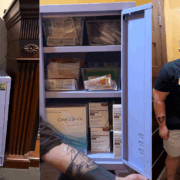
Each locker is designed for discretion as they are about the height of an end table and placed in inconspicuous areas of local businesses that serve at-risk populations. Each locker contains basic harm reduction supplies including free naloxone (generic Narcan), test strips for both fentanyl and xylazine, bandages, condoms, HIV self-testing kits, pregnancy tests, sunscreen, and aloe. 

Harm reduction supplies in a QKY harm reduction locker.

“Someone can overdose at any time and fentanyl is in everything,” Diggs said. “Everyone deserves a second chance and everyone deserves to be able to change their life. No one deserves to die from a drug overdose.”

In addition to the basic supplies, businesses can also opt to carry safer smoking and snorting kits too. These kits decrease the risk of spreading diseases including HIV and hepatitis.

So far, Queer Kentucky has installed six harm reduction lockers in Northern Kentucky at both Roebling Books locations, Old Kentucky Bourbon Bar, and OLLA Taqueria. Some participating businesses have chosen not to market their harm reduction lockers.

Critics of harm reduction lockers argue that providing access to clean pipes and other supplies encourages drug use and increases substance use in their communities, calling the practice unsafe.

“Some of our partners are operating on a ‘if you know, you know’ basis to avoid harassment,” Spears said. “Some businesses serve communities that have less experience around harm reduction models, so we feel like it’s better to quietly exist for those who need it in those spaces versus bring a lot of attention to it, along with the potential for pushback.” 

Queer Kentucky Executive Director Missy Spears with a QKY harm reduction locker.

Julia Keister, owner of Roebling Books, says she wants everyone to know that harm reduction supplies can be found under their roof.

“Everyone can benefit from the lockers, so I believe they should be as accessible and public as possible,” she said. “Oftentimes, taking precautions to prevent harm is not something that can be planned or predicted, so being able to see where the lockers are located is important and could even be life-saving.”

In a 2024 NPR article, it was reported that a study conducted in southern Nevada suggests Narcan in vending machines contributed to a 15% reduction in overdose deaths in the first year of operations. In Cincinnati, research found 24/7 access to supplies was associated with a slower spread of HIV.

Keister understands the research and says she’s acting accordingly.

“Much like offering people a bathroom, or a cup of water, being able to provide free and safe harm reduction seems like a basic human right that every business should want to make readily available,” she said.

Richmond Pride brings hope and unification to rural queer folks

Richmond Pride celebrated its fifth annual celebration last weekend complete with vendors, politicians, advocates, drag queens, and of course, protesters. The yearly event began in 2019 as a small gathering at Dreaming Creek Brewery, a local craft brewery. Within a few years, Pride expanded to Irvine McDowell Park, and this year, to a huge section of East Water Street. 

Anthony Looney, a Democratic candidate for the 81st Kentucky House District, was out spreading his message at the festival. As a nurse practitioner, his main platform is providing equitable healthcare to Kentuckians. In the current political environment, Kentucky has a vast majority of Republican representatives in the House. 

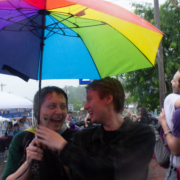
Attendees at Richmond Pride. Photo by Jules Crawley.

“To be honest with you, we’re going to be on defense. We’re going to be up there telling our constituents how those Republican Bills are going to hurt our constituents in our districts,” Looney said.

Political issues are important to be educated on for the LGBTQ+ community, as these policies affect the everyday lives of queer individuals. Healthcare continues to be a priority when discussing these policies, due to issues like HIV and drug crises within the queer community.  Many educational booths and providers of healthcare stood proud at this year’s festivities. 

The White House Clinics Organization was present, providing informational materials on HIV care, harm reduction, and free materials for safer sex such as condoms and lube. Several stations from other providers, such as Planned Parenthood and All Access EKY, were offering free birth control, as well as harm reduction materials like Narcan and Fentanyl test strips, which save lives every day. 

Among the Richmond Pride crowd, the diverse collection of experiences that make up queer culture, ranging from Appalachian rural stories to drag performances, couldn’t be ignored.

One vendor, selling jewelry and copies of her own book, Katherine Hale Stringfield, who grew up in a shotgun holler in Appalachia, said she was raised on superstition, playing in the graveyards, and evening ghost stories. She wrote her own book, “The Mary Luck Tales: Witch’s Curse“, where she discusses a true event from her adolescence, and stories she heard growing up.

Katherine Hale Stringfield holding her book, “The Mary Luck Tales: Witch’s Curse.” Photo by Jules Crawley.

“I played in the mountains my whole life…as a woman from Eastern Kentucky, my options growing up were to graduate high school, get married, and have babies,” she said. “Now, I’ve written my own book.” 

Stringfield’s life as an Appalachian woman eventually led to her success, and her ability to share Appalachian experiences with others. As we were discussing the events she’s undergone, she told me, “I love being from there, I wouldn’t want to have grown up anywhere else,” she said. 

In Kentucky, rural identities are core to the formation of the culture, but are rarely spoken of, particularly for queer individuals. This aspect of Kentucky life is worth exploring, and discussing with each other on a broader scale. 

On the other hand, a widely-discussed subject in queer history was present as well. There was not only one, but two drag shows at Richmond Pride. These were transformative events, as festival-goers were entranced by the routines and messages from the present drag queens and kings. 

While there was so much joy in the atmosphere, a few protesters were at the scene, as to be expected. While they chanted and shouted anti-LGBTQ+ rhetoric, festival-goers stood in front of them, holding a tarp in front of the signs together, and playing music popular within the queer community over their voices. Many people danced and sang in front of the protesters, including drag queens and kids with happiness and freedom clear in their expressions. 

Queer people never fail to come together and carry one another through adversity. These celebrations of LGBTQ+ pride, particularly in rural areas like Richmond, are so important. They bring people together, and remind everyone that there is always community nearby, and it is ready to uphold the values of pride, and prepared to generate societal change for the queer community. 

Op-ed from AVOL Board President: Defunding Prevention Is an LGBTQ+ Public Health Crisis

The views and opinions expressed in submissions to Queer Kentucky are those of the authors and do not necessarily reflect the official policy or position of Queer Kentucky. Any content provided by our submissions or regular columnists are of their opinion. As a reader, you are always welcome to submit your op-eds through our submission form.

By Roy Harrison, Board President, AVOL Kentucky

At AVOL Kentucky, we know that health care is about trust. For more than 30 years, we’ve built that trust by showing up, consistently, compassionately, and without judgment, for Kentuckians living with or at risk for HIV.

So when the Centers for Disease Control and Prevention (CDC) abruptly eliminated our $200,000 in annual HIV prevention funding, it wasn’t just a financial blow. It was a betrayal: of our mission, our staff, and the communities we serve, including Kentucky’s LGBTQ+ community.

The news we received this week wasn’t a budget cut. The funding still exists, it’s just been pulled-back. To where? No one knows. In a sweeping overhaul, the CDC chose to withdraw funding from local and statewide organizations like AVOL. The mechanics are opaque, but the risks are real.

While it would be reassuring if we saw these funds were being allocated differently in the fight against HIV and AIDS, we’re not seeing that evidence. The CDC closed its STI lab in April, and in May they ended their free HIV home test program. Further, the budget bill currently working its way through Congress, does zero out this funding source for future years across the country. 

The CDC is signaling that HIV and sexual health are not a priority. 

We weren’t cut because we failed. In fact, we exceeded every benchmark. We were preparing to expand. And now, instead of building on that success, we’re fighting to maintain critical prevention services in a state that already ranks among the worst for new HIV and hepatitis C infections. 

At AVOL, we provide more than 1,500 free HIV tests each year. We distribute condoms, resources, and care navigation services in every one of Kentucky’s 120 counties, from rural hollers to city streets. Our team helps connect people to affirming providers, educates folks on PrEP, and offers a safe space for those who may not have one anywhere else.

The direct impacts of these developments are immediate. We have reduced our walk-in testing hours, now just Monday to Thursday 1PM to 5PM, and our open testing positions that were funded by these programs will now go unfilled. We are a resilient organization, and we were designed to weather tough storms. But the loss of this funding will mean increased HIV and STI infection rates in Kentucky and across the country. 

This work is our work. It’s harm reduction work. It’s suicide prevention, STI prevention, stigma prevention. And when the CDC cuts ties with trusted, local organizations like ours, it’s not just bad policy, it’s dangerous.

Let’s be real: in many Kentucky communities, AVOL is the only sexual health provider some people will see. That’s especially true for queer Kentuckians who face barriers to care because of stigma, geography, income, or a combination of all three.

Without local providers, we risk losing the human connection at the heart of prevention. We risk replacing empathy with red tape, and trust with distance. That’s not just inefficient, it’s harmful.

The secondary effects of this decision are just as alarming. Regular access to testing and judgment-free care doesn’t just prevent HIV, it improves overall health. It leads to earlier treatment of other STIs, increased condom use, lower anxiety, and fewer emergency room  visits. It helps people live longer, healthier lives.

But instead of investing in that kind of life-saving, cost-effective care, the CDC’s decision asks us to do more with less, or, in this case, to keep doing the same essential work without the federal support that’s sustained it for years.

At AVOL Kentucky, we’ve earned the trust of the people we serve. You don’t get that from a grant proposal. You get it by showing up at Pride festivals, community centers, recovery programs, housing shelters, churches, and wherever else people need us.

We will keep showing up. But we shouldn’t have to fight this fight alone.

If you care about public health, about equity, about Kentucky’s LGBTQ+ community, then this should matter to you. Because when you defund prevention, you increase infections. You create shame. You let people fall through the cracks.

And that’s something none of us can afford.


If you or someone you know is struggling, call or text the 988 Suicide & Crisis Lifeline at 988. LGBTQ+ young people can press 3 to reach counselors trained in LGBTQ+ care, an option that returned on Sept. 30, 2026 after it was cut in July 2025. The Trevor Project also offers 24/7 support at 1-866-488-7386 or by texting START to 678-678.

Op-Ed: They Gave Us the Stage, Then Took the Mic: Pride as Distraction

The views and opinions expressed in submissions to Queer Kentucky are those of the authors and do not necessarily reflect the official policy or position of Queer Kentucky. Any content provided by our submissions or regular columnists are of their opinion. As a reader, you are always welcome to submit your op-eds through our submission form.

Written By Shreeta Waldon

It’s hard to celebrate when the spaces we’ve built for safety are being bulldozed in real time.

All across Kentucky, communities that have fought for belonging, for dignity, for the right to simply be, are once again under attack. The very sanctuaries we created out of necessity;  harm reduction sites, mutual aid hubs, community ceremonies are being stripped of funding, recognition, and protection.

This isn’t just politics. It’s personal.

While we usher in Pride Month with parades and rainbow hashtags, state leaders are moving to cut Medicaid and SNAP, gut harm reduction programs that have directly reduced overdose deaths, and abandon LGBTQIA+ Kentuckians in favor of performative patriotism and regressive tax agendas. It’s a playbook strategy straight out of the federal culture war and Kentucky is marching right along with.

Let’s be clear: budget cuts are not neutral. Snatching resources from communities who rely on them to survive is an act of violence, not fiscal responsibility.

Oh, we will not leave out our fine institutions of higher learning either. Our two largest  universities here in Kentucky;  their cancellation of cultural graduation ceremonies for Black, Latino, LGBTQIA+, and other historically excluded groups was not some sort of logistical decision. It was a loud, calculated message: You are not a priority. You are not protected. You are not welcome.

To those who say we’re being dramatic; no, we’re being honest. These are the same institutions that profit from DEI branding and then go ghost when it’s time to defend marginalized communities from real harm. Folks, it’s not equity if it only exists on paper.

To the students and community members who organized their own ceremonies, to the harm reduction workers stretching dwindling resources, to the queer and trans youth showing up anyway- that’s not just resilience. That’s rebellion.

And lastly, to those watching quietly from positions of power: your silence is loud and complicit. Neutrality in moments of targeted harm is a deadly stance… and it’s on the wrong side of justice.

This Pride Month, I beg, don’t let the glitter distract you. The attacks on our bodies, our care, our survival…they’re happening now. We need more than celebration. We need confrontation.

So no, I’m not lighting sparklers in celebration. I’m lighting torches of resistance. I’m standing with every Kentuckian who refuses to be erased, and asking:

How much more will we allow them to take before we say “enough”?


In resistance and radical love,

Shreeta Waldon, MA, LCADC

About the Author:

Shreeta Waldon (she/her) is a Licensed Clinical Alcohol and Drug Counselor, harm reductionist, poet, and Executive Director of the Kentucky Harm Reduction Coalition. As a lifelong advocate for the people, she leads with radical love, bold truth, and an unwavering commitment to dismantling harmful systems directly affecting the most impacted. Shreeta is the Legislative District Chair for District 44 in Louisville and co-host of the podcast By Any Means, where she brings unfiltered conversations to the forefront of social change. Her work is rooted in both faith and resistance; bridging the spirit of justice, poetry, and policy to create a world where marginalized people don’t just survive, but lead.


Keeping Our Community Safe: Queer Kentucky Installs Harm Reduction Lockers in Local Businesses

This story is part of a digital issue of Queer Kentucky surrounding Harm Reduction and its intersection with the LGBTQ+ community.⁠ Check out the full digital issue here.

In the Queer community especially, you are more likely to know someone struggling with substance use than not. Maybe it’s a friend or family member. Maybe it’s yourself. The thread of substance use, like it or not, is one that runs through our community. Substance use remains a significant challenge for our people, leading to shame, loneliness, isolation, and a proliferation of unsafe practices. For this reason, Queer Kentucky is partnering with the Foundation for a Healthy Kentucky to launch our Harm Reduction Locker Initiative.

Last year, we held several Community Conversations on Substance Use across the state. We heard firsthand how the stigma against substance use and lack of real support can negatively affect members of our community, leading to far worse mental and physical health outcomes than our cisgender and heterosexual counterparts. We heard the call loud and clear: Queer Kentuckians are in need of resources for keeping themselves and each other safe.

At the core of this initiative is a desire to meet people where they are. We recognize that sobriety is the safest form of harm reduction, but how can we support the people who aren’t there yet or aren’t interested in total abstinence? How can we provide resources and show love in a way that makes them feel less alone? In a way that lets them know they are welcome in our spaces? That they have a community no matter where they are on their journey? Enter our locker initiative.

These aren’t your high school lockers. Our harm reduction lockers are cute. They are brightly colored, the size of a small end table, and are purposefully designed to lower the stigma often associated with substance use. To make them even more appealing, each locker will be decked out with a custom design and text by Kentucky artist Levi River House.  Each locker is stocked with essential harm reduction supplies, including OD prevention tools such as fentanyl test strips, safe sex supplies, HIV self-test kits, pregnancy tests, and other resources critical for community members currently experiencing substance use. But these lockers go beyond their functional purpose; they illustrate a message of respect and solidarity.

Our lockers are being placed in bathrooms around the state thanks to over a dozen of our small business and organizational partners, including Roebling Books & Coffee locations in NKY and the Louisville Pride Foundation. By placing harm reduction supplies in accessible yet private locations, these lockers play a crucial role in protecting vulnerable populations, helping to reduce harm and prevent avoidable health crises.  Harm reduction is not about judgment; it’s about compassion, understanding, and keeping people alive.  

Thanks to our incredible partners, the lockers will be accessible in community-oriented settings where people already feel safe and welcome. Whether they’re a local coffee shop, an LGBTQ+ community center, neighborhood bar, or cute retailer, our partners are diverse in both what they offer and where they’re located. This allows us to reach, assist, and educate a large segment of the population. One of the biggest barriers around help is stigma, and these lockers will help facilitate conversations and inspire other forms of grassroots advocacy to create long-lasting systemic change.

Together, we can reshape the narrative around harm reduction and ensure that every member of our community has the opportunity to access resources and support.

For more information about partnering with Queer Kentucky’s harm reduction locker initiative, please email [email protected].  

To view Queer Kentucky’s digital magazine covering harm reduction in the LGBTQ community, visit here.

Rewriting Recovery: How Cannabis Helped One Kentuckian In Her Sobriety Journey

This story is part of a digital issue of Queer Kentucky surrounding Harm Reduction and its intersection with the LGBTQ+ community.⁠ Check out the full digital issue here.

Three years ago, Liz Freedman got sober from the substances that ruled her life starting when she was 12.

“I’m bipolar so I’ve kind of always just had this really bad anxiety,” she said. “When I was a kid I had anger issues, but I wasn’t actually angry. I was just sad and needed something to take me away.”

For Freedman, it started with huffing household chemicals. But that quickly led to abusing pills and alcohol. 

“I would do anything I could. That is what my life revolved around,” she said. “I ended up getting addicted to meth, Adderall and cocaine in my 20s. I also drank very heavily and I also used benzos.”

When she was 28, Freedman woke up one day and realized how unmanageable and dangerous her addiction was. She said she had hit so many “bottoms” by this point, but this day was when she finally decided she wanted to be more present in her life. So she went to rehab.

“ I got sober and I was abstinent from all mood and mind altering things for about two years,” Freedman said. 

In her sobriety Freedman also learned how to manage her bipolar disorder and other mental health struggles, the original reason she turned to drugs and alcohol for relief. But she wasn’t cured of anxiety, trouble sleeping, and flashbacks, so she started thinking about using cannabis as a way to relax her mind.

“I asked myself a lot of questions before I pursued a medical marijuana license,” she said. “ I felt so much shame because of what I personally felt I had heard in AA rooms.”

Programs like Alcoholics and Narcotics Anonymous promote complete abstinence from any mind altering drug.    

“I don’t want to speak down about AA because I know it helps some people, but I believe that the rhetoric can be very harmful,” Freedman said. “So I’m asking myself in those moments, why has it been so demonized in my brain to take a mood or mind altering substance when it could be so incredibly helpful?”

Freedman says for her, using marijuana feels very different from other drugs and alcohol. She uses it when she wants to calm down a little. 

“Sometimes it’s part of my daily routine, sometimes it’s not,” she said. “I don’t feel the phenomenon of craving with marijuana. I just feel like with marijuana, it doesn’t take it all away. It just soothes it. Whereas when you pop a pill, I personally disappear.” 

Freedman ended up getting a medical marijuana license so she could buy cannabis at dispensaries. She wanted to know what she was buying and wanted to use products with more CBD than THC (the psychoactive component in cannabis) to help her relax. For the last year, she’s considered herself California Sober, a popular term for people who don’t use any drugs or alcohol except marijuana. 

Even though sobriety programs like AA or rehab centers still stress complete abstinence, more people in the recovery world see marijuana use as a way to help people in recovery avoid more harmful substances. 

Dr. Peter Grinspoon is a cannabis specialist at Massachusetts General Hospital, an instructor at Harvard Medical School, and a recovering opioid addict. In an op-ed from 2023, Dr. Grinspoon wrote about how using cannabis is not a “slippery slope” for every addict. The common wisdom in many recovery circles (and the true experience for many addicts) is that using marijuana lowers your inhibitions. This could lead to wanting to use the substances that were more harmful. 

But Grinspoon writes this is not true for everyone in recovery and shouldn’t always be looked at as a relapse: 

“Using medicinal cannabis to transition away from more dangerous drugs, such as alcohol or heroin, is an increasingly popular and accepted form of harm reduction. I have had tremendous success in my clinical practice transitioning people from both medicinal opioids and alcohol to cannabis. I find cannabis to be particularly efficacious, because it can help treat or palliate many of the symptoms that may have helped incite and fuel the addiction to these other drugs in the first place, such as anxiety, insomnia, chronic pain, and trauma.”

He also writes that the abstinence model in AA isn’t very effective-only 5-10% of people who attempt it stay sober.

That doesn’t mean cannabis is completely harmless. People under 25 using marijuana could impair her brain development. Pregnant or nursing people shouldn’t use cannabis, and it’s dangerous to drive when you’re high (according to the Substance Abuse and Mental Health Administration). But if the choice is between heroin or smoking a joint to take the edge off of a bad week, Dr. Grinspoon says for some people cannabis is a good option. 

Being completely sober for two years helped Freedman understand what her mind and emotions were like free from substances. And even with re-introducing marijuana, she still feels the clarity and peace she found in sobriety. 

“I feel like if you are struggling with addiction, you can’t go wrong with a period of abstinence because I feel you gain a tremendous amount of wisdom and self awareness,” she said. “But  I think addiction is a spectrum. I think we all have our own needs for that, and I think to judge or to down anyone in any way for how she are getting better is out of this world.”

“It Could Be Me”: Art Scisney on Healing, Harm Reduction, and Humanity

This story is part of a digital issue of Queer Kentucky surrounding Harm Reduction and its intersection with the LGBTQ+ community.⁠ Check out the full digital issue here.

Artilla “Art” Scisney didn’t imagine himself on the frontlines of Louisville’s public health movement—but looking back, every moment led him here. As a Black gay man raised in Louisville, Art grew up feeling like he had to compartmentalize who he was to survive. “I had a very closed-off mindset to who I actually am,” he says. “I wasn’t out. I didn’t feel safe to be. And as a person of color, there weren’t many spaces where I saw myself reflected.”

Even after coming out in college, Art struggled with grief and the pressure to live up to expectations that didn’t fit. “My dad is a manly man,” he explains. “His thing was always like, ‘sometimes you’ve got to see things through, you’ve got to tough it out.’” That message, compounded by societal expectations, led Art into a 20-year career in corporate management that slowly took a toll on his mental health.

After graduating from Western Kentucky University with a degree in interdisciplinary studies, a flexible academic path that combined social and behavioral sciences, giving him tools to better understand community dynamics and human behavior– Art spent nearly two decades at a chain of grocery stores, climbing the ladder into middle management. But the corporate grind and constant pressure to perform, conform, and suppress his empathy began wearing him down mentally and emotionally. 

“I was a great manager, my associates loved me—but they wanted me to be more aggressive,” Art says. “They wanted me to take the empathy out of it. That’s not who I am.” 

For years, Art balanced on a tightrope—striving to please bosses, colleagues, and his community. The expectations piled up until his mental health reached a breaking point. It was during the pandemic that Art experienced his first panic attack, a clear sign that something had to change.

Taking a leap of faith, Art left his secure job, choosing personal wellness over financial security and familial expectations. In doing so, he stepped away from a career that demanded detachment and conformity, and into work that celebrates compassion, connection, and authenticity. Harm reduction gave him something corporate life never could: the freedom to lead with empathy. “Now, I get to make real connections,” he says. “I get to talk to people, listen to their stories, and offer help without judgment. That’s the kind of work I was always meant to do.”

Now serving as a harm reduction specialist and health education coordinator with the UK Target 4 Region 5 team (kirpky.com)—a program under the Kentucky Income Reinvestment Program focused on expanding HIV and Hepatitis C prevention—Art works at the frontline of Louisville’s community health efforts, particularly reaching underserved LGBTQ+ individuals and communities of color. For Art, harm reduction isn’t just handing out clean syringes or providing HIV testing—it’s about restoring dignity, humanity, and choice to people society often overlooks or actively stigmatizes. 

Art’s approach is straightforward, empathetic, and real. 

“Harm reduction is anything that reduces risk or damage in someone’s life,” he explains. “The easiest example is when you get in a car and you put on your seatbelt—that’s harm reduction. It’s not saying you’re going to get in a wreck, but if you do, you’ve got something in place to help protect you.” For Art, that principle carries over to every part of his job. “We’re out here helping people who might be houseless, who use substances, who are living with HIV or at risk for it—and we’re doing it without judgment. We’re saying, ‘You deserve to be safe. You deserve to live another day. You deserve care, even if no one else has told you that.’”

He has seen firsthand how stigma around HIV and substance use disproportionately impacts Black gay men and trans women, individuals often overlooked by traditional public health messaging. According to the CDC (2023), Black Americans accounted for approximately 40% of new HIV infections, despite comprising only 13% of the U.S. population, highlighting the stark racial disparities rooted deeply in structural inequities. Similarly, LGBTQ individuals, particularly Black gay men, face higher risks of substance use disorders due to intersectional stressors such as racism, homophobia, and economic inequality (https://www.samhsa.gov/sites/default/files/covid19-behavioral-health-disparities-black-latino-communities.pdf)

“Public health information mostly comes from white doctors or government officials,” Art notes candidly. “Our community is rightfully skeptical. When someone who looks like them talks openly, clearly, and honestly about these issues, it hits differently. They listen.” This assertion aligns with research indicating increased healthcare engagement when the provider shares a similar background or identity with the patient (https://pmc.ncbi.nlm.nih.gov/articles/PMC10872498/).

Art understands deeply the intersections of identity, health, and social pressures. His lived experience is his greatest asset. “People think they’re above certain things, but it could be you. It could be me,” he says earnestly. “Life happens. Sometimes the direction takes us somewhere we never intended to go.” His voice carries an unmistakable authenticity, shaped by his own struggles with mental health and self-acceptance. “When someone is at their lowest point, it only takes one moment- one coping mechanism- to change everything,” Art explains. “We’re all just trying to survive, one way or another.”

In his role, Art doesn’t just provide resources; he empowers individuals to reclaim their humanity. Whether it’s a person experiencing homelessness trying to survive the night or someone newly diagnosed with HIV fearing the worst, Art’s presence offers reassurance, respect, and hope. He fiercely believes in second chances and meeting people exactly where they are, helping them chart their paths forward.

Art acknowledges the challenges- misinformation, stigma, judgmental attitudes- but his conviction never wavers. To skeptics, harm reduction may seem counterintuitive, but its practical approaches include distributing clean syringes to prevent disease transmission, providing testing and education to reduce the spread of HIV and other infections, offering minor wound care to prevent severe infections, and linking individuals to support services like housing, food, and healthcare. 

Harm reduction doesn’t condone harmful behaviors; rather, it pragmatically acknowledges that such behaviors exist and seeks to minimize their adverse effects on individuals and communities. 

“Harm reduction isn’t about promoting drug use or reckless behavior. It’s about ensuring people have safer options until they’re ready or able to change,” he clarifies passionately. “It’s humanizing people who’ve been dehumanized.”

Through honesty, empathy, and real talk, Art continues reshaping Louisville’s understanding of harm reduction. He bridges gaps long left open by traditional public health, particularly for Black queer communities. For Art, this work isn’t just a job; it’s a calling rooted deeply in personal experience, compassion, and a relentless belief in human dignity.

As Art reflects, he distills his philosophy into a simple but powerful ethos: 

“If you can’t help someone, at least don’t do harm. It’s that easy.”

Art’s journey and his current work illuminate critical realities about the intersectionality of race, sexual orientation, and health outcomes. His story underlines the importance of diverse, authentic voices in public health, illustrating vividly that true harm reduction involves recognizing and dismantling systemic barriers, addressing stigma, and elevating community-driven solutions to create lasting change.

Photo Essay: Finding Euphoria through fentanyl testing

This photo essay is part of a special digital issue of Queer Kentucky surrounding harm reduction and its intersection with the LGBTQ+ community. Read the full issue here.

Harm reduction strategies have played a significant role in Kentucky’s efforts to combat substance use and overdose deaths. In 2024, the state reported 1,410 drug overdose fatalities—a 30.2% decrease from the previous year and the third consecutive annual decline. This progress is attributed to expanded access to treatment, widespread distribution of naloxone, fentanyl test strips and the implementation of syringe exchange programs.

Fentanyl test strips are an important harm reduction tool, allowing people who use drugs to detect the presence of fentanyl before using. As fentanyl continues to drive overdose deaths—accounting for nearly 70% of Kentucky’s overdose fatalities in 2023—the strips help individuals make safer choices. They are especially important for marginalized groups, including LGBTQ+ people, who often face greater barriers to healthcare and support.

The following photo essay by Jon Cherry shows an individual using harm reduction practices while preparing cocaine.


Navigating the In-Between: Ryan Jones discusses the critical importance of the Kentucky Harm Reduction Coalition

This story is part of a digital issue of Queer Kentucky surrounding Harm Reduction and its intersection with the LGBTQ+ community.⁠ Check out the full digital issue here.

Ryan Jones still remembers his family handing him a one-way ticket to Louisville in his hometown of Richmond, Va. Struggling with substance abuse, Jones was told he was either going to go to Louisville to enter a recovery program or he was going to be cut off from the family’s resources. Begrudgingly, Jones took the ticket, which—while he may not have known at the time—was also his first step toward a new life, one defined not by substances but by affecting real, positive change. 

Today, Jones works as an administrator with the Kentucky Harm Reduction Coalition, an organization that strives to “reduce substance use disorder overdoses and deaths, the stigma associated with substance use disorder, and to offer harm reduction solutions.” Jones is over two years clean, has a loving and revitalized relationship with his family, and now spends his days working to curtail the dangerous consequences of substance use, building a more hopeful future not only for himself but also for countless others.

Jones was raised by his grandfather in Richmond as the oldest of 17 grandkids. As a kid, he recalls having been a bit spoiled growing up by his grandpa, a prominent pastor in their Virginia community. While he remembers it being hurtful at the time to hear such a direct ultimatum given by his family about getting clean, looking back on it now, he says, “I didn’t realize it, but when they were sending me out here, it was harm reduction that they used—you know, to be able to meet me where I was—which caused me to actually do a lot of life-altering changes in my life that enabled me to begin to really be a productive citizen again.”

During his journey through recovery in Louisville, Jones discovered the KYHRC and began to understand the idea of harm reduction in general. Learning about the very concept—the practice of mitigating the negative impacts and consequences of drug use and its associated risks—opened his eyes to different avenues of aid. While many may see drug use in a binary of clean or using, Jones was able to understand modalities of assistance that met people in the in-between, helping them make safer choices and reduce the risk of more dire outcomes. “Utilizing harm reduction allowed me to be able to navigate through life a lot easier,” he attests. “It meant that anybody that I talked to wasn’t going to judge me or look down upon me.”

The day Jones made his own decision to stop using altogether was Valentine’s Day 2023, and with it coming on the heels of tempestuous family conflict and challenging personal reflection, he remembers that “it was definitely the best kind of love I could have ever given myself.” Eight months later, he began working at the KYHRC. Given Jones’s clerical background, he was originally hired as a project manager for the coalition’s Health and Wellness Lounge, a safe and welcoming space that provides harm reduction resources to those looking for it. He was provided a budget, a timeline, and from there took the opportunity to prove himself. “I went in with everything I got,” he says. “And I was able to meet the time constraints as well as stay under the budget that they wanted me to spend. And so they were like, ‘You know what, you’re a keeper right here.’”

Now, Jones works day to day to advance the work of the KYHRC. As an administrator, he gets the phone calls, the emails, the “Contact Us” forms from the website. He also works in distribution and outreach—as the coalition is located in Downtown Louisville, they’re mindful of broadening their orbit beyond the immediate area. “That allows us to be able to send out safe use tools, condoms, fentanyl test strips, different things of that nature to be able to, you know, reduce the harm out there,” he explains. “And so we send out thousands and thousands of utensils and tools on a daily basis. … We also want to make sure that we’re reaching people that are outside of our downtown community. So we’re able to actually mail them these tools to be able to assist them in their daily living.”

Indeed, getting the tools of harm reduction to those who need it most is at the very center of the KYHRC’s mission; Naloxone (brand name: Narcan) distribution is one of their primary forms of aid. They also offer training around how and when to use Naloxone to ensure that those who need it don’t just have it, but also understand it. Additionally, the organization offers services focused on syringes, hepatitis C and HIV testing, mobile outreach, fentanyl and xylazine test strips and the aforementioned Health and Wellness Lounge, which provides a safe space for those looking for support on their journey to better health. Kiosks located on their campus allow the community free access to test strips and Naloxone as well as informational materials on harm reduction and substance use.

While critical for any population, these services, Jones notes, are of particular import to LGBTQ folks. As an individual who is HIV-positive, Jones understands that what the KYHRC offers is so imperative to those who may be more susceptible to the dangers of unsafe practices. “You know, everyone isn’t as safe as they may claim to be,” he says. “Everyone may not be practicing the best safety. And so it’s very important to utilize safe tools. Being able to practice these skills will actually help to prevent the spread of any diseases or, you know, anything that is contractible by sharing utensils.”

Jones, having been through recovery himself, sees the need in the community not only for the KYHRC’s services but also for the education around the definition of harm reduction. “A lot of people really think, when they hear harm reduction, they think, ‘Y’all giving away drugs,’” he says. “No, we’re not. We’re not giving away drugs. No, what we are doing is making sure that if you choose not to go into abstinence recovery that you are able to at least assist yourself until you are ready or until you want to at least make a small change or take the steps to where you may want to go.”

By sharing his story and working every day with people who are in similar places to where he once was, Jones hopes to enact real change in his community, change he has the power to affect because he has lived through it. “If I can at least help somebody, one person a day, I’m adding to the change,” he says. “And I often tell people I want to be the change. I don’t just want to hear about the change. I don’t just want to talk about the change. I want to be the change.” And with his empowering outlook, unshakable tenacity and commitment to action, there’s no question he’s making a genuine difference, a difference that impacts not only individuals in the immediate but also the upward trajectory of better health and more intentional compassion in Louisville and beyond.

Space for Liberation: Community, Policy, and Harm Reduction in Kentucky

This story is part of a digital issue of Queer Kentucky surrounding Harm Reduction and its intersection with the LGBTQ+ community.⁠ Check out the full digital issue here.

When we discuss harm reduction, a few common examples spring to mind: needle exchanges, fentanyl testing strips, and education about the health impacts of substance use. But in the Bluegrass State, we don’t stop at these discrete interventions. Harm reduction leaders across the region are advocating for an even more potent strategy: organizing their communities to target the systemic causes of harm, not just their symptoms. 

For Shreeta Waldon, Executive Director of the Kentucky Harm Reduction Coalition, successful harm reduction is about listening and empowering people. 

“What I do is liberate you to live the life you want to live—the kind that makes you say ‘I want to get up and live today,'” says Waldon. “My job is to make space for each person’s liberation, for themselves—not the liberation I imagine for them.”

Waldon’s work with KyHRC directly serves those impacted by substance use and addiction. Their work aims to provide resources which contribute to an individual’s personal liberation, whatever form that may take. Liberation, in this sense, means the freedom to make decisions for oneself—a personal freedom that substance use disorder can often eradicate. 

“We fight for humanity. I got a degree to help people live,” says Waldon. “People who use drugs need the same things as everyone else. Harm reduction is an ecosystem of recovery. We’re all part of this.” 

Kentucky’s “ecosystem of recovery” has many pieces, but Waldon emphasizes the importance of creating a cohesive whole through inter-organization collaboration.

“Over the last fifteen years, we’ve all been driving in our lane,” says Waldon. “‘I’m doing my job, this is how it’s going to be done.’ Nobody talks about how to pivot with each other. A coalition is about coming together with organizations and people—it’s a dance.”

Waldon’s vision for a more collaborative ecosystem was recently illustrated by a major legislative win, led by Jon Parker, executive director of AVOL Kentucky, and Chris Hartman, executive director of the Fairness Campaign. In the wake of the COVID-19 pandemic of 2020, Parker and Hartman were discussing the current state of HIV/AIDS advocacy in the region. With lockdowns occurring, in-person HIV testing had been disrupted. The obvious answer was to mail HIV self-test kits to people in need, but Parker noted that Kentucky considered that a felony. 

“Sometimes these laws get written and hidden and nobody’s looking at them,” said Parker of the obscure law. “If we don’t raise our voices, it won’t change.”

The obscure law, KRS 367.175, was a small, miscellaneous list of “other unlawful acts,” primarily prohibiting trade monopolies. Tucked within this statute was a clause that prohibited the “sale, delivery, holding, [and advertising]” of HIV self-tests. The HIV Is Not A Crime Coalition, powered by the Fairness Campaign, successfully advocated for this clause to be struck with the signing of a bipartisan bill (HB349) in June, 2023.

This situation highlights the need for policy to keep up with public health. When policy lags behind—or worse, prohibits—effective healthcare, we need to (1) notice, and (2) advocate for change. 

Ernesto Scorsone, vice president of JustFundKY, is no stranger to this advocacy. As a former judge and state senator, Scorsone has a long history of protecting LGBTQ+ Kentuckians, from the eradication of anti-sodomy laws, to fairness ordinances and beyond. The seasoned advocate has this advice for Kentuckians looking to make a meaningful change in their communities:

“What we need is local organizing,” he says. “The fight for queer people is not over with any legislative progress. We have to be proactive—we have to push the envelope. We have to be involved at the local level—that’s where you can be most effective. Neighbor-to-neighbor, members of the same faith community, that’s where we really have an impact.” 

Liberation can take many forms, but this much is clear: harm reduction requires both immediate interventions and long-term political advocacy. These local leaders are doing the work, pounding the pavement, and working to realize their dream of a healthier Kentucky. Especially in these troubling times, the only way forward is through. To sit back is to slide back, and too much is at stake for us to remain silent. Act up, get loud, and join the fight for liberation today. 

You’re in good company. 

To the Homies that Will… Some Notes on Harm Reduction

This story is part of a digital issue of Queer Kentucky surrounding Harm Reduction and its intersection with the LGBTQ+ community.⁠ Check out the full digital issue here.

Picture this: It’s 2015, you’re twenty-one years old, it’s a Saturday night in Louisville, and you were invited to some mansion party. The floor is shaking from the bass; there is glitter all over the place; there are folks dressed in leather; you are wearing only a plaid t-shirt and some jeans and have somehow lost your shoes. There is sex happening in the bathroom, someone is putting their ass in a cake on a picnic table in the front yard, and someone hands you a glow stick bracelet with a knowing nod. 

You’ve never been in a situation like this, but feel inclined to ride it out. Some of the night passes, and a cute person is sitting on a wooden swing in the backyard, looking at you with the eyes and offering you a light blue pill. Next thing you know, you are lying on the ground with them, and your hair is acting as a pillow against the grass. Maybe you think to yourself, “Yeah, this is it. This is what I needed.” 

Now, picture this: You are at a queer bar on a busy corner street. You and your friends have just downed so many PBRs that none of you can feel your face anymore. Now, you have to go to the bathroom. Someone is standing by the door, sweating and pacing. You’re an empath, so you start to feel uncomfortable with them. They’re scratching their arms. The door opens, and they go in. 

You wait a while and knock on the door, asking if they’re okay. No answer. You really have to pee. You check to see if the door is unlocked and open it. They’re passed out on the floor. You crouch, move your hand over their mouth, and feel no breath. There is a needle that is covered in black goo and blood next to the toilet. You yell for help, and a person runs in. They ask if they are breathing; you answer, “No.” They rummage through their purse, pull out a spray, and put it up the person’s nose. “If she doesn’t wake up in a few minutes, we call an ambulance.” Two minutes pass, and the person jolts awake. 

What did you learn? To take care of others and ourselves is of the utmost importance. Even when we aren’t sure what to do, we have tools. Seeing that person on the floor with a black goo’ed-up needle tripped me to understand that there are safe ways for people to do their drugs. As someone who was medically transitioning at the time, I received more than enough clean needles to share with others. I carried them everywhere I went after that. I found friends who had access to Narcan, and I carry that everywhere. 

It’s not my place to sit in judgment, nor do I tolerate anyone else sitting in judgment for me for my previous drug use. Whether you are using drugs for fun or survival, the fact is – use them safely. That’s the real T on harm reduction.  

Queer folks have been the most vulnerable population, most directly impacted by unsafe substance use, and the most in need of community care.  From the AIDS crisis to the ongoing criminalization of sex work and drug use, we know what it’s like to be abandoned by government constituents, public health workers, social workers, organizations that utilize us for clout, and family members who want to care for us when it’s convenient.

Queer folks, particularly Trans-BIPOC folks, are disproportionately affected by homelessness, poverty, and substance use. We have a more challenging time accessing quality, non-judgemental care. These factors make the spread of disease easier within our communities. 

When we talk about harm reduction, we’re talking about protecting each other from HIV, Hepatitis B & C, overdoses, and many other risks associated with substance use. When we talk about harm reduction, we’re talking about needle exchanges, safe injection sites, fentanyl test strips, all of which make sure no one gets left behind because of a choice they made. We’re talking about acknowledging the trauma, discrimination, and mental health implications that often lead to substance use. Instead of punishing people for coping, we should be prioritizing and providing safer ways for them to do so.

When we realize our collective power to care and share care, we can make the world a much better place. Many of us didn’t ask to be on this planet, and somehow, we aid to be here. We must ensure safety in understanding, restorative care, and overall health and well-being. This is for everyone.

So, for the homies that will… 

Here are some practical steps to reduce harm in your life and in the lives of all you may come across:

  1. Carry Narcan: Opioid overdoses are killing our folks, and a dose of Narcan can literally bring someone back from limbo.  
  2. Support Needle Exchanges: These programs aren’t just about providing clean needles; they’re about making sure that people are using drugs as safely as possible. It’s not just “here’s a syringe, good luck” – it’s about education on safer injection practices, reducing the risk of infections and abscesses, and providing people with alcohol wipes and sharps disposal containers. It’s about making sure that no one is reusing or sharing needles, which cuts down the transmission of HIV and Hep C. Many needle exchanges serve as community hubs, offering health screenings, overdose prevention training, and connections to housing and support services.   
  3. Know Your Substances: If you’re going to do drugs (or be with people who do), educate yourself. Know the differences between drugs, understand the risks of mixing them, and test them for contaminants. You never want to think you’re doing one drug but actually be doing something much harder.
  4. Create Safe Spaces: Whether it’s a house party or one night out, designate a sober person to check in with everybody; bring water or snacks, and get you home safely if need be.
  5. Decriminalize and Destigmatize: Support decriminalization efforts, advocate for safe consumption spaces, and don’t treat people like they’re less worthy of respect, dignity, and a quality life because they use drugs or have in the past.

We’ve come a long way from the days when the media only showed drug users as tragic figures doomed to die. But we need more stories, ones that don’t just focus on the struggle but also on the community, resilience, and radical care that harm reduction exemplifies. Queer history is built on mutual aid, and that doesn’t just mean throwing dollars at each other. During the height of the AIDS crisis, when the government wouldn’t lift a finger, it was queer folks, sex workers, and activists who distributed medication, educated one another, and built networks of care. That’s what we needed then, and it’s what we still need today.

At the end of the day, it’s about real, radical love. It’s about making sure that when the party’s over, everyone makes it home safely. 

photo provided by Mo Viviane

Mo Viviane (she/they) – Born in Lebanon, Kentucky. She is an artist who focuses on expansion while using ancestral tools of storytelling, sound frequency, and much more. Their work focuses on the abstractions of life and death and the correspondence to the creativity process. She utilizes laughter and crying as medicine, hoping to make the world a more sustainable and loving place.

If you want to read more from them, their poetry chapbook titled death:ing is out for purchase, and you can find them on Medium and Instagram by visiting: linktr.ee/moviviane.


How Apps Like Grindr and Sniffies Are Fueling the Meth Crisis Among Gay Men

This story is part of a digital issue of Queer Kentucky surrounding Harm Reduction and its intersection with the LGBTQ+ community.⁠ Check out the full digital issue here. This story is also in partnership with  Uncloseted Media, an LGBTQ focused investigative news outlet. Subscribe to their latest here.

Chemsex and Party and Play culture have ravaged the gay community for decades. Considering the history of this problem, are hook-up apps doing enough to combat the epidemic on their platforms?

At 21 years old, Robert McAllister remembers unlocking his phone in Louisville, Kentucky, to a grid of bodies on Grindr, the gay hook-up app. 

To the average American, many terms and symbols in user bios read like a foreign language: PnP, Tina and parTy, or the crystal ball, ice cream and diamond emoji. At the time, McAllister also had no clue what these terms meant. 

After chatting with multiple men, he met up with one of them later that night. Before they started having sex, the guy pulled a plastic bag of white powder out of his backpack and asked McAllister if he wanted to partake. 

“He snorted it like cocaine. And for whatever reason, I was like, ‘Oh, well, cocaine isn’t that bad,’ so I tried some,” McAllister, now 27, told Uncloseted Media and Queer Kentucky. 

Photo by Jon Cherry for Queer Kentucky and Uncloseted Media

The powder he snorted was actually crystal meth, a highly addictive drug that can ravage the body and mind and lead to psychosis, organ failure and irreversible brain damage.

“I remember thinking, ‘Wow, I want to do that all the time,’” says McAllister. “I wanted to feel that good all the time. At home, at work, it didn’t matter if I was hooking up with someone or not. It became a daily habit immediately.”

He says the addiction got so bad that the only people he would interact with for months would be the hookups he used with. “I would seek out people that had it in their profile,” says McAllister, who was addicted to meth for four years. “I would invite them to my apartment to use with me just because I didn’t have anybody else around. At that point I had lost my job, my family really didn’t want anything to do with me, and so the app was my excuse for social interaction.” 

McAllister’s experience is common. Party and Play (PnP) culture, also known as chemsex, is exactly what it sounds like: the use of drugs like GHB, ketamine and meth to enhance sexual desire, arousal and pleasure. The practice is most prevalent amongst gay and bi men, who use meth or similar drugs at three times the rate of heterosexual men, according to a 2014 study from the United Kingdom.

photo by Jon Cherry for Queer Kentucky and Uncloseted Media

For 25% of the guys who engage in PnP culture like McAllister, it becomes a severe problem. 

While drug overdose deaths in the United States declined slightly in 2023 for the first time since 2018, deaths from psychostimulants like meth rose, killing 36,251 Americans in 2023. That’s just over 3,000 lives a month, or 100 lives a day. And the epidemic is even worse in rural states like Kentucky.

As meth addiction continues to devastate the gay community, hook-up apps like Grindr and Sniffies —which make hundreds of millions of dollars a year—are where PnP culture thrives. One 2023 survey found that 91% of dating app users had a negative experience with drugs and one in four dating app users deleted an app because of drug-related concerns. 

“[Dating apps] are making lots of money from this community and the biggest problem that [we are] facing is not HIV, it is drug addiction,” says Ignacio Labayen de Inza, CEO and co-founder of Controlling Chemsex, a charity that provides interventions for chemsex users. “People are overdosing, people are suicidal, people are suffering from sexual assaults, they are psychotic, they are losing jobs, they are ending up homeless. And Grindr is the biggest vehicle that people use to get these drugs.”

So what are the apps doing to combat an epidemic that has been exacerbated by the easy access to meth on their platforms? 

Photo by Jon Cherry for Queer Kentucky and Uncloseted Media

The Risk of Hook-Up Apps

Smartphone hook-up apps, which hit the mainstream in the 2010s, have long been associated with a greater risk for sexually transmitted infections (STIs) among queer men. But emerging research suggests they also facilitate drug use among queer men, 15% of whom have used meth within the last year and 23% of whom have used it at least once in their lifetime. A 2017 study found that gay hook-up apps, including Grindr, “significantly increased motivational substance use” and approximately one in 10 of dating app users engaged in substance use after being persuaded on the apps. 

The apps know this is a problem. Sniffies is an app which features an interactive map known for its anonymity and showcases pictures of user’s genitals and butts nearby. In an email to Uncloseted Media and Queer Kentucky, they wrote that their users are significantly more likely to engage in chemsex and meth use compared to users on other platforms. They say a notable percentage of their users have reported deleting their accounts due to drug-related concerns. Recognizing this, Sniffies introduced Profile Fields, “allowing users to explicitly state their boundaries and the safety tools they carry, ensuring that everyone can make informed decisions about their encounters.”


Still, in addition, Sniffies—which has seen “explosive regional growth” in 2024—does not allow users to filter for other people’s drug preferences. In a data report that Sniffies pulled for Queer Kentucky, 18% of users selected “No PNP” under their drug preferences.

One of the major problems is that these apps enable easy access to the drugs, according to Kentucky-based Grindr users Uncloseted Media and Queer Kentucky spoke with.

“You can see it everywhere on dating apps,” says Chris Hackenberg, who first used meth at 19 years old during a Grindr hook-up. He says the drug “opened a door” to a “level 1,000 happiness.”

“It started becoming a slippery slope when I started finding [meth] everywhere,” he says. “Eventually, every hookup, I would try to find Tina [meth], and it just kept getting progressively worse to where [it] engulfed my whole life.” 

Hackenberg, now 23, remembers staying up for seven days driving around Florida looking to PnP. From Jacksonville to Orlando to Miami, he would drive for hours searching for a new place to geolocate himself on Grindr to find a new selection of men who were ready to use meth with him.

“I think Grindr and Sniffies turn a blind eye to all these drugs. Grindr is so well-known for finding drugs. It’s just so easy,” he says. 

What Are the Apps Doing?

The epidemic of crystal meth addiction and PnP culture among gay men has been an issue since the late 1990s, long before smartphones. But the most dramatic increase in meth-related deaths and usage occurred from around 2015 to 2019, when it soared by 180%. At the same time, Grindr exploded in popularity: In 2015, it was reported to have 10.5 million global users and make $38.1 million in sales. 

Grindr and Sniffies declined multiple requests for an interview for this story. Instead, Grindr directed Uncloseted Media to their work with a UK nonprofit, The Love Tank, that provides “safer chillouts” guides on their website for information on sexualized drug use. In the guide, they provide information on harm reduction, such as how to check in with yourself before you use, how to determine proper dosage and how to handle overdoses. 

In an email, The Love Tank told Uncloseted Media and Queer Kentucky that Grindr promotes their guides through inbox and pop-up broadcast messages on the app, but only in the UK region. 

Screenshot of their pop-up. Courtesy of Grindr.


Screenshot of their popup. Courtesy of Grindr.


In the U.S., Grindr works with the nonprofit Building Online Healthy Communities and has a similar pop-up for all users. 

Labayen de Inza, of Controlling Chemsex, says that this is not enough. “Clearly pop-ups and guides aren’t working because the problem [of chemsex addiction] is still an issue,” he says. “If I’m horny, I’m not going to check my pop-ups. And sometimes people are not ‘planning to chill.’ Sometimes people are having horrible psychosis and paranoia and looking for help. People tell me, ‘I want to stop. I have to stop, or I’m going to die.’ The guides aren’t going to help with that.”

In the past, Grindr has gotten bad press for allowing drug dealers to use the app. In 2022, detectives that conducted a Florida investigation titled “Swipe Left for Meth” charged 68 suspects for selling drugs on Grindr and other hook-up apps, causing nearly 280 grams of meth to be seized—the equivalent of roughly 1,400 doses. 

Since then, Grindr’s community guidelines say they have cracked down on banning profiles “centered around or mainly consisting of drug content” and that they prohibit images that are focused on advertising or promoting drug use as well as “emojis commonly associated with buying/ selling.” However, users say that simply putting a capital T, which is not banned, somewhere in their bios is enough to signal that they’re ready to PnP. 

And these bans may not work: Uncloseted Media found five references to PnP after using the app for only 15 minutes in Louisville, Kentucky. 

Screenshots from Grindr

Sniffies, meanwhile, has a resource page with instructions on how to use chemical drugs safely as well as links to harm reduction resources like syringe access and overdose prevention. Labayen De Inza questions, though, whether users will ever seek out a resource page while using the apps. 

Users we spoke with say they wish the apps had a feature where you could filter out folks who are looking to engage in PnP. One 2023 survey by Sniffies’ public health partner found that four out of five participants wanted to be able to filter by drug use practices. 

Legal Immunity

While it is likely that illegal drug use is occurring on these apps, they have Section 230 immunity, meaning that Grindr and Sniffies aren’t liable for any illegal activity that occurs on their apps and aren’t liable for the addictions stemming from the platforms. 

“No one wants to do anything,” Labayen de Inza says. “It’s really difficult to digest the fact that organizations know what is happening to the community. We cannot do very much because we are working on pride parades or HIV prevention. Those are important things. … But lots of people won’t be able to go to the parade because they will be psychotic or they will be suicidal [because of meth addiction].” 

Labayen de Inza, who is in recovery for chemsex addiction, has spent six years on Grindr connecting with folks who have questions about drug use. He says he spoke with over 13,000 users in his first year.

He also surveyed Grindr users in 2019 and found that 10% of the 2,000 respondents were using meth. Of those who said they had used, 90% had a premium subscription to the app, far higher than the roughly 7.5% of all users who pay. 

“I wish I could tell the CEO what is happening [on their] platform,” he says. “If you are human, the pain I see every day would make you cry. We have a responsibility to the community to change something.”

Uncloseted Media requested an interview with Grindr CEO George Arison and he declined. 

Apps Become Triggers: 

Users in recovery from meth also report risking relapse on Grindr and Sniffies. 

Hackenberg started recovery in 2023 after he contracted HIV from injecting meth with a hookup. He says he still can’t use Grindr or Sniffies without relapsing, which is difficult because they are his go-to platforms for meeting guys. “I would try to get on the apps after moving to make friends, but I just couldn’t do it,” he says. “As soon as I start going on Grindr, I get the same head buzz as I did when I would smoke Tina. Every time I’ve relapsed, it was facilitated by the apps,” he says, adding that he has slipped “a few times” in his two years of recovery. 

Mark Just, a 44-year-old finance analyst, started using meth as a way to build community in rural South Carolina, which only had “a bookstore and a park” as queer-friendly spots. “I mean, that was the only avenue to meet people,” he told Uncloseted Media and Queer Kentucky. 

“You’re in the lion’s den on those apps,” he says. “You just have to be really honest about your sobriety and be okay with getting blocked when people don’t read about it in your bio.” 

Now 20 years sober and in a relationship, he says when he tried using the apps to meet people, he had to be careful. “The question comes once you match and you’re chatting,” he says. “PnP or parTy or the puff emoji. I was just trying to meet people, but it would come up over and over again. … 1 in 3 guys would ask.” 

“The temptation is powerful,” he says. “It’s like giving up Krispy Kreme donuts and then someone showing up to your house with a dozen of your favorite donuts. Your body goes into craving mode, even though you haven’t been exposed to it in so long.”

“In a perfect world, they should make it similar to Tinder, where they don’t show you people that you aren’t interested in based on your demographic. So filtering people based on [drug use] would be helpful.” 

What Do We Do?

Ignacio Labayen de Inza says that the apps have to be a part of the solution because they are the ones providing a space where users can easily access the drug. 

He thinks resources for support and harm reduction for chemsex need to be front and center on the apps and constantly visible. “There needs to be a pinned square called ‘Chem Sex Support’ so people know exactly where to go for help and they don’t have to leave the app,” he says. He and his team, who are grant-funded and offer their services for free, are already providing this resource to Grindr users but are constantly getting banned from the app because it violates the app’s user guidelines. 

“The reality is that people are desperate and they don’t know where to go,” he says. “Chemsex support is very unavailable.”

Example of intervention on Grindr, courtesy of Controlling Chemsex.

“There needs to be a bigger conversation,” says Christian Parker, executive director of the community nonprofit Gay & Sober. “The epidemic of meth in the gay community is a perfect storm. There is loneliness, isolation, and stigma all tied together.”

Sean Young, executive director of the University of California Institute for Prediction Technology, says that the apps don’t bear all the responsibility, but silence is not working.

“I think it’s the responsibility of the technology company to have a safe environment, which right now they’re not,” he says. “But the apps don’t have the knowledge about substance use to know how to do these types of interventions, and it could backfire if they tried to start doing this. The solution to this is that technology companies should come to the table with public health officials and with individuals who are using the apps and start a conversation.”

“I would love to have the opportunity to speak with someone from Grindr,” says Labayen de Inza. “To say, ‘Let’s work together. Let’s do something effective.’” 

photo by Jon Cherry for Queer Kentucky and Uncloseted Media

McAllister, who became addicted to meth after his first time trying it with a Grindr hookup, says that education, online support and—most importantly—a destigmatization about meth use would have helped him be more careful. 

“If I had some information about meth, then I could have at least made a decision,” he says. “It’s all still somewhat taboo and behind closed doors so I had no idea what it was when I first used it.” 

“The dating apps are just enabling that by saying ‘Yes, you can put that [PnP] tagline in your profile,’ but they’re not doing anything to educate people about what that means. We’ll just turn a blind eye to it and let people do it,” he says. 

If you or someone you know is struggling, call or text the 988 Suicide & Crisis Lifeline at 988. LGBTQ+ young people can press 3 to reach counselors trained in LGBTQ+ care, an option that returned on Sept. 30, 2026 after it was cut in July 2025. The Trevor Project also offers 24/7 support at 1-866-488-7386 or by texting START to 678-678.

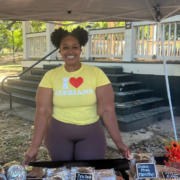
Introducing Our Harm Reduction Issue: Letter from the Executive Director

This story is part of a digital issue of Queer Kentucky surrounding Harm Reduction and its intersection with the LGBTQ+ community.⁠ Check out the full digital issue here.

Did you know that members of the LGBTQ+ community are almost twice as likely to develop substance use disorder as their heterosexual counterparts? And this was before 2025. Before the increased legislative attacks. Before the funding cuts. Before the increased stress and discrimination.

Over the past year, Queer Kentucky has taken steps to better support community members suffering from substance use disorder, including hosting a series of community conversations around substance use, supporting more sober events, advocating for more NA options at all events, adding substance use questions to our first IRB-approved survey, and launching “Stories of Hope,” a reoccurring column telling first-person stories of recovery. Today, this work takes the form of storytelling, as we bring you a free, fully digital magazine centered around harm reduction models in our community. 

This digital issue is intimate. It features first-person accounts, transparent photography, and profiles that showcase harm reduction in action. We’re focusing our attention on important discussions regarding the stigma around harm reduction; the role the community plays in helping our neighbors find healing; and the many, uniquely personal definitions of what harm reduction is and how to do it.  And speaking to that last point is none other than RuPaul’s Drag Race finalist Lexi Love, who shares what her version of recovery is.

Here in the Commonwealth, we know all too well the challenges our communities face. Every day, we battle a new healthcare barrier. Our overdose rates are among the highest in the country. Stigma continues to prevent those seeking help from searching for and accessing it. And this list doesn’t even touch on the systemic discrimination, lack of affirming care, and unique vulnerabilities that come from living at the intersection of multiple marginalized identities. We know what we’re up against, but we also know that we’re the ones best suited to help one another through it all. 

Queer Kentucky’s harm reduction work doesn’t stop with this issue, either. In June, we’ll be launching a new program that will put resources directly into the hands of those who need them most.  We know that harm reduction, coupled with other forms of support, provides a lifeline: empathy, not judgment. Meaningful solutions to complex problems. Above all, empowering people to live the lives they want for themselves, rather than simply succumbing to the hand they have been dealt. 

This is Queer Kentucky’s 2025 Harm Reduction Issue. 

Signed, 

Missy Spears, Executive Director

Lexi Love enters rehab for substance abuse, emotional therapy

Editor’s note: This story was published in May 2025. Some details may have changed since then.

Lexi Love, Louisville’s “Roller-Derby Doll” and RuPaul’s Drag Race Season 17 finalist, has entered rehab for substance abuse and emotional therapy at a treatment center in Texas.

Yesterday, Love posted on her Instagram saying, “I was brave enough to take my mental, physical and emotional health serious for the first time ever. I am in rehab and will be gone for a while.”

After the post went public, longtime friend and manager TJ Liedel told Entertainment Weekly that past trauma led to recent issues with substance abuse and her current treatment.

In a recent exclusive interview with Queer Kentucky, Love discussed her previous decision to practice harm reduction rather than complete abstinence, but Liedel has confirmed to EW that her perspective has shifted and she is seeking abstinence from all substances. He adds that Love may seek an additional 30 days in rehab once she completes her first month in the Texas facility.

Love, who was forced out of her home as a teenager after her family discovered she was queer, says the family rejection enabled her to slip into the world of hard drugs. With nowhere to go and no support system, she found herself on the streets.

“Once you’re homeless, and once you have no running water, electricity…[using drugs] just becomes a way to distract yourself from everything,” she said. “Something turns into a distraction, and then it turns into a lifestyle, and it’s very difficult.”

Love was open about her struggles with addiction on Drag Race, referring to herself as a “frequent flyer”—a term for regular meth users; however Liedel said that meth was not a factor in her decision to enter rehab. 

Not long after she took home the title of Season 17 second runner-up, she announced on her Instagram that she was going to take a step back from the spotlight to nurture her mental, physical, and emotional well-being while also transforming her relationship with her “inner-saboteur.”

“This journey isn’t one I can take alone,” she writes. “I know I’ll need help, guidance, and grace along the way — and I’m so grateful to have the love and support of this incredible community behind me.”

A few days after sharing her message with fans, she posted a stitched video featuring Amy Winehouse singing, “They tried to make me go to rehab and I said…,” which then cuts to a clip of Lexi responding, “OK, let’s go.”

Love promises to come back stronger for her fans, writing, “Y’all better get ready for what’s coming.”

Love, who is living with HIV, would also love to let the Queer Kentucky audience know about HIV resources for those struggling to find care. She would like to direct people to Mistr.com, ViivHealthcare, and Planned Parenthood. If you or someone you know is struggling with substance abuse, please contact the SAMHSA helpline at 1-800-662-HELP.

Lexi Love Opens Up about Meth Experience and Power of Self Love

Earlier this year, Queer Kentucky spoke with Lexi Love about substance use and harm reduction. This story is part of a digital issue of Queer Kentucky surrounding Harm Reduction and its intersection with the LGBTQ+ community. Read the whole issue here.

Sobriety and recovery look different for everyone, whether that means living “California sober,” cutting out one or two substances, or choosing full abstinence. With methamphetamine (colloquially, meth) holding a growing number of LGBTQ+ people in a vice grip, one queer activist and newly rising star is destigmatizing harm reduction through personal awareness and her own safer practices.

Lexi Love, Louisville’s “Roller-Derby Doll” and RuPaul’s Drag Race Season 17 contestant, says it’s time for LGBTQ+ people to have hard conversations about substance use disorder, particularly chemsex or to some known as, party-and-play (or PNP) culture. And Love herself isn’t excluded from those hard conversations, having faced homelessness and battled addiction before her time on Drag Race. 

“I have had my hands in every single recreational drug that you can think of—I’ve tried it all,” she tells Queer Kentucky. “But I think what’s most prevalent in our community is, of course, the use of crystal methamphetamine, GHB and those types of party sex drugs.”

Love, who was forced out of her home as a teenager after her family discovered she was queer, says the family rejection served as the catalyst for her slipping into the world of hard drugs. With nowhere to go and no support system, she found herself on the streets.

“Once you’re homeless, and once you have no running water, electricity…[using drugs] just becomes a way to distract yourself from everything,” she recalls. “Something turns into a distraction, and then it turns into a lifestyle, and it’s very difficult.”

Love struggles to pinpoint her darkest moment because she says there were too many. But she recalls her late friend, Cody, who introduced her to the darker, more dangerous side of the LGBTQ+ meth scene—an experience so unsettling it ultimately scared her away from that world. Love credits Cody’s actions for ridding meth from her life and wishes she could have helped prevent his death with the knowledge she now has.

photo by Josh Astor

“We are gonna have to have a long, hard conversation about intimacy, love, and sex,” Love says, “because these are the three main problems that the gay community [will try to fix] with crystal meth.”

In Love’s Meet the Queens video, she shared that everything she does is “surrounding love and making others feel loved,” emphasizing the importance of human connection in a world where it’s increasingly slipping away.

For her, using meth was the missing puzzle piece during a time when she struggled to love herself and with intimacy. And what does RuPaul say? “If you can’t love yourself, how in the hell you gonna love somebody else?”

“People that have been missing certain types of love and affection in their life, and now they’re searching for it in other ways so a lot of this stems, I think, from love and affection and not receiving it,” she says. “Meth is an upper and makes you feel uninhibited. You’re all of a sudden not worrying about all of your concerns and worries in the world.”

Having moved away from meth, Love explains that she isn’t “Sober Judy,” but has paved a way for a happy life through practicing harm reduction. For Love, sobriety isn’t about abstinence, but stability. She defines sobriety as the ability to be a functioning part of society. She believes that addiction isn’t just about using substances but about finding effective coping mechanisms. Working in clubs and bars, Love says she is often offered every drug imaginable and as a result she must be careful in her own workspace.

Love has been candid about her struggles with addiction on Drag Race, referring to herself as a “frequent flyer”—a term for regular meth users—yet her openness has made her a target for ridicule.

In RuPaul’s Drag Race Season 17, Episode 9, titled “Heavens to Betsy,” theater and flapper queen Suzie Toot joins the other contestants in the iconic “Reading Challenge.” When it’s her turn to take a jab at Love, she said, “You’re just steps away from reaching your dreams—12 steps exactly,” referencing the Alcoholics Anonymous program. She follows up with, “I’ve never met anyone who works harder than Lexi Love’s liver.”

While the reading challenge is a playful chance to throw sharp, below-the-belt digs at fellow contestants, Toot’s words also reflect a broader stigma faced by those practicing harm reduction rather than full abstinence—often dismissed as not being “truly” sober.

Photo provided by MTV

“It doesn’t affect me,” Love says about judgment from others. “You don’t know what you’re talking about. This isn’t your problem, and therefore I really don’t care about your opinion because those people are the ones that have always judged me and never wanted me to succeed—so they can suck my big toe.”

Substance use is a serious issue across the U.S., with 1,984 Kentuckians losing their lives to drug overdose in 2023 — a rate of 45.9 deaths per 100,000 residents. The 2023 Kentucky Drug Overdose Fatality Report shows fentanyl was involved in 79.1% of overdose deaths, while methamphetamine contributed to 55.2%, making them the leading substances in overdose fatalities across the state.

Queer people, like with most progressive social movements, are at the forefront of promoting harm reduction, often disbursing Naloxone and fentanyl test strips in sacred queer spaces to prevent overdose deaths. Love says that bars that understand that drug usage may happen within their facility are being smart and want to keep their patrons as safe as possible.

“I see lots of things happening. I see lots of little baggies being passed around, and that does make me extremely nervous for the people I’m performing for, she says.

The Season 17 second runner-up recently announced on her Instagram that she is taking a step back from the spotlight to nurture her mental, physical, and emotional well-being while also transforming her relationship with her “inner-saboteur.”

Lexi Love’s Instagram

“This journey isn’t one I can take alone,” she writes. “I know I’ll need help, guidance, and grace along the way — and I’m so grateful to have the love and support of this incredible community behind me.”

A few days after sharing her message with fans, she posted a stitched video featuring Amy Winehouse singing, “They tried to make me go to rehab and I said…,” which then cuts to a clip of Lexi responding, “OK, let’s go.”

Queer Kentucky reached out to Love’s public relations team at Metro Public Relations to confirm whether she is entering rehab, but they have not responded.

And for those still struggling? Lexi Love has a message for you:

“I love you. I’m sorry. And whenever you feel like this is too much or thinking ‘what am I doing?’ And maybe thinking that it’s too late to turn back? It’s never too late to turn back, never too late to turn back one more time. It is never too late to turn back. Ever, ever, ever, ever, ever, ever.”

Love, who is living with HIV, would also love to let the Queer Kentucky audience know about HIV resources for those struggling to find care. She would like to direct people to Mistr.com, ViivHealthcare, and Planned Parenthood.

Painting a Picture of HIV Prevalence in Rural Kentucky

The article is from our special issue on Mpox. You can access the full issue here.

In a previous article, we saw that only an estimated 28.8% of Kentuckians have been tested for HIV at least once in their lives. This means that around a quarter of Kentuckians know their status … or have known it. STI testing, like any other form of responsible self-improvement, is best performed routinely and with intention. One doesn’t go to therapy once and declare himself trauma-free or take a look at the weather one day and declare that it’s always sunny from now on—so why are we so quick to take one test and be done with the whole affair? The answer is a complex web of cultural stigma and access to healthcare in the Bluegrass state. 

Stigma around HIV rages strong due to its connection with the LGBTQ+ community (let’s not forget that HIV/AIDS was originally called “gay cancer“) and intravenous drug users. In the United States, anti-LGBTQ+ sentiment rages strong due to flame-fanning from right-wing evangelicals, politicians, and social media personalities. Similarly, the public’s association with intravenous drug users and those living with addiction is very negative—particularly in areas where drug use is pervasive and heavily associated with violent crime. The negative associations people have with these two communities translates to stigma—literally “a mark of shame.” If one’s only understanding of HIV is that it’s a disease for “queers and addicts,” but your math teacher or your congressman comes out as HIV+, one is likely to transfer those associations onto them: to stigmatize them, or apply that mark of shame. The prospect of suddenly losing reputation or standing within one’s community is terrifying, and that deters people from getting necessary care. While there are some protections in place for people taking and receiving results of an HIV test, they may not be enough to ensure people feel safe enough to test in the first place. 

Add to this fear of stigma to the legal ramifications of knowingly spreading HIV—which is still a Class-D felony offense in the state—and there are very real ramifications to being diagnosed with HIV. You can’t unknow something like that, so diagnosis opens up a whole can of worms beyond one’s individual health. 

All of these compounding issues mean that getting tested isn’t as simple as it may seem for Kentuckians. Up until June 2023, even selling or distributing home HIV tests was considered a felony. This was overturned thanks to the work of the HIV Is Not A Crime Coalition, powered by the Fairness Campaign. At-home testing provides the privacy, ease, and accuracy necessary for more Kentuckians to be regularly informed about their status, and to act accordingly.

Beyond the issues of stigmatization, legal persecution, and access to testing, Kentucky faces an additional barrier to effective HIV treatment and prevention: an epidemic of intravenous drug use. A 2019 by Kentucky Public Health and the CDC found that of 220 U.S. counties at risk for an HIV/HepC outbreak among intravenous drug users, 54 of those (24.5%) were in Kentucky. 

via TheKentuckyLantern

A number of concrete steps have been taken to reduce harm within the region, namely increasing the accessibility of syringe services programs (SSPs). Syringes are single-use tools—they should not be used more than once or, even worse, shared. Generally speaking, people using intravenous drugs are focused on other things and don’t have tens of spare needles lying around in sterile conditions. SSPs allow them to reduce the potential harm associated with these activities by safely disposing of used needles, getting access to clean ones, and ultimately offering screening, treatment, and support. These, too, were illegal until 2015. 

As we’ve seen, the statistics paint a negative picture of HIV in Kentucky—low STI literacy rates, stigmatization, legal barriers, and other factors have often blocked meaningful progress. But in the last decade, Kentucky residents on both the local and state levels have organized to make meaningful strides in preventing, treating, and destigmatizing HIV across the state. But there is still work to do! If you’re inspired by all this progress and want to ensure we keep moving forward, join local activist groups like the Fairness Campaign or AVOL and carry on the work that has been done in the name of health and wellbeing. 

The article is from our special issue on Mpox. You can access the full issue here.

Chemsex: Understanding the Risks, Realities, and Resources for LGBTQ+ Communities

Editor’s note: This story was published in January 2025. Data, programs, meeting times and contact details may have changed since then, so check with the organizations listed for the latest information.

Have you heard the term “chemsex?” Maybe you’ve seen phrases like “party and play” or been asked, “you PnP?” or “parTy?” Perhaps during a late-night scroll, you’ve noticed a “🎉” next to a Grindr profile and questioned what it meant. Whatever the coded language, it all boils down to one thing: getting high and having sex.

Let’s talk terms and definitions:

Chemsex: refers to using drugs to enhance and intensify sexual experiences. While “chems” can include substances like poppers, marijuana, or alcohol, the term primarily centers around four main drugs: ketamine, GHB/GBL, cocaine, and of course, crystal methamphetamine.

Ketamine is a dissociative anesthetic used medically for pain relief and anesthesia, and recreationally for its hallucinogenic and euphoric effects, with emerging applications in mental health treatment.

GHB/GBL: GHB (“liquid ecstasy”) and its stronger cousin GBL (a cleaning solvent-turned-party drug) are used for euphoria and relaxation—but mess up the dose, and it’s less party, and more falling out of consciousness…and possible death.

Cocaine: OK, we probably all know a little about coke, but for the sake of argument, let’s define. Cocaine is a powerful stimulant that gives a quick energy boost and heightened alertness, but can quickly lead to intense crashes and cravings once it wears off. 

Methamphetamine: We’ve all seen Breaking Bad, right? Meth is a supercharged stimulant that hijacks your brain unlike any other stimulant, flooding it with an insane rush of dopamine. A high to remember, but a steep price to pay each time. If you’re a millennial, I know you’ve seen the Montana Meth Project, you know what this drug can do to a human.


Prevalence

Anthony Munger, community health manager for the Louisville Pride Foundation, said there is a lack of data focusing on substance use within the LGBTQ+ community in the United States, particularly concerning methamphetamine use and chemsex activities.

“Accurate data about LGBTQ individuals and substance use, particularly around chemsex, is essential because our experiences are unique yet often universal within our community,” he said. “Substances as a coping mechanism against daily discrimination, and without data, policies and resources can’t effectively help us. This data makes our struggles visible and helps create safer practices that are tailored and evidence-based.”

According to the 2020 National Survey on Drug Use and Health by the Substance Abuse and Mental Health Services Administration, approximately 3% of lesbian, gay, or bisexual adults aged 26 and older in the U.S. reported using methamphetamine in 2020.

Adam Neff, M.D., internal medicine and pediatrics primary care physician, Baptist Health, says he sees several LGBTQ+ patients and only a small number of them have come forward about their addictions or participation in chemsex and methamphetamine activities.

“It’s something we don’t ask about as providers whether it’s from a lack of knowledge or hesitancy,” he said. “There is a lot of shame that comes along with this and it can be hard for patients to open up.”

Neff adds that general education to the community, but especially providers would benefit those struggling with chemsex and addiction.

“It’s a tricky area to navigate without the patient feeling super shamed,” he said.

According to a 2023 report from the  Kentucky Office of Drug Control Policy and Kentucky Agency for Substance Abuse Policy, methamphetamine was found in 1,095 drug overdose deaths, representing 55.2% of the total drug overdose deaths and out of those overdoses, 840 involved Fentynal. What does this mean? Meth is being cut with fentanyl…allegedly. 


Health Risks

Chemsex poses significant physical risks, including a heightened likelihood of sexually transmitted infections (STIs) and HIV due to impaired judgment and condomless sex. Prolonged sexual activity, which can happen while under the influence, can cause physical trauma, such as tearing or bleeding, increasing infection susceptibility.

Neff noted that individuals engaging in chemsex may make it more likely to  neglect essential routines like taking daily PrEP or HIV treatment, which reduce the risk of acquiring or transmitting HIV, respectively, or using doxy-PEP, which reduces the risk of gonorrhea, syphilis, and chlamydia. 

“Set an alarm to ensure you don’t miss medication doses as you come down,” he advised.

Drugs like GHB and GBL carry additional risks due to their narrow safety margin, increasing the likelihood of overdose, unconsciousness, or death.

The mental health impact of chemsex can be as severe as its physical consequences. The highly addictive nature of chemsex can lead to dependency, creating a cycle that is difficult to break. The comedown from these drugs often results in anxiety, depression, or even psychosis and paranoia, contributing to ongoing mental health struggles.


Harm Reduction and Resources

If someone is going to participate in chemsex, there are a few things they can do to reduce the harm that can occur during the experience:

Plan Ahead: Set boundaries around substance use, sexual activity, and time limits.

Know Your Substances: Understand the effects, dosages, and interactions of the drugs you’re using. Avoid mixing substances, especially depressants like GHB/GBL and alcohol.

Utilize PrEP, Doxy-PEP: Stay consistent with preventive medications to reduce the risk of HIV and STIs.

HIV treatment: If HIV-positive, stay consistent with medications.

Inform a Trusted Friend: Let someone know your plans and check in periodically.

Stay Hydrated and Nourished: Drink water regularly and eat light meals to maintain energy levels.

Use Protection: Use condoms and lubricants to reduce the risk of STIs and physical trauma.

Use clean supplies: Supplies like syringes and water should be sterile to reduce the risk of HIV, Hep C and other bacterial infections.

Monitor Doses: Keep track of how much and how often you’re using substances to avoid overdosing.

Have Naloxone and fentanyl test strips on Hand: If opioids are involved, ensure someone knows how to use naloxone in case of an overdose. Test strips can help identify if fentanyl is present.

Set Alarms for Medications: Don’t skip doses of PrEP, antiretrovirals, or other necessary medications.

Practice Aftercare: Rest, rehydrate, and nourish your body. Plan for mental recovery, including coping with potential anxiety or depression.

Seek Support: If struggling with dependency or mental health, reach out to harm reduction organizations or support groups.

If you are seeking support in quitting chemsex / methamphetamine or practicing harm reduction please know that there is help locally and internationally.

The Louisville Pride Foundation has a “Queer Men and Meth” support group that meets every Thursday at 7 p.m. at 1244 South Third Street (The LGBTQ+ Center)

Harm reduction supplies including fentanyl test strips and narcan can also be obtained at the LGBTQ+ Center. They will also connect you with therapists and substance use disorder treatment if desired.

Crystal Meth Anonymous Meetings

Harm Reduction Services in Louisville (Syringe exchange and more)

Northern Kentucky Harm Reduction Services

Overdose alert in Lexington

by Lantern staff, Kentucky Lantern
September 20, 2024

The Lexington-Fayette County Health Department has issued an overdose alert for Lexington.

The health department reports a spike in suspected nonfatal drug overdoses with 24 reported in four days, Sept 17-20, according to information from the Overdose Detection Mapping Application System (ODMAP).

“This is an important time to carry naloxone, used to reverse opioid overdoses, especially if you or someone you know has substance use disorder,” said the department’s communications officer Kevin Hall in a news release Friday. “Fentanyl has been found in all types of regulated drugs, so naloxone may help regardless of the drug taken.”

The department’s Harm Reduction Program provides naloxone to anyone who needs it. Naloxone kits are available 11 a.m.-5 p.m. Mondays, 3-6:30 p.m. Wednesdays and 11 a.m.-5 p.m. Thursdays in the Dr. Rice C. Leach Community Room at the Lexington-Fayette County Health Department, 650 Newtown Pike. People picking up the free naloxone also receive a 10-15-minute class in how to use it.

The department recommends:

Don’t use drugs alone If you or someone you know needs help with substance use disorder, visit https://findhelpnowky.org/ky to search for available treatment options (or call 1-833-859-4357 during business hours or 1-800-854-6813 after business hours) Check in on friends, family members, neighbors and others to share this information Call 911 if you suspect an overdose.

Kentucky Lantern is part of States Newsroom, a nonprofit news network supported by grants and a coalition of donors as a 501c(3) public charity. Kentucky Lantern maintains editorial independence. Contact Editor Jamie Lucke for questions: [email protected]. Follow Kentucky Lantern on Facebook and X.

The Head Butch in Charge: Missy Spears

Editor’s note: This story was published in June 2024. Some details may have changed since then.

Queer Kentucky’s New Executive Director to Lead Organization’s Future

Before I understood queerness, I understood masculinity. When I was a child I emulated masculine stereotypes at every turn, grabbing a hammer I could barely hold to help on a project my dad was working on; wearing my cousin David’s corduroy suit to kindergarten; using the bubbles from the bath to form a foam beard around my tiny jaw. Doing anything and everything to show off in front of a girl. I knew I was different than other girls, but it wasn’t until my mom asked me at age seven, after finding a piece of paper on which I had written “I love Alison,” over and over again in the perfect cursive I was practicing, if I was gay that I had a term to describe myself. Without being told what the word meant, I immediately knew I was gay. And I immediately knew to hide it.

Never in a million years would that scared, isolated, seven-year-old imagine that this would be their life. Married to an incredible woman. Openly queer. Accepted. Loved. And running a quickly growing storytelling-based nonprofit focused on the LGBTQ+ community. 

It feels weird introducing myself to you because I feel like I already know you. I’m a 44-year-old Queer that calls Kentucky home. Pink hair. Masculine clothes. Big dreams. Bigger mouth. Neurodivergent. Mentally ill. Former food stamp recipient. College dropout. And I’m the new Executive Director of Queer Kentucky.

I’m a huge proponent of community building by creating spaces that are inviting to the folks most often left on the sidelines. I believe that inclusivity is an intentional action, and that tools like authenticity, storytelling, grassroots marketing, and the word “fuck” are too often underutilized. And I believe that we don’t need approval to do things. Half of the projects on my resume are because I got mad and just did something. Too many stray cats getting hit by cars? Create a TNR program called “Cut Your Balls Off Covington.” White supremacists putting up recruiting stickers in your neighborhood? Organize your neighbors to identify and remove the propaganda. Gentrification increasing food insecurity around you? Co-found a free fridge program on private property.

I am so grateful to Queer Kentucky’s founder Spencer Jenkins for creating and growing such an incredible organization, and I am excited that he has moved into the Editor-in-Chief position, now able to use his journalism skills full time on our web-based and print editorial content. We have so much still left to show you this year, including two more magazines that we’ve been working on since January, and we are excited for where the organization is heading. From April to December of this year you can expect this from Queer Kentucky:

  • An increased focus on the parts of Kentucky outside of Louisville and Lexington. While those cities will remain a big part of what we do, we can’t ignore the fact that the LGBTQ+ community exists in every corner of this beautiful state. Pikeville, Morehead. Bowling Green, Hazard, NKY, Paducah, and more. We’re coming for you.
  • Continuing to prioritize queer health and wellness, with an emphasis on substance use, recovery, harm reduction, and access to care. Yet again, our community is dying, and it’s not being discussed. We want to uplift the folks on the ground, connect with those struggling to know that they aren’t alone, and also dive into why it’s so hard for the LGBTQ+ community to receive care at recovery centers without dealing with additional barriers.
  • This past January, we launched our first civics-based program which saw us hire a political correspondent to cover the 2024 Kentucky General Assembly and all of the bills, people, and events that will most heavily impact the queer community. Not only do I plan on making this program recurring, but I plan on expanding upon it to introduce other civic resources to our audience. Local and state government impacts queer lives on the daily, and getting folks engaged is a personal passion of mine. Expect more.
  • In October we are launching “Bourbon and Belonging: Kentucky’s Queer Bourbon Week”, our weeklong celebration taking place in eight cities across Kentucky, with the goal of making Kentucky’s top product more inclusive and welcoming. 
  • And finally, Issues 6 and 7 of our magazine are still to be released, our first issues designed and scheduled around specific events and themes. In August, Issue 6, our Bourbon and Belonging issue, will be released, bringing more depth and visibility to the LGBTQ+ and BIPOC bourbon community throughout Kentucky. In late October, Issue 7 will hit the shelves, showcasing “25 Years of Fairness.” Created in partnership with historians, archivists, community leaders, artists, and elected officials, this issue will track the twenty five year history of Fairness ordinances, the stories behind these advancements, and the work still left to do.

I realize that there is a lot of responsibility in this position and that as I report to my board, I also report to you. You are what makes this organization great. Your stories. Your passion. Your ability to pinpoint and call out bullshit. Your ability to love and offer forgiveness. I look forward to getting to know so many of you through my work at Queer Kentucky, but also through simply being one of you.

Let’s fucking go.

A Queer Kentucky safe space: Old Louisville Coffee Co-op

Editor’s note: This story was published in February 2024. Old Louisville Coffee Co-Op closed on March 22, 2026.

Queer Kentucky has partnered with Louisville Magazine for our fourth print issue. We asked Louisvillians and Kentuckians at large about their queerness and its relationship to the city, where they feel at home, who was there for them when it felt like nobody else was, the biggest issues facing Louisville’s queer communities, and much more. We would love it if you — whether you live in Louisville or not — would answer the questions too. If you’d like to, you can find the interview here. In this issue, you will find stories of Queer Kentuckians telling tales of their beloved safe spaces, paying tribute to the loved ones who uplifted them when no one else would, laughing about their coming out stories, and so much more. Kentucky, and Louisville, have a lot of work left to do when it comes to embracing the queer community. But hey, it’s not as bad as people think it is. Read on, you’ll see. 

photos by Jon Cherry

Rebekah Frank, Buechel

Besides your own house — or the house of family or friends — what Louisville place makes you feel at home?

The Old Louisville Coffee Co-op. I really love the people who work there. Community is the vibe. It’s a coffee shop, a workspace, a meeting area, a teeny-tiny performance space, a hangout, a place to kill time, a place to be alone. Honestly, that’s more than any home has ever offered me. I love the ‘community-funding’ option, I love that teachers and students get discounts, I love that there are flyers everywhere for local resources and events, I love that they keep Narcan and Plan B and condoms and dental dams in the bathrooms. People will take the time to learn your name if they cross your path often enough. It feels healthy. It feels like progress.

Who was the person you chose to come out to?

The first person I came out to was my mom. I was 12 years old. I chose to come out to her first because, even though it was terrifying, I knew she was a safe person. I think that conversation went something like, ‘Mom, I’m bisexual.’ And she looked at me, a little surprised, then she just looked very curious and said,‘ OK. What does that mean for you, exactly?’ So, I explained it in my own words, and she just smiled at me and thanked me for telling her, told me she loved me and gave me a hug. And then she probably told me some stories about people she’s known in her life who were also LGBTQ+. I think she wanted to make sure I knew that she had seen the pain that being closeted causes, and that she would never intentionally make me feel that way and that I could always tell her big stuff like this. And she continues to hold that space for me almost 20 years later.

Old Louisville Coffee Co-op illustration by Andy Mendoza

Why’d you pick that photo?

Choosing a picture that made me feel nostalgic was difficult. I’ve spent enough time in therapy to know that wishing things could go back to the way they were isn’t an option. But this photo screams ‘late ’90s’ to me. I was probably five or six? I know my grandmother bought that outfit for me because it matches and has dogs on it. I don’t know what the swim goggles are about. There are so many VHS tapes in the background! Y2K hadn’t happened yet! So many things hadn’t happened yet. 

submitted photo

Louisville Pride Foundation appoints interim executive director

The Louisville Pride Foundation hired an interim Executive Director who aims to make the Louisville Pride Center more accessible for people of all ages, folks in recovery, and the entire community. 

In December, the Louisville Pride Foundation’s founding executive director, Mike Slaton, stepped down from his position to take a job with the Louisville Orchestra. 

Ebony Cross, a black and masculine-presenting woman, took on the new role of interim executive director entering 2024. Despite the temporary nature of the title, Cross intends to lead the organization for the foreseeable future. In that time, Cross aims to prioritize representation through staff, events and programing at the foundation and the Louisville Pride Center.

“Being a black masculine or aggressive presenting woman in my new role is something I take great pride in and is an enormous opportunity. I don’t take my role and responsibility lightly,” Cross said.

Originally from Akron Ohio, Ebony Cross followed love to Louisville more than a decade ago. Like most people in the 2010s, Cross was online dating and hoping to find someone special. It didn’t take long; after back-and-forth messages, a first phone call and then a year of dating, Cross moved to Louisville’s west end to live with their soon-to-be wife.

That love manifested and grew from one person to an entire community. Cross recalled a fascination with the people and places that make Louisville home, from Muhammad Ali to its thriving queer community. 

In September of 2022, Slaton successfully recruited Cross to join the Louisville Pride Foundation as an administrative coordinator. “What he did was absolutely wonderful, because none of this would have happened without him,” Cross said, reflecting on Slaton’s initial and continued support. “He knew that leaving the foundation and the center in my hands – just in terms of growth and my vision and where I want to take it – he knew that was a great move.”

In this new role, Cross is looking to change things.

Accessibility and representation are key themes in Cross’s plan for the Louisville Pride Foundation and Pride Center. 

“Currently, we are open just two days out of the week… I would like to change that to be open to Monday through Friday,” Cross said. “So, we can kind of just keep that rotating foot traffic, you get the resources, you get the education, you can attend the events, you can book a space.”

Cross also plans to build on existing programming, opening the door for youth and adults. The foundation currently runs a harm reduction program to educate and empower members of the LGBTQ+ community on issues relating to drug use. Cross said they are also in the process of establishing new resources for community members who are food insecure, as well as an immunity in the community program promoting vaccination in urban and rural communities.

Cross takes on this new role at a difficult time for queer and trans people in the state of Kentucky. With new anti-trans laws banning gender-affirming care and a slew of newly introduced bills targeting Diversity, Equity and inclusion, the leader of a pride foundation in the Commonwealth’s largest city bears the responsibility of not only supporting their immediate community but also queer and trans people across the state. 

“As long as we exist, and we are here, there’s always going to be a message of hope,” Cross said. 

To learn more about the Louisville Pride Foundation and upcoming events at the Louisville Pride Center, you can visit their website here.

Poppers: Queer Cultural Norm or a Harmful Chemical Enhancement Not Worth the Rush?

If someone told you that there was a drug that could completely enhance your sexual experience, would you try it? Would you even think twice or would you dive right in? 

Most people would probably take a step back and consider the factors here. What is it exactly? What does it do? How long does it last? Or, if you’re like me, you’d just give it a shot because you’re vibing on the dance floor with seventeen twinks, a couple of butch daddies, and some throuples flailing about to Cascada. The drug in question here is poppers.

Belonging to the chemical classification of alkyl nitrites, poppers were first synthesized in 1844. They were primarily used as medicine to treat people with angina, chest pain caused by reduced blood flow to the heart. The drug slowly became popularized in club culture during the 1960s, especially from within the gay community. People soon discovered that experimenting with poppers provided muscular relaxation and sexual enhancement. Once they hit, they really hit. Resurfacing again in the 70’s disco scene, and, once again, in the 90’s rave scene. Ever since then, they’ve been here and they’ve been queer. But how much do we really know about them?

Poppers are marketed very similarly to energy drinks and, often, sold as cleaners or solvents. Rush, Jungle Juice, Liquid Gold, and Double Scorpio, just to name a few, are all very popular brands. The FDA has officially stated that “ingesting or inhaling nitrite poppers can cause severe injury or death,” establishing the drug as being unsafe. If you’ve ever done poppers, you’ve probably experienced some side effects such as drop in blood pressure (causing headaches for some) and a possible shortness of breath. The FDA also reports adverse effects to poppers, including difficulty breathing, extreme drops in blood pressure, decreases in blood oxygen levels, seizures, heart arrhythmia, coma, and death. While you’ve probably never heard of anyone dying from poppers, there has been an increase in hospitalizations from the drug usage, prompting a warning against inhaling or consuming poppers, but not altogether banning them.

A close friend of mine, Warren, used to consume poppers on a daily basis for about 3 years of his life and still does on occasion. As a local expert, Warren knows the primary basics about poppers and how they operate in our bodies. I went to him for a few questions about his usage and the potential risks.

“I know that they are…nitrites,” he said. “And they work through your bloodstream and lower your blood pressure.”

Coming from a healthcare background, Warren informed me of the potential dangers of using poppers with certain medications, such as blood pressure medicines, heart medication, and vasodilators (aka Viagra). He also pointed out that, even though most do, you probably shouldn’t drink while using them as well. He brought up some common side effects he’s heard of from people while using poppers. Long-term, repetitive usage of poppers, for some people, can induce erectile dysfunction and similar symptoms. The most common side effect that we had both heard of from people is headaches; however, Warren stated that he’s never experienced this before.

“Oof. Does that mean I have high blood pressure just like all the time?” he questioned.

A couple other friends I talked to also experience the headache sensation that typically occurs in the comedown. While Warren did not even try poppers for the first time until 2016, he says that he used poppers on a daily basis from 2017 to 2020.   When asked why he used them so frequently, he responded that he started using them to relax himself during sex. He shared that because he gets really anxious, poppers helps him feel more in the moment, giving him some of the best orgasms of his life.

He says he primarily buys them online, but has also bought them in various places around town before.

“You used to be able to buy them on Amazon,” he said.

“If poppers were to disappear or become less accessible, how would that impact your life?” I asked.

“I feel.. I hate to say it, but I feel like it really would impact my life. I feel like it has given me a lot more sexual liberty. Not that I’m dependent on it, but it really would make things a lot more difficult. And I could definitely see a potential risk with a possible rise in other types of drug usage to make up for the loss.” Potential for new street drugs?

The rising restrictions being put on the drug brings up just as many issues as improper consumption does. 

For one: LOTS of unsatisfied gays, that’s for sure. The increase in restrictions and regulations on the drug has been referred to as a ‘war on bottoms’ by PinkNews, in a piece discussing the crackdown on poppers in Australia and how it’s affecting the gay community. When I asked my other friends about the drug, I pretty much got an array of answers – anything from “I can’t live without them,” to “I’ve never had them and don’t ever plan to.”

When we think of poppers, we often go to gays and bottoming, right? But something you probably haven’t heard of is poppers being used for female sexual pain. And it absolutely makes sense, given the body relaxation effect. The gays are onto something, for sure, but let’s reassess the dangers. 

One study done from Gregory M. Taylor, D.O. at IU Health Ball Memorial Hospital suggests that poppers can be extremely dangerous in excessive amounts and for people with underlying health conditions.

“The patient was picked up in an adult novelty store after employees noted he kept falling, looked ill and finally collapsed to the floor shortly after checkout,” the study said. The patient was a 69 year-old male with a long history of hypertension who was experiencing methemoglobinemia. Methemoglobinemia is a blood disorder where an abnormal amount of methemoglobin, a form of hemoglobin, is produced. With methemoglobinemia, the hemoglobin can carry oxygen, but cannot successfully release it to other bodily tissues. While the patient was struggling to breathe and basically passing out in the store, he was out of the emergency room within two days, thanks to treatment provided by the Indiana Poison Center. 

In a different study conducted by Daniel Demant from the Australian Centre for Public and Population Health Research, popper usage   was examined among 836 Australian gay and bisexual young men aged 18 to 35 years to learn more about their risks and side effects. The study concluded that among this particular group of individuals, poppers had proven to be pretty harmless over all. “A regulation of poppers with a harm reduction approach may present a valuable public health intervention.” But is regulation a reasonable reality when poppers have played such a huge role in club scenes for decades now? 

A national anti-drug advisory service developed by the Department of Health and Home Office of the British government explains the impact of mixing poppers with other drugs, alcohol, and Viagra or other erectile dysfunction medication. The risks listed on the site describe the drug as being most harmful when mixed with other substances, or when consumed by people with underlying conditions, specifically those related to heart conditions and blood pressure issues. 

Another problem associated with the drug is how people often use it: namely, the duration in which people inhale them, as well as the repetitive consumption of it within short periods of time. Homoculture writes, “Popperbating is the perfect solution when you need a wank, but don’t feel like getting hookup ready.” Although popper porn (interactive porn videos designed to watch while using poppers) has been taken down from the majority of porn websites, if there’s a will, there’s a gay. Warren said popper porn is something he used to be extremely interested in, stating that most of the videos were about an hour or longer. Gay lifestyle publication, Homoculture, says that when watching and indulging in popper porn, there is a possibility of your lips and fingernails turning blue from consuming the drug for prolonged periods of time. It can also cause shortness of breath, prolonged dizziness, and headaches. They suggest “taking a break” to recenter and doing them for shorter periods next time.

Overall, it seems as though poppers definitely can be harmful, depending on your lifestyle and usage of them. However, just like any other drug, there is tremendous stigma around the usage and lots of misunderstanding surrounding the actual facts. If you’d like to know more about the past, present, and future life of poppers, check out Deep Sniff: A History of Poppers and Queer Futures by Adam Zmith.

https://www.fda.gov/consumers/consumer-updates/nitrite-poppers
https://www.fda.gov/food/alerts-advisories-safety-information/fda-advises-consumers-not-purchase-or-use-nitrite-poppers
https://www.medicalnewstoday.com/articles/324000
https://www.newsweek.com/what-poppers-risks-side-effects-explained-fda-spike-deaths-hospitalizations-1607442
https://www.verywellmind.com/what-are-poppers-22094
https://www.healthline.com/health/are-poppers-safe#side-effects
https://www.medicalnewstoday.com/articles/324000#effects-and-side-effects
https://www.verywellmind.com/what-are-poppers-22094

Sex Work and the City: Follow the ‘rules’ and avoid the common narrative of getting strung out

by Ethan Paul
they/them
[email protected]
source: http://orijoreporter.com/male-prostitutes-2/

Every time the elevator doors opened at The New School dorm building on 15th St & 1st Ave, my olfactory nerves were hit with the scent of dozens of strains of weed. Always a reliable source of debauchery, the 12-story Stuy building served as temporary home for a bunch of art school kids whose Northern star was anything but studying. If the course assignments included intoxication, many of us would have straight A’s. Tonight a few of us freshmen were lubricating our social hour with bong rips and Four Lokos (pre-caffeine exodus), soundtracked by that unfortunate early 2010s artifact of egregious dubstep drops. Even the dubstep would pale in comparison to the lurid shit I had planned for the post-midnight hours. 

Those hazy nights in the East Village took the edge off my vague guilt over the $37,000 a year education I was mostly ignoring. Any anxiety caused by this detour from my goals quickly faded, becoming indiscernible as I daydreamed about my future and entertained delusions of the present. The majority of my classmates were hardly plagued by concerns of stability or comfort, many coddled by a privileged upbringing and newly-available trust funds. My burgeoning substance use served a similar purpose, a novocaine that blunted my creeping feelings of doubt and difference. Though I was by no definition a product of poverty, I lacked the assuredness of many of my peers whose upbringing assuaged any potential concerns of fiscal self-responsibility. In moments like these, though surrounded by other people, my inner narrative was like the hypnotic choruses of so many catchy pop songs, a constant reminder of the fear and sadness in my head, a violent and interminable river of self-criticism. Was fleeing Louisville two weeks after my eighteenth birthday the right choice? Was a decent-paying job going to materialize for me soon? Was I creatively skilled enough to compete with my classmates and would that be enough to make a life for myself? Why was I getting fucked up every night and avoiding the education I wanted to pursue? Was my drug use a problem or just the hallmark of an art school freshman?

But then again, making it here was not so easy or simple. I’d had difficulty finding a job, caught in a Catch-22 of employers who demanded NYC experience but wouldn’t give me a chance to attain it. Applications went unnoticed or declined as my bank account went negative. I was at a loss. As a queer person coming of age in 2010, I fancied myself to be sexually enlightened. I felt that queer sex was a radical act worthy of celebration, an act of joy, a work of art which I performed with love and passion. I believed that sex was inherently beautiful, a transformative dance to be viewed with unwavering positivity. By extension, I saw sex work as an opportunity to support myself and feel powerful as I came of age in circumstances that felt uncertain and lonely. 

I began escorting regularly soon after I moved to the city, at first as a way to make extra money. Soon it became a necessity. So, yet again, I brushed off the heavy gravity of a smoke session to leave my friends so I could make some money. I hugged goodbyes to the others cramped in Brandon’s tiny dorm room, offering a vague explanation of “I’m going to hang out with a friend,” my lack of specificity betraying the supposed sex positivity I’d tried to manifest for myself. This was not missed by Brian, who cast shade onto my departure, his disdain and concern for my activities unspoken much like my plans for the evening. 

It was 10pm and the night was as young as me. I hopped in a cab traveling downtown to Battery Park. After losing myself for a few minutes in a motion blur of yellow, blue, and green city lights, the cab deposited me at a bougie high-rise condo building adjacent to 1 Police Plaza. The proximity did nothing to dispel my plans for the evening. I walked down the drab concrete path past the Italian restaurant downstairs, the gamey scent of sewage and algae from the Hudson River wafting toward my nostrils. Walking through a pair of automatic double doors, I greeted the doorman with a curt hello and took the elevator up several floors. Manhattan doormen are famed for their discretion; this one would not betray any suspicion of my activities whether he was aware of them or not. Somewhere around the tenth floor I exited the elevator and walked briskly down the featureless tan carpeted hallway, one of many similar corridors that would blur and blend in my memory.

Arriving to my destination for the evening, I pressed the ubiquitous black doorbell below my date’s apartment number. After a few expectant seconds he cracked the door a few inches. Recognition softened his eyes and he opened it further to welcome me in. After a few introductory hellos and how are yous, I took my black Diesel tennis shoes off and joined him on the couch. We made small talk, conversing about his television production job in Queens and my less-than enthusiastic studies. Men of this type loved to hear about my education; it made them feel more justified in the evening’s damage to their bank account. This John had found me on the escorting website Rent Boy, which would later meet its demise when SESTA/FOSTA* was signed into law. At the time I was barely legal, thin enough to count my ribs, and still had an air of confidence and carelessness possessed by a person who had not yet experienced the bulk of their trauma. I was a prime cut on this particular meat market. Though my profits and prospects would decrease as my years and substance use grew, for now I was making more money by the hour than I would ever make in my life. The payout was my North star, and on nights like these I endured these old men and their objectification with money always on my mind. It helped that the majority of my clients were kind enough. Most were caring, generous, and even sweet. But despite my efforts to cultivate a sense of empowerment in my logical, conscious mind, each one of these encounters and their aftermath were poisoned with a pulsing sense of shame and disgust for both myself and my suitors. But fueled by the promise of $250 an hour and a couple eightballs of cocaine and the man before me transformed into something bearable, if not a vision of beauty. It was my job to make him feel that way, anyway. 

For now, I looked good on the outside, but my life was a house of cards that grew as high as one of the skyscrapers on every block. Every meal I ate, every train ride, every bundle of dope was paid for by men with more stability, capital, and value than me, though we had similarly plentiful amounts of delusion. Sex positive: “an attitude towards human sexuality that regards all consensual sexual activities as fundamentally healthy and pleasurable, encouraging sexual pleasure and experimentation.” That sounded good, and it made sense to my logical mind, but as I tried harder and harder to fit myself into the enlightened box of sexual liberation, I fell lower and lower into an abyss of depression, drug use, and despondency. Each ad I posted became more and more desperate, and so did each bag of drugs I consumed. My desire to fuck for money as a creative, liberated person quickly collapsed into a series of mechanical steps devoid of happiness and self-respect. Each transactional sex act followed a vector of fuck, cum, money, drugs. Every night I worked filled me with more exhaustion and cynicism and self-hatred. The playful and radiant queerness that impassioned me in early adulthood was melting into a smoldering black wax of loneliness and guilt. It dripped down my body, covering me until I felt like one of the figures at Madame Tussaud’s, lit in a spotlight in settings of glamor, but devoid of motion or life. I knew logically that sex work had the potential for revolutionary empowerment, but I lost sight of my fine print – I missed the prerequisite unwavering sense of love and respect for myself. 

One day I woke up and realized that my life had become a hurricane of self-destruction. In my naivety I believed that I could simply show up to my life each day with an assumption of happiness and success, and that the key to these golden things was free and entitled. I had no understanding of karma, of cause and effect, of sowing and reaping, of working hard and then enjoying the fruits of my labor. I had even less understanding that this work was also necessary on an internal level. I dismissed the singular importance of self-actualization and the central life work of healing from wounds inflicted not only on me but on generations of my ancestors. With so little understanding of who and why I was, I was painfully unprepared for work which demanded an inner garden well tended to. With hindsight it is no surprise that my foray into sex work was ultimately the antithesis of empowering. Instead I opened myself up to harm, abuse, and trauma. I ultimately learned that our external liberation is dependent on our internal liberation; before you share your beauty with the world you must be assured of it, and capable of defending yourself from the people and things that wish to take it from you. 

Despite all this, I realize that my years of sex work were fraught with privilege. I, unlike many other queer folks, initially made a choice to engage in sex work on my terms, online and off the streets (though, like substance use for many people including myself, it eventually overtook my ability to control it). For many queer folks, this is the story from the beginning. We are forced into sex work and sex trafficked at a much higher rate than straight people. For many of us who initially use our own agency in choosing to become sex workers, we engage in it as a means to combat extreme food and housing insecurity or as a means to escape abuse, neglect, or poverty. The sex work industry in Lexington and the rest of the Commonwealth has never been painted with an illusion of glitz or a mythology of glamour afforded to “high class” sex workers who serve millionaire clients in lavish homes or clubs in big cities. But in a stifled and oppressive culture of denial, even those of us who have avoided the dangers of street sex work through the privilege of internet access are under attack. After Congress passed SESTA/FOSTA in 2018, law enforcement agencies closed down many of the big online platforms for advertising sex work, forcing many at-risk queers to return to street sex work instead of advertising their services behind the comfort and safety of a computer screen. 

I know that I am happy and privileged to have found other employment, and let’s be real — I’ve long since aged out of sex work anyway. Despite my assumptions, that life was not for me. But those of us who still depend on sex work are desperately in need of legal protections and are often left without recourse when faced with rape, sexual assault, theft, or customers who don’t disclose sexually-transmitted infections. Those of us who use substances for enjoyment or to socialize or out of necessity need much more robust harm reduction and supportive services. And our brothers, sisters, and siblings who have faced incarceration as a result of their job need our support now and as we fight for abolition. All of these changes necessitate a framework of compassion as we uplift each other and encourage young queer folks to have respect and love for themselves and a sense of stewardship and knowledge regarding our bodies and health. 

For resources or support, check out the Sex Workers Outreach Project at https://swopusa.org or this list of resources: https://tryst.link/blog/sex-work-resources/

*2018’s Stop Enabling Sex Traffickers Act and the Fight Against Online Sex Trafficking Act.

HIV cases rise in Kentucky, COVID boredom and drugs to blame

Ben Gierhart
he/him
[email protected]

The pandemic has gone on so long that just about the full spectrum of possible feelings towards it have been experienced by now. Paralyzing anxiety has led to vocal unrest and calls for change, which have in turn led to sheer apathy. Rinse and repeat and/or feel it all at once. One could argue that these responses are perfectly understandable and expected considering the collective trauma members of society are experiencing, but the unfortunate reality is that there are now harsh truths that must be faced in this new world.

Michael Kopp, the community health manager for Louisville Metro’s harm reduction services program

“In Jefferson County, we have seen the highest rate of transmission for new HIV cases that we’ve ever seen in recorded history of the AIDS epidemic,” says Michael Kopp, the community health manager for Louisville Metro’s harm reduction services program. That statement alone potentially elicits both a staggering sense of wrongness – it doesn’t feel right, empirically, statistically – as well as a profound numbness and defeat.

Institutions such as Louisville Metro’s harm reduction services program – the largest and most comprehensive of its kind in the state – are in place because the human beings in need of the program’s care don’t have time for numbness and defeat, and Kopp, who has been in a leadership position for the program since July 2021, doesn’t either.

At its core, harm reduction is about practicality. It is about facing the inevitability of drug use and resultant disease transmission and developing compassionate strategies to help communities cope. Those strategies often involve education and testing, of course, but the pillars of programs such as Kopp’s also go deeper: referral to social, mental health, and other medical services as well as prophylaxis – that is, specific action taken to prevent disease, in this case, HIV and Hepatitis C transmission– through abscess/wound care and syringe exchange.

“I think… two things are fueling this transmission that we’re seeing right now,” says Kopp. “One is the coronavirus pandemic. When this first came about, a lot of our services shut down for a while. We weren’t testing people because of the social distancing measures. Other resources and people were pulled from our team to assist in the COVID response.” All social programs offer under the pressure of finite resources and harm reduction services programs especially so. It stands to reason then that a sudden depletion and/or reallocation of those resources could result in exacerbated conditions.

Kopp believes that while his program’s services had reduced availability, the game has changed substantially, featuring new drugs on the scene many times more powerful than heroin. “I think that [the second contributing factor to the rising numbers are] the physiological effects of the drugs on the street now, namely fentanyl and carfentanyl. It’s a way more intense high. The half-life of the high is like thirty minutes and then there’s an intense urge or need to inject again because of withdrawal symptoms. So people are using more frequently and using at a higher [quantity].”

Kopp goes on to say that resources are not out there at the level they were before the pandemic and certainly not at the level they need to be with these new, unsettling trends in the community.

“People are left in isolation. A lot of people relapsed and had to come back into the program. A lot of these things are working together to create this perfect storm of what we’re seeing right now in the HIV rates in Jefferson County.”

It’s also worth mentioning that this phenomenon is not unique to Louisville.

“[It’s] statewide. I would say nationwide as well. We have community partners in Michigan that we converse with and discuss harm reduction trends and practices, and they’re seeing a severe increase in transmission as well,” he said.

While Kopp doesn’t believe that there is a one-size-fits-all solution that will work for every community facing these troubling times, he is of the belief that it is time to think outside the box. “More specifically we need to increase access to testing.”

One way that Kopp and the harm reduction services program are doing that is by increasing accessibility to HIV self-test kits for those individuals who are experiencing homelessness and/or other individuals who don’t feel comfortable with testing in a government healthcare system.

“We’re working on partnerships with Norton and University of Louisville and Louisville Metro. We’re working on targeted campaigns for PWID [People Who Inject Drugs] and other at-risk demographics.”

It may not seem like it, but these developments display a shift in tactics that are an appropriate response to the recent HIV transmission spike.

In the past, the testing had been largely stationary, on site in the health department.

“We’ve seen a large increase in HIV transmission with the PWID population, and so, historically that’s been a population that doesn’t have the accessibility to come to our building for testing,” says Kopp. “We’ve been increasing our mobile testing capacity,” he said.

Kopp has also worked hard to team up with organizations such as Feed Louisville who provide hot meals to the homeless community once a week, thus increasing his program’s presence for those who require its services. 

Most importantly, Kopp and his team have received funding to begin development of a community advisory board. They are hoping to complete applications and begin work with the official board in March. “[We’re] working with a population that is not targeted to at all for pre-exposure prophylaxis… and working with them to create specific content that is relatable to their experience and then using that content to put together a media campaign using public art installations, media on billboards, and marketed swag material and hoping to see a response from this population because this content was created for this population by this population.”

Since the inception of the pandemic, it seems that the world changes every day, hour to hour even. With people like Michael Kopp and the rest of his team at Louisville Metro’s harm reduction services program, the future may not seem any less uncertain, but it is nonetheless comforting to know that there are institutions out there still working hard to adapt and do as much good as possible.
To learn more, please visit https://louisvilleky.gov/government/health-wellness/harm-reduction and/or listen to QueerKentucky’s Beards and Lavender podcast episode on the subject.