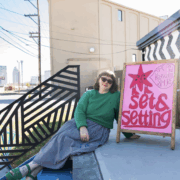
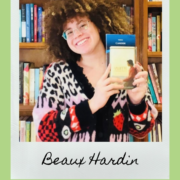
Kaleigh Basso has always wanted to work in a queer bookstore. Now, she owns and operates Set & Setting: one of the quirkiest and most unapologetically queer independent bookstores in Louisville.
Set & Setting Brings DIY Queer Bookstore to Louisville
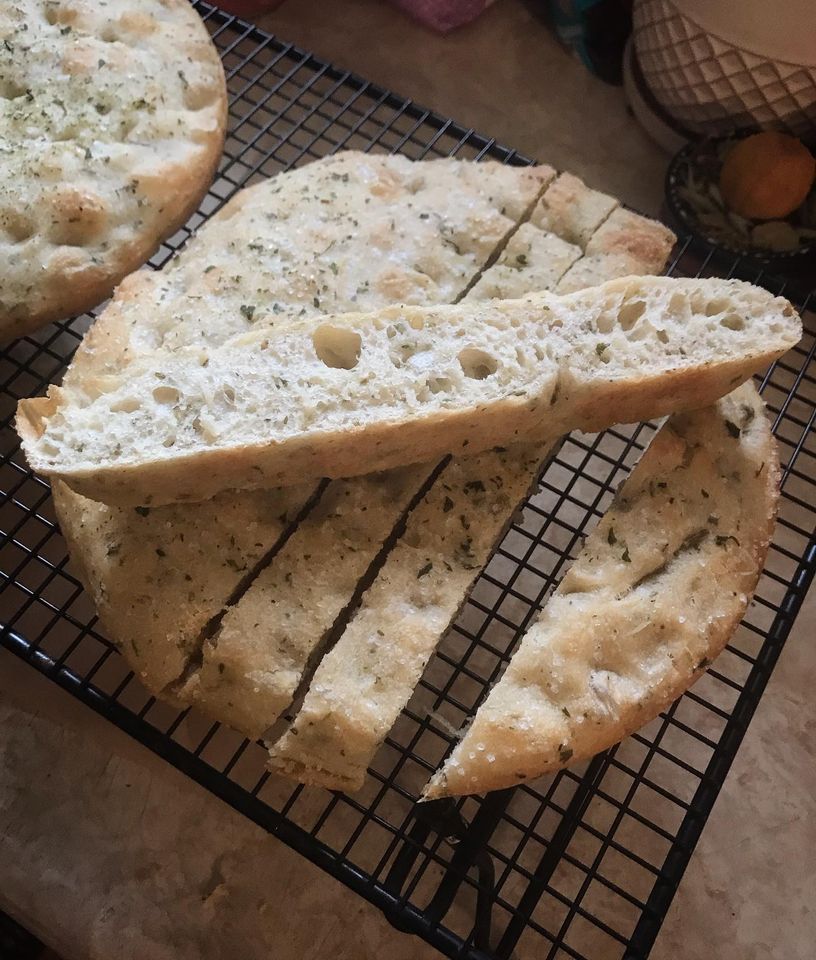
Since moving to her new location within ARTPORTAL, Basso has hosted several colorful events inviting local readers, writers, and artists to exchange advice, supplies, and company. She’s also fulfilled a secondary dream of becoming a barista: serving coffee, tea, and baked goods to customers and visitors hoping to snack while honing their craft.
“I’m not interested in doing it the same way that every other [Queer] bookstore or every other small business does things,” Basso said. “I’ve always been sort of very DIY, very scrappy, very adaptable. And I think that from the previous location in a small studio to now being what is basically a book stand, it lends itself really well to being a different business model that feels new, but is also very clearly not interested in the way things should be done.”
From its name (inspired by research conducted on psychedelic drugs) to its products (indie chapbooks, snarky stickers, and aesthetically pleasing stationery), Set & Setting prides itself on providing an unorthodox, wholly original approach to a book-buying space.
How Kaleigh Basso’s Identity Shapes the Queer Bookstore’s Curation and Community
“As a queer autistic woman, it definitely influences the way that I curate, the way that I run the business, the way that I present the business to other people, and also the way that I interact with customers,” Basso said.
Basso’s unique approach to running her queer bookstore also draws a unique crowd of people, including “a lot of gays, a lot of weirdos, and a lot of crafters.”
“Everyone that comes in is very appreciative of the variety in the curation,” Basso said. “It’s a lot of people who care a lot, and that’s always kind of what I’m going for. I want people who want to be earnest and be in a space that feels good.”
Since starting Set & Setting in 2021, Basso has also formed a meaningful relationship with the Midwest Pages to Prisoners initiative: “An all-volunteer effort that strives to encourage self-education among prisoners in the United States.”
Those interested in supporting Set & Setting’s quest to provide books for the incarcerated can purchase materials on their Bookshop wishlist.
“I’m always trying to figure out ways to do more that helps people,” Basso said.
A Community Hub for Queer Bookstore Readers, Writers and Artists
Basso also helps her community by using her queer bookstore’s space to host unique social events. In the month of December, queer bookstore Set & Setting happily welcomed writers, readers, and artists to participate in a Read & Sip, Writing Salon, and Collage Night.
To keep up with Set & Setting’s event schedule, consider following their Instagram or subscribing to Basso’s Substack, where she updates readers on the behind-the-scenes of running a small business.
Readers interested in surrounding themselves with queer literature and queer authors can explore Basso’s recommendations below!
5 Queer Titles Recommended by Set & Setting Queer Bookstore
“I love novels written by poets, but this one just blew me away,” Basso said.
“Martyr!” was shortlisted for the 2024 National Book Award for Fiction and labelled a New York Times bestseller. Recently, it was selected for Set & Setting’s monthly bookclub, where it also received great praise from its readers.
“It’s about a young orphan in his late 20s trying to figure out what it is to die a meaningful death,” Basso said. “It’s a little surreal and it’s very beautiful.”
“Chain Gang All Stars” is a dystopian novel critiquing the prison industrial complex, the entertainment industry, and capitalism. Its sapphic main characters must fight against other inmates in televised gladiator matches in order to entertain the nation and possibly secure their freedom.
“[“Chain Gang All Stars”] takes something that is rooted in the things we are seeing and witnessing now,” Basso said. “In the way that dystopian literature does, it asks: what if we took that to its extreme?”
Lee Mandelo, a local trans author, describes his 2024 novella as “equal parts historical horror, trans romance, and blood-soaked revenge, all set in 1920s Appalachia.”
At only 153 pages, “The Woods All Black” is a perfect choice for readers craving a small dose of scares.
“Space Story” by Fiona Ostby is a graphic novel that uses color to help readers differentiate between its three main characters: a lesbian couple and their teenage daughter. Trapped on a dying Earth, the family must find a way to escape to a space station and reunite after tragedy separates them.
Set & Setting is open from Tuesday to Saturday and located within ARTPORTAL at 1512 Portland Ave. in Louisville. However, customers can go through Set & Setting’s Bookshop account to search for, order, and ship titles not always available in-store – as well as support an independent bookstore and its seller.
https://queerkentucky.com/wp-content/uploads/2025/12/Screenshot-2025-12-22-at-9.18.28-AM.webp1210884Sav Gripshoverhttps://queerkentucky.com/wp-content/uploads/2024/05/Queer-Kentucky-White-Logo-300x132.pngSav Gripshover2025-12-22 14:22:242026-10-10 14:27:00Set & Setting Owner Kaleigh Basso Is Redefining What a Queer Bookstore Looks Like in Louisville, recommends these 5 books
This story is part of Queer Kentucky’s digital issue surrounding the trans youth experience in the Bluegrass state, featuring personal essays to educational information. Read the full issue here.
With the recent removal of many DEI initiatives from larger organizations and school districts, the future of queer safe spaces in Kentucky has become uncertain. During this time, organizations that uphold queer acceptance and advocate for systemic change are crucial. One organization, Louisville Youth Group (LYG), provides safe spaces for queer youth while also pushing for broader social justice. I sat down with Em Joy, LYG’s program director, to discuss their work and mission.
Our conversation began regarding how LYG addresses the unique needs and experiences of queer youth. Joy had this to say…
We’ve recently expanded our age range downward for younger kids and families—and upward to support young adults. After COVID, many felt unprepared for adulthood. Most queer spaces are bars or clubs, which aren’t accessible or appropriate for everyone, so we wanted LYG to be a place where young adults could find friends, support, and mentorship.
In addition to age-based support, we offer identity-specific groups. Our trans, non-binary, and intersex group focuses on social and emotional well-being, giving youth space to discuss gender identity, expression, and bodily autonomy.
We also run Melanin MagiQ, a group for Black and Brown youth. It’s a space without white peers to talk openly about intersecting identities and how racism impacts their lives. The group was developed with input from our youth of color, especially in response to BLM and the push for racial justice.
We also run our Beyond Labels Resource Closet, where youth can access gender-affirming items—like binders, tuckwear, dresses, and makeup—free of charge. Everything is donated or grant-funded. We help youth explore identity in a supportive environment.
As our conversation continued, our discussion moved towards the subject of trust, and how it’s built between LYG and the youth they serve. When building trust with young people who may feel isolated or misunderstood, Joy says that…
I’ve worked with young people most of my career. The biggest thing is to meet them exactly where they are. Kids—and adults—have big feelings. I try to offer guidance and coping tools. I’m trained in therapeutic approaches and remind youth they’re not alone. If no other adult affirms them, I want to be the one who does—and show them there are others who will, too.
As we were chatting about how organizations reflect the diversity of queer youth, Joy poses the question of “what social or systemic barriers are preventing access?” We discussed Louisville Youth Group’s approach in addressing these barriers…
One thing I’m constantly considering is: who are we serving—and who aren’t we reaching? What social or systemic barriers are preventing access?
We continually evaluate our services to meet our community’s needs. We’re also intentional about how we recruit mentors. It’s not just about being good with youth—we reduce barriers so marginalized mentors can get involved. Volunteering requires financial stability many BIPOC, disabled, or low-income folks don’t have. We offer financial incentives for Black and Brown mentors.
Our main space is in an older church building, so unfortunately, it’s not fully accessible—especially for those who can’t use stairs. But for off-site events, we choose fully accessible locations.
Inside our space, we’ve made it as sensory-friendly as possible. Many of our youth are neurodivergent, so we offer fidget toys, soft lighting, weighted blankets, and a sensory room to decompress with mentor or peer support.
Having discussed the ways LYG serves its community of queer youth, we began examining how LYG simultaneously pushes for broader systemic changes.
One major way we push for systemic change is through training and outreach. We offer professional development to nonprofits, churches, and businesses—any space youth might show up. We teach LGBTQ+ basics and help audit internal policies. Discrimination is often systemic. We help institutions become more inclusive.
And while we work on systems, we stay grounded in our core: creating safe space. If a kid can’t be safe at home, school, or church—they can come to us. We will always be that space.
Even as a small organization, we’re very active. We’ve been around since 1990, and for most of our history, we were entirely volunteer-run. Paid staff only came in the last 10–15 years.
We table at community events, schools, and festivals to build visibility—local Pride events, farmers markets, high school career fairs, and more. We want young people and families to know we exist. And honestly, we’re often the most popular table—because we’re one of the only visibly queer groups there. That visibility matters.
This year, we’re proud to partner with Louisville Public Media and WFPK for Waterfront Wednesdays. We’re sponsoring the kids’ activity space with crafts, games, and support—while wearing our “Protect Trans Youth” shirts and showing families what affirming adults look like.
Parents come up to us all the time—some hearing about us for the first time, some already familiar and grateful. It’s affirming to see how much community support we have, despite what the media suggests.
Finally, we talked through ways our readers can get involved, both in the work of LYG and the broader objectives they pursue…
There are a few big ways. First: volunteer. We’re always looking for mentors and folks to help grow our community relationships. Second: donate. That doesn’t just mean money. Donations of snacks, books, clothes, and art supplies go directly to our youth. Even a few boxes of chips can help feed our kids. We also have a wish list at Carmichael’s Bookstore—if you order from it, you get 20% off. And finally—advocate. Show up to school board meetings. Speak out for trans youth. Go to Frankfort. Meet with legislators—not just during big bills, but all year. If you share identities with those in power, use that to push for real change.
Most importantly, make every space you’re in more inclusive. Listen to kids. Respect their self-determination. Support their autonomy. Be the adult they can trust.
Through my conversation with Joy, the vital role LYG plays in the lives of queer youth in Kentucky became undeniably clear. Between the resources they offer, the diverse community they foster, and the guidance they provide, Louisville Youth Group remains an indispensable asset of Kentucky’s queer community.
While we closed out the interview, Joy shared a message of hope with us…
“To close, I want to share a message of hope. We’ve been here a long time. No matter what happens in government or culture, we will continue to exist. We’re here, we’re queer, and we’re not going anywhere.”
https://queerkentucky.com/wp-content/uploads/2025/08/Transyouth2-5.webp7681366Fiona Joneshttps://queerkentucky.com/wp-content/uploads/2024/05/Queer-Kentucky-White-Logo-300x132.pngFiona Jones2025-10-16 12:00:392026-10-10 14:30:49An Interview with Em Joy: Program Director for Louisville Youth Group
Content note: This story discusses suicide, substance use, sexual assault and an eating disorder. Support resources are listed at the end.
This story is part of Queer Kentucky’s digital issue surrounding the trans youth experience in the Bluegrass state, featuring personal essays to educational information. Read the full issue here.
Photos and story by D.L.
It was 2023. The world had been ending for three years, but my world was ceasing to exist. My family home burned to bits two years prior, my uncle’s breath was flattened by fentanyl months later, and my grandfather had just been crushed by cancer. Death followed me like a dog. In my new adulthood, I fled Louisville, thinking it might not find me. I was 19, suicidal, and believed if I wanted to survive, I needed to be numbed.
Then I tripped.
On acid, I was anything but numb. I was honest with myself. Despite the fact that I was tripping to forget the grief that defined my life, I spent most of my trips remembering the people I’d lost. I could remember their laughs without shutting down. I could remind myself that I’ll never see them again and somehow survive. I felt halfway-human again.
When I tripped, I acknowledged death and grief as part of the incomprehensible human experience and accepted it the same way I accepted any mind-fuck on psychedelics. When I was sober, only two things mattered:
People I love are dead.
There’s something I can put in my body that makes me feel like I’ll survive that.
I spent seven weekends straight searing my brain too stupid to hurt. I avoided sobriety in an effort to evade sadness and how scared I was. In public, I was uncomfortable. At home, I was anxious, like every second spent sober was grief catching up.
On acid, I soaked in a technicolor, spiraled version of my world. I felt everything completely. Every touch was 200 volts of pure, white-hot pleasure. Every emotion was an energetic pulse of ecstasy. I saw heart-shattering beauty in everything and everyone. I had never felt so connected to music, strangers, and myself.
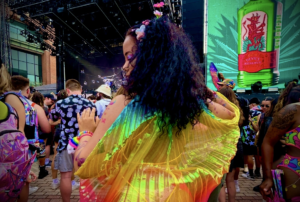
At first, it felt glamorous. I was doing drugs in a big city, mentally unravelling and surrounded by sweat-soaked, sparkling strangers and brain-buzzing bass, held together by nothing but torn fishnets, pasties, and a pink feather boa. I had more fun than fear and got high on the glory of parading my body while destroying it.
I’d never shown so much skin. I grew up bulimic, and before I started raving, the most positive relationship I’d had with my body was centered more on acceptance than any sort of love or confidence. Being chronically ill, I also had a complex relationship with my body and the physical pain that comes with living in it.
It shocked me how supportive the community is. I understand the push toward body neutrality, but to be seen so clearly and to have my style, creativity, and appearance complimented constantly was cathartic. It was impossible not to feel good about myself when beautiful women were saying I was the sexiest person they’d ever seen.
Besides that, I enjoyed the freedom of getting to be topless in rave and festival spaces regardless of my gender. I liked that even if they wouldn’t remember them (typical), nobody looked at me weirdly for saying that my partner and I use they/them pronouns, because to do so wouldn’t uphold PLUR(R) – Peace, Love, Unity, Respect, and (the often omitted) Responsibility.
With this newfound confidence and freedom, my outfits became increasingly revealing. I knew outwardly, to many, I looked like a party girl who was doing too much for attention. But I adored the euphoria that came from being myself, being comfortable in my skin, and feeling seen.
At my first raves and festivals, I pretended there were no preconceived notions about my body or gender. I felt like a ninety-percent-naked, genderless fairy flitting around the woods, surrounded by people who only noticed the music, not my body.
This was delusional. I was groped and misgendered often, sometimes by people I considered friends. People who sexually assaulted me were seeing and enjoying my body and outfits from a place of perversion, not expression. I’m not ashamed of sexuality and value it both in my presentation and as nature, but being groped while incapacitated on drugs is obviously neither a sensual nor consensual experience, and showed me how I was truly perceived: a nearly-naked woman too high to defend myself.
I can’t say I’ve never harmed people on drugs. I let relationships fizzle out because I was putting more energy into escapism than I was into any of the living people I love. I was selfish. My brain was curdled. Even sober, I was an alien disconnected from everyone – and ironically, it was because of the drugs I took to feel connected to people.
On acid, I was no better. I was incoherent and often either too affectionate or standoffish. I prayed that people considered my uncomfortable behavior whimsical (at best) or wooky (at worst), but looking back, I was just sloppy. I felt like my substance use couldn’t be as bad as it felt because friends were still seeking me out at events, still saying they loved me, still saying I was fun to party with. But I woke up steeped in shame after every night out.
Maybe I was fun. Truthfully, I wouldn’t remember. And that was the much larger issue. My feelings on the subject are best summarized by the way my friend explained her sobriety from cocaine: “I’m tired of having no memory of the best nights of my life.” And I’m tired of the memories I do have being shrouded by shame.
For me, the most euphoric part about any rave is being so overtaken by the love for the music and people that I forget to care about how I look dancing and just move and feel. I deserve to be present in that, and I want to remember it.
In the darkest depths of my addiction, I needed to understand that the false dichotomy of drugs being “good” or “bad” wasn’t going to save me.More than I needed to quit any substance, I needed to sit with the reality that I was using drugs to distort. Being constantly high was destroying me, but so was stifling the hurt beneath it.
Two years later, I’m able to find beauty in the world and can feel what is distinctly ugly, painful, and difficult without the buffer of substances – I love the complex, grief-filled world and body I live in enough to not chemically sever myself from them every chance I get.
If you or someone you know is struggling, call or text the 988 Suicide & Crisis Lifeline at 988. LGBTQ+ young people can press 3 to reach counselors trained in LGBTQ+ care, an option that returned on Sept. 30, 2026 after it was cut in July 2025. The Trevor Project also offers 24/7 support at 1-866-488-7386 or by texting START to 678-678.
https://queerkentucky.com/wp-content/uploads/2025/08/1.DL_.Image_.webp7891170Queer Kentuckyhttps://queerkentucky.com/wp-content/uploads/2024/05/Queer-Kentucky-White-Logo-300x132.pngQueer Kentucky2025-09-29 12:00:242026-10-10 18:09:52Acid, Ache, and the Grief Behind the Glamour: A reflection on substance abuse, recovery, and the ghosts, glitter, and grime in between.
By Sage Barr (they/he) & Mo Viviane (they/she/he/it)
This story is part of Queer Kentucky’s digital issue surrounding the trans youth experience in the Bluegrass state, featuring personal essays to educational information. Read the full issue here.
Disability justice is the backbone of trans movements. When navigating through our experiences, we are met with every intersection of being. Here you will find correspondence of two disabled trans individuals, from expansive perspectives and life experiences, that assist in understanding how accessibility is about more than just the physical spaces we enter; it is a collaborative effort to weave together advocacy by prioritizing the most marginalized individuals in planning, execution, and convening.
Sage: Disability and activism are more intertwined than you might think. When you’re disabled, you get good at advocating for yourself, being persistent, and sometimes getting loud just to be heard. Those same skills show up in my activism every day. I’m young, disabled, deaf, queer, and trans–and my activism started when I was 15, speaking at a library board meeting after anonymous complaints about LGBTQ+ Pride Month displays.
The library was my second home– tie-dye programs, robotics camps, volunteering at story times, so it mattered to me to show up. I didn’t think of it as “brave” or as activism, just defending something important. But that night lit a bit of a spark.
Mo:
To me, that spark is about the moment you speak up because you have to, not because you’re ready to be an activist. For me, in my undergraduate studies at Northern Kentucky University, it meant fighting my own brain before I ever reached a meeting or a die-in on campus. Bipolar disorder, AuDHD, and severe anxiety don’t exactly make activism easy. Some days, just getting out of the door feels like a rally in itself.
And yet, like Sage, I couldn’t stay silent. My activism was born out of necessity–when spaces I loved and people I loved were under attack (and still are), my body and mind didn’t get to “opt out.”
Sage: After that library meeting, strangers called me brave. I didn’t see it that way. Soon, I was at school board meetings, speaking against book bans on titles like “Stamped,” “Gender Queer,” and “From the Mixed-Up Files of Mrs. Basil E. Frankweiler.” I joined rallies against SB 150, a bill forcing schools to out trans students. Still, I didn’t call myself an activist – I was just showing up, making signs, lending time.
Mo: And that’s the thing – ”just showing up” is activism. But for disabled folks, showing up comes with extra steps: navigating sensory overwhelm, finding safe transit, and figuring out where to position yourself so you’re not boxed in the crowd. For me, being Black and nonbinary adds another layer; entering spaces that claim to fight for racism and transphobia while still carrying both in their culture.
Sage: The first time I saw intentional accessibility at a protest was the 2023 Trans Youth Rally in Frankfort. There was an interpreter. For the first time, I didn’t have to scramble for access – I could just be there. As a Deaf person who also uses a cane and manages sensory needs, navigating crowded events can be exhausting. If there’s no space to move or no thought given to how people can access the event, it’s easy to feel like your presence isn’t welcome. That rally showed me it could be different. Mo: That’s exactly it. Accessibility isn’t about being extra; it’s the foundation of sustainable movements. For me, that could mean quiet corners, clear signage, or event leaders who understand that I might need to step away. And mental health access matters too – creating spaces where people can be involved without being pushed past their limits.
Co-creatively, we come to activism from different places, yet our truths coincide with one another. Movements are only as strong as the access they build in from the start. When accessibility is treated as an afterthought, movements exclude the very people they claim to fight for. But when disabled folks are centered, when care and access are built into every step, movements don’t just get bigger – they get stronger, more resilient, and closer to the world that we’re all fighting for. For allies, here’s what that looks like: • Ask about accessibility before the event, not the day of. • Budget for interpreters, captions, and mobility access from the start. • Make spaces where people can come and go without shame or guilt. • Share information in multiple formats – written, visual, spoken – so everyone can engage. • Remember that not all activism happens in the streets; online organizing, mutual aid, and behind-the-scenes care work are just as vital. True solidarity isn’t about inviting disabled people into a space that’s already been built – it’s about building the spaces with us at the forefront of your planning.
https://queerkentucky.com/wp-content/uploads/2025/08/Transyouth2-1.webp8641537Queer Kentuckyhttps://queerkentucky.com/wp-content/uploads/2024/05/Queer-Kentucky-White-Logo-300x132.pngQueer Kentucky2025-09-23 12:00:352026-10-10 15:48:58Access in the Movement: A Shared Byline on Disability & Activism
From the Queer Kentucky archive. This digital special issue is one of our past special projects. Today Queer Kentucky is Kentucky’s LGBTQ+ newsroom, reporting every day. Read the latest news.
Digital special issue, 2025
Protect. Trans. Youth.
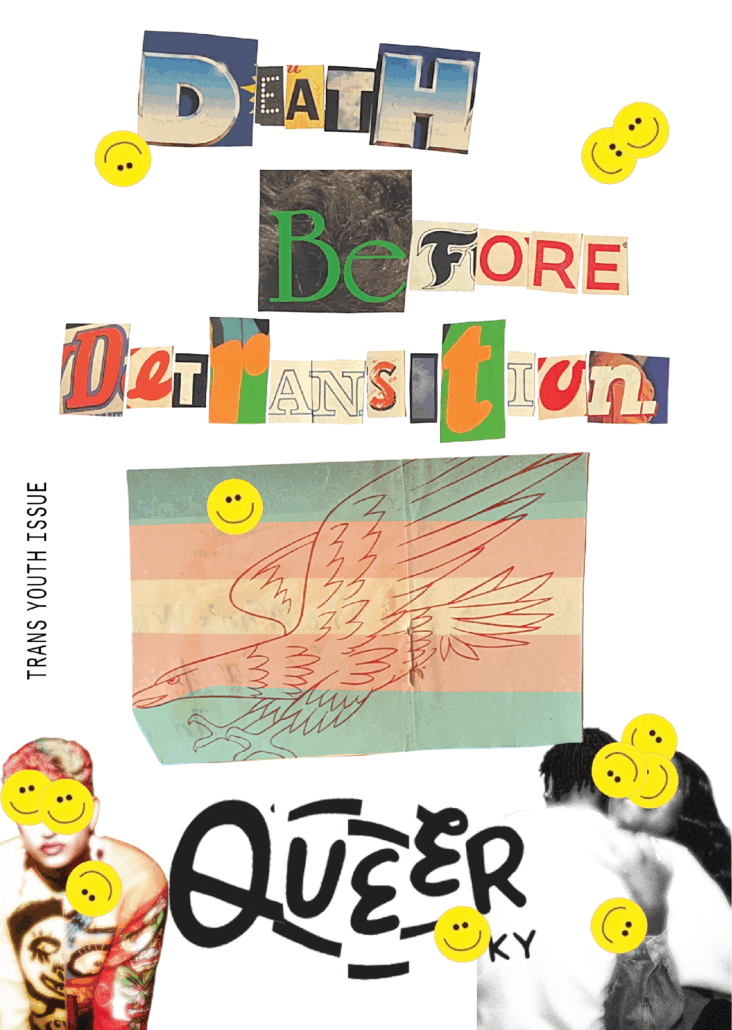
Death Before Detransition is Queer Kentucky’s 2025 trans youth issue, made by more than 15 trans young people across Kentucky. It grew out of a Charles and Jack Endowment Fund Grant from the Community Foundation of Louisville, at a time when anti-trans laws such as Kentucky’s Senate Bill 150 were reshaping daily life for trans youth. Queer Kentucky’s two cisgender leaders handed the project to a trans editor, who calls the collection testimony and resistance.
Gray Hawkins explains first steps into HRT, Leo Figgs asks why bathroom bans exist, and Sage Barr and Mo Viviane share a byline on disability and activism. Jules Crawley writes about trans life at the University of Kentucky and the year’s anti-trans bills, Omni talks with Black drag artists Olympia Gold and Shalyric Monae, and Noel Mitchell offers voice tips for singers on testosterone. Pieces by D.L., Aleksander Perris and Fiona Jones complete the issue. Mo Viviane edited it, El Bruner designed it, and Executive Director Missy Spears and Editor-in-Chief Spencer Jenkins guided the project.
I live in Fayette County, Lexington, KY, for undergrad.
What are your pronouns?
He/They
What does the word Queer mean to you?
It means a fluid label that has been taken back by the LGBTQ+ community—the word honestly feels like home to me as I most closely identify with it.
What was it like growing up as a Queer person in Kentucky?
Some moments were harder than others but I had it better than most living in Lexington—Lexington was more welcoming than a good majority of the state but not all individuals living in Lexington were.
What would you say to any person struggling to come into their own identity?
You don’t need a label. You don’t need to come out. If that stuff is adding more anxiety or more pressure—don’t worry about. I can guarantee that a lot of queer adults don’t stick to their one label that they used to come out with. We are a fluid people—embrace that. Just exist as you are for yourself.
What issue are you most passionate about in the Queer community? And what do you think the best solution or approach would be?
I am most passionate about intersectionality in my community—as someone who is queer, disabled, and POC, there needs to be more room for intersectionality in our community, there needs to be more room for representation, there needs to be a better embrace for all types of queer people.
Where have you found community?
I have found community in my friends, who often reflect the best parts of me and the various communities I belong to.
How have recent political changes affected your life?
They have made me rethink how to navigate life and the ways I go about it. Things weren’t easy beforehand and they are definitely harder now.
What are some ideas you have for bringing other queer people together for community?
More LGBTQ+ centered events throughout the year, a bulletin that announces local queer shops/events!
If you have been on HRT, how has it changed your outlook on life?
It has made me more comfortable and confident in myself and therefore added value back into my life.
What are some LGBTQ+ experiences/artists that have helped you express the struggles or the joy of being queer?
Getting into drag and playing around with expression!!!! I love my local drag shows and artists and the art that is shown there.
Are there any specific queer friendly places you’d like to highlight and share with the rest of the community?
The Bar Complex and Third Street Coffee often have queer community! There’s also a few brunch places like Epping’s that do Drag Brunches. The KY Theatre does queer movie showings/events like Rocky Horror Picture Show and accompanying drag shows!
If you have some accomplishments you’re proud of, share them here! The accomplishments of queer people are something that should be celebrated!
Last summer I received a research grant and part of that completed research was a published poetry chapbook that I created in both English and French about the black trans/queer experience. It’s called “Black Que(e)ries” and all proceeds go to Black education and literacy organizations. Please check it out!
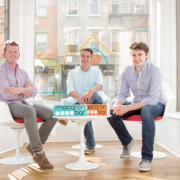
For the past 10 years, Macaron Bar—based in Cincinnati with locations in Louisville, Chicago and Pittsburgh—has served rainbow-colored sweet treats to customers while fostering a queer-inclusive brand and workplace.
“When you come into any of our stores, there are rainbow flags everywhere and we’re very open publicly that it’s a business owned by a married gay couple,” says co-owner Patrick Moloughney.
Twelve years ago, Moloughney and his husband, Nathan Sivitz—who also serves as co-owner and executive chef—noticed macarons gaining popularity in coastal cities like Los Angeles (where they lived at the time) and New York City. Having developed an infatuation with the dessert, the pair set out to bring the burgeoning French treat to Middle America with a boutique bakery of their own.
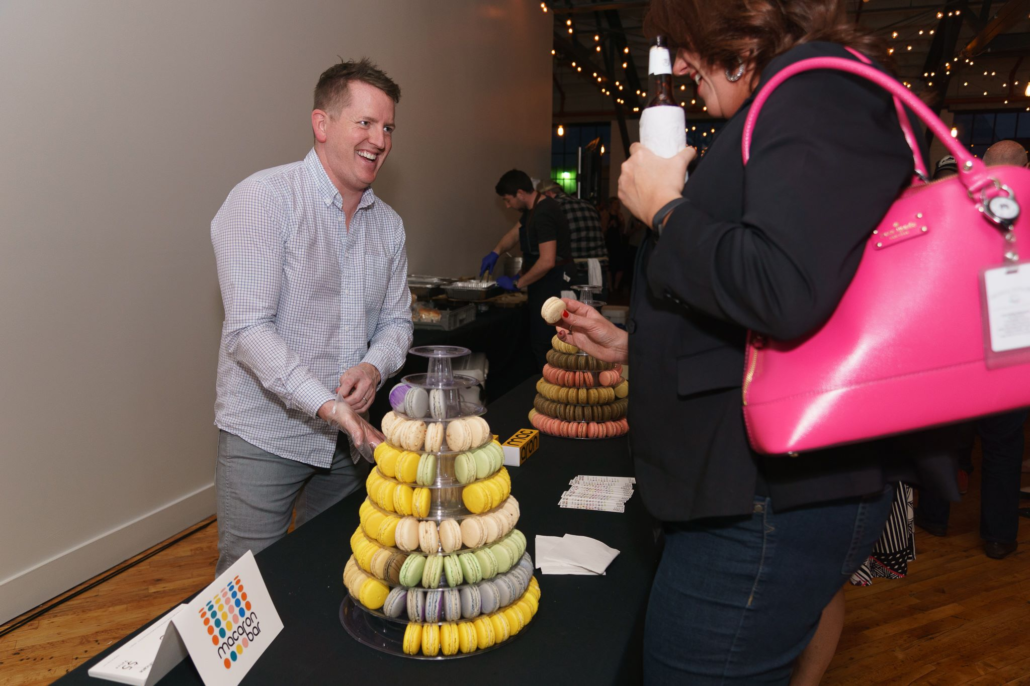
Co-owner Patrick Moloughney serving macarons at a charity event. Photo provided by Home of the Innocence Facebook page.
Moloughney brought a business background to the table from his work in the entrepreneurial space at Procter & Gamble, where he developed new business strategies, while Sivitz had a skilled background in and strong passion for baking. The combination of their expertise proved to be the perfect formula for what would become Macaron Bar. The two set out to research the brightly colored cookies, traveling across the world to immerse themselves in the business culture of macarons.
“We traveled throughout the US and took classes around baking them to learn more about them and learned how different bakeries branded themselves,” he said. “We also went to Europe for research, to cities like Paris and Brussels, where we also toured bakeries and took macaron baking classes.”
They eventually enrolled in a French pastry school in Versailles, where they completed a macaron master’s program. After returning to the heartland, they knew their home city of Cincinnati was the right place to set up shop in 2014. Moloughney and Sivitz equipped their front-of-house staff with the knowledge that they had acquired in their travels abroad so they, in turn, could educate customers on all things macaron. They also brought on a third owner, Mark Santanello in 2015.
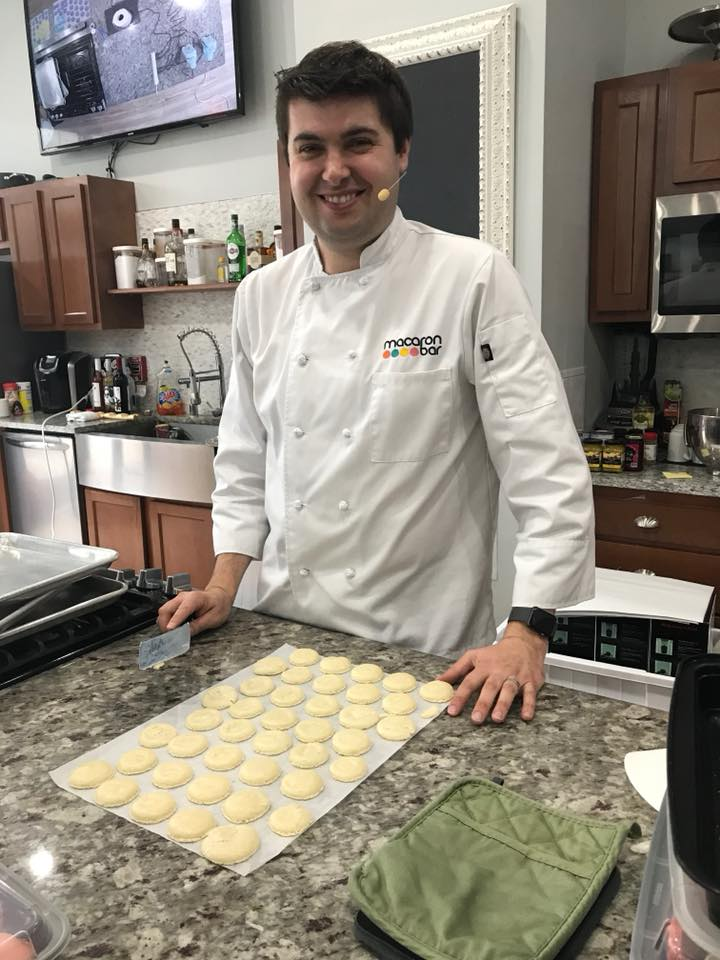
Co-owner and Executive Chef Nathan Sivitz during a baking class. Photo provided by Macaron Bar Facebook page.
“Not only did we want to offer our product, but we also wanted to create an educational experience because a lot of people have never had a macaron, or at least one of quality,” Moloughney said.
Customers can also enroll in pastry classes with Macaron Bar to learn how to bake their own.
“They’re a finicky cookie and difficult to make, a lot of people are interested in taking the classes,” he said. “It’s a pastry that a lot of other pastry schools won’t teach you how to do. It’s a hands-on experience that we offer that’s a big part of our business model.”
He adds that a majority of their front-of-house educators are members of the LGBTQ+ community.
“We’re proud to be LGBTQ+ owned and we’re clear to everyone that this is who we are,” Moloughney reiterates. “The biggest thing we offer to the LGBTQ+ community is a safe place to work.”
He said LGBTQ+ business owners bring a unique perspective when working with LGBTQ+ employees, as they have either shared similar experiences or can empathize with their lives. Working for Macaron Bar offers flexibility for leaves of absences for things like mental health and gender-affirming care.
Dylan Ruffenach, an employee at the Louisville Macaron Bar, said not only does the company provide a safe, queer-affirming space, but also a supportive space for him as a neurodivergent person.
“Having autism, I’m not fully capable of living on my own—I’m working towards it—but the tasks at work are teaching me how to take care of myself like—washing dishes,” he said. “[Having queer employers] has helped me out a lot to be myself more.”
The Louisville Macaron Bar location is located on Market Street in NuLu, which is on the Kentuckiana Pride Parade route and Ruffenach says the parade will be a big day for him and the company.
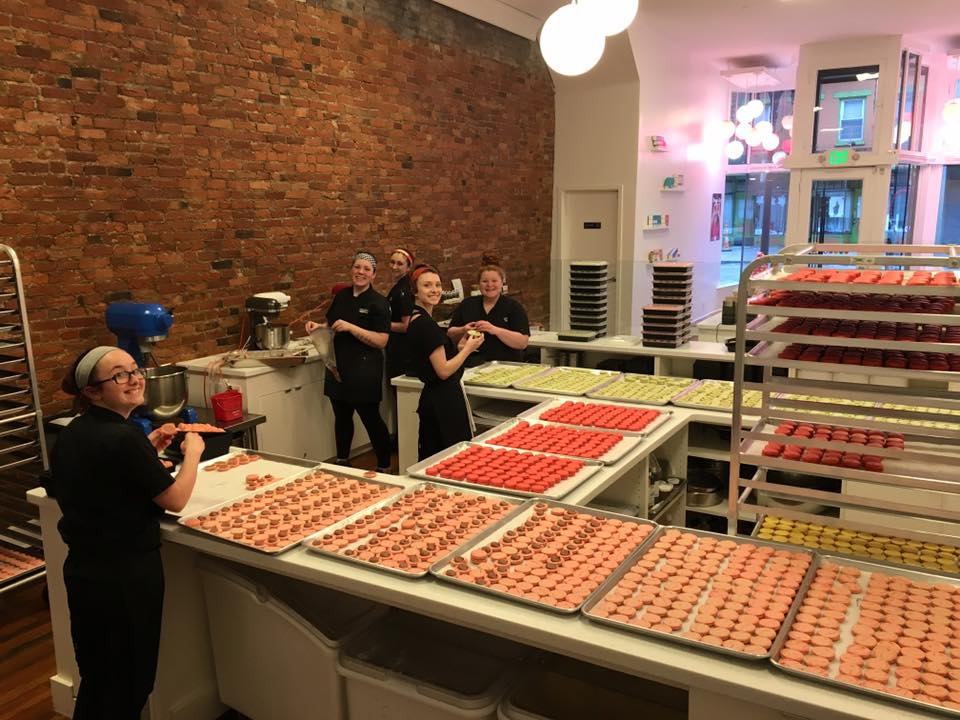
Employees prepare Valentine’s Day treats. Photo provided by Macaron Bar Facebook page.
“I’m excited for the parade to come through because the tips will be pretty good because it will be a lot busier that day and I love seeing people being themselves [walking the parade],” he said.
Not only does Macaron Bar offer a safe place to work, they also put their money where their mouth is and donate products to LGBTQ+ and art organizations across Cincinnati and Louisville throughout the entire year. Their baking classes, often donated for silent auctions, can bring in around $1,500 for an organization.
Fortunately for Macaron Bar, the business has faced little backlash for its commitment to being visibly queer, other than a few Google reviews criticizing the display of rainbow flags and committing not to support the brand again.
“We just delete it and move on,” he said. “And it’s one percent of the time and has a one percent effect on our business. Other than that, nothing significantly [homophobic] has happened.”
For more information on Macaron Bar, visit their website here.
https://queerkentucky.com/wp-content/uploads/2025/06/MBar_Group-2_HiRes.webp19662500Spencer Jenkinshttps://queerkentucky.com/wp-content/uploads/2024/05/Queer-Kentucky-White-Logo-300x132.pngSpencer Jenkins2025-06-25 12:00:242026-10-10 19:12:37Macaron Bar builds sweet success with queer-inclusive business model and community support
Queer Kentucky has partnered with Louisville Magazinefor our fourth print issue. We asked Louisvillians and Kentuckians at large about their queerness and its relationship to the city, where they feel at home, who was there for them when it felt like nobody else was, the biggest issues facing Louisville’s queer communities, and much more. In this issue, you will find stories of Queer Kentuckians telling tales of their beloved safe spaces, paying tribute to the loved ones who uplifted them when no one else would, laughing about their coming out stories, and so much more. Kentucky, and Louisville, have a lot of work left to do when it comes to embracing the queer community. But hey, it’s not as bad as people think it is. Read on, you’ll see.
Old Louisville, he/him
Who was there for you when it felt like nobody else was?
My friend Stephanie. I began working with her almost ten years ago, and eventually we became friends. She took me under her wing in many ways. I see her as sort of my queer mom. I think we bonded over shared mental and physical illnesses and also over being nerdy and weird. She is surly and bisexual and darkly funny and has a binder of Stardew Valley information. When everyone else had somehow abandoned or betrayed me, she was there still to reach out to. She’s been a constant supporter from my teenage years into adulthood, and I can’t picture what my life would look like without her in it.
Who was the person you chose to come out to?
I first came out to a Christian youth counselor, and when I did, I couldn’t say the words myself. I simply told him I had something to tell him. I sat in silence for a long time, and he eventually began listing all the things young people had told him, from their engaging in self-harm to perverted things like molesting their siblings. Eventually he said ‘gay,’ and I nodded at that one. He was the first person I had trusted, and it was largely because he seemed to be my friend and hung out with me despite my ‘oddities’ — what I now know to be autistic traits.
What piece of art — a book, a painting, a movie, a TV show, etc. — means the most to you?
Steven Universe. Over the course of the show, it becomes an analogy for healing from family trauma, queer identity. It is also just very pretty to look at.
Anything about how you identify that you’d like to share?
I’ve been exploring the nuances of terming myself agender vs. non-binary, and how the two are different and how they might overlap.
If you or someone you know is struggling, call or text the 988 Suicide & Crisis Lifeline at 988. LGBTQ+ young people can press 3 to reach counselors trained in LGBTQ+ care, an option that returned on Sept. 30, 2026 after it was cut in July 2025. The Trevor Project also offers 24/7 support at 1-866-488-7386 or by texting START to 678-678.
https://queerkentucky.com/wp-content/uploads/2024/08/Josiah-Rodgers-for-Queer-KY-by-Sarah-Katherine-Davis-Photography00014color-scaled.avif25601707Queer Kentuckyhttps://queerkentucky.com/wp-content/uploads/2024/05/Queer-Kentucky-White-Logo-300x132.pngQueer Kentucky2024-08-24 14:25:112026-10-12 23:04:38Feeling at Home in Louisville: Josiah
Editor’s note: This story was published in June 2024. Some details may have changed since then.
Queer Kentucky’s New Executive Director to Lead Organization’s Future
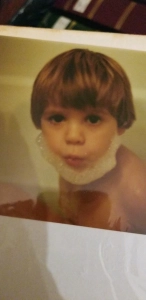
Before I understood queerness, I understood masculinity. When I was a child I emulated masculine stereotypes at every turn, grabbing a hammer I could barely hold to help on a project my dad was working on; wearing my cousin David’s corduroy suit to kindergarten; using the bubbles from the bath to form a foam beard around my tiny jaw. Doing anything and everything to show off in front of a girl. I knew I was different than other girls, but it wasn’t until my mom asked me at age seven, after finding a piece of paper on which I had written “I love Alison,” over and over again in the perfect cursive I was practicing, if I was gay that I had a term to describe myself. Without being told what the word meant, I immediately knew I was gay. And I immediately knew to hide it.
Never in a million years would that scared, isolated, seven-year-old imagine that this would be their life. Married to an incredible woman. Openly queer. Accepted. Loved. And running a quickly growing storytelling-based nonprofit focused on the LGBTQ+ community.
It feels weird introducing myself to you because I feel like I already know you. I’m a 44-year-old Queer that calls Kentucky home. Pink hair. Masculine clothes. Big dreams. Bigger mouth. Neurodivergent. Mentally ill. Former food stamp recipient. College dropout. And I’m the new Executive Director of Queer Kentucky.
I’m a huge proponent of community building by creating spaces that are inviting to the folks most often left on the sidelines. I believe that inclusivity is an intentional action, and that tools like authenticity, storytelling, grassroots marketing, and the word “fuck” are too often underutilized. And I believe that we don’t need approval to do things. Half of the projects on my resume are because I got mad and just did something. Too many stray cats getting hit by cars? Create a TNR program called “Cut Your Balls Off Covington.” White supremacists putting up recruiting stickers in your neighborhood? Organize your neighbors to identify and remove the propaganda. Gentrification increasing food insecurity around you? Co-found a free fridge program on private property.
I am so grateful to Queer Kentucky’s founder Spencer Jenkins for creating and growing such an incredible organization, and I am excited that he has moved into the Editor-in-Chief position, now able to use his journalism skills full time on our web-based and print editorial content. We have so much still left to show you this year, including two more magazines that we’ve been working on since January, and we are excited for where the organization is heading. From April to December of this year you can expect this from Queer Kentucky:
An increased focus on the parts of Kentucky outside of Louisville and Lexington. While those cities will remain a big part of what we do, we can’t ignore the fact that the LGBTQ+ community exists in every corner of this beautiful state. Pikeville, Morehead. Bowling Green, Hazard, NKY, Paducah, and more. We’re coming for you.
Continuing to prioritize queer health and wellness, with an emphasis on substance use, recovery, harm reduction, and access to care. Yet again, our community is dying, and it’s not being discussed. We want to uplift the folks on the ground, connect with those struggling to know that they aren’t alone, and also dive into why it’s so hard for the LGBTQ+ community to receive care at recovery centers without dealing with additional barriers.
This past January, we launched our first civics-based program which saw us hire a political correspondent to cover the 2024 Kentucky General Assembly and all of the bills, people, and events that will most heavily impact the queer community. Not only do I plan on making this program recurring, but I plan on expanding upon it to introduce other civic resources to our audience. Local and state government impacts queer lives on the daily, and getting folks engaged is a personal passion of mine. Expect more.
In October we are launching “Bourbon and Belonging: Kentucky’s Queer Bourbon Week”, our weeklong celebration taking place in eight cities across Kentucky, with the goal of making Kentucky’s top product more inclusive and welcoming.
And finally, Issues 6 and 7 of our magazine are still to be released, our first issues designed and scheduled around specific events and themes. In August, Issue 6, our Bourbon and Belonging issue, will be released, bringing more depth and visibility to the LGBTQ+ and BIPOC bourbon community throughout Kentucky. In late October, Issue 7 will hit the shelves, showcasing “25 Years of Fairness.” Created in partnership with historians, archivists, community leaders, artists, and elected officials, this issue will track the twenty five year history of Fairness ordinances, the stories behind these advancements, and the work still left to do.
I realize that there is a lot of responsibility in this position and that as I report to my board, I also report to you. You are what makes this organization great. Your stories. Your passion. Your ability to pinpoint and call out bullshit. Your ability to love and offer forgiveness. I look forward to getting to know so many of you through my work at Queer Kentucky, but also through simply being one of you.
Let’s fucking go.
https://queerkentucky.com/wp-content/uploads/2024/06/Screen-Shot-2024-06-03-at-8.29.39-AM.png7261142Missy Spearshttps://queerkentucky.com/wp-content/uploads/2024/05/Queer-Kentucky-White-Logo-300x132.pngMissy Spears2024-06-03 12:35:572026-10-12 23:05:42The Head Butch in Charge: Missy Spears
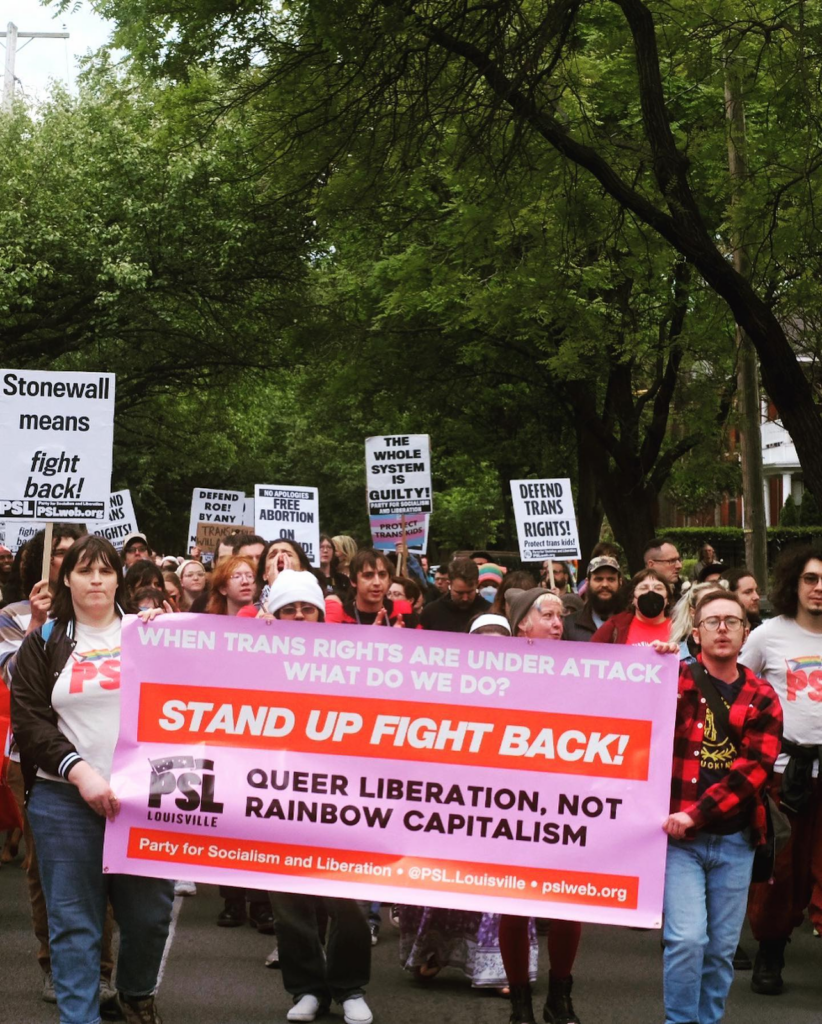
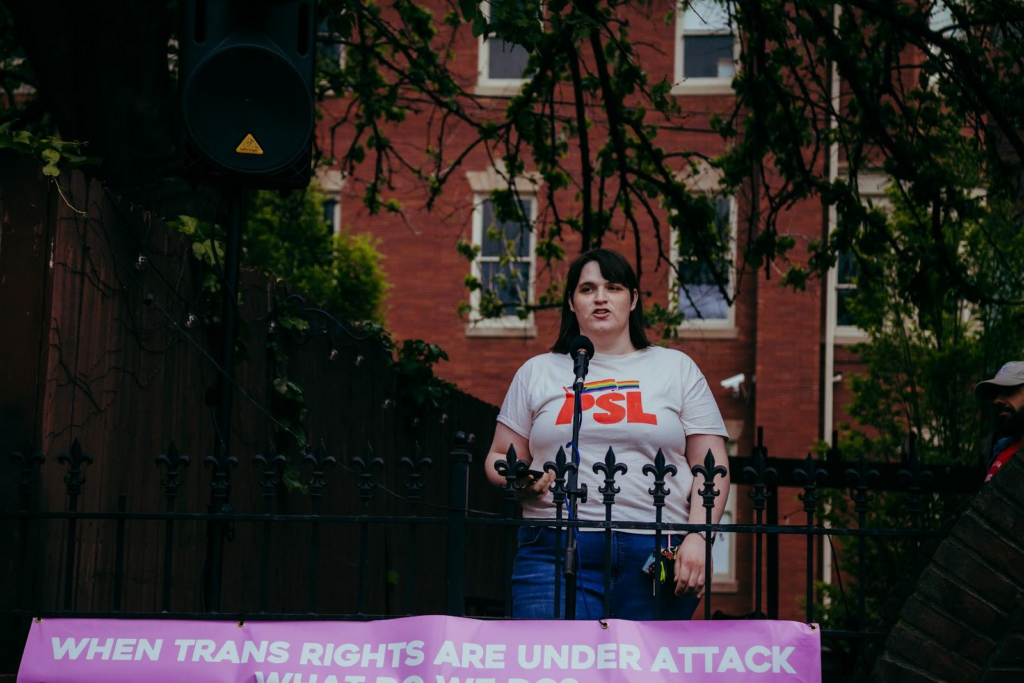
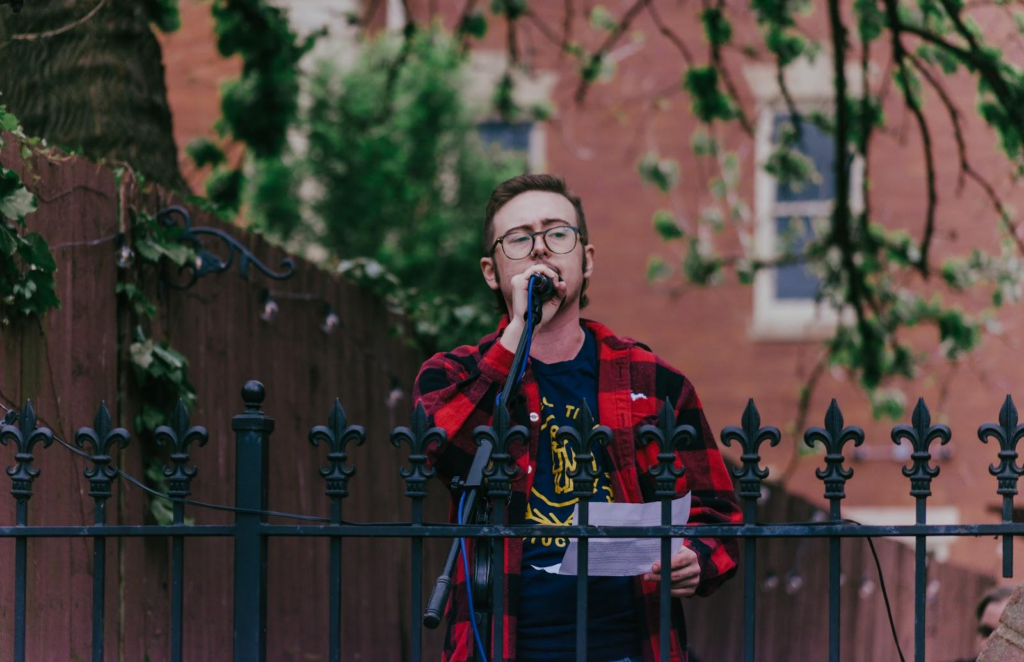
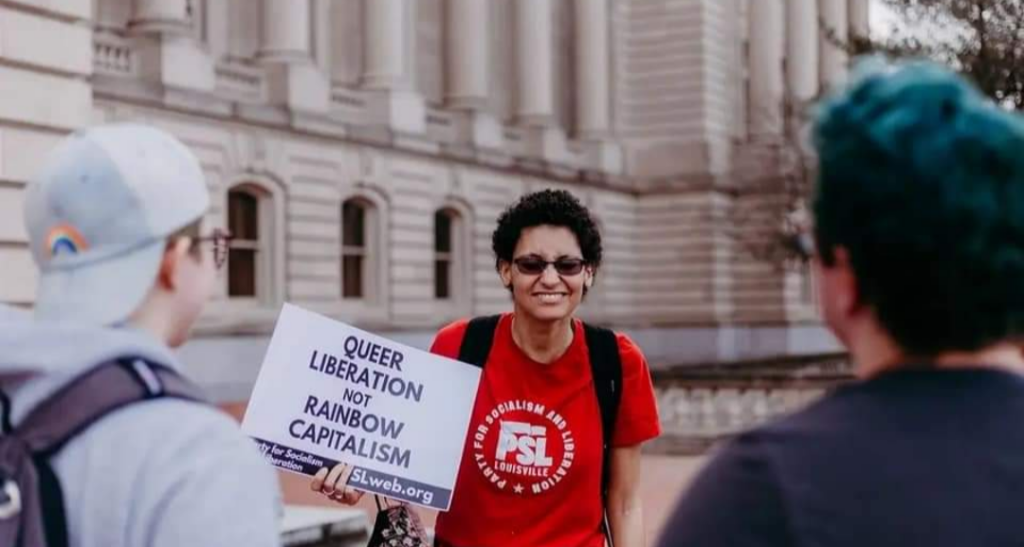
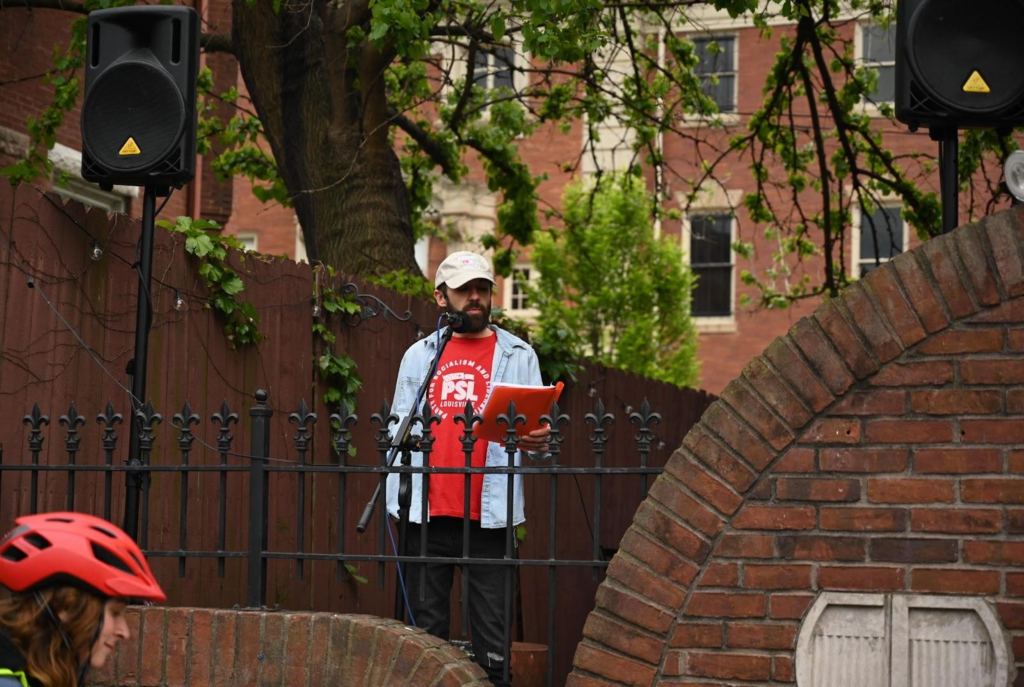
On May 1st 2023, the Party for Socialism and Liberation held a May Day block party and rally for trans rights at Old Louisville Coffee Co-op in Louisville. The event kicked off with a march, which began at Central Park, and ended in front of the coffee shop.
I had been assigned the role of emcee, and was stationed at the co-op’s balcony, ready to launch into our speaker lineup when the protesters reached their destination.
The first protesters rounded the corner, and the parade spilled across third street. Soon the street was filled with people, and more were still coming around the corner. I watched in awe as the mass advanced up the street toward me. Among them were my fellow PSL members, fellow co-op worker/owners, all kinds of regulars, folks from the Louisville Tenants Union, and trans people galore.
When something strikes me as strange or unbelievable, I sometimes experience vertigo. Looking out on the mass of gender-expansive bodies and bicycles, smiling faces and signs that said “a better world is possible,” that queer sensation rippled through me.
I’d expected a good turnout, but this exceeded my expectations—much like life has, seven years into my transition. How did I end up here, when my goal had merely been survival? I pondered. There wasn’t time to answer. The march was over and it was time to introduce the first speaker.
Photo by Emmett Valentin
Looking at the photos from the rally later that evening, two things stood out to me: 1) how much the Louisville branch had grown since I’d joined the party in early 2022, and 2) how many of the new members are trans. Not that I find this all that surprising. Trans folks, in my experience, are one of the most politically radical and politically active groups there is, in general, and especially in Louisville. But while our presence and staying power no longer surprises me, I continue to be amazed at my community.
Anywhere people are fighting oppression, trans people are in the room. In the movement spaces I was a part of in 2020, most of the white folks in attendance were trans. This is significant when you consider that trans folks make up only 1-2% of the general population. Indeed, despite the size of our community, trans folks are rarely the minority in progressive movement spaces.
On more than one occasion I have organized fundraisers for trans individuals I wasn’t on speaking terms with. I know other trans folks who’ve put up total strangers for weeks after surgery, cooking their meals and helping with their aftercare and living needs. Trans people be like, “ Yeah I’ll take Aiden to the ER. Is it pretentious Aiden, or Aydin my girlfriend slept with?” Because of how marginalized we are, my community shows up: whether or not we like (or even know) each other.
And that, in essence, is socialism: the understanding that my well-being depends on the well-being of the community. Trans folks are so deeply aware of our interdependence that socialism is practically in our DNA. Yet most Americans, trans people included, wouldn’t know this, because our government-controlled media and education systems have fed us a false understanding of socialism. We live in a country where “socialism” is used interchangeably with “fascism,” and where typing “communism” into a search engine can get you put on a “government watch list.” In reality, communism (the final goal of socialism) is actual democracy, a system of collective governance and common ownership that produces material equality (i.e. a world where everyone has a house, education, food, healthcare, leisure time, and creature comforts). Actual democracy would destroy capitalism, hence the U.S.’s fear of it.
What follows is a dialogue about socialism between myself and seven of my closest transgender comrades (a.k.a. fellow socialists). Because who better than trans folks to set the record straight, but not too straight?
ERIKA (SHE/HER)
Erika (she/her) is a registered nurse and organizer with the Louisville Tenants Union and PSL Louisville. Growing up in Lexington, KY, Erika struggled to come to terms with her queer identity before finally coming out as trans in her senior year of high school. As an adult, she moved to Louisville, working in the restaurant industry and bouncing from apartment to apartment before completing her nursing education. Today, she’s proud to fight for Socialism and queer liberation. She currently lives in the Highlands with her partner and their cat, Sassy.
Photo by Emmett Valentin
What is socialism?
Erika: Socialism … is the belief that a better world is not only possible, but necessary. It is an outlook that has emerged from the centuries long experience of workers’ exploitation by capital and the realization by workers that the capitalists need us, but we do not need them. Socialism can also refer to a social system, advocated for by socialists, that organizes society in accordance with human need rather than with the desire for a few capitalists to forever increase their profits. A socialist system is by necessity democratic, because it takes power from a small, exploitative minority and puts it in the hands of the masses, who can then organize society around the needs of the many.
Have you always been a socialist?
Erika: For most of my teen years I was essentially a garden-variety liberal, perhaps what might be called today a “progressive.” I joined my school’s Young Democrats and vocally supported Obama. As my queer identity emerged and my political commitments grew, I sought ways to become more directly involved. I participated in lobbying at the Kentucky State Capitol and canvasses for Democratic candidates. I also spent three years as the president of my school’s Gay-Straight Alliance (GSA).
All of this culminated in my senior year of high school, when I set out to form an organization that would connect GSAs at Kentucky schools with one another. Our school GSA, while lacking in many material accomplishments, had been relatively successful thanks to a dedicated staff sponsor and the support of the Lexington Pride Center, which hosted a city-wide GSA. I aimed to support other GSAs throughout the state, especially in more rural areas, by forming an organization wherein students could discuss their experiences and get support from one another.
This project ended up taking the form of a new chapter of GLSEN, the Gay Lesbian and Straight Education Network, a national nonprofit focused on supporting LGBTQ+ students. I managed to form connections with several others in Lexington interested in doing so, and was excited at having some institutional backing for my insurgent project. However, I quickly realized that operating a nonprofit involves far more paperwork and fundraising and far less actual organizing and helping. By the time I had to step away to go to college out of state, I was left with the dismal feeling that I hadn’t at all accomplished what I set out to.
Although many events since then have informed my politics as well, my experience with GLSEN taught me that working within approved systems of change (e.g., the non-profit system) often hampers us more than it helps us. More than ever before, I became convinced that queer liberation would come only from a rejection of conventional, liberal politics, rather than from an embrace of it.
ALEX (HE/HIM)
Alexander is a black transmasculine man and an activist for gender minorities. His struggles to obtain access to transition related services inspired him to create a platform as a resource to the local community. He has worked with several organizations in the community over the years as an educator and advocate for the trans / gender nonconforming community. Alexander is currently pursuing a doctorate degree in Psychology with a concentration in gender and sexual fluidity to undergird the work of building Transcending Stigma, an organization created to connect gender expansive individuals together through mentorship, to provide affirming therapy services and to help remove the element of gatekeeping from transition for gender minorities in the area, and to challenge and educate individual allies, businesses, churches, schools, and other organizations to be more safe affirming for gender minorities to live, work, and commune.
Why are you a socialist?
Alex: My politics have gradually moved toward socialism over time alongside my gender transition. As I struggled to gain access to autonomy over my own body, I couldn’t help but notice the other areas of my life that I also didn’t have autonomy over. Socialism for me goes hand in hand with people having autonomy over themselves, over their bodies, over their time, over their efforts, etc. At the end of the day, everything boils down to control which leads to money. Socialism means putting the needs of the people over the greed of the elite and is the only viable option to combat the fascist intentions of this country.
JIBRIL (THEY/THEM)
Jibril (they/them) is an elementary school teacher and organizer with the Party for Socialism and Liberation, along with the Louisville Tenants Union. Of Haitian descent, they are also Spalding University’s first graduate with an African American Studies degree, their academic work primarily focusing on the Black national question in the US.
How does socialism differ from liberalism?
Jibril: Socialism is a rich terrain of revolutionary ideas from every corner of the world expressing a scientific, humanistic, and optimistic outlook of the world. We can both understand ourselves and make the world better for all of us through struggle. Liberalism [on the other hand] insists that “human nature” is unchanging and selfish, that only the mystical hand of a “free market” can save us from our own worst impulses. While socialism strives to investigate and uplift, liberalism (even in its “progressive” form) damns us to ignorance and pessimism of one form or another. Whether consciously or not, liberals uphold the rule of the minority over the majority…the deification of private property over human life.
How were you introduced to socialism?
Jibril: Let me put it this way: both of my parents are left-wing, my Papi is an outright communist, and my childhood (especially my teen years) still featured me internalizing and expressing reactionary views, emphatically referring to myself as a “neoliberal”. I’m far from the first person to say I’m extremely ashamed of who I was as a teen. But as a communist I now know that all people are capable of change. No one is incapable of this, and I know from my own experience. As I matured and grew, traveling around the world, talking to people (including in former-socialist Eastern European states) and opening my mind to new ideas, I was eventually able to challenge the ideas being presented to me at school and online. But this was a long and drawn out process that was extremely personal to me. There is no single guide or playbook, no magic statement in a conversation which can pull anyone out of liberalism. This took years of living and learning.
For example, I traveled to Peru (a country which came extremely close to becoming socialist in the 90s, and whose revolutionary movement has been heavily repressed, slandered and demonized by imperialists and neo-colonial collaborators since then) well before I truly became a socialist. But I couldn’t help but be profoundly affected when I witnessed houseless Peruvians destroy Incan structures. Their own cultural heritage! What made this so significant to me wasn’t the destruction itself, I had witnessed such tragedies so much in other countries by that point that I was almost numb to it, but why houseless Peruvians were doing it. They held no malice towards their ancestors, they meant no disrespect, they simply couldn’t afford to build their homes out of anything else. The desperate poverty created by centuries of imperialism and exploitation is forcing Peru to eat itself alive to survive. Realizing this, I was pushed further left and eventually into revolutionary politics.
Was your relationship to your gender affected in this process?
Jibril: In my teenage and early college years I had been in deep denial about being non-binary. On some level I knew, and was scared of admitting it to myself. Part of me was afraid of being treated the way many of my trans classmates had been treated in high school, and the other part felt I didn’t deserve to be honest with myself because of my own complicity in that treatment. I was a mess of guilt and self-loathing.
As I read Marx and understood dialectics I also came to see the harm in viewing people as unchanging or static. “I’m just shy”, “I’m just selfish”, “I’m just a hypocrite” are static assessments that give us a wrong mentality about ourselves and others….So for me, overcoming liberalism and engaging with communist politics also became a process of self-love and healing. I gained comrades and friends who I would genuinely die for, and who I know equally have my back. I also gained a vision of a brighter future world for all of us, where neither my students nor anyone else ever have to go hungry, where we can reasonably expect fulfilling work and a good home to live in, where peoples of all nations can support each other rather than climb over and exploit one-another, and where we can all be our most genuine selves. This world won’t be perfect, utopias don’t exist, but it’s a world I’m proud to fight for.
OLIVER (THEY/THEM)
Oliver is a non-binary person born and raised in Louisville, Kentucky. They serve as the Trans Health Director for Kentucky Health Justice Network, where they advocate for Trans Kentuckians’ access to healthcare through direct services, direct funding, education, and legislative advocacy. They graduated from the University of Louisville in 2017 with a B.A in Political Science with minors in LGBT Studies, Social Change, and Philosophy.
Photo by Emmett Valentin
How did you develop an awareness of class, and your position within the U.S. class system?
Oliver: I grew up in a lower middle-class family in the Wilder Park area, my parents were both involved in their respective unions, but I don’t think I really got an understanding of class or that everyone did not struggle financially until I got to high school. I went to DuPont Manual and the majority of my classmates were upper middle class. I was angry most of the time tbh, I was angry because I was being bullied daily for being gender non-conforming but more so because of the inequity I saw. My classmates were wholly going to Europe over summer break and I was making peace with going into immense debt just to go to a state school even after receiving federal financial aid. I was so angry all of the time because I just saw some people having so much while others were struggling to have their most basic needs met.
When I got to college, I entered a monogamous relationship with a cis woman from an upper class family, I was deeply uncomfortable spending time around her family, outside of the homophobia they treated me like I was not good enough for her because it was clear I was not also from a rich family and that I should not be there.
How did these experiences lead to political activation?
Oliver: Strangely that not belonging was a blessing for multiple reasons because rich people are… fucked up. In the fallout from that, I leaned into the organizing I was doing on campus at UofL with Cards United Against Sweatshops, my comrades there had my back and held me through that experience as we organized an international solidarity campaign on campus to get UofL to cut its contract with Jansport/VF. I was seen and valued for my personhood and my contributions to a common struggle rather than my ability to thrive within capitalism.
We went on to occupy the administration building at the end of that campaign for a week (finals week lmao), which resulted in them cutting that contract and us winning our campaign. This was the first time in my life that I felt actual hope. I went on that summer to travel with other United Students Against Sweatshops organizers to the Dominican Republic to learn from union leaders at Alta Gracia and learn more about labor organizing in the Dominican Republic and in Haiti. These experiences solidified my understanding of the power of organizing based on class and collective self-interest.
Can you talk a little about socialism through the lens of your trans experience?
Oliver: After coming out as trans toward the end of college, I learned first hand about the specific ways that capitalism fucks trans people. I found it overwhelming and near impossible to navigate accessing HRT much less the gender-affirming surgeries I knew I needed. I eventually was able to get my insurance to cover HRT after an unnecessary and stressful battle, but the only reason I was able to get top surgery is because my partners grandma died and left them money (almost the exact amount of self-pay for one surgeon at the time, $6,500, an amount I would’ve never come up with on my own working at a non-profit). My insurance was never going to cover top surgery for me. Today even if my insurance covered bottom surgery for me, I would be forced to pay my out-of-pocket max of $8,000 toward it in addition to a month’s minimum of travel costs as there are no phalloplasty surgeons in Kentucky. This is not something I will ever be able to afford.
In the midst of beginning HRT and understanding my trans identity at age 21 I was diagnosed with diabetes. My doctors pointed out how exceedingly rare this was and I came later to understand the role that childhood trauma and the high cortisol from that, in combination with lack of access to nutritious foods, played in my developing diabetes.
I live everyday knowing my life is shorter, harder, and immensely more expensive (in terms of medication and food) because of capitalism. I held socialist sentiment throughout my life but all of these things make it impossible for me to not center a socialist consciousness in the work I do and in my vision for the future.
THERRY (THEY/THEM)
Therry is a Twenty-Five year old nb queen. They graduated from a Black Ivy, where they were taught by Dr. M. Bahati Kuumba and Dr. Beverly Guy Sheftall. Since Breonna’s summer, they’ve been rocking with the Party for Socialism and Liberation (PSL). Their likeness has been featured in and made the front page of many a news source
Photo by Emmett Valentin
How did you identify prior to becoming a socialist?
Therry: I used to identify with however Bernie did. I graduated high school in 2016, so of course I did lol. I went to a boujee high school (public school, but I feel like I needed FBI agents to walk me to class like in the 60’s). This high school basically only offered, and even moreso nowadays, the best of the best when it comes to courses a high school can offer. I was drawn into how Bernie was spouting the idea that things shouldn’t be this hard. That I shouldn’t have the entire rest of my life on my seventeen year-old shoulders.
So, I walked into college with a fire. I and everyone around me should be given what it is we need to meet the bare minimum of our needs. I didn’t know exactly how to explore these ideas/feelings. I didn’t know how deep socialism ran. I knew that I was part of several marginalized groups. I only saw Bernie talking about these things, then I saw that he was just another cog in the machine. I had a lotta good mentors who pegged the 2016 election for what it was: an activation phase. People were finally starting to wake up and feel entitled to see the tax money we pay work in our favor. I suppose there was a year where the only answer I had to things was to “vote vote vote! :)” But once I saw what happened in 2016, I think I knew that there wasn’t much that would get us.
There wasn’t a time where I fit myself into a particular liberal box, in my opinion – a lot of organizations that take that liberalist approach take one look at me, see that I’m a college graduate and that I’m not on the streets, and sort of turn their backs to me. Luckily, I dodged the liberalist bullet by being a Black femme that rich white women couldn’t use as a mouthpiece XD
EMMETT (THEY/THEM)
Emmett is a Genderqueer/Transmasc 28 year old, PSL member, photographer, KY20 member, and animist who is fighting for collective liberation for all oppressed people, a future where we live in tandem with nature instead of exploiting it for it’s capital.
Did you ever go through a “liberal phase?”
Emmett: Yes, certainly. Growing up my dad always told me the stories of the indigenous genocide started by colonists and then continued by the US government. So while the importance of that didn’t really hit me until well into my teen years I did have a healthy distrust for the government at large. But especially conservatives. I would consider myself at that time to have been like a wary liberal.
Overall I think it gave me a general distrust for white folks in positions of power. But I was definitely still very naive in a lot of ways and believed that the government still in some ways worked for the people, it was just hampered by conservatives. So I was elated when Obama was elected as president and then later reelected. I remember in high school coming home from school to watch the president/vice president debates in my room.
When I got to college in late 2013 I started hearing more about socialism and was very open to it from the start because I had at that point, been on my own since my 18th birthday and saw how easily systems of government allow people to fall through the cracks and suffer.
Prior to turning 18, I had spent the prior 4 years in foster care, and really developed this motto of like, I am here to look out for myself and anyone else that doesn’t have people looking out for them, and like, no one else. But the key part here is that I thought that the right reforms could turn everything around, and I truly believed that the government would enact those reforms while Obama was in office.
Fast forward to late 2015, the standing rock protest was definitely the most pivotal event in my overall political development. Seeing videos of water protectors, largely indigenous people, getting sprayed with water hoses and shot at by police was very traumatic. I remember during this time I started having night terrors about indigenous people getting murdered by the government. I thought I was seeing the stories my late father had told me growing up, played out again, and it affected me deeply.
I recall Bernie Sanders urging the Obama administration to get involved and stand up for the water protectors and the response from the administration was essentially that they were just going to “let it play out”. That was the moment that I fully realized that the government was only there to uphold its own self interests and did not care about who was harmed in the process of that. That was definitely the key moment for me where I realized both sides of the political establishment were not going to protect me or anyone else like me. Only through solidarity with other marginalized folks were we going to get anything done.
ADRIAN (HE/HIM)
Adrian is a queer sober trans man, an organizer with the Party for Socialism and Liberation and the Louisville Tenants Union, and a founding member of the Old Louisville Coffee Co-op. He is also a published poet, proud cat dad, freelance writer and speaker, and a member of the Kentucky 20/Protect Trans Kids Taskforce. When Adrian isn’t writing or organizing, he’s sleeping or slinging drinks.
Photo by Emmett Valentin
Notes on Power
I arrived at socialism by feeling my way through the dark. The dark was powerlessness: the human spirit de-illuminated by capitalist propaganda and programming, fear and alienation, and scarcity.
I had plenty of reasons, as a trans person, a queer, and a service industry worker, to reject capitalism, but I lacked a systematic critique of the system, a theoretical framework to ground my resistance.
I also lacked community. A transgender introvert with social anxiety, new to town and new to sobriety, I didn’t set foot in a social situation I wasn’t required to. I fought like hell for reforms at work, and used my writing and speaking abilities to educate cis people all over the country. I networked, voted, lobbied, and provided mutual aid. And as I did all this, the situation for trans people in the U.S. got progressively worse.
During the 2020 uprising that followed the murder of George Floyd and Breonna Taylor, I saw glimmers of power, in the sheer number of people who turned out day after day. Like the fleeting moments of gender euphoria that led me to a body that feels like home, or the flashes of insight that lead to the poem, the glimpses of power I caught that summer were enough to keep me moving forward, hungry for more.
But when the lockdown ended, folks went back to work. The marches thinned out, along with the direct action trainings. All of the property that had been destroyed was replaced, and my social media feeds returned to their regularly scheduled programming. I looked out the window: the oppressive systems we had been so determined to dismantle were still standing. The most powerful actions of the summer, which I am so grateful to have been a part of, had been co-opted by milquetoast liberal nonprofits that are funded by the same gentrifiers said actions targeted.
By the time I joined the Party for Socialism and Liberation (PSL), I’d been to countless protests, marches, lobbying days, election polls, phone banks, direct actions, DEI and direct action trainings, most of which were ineffective. As you can imagine, or as you have experienced, it was painful to realize this.
One of the most important commitments I’ve made this year is the commitment to not show up powerlessly, and not allow folks who don’t share my self-interests to take my power. This principle is modeled by my comrades, who’ve had more wins in the last year than many organizations in this city have in their whole existence.
Lucí (THEY/THEM)
Lucí (they/them) is a communist and ecologist working to co-create a world where people matter. When Lucí isn’t in the lab or organizing, they enjoy playing piano, going on nature walks, writing poetry, dancing, and reading folklore and mythology.
Photo by Emmett Valentin
Socialism seems to be growing in popularity in the United States. What does this say about our current political climate, in your analysis?
Lucí: The popularity of socialist and communist candidates shows that, even with anticommunist media, the people of the US see that we need a change. The government also shows us how afraid it is of socialism when it targets candidates that speak truth to power and advocate for true democracy. So long as capitalists control the levers of power, through lobbying and state violence, the will of the people will be stifled. The two party system (liberals versus conservatives) in the United States is a tool to relieve the pressure of social unrest. By marking one politician red and marking them with tradition, and another blue marked with progress, government officials can divide and conquer. Meanwhile, they push through policies which increase profits, destabilize the climate, and chip at the rights of poor and working people.
What is one specific way that your politics have changed/evolved over time?
Lucí: My understanding of intersectionality has changed greatly over the years. When I was a baby organizer, it was a useful way to look at the ways our identities cross to make a matrix of oppression. The person with the most oppressed categories carried more weight in conversations on how to change the world for the better. As I learned more Marxist theory, I started to see all of these categories as stemming from capitalist exploitation. The power structure and this matrix of oppression were ways to control labor and prevent us from coming together. Now, I see both truths as existing together. Capitalism has taken all these social divisions and turned them into something all its own. Our place in the world is informed by these categories, but these categories do not define us. And the times when we come together in spite of differences are the times when the greatest positive change happens in society. Our struggles are tied together, and none of us are free until all of us are.
As I’ve delved into the partway hidden history of social struggle, privilege has become less of a condemnation and more of a call to action. When I first started hearing it in my organizing, it was used as a weapon to dismiss the plans and thoughts of co-organizers. While someone’s access to social acceptability and/or wealth does impact their work, a person can still contribute meaningfully to debate in spaces for social liberation. People with advantage can also use this advantage to further the struggle, throughout the liberation movements of the 60s and 70s, well-off white people contributed to the fight for black and brown self-determination and autonomy. Marilyn Buck, a white woman and anti-imperialist communist, helped liberate freedom fighters from the clutches of the prison system. John Brown and other white abolitionists sacrificed their freedom and their lives to assist black people in their fight for emancipation. Whether in the heart of empire or on the margins of society, we all share a common heritage and a common struggle, and so long as you use your position to lift us all up, you’re a friend to me.
Can you talk a bit about socialism as it relates to transness?
Lucí: My budding socialist politics gave me a passion for history that I didn’t have before. I wanted to understand how these systems of power came to be in the first place. Through history and contemporary struggles, I realized that gender variant people have existed throughout recorded history. History gave me the language to describe myself. It made me proud to call myself trans, seeing the revolutionaries who lived their fullest lives in the struggle to end sexual oppression and capitalism. ‘Trans’ became a little piece of holiness when I learned of the spiritual leadership roles that gender variant people have played in their communities. Transness subverts those divisions which allow for discrimination to exist, and that is a gift in a world as divided as this one.
How do you think about liberation as a socialist?
Lucí: As I’ve learned more about socialist history and the liberation struggle, I’ve learned to see liberation as both a goal and a process. We fight continuously for our right to exist. When we amass enough people power, politicians and capitalists give concessions to prevent their reign of terror from coming to an end. These reforms give us ground to regroup on as we go on fighting for a true democracy, one in which people have the right to self-governance and access to the means of life. Even after such democracy is a reality though, the struggle for equity continues. Liberation is economic, social, political, and even spiritual. We recommit every day to building a better world. And there’s constant reassessment. There will be large watershed moments when we break through some of the chains that hold us down, but there will be a billion tiny victories as we learn to love our neighbors and build communities based on cooperation. Progress towards liberation is also not linear, and there will be growing pains as we adjust to the constantly changing world. Regardless of setbacks, someday we will all be free. “It is our duty to fight for our freedom. It is our duty to win. We must love each other and support each other. We have nothing to lose but our chains.”
https://queerkentucky.com/wp-content/uploads/2023/05/Screen-Shot-2023-05-18-at-10.54.26-AM.png9301474Adrian Silbernagelhttps://queerkentucky.com/wp-content/uploads/2024/05/Queer-Kentucky-White-Logo-300x132.pngAdrian Silbernagel2023-05-18 10:54:492026-10-10 14:27:52The Revolution Will Not Be Gender-Conforming: Trans/Non-Binary Comrades Talk About Socialism
Visual artists are a vital part of Kentucky’s Queer community. Thanks to the Great Meadows Foundation, which was launched in 2016 by contemporary art collector and philanthropist Al Shands (1928-2021) in order to critically strengthen and support visual art in Kentucky, Queer Kentucky will be featuring interviews with a number of these artists.
Brennen Cabrera is a grunge LGBTQIA+ artist, whose explorations of the sexual and macabre reflect gritty reality and horror: he is a Sagittarius, denoted as being one of the more sexual, impassioned signs aligned with fire, and the subversive nature of his birth timing is reflected in his subversive works. For this feature, we will explore both artist and his current work.
At the age of three, Brennen began using artistic mediums and sketch drawing to express himself, a communication tool as well as an emotional outlet that aided and enriched his navigation of socialization. Progressing with drawing for some time, his experience with painting came later — being born into a religious family, he spent most of his time in the church they attended and its variety of programs, painting with an elder in the church and stopping after they passed. It wasn’t until the death of a church member’s mother that Brennen resumed. He was gifted with the paints of this recently deceased and he would use these paints to greater explore their practice.
The subject matter of his work is so intense to his audience but also himself: it is humanism he embraces. Frequently, Brennen paints to express both empathy and dissatisfaction with the world. Lightheartedness was never familiar to him. Unless we consider the sexual aspect of some of his work. In regards to the sex, he had this to say:
“Treat your artistic practice like your hot mess partner. They’re beautiful, you love them and they’re also scary. And you really want to fuck them.” He believes that every artist needs to learn to “fuck” their art to understand their practice. To explore it not just in function, but sensation. Focusing on the aspects of human connection allows him to create something intimate and surreal. The body, he believes, is a part of knowing someone. The personal bond created during sex is a thing of beauty that encompasses all feelings. Thusly, it is a perfect way to put it.
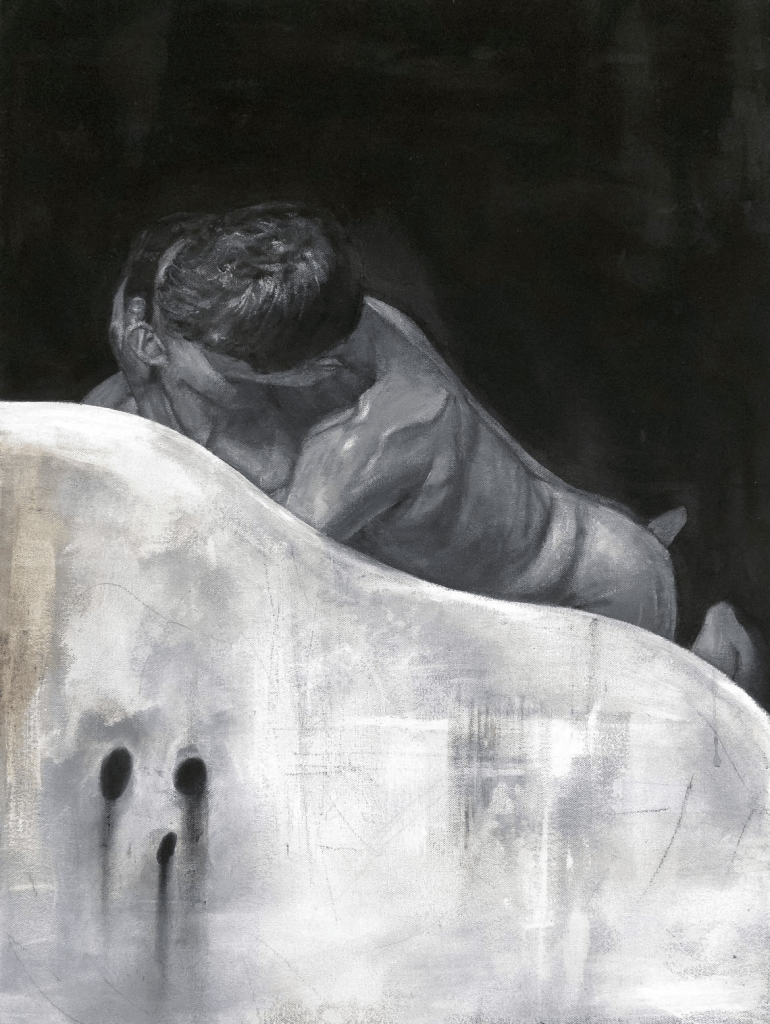
With his own work, he explores human bodies, desire, intimacy, and sex. The things that could not be navigated by himself are replicated in his works, precious moments of connectivity, sentiment, and carnal pleasure.
“So You Sacrificed Sleep Tonight”, 2022, Acrylic, Pigment, Gouache, Charcoal, and Raw Canvas on Wood Board
Brennen himself is a transgressive artist. Rough canvas, holes, dirt, muted tones, and sometimes found materials are utilized. He carries these motifs also through his usage of blood colors and the blood-coated anatomical insides made visible so frequently in his mixed media work. Reflecting on the many forms of violence seen and unseen in the world we live in could also question feelings for our internal anatomy, internal function, and internal emotion.
Ruptured Odium (Acrylic, Charcoal, Spray Foam, Paper, and Raw Canvas on Wood Panel, 31” x 20” x 6”, 2021)
Wanting to always open his art to interpretation, he is used to the title of a “dark artist”, or someone who traverses into “horror.” Believing that there’s more to horror than blood and gore: these aspects are not just horrific, but human. Blood colors and viscera elicit internalized responses. We feel a lot of things internally that much of the time no one sees. Conveying this is important to him. “Life is guts. Life is blood.” It says a lot and it’s also seen in his transgressive elements of self-harm, (which he does not advocate!!!) he is not afraid of pushing the limits of mutilative artwork.
Branching out into performance art, he dives into transgressive practices, creating alternative performance art through “Dimitri”, an alternative self influenced by past trauma. An example of this identity at work was in a recent performance titled “Come To Church.” This performance art piece utilized nudity, violence, confession, and over-stimulatory scenery. Inspired by his own autistic meltdowns and past and current experiences with ableism, he created what he describes as a “relentless confessional mess”, but not one he was disappointed by. He wishes to take performance art more seriously, believing more artists should consider using their body as their own mediums. (But he still doesn’t recommend going as far as hurting yourself too much.)
In a world that experiences many forms of violence, we are forced to acclimate, and to continue this endurance inflicts unwanted pain. Conveying this pain through art could be symbolic of that struggle society faces but also denies it.
He believes queerness was what set his art free — it allowed him to explore his sexuality, differences, and acceptance. Through this, he formed himself as an artist. In person, Brennen is autistic and open about his identity. He is kind, quiet at times, and strong in his speech when absolutely necessary.
“If you have something serious you need to express, do it. I think artists should address more provocative subjects. Those works make us think more.”
Photographed by Bill French, Documentation Photograph from Come To Church, 2022
Relics from “Come to Church” (are previous cumulative work) are on display now at Surface Noise, located at 600 Baxter Ave, Louisville, KY 40204.“Window Rooms are not Vacant” show pieces are included, but most of the pieces were made new. Declining deeper into society’s ableism, he dwells on the sensitive natures of emotion and trauma. Additionally, there are glimpses into queer identity and eroticism. Grungy, at times grotesque aesthetics, amorphous geology, and overstimulating methods of confession are sure to surprise the eyes.
If you or someone you know is struggling, call or text the 988 Suicide & Crisis Lifeline at 988. LGBTQ+ young people can press 3 to reach counselors trained in LGBTQ+ care, an option that returned on Sept. 30, 2026 after it was cut in July 2025. The Trevor Project also offers 24/7 support at 1-866-488-7386 or by texting START to 678-678.
I’m sitting on my bed, laptop cooking my thighs as my partner comes into the bedroom to ask what I’m doing. Staring at the blank word doc in front of me I reply, “I’m writing an article about Disability Pride Month.”
The question tumbles out of their mouth, “Shouldn’t they have someone with a disability write that?”
“They are.”
Disabilities are as diverse as the people who have them. I was diagnosed with Bipolar Disorder in 2006 at the core Myspace marketing age of 13. I was a fat Black closeted theatre kid, living in a small conservative Kentucky town, with the fresh new label of mentally disabled. In short, the world hated me, and so did I.
Even though I felt completely alone, just in the year prior, the Disability Justice Collective (DJC) was founded. A movement started by queer, disabled women of color, Patty Berne, Stacey Milbern, and Mia Mingus. Learning about these women, and joining their movement led me to the first time in my life where I felt like a complete part of a community.
According to their website, the DJC works to create genuine inclusion, accessibility, respect, and connection.
The site states their mission: “As a collective we prioritize leadership and direction from those of us who live in the cracks and at the margins of all our communities. Specifically disabled* queers and Trans*, people of color, and poverty class folks.”
July is Disability Pride month. The month honors the signing into law of the Americans with Disabilities Act, which occurred on July 26, 1990. This act was only signed after an incredible display of civil disobedience known as the Capitol Crawl, in which approximately 60 members of the disabled community showed first hand how inaccessible public spaces were by physically crawling up the steps of the Capitol building. This moment catalyzed Disability Justice as a whole.
According to the Centers for Disease Control, people with disabilities are the largest and most diverse minority group in the United States. Although the ADA was enacted in 1990, systems of oppression were not dismantled to allow for true equity. The DJC saw, and experienced first hand, the compounded bigotry prominent for SDQTPOC (Sick & Disabled Queer Trans People of Color) and SDC (Sick, Disabled, & with Chronic pain) BIPOC people.
We don’t just need an accessible entrance to the Capitol building, we need to be believed by medical professionals. We need the removal of stigma towards mental illness in our various cultures. We need inclusion in queer spaces. We need voices and representation as diverse as our community really is.
This is why the DJC centers “disabled people of color, immigrants with disabilities, queers with disabilities, trans and gender non-conforming people with disabilities, people with disabilities who are houseless, people with disabilities who are incarcerated, people with disabilities who have had their ancestral lands stolen, amongst others.” -Piepzna-Samarasinha & Leah Lakshmi from Care Work: Dreaming Disability Justice.
I am a happier and safer person having the support of a community that understands and holds space for the difficulties of my life. Everyone deserves that. Show pride in all of the pieces that make you who you are, and take action to learn, center intersectionality, and create accessible spaces for all to be able to do the same! You’re allowed to make mistakes, just like my partner, but it’s the work you do after that matters most.
DO. THE. WORK.
Happy Pride!
https://queerkentucky.com/wp-content/uploads/2022/07/Disability-Pride-Month.png10801920Ali Gautierhttps://queerkentucky.com/wp-content/uploads/2024/05/Queer-Kentucky-White-Logo-300x132.pngAli Gautier2022-07-19 15:24:222026-10-10 19:17:21Celebrate Disability Pride Month during July by removing the stigma year-round
Growing up in Clarksville, Tenn., Lease Carmona was the youngest of three children, all born to an Afrolatin family. With their mother being Dominican and their father being Puerto Rican, Carmona had to develop a strong sense of self even if it wasn’t who they were meant to be — it was who they had to be while living in a small, Southern community.
This resiliency brought them to their current role as the owner of a quaint, online bakery in Louisville. Knead Some Love (KSL) is a Dominican, queer owned vegan and soy-free bakery for people looking for cozy and warm treats delivered right to their door. The bakery started in 2018 and has only taken off since then. Carmona has many hopes and dreams for KSL’s future but when I met up with them and their daughter (who will be referred to as “tiny viking”), we delved into the rather complicated history of this small town baker’s humble beginnings.
Carmona was raised by a mother dedicated to education and a military father. Their mother immigrated to New York from the Dominican Republic sometime between the age of 11 and 13. In moving to the states, her goal was educating herself and her children. Carmona’s mother started by ensuring that all of her children were fluent in English.
Not being able to speak Spanish left Lease feeling as though their mother had lost touch with their heritage. She felt she had to hide part of herself and her children in order to “make it” or “come up” on her own in the US. During their childhood, Carmona said she became used to not seeing their father very often as he was deployed often for long periods of time. While he was away, their mother spent her time raising three children and pursuing a PhD in psychology.
“Although we never learned to speak Spanish, I figured out how to connect more deeply to my Dominican side through something I know best — baking,” Carmona said.
They added that their mom is more of a cook than a baker. The family would always get boxed baked goods from the store and Carmona would reinvent them for dessert. They eventually fell into baking completely from doing this so often.
They soon learned that their grandmother baked all the time as well. They have used their passion for baking to connect to their grandmother, despite having lost her when they were very young as well as a language barrier.
Carmona said they chose to attend Sullivan University for their bakery and pastry arts program but soon realized that classroom learning just wasn’t for them. Between high costs and high expectations, Carmona made the decision to leave schooling behind. Though they didn’t obtain a degree while studying, they did develop a relationship fueled by hegemonic manipulation. For a long period in Carmona’s life, they were unable to go out with friends, do things they were passionate about, or even have a personality. Things only picked up when the two decided to marry.
“We were married, but we weren’t ever really ‘together,'” Carmona said.
Being raised in a small town, they realized that marriage, college, and kids felt like checkboxes on a long and tedious list of life. They never knew they had other options until this point in their life. Although the relationship was unstable and toxic, they were able to find their way out of it with a little extra something that they didn’t have before — their now 4-year-old daughter, tiny viking. Although she came at a weird point in their life, they wouldn’t change the outcome for anything in the world.
Since then, several parts of life have changed for Carmona. The end of the relationship allowed them to become a lot more in touch with themselves, discovering things that they had never even realized possible before. This demise marked the beginning of their queer journey to finding out who they really are and who they want to be.
Carmona said they identify as “non-binary” for others but they don’t necessarily fully identify or feel as so. They just are who they are, and that’s the tea. Literally, they started taking low dose T last year to help them get more in touch with their inner femininity. Sound strange to you? Well, it makes perfect sense to me. Originally, they thought that maybe they were a trans man but grappled with it so much that it felt forced. They just knew that they weren’t a woman and felt like the only other option was to be a man but they shortly realized that was not fitting either. Through all of this, they have discovered the divine femininity that they love but also that masculine energy as well. And they are incredibly happy to have found that balance finally — loving their tiny mustache and lower voice.
Though they are thrilled about where they are with their queerness, they’re still grieving the fact that they didn’t get to grow up with a sense of who they were. Growing up, Carmona was a very hyper-femme person. They loved the way they looked but didn’t feel like that was exactly who they were. Last year is when they realized it was more of a performance than a feeling. And we all know gender performativity can be a gift as well as a curse. Before finding themselves, makeup and clothing felt like a chore or something they were supposed to do. Since then, they have started using makeup and other accessories to feel more like their real self.
“I knew it [the gay] was always there but I didn’t have the language to describe it or identify it,” they said,
While going through this self-discovery, baking and patisserie kind of got lost, unfortunately, but they returned to baking after having their daughter in 2018. Tiny viking was born with dairy and soy allergies, which inspired the idea for KSL. They used their old textbooks from school to reinvent regular things into vegan treats. It’s not about making money for them. It’s more about sharing a part of themselves with their community.
They want people with these types of restrictions (soy, vegan, dairy, etc.) to be able to experience the simple delicacies in life like a muffin, cookie, or brownie. Sweet and savory breads have been the go-tos for the time being but Lease seeks to keep KSL a bakery with a very laid back, cafe feeling, serving primarily small treats like cookies, breads, and small cakes. Some of their favorite things that they have made are pumpkin cookies because they love the warm and cozy feeling pumpkin gives you. I mean that’s why we all love fall so much, right?
It took a lot for Carmona to figure out the legal parts of the business but they found some guidance from people around them luckily. They even found a queer accountant to help them with the tax aspects of it all. Eventually, they were able to figure out all of the licensing stuff pretty much on their own. However, as cute and delicious as the treats were, KSL circa 2018, slowly became a failed attempt. At that point, they were doing more freelance baking than anything. They said that it felt more like a chore than something they loved. They had many moments where they had to stop, reset, and take a break.
Though it had previously made them slightly miserable, Carmona decided to give it another try in 2021. It was very important for them to show their daughter that you can do things that you love and want to do while also being a parent. So, they started to take baking seriously last year so as to not let their wonderful personality fade into parental oblivion. This is also when they started doing pop-ups and collaborations more but there have been many times where they have just had to say no. They stand strong in the idea of never putting business above family but this has caused some problems along the way. They said that people don’t take them seriously often because of this value.
One of the daily affirmations they tell themselves is “I am allowed” and it has helped them become much more comfortable with saying “no” or “I can’t” to people. It has allowed them to exist how they want to exist and do things that might make others feel uncomfortable or upset. That mantra applied to the bakery and their queerness. Having two older sisters, Lease has had some difficulties with their family since their queer journey began. Though seemingly accepted, there has been a lot of confusion and pressure in every way. When asking them if there was a “coming out” for them, they replied very directly. “No.” Carmona said they feel no need to “come out” because their journey has been about them and for them. It wasn’t a “coming out” for them, it was them coming in-to themselves. It’s not something they feel the need to explain or present to everyone because they feel complete and satisfied just the way that they are. Although it is absolutely no one’s business but theirs, this has caused some distance for them and their family, unfortunately, but the love is still there both ways.
They also discovered another piece of themself that had been suppressed for far too long. Last year, at the age of 25, Lease was finally diagnosed as neurodivergent. When finding out, they stated that it was, again, something that they always knew was there but had yet to allow themselves to come into. They got so good at masking it because growing up they felt as though they weren’t allowed to be neurodivergent openly. They have had to create a version of themselves that is “trained” or tweaked to make others feel comfortable. This new addition to Lease’s identity does impact their life on a daily basis but they don’t allow it to overtake their life.
Although they have always been more of a shy, reserved person, they absolutely love being around people. But when it gets to be too much, they have learned to allow themselves to set boundaries and give themselves accommodations. It may make some people upset but I think it’s a technique that will allow KSL to go very far. Having finally come into who they truly are, Carmona feels that they are good representation for Hispanic, queer people here in Louisville. Especially since there is a severe lack of Dominican and Latinx voices being raised up within the queer community, and there is little to no representation being displayed as well. They also stand strong as representation for survivors of abusive relationships.
“Not being in fight or flight all the time makes life very, very different.”
They said as they elaborated on the topic. Carmona has become an incredibly strong person through it all but it’s important to remember that they’re strong, not because they chose to be, but because they have always had to be that way.
After starting up again last year, things have been slow moving for the bakery. Covid has made things complicated for the small bakery, yet again, causing KSL to remain at-home for the time being. They do plan to continue to stay in Louisville and grow the business slowly. The ultimate goal being to remain at-home for about 2 to 5 years to save for a brick and mortar. Despite the process is incredibly discriminatory, they have faith. The bakery has remained small for a while but has been catching the attention of many as of lately. This came as a shock to Carmona. They said they often still feel like it isn’t real but they’re slowly seeing how far they’ve come to finally exist outside of their bubble
On top of being a business owner, a parent, and a bad ass survivor, they also have been sober for over 3 years and has big hopes for KSL’s physical entity to be a sober safe space for queer people looking to commune over tea and treats. Though the idea is definitely necessary, we also discussed the difficulties of developing a queer social group while sober living. For the most part, it has just been them and their daughter but not for a lack of trying. Even though they work several odd jobs, have a child, and experience the occasional burnout, they still crave personal social interaction almost all the time. Whether it be after dropping tiny viking off at school or while dancing in their kitchen at 2 a.m. while baking alongside their kitchen witch, they are desperately seeking community.
Currently, they are not just doing KSL, but also working part-time at Glow Worm Play Cafe. They found community through online groups, one of which was created by the owner of Glow Worm. also side-hustle insurance billing from home and teach preschool music. How does one find so much time? They say they love the flexibility that the “hussle life/side gigs” have provided. It means they can say yes/no to anything they want. They also stated that they may be working with some local coffee shops to provide baked goods for them at some point in the near future so be on the lookout!
https://queerkentucky.com/wp-content/uploads/2022/03/Untitled-design-8.png7681366Sophia Harrishttps://queerkentucky.com/wp-content/uploads/2024/05/Queer-Kentucky-White-Logo-300x132.pngSophia Harris2022-03-11 08:42:282023-09-01 20:29:05First generation American finds strength through online bake shop, queerness
My first encounter with Parker was definitively intimate. They were responding to a call I had put out for trans protestors who had spent time in the Louisville Metro Department of Corrections. I explained to them that I was a trans man who had been arrested at a direct action a few weeks prior, and described my unfriendly encounter with a transphobic intake officer. In turn Parker shared their own traumatic jail experience as a “female passing” transmasculine inmate: details from which are now being used in trans sensitivity trainings at LMDC.
Roughly one year later, I found myself reaching out to Parker again, this time after learning that they were a competitive powerlifter and personal trainer. I had been looking into fitness and nutrition coaches to help me rewire some of the unhealthy residual thought patterns I have leftover from my eating disorder. But I was struggling to find someone who knows about these issues and also about transgender bodies and experiences: a tall order, especially here in Kentucky.
Parker is all that and more. As someone who is AFAB (assigned female at birth) they have firsthand experience with aspects of my anatomy and physiology that even a gay trainer who was cisgender wouldn’t. As a trans person, they understand gender dysphoria and euphoria, and how these feelings can both inhibit and motivate me. They are aware of my body’s complexities, and the effects that hormone therapy and certain surgeries have on my body. I don’t have to feel awkward bringing this stuff up, or do the emotional labor of explaining what it is and why it matters.
And Parker and I have more in common than just our transness. We also share a common political orientation, and common dream of liberation. For me, recovery means doing the work to dismantle my unsustainable ways of thinking, acting, and relating. And activism, to me, means doing the work to dismantle white supremacy (and all of the other isms that are baked into it: racism, classism, sexism, cissexism, heterosexism, ableism, and so on). I feel incredibly lucky to be working with a trainer who understands my unique mental and physical challenges, but who also understands my greater aims: healing and strengthening my body, mind, and spirit, so that I can sustain my efforts toward creating a more just world, and so that I can show up more fit to do that work.
Without further ado, let me introduce you to Parker.
Adrian: How/why did you become a personal trainer?
Parker: The first time I ever set foot in a gym was right after ending an abusive marriage of 6 years. I had developed a sizable drinking problem during that marriage and was looking for a healthy coping mechanism to replace it with. I immediately fell in love with everything about training. Being a low income single parent of 3 at the time made it very difficult to consistently work out, however. Fast forward several years and after an inpatient psychiatric stay for a suicide attempt and another intentional period of sobriety, I found myself back in the gym for the same reasons. However, this time I wanted to be able to really make it a solid part of my lifestyle that I’d be able to stick with long term. So I took a HUGE leap and decided that I wanted to compete as a competitive powerlifter. At the time, I was still in the closet as genderqueer and trans… to the degree that I had not realized I was and still identified as a woman. I had several female friends who had taken up the sport over the years and I adored what it seemed to do for them. I wanted to be strong as hell and I admired the muscle they seemed to pack on. I figured that if I committed to a static long term goal of a competition, I would be more likely to regularly train and not give it up so quickly this time. It WORKED! Far better than I had ever imagined it would. I was enamored with the new muscular body I had, the incredible strength I’d gained, the benefits to my mental health.
The gym was the first place I ever experienced gender euphoria, though I didn’t know that was what was happening to me at the time. I am also on the Autism Spectrum and this had become a special interest of mine. The science involved fascinated me. After a year or so of training and competing, I found myself eager to move to the other side of it all and start helping people find what I had in the gym. I had been a certified nursing assistant for a decade and a half at that point.
I chose the field because I have an innate need to help “fix” the world around me and could never have a job where I wasn’t helping people. Healthcare seemed to marry my love of science with that need and I thought it was my only option in that way… until I realized that with personal training, instead of healing people after they were sick or had become unhealthy, I could attack it from the other end and help people lead a lifestyle that might prevent them from becoming unwell to begin with. So I took another huge leap and worked to get certified as a CPT through the NSCA (National Strength and Conditioning Association). My coming out as non-binary and trans masculine actually occurred as a result of training and being a coach. I worked for a very inclusive gym at the time with one of my own coaches and they decided that they wanted to include pronouns in staff bios on their website. When I wrote mine, I used they/them pronouns for the very first time.
Adrian: Has your involvement in movement work shaped how you approach or think about training?
It has had a significant impact. Obviously, the COVID 19 pandemic put a pretty solid halt to my training and coaching in early 2020. That summer, I decided to throw myself into movement work with the free time I suddenly found myself with. Before last summer, I would likely have considered myself a liberal. But my work in the movement completely radicalized me socially and politically. I was exposed to so many different yet intersectional groups of marginalized people. I grew a much better understanding of gender, classist and ableist structures that affect those groups. I was enabled to eventually come out as trans masculine as a result. My approach to training is now much more diversified and comes from a more compassionate perspective. The fitness industry is overwhelmingly binary in nature and does not generally consider genderqueer, disabled, BIPOC/non-white, or economically challenged portions of the population (much in the way that they are overlooked or not represented in many other facets of life). These groups deserve representation in the fitness industry too and that is now a central focus of my coaching and training; my goal is to make fitness accessible to EVERYONE. Is it just me, or is it really hard to find a trans/nonbinary trainer? Why do you think this is? Even as a non-binary, trans masc person, it took a while for me to realize that there is a huge lack of visible genderqueer and trans friendly trainers in the industry. I think there are a lot of reasons for this. We are a minority portion of the population and that lends the illusion that there simply isn’t a ton of money or profit to be made by highlighting yourself as a trans or non-binary trainer. We don’t get representation in many, many other areas, so it makes sense that there is a lack of it within fitness too. I feel some trainers who are genderqueer and trans might hesitate to advertise their services as such with concern over the risk of alienating their customer base that is straight or conservative and losing clients because of discrimination. Those are very valid fears. Not everyone has the privilege to be out like I feel I have. It could potentially endanger professional relationships for a lot of trainers and coaches. I would like to see that change.
Adrian: In lay terms, tell us a bit about your approach to fitness/training. How is this approach shaped by your experience as a trans person (if at all)?
Parker: I’m a huge fan of the saying “Exercise is not a punishment for what you ate; it is a celebration of what your body can do.”. My goal is to focus on overall health and well-being- not a number on the scale. Fitness isn’t just about exercise or physical health in my eyes; it affects your social and psychological health just as much as it affects your body. I also like to approach each new client on a very individualistic basis. Every. Single. Client. Is. Different. There is no one approach that will work for everyone because every person’s social, economic, cultural and psychological situation or history is unique and has a bearing on how they can be successfully coached in order to meet their specific needs. Fitness and nutrition are very intimate in nature and should be treated as such.
Adrian: Talk about classism in the fitness industry. How have you navigated this, as a trainee and/or as a trainer?
Parker: Oh it is RAMPANT and directly impacts accessibility. If you are lower class (and I have been most of my life), you tend to live to survive instead of living to thrive. If you have to worry about where your next meal is coming from or how you can pay your rent that month, getting to the gym 3-5 times a week simply isn’t going to be a priority. If you are a single parent without childcare, you lose accessibility. If you don’t have reliable transportation, getting to the gym is not easy. I went through a period of economic instability in the middle of my first competitive season and found I didn’t have the disposable income to be able to continue to afford my coach. When I told him that, he told me not to worry about my monthly fee, to keep coming to train regardless and to just start paying again when I could. I cannot begin to explain how grateful I was to not lose such an important, healthy coping mechanism when I was at my lowest. My gym at the time also accommodated single parents; I had one friend who was a single parent of 4 young children and they allowed her to bring all of them onto the floor with a big gated play yard while she trained. Pets were welcome also; bring your whole damn family if you have to, just come and train was the motto. As a trainer, I ultimately need to be paid for my time, but I am 100% willing to work with my client’s financial circumstances, whether that means a payment plan, bartering for services or holding off on payments and catching up later.
Adrian: What are some obstacles that you’ve faced as an AFAB trans person in the fitness world?
Parker: I’m honestly not even sure where to begin with this one because it is such a loaded question, especially for me personally. As I mentioned earlier, I was not at all out as genderqueer when I began my fitness journey and fully identified as a woman. To be frank, fitness in general gave me a much healthier relationship with my body mentally and was a catalyst for realizing I was in fact non-binary and trans masculine. When I began training full time and competing, the physique I gained was very muscular and while men do not at all have a monopoly on muscles, it gave me masculine gender euphoria to the hilt. I will likely (maybe?) never medically transition but for the trans people who do, it is an uphill battle to be accepted in sports as their actual gender and not the one they were assigned at birth. When I was still living in the world as a woman who now appeared to be very masculine, there was a lot of pushback involved for ‘looking like a man’ or ‘looking too masculine’. I got rampantly accused of being on steroids for just how muscular I had managed to become as a woman by men in the fitness industry. Even at this point, I am still fairly femme passing despite my attempts at androgyny. So I experience both a lack of representation as a whole as well as the discrimination that women generally face in the fitness world. Which for obvious reasons is difficult because I am not a woman, yet am still being treated as if I am. Again, this is due to the overwhelming binary nature of fitness to begin with. There simply isn’t a concerted space or focus for us in fitness.
Adrian: What is some advice that you would give cisgender trainers when it comes to working with trans clients?
Parker: Educate, educate, educate yourself! Being transgender is a complex psychosocial issue, one that is incredibly unique from one trans client to the next. It is important to understand how being trans affects one’s emotional/mental health as well as how it may have changed their body (i.e. hormone replacement therapy). Get to know what it means to your client personally to be trans and educate yourself on those topics. Do not be afraid to ask questions and learn where their boundaries and triggers lie. Work to create a safe space for them with you and earn their trust as an ally. These things will ultimately directly impact their success within your program.
Adrian: How can folks get in touch with you about your services, or to set up a consultation?
If you or someone you know is struggling, call or text the 988 Suicide & Crisis Lifeline at 988. LGBTQ+ young people can press 3 to reach counselors trained in LGBTQ+ care, an option that returned on Sept. 30, 2026 after it was cut in July 2025. The Trevor Project also offers 24/7 support at 1-866-488-7386 or by texting START to 678-678.
https://queerkentucky.com/wp-content/uploads/2021/08/Untitled-design-22.png6501350Adrian Silbernagelhttps://queerkentucky.com/wp-content/uploads/2024/05/Queer-Kentucky-White-Logo-300x132.pngAdrian Silbernagel2021-08-26 01:36:022026-10-10 14:24:38Kentucky-born Trans fitness trainer brings affirmation, butt-busting workouts to clientele
“If you’re a writer, you are forced to look behind the word into the meaning of the word. You are responsible for what that word means. You have to find a way to use that word to liberate the energy in that word so that it has a positive effect on the lives of the people.”
– James Baldwin, “Soul! A Conversation with James Baldwin and Nikki Giovanni”
Queer and Spirit. As soon as I begin to think I understand these words they shapeshift into other forms I didn’t know were possible. To me, they are like suns. Their clarity only exists in the peripheral view. They leave traces on everything they choose to illuminate and navigate around and through the blackness of time and space. Home.
So much is happening to and in our city (Louisville). The planet. I am overwhelmed, scared, angry, excited, and bewildered. Every day. Sometimes moment to moment. Sometimes all at once. Pandemics and injustice and uprisings. All the time. All at once. I’m in awe of the earth’s ability to assert boundaries with us, and I feel obligated to respect them by sheltering in place and social distancing when necessary. I respect them because we are all too familiar with the exploitation of our generosity and asserting boundaries with the people who have caused us harm. It’s impossible to look at what’s happening in our city, and not see the parallels in nature. The earth seems to be having her own uprising, and it’s a process not to become engulfed it.
As someone living with chronic conditions, how my body metabolizes trauma has an immediate impact on my health. My ability to contribute to my community also becomes impaired. Grief time-travels. My body is still feeling the impacts of the violence endured by my enslaved ancestors. The incessant pain I feel every day could very well be the gnashing of overworked joints in the fields or a lash still echoing throughout time. The way my body composts the grief of our times will be a conversation in my descendant’s bones and neural pathways, generations from now. We don’t deserve this suffering. We have had enough.
Decolonizing my relationship with myself is not just about what I’m doing, it’s also what I’m saying, thinking, believing. I don’t condone toxic positivity, it’s a little too gas-lighty for my taste. But what I believe to be true about myself, is true about myself. And we already have enough to deal with as black, queer, trans, non-binary, neurodivergent people existing in this paradigm of violence. We don’t also need to be dealing with oppression on a subconscious level. We don’t need it polluting our thoughts, motivating our behaviors, suppressing our internal voices, and colonizing the lands otherwise known as our bodies. We have had enough.
My queerness is a commitment to eradicating oppression and the legacy of white supremacy. My queerness is a rejection of power derived from the subjugation of others. My queerness is the cessation of the exploitation of earth’s resources, including human labor. My queerness is abolition. My queerness is black. A quiet knowing with a blunt tip. My queerness encapsulates so much more than I can name right now. Or ever, maybe.
Unironically, my motivation for this piece began with an insatiable hunger to extract meaning from the words queer and spirit. Just as I was about to shape it (or try to), it vaporized and rematerialized in the corner furthest from me. It went on like this for days, me chasing these words around. It took several false starts for me to realize they were avoiding me. And for good reason. My approach was out of alignment. I wasn’t connecting with the energy of either word because I was too busy worrying about the outcome of this piece. Was there a way for me to liberate the energy of these words without restricting their form? These words have provided shelter through many of my life’s storms. Does my approach to them reflect that? Has my process ignited a sense of liberation, joy, pleasure, culture, and autonomy? No.
So I sat with the trouble. Meditated on the transience of the words queer and spirit until I found myself navigating through and around blackness. After all, it was the first queer thing I noticed about myself. Blackness was always synonymous with other(worldly). So much so, that non-black people created entire systems around the color of it, of us. How queer is that? I thought about black and indigenous spiritual technology. I thought about how we’ve survived. I thought about how it shows up in my body, and how I can use it to embody liberation on a day-to-day basis.
Queering the Spirit is an odyssey. An ode to how messy decolonization is, looks, and feels. It’s an ode to queerness as an exercise in cartography. Our bodies are the maps.
“It is never easy to demand the most from ourselves, from our lives, from our work. To encourage excellence is to go beyond the encouraged mediocrity of our society. But giving in to the fear of feeling and working to capacity is a luxury only the unintentional can afford, and the unintentional are those who do not wish to guide their own destinies,”
-Audre Lorde, “Uses of the Erotic”
“…and those who do not realize that guiding their own destinies is a possibility.”
https://queerkentucky.com/wp-content/uploads/2020/09/pexels-lalesh-aldarwish-167964-scaled.jpg15332560Queer Kentuckyhttps://queerkentucky.com/wp-content/uploads/2024/05/Queer-Kentucky-White-Logo-300x132.pngQueer Kentucky2020-09-18 10:33:282020-09-18 10:33:28Queering the spirit: Find your way back
As April begins this year, you may have noticed an increase in the visibility of issues and causes related to Autism—This is no coincidence, as April is Autism Acceptance Month! Previously, this has been called Autism Awareness month. The change may seem subtle, but it is an important distinction.
In a world where people would rather expose their child to every deadly disease we’ve tried to cure for the past century than risk them having autism, acceptance is more needed than awareness. Even one of the most prominent public groups for autism focuses its efforts on ‘curing’ this part of people and ignores the actual input of those on the spectrum (your daily reminder to boycott autism speaks and use red and gold to show support rather than blue). I’m hoping this article can provide a different narrative.
Before I further explain, allow me to introduce myself. I am gay and 23. I have a BFA in Theatre and am ungracefully fumbling through young adulthood, as most twenty somethings are. I am single (howdy gents) and have started a new 9-5 job in marketing. I play video games and read Shakespeare.
I am also autistic.
Autism and being autistic can mean a lot of different things. In popular media we tend to get two main presentations: The Impersonal Savant and The Severe Case. The impersonal savant is a character like BBC’s version of Sherlock Holmes. These characters are socially inept, either callous or awkward, but practically brilliant. This sort of representation is not without its flaws (do we only value and accept these character because of their genius?), but it is generally positive!
The Severe Case is a bit stickier. This trope features a character with more visible and debilitating symptoms. Kazan from cult classic Cube is my go-to example for this character type. This version of autism is often used for the purpose of making a character ‘unique’ and ‘interesting’—a great way for a neutrotypical actor to show off their chops. However, these characters are definitely not without merit. Though these sorts of representations can be scary and uncomfortable for some, and are the kind most often used to in scare tactics about autism, it’s important to recognize the reality that autism can be quite intense. These sorts of characters are also usually positive! Often they come with the ultimate message that even somebody different can be good or helpful, especially if their personal needs are respected!
Still, just because representation is positive doesn’t make it fully representative. Being gay, it’s not uncommon to see stories of my sexuality simplified and split into simple categories. It’s often the starting block, and a very important step in media, to begin with stereotypes and dichotomies. As well, we can’t negate the stories of people in our community just because they fit a stereotype. But, much as we’re breaking molds in queer representation in media, and widening the conversation, I want to help others understand that being autistic doesn’t put me in one of these neat categories.
These images of autism are not the only way to be autistic.
So what is Autism? Well, previously, doctors weren’t all that clear about it either. There were five different diagnoses that all comprised ‘Autism’—One of these, Asperger’s Syndrome, was the initial terminology used by my college psychiatrist, and ‘Aspie’ was how I identified for a long time. This essentially put me in the category of ‘highest functioning’ autistic. However, language and medical knowledge is changing on this subject. Asperger’s, and the four other distinct diagnoses have now all been grouped as one: Autism Spectrum Disorder. ASD is then further classed by levels of care, rather than levels of functionality.
The language of ‘high functioning’ and ‘low functioning’ has historically been used for autism, and for many other disorders. This language is dehumanizing and invalidating for many, essentially putting our worth as people and the value of our experience on how effective we are in an economic system. To be ‘high functioning’ is to be pretending or complaining too much, to be making a fuss when you don’t need to. To be ‘low functioning’ is to be hopeless and tragic, to not be worth the effort to fix. I have Autism Spectrum Disorder, and would be classed as Care Level 1 of three possible care levels. This language puts the focus on our needs, not on our personal ability. Care levels can change, just as ‘function’ can, and the goal is always the personal improvement and health of the individual.
For myself, and I believe for others in the queer community, the word spectrum will resonate. We are learning more and more than sexuality is a spectrum, that gender is a spectrum, and that a spectrum is rarely a sliding scale between two specific extremes. It is much the same for Autism, with many social, intellectual, and behavioral differences between individuals. Trying to encompass all of what autism is in one article would be as impossible as briefly explaining the myriad experiences of the queer community, and it’s equally complex in its interplay with other issues and how identities.
However, what I can present somewhat more concisely is my experience with this spectrum.
Autism is classed primarily as a social disorder. For me, this has definitely been the main struggle. Social interaction has been a delicate and highly concentrated effort, fraught with fear and confusion. I am now and always have been termed ‘weird’, but I don’t think most people realize how very hard I work to seem as normal as I do. When I am confused or overwhelmed by social stimuli, I can shut down: it becomes hard to form words, and making any coherent kind of facial signal or even eye contact becomes difficult or impossible. Anything I hear gets processed literally on the first take, so sarcasm, figurative language, and hints are often things I have to guess at based on context. Sometimes people will insist that I’m clearly angry, happy, or sad when that’s not how I feel inside, and I’m often equally baffled by the emotional reactions of others. I make strange noises, I lack volume control, and I often talk too fast. There are things that are still surprising to this day with how much sense they make in the context of my autism.
Despite these oddities, I think many people would believe that I am fairly socially adept. I am outgoing, I am friendly and, I think, rather charming! To be autistic is not to fail socially, or be unrestrained. In fact, it is often the opposite—It is to have different hurdles to overcome and learn to deal with, in order to come up to the same level of others. Especially in women, where social conditioning tends to start very early and be very strong, the ‘signs’ of autism are frequently restrained or controlled. That’s why a diagnosis one would expect to be even across the sexes is given 4.2 times more often to boys than girls, with many women on the spectrum not understanding their experiences until adulthood.
I don’t think any of us have been lucky enough to avoid the circumstance of pretending to be straight, or cis, or binary. You become very careful—You notice how you hold your hands, how you cross your legs, the tone of voice you speak with. In many ways, this experience is similar to being autistic.You always have to be ‘on’. I have learned that what is natural to me is not what is expected, that it can even be hurtful, and I have had to make adjustments. I am not upset that I have learned these social skills, and though I appreciate patience and understanding, I do not expect people to take my occasional failings as inevitable or excusable. I am glad I have been held to standards and grown as a person, even if it wasn’t always in the ways I would have liked. It has been hard work but I’m proud of how well I do with people.
We all strive to be better people and do better by others, and in that sense I’m just like anybody else.
I don’t want to end this article on a note of struggle. This is how autism is often portrayed, and it’s part of why it is so feared—who hasn’t heard the argument that parents don’t want their kids to be gay or trans because they just don’t want their child to go through that kind of struggle? This too has impacted the Autistic community, and is part of why self advocates are so often overshadowed by parents or guardians ‘enduring the trials’ of caring for their loved ones. So, allow me to say it clearly: Autism is not bad!
One of the most common topics when discussing autism is ‘savant skill’ and special interests. I have certainly benefited from that! I am proud to be a national merit scholar and strongly believe that my natural skill with standardized testing comes from being autistic, along with many other areas of expertise and interest. Beyond that, I think the added effort I need to understand and empathize with others has given me unique abilities to hear and internalize other people’s struggles. Lack of empathy is often discussed when addressing autism—Hyper-empathy, another common symptom, is not.
And, though autism is often associated with ‘left brain’ skills, my experiences on the spectrum have definitely shaped who I am as an artist. I am a natural mimic: Echolalia, or the unsolicited repetition of auditory stimulus, is often associated with Autism and something I personally experience on a regular basis. Not only verbal tics, but physically, I have learned to adopt and borrow movements. This was partially adaptive, as I had noticed or been told about (read: mocked for) my unusual gait and mannerisms. I encountered one of my major acting struggles in my inability to create the faces for anger and sadness. I practiced and copied and even watched myself in the mirror. I have continued throughout my life to widen my physical and tonal vocabulary with stolen gestures and voices, practiced and rehearsed. My hyper-empathy is also an aid: Though my natural reactions to the emotions I feel from my characters might not play on stage, I can let these feelings guide me in which copied display I can pull from my wheelhouse. These things come more naturally now when I perform, but I fully believe that the intentional effort I have to put in has helped my command of them.
So there you have it. My story for Autism Acceptance. Autism is a struggle, for some much more than others, but it’s not something evil or scary. It can have real benefits, even beyond what is stereotypical. I urge all of you to look at Autism this month, not with awareness, but with acceptance.
We are people, and we are not victims struggling against some disease, but are full and developed human beings for whom being autistic is an important part of our identity.
And I think all of us in the queer community can relate to that.
https://queerkentucky.com/wp-content/uploads/2019/04/2d32831b-2097-4278-85e3-671230622243-1.jpg640815Queer Kentuckyhttps://queerkentucky.com/wp-content/uploads/2024/05/Queer-Kentucky-White-Logo-300x132.pngQueer Kentucky2019-04-04 09:00:592019-04-04 09:00:59Autism, Queerness: authentically human
I think to me, queer means unique, not limited to the rules of mainstream society. it’s the freedom to be different from what’s expected.
What do you identify as, or do you identify at all?
I’m a fat, white, atheist, pansexual, agender spoonie. (The Spoon Theory)
WHO ARE YOU?! What are you up to in this world and talk about your business.
Ha! Who am I? I’d love it if someone else could answer that for me. I feel like I’m just starting to figure that out. For so much of my life, I’ve lived to make other people happy & tried to meet their expectations. When I got together with my current girlfriend, she asked me what I wanted out of a relationship. I told her that I had no idea because no one had ever asked me that before. The thought that I could just be me & people could accept me or not & even if they didn’t, that was ok hadn’t ever occurred to me.
I was constantly trying to fit myself into what other people expected I should be. Now, I’m trying to figure out who I am & then just be that person.
In my yoga life, I started change.yoga. I teach a few group classes that I work to make accessible to anyone & everyone. I like to say that I teach to people who, for whatever reason, don’t feel comfortable going to a ‘regular’ class or studio. I also do skillshares, that I call Yoga Confidence, for people who are hesitant to try yoga. They may be intimidated by the Sanskrit or the religious statues & imagery, or the usual ‘I’m not flexible enough,’ whatever the reason, I try to give them info so they can pick the classes & studio that’s right for them (or to start a home practice). And then I do skillshares for teachers that I call, “Stretching Diversity.” I do them for people who are already teachers but I’m also trying to work with as many teacher training programs to help educate new teachers before they even start. When I’m not doing yoga, I’m a freelance marketing consultant & my business is called frankHYPE. Lately I’ve been mixing the two worlds & many of my clients are yoga (or other wellness professionals). They’re also individuals or small businesses who assume that marketing support would be too expensive for them. So I work to give them a few hours of support a month at reasonable rates. I can’t take on all of their marketing needs but I can work with them to help craft a strategy that works for them & then implement a lot of the routine needs that can often bog down micropreneurs.
How did you start your yoga journey?
In college I took a world religions class & yoga was mentioned. I didn’t really know what it was but i knew it was this ‘new’ thing (at least in my world) people were doing to get in shape so I wanted to try it out. My first class was in a school gym after class. I don’t really remember much about the class other than I liked it. After that I did yoga off & on for about 15 years. I always really liked it but life would get in the way & I’d stop practicing. I eventually started going several times a week to studio classes & started learning about the 8 limbs, meditation, pranayama & all the other stuff that makes up yoga that you don’t see in the magazines. I started noticing how much it was helping me mentally & physically & was actually pretty mad.
I’d gone to countless doctors & therapists over the years for my different chronic conditions & no one had ever suggested doing asana or meditation.
It’s a little better now but still extremely undervalued. So I just wanted to shout it out to everyone. I didn’t expect to become a teacher but that’s where I’ve ended up, for now anyway, so I’m just hoping that I can help people avoid some of the struggles & pain that I experienced.
What inspired you to lean into all-inclusive yoga?
Well, I didn’t really have a choice. with my body & my life, if I was going to do yoga, it had to be all-inclusive. and I realized if I needed this, there were probably a bunch of other people who needed it too.
What do you believe the consequences are of teaching yoga without awarenss of privledge?
I think we risk doing real harm to people when we don’t try to address our privilege. We’re never going to be perfect & that stops a lot of people from trying, we feel too afraid or paralyzed.
But if we don’t put the work in to try to break down barriers that are exclusive we’re just reinforcing the marginalization that occurs in our larger society.
Often we want to think of our mats as automatically neutral spaces but they’re not. That doesn’t happen automatically. We have to do the work. If we’re going to create these spaces & invite people to them, we have the responsibility to do it as safely as possible. Otherwise, people come to us and the spaces we’ve created with their guard down, expecting to be safe, because that’s what we’ve told them, only to find themselves experiencing the same microaggressions, prejudice, & trauma they experience off the mat.
How did you come into your queerness and do you feel like a stronger person because of your journey? Why or why not?
Oh, that’s a long complicated story. I first came out to a few people 20-ish years ago in high school. I came out to a few other people over the years but it’s only been in the past few years that I’ve come out completely to my family & everyone. I kind of went in the other direction & just put everything out there publicly. I knew my queerness would be a problem for lots of people, that I would make lots of people who were close to me uncomfortable.
That’s a hard place to be. So, both consciously & unconsciously I kept it a secret. Eventually hiding who I was just simply became too much & I couldn’t keep the secret anymore. I couldn’t keep pretending I was someone else. It was a hard transition and a lot of what I was afraid of did happen. But it’s been worth it. I’ve found a community that’s been supportive more than I could have imagined. I’ve never experienced acceptance like this from anyone before. That’s not to say everything’s perfect but it’s so much better than before.
If you could tell anyone struggling to come in their identity, what would it be?
Take your time. Focus on yourself. And don’t be afraid if you don’t have all the answers right away (or ever). Obviously your safety comes first so don’t do anything that endangers you. But don’t be afraid to step away from people & relationships that aren’t supportive of you, even family. And I don’t mean ones that just tolerate you. Do what you can to find people who truly accept you for who you are. This doesn’t happen overnight, it isn’t easy, & won’t always happen for everyone.
But, looking back on my experiences, those would be the goals I’d go for if I had to do it again. I was so afraid of losing what I had even though I was, at best, being tolerated, that I couldn’t see what I’d gain by being around people who accepted me. If I would’ve known what was possible, I would’ve come out a long time ago.
Do you have a favorite yoga pose?
I’ve always really liked pigeon but lately I’ve been spending a lot of time in child’s pose. I also really, really love reclined, supported hero’s pose. A lot has changed in my practice since I had 3 surgeries in 4 months in 2017 so I’m still learning again what my body needs & likes now.
https://queerkentucky.com/wp-content/uploads/2019/02/img_1531-jpg-webp.webp640801Queer Kentuckyhttps://queerkentucky.com/wp-content/uploads/2024/05/Queer-Kentucky-White-Logo-300x132.pngQueer Kentucky2019-02-05 20:55:412019-02-05 20:55:41Queer Yogi empowers others through inclusivity, love