KEEP. Level of power. Additive. Lawsuits, rulings, judges, at any level.

Tag Archive for: Power: Courts

Voters standing in line to cast ballots at a church polling place in Louisville, Kentucky.

These 12 local offices shape your daily life in Kentucky. Here’s what each one does

The United States is sometimes described as 50 different countries wearing a federal government trench coat. Creating change at the national level is like steering a cargo ship: it takes a large amount of power to move a rudder, and it’s slow to shift directions. Creating change at a local or state level, however, is like steering a speedboat: much simpler and quicker to see change take effect.

Local offices are often overlooked on Election Day, but they impact your daily life more directly than you might think. Local governments are meant to meet the needs and solve the problems of their local residents, as well as provide services like roads, clean water, sanitation and police. They also have a large say in the usage of Flock cameras, the building of data centers, whether to cooperate with ICE or DHS, and the fair treatment of trans Kentuckians. If you have strong feelings about your neighborhood, or how you and your neighbors are treated, you should know the basics of each local office before voting.

A heads-up for Louisville and Lexington voters: both cities have merged city-county governments, so their mayors and councils handle most of what the county judge-executive, city council/commission, and fiscal court do elsewhere. And within Jefferson county are smaller cities, like Jeffersontown or St Matthews, with their own mayors and councils.

County offices

County judge-executive

A county judge-executive is a voting member of the county’s fiscal court. Their main job is to create a county budget, allocate the budget as the fiscal court approves and appoint people to lead various county positions. The judge serves a four-year term.

Because the judge-executive builds the budget, this office helps decide whether county law enforcement gets Flock cameras, Axon gear and similar surveillance tools, and what safeguards come with them.

Fiscal court (magistrates or commissioners)

The fiscal court, which includes magistrates or commissioners, is the group that provides services like road repairs, snow removal and sanitation at the county level. Despite its name, the fiscal court isn’t a court of law. It’s the county’s legislative body, like a county council. The fiscal court votes on county ordinances, orders and resolutions, which are then enforced by the judge-executive. Many decisions on ICE agreements, data centers and surveillance spending are made locally, and the fiscal court votes on many of them, within limits set by state law. Fiscal court meetings are open to the public, and members serve four-year terms. A sheriff or jailer can sign some agreements, like those with ICE, themselves, and the fiscal court doesn’t always vote on them.

Jailer

Kentucky is actually the only state in the country that elects jailers, who maintain order within their county’s jail. Jailers transport people to and from court and process people into the jail. The jailer decides whether the jail signs a 287(g) agreement with ICE and whether it voluntarily honors ICE detainers, which are requests, not warrants.

A 2025 state law bars jails and prisons from using public money to provide hormone therapy, but the jailer still decides whether people get HIV medication, PrEP and other prescriptions on time, and whether a trans person is kept safe.

The jailer also decides whether a parent held for ICE can get a notary to sign power-of-attorney or guardianship papers so someone they trust can care for their kids, how people who don’t speak English can communicate and how much help reaches people inside. That last one varies wildly county to county. In more than 40 counties, the elected jailer has no jail to run, and people are held in a neighboring or regional jail. They serve four year terms.

Sheriff

The sheriff decides whether deputies call ICE after a traffic stop, whether the office signs a 287(g) agreement to do immigration enforcement for ICE, and how deputies treat LGBTQ+ people, immigrants, unhoused folks and sex workers. Deputies also serve court papers, make arrests, and carry out many court-ordered evictions. In Kentucky, the sheriff also collects property taxes. Sheriffs serve four-year terms.

County clerk

County clerks are the local government record-makers and record-keepers. They oversee vehicle registration and titles, marriage licenses, property and legal records and elections. If you’re registering a car, getting married, voting or buying a house, you’ll be interacting with a county clerk’s office. County clerks serve four-year terms.

The office has real stakes for queer Kentuckians: in 2015, Rowan County Clerk Kim Davis refused to issue marriage licenses to same-sex couples and was jailed for contempt of court. Voters removed her from office in 2018, and in 2025 the U.S. Supreme Court turned down her request to overturn same-sex marriage.

Courts and prosecutors

County attorney

The county attorney is the one who prosecutes misdemeanors and other lesser offenses in district court, like DUI offenses, traffic violations, assault and petty theft. This is also where most homelessness, misdemeanor drug possession, sex work and protest arrests get charged. Felonies go to the commonwealth’s attorney.

These attorneys also prosecute juvenile cases, including criminal acts, neglect and abuse. They can work with judges to issue emergency protective orders in domestic violence cases, oversee mental commitments and disability cases and more. Most county attorneys are also involved in collecting delinquent child support payments. County attorneys have four-year terms.

Commonwealth’s attorney

These attorneys prosecute felony crimes and cover a judicial circuit, which can include more than one county. They serve six-year terms. A felony is any crime that can be punished by a year or more in prison. This is where the choice to divert or to cage gets made for felony charges, like possession of meth, heroin or fentanyl, and for protests charged as felonies. The commonwealth attorney decides which cases go to a grand jury as felonies, and a felony knocked down to a misdemeanor stays in district court with the county attorney.

Family court judge

Family court judges are the ones who preside over family-related cases such as divorce, domestic violence protective orders, child custody and visitation, adoptions and more. One judge can decide whether a trans parent keeps their kid, or whether a queer person gets a protective order against an abusive partner. Family court judges serve eight-year terms.

District court judge

District judges hear misdemeanors, traffic cases, small claims, probate matters and the first stages of felony cases. District judges also grant adult name changes, a step many trans Kentuckians need before they can update their IDs. They also set bail, which decides who waits for trial at home and who waits in jail. They serve four-year terms.

Judicial races are nonpartisan, so judges’ party affiliations won’t appear on your ballot.

City and schools

City council or commission

The city council is kind of like a city’s board of directors: they function as a city’s legislature and pass laws and ordinances. City council (sometimes called city commission) is in charge of budgets, taxes, passing ordinances like installing stoplights, and zoning. Cities can also pass fairness ordinances, which ban discrimination against LGBTQ+ people in housing, jobs and public places.

Kentucky has no statewide fairness law, so local ordinances fill the gap. Louisville and Lexington passed the first ones in 1999. Most since then have come from city councils, but Woodford County’s fiscal court passed one in 2020. City council meetings are open to the public. Terms vary by city.

School board

Like the city council, a school board governs a local school district by setting policies, providing funding and setting local school tax rates. The school boards also hire the superintendent, set discipline codes and graduation requirements and more. They serve four-year terms.

It’s the seat nobody watches, but school boards set the discipline codes that decide how a school responds when a queer or trans kid gets bullied. They also decide how book challenges get handled and how the district carries out state rules on students’ pronouns and bathrooms.

Mayor

City governments in Kentucky run on one of three models: mayor-council, commission or city manager. In a mayor-council city, the council enacts ordinances, levies taxes and adopts a budget. The mayor runs the city’s daily affairs, oversees personnel, can veto legislation and can cast a tie-breaking vote. Louisville and Lexington have their own forms: Louisville is a consolidated local government and Lexington is an urban county government. Both have a mayor and a council. Mayors serve for a four-year term.

Find your districts

Pull up your sample ballot at ourpeopleourvote.org, or call your county clerk’s office, to see which of these seats are on your ballot this year and which districts you vote in, including your magistrate or commissioner, city council and school board districts.

Officer Zachary Stayton approaches Brandon Hill during the Roebling Bridge protest on July 17, 2025, captured on Covington Police Department body camera footage

Roebling Bridge protester arrested in court on felony riot charge

Update: the Oct. 5 arraignment

By Molly Stevens, Queer Kentucky.

During a routine pretrial hearing on the morning of October 5, Taylor Marshall was taken into custody on a felony indictment. Bond was set at $2,500. The charges currently filed against Marshall are first-degree rioting, obstructing governmental operations, second-degree disorderly conduct, and resisting arrest. The most severe of these charges is first-degree rioting, a Class D felony.

Per Kentucky Revised Statutes 525.020, rioting in the first degree constitutes knowingly participating in a riot, and that riot resulting in a person other than a participant of the riot suffering physical injury, or substantial property damage occurring. A “riot” per Kentucky Revised Statutes 525.010 is a public disturbance involving an assemblage of five (5) or more persons which by tumultuous and violent conduct creates grave danger of damage or injury to property or persons or substantially obstructs law enforcement or other government function.

At an arraignment in Kenton County Circuit Court that afternoon, Marshall’s attorney, Ben Potash, entered a not guilty plea and told the court that Marshall’s bond had been posted. He then moved for the bond to be rescinded and for Marshall to be released on their own recognizance, arguing that Marshall has no prior criminal record. Judge Kate Molloy granted the motion.

Dozens of community members packed the courtroom, occupying every available seat. After the arraignment, Potash said, “My client is devastated; my client has a life. They were already pulled out of their life for a year over this.”

He called the felony charge disproportionate. “Whatever you may think about it, having this poor person run through the ringer for over a year for this, and now facing a felony charge is just completely out of proportion to whatever you think might have happened that day,” Potash said.

When asked whether Marshall knew they would be detained that day, Potash said, “We didn’t know about the felony indictment until I checked the records this weekend. This was not a transparent process. From where I sit and where my client sits, it sure looks retaliatory.”

Marshall is one of four Roebling Bridge protesters who sued Covington and its police department in July 2026 over the police response to the march. Marshall’s suit, filed in Kenton County Circuit Court, names Officer Ross Woodward, an unidentified female officer and the city. It alleges Woodward caused a concussion that left Marshall with serious memory loss and aphasia, and it states that Marshall never resisted arrest, one of the charges Marshall now faces. Suzanne Bratt, Logan Imber and Brandon Hill filed similar suits in federal court. The civil cases are ongoing.

The next status hearing for this case will take place November 30, at 1:30 p.m. at the Kenton County Justice Center, 230 Madison Avenue in Covington.


Originally published Oct. 5, 2026

Community News, Queer Kentucky.

Taylor Marshall, the final protester still facing charges from the July 17, 2025 Roebling Bridge protest, was indicted Monday on one count of felony riot and taken into custody at a routine pretrial hearing, according to a press release issued the same morning. Bond was set at $2,500.

The protest began on the Cincinnati side of the bridge, where about two hundred people turned out against the detention of Imam Ayman Soliman, a former chaplain at Cincinnati Children’s Hospital whose visa and asylum were revoked before Immigration and Customs Enforcement arrested him. Dozens of demonstrators then marched across the Roebling Bridge into Covington, where 15 people were arrested. Two journalists were among those charged.

The march fell on July 17, the fifth anniversary of the death of civil rights leader and U.S. Rep. John Lewis, and coincided with nationwide “Good Trouble Lives On” demonstrations held that day. Lewis was 25 when Alabama state troopers fractured his skull on the Edmund Pettus Bridge in Selma in 1965, during the voting rights march that became known as Bloody Sunday.

Covington police officer Zachary Stayton was placed on unpaid administrative leave in November 2025 after a department investigation found he did not follow proper procedure at the protest. Video released by the Covington Police Department and reviewed by Queer Kentucky showed Stayton punching protester Brandon Hill in the head while Hill lay on the ground. Covington police said at the time they believed Hill had a gun. Stayton completed remedial training before returning to duty.

Hill sued the department and two officers in federal court in July 2026, alleging excessive force and civil rights violations. In a statement to Queer Kentucky at the time, the city of Covington declined to comment on pending litigation and noted that a Kenton County judge had reviewed the evidence and found probable cause for the felony charges against Hill.

Queer Kentucky has followed the case since 2025, including the community response to Stayton’s suspension and a broader look at policing, civil rights and community safety in Northern Kentucky.


Full text of the Oct. 5 press release

Reproduced in full and unedited, as issued on October 5, 2026.

Covington, Kentucky: Urgent – new felony indictment in Roebling Bridge case.

This morning, Taylor Marshall, the final defendant in the Roebling Bridge arrests last July, was indicted on one charge of felony riot. The vigil and march were in support of Imam Ayman Soliman, who was being detained by ICE. Despite being offered the same plea deal that most of the other defendants have been offered over the past year, Marshall was denied that plea at a September 16th hearing. Marshall was taken into custody this morning during their routine pretrial hearing and bond has been set at $2500.

Marshall’s attorney, Ben Potash, said of the case, “I have never seen a protester arrested in court for something that may have happened a year prior. I have never seen a judge reject a plea because a defendant failed to admit to an unindicted conspiracy. Taylor’s incarceration is unjust and unfair and it does not fit in with the rule of law. We are going to defend Taylor and avail ourselves of every legal remedy that we have.”

Their next court date is today October 5, 2026 at 1:30PM at the Kenton County Justice Center at 230 Madison Avenue, Covington, KY 41011 Room 7A in front of Judge Kate Molloy.


An empty wooden chair under a single spotlight on a dark stage.

Kentucky’s Competing Laws Make a Senate Vacancy Anything But Simple

Editor’s note: This story was published in August 2026. Sen. Mitch McConnell returned to the Senate on Sept. 14, 2026, casting his first vote since his June hospitalization.

Republican Sen. Mitch McConnell’s extended hospital stay has sparked more than conspiracy theories and proof-of-life memes. It’s raised a question Kentucky politicians and officials are grappling with: If a vacancy were to occur, who decides who will represent Kentucky in the U.S. Senate? 

McConnell, 84, has not made a public appearance since being hospitalized on June 14 following what he described in a statement as a fall that left him “briefly unconscious.” “My doctors have confirmed that I didn’t break any bones or suffer a concussion. I didn’t have a heart attack or a stroke. I don’t have any tumors or hemorrhages,” he said. His office published additional statements in late July saying he is still having “intense physical therapy.”

While his office has issued assurances that McConnell is stable and pushing through a rigorous regimen of physical therapy, two recently released bedside photos with his wife Elaine Chao have been mocked for their “staged” vibes, fueling speculation ranging from claims that the senator is on life support to suggestions that he is purposely convalescing to avoid dealing with the SAVE Act. For some, his absence at Fancy Farm was the last straw, and Kentucky Gov. Andy Beshear has been leading the charge among Democrats to call for the senator’s resignation. Were he to do so, what follows isn’t straightforward.

“It’s actually pretty complicated,” Joshua A. Douglas, a professor and associate dean for research at the University of Kentucky Rosenberg College of Law, told Queer Kentucky. “And I think there’s a decent chance the issue could end up in the courts.”

To be clear, McConnell may be absent from the Senate floor, but he still has the seat — though senators are not permitted to vote when absent. McConnell has missed 46 votes since being hospitalized, and the empty chair has generated interest in an unresolved constitutional question involving Kentucky law and competing U.S. constitutional provisions.

Wielding a vote, a senator can affect federal legislation like the Equality Act, approve funding for programs including HIV prevention and treatment, and influence judicial confirmations that could be highly consequential for LGBTQ+ rights, such as marriage equality and trans protections.

In Kentucky, competing state laws are creating uncertainty about how a vacancy would be filled, should one arise — typically, this would happen as a result of death, resignation or expulsion from the Senate.

“Before 2024, Kentucky law allowed the governor to appoint a successor if there is a vacancy from a list of three people provided by the outgoing senator’s party,” explained Douglas. “But the legislature passed a new law in 2024, House Bill 622, that takes away the governor’s authority to fill a vacancy.”

That bill had been introduced in the wake of McConnell’s February 28, 2024, announcement that he would step down as Senate Republican leader, while serving the remainder of his term. While the bill was winding its way through Kentucky’s General Assembly, Beshear, a Democrat, vetoed it, but Kentucky’s GOP-controlled House and Senate overrode the veto.

“So, if there is a vacancy, the governor would call a special election,” said Douglas.

But it’s tricky.

“The Kentucky Constitution Section 152 seems to contradict this,” Douglas told Queer Kentucky, quoting the provision’s language: “Vacancies in all offices for the state at large, or for districts larger than a county, shall be filled by appointment of the governor.”

And it gets more complicated when the 17th Amendment to the U.S. Constitution is taken into account. It establishes a federal framework, but how that framework interacts with Kentucky’s constitution and current statute is where things get murky.

The amendment permits a governor to make a temporary appointment until the vacancy is filled by election, if state law allows such appointments. Most states permit a governor to make a temporary appointment as per the 17th Amendment, and Kentucky law allowed this for about 80 years, until 2021, when McConnell and fellow Republicans backed a bill that was passed by the Republican-controlled legislature, which restricted how Beshear might fill a vacancy.

Per Kentucky’s current statute (HB 622), that would involve a special election. The person would only serve for the remainder of the current term, said Douglas. There would still be a regular election for the term that starts January 3, 2027, when the next U.S. Congress begins.

“Hence the contradiction,” he said, “The 17th Amendment says the legislature may authorize the governor to appoint a temporary replacement, the Kentucky Constitution says the governor appoints one, and the Kentucky legislature now says there must be a special election after the new law.”

Timing adds another layer of uncertainty.

While the current law says that there is a 63-day deadline for notice and a 56-day deadline for filing, Douglas said he doesn’t see a deadline requirement for the governor to call the special election.

“I don’t see anything in the law providing a deadline for when the Governor must call the special election. But the 63-day notice and 56-day deadline for filing certainly impacts this all.”

Considering that November 3 is the scheduled general election day to determine who will replace McConnell at the end of his term, Beshear would have to issue a “proclamation” that sheriffs receive by September 1. County sheriffs are responsible for giving public notice of elections. So Candidates would need to file by September 8 if the special election were to be held by November 3.

If those deadlines are not met, it’s unclear when the special election would be held to fill the remainder of McConnell’s term, should the seat become vacant. That raises the question as to whether the special election could be held on or after the scheduled general election on November 3 to determine who serves the new six-year Senate term starting January 2027.

All things considered, given the latest change in current law enacted by Republican legislators in 2024 (HB 622), the most likely outcome would be a special election with a good chance the matter gets taken up by the Kentucky court system – potentially working its way from Circuit Court to Kentucky Court of Appeals to the Supreme Court of Kentucky – to address the question as to whether the governor has the constitutional authority or obligation to make a temporary appointment.

As for working its way up to SCOTUS? It probably won’t reach the U.S. Supreme Court, because it’s really a matter of Kentucky constitutional law, and also, the 17th Amendment permits a state legislature (governor) to make a temporary appointment – but doesn’t require it.

With Republicans holding a narrow majority of 53-47, even a temporary vacancy – or a Democrat appointee – could affect legislation and political dynamics for the whole country. While Republican U.S. Rep. Andy Barr and Democrat Charles Booker are on course to challenge each other in the general election for McConnell’s seat, it’s not a given that they would be selected to face off against each other in a special election. That uncertainty of timing, authority, and eventually who is on the ballot is probably going to remain unresolved until McConnell’s seat becomes vacant or his term simply ends. 

Officer Zachary Stayton approaches Brandon Hill during the Roebling Bridge protest on July 17, 2025, captured on Covington Police Department body camera footage

Roebling Protester Sues Covington Police for Excessive Force

COVINGTON – A man who suffered injuries during the Roebling Bridge protest last year sued the Covington Police Department and two officers this week. 

Brandon Hill sued officer Zachary Stayton, an unidentified officer and the department, according to a complaint filed in the U.S. District Court for the Eastern District of Kentucky. Hill alleges a Monell violation, accusing the defendants of excessive force and violating his civil rights.  

Hill was among 15 people arrested at the protest on July 17, 2025, which began at The Banks in Cincinnati and crossed the Roebling Bridge into Covington. Two journalists were among those charged. More than 100 people were protesting the detainment of Imam Ayman Soliman, a former chaplain at Cincinnati Children’s Hospital, who had his visa and asylum revoked before being arrested by Immigration and Customs Enforcement. 

On November 4, 2025, Stayton was put on unpaid administrative leave after the department investigated the protest and found he did not follow proper procedure. Videos showed Stayton punching Hill in the head while Hill lay on the ground. Covington police said at the time they believed Hill had a gun. Stayton was required to complete remedial training before returning to duty. Queer Kentucky covered the community response to the suspension at the time.

“Hill’s injuries include, but are not limited to, numerous contusions, swelling, and an injury to his arm that significantly limited his mobility in the weeks following the assault,” the complaint says. “These injuries resulted in Hill both missing work (approximately six weeks) and being assigned to “light duty” by his employer upon his return.”

In a statement to Queer Kentucky, the city of Covington said Hill was still facing charges.

“The City of Covington is aware of the federal lawsuit recently filed by one of the individuals facing criminal charges related to the July 2025 incident on the Roebling Suspension Bridge,” the statement said. “As a matter of policy, the city does not typically comment on active litigation. However, it is important to note that the individual who filed the lawsuit is currently being prosecuted by the Commonwealth’s Attorney’s office after a Kenton County Judge reviewed the evidence presented in the case and determined there was probable cause for the felony charges, allowing the matter to move forward through the criminal justice system. 

“The events that occurred on the Roebling Bridge in July 2025 posed serious public safety concerns. The city remains committed to ensuring Covington is a safe place for all residents and visitors. 

“Because both the criminal case and the civil litigation remain pending, the city has no further comment at this time.”

Supreme Court upholds state laws banning transgender girls and women from school athletic teams

The Supreme Court on Tuesday upheld state laws barring transgender girls and women from playing on school athletic teams, in another setback for transgender people.

The court’s six-justice conservative majority, which has repeatedly ruled against transgender Americans in the past year, ruled that state bans in Idaho and West Virginia don’t violate the Constitution. The court unanimously agreed that barring transgender girls and women also doesn’t run afoul of the federal law known as Title IX, which prohibits sex discrimination in education.

Justice Brett Kavanaugh wrote for the court that, “states may maintain women’s and girls’ sports for biological females.”

More than two dozen other Republican-led states have adopted bans on female transgender athletes, and the decision seems certain to extend to them as well.

Left unresolved by the outcome are lawsuits challenging state laws and regulations in Connecticut, California and elsewhere that permit transgender athletes to compete consistent with their gender identity.

Becky Pepper-Jackson, a 16-year-old high school sophomore in Bridgeport, West Virginia, has been taking puberty-blocking medication, has publicly identified as a girl since age 8 and has been issued a West Virginia birth certificate recognizing her as female. She is the only transgender person who has sought to compete in girls sports in West Virginia.

Pepper-Jackson has progressed from a back-of-the-pack cross-country runner in middle school to statewide champion in the shot put. She beat the second-place finisher by two feet in last month’s West Virginia championship meet.

In the Idaho case, Lindsay Hecox sued over the state’s first-in-the-nation ban for the chance to try out for the women’s track and cross-country teams at Boise State University in Idaho. She didn’t make either squad because “she was too slow,” her lawyer, Kathleen Hartnett, told the court during arguments in January, but she competed in club-level soccer and running.

Prominent women in sports have weighed in on both sides. Tennis champion Martina Navratilova, swimmers Summer Sanders and Donna de Varona and beach volleyball player Kerri Walsh Jennings are supporting the state bans. Soccer stars Megan Rapinoe and Becky Sauerbrunn and basketball players Sue Bird and Breanna Stewart back the transgender athletes.

In 2020, the Supreme Court ruled LGBTQ people are protected by a landmark federal civil rights law that prohibits sex discrimination in the workplace, finding that “sex plays an unmistakable role” in employers’ decisions to punish transgender people for traits and behavior they otherwise tolerate.

But last year, the six conservative justices on the nine-member court declined to apply the same sort of analysis when they upheld state bans on gender-affirming care for transgender minors.

The states supporting the prohibitions on transgender athletes argued there is no reason to extend the ruling barring workplace discrimination to Title IX.

Idaho’s law, state Solicitor General Alan Hurst said, is “necessary for fair competition because, where sports are concerned, men and women are obviously not the same.”

Lawyers for Pepper-Jackson argued that such distinctions generally make sense but that their client has none of those advantages because of the unique circumstances of her early transition. In Hecox’s case, her lawyers wanted the court to dismiss the case because she had forsworn trying to play on women’s teams.

NCAA president Charlie Baker told Congress in 2024 that he was aware of only 10 transgender athletes out of more than half a million students on college teams. But despite the small numbers, the issue has taken on outsize importance.

Baker’s NCAA and the U.S. Olympic and Paralympic Committees banned transgender women from women’s sports after President Donald Trump, a Republican, signed an executive order aimed at barring their participation.

The public generally is supportive of the limits. An Associated Press-NORC Center for Public Affairs Research poll conducted in October 2025 found that about 6 in 10 U.S. adults “strongly” or “somewhat” favored requiring transgender children and teenagers to compete only on sports teams that match the sex they were assigned at birth, not the gender they identify with, while about 2 in 10 were “strongly” or “somewhat” opposed and about one-quarter did not have an opinion.

About 2.1 million adults, or 0.8%, and 724,000 people ages 13 to 17, or 3.3%, identify as transgender in the U.S., according to the Williams Institute at the UCLA School of Law.

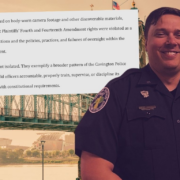
Covington Police Officer Doug Ullrich smiling in uniform, pictured in front of the Roebling Bridge. Overlaid is an excerpt from a federal civil rights lawsuit alleging his actions and departmental failures violated plaintiffs' Fourth and Fourteenth Amendment rights.

Covington’s LGBTQ+ Liaison Officer Has 9 Federal Lawsuits. The Community Wants Answers.

Curtis Clemons has lived in Northern Kentucky his entire life.

The 36-year-old said he’s loved Covington since he was a kid. Growing up 45 minutes away in Williamstown, he looked forward to weekends “in the city” with his family.

Clemons, now a resident and a local realtor, said he usually felt safe in Covington when he interacted with local law enforcement until he learned of a police officer in Covington named Doug Ullrich.

“The interactions I’ve seen on the news and reported about Officer Ullrich, but also the interactions officers have had on the Roebling Bridge last summer,” Clemons said. “There was unjust violence toward citizens on the bridge.”

Clemons was one of several members of the Covington LGBTQ+ community that spoke with Queer Kentucky who were concerned with Ullrich, the number of lawsuits filed against him and what they see is a lack of action by the city and the Covington Police Department.

Ullrich is a training specialist and the department’s LGBTQ+ Liaison Officer. On the Covington Police Department website, it describes the LGBTQ+ Liaison Officer mission, “To build communication between the LGBTQ+ community and (the department),” by “developing trust and understanding.” Clemons, and other members of the LGBTQ+ Community interviewed by Queer Kentucky, believe the department is failing in that mission.

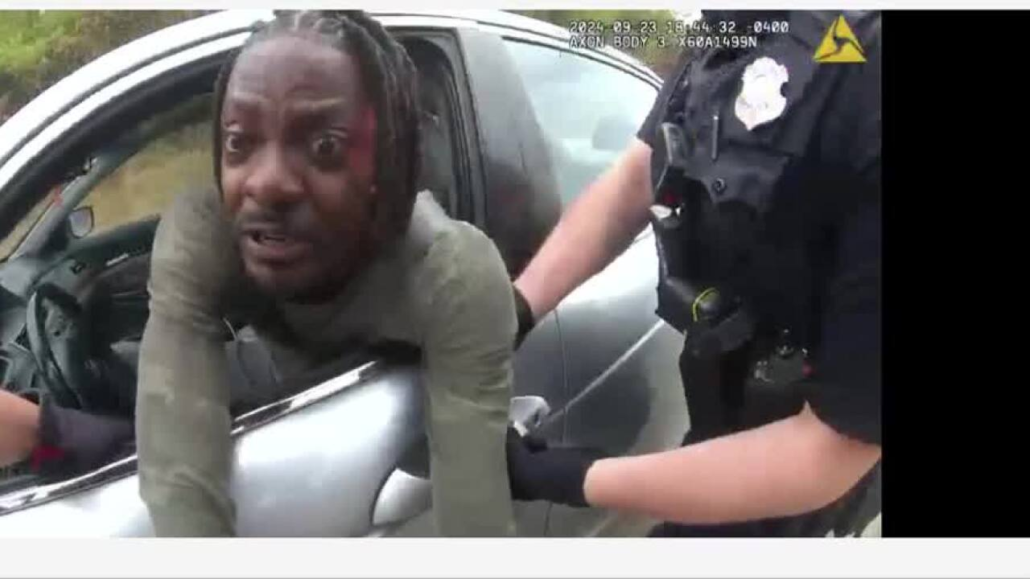
Ullrich made news in early 2025 when dashcam video of his October 2024 arrest of Damien Connor became public. Connor, an LGBTQ+ Black man, was pulled out of his car by Ullrich and another officer after they cut his seat belt. According to the complaint, Ullrich said he smelled marijuana in Connor’s vehicle after he began removing him from the vehicle.

Connor was held overnight, but wasn’t charged when he was released the next morning.

In March 2025, he filed a federal lawsuit against the Covington Police Department and Ullrich for violating his civil rights. It’s one of nine lawsuits filed in federal court against Ullrich since 2021.

Clemons said the lawsuits against Ullrich and the handling of protestors on the Roebling Bridge last year, who were rallying against the detention of Ayiman Soliman by ICE, have put him in a position where he’s afraid of interactions with the police department.

“It has eroded any trust that I might have had,” Clemons said.

Ullrich has been the department’s LGBTQ+ Liaison since 2023. In May 2025, Queer Kentucky published a profile on Ullrich, including excerpts from his 300-page personnel file.

Ullrich’s personnel file showed praise for his work involving traffic stops and drug enforcement. It also showed concerns from other officers and supervisors, including a 2014 group chat conversation with other officers, where Ullrich said, “I violate every policy,” in response to another officer discussing the time he tased a suspect who posed no threat and was running away. 

Another member of the chat wrote, “…if u r ever the defendant in a federal case, it could come back to haunt…just my piece of advice, been there, done that, it was not fun.”

Nine lawsuits since 2021

Despite being sued nine times in federal court, Ullrich hasn’t been found liable in the three cases that have been decided. One of those cases is before the Sixth Circuit Appellate Court.

“When one officer repeatedly appears in these cases, it naturally leads people to ask whether supervisory oversight and accountability mechanisms are working the way they should and if anyone truly cares,” said Elise Sebastian, who does volunteer work in the city.

In 2021, Jeffrey Cundiff sued Ullrich and the department after he was given a body cavity search during a traffic stop. Ullrich won partially on summary judgment in March 2024.

In a suit filed in 2021, Anthony Wynn claimed he was assaulted by Ullrich and other officers over the course of three arrests. Wynn sued Ullrich, the police department and 50 officers. Ullrich and some other defendants were dropped from the suit after the judge partially dismissed portions of the case on statute of limitations grounds. The Eastern Kentucky District ruled in favor of the defendants last year. The Sixth Circuit affirmed the ruling in April.

Ashley Ferreiras filed a civil suit in 2024 after she claimed she was physically and sexually assaulted, and had her First Amendment rights violated after she was knocked off her crutches and arrested when questioning why her boyfriend was pulled over. Her case was appealed after the court found in Ullrich’s favor in February. Ferreiras is also awaiting an appeal on her criminal conviction in the case related to her civil filing.

Eight days after the Ferreiras case was decided in Eastern Kentucky District Court, Ullrich was sued in February by Covington residents Stephen Weier and Brandon Greenlee for allegedly conducting a warrantless vehicle search, false arrest and unlawful detainment during a March 2025 traffic stop. Weier accused Ullrich of sexual assault while being searched.

Despite the court deciding in Ullrich’s favor in the Ferreiras case (the judge ruled that Ferreiras’s convictions in Kenton County Court wiped out her claims of having her civil rights violated), Clemons said it hasn’t assuaged his worries about the department.

“If the suits are still being filed then it’s clear there’s still a problem at the Covington Police Department,” Clemons said. “Ullrich may just be a symptom of those issues. Mayor Ron Washington, I think he was the highest or one of the highest-ranking African American police officers in the state of Kentucky, even though he’s retired,” Clemons said. “I would love to see him say something.”

In a response to Queer Kentucky, the City of Covington sent the following statement:

“Because some cases remain pending, the Covington Police Department and the City are limited in what we can comment on publicly.

“That said, the rulings issued so far show that the actions taken by the City’s police officers were professional, lawful, and within established operating procedures.

“The Covington Police Department is committed to professional policing, accountability, and ensuring that officers carry out their duties responsibly while protecting the people and visitors of Covington.

“The City will continue to let the legal process play out while remaining focused on serving the community and upholding the standards expected of the police department.”

A Dangerous and Confusing Message

“Liaison roles exist to build trust with communities that historically have had complicated and often harmful interactions with law enforcement,” said Elise Sebastian. “When the officer assigned to build that trust is simultaneously facing repeated allegations of excessive force, it sends a dangerous and confusing message. This creates a credibility problem.”

Sebastian lives outside Covington with her wife. She’s frequently in the city for LGBTQ+ events and first heard of Ullrich when his arrest of Connor made local news.

“After the news reports, I started paying closer attention to the department’s response,” Sebastian said. “What stood out to me wasn’t just the lawsuits themselves, but the pattern. When one officer appears in that many cases, people are going to ask questions about oversight and accountability.”

Dr. Chelsea Elsmere, a psychologist specializing in LGBTQ+ health concerns, said instances of discrimination can lead to members of a marginalized group losing trust in institutions and feeling they aren’t safe where they live. That can lead to adverse mental and physical health effects, Elsmere said. Ullrich’s status as LGBTQ+ Liaison and the allegations of excessive force could pose a mental health issue.

“It’s a big problem if you can’t trust who is supposed to be protecting you,” Elsmere said. “There is so much fear in our world today; people need to feel secure in their own spaces.

“This is called ‘minority stress theory;’ and is particularly relevant to police interactions,” Elsmere said. “LGBTQ+ individuals are likely to have a baseline of low trust in police and be reluctant to seek help from them. Documented incidents that bring safety into question aren’t going to help this problem, nor is a lack of transparency/accountability from the department in response.”

Sebastian said the situation has caused her to make fewer trips to Covington.

“Trust is fragile, especially between law enforcement and LGBTQ+ communities that historically have experienced discrimination or over-policing,” Sebastian said. “When the officer assigned to be a bridge to that community is repeatedly named in civil rights lawsuits, it undermines the purpose of that bridge.”

Questions about Use Of Force Policy

While Ullrich won the Ferreiras case, depositions reveal that there may be inconsistencies in the department’s use of force policy.

Ullrich and Officer Anthony Fritsch were sued in federal civil court by Ferreiras in 2023 after she alleged officers assaulted her in front of her house. The incident began when officers, including Ullrich, had pulled over her boyfriend in front of her home for a broken taillight.

According to her complaint, she came down to the sidewalk on crutches, and officers pulled the crutches away from her. She filed the suit claiming she was unlawfully charged and arrested, and accused the officers of “physical and sexual assault.”

Ferreiras was found guilty of charges related to the incident. Like her civil suit, that case is before an appeals court.

During the August 2025 deposition, Officer Anthony Fritsch was asked by attorney Justin Whitaker if he was trained on the department’s use of force policy.

“No one specifically trained us on use of force policy,” Fritsch said. “We were expected to read it and understand it.”

Ullrich, a department training officer, said this wasn’t the case when questioned by attorney Whitaker.

During the deposition, Ullrich didn’t say whether he was in charge of training Fritsch on use of force policy. But it has caused community members to question whether the department is taking the policy seriously, especially with the training officer being sued nine times.

Community members: Department needs to address concerns

Elsmere said if more cases against Ullrich continue to be filed, the city’s police department would be in a bind, not only with the LGBTQ+ community, but anyone who feels the department isn’t being responsive to major issues.

“Each new case deepens the rift,” Elsmere said. “Though Ullrich’s interest in serving as LGBTQ+ liaison may come with good intent, the incidents in question have had damaging impact. It is undeniable that these events have undermined relations between the community and (the Covington) police department as a whole. That’s quite contradictory to the very concept of a liaison.”

As long as the department remains quiet, Sebastian, who does regular volunteer work in Covington, said she doesn’t believe the department is taking Ullrich or the community’s concerns seriously.

“The public understands that policing is difficult work,” Sebastian said. “What people struggle with is when a pattern emerges and the response from leadership appears quiet or procedural. That is when trust erodes.”

After the Roebling Bridge Protest, the department suspended one officer for a month and recommended he receive additional training. Sebastian said this is a similar moment and requires similar action.

“This is a moment for the city and the police department to demonstrate that ethical standards and public trust actually matter,” Sebastian said.

Tracy Kisenda, who is suing Ullrich, is awaiting his criminal trial in June. Kisenda is facing charges of assaulting officers and disrupting governmental operations. He said those charges are false, according to his civil complaint, filed in 2025.

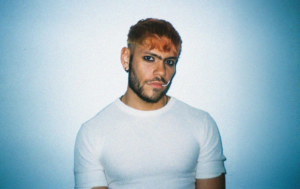
Two overlapping Polaroid-style mirror selfies of Cain Culto, shot in black and white with a soft, hazy quality, set against a dark background.

Cain Culto Was Sent to Conversion Therapy. He Came Out a Pop Star.

In a time of political backsliding, artists are at the forefront fighting against white patriarchal ideals with acts of rebellious queerness and authenticity. One singer in particular, Cain Culto, blends unapologetic queerness and witchy aesthetic—long fingernails, grills with tusks, and jockstraps—with music that takes on themes of sexuality, battling colonialism, and healing his
inner child.

But Cain Culto wasn’t always singing about wearing a “lil’ femme fit,” growing up in Kentucky, and how there are “too many Klu Klux Kardashians” as he does on his hit single KFC Santería.

Before he became Cain Culto, he was Andrew Padilla, a biblical studies major in a Christian rock band singing the lyrics “My shadow side and my wicked ways / My selfish heart, all my sinful days”.

The evolution from Andrew Padilla in the white evangelical church to Cain Culto exploring his Colombian and Nicaraguan heritage through music was a tough journey through repression, conversion therapy, and an eventual mental breakdown.

Worries about conversion therapy have started once again after the Supreme Court of the United States ruled 8-1 in favor of Kaley Chiles, a mental health counselor in Colorado. She filed a lawsuit against the state of Colorado, claiming that the law banning conversion therapy in Colorado infringed on her freedom of speech.

This now opens the door to allow Conversion therapy, the practice of trying to change someone’s sexuality or gender identity on the basis that it can be “cured”, to be allowed for minors once again. And while research shows this kind of “therapy” is extremely damaging for those under 18—LGBTQ+ youth who experienced conversion therapy are more than twice as likely to attempt suicide—even adults who undergo this pseudoscience practice are left emotionally scarred.

In regard to this ruling, major scientific outlets such as the American Psychiatric Association state that “Being LGBTQ+ is not a mental illness or disorder. Conversion therapy — efforts to change sexual orientation and gender identity — is not a legitimate therapeutic treatment. Leading health care entities, the APA among them, have concluded that these are potentially
harmful, discredited practices and are not supported by scientific evidence.”

Unfortunately, this kind of practice is not unknown for children of Christian evangelist parents. Singer Cain Culto experienced this kind of therapy as an impressionable 20-year-old college student, and while he uses this experience to fuel his art and heal, this “therapy” was mentally tumultuous and emotionally scarring. But music was the throughline before and after the fall.

Also read: Fried Chicken and Jockstraps: “KFC Santería” singer Cain Culto finds queerness in Kentucky Latin Art-Pop music

Cain Culto on ‘Same-Sex Attraction’ Therapy in the Church

Andrew Padilla was a man of the church and a Christian singer long before he became Cain Culto, the jock strap-wearing, long-nailed queer pop star. As a 20-year-old student of biblical studies and a leader at his church, he wanted to spread “the word of Jesus and help the world”.

But his homosexuality, or “same-sex attraction” (SSA), as it was referred to in his ministry, was a major detriment to his social and clerical position. Remembering this time in his life, Culto talks about how his church taught him that “you are not
your desires,” he said. To be gay, in their eyes, was not who he was as a person but a problem to be solved.

“And so they said, I struggle with ‘same sex attraction’, and so I never came out to my parents. There was just so much secrecy and so much isolation in that,” he said.

Growing up in an evangelical household, he knew that coming out to his parents wasn’t an option, and feared that if he did, he would end up in conversion therapy against his will. “It was really sad as a young adult and teenager, just never being able to experience romance or dating. I witnessed my peers experience, and how beautiful that was. But if I was going to be a godly young man, that was just not in my story.”

To fight his attractions while studying at his university in 2018, he began opening up to his church mentors about his SSA and they advised conversion therapy.

The Church Outsourced His ‘Healing’ to an Ex-Gay Ministry

The general feeling in the church at the time, Culto explains, was one of uncertainty in how to deal with those experiencing SSA. His church outsourced its therapy, recommending an ex-gay Brazilian ministry for artists and creatives that hoped to “reclaim the rainbow back for God” (“So cringe,” he remembers.) So he then started working with a mix of therapists, all of whom felt a
little off.

“I remember I first connected with this one guy over Zoom briefly. He was essentially a counselor for people who are attracted to the same sex,” he recounted. But Culto wasn’t swayed.

“And I remember leaving that Zoom call, thinking… ‘he was the success story?’” Seeing this depressed Brazilian man over Zoom, Cain couldn’t help but think he was a product of severe repression.

“I think repression does so much trauma to the mind, and I think you feel that in one person, not only their sexual repression, but it kind of stems out into every aspect of their being.”

He was eventually connected with an older female therapist in the church, and while she was nice and her intentions were good, she was quick to shame Culto’s femininity, he said.

“I don’t know if you know anything about Scientology: it’s essentially trying to get into a meditative state and kind of realize what’s the root of your malfunctions with your system. It’s very pseudoscience in a lot of ways,” Cain recalls, though the therapy wasn’t rooted in Scientology’s specific practices.

During these ‘inner healing’ sessions, they told him he was rejecting his masculinity and sought to find the reason for his gayness: was it due to past traumas? Sexual assault as a child? The message was clear: something must have caused his ‘condition.’

“So I was doing that (conversion therapy sessions), and it’s interesting to see the timeline of how quickly after I started that therapy that my mental health spiraled.”

Soon after, Culto said, came the nervous breakdown.

How Conversion Therapy Led to a Mental Breakdown

Like many people during the coronavirus pandemic, Culto started to gain a different perspective on what mattered to him. He was deeply enmeshed with the church’s cruel, shame-based practices rooted in Christian fundamentalism and white evangelical ideals. That was the turning point –his authentic self and who the church wanted him to be were incompatible.

“There was a split that happened within me,” Culto explains, reflecting on having to compartmentalize his queerness with his youth pastor persona.

“Since childhood, I think that I had to process this split in order to survive in these communities. And then therapy only severed that even more so…” Trying to drown out his same sex attraction caused him to finally be hospitalized for a week in a psychedelic psychotic episode where he thought he was seeing God.

Cain Culto sits shirtless in a leather chair in a gritty, dimly lit room, wearing black shorts, white knee-high socks, and black gloves, with his head resting in one hand in a pose of quiet introspection.

Cain Culto photographed in Vancouver. Photo by Xinger Xanger.


Looking back, he can see that power over sexuality is the ultimate way that evangelical spaces control their congregation, and that “once the sexual self is repressed, you are so much more vulnerable to manipulation and leadership.” Even “Cain Culto,” his alter ego created after these therapies, leans into the idea of cult leaders and cult tactics, and how leaders consciously or
unconsciously use them.

This was a major turning point for him, and he began to search for answers outside of the church. And one of the answers came in the form of his violin.

How Music Became Cain Culto’s Path Out of the Church

Music was always a big part of Cain’s life: going to radio broadcast WoodSongs to listen to folk and bluegrass musicians with his father, playing the violin at a performing arts school in Lexington, Kentucky, and eventually becoming a member of the Christian music group Ecclesia. Music became his medium and means for self-expression.

So when his world crumbled around him, his music became his escape path to embrace his queerness fully and to confront the “shit from these therapies”. His music began to evolve from his 3-person Christian group praising God and asking for forgiveness, to writing songs with titles like “Sold My Devil,” “WitchyMan,” and even covering Madonna’s “Like A Prayer”.


A black and white portrait of Cain Culto standing in front of a stained glass-style mural, wearing a frayed textured jacket and looking directly into the camera with a piercing, confident expression.

Six years later, Cain still uses his music to process the trauma of repression by confronting the darkness and embracing his inner demons. Photo by Xinger Xanger.


Cain regards his art as a practice of processing his own shame from this experience, which can be seen especially in his early work. “Cain Culto, as a music project and kind of my artistic practice, is trying to undo these things, the things that I was taught to be ashamed of, to be afraid of within myself, embracing those things truly, finally.”

Six years later, Cain still uses his music to process the trauma of repression by confronting the darkness and embracing his inner
demons. Cain wants those who’ve suffered from conversion therapy to look outside the small Christian bubble you were born into, be curious, and know that nothing about your true self is as dire as this ideology is making it seem.

If you or someone you know is struggling, call or text the 988 Suicide & Crisis Lifeline at 988. LGBTQ+ young people can press 3 to reach counselors trained in LGBTQ+ care, an option that returned on Sept. 30, 2026 after it was cut in July 2025. The Trevor Project also offers 24/7 support at 1-866-488-7386 or by texting START to 678-678.

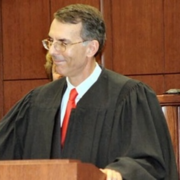
Judge Lewis Grant Paisley stands in a Kentucky courtroom wearing judicial robes and a red tie.

Judge Lewis Grant Paisley: Kentucky Man Who Advanced LGBTQ+ Rights Remembered for Courage and Allyship

Throughout his life and career, Judge Lewis Grant Paisley of Lexington, committed himself to uplifting and supporting those who were most marginalized in his community. Last week, Paisley, 80, passed away from complications of Parkinson’s Disease on October 27. However, his legacy has already made a lasting impact in Kentucky’s history. 

Paisley is most known for bravely ruling Kentucky’s fourth degree sodomy law as unconstitutional in 1986. His landmark ruling was appealed and, after years of litigation, the Kentucky Supreme Court affirmed his ruling in the landmark case of Commonwealth v. Wasson in 1993. This was a decade before the United States Supreme Court would invalidate sodomy laws nationwide in the 2003 case of Lawrence v. Texas.

Paisley’s 1986 Ruling Paved the Way for LGBTQ+ Legal Protections in Kentucky

Paisley’s ruling and the subsequent Kentucky Supreme Court ruling are memorialized in a historic marker in downtown Lexington (one of only four LGBTQ historic markers in the state, dedicated in 2018). 

Jeffrey Wasson’s attorney, Ernesto Scorsone, shared how impactful Paisley’s ruling was for the case, LGBTQ+ Kentuckians, and the state at-large.

“It recognizes the rich tradition we have in Kentucky of protecting the rights of privacy of individuals, particularly their privacy rights in the home,” Scorsone told the Lexington Herald-Leader in 1986. “The cases he [Paisley] cites, some of the language in them is really remarkable at just how strong the court system has felt toward the right to privacy, particularly in people’s homes.”

This ruling was a risky move for Paisley to make. At a time when anti-LGBTQ+ sentiment was at an all time high due to the HIV/AIDS crisis, Paisley courageously stood up for the right to privacy for LGBTQ+ Kentuckians. 

As a result of this support, he was viciously attacked while running against a homophobic candidate during his 1991 campaign. Despite the onslaught of hatred facing him, Paisley won the election and remained steadfast in his support for all of those in the Lexington community. The bravery of being such a strong ally for the LGBTQ+ community during a time of intense oppression remains incredibly admirable to this day. 

Despite the stereotypes of Kentucky as a deeply homophobic state, the Commonwealth has continually served as the site of milestone successes in the fight for LGBTQ+ rights. This sense of legal and community support from allies to the LGBTQ+ community was also later seen with the historic passage of the Fairness Ordinance in Louisville and Lexington on July 9, 1999. 

Judge Lewis Grant Paisley reads a document while seated in a courtroom gallery, wearing glasses, a suit, and a patterned tie.

Judge Lewis Grant Paisley, remembered for his landmark ruling advancing LGBTQ+ rights in Kentucky. Photo provided by Ernesto Scorsone.

A Legacy of Allyship and Justice That Still Inspires Kentucky’s LGBTQ+ Community

Paisley’s life and legacy reminds us that allyship is a crucial aspect of LGBTQ+ activism and fighting for equal rights under the law. After the judge’s death, Scorsone emphasized the importance of having more LGBTQ allies like Paisley:

“Judge Paisley was a Vietnam veteran and had no contact with the LGBTQ community. And yet, he had no hesitation in finding that queer Kentuckians deserved to be treated fairly and that the concepts of ‘equal protection of the law’ and ‘privacy’ extended to us, just like everyone else,” he said. “His ruling was based on justice and fairness. We mourn his passing. We need more Lewis Paisleys right now.”

Judge Paisley’s legacy is one of justice, kindness, allyship, and courage, and he will be deeply missed. You can view his full obituary below.

https://www.legacy.com/us/obituaries/kentucky/name/lewis-paisley-obituary?id=59914514 

Supreme court formally asked to overturn marriage equality

Editor’s note: This story was published in August 2025. On Nov. 10, 2025, the U.S. Supreme Court denied Kim Davis’ petition without comment, leaving Obergefell v. Hodges and the judgment against her in place.

The U.S. Supreme Court has been asked to overturn its 2015 decision that legalized same-sex marriage nationwide, marking the first direct challenge to the landmark Obergefell v. Hodges ruling in a decade.

The petition comes from Kim Davis, a former county clerk in Kentucky who gained national attention after refusing to issue marriage licenses to same-sex couples in 2015, citing her religious beliefs. Davis served five days in jail at the time for defying a federal court order and later lost a civil lawsuit filed by two men she denied a license to marry.

In her request to the high court, Davis is seeking to void more than $350,000 in damages and legal fees awarded to the couple and is urging justices to declare Obergefell unconstitutional. Her legal team argues the decision was wrongly decided and infringes on First Amendment protections for religious liberty.

Mary Bonauto, senior director of civil rights and legal strategies at GLBTQ Legal Advocates & Defenders, said in a statement to Queer Kentucky that Davis’ case is extremely narrow and that her arguments have been rejected by the 6th U.S. Circuit Court of Appeals multiple times.

“Earlier this year, the Sixth Circuit Court of Appeals ruled against her on the same claims, and then the whole court denied her petition to rehear her case,” she said. 

The Supreme Court has not indicated whether it will hear the case. Lower courts have repeatedly rejected Davis’s arguments, and legal experts say the petition faces steep odds. Still, the filing comes as lawmakers in several states have introduced symbolic measures or legislation calling for the ruling to be revisited.

“People from all walks of life and across the political spectrum support or have a live-and-let-live approach to marriage equality and want to focus on other issues,” Bonauto continued. “There’s good reason for the Supreme Court to deny review in this case rather than unsettle something so positive for couples, children, families, and the larger society as marriage equality.”

If Obergefell were overturned, the Respect for Marriage Act would still require states to recognize existing same-sex marriages, but states could block new marriage licenses for same-sex couples.


ACLU of Kentucky files class action lawsuit over state’s ban on gender-affirming care for incarcerated people

The American Civil Liberties Union of Kentucky filed a class-action lawsuit Monday on behalf of a transgender woman in state custody, arguing that transgender inmates should have access to hormone replacement therapy.

According to a press release from the ACLU, the lead plaintiff, Maddilyn Marcum, first received a diagnosis of gender dysphoria in 2009 and received hormone replacement therapy under a licensed medical provider’s care for five years prior to her incarceration at Northpoint Training Center in Boyle County. Once incarcerated, corrections officials initially denied the continuation of hormone replacement therapy, but eventually deemed the treatment necessary for her.

Senate Bill 2 changed everything for Marcum. After years of receiving treatment for her gender dysphoria, she is now being denied medical care after the department of corrections began enforcing the new state law in late June.

During the 2025 Kentucky General Assembly, lawmakers passed SB 2, which prohibits the use of public funds to cover gender-affirming care—including hormone replacement therapy and gender reassignment surgeries for incarcerated trans people.

Gov. Andy Beshear opted not to veto the bill, but allowed the bill to pass without his signature. A statement from his office said, “The Governor does not believe that the state should pay for gender reassignment surgeries for convicted felons, as this would mean those in prison would receive better access to medical care than a law-abiding citizen.”

The ACLU’s 19-page filing argues that banning the use of public funds for hormone replacement therapy is unconstitutional, claiming it violates the 8th Amendment’s prohibition of cruel and unusual punishment and the 14th Amendment’s guarantee of equal protection. The ACLU is only arguing against the ban on gender-affirming medication, not the part of the law that prohibits the department of corrections from using funds for gender reassignment surgeries.

“People who are incarcerated are already serving the sentence they received,” said William Sharp, senior staff attorney for the ACLU of Kentucky. “But that sentence does not include, nor does the Constitution permit, that they also be denied adequate healthcare simply because politicians disagree with the treatment that the medical community recognizes as appropriate and that medical providers have prescribed.”

Marcum brings the suit on behalf of herself and the current and future incarcerated individuals in the department of correction’s custody who will be deprived of hormone replacement therapy. At the time Senate Bill 2 passed, 67 of roughly 20,000 inmates about 0.35% of Kentucky’s incarcerated population—were receiving treatment for gender dysphoria. Now, all have lost or will lose access to care.

“Untreated Gender Dysphoria creates a substantial risk of severe physical and psychological harm to the individual, which I have personally suffered from in my life,” said Marcum in a press release from the ACLU. “This case is not about a lifestyle choice, it is about ensuring that I and others receive medically accepted, appropriate healthcare for a diagnosed condition.”

In addition to suing Kentucky Department of Corrections officials, the ACLU also filed suit against Appalachian Regional Healthcare, Inc., challenging their corporate policy that mandates providers, including the providers overseeing Marcum’s care, enforce the new law by reducing, terminating, or withholding hormone replacement therapy even when treatment is considered medically necessary.  

Chris Hartman, executive director of the Fairness Campaign, said enforcement of SB 2 amounts to cruel and unusual punishment and a violation of rights.

“You’ve got to give people incarcerated in your state access to the healthcare that the doctors say that they need,” he told Queer Kentucky. “There’s no exception there. That includes transgender inmates.”

Courts across the country have consistently ruled that laws like Senate Bill 2 are unconstitutional when applied to incarcerated people. In the 2011 case Fields v. Smith, the U.S. Seventh Circuit Court of Appeals struck down a Wisconsin law that barred access to gender-affirming hormones for people in the custody of the Department of Corrections, finding it violated the Eighth Amendment’s ban on cruel and unusual punishment.

“I think the court will issue an injunction and it will be fairly swift,” Hartman said. “The provisions of Senate Bill 2 will be invalidated and Senate Bill 2 will become a meaningless law.”

Queer News Round Up: July 5 -July 11

As Queer Kentuckians, staying informed about LGBTQ+ news worldwide is essential. Changes in policy, activism, and culture in other regions can impact our community and efforts locally. Our weekly global news roundup keeps you updated on important LGBTQ+ developments, ensuring we remain informed and connected.

  • Wisconsin Supreme Court Rules in Favor of Conversion Therapy Ban: Since 2020, Gov. Tony Evers has been trying to pass a ban on LGBTQ+ conversion therapy in Wisconsin. A Republican legislature has blocked this ban twice, and the Wisconsin Supreme Court has now ruled those actions to be violations of the constitution, clearing the path for the conversion therapy ban. 
  • Stonewall National Monument Website Erasing LGBTQ+ History: The website for the historical monument, the Stonewall Inn, has removed bisexual women from its official description. In February, the website removed mentions of transgender people, using the acronym “LGB” instead. Now, the website states that only lesbians and gays were involved in the Stonewall riots. 
  • New Same-Sex Marriage Framework Proposed in Hong Kong: In a 2023 court ruling, it was ruled that Hong Kong’s government was to create an “alternative framework” to recognize the “core rights” of same-sex couples. This past week it was released, and has been the subject of scrutiny due to its minimal nature and inclusion. It lacks protections for rights in terms of housing, and is only applicable to certain couples. 
  • Historical Phone Used in Early LGBTQ+ Hotline Goes on Display in Bristol, UK: A phone used in the Bristol Gay and Lesbian Switchboard, begun by Dale Wakefield in 1975, has gone on display in an exhibition called Gender Stories at the Bristol Museum and Art Gallery. The helpline ran until 2012, and for the first three years, Wakefield ran the 24/7 hotline often all on her own.
  • Budapest Pride Participants Will Not Be Prosecuted: Budapest Pride had a record-breaking attendance of over 200,000 people despite the ban on the event. While attendees are safe from prosecution, some organizers, such as the city’s mayor, Gergely Karacsony, have been under police investigation and face threats of prison time.

Queer News Round Up June 28 – July 5

As Queer Kentuckians, staying informed about LGBTQ+ news worldwide is essential. Changes in policy, activism, and culture in other regions can impact our community and efforts locally. Our weekly global news roundup keeps you updated on important LGBTQ+ developments, ensuring we remain informed and connected.

  • Two Teenage Girls Shot in NYC Near Historic LGBTQ+ Bar: At the end of NYC Pride Celebrations, shots were fired at a pair of teenage girls near Stonewall Inn. There has been no suspect identified, and it hasn’t been determined yet whether or not it was hate-crime related.
  • Court in India Rules in Favor of Trans Women: The Andhra Pradesh High Court in India has ruled that Indian law is not permitted to deny recognition of trans women based on their ability to reproduce. This ruling allows for protections that apply to cisgender women to apply to trans women as well. 


Queer News Round Up: June 21 – June 27

As Queer Kentuckians, staying informed about LGBTQ+ news worldwide is essential. Changes in policy, activism, and culture in other regions can impact our community and efforts locally. Our weekly global news roundup keeps you updated on important LGBTQ+ developments, ensuring we remain informed and connected.

  • 10 Years of Marriage Equality in the U.S.: June 26th was the anniversary of Obergefell v. Hodges, which allowed marriage equality for queer couples in all 50 states. Since then, nearly half a million same-sex couples have gotten married. 
  • Pentagon Further Reduces LGBTQ+ History: The USNS Harvey Milk, named for the gay rights leader who served in the Navy during the Korean War and was assassinated in 1978, is to be renamed after a WWII sailor. The ship was named in 2016 to honor diverse service members, and the current administration claims to be renaming it to “re-establish the warrior culture”. 
  • Supreme Court Defends Exclusion of LGBTQ+ Materials in Schools Under Religious Expression: The Supreme Court ruled in favor of claims that not providing an “opt-out” option for LGBTQ+ materials was a violation of religious freedoms. Justice Sonia Sotomayor wrote in a dissenting opinion that this decision will lead to chaos, as there is such diversity in this country that there is likely to be many interactions in schools where religions conflict with one another. 
  • New Council Policy in UK Removes Rainbow Flags from Buildings: The Reform UK Administration, which was recently elected, has changed their flag protocol, removing their use of the LGBTQ+ rainbow flag. The administration claims to have done this under the pretense of ensuring, “consistent and respectful use of public buildings.”


Jim Obergefell speaks with Queer Kentucky on storytelling’s power 10 years after Supreme Court marriage ruling

Today marks the tenth anniversary of Obergefell v. Hodges, the landmark Supreme Court ruling that legalized same-sex marriage nationwide. At the time of that ruling, 35 states had constitutional bans against same sex marriage, including Kentucky. This decision cemented the political and social capital that the LGBTQ+ community had built in this country. That ruling changed us. It put some sass in our step. And I bet most of you could tell me where you were when it happened. 

And I wish I could report that it’s only been uphill from then for the LGBTQ+ community,  but from the record number of anti-LGBTQ+ bills to the overturning of Roe v. Wade, many in the LGBTQ+ community are worried for the future of LGBTQ+ rights, including the potential overturning of Obergefell v. Hodges. 

So what do we do? 

We connect over our stories. And nobody knows the power of stories more than Jim Obergefell. From his time in Cincinnati to his shift towards local activism, I am excited to share my conversation with Jim Obergefell with you on the tenth anniversary of Obergefell v. Hodges.


Missy Spears: What were the moments growing up as a queer person that really impacted you?

Jim Obergefell: Well, I think it starts way back when I was probably maybe 10 at most, and realizing at that point that I was different, because I would dig out the Sears catalogs and JCPenney catalogs my family finished with. I’d dig them out of the trash and cut out the pages of men’s underwear, but feeling, not being able to put it into words, but feeling and knowing that it was wrong, so I kept them hidden. So I think back to that, just that as a young kid, knowing something was different about me. 

You know, when I left Sandusky and moved to Cincinnati to go to UC, that was 1984. It was the height of the HIV and AIDS crisis. What I remember is, as I started to explore a little bit, my freshman year, just being terrified that if the cute boy on my residence hall floor, if I kissed him I was going to get AIDS and die. And that really had a big impact on me. It forced me back into the closet. I mean, I nailed that closet shut because AIDS scared the daylights out of me. So it really wasn’t until that summer of ‘92, when I went to graduate school at Bowling Green State University, that I came out, and then I started my life with John. I met John just a couple months later, and we became a couple.

For me, the things that formed me into the person, the gay man I am today, came from being in Cincinnati. It was a horrible place for the queer community, horrible place in the nineties, and John and I, not that we necessarily did anything different than who we were, but John liked to always say we weren’t our own personal Pride parade. So we did okay in Cincinnati, because we were kind of these clean-cut white men, and that made life easier. So we kind of fit into what Cincinnati expected from the queer community. If you’re going to be queer, okay, just be quiet. Don’t be obvious about it, and you’ll be okay.

And that’s what we did. I mean, everybody knew we were a couple from our neighbors, our friends, people we worked with. We worked at the same place multiple times. Everybody knew we were gay and a couple, but it was that kind of pressure that Cincinnati just put on us not to stand out. Don’t stick out, don’t! Don’t be too gay, and like I say, I think that was just kind of who we were, anyway. But I don’t know. I would love to go back in time and figure out, would I be different today had I not been in Cincinnati and felt that pressure?

But then, in the mid-nineties, when Cincinnati City Council passed the human rights ordinance that included our community, and there was the backlash which resulted in the city of Cincinnati, the people of Cincinnati, passing a ballot issue to amend the city charter, to say no laws could be passed to protect us, to protect the queer community that was like the first time I did anything that I felt like was activism. And that’s when I went to my polling place and protested against that ballot issue on Election Day. But that was a tough time. Knowing that our fellow Cincinnatians chose to vote against us.

Because here we were in a city, we knew Cincinnati wasn’t a great place for us, for our community, but John had grown up there. I had fallen in love with Cincinnati. We had family, we had friends, people who treated us like a married couple. So that hurt. It was already not the best city, but to have our knowing that our neighbors voted to permanently make us second-class citizens really hurt.

And then, 2004. That was the year that the people of Cincinnati repealed it. That was a great thing, and that was when our feelings about Cincinnati really started to change, because the fact that the people of Cincinnati said, “This isn’t who we are as a city. We take it back, we repeal it.” But it was also the year that Ohio passed its state-level Defense of Marriage Act. We had talked marriage in the mid-nineties when the Hawaii State Supreme Court ruled in favor of marriage equality, and John’s stepmom said, “Well, if this all happens, I’ll take everybody to Hawaii so you can get married.” We talked about that in the mid-nineties, and yet here we’re living in Ohio, once again a state that’s deciding to officially make that out of reach for us. So yeah, definitely, Cincinnati. It’s nice to see how much it’s changed.
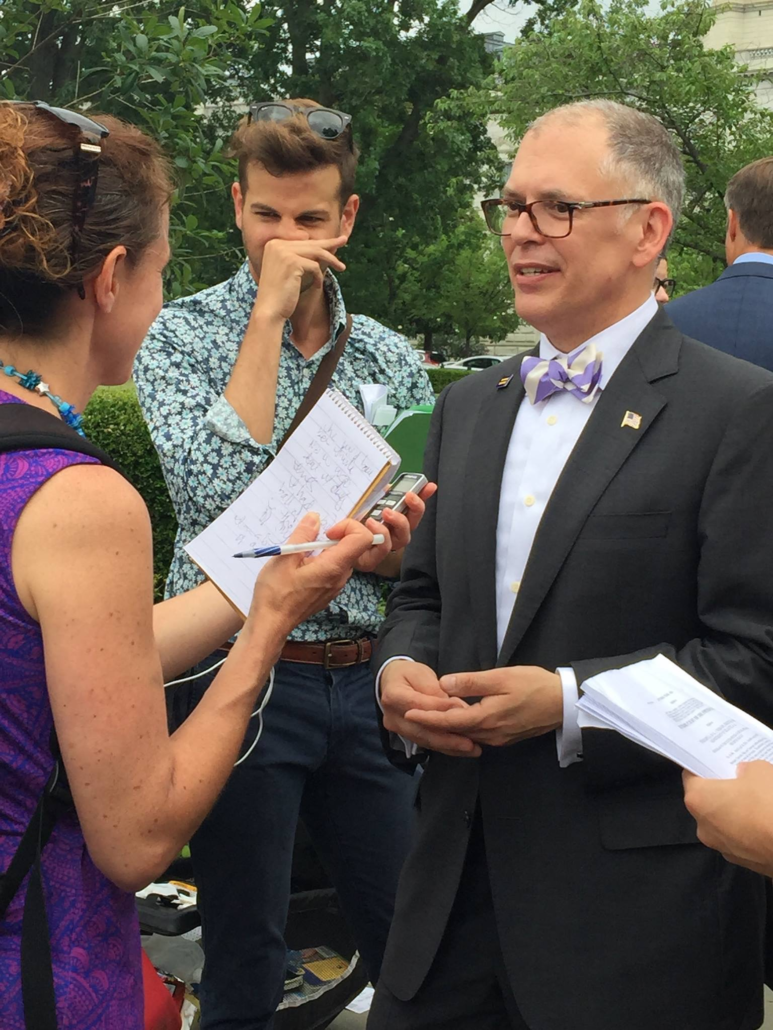
Jim Obergefell answers reporters after Supreme Court ruling. Photo provided by Jim Obergefell.

Missy Spears: It is. It was crazy how long it took for them to repeal that. Covington had passed a fairness ordinance in 2003, when that was still on the books in Cincy.

Jim Obergefell: So it’s so funny now to look at Cincinnati. They have John Arthur, Jim Obergefell Way. And it was what, the first or second city to ban conversion therapy?


Missy Spears: Yeah.

Jim Obergefell: It was Cincinnati. I think there’s some conflict over who was first, but I just love how much it’s changed for the better.


Missy Spears: I wanted to ask about your move back to Ohio from DC. I saw a comment that you made about how the fight for equality for all marginalized groups was now at the state level, rather than the federal level. I would love to hear more about that, including how it changes you as an activist.

Jim Obergefell: So these days, given the Federal Government that we have, the administration that’s in place, we’re going to have no success whatsoever at the federal level. So we really have to focus on local and state. And honestly, that’s what we should have been doing anyway, because when we change our local level, we were part of changing our state. And then, as more and more states change and progress, becoming better, that makes the whole country better. So that’s just what we really should be focusing on. And it’s for all marginalized communities, not just the queer community. I mean, we have to be fighting for everyone because, when Roe was overturned with the Dobbs decision, and Clarence Thomas wrote his concurrence where he put a target on Obergefell, he put a target on Lawrence, which overturned anti-sodomy laws, and also Griswold, which guarantees the right to birth control. When we lose one right in this country, all rights are at risk. And that’s what we’re facing. And we have a Supreme Court, that has made it clear that at least 2 of them would like to overturn marriage so what we have to do is be active and focused on the local level, on the state level. We’re not going to have success passing positive legislation in Congress, we’re not going to have luck with the Supreme Court. So what do we do? Do we give up? No, we have to fight locally, and a big part of that is, going back to what Harvey Milk said, come out, because that’s the only way we’re going to change people’s minds when they understand that. “Oh. queer people!” That’s not just some abstract thing, that’s my coworker. That’s my neighbor. That’s my family member. 

We do that by sharing our stories, because stories are really how we connect with each other. Stories are how we can change that abstract into something real and something that people can connect with. And you know that was something I felt throughout the fight for marriage, something that I saw again and again. I think one of the biggest moments I had was when I was in the Supreme Court for oral arguments. The guy sitting next to me said, “Jim, I just want you to know your and John’s story really had an impact on two people I know, including my twin brother, who’s a Roman Catholic priest.” His brother had called him that morning on the way to the courthouse to say, I just watched a story about the Plaintiff and his late husband, and it made me rethink my opposition to marriage equality.

This was a Catholic priest saying this, and telling that same thing to another person. I thought, well, you told me about your brother? Who’s the other one? Then he turned back to me, shook my hand, and said, Thank you. You’re doing the right thing, fighting for marriage equality. And then he told me that he was an evangelical republican, whose mind had been changed because of stories. So that was a huge moment for me. It was just this really obvious, yeah, Jim, here’s somebody who is part of a group that you never expected to be on your side, that you never thought would support this fight. And yet here he is, telling me that he does, and that I was doing the right thing. So stories matter. 

I was in Ireland and I did some events, and I heard over and over again from people who were part of the national vote in Ireland about how, when they were going out into rural Ireland to knock on doors and campaign, to ask people to vote for marriage equality, again and again they’d knock on a door, and an elderly couple would answer and say, “Well, of course we’re voting for it. Our child talked to us, our grandchildren talked to us, told us stories.” So I saw there how important storytelling was, and I think right now, for the trans community, that’s one of the most powerful things we can do is tell their stories and have them tell their stories when they feel safe, because so many people think, “well, I don’t know a trans person,” and they just have this preconceived wrong made up idea of what a trans person is. But then, when they meet a trans person—“oh, you know what? They’re really no different than me.”

So it’s sharing our stories, letting people in again, keeping our safety in mind these days, especially. But it’s those stories that really break down preconceived notions, break down barriers, and help others see another person as a human being.
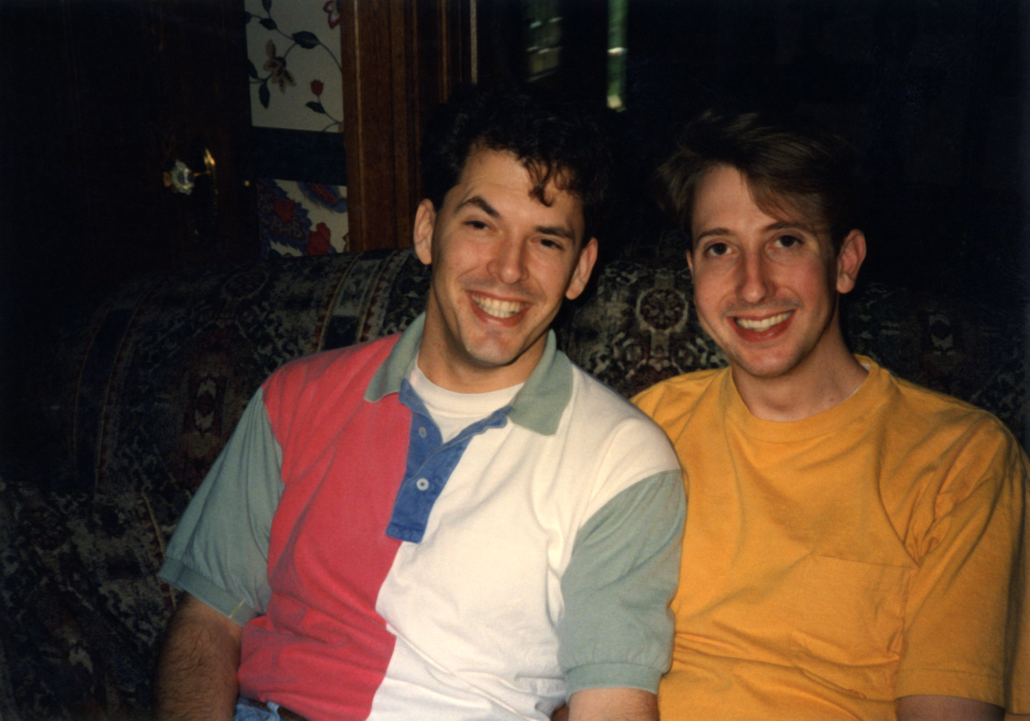
Jim Obergefell (left) and husband John Arthur (right). Photo provided by Jim Obergefell

Missy Spears: Sharing your story can be draining, especially putting yourself out there on such a huge level like you have. How have you built the emotional endurance to stay so involved?

Jim Obergefell: I don’t know. Honestly. I just did it. I mean, I’ve had so many people tell me, especially after maybe they’ve been in an event where I’ve spoken, and they’ll say, it must be so so draining, so tiring, so hard for you to tell your and John’s story again and again, and to talk about John, who’s dead, and my answer has always been, unequivocally, no. 

I love it because I get to talk about my husband. I get to talk about the most important person in my life.

I keep him alive that way, and that was especially important for me in the first few years after he died. It was a huge part of my grieving process. I talked about him all the time, and I kept him alive in my heart, in my mind, and in my thoughts, and in everything I did. So, I don’t know. I don’t know that I ever necessarily thought it was draining, because John and I filed our lawsuit because we wanted to exist. We wanted to matter to the state we called home, and somewhere in the back of my mind, my mindset was, Jim, just get over it. You’re going to get tired, but it’s the right thing to do. Keep telling your story because it matters.

And what I love is I’ve had so many people share their stories with me. I’ve had young people come out to me. I had one kid say, Jim, I’ve never told anyone this, I’ve never even admitted it to myself, but I’m like you. I like guys. So there was something about my story and the connection I helped build with him that made him feel comfortable to come up to me and share that with me. And I’ve had other people do that. I’ve had a young woman tell me that marriage equality saved her life, because she was going to commit suicide because she never saw a future for herself.

So again and again, people share their stories. I mean, they show me photos of their commitment ceremony, and their wedding in California, which was then reversed, and then their next wedding, and then the next wedding, and they show me pictures of their families and their loved ones. And my wine business that I have out in Sonoma County. Every wine we release tells a story, and when I’m out there, I’m telling stories again and again and again, and people tell me their stories, and it never fails. People leave feeling happy, feeling seen, feeling respected, feeling part of something bigger than themselves, and it’s all because of stories.


Missy Spears: We went from this amazing high in 2015 to feeling like it’s 2004 again. Do you think that this is just the natural result of progress? A 2 steps forward, one step back. Or are we dealing with a different kind of cultural backlash?

Jim Obergefell: I think it’s a mix of both. Every step forward in our nation for civil rights, for human rights, there’s always a backlash, because there are people who, for whatever reason, think equality is a pie. And if one group gets equality, that means they’re taking a piece of the pie away that nobody else can have. So there’s always backlash. And I knew, even on June 26, 2015, that there would be backlash. I mean, Kim Davis. How long did that take, a week? So I think part of it is just the natural human backlash from people who lack empathy, who think that other people are less than human. It just seems like that’s unfortunately human nature. And I wish we could get past that. But I think it’s worse these days because of the advent of a national leader. I refuse to say his name, but a national leader, who knows only how to inspire people to embrace their hate and be bold and proud about it, and to be just disgusting about it. So I feel like it’s a combination of things like human nature, but it’s made worse by our current MAGA world. People who have gotten the okay to be racist, to be homophobic, to be misogynistic. You name it, and they’ve been emboldened, and they’re happy to do that because they think that they’ve been given the okay to do it from the highest office in our country. So yeah, it’s not normal. But it’s what we have. It’s what we have to deal with.
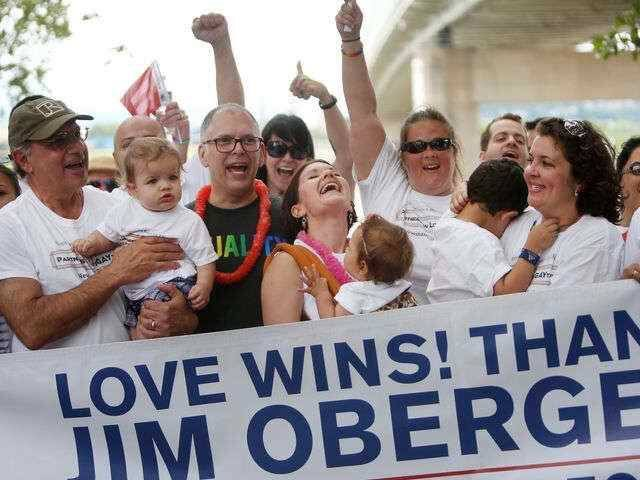
Jim Obergefell and supporters celebrating the Supreme Court ruling. Photo provided by Jim Obergefell.

Missy Spears: For the folks who want to get more involved, what would you recommend that they do to jump in?

Jim Obergefell: Find local or State organizations that are fighting for the causes you believe in. The Fairness Campaign in Kentucky is like Equality Ohio here. Find and follow your state’s organization, and get on their email list for when they say, “Hey, we need people to call elected officials to say, we oppose this bill, or we’re in favor of this bill” or when they say “we need people to show up at the Capitol and testify.” You’ll find out through that organization. So follow organizations like that, and if you can, support them financially. And use your voice within your community, in your family, but use your voice in your community. Speak up when people are saying things that are hateful. When people are saying things that are just flat out lies, speak up because silence, in so many ways it means you accept what they’re saying, or agree with what they’re saying, so don’t let them think everyone is on their side.

Speak up. You speak up in the ballot box. The only way this country can actually live up to its ideals. We, the people, equal justice, life, liberty, and the pursuit of happiness, is when every single person votes in every single election. And not just presidential, vote in every single election, dog catcher, state representatives, city council, township, trustees. You name it. Vote in every single election, because, honestly, that’s the only way. That is our only voice in government.

I want people to think back to 2016 when a lot of people chose not to vote, or they lodged protest votes because they thought it was funny, or they thought, well, I just want to blow things up. Well, those votes in 2016 gave us the current Supreme Court, and that Supreme Court has already taken away a right that people relied on for almost 50 years, and it’s poised to take away marriage and other rights. So vote in every single election.


Missy Spears: What would you say to trans kids and trans families today?

Jim Obergefell: You are not alone. There are millions of people who value your humanity, who value you as people, who know that you deserve to live your life the way you want to live your life, that you deserve the right to gender-affirming care. You deserve the right to use the bathroom that fits who you are. You deserve to play sports with your friends. If that’s what you want to do. There are millions of people who believe that share those values.

I know I can only imagine how alone many people in the trans community must feel at times these days. They’re bearing the brunt of it. I mean, they’re being treated the worst at least within the queer community. They’re bearing the brunt. They’re being treated the worst by state legislatures and elected officials. But you’re not alone. There are millions of people out there who are on your side, so don’t forget that there are people who care, people who want you to live unapologetically as you, and live your life without fearing for your life, because you deserve that as a human being. So just remember that you’re not alone, even though at times I’m sure you feel like you are.

I’m out there fighting for you. There are millions of others.

Yeah, I guess that’s what I would say. You’re not alone.

We’re on your side, and we continue to fight for you.

If you or someone you know is struggling, call or text the 988 Suicide & Crisis Lifeline at 988. LGBTQ+ young people can press 3 to reach counselors trained in LGBTQ+ care, an option that returned on Sept. 30, 2026 after it was cut in July 2025. The Trevor Project also offers 24/7 support at 1-866-488-7386 or by texting START to 678-678.

Queer News Round Up June 16 – June 20

As Queer Kentuckians, staying informed about LGBTQ+ news worldwide is essential. Changes in policy, activism, and culture in other regions can impact our community and efforts locally. Our weekly global news roundup keeps you updated on important LGBTQ+ developments, ensuring we remain informed and connected.

  • New Powerful HIV Drug Approved by FDA: Yeztugo, generically known as Lenacapavir, is a newly approved injection that only needs to be administered twice per year. It has been proven to be significantly more effective than existing oral HIV preventatives. However, it is costly, and with the Trump administration’s anti-LGBTQ+ legislation impacting insurance coverage for queer folks’ needs and HIV research, experts are concerned about its accessibility. 
  • Federal Judge Blocks Limits on Passport Sex Markers: After months of fear due to passport restrictions and changes, a federal judge has ruled that any transgender or nonbinary people with a need to apply for a passport or make changes to a current one can now request male, female, or an X identification marker. Previously, this ruling only applied to six individuals involved in an ACLU lawsuit against the previous executive orders, but now applies to anyone in need of a passport. 
  • 2025 UN Trans Advocacy Week:  The UN’s trans advocacy week is an annual event, which started in 2017, that takes place to amplify trans voices worldwide by allowing transgender people to speak directly to global leaders. This week the event is taking place in Geneva, and topics that will be covered include the impacts of foreign aid cuts, anti-trans legislation and its impact, and the renewal of the UN mandate of the Independent Expert on Sexual Orientation and Gender Identity. 
  • Budapest Pride to Take Place in Defiance of Attempted Government Ban: Hungary’s Prime Minister, Viktor Orbán, attempted to ban the pride festival this year. Around 70 Members of the European Parliament have pledged to be at the pride festival next week in solidarity. The city’s mayor also said the event was to go ahead, and ignore the attempted ban from the Prime Minister. 


U.S. Supreme Court ruling keeps gender-affirming care ban in place for Kentucky transgender youth

Editor’s note: This story was published in June 2025. Some details may have changed since then.

The U.S. Supreme Court ruled Wednesday to uphold another state’s ban on gender-affirming health care for transgender youth — meaning Kentucky’s kids and teens who identify outside of their assigned sex at birth will not be able to access health care most major medical associations consider to be critical. 

The nation’s top court ruled 6-3 to allow Tennessee’s law banning access to care such as puberty blockers and hormone therapy treatments for transgender minors to remain in effect. 

“The Court’s ruling abandons transgender youth and their families to political attacks,” Shannon Minter, the National Center for LGBTQ Rights Legal Director, said in a press release. “It ignored clear discrimination and disregarded its own legal precedent by letting lawmakers target young people for being transgender. Healthcare decisions belong with families, not politicians. This decision will cause real harm. Today’s decision is a cruel blow to transgender youth and their families in Kentucky and other states, but we will continue to fight.”

Kentucky lawmakers passed a similar law in 2023’s Senate Bill 150, then considered the nation’s worst anti-trans piece of legislation in a year full of bills aimed at the LGBTQ+ community. Legal challenges over SB 150 got lumped into Tennessee’s Supreme Court fight since they were so similar and in the same court system. But, the ACLU of Kentucky noted Wednesday, the court ruling focused just on this topic and does not immediately impact other cases concerning transgender people’s rights. 

Trans youth in the Bluegrass State have been prohibited from accessing such care for two years, and Kentucky’s GOP-dominated legislature has since passed additional laws aimed at reducing LGBTQ+ rights and health care access. 

After SB 150 passed in the spring of 2023, groups including the NCLR and ACLU of Kentucky stepped in to challenge parts of the law in court. Their lawsuit, filed on behalf of multiple impacted Kentucky kids and teens and their families, focused just on the parts of the law aimed at non-surgical forms of gender-affirming care. Parts of SB 150 prohibiting gender-affirming surgeries weren’t contested.

A legal saga ensued. Initially, a judge ruled that trans youth should be able to access needed health care, reversing the law. But then the same judge reversed their thinking, allowing Kentucky’s ban on care to stay in effect.

And it has remained in effect as the lawsuit worked its way through the court system. It eventually got combined with a similar lawsuit coming out of Tennessee, which is the case that officially got tried in front of the Supreme Court last December and ruled on Wednesday.

Following the ruling, pro-LGBTQ+ rights advocates condemned the step, while some in the GOP — which dominates Kentucky’s legislature that passed SB 150 two years ago — celebrated. Senate Majority Floor Leader Max Wise, a Republican who sponsored SB 150, said the decision is “a victory for common sense and the safety of our children.”

Chris Hartman, who leads the Fairness Campaign, called the ruling “unconscionable and unacceptable,” adding more than two-dozen states still allow families to access these kinds of health care and the ruling won’t stop families from seeking it out.

“The Supreme Court has failed to protect families’ freedoms and allowed politicians to target transgender youth,” Corey Shapiro, the ACLU of Kentucky’s legal director, said. “This is a painful setback, and it is clear the Court will not protect these children. But it will not stop us from using all available legal tools to fight back against the political extremists targeting transgender people’s safety and dignity. What’s important to remember is that no matter what the Court or politicians say, transgender young people and their families are not alone in this fight.”

This story will be updated.

Greg Bourke, Gay Catholic Activist, on Why It’s More Important to Stay and Fight

Editor’s note: This story was published in June 2025. Some details may have changed since then.

Greg Bourke claims he is just a “suburban dad, with a husband, two kids and a car.” But that’s his humble, soft-spoken Southern way of downplaying that he was involved in several important developments in the arc of 21st Century gay history. First, he took on the Boy Scouts of America and their policies after he was dismissed as a troop leader in 2012 for being openly gay. Then he was one of the plaintiffs in Obergefell v. Hodges, arguably one of the most important Supreme Court cases of our lifetime, since it radically changed the idea of marriage in the United States.

“I didn’t expect to be any kind of an activist. All I wanted to do was live my life quietly here in Louisville,” he explains. “But when you have a family, life gets complicated. Then you also realize you have an obligation to your children, and to the next generation.”

In his 2021 memoir, Gay, Catholic, and American, Bourke gives a heartfelt account of what it took to grow up in working-class Kentucky and what propelled him to fight for marriage equality and LGBTQ inclusion. Yet, despite being a trailblazer who has helped shape policy, he maintains that his domestic achievements are the ones that truly matter.

“Trying to raise a family as a gay couple in the Catholic Church was probably one of the hardest things that we did. The Supreme Court case played itself out over a little more than two years. But when you have a family, it’s a lifetime commitment.”

As the United States approaches the 10-year anniversary of the Obergefell decision in June—and with many anxious that it could be overturned—Greg Bourke spoke with us about the current state of LGBTQ equality, the battles that remain to be fought, and his hopes for the future.

Our conversation has been edited for length and clarity.

***

Jerry Portwood: Your book is obviously an important historical archive. What compelled you to write it? 

Greg Bourke: I had a bit of an awakening, or a calling, that occurred while I was at church. It just kind of compelled me to take a look at what had been going on and transpiring in my life and to really reflect, analyze, and then record it. Because I think that a lot of that wouldn’t have been available to people. A lot of that history has just been lost.

Another thing that I think is important is, you know, my husband Michael and I, when we got together in 1982 in Kentucky, the world was a very different place; the odds were very much stacked against us. I think it’s important to capture for people what the world was like when we made that commitment to each other and how remarkable it is that we’re still together today in 2025. We were the exception.

JP: Plus, your book details how many logistics go into doing advocacy or activism.

GB: Absolutely. I really don’t think people appreciate that. We didn’t have a lot of downtime during those years. If you have a family, where both parents are working full-time corporate jobs that are very demanding, and you’ve got children in high school, and you’re trying to help ’em, support ’em, and get ‘em moving in the right direction, it takes a tremendous amount of time to just keep up with those things. So, if you add on trying to take on the Boy Scouts of America and then take on the federal court system—it was pretty overwhelming at times. But we lived to tell the tale and, through all that, Michael and I are still together as a couple, and I think we’re probably happier now than we ever have been in our lives.

JP: People don’t always remember that you were among many other plaintiffs in Obergefell v. Hodges because Jim Obergefell was the named plaintiff. Can you explain how that happened and what it’s like for his name being the one front and center?

GB: Obergefell v. Hodges filed first. [Our lawyers] filed six minutes later. So, if a couple things went different ways, that case could have been named Bourke v. Beshear. I’ll tell you what I’ve told Jim Obergefell many times: I was glad that it was his name on the case instead of mine.

I’m sure there are a lot of great advantages and perks to it, but I’m glad it was him instead of me. And I still feel that way. From my perspective, it’s been difficult at times. Michael and I have had to endure a lot of pushback, a lot of criticism. So I’m really grateful that it was not my name on that case.

JP: I know it can be quite difficult being Catholic in some parts of the South. How was it in Kentucky? Did you ever feel othered?

GB: Speaking about Catholicism in general, I am an Irish American. My great-grandfather came from Ireland, so I grew up in this big Irish Catholic family. Every weekend, we would go and have dinner at my grandparents’ houses, hang out with my cousins. Every weekend we had a family reunion! Everybody was Catholic. And I went to Catholic school, right? So my whole world revolved around this Catholic community in Louisville. So let me talk about Louisville: we have more Catholics than we do Baptists or Presbyterians, so there’s a huge population of Catholics here.

So that was the world that I grew up in, and I really didn’t feel othered; I kind of felt more like I was in the majority. In that respect, I was comfortable and happy with that—just because I got so much good reinforcement from my family, from my friends, who I am still in contact with.

JP: You’re highly active in your church; you’re highly active in the Boy Scouts of America; then you’re highly active in all these legal cases. Yet, your mission was to have a family before you took on these powerful institutions. What kept you going through all of this? Because it seemed like a ton of work!

GB: I think a lot of that drive comes from my background and my family. My siblings—I have three brothers—they’ve all been extremely successful in their lives. We came from a family where that was kind of expected. We grew up in a Catholic community that expected you to excel. We went to very challenging schools that compelled us to not only achieve academically but also to be of service to our fellow men, to be faithful stewards as best we can.

My faith has driven so much of what I have done in life. The fact that I wanted to get involved in sustaining a relationship over a long period of time—like my parents who were married for 67 years when my father passed—I wanted to have that relationship. I wanted to have a family at some point. I don’t think either of those things are outrageous asks. There are so many millions of Americans who seek and achieve the same thing.

Now, as an openly gay man—I’ve been out since I was 19 years old, and I’m 67 now—I never really had to deal with discrimination. Nothing that I couldn’t handle, nothing that really motivated me to get extremely active until I got ousted from my position in the Boy Scouts as a Scoutmaster. When they said I was not competent to do a job that I’d been doing for 10 years, that was the last straw. Prior to that, I was just so fortunate in terms of being able to be openly gay at my place of work; I never got turned away from a school, or a job, or any kind of a social group because I was openly gay. It was only when the Boy Scouts said, “You have to leave,” that I knew how wrong that was. I knew that was happening with other people, but it wasn’t happening to me.

I think it’s what many people have to experience: you have to have that personal experience of discrimination to really get motivated. Now, I appreciate all the people—and there are plenty of folks—who get out there and get active just because it’s the right thing to do. But for the first big majority of my life, you know, what was important to me was having a job, having a relationship, having a family. And that was a lot to do as a gay man. So I didn’t really feel like I had a whole lot left to give until something happened to me. Then some opportunities presented themselves to me, and I acted on it.

JP: I think many people would be angry. Instead, you said, “I love the Boy Scouts and I wanna change it.” The same with the Catholic Church. You don’t exhibit that sort of animus. Instead, you decided: I love this thing, and I’m going to make it better.

GB: Well, I wish more people would do that. Yes, you’re right. Sometimes the easier thing to do is just to pack your bags, shake the dust off your feet, and walk away and say, “I’m not welcome here; I’m leaving.” I never really felt that. I’ve never had a break with the Catholic Church. I’ve never had that moment where I said, “I can’t go back, or they don’t want me to come back.” So I’ve been able to sustain that over a period of my whole lifetime. And it’s so important that I had that continuity in my life to be able to just have it going and going and going. I get frustrated with the church but never to the point where I get really angry or want to leave.

To get back to your question, I think it’s harder to stay and try to fight things and make things better. But as I have seen personally, if you stay, then people have to continue to deal with you. You know, then the opposition is gone.

As my husband says all the time, “If we leave, they win.” If everybody just walks away, then the bullies are gonna win, the injustice is gonna remain, and nothing’s gonna get changed. But if you stay, and you’re reasonable and you explain why you should be included, why this shouldn’t have happened, why it should change, you know, people kinda have to listen to you. I mean, they can tune you out to a certain extent, but if you get enough people together—and you’re putting the messages out there in the right way—they have to acknowledge that and deal with it.

JP: Right now, issues around masculinity are swirling, and you’ve been involved in organizations that deal with a version of masculinity. When JD Vance says something like, “We’re gonna get the normal gay guy’s vote” or the “acceptable gay,” what’s your reaction to that?

GB: I don’t know what he’d consider a “normal gay” anyway. Because I don’t know who he knows or who he doesn’t know. But I just thought that was out of line. I don’t think there’s a thing as “normal gays”—there’s just gays! I mean, we’re a broad range; there’s a spectrum. You’ve got the boring ones—like Michael and me—who are perfectly satisfied to wrap our lives together and live ’em for 43 years and just deal with whatever comes up. Then, you have other people who have a variety of different lifestyles and attitudes and things that they are seeking out of life, and I respect them all.

JP: What about Pope Francis? By the time this piece publishes, we don’t know if he’ll be with us since he has serious health issues. But I wonder what you think about his legacy. At one point, he appeared inclusive toward LGBTQ people—now gay people can be baptized and can be a godparent—then he said other negative comments about “gender ideology” and trans people. How has all of that affected you?

GB: I’m coming from that progressive wing of the Catholic Church, and I’m confused by it. I think people on the more conservative side of the Catholic Church are just as confused, just as frustrated. So I have some sympathy for them. We’re all in the same place. He has not had a consistent message; he’s reversed course a couple of times; he’s been caught using gay slurs. It’s frustrating, and I think the whole church would like more clarity.

We recently, at the Pope’s direction, went through this Synod project for a couple years where we listened to people at a very grassroots level, and it was all supposed to flow up. There was optimism that there would be some great changes that came out of that, whether it was going to be women deacons or better inclusion of LGBTQ people. And practically none of it happened.

That’s what’s frustrating to me: that we have a Pope who is so often criticized for being “too progressive,” and too “soft on gays,” and all this, and from my perspective, things haven’t really changed that much. I don’t know what people are complaining about; church doctrine has not changed.

So yeah, I get frustrated with the Catholic Church, but I also know it’s my home. And I don’t know who I would be without my experience in the church. It’s been so integral to my whole life—from baptism to right now. I’ve always been active in the church.

It’s the same way I can’t envision not being an American. I know people who expatriate and retire and move to other places. But I can’t imagine not being an American. It’s still my church, the same way that this is still my country—with all its flaws.

I don’t like what’s going on with the country, but I’m not gonna disown my country, and I’m not gonna disown my church. They’re just too important to me, so I will take those to the grave with me and do it gladly.

JP: Speaking of, in your book you describe a recent battle to get your joint tombstones into a Catholic cemetery. That was shocking! 

GB: I didn’t realize we were gonna get that much pushback. Michael and I were planning to do this anyway—we wanna get buried in the Catholic cemetery. We didn’t realize this was gonna turn into, like, a nine-month process of getting the archdiocese to approve our tombstone. It was frustrating; it was everything.

I got a little angry over that, but it was a situation where it was good news, bad news. We kind of took the archdiocese on, and they said, “OK, we’re not gonna give you everything you want. We’re gonna allow you two to be buried together, in a Catholic cemetery, so we’ll allow you to have a joint headstone. But, we will not allow you to have certain elements on that headstone.”

This was a very public battle. We had the local media covering this, and the archdiocese was forced to make a decision, and it set a precedent: Yes, two same-sex people can be buried together, in a grave like this, we just can’t have the interlocking rings. So, you know, we got most of what we wanted, and we think it was an important fight that we took on.

JP: How do you feel that, since your case, the Supreme Court has gotten more Catholic and more conservative?

GB: It doesn’t bother me that it’s so Catholic, but it does bother me that it’s so conservative Catholic. The three that were appointed by President Trump really shifted the nature of the court. They were brought in, in my opinion, specifically to target Roe v. Wade and, in fact, they did. I’m not sure what will happen beyond that. I think it’s possible that they could pivot and target Obergefell. It hasn’t happened yet, but it could.

For years, people would come to me and ask, “Are you concerned with what they might do with Obergefell? Are you concerned with what they might do with Roe v. Wade?” My response was always: “That is settled. I’m not worried about it. Listen to what they said in their testimony when they were being vetted in the Senate. That’s finished law, and we’re not gonna revisit that. They don’t overturn stuff like that!”

Then what happened?

So now I have an ultra-cautious approach, and I feel like it could happen; it might happen. Yes, we have the Respect for Marriage Act, and I think that’s great. We were there when it was signed, and I thought that was fabulous! I think it’s a very good protection. But I think what a lot of Americans are starting to feel is that anything that’s been done in the past can get undone very, very quickly these days—if people don’t stand up and fight for it and try to stop it from happening.

You know, I’m willing to do my part, but there’s going to have to be a whole lot of other people who stand up, too.

JP: I appreciated that you wrote about how you got very frustrated with people saying, “We have to wait until you change hearts and minds before we can get this form of equality.” It reminded me that this is a euphemism for how the minority must try to change the ideas of the majority, which in fact is why we have democracy. Because the majority isn’t supposed to crush the minority, and it isn’t actually the minority’s job to change hearts and minds—it’s the job of a representational democracy to protect everyone. Right?

GB: I felt like we had been waiting long enough. If it was simple, it would have happened more rapidly than it did. At a certain point, you realize some people’s hearts are so rotten, you can’t change ’em, and their minds are so bad, they’re unwilling to listen to arguments for reason or to think empathetically. It’s a small number of people who are willing to dig in and do whatever they can or whatever they have to keep from having to change or think about change.

JP: Well, change is scary. 

GB: Right, the change part is what people are resistant to; some people don’t want to change. They learned something when they were very young, and it’s really hard to change the way they think, the way they feel, and what they believe when they learned it so early in life. They got it time and time again, and it’s been reinforced for so long.

Our only hope is the next generation that comes up after is gonna be a little more open. I think that’s proving to be the case.


Jerry Portwood is the founder of The Queer Love Project and was a top editor at Rolling Stone, Out magazine, and New York Press. He’s a long-time instructor at the New School, where he teaches essay writing and arts criticism.

Covington Police officer Doug Ullrich, the department’s LGBTQ+ liaison, during a city council meeting.

‘I Violate Every Policy’: Covington Police LGBTQ+ liaison officer under fire amid civil rights lawsuits

Editor’s note: This story was published in May 2025. Our 2026 follow-up reports Ullrich now faces nine federal lawsuits. Read it here.

Ullrich’s Personnel File Reveals Pattern of Complaints


As Northern Kentucky gears up for Pride under a second Trump administration — one already markedly more hostile toward the LGBTQ+ community — one of the people trusted with protecting a marginalized community is under fire for allegedly repeatedly violating civil rights of those he is trusted to protect.

Covington Police Officer Doug Ullrich has been one of the department’s LGBTQ+ liaisons — a rarity in Kentucky police forces — since 2023.

The role is personal to him: He identifies as LGBTQ+, as do several of his close friends and family, he told Queer Kentucky.

But his suitability for the role has been called into question after Ullrich made headlines — again — for being sued in federal court earlier this year, this time for allegedly violating a Black LGBTQ+ man’s civil rights in what started as a standard traffic stop that escalated into a situation where the man’s seatbelt was cut off and he was pulled through a car window.

It isn’t the first time Ullrich has been sued over alleged civil rights violations. Since 2021, he’s been sued five times in federal court — almost always over allegations of excessive use of force and traffic stops gone awry.

The situation comes on top of a career-long pattern of being seen as proactive to the point of being overzealous and insubordinate, at times landing him in trouble with supervisors during his time at the department, per a review of his personnel file.

City and police officials allowed Ullrich to answer most of Queer Kentucky’s questions in his first public statements since the March lawsuit was filed.

Due to department policy, Ullrich wasn’t allowed to answer questions about the pending litigation or his personnel file. And he declined to say whether or not he would step down from the liaison role should the community ask him to.

“The city of Covington’s commitment to transparency and inclusivity remains steadfast,” a city spokesperson said. “The LGBTQ+ liaison role, which was the first of its kind in Northern Kentucky, was created in an effort to provide a specific community with a direct connection to the Covington Police Department’s administration.

“We have no question regarding Officer Ullrich’s ongoing support for the LGBTQ+ community and his willingness to build meaningful relationships with those who would like to partner with him.”

Attorney Jamir Davis, who has sued Ullrich in federal court twice over accusations stemming from traffic stops, including the most recent lawsuit, though, was clear.

“Based on my experience representing clients in cases involving Officer Ullrich,” Davis said, “and considering the allegations, patterns, and conduct we’ve encountered, I do not believe he should be serving in any liaison role—especially one intended to support or advocate for minority communities.”

‘I violate every policy’

Flashing red and blue police lights in the dark symbolize Covington Police under scrutiny.

Ullrich’s nearly 300-page personnel file — examined multiple times by Queer Kentucky — paints a picture of a police officer eager to join law enforcement, proactively studying up on practices around policing and case law, and becoming a de facto leader on his shifts around traffic stops, particularly ones involving drugs.

Now a specialist, he is a Drug Recognition Expert, “constantly sought out by other officers for his exceptional knowledge of controlled substances and impaired driving,” one of the notes in his file said.

He’s been commended by the state for his traffic stop and drug enforcement skills in the past, and he minored in gender and diversity studies when he was at Xavier University, “knowing even then that I wanted to serve the LGBTQ+ community,” he told Queer Kentucky.

But Ullrich’s file is also peppered with concerns from supervisors regarding improper use of force, sloppy police work, insubordination and telling a police group chat he “violate(s) every policy.”

“I believe Officer Ullrich has become his own worst enemy,” a supervisor wrote in a performance review early in his career.

“He has the skill, desire, motivation, and discipline to do this job better than anyone else, but his lack of patience and attention to detail have overshadowed most of his accomplishments this year,” they wrote.

Another note in his file stated, “Ullrich’s desire to be so proactive sometimes backfires on him,” adding that, “When he rushes through his paperwork and evidence procedures to get to that next call or make that next arrest, it results in incomplete or inaccurate paperwork.”

Several concerns about Ullrich’s policing didn’t make it into his file, one note signaled, with someone saying they’ve “received many complaints about Officer Ullrich’s performance from his fellow officers, records clerks, crime lab personnel, and supervisors from other shifts” but handled them during his shifts.

One note detailing a meeting between Ullrich and a supervisor discussed an arrest where Ullrich charged a suspect with 69 counts of possession of drug paraphernalia for unused syringe needles. When Ullrich tried to defend himself, the supervisor told him he should be “embarrassed.”

In another instance, Ullrich got in trouble for using his taser on a suspect who was running away from him and posed no clear threat to him — and for how he reacted when a colleague brought it up in a chat room.

“Or I could of tased him… kinda how you voliate policy and tased” the suspect in question, one person wrote in the June 2014 chat thread.

Ullrich responded: “i violate every policy.”

A different person jumped in, warning Ullrich to be careful what he says: “…if u r ever the defendant in a federal case, it could come back to haunt…just my piece of advice, been there, done that, it was not fun.”

A note from a supervisor in Ullrich’s file said, “My most pressing concern is not necessarily the errors that he continues to make, but rather his cavalier attitude toward his continual policy violations,” pointing to the aforementioned chat message.

“I realize that this comment may have been made in jest during what he thought was private conversation, but there is more truth spoken in jest than some are willing to admit,” the supervisor continued. “This truly concerns me.”

Ullrich’s issues at the department-level seemed to slow down as he got older, with one review from around 2021 saying he showed “a constant progression of learning from his mistakes.”

But, the review continued, he “has had a history of issues that have plagued him. It appears these are getting better but they are still popping up on occasion. I would imagine that these issues may be what is keeping Spec. Ullrich from achieving his desire to become an (field training officer).”

Ullrich also got in trouble in 2022 for failing to log evidence properly after he conducted a traffic stop, suspected marijuana use, searched the car, found a suspected THC cartridge and drove off without realizing he left it on the roof of his cop car.

Ullrich faces multiple federal lawsuits involving civil rights

Body camera footage showing Damien Connor, the Covington man suing Officer Doug Ullrich for civil-rights violations.

Damien Connor arrest by Officer Doug Ullrich. Photo from Covington Police Department

Police leaders tapped Ullrich as one of the department’s LGBTQ+ liaisons in 2023, despite multiple allegations of civil rights violations against him already on file in federal court.

And they’ve chosen to keep him there over the last two years, even as additional allegations rack up.

Lawsuits represent one side of a situation, and typically public entities don’t comment on pending litigation. However, the city is standing by Ullrich, making an unusual move to call the most recent claims against Ullrich “ridiculous” and publicly critiqued the lawsuit within weeks of it being filed.

Of the five times Ullrich has been sued in federal court since 2021, one case has been dismissed, another is being appealed and the remaining three are in front of a judge.

A Queer Kentucky review of the lawsuits found a pattern of alleged excessive use of force, often aimed at those in marginalized communities, and traffic stops forced to spiral out of control.

The most recent lawsuit, filed by Davis in March, stems from a Sept. 2024 traffic stop when Ullrich pulled over Damien Connor — a Black man who identifies as LGBTQ+.

Connor initially got pulled over for being on his phone, but according to the lawsuit and body cam footage of the incident, the situation rapidly escalated beyond what should’ve been a rather routine stop.

Ullrich asked Connor if he had a gun, and that situation ultimately, allegedly, ended with Connor having his seatbelt cut off, getting pulled out of his car window by officers and ending up in handcuffs.

At some point, Ullrich accused Connor of smelling like weed and thus, in his view, necessitating a search of Connor’s car. Connor has said he can’t use marijuana due to his job’s drug policy.

In the lawsuit, Davis accuses Ullrich of having a long history of wrongfully accusing Black people of being drunk and/or smelling like weed as grounds to unlawfully search their vehicle.

He also contends the city and Police Chief Brian Valenti knew of Ullrich’s long history of such conduct “and failed to take any corrective action” and that they’ve allowed officers “to act with impunity and have failed to properly train or supervise their officers in accordance with established policies.”

An initial statement from the city called the lawsuit’s allegations “false and ridiculous.” Davis had sued before, also over Ullrich’s alleged civil rights violations during a traffic stop. He ended up getting sanctioned for how the lawsuit was handled, and his plaintiff got charged for some of the city’s legal fees. (That case is now being appealed.)

A few weeks after the lawsuit’s filing, the City released extra body cam footage of the Connor incident and double-downed on its support of Ullrich, saying it “is committed to defending its officers who engage in lawful actions.”

And there may be more on the way. Davis told the Atlanta Black Star at least five other citizens claim to have had similar situations with Ullrich, and they might be added to Connor’s lawsuit as co-defendants.

Why does the police have a LGBTQ+ liaison? 

Crowd waves rainbow Pride flags during a Pride parade.

Like many marginalized communities, the LGBTQ+ community has — and has had for decades — a fraught relationship with law enforcement.

LGBTQ+ people — particularly those who identify as transgender, nonbinary and bisexual — often face harsher and more frequent run-ins with police, a 2024 ACLU report found, compared to those who aren’t LGBTQ+. More likely to face police search, more likely to face arrest, more likely to be placed in custody. And they tend to be less willing to call the police for help if needed.

Having a designated LGBTQ+ liaison for a police department is seen as one of the most effective ways to rectify law enforcement’s ties to the queer community, a former federal guide to best practices for creating such a role said. (The federal web page got yanked during Trump’s first 100 days in office.)

It isn’t a new concept. The first liaison role on record was created in 1962 in San Francisco.

Ullrich, who has been a Covington police officer since 2011, told Queer Kentucky he’s been interested in the department’s LGBTQ+ Liaison role since it was created in 2016.

As a member of the LGBTQ+ community, and as someone with plenty of close friends and family tied to the LGBTQ+ community, Ullrich feels “a strong duty to speak, act, and work with/for our community,” he told Queer Kentucky.

“I have witnessed and experienced discrimination,” Ullrich said. “I know that members of the LGBTQ+ community have historically been underserved by law enforcement.”

The liaison role is a key reason why Covington is able to claim they’re one of the most LGBTQ-friendly cities in Kentucky. When the Human Rights Campaign judges how supportive cities are to queer people, they look at whether or not local law enforcement has a LGBTQ+ liaison or task force.

Ullrich’s responsibilities fluctuate. Sometimes, it looks like attending community events like the recent Mx. Cincinnati PRIDE Pageant and the upcoming NKY Pride Parade and Festival.

Other times, it means helping his colleagues better understand the community and answer questions about the LGBTQ+ population or jumping in to help with reported hate crimes against LGBTQ+ people.

“In this role, I work to build bridges with the community so that they have a friendly, trusted face for those facing victimization, discrimination, or simply seeking clarity about the law,” Ullrich said. “I entered policing to make a difference for my community, and being the LGBTQ+ liaison helps me do just that.”

NKY Pride leader quiet on Ullrich’s ties to event

Northern Kentucky Pride logo; the organization’s president Bonnie Meyer has declined to comment.

The 2024 ACLU report on policing the LGBTQ+ community pitched several potential solutions. One such suggestion: “Carefully consider police presence in public LGBTQ+ spaces and events, such as pride parades and festivals.”

Queer Kentucky reached out to Bonnie Meyer, who leads the Northern Kentucky Pride Center, twice to get her reaction to Ullrich’s recent headlines and to see how he is involved with NKY Pride.

Meyer told Queer Kentucky in late March the group typically doesn’t start planning for Pride until after Kentucky’s legislative session ends. She redirected any questions involving Ullrich to the city.

Meyer did not respond to a more recent request for comment regarding Ullrich or broad information regarding security at this year’s events.

But Ullrich told Queer Kentucky he’s excited to work with the NKY Pride board as one of the police department’s LGBTQ+ liaisons to help organize this year’s events, work out logistics for the parade and address safety concerns that may come up.

He also helps during the event, assisting with medical calls, police and safety needs and even helping out vendors, he said.

NKY Pride events kicked off May 27, with the parade and festival scheduled to start at noon on June 1.

Questions or comments about this article? Want to weigh in? Contact reporter Olivia Krauth at [email protected].

Queer Kentucky World News Round Up: May 19-23

As Queer Kentuckians, staying informed about LGBTQ+ news worldwide is essential. Changes in policy, activism, and culture in other regions can impact our community and efforts locally. Our weekly global news roundup keeps you updated on important LGBTQ+ developments, ensuring we remain informed and connected.


  1. Hispanic Society Museum and Library Presents Photos on Queer Joy from 1970: From 1975-1976, photographer Francisco Alvarado-Juárez captured photos from the historical New York City Pride marches. These photos, titled “Out of the Closets! Into the Streets!” will be on display until August 31, 2025, celebrating the history and joy of queer people. 


  1. Major Legal Victory for Lesbian Couples in Italy: Since 2004, it has been illegal for the non-biological mothers of children conceived via IVF to be considered their parents in Italy, specifically in same-sex marriages.  A ruling announced on May 22nd, 2025 has changed this, announcing that the previous law was unconstitutional. However, this ruling only applies to women who seek IVF treatments abroad, meaning there is still much work to be done. 


  1. Pride Bench Set on Fire in the UK: In April, a Pride bench located in Windmill, Hitchin, UK was set on fire, and arson is suspected. Despite this, a fundraiser set up by North Herts Pride raised over £2,000, and the bench has been replaced.  


  1. New Zealand First Party Proposes New Legal Definitions of Biological Sex: To reject “woke ideology”, the NZF party announced a bill defining women as “a human biological female”, and men as “a human biological male”. While it is uncertain whether the bill has the prospect of becoming an actual law, this proposal came less than a week after the UK’s highest court ruled that women will be henceforth defined by biological sex. 


  1. LGBTQ+ Fundraising Event Held in New York by Naomi Watts and Kai Schreiber: Naomi Watts, and her transgender daughter Kai, hosted the “Mother Daughter Holy Spirit” fundraiser in New York on May 22nd, 2025. This is a piece of a three-part fundraising campaign led by the Trans Justice Funding Project, which has a goal of $500K. 


Kim Davis will appeal to SCOTUS in marriage equality case

Editor’s note: This story was published in April 2025. Davis has since formally petitioned the U.S. Supreme Court; see Supreme court formally asked to overturn marriage equality.

By Sarah Ladd

Former Rowan County Clerk Kim Davis plans to ask the United States Supreme Court to weigh in on whether she was protected by the First Amendment when refusing same-sex marriage licenses a decade ago, her lawyer announced Monday.

This comes after the 6th U.S. Circuit Court of Appeals refused a request to re-hear her case, saying the panel of judges who ruled against Davis in March already considered the case fully.

Mat Staver, the founder and chairman of conservative legal group Liberty Counsel, said in a statement that the nation’s highest court is “the next step to give Kim Davis justice in this case since the emotional distress damage award against her in her individual capacity is barred by the First Amendment.”

Davis is fighting a federal jury’s decision that she should pay $100,000 to a couple she denied a marriage license in 2015. But her lawyers also want the case to result in same-sex marriage rights being revoked.

“This case underscores why the U.S. Supreme Court should overturn Obergefell v. Hodges, because that decision threatens the religious liberty of many Americans who believe that marriage is a sacred institution between one man and one woman,” Staver said. “The First Amendment precludes making the choice between your faith and your livelihood.”

The move is expected. Staver, who argued on Davis’ behalf in Cincinnati in January before a 3-judge panel in the 6th Circuit, said at that time he intended to use her case to try and overturn marriage equality.

Obergefell v. Hodges, the 2015 decision that guaranteed same-sex couples marriage rights, is “on the same shifting sand” that doomed Roe v. Wade, Staver said.

“I think … it’s not a matter of ‘if,’ it’s a matter of ‘when’ Obergefell will be overturned,” Staver told the Lantern in January. “I have no doubt that Obergefell will be overturned, and the issue will be returned back to the states as it was before 2015.”

The Kim Davis case

Davis, then the Rowan County clerk, made national headlines in 2015 for refusing to issue marriage licenses to several same-sex couples based on her religious beliefs.

In 2015, U.S. District Judge David Bunning ordered Davis to jail for five days for contempt for refusing to comply with a court order.

In 2024, Bunning ordered Davis to pay $260,104 in fees and expenses to attorneys who represented one of the couples she refused a marriage license. Bunning earlier ordered Davis to pay the couple, David Ermold and David Moore, $100,000 in damages for violating their constitutional rights. Liberty Counsel has unsuccessfully fought Bunning’s decisions.

Davis lost her bid for reelection as Rowan County clerk in 2018.

Her lawyers have argued she acted within her First Amendment rights when she refused to issue the licenses, though judges don’t agree.

In March, the 6th Circuit refused to strike down the jury judgement against her on those grounds, saying she “cannot raise a Free Exercise Clause defense because she is being held liable for state action, which the First Amendment does not protect.”

Liberty Counsel said the case raises the question “of whether a government official sued in an individual capacity and stripped of governmental immunity may assert a personal First Amendment defense to monetary damages.”

The group wants the Supreme Court to take up the case to “answer the question of ‘first impression,’ resolve any conflicts with Supreme Court precedent, and ensure that former government defendants standing before the Court in their personal capacity do not lose First Amendment protections.”


GET THE MORNING HEADLINES.

SUBSCRIBE


Kentucky Lantern is part of States Newsroom, a nonprofit news network supported by grants and a coalition of donors as a 501c(3) public charity. Kentucky Lantern maintains editorial independence. Contact Editor Jamie Lucke for questions: [email protected].

Trump’s executive order sows confusion for transgender federal prisoners

This article was published in partnership with The Marshall Project, a nonprofit news organization covering the U.S. criminal justice system. Sign up for their newsletters, and follow them on Instagram, TikTok, Reddit and Facebook.

First, President Donald Trump issued an executive order prohibiting the use of federal funds for gender-affirming care. Then, in response to a lawsuit from prisoners, a judge temporarily blocked the order. The result, say employees and incarcerated transgender people, has been chaos and uncertainty as policies are adopted and applied unevenly throughout the federal prison system.

At a federal women’s prison, all the transgender women were rounded up and placed into a special segregated unit shortly after Trump’s January 20 order. The warden told them they “would all be transferred to men’s facilities and that the paperwork for those transfers was already being processed,” one of the women said in a court filing, which did not name the prison. A few days later, they were moved back into the prison’s general population, with no explanation.

At another federal women’s prison in Texas, a transgender man was due for a testosterone injection, but his nurse wasn’t sure what to do. The facility’s warden “was saying the policies might be this, or might be that, but we haven’t gotten anything in writing yet,” said the nurse, who spoke on the condition she not be named because she is not authorized to speak to the press. Finally, after consulting with the facility’s pharmacist, she gave the man his medication. “I’d rather ask forgiveness than permission,” she said. 

And at FCI Seagoville, a men’s prison in Texas, an unsigned memo went out last week saying that the dozens of transgender women housed there would have to turn in their women’s clothing and undergarments. They would also no longer be able to buy makeup or other women’s items from the commissary, or have access to group therapy. Within a week, that memo was rescinded. 

The Bureau of Prisons has not issued formal guidance to its employees about how to implement Trump’s order “defending women from gender ideology extremism and restoring biological truth to the federal government,” according to several current and former agency staffers who spoke to The Marshall Project on the condition of anonymity because they weren’t authorized to speak to the press. “Everyone is afraid to say or do anything,” said one former top bureau official. The executive team at the bureau wants guidance from the Justice Department, “because they are afraid of getting fired. DOJ is in turmoil.”

Transgender people in federal prison are “being told one thing from one staff person and a totally different thing from another,” said Shawn Meerkamper, an attorney at the Transgender Law Center, a nonprofit that does legal and advocacy work on behalf of the transgender community. Meerkamper described the situation as whiplash. 

Trump’s executive order instructed federal agencies to stop recognizing transgender people and prohibited the use of federal funds for prisoners’ gender-affirming care. It specifically instructed the attorney general and the secretary of Homeland Security to “ensure that males are not detained in women’s prisons” or immigration detention centers. 

The memo distributed at the prison in Seagoville, Texas, said “The Federal Bureau of Prisons intends to comply with the Executive Order in all respects.” 

But the bureau’s leadership in Washington, D.C., had not authorized the policy outlined in the memo, according to a staffer at Seagoville, who spoke on the condition that they not be identified because they weren’t permitted to speak about the memo. “Somebody just kind of got the cart before the horse and decided, ‘Let’s do this,’” they said.

Similar directives went out to prisoners and staff at a federal penitentiary in Terre Haute, Indiana, according to a person familiar with that institution.

“Any other male joints make the trans inmates turn in their laundry issued dresses, bras, and panties?” a person who identified themself as a Bureau of Prisons staffer wrote on a private Facebook group for federal prison employees. “We had one go on suicide watch over it.” This employee did not respond to emails seeking additional information, but three days later posted again: “Well Everyone, they gave back the undergarments and dresses yesterday.”

The vast majority of the 1,500 transgender women incarcerated in federal prisons are housed in men’s prisons. Under both the Biden administration and the first Trump administration, they have had access to accommodations like women’s clothing and toiletry items and permission to only be patted down by staff of the same gender. 

One bureau employee who disagreed with Trump’s order said these accommodations were reasonable. “There’s no extremism involved in giving an inmate a bra,” said a bureau caseworker who is not authorized to speak to the press.

Just 16 trans women are currently housed in women’s prisons, according to documents the bureau filed in federal court as part of the recent lawsuit. Each of them was moved to a women’s prison only after undergoing a lengthy process overseen by a panel of experts at the Bureau of Prisons called the Transgender Executive Council. In the last few weeks, a message went out to transgender people that they could no longer communicate with the council, according to attorneys for transgender women in both women’s and men’s facilities. 

Since at least 2022, the council has met monthly “to offer advice and guidance on unique measures related to treatment and management needs of transgender inmates,” according to a policy document that has since been removed from the bureau’s website. Some transgender people and their advocates believe the council has been disbanded. The Bureau of Prisons did not respond to questions about the council or policies regarding care for transgender people in its custody.

Last week, the bureau’s acting director, William Lothrop, sent a message to the agency’s six regional directors regarding transgender prisoners and noted that the bureau’s health services division and reentry services division were working with the bureau’s lawyers “to finalize language regarding medical and mental health care.”

In addition to changes to health care and housing, transgender people have reported other smaller ways that Trump’s order has upended their lives in prisons. Many officers have stopped using people’s preferred names and pronouns, according to prisoners and staff. Some prisoners also report being taunted and disrespected by staff, who they believe have been emboldened by the president’s order. 

Jenni Stallcup, a transgender woman incarcerated at the penitentiary in Coleman, Florida, said, “I have already experienced the ugly ‘vibes.’ A staff member the other day even called out, as I was on the sidewalk, telling me to ‘Be ready…you have one more month and no more makeup.’”

If you or someone you know is struggling, call or text the 988 Suicide & Crisis Lifeline at 988. LGBTQ+ young people can press 3 to reach counselors trained in LGBTQ+ care, an option that returned on Sept. 30, 2026 after it was cut in July 2025. The Trevor Project also offers 24/7 support at 1-866-488-7386 or by texting START to 678-678.

25 Faces of Fairness: Greg Bourke

Greg Bourke he/him Louisville

Use one queer slang word to describe Kentucky! 

Queer. It seems cliche but as someone who has been out since 1976, I remember how hateful and condemning this term used to be for anyone who didn’t fit the cis hetero normative criteria. It was a horrible and demeaning insult that was used frequently. Now people don’t bat an eye when they hear this term in Kentucky, the script has been flipped, it is perceived generally as a positive. In one term, for me this symbolizes how far Kentucky has come.


How did you activate and organize your community for equality?

After being removed in 2012 from my position as a scoutmaster for our son’s boy scout troop, I launched a campaign to pressure the Boy Scouts of America to revise its membership policies and eliminate its ban on gay scouts, as well as, gay and lesbian adult scout leaders. Working with Scouts for Equality, GLAAD and change.org, these policies were successfully revised in 2014 and 2015 making scouting now much more inclusive of LGBTQ+ people. 


In the last 25 years, what is one moment that gave you hope for Kentucky’s fight in equality?

June 26, 2015 when the Supreme Court ruled that marriage equality was a right all Americans deserved under the law. This ruling brought such joy and relief to the LGBTQ+ community and was also heralded by our countless allies as a turning point in the long fight for LGBTQ equality and inclusion. Obviously, other challenges still remain, and new ones have emerged since then, but that was a moment of great hope and accomplishment for so many. 


What do you think is next for Kentucky in the fight for Equality?

Trans rights have been under attack for the last several years in Kentucky, particularly by our state legislature. We all need to rally behind the defense of those impacted by this hateful and unnecessary targeting of the trans community. 


What are Kentucky’s greatest strengths when it comes to the fight for Queer equality? 

Kentucky’s free-spirited people who believe in the freedom and equality we are all guaranteed under the Constitution, Kentucky people, for the most part, believe that all have the right to be their full and true selves, and the government should not be dictating how we can identify and live our lives. One remarkable aspect of Kentucky is how broadly marriage equality is now accepted by Kentuckians, after it was so widely rejected by 75% of voters in passing a constitutional same-sex marriage ban in just 2004. 

Thawing Out Details on the Trump Funding Freeze

The views and opinions expressed in submissions to Queer Kentucky are those of the authors and do not necessarily reflect the official policy or position of Queer Kentucky. Any content provided by our submissions or regular columnists are of their opinion. As a reader, you are always welcome to submit your op-eds through our submission form.

The funniest jokes are obviously the ones you have to explain. I mean that is what I tell myself when no one laughs at my attempts at humor. See—when I said the turtle, it obviously was referencing the 1950’s era misconceptions and…never mind you don’t get it… Those kinds of jokes, super funny right? Some say that the same can be said about a presidency that issues an order then has to clarify over and over again what they were trying to do.  

On the heels of the recent effort to cut funding for healthcare providers suspected of gender affirming care, the administration via the Office of Management and Budget (OMB) issued a memo to pause federal grants funding. 

Critics say this isn’t good, isn’t wise, and is a dangerous and calculated move that disproportionately harms marginalized communities—particularly Black and brown, low-income, and the LGBTQ+ community. These actions can slow access to critical programs that provide assistance with housing, food, and safety.

So, a quick rundown before going any further.  What is the OMB and why do we even care? The OMB is the office that handles the money that is being paid out. They quite literally handle the management of the budget…aka the name Office of Management and Budget. A common thought or question is how does this really work though? Don’t the people already have the money? The short answer to that question is the lawyerly, it depends, and the more frank—not quite.

I personally had experience managing a federal grant when I was executive director for the Kentucky Commission on Human Rights. Often, when you have a federal grant, they don’t just hand you a check or a pot of cash. You have to work for it. Once you have an agreement in place, you can log in on a secure portal and “draw down” funds. This action then initiates the payment for the previously agreed amount that you put in the request to draw down.Confusing, I know.

More confusing though is the uncertainty that comes alongside this order and who it can impact the most. Millions of people who depend on rental assistance, housing vouchers, and SNAP (food stamps) could face increased food insecurity and potential eviction. Many low-income and LGBTQ+ individuals, already facing higher rates of poverty, are now at even greater risk of homelessness.

Grants also are vital in keeping shelters open for survivors of domestic violence and LGBTQ+ youth facing family rejection. The funding freeze means shelters may shut down or turn people away, leaving victims with nowhere to go and increasing the likelihood of returning to unsafe environments. On top of that, Kentucky’s beleaguered foster care system that is currently overrepresented with LGBTQ+ youth are now at risk of losing key operational funding.

Those who already feel the pressures of family and society and the LGBTQ+ youth, who already face alarmingly high rates of suicide, this freeze can also impact federally funded crisis hotlines for support. With the freeze, essential helplines like the 988 Suicide & Crisis Lifeline and LGBTQ+ specific hotlines face possible funding gaps, cutting off life-saving services when they are needed most. 

Lastly, this freeze impacts the operation of Medicaid portals, potentially delaying coverage enrollment for millions of low-income individuals, seniors, and people with disabilities. Any disruption in Medicaid access disproportionately harms Black and brown communities, LGBTQ+ individuals, and those living in poverty.

But can they even do this? As with many of the recent actions from Washington this too carries a question of constitutionality. Attorneys General in more than twenty-two states (and DC) have already filed suit to challenge the order. In Kentucky, the Attorney General did not join this suit aiming to protect funding and instead penned a letter to Costco regarding their recent decision to not end their DEI programs.  

Legal experts and the good Attorneys General, are pointing out the apparent separation of powers issue under the U.S. Constitution. Yeah, that old thing.

The Constitution’s Appropriations Clause (Article I, Section 9, Clause 7) explicitly states that 

“No money shall be drawn from the Treasury, but in Consequence of Appropriations made by Law.” This means that once Congress approves funding, the President must ensure its disbursement. By instructing the OMB to halt funds, the Trump administration may be violating the separation of powers and defying congressional authority. Realizing this, a federal judge has temporarily blocked this order from going into effect. 

Okay, enough legal stuff. The OMB tried to clarify over and over the day after the order to clarify who wasn’t part of the impacted group in the freeze. Just like a bad joke, they had to keep explaining and explaining often times confusing even more people. Maybe that is part of it, the confusion. 

Building on the confusion, the Trump White House issued a rescission of the memo. This announcement was received with excitement, to quickly be clarified (one of those again) by the White House that the memo is rescinded, but not the freeze. What? 

Confusion on the impact of a potential rule can do more damage than the rule itself. Groups may slow their services preemptively to circumvent inevitable cuts later. These actions have a lasting chilling effect on providing services to the most vulnerable.

If you or someone you know is struggling, call or text the 988 Suicide & Crisis Lifeline at 988. LGBTQ+ young people can press 3 to reach counselors trained in LGBTQ+ care, an option that returned on Sept. 30, 2026 after it was cut in July 2025. The Trevor Project also offers 24/7 support at 1-866-488-7386 or by texting START to 678-678.

Kim Davis’ lawyer eager for next step as he argues same-sex marriage case before appeals panel

originally published by the Kentucky Lantern by Sarah Ladd

CINCINNATI — A lawyer for former Rowan County Clerk Kim Davis argued before the 6th U.S. Circuit Court of Appeals Thursday in a case he hopes will help overturn federal same-sex marriage protections.

The oral arguments focused on the question of whether Davis should pay $100,000 to David Ermold and David Moore for denying their marriage license a decade ago.

After the hearing, Davis’ lawyer, Liberty Counsel founder and chairman Mat Staver, told the Lantern that his team’s goal is for the appeal to reach the U.S. Supreme Court. The case would provide the justices an opportunity to re-evaluate the decision that guaranteed gay couples equal marriage rights on the same grounds that the court in 2022 used to overturn the federal right to abortion, Staver said.

Obergefell v. Hodges, the 2015 decision that guaranteed same-sex couples marriage rights, is “on the same shifting sand” that doomed Roe v. Wade, said Staver.

“I think … it’s not a matter of ‘if,’ it’s a matter of ‘when’ Obergefell will be overturned,” Staver told the Lantern. “I have no doubt that Obergefell will be overturned, and the issue will be returned back to the states as it was before 2015.”

The arguments: First Amendment and the’color of law’

Each side argued for about 15 minutes before a three-judge panel at the Potter Stewart Courthouse in downtown Cincinnati.

Davis’ lawyers are asking that she not be required to pay $100,000 to Ermold and Moore for denying their marriage license in 2015 as ordered by a federal jury. Davis made national headlines in 2015 for refusing to issue marriage licenses to several same-sex couples based on her religious beliefs.

During Thursday’s oral arguments, Staver focused his arguments on the First Amendment, which promises the freedom of speech, religion and the press, as a defense of Davis’ actions.

He also argued that emotional distress isn’t quantifiable, therefore the $100,000 payment was “pulled out of thin air” and Davis should pay out nothing.

“There’s no lost wages, there’s no treatment, there’s no injury, there’s no out of pocket expenses,” Staver told the judges. “It’s only based upon their hurt feelings that occurred when they went to the clerk’s office to get the license, and they said that Kim Davis’ words caused them the distress.”

Because of that, he said, the amount in question is arbitrary.

“Just being upset when they came to the counter to get the marriage license and raising their voice is not sufficient for a jury to award emotional damages based solely upon that information,” Staver said. “How in the world would the jury, for example, calculate $50,000 for each plaintiff when they had nothing before them on which to calculate it?”

The judges pushed back on Staver’s argument that Davis is now a private citizen and has full First Amendment rights.

Senior Judge Helene N. White, who was appointed by President George W. Bush, said the relevant question is what Davis did as a “government actor.”

Judge Chad A. Readler, who was appointed by President Donald Trump, said “the problem there seems to be that she didn’t try to avail herself of any of those rights she may have had under federal or state law, vis-à-vis her employer, to get an accommodation. She just refused, herself, to do this.”

Judge Andre B. Mathis, who was appointed by President Joe Biden, posed this question twice: “Are you saying she was not engaged in state action?”

Staver replied, “She was a state actor, and that’s where she had sovereign immunity originally, but then they stripped her of the qualified immunity and came after her in her individual capacity.”

Bill Powell, Ermold and Moore’s attorney, argued that Davis violated his clients 14th Amendment rights while acting under the color of law.

“As long as my clients had enough testimony to support $1 in damages, then the argument that there should be zero should fail,” Powell said.

Davis had the right to oppose the concept of gay marriage in her personal and private capacities, he said, but “the state cannot continue to discriminate against same sex couples.”

 The Potter Stewart United States Courthouse in Cincinnati. (Kentucky Lantern photo by Sarah Ladd) 

Powell also addressed the argument that Davis’ actions are covered under the First Amendment.

“When a government official acts under color of state law, they do not have that kind of First Amendment protection. Even if you disagreed with that, and even if you thought that Miss Davis had some kind of First Amendment protections in her job, it would have to be for speech that she took in her private capacity outside of her official duties,” Powell argued. “And that is not what happened here.”

“In this case,” he added, “the accommodation that (Davis) gave herself was to make it the official policy of her entire office not to issue marriage licenses to same sex couples, even her subordinates. And that kind of an accommodation … took the law into her own hands, and there was no possible justification for that.”

What happens next?

Powell didn’t speak to the press after Thursday’s arguments, saying his comments in court would speak for themselves.

Staver with Liberty Counsel said it was difficult to get a sense of where the judges stood based on their questions, but he’s “optimistic.”

He expects a ruling in around 90 days, he said. Should the court rule against him, he intends to appeal to the U.S. Supreme Court. Should it rule in his favor, he expects an appeal from the other side as well.

“There’s two arguments that we would present to the Supreme Court,” Staver explained. “One, that the First Amendment is a defense in cases like Kim Davis’ for other people who have sincere religious beliefs. But beyond that, that Obergefell should be overturned.”

In a brief filed in June 2024, Liberty Counsel said the Supreme Court should reconsider Obergefell v. Hodges for the same reasons the high court rolled back federal abortion protections.

Liberty Counsel’s argument picks up on Supreme Court Justice Clarence Thomas’ concurring opinion in the 2022 abortion ruling. Thomas wrote that the court could use the same rationale to overturn earlier decisions on same-sex marriage and access to contraception.

“Obergefell was wrong when it was decided and it is wrong today because it was based entirely on the legal fiction of substantive due process, which lacks any basis in the Constitution,” Liberty Counsel said in court documents filed last year.

Listen to an audio recording of the oral arguments here.

Dobbs v. Jackson: What the Supreme Court’s Abortion Decision Means for Same-Sex Marriage

Why the Future of Same-Sex Marriage is Still in Question

Same-sex marriage became legal across the United States on June 26, 2015, thanks to the Supreme Court’s ruling in Obergefell v. Hodges. This landmark decision was a victory for LGBTQIA+ rights, affirming that same-sex couples have the same fundamental right to marry just like anyone else.

However, this hard-won progress now feels uncertain. In 2022, the Supreme Court overturned Roe v. Wade in Dobbs v. Jackson Women’s Health Organization, ending federal protections for abortion rights. Both cases, Roe and Obergefell, rest on similar legal principles, particularly the constitutional right to privacy. With the Court’s willingness to revisit established precedents and the inauguration of Donald Trump in 2025 adding further uncertainty, many are questioning the future of marriage equality and LGBTQIA+ rights more broadly.

So, why are some people connecting abortion access and same-sex marriage? The answer comes down to a legal concept called precedent.

The Role of Precedent in Legal Decisions 

Precedent refers to when courts rely on past decisions to guide rulings on similar cases. This is rooted in a Latin term, stare decisis, which means “to stand by things decided.” Many important Supreme Court decisions, including Roe and Obergefell, were based on this principle.

The Roe v. Wade ruling didn’t just legalize abortion; it also established that people have the right to make personal choices about their own lives without the government interfering. This idea of a “right to privacy” became the foundation for other cases, like the right for interracial couples to marry, access to birth control, and eventually, same-sex marriage in Obergefell v. Hodges.

When the Supreme Court overturned Roe in 2022, it shook the foundation for all the rights that depend on similar privacy protections.

A New Policy Landscape

One of Trump’s first actions after taking office was to issue an executive order narrowly defining gender in federal policies, erasing recognition of transgender and nonbinary individuals. Such actions magnify concerns that LGBTQIA+ rights may come under further scrutiny in this administration, making the fight for marriage equality and broader protections all the more urgent.

Adding to the anxiety is the current makeup of the Supreme Court. With three conservative justices appointed by Trump during his first term, the Court now has a 6-3 conservative majority. Trump’s 2025 inauguration raises fears that any new Supreme Court vacancies could shift the balance even further, making it more likely that cases like Obergefell could be challenged.

How Are Supreme Court Justices Appointed?

Here’s a quick breakdown of how Supreme Court appointments work:

  1. A Vacancy Happens: A seat on the Court opens up, usually because a justice retires or passes away.
  2. The President Nominates: The President picks someone to fill the spot, often a judge or legal expert.
  3. The Senate Judiciary Committee Reviews: This committee interviews the nominee to decide if they’re qualified.
  4. Senate Votes: The entire Senate votes on whether to approve the nominee. A simple majority is needed.
  5. Lifetime Appointment: If confirmed, the nominee becomes a justice and serves for life or until they choose to step down.

The president and Senate’s political leanings can make a big difference in who gets appointed, which is why Trump’s return to the presidency adds stress to an already tense situation.

A Call to Action for the LGBTQIA+ Community

The fight for civil rights requires vigilance and participation. From advocating for inclusive policies to understanding how Supreme Court nominations impact the judiciary, staying informed and engaged is vital. Above all, the LGBTQIA+ community must continue building coalitions, fostering resilience, and claiming spaces where joy and love can flourish, no matter the challenges ahead.

The future of marriage equality and broader LGBTQIA+ rights remains uncertain, but one thing is clear: this community has a long history of perseverance, and there’s no way in hell it’s stopping now.

Weekly Queer World News: Dec. 17

As Queer Kentuckians, staying informed about LGBTQ+ news worldwide is essential. Changes in policy, activism, and culture in other regions can impact our community and efforts locally. Our weekly global news roundup keeps you updated on important LGBTQ+ developments, ensuring we remain informed and connected.


Dylan Mulvaney and Gus Kenworthy Launch Book Clubs Supporting LGBTQ+ Rights: Transgender activist Dylan Mulvaney and Olympian Gus Kenworthy have partnered with RuPaul’s book marketplace, Allstora, to launch book clubs aimed at distributing banned books to LGBTQ+ organizations nationwide. Their initiative includes donating 2,500 banned books over the holiday season, contributing to a total of 10,000 books by the end of 2024.

Right-Wing Twitter Baselessly Insists a Mass Shooter Is Trans: Following a tragic mass shooting at Abundant Life Christian School in Madison, Wisconsin, right-wing activists have been spreading unsubstantiated claims that the perpetrator was transgender. Despite official statements clarifying that the individual’s gender identity is unknown and irrelevant to the incident, misinformation continues to circulate, perpetuating harmful stereotypes against the LGBTQ+ community.

The Push for Puberty Blockers Got Ahead of the Research: The Supreme Court is considering a Tennessee law that restricts puberty blockers and other medical transitions for minors with gender dysphoria. This has sparked a debate over the scientific validity and ethical implications of such treatments, highlighting a polarized landscape in the U.S. regarding medical interventions for transgender youth.

Montana Judge Blocks Rule Preventing Transgender People from Changing Sex on Documents: A state judge in Montana has temporarily blocked policies that prevented transgender individuals from changing the sex designation on their birth certificates and driver’s licenses. This decision is seen as a victory for transgender rights advocates in the state.

U.K. Indefinitely Bans Puberty Blockers for People Under 18: An emergency ban on hormones used to suppress puberty in transgender young people has been implemented in the United Kingdom. While this decision directly affects the U.K., it has implications and is being closely watched by LGBTQ+ rights advocates in the United States.

Kentucky’s ban on gender-affirming care for trans youth faces U.S. Supreme Court

Editor’s note: This story was published in December 2024. On June 18, 2025, the U.S. Supreme Court ruled 6-3 in United States v. Skrmetti to uphold Tennessee’s ban on gender-affirming care for minors. The ACLU of Kentucky said the ruling effectively ended Kentucky’s lawsuit, and the ban in SB 150 remains in effect.

A pending U.S. Supreme Court decision will likely have huge ramifications for transgender youth in Kentucky seeking gender-affirming health care.

Such care, including hormone therapy and puberty blockers, has been banned in Kentucky for more than a year after Kentucky’s GOP-dominated legislature outlawed it with Senate Bill 150 in 2023. 

But a lawsuit hoping to overturn part of SB 150 has made its way to the highest court in the land, which heard oral arguments on the topic Dec. 4. 

Here’s a quick refresher about what’s going on and how we got here. 

What is SB 150? And what’s this about a lawsuit?


Senate Bill 150 from Kentucky’s 2023 legislative session was and is considered to be one of the worst anti-trans bills in the country. 

SB 150 is pretty far-reaching, touching on everything from how teachers can approach students’ pronouns in class to whether or not transgender kids can access gender-affirming health care and surgeries.

The part we need to focus on right now is the gender-affirming care part, because that’s what seven families of trans youth and the ACLU of Kentucky sued the state over in May 2023 to block. 

The lawsuit, named Doe v. Thornbury, focuses solely on allowing minors to access gender-affirming care like puberty blockers and hormone therapy. It does not seek to overturn SB 150’s ban on gender-affirming surgeries on minors. 

SB 150, the ACLU of Kentucky says on its website, “is an egregious example of government overreach by inserting lawmakers between doctors and patients and violating the fundamental rights of parents to direct the upbringing of their children. This law prohibits essential medical care for trans youth in Kentucky by targeting health care providers and threatening them with loss of licensure if they provide that care to minors.”

(The ACLU of Kentucky also has all of its legal documents publicly available on its website, should you be interested.)

What’s going on with the lawsuit and how did it land in front of the Supreme Court?


The lawsuit’s legal journey has been kinda confusing, so I’m going to simplify it as much as possible. 

Basically, the Kentucky lawsuit got filed in May 2023, yes? OK. It got filed in federal court. That court decided in June 2023 to allow trans youth in Kentucky to continue being able to receive gender-affirming care while the larger lawsuit played out. 

The next day, then-Attorney General Daniel Cameron — a Republican — appealed the decision. At some point in this process, a federal appeals court overturned a similar decision issued in a lawsuit over Tennessee’s ban on gender-affirming care. 

Because of this, the same judge who initially said it was OK to continue allowing gender-affirming care in Kentucky backtracked and said, actually, no, y’all can’t do that. 

In September 2023, that appeals court ruled 2-1 that Kentucky’s ban could stay in effect as the lawsuit plays out. 

Also, at some point, Kentucky’s case got merged with the super similar case from Tennessee because the two states share the same federal Court of Appeals.

So then, Tennessee’s case gets appealed to the U.S. Supreme Court, which is the final legal recourse in a situation like this. The Supreme Court agreed to review the situation, and held oral arguments in early December. 

Why should I care?


TL;DR: Because this will likely determine whether or not Kentucky’s young people — along with young people across the country — will be able to access gender-affirming care, particularly before puberty runs its course.

Although the legal focus is technically more on Tennessee’s law, any decision the Supreme Court issues will impact trans rights nationally — but especially in Kentucky, since our case is tightly linked to Tennessee’s. 

At least 26 states have passed similar legislation, and this is the first time the country’s top court is looking at the issue. 

A recent press release from the ACLU of Kentucky described the situation: “The outcome of the DOJ’s challenge to the Sixth Circuit’s decision will determine how Kentucky’s case, as well as Tennessee’s, moves forward, and a favorable decision would have important implications for pending challenges to categorical bans on care for transgender youth in multiple states.”

Basically, if the Supreme Court decides that these types of bans are fine and legal, the ban on gender-affirming care for trans kids in Kentucky will likely stay in effect. 

If the nine justices decided to strike down Tennessee’s ban, that could ultimately mean Kentucky’s ban goes down, too — allowing trans kids to access necessary health care again.

When is the Supreme Court dropping their SB 150 decision?


The U.S. Supreme Court is expected to rule on the Tennessee/Kentucky/SB 150 legal situation in June 2025. 

Yes, I said June. Sorry, I don’t make the rules. 

What does a Donald Trump Presidency look like for LGBTQ+ Kentuckians?

Editor’s note: This story was published in November 2024. Some details may have changed since then.

Former President Donald Trump is now President-elect Donald Trump after he won Kentucky’s, along with the majority of the country’s, votes on Election Day. 

It is no secret Donald Trump’s campaign was full of hateful rhetoric aimed at basically every marginalized population, but what exactly could his presidency look like for the LGBTQ+ community?

For LGBTQ+ Kentuckians, the list of could-be federal changes and policies won’t be very surprising: They’re basically the same stuff Kentucky’s GOP-dominated legislature has tried to (and sometimes actually done) over the last few years. 

Many of the potential changes stem from Project 2025, a conservative roadmap for the country devised by several tied to Trump. 

Trump has tried to distance himself from the proposal, but several conservatives were quick to point out post-election that they now expect its ideas to be implemented now that Republicans will control the Presidency, House, Senate and the U.S. Supreme Court. But it is important to note many of the proposals are designed to be quickly implemented without the help of Congress. 

Here’s a quick synopsis of what could be coming. 


Bye, anti-discrimination protections: Project 2025 directly calls for a federal statement of policy saying it won’t “enforce any prohibition on sexual orientation and gender identity discrimination.” 

So, broadly speaking, any situation where sexual orientation, gender identity or transgender status is seen as a protected status — so, discrimination is not allowed — could go away at a federal level. 

And protections against sex discrimination could be based solely on how one was identified at birth. 

It doesn’t appear, at least right now, that individual states or cities would be banned from passing fairness ordinances. Kentucky does not have a statewide fairness ordinance, but several cities in the state do.


Man and woman only?: Project 2025 doesn’t explicitly call for an end to gay marriage (although the U.S. Supreme Court could overturn rulings that legalized gay marriage, and, yes, interracial marriage).

But it does propose several changes that roll back the rights LGBTQ+ couples have. Generally, anything “family” could now be considered basically the “traditional” nuclear family. So, man, woman, children. 

One big possibility: Adoption and foster care groups could be allowed to discriminate against LGBTQ+ couples and families hoping to adopt or foster a child. 


Gender-affirming care: The proposal recommends cutting federal funding for gender-affirming care for both transgender kids and adults, plus funding studies focused on the “negative” impacts of such care.

LGBTQ+ Kentuckians know this topic well: In 2023, the state banned gender-affirming care for minors despite widespread protests. The bill, Senate Bill 150, also made several other anti-LGBTQ+ changes, including allowing teachers to misgender their students and blocking conversations about sexual orientation and gender identity from K-12 classrooms.

That fight is still in the court system, with oral arguments to potentially reverse parts of SB 150 in front of the U.S. Supreme Court expected for early December. 


Attack on transgender people: On top of the gender-affirming care proposals, Project 2025 also seeks to reverse a rule allowing transgender people from serving in the military. 


A ban on porn/“porn”: Pornography could be banned and those who make or distribute it could be punished. Now, porn isn’t just an LGBTQ+ issue, but this is important to note because several conservatives view books dealing with LGBTQ+ topics as “pornographic” in nature. The same line of logic has also been used to try and heavily restrict drag performances, as well as punish performers and businesses. 

Kentucky has seen several bills filed in the last two years aimed at restricting access to actual pornography, LGBTQ+ books in schools and drag performances. The more far-reaching ones that align more closely to what Project 2025 is suggesting haven’t passed, but Kentucky now has a statewide process for people to get books they don’t like banned from schools. Oh, and Kentuckians can’t access PornHub.

LIVE: LGBTQ+ Election Coverage with Queer Kentucky, Queer News Network

Editor’s note: This story was published in November 2024. It was a live blog on Election Day, and some details may have changed since then.

Well, y’all, the day is finally here: It is Election Day 2024. 

Queer Kentucky, alongside the Queer News Network, will be tracking the results and how they could impact you throughout the day and night. 

Here’s a rundown of what’s going on and what you need to know.

1:20 a.m.: Yes, we’re still awake

Almost all of Kentucky’s votes are counted, yay. It is getting late, so here’s a quick highlight reel of the night thus far. If something big happens after this post, I am basically nocturnal, so I’ll jump on here to update y’all. But, for now, the highlight reel:

  • Amendment 2 failed in dramatic fashion.
  • Amendment 1 passed easily despite literally no one advocating for or against it. (Who needs to spend millions on ad campaigns, anyway?)
  • Big night for LGBTQ+ politicians! Rep. Keturah Herron officially became the first openly LGBTQ+ person to be elected to Kentucky’s state Senate, and Emma Curtis became the first openly transgender member of the Lexington city council.
  • It is looking like the political balance of Kentucky’s legislature will stay the same: overwhelmingly Republican. One Dem may have lost their race (House Dem Caucus Chair Cherlynn Stevenson, but it hasn’t formally been called), but another appears to have won his (Adam Moore flipping GOP Rep. Killian Timoney’s seat blue).
  • There were several Louisville-area seats that maybe could’ve flipped one way or another, especially in the suburbs. Nothing flipped, though, although there will be a few new faces (see the 11:40 p.m. entry).

11:40 p.m.: OK, Louisville, your turn!

With all of Jefferson County’s votes in, let’s take a quick look at how the key state legislature races played out.

Spoiler: Despite some rumblings that some of Louisville’s state House seats would flip to the GOP or the Dems, it looks like … not much changed.

Several of the 18 state House seats with some part in Jefferson County were unopposed, and all of the incumbents who were running appeared to score another term.

But since a few folks are leaving office, we’ll have a few new faces representing Louisville in the 2025 session:

  • GOP Rep. Kevin Bratcher is switching to Louisville’s Metro Council, and Republican Chris Lewis won his soon-to-be former seat, so this seat will stay red.
  • Democratic Rep. Josie Raymond also is aiming for Metro Council, and she’ll be replaced by former state Rep. Mary Lou Marzian, who is also a Dem. Marzian took some time off after redistricting tried to match her up with Raymond, but now she’s so back and won 74% of the vote in her district.
  • Rep. Keturah Herron is heading to the state Senate, so her seat will be taken by fellow Dem Josh Watkins.

10:26 p.m.: So, Lexington, what’s poppin’?

My eyes are on Lexington right now as some of my top races to watch are super close. (And another just got called.) 

First up is House Democratic Caucus Chair Rep. Cherlynn Stevenson, who is behind her Republican challenger Vanessa Grossl by a few dozen votes. 

I would say something about the GOP potentially flipping that seat but … the Dems might have just picked up a different seat in the area to make things even. Democrat Adam Moore appears to have won over his Republican challenger Thomas Jefferson (yes, real name, not lying) to take over GOP Rep. Killian Timoney’s current seat. Margin? Around 150 votes. 

And then, at the city council level, Emma Curtis just became the first openly transgender city council member in Lexington! Woo!

10:13 p.m.: Amendment 1 passes

Non-citizens can’t vote in Kentucky elections after Amendment 1 passed Tuesday night. So, like, this already wasn’t a thing, but … now the Kentucky Constitution will explicitly say that.

8:55 p.m.: Kentuckians to “school choice:” thank u next

It is official: Amendment 2 has FAILED, according to the AP.

8:40 p.m.: OK, yeah, so definitely Amendment Who

Now with almost 60% of the vote in, Amendment 2 — the “school choice” amendment — is for sure going to fail.

And don’t take it from me; take it from Kentucky Students First, the main Kentucky-based group backing the measure, which basically conceded the race right before 8:30 p.m. (You can’t really concede from a constitutional amendment fight, but you get the idea.) 

“Perpetuating the low performance of Kentucky’s education system is a disservice to our children and our Commonwealth,” the group wrote in a statement. “Kentucky students deserve better, and our resolve to serve students over systems remains unchanged.” 

7:55 p.m.: Amendment 2? More like Amendment who? 

We’re still early in this beautiful evening, but it looks like Kentucky’s “school choice” amendment is going to fail. 

LEX18, a Lexington TV station known for calling races and typically getting it right, called the Amendment 2 race for the opponents — Kentuckians overwhelmingly rejected the idea of public dollars going to private schools. 

We have about 35% of the vote in and it is looking like this:

  • Against: 64.1%
  • For: 35.9%

And it has kinda looked like that all night. 

Typically, I wait for the AP to formally call a race, but y’all, this margin is massive and this education-turned-politics reporter who spent years covering school choice in Kentucky doesn’t see how the supporters can rebound.

7:20 p.m.: Trump wins Kentucky (shocker)

Alright, y’all, the fun is (slowly) starting to begin on Election Night. All polls in Kentucky are now closed, and we’re starting to see some of the first results.

Big caveat here: The night is still young, and a lot of the early numbers are from absentee voters. A lot can still change, so while I’ll give you some hot takes about the current results, please know they may become wrong very quickly. 

One thing we know basically for sure: Former President Donald Trump has won Kentucky. Shocker, I know, I know. While Kentucky has a Democratic governor, it is still considered a red state. So much so the AP — which is the gold standard for election-calling — called it for Trump within, maybe, 10 minutes of the last polls closing. So, yeah.

6:15 p.m.: Louisville polls closed at 6 p.m. after judge’s ruling

After widespread tech issues caused delays at polls across Louisville, a judge has ruled that Jefferson County voters will not get extra time to cast their ballots.

The Kentucky Democrats and later the ACLU of Kentucky filed an emergency motion to keep polling locations open until 8 p.m. due to the unexpected delays, but the judge rejected their request around 5:30 p.m. — giving voters mere minutes to sprint to the polls.

The Republican Party of Kentucky opposed the effort, telling the judge only the GOP-dominated legislature has the power to extend voting hours.

Polls closed at 6 p.m. local time, so western Kentucky friends, you still have time! Remember: As long as you’re in line by the time polls close, you will be allowed to vote.

2:50 p.m.: Louisville polls might be open later

Some are trying to extend voting hours in Louisville after widespread tech issues caused lengthy standstill lines across Jefferson County right as polls opened this morning. 

The Kentucky Democrats said early Tuesday afternoon they filed a motion requesting Jefferson County polls stay open until 8 p.m. Eastern tonight to give folks who didn’t get a chance to vote more time to cast their ballots. 

“After receiving numerous reports of technical issues causing severe delays and infringing on Kentuckians’ constitutional right to vote, we immediately filed a motion to request that the Jefferson County Clerk’s Office extend polling hours until 8 p.m. ET,” KDP Executive Director Morgan Eaves said in a statement. 

“We will use all legal means necessary to ensure that every single Kentuckian eligible to vote has the ability to do so,” she continued.

The Jefferson County Clerk’s office, which oversees local elections, previously said it would not extend voting hours after Mayor Craig Greenberg requested it. It is unclear when the Dems’ motion will be decided on.

Polls are typically open from 6 a.m. to 6 p.m. local time in Kentucky. Almost immediately after polls opened, tech issues began at precincts across Louisville, causing lines at several spots that typically do not have lines on Election Day. 

What to know for Election Day (and night)

Please go vote, y’all

Early voting in Kentucky is obviously over, but you can still — and should — vote Tuesday.

  • Polls are open from 6 a.m. to 6 p.m. local time in Kentucky.
  • If you are in line by 6 p.m., they have to let you vote. So, stay in line.
  • Not sure where you’re supposed to go? Go here, enter your information and it will tell you where your polling location is.
  • Make sure you look up your sample ballot ahead of time so you know what you’ll be voting on and can educate yourself on the races and issues. Need some help? Queer Kentucky’s Election Toolkit is a great place to start.
  • There were some long lines for early voting, so think smart — some folks who voted early recommended dressing in layers; maybe bringing an umbrella and perhaps a snack or refreshment.

Things to watch for on Election Night

What matters most to you on Election Night, of course, depends on you and where you live, but here are a few Kentucky-level things to keep an eye on:

  • The constitutional amendments: Kentucky has two proposed constitutional amendments on the ballot: Amendment 1 would make it illegal for noncitizens to vote and Amendment 2 would let public tax dollars go to private schools. The latter is easily one of the most controversial things on the ballot in Kentucky this year, and the battle already broke a record for being the most expensive amendment race in the state’s history.
    • A handful of state Senate races: Half of Kentucky’s 38 state Senate seats are up for election this year, and of those, only about a half-dozen are contested races. One key race to watch is the Eastern Kentucky battle of nearly a dozen write-in candidates to replace late Sen. Johnnie Turner, who died a few weeks ago. 
    • State House races: All 100 of Kentucky’s House seats are up for grabs, with just under half facing contested races Tuesday. Watch for what happens in your home district, and watch for news that a seat or two flipped from a Republican to Democrat — or vice versa. (It is unlikely the power dynamic in the House will change much, though — it is currently 80% Republican.)
    • Medical marijuana: Depending on where you live, you might have a ballot question asking whether or not you think medical marijuana businesses should be able to open near you. This will be a hyperlocal decision, so pay attention to your local news outlets for updates here.

How to track election results

Want to follow along as results come in Tuesday night? Here are a few suggestions for Kentucky folks:

    • X: Several journalists, both local and national, will have live tweet threads going, providing results in real-time and extra context to help make sense of them. Many will also be sharing links to stories for more in-depth looks at the races. Check your favorite political reporters’ accounts to see if they’re tweeting. Some may also be active on Threads, so you might want to check there, too.
    • Kentucky’s Secretary of State: For folks looking for an official government source, the Secretary of State’s office will have live election results from across Kentucky, plus a few graphics as visual aids, on its website.
    • Queer Kentucky + Queer News Network: While Queer Kentucky’s coverage will focus on Kentucky, QNN’s website will have updates from across the country and a handy map showing the results as they come in.
    • Your favorite news outlet’s website: Obvs, a whole lot of news outlets will be covering the elections and most will have some form of visual graphics to help you understand the results. Try to find a few near you to toggle between — outlets tend to get info at slightly different times or have different schedules for updating their graphics. Having a handful of go-tos will help you get a larger sense of what’s going on.

Where to find Queer Kentucky on Election Night

We’re really excited to be partnering with the Queer News Network for election coverage this year. You’ll be able to find our coverage both here and there.

As for here, we’re planning on having live updates throughout the day about what y’all are seeing, hearing and experiencing at the polls, plus, of course, election results throughout the night. We’ll also be writing a handful of more in-depth stories as the news cycle demands. 

On top of that, make sure you check out our Instagram for live updates.

What’s on your ballot: Kentucky Amendment 2

Editor’s note: This explainer was published before the November 2024 election. Kentucky voters rejected Amendment 2.

So, you might have already heard a thing or two (or maybe fifteen) about Amendment 2 in Kentucky. 

And, no, not the 2022 version of Amendment 2, which dealt with abortion. (I don’t know what it is about Kentucky making their controversial proposed constitutional amendments the second one on the ballot, but I don’t make the rules or propose the amendments or arrange the ballots.)

This year’s Amendment 2 deals with “school choice,” or broadly the idea of public tax dollars (or would-be tax dollars) going to schools outside of the current public school system. 

We’ve got … a lot going on with the topic, so let’s dive right in. 


Just as a refresher, what is a constitutional amendment?

A constitutional amendment is something that wants to change Kentucky’s state constitution. 

Every voter who shows up to the polls this fall will see them on the ballot and have a say in whether or not they want to alter the text governing the Commonwealth. 


How many constitutional amendments are Kentuckians voting on in 2024?

Kentucky voters will have two constitutional amendments on their ballots this fall: this one about school choice and another about non-citizens being able to vote. 


What is Kentucky’s Amendment 2 in 2024?

Simply put, Amendment 2 would allow public tax dollars to go to schools outside of the current public school system in Kentucky — aka any K-12 educational concept outside of Kentucky’s 171 public school districts.

Amendment 2 does not specify what, exactly, that could look like. So, it could mean anything from funding charter schools (which are technically public schools, but are operated differently) to creating “vouchers” (basically government-funded private school scholarships) to not really doing anything differently. 


What is the full text of Kentucky’s Amendment 2 in 2024?

You can read the full text of Amendment 2 on the Secretary of State’s website. 

The full text of both proposed amendments will also be available on everyone’s mock ballots once those are finalized in the next few weeks. Once they are approved, you’ll be able to look up your ballot to read the proposed language and prepare the rest of your votes using this tool on the Secretary of State’s site. 


If I vote yes on Amendment 2, what does that mean?

Honestly, not nearly as much as you might think it means — but also, perhaps even more than you think it means.

I’m being so vague because Amendment 2’s impact is incredibly cloudy. Voting yes does not immediately create charter schools or tax credits for folks sending their kids to private schools or publicly funded scholarships for religious schools; nor does it immediately take away funding from public schools as they exist right now.

Voting yes, though, gives the GOP-dominated legislature basically a blank check to pass laws in the future that would, either indirectly or directly, allow public dollars to go to schools outside of the typical public school system. So, lawmakers would still need to pass the legislation to make their dreams of school choice — whatever that looks like — a reality.

But it would be easier for them to do so, and they’d definitely face fewer legal challenges when trying to enact such laws. In recent years, lawmakers have narrowly passed a few “school choice” laws — one creating a tax credit system for folks who donate to private school scholarships, another creating a permanent funding mechanism to allow charter schools to exist. But the courts have blocked such attempts, ruling in part that Kentucky’s constitution does not allow public dollars (or would-be public dollars) to go to non-public schools.


If I vote no on Amendment 2, what does that mean?

Voting no means the current constitution remains the same, aka public dollars still won’t be able to go to anything outside of the current public school system. 

Again, this is because the courts have repeatedly said in recent years that the constitution prohibits stuff like long-term state-level funding for charter schools or any sort of anything that would redirect tax dollars (or would-be tax dollars) to funding private and religious schools. If the constitution doesn’t change, those rulings likely won’t change, either. 


If Kentucky’s Amendment 2 passes, what happens next? 

The state constitution would allow for public dollars to go wherever educationally speaking, clearing the GOP-dominated legislature to file and potentially pass any sort of school choice initiative they’d like during the 2025 legislative session.

Kentucky’s 2025 legislative session is not a budget year, and it is half as long as this year’s session: 30 days, spread across January, February and March. A short session is often meant for more technical or clean-up changes — not major legislation like school choice. But that doesn’t mean lawmakers won’t quickly capitalize on the new freedom in the constitution. 


If Kentucky’s Amendment 2 does not pass, what happens then?

State lawmakers will not be able to pass basically any type of common school choice legislation during the 2025 session. The constitution’s limits on education funding would remain the same. 


What are people saying about Amendment 2?

A lot.

Amendment 2 is and has been shaping up to be one of the biggest topics of the 2024 election cycle in Kentucky, if not the biggest. 

Folks on both sides of the issue are already mobilizing, including showing up to Fancy Farm, hosting both press and public events and sending out releases to the media.

Basically, those in favor of Amendment 2 argue it is time Kentucky families have more of a say over their children’s education — including the government helping provide more or easier access to options outside of the typical public school.

Opponents to Amendment 2 say this could further reduce funding for already cash-strapped public school districts, including those in the rural parts of Kentucky. 


When is Election Day 2024?

Election Day will be Tuesday, Nov. 5. 

But Kentucky offers a few early voting options. Those who qualify will be able to vote via mail-in ballot or with extra in-person voting days starting in mid- to late October. 

Early voting will be open for everyone from Oct. 31 to Nov. 2, and then polls will be open from 6 a.m. to 6 p.m. on Election Day.