The Information Game: Women’s Soccer, HIV and Belonging for LGBTQIA+ People of Color in Kentucky
On May 29, 1995, R&B group TLC released the song “Waterfalls.” It was the first No. 1 song ever to refer directly to AIDS, spending seven weeks at the Billboard 100 chart’s top spot: a song by three Black women to break the stigma surrounding HIV and to promote safer sex practices.
That same year was also one of the most important years in the history of professional women’s soccer. In 1995, it was the second year of FIFA’s Women’s World Cup, held just two months after TLC released “Waterfalls.” According to the U.S. Soccer archives, women’s soccer had almost no professional leagues in 1995. Most successful American players were competing for colleges and universities; salaries were nearly non-existent, and it was still a year before the Summer Olympics would welcome women’s soccer as a medal event. Women’s soccer at that time was still in its infancy.
Much like women’s soccer athletes from around the world were just beginning to be seen and taken seriously on the world stage, a deadly virus was expanding across LGBTQIA+ communities, at a time when effective treatment remained limited. Thirty years later, these two histories have intersected in a conversation about the National Women’s Soccer League (NWSL), the evolution of HIV treatment and healthcare, and what it truly means to belong. As women’s professional soccer continues to grow, so does the opportunity to examine how the league’s relationship with LGBTQIA+ communities can extend beyond visibility and representation to include education, access to sexual healthcare, and meaningful support.
According to a first-person account by Kevin Garner, published last year by Queer Kentucky, “In [19]80s and ‘90s Kentucky, HIV/AIDS services were concentrated in urban areas such as Louisville and Lexington. As a conservative state, political attitudes and action were slowly emerging.”
Garner pointed to Nazareth Home and Lyndon Lane Nursing Facility as “the only two facilities that would take clients under 40 who were affected by this disease during this time.
“There was a push for prevention.”
An unmet need unevenly shared
In 1995, more than 500,000 AIDS cases were reported nationally, and about 62% of those diagnosed had died by October. A 1992 study found that one in three Kentuckians diagnosed with AIDS in the 12 months between July 1990 and June 1991 died within three months of their diagnosis. Researchers concluded that many patients had not received consistent HIV care before developing AIDS, and they pointed to missed diagnoses, fragmented medical care (across dozens of hospitals and physicians), and gaps in follow-up treatment as major contributors to poor outcomes.
From the 1990s to today, the highest burden of HIV/AIDS deaths in the U.S. has not been evenly shared. Data from the Centers for Disease Control and Prevention (CDC) show, in the early years of the epidemic, AIDS deaths were heavily concentrated among men, especially gay and bisexual men, and the epidemic was especially severe in places like New York, New Jersey, California, and Florida.
By the mid-1990s, AIDS deaths reached their peak: The CDC reported that about 50,628 people died of AIDS in 1995, just before combination HIV treatment became widely available. After those stronger drug combinations arrived in 1996, deaths dropped sharply. Across race, Black Americans became increasingly overrepresented in HIV/AIDS illness and death, and that disparity continues today.
In plain terms, Black communities have carried a much higher share of HIV-related deaths than their share of the U.S. population. By region, the burden shifted over time: Early in the epidemic, AIDS was particularly concentrated in the Northeast, but today the South carries the largest share of both new HIV diagnoses and HIV-related deaths. In 2024, the South accounted for 51% of HIV diagnoses and 53% of HIV-related deaths nationwide.
Community in the crowd
From the 1990s to today, as HIV/AIDS prevention and treatment has changed considerably, so has the sport of women’s soccer in Kentucky. In 2021, Racing Louisville FC began play in the National Women’s Soccer League (NWSL), bringing a major-league professional sports franchise to Louisville for the first time in 41 years. Today, the club plays at the 15,304-seat Lynn Family Stadium, where more than 11,000 people attended a single NWSL match in 2024.
In recent years, increased investment in women’s sports has also meant more “third spaces” – what sociologist Ray Oldenburg described in 1989 as informal gathering spaces outside the home (first place) and work (second place), where people build relationships and community. For longtime LGBTQIA+ fans, who have long existed as the foundation of women’s sports fandoms around the world, stadiums and the communities that gather around us can function as third spaces, offering opportunities to build relationships, express our identities freely, and experience a sense of belonging that may not always be available in other parts of our lives.
I met two of these fans, Paulina Helm-Hernández and Ashe Helm-Hernandez, on a Wednesday night in Louisville. Paulina is a feminist philanthropic advocate whose work spans the Southeast, LGBTQ+, feminist and migrant rights movements. Born in Mexico City, with family from Veracruz, Mexico, she grew up in eastern North Carolina. Ashe, a philanthropic advocate for trans movement work, is originally from Louisville. Their family has been in the city for a century, and they attended Jefferson County Public Schools and the University of Louisville. After spending time away, they returned home with their wife, Paulina, to be closer to family.
Both had been to prior Racing Louisville matches, but Paulina still remembers what struck her the first time friends invited her to a match.
“I attended with some friends that invited us specifically because they’re also Racing Louisville fans, and we made an outing of it as a group of friends,” Paulina said. “It was my first time. My family also grew up, you know, as Mexican, as a Chicana woman, like following and watching soccer, and also one of the favorite sports of the Latino community, and I was a little bit surprised by the lack of racial diversity, to be honest, because I was like, ‘Wait, where are my people at?’ Because my people love soccer, and more and more girls are playing soccer.
“So I do feel like there’s like a little bit of a disconnect between the community and who attended those games,” she said. “Or who attended the games at the time was a couple years ago. So to be fair, I hope that that’s changed.”
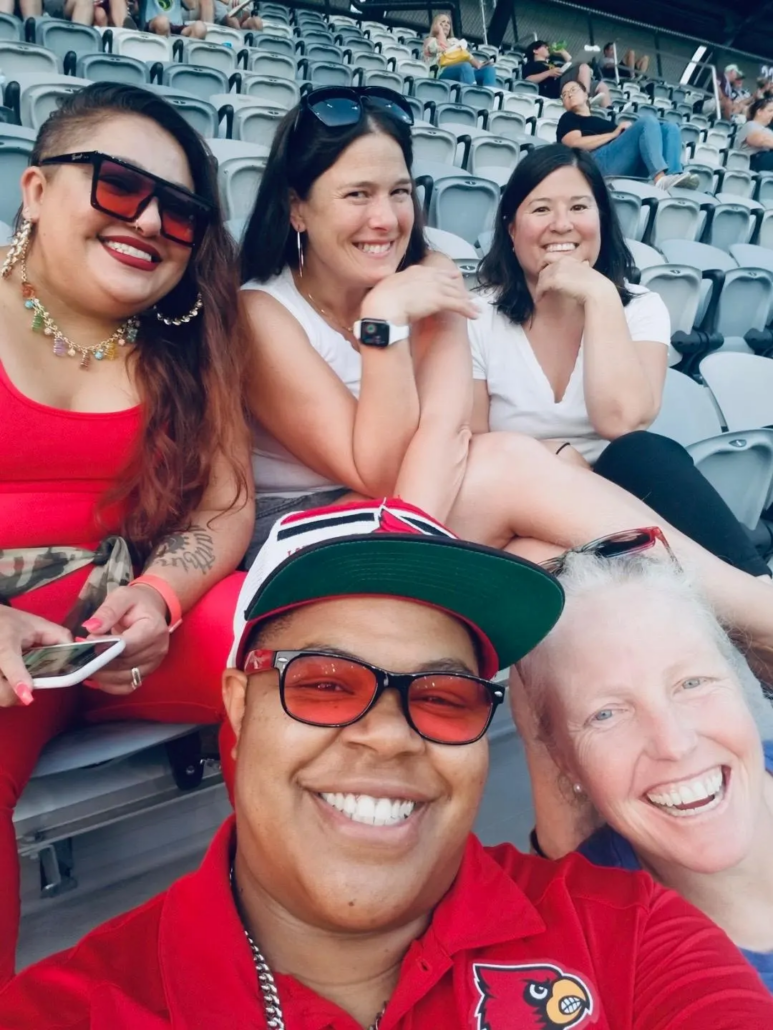
Paulina Helm-Hernández, left, and Ashe Helm-Hernandez, front, with friends at a Racing Louisville game. Supplied by Paulina Helm-Hernández and Ashe Helm-Hernandez
Paulina observed a crowd of fans that day considerably less diverse than the city’s larger population. Black residents make up about 23% of the Louisville-Jefferson County metro’s population, and Latino residents about 9%. But Louisville’s diversity has never been evenly distributed across the city. Decades of racial zoning, redlining and other discriminatory housing practices helped produce geographic divisions that remain visible today, with Louisville Metro’s own housing research finding that the city remains segregated by race and ethnicity.
Those divisions also intersect with Louisville’s LGBTQIA+ history. Researchers at the University of Louisville’s Anne Braden Institute have documented race as an important part of understanding queer life and history across Kentucky. Today, Louisville contains some of the state’s strongest LGBTQIA+ community and health infrastructure, but recent survey data from Queer Kentucky suggests that access and belonging remain uneven, even within the state’s largest urban center. Queer Kentucky’s 2025 Community Health Survey found that 65.5% of its 559 LGBTQIA+ respondents reported a strong sense of community belonging, while 11.4% reported low belonging. Respondents living with HIV reported an average belonging score of 3.98, compared with a statewide average of 4.86, the lowest average belonging score of any group measured.
Belonging is a primary indicator of good health. People need access to doctors, medicine, testing and treatment to be well, but research increasingly recognizes that people also need relationships, community and places where they can meaningfully connect with other people. The CDC names social connection an important determinant of physical and mental health, while research cited by the U.S. Surgeon General found that people with a strong sense of community belonging were 2.6 times more likely to report being in good or excellent health than people with a low sense of belonging.
This is especially important for LGBTQIA+ communities, whose rights to love, marry, build families and openly exist continue to be challenged and questioned by elected leaders. For communities whose belonging in public life has repeatedly been contested, having spaces where people can safely gather, build relationships and see themselves reflected is not just about having somewhere to go. Those spaces can become part of what people need to feel connected, supported and well.
That makes the places where LGBTQIA+ people gather part of the conversation about community health, too. A stadium cannot replace a doctor’s office, a testing site or a public health program. But it can do something those institutions cannot always do on their own: regularly bring queer and trans people together around a shared experience and create opportunities for LGBTQIA+ people to feel like they are part of fandom that affirms who they are and who they wish to be in the world.
Still, what Paulina encountered inside the stadium suggested to her that Racing already had much of what it needed to reach a broader community.
“I remember thinking, you know, as a fan of women’s sports, I thought it was a great atmosphere. But I do think, you know, it lacked the cultural diversity that I’m used to in terms of being able to enjoy like those kinds of sporting events, knowing that they’re also a reflection of like not just fanhood, but like what does it actually mean to have infrastructure that like is actually focused on women’s sports and women athletes so that to me you know it’s a mixed bag,” she said. “But I do remember enjoying the game, we had a great time, everybody that worked at the stadium was very welcoming and very warm, and I feel like the space in and of itself… It’s a beautiful arena, and so to me, they have everything in space in terms of the infrastructure, you know, to be able to welcome more people.”
Ashe’s first experience with Racing started differently. A lifelong Louisville sports fan, they showed up dressed for the Louisville team they already knew, but whose colors didn’t match this home team.
“I can go ahead and admit that I totally had on red,” they said. “I had on a University of Louisville ball cap, and my friends busted out laughing at my appearance and quickly took me to the Racing store to get some gear. And so, you know, I was shy. I was like, I didn’t look this team up. My friends invited me out, and I was like, ‘Let’s go! It’s Louisville,’ and I am a diehard University of Louisville fan, and I got that mixed up a bit. So yeah, but lavender is a beautiful color, and I appreciate it very much having some new gear.”
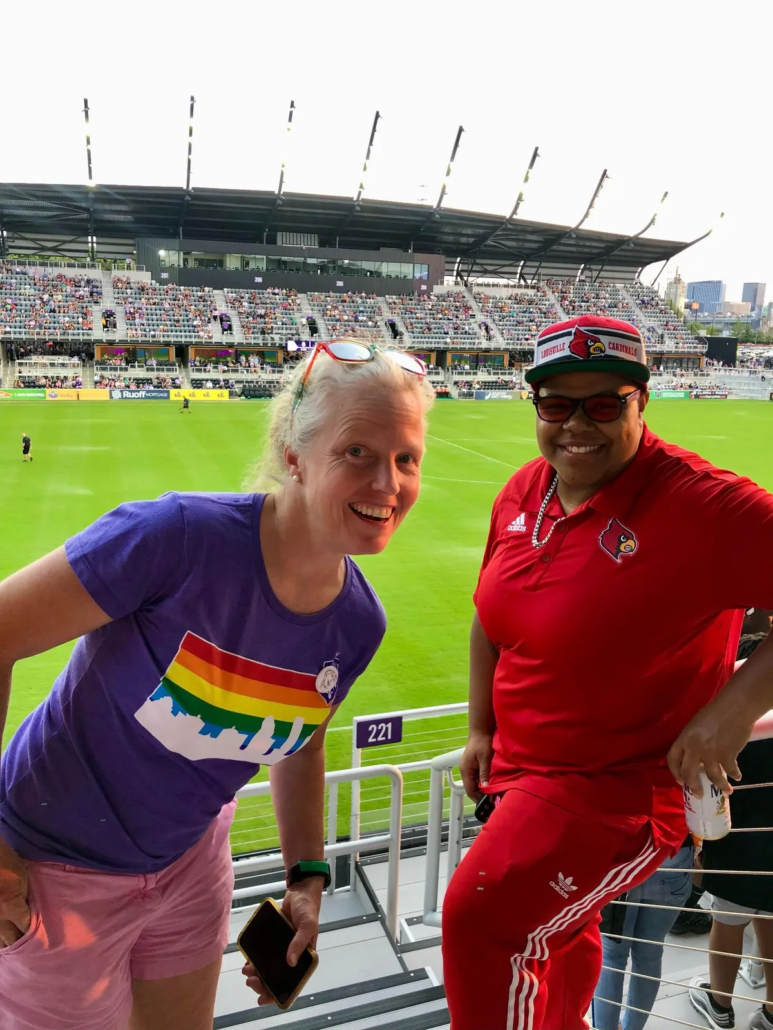
Ashe Helm-Hernandez, right, in University of Louisville red with a friend at a Racing Louisville game in 2021. Supplied by Paulina Helm-Hernández and Ashe Helm-Hernandez
Soccer as belonging, belonging as care
Their experiences point toward something larger than fandom. In 1995, Kentucky did not have a top-tier professional women’s soccer team or a stadium capable of regularly gathering thousands of women’s soccer fans. Today it does. That growth creates an opportunity that did not exist three decades ago. Professional women’s soccer now has the physical infrastructure, cultural visibility and audience to bring thousands of people together at a time. And some of the communities gathering around women’s sports are the same communities Kentucky’s existing healthcare infrastructure is still struggling to reach.
Queer Kentucky’s 2025 Community Health Survey found that 48.2% of its 559 LGBTQIA+ respondents had never been tested for HIV. Among cisgender women, that figure was 53.6%. Among transgender women, it was 57.7%, and among nonbinary respondents, 50.6%. At the same time, more than one in three respondents statewide reported having no regular healthcare provider, while the U.S. Department of Health and Human Services reports that approximately 1.2 million people in the United States are living with HIV, and one in eight do not know they have the disease.
The relationship between community and HIV prevention is not theoretical. The U.S. Surgeon General’s advisory on social connection notes that stigma surrounding HIV can create barriers to both healthcare and social inclusion, while National Institutes of Health research has found a link between stronger community connections and people taking steps to prevent HIV.
That raises a different question about the economic and social value of professional women’s sports in Kentucky. What if the value of a stadium is not limited to what happens on the field? What if the same infrastructure, built to gather thousands of fans around women athletes, can also become infrastructure for connecting communities to information, testing, prevention and care?
There is already another professional women’s sports league that offers a glimpse of what can happen when that kind of infrastructure is given time to grow.
For Paulina and Ashe, the Women’s National Basketball Association (WNBA) has never been just basketball. Both came of age alongside a league that has now existed for 30 years and watched women’s professional basketball become a place where Black women, queer people and generations of women’s sports fans could see themselves reflected.
Some of Paulina’s earliest experiences in LGBTQ+ movement spaces were already intertwined with women’s basketball. She remembers older lesbians gathering around games and using basketball itself as a language for thinking about organizing and movement building.
“I grew up in an era where people were very like: This is one of the lenses to understand, you know, movement building,” she said.
Three decades later, she sees what women’s professional basketball has become, as more than commercial growth. She called the rise of the WNBA a “social and political win,” describing women’s sports as one of the places where fans can now see “queer excellence” and “feminist excellence” at the highest level.
Ashe remembers that history differently. Growing up playing basketball, some of the women they watched in the earliest years of the WNBA became their heroes.
“I was able to look up to Cheryl Swoopes, and I was able to look up to Cynthia Cooper as people and role models,” they said. “That I could be, that Black women could do that, that they could be on television, that they could play sports, that they could play basketball, that they could sweat, they could be fierce.”
Today, Ashe sees younger players learning whose footsteps they are following, while the players they grew up watching are finally being recognized as living legends.
Their experiences show what can happen when a professional women’s sports league has enough time to become part of a generation’s lives. The NWSL is still building that history. The WNBA was founded in 1996 and began play the following year. In 2026, the league celebrated its 30th season. The NWSL, by comparison, was founded in 2012 and played its first season in 2013. In just over a decade, professional women’s soccer has grown considerably, but that’s still only half the time the WNBA has had to become part of the lives, traditions and communities of its fans.
That difference in time matters when thinking about what Paulina and Ashe described. The impact of the WNBA on their lives cannot be measured only through attendance, television audiences or revenue. They are describing what happens when a professional women’s sports league exists long enough for people to grow up alongside it. Players become childhood heroes. Games become traditions. Fans build relationships with one another.
Queer people find spaces where they see themselves reflected. Over time, a sports league can become part of the social infrastructure of a community.
For Paulina, women’s basketball was woven into LGBTQ+ community life long before the WNBA became a mainstream cultural phenomenon. She remembers gathering at people’s homes to watch games, where basketball brought people together for more than just the competition.
“You just had to get with the program and you had to watch games and you had to go to people’s houses and know that the meetings happen after the game and know you were not allowed to talk through it,” she recalled.
For Ashe, the league’s history is personal. During a recent presentation at work, they shared a photograph of WNBA players from three decades ago with their colleagues: “I told my team that these were my heroes,” Ashe said. Those same athletes who inspired Ashe as a young basketball player are now being celebrated by another generation.
“For me, it’s a very serious moment where players are getting their due, and where younger players are learning whose footsteps they walk in, and they too are being able to recognize living legends,” Ashe said.
Paulina remembers the relationships and organizing that happened around games; Ashe remembers the athletes who showed them what was possible for Black women in professional sports. Together, their experiences illustrate how a league can become part of a community’s history, creating relationships, traditions and a sense of belonging that develop over generations.
Racing Louisville, which joined the league in 2021, is part of a story that is still unfolding, as fans begin building those traditions and relationships that future generations may one day inherit. But just five years after the club began playing in Kentucky, questions have emerged about its long-term future in Louisville.
That possibility raises another question about how communities measure the value of women’s sports institutions. Five years may be enough time to count tickets, calculate attendance and measure revenue. It may not be enough time to measure what happens when a generation grows up with a professional women’s team in its city, when queer fans build traditions around going to games together, when Black and Latine children begin seeing the stadium as somewhere they belong – when community organizations begin treating that stadium as another place where people can be reached.
Lynn Family Stadium represents physical infrastructure. It has more than 15,000 seats and the ability to bring thousands of people together at once. But what Paulina and Ashe describe through their experiences with women’s sports is another kind of infrastructure that takes much longer to build. Relationships, traditions, information networks, chosen family, representation, belonging and trust develop over years as LGBTQIA+ people repeatedly gather in the same places and around the same women’s sports teams.