KEEP. Year. Marks the election or session CYCLE, not the publish date. A November 2025 story about the 2026 election is Year: 2026.

Tag Archive for: Year: 2025

Will transgender Kentuckians on Medicaid lose some health care? It is unclear.

A new law blocking transgender Kentuckians from using Medicaid to cover some forms of gender-affirming health care goes into effect Friday — but will it actually be enforced?

It seems like no one knows for sure, leaving an untold number of LGBTQ+ individuals in limbo.

“Everything is a little unclear and we are preparing for the worst case scenario,” Chris Hartman, who leads the Fairness Campaign, told Queer Kentucky Wednesday. 

This year’s House Bill 495 sought to do two things aimed at the LGBTQ+ community: Undo Gov. Andy Beshear’s executive order banning “conversion therapy” in the state, and prohibit people on Medicaid from accessing some treatments tied to gender dysphoria. 

The part of HB 495 around “conversion therapy” went into effect upon the bill’s passage this spring, but the Medicaid piece is scheduled to go into effect alongside dozens of other new laws Friday. 

But, back in March, Beshear told lawmakers HB 495, along with nearly a dozen other bills, didn’t come with what his office believes to be necessary funding, and therefore, he shouldn’t be expected to implement it. 

“These holdings are simple: if the legislature creates a policy or program but does not provide  funding, it does not intend for the executive branch to perform those services over the biennium. The omission of an appropriation is the same as its elimination,” Beshear wrote at the time.

A fiscal analysis conducted by Beshear’s office estimated that HB 495 would cost the Medicaid program, partially funded by state dollars, an extra $6.3 to $9.8 million for “increased behavioral and mental health services for 5,000-10,000 persons.”

Reducing access to gender-affirming treatments and allowing the discredited practice of conversion therapy can lead to increased mental health issues for LGBTQ+ individuals, therefore potentially costing the state more for needing to cover additional counseling services and more psychiatric hospitalization.

Beshear’s letter did not differentiate between the two distinct pieces of HB 495. A spokesperson for Beshear’s office did not directly respond to questions as to whether or not the administration plans on implementing the Medicaid portion of the bill. 

However, no state funds are currently spent on “conversion therapy.” It is unclear how much, if any, state funds went to the discredited practice prior to Beshear’s September executive order banning the use of state dollars from covering it. 

The GOP-dominated legislature said in March they expect Beshear’s administration to enforce all of the laws they pass as written. Some GOP leaders went as far as to threaten Beshear’s budget and authority, should he not do what they say. 

“He won’t hire anybody, he won’t travel. He won’t do anything unless he gets authority from the legislature,” Senate President Robert Stivers told reporters at the time. 

Meanwhile, Kentuckians using Medicaid to cover gender-affirming health care like hormone therapies and puberty blockers are caught in the middle of the ongoing power struggle between Beshear and the legislature. 

Hartman pointed to the Kentucky Health Justice Network, which is expected to share options for “copayment assistance should it become necessary.”

He continued: “The Fairness Campaign is committed to doubling KHJN’s current transgender healthcare copayment fund as the need increases, and then we will assess where we are after things shake out in a few months. I hope our commitment will inspire other organizations and individuals to help underwrite any potential added costs to transgender Kentuckians’ healthcare due to the effects of House Bill 495.”

WTF is the interim session? What to know about why folks are heading back to Frankfort — and you should too.

My party people, I do fear it is time to return to Frankfort. 

Unfortunately, yes, I am serious.

But this time around, the GOP-dominated legislature won’t be able to pass any laws — just chit-chat about them.

Kentucky’s 2025 interim session kicks off the first week of June and runs until around December. 

Even though lawmakers won’t be able to pass anything, the interim session is a great way to deepen your knowledge of Frankfort, talk with your elected officials or even dip your toes into the warm sands of civic engagement for the first time. 

What is the interim session and why should you care? Allow me to explain. 

What is the interim session?

Think of the interim session as Frankfort’s off-season conditioning. 

Unlike during the regular legislative session, which runs typically from January until April-ish, lawmakers aren’t in Frankfort every day. But during the interim, lawmakers show up maybe a few times a month to attend committee meetings and discuss topics of some sort of importance.

The House and Senate versions of each committee — like, say, education committees — combine into one for joint meetings. You also typically see a few task forces designed to target specific topics or issues meeting during the interim so they can study a topic and give the legislature ideas about how to fix it ahead of the next legislative session.

They can’t pass any legislation, but often, the stuff they discuss during the interim turns into or at least informs the bills they file in the next legislative session. So it is important to pay attention. 

What’s the difference between the interim session and the legislative session?

Simple: Lawmakers can file and pass bills during the legislative session, and they can’t do that during the interim session. 

Why should I care?

Listen, I get it. We’ve fought through yet another legislative session in Kentucky, and no one really wants to think about Frankfort again until the next legislative session. 

But the interim session is a great way to get civically engaged in whatever way feels best for you. For folks who don’t know much about Frankfort or are intimidated by the whole legislative process, the interim session is a great way to get your foot in the door. 

A lot of the conversations are about topics that could potentially turn into bills. This is a time where lawmakers hear directly from experts or key officials, so listening in can help you understand the underlying facts of a situation before everything gets more political. 

You also may be able to testify directly to lawmakers without the stringent time restraints that tend to cut off stakeholder voices during session. The interim generally is a low-pressure time where everyone is focused more on learning and understanding an issue, rather than political rhetoric and yelling. 

This means your lawmaker might have more time free to talk to you about topics you’re interested in, too. Even if it is just a quick introduction, this is a lower-stress time to lay any advocacy groundwork. 

You can learn more about Queer Kentucky’s tips for advocating for yourself and others in Frankfort right here. 

What are some things to watch for during the interim?

2026 is a budget year in Kentucky, so expect a lot of chatter about that.

Past that, I’m expecting some talk about how the Trump administration is — or could be — impacting Kentucky, and how the state government should adapt to federal changes.

On the LGBTQ+ front, I would be on the watch for discussions about bathroom policies on the state Capitol grounds. The 2025 legislative session ended with a bang with a GOP state representative accosting a transgender woman outside of a women’s restroom in the Capitol. The rep pretty quickly vowed to propose legislation to enforce some sort of “bathroom ban” in 2026. 

When is Kentucky’s interim session? 

Kentucky’s interim session starts June 3 and runs for several months. Typically, committees wrap things up in November, but some keep going in December. 

Instead of meeting weekly (if not more) during a legislative session, committees tend to meet monthly during the interim. You’re less likely to see multiple committee meetings happening at the same time, too, making it easier to focus on the one you’re in. 

You can see the full schedule for interim session meetings on the LRC website.

Where do interim meetings happen? 

Generally, meetings happen in the Capitol Annex in Frankfort. 

But a fun part of the interim session is that sometimes, they hold meetings elsewhere in Kentucky. For example, several committees opt to meet at the Kentucky State Fair in Louisville in August rather than going to Frankfort. 

How can I get involved?

You can show up in-person in Frankfort or you can watch a live-stream. KET tends to be a good pick, but the LRC — the nonpartisan group of workers who make everything work behind-the-scenes — has a YouTube page that has never failed me. 

What Are Your Rights if Someone Posts Your Nudes or AI Deepfakes Online in Kentucky?

If someone drops your nudes online without your consent, what rights — if any — do you have in Kentucky? 

What about AI-generated deep fakes meant to look like you? Revenge porn? Even — as hundreds of Kentucky girls and women, including a sitting GOP state representative, recently experienced — grabbing your fully clothed pictures from social media and uploading them, still without your knowledge or permission, to a porn site? 

Some Kentucky lawmakers are trying — and have been trying — to clarify, codify and bolster your rights, should something like that happen to you. 

Here’s a look at where things stand, and what could be up for discussion in the 2026 legislative session.


‘Sextortion’ now a crime in Kentucky

Kentucky made revenge porn — basically sharing your nudes or other intimate images without your consent — a crime in 2018. 

And earlier this year, “sextortion” — when someone obtains either real or fake explicit images of you and threatens to release them publicly unless you meet their demands — became a felony in Kentucky with the passage of Senate Bill 73. 

“Sexual extortion is one of the most dangerous and rapidly growing crimes targeting young people today. It is calculated, it is cruel and it thrives on fear and silence,” bill sponsor Sen. Julie Raque Adams (R-Louisville) told a Senate committee in February. “Too many kids today are being manipulated into situations that they don’t know how to escape from.”

The bill also requires schools to help students and their families understand the dangers around sextortion. 

SB 73 passed both chambers unanimously and was signed into law by Gov. Andy Beshear in mid-March. It will go into effect at the end of June. 


‘Right of Publicity’ bill struggles 

Another bill aimed at giving Kentuckians more rights over their images, however, didn’t pass during the 2025 legislative session.

Sen. Amanda Mays Bledsoe (R-Lexington) filed Senate Bill 7, which she dubbed the “Right of Publicity Act.” Basically, it sought to codify a person’s property rights over images of their unclothed body, and set up parameters around how said rights could be transferred or terminated. 

SB 7 would’ve also allowed Kentuckians who had their nudes used without their consent to sue whomever shared them for at least $10,000 per violation, per person. 

The bill also paid special attention to computer-generated images, building on Bledsoe’s — and the legislature’s — work around targeting artificial intelligence. 

“This is about personal dignity, privacy, and control,” Bledsoe said in March. “Technology moves faster than the law, and artificial intelligence has made it possible to fabricate completely false images with terrifying accuracy. No Kentuckian—not a public figure, not an ordinary citizen, and certainly not a child—should have to fight to reclaim ownership of their likeness.”

SB 7 easily cleared the Senate on a unanimous vote, but ultimately stalled in the House and didn’t become law. 


Federal legislation gets passed

Congress passed something similar in April with the Melania Trump-backed TAKE IT DOWN Act. That stands for Tools to Address Known Exploitation by Immobilizing Technological Deepfakes on Websites and Networks. 

It prohibits someone from sharing intimate images of you online — both actual photos and AI-created ones — without your consent. It also requires online platforms to remove the images within 48 hours of a victim requesting them to take them down. 

Bledsoe celebrated its passage, adding on specific praise for Kentucky Congressman Brett Guthrie for his work “advancing protections for victims of digital exploitation” at the federal level.

“As a mother and a legislator, I know how urgent it is to modernize our laws to meet the threats of a rapidly changing digital world, especially when it comes to protecting our children and families from image-based abuse and exploitation,” Bledsoe said in a statement. 

She continued to say the federal-level action “builds on the momentum we’re seeing at the state level. 

“It sends a powerful, united message: personal privacy and human dignity must be protected in our fast-moving digital world.”


A state rep’s real-time experience and what could come in 2026

More than 300 Kentucky girls and women recently discovered someone had been pulling their photos from social media and posting them to a porn site. And, allegedly, he had been doing so for years. 

One of them was 33-year-old GOP Rep. Samara Heavrin from Leitchfield. 

Saying she was “deeply disturbed” by the situation, Heavrin wrote in a Facebook post that “many of the photos were of clothed women.” (In an interview with KET, Heavrin said her photos got pulled from her personal Facebook page and included stuff like a picture of her and her dog posing for their Christmas card.)

But, she added on Facebook, “the horrific comments posted by users of the website are something that will take years for these women to overcome. This behavior is unacceptable.”

On KET, Heavrin described Kentucky’s legal landscape around situations like hers as “a really gray area.

“Our law reads that it’s not — I don’t want to say it’s fair game, but if you post something on the internet, there’s not really any laws that protect people from it being put on a pornographic website.”

She plans on using her role as the House Families and Children Committee Chair to look at what state lawmakers could do.

“I plan on exploring legislation that would require consent of the individual for photographs of them to be placed on pornographic or explicit websites,” she wrote on Facebook. “We must hold predators accountable for their actions.” 

Kentucky’s next legislative session doesn’t start until early January 2026, but its interim session — a time where lawmakers gather to discuss pressing topics and potential pieces of legislation, but can’t pass anything — kicks off June 3. As a committee chair, Heavrin will oversee and set the agenda for the Families and Children meeting every other month.

“What I want to do is be able to prevent this from happening again,” she said on KET, “and unless we have a hard conversation about it and make real policy changes, it will happen again.”


“This Is an Attack on Our Lives”: The Impact of Kentucky’s Anti-Trans Laws

feature photo provided by JustFundKy

When Sirene Martin read the news that Kentucky had officially banned Medicaid coverage for gender-affirming care, her heart sank. Martin, a 26-year-old trans woman, says that being able to start hormone replacement therapy (HRT) five years ago was life-changing. The process was, as she recalls, painful at first — an excruciating second puberty in which her body transformed into something new and, ultimately, resplendent. Martin felt as if, for perhaps the very first time, she was becoming in touch with her physical form. She had to learn how to carry herself in this new body: from how she stood up and sat down to how she moved through the world.

“It was sort of like relearning how to walk, in a way,” she tells QueerKentucky. “Having access to hormones, and knowing that over time, slowly, I was going to start recognizing myself in the way that I always have known myself to be, has been instrumental to my growth. Hormones have allowed my mind to be freed up so that I can focus on things that everyone else focuses on, just daily life.”

photo provided by Sirene Martin

Under Kentucky’s Medicaid ban, Martin isn’t sure how she will continue to access the medication that has allowed her to be transcendently herself. Martin works as a curatorial assistant, and because her employer doesn’t cover her health care, she is insured through the state’s Medicaid program. After Republican lawmakers overrode Democratic Gov. Andy Beshear’s veto of a bill stripping coverage for HRT, surgical care, and other transition treatments, the new law — which impacts both youth and adults — will take effect in June. Beshear has vowed that he will not implement the Medicaid ban, but should be unable to impede it, paying for hormones out of pocket would set Martin back $150 every refill. She doesn’t think she could afford that added expense.

When Martin contemplates what it would be like to lose her hormones, anger radiates through her chest. While she says the feeling of being wedged “between a rock and a hard place” is not unfamiliar or unsurprising to her, Martin is nonetheless shaken by the needlessness of her imposed suffering. “The anger is obviously righteous, but even more, it’s volatile,” she says. “People don’t understand that this is an attack on our lives — not just on our ability to access medical care, but our ability to be human beings on the earth.”

Trans Kentuckians say they are reeling from the combined impact of the state’s recent spate of laws targeting their everyday lives. The legislative onslaught began in 2023, when GOP lawmakers — over Beshear’s objections — forced through a sweeping omnibus bill that some observers deemed to be among the most harmful pieces of anti-trans policy in U.S. history. In addition to restricting gender-affirming medical treatments for trans youth under the age of 18, SB 150 also bars any mention of LGBTQ+ identities in K-6 classrooms, blocks trans youth from using school bathrooms that correspond with their lived identities, and impedes disciplinary action against teachers who misgender trans students. It also mandates that schools inform parents if they learn that a student is trans, potentially outing youth to unsupportive families.

Legislators have continued to up the ante in 2025, introducing at least 18 bills targeting the trans community, according to the Trans Legislation Tracker website. Among them, Republican lawmakers are pushing bills that would deny gender-affirming care to incarcerated trans people and force them to be housed in accordance with their sex assigned at birth. This year, Kentucky also became the first state in U.S. history to overturn its own conversion therapy ban, by passing a bill that effectively nullified a 2024 executive order from Beshear restricting the discredited, harmful practice. Beshear, again, attempted to stop the latter effort, but Republicans wield a veto-proof supermajority in the legislature.

Sources tell Queer Kentucky that, taken in aggregate, these decisions have made being a trans person in the Bluegrass State significantly harder. Sage Barr, an 18-year-old student, says the state’s shifting political tides have significantly heightened their daily anxieties. They are concerned about what others emboldened by anti-trans rhetoric might do to them, especially with President Donald Trump now back in office, and scared about what laws might be coming next. “I sometimes can’t focus on homework on conversations with friends or family because I’m so worried about what’s going on, about America turning into 1930s Germany,” Barr says.

photo provided by Sage Barr

Others agree that Kentucky, despite its progressive bubbles, has become more hostile to their existence in the wake of recent legislation. As the resident of a rural community, 28-year-old Beck Jensen says the differences are subtle but unmistakable: a marked increase in “ma’ams” from strangers and prolonged stares in public. Jensen, a self-described “nonbinary butch lesbian,” says that the shopkeeper at a thrift store kept attempting to guide them over to the women’s section while shopping for a Halloween costume inspired by the 2005 queer neo-western Brokeback Mountain. “Before I was used to people always being really friendly with me,” Jensen tells Queer Kentucky. “Now I feel like I have to watch my back a little bit more.” 

But that passive aggression, for all its sinister undertones, is less immediately pressing than the tangible impact of Kentucky policy. After booking their first appointment the same day that SB 150 passed, Jensen plans to start testosterone as soon as possible, but as a Medicaid recipient, that treatment will only be covered for the next two months. Because Jensen earns a very modest wage from their day job as a zookeeper at a nonprofit sanctuary, friends have offered to share their hormones to ensure Jensen’s medical transition isn’t interrupted. Deciding whether to accept their kindness means choosing between their own wellbeing and others’ health, Jensen notes.

“They might need those backup reserves, and I don’t want to take medication away from somebody,” they say. “Some of my friends are full-on trans men, and if they were to stop, they would regress in their treatment. That might be more endangering for them than it would be for me.”

Carma Marshall, 35, says that she has begun rationing her medication in preparation for losing her Medicaid coverage in June. While she hopes to be able to afford the cost of HRT without insurance, Marshall knows there are times she may not have the money. Going without, Marshall says, is simply not an option. She fears what would happen if she were no longer able to meet society’s normative expectations of femininity, if her body hair started to grow back thicker or her shape were to suddenly be a little less womanly. Marshall already has some experience with the harassment that could result: While testifying against anti-trans legislation earlier this year, Marshall was verbally accosted by a GOP lawmaker outside the women’s restroom at the Kentucky state capitol building. 

photo provided by Carma Marshall

Being able to assimilate, Marshall says, is key to escaping the violence that disproportionately affects Black trans women, but it’s not merely about surviving. Her medical transition has allowed her to thrive: Before she began taking steps to be the woman that she had been all along, Marshall was a shut-in who barely left her home. She was scared of “how the world would see me and treat me,” Marshall recalls. Now, she is a co-chair of Louisville’s Transgender Wellness Coalition, helping other vulnerable members of the community find their own strength and resilience. Marshall refuses to be shoved back inside again, not after how far she’s come.

“We all deserve dignity and the pursuit of happiness in this slice of American pie that we’re all trying to live,” she tells Queer Kentucky. “For them to now say that we’re not worthy of that — or that we’re crazy for trying to pursue that — is absolutely ridiculous.  If you want to hate me, that’s fine. You can hate me, but let’s try to work together so that we all can make it in this really difficult world.”

Five takeaways from Kentucky’s 2025 legislative session

Kentucky’s 2025 legislative session is officially done.

Lawmakers left Frankfort more than a week ago, and Gov. Andy Beshear just signed off on the last bill on his desk. 

So, what exactly happened this session? And where do things go from here? I’ve been covering the legislative session for Queer Kentucky for the last three months, and here are my top takeaways for y’all.


The GOP is still very much in charge

Kentucky’s legislature is 80% Republican, and they won’t let you forget it. 

Now, this isn’t particularly groundbreaking — the GOP has had a veto-proof supermajority in both chambers for a few years now — but it seemed slightly more dominant this year.

Debate rules got changed, ultimately preventing House Democrats from filibustering their way from stopping two anti-LGBTQ+ bills from passing. We saw fewer aisle-crossers, with Republicans seemingly presenting a more unified front when faced with high-profile controversial bills than in the past. 

Beshear vetoed around 30 of the roughly 160 bills and resolutions they sent to him. All but a handful of specific line-item vetoes got overridden, with very little fight. Unlike in past sessions, where some bills or veto overrides seemed like they could fail due to infighting or divisions, it felt like everything was simply a done deal. 


Turned down the temp, still got burned

Frankfort was … a little quieter than expected this year. 

There are several reasons for that: A renewed focus on smaller bills and technical changes during short sessions, fewer majorly controversial bills — especially surprise ones — and infighting around them, multiple major weather events that prevented folks from getting to the Capitol. 

But the LGBTQ+ community still got burned. 

Beshear’s ban on conversion therapy is already gone, and he won’t be allowed to enact another one for the rest of his time as governor. 

Kentuckians won’t be able to use Medicaid to cover gender-affirming health care, beginning in late June. Lawmakers passed a last-second bill clarifying that when they talk about “gender-affirming care,” they are specifically targeting treatments used for gender dysphoria. 

And transgender inmates in Kentucky won’t be able to access gender-affirming health care, either. 

Meanwhile, several pro-LGBTQ+ bills, including ones to enact a statewide fairness ordinance and codify Beshear’s ban on conversion therapy, went nowhere. 


Eyes on Beshear

One thing that stuck out to me: A slight shift in Beshear’s approach to anti-LGBTQ+ legislation as he eyes a potential run for president in 2028.

Beshear has been lauded as being a pro-LGBTQ+ governor, being the first sitting Kentucky governor to attend the annual Fairness Rally at the state Capitol and routinely vetoing anti-LGBTQ+ bills in the past, even when he knows he’ll be overruled.

We saw a break from that this year, when he let two of the three anti-LGBTQ+ bills — specifically ones aimed at the transgender community — on his desk become law without him. 

He proudly vetoed House Bill 495 — the one undoing his ban on conversion therapy and restricting Medicaid access for transgender Kentuckians — to a standing ovation at the Fairness Dinner in March. 

But his veto message focused solely on conversion therapy, without mention of the untold number of transgender Kentuckians who will lose valuable health care under the bill. 

And when it came to protecting the same health care access for transgender inmates, he let Senate Bill 2 become law without his signature.

“The Governor does not believe that the state should pay for gender reassignment surgeries for convicted felons, as this would mean those in prison would receive better access to medical care than a law-abiding citizen,” a press release from Beshear’s office said at the time. “However, courts have ruled that federal law may require some nonsurgical care.”

Kentucky currently only has a few dozen transgender inmates receiving treatment, and surgeries already weren’t happening. But given the current political climate and direct target on the trans community’s backs, there is a fear simply being trans will become a crime — therefore potentially making Beshear complicit in what could be a mass forced detransitioning. 

He also let House Bill 501, which clarified the legislature is targeting hormone treatments for gender dysphoria, become law without his signature, even though he could’ve vetoed it and the legislature wouldn’t have been able to override him. 


Next GOP target: Capitol bathrooms

It is never too early to look ahead to the 2026 legislative session, y’all. Two things to go ahead and put on your to-watch list: Budgets and bathrooms. 

Lawmakers deal with the state budget every other year, so that’s to be expected, so let’s focus on bathrooms for now.

ICYMI: The 2025 session ended with a major saga involving a GOP state representative cornering a transgender woman coming out of the bathroom at the state Capitol, and right-leaning social media had a field day with it. 

There doesn’t currently seem to be any policies over who can use which restroom on Capitol grounds. Trans activists have been able to use whichever facilities they’re most comfortable with without issue, I’ve been told. 

But the aforementioned GOP state rep — Rep. Bill Wesley — has vowed to introduce legislation next year to require folks at the Capitol to use the bathroom tied to their assigned sex at birth. It isn’t clear how it would be enforced or if it would have much traction.

It is also important to note that next year is an election year, with all of the House seats and half of the Senate up for grabs. So folks will be looking for ways to get votes, and given how much conservative Twitter ate up this whole debacle, don’t expect this issue to go away over summer. 


What’s next? 

The interim legislative session — where lawmakers casually meet in Frankfort to chat about issues that could come up in the 2026 session — should begin in June and run until early December. 

This is a good time to start watching the legislature because it is low-pressure, you’ll get a good sense of the actual issues at hand instead of just rushed rhetoric, and people rarely fight. It is also a good time to start talking to your lawmakers (if you’d like) and/or get involved with advocacy groups that align with issues you care about. 

Kentucky’s 2026 legislative session starts Jan. 6, 2026. 


GOP State Representative denies trans woman bathroom access sparking controversy at Kentucky Capitol

A GOP state representative in Kentucky accosted a transgender woman trying to use the women’s bathroom at the state Capitol Thursday, sparking a terse exchange with another lawmaker on the House floor later in the day.

Carma Bell Marshall, who leads the Trans-Wellness Coalition, tried to use the restroom before speaking at a trans pride event when Rep. Bill Wesley (R-Ravenna) intervened, allegedly falsely saying it was illegal for her to use the women’s restroom and involving state law enforcement.

Restrooms at the state Capitol and the Capitol Annex, where committee meetings are held, do not appear to have policies about who can and cannot use them. Marshall did not respond to a request for comment.

Photos of the encounter got posted on social media, with conservatives celebrating Wesley and using the moment to spread anti-trans sentiments.

“My colleague stood up to this madness, reminded the man that he is a man, and he has no place in women and girl’s spaces, especially the bathroom,” GOP Rep. TJ Roberts tweeted. “This is the truth. Men are men, and can never become women.”

Later, Sen. Karen Berg — a Louisville Democrat who lost her transgender son to suicide in 2022 — approached Wesley on the House floor, having a tense exchange captured on video.

In the roughly 20-second clip, you can see the two speaking closely but can’t hear them. As Berg turns to leave, Wesley says something to her, causing her to come back and put a hand on his shoulder. She then smacks his back as she leaves.

“A far left democrat senator slapped me after I kept a man pretending to be a woman out of the girl’s bathroom in the Kentucky Capitol,” Wesley tweeted. “I will always protect women and girls from insanity, and will never yield to threats and violence of the far Left, including from Karen Berg!!”

(Wesley said in a subsequent tweet categorizing Berg’s actions as “slapped” was him being sarcastic.)

House leadership permanently revoked Berg’s floor privileges over the incident, the Lexington Herald-Leader reported.

Berg’s late transgender son, Henry, was a trans rights activist who got his start in Frankfort fighting against an attempted bathroom ban bill several years ago. Wesley sponsored one of the most recent attempts to police school bathrooms in 2023. Parts of his bill got added to 2023’s Senate Bill 150, which was considered one of the worst anti-trans pieces of legislation in the country.

The debacle came as Kentucky wraps up its 2025 legislative session, in which it passed multiple laws aimed at restricting access to gender-affirming health care for transgender people.

Senate Bill 2 prohibits gender-affirming care for transgender inmates. House Bill 495 blocks Medicaid dollars from covering hormone treatments and surgeries. It also protects conversion therapy, which has largely been banned in Kentucky since September.

Both are now law — SB 2 became law without Beshear’s signature Wednesday, and lawmakers overrode Beshear’s veto of HB 495 Thursday.

Friday was the final day of session.

If you or someone you know is struggling, call or text the 988 Suicide & Crisis Lifeline at 988. LGBTQ+ young people can press 3 to reach counselors trained in LGBTQ+ care, an option that returned on Sept. 30, 2026 after it was cut in July 2025. The Trevor Project also offers 24/7 support at 1-866-488-7386 or by texting START to 678-678.

Follow along with the last two days of Kentucky’s 2025 legislative session

Kentucky’s 2025 legislative session is finally almost over. 

Lawmakers will spend Thursday and Friday in Frankfort tying up some loose strings and mainly overriding several (if not all) of Gov. Andy Beshear’s nearly 30 vetoes. 

Queer Kentucky will be monitoring things so you don’t have to (but, obviously, feel free to join us in civic engagement). We’ll be updating this story as things progress from now until the clock strikes midnight Friday and lawmakers, per the state constitution, must go home. 


6:21 p.m. Friday: Y’all, it is done!

Kentucky’s 2025 legislative session is officially over. Actually, it ended close to an hour ago. I’ve yet to hear from anyone — lawmakers, journalists, even the Senate Gallery doorkeeper — who can prove that this isn’t a record time on the final day of session.

As expected, it was a light day. The change to HB 501 to clarify that lawmakers are directly targeting transgender people’s hormone therapies in a new law blocking Medicaid coverage of such treatments cleared the House, but Beshear will have a chance to veto it and lawmakers will not be able to override him. He has until April 9 to make a decision.

But it looks like the other two bills I mentioned this morning — SB 132 and HB 392 — did not end up going anywhere.

Unless something crazy happens, I do believe this is the end of the live blog. Thanks for following along!

4:23 p.m. Friday: We’re almost done

Seriously. The House just wrapped up passing any bills it was interested in. All there is left to do now is some paperwork-type of formalities. At this point, the vast majority of senators have left the scene. We’re about to adjourn at a record time.

3:11 p.m. Friday: They’re running out of stuff to do

Friends, it looks like the end is near. The Senate has spent much of the last two hours waiting on the House to send them a single bill: Senate Bill 9, which creates paid maternal leave for teachers.

And that’s kind of all they had left to do, Senate Majority Floor Leader Max Wise said. Now all eyes are on the House.

1:32 p.m. Friday: Lunch break is almost done

Just checking in from Frankfort to say we haven’t done much except take some lengthy lunch breaks. The Senate is about to restart and the House is expected back closer to 2 p.m.

We’re still expecting an early end to the day compared to the typical final day of session. When they adjourn, they’ll do so sine die — meaning anything filed this year that hasn’t been passed is officially dead.

11:24 a.m. Friday: Senate clarifies HB 495

The Senate passed a new version of House Bill 501 that would clarify Kentucky’s new ban on using Medicaid for gender-affirming care. The change, which the House now needs to confirm, clarifies that only hormone treatments meant to treat gender dysphoria are banned.

8:42 a.m. Friday: The final day begins

Hello and welcome to the final day of Kentucky’s 2025 legislative session!

We’re looking at a hopefully short and easy day in Frankfort after the legislature knocked out most of their business Thursday. The House and Senate both start at 9 a.m. and currently have pretty light agendas, but they can always add bills and resolutions to the list.

A few things I’ll be watching:

  • I’m hearing some rumblings that the House could vote on Senate Bill 132, which will allow health care professionals to refuse to treat someone based on moral or religious grounds. Most thought this bill was dead, and if it is resurrected and passed, Beshear would be able to veto it and lawmakers won’t be able to overrule him.
  • Another bill potentially back from the dead: House Bill 392. This would require inmates to be assigned to facilities tied to their assigned sex at birth. It also needs a House vote, and Beshear would also be able to veto it.
  • A late Senate floor amendment to House Bill 501 would clarify the new HB 495 ban on Medicaid coverage for gender-affirming health care, specifically saying hormone treatments for gender dysphoria would be outlawed. The original law currently says “cross-sex hormones in amounts greater than would normally be produced endogenously in a healthy person of the same age and sex.”

The session must end by midnight tonight, but Senate President Robert Stivers told reporters earlier this week they’re hoping to have everything wrapped up in time for the UK men’s basketball game around 7:30 p.m.

8:55 p.m. Thursday: Everything is overridden

Lawmakers have called it a night after spending the day overriding basically all of Beshear’s vetoes. New laws include sweeping restrictions to diversity, equity and inclusion efforts at colleges; weakened labor and water rules; and language aimed at “clarifying” when doctors can provide abortions.

We still have one day of session left, with the House and Senate expected to start at 9 a.m. Friday.

5:01 p.m. Thursday: Advocates react to HB 495 veto override

Shortly after lawmakers overrode the veto of HB 495, Chris Hartman, the leader of the Fairness Campaign, said, “It’s a sad day in Kentucky.

“Two anti-LGBTQ bills will become law with devastating consequences for our community. HB495 opens the door to ‘conversion torture’ and denies Medicaid coverage for transgender healthcare. Likewise, SB2 denies healthcare to transgender inmates. Both are cruel and have no place in our Commonwealth.”

Senate Bill 2 became law Wednesday after Beshear let it become law without his signature.

4:36 p.m. Thursday: HB 495 veto overridden

Conversion therapy will be allowed in Kentucky and transgender Kentuckians will no longer have gender-affirming health care covered by Medicaid after lawmakers overrode Beshear’s veto of HB 495 Thursday afternoon.

The reversal of Beshear’s executive order blocking conversion therapy in the state will go into effect immediately.

2:40 p.m. Thursday: House overrides HB 495 veto

Greetings from Frankfort, where the House and Senate have spent the bulk of the day overriding Beshear’s vetoes.

Main thing of note for now is that the House has overridden Beshear’s veto of House Bill 495, which allows conversion therapy and blocks transgender people on Medicaid from accessing gender-affirming care. The Senate also has to override the veto in order for it to become law.

What to know about the last two days of #KYGA25 

Kentucky’s Republican-dominated legislature will be focused on overriding Beshear’s vetoes. The GOP has a supermajority in both chambers, so it’ll be relatively easy for them to do this, but it will probably be kinda time-consuming. 

The only anti-LGBTQ+ bill left in the game is House Bill 495, which blocks transgender Kentuckians on Medicaid from getting gender-affirming health care and undoes Kentucky’s current ban on conversion therapy. Beshear vetoed this (at the Fairness Dinner, no less), but it is expected to be overridden. 

Some other override situations to keep an eye on include, but aren’t limited to:

  • House Bill 4, which broadly restricts colleges and universities’ diversity, equity and inclusion efforts.
  • House Bill 90, which proponents say adds needed clarity to Kentucky’s abortion ban, but opponents say actually makes things more difficult for doctors and pregnant people. 
  • Senate Bill 89, which Beshear’s veto message argues could make more water pollution and devastating floods a real possibility for the state. 
  • House Bill 398, which would weaken the state’s worker protections. 

We’re so late into session that there are very few bills that can still pass that haven’t already — especially when it comes to anything high-profile or controversial. But lawmakers will likely have a few more mundane bills to get through. They can still pass bills to Beshear’s desk, but they just won’t have a chance to override him should he veto them. 

Kentucky’s 2025 legislative session, legally, must end by midnight Friday.


Kentucky’s transgender inmates to lose access to gender-affirming health care

Transgender inmates in Kentucky will no longer have access to gender-affirming health care after Gov. Andy Beshear let a bill become law without his signature Wednesday.

Senate Bill 2 — one of the Republican-dominated Senate’s top priorities during the 2025 legislative session — will now go into effect in late June. 

“The Governor does not believe that the state should pay for gender reassignment surgeries for convicted felons, as this would mean those in prison would receive better access to medical care than a law-abiding citizen,” according to a press release from Beshear’s office. “However, courts have ruled that federal law may require some nonsurgical care.” 

Kentucky’s 67 transgender inmates — less than 1% of the inmate population — became a top legislative target in late 2024, when political chatter began around whether or not such health care is provided, and if it is, whether it should be. 

Top Department of Corrections officials told lawmakers at the time that gender reassignment surgeries are not currently provided for Kentucky inmates, but some inmates receive treatment like hormone therapies. 

SB 2 was one of two anti-LGBTQ+ measures that made it to Beshear’s desk in time for the legislature to override any potential vetoes. 

Over the weekend to a standing ovation at the Fairness Dinner, Beshear vetoed House Bill 495, which seeks to protect conversion therapy and block transgender people on Medicaid from accessing gender-affirming care. He is, however, expected to be overridden by Kentucky’s GOP-heavy legislature during the final days of the legislative session Thursday and Friday. 


Kentucky State Capitol building in Frankfort

Trans joy takes center stage at Kentucky Capitol amid legislative challenges

In a bold and joyful act of visibility, trans advocates and allies will gather at the Kentucky State Capitol Rotunda on Thursday, March 27, for a Trans Joy Party and Visibility March. 

The event, beginning at 11:30 a.m., is a celebration of trans resilience and community strength in the face of increasing legislative attacks including the now vetoed HB 495, which would prohibit bans on conversion therapy and ban gender-affirming care for transgender Kentuckians on Medicaid.

Organizers, including members of the ACLU of Kentucky, Fairness Campaign, Louisville Youth Group (LYG), and other LGBTQ+ advocacy organizations, are reclaiming space in a building that has often been hostile toward trans Kentuckians. 

“[This is] a deliberate act of reclaiming space in a building that’s been challenging and often hostile for LGBTQIA+ communities, especially trans individuals,” said Madelyn Spalding of Louisville Youth Group. 

The event will feature a lineup of speakers, musicians, and performers, including Jacks Gilles of Mandala House, who will speak on themes of healing and joy, and representatives from Louisville Youth Group, amplifying the voices of trans youth. A musical performance by Maddie Spalding and Lorna Dries will set the stage for a dance party, led by Carma Bell Marshall, to close out the celebration before participants transition into a visibility march outside the Capitol.

Spalding emphasized the importance of showing up, not just for the trans community but for Kentucky as a whole.

“This event is critical because it asserts the visibility, dignity, and resilience of the transgender community at a time when we’re facing unprecedented legislative attacks and societal challenges,” she said. “Celebrating trans joy publicly, especially in Kentucky’s Capitol, is an act of resistance against hate, misinformation, and legislative oppression. It’s a way of showing trans youth—and all trans individuals—that they are valued, supported, and worthy of joy and dignity.”

Allies and advocates are encouraged to attend in their most joyful clothing and presentation to create a vibrant and affirming atmosphere. With the Rotunda set to undergo renovations, Spalding pointed out that this may be the last time trans Kentuckians are able to gather in this historic space.

The Rotunda will soon be closed to the public for renovations and Spalding said she fears that this celebration could be the last time trans people walk through its doors.

“Given current trends of legislation that aim to restrict LGBTQIA+ rights and visibility, there’s legitimate concern this could indeed be our last opportunity, at least for the foreseeable future, to openly celebrate trans identities in such a significant public and symbolic space,” she said. “That’s why it’s so important to document this joy now, ensuring it’s recorded as part of Kentucky’s history.”

She adds that though resistance of the event is expected, organizers remain focused on ensuring a safe and positive experience. 

“Realistically, we’re prepared for potential backlash from individuals or groups who oppose LGBTQIA+ rights or misunderstand our intent,” Spalding said. “However, our primary focus is the safety and emotional well-being of everyone attending. We’re approaching the event with cautious optimism and have taken measures to ensure it’s a safe and positive experience for attendees of all ages.”

Above all, Spalding hopes this event serves as a reminder of the resilience and strength of Kentucky’s trans community.

“We want the state to recognize trans individuals as integral parts of Kentucky’s broader community, deserving equal rights, dignity, and respect,” she said. “This gathering underscores our collective humanity and sends a clear message: trans joy is a powerful, undeniable, and unstoppable force!” 

The Trans Joy Party and Visibility March is open to all who support equality, inclusion, and LGBTQ+ rights. Families, allies, and community organizations are encouraged to attend, dance, create, and amplify the message of trans resilience.


Beshear vetoes ‘conversion therapy’ bill, Republicans are likely to override him

As anticipated, Gov. Andy Beshear vetoed a bill that would both allow conversion therapy in Kentucky and prevent transgender Kentuckians on Medicaid from accessing gender-affirming health care.

Kentucky’s overwhelmingly Republican legislature, though, is likely to override his veto of House Bill 495 during the final days of session this coming week. 

“Conversion therapy is torture, and that’s why I signed an executive order banning it in Kentucky,” Beshear said in a social media post Saturday night. “Legislators seek to overturn those protections with HB 495, which I vetoed at the Fairness Dinner.

“I’m going to keep fighting for what’s right — and that’s loving thy neighbor,” Beshear added.

Beshear signed the veto at the Fairness Dinner before handing off the pen to Fairness Campaign Director Chris Hartman should he want to “auction it off.” Applause and chants of “Andy!” erupted immediately after.

Beshear, a Democrat, signed an executive order in September prohibiting the discredited counseling practice. Lawmakers had been trying for years to pass legislation to end conversion therapy in Kentucky to no avail. 

HB 495 initially sought to just allow conversion therapy in Kentucky. A last-minute substitute version of the bill tacked on a change to also block hormone treatments and gender-affirming surgeries from transgender people on Medicaid. 

It is one of two anti-LGBTQ+ bills that landed on Beshear’s desk ahead of a 10-day veto period before the 2025 legislative session ends. Senate Bill 2 seeks to restrict what health care transgender inmates can receive.

Beshear is halfway through the veto period — a dedicated space for him to sign bills into law, veto them or let them become law without his signature. More than 100 pieces of legislation landed on his desk before 11:59 p.m. on March 14, the last moment the legislature could give him bills to consider while still giving themselves a chance to override his vetoes.

Lawmakers will head back to Frankfort to close out the session on March 27 and 28.

This story will be updated.


Who asked for this? New poll signals Kentuckians don’t want lawmakers blocking gender-affirming health care

Kentucky’s Republican-dominated legislature spent some of its final veto-proof minutes Friday prioritizing bills aimed at taking away gender-affirming health care for some transgender Kentuckians, stifling debate and rushing votes as a midnight deadline drew near. 

But guess what a majority of Kentucky voters don’t think is a priority? 

That’s right — blocking transgender Kentuckians from accessing gender-affirming health care. 

A new poll, released last week, found Kentuckians are much more likely to want their lawmakers to prioritize things like public education and affordable health care than going after the transgender community. 

Pollster Mason-Dixon teamed up with the Fairness Campaign, a pro-LGBTQ+ organization, to talk to hundreds of Kentuckians at the end of February to see where their priorities are. They talked to 625 registered voters and the poll has a margin of error of plus or minus 4 percentage points.

Of the topics they asked a statewide group representative of Kentucky’s voter registration breakdown, restricting access to gender-affirming health care for transgender people ranked last. 

For example, 93% of people said expanding access to affordable health care was a high or very high priority. Meanwhile, about two-thirds of folks said barring transgender Kentuckians on Medicaid from accessing gender-affirming health care was a low or very low priority. 

Also more popular with respondents? Focusing on improving disaster relief efforts and bolstering funding for public schools. 


“The Kentucky General Assembly is once again prioritizing politics over the people of Kentucky,” Chris Hartman, the executive director of the Fairness Campaign, said in a press release. 

“Kentucky voters care about what matters to their real lives—access to affordable healthcare, public education, and disaster relief,” he continued. “Instead, Kentucky lawmakers are fast tracking a sneak attack on Transgender Kentuckians. They would be wise to listen to Kentucky voters and prioritize the values that unite us, not divide us.”

This isn’t the first time Kentucky voters have sided with the LGBTQ+ community. In 2023, as debates over pronouns in schools and gender-affirming care for minors raged in Frankfort, a different poll showed more than 70% of people opposed anti-transgender legislation. 

The latest poll came as lawmakers rushed to get more than 100 bills through the legislature and onto Gov. Andy Beshear’s desk ahead of a veto period. Among the bills they passed are House Bill 495, which would undo a current ban on conversion therapy and block transgender people on Medicaid from accessing gender-affirming care like hormone therapy and surgeries, and Senate Bill 2, which would place similar health care restrictions on Kentucky’s 67 transgender inmates. 

Beshear is expected to veto both bills, but the legislature will be able to override any of his vetoes when they return to Frankfort to close out the session March 27 and 28. 


What happens to marginalized groups in a DOGE Eat KOGE World?

The views and opinions expressed in submissions to Queer Kentucky are those of the authors and do not necessarily reflect the official policy or position of Queer Kentucky. Any content provided by our submissions or regular columnists are of their opinion. As a reader, you are always welcome to submit your op-eds through our submission form.

Since originality is dead and redundancy is in—Kentucky has been quick to join the list of states mirroring the new, and legally questionable, Department of Governmental Efficiency or DOGE at the state level. 

The proposed Kentucky Senate Bill 257 (SB 257) aims to establish the Office of Government Efficiency within the Auditor of Public Accounts, tasked with evaluating and recommending improvements to the efficiency, cost-effectiveness, and performance of state government agencies, programs, and operations. 

Aiming to cut waste and be more efficient is good. I am annoyingly known to be very efficient with how much I have to talk, aiming for fewer words because I don’t love hearing my own voice. I also have had relationships struggle because of my incessant need to be efficient…like looking up the EXACT time to head to dinner based on traffic patterns– so far be it from me to criticize anyone wanting to work at efficiency. I am one of you.

But what the proposed Kentucky office, or KOGE as they wish to be called, doesn’t factor in are the possible inadvertent negative impacts on marginalized groups, including LGBTQ individuals and people of color. 

As history has shown, when the costs start getting cut—stuff for people who are of the lesser regarded class, aka the others, are often first on the chopping block. Efficiency initiatives often lead to budget cuts or restructuring of programs deemed non-essential. Services specifically supporting marginalized communities, such as LGBTQ health programs or minority outreach initiatives, might be at risk if they are not prioritized, thereby reducing access to critical resources for these populations.

A primary focus on cost-cutting may also neglect to factor in the importance of equity. Yes equity, that word some people are now trying to paint as a negative when really it is anything but. A valid concern with KOGE is how it would handle programs and services designed to address systemic disparities which pose a risk of being undervalued if their benefits are not immediately quantifiable in economic terms, potentially exacerbating existing inequalities. Further, without explicit inclusion of diverse perspectives in the evaluation process, the unique needs of marginalized groups might be overlooked. This oversight can result in recommendations that do not account for the challenges faced by these communities, leading to policies that are not inclusive.

A more tangible fear I hold relates to an office I hold dear to my heart. As the former Executive Director of the Kentucky Commission on Human Rights, I value the mission and purpose of the agency. Past state budgets, not so much. And I know firsthand the importance of the work being done there to this day. When we can look to the federal model of DOGE that has used an approach that seems kind to call “control find” as its guiding practice, I fear what happens to an agency that’s main mission is to “safeguard all individuals within the state from discrimination.”  When the federal version is closing buildings referencing the Civil Rights Movement or looking for things that use the word women, or Black, or queer and laying them out for more scrutiny—what happens with an agency tasked with protecting people who are discriminated against for being a woman, or Black, or queer? Does KOGE make it easier to fire or choose to not hire a queer or Black applicant? Even if that isn’t the intention, the chilling effect on the work of an agency can be pretty severe. On top of open discrimination, this can lead to increased unemployment among populations already facing employment challenges.

Kentucky rarely leads on things outside of bourbon, basketball, and horses. The desire to be one of the first states to emulate DOGE at the state level is befuddling. Why rush? State legislatures already have sweeping authority to monitor and provide oversight of the same things KOGE seeks to address. Does it have a cool name that gets a tweet, sorry X, from Elon Musk? Probably not, but the purpose can be carried out without endangering vital services to marginalized communities. But then again, isn’t it super-efficient to have multiple offices doing the same thing?


Crunch time: Follow along on the last day before the veto period in Frankfort

It is crunch time in Frankfort: Friday is the last day Kentucky’s Republican-dominated legislature can pass bills and know they’ll be able to override any vetoes from Democratic Gov. Andy Beshear. 

Read: Any anti-LGBTQ+ legislation needs to pass today, otherwise it is dead for 2025. 

Here’s a general outline of what to watch for Friday, plus an outline of where things go from here. We’ll be updating this story throughout the day, too, so go ahead and bookmark this page and keep an eye on our socials for the latest. 


11:42 p.m.: House OKs more health care restrictions for transgender Kentuckians

Kentucky’s House also just voted to block gender-affirming health care from transgender inmates in Kentucky — all 67 of them. This one will also go to Beshear’s desk for consideration.

They approved Senate Bill 2 on a 73-12 vote with mere minutes remaining before the veto period.

Minority Whip Rep. Lindsey Burke (D-Lexington) called out GOP leadership for calling the bill after just passing HB 495, which also restricts access to gender-affirming care — and did so with such little time left on the clock.

“What a wasteful piece of legislation, what a waste of our time when we actually could do something to help instead of hurt,” Burke said.

11:09 p.m.: House OKs blocking health care from some transgender Kentuckians

After using a swift legislative move to stifle debate on HB 495 at the 11th-hour, the GOP-dominated legislature will be sending a bill to both block gender-affirming health care from transgender Kentuckians on Medicaid and prohibit bans on conversion therapy to the governor’s desk.

Five House Democrats spoke against the bill before GOP leadership ended debate and immediately called for a vote on the bill. It passed on a 67-19 vote, with Rep. Kim Banta being the lone Republican to join the Dems in voting against the bill.


10:41 p.m.: Clock is ticking, y’all

Checking in real fast to confirm that my prior statement of this being a long night is true.

My eyes are on the House right now, which needs to take action on basically all of the bills I told y’all to watch tonight in the next, um, 80 minutes or so.  Anything controversial must be passed by midnight in order to withstand a potential Beshear veto, so the clock is ticking.

The House just started debating House Bill 495, which would ban transgender Kentuckians on Medicaid from accessing gender-affirming health care as well as prohibit bans on conversion therapy.

Stay tuned here and you can watch live on KET, if you’d like.


6:30 p.m.: A last-second Senate change aimed at transgender inmates

It has been a long day and it is expected to be an even longer night. Lawmakers gaveled in this morning and have largely been bouncing between closed door caucus meetings, last-second committee hearings to hammer out final details of a handful of bills and votes on a variety of topics.

This morning, the Senate changed an uncontroversial bill initially aimed at mental health facilities — House Bill 392 — to require inmates to use facilities tied to their assigned sex at birth. The House needs to agree with the changes in order for it to advance to Beshear’s desk for consideration.


What to expect in Kentucky’s legislature Friday

Expect a dizzying rush of legislation mixed with random, at times lengthy, periods of downtime as lawmakers meet with their caucuses behind closed doors. 

Also, you should probably expect an incredibly long day — the Senate starts at 9 a.m. and the House at 10 a.m., and they have until midnight to pass whatever they’d like. 


What are the bills to watch on Friday?

Queer Kentucky has been tracking LGBTQ-focused legislation all session, and only a handful of the bills are still at play this late into the legislative session. 

The biggest one to watch Friday is House Bill 495. This is the one that initially wanted to just undo Beshear’s ban on conversion therapy, but then suddenly also wanted to block transgender Kentuckians on Medicaid from receiving gender-affirming health care. 

HB 495 passed out of the Senate Thursday, and now the House needs to approve the new health care ban language before the legislature sends the bill to Beshear’s desk. 

And then two bills — Senate Bill 2 and Senate Bill 132 — could get a House vote Friday. SB 2 would block gender-affirming health care for transgender inmates, and SB 132 would allow health care providers to refuse to offer certain treatments if they don’t want to for religious or moral reasons. 

You might also want to keep an eye on House Bill 392, which is poised for a Senate vote on Friday. It is about mental health facilities and has sailed through the legislature thus far. However, Senate Majority Whip Mike Wilson (R-Bowling Green) — the sponsor of SB 2 — added a floor amendment that would, if passed, require inmates to use facilities tied to the sex they were assigned to at birth. 

The Senate may not approve it, but it is worth watching. Like HB 495, this would need to go back to the House for approval before it goes to the governor if it gets changed.


And what if the House doesn’t like these changes? 

I will try to make this as conversational as possible. 

OK, so, if the two chambers don’t agree on something, it goes to a thing called a conference committee. Basically, a group of lawmakers talk about the bill and can change around its parts to try and reach a compromise. But they can’t add anything new in; they’ve gotta work with what they’ve got.

But if this doesn’t work, then they get to go to a free conference committee. Now, they can kinda do whatever to reach a compromise. They can add, subtract, multiply, divide, whatever it takes to strike a deal.

Typically, the free conference committee works, so I’ll be honest, I’m not sure if there is a step after that other than the bill failing to pass. 

And I’ll remind y’all that in this situation, they’d be trying to do all of this in a day that is typically the legislature’s busiest. 


What happens after Friday?

Everyone is in a rush because the veto period starts at, like, 12:01 a.m. Saturday. This is a block of time dedicated to Beshear reviewing everything passed thus far, and vetoing what he doesn’t like. (Of course, he can also sign things into law, or let them become law without his signature.)

There are then two days of the legislative session left — March 27 and 28 — where the legislature can override those vetoes. So, the GOP-heavy legislature needs to pass anything controversial now so they get the last say. 

They can still pass stuff on those last two days, but then Beshear gets the last say — not them. 


Let’s look at the final full week of Kentucky’s 2025 legislative session

This article was originally published by The Gallery Press by Olivia Krauth

This is the final full week of Kentucky’s 2025 legislative session and, honestly, thank God for that.

The GOP-dominated legislature has until 11:59 p.m. Eastern Friday night to pass anything controversial before a 10-day veto period starts. That’s when Gov. Andy Beshear — known supporter of DEI efforts and the LGBTQ+ community — can reject bills sent to him for consideration to be law, but lawmakers would still have two days at the end of the month to override him.

If anything anti-DEI or anti-LGBTQ+ *doesn’t* make it to Beshear by then, I would tell you it is safe to assume it is dead and won’t become law. But also this is Frankfort and apparently we can randomly try and block needed health care from transgender Kentuckians at 8:30 in the morning, so.

A note of caution: There is so, so, so much going on in Kentucky politics right now. For this evening, I’m focusing on the five bills left on the Queer Kentucky bill tracker I’ve been running all session that are still considered alive because what an absolute day for going after the LGBTQ+ community.

As always, you can fill out this survey real fast to let me know what questions you have or what bills you’d like an update on. (And yes, you can also submit people for the potential Best Dressed of #KYGA25 list.)

OK, let’s begin.


FRANKFORT, March 7 – Rep. Ryan Dotson, R-Winchester, (left) confers with Rep. David Hale, R-Wellington, during Friday’s House session. (Photo: LRC Public Information)

OK, seriously?

We can start with the way some Republicans decided to take a bill that already sought to prohibit bans on conversion therapy — a discredited attempt at counseling kids out of being anything other than straight — and then somehow add a section barring Medicaid funds from covering gender-affirming health care for transgender Kentuckians.

They did this literally at 8:30 a.m. Wednesday in front of a Senate committee, which proceeded to pass the new bill (House Bill 495, sponsored by GOP Rep. David Hale).

Hale, to his credit, explained the committee substitute of the bill, which radically altered the bill with all of the new we’re-taking-away-your-health-care language, in the committee.

It was interesting to hear Hale present and defend this sudden change because just last week, he seemed to be defending a parent’s right to choose their child’s health care. Now, he’s defending the state’s right to choose your health care, regardless of age. Wonder what changed.

However, he was — and has been — praised for working to make the conversion therapy part of the bill stronger, per Dem Sen. Karen Berg. But the new section yanking away health care was a no-go.

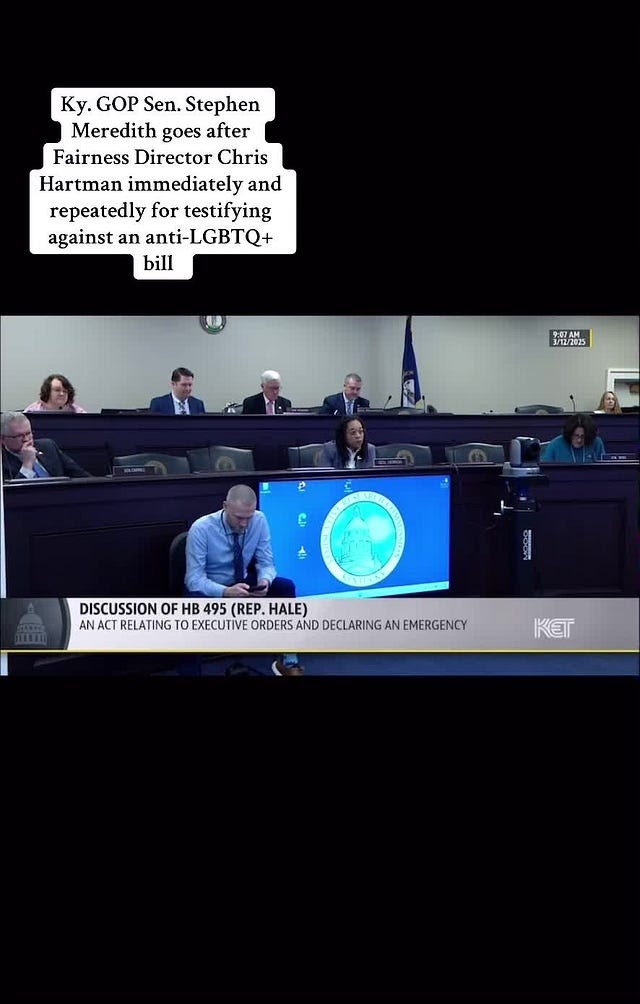
The HB 495 committee vote also included committee chair GOP Sen. Stephen Meredith yelling at Fairness Campaign director Chris Hartman mere *syllables* into Hartman’s testimony against the bill.

I’ve seen plenty of high tensions in Frankfort, but Meredith’s audacity might be unprecedented.

HB 495 now has two readings in the Senate, meaning it could get a full Senate vote as early as Thursday morning, actually, since both the House and Senate decided to gavel in at 9 a.m. instead of the normal 2 p.m.

If it passes the Senate, the House needs to agree with the changes the Senate made to their bill before it gets sent to Beshear’s desk where it will almost absolutely be vetoed.

But here’s the thing: Some Republicans in the House already tried to make the whole blocking Medicaid funds situation a thing several weeks ago and the bill went nowhere. Not even when HB 495 was up for a House vote last week did they try to add this language to it.

So, why now? And will the Senate be interested in it?

And if the Senate approves it, the House has to agree with the changes — will they? Will they do so by Friday night? If they don’t, will a conference committee — a group of lawmakers tasked with finding a compromise — be successful in time?

And if the conference committee fails, what will the free conference committee — the group that basically gets to take the bill and do whatever they want to it — come up with? And will they reach a solution in time?

Is it really worth it to them to spend that much time during the next two legislative days? We’ll see.

It is entirely possible that adding this language about Medicaid will cause the entire thing to collapse, therefore allowing Beshear’s ban on conversion therapy to stay in place. But again, we’ll see.


FRANKFORT, March 12 – Senate Democratic Floor Leader Gerald A. Neal, D-Louisville, speaks on House Bill 4, an act related to diversity, equity and inclusion initiatives, on the Senate floor Wednesday. (Photo: LRC Public Information)

Does anyone know when slavery ended?

Kentucky’s GOP-dominated Senate easily approved — with an assist from Dem Sen. Robin Webb, who also voted in favor of the measure — this year’s marquee anti-diversity, equity and inclusion bill, House Bill 4.

HB 4 is aimed at college campuses, and despite this being a high-profile topic for the last two sessions and the bill actually not changing a ton since being filed last month, I’m still not sure if anyone is 100% sure what exactly it does and doesn’t do.

Generally, it is aimed at not forcing any policy designed to be based on religion, race, sex, color or national origin. It wants to do away with DEI offices. It wants to foster intellectual diversity, though, that is safe.

But, just like with so many other bills sparked by the GOP’s culture wars, even with attempts to make its language specific and after months of discussion, it still isn’t totally clear.

And when things like this aren’t clear, it often has a chilling effect on educators and admins.

Wednesday’s Senate vote was, um, interesting. Some Dems, like Louisville Dem Sen. Karen Berg, shared lengthy, personal stories about how DEI impacted them directly. Republican Sen. Donald Douglas, who is Black, rattled off a list of historical facts, including sharing that slavery ended in 1805. Dem Sen. Reggie Thomas, who is also Black, later corrected him regarding slavery facts.

And apparently there was an off-camera fight between legislative leaders, captured by the Kentucky Lantern’s McKenna Horsley.

McKenna Horsley @mckennahorsley.bsky.social

Some party leaders are having a heated discussion.

View on Bluesky

I could write an entire other newsletter about the energy, the body language, Sen. Karen Berg’s shawl version of a Snuggie (?), the last second appearance of Sen. Cassie Chambers Armstrong — everything — in this clip, but I am tired and so therefore I will move on (for now).

This one is off to Beshear, who has 10 days to decide what he wants to do with it. (Spoiler: He will most likely veto it.)


More on LGBTQ+ issues

Senate Bill 2

SB 2, which would block gender-affirming health care for the 67 or so transgender inmates in Kentucky, passed a House committee Wednesday.

This is a top priority bill for the Senate GOP — all 31 Republican senators signed on as a cosponsor — but it looks like it might not have the time to pass the House. It needs three readings across three days, like all bills, and it needed its first reading on Wednesday in order to pass by Friday. And it got that first reading. So we’ll see how this goes.

But while Beshear is pretty pro-LGBTQ+, I don’t know if he’s gone on record regarding this particular issue. It might be possible that he won’t veto it, and therefore Republicans have a bit of extra time.

Senate Bill 132

This one would basically allow health care professionals to refuse to do certain medical procedures if those procedures violate their values. So, think, if their religious values include not believing LGBTQ+ people are real, they could refuse to provide needed gender-affirming health care. Same idea goes for abortions.

This passed out of a House committee and got that first reading Wednesday, so this also could pass Friday.

Senate Bill 60

SB 60 is very much like SB 132, but it extends the religious liberty thing to basically everything — not just health care.

It is almost safe to say this one is dead. It could’ve been heard in committee Wednesday, and yet they didn’t put it on the agenda. It also doesn’t have any of its three readings in the House, and there are only two legislative days left before the veto period, so … the math.


Oh, and also

For reasons I have not seen publicly and/or widely articulated, apparently Grimace was terrorizing the Kentucky Capitol Annex Wednesday.

As if the session itself wasn’t a terror enough.

Apparently, there is also an uprising regarding an alleged recent decision to stop the Capitol Annex snack shop (a small place with a gas station-like assortment of snacks and drinks so you don’t pass out in Frankfort and/or for those of us who have a fear of the Capitol Annex cafeteria) from offering *checks notes* hot food?

Obviously, I will keep y’all updated with such incredibly passing matters, especially as the veto period approaches.


Some programming notes

Just a bunch of repeats from last week:

  • If you’re a paid sub, PLEASE double-check what card you have on file so any and all payments go through. Several of y’all signed up for annual subscriptions last March, so those should be renewing soon and I’d hate for you to lose access at the worst possible moment of session.
  • It is fully party time in Frankfort, but party time in Frankfort does not come cheap. If you’d like to chip in a few bucks for gas or a Celsius via Venmo, I’d be forever grateful (but no pressure, seriously). My Venmo is right here.
  • Also, please take a second and share this newsletter with a friend and/or on your social media feeds! As I said, it is fully party time in Frankfort, and the more folks we have reading + sharing The Gallery Pass, the better the party. Plz + thx!

Where can you find me?

  • For live updates: Either Twitter or BlueSky.
  • For video recaps/explainers/answering your questions: TikTok.
  • For aesthetically pleasing things to add to your Insta story: My professional Instagram.
  • For full-length articles: Queer Kentucky.
  • For regular recaps + analysis: The Gallery Pass. (Please tell your friends to subscribe!)
  • To send me ideas and tips: Use this survey. It is anonymous and you can fill it out as often as you’d like.
  • To support my work: Venmo. (Again, no pressure.)

Aight, my party people, we will talk when we talk next. If you see me in Frankfort and I’m not sobbing in my car, feel free to come up and say hi! I have friendship bracelets!

Toodles!

LGBTQ+ allies, advocates and organizations to follow in Kentucky’s General Assembly

Editor’s note: This story was published in March 2025. Some details may have changed since then.

Kentucky’s 2025 legislative session is well underway, and LGBTQ+ rights are once again under attack. 

Over a dozen bills could directly negatively impact the LGBTQ+ community, taking aim at everything from healthcare for transgender inmates to school bathrooms. 

So, Queer Kentucky compiled this list of allies, advocates and organizations doing the work in and around Frankfort — from groups you can get involved with, to activists speaking against bills, to elected officials filing and supporting pro-LGBTQ+ legislation.

This list is by no means exhaustive, but it should provide a solid starting point for anyone looking to help defend LGBTQ+ rights in Kentucky. 

Want to see beyond the LGBTQ+ list? Check out the FULL POWER BROKERS LIST!

Activists

Emma Curtis — A well-known LGBTQ+ activist in Frankfort, Curtis is now a Lexington Councilmember and the only openly transgender elected official in Kentucky. Despite now being in office, she still has made her way to Frankfort to push against anti-LGBTQ+ legislation.

Lexingtonky.gov


Maddie Spalding — As the founder of the Kentuckiana Transgender Support Group and Transgender Wellness Coalition, Spalding knows a thing or two about supporting and advocating for the transgender community.

Via Maddie Spalding’s Facebook


Chris Hartman — Hartman is easily the most prominent LGBTQ+ activist in Frankfort during the legislative session. The Executive Director of the Fairness Campaign can typically be found holding lawmakers’ feet to the fire with fiery testimony against bills.

Via Fairness Campaign


Mason Kalinsky — Kalinsky was a key figure during the fights against some of the nation’s worst anti-transgender legislation in 2023. He remains an activist for the community.

Via Mason Kalinsky’s LinkedIn


Oliver Hall — As the Director of Trans Health for the Kentucky Health Justice Network, Hall is another prominent face in and around Kentucky political issues and advocacy networks. 

Via Oliver Hall’s Facebook


Jacks Gilles — Gilles, a psychologist and leader of the Mandala House in Louisville, Gilles was one of the first activists to testify in Frankfort against anti-LGBTQ+ legislation this session.

https://mandalalouisville.com/


Jordan Clay-Tucker — Clay-Tucker came highly recommended from another activist on this list for their work at Planned Parenthood Alliance Advocates.

Via Jordan Clay-Tucker’s LinkedIn


Lawmakers

Sen. Keturah Herron (D-Louisville) — Herron is Kentucky’s first openly LGBTQ+ woman in the state Senate, so of course she made the list.

Kentucky Legislative Research Commission, Public Information Office


Senate Minority Floor Leader Gerald Neal (D-Louisville) — The top Democrat in the state Senate, Neal is also the primary sponsor of Senate Bill 102 which would enact a statewide fairness ordinance.

Kentucky Legislative Research Commission, Public Information Office


Sen. Karen Berg (D-Louisville) — After losing her transgender son Henry a few years ago, Berg has been an incredibly vocal legislative advocate for the LGBTQ+ community. This year, she is sponsoring Senate Bill 94 to permanently ban conversion therapy.

Kentucky Legislative Research Commission, Public Information Office

Rep. Lisa Willner (D-Louisville) — The psychologist and Louisville Democrat tends to back pro-LGBTQ+ measures. She’s sponsoring House Bill 426, which is the House’s attempt to ban conversion therapy this year.

Lexington Times


Rep. Adrielle Camuel (D-Lexington) — Camuel is countering a GOP push to require public schools to make almost all of their bathrooms single-sex by sponsoring House Bill 270, which would require single-user bathrooms in schools.

legislature.ky.gov


Rep. Mary Lou Marzian (D-Louisville) — Marzian just returned to public office after a term off. She’s sponsoring House Bill 235, which would also enact a statewide fairness ordinance.

Kentucky Legislative Research Commission, Public Information Office

Groups

  • ACLU of Kentucky — The ACLU of Kentucky is a regular face in Frankfort, advocating not just for LGBTQ+ rights but other social justice issues that intersect with the community.
  • Fairness Campaign — This is the group to follow if you’re focused strictly on LGBTQ+ issues in the state Capitol. They’ll keep you updated about calls to action and when you should show up in Frankfort.
  • Louisville Youth Group — LYG was one organization suggested by other folks on this list as one to watch. As their name suggests, they focus on LGBTQ+ youth in Louisville. 
  • Kentucky Youth Law Project — Another one that came highly recommended by the others. They provide free legal help to defend the rights of LGBTQ+ youth in the commonwealth. 
  • LGBTQIA Council for Kentucky Democrats  — This group focuses on advocacy, education and collaboration to bolster the LGBTQ+ community. 
  • Queer Kentucky — Don’t mind us including ourselves on this list. Queer Kentucky is covering all of the key pieces of legislation impacting y’all, so stick with us for stories, social media updates and a regularly updated bill tracker.

My Kentucky party people, welcome to the 2025 Frankfort Power Players list!

This is republished from The Gallery Pass.

This list comes after weeks of careful consideration and repeatedly running through scores of nominations, including some of my own recommendations from my time as a politics reporter.

All told, nearly 200 people were considered for this list, and only a few dozen ultimately made the cut. To everyone who nominated folks, thank you so much — there are a few folks who made this list solely because of how strongly someone vouched for them.

Before we dive in, let me be clear on a few things. First, just because someone isn’t on this list, doesn’t mean they don’t have power or sway in Frankfort or Kentucky politics. This list is by no means definitive or exhaustive. It also isn’t a ranking in any way, shape or form.

Additionally, just because someone is on the list, does not mean I endorse or condone their actions, policies or politics. I repeat: This is not a list of endorsements. It is a list of people in Frankfort, almost all tied directly to the legislative session, who, in some way, shape or form, hold power.

Over time, I’ve described this list as “power brokers,” “names you should know” and “unsung heroes.” I tried to find folks at the sweet spot between all three of those categories.

But I considered a lot more than that. When they speak, do people listen? Where do they fall at the intersection of public name recognition and perceived power? If they’re a lawmaker, how successful are their bills? If they got nominated by someone else, how strong of a nomination was it?

As you may notice, I kept a lot of super common names off of the list. For example, you won’t see Senate President Robert Stivers or Speaker of the House David Osborne on this list. Gov. Andy Beshear also didn’t make the cut. Same goes for several popular high-power lobbyists.

Ultimately, though, the concept of “power” — particularly when it comes to Frankfort — is subjective. And, therefore, so is this list.

The list ended up being so long that I felt it was best to split it into two parts: One with the lawmakers, and one with the attorneys, media and policy-shapers.

We will begin with the lawmakers. Again, this isn’t a ranking, so these will (almost) be in alphabetical order by last name.

Let the games begin.


Sen. Julie Raque Adams (R-Louisville)

Who needs a title to have power?

After she didn’t get a leadership spot in the Senate GOP caucus after being the caucus chair, she’s still out here, kicking. One top thing to watch from her: A bill on “sextortion,” which had a bipartisan slate of sponsors and is expected to pass out of the Senate Wednesday afternoon.


Sen. Cassie Chambers Armstrong (D-Louisville)

Since day one of #KYGA25, she’s been one of the most prolific bill filers in the statehouse. As of Tuesday night, she’s the most prolific in the Senate. It was enough to get name dropped on one of KET’s Kentucky Tonight episodes looking ahead at the session.

She’s still relatively new (started mid-2023 session), and of course she’s a Dem in the heavily Republican Senate, but I think she’s best poised to get some bipartisan work done this session (and probably also remain one of the more prolific filers).

One example: On Tuesday, she announced a bipartisan effort alongside GOP Sen. Steve West to help school athletic coaches to better report child abuse following a Courier Journal investigation examining abuse at the hands of coaches.


Sen. Amanda Mays Bledsoe (R-Lexington)

I mean, it feels like she’s been here for all of, what? Three seconds? (Two years) And she is the vice chair of multiple committees and is routinely the name tied to big-deal bills or the face tasked with repping the Senate GOP caucus on TV.


Rep. Josh Calloway (R-Irvington)

I feel as if I’ve written about Calloway more than any other lawmaker thus far this session, and there’s a reason for that.

Sure, my coverage does tend to focus more on the culture wars issues that his legislation tends to gravitate towards, but he’s easily one of the liberty thought leaders in that particular arena in the legislature, as well as in general in the House.

Historically, his success rate is not great, but I’ll be watching to see if maybe this year is the year (especially with Trump in office).


Rep. Kim Moser (R-Taylor Mill)

Moser is not simply making this list because she is the only sitting lawmaker to successfully drive up my parents’ steep, windy, gravel driveway (although that is peak power player energy).

The House Health Services Chair was formally nominated due to her effectiveness as a lawmaker: “She has passed over 40 of her sponsored bills into law, including several public healthcare reforms that expand KY healthcare services, including SAD treatment, mental health, and maternal health.

“A commonsense conservative, Kim brings a voice of reason in Frankfort, and she works across the aisle, collaborating with many of her colleagues, advocacy groups, and stakeholders to find real solutions,” the nomination continued.


Rep. Rebecca Raymer (R-Morgantown)

Raymer’s gotten some big-ish stuff done in a short amount of time (looking at you, 2023 push to study and regulate hemp-derived substances). And judging by the stuff she’s filed thus far this year, she’s poised to work on Kentucky’s lack of sexual assault nurse examiners — a big issue uncovered a few years ago by a KyCIR investigation that has since seemingly fallen out of people’s minds.


Rep. TJ Roberts (R-Burlington)

Wow, what to say about TJ Roberts.

Roberts, a NKY freshman legislator, easily earned a spot on this list by being the most prolific bill filer thus far this session (and some of them have already started to move).

But he was also one of the most nominated folks for this list, and the nominations were … colorful. Number of haters was not one of the metrics used to determine this list, but perhaps it should’ve been.

Someone called him, and I quote, a “bitch ass hoe.” (I was going to censor that a bit, but I couldn’t figure out how to do it without robbing it of its richness.) He was also told his “aura is beige, your energy is flat, and your shade game? Nonexistent.” And was then told to “sashay away.”

But, really, a different nomination explained it best: “Despite being a freshman legislator, TJ has gotten large amounts of media attention for his bills introduced in the first 2 weeks of session. The governor even personally called him out for his efforts. TJ will be a top name to watch for the remainder of the session, and he is poised to influence what the talk of the session revolves around.”


Rep. Pam Stevenson (D-Louisville)

The House Dems have a brand new slate of leaders this session, led by one of TikTok’s favorite Kentucky-based floor speakers, Rep. Pam Stevenson as House Minority Floor Leader.

Stevenson also recently announced she plans on running for Sen. Mitch McConnell’s seat in 2026 in what is expected to be a closely watched and contested race (well, if McConnell decides not to run again).

For now, she’ll be joined by Reps. Al Gentry and Lindsey Burke, as House Minority Caucus Chair and House Minority Whip, respectively, as the squad seeks to make the Kentucky House Dems relevant again. (They are on the losing end of a 80-20 minority.)


Sen. Lindsey Tichenor (R-Smithfield)

Since getting elected a few years ago, Tichenor has been continuously growing strength as one of the Senate’s liberty leaders. She’s sponsored some high-profile legislation, maybe most notably efforts to restrict drag performers, and helps add numbers to any and all liberty-oriented bills coming through the senate.

To quote her nominator: “She is a little prickly but plays the game well.”


Rep. James Tipton (R-Taylorsville)

As the inaugural chair of the House Postsecondary Education Committee, Tipton will play a critical role in determining which, if any, anti-DEI measures get through to the House floor.

Someone who nominated him added he “has been fighting to protect KY children from sexual abuse. He plans to continue to push for passage of protective legislation in the 2025 session.” And he already has: House Bill 36 got filed on Day One.


The unknown anti-DEI work group

ICYMI, Senate President Robert Stivers recently said a work group of House and Senate members, plus Attorney General Russell Coleman and reps from Kentucky’s universities, is working on anti-diversity, equity and inclusion legislation aimed at higher ed.

Outside of Coleman, do we have any specific names involved with the group? No. Will we have more details in the coming week, as we approach and hit the bill filing deadlines on Feb. 18 and 19? Hopefully. But for now, I consider the entire group to be a power player.


Sens. Max Wise and Robby Mills (R-Campbellsville and Henderson, respectively)

Wise and Mills are the fresh faces for GOP leadership, taking over as Senate Majority Floor Leader and Senate Majority Caucus Chair, respectively.

If their names sound familiar, good, they should. Both ran for lieutenant governor in 2023 (Wise with Kelly Craft and Mills with Daniel Cameron) and both have produced high-profile legislation in recent years, particularly involving LGBTQ+ issues.

Mills spearheaded the 2022 push to keep transgender girls out of girls’ sports, and Wise sponsored Senate Bill 150 in 2023, which was largely considered one of the worst anti-trans bills in the country that year.

Now, they’re in leadership roles, steering the GOP supermajority in the Senate.


THE ATTORNEYS


Jeff Harmon

As a member of the Senate GOP’s legal team, Harmon got a shout-out for “his expertise in the energy sector and overall work ethic in supporting a very busy Senate Majority Caucus in multiple subject areas.”


Eric Lycan

As general counsel for House GOP leadership, Lycan is “one of the most influential players you have never heard of.”*

Per his nomination: “He has represented many KY Republican officials, from campaigns and election contests to ethics and legislation, and has the trust of the House majority caucus and joint leadership. He was on the RPK executive committee and is on the Board of the Republican National Lawyers Association. He is involved with virtually all of the contentious legislation that comes before the House, and is the on-the-floor parliamentary advisor to the Speaker.”

*I’d like to take this opportunity to say I have heard of him primarily because when I was a young rookie reporter who did not realize the attorney for the House GOP sat in the media section on the House floor, I accidentally sat in his seat one time. He made me move. I remain apologetic to this day.


Tyler Peavler

As a member of the House GOP legal team, Peavler “works tirelessly behind the scenes to keep the House moving,” his nominator wrote.

“Having served in both the state Senate and House, few people have the expertise Tyler does in procedure and policy. He’s been working in the legislature since 2018 and has silently overseen the Republican reform of KY’s legislation.”


THE MEDIA

Quick note: I am, obviously, a politics reporter. I could easily write an entire other piece about the Frankfort press corps and who to go to for coverage about what, but to keep things focused and fair, the three reporters listed below are the three who got nominated by the public.


Bode Brooks

The nomination for the FOX 56 reporter called him “a solid political journalist with strong sourcing.”

But, both for his nominator and myself, his relatively new show “Red, White and Bluegrass” is what fully earned him a spot on this list.

Brooks is a relative newcomer to the Frankfort beat, but he has quickly earned the trust and interview time with several high-profile lawmakers with his TV segment. His show grew crazy fast, and now regularly gets enough play it is becoming a bit of a mainstay in Kentucky political journalism.


McKenna Horsley

Horsley has been the Kentucky Lantern’s state politics reporter since the newsroom’s inception in late 2022, and she’s been on it ever since.

A reader nominated her, saying she has “excellent writing, timely articles with a good grasp of the issues, also clear reporting on Comment on Kentucky.”


Renee Shaw

A list of Frankfort reporters would be incomplete without KET’s Renee Shaw, aka our queen. No, seriously: One of her nominators literally wrote her job title as “queen.”

The other, who described her as “Renee Motherf***ing Shaw” (asterisks my own), referred to her as the “HBIC/GOAT.”

Listen, anyone who can routinely host an hour-long live TV broadcast of roughly four people who do not agree with each other on a high-profile controversial political topic deserves to be on this list. Straight up.

(“Presumably she was already on the list but I have a sacred obligation to nominate her anyway,” the aforementioned “queen” nominator wrote.)


THE LOBBYISTS


Stephen Huffman

Huffman is a lobbyist for several high-profile organizations, including Keeneland and the University of Kentucky.

Per his nomination: “His star has risen dramatically. He is very close to House leadership and top three most influential lobbyists with the House. He is extremely well liked and gets results. His portfolio of clients has grown extensively to include key KY industries.”


Brian Lacefield

Whoever nominated Lacefield is his hype person, so I’ll just drop the nomination here:

“He is a policy guy. Understand how the sausage is made. Getting 80% of what you want is a win and that politics is not a zero sum game, it’s the long game of building consensus and finding a win-win.

“Lacefield has made a career on building symbiotic relationships to advance the greater good. He will always listen to opposition and seek to learn in an understanding way.

“He is a true independent lobbyist with great relationships on both sides of the aisle. His role is to educate legislators to his clients interest and advise against unintended consequences, making legislation better for our Commonwealth.”


Richard Nelson

As the leader of the conservative Commonwealth Policy Center, “Richard has been instrumental in helping social conservatives get elected to the General Assembly, and he’s been influential in getting bills on social issues passed.”

As a reporter, I best know Nelson as the guy who handed me a packet of photos of scantily clad drag performers during an early morning legislative hearing over whether or not heavy restrictions should be placed on drag a few years ago. Attempts at limiting drag have failed, but I understand exactly why he got nominated.


Abby Piper

The founder and managing partner of government relations/PR firm Piper-Smith got a few nominations.

The first: “Abby has built a steady and successful lobbying and PR firm from scratch. She handles tough issues and elevates clients into getting the best possible outcomes. She never backs down from a challenge and is respectful and thoughtful as she navigates her and the firm’s way through Frankfort.”

And then the second (a bit more succinct): “She’s brilliant.”


Chuck Truesdell

After the past year of maybe-we-should-break-up-JCPS energy and some more recent vibes of let’s-target-JCPS-because-our-school-choice-amendment-didn’t-pass, in what world would Jefferson County Public Schools’ lobbyist not make this list?


David Walls

As the executive director of The Family Foundation, a conservative group focused on Biblical values, Walls made the list for basically the same reasons as Nelson. He’s played a big role behind-the-scenes as the GOP has grown in the legislature, particularly around social issues.


THE POLICY-SHAPERS

Sure, lobbyists definitely fall into this category, but this is designed to be a catchall spot for advocates, activists, leaders who aren’t quite lobbyists — anyone who shapes policy either publicly or privately, in some way, shape or form.


Jason Bailey

As the leader of the left-leaning Kentucky Center for Economic Policy, Bailey is a frequent challenger to GOP-led initiatives.

“KY Policy drives the agenda for Democrats in Frankfort. Nobody provides more policy details and analysis than that group. They are key to forming the policy arguments for the entire Kentucky center left, and that’s all we’ve got: arguments,” one nominator said.

The group’s data and analysis are frequently cited by advocates, lawmakers and reporters alike, too.


Alex Berling

Berling calls herself a “citizen advocate for commonsense data-driven policies that improve the quality of life for Kentuckians,” which is a lot of words, but accurate.

Their anonymous nominator explained: “After volunteering for the county Dem party and Dem candidates for a year, Alex ran for statehouse while attending Emerge in 2023…and she was essentially railroaded out of the party for being too progressive of a candidate.

“She took her passion and skill set to Rep. Kim Moser and has spent the past year working with Moser on like-minded issues, getting more accomplished than she would have as a Democrat.”

(ICYMI: Moser also made this list due to her effectiveness as a legislator.)


Kelsey Hayes Coots

She’s here for a pretty simple reason: She was basically the architect behind Amendment 2’s downfall. And as a reminder, Amendment 2 failed not just by a little bit, but by a whole lot. So, what’s next? A reframed mission for Protect Our Schools KY aimed at generally improving public education.


Emma Curtis

Curtis has been a common face in Frankfort for the last few years, and now she’s an elected official in Lexington.

“With a new wave of national anti-trans legislation and having campaigned on her ability to work with the legislature to benefit Lexington,” her nominator wrote that they expect her to use her new role as a Lexington councilmember (and one of the first transgender people elected to office in Kentucky) “to draw attention and lead the charge against any filed in KY.”

Curtis was also one of three women who initially went on record detailing their experiences with embattled Rep. Daniel Grossberg, who is under investigation for accusations of sexual harassment.

On that note, I’d like to also add Allison Wiseman and Sarah Ritter to this list. They, too, spoke out against Grossberg, even when it could’ve cost them their careers in Kentucky politics. Because of them, several others came forward with their story and/or called for Grossberg’s removal from office (myself included).


Robbie Fletcher

Between a sudden multimillion dollar funding shortfall and some districts’ need for more online learning days, the new education commissioner is already playing a big role in Frankfort this session.

But when does Kentucky’s K-12 chief not play a large role in state policy and politics? Fletcher is the first commissioner to have to be confirmed by the state senate after Republicans took a major disliking to former commissioner Jason Glass over culture wars issues, so it’ll be interesting to see how he balances the best interest of Kentucky students and Frankfort — two things that often don’t mix well.


Michael Frazier

Frazier’s exact title is Executive Director of the Kentucky Student Rights Coalition and, larger than that, policy advisor, but how does one truly define Michael Frazier?

He seems somewhat omnipresent in the halls of Frankfort — “He has done pretty much everything you can do in Frankfort from campaigning to writing legislation to lobbying,” one Democrat who nominated him said. (Frazier tends to lean Republican.)

But the majority of his nominations — and he was one of the most nominated folks on this list — focus on his work on free speech and anti-DEI measures in higher ed. And, one person added, he “is a principled defender of liberty.”


The Kentucky Student Voice Team

They were already going to make the list, but KSVT definitely earned its spot here when it sued Kentucky over providing an allegedly inadequate education earlier this year.

They’ll be doing more on that front throughout the upcoming year, and it’ll be interesting to see if/how lawmakers react to their allegations via legislation in the coming weeks.

(Let the record reflect that even before January’s lawsuit, several individual KSVT-ers got nominated on their own.)


Cara Stewart

Described by one nominator as “Kentucky’s Whisperer to the Stars,” Stewart was one of the most nominated folks on the list, so I’ll just sit back and quote some of them:

“Cara is my go-to for legislative info and insights and I trust her as a source of knowing who is who, what they do, and how to effect real change.”

“Bipartisan mover and shaker. Cara is widely respected in Frankfort and the go-to for many lawmakers on matters of health policy.”

“Cara Stewart not only defines what it means to be an effective and compassionate advocate, but she is also a diplomatic problem solver. Her unique ability to work with anyone/everyone to achieve the goals for those she advocates for is beyond description.”

“I mean she knows everything…and everyone. More lawmakers call her now for advice than even when she was the House Dems chief of staff. She’s influential on policy, helps shape bills, knows the inside dirt (on everything and everyone), works well with Republicans without losing her progressive vibe, and is one of the few NKY folks shaping this state.”

 

Kentucky Republicans take aim at conversion therapy as bill to end protections advances

LGBTQ+ youth in Kentucky are a step closer to losing one of the very few protections they have from their state government. 

Kentucky’s GOP-dominated House voted Wednesday afternoon to end Gov. Andy Beshear’s 2024 executive order banning conversion therapy and to block future restrictions on the discredited counseling practice until 2028. 

They voted largely along party lines, with Democrats generally against the legislation. 

House Bill 495 initially sought to allow mental health practitioners and religious leaders to provide conversion therapy without consequence, but was suddenly changed on the House floor to focus solely on preventing executive orders — essentially returning Kentucky to where it was before Beshear’s order in September 2024. 

“While we are glad the original language, which would have encouraged incredible harm to LGBTQ kids, is gone, we still strongly oppose HB495,” Chris Hartman, the leader of the Fairness Campaign, said in a press release. 

“No child should be subjected to ‘conversion torture.’ It serves no purpose but to increase anxiety, depression, self-harm, and suicide among Kentucky’s LGBTQ kids. We hope the Kentucky Senate will reject HB495 and ensure the safety of LGBTQ youth all across our commonwealth,” he continued.

HB 495 now heads to the Senate, where it will need to quickly clear several legislative hurdles in order to make it to Beshear’s desk in time to withstand a likely veto. 

Kentucky lawmakers have tried, unsuccessfully, for years to pass legislation to ban conversion therapy. Beshear took matters into his own hands last fall when he issued an executive order blocking state funds from paying for the practice. 

“Kentucky cannot possibly reach its full potential unless it is free from discrimination by or against any citizen – unless all our people feel welcome in our spaces, free from unjust barriers and supported to be themselves,” Beshear said in a press release at the time. “This is about protecting our youth from an inhumane practice that hurts them.”

Several Republicans criticized the move at the time, partially because they deemed it an unconstitutional infringement on religious and parental rights. 

Such energy was a driving force behind House Bill 495. Bill sponsor Rep. David Hale (R-Wellington) initially contended the bill seeks to protect a parent’s right to select mental health supports that best match their morals and values. 

Kentuckians should be able to do so “without the threat of action being taken against them or the individual providing those services,” Hale, a pastor, said during a committee vote on the bill last week.

Several LGBTQ+ advocates and trained mental health professionals — including multiple conversion therapy survivors — testified against HB 495 ahead of the committee vote. 

Eric Russ, a psychologist, argued mental health professionals have an ethical obligation to provide quality, research-backed services. Conversion therapy is not that. 

When asked by Rep. Matt Lehman (D-Newport) if he was OK with allowing discredited practices to be available to kids, Hale didn’t directly answer but said he felt testimonies against the bill were “not correct.” 

If ultimately passed, HB 495 would go into effect immediately. 


If you or someone you know is struggling, call or text the 988 Suicide & Crisis Lifeline at 988. LGBTQ+ young people can press 3 to reach counselors trained in LGBTQ+ care, an option that returned on Sept. 30, 2026 after it was cut in July 2025. The Trevor Project also offers 24/7 support at 1-866-488-7386 or by texting START to 678-678.

Louisville Pride Says QPOC, Trans Inclusion Critical Under Shifting Political Landscape

The new year brought the arrival of new administrations and legislatures across the United States. In Kentucky and beyond, that has meant renewed threats to things like gender-affirming health care, diversity and inclusion programs and protection from anti-LGBTQ discrimination.

For queer residents — and LGBTQ residents of color especially — political moments like this can heighten the need for resources and community support, according to Ebony Cross. Cross serves as executive director of the Louisville Pride Foundation, a nonprofit that aims to foster community and equity for LGBTQ community members and all residents.

“As this breaking news comes out, we see a lot more foot traffic in the center,” Cross said. “Our trans community is concerned. Our LGBTQ community is concerned. Our Black community is concerned.”

Key to Louisville Pride’s mission is filling in gaps in support for residents of all backgrounds. As policies targeting LGBTQ people and people of color continue to arise, Cross said making resources accessible on the local level becomes all the more crucial.


DEI under attack

Last November, Republican candidates swept Kentucky’s presidential election, and all but one race for the U.S. House of Representatives. Cross said the election’s results triggered immediate worry.

“My reaction was just like half of the country,” she said. “It was: ‘What are we going to do?’”

In his second term, President Donald Trump has set the repeal of diversity, equity and inclusion (DEI) programs as an administrative priority. Republican-led state legislatures nationwide have followed suit in restricting DEI resources for publicly funded offices and programs.

Cross said when people approach the topic of DEI, many overlook the variety of communities that benefit from DEI programming.

“You’re speaking of the veterans. The elderly. The LGBTQ, the BIPOC population,” she said. “DEI doesn’t just center on one specific thing. … When you pull that, it isn’t just harming one culture or group of people. It’s harming more than one section of our community.”

For Louisville Pride, focusing on marginalized groups means helping residents find therapists, support groups and mental health resources specialized to their identity and background, Cross said.

Or, it can mean providing identity-inclusive educational resources and community spaces. Recently, a growing number of Black community organizations have visited Louisville Pride’s center and booked its spaces, Cross said.

Cross said looking at the history of Black and feminist organizing in moments of hardship can contextualize what residents are going through, and offer a light at the end of the tunnel.

“We’ve been here before,” she said. “I look at all the work that has been done for us to get where we are. We just have to pick up the torch.”


Trans rights

Transgender identity and access to gender-affirming health care were focal points of last year’s election, not to mention this year’s legislative session at the Kentucky State Capitol.

In January, Trump signed an executive order to ban youth below age 19 from receiving gender-affirming medical care, although a federal judge temporarily blocked the order on Feb. 13.

On Feb. 18, the Kentucky Senate passed Senate Bill 2, which would prohibit transgender people incarcerated in state-run prisons and jails from accessing hormone therapy. The bill still needs approval from both the Kentucky House of Representatives and Gov. Andy Beshear before taking effect, but has deepened concerns over the future of trans health care in the state.

“Our trans youth and our trans community [are] concerned about their HRT, and receiving those health services that they need,” Cross said. “We don’t know what’s going to happen. It changes from day to day. So we continue to do the work that we do.”

Louisville Pride partners with trans-inclusive providers already operating in the area, and helps connect trans community members seeking health resources to someone who can meet their needs. Some information comes from those who have already accessed certain health services and had positive experiences with them.

“We don’t want to get too in detail of what their personal matters are. Just a general sense of the care that they need, in terms of how we can support them,” Cross said. “We know the direction to point them.”

Cross said her organization also offers support groups, where residents can speak to medical experts and other trans people about things like hormone therapy and gender-affirming care. 

“We can kind of help comfort them and just give them a guide on where to go and how to go about things as these changes are happening,” she said.


‘When we all come together’


Louisville Pride was founded in 2014, and much of its current leadership became involved in LGBTQ organizing well before then. Cross said this long-term connection to Louisville makes the group especially prepared to meet community members’ needs in moments of both calm and concern.

“In terms of how we operate, we have changed absolutely nothing. We have been in this fight for decades,” she said. “We’ve just been on top of making sure that we add necessary programming if needed.”

As a Black, masc-presenting lesbian, Cross said it can be taxing to respond to threats against communities she belongs to. She tells the Louisville Pride team to prioritize their own well-being, but has found the urgency of the current political moment motivational.

“It can, at times, be exhausting. But for me and my heart and soul, I’ve always felt like I’ve been born and bred to help people, especially in the LGBTQ community and our Black community,” she said. “My motto is: ‘Let’s get to work.’”

Cross said Louisville Pride has a wide slate of events coming up that aim to foster community and connect residents to resources, ranging from art nights to social events to food pantry open hours.

And, for Cross, prioritizing inclusion and community-building across lines of identity makes this work even more effective.

“We can make a bigger impact when we all come together in this fight,” Cross said. “That’s what it’s going to take. It’s going to take all of us.”

Bill barring use of public funds on transgender treatments for Kentucky inmates advances

photo: From left, Hannah Callahan, Chris Hartman and Jacks Gilles testify against Senate Bill 2, barring gender-affirming care for Kentucky inmates, including phasing out transgender inmates’ ongoing hormone treatment. (Kentucky Lantern photo by Sarah Ladd)

by Sarah Ladd, Kentucky Lantern
February 13, 2025

FRANKFORT — Under a Republican bill advancing in the Kentucky legislature, a reported 67 incarcerated people would have to stop taking “cross sex hormones” if the treatments are paid for with public funds.

Advocates who asked — in vain — members of the Senate Judiciary Committee to vote against Senate Bill 2 said it’s unfair to target such a small population.

Chris Hartman, the executive director of Kentucky’s Fairness Campaign, called the bill “a politically motivated attack against one of our smallest and most vulnerable communities.”

“You cannot tell me,” he said, “that this is one of the most pressing issues for the vast majority of Kentuckians.”

The bill says public dollars cannot be used to fund a “cosmetic service or elective procedure” for Kentucky inmates. It also says if a health care provider documents that ending a treatment would harm an inmate, use of the drug or hormone may be “systematically reduced and eliminated.”

It passed Thursday’s committee along party lines. One Republican took issue with forcing a transgender prisoner to end a medical treatment that’s already underway.

Sen. Michael Nemes, R-Shepherdsville (LRC Public Information)

“I think the intent of this bill is not to have the state pay for operations that are elective while people are in prison,” said Sen. Michael Nemes, R-Shepherdsville, who passed on the vote. “I don’t think the intent of the bill is to deny medical treatment that they’re already receiving, and I need clarification that that does not stop that.”

Rep. Kim Moser, R-Taylor Mill, has filed similar legislation, House Bill 5. Hers, though, would allow continued treatment “if the inmate was undergoing this treatment upon admission to the correctional facility and physical harm would result from its discontinuation,” according to the bill.

“Kentucky taxpayer dollars should not be used to fund cosmetic or elective procedures for individuals who have committed crimes against the Commonwealth and its citizens,” Moser said in a statement. “I filed HB 5 to protect the use of taxpayer funding, ensuring that public funds are spent responsibly.”

Moser’s bill covers plastic surgery, knee replacement surgery, breast augmentation, gender reassignment surgery and prescribing or administering cross-sex hormones. Wilson’s focuses on the last two treatments.

SB 2’s sponsor, Senate Majority Whip Mike Wilson, R-Bowling Green, called it a “simple” bill to address an issue that came up last year involving a Kentucky Department of Corrections regulation allowing transgender inmates to apply for gender-affirming treatments.

Sen. Mike Wilson presents Senate Bill 2. (Kentucky Lantern photo by Sarah Ladd)

Sen. Reggie Thomas, D-Lexington, echoed concerns that the population in question is small.

“We’re not damaging the state budget by treating 67 people,” he said. He called focusing on that many people “a distortion of priorities.”

Wilson said he was aware of 67 inmates receiving “cross sex hormones” but knows of no evidence Kentucky prisoners have undergone gender reassignment surgeries while incarcerated.

But, he added, “it’s in their policy that they will provide that, so we can’t really trust that they’re not going to do that.”

Kentucky Republicans condemn state policies on gender-affirming care for inmates

Gov. Andy Beshear has said he thinks inmates do not have the right to “any and all medical surgeries paid for entirely by tax dollars.” In December, Beshear said a regulation under fire from Republicans would be pulled and aligned with an opinion from Republican Attorney General Russell Coleman that there is no federal requirement for the state to provide prisoners with gender-affirming care.

Minority Floor Leader Sen. Gerald Neal, D-Louisville, said “I’m not going to put myself in the place of a doctor, which I have no training in,” when explaining his vote against the bill.

‘You could be sentencing (people) to death’

Four people testified against the bill, including transgender Kentuckians and other advocates.

Jacks Gilles, a Louisville psychologist, testified that ending the treatments laid out in the bill “will result in negative health outcomes, including increased anxiety, disturbances in social and familial relationships, depression, suicidality and death.” The National Suicide Prevention Lifeline is 988.

“Gender affirming medical care is not experimental, it’s not elective, and it’s not cosmetic,” Gilles said. “Treatment for gender dysphoria has proven to be necessary for individuals to lead happy, healthy lives, and is rooted in decades of scientific research, testing and practice.”

Emma Curtis, a Lexington council member and openly transgender Kentuckian, appealed to religion in her testimony. She read two Bible verses about treating everyone with kindness.

“I ask you to heed those words,” she said, “to act in a Christ-like manner and to vote no on Senate Bill 2.”

Hannah Callahan, who lives in Lexington and was incarcerated “many, many years” into being on hormones, “a treatment my doctor considered medically necessary.”

Callahan said she couldn’t access her weekly injection for a while after going to jail and “being denied my medically necessary health care was far worse punishment than the one that I actually received from the actual judge.”

“Those weeks without medical treatment were an absolute nightmare. Suddenly, my body and my mind began to change and I had a rapid decrease in body fat and other physical side effects that triggered extreme gender dysphoria, body dysmorphia and mental anguish,” Callahan said. “I suddenly became weak and lethargic. I spent most of my time in my bunk asleep. I didn’t have a clear head, and my mind felt numb. My depression became so severe that I contemplated suicide.”

The National Suicide Prevention Lifeline is 988.

Callahan called the experience “cruelty” and told lawmakers if they passed Wilson’s bill, “you could be sentencing (people) to death without meaning to.”

Kentucky Lantern is part of States Newsroom, a nonprofit news network supported by grants and a coalition of donors as a 501c(3) public charity. Kentucky Lantern maintains editorial independence. Contact Editor Jamie Lucke for questions: [email protected].

If you or someone you know is struggling, call or text the 988 Suicide & Crisis Lifeline at 988. LGBTQ+ young people can press 3 to reach counselors trained in LGBTQ+ care, an option that returned on Sept. 30, 2026 after it was cut in July 2025. The Trevor Project also offers 24/7 support at 1-866-488-7386 or by texting START to 678-678.

Breaking it Down: How to advocate for yourself in Frankfort

Editor’s note: This guide was first published in January 2025. The advice still stands, but dates mentioned below are from the 2025 General Assembly. For this year’s calendar, see our General Assembly hub.

photo by Jon Cherry

ICYMI: Kentucky’s 2025 legislative session is upon us and, as always, it is shaping up to be a bit of a doozy.

Want to advocate for yourself, your friends or your favorite causes? Want to push for or against a bill? Just want to be more plugged into state politics this year?

Queer Kentucky talked to advocates, activists and political watchers to gather up some helpful tips for navigating Frankfort and making the most of your time with lawmakers.

I, Olivia Krauth, Queer Kentucky’s go-to civics reporter and an award-winning political reporter, also threw in some information that would’ve helped me when I was first trying to figure out Frankfort.


Know the process and lingo

LGBTQ+ activist Mason Kalinsky summed it up best: “Learn as much as you can about the process and how it works. Learn who you need to talk to to make change happen (committee leaders, leadership, etc.) and how to talk to them to make change. What do they care about? What will convince them?” 

Step one: Know the legislative process (at least the basics). 


In Kentucky, this is the fastest way to describe how a bill becomes a law:

  • A bill gets filed.
  • It gets a committee vote. 
  • It gets a full floor vote in the chamber it was filed in (so, House or Senate).
  • If it passes, it goes to the other chamber to repeat the process (committee vote, then a full floor vote). 
  • It then goes to the governor to either be signed into law, vetoed or become law without their signature. 
  • If it is vetoed, the legislature has a chance to override it. Both chambers need to vote to override the veto. If they do, it becomes law. 

And there will probably be a lot of unfamiliar words and phrases. We’re trying our best to explain things in conversational terms in civics and politics coverage, but it will be helpful to bookmark this handy glossary of legislative terms from the LRC. 


And know the dates

Here’s a quick outline of key dates for the rest of the 2025 session:

  • Feb. 4: Lawmakers return to Frankfort. From there, they’ll generally meet Tuesday through Friday each week. 
  • Feb. 18 and 19: The last day for new bills to be filed in the Senate and House, respectively. 
  • March 14: The last day before Gov. Andy Beshear gets a 10-day period to veto or sign any bills passed thus far. Typically, this is the final day for the GOP to pass any controversial bills so that they can override Beshear’s veto during the last two days of session.
  • March 28: The final day of session. This is called sine die. 

And also know the who, what, when and where

We’ll get more into the “who” in a second, but when it comes to the rest of it, the LRC website and social media accounts are your best friend. 

The daily legislative calendar will show you what committees are meeting each day, in what room and at what time. It’ll also show you what they’ll be discussing and voting on.

The standing committee schedule shows the standard committee meeting schedule so you have some sort of baseline to plug into your planner. Be aware, though: Meetings can be canceled and called at any time, and especially so late into session. 

The LRC’s social media accounts are great for reminders about meetings and updates about the cafeteria’s menu for the day. 

You can also rely on organizations you know and trust. 

“Follow an organization you support and sign up for their newsletters, events, and updates. READ THEIR UPDATES, even if it’s just skimming them to see what’s happening,” the ACLU of Kentucky recommended.


‘Lawmakers are just people’


The advocates we spoke to were clear: Get to know your lawmakers, and talk to them. 

“Every Kentuckian has a representative and a senator. Learn who they are, learn how they vote, and talk to them! Ask if you can meet them to talk or even shadow them for a day during the legislative session, even if (especially if) you didn’t vote for them,” the ACLU of Kentucky said. 

(You can find out who represents you in Frankfort by plugging in your address here. You’ll be able to access their contact info from there.)

“Lawmakers are just people,” the folks at the ACLU of Kentucky continued. “It can seem intimidating to attend a committee hearing, testify, or meet with a representative or senator, but legislators are no different than you are. They have been elected to represent YOU, and to do that, they need to hear what you think.”

Nisia Thornton and Jenn Bell from the LGBTQIA Council for Kentucky Democrats agreed: Those state reps and senators are ultimately just people. 

“They’re only in office because voters put them there. Treat them with respect, but don’t be afraid to introduce yourself and start a conversation,” they said.

“Learn their faces and stories: Recognizing your legislator can lead to chance

conversations, but learning their story can help build a real connection. Advocacy is

about relationships, not just requests,” they continued.

One other thing from the ACLU: “They all have different experiences and expertise; they can’t know everything, and we shouldn’t expect them to. Give them the benefit of the doubt and try talking to them about things that are important to you.”


Respect the aides


We love an unsung hero, and legislative aides are top of that list. 

“Become besties with the legislative aides. They are the gatekeepers. Approach them with extra empathy and respect,” Heather Hyden, a former lobbyist, recommended.


How to (get to) talk to lawmakers


Thornton and Bell had plenty of advice when it comes to actually sitting down with your lawmakers:

  • “Say yes to meeting offers: Legislators’ schedules during the session are packed, so if they offer you a meeting time, try to take it — they may not have another opening.”
  • “Virtual meetings are the norm: Since COVID-19, most legislators offer Zoom meetings in lieu of in-person visits. It’s an easy way to stay connected if you can’t make it to the Capitol.” 
  • “Prepare your elevator pitch: Some meetings might only last 15 minutes — or less! Be clear about your message and why it matters. Even a few minutes can make an Impression.” 
  • “Plan for extra time: If your legislator offers more time, don’t feel rushed. Stay for the conversation — you never know where it might lead.” 


Go at it alone vs. with a group (or both)


There are pros to both sides, folks told Queer Kentucky. 

“My biggest advice would be to try and show up as yourself and not be immediately associated with a big name org. It loses credibility for yourself immediately,” Hyden recommended. 

“Legislators are exhausted by the big advocacy orgs and many don’t trust them,” Hyden continued. “Your story and experience are invaluable and we desperately need more people to share as themselves, not coached or wordsmithed. You can go far by building a relationship with your legislator as yourself and then having them help introduce you to others.” 

But when you’re navigating a new and often unfriendly space, it can help to have someone to guide you through the process and tell you what to do and when. And there can be power in numbers.

Chris Hartman, who leads the Fairness Campaign, said: “First, keep a cool head. The Fairness Campaign will let you know when it’s time to light your hair on fire.

“We’ll let you know exactly the right time to send an email, make a phone call, or show up in Frankfort to maximize our collective impact.” 


How to stay in the loop + how to follow bills

You can go through bills on the LRC’s website. There are several ways to search through legislation. Find what works for you. 

Queer Kentucky will be tracking all of the biggest bills — especially those impacting the LGBTQ+ community — in our 2025 legislative session bill tracker. Bookmark that page and check it frequently for updates. 

But one big thing to know: Hundreds of bills will be filed. Very few of them will go anywhere.

“In fact, some of the worst bills will serve as a distraction — sucking up media attention, energy, and the spotlight — while more subtle threats quietly slip under the radar,” Hartman said. “Reserve your knee-jerk reactions. We will be in Frankfort every day doggedly tracking bills to let you know what the real threats are.”

To stay on top of things, obvs, Queer Kentucky has you covered, but so do other folks. 

From the ACLU of Kentucky: “Sign up for updates on our website, sign up to volunteer with us, and come to an event we host! And check out the new ALL ACCESS PASS. It’s a living toolkit we will add to and edit as session continues!” 

And you can find info for the Fairness Campaign here and the LGBTQIA Council here.


Practical tips on navigating the state Capitol

In no particular order: 


  • “Be ready to walk—a lot: You’ll cover more ground than you expect, so wear comfortable shoes and be prepared to walk outside as well.” — Thornton and Bell.
  • “Park in the garage: It’s free, convenient, and sometimes you’ll run into legislators there.” — Thornton and Bell.
  • “The salad bar in the Capitol Annex Cafeteria is legit.” — The ACLU of Kentucky.
  • “You can, and likely will, get lost in the Capitol Building or in the Annex. You may even end up on the roof. It’s okay, just ask someone for directions.” — The ACLU of Kentucky.
  • “Take your time in the building: The Capitol is designed for visitors. You’re not in the way—you belong there just as much as anyone else.” — Thornton and Bell.


What happened week one of #KYGA25?

Editor’s note: This story was published in January 2025. Some details may have changed since then.

Well, friends, we are more than 13% of the way done with Kentucky’s 2025 legislative session and what a time we have already had. 

Actually, honestly, this year’s session has been off to a slow and snowy start. It looks like the GOP-dominated legislature is keeping — at least, as of right now — some of their pre-session promises.

Here’s the recap of week one of #KYGA25. (That hashtag, btw, stands for Kentucky General Assembly 2025. Use it on your favorite social media platform to find folks posting about the session.)


Keeping promises?

So far, it looks like two of the things we told y’all to look out for are holding true. 

First, a bill to reduce the income tax (House Bill 1) has been the only measure to move thus far. It passed out of the House on a 90-7 margin Thursday afternoon, and passed out of a Senate committee on Friday. 

This means they’ll be able to pass it and send it to Gov. Andy Beshear, who seems poised to sign it into law, in early February. 

Second, the legislature has definitely been keeping to their promises of short session energy. Read: Sessions in odd-numbered years in Kentucky are historically meant to focus on not a lot of bills, and mainly those with smaller or technical changes. 

Of course, it snowed and everything, but week one definitely embodied short session energy. They only moved one bill and many of the bills filed were ones we’ve seen before in previous years that didn’t move at all. 

Typically with short sessions, though, everything ramps up fast when lawmakers return to Frankfort for the rest of session Feb. 4. They have until the end of February to file new bills, and you often see some of the biggest, most controversial ones drop right before the deadline. 


Key moments

We gotta start with the snow. The legislature is actually required by the Kentucky Constitution to start on a certain day, and that day was Tuesday, weather and snow-covered roads be damned. 

It looks like basically every lawmaker made it there safely in time (several appeared to have gotten there over the weekend to avoid the storm). 

And then, of course, we have the pomp and circumstance that is the first day of the session. About 86% of lawmakers were starting fresh terms, so almost everyone got to stand up and take the oath and publicly promise they’ve never fought a duel with deadly weapons. 

Keeping with the formalities of the first day, both chambers passed their ground rules for the next few months. Both the House and Senate had some changes, and I fear I’m about to get a little wonky, so please hang with me. 

The biggest change was one that essentially added a way to limit debate on a bill. Dems in both chambers criticized the move, but it still passed. It is hard to say exactly how much debate this could stifle, especially in high-profile debates over controversial bills (read: basically all anti-LGBTQ+ legislation), but I guess we’ll find out soon. 

Another change of note: Whether or not all bills get assigned to a committee. The House and Senate have had different policies on this, and this year, they swapped policies. 

I told you I was gonna get wonky, so, again please hear me out; I have a point, I promise. Once a bill gets filed, it goes to a place called the Committee on Committees. As you may have guessed, this is a committee dedicated to assigning bills to committees, where they get their first vote in the legislative process. 

In the past, the House and Senate took different approaches on this. The House would let bills leadership didn’t love wither and die in the Committee on Committees; the Senate almost immediately assigned all bills to a committee and let them wither and die there instead. 

This year, the policies flipped. The House will now have five legislative days from a bill’s filing to assign it to a committee. But the Senate will no longer assign everything to a committee, making it easier for bills to, again, wither and die. 

Another start-of-session tradition: The Governor’s State of the Commonwealth Address. Gov. Andy Beshear delivered a roughly 45-minute-long speech covering all of his favorite topics. Not much new news, but you can watch the full thing on YouTube if you’d like. (He starts speaking around the 13-minute mark.)


What about the bills?

Lawmakers have filed more than 260 bills already, with more to come in February. Queer Kentucky is tracking all of the bills you need to know about with our #KYGA25 bill tracker. 

So far, a few trends jump out at me. As per usual with the start of a session, we have a lot of perennial bills — those things that get filed year after year, and are almost immediately DOA. 

But we have the promised income tax reduction bill, House Bill 1, which has already cleared the House and should head to the governor’s desk in early February.

We already have a few bills aimed at the LGBTQ+ community:

  • House Bill 64: Undoes Gov. Andy Beshear’s Executive Order banning conversion therapy for minors.
  • House Bill 154: Blocks public health insurance plans from covering gender-affirming care.
  • House Bill 163: Would require 95% of a school’s bathrooms to be designated for a specific biological sex. 

It’s unclear if these bills will go anywhere, and if they do, how much support they would have. 

You can take a look at all of the bills filed on the LRC website. 


What’s next

Lawmakers are on a break until Feb. 4. From there, they’ll meet throughout much of February and March before closing out the session March 28. 

The break doesn’t mean politics will completely grind to halt. There are sure to be plenty of pressers and organizing calls for advocates and folks wanting to get involved with advocacy. But lawmakers won’t be meeting and can’t file any new bills. 

Queer Kentucky’s #KYGA25 Bill Tracker

We get it: It can be incredibly difficult, downright tiring and often straight-up boring to follow all of the different bills moving through Frankfort during Kentucky’s legislative session. 

That’s why we’re launching the Queer Kentucky #KYGA25 Bill Tracker. As new bills get filed and legislation moves through Frankfort, we’ll comb through everything and put quick blurbs about the bills you need to know about here. 

We’ll update this page regularly throughout the legislative session, so go ahead and bookmark it now. 

Kentucky’s legislature meets from Jan. 7 to Jan. 10, and then from Feb. 4 through March. Lawmakers had until the end of February to file new legislation. 

Have a bill you’re interested in or think we should be following? Email civics reporter Olivia Krauth at [email protected]. 


This story was last updated on March 28 at 6:44 p.m. Eastern.

Now law

House Bill 495: Prohibit bans on conversion therapy, bans gender-affirming care for transgender Kentuckians on Medicaid

  • Sponsor: Rep. David Hale (R-Wellington)
  • Quickly, what’s going on here?: Undo Beshear’s executive order banning conversion therapy in Kentucky and prohibit similar bans until 2028. A last-minute substitute version of the bill also seeks to ban gender-affirming health care for transgender Kentuckians on Medicaid, with no age restriction.
    • Initially, it would’ve prohibited restrictions on mental health care providers based on the types of services they offer, aka would prohibit future bans on conversion therapy.
  • Here’s a link to the full bill.
  • Where is the bill: Law after Beshear’s veto was overridden March 27.

House Bill 4: Anti-DEI in higher ed

  • Sponsor: Rep. Jennifer Decker (R-Waddy)
  • Quickly, what’s going on here?: A wide-ranging bill to restrict, if not completely eliminate, diversity, equity and inclusion efforts on public college and university campuses. Among the things impacted: Scholarships targeted at marginalized communities, DEI offices and funding for trainings, housing or student services for marginalized communities. Among the things not impacted: Academic research and course offerings, faculty and student freedom of speech, services focused on sexual orientation and/or gender identity (discrimination based on biological sex would be outlawed, though).
  • Here’s a link to the full bill.
  • Where is the bill: Law after Beshear’s veto was overridden March 27.

Senate Bill 2: Prohibit funding for gender-affirming care for transgender inmates

  • Sponsor: Senate Majority Whip Mike Wilson (R-Bowling Green)
  • Quickly, what’s going on here?: SB 2 would prohibit funding gender-affirming hormone treatment and surgeries for transgender inmates. Surgeries were already not happening, but 67 inmates — around 0.05% of all inmates — are receiving gender-affirming hormone treatment.
  • Here’s a link to the full bill.
  • Where is the bill: Became law without Beshear’s signature on March 26.

Bills that are dead

Senate Bill 132: Health care professionals’ conscience

  • Sponsor: Sen. Donald Douglas (R-Nicholasville)
  • Quickly, what’s going on here?: Health care professionals could not be discriminated against for refusing certain treatments or procedures that violate their conscience.
  • Here’s a link to the full bill.
  • Where is the bill: Passed out of the Senate and a House committee, now waiting for a full House vote.

House Bill 392: Dividing inmates based on sex assigned at birth

  • Sponsor: Rep. Marianne Proctor (R-Union)
  • Quickly, what’s going on here?: This bill focuses on mental health facilities, but a last-second amendment by Senate leadership would require inmates to be sent to facilities tied to their assigned sex at birth.
  • Here’s a link to the full bill.
  • Where is the bill: Passed out of the House and the Senate, now back to the House for concurrence.

Senate Bill 60: Protecting “religious liberty”

  • Sponsor: Sen. Steve Rawlings (R-Burlington)
  • Quickly, what’s going on here?: SB 60 says the government could not “substantially burden” someone’s freedom of religion, including but not limited to forcing someone to serve LGBTQ+ people.
  • Here’s a link to the full bill.
  • Where is the bill: Passed out of the Senate Feb. 26, now waiting for a committee vote in the House Judiciary Committee.

Senate Bill 116: Male and female only 

  • Sponsor: Sen. Lindsey Tichenor (R-Smithfield)
  • Quickly, what’s going on here?: SB 116 would establish a “Kentucky Women’s Bill of Rights,” which would allow public entities to distinguish between male and female based on biological sex and require several such entities that keep vital statistics to only use male or female.
  • Here’s a link to the full bill.
  • Where is the bill: Assigned to the Senate Education Committee.

Senate Bill 165: Anti-DEI in K-12 schools

  • Sponsor: Sen. Lindsey Tichenor (R-Smithfield)
  • Quickly, what’s going on here?: SB 165 is similar to another anti-diversity, equity and inclusion bill on this list (HB 4), but this bill focuses on K-12 schools and includes a line forbidding any policy “promoting gender nonconformity or disparaging heterosexuality and heteronormativity.”
  • Here’s a link to the full bill.
  • Where is the bill: Assigned to the Senate Education Committee.

House Bill 5: Prohibit gender-affirming health care for transgender inmates

  • Sponsor: Rep. Kim Moser (R-Taylor Mill)
  • Quickly, what’s going on here?: HB 5 is similar to SB 2 in that it would largely prohibit gender-affirming health care for transgender inmates. It would also require separate sleeping quarters and bathrooms for males and females.
  • Here’s a link to the full bill. 
  • Where is the bill: Assigned to the House Judiciary Committee. 

House Bill 154: Blocking funding for gender-affirming care

  • Sponsor: Rep. Josh Calloway (R-Irvington)
  • Quickly, what’s going on here?: Several publicly funded health insurance plans — including Medicaid — would be prohibited from funding any type of gender-affirming care, from surgeries to mental health supports. Health care providers who break the law could lose their license.
  • Here’s a link to the full bill.
  • Where is the bill: Assigned to the House Health Services Committee. 

House Bill 163: Bathrooms in schools

  • Sponsor: Rep. Matt Lockett (R-Nicholasville)
  • Quickly, what’s going on here?: Would require at least 95% of restrooms at a school to be designated for a specific biological sex, therefore limiting how many gender-neutral options could be available to LGBTQ+ students.
  • Here’s a link to the full bill.
  • Where is the bill: Assigned to the House Primary and Secondary Education Committee. 

House Bill 723: Male or female only

  • Sponsor: Rep. Ryan Dotson (R-Winchester)
  • Quickly, what’s going on here?: Would “officially recognize that a person has only one gender, male or female.”
  • Here’s a link to the full bill.
  • Where is the bill: Assigned to the House Health Services Committee. 

House Bill 64: Undo ban on conversion therapy

  • Sponsor: Rep. Josh Calloway (R-Irvington)
  • Quickly, what’s going on here?: Three House Republicans want to immediately undo Gov. Andy Beshear’s September executive order banning conversion therapy in Kentucky.
  • Here’s a link to the full bill. 
  • Where is the bill: Added to HB 495 and passed out of the House.

House Bill 177: More on “religious liberty” 

  • Sponsor: Rep. TJ Roberts (R-Burlington)
  • Quickly, what’s going on here?: This is basically the same bill as SB 60.
  • Here’s a link to the full bill.
  • Where is the bill: Assigned to the House Judiciary Committee. SB 60, though, has a chance of passing

Senate Bill 94: Ban conversion therapy

  • Sponsor: Sen. Karen Berg (D-Louisville)
  • Quickly, what’s going on here?: Would ban conversion therapy in Kentucky.
  • Here’s a link to the full bill.
  • Where is the bill: Assigned to the Senate Health Services Committee.

Senate Bill 102: Statewide fairness ordinance

  • Sponsor: Sen. Gerald Neal (D-Louisville)
  • Quickly, what’s going on here?: Would enact a statewide fairness ordinance in Kentucky.
  • Here’s a link to the full bill.
  • Where is the bill: Assigned to the Senate Judiciary Committee.

House Bill 235: Another statewide fairness ordinance

  • Sponsor: Rep. Mary Lou Marzian (D-Louisville)
  • Quickly, what’s going on here?: This is basically the same bill as SB 102.
  • Here’s a link to the full bill.
  • Where is the bill: Assigned to the House Judiciary Committee. 

House Bill 270: Require single-user bathrooms in schools

  • Sponsor: Rep. Adrielle Camuel (D-Lexington)
  • Quickly, what’s going on here?: Would require new or renovated schools to have at least one single-user bathroom.
  • Here’s a link to the full bill.
  • Where is the bill: Assigned to the House Primary and Secondary Education Committee. 

House Bill 426: Ban conversion therapy

  • Sponsor: Rep. Lisa Willner (D-Louisville)
  • Quickly, what’s going on here?: HB 426 would ban conversion therapy in Kentucky, and is also labeled as emergency legislation, so it would go into effect immediately after being signed into law. 
  • Here’s a link to the full bill.
  • Where is the bill: Assigned to the House Health Services Committee. 


Queer Kentucky’s Guide to Kentucky’s 2025 Legislative Session

Y’all, it is time: Kentucky’s 2025 legislative session has arrived. 

Queer Kentucky compiled this handy guide to all things #KYGA25 so you can stay on top of what’s happening in Frankfort. 

Have ideas of what our team should keep an eye on during the session? We’re all ears: Email civics reporter Olivia Krauth at [email protected].


When does Kentucky’s 2025 legislative session take place? 


Kentucky’s 2025 legislative session is slated to begin at noon Tuesday, despite the recent winter storm and subsequent hazardous road conditions. 

The state constitution requires the session to start on the first Tuesday after the first Monday of the year, which is this Tuesday. But past that, lawmakers can amend their calendar, so take these dates with a grain of (road) salt. 

  • Kentucky’s legislature meets for a “short session” in 2025, so they’ll meet a total of 30 days between Jan. 7 and the end of March. 
  • Lawmakers meet for Part I of the session from Jan. 7 to Jan. 10 before taking the rest of January off.
  • They’ll reconvene and meet Tuesday through Friday in Frankfort starting Feb. 4. 


What will lawmakers focus on during Kentucky’s legislative session?

You can find more details on key topics to watch here, but here’s a quick rundown:


  • Reducing the state income tax
  • Changes to education policy, maybe with a special focus on JCPS
  • Restricting anti-diversity, equity and inclusion programs in higher ed
  • Potentially more anti-LGBTQ+ legislation
  • A focus on smaller bills and technical fixes instead of major overhauls


Who is in charge of Kentucky’s legislature?

Kentucky’s legislature is dominated by the GOP, with Republicans holding about 80% of all seats in the state House and Senate. 

This means Republicans are in charge, their legislation is prioritized and if/when Gov. Andy Beshear vetoes something they passed, they can easily override him. 

Here’s who is in charge of the House:

  • Speaker of the House: Rep. David Osborne
  • Speaker Pro Tem: Rep. David Meade
  • House Majority Floor Leader: Rep. Steven Rudy
  • House Majority Caucus Chair: Rep. Suzanne Miles
  • House Majority Whip: Rep. Jason Nemes


And in charge of the Senate:

  • Senate President: Sen. Robert Stivers
  • Senate President Pro Tem: Sen. David Givens
  • Senate Majority Floor Leader: Sen. Max Wise
  • Senate Majority Caucus Chair: Sen. Robby Mills
  • Senate Majority Whip: Sen. Mike Wilson


As for the Democratic leadership, in the House:

  • House Minority Floor Leader: Rep. Pam Stevenson
  • House Minority Caucus Chair: Rep. Al Gentry
  • House Minority Whip: Rep. Lindsey Burke


And in the Senate:

  • Senate Minority Floor Leader: Sen. Gerald Neal
  • Senate Minority Caucus Chair: Sen. Reggie Thomas
  • Senate Minority Whip: Sen. David Yates


Where can I find copies of bills filed in Kentucky?

The Legislative Research Commission — aka the LRC, the nonpartisan squad that works behind the scenes to make Frankfort happen — regularly updates its website with new bills and progress those bills are making through the legislature. 

You can start at this page, then go to the 2025 link (once it is live) and head to the House and Senate new bills tabs to see lists of legislation. I recommend using the links to House and Senate bills with title and prime sponsor — it can be a bit easier to find what you’re looking for with that information instead of just a bill number. 

Bills often change throughout the session, including right at the start of committee meetings when they’re about to get a vote. Each bill’s page on the LRC site will include information on votes, committee substitutes (so, those new drafts I mentioned earlier) and proposed amendments to the bills. 

But often enough, committee subs aren’t published online before getting a vote. This is when following political reporters and other advocates on social media comes in. If there’s a committee sub, especially on something high-profile, they’ll likely be tweeting and posting about the changes as they face the committee. 


What do all of these words mean? 

Before we go any further, please know there are a lot of words that Frankfort uses and, like, only Frankfort uses. I’ll do my best here and in all of my coverage to explain things in the most conversational way, but I do slip up. 

If you don’t know what a word means, try looking at this glossary.


How do I know when lawmakers meet?

Lawmakers will generally meet Tuesday through Friday during the 2025 session. Typically, they only have committee meetings — where everything gets its first vote — Tuesday through Thursday. 

Here’s this year’s standing committee schedule — but, remember, meetings can pop up whenever. 


How can I watch? 

You can watch legislative happenings a few ways:

  • Show up in-person and watch from a committee room or the House or Senate gallery.
  • Catch the live stream on KET.
  • Tune into the LRC’s YouTube channel for live streams of committee meetings.
  • Check out different groups’ social media platforms — sometimes, they’ll live stream press conferences or other things that are related to what they’re doing in Frankfort.
  • Follow your favorite media outlets and reporters on social media, subscribe to their newsletters and coverage. 


How can I contact my lawmaker? 

First, plug in your address here to find out who represents you in Frankfort.

Then, there are a few ways to contact them:

  • Email them.
  • Call the LRC message line: 1-800-372-7181
  • You could try social media. 
  • And, of course, you can show up to Frankfort in-person. 


5 Key Issues to Watch as Kentucky’s 2025 Legislative Session Kicks Off

Well, folks, it is that time of year again: Kentucky’s legislative session is just around the corner. 

State lawmakers head back to Frankfort for the 2025 session on Jan. 7, and will be fighting over legislation and passing laws until the end of March. 

Kentucky stopped allowing bills to be pre-filed ahead of the session a few years ago, so we don’t know exactly what lawmakers are plotting for the upcoming session, but here are some things to keep an eye on. 


Will Kentucky move towards eliminating the income tax?

One of the GOP-dominated legislature’s top priorities is — and has been — reducing Kentucky’s income tax, so expect that to be one of the first things they do. 

They’re expected to consider legislation to drop the state income tax to 3.5% in 2026, which would be the next step in a journey to completely eliminating the income tax. 

Gov. Andy Beshear said recently he would support legislation cutting the income tax, too. 


With school choice out, what’s next for education?

Kentucky voters overwhelmingly rejected the GOP’s attempt at allowing public dollars to go to private schools in November, but education is still expected to be a big deal in Frankfort. 

Don’t expect anything related to “school choice,” though. After Amendment 2 failed, legislative leaders have made it pretty clear they’ve heard the voters and will try to find other legislative ways to improve education. 

“We will have to skirt around the edges and figure out how we can deliver products to failing schools or have accountability measures for those failing schools that give our children the best opportunities to succeed,” Senate President Robert Stivers, a Republican, said during a November event. 

Stivers also said right after the election the legislature’s education gaze will likely fall heavily on Jefferson County Public Schools, the state’s largest district and a longtime target of Frankfort. 

Just what that would look like is unclear. A state task force that spent the summer and fall examining JCPS ultimately only recommended that the task force meet again next year before issuing any major recommendations, such as splitting up the district. 


Anti-diversity, equity and inclusion: Is the fight over?

Speaking of education: Expect bills aimed at limiting diversity, equity and inclusion programs at colleges and universities to return this year. 

Anti-DEI legislation was a huge topic during the 2024 legislative session, but the GOP ultimately didn’t pass anything because they couldn’t agree just how far the legislation should go. 

Now, they’ve spent much of the summer and fall discussing the topic and everyone expects some version of DEI legislation — or maybe multiple versions — to be considered in 2025. 

What exactly that could look like? Not sure — especially because some universities made big changes to how they handle DEI efforts in the wake of the 2024 session. 

“The universities have made quite a few changes as a result of that conversation that’s been ongoing, but I think there will be some additional legislation that will ensure those changes remain permanent as opposed to reverting back,” Speaker David Osborne, a Republican, said at a November event.


Drag bans? Limits to gender-affirming care? What’s next for LGBTQ+ issues?

Any anti-DEI legislation will likely impact the LGBTQ+ community, but what else could pop up? 

The past couple of years in Frankfort have seen a series of bills aimed at the LGBTQ+ population, including restrictions on gender-affirming care for minors and attempts at limiting drag performers.

Don’t expect anti-LGBTQ+ efforts to completely go away in 2025, especially with a new Trump presidency and likely subsequent federal changes. But the culture wars tides are always shifting, and in Kentucky, it looks like they’re going to be focused on higher ed issues for another year. 

So, it might be a more quiet year on the LGBTQ+ legislation front, mainly because I honestly don’t know what they could target and successfully pass that they haven’t already done. 


Will we have a shorter session that affects this year’s legislature?

There’s been some interest in making 2025 the return to traditional short session energy — basically, focus on small bills and technical or clean-up language and nothing else.

Explainer: Kentucky’s legislature meets every year. In even-numbered years, they handle the budget and meet for a total of 60 days from January to mid-April. And in odd-numbered years, they have a “short session” where they only meet for 30 days from January to March. 

Historically, short sessions are supposed to be for fixing things — not major legislative overhauls. However, lawmakers have strayed from this tradition recently, including in 2023, where they thought it would be fun to pass laws banning gender-affirming care for transgender youth, legalizing sports betting and also legalizing medical marijuana. All in 30 days. 

Osborne said the legislature has used the short session “very aggressively over the years, but the original intent of the short session was to use it to make tweaks to legislation, to deal with things that come up, to prevent special sessions.

“I think you’ll see more of that,” he continued. 


Here’s what to know about Kentucky’s 2025 legislative session:

  • The 2025 legislative session in Kentucky runs from Jan. 7 to March 28. 
  • There are some breaks mixed in: 
    • Lawmakers will meet Jan. 7 to Jan. 10 before taking the rest of January off.
    • They’ll return Feb. 4 and continue meeting until mid-March, where they take another break to let Gov. Andy Beshear veto some bills (or not). 
    • Then they come back to close things out March 27 and 28.
  • You’ll be able to track each day’s calendar of events and proposed legislation on the LRC’s website.